The Pendulum Between the Social Principle and Individuality

I was born in 1960. In Madison, Wisconsin, where a grew up (until age 13), individuality was celebrated, and the motto “Question authority” was burned into my soul. Not so in the Victorian England John Stuart Mill writes of in his 1859 masterpiece On Liberty. In chapter III, “Of Individuality, as One of the Elements of Well-Being,” paragraph 6, he writes:

There has been a time when the element of spontaneity and individuality was in excess, and the social principle had a hard struggle with it. The difficulty then was, to induce men of strong bodies or minds to pay obedience to any rules which required them to control their impulses. To overcome this difficulty, law and discipline, like the Popes struggling against the Emperors, asserted a power over the whole man, claiming to control all his life in order to control his character—which society had not found any other sufficient means of binding. But society has now fairly got the better of individuality; and the danger which threatens human nature is not the excess, but the deficiency, of personal impulses and preferences. Things are vastly changed, since the passions of those who were strong by station or by personal endowment were in a state of habitual rebellion against laws and ordinances, and required to be rigorously chained up to enable the persons within their reach to enjoy any particle of security. In our times, from the highest class of society down to the lowest, every one lives as under the eye of a hostile and dreaded censorship. Not only in what concerns others, but in what concerns only themselves, the individual or the family do not ask themselves—what do I prefer? or, what would suit my character and disposition? or, what would allow the best and highest in me to have fair play, and enable it to grow and thrive? They ask themselves, what is suitable to my position? what is usually done by persons of my station and pecuniary circumstances? or (worse still) what is usually done by persons of a station and circumstances superior to mine? I do not mean that they choose what is customary, in preference to what suits their own inclination. It does not occur to them to have any inclination, except for what is customary.

I wonder if John Stuart Mill would class 2013 America as

… a time when the element of spontaneity and individuality was in excess, and the social principle had a hard struggle with it.“

Or would he say today, as he did in 1859, that

… society has now fairly got the better of individuality; and the danger which threatens human nature is not the excess, but the deficiency, of personal impulses and preferences.

The Good Neighbor Policy: Negative Interest Rates

Unfortunately, the University of Michigan Credit Union does not currently have negative interest rates.

My neighbor, Jim Arthurs (who chose fame rather than anonymity, when I posed that choice to him after writing a draft of this post), came over yesterday to bring over some mail and newspapers he had picked up for me looking after our house when I was in Washington D.C. talking to the folks at the Fed. He said he hadn’t realized until recently that many of my trips this past year have been to central banks to talk about how to handle money.

Jim said it made sense to him that banks could charge people for taking care of their money–something I talk about in “America’s Big Monetary Policy Mistake: How Negative Interest Rates Could Have Stopped the Great Recession in Its Tracks.” He pointed out that banks already charge many fees, so it wouldn’t be such a big change.  

Jim wanted to get clear how it would help the economy if people had to pay for the safekeeping of their money. I said that now, many individuals, banks and firms have piles of money they are not doing much with. If they were charged for keeping piles of money that aren’t doing anything, they would be more likely to put the money to work by doing something with it–like building a factory and hiring some people.

It is often claimed that non-economists would be freaked out by the idea of negative interest rates. Not all of them.

How the Idea that Intelligence is Genetic Distorted My Life—Even Though I Worked Hard Trying to Get Smarter Anyway

Miles in Copenhagen, September 2013

Miles in Copenhagen, September 2013

The idea that intelligence is inborn makes us less intelligent by discouraging effort. It also distorts our lives in other ways. I wanted to share my story–a story Noah Smith and I couldn’t figure out how to fit into our column “Power of Myth: There’s one key difference between kids who excel at math and those who don’t.” Here is my story. Along the way, you will see how competitive I am. I hope you don’t come to hate me too much as a result!

For most of my life, I believed firmly in the idea that intelligence was mostly genetic, and much of my identity was wrapped up in “being the smartest kid on the block”—with as big a “block” as possible. But, I knew I couldn’t convince others of how smart I was without working hard in some sense. The trick to convincing both myself and others of my intelligence was to work hard in ways that were off the books. Working hard in a class I was actually in: not cool. Browsing in the math section of a nearby university library, honing public speaking skills on the debate team, reading the encyclopedia, reading Isaac Asimov’s science and history books, and reading the New York Times and the Wall Street Journal: cool. Listening to the teacher with both ears: not cool. Double-tasking by inventing a new game or fiddling with mathematical equations while the English teacher was talking and still doing my best to dominate the class discussion: cool. To avoid feeling I was just a grind, working hard like the peons obsessed by getting good grades, I always tried to find a bigger game to play, like learning things that would help once I got to college rather than learning things for my high school classes.

Once I actually got to college, with many other smart competitors, I knew I would have to work hard in ways more directly related to classes. But the desire to impress my classmates with the appearance of little input for high performance was still there. I still get a frisson of joy remembering the time one of my classmates expressed awe that I managed to survive in college despite not studying on Sunday. What he didn’t realize was that–in terms of time available for studying–my religious strictures against drinking and carousing more than made up for my rule against studying on Sunday.

What I hope you get from the story so far is not the fact that I must have seemed insufferable, but this: one way or another, I figured out ways to work very hard while never seeming to work hard. I fooled even myself, at least in part, especially by routinely working hard on things other than what I was supposed to be working on at the moment.

Despite having a strategy that spared me the worst excesses of smart-kid laziness, the idea that being innately smart was what counted rather than hard work caused me a lot of psychic pain along the way. There came a point in my career when I wondered why other economists were passing me by in prestige and honors. At long last I realized that being a successful economist isn’t just about proving one is smart. The currency of the realm is writing academic papers and shepherding them through endless rounds of revision to get them published in academic journals. There is a limit to how much of my time I am willing to spend on that activity. So this realization alone did not rocket me to the top of the profession. But at least I understand what is going on. Hard work is needed not only in order to get smarter, but also to get the payoff from being smart–whatever type of payoff I choose to pursue.

David Beckworth—Monetary Policy at the Zero Lower Bound: 3 Quasi-Natural Experiments

Link to the post on David Beckworth's Macro and Other Market Musings blog

I appreciate David giving me permission to reprint his post here. 


Can monetary policy still pack a punch at the zero lower bound (ZLB)? For Market Monetarists, the answer is an unequivocal yes. For others, the answer is less clear. Paul Krugman, for example, made the following comment recently on the efficacy of monetary policy during liquidity traps:

[T]he liquidity trap is real; conventional monetary policy, it turns out, can’t deal with really large negative shocks to demand. We can argue endlessly about whether unconventional monetary policy could do the trick, if only the Fed did it on a truly huge scale..

Krugman is right, this issue is contentious. It has been argued almost endlessly over the past five years. I submit, however, that over this time we have had several quasi-natural experiments on the effectiveness of monetary policy at the ZLB. These “experiments” along with an earlier one have shed some light on this issue.

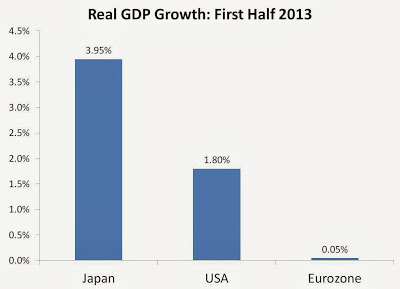
1. The first quasi-natural experiment has been happening over the course of this year. It is based on the observation that monetary policy is being tried to varying degrees among the three largest economies in the world. Specifically, monetary policy in Japan has been more aggressive than in the United States which, in turn, has had more aggressive monetary policy than the Eurozone.

These economies also have short-term interest rates near zero percent. This makes for a great experiment on the efficacy of monetary policy at the ZLB.

So what have these monetary policy differences yielded? The chart at the top answers the question in terms of real GDP growth through the first half of 2013. 

The outcome seems very clear: when really tried, monetary policy can be very effective at the ZLB. Now fiscal policy is at work too, but for this period the main policy change in Japan has been monetary policy. And according to the IMF Fiscal Monitor, the tightening of fiscal policy over 2013 has been sharper in the United States than in the Eurozone. Yichang Wang illustrates this latter point nicely in this figure. So that leaves the variation in real GDP growth being closely tied to the variation in monetary policy. Chalk one up for the efficacy of monetary policy at the ZLB.

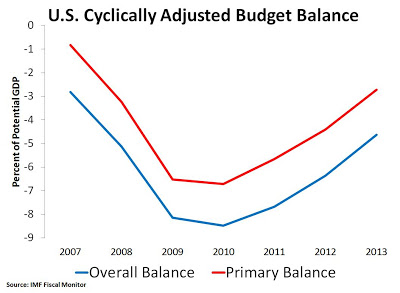
2. The second quasi-natural experiment has been running since 2010 in the United States. Over this period the cyclically-adjusted or structural budget balance as a percent of potential GDP has been shrinking. This is the best measure of the stance of fiscal policy, as noted by Paul Krugman:

[M]easuring austerity is tricky. You can’t just use budget surpluses or deficits, because these are affected by the state of the economy. You can — and I often have — use “cyclically adjusted” budget balances, which are supposed to take account of this effect. This is better; however, these numbers depend on estimates of potential output, which themselves seem to be affected by business cycle developments. So the best measure, arguably, would look directly at policy changes. And it turns out that the IMF Fiscal Monitor provides us with those estimates, as a share of potential GDP… 

Below is the IMF’s measure of both the overall and primary structural budget balance for all levels of government:

So what is the implication of this figure? First, it shows that independent of business cycle influences fiscal policy has been tightening since 2010. It has gone from an overall deficit of 8.5% in 2010 to an expected one of about 4.6% in 2013. Stated differently, the above reduction in the general budget deficit is not the government endogenously adjusting its balance sheet in response to improvements in the private sector’s balance sheet. Rather, it is the consequence of explicit policy choices to sharply tighten fiscal policy. 

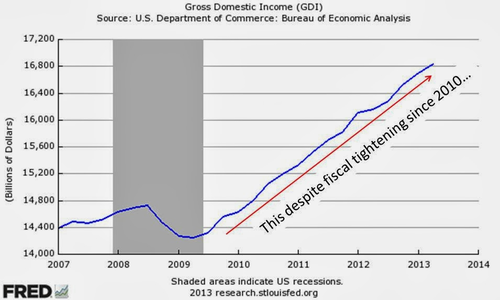
So what have these three years of fiscal policy tightening done to aggregate demand over this time? Apparently nothing as seen in the figure below:

blog.supplysideliberal.com tumblr_inline_mtt4c50QF61r57lmx.png

So what explains this development? How is it that fiscal policy tightening in conjunction with the Eurozone shocks, the China slowdown shocks, and other negative shocks has not slowed down aggregate demand growth? The answer is that Fed policy has effectively offset the effect of the fiscal austerity and the other shocks. This is another great quasi-natural experiment that demonstrates the effectiveness of monetary policy even with interest rates close to zero percent. Chalk another one up for the efficacy of monetary policy at the ZLB.

Of course, this remarkable stabilization of U.S. aggregate demand growth by the Fed has been far from adequate in terms of restoring full employment. It is, therefore, ultimately frustrating to watch. For it speaks to both the power and shortcomings of current Fed policy

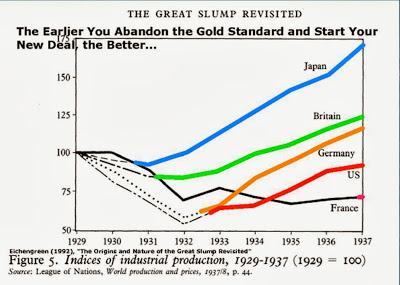
3. While these recent quasi-natural experiments on the efficacy of monetary policy at the ZLB are informative, an even more telling one can be found in the 1930s. This is the quasi-natural experiment of advanced economies going off the gold standard. As is well known, the interwar gold standard was flawed and played a key role in causing the Great Depression in the early 1930s. The countries involved were in a slump and their interest rates were near zero percent. Yet, as Eichengreen (1992) notes, the quicker a country abandoned the gold standard the quicker it experienced a robust recovery.

blog.supplysideliberal.com tumblr_inline_mtt4dwpfbk1r57lmx.png

This cross-country, quasi-natural experiment of the efficacy of monetary policy at the ZLB should give any monetary skeptic pause. Christina Romer notes that in the case of the U.S. economy this recovery was almost entirely the consequence of easing monetary conditions. Fiscal policy played  little role.

These three quasi-natural experiments indicate that there is much monetary policy can do at the ZLB. If so, the key issue is why central banks did not do more over the past three years to shore up the recovery.

Footnote: In more precise terms, the Bank of Japan has signaled more definitely than the Federal Reserve a permanently higher future monetary base level relative to the expected real demand for it. The Fed, in turn, has signaled the same relative to the ECB.

Quartz #33—>Don't Believe Anyone Who Claims to Understand the Economics of Obamacare

Link to the Column on Quartz

Here is the full text of my 33d Quartz column “Don’t believe anyone who claims to understand the economics of Obamacare,“ now brought home to supplysideliberal.com. It was first published on October 3, 2013. Links to all my other columns can be found here.

If you want to mirror the content of this post on another site, that is possible for a limited time if you read the legal notice at this link and include both a link to the original Quartz column and the following copyright notice:

© October 3, 2013: Miles Kimball, as first published on Quartz. Used by permission according to a temporary nonexclusive license expiring June 30, 2015. All rights reserved.

Below, after the text of the column as it appeared in Quartz, I have the original introduction, and some reactions to the column.  


Republican hatred of Obamacare and Democratic support for Obamacare have shut down the US government. Now might be a good time to remind the world just how far the country’s health care sector—with or without Obamacare—is from being the kind of classical free market Adam Smith was describing when he talked about the beneficent “invisible hand” of the free market. There are at least five big departures of our health care system from a classical free market:

1. Health care is complex, and its outcomes often cannot be seen until years later, when many other confounding forces have intervened.  So the assumption that people are typically well informed—or as well informed as their health care providers—is sadly false. (And the difficulties that juries have in understanding medicine create opportunities for lawyers to get large judgments for plaintiffs in malpractice suits.)

2. Even aside from the desire to cure contagious diseases before they spread, people care not only about their own health and the health of their families, but also the health of strangers. On average, it makes people feel worse to see others suffering from sickness than to see others suffering from aspects of poverty unrelated to sickness.

3. “Scope of practice” laws put severe restrictions on what health care workers can do. For example, there are many routine things that nurses could do just as well as a general practitioner, but are not allowed to do because they are not doctors–and the paths to becoming a “medical doctor” are strictly controlled.

4. Those who have insurance pay only a small fraction of the cost of the medical procedures they get, leading them to agree to many expensive medical procedures even in cases where the benefit is likely to be small.

5. In order to spur research into new drugs, the government gives temporary monopolies on the production of life-saving drugs—a.k.a. patents—that push the price of those drugs far above the actual cost of production. 

Sometimes these departures from a classical free market cancel each other out, as when insurance firms shield patients from the official price of a drug and make the cost of that drug to the patient close to the social cost of producing it, or when laws prevent outright quacks from performing brain surgery on an ill-informed patient. But one way or another, there is no obvious “free market” anywhere in sight. That doesn’t mean that the economic reasoning behind the virtues of the free market doesn’t help, it just means that when we think about health care policy, we swim in deep water.

At the level of overall health care systems, one of the most important things we know is that many other countries seem to get reasonably good health care outcomes while spending much less money than we do in the US. There are several factors that might contribute to relatively good health results in other countries:

  • There are large gains in health from making sure that everyone in society gets very basic medical care on a basis more regular than emergency room visits.
  • Most other countries have less of a devotion to fast food—and food from grocery store shelves that is processed to taste as good as possible (in the sense of “can’t eat just one”) without regard to overall actual (as opposed to advertising-driven) health properties.
  • Most other countries are either poor enough, or rely enough on public transportation, that people are forced to walk or ride bicycles significant distances to get to where they need to go every day.

Part of the recipe for spending less in other countries is the fact that they can cheaply copy drugs and medical techniques developed in the US at great expense, But, there are two simple ingredients to the recipe beyond that:

  • Ration procedures that don’t seem very effective (inevitably along with some inappropriate rationing as well)
  • Use the fact that most of the money for health care runs through the government as leverage to push down the pay of doctors and other health care workers.

My main concern about Obamacare is the fear that it will inhibit experimentation with different ways of organizing health care at the state level. So far that is only a fear, but it is something to watch for. But there is one way in which state-level approaches are severely limited: they can’t push down the pay of doctors and other health care workers without causing an exodus of doctors and other health care workers to other states. National health care reform can be more powerful than state-level health care reform if a key aim, stated or not, is to reduce the pay of doctors and other health care workers (and workers in closely connected fields, such as those who work in insurance companies) in order to make medical care cheaper for everyone else. Fewer stars would go into medicine if it paid less—but if most of the benefits from health care are from basic care, that might not show up too much in the overall health statistics. And if less-expensive nurses can do things that expensive doctors are now doing, those who would have been nurses will still do a good job if they end up becoming doctors because the pay is too low for the stars to fill the medical school slots.

Reducing the total amount of money flowing through the health care sector should reduce both the amount of health care and the price of health care. But even in a best-case scenario, in which reasonably judicious approaches to rationing and dramatic advances in persuading people to exercise and eat right kept the overall health statistics looking good, a reduction in the price and quantity of health care could mean a big reduction in income for those working in health care and related fields.

Still, the key wild card in judging Obamacare will be its effect on health care innovation. Subsidies may get people more care now, but crowd out government funding for basic medical research. Efforts to standardize medical care could easily yield big gains at the start as hospitals come up to best practice, yet that standardization could make innovation harder later on. An emphasis on cost-containment could encourage cost-reducing innovations, but discourage the development of new treatments that are very expensive at first, but could become cheaper later on. And Obamacare will tend to substitute the judgments of other types of health care experts in place of the judgments of business people, with unknown effects. Whatever the effects of Obamacare on innovation, we can be confident that over time these effects on innovation will dwarf most of the other effects of Obamacare in importance.

The October 2013 US government shutdown is only the latest of many twists and turns in the bitter struggle over Obamacare. A large share of the partisan energy comes from people who feel certain they know what Obamacare will do. But ideology makes things seem obvious that are not obvious at all. The social science research I have seen on health care regularly turns up surprises. To me, the most surprising thing would be if what Obamacare actually does to health care in America didn’t surprise us many times over, both pleasantly and unpleasantly, at the same time.


Here is my original introduction, which was drastically trimmed down for the version on Quartz: 

Republican hatred of Obamacare, and Democratic support for Obamacare, have shut down the “non-essential” activities of the Federal Government. So, three-and-a-half years since President Obama signed the “Patient Protection and Affordable Care Act” into law, and a year or so since a presidential election in which Obamacare was a major issue, it is a good time to think about Obamacare again.

In my first blog post about health care, back in June 2012, I wrote:

I am slow to post about health care because I don’t know the answers. But then I don’t think anyone knows the answers. There are many excellent ideas for trying to improve health care, but we just don’t know how different changes will work in practice at the level of entire health care systems.  

That remains true, but thanks to the intervening year, I have high hopes that with some effort, we can be, as the saying goes, “confused on a higher level and about more important things.”

One thing that has come home to me in the past year is just how far the US health care sector—with or without Obamacare—is from being the kind of classical free market Adam Smith was describing when he talked about the beneficent “invisible hand” of the free market. 

Reactions: Gerald Seib and David Wessel Included this column in their “What We’re Reading” Feature in the Wall Street Journal. Here is their excellent summary:

The key to the long-run impact of Obamacare will be whether it smothers innovation in health care — both in the way it is organized and in the development of new treatments. And no one today can know whether that’ll happen, says economist Miles Kimball. [Quartz]

(In response, Noah Smith had this to say about me and the Wall Street Journal.) This column was also featured in Walter Russell Mead’s post "How Will We Know If Obamacare Succeeds or Fails.” (Thanks to Robert Graboyes for pointing me to that post.) He writes:

Meanwhile, at Quartz, Miles Kimball has a post entitled “Don’t Believe Anyone Who Claims to Understand the Economics of Obamacare.” The whole post is worth reading, but near the end, he argues that the ACA’s effect on innovation could eventually be the most important thing about it’s long-term legacy…

From our perspective, these are both very good places to start thinking about how to measure Obamacare’s impact. Of course, Tozzi’s metric is easier to quantify than Kimball’s: it will be difficult to judge how the ACA is or isn’t limiting innovation. But that doesn’t mean we shouldn’t try: without innovation, there’s no hope for a sustainable solution to the ongoing crisis of exploding health care costs.

I have also been pleased by some favorable tweets. Here is a sampling:

The Message of Mormonism for Atheists Who Want to Stay Atheists

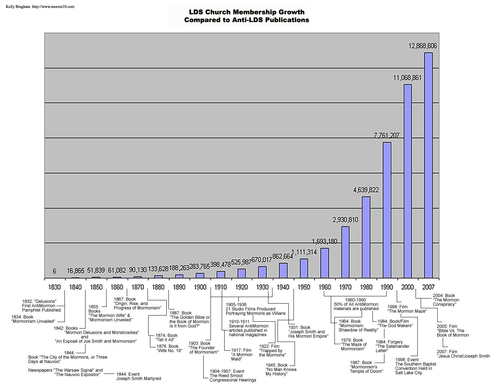
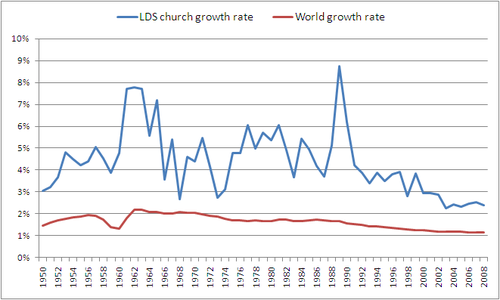
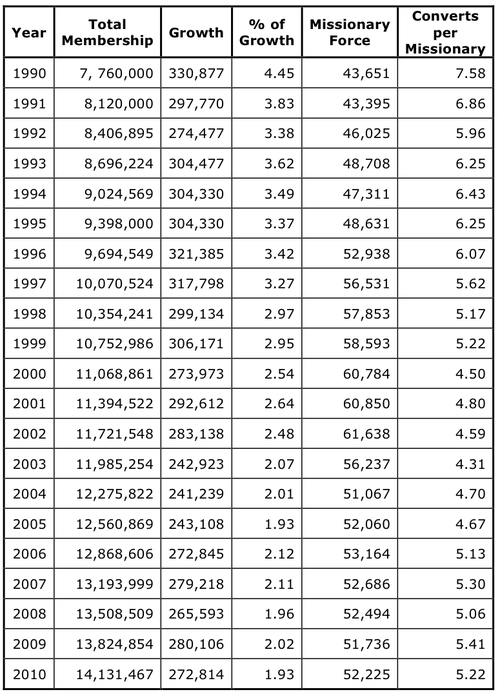
source (via googling “graph of Mormon membership”)

source (via googling “graph of Mormon membership”)

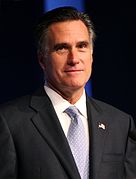
This post is a revised version of a sermon I gave to the Community Unitarian Universalists in Brighton, on May 20, 2012. They had asked me to try to give some insight into Mitt Romney and Mormonism. I thought it would be appropriate to post this near the first anniversary of the 2012 US Presidential election in which Mitt played one of the two starring roles. You can see the video of this talk here. 

Here is the abstract for the sermon: 

Even from the viewpoint of a thoroughgoing atheist or agnostic, Mormonism is a remarkable religion that has many lessons for those who wish to strengthen godless or agnostic religion.  Its survival and growth and the generally high level of commitment of its members are due not only to strengths in its sociological structure and a theology that was fully modern and scientific at the time of its early 19th-century founding, but also to its ability to guide its members towards a distinctive type of mystical spiritual experience.   


Today, by popular demand, I am going to tell you about Mormonism.  My main qualification for telling you about Mormonism is that I was a staunch, active, observant, believing Mormon until I neared my 40th birthday, though I became more and more unorthodox toward the end of that time.  Thus, I was a participant observer of Mormonism for a long time.  Given that personal history, in the course of this sermon, I am sure I will slip into talking about Mormonism using the first person plural “we,” “us” and “our” and into referring to the Mormon Church as simply “The Church.” 

Let me also mention several points of interest. My grandfather, Spencer Woolley Kimball was the 12th President and Prophet of the Mormon Church.  He was a much-loved president and prophet, who extended the Mormon priesthood to blacks and was also president when the efforts of the Mormon Church provided the critical margin to defeat the Equal Rights Amendment.  One of my great-great grandfathers was Heber C. Kimball, Brigham Young’s top counselor in Utah. Another one of my great-great grandfathers (whom I am named after) was Miles Park Romney, whose great grandson Mitt Romney is now almost certain to be the Republican nominee for President of the United States.  Assuming he does, both Intrade and the Iowa Political Stock Market put his chances of becoming President of the United States at 40%.

In relation to Mitt Romney and Mormonism, let me say three things: one about the source of his ambition, one about why so many Mormons are Republicans and one about what we can learn about Mitt Romney from his service as a lay church leader.  As a possible source of Mitt’s ambition to be president, let me say that Mormon men, and to a much lesser extent, Mormon women, are brought up to believe that they can change the world.  When I was only about 8 years old, my mother arranged for me to sing in church a solo that had the refrain “I might be envied by a king, for I am a Mormon boy.”  As teenagers, we were told that we were “a chosen generation, a royal priesthood.” Instead of hiding our lights under a bushel, we were exhorted to be an example to the world, and to prepare the world for the Second Coming of Jesus Christ by preaching “the Gospel”—which meant the Mormon gospel–in all the world.  This was heady stuff. And then there was an unofficial, but intriguing prophecy that the Mormon elders would save the Constitution of the United States at a time when it was hanging by a thread. 

In addition to being taught these things directly, there was another lesson in how much honor was given to Mormons who succeeded in the outside world, whether as a scientist like my great uncle Henry Eyring, as a golfer like Johnny Miller, or as entertainers, like Donny and Marie Osmond.  I now view all of that as a sign of the status anxiety of a despised minority.  Because of its history of polygamy and other weirdnesses, polls put American’s view of Mormonism about on the same footing as their view of Islam.  So we were subtly urged to try to succeed in a big way to make Mormonism look better.  So it would mean a lot to many Mormons to have Mitt Romney become president.  And it would mean a lot to Mitt himself. 

With lessons on Mormon Church history and their interest in genealogy in order to be able to baptize long-dead relatives, Mormons are aware of the history of persecution of Mormonism.  In the 1830’s the Governor of Missouri issued an “Extermination Order” banishing Mormons from the state.  In 1844, Joseph Smith, the founder of Mormonism, was murdered by a mob.  In 1857, the U.S. government sent an army to Utah to fight the Mormons.  In 1890, the U.S. Government forced the Mormon Church to renounce polygamy by threatening to seize all of its property, including the Mormon temples.  And to this day, Mormons deal in a mostly good-natured way with a lot of condescension and some overt hostility toward their religion. 

Of course, it doesn’t always make friends to be claiming to have the “One True Church,” “The Only True and Living Church on the Face of the Earth.”  The Mormon Church is not in communion with any other church.  It does not recognize the baptism or any other rite of another church except for marriage according to the laws of the land, and even there does not recognize gay marriage as religiously valid. 

Now let me tell you the story of why so many Mormons are Republicans.  In the late 19th century, most Mormons were progressives in sympathy with the Democratic party.  In the wake of narrowly averting having the Federal Government seize all the Mormon Church’s assets in 1890, having Utah be a territory made Mormons especially vulnerable to the Federal Government.  So Church leaders were very eager to have Utah become a state, which would provide some protection.  In 1896, Mormon Church leaders made a deal with the Republican party that if the Republican party would support statehood, then the church leaders would throw the church behind the Republican party.  This is how they did it.  Those church leaders who politically happened to be sincere Republicans were told to go out and speak their minds, while those church leaders who happened to be sincere Democrats were muzzled and told not to talk about politics at all.  One Democratic-leaning apostle, Moses Thatcher, was dropped from the Quorum of the Twelve Apostles for refusing to be muzzled according to this plan. Because Mormon Republicanism grew out of the sincere beliefs and theological connections that the Republican half of the church leadership felt during that time when the Democratic half of the church leadership was silenced by church policy as part of the deal to get statehood, Mormon Republicanism has a theologically organic quality to it that wouldn’t have been there if the church had just told everyone directly that they were supposed to vote Republican.  Progressive views might be theologically even more natural, but to most modern Mormons, they don’t seem that way, given the course that history has taken. 

What does Mitt’s church service tell us about his beliefs?  Wikipedia gives a good account of Mitt’s Church service.  Using the metaphor of the Church as a tent with tent stakes, the Mormon Church calls a group of about ten congregations a “stake”—what the Catholic Church would call a diocese.  Mitt served for eight years as the head of the Boston Stake—an unpaid 30-hour a week job in the Mormon Church on top of his job at Bain Capital. I spent seven years in the Boston Stake during college and graduate school, and can tell you that it is one of the most liberal stakes in the Mormon Church.  In Wikipedia’s words, “Romney tried to balance the conservative dogma insisted upon by the church leadership in Utah with the desire of some Massachusetts members to have a more flexible application of doctrine.” As a result, for example, women had a somewhat greater role in the Boston Stake than in other areas in the Mormon Church.  (My older brother served as the bishop over a congregation of older singles not long after Mitt stepped down as the Stake President of the Boston Stake. In accordance with that local Boston Stake culture, he was allowed to deal more flexibly with issues involving gays than would have been possible in most stakes in the Mormon Church.)  Like ministers in other churches, as Stake President, Mitt spent a lot of time counseling people going through troubles of various kinds, including trying to solve problems among poor Southeast Asian converts.  All of this was reflected in the relatively moderate political positions Mitt took in his campaign for Ted Kennedy’s senate seat and in his time as Governor of Massachusetts.  Those who knew Mitt in the Church were not surprised by his positions then. 

How then was Mitt psychologically able to turn around his positions so much in order to have a better chance in the race for the Republican presidential nomination?  Remember that in his role as a Stake President, he needed to follow the directives of higher church leaders, and according to a common version of Mormon doctrine, even try to get himself to believe that what they were directing was for the best. (My father’s first cousin Henry B. Eyring, who is now the First Counselor to the President of the Mormon Church argued this view forcefully in a conversation I had with him a few days before he gave this sermon broadcast to Mormons around the world.) So the traditions of the Mormon hierarchy would have given Mitt practice in doing mental handstands to turn around his beliefs when necessary.  

Enough of politics.  I need a moral to the story.  But before I draw a moral, let me give you three lists: things I carry with me from my Mormon background, things I miss that were there in Mormonism, and reasons why Mormonism is as successful as it is. 

Things I Carry With Me.  One thing I carry with me from my Mormon background is the emphasis on family and avoiding the excesses of workaholism.  Mormon Prophet David O. McKay said it in a somewhat harsh way:  “No other success can compensate for failure in the home.”

Second, I feel bad about idleness.  When I was young, a Mormon hymn had this line, which was later expunged because of its harshness:  “Only he who does something, is worthy to live; the world has no use for the drone.” 

Third, I still don’t drink alcohol, never used tobacco, and even avoid the routine use of caffeinated coffee and other caffeinated beverages. 

Things I Miss.  One thing I miss about Mormonism is personally preaching and teaching religion.  That is one reason I am here today.  Nowadays, I may be one of the few proselyting Unitarian-Universalists.

Second, I miss the tight-knit Mormon congregations where everyone knows everyone else.

Third, I miss the sense of mission and grandeur of purpose in Mormonism.  I am trying to replace that in my life.  Mormonism instilled in me an ambition to change the world for the better that for a long time lacked direction due to my rejection of Mormonism.

source (via googling “graph of Mormon membership”)

source (via googling “graph of Mormon membership”)

What Makes Mormonism as Successful as It Is?  In the year 1830, there were quite a few Unitarians and Universalists but only six Mormons.  Now there are officially 15 million Mormons in the world, about 5 million of whom regularly show up at church, while there are less than one million Unitarian-Universalists, maybe closer to half a million.   The Sociologist Rodney Stark wrote a wonderful book called The Rise of Christianity that explains how the Early Christian church could grow so fast during the first few centuries A.D. by using Mormonism as a model of how fast growth can happen.  Especially at the beginning, when a church starts out small, the key to growth is missionary effort.  The Mormon Church has about 50,000 full-time proselyting missionaries in the field at any one time, who do a lot to generate more than a quarter of a million convert baptisms per year, where being baptized implies joining the Mormon church.  These 50,000 missionaries serve unpaid.  Often their families pay for their living expenses instead of the Mormon Church even providing subsistence. 

source (via googling “graph of Mormon membership”)

source (via googling “graph of Mormon membership”)

How does the Mormon Church motivate this level of effort? To begin with, there is the expectation that all “worthy” young men go on two-year missions at the age of 18 or soon thereafter. (It used to be 19.) Note the gender-bias.  Many young women go on missions, but they are not required to.  Given the full weight of church doctrine behind every young man going on a mission, many young men are motivated by subjective spiritual experiences that convince them that “The Church is true.”  This is called “getting a testimony.”  Social pressure on the young man and social pressure on the parents to encourage the young man provide additional motivation.  But there is yet another motivation.  The young women are urged to have as their aspiration marrying a returned missionary.  And indeed, to the extent that almost every worthy young man goes on a mission, not going on a mission becomes a sign of unworthiness in a variety of ways that genuinely would make someone less desirable as marriage material.  For example, given the rules, premarital sexual activity or use of alcohol can prevent or delay a young Mormon man from going on a mission.

While on a mission, missionaries are urged to work even harder to “get a testimony”—subjective spiritual experiences that will convince them the Mormon Church is true.  In addition, they are motivated to work hard by a system of promotions in rank no doubt devised by one of the many middle-aged businessmen who take three years off from a regular job to serve as a “Mission President”–the head of a group of 150 or so young missionaries in a particular region.  Mormon missionaries always travel in twos, so they can keep each other from getting into trouble–and in other countries to make sure that one of them has been there long enough to be able to speak the language reasonably well.  A missionary starts out as a junior companion.  It is a big day when a missionary finally makes it to being a senior companion.  Later on, the missionary can hope to be promoted to District leader over three to seven other missionaries, to a Zone leader over, say, nineteen, and maybe even to being an assistant to the Mission President.  It is hard to communicate how much we as missionaries cared about those promotions.  And of course, there could be demotions in the form of being exiled to a remote district where it was especially hard to make converts. 

The Mission Presidents, who, as I mentioned, often have business experience, also devise many other motivational strategies akin to those in the world of sales.  The goal and the measure of success is a relatively uncompromising goal: convert baptisms, with the convert understanding as fully as possible what a big commitment it is to join the Mormon Church.  

After a mission, the Mormon man is supposed to get married relatively soon and the couple is supposed to start having kids soon after getting married.  Contraception is OK, but having lots of kids is seen as a good thing.  Elderly Mormons brag about the number of grandchildren and great grandchildren they have.  So the Mormon Church grows faster by encouraging having a lot of kids as well as by encouraging young men to go on proselyting missions.

I left one key element out a minute ago.  Mormons are supposed to get married in a Mormon temple “for time and all eternity” rather than getting married outside a temple “until death do us part.”  Mormon temples are a central part of Mormonism’s strength.  The secret ceremonies in Mormon temples have a certain grand sweep from reminders of the creation of the world to the ultimate destiny of those participating in those ceremonies.  In the temple, Mormons make solemn promises, such as the promise to be willing to devote all of their time and resources to the Mormon Church if called upon and the promise to never have sex except within the bonds of marriage.  Returning to the temple often to participate in ceremonies for dead relatives and other people already dead reminds Mormons of these promises they have made. 

Mormon temples reinforce what I view as key theological strengths of Mormonism.   First is the principle of Eternal Progression.  The fifth President of the Mormon Church, Lorenzo Snow, expressed the doctrine most memorably:

As Man is, God once was; as God is, Man may become. 

This is an absolutely central doctrine in Mormonism. I think the idea of perpetually improving and advancing–with no clear limits on what is possible–is a wonderful doctrine.

A second powerful doctrine is the doctrine that men and women are not created by God, but always existed in some form.  The reason it is important is that it means that–although God will seem all-powerful in practical terms–God is not technically all powerful, and therefore it is more understandable why there is evil in the world when God is good. (This is an argument made by Sterling McMurrin in his classic The Theological Foundations of the Mormon Religion.) 

Finally, Mormon theology draws strength from the fact that it is fully consistent with science as known at the time of its founder Joseph Smith’s death in 1844–including a surprisingly strong element of talking about other inhabited planets beyond the Earth. (This sympathy of Mormonism for the idea of other inhabited planets has made Utah a Mecca for science fiction writers.) I believe that, had he lived, Joseph Smith would have responded to Darwin’s discoveries by incorporating evolution into Mormon doctrine in a central way.  But Joseph Smith’s successors, such as Brigham Young, were not as theologically creative.  So Mormonism has some of the same tensions with evolution that many Christian churches display.  The consistency of Mormon doctrine with at least early 19th Century science does a lot to help keep many highly educated Mormons in the Church.  Another factor that helps keep many highly- educated Mormons from drifting away is the sheer intellectual interest of a complex doctrine, history and set of holy books.  I found Mormon doctrine, history and scripture fascinating for many years.   

Though I didn’t like the hierarchical aspects of Mormonism, the way the central leadership is structured is a sociological strength of the Mormon Church.  Promising local leaders who have done a good job in unpaid leadership roles are promoted to central church leadership.  Of those who become one of 15 apostles (12 in the “Quorum of the 12” and 3 in the “First Presidency”), the longest serving becomes President of the Church.  Church leadership based on seniority—with some collective leadership elements—gives stability and continuity, and the wisdom of age, while the principle of continuing revelation permits any change to be made without loss of institutional legitimacy.  Thus, the Mormon Church is able to be more flexible than the Catholic Church, which–as I understand it–must change by a process of interpretation rather than by any entirely new revelation.

Mormonism inculcates respect for authority.  The church leaders repay that respect by trying to make Church members’ lives better within the limits of the perspective they have.  Mormon church leaders are generally well-behaved in their personal conduct. In running the church, the only time I have seen high Church leaders behave in ways I consider morally objectionable (and this is much more emotional for me than that phrase conveys) has been when they were defending their collective authority and the stories underlying their legitimacy—and the legitimacy of the institution they have charge of.    

The final strength of Mormonism that I want to highlight is its reliance on a lay ministry in relatively small congregations.  Every Mormon who attends church is given a “calling” or an unpaid church job that involves him or her in helping to run the congregation.  One of the biggest issues in the Mormon Church on the ground, on a week-to-week basis, is that the nature of the callings is not equal between men and women. But everyone is given some calling.  And men who have leadership callings are made bishops and stake presidents on top of the regular jobs by which they make a living.  Being involved in this way does a lot to generate commitment and loyalty. (This mechanism for deepening loyalty is especially important among well-educated Mormons.) 

My younger brother’s father-in-law Eugene England was a well-known liberal Mormon writer who felt that the fact that Mormons are assigned to a Mormon congregation based on geography rather than choosing which Mormon congregation to go to does a lot to help make sure that Mormons rub shoulders with Mormons in different social classes. (Here is a link to the essay where he makes that case.) Certainly, for the men who take turns being a bishop in charge of a congregation for a few years, counseling people who are suffering or in trouble is an eye-opener. And in a smaller way each Mormon adult who shows up at Church is assigned with a partner to look after several Mormon families with monthly visits.  

Lessons for Unitarian-Universalism and Other Agnostic Religions.  It is time to draw the moral or lesson of the story, as I see it.  The first lesson I draw is that proselyting works.  I believe we should make more efforts to share Unitarian-Universalism.  We have something good here, and we should give people a chance to look it over.  Let’s spread the word that there is in the world a living, breathing, agnostic religion with full freedom of thought and belief.  Most people don’t know that.  They think that all religions require a specific belief in the supernatural.    

The second lesson is that a religion can be strengthened by involving all its members directly in the work of the religion in one way or another.  Especially at the local level, it can work well to blur the line between what the paid minister does and what the members of the congregation do. 

The third lesson, drawn from the way that Mormon missionaries are motivated, is to always remember the power of nonfinancial motivations for people.  Up to a point, what we honor people for doing, and dishonor them for not doing, gets done. (This is a theme of my posts “Scott Adams’s Finest Hour: How to Tax the Rich,” and “Copyright.”) Of course, there is a tradeoff between accepting people for who they are and disapproving of things that really are bad behavior.  And we need to make sure we are disapproving of genuinely bad behavior rather than just going with our prejudices.

The fourth lesson is the importance of a sense of purpose and the belief that we can make the world a better place. (See my post “So You Want to Save the World.”)

The final lesson is the importance of having powerful theologies of human advancement.  What is a theology? A theology is a story of how the world works, focusing on the very most important questions, plus a vivid picture of a big objective, such as heaven, a loving community, or justice. (See my post “Teleotheism and the Purpose of Life.”)

In some of the Landmark Education personal growth courses I once took, we were asked to speak what they called a “possibility”—an attractive vision of where we wanted things to go.  Mine was “the possibility of all people being joined together in discovery and wonder.”  Others in the course painted other wonderful pictures of possibilities with a short phrase.  Our Unitarian-Universalist congregations are a place where, in addition to taking care of our own souls, we get together to talk about our individual visions of something good for humanity and to organize subgroups to work toward these various goals. (See my post “UU Visions.”)

In choosing our goals and visions for humanity, we sometimes take our clue from politics, but given the state of politics, I hope that we do not always take our clue from existing political ideals.  There is a limit to what tactical politics can achieve.  Sometimes we need to imagine something totally new, beyond preexisting political categories, as I believe the framers of the U.S. constitution did in 1787, and as the Suffragettes at Seneca Falls did in 1848, pushing for women to have the right to vote. 

I believe that religion, and especially free-thinking religion, should play a part in bring forward new visions for the advancement of our Republic and for the advancement of Humanity. 

Note: If you enjoyed this post, you may enjoy some of these in addition to the posts flagged above:

The Myth of 'I'm Bad at Math'

blog.supplysideliberal.com tumblr_inline_mvexa8ZqkX1r57lmx.png

Link to the column on The Atlantic website

This is the Atlantic’s layout for my Quartz column with Noah Smith: “There’s one key difference between kids who excel at math and those who don’t.” This is only the second time I have cracked the Atlantic. (Both Quartz and the Atlantic website are owned by the Atlantic Company, so they freely syndicate to one another, but they are editorially separate.)

Noah and I have been overwhelmed with a flood of positive reactions to this column, which I have not had a chance to process because of my trip to the Federal Reserve Board this week. I am retweeting many of the wonderful responses I have seen on Twitter. One notable tweet is this one by the World Economic Forum (@davos), which is followed by a total of 1,962,107 humans and bots. 

Some of the responses that are the most moving are readers whose faith in their own ability to learn math has gone up.  

Henrik Jensen: Willem and the Negative Nominal Interest Rate

In the early years of the Third Millenium, before becoming Chief Economist of Citigroup, Willem Buiter laid out clearly the various options for eliminating the zero lower bound. Here are his two May 2009 blog posts summarizing his work on eliminating the zero lower bound:

Because of my trip to Copenhagen in September 2013, I discovered that Henrik Jensen of the University of Copenhagen had written a March 7, 2010 response to Willem’s posts in Danish. I begged Henrik to translate his post into English. He kindly agreed. Here it is. 

(Note: You can see what I have written on this topic here.)

Posted in Danish on http://altandetlige.dk/blog/henrikjensen/willem-og-den-negative-nominelle-rente.htm, 9 March, 2010. © 2010, Henrik Jensen. English translation, 17 September, 2013. © 2013, Henrik Jensen, 2013 blog post here.


he challenge: Can the nominal interest rate become negative?

The global economic crisis has made a special discontinuity in traditional economies very topical: The nominal lending rate is limited downwards by zero. This can be a binding constraint for monetary policy, if one wants to stimulate economic activity by lowering interest rates. Recently, Willem Buiter, a Dutch economist known for his forthright and provocative (in the best sense of the word) writings, has questioned whether this restriction should be taken at face value. He has instead advocated that the implementation of negative interest rates need not pose a particular problem in modern economies.  So, the answer to the headline question is “yes”.

In the “old” days (read: between the 1930s and mid-1990s), the zero lower bound on interest rates was a problem that had only academic interest, and which never created real challenges for monetary policy. Inflation was a phenomenon that was of significant importance, whereby the nominal interest rates in most economies were at a level far above zero. Statistically, it was therefore unthinkable that the “zero” could ever be a relevant scenario. The situation in which the nominal interest rate reached zero, was academically known as the “liquidity trap”, in the sense that bonds and money were perfect substitutes, such that an increase in the money supply could not cause the usual reduction in interest rates, with the consequent stimulatory effect on the economy,  as known from the IS/LM model.[1] Instead, cash would just be hoarded (the opportunity cost of holding money, the nominal interest rate, is zero).

This seemingly theoretical curiosity began to gain practical importance and academic attention due to, for example, the economic crisis in Japan during the 1990s when the Japanese short-term policy rate for long periods was around zero. Thereby, the traditional monetary policy response to economic downturns was no longer possible. Simultaneously, inflation became a phenomenon of minor importance in the industrialized world, implying that nominal interest rates adjusted correspondingly downwards. In consequence, economists began to take serious the possibility that the zero lower bound on interest rates could bind. In the new millennium, both the US and the ECB’s monetary policy-interest rates to reach record lows. A new literature arose where the zero interest rate floor was taken seriously, and where different strategies for conducting monetary policy under this restriction and strategies to get away from the restriction were discussed.

Reality then the made the issue very much pressing in the wake of the financial crisis that began in 2007 and struck violently through the end of 2008. Some would argue that monetary policy before the crisis had been too lenient in the United States and therefore directly was a contributing factor to the crisis. It is not my intention to take this interesting discussion here. My starting point will be that the crisis is there: the economy is contracting and inflation is low. Those who believe that monetary policy can and should play a counter-cyclical role in such a situation will without doubt argue that interest rate should be cut.[2] This will also be the recommendation if you let interest rates follow a Taylor-type rule. As is well known, a Taylor rule posits that the interest rate reacts to inflation deviations from its mean (or “target”) and output’s deviations from potential output. Whether it is an expression of optimal monetary policy is debatable, but data is often consistent with Taylor-rule behavior in many countries.

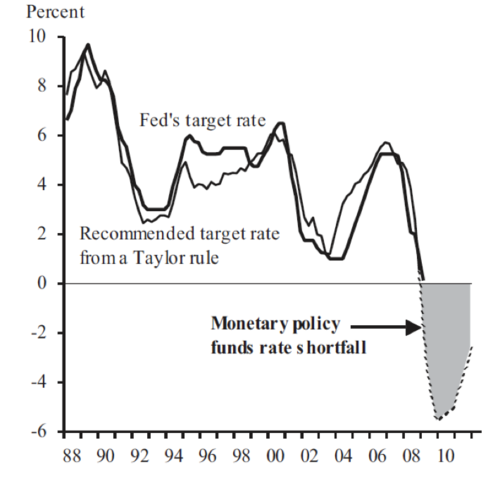
With data from the US, Rudebusch (2009) demonstrates this for the period 1988 to 2012, when data for 2009-2012 is the FOMC forecasts. A Taylor rule (with unemployment as the activity variable) is estimated using historical data, and Figure 1 shows that it explains the historical setting of Federal Funds rate reasonable well.[3] In addition, the figure shows that if the economy is going to experience an increase in unemployment over the next few years (and a slight decline in inflation), then the Federal Reserve should aim for a negative nominal interest rate; and a considerable magnitude. If it had the opportunity to continue the historical pattern of monetary policy, one should set an interest rate below -5 per cent. But since late 2008, zero is the lowest one could go.[4] So, the figure suggests that the zero lower bound is relevant to the US right now and in the near future. Instead of designing new types of monetary policy strategies when the restriction binds, a simple and natural question is therefore whether one can completely remove it, thereby eliminating the asymmetry in monetary policy it entails?

Figure 1: The Fed funds rate in the future if a historical Taylor rule is followed

Source: Rudebusch (2009)

Source: Rudebusch (2009)

Why is it seemingly impossible to have negative interest rates?

Before I discuss Willem Buiter’s solution(s) to how the zero lower bound can be eliminated, it is appropriate to recall briefly why the bound exists. Why does the Federal Reserve not just set the interest rate to -5 per cent, if that’s what is needed to mitigate the unemployment problem? The reason is simple. There is no sane person who will lend to -5 per cent. If they did have the means to invest they would rather leave them as cash under the mattress. There, they after all provide a return of zero per cent.[5]  So even though that there might be infinitely many that would borrow at -5 per cent (you get paid for borrowing, so the path to unbound riches is open), there will not be any lenders. I would think that even the bitterest opponent of assuming economic agents to possess minimal rationality will accept this.

So, the problem is the mere existence of cash. They provide zero percent interest, and thereby they define the lower limit on the nominal interest rate. Cash are anonymous bearer bonds that therefore cannot be taxed in any conventional manner. To eliminate the zero lower bound, Buiter’s proposal is not surprisingly founded in different ways to challenge cash’s zero return.[6] If cash for example decreased in value by 10 per cent, then it’s suddenly not so foolish to lend out to -5 per cent. It is better than choosing the mattress. Infinite wealth accumulation through borrowing is not possible anymore, despite the “subsidization” of borrowing, since borrowers cannot gain from accumulating cash as cash now have even lower negative return than the lending rate.

Willem Buiter and his solution(s)

Who is Willem Buiter?

As indicated in the Introduction, Buiter is known as a sometimes controversial economist who says things very directly. His production is an interesting mix of mainstream state-of-the-art macro theory and intriguing and harsh attacks on different aspects of the same theories. He has besides his academic career served as external member of the Bank of England’s Monetary Policy Committee (one of the few foreigners ever), for the first three years of UK’s then relatively new inflation targeting regime (1997-2000) . The fact that he is a man with own views, was proven clear. During his tenure he set a still unsurpassed record of dissenting in almost half of all committee votes on the interest rate (Gerlach-Kristin, 2003). Interestingly, it was not because he held a systematically more or less “conservative” view on interest-rate determination: he voted for higher and lower interest rates with the same frequency. From 1998, members should in the event of dissent indicate how much their preferred rate differed from the majority’s decision. In all cases, the deviations have been size +/- 0.25 percentage points. Except in one single case where Buiter in March 1999, against the majority, voted for a rate cut of 0.40 percentage points (Gerlach-Kristin, 2009). He is a man with attention to detail.

Because of his, to some, unorthodox writings, he was nicknamed “Maverick”. This moniker he brought with him when he later in his career, at the London School of Economics, started his blog “maverecon”, which ended up becoming published by the Financial Times. The blog unfortunately stopped as of 1/1 2010, when Buiter again left the academic world (hopefully only for a time). This time for a job as chief economist at Citi. Therefore he can not continue as an academic blogger. As he says: “In Maverecon I wrote under the cover of ‘academic immunity’. Academics have no duty other than to state the truth as they see it—to ‘speak truth to power’. This gives them the ability to be undiplomatic, blunt, tactless and outspoken in ways that are unacceptable in the wider world—the world of grown-ups.”

Buiter’s solution(s)

Before leaving academia, he luckily managed to write some interesting blog posts about negative interest rates, and the possibility of achieving them. Buiter (2009a) is the main post, and Buiter (2009b) is his very undiplomatic sequel, which responds to a series of wildly excited reader comments, which the first post raised. As he tactlessly, but very witty, notes: “Because the heat and emotion are based on heart-stopping ignorance and lack of elementary logic, I will have another go at explaining the basics.” But it must be stressed that he is not just firing blanks. As the serious economist he is, the writings are backed by academic articles that ensures that the posts do not amount to just politically or ideologically motivated aphorisms (two of these articles is Buiter, 2007 and 2009c). So even though his blog posts may not appeal to diplomatic, restrained, tactful and introvert adults, try giving the contents a chance for the sake of creative interest.

To the point! As shown in the previous section, the zero lower bound exists due to the existence of non-interest bearing cash. Therefore Buiter’s proposals range from removing them completely from circulation, to tax them in clever ways or to eliminate their economic importance as a unit of account.

Taxing cash is obviously the suggestion that interests Buiter the least. He wrote about it in the context of the Japanese crisis at the turn of the millennium, but the problem is simply that it seems rather impractical. As mentioned, cash is an anonymous bearer bond, so you would have to introduce a form of labeling cash, which can then be used to indicate a decline in value. The basic idea that cash should not be allowed to be accumulated at no cost goes back to Silvio Gesell , who proposed to introduce tokens (“scrips”), which should be stamped to maintain value. When stamping, the authorities can then charge a tax.[7] Alternative, one can also date notes and announce that the new notes are worth less than the old one, or simply introducing an expiry date.[8] If one before expiry does not get stamped the note (and paid taxes), or swapped it to a new (at a cost), it becomes valueless. Buiter argues that such proposals are not operational. Besides the huge administrative hassle, notes have the value that people assign it. So despite the fact that a banknote is officially expired, missing a stamp or similar, some might accept it as payment, if others will, and others will, etc. One can therefore imagine a situation where stamping do not have any real effect on how the public views the means of payment. Then nothing is accomplished, and the authorities would almost have to resort to frisking people in the streets asking: “Do you have an expired note on you? Well, your note is confiscated; here is a new one of less value”. So the risk of being detected must be large enough to make it unattractive to keep expired cash. It will therefore require a great deal of supervision to effectively “de-anonymize” (if there is such a word) an anonymous piece of paper as a banknote. As Buiter presents it, I am indeed convinced that this is not a viable option to break the zero interest rate limitation. Too much administration and costly interference by the public authorities.

The next proposal is much simpler but also (to some) quite drastic: Cash is simply eliminated from the surface of the earth. In modern economies, a larger and larger proportion of all trades are made by electronic means, and since most electronic payment instruments are not anonymous, a negative interest rate on their associated accounts poses no practical problem. The central bank can still manage short-term interest rates through manipulation of base money as base money besides cash also consists of bank reserves in the bank (see Woodford, 2003, whose basic model indeed consider such a “cashless limit”). An expansionary monetary policy in the form of expansion of the reserves will therefore push interest rates down, but in the absence of cash, the interest rate can now without problems be targeted at below zero in situations where this is considered desirable.[9]

A beneficial side effect of the elimination of banknotes and coins is that black economic activity and social services fraud become more difficult. Such activities are based on the existence of cash (cash in circulation is often used as an empirical proxy for “informal” economic activity; Smith, 1987). I have, e.g., never grasped why we need a 1000 kroner note in Denmark (around US $ 175). Or how about a 500 Euro note? I do not know many people who walk around with them in your pockets (my own bank could tell me that they do not take 500 Euro banknotes home as nobody wants them). Nevertheless, in Denmark about 30 billion kroner is in circulation as 1000 kroner notes . Simple arithmetic reveals that 30 million of these notes in circulation amounts to about 6 notes per Dane—from newborn to dying. It seems to me, to be diplomatic, quite suspicious.  Similar conditions apply for the Eurozone, which exhibits an absurd number of 500 Euro notes in circulation—even three times more than the number of 200 Euro notes![10]

Besides that criminals will have a considerably harder time without cash, the central bank will also lose seigniorage from the issue of cash. But since in most developed countries this represents a very small share of the financing of public expenditures, this loss will be correspondingly limited. Finally, there is a problem concerning monitoring again. Cash is useful for performing legal transactions that you would rather not see present on your bank statement. Elimination of cash can therefore be seen as a violation of personal freedom. But in a society that is already geared to electronic transactions, one could issue electronic payment cards that are charged with a give amount (as a phone card) from one’s bank account. When they are emptied after performing legal economic activities and must be “refilled”, then the interest rate—positive or negative—is applied.

Should the total elimination of cash as a way of making negative interest rates feasible appear too offensive, then Buiter has ready a final proposal. One implements a monetary reform, where you introduce cash that can be used as a means of payment (but you make sure that they do not have too high denomination to limit the scope for illegal transactions and fraud). At the same time one introduces a virtual currency, which acts as the economy’s unit of account (the numeraire), and which is used to carry out all electronic transactions. It will thus, and that is the idea, be the relevant unit of account for the majority of economic activity in society. The central issue is that the unit of account is being separated from the value of the cash in circulation. The basic idea originates from the Austrian multi-talent Robert Eisler, who developed it in the 1930s.[11] Buiter became aware of it when he worked on the taxation of cash as an opportunity to break the zero lower bound, and realized that this separation can pave the way for a more convenient way to facilitating the feasibility of negative nominal interest rates.

Let’s look at a situation where reform is implemented in Denmark. With the current monetary policy regime it is obviously not relevant as Denmark approximately copy the ECB’s interest-rate policy for the sake of the fixed exchange rate policy.  And since the Euro interest rates are subject to zero lower bound, the Danish interest rate does not need to be negative. But should, for instance, the Eurozone decide to somehow break the lower bound, and thus from time to time set a negative interest rate,  then Denmark has to be able to do the same if the fixed exchange rate policy must be preserved. In this sense, it is perhaps not entirely far-fetched to describe the reform from a Danish perspective.

All electronic transactions continue to take place in the in kroner, and kroner continue to be the unit of account for prices and wages. Kroner have, however, become virtual, and can no longer be used as a physical means of payment. That is, cash denominated in kroner cease to exist. Unlike the proposal with the total elimination of cash, cash are introduced that are not denominated in kroner, but in something we will call a “Bernstein” (and they are introduced—with all respect—only low denominations n order not to subsidize the black economy too much).[12] This Bernstein has all the usual characteristics of cash. It is a bearer bond that does not carry interest. One can easily imagine that there are bonds issued in Bernsteins, but the interest rate on these will have a zero lower bound, for the same reason as existence of cash denominated in kroner today makes a negative krone interest rate impossible.

The simple trick is that with virtual kroner as a unit of account and the existence of a physical “parallel currency”, Bernsteins, then it is ossible that the krone interest rate can be negative: Monetary policy defines a spot exchange rate, St, between kroner and Bernsteins, which indicates the number of kroner per Bernstein. Next, let Ft,t +1 indicate the forward rate. Absence of arbitrage opportunities between kroner and Bernsteins therefore requires that a Buiter-Eisler version of the covered interest rate parity condition is met:

1 + ikt = (1 + ibt ) ( Ft,t+1 / St )

where ikt is the krone interest rate and ibt is the Bernstein interest rate. It is seen that a negative interest rate on kroner can be achieved when the central bank lets the krone appreciate against the Bernstein (Ft,t+1 / St ) when its interest rate is zero. It this situation it is profitable to lend in kroner at a negative rate. The alternative investment in Bernstein cash in the mattress provides zero interest rate, but it will leave the investor with the same loss as the lending in kroner, since the relative purchasing power of the Bernstein has fallen. The real krone and real Bernstein interest rate will be the same. This can be seen by the fact that a product costs pkt kroner or St * pbt kroner, where pbt is the price of the product in Bernsteins. Use this “purchasing power parity” with the uncovered interest rate parity, where EtSt+1  replaces Ft,t +1, to get

(1 + ikt ) / ( Et pkt+1 / pkt ) = (1 + ibt ) / ( Et pbt+1 / pbt) ;

i.e., identical real interest rates (Et is an expectations operator). One cannot become infinitely rich by borrowing at a negative nominal interest rate either. Placing funds in Bernsteins makes no net gain; see the argument above. Investment in shares or durable goods will yield same negative returns as the lending rate as a result of arbitrage, which implies expected losses on these assets (from presumably higher price levels). But monetary policy has moved the intertemporal price of consumption and investment, so it becomes more attractive to consume and invest now than later. And that’s the whole idea of an expansionary monetary policy.

A negative rate of the krone is therefore feasible, and monetary policy stimulus through a reduction in the nominal interest rate, without worrying about a zero lower bound, becomes a reality.  It will be effective if, and this is an important “if,” most of the economy’s transactions are made in kroner. Buiter (2009c) discusses in detail how the actual choice of the unit of account of important economic transactions is not trivial to manage for authorities. History contains many examples of instances where official unit of account has not been used. For example, the Euro was the official unit of account in all EMU countries from 1999, but before Euro cash was introduced at the beginning of 2002, most transactions were made in the still existing national currencies. He argues that adequate legislation will help ensuring that relevant transactions carried out in the selected unit of account.

Compared with the proposal with total elimination of cash, this proposal is probably more attractive. One maintains cash in circulation, which may be downright practical in some circumstances while also ensuring anonymity in some (hopefully legal) transactions.[13] Also, the central bank will be able to extract some seigniorage. The only losers seem to be actors in the criminal realm of the economy, if one makes sure that the nominal value of Bernsteins is not too large; notes or coins above 50 kroner (around $10) should not be necessary.

So for countries or unions that conduct countercyclical monetary policy, it is hard to see why one should not eliminate the bizarre policy asymmetry that the zero lower bound imposes on central banks and which right now forces central banks around the world to engage in more or less experimental quantitatively oriented policies.

Too modern, old-fashioned or just crazy?

The colleagues I have discussed these ideas with, do not appear particularly enthusiastic. I have often heard the argument that it is would be incomprehensible to the population and “difficult” to implement. Or even that it involves the confiscation of citizens’ wealth (those that are creditors) and therefore may be illegal. I cannot see that it should be incomprehensible or cumbersome. It corresponds to a change in the unit of account and the introduction of a new type of paper currency; reforms of that scale have been implemented many times in history around the world. Yes, it may not be done from one day to the other (Buiter, 2009a, however, believes that it can be done in a weekend). On the other hand, it cannot be any more cumbersome than to phase in a new tax reform. Regarding the confiscation argument, I do not know the legal aspects, but I know that the government every month “confiscates" a significant percentage of my salary. Governments have done that without legal issues all over the world for a very long time (and thanks for that). The fact that monetary policy under the proposed system from time to time may imply a negative nominal interest rate completely pales in comparison.

Note also that it will often be in the business cycle downturns with low inflation, or perhaps deflation, where there may be a need for negative nominal interest rates. Therefore, the real interest rate can be positive, even though the nominal is negative. Even if the real interest rate goes negative as well, it will not be uncommon at all in a historical context. Several times, inflation has exceeded nominal interest rates in Denmark and other countries. If this happens in a situation of negative nominal interest rates, then it is perhaps even a more favorable situation than in the historical instances. I would clearly prefer a real interest rate of -2 per cent as a result of zero inflation and a nominal interest rate of -2 per cent, rather than as a result of an inflation rate of 15 per cent and a nominal interest rate of 13 per cent. (just to emphasize the fact that the zero lower bound is more topical in a low-inflation environment that we fortunately live in nowadays).

Many are probably likely to consider the proposal with considerable skepticism. Several of the responses to Buiter’s (2009a) blog post are in line with the most rude and perfidious comments you can find online, and many seem to suffer from the misconception that it’s all about systematically stealing from citizens. It lead me to wonder if the reluctance could be rooted in a kind of bounded rationality, which also typically causes people to flatly reject a decline in nominal wages even if it is accompanied with a corresponding fall in prices; see, e.g., Fehr and Goette (2005).

In any case, I find Buiter’s proposal interesting. It extends the scope for monetary policy action in the direction where it is most needed. Namely, when one wants to mitigate recessions. And why would anybody write off a greater scope for policymaking, which can be achieved without much cost? This would seem old-fashioned and completely crazy.

References

Bailey, M. J., 1956, The Welfare Costs of Inflationary Finance. Journal of Political Economy 64, 93-110.

Buiter, W. H., 2007, Is Numerairology the Future of Monetary Economics? Unbundling numeraire and medium of exchange through a Virtual Currency and a Shadow Exchange Rate. Open Economies Review 18, 127-156.

Buiter, W. H., 2009a, Negative interest rates: when are they coming to a central bank near you? ft.com/maverecon, 7 May, 2009.

Buiter, W. H., 2009b, The Wonderful World of Negative Nominal Interest Rates, Again. ft.com/maverecon, 19 May, 2009.

Buiter, W. H., 2009c, Negative Nominal Interest Rates: Three Ways to Overcome the Zero Lower Bound. NBER Working Paper No. 15118.

Champ, B., 2008, Stamp Scrip: Money People Paid to Use. Federal Reserve Bank of Cleveland, April 2008.

Fehr, E. and L. Goette, 2005, Robustness and Real Consequences of Nominal Wage Rigidity. Journal of Monetary Economics 52, 779-804.

Friedman, M., 1969, The Optimum Quantity of Money. In “The Optimum Quantity of Money and Other Essays ”. Chicago: Aldine.

Gerlach-Kristen, P., 2003, Insiders and Outsiders at the Bank of England. Central Banking XIV(1), 96-102.

Gerlach-Kristen, P., 2009, Outsiders at the Bank of England’s MPC. Journal of Money, Credit and Banking 41, 1099-1115.

Mankiw, N.G., 2009, Reloading the Weapons of Monetary Policy . gregmankiw.blogspot.com, 19 March, 2009.

Romer, D., 1996/2006, Advanced Macroeconomics (first edition / third edition), Boston: The McGraw- Hill Companies.

Rudebusch, G. E., 2009, The Fed’s Monetary Policy Response to the Current Crisis , Federal Reserve Bank of San Francisco Economic Letter, 2009-17, May.

Smith, J. D., 1987, Measuring the Informal Economy. The Annals of the American Academy of Political and Social Science 493, 83-99.

Woodford, M., 2003, Interest and Prices. Princeton University Press.

[1] At the risk of committing a blunder in terms of history of economic thought, I dare to say that the idea of liquidity trap comes from Keynes. This is at least what David Romer writes in the first edition of its Advanced Macroeconomics (1996), where the subject is relegated to a minor exercise in Chapter 5. This signals in itself that the situation was not considered relevant at that time. In the third edition (2006) of his book, however, Romer devotes a separate section to the zero interest rate bound. (So, ost definitely textbooks are revised in light of changes in society and relevant new insights—contrary to what many critiques of modern macro would assert! But appropriately, changes are implemented through decisions of scientifically qualified individuals, and not because of populist statements from politicians or people just seeking to bash economists.) Anyway, in an IS/LM universe, only fiscal policy can stimulate demand and output in a liquidity trap. This obviously explains the discussion of the need for fiscal easing in the current situation.

[2] From now on, “interest rate" means the central bank’s policy rate.

[3] The interested reader can download the entire data set—including estimation—as an MS Excel spreadsheet by opening the link to the article.

[4] Americans therefore live in a situation where the Friedman (1969) rule for optimal (steady-state) monetary policy applies. As Friedman argued (and before him, Bailey, 1956), it is best if the private opportunity cost of holding money—the nominal interest rate—is equal to the marginal social cost of producing money. Since the latter is approximate zero, the nominal interest rate must also be zero. In a multitude of theoretical models with flexible prices appears this result is unusually robust. Introducing realistic sluggish adjustments in nominal variables, the need for stable prices means that a positive nominal interest rates, ceteris paribus, desirable (if the steady-state real interest rate is positive—a reasonable assumption). Friedman’s insight nevertheless demonstrates that positive nominal interest rates have costs when there is money that does not gives interest. But many will probably, along with Rudebusch, not think that the elimination of the “Friedman cost” can compensate for the loss of output and employment in the current recession.

[5] The real value of cash is of course eroded by inflation, but inflation erodes the value of an investment in, e.g., a bond by the same percentage. So when comparing returns between bonds and money we do not need to consider inflation, and I ignore it for the most part. Moreover, I ignore non-financial costs of holding cash (for example, storage costs and the risk of theft). Introduction of these would reduce the return of cash to below zero, but probably not by much.

[6] It should be said immediately that Buiter stands on the shoulders of his predecessors. All proposals have historical roots, but Buiter’s accomplishment is to bring the ideas forward in a modern form in a situation where innovation is welcome.

[7] See Champ (2008) for a description of Gesell’s proposal (and actual implementations in the beginning of the last century), and for a review of how both Irving Fisher as Keynes found the idea interesting as this—cumbersome—stamping would make people spend money more quickly, which could be beneficial in a recession.

[8] Or consider a stochastic version where a lottery from time to time determines that all banknotes ending on digit n lose their value. This idea is attributed by a student of N. Gregory Mankiw (Mankiw, 2009). Buiter (2009b) mentions that Charles Goodhart has had the idea for years.

[9] Banks can of course still make profits on their interest rate spreads. Whether they offer zero per cent for customers’ deposits and lend to 2 per cent, or offer -5 per cent for deposits and lend to -3 per cent, give the same profits.

[10] Buiter has informally inquired at the ECB why they issue a 500 Euro note, which is after all quite a hefty size. One of the arguments was that house sales in Spain were often made in cash and therefore it would be too difficult to trade if you had to carry a lot of notes of small denomination. Similarly, I know from a reliable source that car trades in Germany often only takes place with cash. So people have to go to the bank, make withdrawals, and nervously carry several thousand Euros in cash on the way to the car dealer. To such arguments, based on such dubious trade patterns, I say just as Buiter (2009b): “Quatsch“.

[11] Eisler’s goal with the idea was monetary stability, since he interpreted the virtual currency (called "money banco”) as being defined in relation to a product bundle. That it can be dangerous to propose controversial economic reforms is well known, but Eisler nearly lost his life by it. Prior to World War II, he proposed that Austria should join the Pound Sterling zone, and was immediately arrested by the Nazis and sent to concentration camp. He survived 15 months of forced labor in Dachau and Buchenwald. He lived in England afterwards.

[12] Here, I follow Buiter (2009c) by naming a parallel currency after a central bank governor. He uses the term “Wim” in honor of the ECB’s first president, Wim Duisenberg.

[13] It would also be preferable for people who seem to weigh a currency as a national symbol very heavily. There could then be a referendum concerning the name of the new currency. Or one could simply keep the krone as the cash currency, and then call the virtual something else; Buiter (2007) has a fun suggestion: “Phlogiston”. If one is afraid that Danish identity is lost by that name, one could call it “The Danish people’s sovereign unit of account in honor of God and Fatherland”. I personally do not care.


Banks Now (2008) and Then (1929)

blog.supplysideliberal.com tumblr_inline_mv5hwnPqRo1r57lmx.png

The Hellhound of Wall Street: How Ferdinand Pecora’s Investigation of the Great Crash Forever Changed American Finance

James Grant’s October 2010 review of Michael Perino’s book The Hellhound of Wall Street is titled “Out for Blood: A Portrait of the prosecutor charged with investigating the 1929 crash.” Trying to distinguish between size of shock and ability to withstand a shock of a given size, James Grant contrasts the stability of banks back then compared to banks now:

For 10 days in March 1933, Pecora’s investigatory target was Charles E. Mitchell, chief executive of National City Bank, later to become Citigroup. “Sunshine Charley,” as Mitchell was mockingly known after his fall from grace, came pre-convicted, but his bank was a pillar of strength. Today, in the wake of the serial bailouts of 2008-09, Mitchell’s managerial achievement seems almost mythical. From the 1929 peak to the 1933 depths, nominal GDP fell by 45.6%—the American economy was virtually sawed in half. By contrast, during our late, Great Recession, nominal GDP dropped by only 3.1%. Yet this comparatively minor perturbation sent Citigroup into the arms of the federal government to the tune of $45 billion in TARP funds and wholesale FDIC guarantees of the bank’s tattered mortgage portfolio.

National City did accept a $50 million federal investment in 1934, after Mitchell resigned. However—and herein lies the difference—the bank’s solvency didn’t hinge on that cash infusion. Many banks did fail in the Depression, of course. But from today’s perspective the wonder is that so many didn’t.

There is a moral to this story. We have better monetary policy now than at the beginning of the Great Depression. And we know enough to know that to save the economy we need to bail banks out, if they would otherwise drag the economy with them. But what we have not yet learned is that to keep banks from needing to be bailed out, the key is to have much higher equity requirements than those contemplated today, even under the heading of financial reform.

Here is how I frame the issue in my column “How to Avoid Another Nasdaq Meltdown: Slow It Down (to Only 20 Times Per Second)”:

In academic finance, concerns about high-frequency trading go under the heading of “market microstructure” issues. There are other bigger problems in finance at the macroeconomic level that I have talked about morethanonce [3 different links]. The best reason to fix unfairness—or even perceived unfairness—in market microstructure is so people aren’t distracted from noticing how those in the financial industry use low levels of equity financing (often misleadingly called capital) to shift risks onto the backs of taxpayers and rewards into their own pockets. In quantum mechanics, electrons can “tunnel” from one side of a barrier to another. Using massive borrowing to ensure later government bailouts, the financial industry has perfected an even more amazing form of tunneling: the art of tunneling money from the government so that the profits appear on their balance sheets and in their pockets long before the money disappears from the US Treasury in bailouts. By comparison with this financial quantum tunneling of money from the US taxpayer that has been a mainstay of the financial industry, high-frequency trading profits of a few billion dollars a year are small change.

And here is the question I posed in my column “Three Big Questions for Larry Summers, Janet Yellen, or Anyone Else Who Wants to Head the Fed”:

What do you think of what Anat Admati and Martin Hellwig have to say about financial regulation in their book The Bankers’ New Clothes: What’s Wrong with Banking and What to Do About ItTheir argument comes down to this: despite all of the efforts of bankers and the rest of the financial industry to obscure the issues, it all comes down to making sure banks are taking risks with their own money—that is, funds provided by stockholders—rather than with taxpayers’ or depositors’ money. For that purpose, there is no good substitute to requiring that a large share of the funds banks and other financial firms work with come from stockholders. (For follow-up questions on financial regulation, Admati and Hellwig have an invaluable cheatsheet.)

That is a question I now pose to all of you. I give my answer here and here.

Ben Bernanke: The Fed Does Less Monetary Stimulus Than It Thinks Is Warranted Because It Is Afraid of the Side Effects of Unconventional Tools

On January 14, 2013, Ben Bernanke came to a Q&A session at the University of Michigan, sponsored by the Ford School of Public Policy. Here is the video and the full transcript can be found here. I thought Ben said some particularly important things about the use of unconventional tools of monetary policy and about financial stability. Let me excerpt four question and answer exchanges. I consider the last of the four the most important.

The Effectiveness of Quantitative Easing

Susan Collins (Dean of the Ford School): …the Fed, of course, has been keeping interest rates at close to zero since roughly 2008. And it’s dug pretty deep into its arsenal and very unconventional policies more recently in terms of, in particular, the very massive asset purchases recently launched its third round which are intended to bring long-term interest rates. Can you tell us how well you think that is working?

Ben Bernanke: So, to go back just one step, as you said, we’ve brought the short-term interest rate down almost to zero. And for many, many years, monetary policy just involved moving the short-term, basically, overnight interest rate up and down and hoping that the rest of the interest rates would move in sympathy. Then we hit a situation in 2008 where we had brought the short-term rate down about as far as it could go, almost entirely to zero. And so, the question is, what more could the Fed do? And there were many people–a decade ago, there were a lot of articles about how the Fed would be out of ammunition if they got the short-term rate down to zero. But a lot of work by academics and others, researchers at the central banks suggested there was more that could be done once you got the short-term rate down to zero. And in particular, what you could do is try to address the longer term interest rate, bring longer term rates down. And there are two basic ways to do that. One way is through talk, communication, sometimes called open mouth operations. [Laughter] The idea being that if you tell the public that you’re going to keep rates low in the long-term, that that will have the effect of pushing down longer term interest rates. But the quest–the one you’re asking about is what we call at the Fed large scale asset purchases or otherwise known as QE. The idea there is that by buying large quantities of longer term treasury securities or mortgage-backed security so that we can drive down interest rates on those key securities. And that, in turn, affects spending investment in the economy. The latest episode, you know, so far, we think we are getting some effect. It’s kind of early. But overall, it’s clear that through the three iterations that you refer to that we have succeeded in bringing longer-term rates down pretty significantly, and a clear evidence of that would be mortgage rates, as you know, a 30-year mortgage rate is something like 3.4 percent now, incredibly low. And that, in turn, makes housing very affordable. And that, in turn, is helping the housing sector recover, creating construction jobs, raising house prices, increasing activity in that sector, real estate activity, and so on. So, I think broadly speaking, that we have found this to be an effective tool. But we’re going to continue to assess how effective, because it’s possible that as you move through time and the situation changes that the impact of these tools could vary. But I think what we have decisively shown is that the short-term interest rate getting down to zero, but economists call it the zero lower bound problem, it does not mean the Fed is out of ammunition. There are still things we can do, things we have done. And I would add that other central banks around the world had done similar things and have also had some success in creating more monetary policy support for the economy….

Inflation and Financial Stability Risks of Fed Stimulus

Susan Collins: And I wonder what you might say to those who argue that … the massive asset purchases have created extremely high risks, perhaps, under appreciated risks for future inflation.

Ben Bernanke: …the Federal Reserve has a dual mandate from the Congress to achieve or at least to try to achieve price stability and maximum employment. Price stability means low inflation. We have basically taken that to be two percent inflation. Inflation has been very low. It’s been below two percent and appears to be on track to stay below two percent. So, our price stability record is very good. Unemployment, though, as we’ve already discussed, is still quite high. It’s been coming down but very slowly. And the cost of that is enormous in terms of lost, you know, lost resources, hardship, talents and skills being wasted. So, our effort to try to create more strength in the economy, to try and put more people back to work, I think that’s an extraordinarily important thing for us to be doing. And I think it motivates and justifies what has been, I agree, an aggressive monetary policy. So, that’s what we’re doing and that’s why we’re doing it. Now, are there downsides? Are there potential costs and risks? There are some. You mentioned inflation. We have, obviously, used very expansionary monetary policy. We’ve increased the monetary base which is demand reserves that banks hold with the Fed. There are some people who, I think, that’s going to be inflationary. Personally, I don’t see much evidence in that. Inflation, as I’ve mentioned has been quite flow. Inflation expectations remain quite well-anchored. Private sector forecasters do not see any inflation coming up. And in particular, we have, I believe, we have all the tools we need to undo our monetary policy stimulus and to just–to take that away before inflation becomes our problem. So, I don’t believe that significant inflation is going to be a result of any of this. That being said, price stability is one part of our tool mandate, and we will be paying very close attention to make sure that inflation stays well contained as it is today. A second issue, I think, probably worth mentioning is financial stability. This is a difficult issue. The concern is–has been raised at–by keeping interest rates very low, that we induce–the Federal Reserve induces people to take greater risks in their financial investments, and that, in turn, could lead to instability later on, again, a difficult question. In fact, I could take the rest of the hour talking about this, so I don’t think I’ll do that. But what I will say is that we are, first of all, very engaged in monitoring the economy, the financial system. The Fed has increased enormously the amount of resources we put into monitoring financial conditions and trying to understand what’s happening in different sectors of the financial markets. We’ve also, of course, been part of the very extended effort to strengthen our financial system by increasing capital in banks, by making derivatives and transactions more transparent, by stiffening supervision, and so on. So, we are taking measures to try both to prevent financial instability and to identify potential risks that we would then address through regulatory or supervisory methods. So, we’re very much attuned those–to these issues. But once again, I think this is something that we need to pay careful attention to. And as I–as we discussed in our statement and have for a while, as we evaluate these policies, we’re going to be looking at the benefits which, I believe, involve some help to economic growth to reduction in unemployment. But we’re also going to be looking at cost and risk. We have a cost benefit type of approach here. We want to make sure that the actions we’re taking are fully justified in a cost benefit type of framework. …interest rates will eventually rise. We hope they rise, because that means the economy will be strengthening. So, you know, we’re not going to playing games with that. We are going to follow our mandate, which means do what’s necessary to help the economy be strong. … Indeed, I think the worst thing we could do would be if we raise interest rates prematurely and caused recession, that would greatly increase budget deficits.

Monetary vs. Regulatory Approaches to Financial Stability

Audience Question: Do you believe that the Fed should actively prevent future asset bubbles and if so what tools do you have to do that?

Ben Bernanke: Well, asset bubbles have been–they’re very, very difficult to anticipate, obviously. But we can do some things. First of all, we can try to strengthen our financial system, say, by increase–as I mentioned earlier, by increasing the amount of capital liquidity the banks hold, by improving the supervision of those banks, by making sure that every important financial institution is supervised by somebody. There were some very important ones during the crisis that essentially had no effective supervision. So you make the system stronger that if a bubble or some other financial problem emerges, the system will be better able to be more resilient, will be better able to survive the problem. Now, you can try to identify bubbles and I think there has been a lot of research on that, a lot of thinking about that. We have created a council called the Financial Stability Oversight Council, the FSOC, which is made up of 10 regulators and chaired by the Secretary of the Treasury. One of whose responsibilities is to monitor the financial system as the Fed also does and try to identify problems that emerge. So, you’re not going to identify every possible problem for sure but you can do your best and you can try to make sure that the system is strong. And when you identify problems, you can use–I think the first line of defense needs to be regulatory and supervisory authorities that not only the Fed but other organizations like the OCC and the FDIC and so on have as well. So you can address these problems using regulatory and supervisory authorities. Now having said all that, as I was saying earlier, there’s a lot of disagreement about what role monetary policy plays in creating asset bubbles. It is not a settled issue. There are some people who think that it’s an important source of asset bubbles, others would think, it’s not. Our attitude is, that we need to be open-minded about it and to pay close attention to what’s happening and to the extent that we can identify problems. You know, we need to address that. The Federal Reserve was created in about 100 years ago now, 1930 was the law, not to do monetary policy but rather to address financial panics. And that’s what we did, of course, in 2008 and 2009. And it’s a difficult task but I think going forward, the Fed needs to think about financial stability and monetary economics stability as being, in some sense, the two key pillars of what the Central Bank tries to do. And so we will, obviously, be working very hard in financial stability. We’ll be using our regulatory and supervisory powers. We’ll try to strengthen the financial system. And if necessary, we will adjust monetary policy as well but I don’t think that’s the first line of defense.

Costs and Benefits of Unconventional Tools of Monetary Policy

Question Tweeted In: This question comes from Twitter. Since the Fed declared it was targeting a two percent inflation rate in January of 2012, the FOMC has released its projections five times. And each one of these projections, the inflation rate has come in below this target. Why then has the policy been set to concessively undershoot the target?

Ben Bernanke: Was that 140 characters? [ Laughter ] I suspect many in our audience had related questions. [Laughter] Yeah. That’s a very good–it’s a very good question and let me try to address. As I said earlier when Dean Collins was asking me about the risks of some of our policies, I was pointing out that inflation is very low. Indeed, it’s below the two percent target and unemployment is above where it should be and therefore, there seems to be a pretty strong presumption that we should be aggressive in monetary policy. So, you know, I think that that does make the case for being aggressive which we are trying to do. Now, the additional point that I made, though, was that, you know, the short-term interest rate is close to zero and therefore we are now in the world of non-standard monetary policy [inaudible] asset purchases and communications and so on. And as we were discussing earlier, we have to pay very close attention to the costs and the risks and the efficacy of these non-standard policies as well as the potential economic benefits. And to the extent that there are costs or risks associated with non-standard policies which do not appear or at least not to the same degree for standard policies then you would, you know, economics tells you when something is more costly, you do a little bit less of it. We are being quite accommodative. We are working very hard to try to strengthen the economy. Inflation is very close to the target. It’s not radically far from the target. But in trying to think about what the right policy is, we have to think not only about the macroeconomic outlook which is obviously very critical, but also the costs and risks associated with the individual policies that we might apply.

The Costs and Benefits of Repealing the Zero Lower Bound...and Then Lowering the Long-Run Inflation Target

blog.supplysideliberal.com tumblr_inline_mvdxdbCZir1r57lmx.png

Here is a link to my second Pieria exclusive: “The Costs and Benefits of Repealing the Zero Lower Bound …and Then Lowering the Long-Run Inflation Target.”

The tag line at the bottom of Pieria’s cover page is from the post itself:

Repealing the zero lower bound has some costs, but those costs should be weighted against the benefits: not only ending recessions, but also ending inflation. 

Those words refer to my first column on electronic money: “How Subordinating Paper Currency to Electronic Money Can End Recessions and End Inflation.”

John Stuart Mill Prefers Preferences for Almost Anything But Indolence

John Stuart Mill makes an eloquent argument for freedom of desire in On Liberty, chapter III, “Of Individuality, as One of the Elements of Well-Being,” paragraph 5:

To a certain extent it is admitted, that our understanding should be our own: but there is not the same willingness to admit that our desires and impulses should be our own likewise; or that to possess impulses of our own, and of any strength, is anything but a peril and a snare. Yet desires and impulses are as much a part of a perfect human being, as beliefs and restraints: and strong impulses are only perilous when not properly balanced; when one set of aims and inclinations is developed into strength, while others, which ought to co-exist with them, remain weak and inactive. It is not because men’s desires are strong that they act ill; it is because their consciences are weak. There is no natural connexion between strong impulses and a weak conscience. The natural connexion is the other way. To say that one person’s desires and feelings are stronger and more various than those of another, is merely to say that he has more of the raw material of human nature, and is therefore capable, perhaps of more evil, but certainly of more good. Strong impulses are but another name for energy. Energy may be turned to bad uses; but more good may always be made of an energetic nature, than of an indolent and impassive one. Those who have most natural feeling, are always those whose cultivated feelings may be made the strongest. The same strong susceptibilities which make the personal impulses vivid and powerful, are also the source from whence are generated the most passionate love of virtue, and the sternest self-control. It is through the cultivation of these, that society both does its duty and protects its interests: not by rejecting the stuff of which heroes are made, because it knows not how to make them. A person whose desires and impulses are his own—are the expression of his own nature, as it has been developed and modified by his own culture—is said to have a character. One whose desires and impulses are not his own, has no character, no more than a steam-engine has a character. If, in addition to being his own, his impulses are strong, and are under the government of a strong will, he has an energetic character. Whoever thinks that individuality of desires and impulses should not be encouraged to unfold itself, must maintain that society has no need of strong natures—is not the better for containing many persons who have much character—and that a high general average of energy is not desirable.

Unfortunately, John Stuart Mill undercuts his argument for freedom of desire by implicitly attacking the desire for indolence and passivity. In modern American culture as well, two of the desires we are the most ready to denigrate is the desire to watch TV (which in recent years has been the medium for some of our greatest works of art) and for sleep–which can be one of the most beautiful forms of indolence and passivity. (I found it entertaining to see the varied google search results for the phrase “I’ll sleep when I’m dead.”

I often fail in my resolutions. But I value happiness enough that ever since my psychologist colleague Norbert Schwarz impressed upon me the high marginal product sleep has in producing happiness, I have made an effort to get more sleep. I have not regretted those efforts. And my wife Gail and I just finished a “Prison Break” marathon. 

Pieria #1—>Going Off the Paper Standard

Here is the full text of my 1st Pieria exclusive “Going Off the Paper Standard,“ now brought home to supplysideliberal.com. It was first published on October 9, 2013.

If you want to mirror the content of this post on another site, that is possible for a limited time if you read the legal notice at this link and include both a link to the original Pieria exclusive and the following copyright notice:

© October 9, 2013: Miles Kimball, as first published on Pieria. Used by permission according to a temporary nonexclusive license expiring June 30, 2015. All rights reserved.

This post is in part a response to Izabella Kaminska’s Alphaville post "Gold, paper, scissors, lizard, e-money.” I was delighted to see her reaction to this post in a tweet saying

Going off the paper standard - by @mileskimball http://www.pieria.co.uk/articles/going_off_the_paper_standard … Well argued response to queries I posed.


For almost a year now I have been advocating the use of negative interest rates for brief periods of time to cut recessions short without:

  • adding to the national debt,
  • maintaining zero interest rates for years on end and making quasi-promises to keep them zero for years more to come,
  • large-scale purchases of long-term assets by the central bank that squeeze financial market spreads in ways that could have unpredictable side effects, or
  • having a positive inflation target in good times to give running room for monetary policy in bad times. 

My most direct attempt to make the case for including negative interest rates in the monetary policy toolkit is my Quartz column “America’s Big Monetary Policy Mistake: How Negative Interest Rates Could Have Stopped the Great Recession in Its Tracks.” I wrote that column in recognition of the political challenge of persuading people of the benefits of brief periods of negative interest rates during serious recessions. 

In addition to the political challenge of persuading people of the benefits of brief periods of negative interest rates as an alternative to long slumps, the additions fiscal stimulus makes to national debt, QE, or unending inflation intentionally engineered by the central bank, there are technical challenges in making negative interest rates deeper than a few score basis points possible. I have been on a tour of central banks and their affiliates around the world—the Bank of England, the Bank of Japan, Denmark’s National Bank, and the Bank of France already, and head to the Fed on November 1, 2013—to explain how to deal with this technical challenge. 

In all of these interactions with central bank economists and policy-makers, there has been no serious dispute about the technical feasibility of eliminating what economists call the “zero lower bound on nominal interest rates.” 

The two key measures for eliminating the zero lower bound and making sharply negative interest rates possible are:

  1. establishing electronic money—the e-dollar, e-euro, e-yen, e-pound, or the like—as the unit of account, and
  2. levying a time-varying fee—expressed as a given percentage of the amount of paper currency deposited—when commercial banks or other financial institutions deposit paper currency with the central bank in exchange for electronic reserves.

Because the paper currency deposit fee that commercial banks face changes over time, it can make the effective rate of return on paper currency negative when expressed in terms of electronic money. And this negative rate of return on paper currency is achieved without any need to keep track of when the paper currency was withdrawn. A longer interval between withdrawal and deposit of the paper currency occasions a bigger change in the deposit fee over that interval, and that is enough.

As long as paper currency earns a rate of return lower than the central banks target interest rate, the only forces that will limit how low the central bank can push interest rates are forces that are part and parcel of the recovery of the economy from a recession. Interest rates will only be able to go a few hundred basis points at most into negative territory before businesses ramp up their building of factories, buying of machines, and development of new products, households ramp up their purchases of cars, other consumer durables and houses, and financial investors send money to seek higher returns abroad, generating capital outflows—which, by a central identity of international finance, will increase net exports. All of these effects of lower interest rates are entirely standard and well understood from hundreds of instances in which central banks have lowered interest rates in situations where they had high enough inflation that the zero lower bound did not bind.  

It might seem that the time-varying fee on the deposit of paper currency with the central bank would disadvantage paper currency playing field between paper currency and electronic money. It is straightforward to implement negative interest rates on electronic accounts as a “carry charge.” It takes a little more engineering to yield the equivalent of a negative interest rate on paper currency. Engineering that effective negative interest rate with a paper currency deposit fee that gradually increases over the course of a few quarters does not necessarily make paper currency unattractive in an environment where all other interest rates are also negative. The negative interest rate on paper currency simply makes it so that there is no place to hide from negative interest rates except through activities that stimulate the economy by raising productive investment, raising consumption or raising net exports. (Of all such activities, increased mining of gold in those countries that have viable gold deposits may be one of the least attractive from a policy point of view, but increased mining of gold would also stimulate the economy.)

The Path to Electronic Money as a Monetary System

A month ago, in my blog post “The Path to Electronic Money as a Monetary System,” I laid out in some detail how a transition to an electronic money system with a time-varying paper-currency deposit fee could work in practice. Trying to make each step as clear as possible, I ended up with 18 steps, all of which I consider advisable, but not all of which are absolutely necessary in order to eliminate the zero lower bound. Here is the short version of those 18 steps:

  1. Announce that eliminating the zero lower bound is possible from a technical point of view.
  2. Strengthen macro-prudential regulation by raising equity requirements(a.k.a. “capital requirements”) as far as possible, in order to minimize any financial stability issues arising from negative interest rates. Given the recent history of financial stability, this is, of course, a valuable step in its own right, quite apart from its role in enabling safe use of negative interest rates.
  3. Ask banks and other financial firms to prepare contingency plans for negative interest rates.
  4. Develop accounting standards for negative interest rates that take electronic money as the unit of account, and give to paper money the value it is worth in the market relative to electronic money.
  5. Ask government agencies to prepare contingency plans for negative interest rates and non-par   valuation of paper money. 
  6. Make it clear that no one has the right to pay off large debts to the government in paper currency in contexts where transactions are now routinely conducted with bank money. 
  7. Establish by law that debtors do not have the right to pay off large debts with paper currency at par when the market value of paper currency is below par. 
  8. Formally make money in government insured bank accounts legal tender.
  9. Announce the intent to introduce an electronic money system.
  10. Lower the central bank’s interest rate on reserves to zero or slightly below zero.
  11. Lower the central bank’s target interest rate, interest rate on reserves, and the central bank’s lending rate substantially below zero.
  12. If there is any sign of large increases in paper currency withdrawal, institute a time-varying deposit charge when banks deposit paper currency with the central bank in exchange for reserves. Since the deposit charge starts at zero, and only needs to increase by a few percent per year at most, there will be plenty of time for people to get used to the deposit charge as it grows. The deposit charge only grows when negative interest rates are needed. When interest rates are positive, the deposit charge will be allowed to gradually shrink until it reaches zero again.
  13. Discount vault cash applied to reserve requirements according to the market value of paper currency.
  14. Implement the accounting standards appropriate for negative interest rates and paper currency at non-par valuations.
  15. Require payment of taxes and other substantial debts to the government in electronic form. 
  16. Implement the contingency plans for government agencies.
  17. Ask all firms to post prices in terms of electronic money. (This could be in addition to prices posted in paper currency terms if firms want to post prices in both.)
  18. Make it clear that firms are allowed to specify in contracts (including loan contracts) and in retail sale the terms under which they will accept paper currency. 

A response to FT Alphaville 

In what represents an important step forward for this proposal, Izabella Kaminska gave detailed, largely favorable, reactions in her Alphaville post “Gold, paper, scissors, lizard, e-money.”

I will let you see for yourself the many positive reactions Izabella expresses, and her excellent descriptions of what I am proposing. Let me limit myself here to responding to the points at which Izabella questions the approach I am recommending. I have her words in bold, my answers in regular type:

  • We’re not sure why he hasn’t considered the simpler option of abolishing paper currency altogether…. While it’s incorrect to assume that everyone in the economy has access to a digital platform that has the capability to store official e-money (whether a mobile phone or simply a digital account), we do have the means to issue digital wallets cheaply and efficiently to the entire population…. Technological solutions on this front abound.Because there is a strong demand by some for privacy in transactions, I do not consider it feasible to altogether abolish paper currency. At some point people would begin using foreign paper money, or some form of commodity money (such as the cigarettes that prisoners often use as currency). In my view, if people are going to use some form of paper currency or commodity money, for the sake of monetary policy it is better not to drive paper currency usage (with foreign currency) underground. In this context, note that negative interest rates alone would not necessarily drive people to use foreign paper currency, since foreign bank accounts would provide at least as high a rate of return as foreign paper currency (unless a foreign government was crashing head-on into the zero lower bound, with a lower target rate than their paper currency interest rate). It may be possible to develop digital currencies that allow full privacy of transactions, but on crime-control grounds, the government is likely to prefer paper currency to allowing fully private digital transactions. 
  • Or, alternatively, the substitution of current banknotes with some form of depreciating note technology. The trouble here is that any note technically sophisticated enough to have a value that changes over time would make it technically easy to compromise privacy, and so might as well be considered just one more type of electronic account. Also note that—other than its different privacy properties—the ordinary low-tech paper currency in my proposal, combined with a simple smartphone app that applies the appropriate exchange rate on a given day, is the functional equivalent a depreciating note technology. 
  • This strikes us as a tricky recommendation: a negative-rates-on-reserves policy would create a liquidity absorption effect and thus be equal to a tightening path. Unless, of course, the idea is to stimulate the economy through increased velocity of money alone…. The key problem with a negative rate regime, after all, is that while it encourages the circulation and velocity of money, it also contracts the money supply. In order to work, the velocity improvement must be substantial enough to diminish the risk associated with new loans — in that way compensating for the money supply contraction. There is no need to rely on increased velocity of money and the multiplication of money by banks alone. There is no limit on the central bank’s ability to create high-powered money. And the overall money supply is bounded below by the amount of high-powered money. In the absence of a zero lower bound, it is easy for the central bank to increase the money supply as necessary to achieve a given target interest rate. 
  • The bigger risk, we’d argue, is that the economy, rather than accepting negative rates, would flee to an alternative digital currency like Bitcoin. But, as Kimball himself notes, this shouldn’t be a problem providing that the payment of government debts and taxes is legally required to be in official e-money. The future of private currencies, such as Bitcoin is unclear. It is especially unclear whether they can survive active government hostility. As it is, the government takedown of Silk Road has seriously hurt Bitcoin. But more fundamentally, JP Koning points out that no private firm would have an unlimited willingness to provide a safe zero interest rate if all other safe interest rates were negative. Doing so would be a good way to lose a lot of money. Stylized economic theory would predict that any asset in limited supply, including private digital currencies, should increase in value when interest rates go negative, and then face an expected capital loss from that high price that would generate a negative interest rate. This is the more clear since the negative interest rates that would raise the price of assets in limited supply would be temporary. 
  • The implementation of digital e-money is in many ways the equivalent of a central bank announcing that it is taking money creation power away from banks. In that sense it not only sees the central bank increasingly compete with banks, becoming a universal banker in its own right, it begins to challenge their raison d’etre. This is a possible policy direction, but it is far from inevitable. Given control of the paper currency interest rate, as well as the target rate, interest on reserves, and central bank lending rate, the central bank can lower all short-term rates in tandem, so that the spreads that banks and other financial firms live on remain well within their historical norm. To discuss this, let me leaving aside for a moment the international capital flows that would occur if some countries have electronic money while others have kept their zero lower bound. If people are earning -3% per year on paper currency, customers would be willing to hold money in bank deposits earning -2%, and banks could make profits from ordinary risky lending at small positive interest rates. As far as the international capital flows go, by the time they jeopardized commercial bank deposits they would have long since caused a dramatic increase in net exports that would generate a strong economic stimulus. And when all major countries have abolished the zero lower bound, international monetary policy reaction functions are likely to be similar to what we have seen in the past when interest rates were too high for countries to be up against the zero lower bound. 
  • The happy medium might consequently be introducing official e-money at a zero rate, whilst having the central bank/government influence economic activity via a combination of negative interest rates and real money printing (rather than against asset purchases). I don’t understand this comment. If the government directly offers accounts that pay a zero interest rate for any size of account, that zero interest rate in accounts with the government creates a zero lower bound just as surely as paper currency does now. Indeed, zero-interest government accounts would create a tighter zero lower bound because there would be no storage costs for money in the government accounts. If there are significant fees for the government accounts that go up proportionately to account size, those fees are effectively negative interest rates. So I don’t understand how the government manages negative rates while official e-money has a zero rate.

In case I misunderstood one of Izabella’s concerns or missed something entirely, let me make the general point that there are a variety of different approaches that can eliminate the zero lower bound. The two big engineering issues for monetary policy are (a) eliminating the zero lower bound and (b) putting financial stability on such a solid foundation with high equity requirements that central banks need not worry about the effects of interest rate policy on financial stability. Anything that can achieve those two objectives is likely to be a big improvement over current policy.

Among approaches that achieve those objectives, the main way that I would sort through them is to favor approaches that have a greater chance of adoption. Given what little I know or suspect about the politics of electronic money at this point, that makes me lean toward approaches that are as close to the current monetary system as possible, in which as many as possible of the changes that are necessary to make substantially negative interest rates possible can be carried out in a way that would seem technical and even boring to those of the general public who do not work in the financial sector. 

The exchange rate between electronic money and paper currency would be salient to the general public, but I have argued  that this would be politically tolerable because banks would begin offering paper currency at a discount for a substantial period of time before the deposit charge hit the level of 3% or so that would induce retail shops to have a paper currency price higher than the electronic money price. The negative interest rates themselves will always be salient, and the case for them must be made forthrightly. But the technical measures needed to make negative interest rates possible can, I believe, be sold as part of the transition to a modern, electronic money system, if the negative interest rates themselves can be sold politically.  

Andrew Carnegie on Cost-Cutting

Link to a New York Times review of American Colossus by reviewer John Steele Gordon

In his book American Colossus: The Triumph of Capitalism 1865-1900, H. W. Brands writes this, quoting from his earlier book Masters of Enterprise: Giants of American Business from John Jacob Astor and J.P. Morgan to Bill Gates and Oprah Winfrey(p. 59) and from Joseph Frazier Wall's Andrew Carnegie(p. 337):

Carnegie obsessed over cost because it was the one part of his business he could control. “Carnegie never wanted to know the profits,” an associate said. “He always wanted to know the cost.” Carnegie himself explained: “Show me your cost sheets. It is more interesting to know how well and how cheaply you have done this thing than how much money you have made, because the one is a temporary result, due possibly to special conditions of trade, but the other means a permanency that will go on with the works as long as they last.” (p. 93)

Twitter Melee Over Negative Interest Rates

This spirited Twitter discussion of negative interest rates serves as a useful compendium of issues that I need to address as I have time. 

Let me point out one big victory in this discussion that you might not otherwise notice: every one of the participants in this discussion takes for granted that the zero lower bound is a policy choice–not a law of nature, and discusses it seriously as a policy choice.