Why I Write

Link to the essay on Pieria–which has an ever-expanding list of links essays by other economics bloggers in the “Why I Write” series

On his Pieria website, Tomas Hirst has put together a series in which each Pieria experts answers the question “Why Do You Write?” Here is Tomas’s introduction:

In this series we aim to shed light on the motivations, inspirations and writing processes of some of the leading financial bloggers. Here, Miles Kimball, Professor of Economics and Survey Research at the University of Michigan and author of Confessions of a Supply-Side Liberal, explains why he writes.

Tomas did a masterful job of posing questions and editing the email responses I sent him into this essay, which first appeared on Pieria on July 17, 2013.


“A year ago, I started a blog, “Confessions of a Supply-Side Liberal” out of a mixture of raw ambition, desire for self-expression, duty, and hope. Sometimes duty keeps me up late at night, but it is raw ambition that makes me wake up too early in the morning so that I slip further and further behind in my sleep.”

The quote above come from my post “So You Want to Save the World”, which is about ethics for bloggers, as are my series of John Stuart Mill quotations (easy to find in my Religion, Humanities and Science sub-blog) focusing on taking alternative views seriously (even if they are very wrong – for reasons JS Mill lays out carefully – and even more if they just might be right). Some of the more recent John Stuart Mill quotations also express why I think blogs are so important in the media landscape. 

Blogs (and Twitter) allow real discussion and debate about alternative views for the following reasons: 

  1. Blogs are one place that progressives and conservatives actually interact and wrestle with each other’s arguments.
  2. Blogs and Twitter and comments point out alternative perspectives one wouldn’t have thought of.
  3. The back-and-forth on blogs, Twitter and comments helps one clarify one’s own thinking.

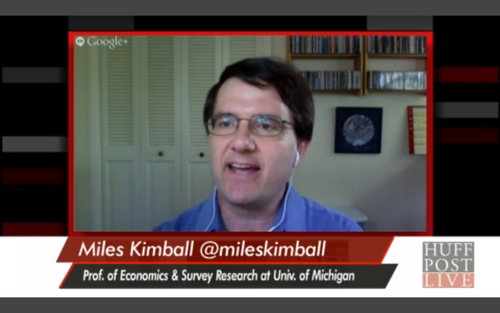
Finally, in the HuffPost Live segment that I did with Umair Haque and others I give a view of blogs as the place people can really get the real deal that is not dumbed down.  One thing I mention is that breaking things down into the blog format of relatively short posts can give much more impact to an argument and make it much more understandable than if one expected someone to have the patience to sit down and read something very long and understand it. Even if I do some posts that are long, they alternate with shorter ones on the same topics.

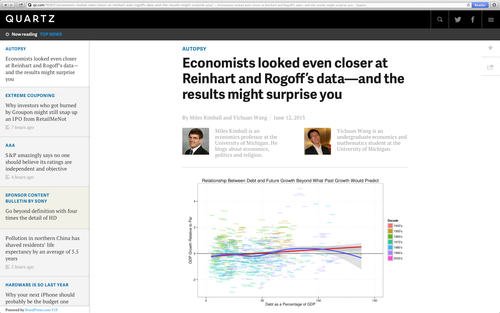
One thing that may be a serious mistake is that I find myself wanting to resist anything like Krugman’s labeling the level of wonkishness on his posts. It is unrealistic, perhaps, but I hope people try the harder posts without expecting too much of themselves, and then get something from those posts even if they don’t fully understand them. Some of what is behind my attitude on this can be seen in today’s post on Deliberate Practice. Without trying to understand things that are a bit hard, how can people get smarter? If I have a range of different difficulties for posts, hopefully people can read both the ones that are easy for them and the ones that are a bit difficult, and let themselves off the hook for the ones that are over-the-top difficult. I am glad for the discipline of writing some of my pieces for a more general audience in Quartz. Although those columns are toned down relative to some of the posts on my blog, I am proud that they push the boundaries on difficulty level in pieces intended for a popular audience. I hope that even people who did not understand everything in the two columns I wrote with Yichuan Wang on what we found in the Reinhart and Rogoff dataset got a sense for what it means to be careful in analyzing data.

“I think I have a niche of daring to do relatively difficult posts. In addition to hoping that people will stretch, that accords with this strategy” - (from A Year in the Life of a Supply-Side Liberal)

My primary strategy for making the world a better place is not to influence politics in the short run, but to make my case on the merits for each issue to the cohort of young economists who will collectively have such a big influence on policy in decades to come, and to the economists who now staff government agencies (including the Federal Reserve System).

Collectively, I believe that economists are a group that can move the world. It it is not altogether Quixotic to hope to affect the ideas that will animate thinking of the rising generation of economists. And, as a bonus, many others will enjoy hearing, and may be affected by, arguments directed at that group.

On the future of the economics blogosphere

The economics blogosphere is already vibrant, brimming with intellectual energy. The obvious next phase of its development is for more and more of the most academically respected economists to engage in blogging as the respectability of blogging grows in a virtuous cycle. Historically, the interesting thing is that this will constitute a full-scale revival of the literary economics that prevailed before the mathematization of economics in the early 20th century–this time, alongside mathematized economics. That emerging two-barrel, balanced approach to economics through both math and accessible writing in counterpoint is an important development that will make economics both more powerful at getting to the truth and more powerful as a social force.

Note: In the comments below, Isomorphisms mentions my idiosyncratic “Links I am Thinking About” aggregator blog. I have a link to it on my sidebar. I think many of my readers might find it of some interest.


Michael Huemer on Moral Progress

Michael Huemer (from a University of Colorado Boulder website)

Michael Huemer is one of my favorite philosophers. His arguments are powerful, cogent, and well-written. In his book The Problem of Political Authority (pp. 331-332), he makes this case that there is a "general tendency for correct ideas to win out in the long run":

At any moment in history, it will be tempting to look around at all the people with bad ideas and conclude that humanity is too irrational and ignorant ever to grasp the important truths. But this is historical myopia. The most salient and important trend that stands out in any study of the intellectual history of the past 2000 years must surely be the gradual accretion of knowledge and the corresponding move from worse ideas to better ideas. The process is of course not monotonic–there are cases of stagnation and regression–but the undeniable difference between humanity’s knowledge today and its knowledge 2000 years ago is staggering. In the short run, the forces of prejudice may outweigh those of rationality. But prejudices can be worn down over time, while the basic truth of a given idea remains intact over the centuries, exerting whatever force it has on the human mind.

Sometimes it is said that, unlike the sciences, fields such as philosophy, ethics, and politics have made little or no progress in the last 2000 years. While the natural sciences have made the most impressive intellectual progress, the dramatic progress that has occurred in philosophical, moral, and political matters can be missed only through a modern lens that filters out all those issues that we no longer consider worth discussing because we have already resolved them. Throughout most of human history, slavery was widely accepted as just. The mass slaughter of foreigners for purposes of capturing land and resources, forcing conformity to one’s own religion, or exacting vengeance for perceived wrongs against one’s ancestors was often viewed with approval, if not glorified. Alexander ‘the Great’ was so called because of his prowess at waging what nearly anyone today would unhesitatingly judge to be unjust and vicious wars. Judicial torture and execution for minor offences was widely accepted. 'Witches’ were burned at stake or drowned. Despotism was the standard form of government, under which people were granted no right to participate in the political process. Even when democracy was at last accepted in some countries, half the adult population was denied any rights of political participation because they were deemed inferior.

When people today say that there is little agreement in ethics and politics, they are ignoring all the issues in the preceding paragraph. For us, none of those issues is worth discussing, since the correct evaluation is intellectually trivial. 'Should we torture someone to extract a confession of witchcraft and then execute her for being a witch?’ This question merits no more than a laugh. But practically speaking, these questions are far from trivial. Slow though it may have been in coming, the current consensus on all these questions represents and enormous advancement from terrible ideas to not-so-terrible ideas.

When Honest House Appraisers Tried to Save the World

Being a bond-rater may not seem like the kind of job that could save the world, but it was. In particular, the financial crisis that has cost us so dearly since 2008 could have been avoided if the bond-raters had refused to stamp undeserving mortgage-backed securities as AAA. But bond-raters are not the only ones who could have averted the crisis. It turns out that a large group of home appraisers not only tried to do the jobs we trust them to do, but blew the whistle on other home appraisers who weren’t worthy of that trust. Here is how Bill Black describes the events in his post “Two Sentences that Explain the Crisis and How Easy It Was to Avoid”

Here are the two sentences of Bill Black’s title, which appeared in the 2011 report of the Financial Crisis Inquiry Commission (FCIC):

“From 2000 to 2007, [appraisers] ultimately delivered to Washington officials a petition; signed by 11,000 appraisers…it charged that lenders were pressuring appraisers to place artificially high prices on properties. According to the petition, lenders were ‘blacklisting honest appraisers’ and instead assigning business only to appraisers who would hit the desired price targets” (FCIC 2011: 18). 

Bill argues that “This had to be done with the knowledge of the bank CEOs”:

One of the wonderful things about being a CEO is the ability to communicate to employees and agents without leaving an incriminating paper trail.  Sophisticated CEOs running large accounting control frauds can use compensation and business and personnel decisions to send three key messages:  (a) you will make a lot of money if you report exceptional results, (b) I don’t care whether the reports are true or the results of fraud, and © if you do not report exceptional results or if you block loans from being approved by insisting on effective underwriting and honest appraisals you will suffer and your efforts will be overruled.  The appraisers’ petition was done over the course of seven years.  Even if we assumed, contrary to fact, that the CEO did not originate the plan to inflate the appraisals the CEOs knew that they were making enormous numbers of fraudulent “liar’s” loans with fraudulent appraisals.  It is easy for a CEO to stop pervasive fraudulent lending and appraisals.  Where appraisal fraud was common it was done with the CEO’s support.

Here is how he sees this kind of fraud as contributing to, and in turn being propelled by the bubble in mortgage-backed securities: 

the fraud “recipe” cause an enormous expansion in bad loans.  This can hyper-inflate a financial bubble.  As a bubble grows the fraud recipe becomes even more wealth-maximizing for unethical senior officers.  The trade has a saying that explains why bubbles are so criminogenic – “a rolling loan gathers no loss.”  The fraudulent lenders refinance their bad loans and report (fictional) profits.

Here is the dilemma the honest appraisers faced:

The Gresham’s dynamic that causes us the most wrenching pain as regulators is the one that the officers controlling the fraudulent lenders deliberately created among appraisers.  They created the blacklist to extort the most honest appraisers.  The fraudulent lenders, of course, do not have to successfully suborn every appraiser or even most appraisers in order to optimize their frauds.  A fairly small minority of suborned appraisers can provide all the inflated appraisals required.  The honest appraisers will lose a great deal of income and many will be driven out of the profession by the lost income or because the degradation of their profession disgusts them.  These non-wealthy professionals, the ethical appraisers, were injured by the fraudulent CEOs because the appraisers knowingly chose honesty over maximizing their incomes.  The CEOs of the lenders and the officers and agents they induced (by a combination of de facto bribery and extortion) to assist their frauds chose to maximize their incomes through fraud.

The government then failed in its duty to prevent fraud:

The U.S. government did nothing in response to the appraisers’ petition warning about the black list of honest appraisers.  The federal banking agencies’ anti-regulatory leaders’ hatred of effective regulators caused them to do nothing in response to the appraisers’ petition.  The anti-regulators did nothing for years, as the number of appraisers signing the petition grew by the thousands and surveys and investigations confirmed their warnings about lenders extorting appraisers to inflate appraisals.  The appraisers put the anti-regulators on notice about the fraud epidemic for seven years beginning in 2000.

Bill’s explanation of why the government failed in its duty to prevent fraud: a confusion between regulations to prevent fraud–without which there can be no expectation of a good market outcome–from regulations limiting what a fully honest company can do. As I wrote in my Quartz column “US Government Spying is Straight Out of the Mob’s Playbook," 

The idea that the free market requires tolerance of corporate deception is itself a big lie.

Preventing fraud, like enforcing property rights and preventing blackmail and extortion, is a fundamental requirement for getting the good results that free markets can yield. Therefore, preventing fraud should never be lumped into the same category as other regulations that limit what a fully honest individual or company can do. If a regulation limits what a fully honest individual or company can do, that regulation requires very careful justification. But there should always be a strong presumption in favor of regulations insisting that individuals and companies tell the truth in commercial contexts–except perhaps in cases where tort law in fact induces truth-telling even without the help of regulations.  

John Stuart Mill on Balancing Christian Morality with the Wisdom of the Greeks and Romans

As part of his discussion in On Liberty of how freedom of speech helps avoid the dangers of one-sided thought, John Stuart Mill makes the case for Greek and Roman thought as an important part of our moral and ethical heritage. In Chapter 2 “Of the Liberty of Thought and Discussion,” paragraphs 37 and 38, he writes:

It may be objected, “But some received principles, especially on the highest and most vital subjects, are more than half-truths. The Christian morality, for instance, is the whole truth on that subject, and if any one teaches a morality which varies from it, he is wholly in error.” … But before pronouncing what Christian morality is or is not, it would be desirable to decide what is meant by Christian morality. If it means the morality of the New Testament, I wonder that any one who derives his knowledge of this from the book itself, can suppose that it was announced, or intended, as a complete doctrine of morals. The Gospel always refers to a pre-existing morality, and confines its precepts to the particulars in which that morality was to be corrected, or superseded by a wider and higher… St. Paul, a declared enemy to this Judaical mode of interpreting the doctrine and filling up the scheme of his Master, equally assumes a pre-existing morality, namely, that of the Greeks and Romans; and his advice to Christians is in a great measure a system of accommodation to that; even to the extent of giving an apparent sanction to slavery. What is called Christian, but should rather be termed theological, morality, was not the work of Christ or the Apostles, but is of much later origin… That mankind owe a great debt to this morality, and to its early teachers, I should be the last person to deny; but I do not scruple to say of it, that it is, in many important points, incomplete and one-sided, and that unless ideas and feelings, not sanctioned by it, had contributed to the formation of European life and character, human affairs would have been in a worse condition than they now are. Christian morality (so called) has all the characters of a reaction; it is, in great part, a protest against Paganism. Its ideal is negative rather than positive; passive rather than active; Innocence rather than Nobleness; Abstinence from Evil, rather than energetic Pursuit of Good: in its precepts (as has been well said) “thou shalt not” predominates unduly over “thou shalt.” In its horror of sensuality, it made an idol of asceticism, which has been gradually compromised away into one of legality. It holds out the hope of heaven and the threat of hell, as the appointed and appropriate motives to a virtuous life: in this falling far below the best of the ancients, and doing what lies in it to give to human morality an essentially selfish character, by disconnecting each man’s feelings of duty from the interests of his fellow-creatures, except so far as a self-interested inducement is offered to him for consulting them. It is essentially a doctrine of passive obedience; it inculcates submission to all authorities found established; who indeed are not to be actively obeyed when they command what religion forbids, but who are not to be resisted, far less rebelled against, for any amount of wrong to ourselves. And while, in the morality of the best Pagan nations, duty to the State holds even a disproportionate place, infringing on the just liberty of the individual; in purely Christian ethics, that grand department of duty is scarcely noticed or acknowledged. It is in the Koran, not the New Testament, that we read the maxim—"A ruler who appoints any man to an office, when there is in his dominions another man better qualified for it, sins against God and against the State.“ What little recognition the idea of obligation to the public obtains in modern morality, is derived from Greek and Roman sources, not from Christian; as, even in the morality of private life, whatever exists of magnanimity, highmindedness, personal dignity, even the sense of honour, is derived from the purely human, not the religious part of our education, and never could have grown out of a standard of ethics in which the only worth, professedly recognised, is that of obedience.

I am as far as any one from pretending that these defects are necessarily inherent in the Christian ethics… Far less would I insinuate this of the doctrines and precepts of Christ himself. I believe that the sayings of Christ are all, that I can see any evidence of their having been intended to be; that they are irreconcilable with nothing which a comprehensive morality requires; that everything which is excellent in ethics may be brought within them… But it is quite consistent with this, to believe that they contain, and were meant to contain, only a part of the truth; that many essential elements of the highest morality are among the things which are not provided for, nor intended to be provided for, in the recorded deliverances of the Founder of Christianity, and which have been entirely thrown aside in the system of ethics erected on the basis of those deliverances by the Christian Church. And this being so, I think it a great error to persist in attempting to find in the Christian doctrine that complete rule for our guidance, which its author intended it to sanction and enforce, but only partially to provide. I believe, too, that this narrow theory is becoming a grave practical evil, detracting greatly from the value of the moral training and instruction, which so many well-meaning persons are now at length exerting themselves to promote. I much fear that by attempting to form the mind and feelings on an exclusively religious type, and discarding those secular standards (as for want of a better name they may be called) which heretofore co-existed with and supplemented the Christian ethics, receiving some of its spirit, and infusing into it some of theirs, there will result, and is even now resulting, a low, abject, servile type of character, which, submit itself as it may to what it deems the Supreme Will, is incapable of rising to or sympathizing in the conception of Supreme Goodness. I believe that other ethics than any one which can be evolved from exclusively Christian sources, must exist side by side with Christian ethics to produce the moral regeneration of mankind; and that the Christian system is no exception to the rule, that in an imperfect state of the human mind, the interests of truth require a diversity of opinions. It is not necessary that in ceasing to ignore the moral truths not contained in Christianity, men should ignore any of those which it does contain…. The exclusive pretension made by a part of the truth to be the whole, must and ought to be protested against; and if a reactionary impulse should make the protestors unjust in their turn, this one-sidedness, like the other, may be lamented, but must be tolerated. If Christians would teach infidels to be just to Christianity, they should themselves be just to infidelity. It can do truth no service to blink the fact, known to all who have the most ordinary acquaintance with literary history, that a large portion of the noblest and most valuable moral teaching has been the work, not only of men who did not know, but of men who knew and rejected, the Christian faith.

David Byrne on Non-Monetary Motivations

As illustrated by arguments I make in my posts “Scott Adams’s Finest Hour: How to Tax the Rich” and “Copyright,” understanding the strength of non-monetary motivations for work is important for public policy. David Byrne gives a vivid description of non-monetary motivations in his line of work in this passage from his book How Music Works, pp. 203-204.

How important is getting one’s work out to the public? Should that even matter to a creative artist? Would I make music if no one were listening? If I were a hermit and lived on a mountaintop like a bearded guy in a cartoon, would I take the time to write a song? Many visual artists whose work I love–like Henry Darger, Gordon Carter, and James Castle–never shared their art. They worked ceaselessly and hoarded their creations, which were discovered only after they died or moved out of their apartments. Could I do that? Why would I? Don’t we want some validation, respect, feedback? Come to think of it, I might do it–in fact, I did, when I was in high school puttering around with those tape loops and splicing. I think those experiments were witnessed by exactly one friend. However, even an audience of one is not zero. 

Still, making music is its own reward. It feels good and can be a therapeutic outlet; maybe that’s why so many people work hard in music for no money or public recognition at all. In Ireland and elsewhere, amateurs play well-known songs in pubs, and their ambition doesn’t stretch beyond the door. They are getting recognition (or humiliation) within their village, though. 

In North America, families used to gather around the piano in the parlor. Any monetary remuneration that might have accrued from these “concerts” was secondary. To be honest, even tooling around with tapes in high school, I think I imagined that someone, somehow, might hear my music one day. Maybe not those particular experiments, but I imagined that they might be the baby steps that would allow my more mature expressions to come into being and eventually reach others. Could I have unconsciously had such a long-range plan? I have continued to make plenty of music, often with no clear goal in sight, but I guess somewhere in the back of my mind I believe that the aimless wandering down a meandering path will surely lead to some (well-deserved, in my mind) reward down the road. There’s a kind of unjustified faith involved here. 

Is the satisfaction that comes from public recognition–however small, however fleeting–a driving force for the creative act? I am going to assume that most of us who make music (or pursue other create endeavors) do indeed dream that someday someone else will hear, see, or read what we’ve made.

For balance, I should point out that in the paragraph after this passage, David writes of monetary motivations as well:

Many of us who do seek validation dream that we will not only have that dialogue with our peers and the public, but that we might even be compensated for our creative efforts, which is another kind of validation. We’re not talking rich and famous; making a life with one’s work is enough. 

But notice that in David’s description, even the monetary motivation has two dimensions: enabling consumption and validation.

Michael Huemer's Immigration Parable

At Bryan Caplan’s recommendation, I have been reading Michael Huemer’s book The Problem of Political Authority. Michael tells this parable on pages 142-143:

Marvin is in need of food, without which he will suffer from malnutrition or starvation. He plans to travel to a nearby marketplace, where he will be able to trade for food. But before he can reach the marketplace, he is accosted by Sam, who does not want Marvin to trade in the marketplace, for two reasons. First, Sam’s daughter is going to be shopping in the marketplace, and Sam fears that Marvin might bid up the price of food. Some vendors might even run out of bread if too many people come to the marketplace. Second, Marvin comes from a different culture from most people presently at the marketplace, and Sam fears that Marvin might influence other people and thus alter the culture of the marketplace. Sam decides to solve the problem by force. He points his gun at Marvin and orders Marvin to turn around. The starving Marvin is thus forced to return home empty-handed. 

Sam’s reasons for coercing Marvin in this story are clearly inadequate. Furthermore, Sam will be culpable for whatever harms Marvin suffers as a result of being unable to reach the marketplace; they will be harms that Sam inflicted upon Marvin. If Marvin starves to death, then Sam will have killed him. This is true even though Sam was not responsible for Marvin’s initial situation of being hungry and out of food; it is true because Sam actively prevented Marvin from obtaining more food. If a person is starving, and you refuse to give him food, then you allow him to starve. But if you take the extra step of coercively interfering with his obtaining food from someone else, then you do no merely allow him to starve; you starve him. The same point applies to lesser harms: If, for example, Marvin merely suffers malnutrition as a result of being unable to reach the marketplace, Sam will have inflicted this harm upon him. 

The behavior of Sam in the story is analogous to that of the government of any modern country that excludes poor immigrants. Potential immigrants from developing nations come to participate in the marketplaces of wealthier countries. The governments of the wealthier countries routinely forcibly exclude these potential immigrants. As a result, many suffer greatly diminished life prospects. The government does not merely allow harms to befall these would-be immigrants. If the government merely stood by passively and refused to give aid to potential immigrants, then it would be allowing harms to occur. But it does not stand by passively; the government of every wealthy country in the world deliberately hires armed guards to forcibly exclude or expel unwanted persons. This coercive intervention constitutes an active infliction of harm upon them, just as Sam inflicts harm on Marvin in the story above. 

The most common reasons given for immigration restrictions are twofold. First, that new immigrants compete with existing Americans in the labor market, thus driving down wages for unskilled labor and making it more difficult for American workers to find jobs. Second, that if too many immigrants enter the country, they will alter the country’s culture. The first concern is analogous to Sam’s concern about Marvin’s competing with Sam’s daughter in the marketplace. It is not permissible to use force against another person simply to prevent a third party from suffering economic disadvantage through normal marketplace competition. The second concern is analogous to Sam’s concern about the culture of the marketplace. It is not permissible to use force against another person simply to prevent that person from influencing the culture of one’s society in undesired ways.

Shane Parrish on Deliberate Practice

In my introductory macroeconomics class, I recommend that my students read Daniel Coyle’s book The Talent Code: Greatness Isn’t Born. It’s Grown. Here’s How.(Daniel Coyle also has a website called The Talent Code”)There are two key messages of that book, important both for gaining skill in economics and for thinking about the economics of education and economic growth

  1. Effort can bring skill to almost anyone.
  2. The kind of effort required is the difficult regimen of deliberate practice.

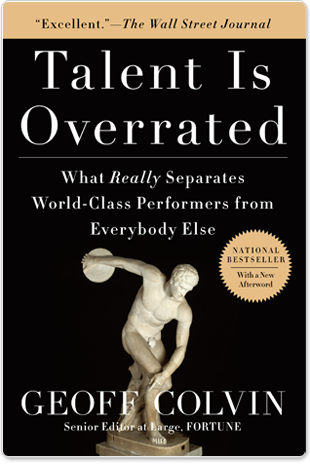
Talent is OverratedGeoff Colvin’s book Talent is Overrated has the same two messages. Shane Parrish, in his Farnam Street blog post “What is Delieberate Practice?” ably pulls from Talent is Overrated a description of deliberate practice.

Shane begins with these two quotations from Talent is Overrated indicating the difference between deliberate practice and what most people think of when they think of practice:  

  • In field after field, when it comes to centrally important skills…parole officers predicting recidivism, college admissions officials judging applicants—people with lots of experience were no better at their jobs than those with less experience. 
  • Deliberate practice is hard. It hurts. But it works. More of it equals better performance and tons of it equals great performance.

Shane clarifies:

Most of what we consider practice is really just playing around — we’re in our comfort zone.

When you venture off to the golf range to hit a bucket of balls what you’re really doing is having fun. You’re not getting better. Understanding the difference between fun and deliberate practice unlocks the key to improving performance.

Shane then structures the rest of his post by this that Geoff Colvin says of deliberate practice:

  1. It is activity designed specifically to improve performance, often with a teacher’s help;
  2. it can be repeated a lot; feedback on results is continuously available;
  3. it’s highly demanding mentally, whether the activity is purely intellectual, such as chess or business-related activities, or heavily physical, such as sports; it isn’t much fun.

1. Deliberate practice is designed to improve performance. Teachers can help in that design. As Geoff Colvin writes: 

  • In some fields, especially intellectual ones such as the arts, sciences, and business, people may eventually become skilled enough to design their own practice. But anyone who thinks they’ve outgrown the benefits of a teacher’s help should at least question that view. There’s a reason why the world’s best golfers still go to teachers.
  • A chess teacher is looking at the same boards as the student but can see that the student is consistently overlooking an important threat. A business coach is looking at the same situations as a manager but can see, for example, that the manager systematically fails to communicate his intentions clearly.”

Shane comments:

Teachers, or coaches, see what you miss and make you aware of where you’re falling short.

With or without a teacher, great performers deconstruct elements of what they do into chunks they can practice. They get better at that aspect and move on to the next.

Noel Tichy, professor at the University of Michigan business school and the former chief of General Electric’s famous management development center at Crotonville, puts the concept of practice into three zones: the comfort zone, the learning zone, and the panic zone.

Most of the time we’re practicing we’re really doing activities in our comfort zone. This doesn’t help us improve because we can already do these activities easily. On the other hand, operating in the panic zone leaves us paralyzed as the activities are too difficult and we don’t know where to start. The only way to make progress is to operate in the learning zone, which are those activities that are just out of reach.

2. Deliberate practice can be repeated a lot, with appropriate feedback.

Shane gives these two quotations from Talent is Overrated:

  • Let us briefly illustrate the difference between work and deliberate practice. During a three hour baseball game, a batter may only get 5-15 pitches (perhaps one or two relevant to a particular weakness), whereas during optimal practice of the same duration, a batter working with a dedicated pitcher has several hundred batting opportunities, where this weakness can be systematically exploited. 
  • You can work on technique all you like, but if you can’t see the effects, two things will happen: You won’t get any better, and you’ll stop caring.

Shane points out that if results must be subjectively interpreted, it is valuable not to have to rely entirely on one’s own opinion to judge the results. A coach can provide such a second opinion. But sometimes all it takes is a friend with good judgment. 

3. Deliberate practice is highly demanding mentally and isn’t much fun. 

Shane writes

Doing things we know how to do is fun and does not require a lot of effort. Deliberate practice, however, is not fun. Breaking down a task you wish to master into its constituent parts and then working on those areas systematically requires a lot of effort.

Indeed, Geoff Colvin claims that it is hard to do deliberate practice for more than four or five hours a day, or for more than ninety minutes at a stretch. 

Deliberate practice can also be embarrassing. Shane quotes from Susan Cain’s book, Quiet: The Power of Introverts in a World That Can’t Stop Talking this claim:

  • Deliberate Practice is best conducted alone for several reasons. It takes intense concentration, and other people can be distracting. It requires deep motivation, often self-generated. But most important, it involves working on the task that’s most challenging to you personally. Only when you’re alone, Ericsson told me, can you “go directly to the part that’s challenging to you. If you want to improve what you’re doing, you have to be the one who generates the move. Imagine a group class—you’re the one generating the move only a small percentage of the time.”

Presumably, a tutorial by a good coach is even better than doing deliberate practice alone.  But some people do manage deliberate practice alone. A wonderful example is Ben Franklin.

A detailed example of deliberate practice: Ben Franklin. I remember vividly from my own reading of Talent is Overrated this passage Shane quotes about Ben’s program for improving his writing:

  • First, he found examples of prose clearly superior to anything he could produce, a bound volume of the Spectator, the great English periodical written by Joseph Addison and Richard Steele. Any of us might have done something similar. But Franklin then embarked on a remarkable program that few of us would have ever thought of.
  • It began with his reading a Spectator article and marking brief notes on the meaning of each sentence; a few days later he would take up the notes and try to express the meaning of each sentence in his own words. When done, he compared his essay with the original, “discovered some of my faults, and corrected them.
  • One of the faults he noticed was his poor vocabulary. What could he do about that? He realized that writing poetry required an extensive “stock of words” because he might need to express any given meaning in many different ways depending on the demands of rhyme or meter. So he would rewrite Spectator essays in verse. …
  • Franklin realized also that a key element of a good essay is its organization, so he developed a method to work on that. He would again make short notes on each sentence in an essay, but would write each note on a separate slip of paper. He would then mix up the notes and set them aside for weeks, until he had forgotten the essay. At that point he would try to put the notes in their correct order, attempt to write the essay, and then compare it with the original; again, he “discovered many faults and amended them.”

Other Readings. Shane recommends this New Yorker article by Dr. Atul Gawande.Many others have written online about deliberate practice, as googling the words “deliberate practice” indicates. One I stumbled across in my googling was Justin Musk’s excellent post “the secret to becoming a successful published writer: putting the deliberate in deliberate practice.”

A Plea: I would love to see more in the economics blogosphere about what deliberate practice looks like for gaining skill in economics.

Quartz #25—>Examining the Entrails: Is There Any Evidence for an Effect of Debt on Growth in the Reinhart and Rogoff Data?

Link to the Column on Quartz

Here is the full text of my 25th Quartz column, that I coauthored with Yichuan Wang, “Autopsy: Economists looked even closer at Reinhart and Rogoff’s data–and the results might surprise you.” It is now brought home to supplysideliberal.com (and soon to Yichuan’s Synthenomics). It was first published on May 14, 2013. Links to all my other columns can be found here.

If you want to mirror the content of this post on another site, that is possible for a limited time if you read the legal notice at this link and include both a link to the original Quartz column and the following copyright notice:

© June 12, 2013: Miles Kimball and Yichuan Wang, as first published on Quartz. Used by permission according to a temporary nonexclusive license expiring June 30, 2014. All rights reserved.

(Yichuan has agreed to extend permission on the same terms that I do.)


In order to predict the future, the ancient Romans would often sacrifice an animal, open up its guts and look closely at its entrails. Since the discovery of an Excel spreadsheet error in Carmen Reinhart and Ken Rogoff’s analysis of debt and growth by University of Massachusetts at Amherst graduate student Thomas Herndon and his professors Michael Ash and Robert Pollin, many economists have taken a cue from the Romans with the Reinhart and Rogoff data to see if there is any hint of an effect of high levels of national debt on economic growth. The two of us gave our first take in analyzing the Reinhart and Rogoff data in our May 29, 2013 column. We wrote that “…we could not find even a shred of evidence in the Reinhart and Rogoff data for a negative effect of government debt on growth.

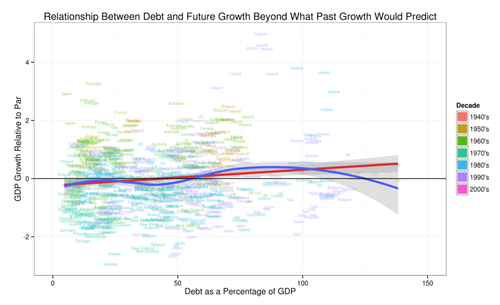
Our further analysis since then (here, and here), and University of Massachusetts at Amherst Professor Arindrajit Dube’s analysis since then and full release of his previous work (herehere, and here) in response to our column have only confirmed that view. (Links to other reactions to our earlier column can be found here.) Indeed, although we have found no shred of evidence for a negative effect of government debt on growth in the Reinhart and Rogoff data, the two of us have found at least a mirage of a positive effect of debt on growth, as shown in the graph above.

The point of the graph at the top is to find out if the ratio of debt has any relationship to GDP growth, after isolating the part of GDP growth that can’t be predicted by past GDP growth alone. Let us give two examples of why it might be important to adjust for past growth rates when looking at the effect of debt on growth. First, if a country is run badly in other ways, is likely to grow slowly whatever its level of debt. In order to see if debt makes things worse, it is crucial to adjust for the fact that it was growing slowly to begin with. Second, if a country is run well, it is likely to grow fast while it is in the “catch-up” phase of copying proven techniques from other countries. Then as it gets closer to the technological frontier, its growth will naturally slow down. If getting richer in this way also tends to lead through typical political dynamics to a larger welfare state with higher levels of debt, one would see high levels of debt during that later mature phase of slower growth. This is not debt causing slow growth, but economic development having two separate effects: the slowdown in growth as a country nears the technological frontier, and the development of a welfare state. Adjusting for past growth helps us adjust for how far along a country is in its growth trajectory.

In the graph, if “GDP Growth Relative to Par” is positive, it means GDP growth is higher in the next 10 years than would be predicted by past GDP growth alone. If “GDP Growth Relative to Par” is negative, it means GDP growth is lower in the next 10 years than would be predicted by past GDP growth. (Here, in accounting for the effect of past GDP growth, we use data on the most recent five past years individually, and the average growth rate over the period from 10 years in the past to five years in the past.) The thick red line shows that, overall, high debt is associated with GDP growth just a little higher than what one would guess from looking at the past record of GDP growth alone. The thick blue curve gives more detail by showing in a flexible way what levels of debt are associated with above par growth and what levels of debt are associated with below par growth. We generated it with standard scatterplot smoothing techniques. The thick blue curve shows that, in particular, GDP growth seems surprisingly high in the range from debt about 60% of GDP to debt about 120% of GDP. Higher and lower debt levels are associated with future growth that is somewhat lower than would be predicted by looking at past growth alone. Interestingly, debt at 90% of GDP, instead of being a cliff beyond which the growth performance looks much worse, looks like the top of a gently rounded hill. If one took the tiny bit of evidence here much, much more seriously than we do, it would suggest that debt below 90% of GDP is just as bad as debt above 90% of GDP, but that neither is very bad.

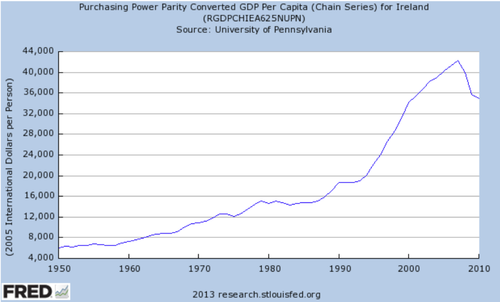
Where does the evidence of above par growth in the range from 60% to 120% of GDP come from? Part of the answer is Ireland. In particular, all but one of the cases when GDP growth was more than 2.5% per year above what would be expected from looking at past growth occurred in a 10-year period after Ireland had a debt to GDP ratio in the range from 60% to 120% of GDP. It is well-known that Ireland has recently gotten into trouble because of its debt, but what does the overall picture of its growth performance over the last few decades look like? Here is a graph of Ireland’s per capita GDP from the Federal Reserve Bank of St. Louis data base:

The consequences of debt have reversed some of Ireland’s previous growth, but it is still a growth success story, despite the high levels of debt it had in the 1980s and ’90s.

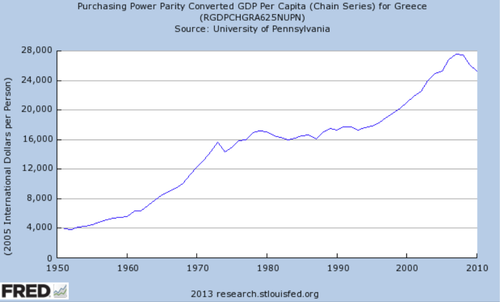
In addition to Ireland, a bit of the evidence for good growth performance following high levels of debt comes from Greece. As the graph below shows, Greece has had more impressive growth in the last two decades than many people realize, despite the hit it has taken recently because of its debt troubles.

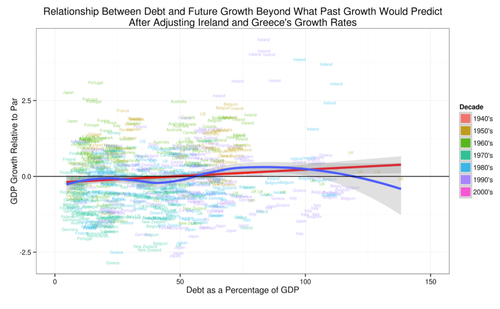
We did a simple exercise to see if the bump up in the thick blue curve in the graph at the top is entirely due to Ireland’s and Greece’s growth that has been reversed recently because of their debt troubles.  To be sure that the bad consequences of Ireland’s and Greece’s debt for GDP in the last few years were accounted for when looking at the effect of debt on growth, we pretended that the recent declines in GDP had been spread out as a drag on growth over the period from 1990 to 2007 instead of happening in the last few years. Then we redid our analysis. Making this adjustment to the growth data is a simple, if ad hoc, way of trying to make sure that the consequences of Irish and Greek debt are not missed by the analysis.

Imagining slower growth earlier on to account for Ireland’s and Greece’s recent GDP declines makes the performance of Ireland and Greece in that period from 1990 to 2007 look less stellar. The key effect is on the thick blue curve estimating the effect of debt on growth. Looking closely at the graph below after adjusting Ireland’s and Greece’s growth rates, you can see that the bump up in the thick blue curve in the range where debt is between 60% and 120% of GDP has been cut down to size, but it is still there. So the bump cannot be attributed entirely to Ireland and Greece “stealing growth from the future” with their high levels of debt.

We want to stress that there is no real justification for making the adjustment for Ireland and Greece that we made except as a way of showing that the argument that Ireland and Greece had high growth in the 1990s and early 2000s, but now have had to pay the piper is not enough to turn the story about the effects of debt on growth around.

There are three broader points to make from this discussion of Ireland and Greece.

  • We still don’t recommend taking the upward bump in growth predicted by the thick blue curves in the 60% to 120% ranges for debt seriously.
  • The fact that looking at the experience of two countries in two decades can account for a good share of the bump up in the 60% to 120% ranges illustrates just how little there is to go on from the Reinhart and Rogoff data set. Our scatter plots with the thick blue curves give the impression of more than there really is, because we have dots for growth from 1970 to 1980 and 1971 to 1981 and 1972 to 1982, and so on. And there is no way to escape this kind of issue when the economic forces one is interested have both short-run and long-run effects, and change as slowly over time as levels of national debt do. There are advanced statistical methods for correcting for such issues; the corrections almost always go in the direction of saying that there is less evidence in a set of data than it might seem. Even without being experts ourselves in making those statistical corrections, we feel reasonably confident in saying that the Reinhart and Rogoff data speak very softly about any positive or negative effect of debt on growth at all: barely a whisper.
  • Third, the inclusion of Ireland and Greece and the fact that the basic story survives after pretending their GDP declines were a drag on growth earlier contradicts to some extent the claim of economics blogger and blog critic Paul Andrews in his post “None the Wiser After Reinhart, Rogoff, et al.” that Reinhart and Rogoff’s data focus on “20 or so of the most healthy economies the world has ever seen.” After adjusting for the hit their economies have taken recently, the inclusion of Ireland and Greece gives some perspective on the effects of debt on the growth of economies that havesubsequently had problems paying for their debt. There could certainly be other economies whose growth is more vulnerable to debt than Ireland and Greece, but to us these seem like exactly the kinds of cases people would have in mind when they argue that one should expect debt to have a negative effect on growth.

Understanding all of this matters because, as Mark Gongloff of Huffington Postwrites:

Reinhart and Rogoff’s 2010 paper, “Growth in a Time of Debt,” … has been used to justify austerity programs around the world. In that paper, and in many other papers, op-ed pieces and congressional testimony over the years, Reinhart and Rogoff have warned that high debt slows down growth, making it a huge problem to be dealt with immediately. The human costs of this error have been enormous.

Even though there are many effective ways to stimulate economies without adding much to their national debt, the primary remedies for sluggish economies that are actually on the table politically are those that do increase national debt, so it matters whether people think debt is damning or think debt is just debt.  It is painful enough that debt has to be paid back (with some combination of interest and principal), and high levels of debt may help cause debt crises like those we have seen for Ireland and Greece. But the bottom line from our examination of the entrails is that the omens and portents in the Reinhart and Rogoff data do not back up the argument that debt has a negative effect on economic growth.

The Descent—and the Divine Calling—of the Modernists

blog.supplysideliberal.com tumblr_inline_mpskiziZjj1qz4rgp.jpg

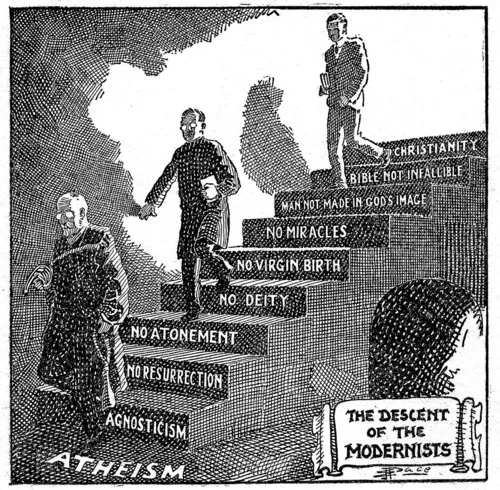
‘The Descent of the Modernists’, cartoon by E. J. Pace, first published in Seven Questions in Dispute by William Jennings Bryan (1924). (cmnotes gives some nice autobiographical details.)

The 1924 cartoon above is reblogged from isomorphismes. By this standard I am a descended Modernist. 

What I find intriguing about the cartoon is the contrast between how each of these beliefs sounded to me when I believed in Mormonism and how they sound to me now. Here is where I stand today on the issues highlighted in the cartoon:

  • CHRISTIANITY: I do not believe in all the teachings of Christianity, but I believe Christianity as a whole has been a force for good in the world, as Rodney Stark describes in his series of books on the effect of religion on history. 
  • BIBLE NOT INFALLIBLE: Joseph Smith, the founder of Mormonism, talked a lot about the imperfections of the Bible, and even did his own revision of the Bible, so I have always believed the Bible to be fallible.
  • MAN NOT MADE IN GOD’S IMAGE: I like the idea that humankind is made in the image of God. That fits with the theology I lay out in my post “Teleotheism and the Purpose of Life.” There, I define God as “the greatest of all things that can come true.” Human beings– and even more, groups of human beings working together–are the greatest of all things I know to exist. In my book, that counts as being “in God’s image.” Evolution has put humankind in an exalted place, and given our species a great opportunity. But reaching our potential is not guaranteed. As Joseph Smith said: “Thy mind, O man! if thou wilt lead a soul unto salvation, must stretch as high as the utmost heavens, and search into and contemplate the darkest abyss, and the broad expanse of eternity–thou must commune with God.”  My post “Teleotheism and the Purpose of Life” is about what it means to me to “commune with God."
  • NO MIRACLES: I believe that the picture of the world painted by physics–which drastically limits any wiggle room for "miracles”–is basically correct. (See my post “What Do You Mean by ‘Supernatural.’”)  I don’t have any problem with “miracles” that are within the laws of physics (including the Second Law of Thermodynamics that establishes the key difference between “the future” and “the past”).
  • NO VIRGIN BIRTH: The importance of the virgin birth is in singling out Jesus as God's “Only Begotten Son.” Here, what I find most fascinating is the way in which the New Testament attributes to Jesus almost every way in which Jewish and Greek culture at the time had found to describe what we would now call “superheroes.” For this and for many other insights, the book Surpassing Wonder: The Invention of the Bible and the Talmuds, by Donald Harmon Akenson, is absolutely wonderful. I see his model of new layers of scripture incorporating and powerfully reinterpreting earlier layers of scripture as a wonderful description of what Joseph Smith did with a new layer of distinctively Mormon scriptures.    
  • NO DEITY: My belief is that God comes toward the end of history, not at the beginning, as I spell out in “Teleotheism and the Purpose of Life.” The presence of great evil in the world makes it seem unlikely that God is already with us in full measure. (This is the “Problem of Evil” that has bedeviled believers in God for millennia.) 
  • NO ATONEMENT: I believe that, through non-miraculous means, Jesus brought humankind to a higher level. What he accomplished easily counts as “saving the world” in the sense I talk about saving the world on this blog. As for the traditional doctrine of the atonement, it would be wonderful to be loved in the way described in John 3:16: “For God so loved the world that he gave his one and only Son, that whoever believes in him shall not perish but have eternal life.” But in Mormon Christianity, Protestant Christianity, and Catholic Christianity, the traditional doctrine of the atonement has a dark side: the necessity for Jesus to suffer and die in order to temper God’s Justice. Even before I left Mormonism, I wondered about “God’s Justice,” which required Jesus’ death in order to be become something that corresponds to our usual notions of justice. If the intemperate, pre-atonement version of “God’s Justice” was a part of God, how could that be squared with God’s goodness? If the intemperate, pre-atonement version of “God’s Justice” was not a part of God, what was this mysterious entity called “God’s Justice”?
  • NO RESURRECTION: The possibility that science will someday be able to bring people back from the dead motivates a slice of GDP devoted to cryogenically freezing people’s heads after death in the hopes of future resurrection with technology that does not exist yet. Based on my own imperfect assessment of the difficulties of the relevant technology, I believe that those alive today are doomed to die. That is, I think Ray Kurzweil and Terry Grossman are over-optimistic in thinking that current and near-future anti-aging technologies can allow people to live long enough that more advanced technologies such as the technology I discuss in my post “Cyborgian Immortality” can come into play. If we are doomed to die, some form of resurrection is our only real hope for an after-life. (But I find myself very queasy about the route of hoping to be one of the unfrozen.) Unlike Plato, who felt that the soul was naturally immortal, I think consciousness is a complex phenomenon that can easily be disrupted. Hence, for us to have an afterlife, someone or something with a great deal of power will have to make that afterlife happen.         
  • AGNOSTICISM: David Hume, one of the greatest philosophers of all time, gives sound reasons to be philosophically agnostic about just about everything, while allowing oneself a sense of relative certainty about key things at the psychological level. By personality type, I am a believer. Other than people’s general tendency to tell the truth, the only thing that saves me from being constantly duped is that I want to believe the critics as well as the proponents of any idea.  
  • ATHEISM: From a sociological point of view, I think of myself as an atheist. I don’t want to pretend that my beliefs are at all consistent with traditional beliefs in a supernatural God. But if you, my reader, are willing to accept the definition of “God” I propose in “Teleotheism and the Purpose of Life” as the greatest of all things that can come true, then I am delighted to call myself a theist, and to echo Joseph Smith in saying:

Now behold, a marvelous work is about to come forth among the children of men [and women]. Therefore, O ye that embark in the service of God, see that ye serve [God] with all your heart, might, mind and strength, that ye may stand blameless before God at the last day. (D&C 4:1,2)

Working for the greatest of all things that can come true with all our heart, might, mind and strength is a worthy calling for Modernists. Our responsibility is great. It is only by our diligent efforts that the world can be saved in our day, and that humankind and its descendants can move further down the path toward bring God fully into being in a day yet to come.

Miles on HuffPost Live: Getting Beyond Economics 101

blog.supplysideliberal.com tumblr_inline_mpt4s2pG1r1qz4rgp.png

Here is a link to the HuffPost Live segment “Basic Economics are Killing America.” I appeared in the segment along with Mark Gongloff, Umair Haque, Andrea Castillo and the host, Mike Sacks. I thought we had a great discussion.

I was pleased to have Umair strongly agree with me in urging that all journalists and economic policymakers who deal with economics read Anat Admati and Martin Hellwig’s book 

The Banker’s New Clothes

as a way to get past the confusion created by bank lobbyists.

Paul Romer and Company on the Cashless Society

Paul Romer is one of the economists I respect most. I wrote about Paul Romer in my post “Paul Romer on Charter Cities,” and I have given the link to his Wikipedia bio under his photo above. I am one of several people who encouraged him to start blogging, arguing that blogging is the way to reach young economists, who are a force to be reckoned with for the world’s future. Paul can be found on Twitter here.

Soon after I published my first column on electronic money, How Subordinating Paper Money to Electronic Money Can End Recessions and End Inflation, I received an invitation to a meeting put together by Paul’s Urbanization Project on the cashless society. Here is Paul’s account of that meeting, which first appeared here on Paul’s Urbanization Project blog. Thanks to Paul for his permission to reprint that account here, as a guest post. 


In November of 2012, the Urbanization Project hosted a workshop on “The Cashless Society” that focused both on the implications of cashlessness for monetary policy and crime and on related developments in biometric technologies, with particular emphasis on the status of India’s UID project. This post provides a summary of the general consensus that emerged from these discussions.

Experience has show that any discussion about changes in payment systems will activate strong passions about the balance between tyranny and independence, particularly in the United States. Rational discourse about payment systems will be hindered by these passions and by the technical difficulty of monetary theory.

Creating a strong but accountable state is, of course, the essence of good governance. We need states that are strong enough to enforce laws, which are required to achieve efficient outcomes. We must also be sure that the individuals who are part of the state must themselves follow the law. Moreover, in holding the people who administer the state accountable, we must guard against a political process that creates an opening for powerful private actors to use the state for narrow private purposes, e.g. when incumbents prevent entry by new competitors.

These perennial concerns are closely related to questions about how best to protect privacy and individual freedom and to prevent firms from using strategies that use obscurity and complexity to undermine the power of competition. Given how powerful private actors have become in the online world, it is unclear whether the greater risk now springs from a state that is too strong to be held accountable or too weak to maintain the essentials necessary for consumers to benefit from safety and competitive markets.

It is unclear whether the type of privacy that an anonymous payment system based on hand-to-hand payments of currency is in fact an effective mechanism for holding a government accountable. Maintaining a payments system based on fiat currency seems, on its face, to be an implausible way to hold a state that stops obeying the law in check — the monetary authority could simply use inflation to destroy this payments system.  

Based on extensive experience in India and in smaller experiments in other developing countries, there are feasible, low cost biometric identification systems that could support electronic payment systems, systems that could replace the use of hand-to-hand currency. In many developing countries, where it is the weakness of the state that poses more of a threat to daily life, these systems may be welcomed as more effective mechanisms for citizens to get benefits from the market system and from the state.

Within any jurisdiction, a prohibition on the use of paper currency could displace certain types of criminal activity, e.g. money laundering that brings cash from drug gangs into the banking system. It could raise the cost and/or reduce the incidence of some local criminal activities, but only if some substitute form of payment did not develop that provides an equal level of anonymity. Hand-to-hand exchange of a commodity like gold is one possibility. Electronic systems like bitcoin, coupled with pervasive internet connected mobile devices, might be another. But all such systems leave extensive electronic records of transactions, so they might expose criminal enterprises to more risk of detection and prosecution than systems based on hand-to-hand currency.

Prohibiting the possession of currency would remove the “zero nominal bound” as a constraint on countercyclical monetary policy. Nevertheless, one surprising conclusion from the discussion was that this should not be counted as an advantage of a prohibition on the possession of currency. One of the participants in the conference, Miles Kimball, pointed out that monetary authorities already have feasible mechanisms that they could use to avoid this constraint even when hand-to-hand currency continues to circulate. In the US, we have already adopted one of the key required measures: non-zero interest payments on banks’ reserves at the Fed, at a rate that can be set by the monetary authority.

This rate could easily be set to a negative value. The next step under the Kimball proposal is to establish an exchange rate between currency and the reserves held at the Fed and to identify bank reserves as the unit of account. This exchange rate could deviate from 1 unit of reserves per unit of currency. If, for example, one dollar of paper currency purchased only 0.98 dollars in reserves, someone who makes a purchase with paper currency could face a 2% surcharge. (Many travelers who purchase foreign exchange overseas have already encountered a value for a paper bill that is slightly less than a claim on a bank in the form of a travelers check.) In practice, it is likely that many merchants would not impose this charge on small purchases. It would matter only for organizations like banks that make big exchanges of reserves for currency and vice versa. In effect, this would amount to having the monetary authority issue two types of currency and manage the exchange rate between them. 

Under the Kimball proposal, central banks would probably have enough room to stimulate the economy if this exchange rate deviated from strict 1 to 1 equality only temporarily and only by a relatively small amount. For example, by letting the value of currency fall relative to reserves by a few percent per year for a year or so while nominal interest rates are negative, then recovering back to par soon thereafter. 

The other possibility that emerged from the discussion was that a central bank that wanted to “tax” the use of currency without prohibiting it outright could let the value of the paper currency depreciate forever relative to reserves, e.g. by 10% per year. When the exchange rate between currency and reserves was large enough, merchants would presumably charge more for payment in paper currency, just as merchants near the US-Canada border charged more for payment in Canadian dollars than for payment in US dollars when the exchange rate between the two types of dollars fell to 0.8 Canadian dollars per US dollar.

The surprising conclusion was that by managing the exchange rate between currency and bank reserves, the central bank could remove the zero lower bound and could tax the use of currency, which would tax criminal enterprises that rely on currency. So a full prohibition on the use of currency could be viewed as a limiting version of less extreme policies that tax currency by letting its value depreciate relative to bank reserves. Because prices and inflation would be denominated in units of bank reserves, this type of policy can tax currency without causing inflation and without inducing any of the distortions associated with inflation.

In fact, as Kimball has noted, this policy is the only policy that has been proposed that has any credible claim to offering a monetary environment with zero inflation.*

* Note added 6-13: Conventional monetary policy can of course yield zero inflation (or negative inflation for that matter, as we had during the Great Depression.) Policies that do this without solving the problem of the zero nominal bound will not be credible in the sense that they will eventually be abandoned once people have experience with the high cost that comes from giving up the ability to implement a counter-cyclical monetary policy.  

TAGS: Biometric IdentificationCashless SocietyCrimeGovernanceMonetary PolicyTechnologies


Here is my own account of that meeting, taken from the current draft of my paper “Breaking Through the Zero Lower Bound" (download):

At a small working group of NYU’s Urbanization Project including Paul Romer, Miles Kimball and others that met on November 30, 2012, two variants of the crawling peg were discussed. The one above in which, assuming positive steady-state real rates, there is an eventual return to par between electronic money and paper money in normal times, and another variant for use in environments that have large underground economies that are difficult to tax. In such an environment, paper currency–which is advantageous for participants in the underground economy—would continually depreciate at a rate meant to generate substantial revenue but stop short of leading those in the underground economy to primarily use a foreign currency or some type of commodity money instead of the depreciating domestic paper currency.  (There might be border controls on the importation of foreign paper currency, without any restrictions on well-documented electronic accounts in foreign money.) Since there is widespread use of domestic paper currencies even in countries with substantial inflation, it should be possible to generate quite a bit of seignorage revenue. The interesting thing about this kind of seignorage revenue is that it is at least theoretically consistent with zero inflation in the unit of account: electronic money.  Although the temptation using monetary policy to push the economy above the natural level of output would continue to provide a temptation to raise inflation, in a system with a crawling-peg exchange rate, the desire for seignorage need not by itself create a temptation toward higher inflation.

What Would Economic Growth Look Like If We Properly Valued the Web?

I love Jeremy Warner’s essay “The UK internet boom that blows apart economic gloom” in the Telegraph. Jeremy makes several important points. One is that accounting for intangible investment, as the latest US GDP revisions do, can affect GDP figures. Here is a deeper issue Jeremy raises:

But even if these changes were to be incorporated, it still wouldn’t do justice to the growth in the digital economy. This is because much internet activity is free, and therefore immeasurable.

Take the traditional music industry, which used to involve, finding, recording and marketing new acts, and then cleaning up through copyrighted CD sales.

For decades, the model worked well — at least for the record producers and a small, elite of popular artists — and made a not insignificant contribution to GDP.

Then along came digital downloads, legal or otherwise. These have destroyed the old music company stranglehold on distribution, and in so doing made previously quite pricey music either far less expensive or completely free.

The pound value of music consumption has declined, and with it the music industry’s contribution to GDP, but the volume of music consumption has risen exponentially.

Much the same thing can be said about newspapers. The traditional business model has been badly undermined by the internet, but news demand and consumption has never been higher. If only we could persuade the blighters to pay, our industry would again be booming….

Prof Brynjolfsson believes that the correct way to measure all this… is via the time people spend immersed in it.

I know Erik Brynjolfsson from his Twitter feed as an excellent commentator on the digital economy.

The growing importance of free goods is one of the many reasons we need to go beyond GDP in accounting for well-being. Looking at the amount of time people spend online to infer value makes a lot of sense. But there are also more radical ways to go beyond GDP, as discussed in “Ori Heffetz: Quantifying Happiness” and “Judging the Nations: Wealth and Happiness are Not Enough.”

For the richest countries, at the technological frontier, human progress has shifted more and more into the realm of intangibles. Services are less tangible than goods; online activities are less tangible than face-to-face services; happiness, job satisfaction and meaning are less tangible than time spent hanging out in cyberspace. If we don’t develop good ways to account for the increasingly intangible dimensions of human progress, we will miss the main story going forward. 

Why Progressives and Conservatives Need Each Other

It is easy to get upset at the wrong-headedness of one’s political opponents. But sometimes there is a grain of truth to what they have to say. John Stuart Mill had this to say about why progressives and conservatives need each other (from On Liberty, Chapter II “Of the Liberty of Thought and Discussion,” paragraph 36):

In politics, again, it is almost a commonplace, that a party of order or stability, and a party of progress or reform, are both necessary elements of a healthy state of political life; until the one or the other shall have so enlarged its mental grasp as to be a party equally of order and of progress, knowing and distinguishing what is fit to be preserved from what ought to be swept away. Each of these modes of thinking derives its utility from the deficiencies of the other; but it is in a great measure the opposition of the other that keeps each within the limits of reason and sanity. Unless opinions favourable to democracy and to aristocracy, to property and to equality, to co-operation and to competition, to luxury and to abstinence, to sociality and individuality, to liberty and discipline, and all the other standing antagonisms of practical life, are expressed with equal freedom, and enforced and defended with equal talent and energy, there is no chance of both elements obtaining their due; one scale is sure to go up, and the other down. Truth, in the great practical concerns of life, is so much a question of the reconciling and combining of opposites, that very few have minds sufficiently capacious and impartial to make the adjustment with an approach to correctness, and it has to be made by the rough process of a struggle between combatants fighting under hostile banners. On any of the great open questions just enumerated, if either of the two opinions has a better claim than the other, not merely to be tolerated, but to be encouraged and countenanced, it is the one which happens at the particular time and place to be in a minority. That is the opinion which, for the time being, represents the neglected interests, the side of human well-being which is in danger of obtaining less than its share. I am aware that there is not, in this country, any intolerance of differences of opinion on most of these topics. They are adduced to show, by admitted and multiplied examples, the universality of the fact, that only through diversity of opinion is there, in the existing state of human intellect, a chance of fair play to all sides of the truth. When there are persons to be found, who form an exception to the apparent unanimity of the world on any subject, even if the world is in the right, it is always probable that dissentients have something worth hearing to say for themselves, and that truth would lose something by their silence.