Quartz #15—>How to Stabilize the Financial System and Make Money for US Taxpayers
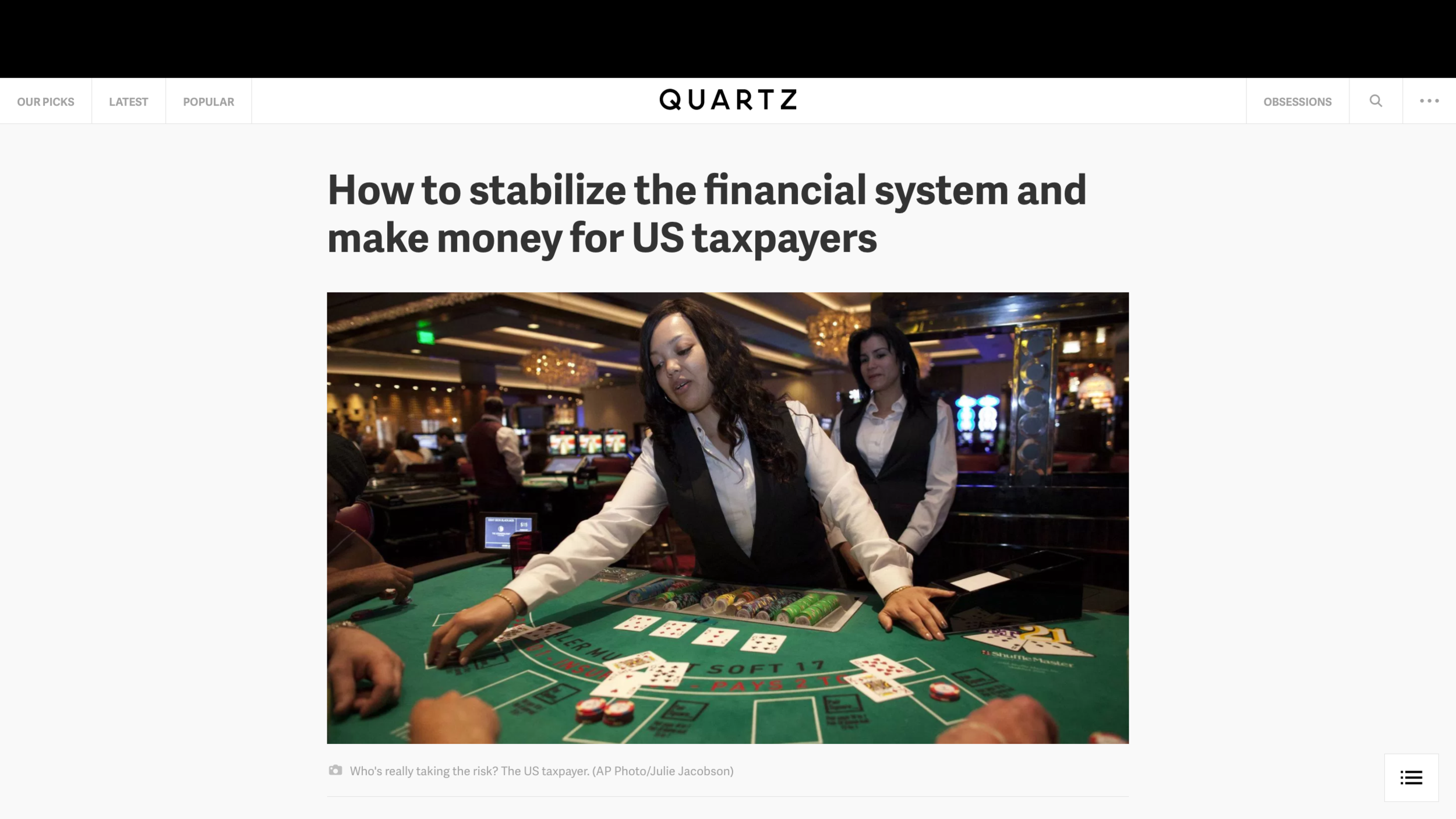
Here is the full text of my 15th Quartz column, “How to stabilize the financial system and make money for US taxpayers” now brought home to supplysideliberal.com. It was first published on February 8, 2013. Links to all my other columns can be found here.

If you want to mirror the content of this post on another site, that is possible for a limited time if you read the legal notice at this link and include both a link to the original Quartz column and the following copyright notice:

© February 8, 2013: Miles Kimball, as first published on Quartz. Used by permission according to a temporary nonexclusive license expiring June 30, 2014. All rights reserved.

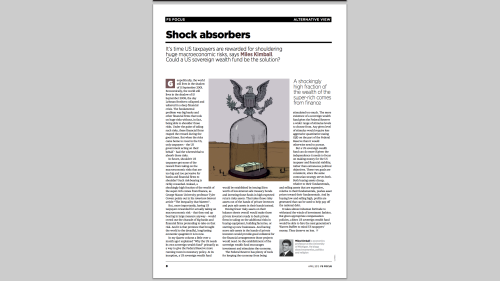
Note: a version of this column is also slated to be published in FS Focus, the financial services magazine of the ICAEW, an organization of accountants in the UK. In that version, the passage from “In brief, …” to the end of its paragraph was replaced with this passage, which I think you will find interesting as well:

At its inception, a US sovereign wealth fund would be established by issuing $1 trillion worth of low-interest safe Treasury bonds and investing those funds in high-expected-return risky assets. That takes those risky assets off the hands of private investors and puts safe assets in the hands of those private investors instead. Having fewer risky assets on their balance sheets overall would make those private investors readier to back private firms in taking on the additional risks involved in buying equipment, building factories, or starting up new businesses. And having more safe assets in the hands of private investors would provide good collateral for the financial arrangements those projects would need. Thus, the establishment of the sovereign wealth fund encourages investment and stimulates the economy. The Fed has plenty of tools for keeping the economy from being stimulated too much. So the mere existence of the sovereign wealth fund gives the Fed a wider range of stimulus levels to choose from. Moreover, any given level of stimulus would requires a less aggressive course of quantitative easing (QE) on the part of the Fed than it would otherwise need to pursue.


Geopolitically, the world still lives in the shadow of Sept. 11, 2001. Economically, the world still lives in the shadow of Sept. 15, 2008, the day Lehman Brothers collapsed and ushered in a deep financial crisis. The fundamental problem: big banks and other financial firms that pretended to take on huge risks without, in fact, being able to shoulder those risks. Under the guise of taking such risks, these financial firms reaped the reward during the good times. But when the risks came home to roost, only US taxpayers—the US government acting on their behalf—had the wherewithal to absorb those risks.

In the future, shouldn’t US taxpayers get some of the reward from taking on the macroeconomic risks that are too big and too pervasive for banks and financial firms to shoulder? Such risk-bearing is richly rewarded. Indeed, as George Mason University professor Tyler Cowen points out in his American Interest article, “The Inequality that Matters,” a shockingly high fraction of the wealth of the super-rich comes from finance. But more importantly, having US taxpayers rewarded for actually taking on macroeconomic risk—risk that US taxpayers end up bearing in large measure anyway—would crowd out the charade of big banks and financial firms pretending to take on that risk. And it is that pretense that brought the world to the dreadful, long-lasting economic quagmire it is in now.

In my Quartz column a little over a month ago I explained “Why the US needs its own sovereign wealth fund” primarily as a way to give the Federal Reserve more running room in monetary policy. In brief, the mere existence of a US sovereign wealth fund, one that issued through the Treasury $1 trillion worth of low-interest safe bonds and invested it in high-expected-return risky assets, would give the Federal Reserve a lot more room to maneuver.  Moreover, it would allow the Fed to pursue a less aggressive course of quantitative easing (QE) than it would otherwise need to pursue. The US fund would draw political controversy to itself, and away from the Fed, thereby preserving the independence of monetary policy that we need in order to avoid inflation in the long run.

But a US sovereign wealth fund can do more if given the independence it needs to focus on (1) making money for the US taxpayer and (2) financial stability, rather than extraneous political objectives. These two goals are consistent, since the same contrarian strategy serves both. Buying assets cheap, relative to their fundamentals, and selling assets that are expensive, relative to their fundamentals, both pushes asset prices toward their fundamentals and, by buying low and selling high, makes profits that we can use to help pay off the national debt. It takes almost inhuman fortitude to withstand the winds of investment fashion. But given appropriate compensation policies, a $1 trillion US sovereign wealth fund would be able to hire the next generation’s Warren Buffett to take care of US taxpayers’ money. They deserve no less.


Update: I discovered in a forgotten email a pdf of a version of this in print (on page 8) and a link to a version on the Economia website. I find those mostly interesting for the visuals:
blog.supplysideliberal.com tumblr_inline_nx5x6a2W5E1r57lmx_500.png

Let the Wrong Come to Me, For They Will Make Me More Right

blog.supplysideliberal.com tumblr_inline_mlx8niAdpg1qz4rgp.jpg

My title is a riff on this verse in the Gospel of Luke. The Vogel von Vogelstein painting reproduced above illustrates the scene. Here is a link to this and other paintings of the event. (I don’t see any reason to think that the event described by this Biblical verse is not historical.)

In the blogosphere and in academia, the frustration those who are wrong represent for those who are right is often palpable. It is good to remember that, as long as they do not win, those who are wrong provide an important service to those who are right. For you to understand this post, let’s stipulate that you are absolutely right. Here is what you and those on your side get from those who are wrong, as laid out by John Stuart Mill in On Liberty, chapter II

However unwillingly a person who has a strong opinion may admit the possibility that his opinion may be false, he ought to be moved by the consideration that however true it may be, if it is not fully, frequently, and fearlessly discussed, it will be held as a dead dogma, not a living truth.

There is a class of persons (happily not quite so numerous as formerly) who think it enough if a person assents undoubtingly to what they think true, though he has no knowledge whatever of the grounds of the opinion, and could not make a tenable defence of it against the most superficial objections. Such persons, if they can once get their creed taught from authority, naturally think that no good, and some harm, comes of its being allowed to be questioned. Where their influence prevails, they make it nearly impossible for the received opinion to be rejected wisely and considerately, though it may still be rejected rashly and ignorantly; for to shut out discussion entirely is seldom possible, and when it once gets in, beliefs not grounded on conviction are apt to give way before the slightest semblance of an argument. Waving, however, this possibility—assuming that the true opinion abides in the mind, but abides as a prejudice, a belief independent of, and proof against, argument—this is not the way in which truth ought to be held by a rational being. This is not knowing the truth. Truth, thus held, is but one superstition the more, accidentally clinging to the words which enunciate a truth.

… If the cultivation of the understanding consists in one thing more than in another, it is surely in learning the grounds of one’s own opinions. Whatever people believe, on subjects on which it is of the first importance to believe rightly, they ought to be able to defend against at least the common objections. But, some one may say, “Let them be taught the grounds of their opinions. It does not follow that opinions must be merely parroted because they are never heard controverted. Persons who learn geometry do not simply commit the theorems to memory, but understand and learn likewise the demonstrations; and it would be absurd to say that they remain ignorant of the grounds of geometrical truths, because they never hear any one deny, and attempt to disprove them.” Undoubtedly: and such teaching suffices on a subject like mathematics, where there is nothing at all to be said on the wrong side of the question. The peculiarity of the evidence of mathematical truths is, that all the argument is on one side. There are no objections, and no answers to objections. But on every subject on which difference of opinion is possible, the truth depends on a balance to be struck between two sets of conflicting reasons. Even in natural philosophy, there is always some other explanation possible of the same facts; some geocentric theory instead of heliocentric, some phlogiston instead of oxygen; and it has to be shown why that other theory cannot be the true one: and until this is shown, and until we know how it is shown, we do not understand the grounds of our opinion. But when we turn to subjects infinitely more complicated, to morals, religion, politics, social relations, and the business of life, three-fourths of the arguments for every disputed opinion consist in dispelling the appearances which favour some opinion different from it. The greatest orator, save one, of antiquity, has left it on record that he always studied his adversary’s case with as great, if not with still greater, intensity than even his own. What Cicero practised as the means of forensic success, requires to be imitated by all who study any subject in order to arrive at the truth. He who knows only his own side of the case, knows little of that. His reasons may be good, and no one may have been able to refute them. But if he is equally unable to refute the reasons on the opposite side; if he does not so much as know what they are, he has no ground for preferring either opinion. The rational position for him would be suspension of judgment, and unless he contents himself with that, he is either led by authority, or adopts, like the generality of the world, the side to which he feels most inclination. Nor is it enough that he should hear the arguments of adversaries from his own teachers, presented as they state them, and accompanied by what they offer as refutations. That is not the way to do justice to the arguments, or bring them into real contact with his own mind. He must be able to hear them from persons who actually believe them; who defend them in earnest, and do their very utmost for them. He must know them in their most plausible and persuasive form; he must feel the whole force of the difficulty which the true view of the subject has to encounter and dispose of; else he will never really possess himself of the portion of truth which meets and removes that difficulty. Ninety-nine in a hundred of what are called educated men are in this condition; even of those who can argue fluently for their opinions. Their conclusion may be true, but it might be false for anything they know: they have never thrown themselves into the mental position of those who think differently from them, and considered what such persons may have to say; and consequently they do not, in any proper sense of the word, know the doctrine which they themselves profess. They do not know those parts of it which explain and justify the remainder; the considerations which show that a fact which seemingly conflicts with another is reconcilable with it, or that, of two apparently strong reasons, one and not the other ought to be preferred. All that part of the truth which turns the scale, and decides the judgment of a completely informed mind, they are strangers to; nor is it ever really known, but to those who have attended equally and impartially to both sides, and endeavoured to see the reasons of both in the strongest light. So essential is this discipline to a real understanding of moral and human subjects, that if opponents of all important truths do not exist, it is indispensable to imagine them, and supply them with the strongest arguments which the most skilful devil’s advocate can conjure up.

See links to my other John Stuart Mill posts here:

Quartz #14—>Off the Rails: How to Get the Recovery Back on Track

blog.supplysideliberal.com tumblr_inline_mlkedka0Pt1qz4rgp.png

Link to the Column on Quartz

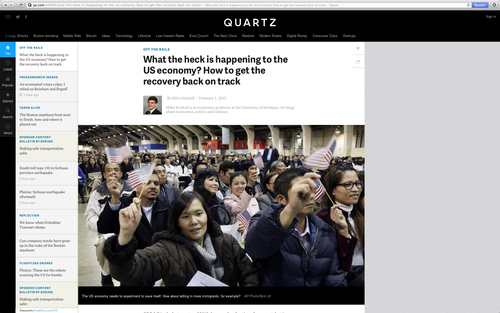
Here is the full text of my 14th Quartz column, “Off the Rails: What the heck is happening to the US Economy? How to get the recovery back on track,” now brought home to supplysideliberal.com. It was first published on February 1, 2013. Links to all my other columns can be found here.

If you want to mirror the content of this post on another site, that is possible for a limited time if you read the legal notice at this link and include both a link to the original Quartz column and the following copyright notice:

© February 1, 2013: Miles Kimball, as first published on Quartz. Used by permission according to a temporary nonexclusive license expiring June 30, 2014. All rights reserved.


GDP fell in the last quarter of 2012. It was only a fraction of a percent, but it means the recovery is on hiatus. Why? Negative inventory adjustments tend to be short-lived, so let me leave that aside, although it definitely made last quarter’s statistics look worse. Of the longer-lived forces, on the positive side,

  • consumer spending rose,
  • home-building rose, and
  • business investment on buildings and equipment rose.

On the negative side,

  • exports fell more than imports, and
  • government purchases fell.

Net exports and government purchases are the big worries going forward as well.

How much the rest of the world buys from the US depends on how other economies are faring. And most of the rest of the world is hurting economically. The Japanese are so fed up with their economic situation that they are on their sixth prime minister in the six and a half years since Junichiro Koizumi left office in 2006.  The European debt crisis is in a lull right now, but could still resume full force at any time. In addition to all of its other problems, the United Kingdom is facing a mysterious decline in productivity, explained in Martin Wolf’s Financial Times article “Puzzle of Falling UK Labour Productivity” and the Bank of England analysis by Abigail Hughes and Jumana Saleheen.

The decline in US government spending comes from the struggle of state and local governments with their budgets and at the federal level from the ongoing struggle between the Democrats and Republicans about the long-run future of taxing and spending. Last quarter saw a remarkable decline in military spending that Josh Mitchell explains this way in today’s Wall Street Journal (paywall).

The biggest cuts came in military spending, which tumbled at a rate of 22.2%, the largest drop since 1972. …

Military analysts said the decline likely was a result of pressure on the Pentagon from a number of areas.

Among them: reductions in spending on the war in Afghanistan as it winds down, a downturn in planned military spending, a constraint placed on the Pentagon budget because the federal government is operating on short-term resolutions that limit spending growth, as well as concern that further cuts may be in the pipeline.

The problem is that, absent a big increase in economic growth, balancing the federal budget in the long run requires big increases in taxes or big reductions in spending. But, although opinions differ on which option is worse, tax increases and spending cuts themselves are enemies of economic growth. So the traditional options for balancing the federal budget in the long run all have the potential to make things much worse.

Our problems are so big they need new solutions. In our current situation, the fact that a proposal is “untried” is a plus, since none of the economic approaches we have tried lately have worked very well. In the last few months I have focused my Quartz columns on explaining how the US and the world can get out of the economic mess we are in with new solutions. A recap:

  1. One of the new solutions is really an old one, that Congress and the President might be timidly tiptoeing toward too little of: dramatically more open immigration. Done right, this is guaranteed to add to long-run economic growth, as more workers make more goods, perform more services, and contribute to solving our long-run budget problems. And it isn’t just the US that would benefit from more open immigration. Ryan Avent has a must-read article in The Economist arguing that “Liberalising migration could deliver a huge boost to global output.”
  2. The long-run budget can be balanced in a way that achieves both the core Republican goals of holding down the size of government and the burden of taxation and the core Democratic goal of taking care of the poor, sick and elderly. Here is how: by using the tax system to back up a program of public contributions to expand the non-profit sector instead of taxes and spending to expand government, or brutal cuts with no compensating way to take care of those in need.
  3. For stimulating the economy, the one current approach that has been working at least halfway is “quantitative easing”: the Fed’s large purchases of long-term government bonds and mortgage-backed securities. But quantitative easing is hugely controversial and has an unfortunate side effect of making our long-run government debt problem worse than if we could stimulate the economy some other way. Establishing a US Sovereign Wealth Fund to do the purchasing of long-term and risky assets would give the Fed room to maneuver in monetary policy, and restrict its job to steering the economy rather than making controversial portfolio investment decisions. And a US Sovereign Wealth Fund could stand as a bulwark against wild swings in financial markets. (In addition to the column linked above, I spoke on CNBC’s Squawkbox about a US Sovereign Wealth Fund.)
  4. Although valuable, a US Sovereign Wealth Fund is a poor second best to electronic money. It is the fear of massive storage of paper currency that prevents the US Federal Reserve and other central banks from cutting short-term rates as far below zero as necessary to bring full recovery. (If electronic dollars, yen, euros and pounds are treated as “the real thing”—the yardsticks for prices and contracts—it is OK for people to continue using paper currency as they do now, as long as the value of paper money relative to electronic money goes down fast enough to keep people from storing large amounts of paper money as a way of circumventing negative interest rates on bank accounts.)  As I argued in “Could the UK be the first country to adopt electronic money,” the low interest rates that electronic money allows would stimulate not only business investment and home building, but exports as well—something that would lead to a virtuous domino effect as the adoption of an electronic money standard by one country led to its adoption by others to avoid trade deficits. If I were writing that column now, I would be asking if Japan could be the first country to adopt electronic money, since Japan’s new prime minister Shinzo Abe is calling for a new direction in monetary policy. For the Euro zone, I argue in “How the electronic deutsche mark can save Europe” that electronic money is not only the way to achieve full recovery, but the solution to its debt crisis as well.
  5. Finally, if electronic money is too radical, the government can stimulate the economy without adding too much to the national debt by giving consumers extra borrowing-power with a government-issued credit card and a $2,000 credit limit to every taxpayer. These Federal Lines of Credit would stimulate the economy at a fraction of the cost of tax rebates. This is a big advantage for countries deep in debt, which includes most major economies. And Lines of Credit are an affordable way to stimulate the economies of European countries such as Spain and Italy that lack an independent monetary policy because they share the euro with many other European countries.

Franklin Roosevelt famously said:

The country needs and, unless I mistake its temper, the country demands bold, persistent experimentation. It is common sense to take a method and try it: If it fails, admit it frankly and try another. But above all, try something.

We are at such a moment again. The usual remedies have failed. It is time to try something new. Any one of these proposals could make a major difference. In combination, they would transform the world.

Quartz #13—>John Taylor is Wrong: The Fed is Not Causing Another Recession

Link to the Column on Quartz

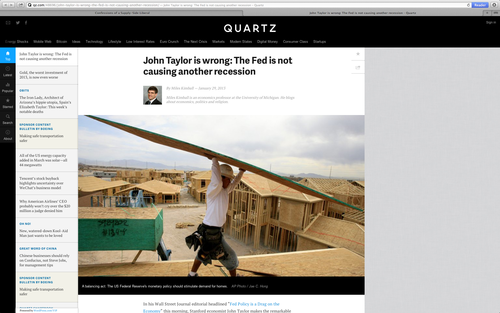
Here is the full text of my 13th Quartz column, “John Taylor is Wrong: The Fed is not causing another recession,” now brought home to supplysideliberal.com. It was first published on January 29, 2013. Links to all my other columns can be found here.

If you want to mirror the content of this post on another site, that is possible for a limited time if you read the legal notice at this link and include both a link to the original Quartz column and the following copyright notice:

© January 29, 2013: Miles Kimball, as first published on Quartz. Used by permission according to a temporary nonexclusive license expiring June 30, 2014. All rights reserved.


In his Wall Street Journal editorial headlined “Fed Policy is a Drag on the Economy“ this morning, Stanford economist John Taylor makes the remarkable claim that the US Federal Reserve’s efforts to keep interest rates down by asset purchases now—and promises of asset purchases in the future—is like rent control. If this were true, then the Fed’s actions to lower interest rates could be contractionary and could cause another recession. But it is just wrong.

The Fed’s actions to lower interest rates are more like  encouraging the construction of more apartments—by granting building permits more readily—in an effort to keep rents down. That makes all the difference. The Fed’s actions are stimulative because the Fed is acting within the framework of supply and demand bringing markets to equilibrium. While the Fed is intervening in asset markets, contrary to Taylor’s claim, it is not doing anything to take away the role of interest rates to equate supply and demand. So when the Fed brings interest rates down, people will build more houses and factories, and buy more machines and consumer durables than they otherwise would.


This column is the two-paragraph précis of my post “Contra John Taylor.”

Twitter provided some reviews of these two pieces that I liked. Here are a few:

Paul Krugman cited “Contra John Taylor.” in his column “Calvinist Monetary Economics,” writing

Actually, as Miles Kimball points out, [John Taylor is] committing a basic microeconomic fallacy — a fallacy you usually identify with Econ 101 freshmen early in the semester…

An Economist's Mea Culpa: I Relied on Reinhart and Rogoff

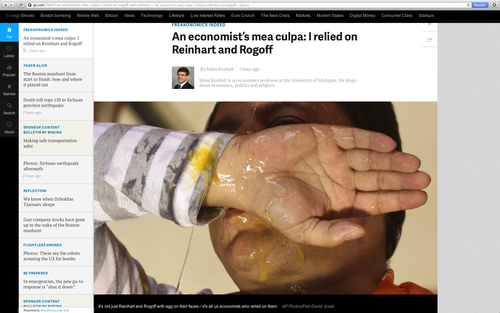
Here is a link to my 22d column on Quartz: “An economist’s mea culpa: I relied on Reinhart and Rogoff.”

Let me also reprint here from my update to “Noah Smith Joins My Debate with Paul Krugman: Debt, National Lines of Credit and Politics” in the light of recent events:

You can see what I have to say in the wake of Thomas Herndon, Michael Ash and Robert Pollin’s critique of Carmen Reinhart and Ken Rogoff’s work on national debt and growth in my column “An economists mea culpa: I relied on Reinhart and Rogoff.” (You can see my same-day reaction here.) Also, on the substance, see Owen Zidar’s nice graph in his post “Debt to GDP & Future Economic Growth.” I sent a query to Carmen Reinhart and Ken Rogoff about whether any adjustments are needed to the two figures from the paper with Vincent Reinhart that I display below, but it is too soon to have gotten a reply. I think that covers most of the issues that recent revelations raise. 


Note that I have revised “What Paul Krugman got wrong about Italy’s economy.” [My post “Noah Smith Joins My Debate with Paul Krugman: Debt, National Lines of Credit and Politics”] is now the go-to source for what I originally said there, relying on “Debt Overhangs, Past and Present” (which has Vincent Reinhart as a coauthor along with Carmen Reinhart and Ken Rogoff). 

One final thought. Given the spotlight they put on Reinhart and Rogoff, and the spotlight that is therefore on them as well, Thomas Herndon, Michael Ash and Robert Pollin may not be as careful as they should be. Am I mistaken in what I said in this tweet:

Herndon, Ash & Pollin report 11% p-value for 30-60% debt GDP vs. BOTH 60-90% and >90% bins, but don’t report p-value for 60-90% vs. >90% !

One way or the other, they should report the p-value for the 60-90% bin vs. the above 90% bin alongside the test they do report, which is less germane to the controversy about the 90% threshold. They should have made the results of the 60-90% vs. above 90% statistical test impossible to miss. How easy is it to find their report of that statistic in their paper?

Note on Comments on this Blog: I want to encourage more commentary on my blog. I need to approve each comment unless you are whitelisted. But if you send me a tweet to let me know you need a comment approved, I will get to it quicker, and normally approve it and whitelist you. I do try to enforce a certain level of civility and decorum (including a language filter), but on substance, I want a robust debate. For Quartz columns, the link I post on my blog (usually the day after the column appears) is a good place to make comments.

The Dark Side of the Human Spirit: Take 1

In my post “A Wish in the Wake of the Boston Marathon Bombings,” I wrote:

May the best in the human spirit vanquish the worst in the human spirit.

In thinking of the worst in the human spirit, I was reminded of a chapter in Stephen Pinker’s wonderful book The Better Angels of Our Nature: Why Violence Has Declined.In chapter 4, “The Humanitarian Revolution,” he writes:

But the practical function of cruel punishments was just a part of their appeal. Spectators enjoyed cruelty, even when it served no judicial purpose….

Samuel Pepys, presumably one of the more refined men of his day, made the following entry in his diary for October 13, 1660:

“Out to Charing Cross, to see Major-general Harrison hanged, drawn and quartered; which was done there, he looking as cheerful as any man could do in that condition…”

Pepys’s cold joke about Harrison’s “looking as cheerful as any man could do in that condition” referred to his being partly strangled, disemboweled, castrated, and shown his organs being burned before being decapitated….

The word keelhaul is sometimes used to refer to a verbal reprimanding. Its literal sense comes from another punishment in the British navy. A sailor was tied to a rope and pulled around the bottom of the ship’s hull. If he didn’t drown, he would be slashed to ribbons by the encrusted barnacles….

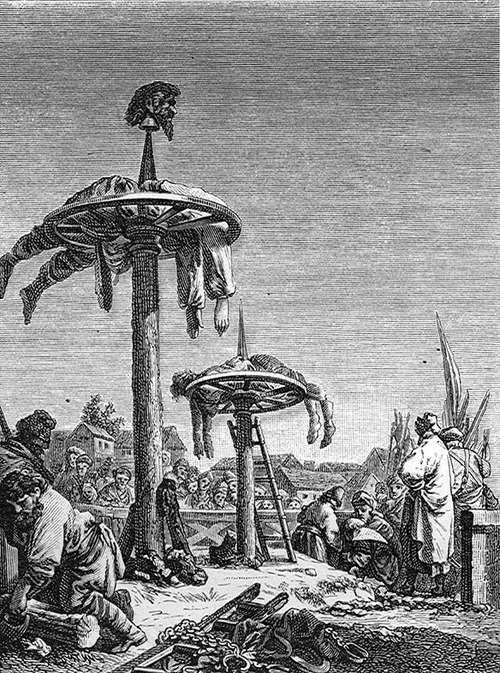
The bland phrase broken on the wheel cannot come close to capturing the horror of this form of punishment. According to one chronicler, the victim was transformed into a “huge screaming puppet, writing in rivulets of blood…”…

… Still others, like the American physician and signer of the Declaration of Independence Benjamin Rush, appealed to the common humanity of readers and the people who were targets of punishment. In 1787 he noted that “the men, or perhaps the women, whose persons we detest, possess souls and bodies composed of the same materials as those of our friends and relations…." 

I had to leave out some of the details Steven Pinker gives because the passage was too graphic. But I left some graphic things in because I wanted the message of our brutal human past to come through.

Anger, hatred and cruelty are elements in the human spirit that can be either nursed and encouraged or fought and subdued. Many of those who commit atrocities have spent many years nourishing and tending their anger, hatred and cruelty before the moment when they commit those atrocities. (Some are psychopaths without a conscience.) May we tame our anger at what they have done into an abiding motivation to make the world a better place, safer in all ways from their dark side, and from our own.

Quartz #12—>Yes, There is an Alternative to Austerity vs. Spending: Reinvigorate America's Nonprofits

blog.supplysideliberal.com tumblr_inline_mkvzvh8n041qz4rgp.png

Link to the Column on Quartz

Here is the full text of my 12th Quartz column, “Yes, there is an alternative to austerity vs. spending: Reinvigorate America’s nonprofits,” now brought home to supplysideliberal.com. It was first published on January 15, 2013. Links to all my other columns can be found here.

If you want to mirror the content of this post on another site, that is possible for a limited time if you read the legal notice at this link and include both a link to the original Quartz column and the following copyright notice:

© January 15, 2013: Miles Kimball, as first published on Quartz. Used by permission according to a temporary nonexclusive license expiring June 30, 2014. All rights reserved.


Despite serving only one term from 1989-1993, US President George H. W. Bush (just released from the hospital yesterday after a bout of fever and other complications) has cast a long shadow over subsequent events. His decision to leave Saddam Hussein in place after the First Iraq War led to his son’s immensely controversial Second Iraq War. And the negative reaction to his decision to compromise with Democrats in raising taxes in 1990 despite his pledge “Read my lips, no new taxes” has set the terms of the tax policy debate ever since. Tax reformer Grover Norquist codified the principle of “no new taxes” into the Taxpayer Protection Pledge, which goes as follows:

I, ____ pledge to the taxpayers of the state of ____, and to the American people that I will:

ONE, oppose any and all efforts to increase the marginal income tax rates for individuals and/or businesses; and

TWO, oppose any net reduction or elimination of deductions and credits, unless matched dollar for dollar by further reducing tax rates.

Republican Speaker of the House John Boehner made a nod toward this pledge two weeks ago, pushing for the temporary resolution of the fiscal cliff, when he reminded his rank and file that, technically, taxes had already gone up, due to the expiration of the younger Bush’s tax cuts at year end. The implication was that members of Congress would really be voting for a tax cut, not a tax increase, and so would not be breaking their pledge. There is no doubt that this matter of interpretation will feature prominently in the GOP primaries in 2014.

The ongoing crisis in long-run US taxing and spending policy is born from the collision of an almost unstoppable force on the spending side with Grover Norquist’s almost immovable object on the taxing side. Former Treasury Secretary Larry Summers ably describes the almost unstoppable force on the spending side in his Washington Post editorial “The Reality of Trying to Shrink Government.” The bottom line is that the explosion of government spending is primarily the result of (1) an aging population, (2) having to pay interest on ballooning government debt, and (3) the increasing cost of medicine that keeps discovering ways to do more with the expensive skilled labor of doctors and other medical professionals. To put it bluntly, the only way to keep government spending constant in the future, let alone reduce it, would be to dramatically reduce benefit levels for Social Security, Medicare and Medicaid, or to gut all the other functions of government, from national defense to the judicial system to scientific research.

It is easy to be misunderstood when mentioning Hitler, but here I want to invoke a comparison solely in his role as an inept commander-in-chief of the German armed forces and in no other capacity. In his book, The Storm of War: A New History of the Second World War, Andrew Roberts argues that Hitler’s no-retreat, “stand-or-die” orders were strategically disastrous for the German forces. German generals had a brilliant record at turning tactical retreats into great German victories. But Hitler’s stand-or-die orders took away the advantage of maneuver and left German troops to be mowed down by the Russians under Stalin. My point is that the “stand-or-die” approach is likely to do no better against the spending juggernaut than it did against Stalin.

In our long-run fiscal situation, the alternatives (of which we may need more than one) are to convince the American people to swallow straight benefit cuts, to directly raise tax rates, to grow the economy to get more revenue through:

1. Increased immigration, done in a way that focuses on economic growth, as I discussed in a previous Quartz piece entitled “Obama could really help the US economy by pushing for more legal immigration”

2. A more efficient tax system that encourages capital formation, as discussed in my “Twitter Round Table on Consumption Taxation

3. A big push for increased scientific research to accelerate technological progress

But then what? I propose that many of the jobs the government has set for itself actually be done outside the government, by the non-profit sector.

In my recent blog post “No Tax Increase Without Recompense” (there’s a cliff notes version here), I propose a “public contribution system” that goes far beyond the current tax deduction for charitable contributions. In this program:

A public contribution is a donation to a nonprofit organization meeting high quality standards that engages in activities that (a) could be legitimate, high-priority activities of Federal or State governments and (b) can to an important extent substitute for spending these governments would otherwise be likely to do.

My proposal is to raise marginal tax rates above about $75,000 per person—or $150,000 per couple—by 10% (a dime on every extra dollar), but offer a 100% tax credit for public contributions up to the entire amount of the tax surcharge.

In addition to helping the government budget by taking over tasks the government is now doing and by reducing revenue lost to the current charitable deduction, I believe the non-profit sector (with the usual level of regulation) can do many things better than the government, and this program would be much less painful for people than paying the same amount in taxes. It is easy to find fulfillment in philanthropy. There is satisfaction in knowing one has made a difference in the world, in a way of one’s own choosing. And giving can serve as a good opportunity for teaching children to care. No doubt, some would view these contributions to charitable causes as almost as onerous as the taxes to which they would be an alternative. But I don’t think that would be the typical reaction.

Many people talk as if taxes are hateful only because the government is taking our money. But taxes are also hateful because the government is arrogating to itself the choice of what should be done with the money it takes from us. The government is jealous of its power. But let us insist that any resolution of our long-run fiscal crisis reduces, rather than adds to, government power. We do need to take care of those who are poor, sick and elderly. A program of public contributions shrinks government, while getting the job done. And it would be a fitting honor for George H. W. Bush, who said movingly in his inaugural address:

I have spoken of a thousand points of light, of all the community organizations that are spread like stars throughout the Nation, doing good… . The old ideas are new again because they are not old, they are timeless: duty, sacrifice, commitment, and a patriotism that finds its expression in taking part and pitching in.

Show Me the E-Money


Q: Would negative nominal rates effectively act as a flat tax indiscriminately hitting those who can afford to pay it and those who would struggle to?

A: I really think you would see short rates go down but long rates go up because people would see that there was going to be an economic recovery. Those long-term rates should matter more for retirees, for example.

Even if the worse off are impacted in the short run you’re not going to touch social security or benefits. You’re not hitting the people at the very bottom. So we’re really just talking about relatively better off people who have something more than the state pension to retire on anyway.

Q: Given that we already have negative real returns on cash holdings and there is little evidence that it is causing firms or individuals to spend heavily, why should we expect them to respond differently to negative nominal rates?

A: Theoretically you shouldn’t have much of a response until you get the interest rate below the net rental rate. If you take a very simple model you get very little investment until you get to that point but once it is crossed you get a large amount of investment.

Things are more complicated in the real world because you have a variety of different investment projects. Nevertheless the simple model has a message that there is a critical interest rate at which investment takes off.

Suppose the net rental rate is around -2%. The message from the simple model is that there are lots of investment projects that have an internal rate of return of -2%. You might see some difference if you reduce rates from 0.5% to around zero but you shouldn’t expect to see much activity before you get below that level.

Q: Are you suggesting that at present the weakness in private sector spending is that they in effect expect a negative return on investment?

A: Absolutely. The internal rate of return companies expect, which I call the net rental rate, is currently below the natural rate of interest partly because the economy is doing badly.

This doesn’t mean that an investment will earn a negative rate of return. Investment projects may still be making positive returns on average but after adjusting for risk they might not look so appealing.

What you need to do is make it so that there is no way of getting a safe return of more than -2% anywhere and then people will take the risk of buying a new factory or building new equipment. That is why electronic money is crucial.

Q: How do you prevent huge capital flight in the interim?

A: I would use the more neutral term of a net capital outflows and there’s nothing wrong with that. The way this thing works is that the first adopter country gets a big trade surplus as a weakening currency stimulates exports.

So the first mover gets a big boost to their economy but of course other countries may complain. There are two possible answers for them:

The first is that they bring in electronic money and negative interest rates too so that the world can get the monetary stimulus it needs.

The second answer is to invite other countries to do a currency intervention. You have government debt yielding -2% and if other countries purchase it the UK gets paid handsomely for exporting some of the stimulus it’s providing to the world.

Any major country that adopted electronic money and negative rates would do the service of quickly making it happen in other countries. Although it might seem like there is a big political barrier to doing it initially the fact that any country doing it makes it politically necessary for other countries to do it makes it much more likely to happen than people realise.

Q: There was an implicit assumption behind the current policy mix in the UK that a weaker pound would boost exports. Despite falls in the value of sterling the export boom failed to materialise. Why should people expect a different result with negative nominal rates?

A: If you lower rates into negative territory at some point you are going to get more investment or more exports. It does depend on the balance of investment opportunities in the UK, for example, compared to elsewhere but you’re going to get one or the other.

Quantitative easing is a relatively weak tool and in simple models it doesn’t work at all. So I’m not surprised that it hasn’t been able to weaken sterling more and boost exports. Lowering interest rates is a much more powerful tool.

Q: But if an export boom fails to materialise could you become trapped in negative rates?

A: There’s no way you’re not going to recover. At some point you’re going to get production just for storage.

Even in the worse possible case where there were no factories or equipment that could possibly be a worthwhile investment you would still have some uplift to production from people stocking up on canned goods. So you will eventually get a recovery.

Q: From a more philosophical perspective, could the effect of the combination of electronic money and negative rates prize the commodity aspect of money from its value as a means of exchange?

A: What I would say is that electronic money represents the logical completion of the process of governments taking charge of monetary policy. It’s demoting the store of value aspect of currency, although it’s still important for it to be a decent short-term store of value between the time you get it out of the ATM and when you spend it.

Under the system of electronic money I’m talking about, where you still have paper currency around, you will still need that short-term store of value but you’ve totally demoted money as a long-term store of value. We want people to be funnelling money into building factories, buying new equipment and funding research and development. We don’t want them doing things that are not advancing the world around them.

Q: What are the implications of this for fiscal policy?

A: The zero lower bound does get in the way of monetary policy dominance. Once you get rid of it with electronic money then you really do get monetary policy dominance, and actually we’ve been there before. We didn’t have big discussions about how fiscal policy needed to stabilise the economy in the 1990s or even in the early 2000s. It’s only because we’ve run into the zero lower bound that fiscal policy has been a part of the discussion.

With fiscal policy, however, you really do have a problem as you have to deal with short run stabilisation and long run debt sustainability problems all at once. If you could get the former done through monetary policy then you only have to deal with the debt problem.

Thomas Herndon, Michael Ash, Robert Pollin and Mike Konczal: Researchers Finally Had a Chance to Replicate Reinhart-Rogoff, and There Are Serious Problems.

I thought it important to put this up right away, since I have referenced the correlations in the Carmen Reinhart, Vincent Reinhart and Ken Rogoff paper “Debt Overhangs, Past and Present.” It is likely that the later paper I relied on has some of the same problems as the earlier paper that Mike Konczal discusses based on Thomas Herndon, Michael Ash, and Robert Pollin’s paper “Does High Public Debt Consistently Stifle Economic Growth? A Critique of Reinhart and Rogoff,” In particular, I would like to know how the figures from “Debt Overhangs, Past and Present,” that I copied over in my post “Noah Smith Joins My Debate with Paul Krugman: Debt, National Lines of Credit, and Politics” are affected by the emendations of Thomas Herndon, Michael Ash, and Robert Pollin. I would be grateful for any help in figuring this out. 

Optimal Monetary Policy: Could the Next Big Idea Come from the Blogosphere?

blog.supplysideliberal.com tumblr_inline_mlaoxsKIEv1qz4rgp.png

Here is the link to my 21st Column on Quartz: “This economic theory was born in the blogosphere and could save markets from collapse.”

Even before I started blogging, Noah Smith told me I should write a post about NGDP targeting. This is that post. And it is also the post on “Optimal Monetary Policy” that I have been promising for some time.

What Do You Mean by 'Supernatural'?

Q: kentlyon asked: “What Do you Mean by Supernatural?”

A: My notion of “natural” comes from what I know of science. Since science progresses, that is a moving target, but I think the idea of regular laws will continue to be central to science. A claimed phenomenon is being treated as “supernatural” if there is no serious attempt to subject it to scientific investigation in order to establish its existence and explain it by the principles of regular science. On the other hand, if something exotic–say a claim of mind reading–is subjected to scientific investigation, it will either be (a) drawn within the orbit of science and what we count as “natural,” (b) shown to be a hoax, or (c) investigated by “science” done so badly that we can justifiably call it pseudo-science.

Remarks:

  1. Very often, how statistical issues are handled makes the difference between good science and bad science. For example, people often point to selected anecdotes as persuasive evidence even in situations where large-sample, even-handed evidence is, in principle, available.

  2. If someone makes a claim that would require new physics, the one making the claim should be making an attempt to convince the physicists. More generally, the immediate objections of the relevant experts should be registered alongside whatever claim is made.

  3. In cases where a scientific discipline itself is off target, it may be necessary to find a jury for a claim made up of people capable of understanding a scientific discipline who are enough on the outside that they can have some impartiality. Typically, it will be best to choose such a jury for judging an entire discipline as a panel of academics in other disciplines.

  4. Though particular scientific disciplines may be badly off target, I disagree with any claim that science and academic inquiry as a whole are off target.

  5. Scientific disciplines such as economics often have only weak evidence one way or another on questions people care a great deal about. In that case, it is important to distinguish between scientific statements that are backed by a large, informative body of evidence, and scientific statements that are simply the best one can make of grossly inadequate evidence. In this, I want to emphasize that evidence is often grossly inadequate even after valiant efforts to gather as much evidence as possible. Scientists in disciplines that often have grossly inadequate evidence sometimes forget to remind each other just how uncertain the answers to the questions they are debating really are, given the inadequacy of evidence.

  6. One should be especially slow to accept a claim that requires violating a principle of a scientific discipline such as physics where most statements are backed by a large amount of evidence.

  7. To the extent that there is no conceivable way to test a statement, then it is neither natural nor supernatural. (Indeed, it may not be a “phenomenon.”) Following Wittgenstein, let’s call such a statement “metaphysical.” Metaphysical statements can be important as framing, but they should not be confused with claims of the supernatural. Often, a way to quickly tell the difference between a supernatural claim and a metaphysical claim is that a supernatural claim usually has a hint of something that (if true) would seem like genuine magic (at least outside of religious contexts that desensitize people to the magical element), while a metaphysical claim points to at best metaphorical magic–which isn’t really magic at all.

  8. Just because a claim is extraordinary doesn’t make it a supernatural claim. For example, take the claim that Earth might be observed by intelligent aliens from listening posts inside our own Solar System, and that these aliens make intentional efforts to hide their presence. If the claim is that these aliens came to our Solar System in at only a small fraction of the speed of light, this does not violate any laws of physics. There is no particular implausibility to the idea that intelligent aliens would be interested in studying us scientifically. (Presumably, some species of intelligent aliens would be interested in such a scientific investigation, even if others wouldn’t.) And there is no implausibility to the idea that they might want scientific data about our behavior that was not contaminated by awareness of their existence.

  9. To give another example, there are conspiracy theories that are very implausible, but do not violate the laws of physics. I would be inclined to call these claims natural. That tells me that in my distinction between “natural” and “supernatural,” I am privileging my understanding of the laws of physics over my understanding of social science. This is in line with the phrase “the natural sciences.” It is my impression that pretty much all the principles of the natural sciences can be derived from the principles of physics and basic logic. (Leaving aside any broader claims of evolution, the narrow version of the principle of natural selection is just a matter of the logic of selection–it is like counting.)

Update. This afternoon, Noah Smith tweeted links to two articles that are wonderful on exactly the issue here: 

Luigi Zingales: Pro-Market vs. Pro-Business

From Chrystia Freeland’s book Plutocrats, pp. 261-262:

Luigi Zingales, a professor at the University of Chicago’s Booth School of Business, frames [a central issue for government policy] as the choice between being promarket and being pro business. Super-elites are often the product of a strong market economy, but, ironically, as their influence grows, they can become its opponents. 

Here is how Zingales, an ardently patriotic immigrant to America and a passionate defender of the market economy, describes the dynamic: “True capitalism lacks a strong lobby. That assertion might appear strange in light of the billions of dollars firms spend lobbying Congress in America, but that is exactly the point. Most lobbying seeks to tilt the playing field in one direction or another, not to level it. Most lobbying is pro-business, in the sense that it promotes the interests of existing businesses, not pro-market in the sense of fostering truly free and open competition. Open competition forces established firms to prove their competence again and again; strong successful market players therefore often use their muscle to restrict such competition, and to strengthen their positions. As a result, serious tensions emerge between a pro-market agenda and a pro-business one.”

Quartz #11—>Why the US Needs Its Own Sovereign Wealth Fund

Link to the Column on Quartz

Here is the full text of my 11th Quartz column, “Why the US needs its own sovereign wealth fund,” now brought home to supplysideliberal.com. It was first published on January 3, 2013. Links to all my other columns can be found here.

If you want to mirror the content of this post on another site, that is possible for a limited time if you read the legal notice at this link and include both a link to the original Quartz column and the following copyright notice:

© January 3, 2013: Miles Kimball, as first published on Quartz. Used by permission according to a temporary nonexclusive license expiring June 30, 2014. All rights reserved.


The fate of the US economy, like that of Japan, the euro zone, and the rest of the world will rest on an important fact: unless private investors or another government counteract central bank asset purchases 100%, central banks can drive asset prices up and interest rates down by buying any asset that has an interest rate above zero. The Fed has committed to continue buying $45 billion of longer-term Treasurys every month and $40 billion a month of mortgage-backed securities until the economy recovers.

But what if longer-term Treasuries and mortgage-backed securities are the wrong assets for the Fed to buy? Most of those rates are already below 3%, so it’s not that easy to push the rates down further. What is worse, when long-term assets already have low interest rates, pushing down those interest rates pushes the prices of those assets up dramatically. So the Fed ends up paying a lot for those assets, and when it later has to turn around and sell them—as it ultimately will need to, to raise interest rates and avoid inflation, it will lose money. Avoiding buying high and selling low is tough when the Fed has to move interest rates to do the job it needs to do. At least economic recovery reduces mortgage defaults and so helps raise the prices of mortgage-backed securities through that channel. But the effects of interest rates on long-term assets cut against the Fed’s bottom line in a way that is never an issue when the Fed buys and sells 3-month Treasury bills in garden-variety monetary policy.

From a technical point of view, once 3-month Treasury bill rates (and overnight federal funds rates) are near zero, the ideal types of assets for “quantitative easing” to work with are assets that (a) have interest rates far above zero and (b) are buoyed up in price when the economy does well. That means the ideal assets for quantitative easing are stock index funds or junk bond funds!

Yet, is the Federal Reserve even the right institution to be making investment decisions like this? University of Chicago finance professor John Cochrane writes in his Wall Street Journal editorial “The Federal Reserve: From Central Bank to Central Planner.”

In his speech Friday in Jackson Hole, Wyo., Mr. Bernanke made it clear that “we should not rule out the further use of such [nontraditional] policies if economic conditions warrant.”

But the Fed has crossed a bright line. Open-market operations do not have direct fiscal consequences, or directly allocate credit. That was the price of the Fed’s independence, allowing it to do one thing—conduct monetary policy—without short-term political pressure. But an agency that allocates credit to specific markets and institutions, or buys assets that expose taxpayers to risks, cannot stay independent of elected, and accountable, officials.

This is not a criticism of personalities. It is the inevitable result of investing vast discretionary power in a single institution, expecting it to guide the economy, determine the price level, regulate banks and direct the financial system.

As Cochrane points out, isn’t it a bit much to expect the Fed to both choose the right amount of stimulus for the economy and decide which financial investments are the most likely to turn a profit for a government that faces remarkably low borrowing costs?

Why not create a separate government agency to run a US sovereign wealth fund? Then the Fed can stick to what it does best—keeping the economy on track—while the sovereign wealth fund takes the political heat, gives the Fed running room, and concentrates on making a profit that can reduce our national debt.

Sovereign wealth funds are already standard for governments that have paid off their national debt and gone into the black. And some countries have both debt and sovereign wealth funds on their balance sheet. In order of holdings, the Monitor Group’s Sovereign Wealth Fund Assets Under Management Table shows that Norway, China, United Arab Emirates, Singapore, and Kuwait have the top sovereign wealth funds. Markets today are so hungry for assets as safe as US Treasurys, and so frightened of risk (pdf), that a US sovereign wealth fund would be paid handsomely to provide safe assets and shoulder some of the risk. But those financial returns are a bonus over and above the primary aim: fostering full economic recovery.

As an adjunct to monetary policy, the details of what a US Sovereign Wealth Fund buys don’t matter. As long as the fund focuses on assets with high rates of return, the effect on the economy will be stimulative, and the Fed can use its normal tools to keep the economy from getting too much stimulus. So there can be a division of labor: the US Sovereign Wealth Fund can focus on making as high a return as possible for the US taxpayer, and hire accordingly, as other sovereign wealth funds do, while the Federal Reserve focuses on getting the amount of stimulus right, which is where its expertise lies. The US Sovereign Wealth Fund needs the same level of independence as the Fed, and a single mandate to earn high returns, given the level of risk it is taking on. Above some minimum, the US Treasury can be given the authority to determine the amount the US Sovereign Wealth Fund is allowed to borrow so that no one institution would have too much power or too much responsibility.

Since it would horn in on their turf, big investment banks on Wall Street are likely to offer a chorus of complaints about a US Sovereign Wealth Fund. But after many years of playing a “heads I win, tails you lose” game with the US Government and the US taxpayers, the big investment banks have no moral standing to object to the US government and the US taxpayers finally getting some of the return that should go along with the risks that they have always had to bear.