Judging the Nations: Wealth and Happiness Are Not Enough

blog.supplysideliberal.com tumblr_mejabdMaDi1r57lmx.png

Here is a link to my 8th column on Quartz: “Emotional Indicator: Obama the libertarian? Americans say they’d be happy if government got out of their way.”

The title of this post is the original working title of the column. 

In early drafts, I related what I say in the Quartz column to Jonathan Haidt’s six moral tastes in his book The Righteous Mind: Why Good People Are Divided by Politics and Religion. Here is a New York Times book review by William Saletan, and here is a good passage from Jonathan Haidt summarizing his theory, chosen by Bill Vallicella, in Bill’s post “Jonathan Haidt on Why Working Class People Vote Conservative.”

There is a key chunk of text making the link to Jonathan Haidt’s theory that was appropriately cut for being too wonkish, but that I think you might find valuable

  1. for making that connection and 
  2. for more carefully stating the key findings about people’s preferences in hypothetical policy choices from my paper with Daniel Benjamin, Ori Heffetz and Nichole Szembrot

Here it is:

The most important boon people want for the nation as a whole is freedom. In the words we used for the choices we gave them, the #1, #2, #10, #13, #18 and #23 things people want for the nation are

  • freedom from injustice, corruption, and abuse of power in your nation
  • people having many options and possibilities in their lives and the freedom to choose among them;
  • freedom of speech and people’s ability to take part in the political process and community life;
  • the amount of freedom in society;
  • people’s ability to dream and pursue their dreams; and
  • people’s freedom from emotional abuse or harassment.

The next most important boons people want for the nation are goodness, truth, loyalty, respect and justice. On our list, the #3, #6, #8, #17, #19 and #21 most highly-valued aspects of the good society are

  • people being good, moral people and living according to their personal values;
  • people’s freedom from being lied to, deceived or betrayed
  • the morality, ethics, and goodness of other people in your nation; and
  • people having people around them who think well of them and treat them with respect
  • the quality of people’s family relationships
  • your nation being a just society.

The exact picture of “goodness” and “justice” might differ from one person to the next, but it is clear that they represent more than just money and happiness.  University of Virginia psychologist Jonathan Haidt,  in his brilliant book The Righteous Mind: Why Good People Are Divided by Politics and Religion argues that morality comes in six flavors (“The righteous mind is like a tongue with six tastes.”):

  1. liberty vs. oppression,
  2. fairness vs, cheating,
  3. sanctity vs. degradation,
  4. loyalty vs. betrayal,
  5. authority vs subversion, and 
  6. care vs. harm.

The first five of Haidt’s flavors of morality are well represented above.  The fourth flavor of morality, care vs. harm, is the one many authors focus on, to the exclusion of the others. It is the bread and butter aspects of people’s lives. In our findings, care vs. harm is reflected in 11 of the top 25 (numbers 4, 7, 9, 11, 12, 13, 16, 18, 22, 24, 25), including “the overall well-being of people and their families” in your nation, people’s health, financial security, and freedom from pain; “people having people they can turn to in time of need” and a “sense of security about life and the future in general” and balance, as reflected in the items “people’s mental health and emotional stability,” “how much people enjoy their lives” and “how peaceful, calm and harmonious people’s lives are.”

In addition to all of these, people want meaning, as reflected by #5 and #14 on our list: “people’s sense that they are making a difference, actively contributing to the well-being of other people, and making the world a better place, and “people’s sense that their lives are meaningful and have value.”  In addition to his discussion of key dimensions of morality, in The Righteous Mind: Why Good People Are Divided by Politics and ReligionJonathan Haidt emphasizes the importance of meaning—in particular, the importance of feeling one is a part of a larger whole. One of his central metaphors is “We are 90 percent chimp and 10 percent bee.” That is, Haidt believes that perhaps 90% of the time we are out for ourselves, however gently, but perhaps 10% of the time we are out for a higher cause (like the general good of everyone in our group) to the deepest level of our beings. A sense of “meaning” often comes from making that connection to something greater than ourselves.  

You can see my other posts on happiness in the happiness sub-blog linked at my sidebar, and here:

http://blog.supplysideliberal.com/tagged/happiness

Joshua Hausman: More Historical Evidence for What Federal Lines of Credit Would Do

This is the second guest post by Joshua Hausman on supplysideliberal.com.

An excellent historical analogy to Miles’s Federal Lines of Credit proposal are the 1931 loans to World War I veterans that I discussed in a guest blog post in August. As I described then, in 1924, Congress promised to pay World War I veterans a large bonus in 1945. When the Depression threw many out of work, veterans lobbied for early payment of the bonus. Congress acquiesced in 1931 by allowing veterans to borrow up to 50 percent of the value of their bonus. The main chapter of my dissertation focuses on the larger payment to veterans that occurred in 1936. In this blog post, I summarize my paper and discuss its possible implications for the success of a Federal Lines of Credit program.

Background

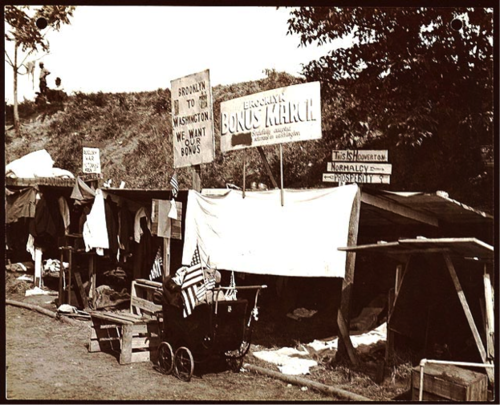
Despite their ability to take loans after 1931, veterans continued to demand immediate cash payment of the entire, non-discounted, value of their bonus. Tens of thousands camped out in Washington, DC from May to July 1932 to lobby Congress and the President for immediate payment (see picture). Rather than agree to their demands, President Hoover allowed General Douglas MacArthur to use soldiers and tanks to evict the veterans from Washington. Soldiers burned down veterans’ shacks in Anacostia. This forcible eviction provoked a political reaction that helped propel Franklin Roosevelt to victory the next year. 

  • Although popular history often emphasizes Roosevelt’s New Deal spending, FDR was in fact a deficit hawk, who raised taxes as much as he increased spending. Consequently, Roosevelt opposed payment of the bonus. But eventually, in January 1936, widespread popular support led Congress to override Roosevelt’s veto and authorize payment.

In June 1936 the typical veteran received $550, more than annual per capita income and enough money to buy a new car. In aggregate, the Federal government issued 3.2 million veterans bonds worth $1.8 billion or 2% of GDP. As a share of the economy, bonus payments were roughly the same size as the American Recovery and Reinvestment Act (the Obama stimulus) in 2009.

This payment had a loan component analogous to a Federal Lines of Credit program since it allowed veterans access to money in 1936 that they were supposed to receive in 1945. Furthermore, taking the money as cash in 1936 came with an interest rate penalty: veterans were issued bonds in $50 denominations and could cash as many or as few of them as they desired. If they held the bonds, they would receive 3 percent interest every year until 1945. Just as one pays interest when one borrows money from a bank, veterans had to forgo interest if they chose to cash their bonus in 1936.

But the 1936 legislation also was an outright gift, since it increased the present value of veterans’ lifetime income. In particular the legislation forgave interest on loans that they had taken against the bonus, and gave veterans in 1936 the same nominal sum they had been supposed to receive in 1945. In my paper, I calculate that for the typical veteran roughly half the bonus amount received in June 1936 was an increase in present value lifetime income.

Effects of the bonus

Out of the $1.8 billion of bonds issued to veterans through June 30, 1936, $1.2 billion were cashed in June and July 1936. A further 200 million were redeemed in late summer and fall. Thus 80 percent of the dollar value of the bonds was cashed in 1936. This in itself suggests large effects from giving veterans access to cash; more generally, it suggests that a program giving individuals access to low interest rate loans, as Federal Lines of Credit would do, can be quite popular. 

My paper explores whether and how veterans spent this money. The primary source of evidence is a household consumption survey administered by the Works Progress Administration and the Bureau of Labor Statistics in 1935 and 1936. By exploiting variation in when households were surveyed and in the likelihood that a household included a veteran, I estimate a marginal propensity to consume (MPC) out of the bonus of 0.7, meaning that out of every dollar of bonus bonds received, the typical veteran spent 70 cents. This result is confirmed by other, independent, sources of evidence. 

Interestingly, an MPC of 0.7 is as large as that measured from the 2001 tax rebates and 2008 stimulus payments, programs that did not have a loan component. If veterans’ spending were only influenced by the part of the bonus that represented a change in the present value of their lifetime income, then it would be almost impossible to explain the amount of spending I observe. An MPC of 0.7 out of the total bonus implies a MPC out of the increment to lifetime income of about 1.4 (since the increment to lifetime income was roughly half the bonus amount). This is implausible. Instead, the much more likely explanation is that veterans’ spent more in 1936, not only because their lifetime income was higher, but because the bonus meant access to a low interest rate loan at a time when liquidity constraints were pervasive.

Further evidence on the bonus’s effects comes from differences in the proportion of the population made up of veterans across states and cities. This variation meant significant geographic variation in bonus payments received. The figure at the top of this post juxtaposes the change in new car purchases from 1935 to 1936 in a state against the number of veterans per capita as measured in the 1930 census in that state. The slope implies that for every additional veteran in a state, roughly 0.3 more new cars were sold in 1936. In the paper, I show that this result is robust to controlling for a variety of different possible confounding variables. 

A third source of evidence on veterans’ spending behavior is an unpublished survey by the American Legion that asked 42,500 veterans how they planned to use their bonus. Veterans told the American Legion that they planned to consume 40 cents out of every dollar and to spend an additional 25 cents out of every dollar on residential and business investment. Evidence from the 2001 and 2008 Bush tax rebates suggests that such ex ante surveys are likely to significantly understate the total cumulative spending response (see section 5 of my paper for more on this argument). Thus, the prospective MPC of 0.4 measured in the American Legion Survey is consistent with an actual MPC that was significantly higher. 

Aggregate time series are also consistent with a large spending response. GDP grew 13.1 percent in 1936, more rapidly than in any other year of the 1930s. In the paper, I estimate that the bonus contributed 2.5 to 3 percentage points to this growth.

Conclusion

My results are encouraging evidence for the efficacy of Federal Lines of Credit, since they suggest that even when a large portion of a transfer payment is a loan (roughly half in the case of the veterans’ bonus), the MPC can be high. 2012 is not 1936, of course, and particular features of the 1936 economy may have contributed to unusually high spending from the bonus, specifically on durables. Still, at a minimum, my results suggest that further research on the efficacy of Federal Lines of Credit is desirable. 

Sources

The Bonus March photo is from http://www.loc.gov/exhibits/treasures/images/at0058f2as.jpg

All other material is taken from my job market paper, with sources documented there. One other paper, Telser (2003), examines the 1936 bonus in detail. Telser studies a variety of time series and concludes that the bonus “brought a large measure of recovery to the economy’‘ (p. 240).

Tunku Varadarajan on the Backlash Against Winner-Take-All in Online Journalism

In his Daily Beast article “Schadenfareed,” Tunku Varadarajan has something interesting to say about a side-effect of the winner-take-all tendencies of online journalism:

It’s lonely at the top. As the traditional news media shrivel and other platforms proliferate, celebrity public intellectuals like Zakaria (think, also, of Tom Friedman and David Brooks) become the only bankable resource left. Recognizable across all the mediums, the branded few become mini-industries unto themselves. Simultaneously, a huge cloud of excluded people, regular civilians and workaday journalists alike, can now respond on the Internet, many of them resentful that their voices go unheard while the Zakarias loom ever larger. So they pick over every word.

Tunku is explicit about the envy of the many against the few big winners in the tournament as a motivating force for the heat Fareed got for his bit of plagiarism:

What one has seen in the past few days can only be described as a hideous manifestation of envy—Fareed Envy.

It occurs to me that, while college teaching has only recently had the technological potential for such dynamics of winner-take-all, coupled with envy, academic research has long has exactly these dynamics of winner-take-all plus envy. Although often unpleasant, those dynamics are part of what keep science honest, as those on their way up make their bones by finding flaws in the work of those who are already big guns.

An Agnostic Invocation

An illustration of a traditional Christian conception of Heaven

Last Sunday, in my post “An Agnostic Grace,” I described a possible pattern for a mealtime blessing appropriate for agnostics who lean toward non-supernaturalism, but have some Christian background themselves or are aware that some Christians are also present for the meal. In this post, I want to modify that ritual to make it appropriate for opening a  religious gathering sensitive to the presence of agnostics, such as Unitarian Universalist Sunday services, or a small group meeting of Unitarian Universalists. But I want to stress that this invocation could work well in any religious gathering where the intent was to  make agnostics feel welcome. The theological background for this agnostic invocation is discussed in “An Agnostic Grace,” and in my post “Teleotheism and the Purpose of Life.”

From the beginning:

May this gathering uplift our hearts, enlighten our minds, and inspire our endeavors to bring us closer to, and glorify, the God or Gods Who May Be.

This is then followed by extemporaneous expressions of one or more of the following:

  • Gratitude: (We are thankful …)
  • Hopes: (We hope …)
  • Concerns (We are concerned …)
  • Worries (We are worried about …)
  • Thoughts (We are thinking of …)
  • Additional wishes (May …)
  • etc., in no particular order

The final words are:

And may we understand more fully the mystery of the humanity we all share, and act as one family to bring this Earth nearer to Heaven. Amen.

Duncan Green: Lant Pritchett v. the Randomistas on the Nature of Evidence—Is a Wonkwar Brewing?

I find this post by Duncan Green about the direction of the field of Economic Development especially interesting because I know people on both sides of this debate. I met Lant Pritchett when he was in graduate school at MIT and I was at Harvard since we were both in the same Mormon congregation at that time, and my wife Gail and I have kept up with Lant and his wife Diane to some degree in the years that followed. On the other side of the debate, several of my colleagues are involved in randomized controlled trials in the developing world.

Steven Johnson: We're Living the Dream, We Just Don't Realize It

In my post “The True Story of How Economics Got Its Nickname ‘The Dismal Science,’” I told how economics got its nickname “the dismal science” as a result of the opposition of John Stuart Mill (who was a noted economist as well as philosopher) to slavery. But the nickname sticks partly because people think of economists as bearers of bad news. But in fact, economists are prominent among those who remind people that over the long haul “Things Are Getting Better.” Steven Johnson’s article “We’re Living the Dream, We Just Don’t Realize It” has the same message.  For a book-length treatment of this theme, I recommend The Progress Paradox: How Life Gets Better While People Feel Worse

The economic slump we are in will someday be over. We should not let it falsely color our picture of the broad, progressive sweep of modern history. 

Joe Weisenthal on Mark Carney, Who is Moving from Bank of Canada Chief to Bank of England Chief

The UK made the unusual move of appointing a Canadian as head of the Bank of England. I applaud this small step toward a more global market in central bankers. Sometimes, the best candidate is a foreigner, even after taking political and national security concerns into account.

In this article, Joe Weisenthal expresses his admiration for Mark Carney’s record as head of the Bank of Canada.

How African Statistics are Worse and African Economies are Better than You Think

This is an interesting summary on the African Arguments website of the book “Poor Numbers: How We are Misled by African Development Statistics and What to Do About It” by Morten Jerven. There are many problems with government economic statistics in Africa. But the emphasis in this summary is that by using historical weights they often give much too much weight to declining or stagnant sectors of an economy as compared to the growing, dynamic sectors of an economy. Thus, much of the economic growth is missed.   

Time for the Paperless Revolution? Tomas Hirst Interviews Miles about Electronic Money

This interview of me by Tomas Hirst, “Time for the Paperless Revolution?” was prompted by my two Quartz columns on electronic money: 

Also, note my recent post on electronic money:

I anticipate more to come on electronic money.

An Agnostic Grace

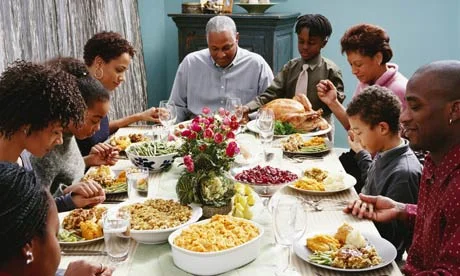
Thanksgiving-time made me think about the custom of saying grace at mealtimes to give thanks to God. Unitarian-Universalism encourages people to develop rituals that accord with their own personal beliefs, so I wanted to come up with a way of “saying grace” that would be appropriate for an agnostic like me, but that would also be appropriate in an ecumenical context where some who do believe affirmatively in God are also present. In my own case, my Mormon Christian relatives are very accepting of my beliefs, but I also wanted to be sensitive to their beliefs. Here is what I came up with.

To begin with, the invocation of a possible God or Gods is combined with a mention of the mealtime occasion:  

May the works that we do, sustained by this food, bring us closer to, and glorify, the God or Gods Who May Be.

This is then followed (in line with the Mormon custom of extemporaneous content in prayers) by expressions of one or more of the following:

  • Gratitude: (We are thankful …)
  • Hopes: (We hope …)
  • Concerns (We are concerned …)
  • Worries (We are worried about …)
  • Thoughts (We are thinking of …)
  • Additional wishes (May …)
  • etc., in no particular order

Finally, in a context in which the gathering includes mostly agnostics and Christians:

And we remember Jesus Christ, symbol of all that is good in humankind, and thereby clue to the God or Gods Who May Be. Amen.      

Let me comment on some of the choices I made in the language above:

  1. I thought it important to put the emphasis on doing good works (working toward “saving the world” in whatever ways we can, however small) rather than on the food. So the good works are mentioned first. 
  2. The phrase “Who May Be” has two different interpretations. I am a teleotheist: a theology I explore in my post “Teleotheism and the Purpose of Life.” Teleotheism is the belief that God comes at the end of history rather than at the beginning. So I interpret “Who May Be” as a future possibility. But it can also refer to a present possibility.    
  3. To me, the phrase “God or Gods” with its key word “or” is important as an affirmation of agnosticism. In Teleotheism and the Purpose of Life,” I propose this definition of God: “The greatest of all things that can come true.”  Even by this definition, it is unclear whether there is one God or many, since there could be multiple judgments by different people about what "the greatest of all things that can come true” is. To count as multiple Gods, these different Gods would have to be logically compatible. Also, given our lack of knowledge, if God is the greatest of all things that can come true, it seems reasonable to me to characterize God grammatically as a “who” rather than a “what,” even if that may ultimately turn out to be stretching the English language. In any case, “God or Gods Who May Be” should have some acceptable interpretation to most of the others in the gathering, if they come with an ecumenical spirit.   
  4. The final sentence, “Amen” is a traditional ending to prayers in Judaism, Christianity and often in Islam. It is from Hebrew and means “So be it.” In addition to that meaning, it has the practical function of indicating that the ritual is completed.  
  5. The theological background to the rest of my ending is in this passage from “Teleotheism and the Purpose of Life,” in which I am exploring what the “greatest of all things that could come true” might be:

Let’s start with the easier question of what an ideal human being looks like.Here I look to Jesus.Not the historical Jesus, but the imagined Jesus who is the projection of every good human trait, as valued by our culture.It makes all the sense in the world to ask “what would Jesus do” even if one believes that the historical Jesus was only a man, since “what would Jesus do” is a good shorthand for what our culture thinks a good person would do.This is an example of the way in which many of the highest ideas of goodness in Western Culture are embedded in religious language.

From a Christian perspective, while “we remember Jesus Christ, symbol of all that is good in humankind, and thereby clue to the God or Gods Who May Be” falls far short of affirming the divinity of Jesus Christ, it accords at least weakly with the standard Christian teachings that Jesus Christ came to earth as a revelation of God the Father, and an example to humankind of how to live, and it accords with the statement in Genesis that humankind was created in the image of God, so that human goodness gives us a clue to the goodness of God.

To give a backstory for why I would want to create a ritual like this, let me tell you my beliefs that

  1. We should each adhere to the truth as we see it, rather than trying to believe in a “noble lie,” and
  2. Human beings need religion even if there is no God. Here is why: 

Religion is the “everything else” category in our existence in human societies and as individuals after parceling out the things people understand fairly well about human life–just as “natural philosophy” used to be the “everything else” category after parceling out as natural sciences the things people were beginning to understand fairly well about the natural world.

There is still a great deal we don’t understand well enough about our existence in human societies and as individuals to parcel out as generally understood social science knowledge. I am defining “religion” as encompassing all of those areas touching on our human existence where we are still groping for answers and for the meaning of things (or for a meaning of things), even if one has ruled out supernatural answers.

I can now say that this way of saying grace is road-tested. In the last week, I have had occasion to say grace in this way twice, and found it suited those occasions well. It felt more natural in practice than it may seem on this page.

You can see my other posts on religion, culture, humanities, philosophy and science at the link

http://blog.supplysideliberal.com/tagged/religionhumanitiesscience

which is also at my sidebar.

How Marginal Tax Rates Work

Here is an exercise. What is wrong with the way the people quoted below are thinking?

1. Kristina Collins, a chiropractor in McLean, Va., said she and her husband planned to closely monitor the business income from their joint practice to avoid crossing the income threshold for higher taxes outlined by President Obama on earnings above $200,000 for individuals and $250,000 for couples.

Ms. Collins said she felt torn by being near the cutoff line and disappointed that federal tax policy was providing a disincentive to keep expanding a business she founded in 1998.

“If we’re really close and it’s near the end-year, maybe we’ll just close down for a while and go on vacation,” she said.

2. … [the extra money that comes with a raise] “is nice, but it could very well bump you into the next tax bracket, possibly leaving you with less money than you had before the raise.”

For an answer, see the wikipedia entry on “Tax Rate” and Matthew Yglesias’s posts “Nobody Understands How Taxes Work,”  “Tax Whiners Don’t Understand How Marginal Tax Rates Work,” and “Tax Ignoramuses.”  

The Wonderful, Now Suppressed, Republican Study Committee Brief on Copyright Law

This is an excellent policy brief that is a well-written, fast, easy read. You can still see it here.  Alex Tabarrok flagged it here. And Matthew Yglesias has a great discussion of the politics and the economic merits in his post “The Case of the Vanishing Policy Memo.” But on the economic merits, the policy brief speaks well for itself. 

The supplysideliberal Style Guide for Referring to Public Figures

I wanted to elevate this comment to my post “Whither the GOP,” and my reply to it, to the status of a post. Here is the comment from Tom in Tempe: 

I’ve just got to remark on your continued use of first names for President Obama and Governor Mitt Romney.  Neither is Barack nor Mitt in polite conversation.  They are as stated in the first sentence.  Please show due respect to our leadership.  The last thing we need is to grind down our leaders into the dirt of the common.

Tom in Tempe

Here is my reply:

I feel strongly that we all need to be reminded that our leaders are all fallible humans. For leaders one likes, the reminder of fallibility is most important. For leaders one doesn’t like, the reminder of humanity is most important.

In America, economists always typically call each other by their first names, regardless of how eminent an economist is. To me, that is a good reminder that it is the quality of the ideas being discussed at any time that matters, not someone’s reputation.

At another level, I feel that what the blood of our ancestors bought in the American Revolution was the right to treat all human beings as equals. We have no king that we bow to. As Americans, we all stand on an equal footing.

My custom of using first names for public figures and well as private individuals (which has some exceptions for the sake of clarity, rhetorical effect, and deferring to the sensibilities of editors, hosts or coauthors) began when I realized I had fallen into referring to the two presidential candidates as “Mitt” and “Obama,” and needed to resolve the asymmetry.   

Deference and outward shows of respect to position certainly have their place in society, but a blogger’s role is often to challenge public figures and put them in the searchlight, not to put them on a pedestal. Psychologically, referring to public figures by their first names helps me to do that.

Previously, I explained my custom of using first names in these words:

Style Guide Note: In order to emphasize the equality of all human beings, in posts appearing on supplysideliberal.com, I lean toward referring to public figures as well as others by their first names. (Of course, I only follow that rule as long as it does not get in the way of clarity or conflict too much with other stylistic considerations. I am less consistent in using first names in tweets, since there, readers don’t have as much chance to get used to it.)

I should mention here that every human being is a marvel in the universe. (Of course, biologically, even dirt is a marvel. And human beings are more than dirt.) So to treat someone properly as a human being, equal to other human beings, is to treat them with high respect.

More on the History of Thought for Negative Nominal Interest Rates

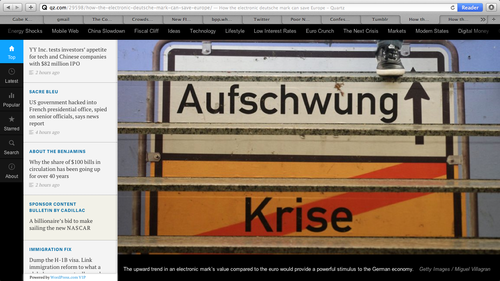
Thanks to a tweet from Migeru, I learned this morning of Willem Buiter’s post on negative nominal interest rates, “Negative interest rates: when are they coming to a central bank near you,” which discusses in detail the idea of paper currency that depreciates relative to electronic currency (with the electronic currency serving as the unit of account), which plays such an important role in my post “How Subordinating Paper Money to Electronic Money Can End Recessions and End Inflation,” (which is primarily a link to my Quartz column “E-Money: How paper currency is holding the US recovery back.”)

I consider paper currency that depreciates relative to electronic currency when there is a need for a negative nominal interest rate, and then gradually appreciates back to par when it is OK to have positive nominal interests to be superior to Silvio Gesell’s proposal of currency that is stamped after interest is paid on it. I would be glad to know more of the history of thought for the idea of paper currency that depreciates relative to electronic currency in low-interest-rate periods and then gradually appreciates back to par in higher-interest-rate periods.

Brendan Bowen champions Gesell’s proposal in his post “The case for negative interest rates now.” I learned that from Donald Pretari’s comment to Willem’s post (the second comment). Donald also refers to a Martin Wolf comment with the reference to Brad DeLong’s post on Gesell: “Silvio Gesell and Stamped Money: Another Thing Fisher and Wicksell Knew That Modern Economists Have Forgotten.”