Debora Spar on the Dilemma of Modern Women

Debora Spar has what I feel is good advice for modern women in her Daily Beast essay “Why Women Should Stop Trying to Be Perfect.” I have no first-person authority on dilemmas that women face, but having been born in 1960, I watched the Second Wave of Feminism and the Third Wave of Feminism with interest from their inceptions. I recommended this essay to my daughter.

Debora has useful things to say about how inequality in the sharing of household burdens–and in particular, the unequal sharing of child care–affects how women fare in the workforce as well:

…women who juggle children and jobs will still face a discrete and serious set of tensions that simply don’t confront either men (except in very rare cases) or women who remain childless….

Another piece of the puzzle sits closer to home, where parity remains frustratingly elusive and women still consistently log more hours than their mates. Between 1965 and 2000, the number of working mothers in the United States rose from 45 to 78 percent of all mothers, and the average time that an American woman spent in the paid labor force increased from 9 to 25 hours a week. Yet women were still devoting nearly 40 hours a week to family care: housework, child care, shopping. Men, by contrast, spent only 21, most of which were devoted to fairly discrete and flexible tasks like mowing the lawn, washing the car, and tossing softballs with the kids. (Try this. See who in any household schedules the kids’ dental appointments. My own husband, lovely though he is, seems not to be aware that our children even have teeth.)

At work, Debora points out how the true marginal products of women are often underestimated because women are less boastful than men and because the ways in which they contribute to balanced decision-making and the output of others are not fully counted:

Let me say what is often forbidden: women may differ from men in a whole range of important ways. In the aggregate, as research has shown, they may be less comfortable with outsize risk than men, and more inclined toward caution. They may be less directly confrontational, and slower to boast of their talents and successes. They may prize consensus over discord and favor personal relationships over hierarchical ones. Rather than wishing these differences away, or pretending they don’t exist, we need to analyze them, understand them, and then talk to one another about how best to create a world shaped by a diversity of styles and patterns; a world driven by women’s skills and interests and passions as much as by men’s.

Debora also has some wise words about the costs of political correctness:

Thankfully, the time for this evolution is now ripe. Millions of men have watched their daughters play soccer, their mothers launch companies, their sisters struggle to compete. They have invested in female employees who subsequently quit and have wondered, later in their own lives, whether they asked their wives to sacrifice too much on their behalf. Most of these men genuinely want women to succeed.

But they don’t know how to make the right changes and are generally not party to the conversations that women have among themselves. All too often, women are scared of raising the topic of gender with men, thinking it will brand them as radicals or troublemakers, while men are terrified of saying or doing anything that might classify them as politically incorrect. The result, of course, is that no one says anything productive at all. Women mutter to themselves about their continued exploitation, men mumble platitudes and hire high-priced diversity consultants, and nothing changes.

Finally, Debora has two key pieces of advice for women juggling both work and children in the world as it is now: 

  1. Let some things go.  
  2. If you can’t live near extended family, try to put together a group of friends who can serve as a surrogate extended family.

I like both of these points. On the first point, let me add this thought of my own:

If you think “setting priorities” is a pleasant platitude, you don’t understand what it really is. “Setting priorities” is the brutal process of deciding which things won’t get done.

The 7 Principles of Unitarian Universalism

Note: This is a major November 10, 2019 update of the original November 18, 2012 blog post, adding my own take on things. I have the same content at “Miles Kimball on `The 7 Principles of Unitarian Universalism'

I have mentioned on this blog that I am a Unitarian Universalist. The website for the Unitarian Universalist Association has a nice summary of the principles and sources of Unitarian Universalism. Let me reflect on what each one means to me. I’ll give the official statement uninterrupted, then comment. I hope that in, some measure, my blog reflects these principles.

There are seven principles which Unitarian Universalist congregations affirm and promote:

The inherent worth and dignity of every person;Justice, equity and compassion in human relations;Acceptance of one another and encouragement to spiritual growth in our congregations;A free and responsible search for truth and meaning;The right of conscience and the use of the democratic process within our congregations and in society at large;The goal of world community with peace, liberty, and justice for all;Respect for the interdependent web of all existence of which we are a part.

Unitarian Universalism (UU) draws from many sources:

Direct experience of that transcending mystery and wonder, affirmed in all cultures, which moves us to a renewal of the spirit and an openness to the forces which create and uphold life;Words and deeds of prophetic women and men which challenge us to confront powers and structures of evil with justice, compassion, and the transforming power of love;Wisdom from the world’s religions which inspires us in our ethical and spiritual life;Jewish and Christian teachings which call us to respond to God’s love by loving our neighbors as ourselves;Humanist teachings which counsel us to heed the guidance of reason and the results of science, and warn us against idolatries of the mind and spirit;Spiritual teachings of earth-centered traditions which celebrate the sacred circle of life and instruct us to live in harmony with the rhythms of nature.

These principles and sources of faith are the backbone of our religious community.

Let me discuss each principle in turn.

1. The inherent worth and dignity of every person: These days I feel keenly the denial from many quarters of full humanity to those born elsewhere, particularly if they are poor and don’t yet speak English well. One of my best statements about immigration is “"The Hunger Games" Is Hardly Our Future--It's Already Here.” I also have a sermon on the general tendency to divide the world into “Us and Them.”

For economists, a routine way of denying the inherent worth and dignity of each person is to do a cost-benefit or welfare analysis, that without comment, puts a weight of zero on non-citizens. My alternative is “The Aluminum Rule”:

When acting collectively–or considering collective actions–put a weight on the welfare of human beings outside the in-group at least one-hundredth as much as the welfare of those in the in-group.

Because of the rampant poverty in the world, the Aluminum Rule would lead to dramatically different policies than putting a weight of zero on the out-group.

2. Justice, equity and compassion in human relationships: When I read the words “justice,” and “equity,” I think of John Rawls’s book A Theory of Justice, which to me points toward the broader class of mathematically formal social welfare functions—which is a serious research interest of mine in my work with Dan Benjamin, Ori Heffetz and Kristen Cooper toward building national well-being indexes.

Beyond that, “justice” to me means this principle, distilled from blogging my way through on liberty and John Locke’s 2d Treatise—see “John Stuart Mill’s Defense of Freedom” and also “Miles Kimball on John Locke's Second Treatise,” from which the following quotation is taken:

… no government action that clearly both reduces freedom and lowers overall social welfare is legitimate, regardless of what procedural rules have been followed in its enactment.

When, as is often the case, freedom is abridged in order to enrich the lives of the rich and impoverish the lives of the poor, it makes me burn with indignation. I give some examples of policies in this category that treated by all too many people as innocent in “‘Keep the Riffraff Out!’

The word “compassion” makes me think of my own behavior much closer to home. Do I care about the people I deal with every day as much as I should? Do I strive to understand where they are coming from and what matters to them? (See “Liberty and the Golden Rule.”) Do I treat them right, both in doing my duty and looking for cases in which a modest effort on my part could benefit them greatly? Am I fulfilling my long-run duty to develop my social skills to the extent I reasonably can in order to be a warmer and more positive presence for others?

3. Acceptance of one another and encouragement to spiritual growth in our congregations: Each of us is different. Each of us has something that can be made fun of. Each of us could be made an outcast. I have my own stories of being treated at times as less than fully human because of my nerdly leanings. Those remembered moments still hurt, even decades later. Other people have their own stories of being made to feel less than fully human. To me “acceptance of one another” means a lot less of that happening.

To me, the interesting thing about “spiritual growth” is that I don’t know what it means. But that’s OK. As I wrote in “An Agnostic Grace”:

Religion is the “everything else” category in our existence in human societies and as individuals after parceling out the things people understand fairly well about human life—just as “natural philosophy” used to be the “everything else” category after parceling out as natural sciences the things people were beginning to understand fairly well about the natural world.

The same can be said for “spiritual” in the way it is used by nonsupernaturalists: “spiritual” refers to important things—many of them very, very positive—that we don’t fully understand yet. Spiritual growth is coming to a somewhat better understanding of those things and using that understanding to better our lives. To encourage one another in spiritual growth requires a sensitivity to things others are striving for or struggling with that may be hard for them to articulate. Let’s respect the things that people feel in their gut but can’t yet express very well, and give time for words to be put to those things.

4. A free and responsible search for truth and meaning: One of the glories of the U.S. Constitution is that it guarantees freedom of religion. (One of its shames was that it winked at slavery.) What is rare and precious beyond that is to have freedom of religious belief within the walls of a house of worship. I have that in Unitarian Universalism. I can believe as I believe and it is OK with everyone within a UU congregation. And I accord the same privilege to others. For example, I was fascinated rather than distressed to have Wiccan believers as full fellow members of the First Unitarian Universalist Congregation of Ann Arbor.

Truth is a sacred word to me. I left my previous religion in large measure because I felt my religious leaders (including very high-ranking leaders) had lied to me. In my career as an economist, the sacredness of truth shows up in a strong desire to urge statistical practices that put the truth ahead of careerist scientific advancement or confirmation of an ideology.

“Meaning” suggest to me both deep introspection into my own values and “Leaving a Legacy” by doing good that extends beyond one’s immediate circle. But “meaning,” like “spiritual” also points to the transcendent things that I don’t understand very well. I would like more transcendence in my life, and I don’t have much of a clue what that means. But I think the quest for transcendence, in balance with my other values, will lead to something bright and beautiful.

5. The right of conscience and the use of the democratic process within our congregations and in society at large: To me democratic values, and “the right of conscience,” means that I don’t have to bow the knee to anyone (unless I choose to do so out of freely-arrived at, deeply-felt respect). Human beings have evolved adaptations for hierarchy. But it is possible for each of us to insist on being treated as an equal and to treat others as equals. There are many intellectually interesting issues—not all of them resolved—on the question of in what sense should we be treating one another as equals. But what I am sure of is that we can and should be insisting on equality and treating others as equal to a greater extent than we do.

6. The goal of world community with peace, liberty, and justice for all: War is hell. Slavery is hell. Poverty is hell. They are hell when they happen in other countries just as much as if they happen in ours. Working to make war, slavery and poverty much rarer than they are in the world is a noble goal. And having the world sliced up into pieces with a majority of the world’s people only allowed to go into a few of those pieces is truly unfortunate.

7. Respect for the interdependent web of all existence of which we are a part. As I get older, plants and nonhuman animals intrigue me more and more. Some of our quest for meaning is likely to run through a contemplation and appreciation of plants and other animals.

Now, our planet is in danger of getting distressingly hot due to human action. We should take that seriously with serious measures (such as a carbon tax or a worldwide ban on burning coal) that go far beyond the symbolic. This doesn’t mean that we need to turn against capitalism. The best ways to take care of our precious planet, with plants, other animals, and us on it, is by using the price system and the creative potential of capitalist institutions, along with appropriate government measures.

To me, “the interdependent web of all existence” also includes the rest of the universe beyond our planet. Particularly valuable for contemplation are the many planets now being discovered beyond our solar system. (See “Exoplanets and Faith.”)

Conclusion: Besides being repelled by lies, I left my previous religion for Unitarian Universalism because its theological underpinnings felt too small. I felt the universe, and even our still tentative understanding of the universe, had a grandeur missing from what I was taught in that Church. When I was still a believer in Mormonism, I resolved (in the abstract) that I would only leave it for something that was bigger and better. Although Unitarian Universalism has a certain minimalism to it, it not only allows, but encourages the freedom of thought that allows all the best and and most wonderful thinking that has been done throughout human history in. That is truly grand.


Don’t miss these Unitarian-Universalist sermons by Miles:

By self-identification, I left Mormonism for Unitarian Universalism in 2000, at the age of 40. I have had the good fortune to be a lay preacher in Unitarian Universalism. I have posted many of my Unitarian-Universalist sermons on this blog.


Also, you can see other posts on religion, philosophy, humanities, culture and science by clicking on this link:

http://blog.supplysideliberal.com/tagged/religionhumanitiesscience

Reihan Salam: "Miles Kimball on How Electronic Currency Could Yield True Price Stability"

In his November 6, 2012 post on National Review Online, Reihan Salam begins this way:

Miles Kimball has written a stimulating, and quite convincing, short article for Quartz arguing that governments should swap electronic currency for physical currency as the “unit of account,” i.e., as the “yardstick for prices and other economic values.” While paper currency could be retained for everyday transactions, its value would fluctuate relative to  the electronic currency that would serve as an anchor.

And I especially like his later phrase:

Kimball’s discussion is nuanced…

In addition to his November 26 post, Reihan also tweeted this today:

I’m a big fan of the @mileskimball to replace paper money with electronic money as the unit of account: http://qz.com/21797/the-case-for-electric-money-the-end-of-inflation-and-recessions-as-we-know-it/ …

Whither the GOP?

I am very interested in how the Republican Party will respond to losing the presidential election. In this post, I have collected some links addressing that question. I see three possibilities.

1. More Pro-immigration. As I see it, the adjustment that maintains competitiveness in presidential elections but keeps the Republican Party’s values as close as possible to what they are now would be to become more pro-immigration. The key issue this would address is clear in the title of one of my recent posts: “Central Political Fact: Mitt Lost Despite Getting Almost 60% of the White Vote.” To be specific about how to change perceptions of the GOP without changing core Republican values, the approach I recommended to Barack in my post “Obama Could Really Help the US Economy by Pushing for More Legal Immigration” would work even better for the Republican Party if they initiated it. I predict that, if the Republican Party were willing to put up with serious grumbling from their base, outflanking the Democratic Party in being pro-immigration, while continuing to make a strong distinction between legal and illegal immigration would dramatically improve the fortunes of the GOP. Noah Smith’s post “Asian-Americans Destroy the Maker-Taker Narrative” is in the same spirit, saying that the Republican Party is in trouble if it continues to be primarily a White party.  

2. More Libertarian. Matthew Yglesias, in “The Central Tension of the GOP Coalition,” in addition to recommending less ethnocentrism, adds another possibility: becoming more libertarian (at least on gay rights) in order to appeal to the young. He writes:

… one option would be to stay committed to the idea of dismantling the welfare state and try to ditch the existing coalition in favor of some different, younger, less-white, less-ethnocentric coalition that’s more likely to want to cut retirement security programs.

3. More Populist. A final possibility is for the Republican Party to become more populist–for example, by attacking the rich and “big business.” That seems to be the direction Bobby Jindal has in mind, based on his recent interview with Jonathan Martin: “Jindal: End ‘dumbed-down’ conservatism.” Bobby also calls for less anti-intellectualism in the GOP. 

Bill Clinton on the National Debt

I liked what Bill Clinton said about the national debt at the 2012 Democratic Convention. (Here is a transcript of his speech.)

Now, let’s talk about the debt. Today, interest rates are low, lower than the rate of inflation. People are practically paying us to borrow money, to hold their money for them.

But it will become a big problem when the economy grows and interest rates start to rise. We’ve got to deal with this big long- term debt problem or it will deal with us. It will gobble up a bigger and bigger percentage of the federal budget we’d rather spend on education and health care and science and technology. It — we’ve got to deal with it.

I like this passage in his speech because he is careful to discuss the fact that interest rates are temporarily low, something I discussed in my post “What To Do When the World Desperately Wants to Lend Us Money.”

God and Devil in the Marketplace

Jonathan Haidt, in The Righteous Mind: Why Good People Are Divided by Politics and Religion, pp. 303, 304:

The next time you go to the supermarket, look closely at a can of peas. Think about all the work that went into it–the farmers, truckers, and supermarket employees, the miners and metalworkers who made the can–and think how miraculous it is that you can buy this can for under a dollar. At every step of the way, competition among suppliers rewarded those whose innovations shaved a penny off the cost of getting that can to you. If God is commonly thought to have created the world and then arranged it for our benefit, then the free market (and its invisible hand) is a pretty good candidate for being a god. You can begin to understand why libertarians sometimes have a quasi-religious faith in free markets.

Now let’s do the devil’s work and spread chaos throughout the marketplace. Suppose that one day all prices are removed from all products in the supermarket.  All labels too, beyond a simple description of the contents, so you can’t compare products from different companies. You just take whatever you want, as much as you want, and bring it up to the register. The checkout clerk scans in your food insurance card and helps you fill out your itemized claim. You pay a flat fee of $10 and go home with your groceries. A month later you get a bill informing you that your food insurance company will pay the supermarket for most of the remaining cost, but you’ll have to send in a check for an additional $15. It might sound like a bargain to get a cartload of food for $25, but you’re really paying your grocery bill every month when you fork over $2000 for your food insurance premium.

Under such a system, there is little incentive for anyone to find innovative ways to reduce the cost of food or increase its quality. The supermarkets get paid by the insurers, and the insurers get their premiums from you.  The cost of food insurance begins to rise as supermarkets stock only the foods that net them the highest insurance payments, not the foods that deliver value to you.

As the cost of food insurance rises, many people can no longer afford it. Liberals (motivated by Care) push for a new government program to buy food insurance for the poor and the elderly. But once the government becomes the major purchaser of food, then success in the supermarket and food insurance industries depends primarily on maximizing yield from government payouts. Before you know it, that can of peas costs the government $30, and all of us are paying 25% of our paychecks in taxes just to cover the cost of buying groceries for each other at hugely inflated costs.

In 2009, [David] Goldhill published a provocative essay in the Atlantic titled “How American Health Care Killed My Father”: One of his main points was the absurdity of using insurance to pay for routine purchases. Normally we buy insurance to cover the risk of a catastrophic loss. We enter an insurance pool with other people to spread the risk around, and we hope never to collect a penny. We handle routine expenses ourselves, seeking out the highest quality for the lowest price. We would never file a claim on our car insurance to pay for an oil change.

Jennifer Hunt: The Impact of Immigration on the Educational Attainment of Natives

In my latest column on Quartz, “Second Act: Obama Could Really Help the US Economy by Pushing for More Legal Immigration,” I wrote:

Additional immigration may cause a problem for native-born Americans who don’t complete high school, but the kind of education reform that will help solve that problem is already one of the president’s strong suits and something strongly supported by Republicans.

Jennifer Hunt, in her recent NBER Working Paper “The Impact of Immigration on the Educational Attainment of Natives,” finds evidence that the impact of additional immigration on high school dropouts is mitigated by the fact that many of the native born come to realize they need more schooling to avoid being in competition with immigrants. Jennifer’s paper was considered of enough general interest that it was featured in the NBER Digest. Here is the NBER Digest’s summary of her paper:   

An increase of one percentage point in the share of immigrants aged 11-64 in the population increases the probability that natives aged 11-17 eventually complete 12 years of schooling by 0.3 percentage points.

In The Impact of Immigration on the Educational Attainment of Natives (NBER Working Paper No. 18047), Jennifer Hunt finds that, contrary to the popular notion that immigrants may have a negative impact on the public education experience of native-born children, the net effect of immigrant children in schools is positive. Using the 1940-2000 censuses and the pooled 2008-2010 American Community Surveys, Hunt focuses on the impact of immigration on the probability of natives’ completion of 12 years of schooling. She finds that an increase of one percentage point in the share of immigrants aged 11-64 in the population increases the probability that natives aged 11-17 eventually complete 12 years of schooling by 0.3 percentage points.

There are at least two ways in which immigration could affect schooling outcomes for natives. Immigrant children could compete for schooling resources with native children, lowering the return to native education and discouraging native high school completion. Conversely, native children might be encouraged to complete high school in order to avoid competing with immigrant high-school dropouts in the labor market. Hunt finds evidence that both channels are operative and that the net effect is positive, particularly for native-born blacks, but not for native-born Hispanics.

Compared to natives, immigrants to the United States are much more likely to be poorly educated, and also more likely to be highly educated. Immigrants are underrepresented among workers with an intermediate level of education, such as a high school diploma.  –Matt Nesvisky

The Digest is not copyrighted and may be reproduced freely with appropriate attribution of source.

The one finding that is worrisome is the less positive effect on education for the native-born Hispanics, who are most similar to the bulk of the immigrants. This suggests that it might be wise for a policy increasing legal immigration to aim for increased immigration from a wide range of different countries. This would be consistent with having a large number of legal immigration slots for those coming from Latin American countries, if most of those slots were reserved for those who already have a strong connection to the United States–for example, by having resided here for a long time.

Central Political Fact: Mitt Lost Despite Getting Almost 60% of the White Vote

I wanted to back up some of the claims I made in my Quartz article yesterday (“Second Act: Obama Could Really Help the US Economy by Pushing for More Legal Immigration”) about the political feasibility for Barack to dramatically change America’s approach to immigration.  

In Wednesday morning’s Wall Street Journal, Gerald Seib had an interesting analysis of the situation now for the Republicans: “Tough Loss Leaves GOP at a Crossroads.” Gerald poses the question from the Republican points of view “What went wrong?” Here is his answer:

But the most significant critique will be the one that says the party simply failed to catch up with the changing face of America. Exit polls showed that Mr. Romney won handily among white Americans—almost six in 10 of them—but lost by breathtaking margins among the nation’s increasingly important ethnic groups: By almost 40 percentage points among Hispanics, by almost 50 points among Asians, and by more than 80 points among African-Americans.

The groups Barack did well among are groups that are becoming a bigger and bigger fraction of voters. 

Neil Irwin’s note “Republicans’ immigration problem in two numbers” on Wonkblog, ties the big margin for Barack among Hispanic voters to Barack’s advantage on immigration policy:

Asked how U.S. immigration policy should deal with illegal immigrants, 74 percent of Republican voters said that they should be deported to the country from which they came. But only 29 percent of voters overall shared that view. (Some 64 percent of all voters favored giving illegal immigrants a chance to apply for legal status).

My argument is that by focusing first on reform of legal immigration, Barack can get support for that from a bigger fraction of the Republican coalition than the 26% or so who are somewhat tolerant of illegal immigration. What I don’t know is how support for an expansion of legal immigration shifts as the size of the expansion increases.

Democracy in Action

We traditionally celebrate our nation on July 4. But in a very real sense, Election Day best symbolizes what America is all about. Most of us care deeply about the outcome of the election, though not all with the same hopes. But the greatest value of free elections is in all of the out-of-equilibrium outcomes that, because of the regularity of free elections, never come close to happening. Abraham Lincoln had it right in what he said about the importance of our democratic experiment:

Four score and seven years ago our fathers brought forth, on this continent, a new nation, conceived in Liberty, and dedicated to the proposition that all men are created equal.

Now we are engaged in a great civil war, testing whether that nation, or any nation so conceived and so dedicated, can long endure. We are met on a great battle-field of that war. We have come to dedicate a portion of that field, as a final resting place for those who here gave their lives that that nation might live. It is altogether fitting and proper that we should do this.

But, in a larger sense, we can not dedicate—we can not consecrate—we can not hallow—this ground. The brave men, living and dead, who struggled here, have consecrated it, far above our poor power to add or detract. The world will little note, nor long remember what we say here, but it can never forget what they did here. It is for us the living, rather, to be dedicated here to the unfinished work which they who fought here have thus far so nobly advanced. It is rather for us to be here dedicated to the great task remaining before us—that from these honored dead we take increased devotion to that cause for which they here gave the last full measure of devotion—that we here highly resolve that these dead shall not have died in vain—that this nation, under God, shall have a new birth of freedom—and that government of the people, by the people, for the people, shall not perish from the earth.

Michael Quinn, Mormon Historian

In Slate, on November 1, David Haglund published a powerful article about key controversies in the recent history of the Mormon Church:

The Case of the Mormon Historian: What happened when Michael Quinn challenged the history of the church he loved.

This history intersects with my own personal history. Although I did not leave Mormonism until 2000, the “Purge” of six Mormon scholars in September 1993 and the surrounding events forever changed my view of Mormonism. I was also a bit player in some of those events, in ways I will share at some point. Let me say that I found the work of the scholars who were purged to be very insightful and revealing.

For those who are not Mormons, I think you will find this article well worth your while as a way to get an insider’s perspective of controversies within Mormonism. There are also hints in the article of the other, more positive, side of Mormonism that engenders such great devotion in the members of the Mormon Church. To understand the pain of being excommunicated, one has to understand the level of devotion to Mormonism that these scholars had–and which many of them still have.

How to Find Your Comparative Advantage

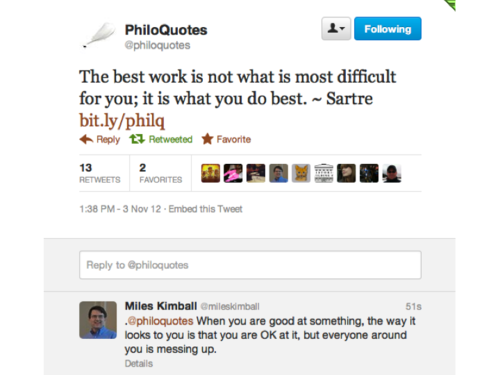
Miles gives a delayed response to Jean-Paul Sartre on Twitter

Jean-Paul Sartre said:

The best work is not what is most difficult for you, it is what you do best.

From my own observation, of others as well as myself, let me say this:

When you are good at something, the way it looks to you is that you are OK at it, but everyone around you is messing up.

When things look that way, be patient with those around you and realize that you may have found your comparative advantage–a comparative advantage that might help you go far.

Divided Government Likely to Win Again

As an independent, I am a fan of divided government. Since Democrats have lately been doing better in their Senate races, while the Republicans are quite unlikely to lose the House of Representatives, there is an excellent chance that the winner in the presidential election will not have a majority in both houses of Congress. Brian Beutler somewhat overstates the case that divided government will win in his post “Why the GOP Agenda is Likely Dead Even If Romney Wins.” Mitt is more likely to win in a situation where the Republicans also do will in their Senate races, than in a situation in which the Democrats hold the Senate. So the folks betting on Intrade are today giving an 18.4% chance that Mitt will win along with the Republicans getting both houses of Congress, while Mitt has a 13.8% chance of winning but facing a Democratic Senate, and quite small chances of winning but facing a Democratic House. (Mitt’s overall probability of winning is 33% according to Intrade.) So conditional on Mitt winning, Intrade suggests he is more likely than not to have both houses of Congress with him, but there is a substantial chance he will be checked by a Democratic Senate.

On the other side, Intrade gives only a 2% chance that Obama will be elected along with both houses of Congress being in Democratic hands. So an Obama victory has a very high chance of also being a victory for divided government. Overall, Intrade gives divided government an 80% chance of winning, with the bulk of the 20% chance of divided government losing falling on Mitt’s side.

Let me make the prediction that, even if Mitt wins the presidency and the Republicans win the Senate as well as the House, Republican control of both houses of Congress would last no more than two years. The President’s party often loses seats at the first midterm election– and the Republicans seem eager to try enough bitter medicine for the body politic–that I suspect an all-Republican government would suffer somewhat larger than usual losses at the elections in 2014.

What all this boils down to is that anyone who fears truly extreme results from the presidential election is unlikely to see those fears realized. We are likely to continue to experience the blessings of divided government bestowed upon us abundantly by the framers of the Constitution through their ingenious design of checks and balances.