David Leonhardt on How the Coming Economic Recovery Will Give Whoever is Elected the Power to Reshape Long-Run Economic Policy

This New York Times op/ed by David Leonhardt, “Who Gets Credit for the Recovery” is excellent in its discussion both of politics and of the long-run economic policy issues at stake in this election. Notice the prominence David gives in the article to the pattern Carmen Reinhart and Ken Rogoff found of especially long slumps after serious financial crises in guessing that a full recovery is on the way in the next few years. I wrote about how the Reinhart and Rogoff finding should affect our judgment of Barack Obama’s performance in short-run fiscal policy in an earlier post. David makes a good case for the importance of Barack’s long-run economic policies.

Martin Feldstein on the "Fiscal Cliff"

I don’t want to endorse his slant as an advocate, but Martin Feldstein gives a useful description of the “fiscal cliff" in his new Financial Times column "The US is unlikely to avoid ‘fiscal cliff.’” Here is his opening line:

The United States is rapidly approaching the “fiscal cliff,” a dangerous combination of increased taxes and decreased government spending scheduled for January 1 that would reduce the budget deficit by five percent of GDP between 2012 and 2013.

5% of GDP is a huge change.  

Quartz has made the fiscal cliff one of their “obsessions.” You can see Quartz’s articles on the fiscal cliff here.

International Finance: A Primer

In this post, I want to lay out the basics of international finance at the level of my Principles of Macroeconomics class. Trust me, it will be worth it. There are many points about economic policy I have wanted to make on this blog that I have been unable to make without first laying the groundwork with a discussion of international finance like this. This post focuses on international finance in the long-enough run that aggregate demand is not an issue. So any discussion of monetary policy will have to wait for another post: “Short-Run International Finance: A Primer” to come. Also, the longer-run focus of this post will show up when I talk about an increase in the national saving rate as a good thing–which I think it will be, about five years from now. But right now (2012) it would be good for people to spend more, as I assume in my posts so far about short-run fiscal policy and about monetary policy.  

I use Greg Mankiw’s Brief Principles of Macroeconomics in my class; I like his treatment of international finance very much. Underneath the surface, Greg’s treatment of international finance has two key foundational pillars:

  1. People have definite ideas (somewhat independent of the true distribution of returns on those foreign assets) about how much in the way of foreign assets they want among the assets that make up their wealth     

  2. Foreign currency is a hot potato that people want to get rid of. 

Let start by discussing these two foundational pillars in turn.

Having Definite Ideas about the Amount of Foreign Assets to Hold. Having definite ideas about how much of one’s portfolio should be in foreign assets, in a way that is partly independent of the true return properties of those assets, is not fully rational. But home-bias, the tendency to be underweight in foreign assets relative to what would be optimal in the absence of prejudice based on the distribution of asset returns alone is one of the well-documented psychological biases in economics. And because of finite cognition that is scarce in relation to the difficulty regular households have in thinking about foreign assets, people’s attitudes toward foreign assets are likely to change over time in ways that are not fully rational.

If people were fully rational about foreign assets, I suspect that Greg’s treatment of international finance would not work very well. But I think it actually does work well because cognitive limitations exist. Financial decisions are some of the hardest decisions that people make, and international finance adds an extra layer of complexity. Having some players in the market who are fully rational would make a difference, but risk aversion and limitations on the quantity of wealth those rational financial actors control means that they cannot necessarily make the markets over in their own images. Also, many people think they are being fully rational when they are depending very heavily on returns in the future having similar properties to returns in the past, and depending on those returns to have few sudden jumps.

Foreign Currency as a Hot Potato.  Nick Rowe, who is a Canadian, gives a good discussion of why foreign currency is more of a hot potato than domestic currency, in his post “Money is Always and Everywhere a Hot Potato”:

I sold my car for Australian dollars, which were also a hot potato. I sold them at a place, called a “bank”, which is a dealer in Australian dollars. Because, including transactions costs and search costs and everything else, I would probably have got the best deal from someone who specialises in trading Australian dollars and who holds an inventory of Australian dollars. Only banks do that.

If I had sold my car for Canadian dollars, which are also a hot potato, I would have looked for a buyer who specialises in trading Canadian dollars and who would give me the best deal. But everyone I deal with here in Canada specialises in dealing with Canadian dollars and holds inventories of Canadian dollars. Everyone does that. Not just banks, but jewelers too, and car dealers, and my local supermarket, and my broker, and everyone I know.

Right now I have $100 in my pocket. It’s a hot potato. I don’t want it. I plan to get rid of it. Only not right now, because I am typing this right now. I plan to get rid of it a little later. Where will I get rid of it? At my bank? Well, if I thought my bank would give me the best deal, and something I really wanted more than anything else right now, then yes I would get rid of it at the bank. But I don’t think that. I think I will get a better deal at the supermarket and gas station. So that’s where I’m planning to spend it, in a little while. (Unless the bank phones me with a great new offer that can’t wait.)

The gas station trades gas for Canadian dollars. The supermarket trades food for Canadian dollars. Continue through a long list of other traders. And the bank trades IOUs for Canadian dollars. A bank is just 1 out of 999 other places I could trade Canadian dollars.

Thus, for reasons that Nick describes, most people are willing to tolerate a significantly bigger pile of domestic currency than of foreign currency. And they are reasonably quick to trade even domestic currency for assets that are IOU’s from someone else such as an addition to the balance in a checking account, savings account or money market fund, or for stocks or bonds. And for most people, those assets that people regularly convert currency into are primarily domestic assets.  

The Recycling of Dollars (and Other Currencies). Let’s start by looking at things from the perspective of Americans thinking of buying something from abroad or otherwise sending dollars abroad, say as a charitable gift. Since U.S. dollars are a foreign currency in most of the world (leaving aside places such as Ecuador, which do use U.S. dollars), people there will want to get rid of those dollars. They are likely to go to a bank and exchange those dollars for euros, yen or whatever the local currency is. But the bank doesn’t really want those U.S. dollars either, so it wants to get rid of them as well. One way or another, the price system will ensure that those dollars get back to the United States where they are wanted, instead of staying where they are not wanted except as a way to get euros, yen or whatever the local currency is. The key part of the price system that accomplishes this are exchange rates between different currencies. But the brilliance of Greg’s approach is that one can wait until the very end to figure out what happens to exchange rates. To begin with, all one needs to know is that the exchange rates will do whatever it takes to get U.S. dollars back to the United States (or other places such as Ecuador that use U.S. dollars as the local currency). 

The other thing to realize is that exchange rates primarily affect the level of exports and imports–and given a little time, usually quite a bit: more than a 1% change in the quantity of exports or imports for a 1% change in the exchange rate. As a result:

  • A lower value of the dollar as expressed in foreign currency makes American goods cheaper to foreigners, increasing exports, and makes foreign goods look more expensive to Americans, reducing imports. (Thus, net exports, which equals the value of exports minus the value of imports, definitely increases.)  

Why? Let me look at things from the perspective of American, and think of transactions as having dollars on one side or the other of a transaction (with whatever currency exchange necessary to think of things that way rolled into the transaction). From that point of view, exports are an exchange of foreigners’ dollars for some of our goods and services. More exports are a way to get dollars that are in foreigners’ hands back to the United States. And imports can be seen as an exchange of dollars in our hands for foreign-produced goods and services. So fewer imports means less outward flow of dollars. Therefore, a lower value of the dollar shifts the flow of dollars back toward the United States.  

  • A higher value of the dollar as expressed in foreign currency makes American goods more expensive to foreigners, reducing exports, and makes foreign goods look cheaper to Americans, increasing imports. (Thus, net exports, which equals the value of exports minus the value of imports, definitely decreases.)  

Since imports send dollars outward, while exports bring them back, a higher value of the dollar tends shifts the flow of dollars away from the United States.  

The bottom line is that, in response to any initial flow of dollars, exchange rates will adjust to modify the levels of exports and imports in a way that will recycle those dollars back to where they came from.  The total amount of recycling of dollars is equal to the value of net exports. And the same principle works for any other currency. The flow of U.S. dollars helps us think about the U.S. dollar zone (the U.S. plus Ecuador and few other places), the flow of euros helps us think about the Eurozone, and the flow of yen helps us think about Japan. 

The Effects of Exchange Rates on Asset Holding. The reason to emphasize the effect of exchange rates (in this case the dollar in relation to other currencies) on net exports rather than on asset flows is that, as long as I want to start and end in the same currency, the level of exchange rates does not affect my rates of return. For example, suppose that there are 100 yen to the dollar, and the interest rate is 1% per year in Japan. I change a dollar into 100 yen, get 101 yen a year later, then turn those 101 yen into $1.01. The interest rate is still 1%.  It is only predictable changes in exchange rates that should affect rates of return. (And the fact that something is a foreign asset, which I am assuming you care about, is pretty much the same regardless of the level of the exchange rate.) What Greg does is to effectively assume that the only predictable exchange rate movements are those associated with the two currency areas at issue having different rates of inflation. That means that there are no predictable movements in real (that is, inflation-adjusted) exchange rates, so that if we think about real interest rates, we don’t need to worry about the effects of exchange rates on rates of return in our home currency. (I should say that advanced international finance models worry a lot about the effects of predictable exchange rate movements on the desire to hold various assets.)

There is one part of the effect of predictable exchange rate movements that we should definitely worry about here. If people can ever predict a sudden movement in exchange rates, they will want to get ahead of that movement by getting into the currency that is going up relative to the other, and out of the one that is going down. That tends to make the sudden movement happen early–that is, as soon as people are confident there will be a sudden movement. 

But there is another part of predictable exchange rates that it might be OK for us to ignore for now: small predictable movements. Because unpredictable movements in exchange rates tend to be so large, it is hard for people to be confident about the small predictable movements in exchange rates that might be there. Given the uncertainties, it is easy for people to ignore those small predictable movements even if they should pay attention to them. In any case, as a starting point for a Principles of Macroeconomics level analysis, Greg and I will treat asset transactions as unaffected by exchange rates.  

The Principle of Comparative Advantage from the Perspective of International Finance. Suppose that in the future, some other country became better at making everything. Let’s call it Superbia, since they are superb at making everything, and call its currency the superbo. Would we run a trade deficit with Superbia? In order to save the effects of international transactions involving financial assets until later, let’s imagine that Superbia doesn’t allow any international financial transactions except in currency. Also, assume there are no international gifts. And let’s keep things simple by thinking of Superbia as the only other country in the world. 

At first, we might imagine that we would be buying just about everything from Superbia, and they would be buying very little from us. But if initially that did happen, the people in Superbia would soon get big piles of dollars that they would be trying to get rid of. They would start getting very reluctant to let go of their superbos (the currency of Superbia) for dollars that they already had way too many of. So the value of dollars relative to superbos would go down, and the value of superbos relative to dollars would go up. That would make all of the wonderfully made Superbian goods look quite expensive. The exchange rate would keep adjusting until the dollars were well recycled.

Knowing that the dollars will get recycled, what can we say about imports and exports? With no international financial transactions and no gifts, basically the only way dollars get from one country to another are in exchange for goods. For dollars to be recycled, the Superbians must be buying things from America as well as Americans buying things from Superbia. Indeed, the value of imports and exports must be equal, which is what we mean when we say that “net exports” are zero. Of the everything that the Superbians make better with the same resources or just as well with fewer resources, Americans will end up buying those things where the Superbian advantage is greatest. But where the Superbian advantage is less, the high price of the superbo in dollars will make the Superbian version look more expensive than the American version of the good, so it will be exported from America to Superbia.

International Asset Purchases and Sales Drive Net Exports. Now let’s add in asset purchases and sales. Suppose, for example, that my readers in the United States (but not elsewhere) really took to heart the arguments I give for international diversification in my post “Why My Retirement Savings Accounts are Currently 100% in the Stock Market.” So American purchases of foreign stock increase. Initially, this puts a lot of dollars in the hands of foreigners. Those dollars are a hot potato. And no one outside the United States has been convinced by my arguments to change the amount of U.S. assets they have. So they don’t want to get rid of those dollars by buying and holding U.S. assets for any substantial period. Those unwanted dollars then kick around in the rest of the world until the price of dollars in terms of other currencies goes down. That makes American goods cheaper to the rest of the world, increasing our exports, and makes foreign goods more expensive to the rest of the world, reducing our imports, as discussed above, and eventually the dollars make their way back home.

Notice that the shift in Americans’ portfolio choices toward holding foreign assets ends up raising net exports from America. And we can figure out how much, without knowing the details of how much the dollar goes down! The increase in net exports must be exactly equal to the value of the foreign asset purchases American’s made. If they shifted $100 billion into foreign assets, it will result in $100 billion worth of extra exports as compared to imports from America.  

An Easy Policy to Restore America’s Industrial Heartland (Including Key Swing States). It is not likely that many people will actually be persuaded by my portfolio advice, so let’s think of a policy that really would increase the amount of foreign assets that Americans buy and so increase our exports and reduce our imports. David Laibson and his coauthors have found that in retirement accounts, people often stay with the default contribution level and allocation to different assets, even if they are allowed to change the contribution level and allocations of contributions to different assets by going through a little paperwork. There are at least two reasons for this. One is that people are sometimes a little lazy–or to be more charitable, perhaps scared of financial decisions. That makes them want to do nothing. The other reason people often stick with the default settings for their retirement accounts is that they think (unfortunately wrongly for the most part right now), that their company, or maybe the government has carefully thought through how much they should be putting aside and what they should be financially investing it in.  

So imagine that the government establishes a regulation that employers all need to have a retirement saving account and have a relatively high default contribution level. The employers are not required to match it. And employees can get out of making any contributions just by doing a little paperwork. But many, many employees won’t change the default contribution. So this simple regulation could dramatically raise the household saving rate in America. Assuming the government keeps its budget deficits on the same path as it otherwise would, that would also raise the national saving rate. A higher national saving rate would make loanable funds more plentiful at any real interest rate, making a surplus of loanable funds at a high real interest rate and so drive down the real interest rate. With real interest rates low in the United States, Americans would start thinking of buying more foreign assets that earn higher interest rates, and foreigners would be less likely to buy low-interest-rate American assets. (How much people want foreign assets is only somewhat independent of rates of return, not totally independent. A big enough interest rate differential will lead people in both countries to shift.) With Americans buying more foreign assets and foreigners buying fewer American assets, the flow of dollars has shifted outwards. Something has to happen to recycle those dollars. That something is a change in the exchange rate that increases net exports. And it has to increase net exports by the same amount as the change in the flow of dollars for asset purchases.

Indeed, following the tradition of calling the flow of dollars for intentional asset purchases net capital outflow, we can say that net exports would have to equal net capital outflow. More precisely, the net flow of dollars for anything other than buying goods and services has to be exactly balanced by a countervailing net flow of dollars that is about buying goods and services. And except for short periods of time, the net flow of dollars for purposes other than buying goods and services has to be intentional; it won’t take long before unintentional movements get undone by recycling. 

Now suppose that the government wants to increase net exports even more than was accomplished by mandating that all employers provide retirement savings accounts and setting a high default contribution level for retirement savings accounts. The government could simply add the regulation that the default asset allocation would be, say, 40% in foreign assets. That would dramatically increase the buying of foreign assets relative to what would be likely to happen otherwise (at least in the United States with current attitudes toward foreign assets). That would further increase net financial capital outflow from the United States, and lead to exchange rate adjustments that would further raise net exports to recycle those dollars back to the United States.       

China’s “Currency Manipulation.” China has been accused of “currency manipulation,” meaning doing something unusual to affect its exchange rate. But in Greg Mankiw’s approach, we don’t need to think much about the exchange rate at all. We can just track the flow of dollars. The bottom line is that China is buying a lot of American assets, which accounts for a big chunk of their trade surplus and a big chunk of our trade deficit. But let me tell the story starting at a little different place. Let’s start with Americans buying a lot of Chinese goods that come over on container ships. Normally, the dollars we sent to China would get recycled by the Chinese buying a lot of foreign goods. Then one way or another, exchange rates would adjust so that Americans were exporting enough more and importing enough less to counteract the initial increase in buying of Chinese goods. But in China’s case, the government intercepts those dollars before they make it back to the United States. The Chinese government gives the Chinese exporters the Chinese currency for those dollars. Then the Chinese government takes those dollars and buys foreign assets with them–including a large amount of U.S. Treasury bills. That gets the dollars back to the United States without the Chinese buying very many American goods, or buying very many goods from other countries who then buy American goods.

At the end of the day, we get a lot of Chinese goods that come over in container ships, and they get a large pile of IOU’s such as U.S. Treasury bills. There is something odd about this. An argument can be made that this hurts the Chinese much more than it hurts us Americans, and probably even helps us, but the effects are actually quite complex because they affect different groups within each country differently. In China, the political elites are often closely connected to exporters, and may even have a strong financial interest in exporters, so they may want to help their exporters even if it hurts China overall. And the part of the U.S. trade deficit caused by large Chinese purchases of American assets hurts many American businesses (both exporters and those who compete with imports) even while it helps American consumers.  

For now, though, I want to emphasize the economics without getting too much into policy evaluation. I want to emphasize that if the Chinese buy a lot of foreign assets, they will run a trade surplus, and we can say that in a quantitative way without even knowing the details of what will happen to the exchange rates. For example, if the Chinese buy an extra $1 trillion worth of foreign assets, it will result in an extra cumulative trade surplus of $1 trillion. Sometimes people say that something like that can’t go on forever. But if the Chinese government had an unlimited willingness to accumulate foreign assets, there is nothing to stop it from going on a long, long time. At some point, the pile of foreign assets will get so big, that I doubt the Chinese would actually succeed in trying to collect on all of those assets. But if they are willing to risk not getting their money back, they can keep on accumulating.    

A New Sidebar and a Badge of Honor

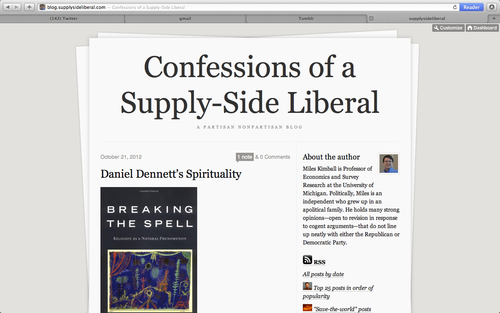
I know that many of you view supplysideliberal.com in ways that don’t let you see the sidebar. So I wanted to make sure you knew how many useful links and other things there are on the sidebar if you go to supplysideliberal.com itself on a device with a full screen. Following my technical expert Diana Kimball’s advice, I have tried to make the sidebar attractive to the eye by sprinkling thumbnail photos throughout the sidebar (often of the header illustrations of key posts).

The most important innovation on the sidebar are the “sub-blogs” of tagged posts. The sub-blogs look exactly like the blog itself, with one full post after another (not just links), but with only a subset of all the posts. Here are the sub-blogs I have so far (more to come):

http://blog.supplysideliberal.com/tagged/longrunfiscal

http://blog.supplysideliberal.com/tagged/shortrunfiscal

http://blog.supplysideliberal.com/tagged/money

http://blog.supplysideliberal.com/tagged/politics

http://blog.supplysideliberal.com/tagged/reviews

http://blog.supplysideliberal.com/tagged/humor

http://blog.supplysideliberal.com/tagged/happiness

http://blog.supplysideliberal.com/tagged/religionhumanitiesscience

Among the many useful things lower down on the sidebar that you can’t see in my two screen shots above, the most useful is the within-blog search box. I use that all the time to find posts. It has to be at the bottom of the sidebar because the search results appear underneath it.

Finally, another new addition is the “Top Economics Site" badge which clicks through to an aggregation site that lays out its selection of 100 other economics sites. I like the short description there of this blog so much that I quote it under the badge on my sidebar. Here is that description:

This unique blog by a University of Michigan economics professor applies market-driven and supply-side ideas to issues normally dominated by liberal activists. The result is a fascinating and well-written site that will challenge the assumptions of nearly any reader.

Daniel Dennett's Spirituality

Breaking the Spell: Religion as a Natural Phenomenon, p. 303:

What these people have realized is one of the best secrets in life: let your self go. If you can approach the world’s complexities, both its glories and it horrors, with an attitude of humble curiosity, acknowledging that however deeply you have seen, you have only just scratched the surface, you will find worlds within worlds, beauties you could not heretofore imagine, and your own mundane preoccupations will shrink to proper size, not all that important in the greater scheme of things. Keeping that awestruck visions of the world ready to hand while dealing with the demands of daily living is no easy exercise, but it is definitely worth the effort, for if you can stay centered, and engaged, you will find the hard choices easier, the right words will come to you when you need them, and you will indeed be a better person. That, I propose, is the secret to spirituality, and it has nothing at all to do with believing in an immortal soul, or in anything supernatural.

Q&A with Evan Soltas on the Fragility of Markets

I thought you might be interested in this question Evan Soltas posed to me (as he started thinking about what became his post “An Alternate View of Markets”) and my answer. I share this with his permission.

Question: I’m thinking about a question which might become a blog post, but before I go anywhere with it, I wanted to put my thoughts out there to someone who will be more knowledeagble on these questions.       

Do you know / have read anything about supply-and-demand equilibriums which are made unstable by certain conditions – in particular, I’m thinking about a stylized micro model in which demand is determined to a significant extent by recent changes in price, and another in which supply is determined similarly by demand, or rather the nominal expenditure level, averaged over a long period of time. 

That probably sounds absurdly vague or basic… Where I suppose I’m going with this is the first model appears to character some asset markets, particularly housing. The second is about hysteresis, particularly as it pertains to labor.

I understand those specific stories pretty well as a qualitative matter, but what I’m interested in here is the abstracted version of unstable systems, and general implication that in a very broad class of markets, the vanilla supply-and-demand story irons out too many wrinkles. Those wrinkles, in sum, point to a rather different model – one which exhibits significant path-dependent behavior, tends not to a single equilibrium but to multiple equilibria or just instability.

Maybe one way to phrase the question is: to what extent does the emphasis upon supply-and-demand blind economists? Are these portentous footnotes on the supply-and-demand really more than footnotes? Are they the “real story”? Thinking about exchange rates, we know that PPP doesn’t explain everything, and that forecasting based on fundamentals does a pretty poor job of things – are economists pretending to see equilibrating systems in realities which are more brittle, fragile, and chaotic?

Answer: This sounds like a great topic for a post. The main thing I would advise would be to preface things as what can happen when there are behavioral (=psychological, non-neoclassical) things going on in people’s behavior.  If you do that, you don’t have to worry too much about being wrong if you have good intuition for a result. But when everyone in sight is optimizing from here to the end of time, there are some very powerful, and subtle, stabilizing influences. What multiple equilibria there are in fully optimizing models don’t usually seem very plausible to me: they require extreme parameter values. There are economists who study that kind of thing, but it usually degenerates into mathematical fun and games rather than serious economics. If your story is based on someone’s non-optimizing behavior, on the other hand, it could be very robust.  Though even then, you have to worry about whether a minority of fully optimizing people could stabilize things. (The noise trader literature worries about that.)

What Should the Historical Pattern of Slow Recoveries after Financial Crises Mean for Our Judgment of Barack Obama's Economic Stewardship?

In 2003, Carmen Reinhart and Kenneth Rogoff started writing a book about the aftermath of financial crises: This Time is Different: Eight Centuries of Financial Folly. Their book’s finding that returning to the previous level of per capita GDP takes a long time after serious financial crises has become part of the political debate. In both the Democratic Convention and in the debates, part of the argument that Barack has done a good job, under the circumstances, has relied on the idea that recoveries should be expected to be especially slow after serious financial crises. Noah Smith ably discusses the merits of the  Republican counterattack on the Reinhart-Rogoff finding in his post Reinhart-Rogoff vs. Bordo-Haubrich (with grandstanding by John Taylor). Carmen Reinhart and Ken Rogoff’s own defense of their finding is very useful, especially if you haven’t read their book. They are focused only on the historical evidence in their response. They do not directly engage in the political debate.    

I take the Reinhart-Rogoff finding very seriously, and will treat it as a good historical generalization in this post. But I want to point that–even stipulating that returning to the previous level of per capita GDP has historically taken a long time after serious financial crises–the implications of this Reinhart-Rogoff finding for the political debate are much more less clear than the Democratic argument would suggest. In particular, as Carmen and Ken acknowledge in their recent defense of their finding, what happens after a serious financial crisis is not some immutable law of nature, but depends on the policy response. And the key question for the political debate is not if the policy response of the Obama administration’s policy response was better than the policy response to serious financial crises has been historically, but whether the Obama administration’s policy response was as good as it should have been given what was known at the time. The very existence of This Time is Different: Eight Centuries of Financial Folly (published in September 2009 and surely existing in draft form quite a bit earlier)within a time period relevant for Obama Administration policy making should set the bar higher. 

In particular, in the light of the Reinhart-Rogoff finding that he should have had access to, one can make the argument that Barack should have known he needed to do more than the policies he chose in order to get a robust recovery. Indeed, (as I also cited in my post “Why George Osborne Should Give Everyone in Britain a New Credit Card”) in his excellent Atlantic article, “Obama Explained,” James Fallows wrote:

If keeping the economy growing was so central for Obama, why was the initial stimulus “only” $800 billion? “The case is quite compelling that if more fiscal and monetary expansion had been done at the beginning, things would have been better,” Lawrence Summers told me late last year. “That is my reading of the economic evidence. My understanding of the judgment of political experts is that it wasn’t feasible to do.” Rahm Emanuel told me that within a month of Obama’s election, but still another month before he took office, “the respectable range for how much stimulus you would need jumped from $400 billion to $800 billion.” In retrospect it should have been larger—but, Emanuel says, “in the Congress and the opinion pages, the line between ‘prudent’ and ‘crazy spendthrift’ was $800 billion. A dollar less, and you were a statesman. A dollar more, you were irresponsible.”

Barack certainly had access to Larry Summers’s advice. And I would be surprised if Larry Summers’s advice at the time didn’t incorporate Larry’s awareness of what Carmen and Ken had found. So the fact that Barack did not push for a bigger stimulus package really is an indictment of his economic leadership. According to the reported statement by Larry Summers, it was a political judgement that a bigger stimulus was not politically feasible. I am not at all convinced that a bigger stimulus was politically impossible. It would not have been easy, I’ll grant that, but I was amazed that Barack managed to get Obamacare through. If, instead, Barack had used his political capital and the control the Democrats had over both branches of Congress during his first two years for a bigger stimulus, couldn’t he have done more? 

The bottom line is that (asking a lot of Mitt’s protean ability to shapeshift) if Mitt were willing to distance himself far enough from the Republicans in Congress and the Republican orthodoxy, it would be quite possible to use the Reinhart-Rogoff finding to attack Barack’s economic stewardship. Barack should have known the economy needed more stimulus, and in fact his closest economic advisor knew that the economy needed more stimulus! Mitt could then claim that Barack was so set on forcing through health care reform that he took his eye off the more urgent task of ensuring economic recovery. (I remember Peggy Noonan, without specifying what economic policy should have been taken, forcefully making the argument at the time that Barack was putting too high a priority on health care reform relative to fostering economic recovery.) It is a tricky argument for a Republican to make, saying that with the Republicans dead set against both an adequate stimulus and Obamacare, Barack should have focused on the fight for an adequate stimulus rather than for health care reform, but it is a logically cogent one. (I have to confess to my own ignorance about the extent to which Mitt’s own statements about the stimulus package in 2009 would also cause him trouble in making this argument. Given Mitt’s willingness to emphasize at different times a different one of his contradictory statements over others, did he ever say anything then that could be spun as having warned that the stimulus wasn’t big enough–or should have been the same size but focused on things that most economists would agree would have been more effective at raising aggregate demand?)

Aside from the political argument itself, the issues I raise should be part of history’s judgement of Barack Obama. In particular, I take exception to Joe Biden’s claim in the vice presidential debate with Paul Ryan that “no president could have done better” than Barack has done. I suspect, in fact, that Bill Clinton would have done better if he could have been president again. It is quite possible that Hillary Clinton would have done better–in part because she might have been more gun-shy about health care reform and so have focused more intensely on the more immediate economic issue. And Mitt might well have done better had he won the presidency in 2008 (in part because he would have faced less intense Republican opposition to needed stimulus)–though it is hard to know if he would have taken the right policy direction.

Notice that in all of this, I am treating a larger stimulus of a conventional kind as the best among well-discussed policy options when Barack took office in 2009. So I am backing up Paul Krugman’s criticisms of Barack’s policies at the time. However, given what we know now we could do even better, as I discuss in my post “About Paul Krugman: Having the Right Diagnosis Does Not Mean He Has the Right Cure.”

Update:

About Paul Krugman: Having the Right Diagnosis Does Not Mean He Has the Right Cure

This is the second time in less than a month that Paul Krugman’s picture has headed one of my posts. (The other time is here.) That is no accident. Paul is the true monster of the economics blogosphere–as well as in the beleagured redoubts of non-electronic economic journalism that remain.  I use the word “monster” in the positive and enviable sense of having a large reach and influence with the words that he writes. (Please, may I some day grow up to be a monster? See the illustration from Where the Wild Things Are.

In his recent post, “Smuggish Thoughts (Self-Indulgent),” Paul writes this:

I got obsessed with Japan in the 1990s, and I think can fairly claim to have started the whole modern liquidity-trap literature. I approached the Japan problem the way I approach just about all economic problems, building a stylized, minimalist model (big pdf) that seemed to make sense of the available facts and yielded strong conclusions. But does this style of analysis work in the real world?

Well, events provided an acid test. If you believed in the little models I and others were using, you made some very striking predictions about how the world would work post-crisis–predictions that were very much at odds with what other people were saying. You predicted that trillion-dollar deficits would not drive up interest rates; that tripling the monetary base would not be inflationary; that cuts in government spending, rather than helping the economy by increasing confidence, would hurt by depressing demand, with bigger effects than in normal, non-liquidity trap times.

And the people on the other side of these issues weren’t just academics, they were major-league policy makers and famous investors.

And guess what: the models seem to work. It appears that I wasn’t just a successful self-marketer, that I really did and do know something.

Basically, I agree with Paul’s assessments here–his diagnosis of what happened. But I do not agree with his prescription. As near as I can make out (and I am happy to be corrected on this), his number one recommendation has been a large increase in government spending to provide Keynesian stimulus, and his number two recommendation has been for the Fed to promise future inflation above its normal 2% target.

That secondary recommendation I discussed in my earlier post on Paul Krugman. I will not repeat everything I said there, but let me say a few words about the relevant scientific issue. The issue I have with Paul’s analysis there is that he seems to approach the approximate Wallace neutrality that is likely in the real world–which can account for the facts he mentions above–for the perfect Wallace neutrality of his simple model, which would imply that large scale asset purchases by the Fed (as in QE1, QE2, QE3 and Operation Twist) will not work in any direct way, so that the Fed’s only option for stimulating the economy is to promise (or hint at) inflation above 2% in the future.

In relation to Paul’s primary recommendation of a massive increase in government spending in the short run, my main objection is that (assuming we are not willing to contemplate national bankruptcy), every dollar the Federal government ultimately adds to the national debt is a dollar that has to be paid for by taxes further down the road, or by cuts in government spending further down the road that will be hard to bear, given the aging of the population. Except in the case of spending now that can genuinely serve instead of spending in the future, we have to be very concerned about the cost of stimulative spending.

Let me give a simple numerical example to make the point. After the economy gets fully back on its feet, I expect the interest rate to be something like 4% per year in real terms. Suppose we added $2 trillion more to the debt to stimulate the economy and then wanted to keep that extra debt from growing further in real terms so that the growth of GDP could gradually reduce the debt-to-GDP ratio. To do that, we would have to pay the real interest on that extra debt: $2 trillion * 4% per year = $80 billion per year. If GDP by then is a little higher than now, at $16 trillion per year, that is a ½ % addition to the spending to GDP ratio. A lot of the big arguments between Republicans and Democrats are about differences in government spending on the order of about 3% of GDP. So ½ % of GDP difference in government spending due to extra interest payments is actually a very big deal.

So it is a great advantage to simulate the economy by measures that add less to the national debt, the Federal Lines of Credit which I lay out in my second post “Getting the Biggest Bang for the Buck in Fiscal Policy” and have discussed at great length in the other short-run fiscal policy posts on this blog.

(It seems plausible to me that large scale asset purchases by the Fed also have this property of stimulating the economy while adding relatively little to the national debt in the end. I would be glad to see a careful analysis of the likely round-trip financial costs to the Fed of pushing interest rates down and asset values up by buying long-term government bonds and mortgage-backed securities now to stimulate the economy, and pulling interest rates up and asset values down later by selling them to rein the economy in–or alternatively raising interest on excess reserves later.) 

It matters how we approach the problems that we face. Paul Krugman deserves a lot of credit for getting the basic diagnosis of our problems right, but he needs to be just as serious about identifying the best possible solutions. Traditional Keynesian remedies or promises of inflation may work to stimulate the economy, but what if there is a better remedy, with fewer undesirable side effects? It is my contention that there is a better remedy, that would have the same effectiveness at lower cost: Federal Lines of Credit. And that is in addition to the possibility that the Fed has already found a better approach in large scale asset purchases, if only it pushes hard enough on its string.  

Update: A commenter on Twitter (I’ve lost track of the tweet) points out that the government can stabilize the debt to GDP ratio if it pays only the interest rate minus the growth rate of the economy on the debt each year, rolling over the rest, including rolling over the part of interest payments equal to the growth rate. That makes the long-run picture look less stark than the calculation I make if the interest rate is less than 3% above the growth rate of the economy. For example, approached that way, if the interest rate is only 1.5% above the growth rate of the economy, then the $2 trillion in extra debt would mean a permanent ¼ % of GDP less spending or a permanent ¼% of GDP less taxes.

A New Engine for Discovery in Economics and Other Social Sciences: RAND's American Life Panel

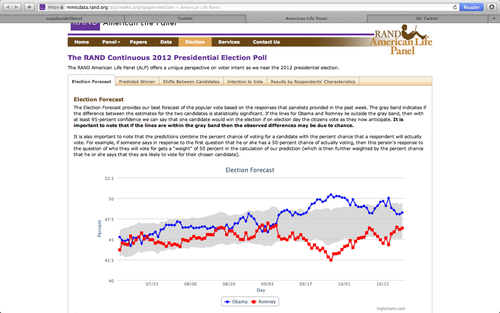
A few years back, economists and other social scientists and technical experts at RAND and the University of Michigan put together a grant proposal focused on seeing what can be done with web surveys. Thanks to funding provided by the National Institute on Aging (part of the National Institute of Health), we were able to find out the answer. Leaving out many details, the basic answer is that, except for a few things that have to be done in person, web surveys are at least as good, and usually better, than other survey methods. RAND’s American Life Panel arose out of that collaboration (though it is now an independent RAND survey that has a wide range of clients other than government research agencies). I can’t pretend to be objective about the American Life Panel. As part of a large team, I have been involved in it from the beginning and I love it. 

An important distinction has to be made between commercial web surveys, which use samples of convenience (often trying to match certain broad demographic frequencies to the population as a whole) and scientific web surveys that make great efforts to get as close to a representative sample as possible–even on characteristics that are unmeasured. The American Life Panel is just such a scientific web survey. Every effort is made not only to draw respondents randomly from the population as a whole, but also to give web access to those randomly chosen who don’t already have web access.

By contrast to most surveys, which fairly soon became calcified under the weight of a standard set of questions that are asked again and again, taking up most of the available survey time, under Arie Kapteyn’s leadership, the American Life Panel (ALP) has grown in power and reach under a unique philosophy of experimental modules initiated in a relatively decentralized way that over time add up to much more than the sum of the parts. At this point, data from a huge variety of experimental modules can now be compared to data on ALP respondents that duplicates most of what is collected from respondents to Michigan’s Health and Retirement Study and data that duplicates a big subset of what is collected from respondents to Michigan's Cognitive Economics Study. Arie’s commitment to supporting “bold, persistent experimentation” in surveys augurs well for the future of the American Life Panel.

Because the American Life Panel has only recently come into its own, most economists don’t realize what is there, what can be done with the existing data on the ALP, and what can be done by collecting new experimental data to combine with the ALP’s existing data. For young economists in particular, I am confident there are many, many dissertations hiding in the data already collected, aside from everything that is coming.    

Just for fun, I have put a link under the illustration to the ALP’s election forecast webpage, based on survey questions that probe for probabilities as opposed to discrete answers–a style of survey question that has been advocated most forcefully by Chuck Manski and his coauthors. Also, unlike typical election polls, the results you see above and at the election forecast webpage are based on panel data: the same people are asked the questions repeatedly, so that the changes you see are more likely to be genuine changes in opinion, instead of random  fluctuations in the set of people surveyed. (Note: the election polling behind the picture above is not supported by any government agency.) 

Update: Brad DeLong tweeted to me this interesting comment:

RAND’s reinterview method is a treatment that over time turns low-info voters into high info voters. That’s a powerful bias…

My reaction is that if Brad is right, the views of a high-information sample of otherwise typical voters from a representative sample is itself very interesting. The question that Brad raises is a good example of the value of an experimental survey–to be able to discover and investigate, or rule out, effects such as that.

Al Roth's Nobel Prize is for Economics, but Doctors Can Thank Him, Too

image

Here is a link to my third column in Quartz, about the Nobel Prize in Economics for Lloyd Shapley and Al Roth. This column describes ongoing research by Dan Benjamin, Ori Heffetz and Alex Rees-Jones and me about trade-offs young medical doctors make in their National Resident Matching Program choices–in particular, tradeoffs between happiness and other goods.  

Update: Thanks to Daniel Altman’s digging, Here is a little more detail from Al Roth his efforts with the National Resident Match Program and how it works:

Joshua Muravchik and Bryan Caplan on Field Trials of Socialism

At this link, Bryan Caplan does a great job of framing Joshua Muravchik’s account of Robert Owen’s utopian socialist experiments. Bryan sums up his take in this way:

Until now, I’d always thought that despite his pretensions, Marx was no better than the Utopian socialists.  Now I realize that this was entirely unfair.  Marx was decidedly inferior to his “Utopian” rivals.  They were wrong, but at least they had the common sense and common decency to beta test their radical proposals on a small scale with consenting subjects.

Enrico Moretti on Rich Cities and Poor Cities

Instead of thinking of rich countries and poor countries, rich regions an poor regions, this article by Enrico Moretti recommends thinking about rich cities and poor cities. Here are some of the highlights–the striking outcomes and the paradox that distance still matters in a wired world. One element of the story, at least in the U.S., is the rise of industries in which human capital is more important than physical capital. Highly educated people–who are the key resource for those industries–often want to congregate in interesting cities. (That claim is the main point of Richard Florida’s book The Rise of the Creative Class.)

The economic map of America today does not show just one country – it shows three increasingly different countries. At one extreme are America’s brain hubs – cities like Seattle, Raleigh-Durham, Austin, Boston, New York and Washington DC – with a thriving innovation-driven economy and a labor force among the most creative and best paid on the planet. The most striking example is San Francisco, where the labor market for tech workers is the strongest it has been in a decade. At the other extreme are cities once dominated by traditional manufacturing – Detroit, Flint, Cleveland – with shrinking labor force and salaries. 

In 1980, the salary of a college educated worker in Austin was lower than in Flint. Today it is 45 percent higher in Austin, and the gap keeps expanding with every passing year. The gap for workers with a high school degree is a staggering 70 percent by some estimates. It is not that workers in Austin have higher IQ than those in Flint, or work harder. The ecosystem that surrounds them is different.

In China, Shanghai has reached a per capita income close to that of a rich nation. Its students outperform American and European students in standardized tests by a wide margin. Its public infrastructure is better than that of many American cities. But agricultural communities in western China have made much less progress.

Despite all the hype about exploding connectivity and the death of distance, economic research shows our salary, productivity and creativity increasingly depends on the place where we live.

Video conferencing, e-mail, and Skype have not made a dent in the need for innovative people to work side by side. In fact, that is more important than ever. Thousands of well-educated innovative workers are now moving to San Francisco and Silicon Valley, many attracted by jobs in social networking. They will produce software intended to create virtual communities that erase distance and allow us to share ideas and information from any corner of the world. Ironically, in order to do that successfully, all this talent must concentrate into a single location. Research shows that our best ideas still reflect the daily, unpredictable stimuli that we receive from the people we come across and our immediate social environment.

Does Ben Bernanke Want to Replace GDP with a Happiness Index?

Here is the link to my column on Quartz and a screen shot of the illustration at the top. 

This is my second column on the Atlantic’s new world business website Quartz. One of the interesting things about Quartz is that it is designed to look good on a smartphone or tablet. But it works fine on a regular computer as well, as you can see from the screen shot.   

Anders Åslund on the Lessons of Sweden

Note: The original link is now broken. The best replacement I could find is Scott Sumner’s extensive quotations here.  

Sweden went through some large swings in economic policy highly relevant for U.S. economic policy debates. The full story is important. Here is Anders Aasland’s version. (I think “aa” is an acceptable spelling of an “a” with a circle over it.)

Thanks to Scott Sumner for highlighting this Anders’s essay. Scott notes:Aslund neglects to mention things like Stockholm’s congestion pricing scheme.” 

Greg Ip on Barack Obama's Performance as Steward of the Economy

This is an excellent discussion by Greg Ip of how Barack has done in his economic policy choices and the economic role of presidents in general.

Note: The appropriate judgment of Barack’s performance would be much different if the many ways to stimulate aggregate demand

  1. without adding too much to the national debt and
  2. in an environment where short-term interest rates are already down to zero

had been better understood when he faced the economic challenges of the last few years.

On the many ways to stimulate aggregate demand without adding too much to the debt and in a low-interest rate environment, see my blog posts on short-run fiscal policy and monetary policy, which are nicely laid out in these two “sub-blogs” of tagged posts:

These sub-blogs of tagged posts automatically update as I add more posts with the relevant tags. I put links to these sub-blogs on my sidebar. (I will add links to other sub-blogs soon.)