More Evidence for the Use It or Lose It Hypothesis for Dementia Prevention: Better Vision Seems to Help Ward Off Dementia

In addition to looking at the article shown above, don’t miss these related posts:
A Partisan Nonpartisan Blog: Cutting Through Confusion Since 2012
In addition to looking at the article shown above, don’t miss these related posts:
Juvenal’s question of “Who guards the guardians” is a very difficult design question that appears in many social domains and at many levels.
In the economic realm, supervisors and bosses and CEOs are guardians an important piece of the social structure. The free market only works well at all because of a set of rules that block the most obvious ways to get rich: stealing, lying, and extortion by threats of violence. And the free market in the 21st century will only work really well if we go through the design process of figuring out all the other ways that people—especially those with a great deal of economic reach—can only get rich by doing something commensurately valuable for other people, after netting out any harm done. (An adequate design process would probably come to a different set of rules for different sectors of the economy; possible ways to get rich without doing something commensurately valuable for other people differ by sector.)
In the political economy realm, the difficult design problem, essential for economic growth, is to create a government that can and will stop people from stealing, lying, extorting by threats of violence—or getting rich by some other means that does not serve other people—without that government itself being so strong and wanton that it steals, lies, intimidates and actively perpetrates injustice itself.
Democracy with reasonably free and fair elections (and reasonably peaceful transfers of power) cuts off the worst bad governments in the tail. But even genuine democracy is not enough to prevent moderately serious governmental malfeasance. The framers of the US Constitution had these problems in mind.
The checks and balances between different components of government was the best solution they could come up with. The first half of the Federalist Papers #51, written by either Alexander Hamilton or James Madison, details some of the checks and balances they hoped would help ward off bad outcomes. That the author of the Federalist Papers #51 had the difficulty of the design problem in view is clear from these passage:
In framing a government which is to be administered by men over men, the great difficulty lies in this: you must first enable the government to control the governed; and in the next place oblige it to control itself. A dependence on the people is, no doubt, the primary control on the government; but experience has taught mankind the necessity of auxiliary precautions.
Here are some of the key ideas in the first half of the Federalist Papers #51 (bullets added to separate passages):
… each department should have a will of its own; and consequently should be so constituted that the members of each should have as little agency as possible in the appointment of the members of the others. Were this principle rigorously adhered to, it would require that all the appointments for the supreme executive, legislative, and judiciary magistracies should be drawn from the same fountain of authority, the people, through channels having no communication whatever with one another.
Some deviations, therefore, from the principle must be admitted. In the constitution of the judiciary department in particular, it might be inexpedient to insist rigorously on the principle: first, because peculiar qualifications being essential in the members, the primary consideration ought to be to select that mode of choice which best secures these qualifications; secondly, because the permanent tenure by which the appointments are held in that department, must soon destroy all sense of dependence on the authority conferring them.
… the members of each department should be as little dependent as possible on those of the others, for the emoluments annexed to their offices.
Ambition must be made to counteract ambition. The interest of the man must be connected with the constitutional rights of the place.
It may be a reflection on human nature, that such devices should be necessary to control the abuses of government. But what is government itself, but the greatest of all reflections on human nature? If men were angels, no government would be necessary. If angels were to govern men, neither external nor internal controls on government would be necessary.
This policy of supplying, by opposite and rival interests, the defect of better motives, might be traced through the whole system of human affairs, private as well as public.
… the constant aim is to divide and arrange the several offices in such a manner as that each may be a check on the other that the private interest of every individual may be a sentinel over the public rights. These inventions of prudence cannot be less requisite in the distribution of the supreme powers of the State.
In republican government, the legislative authority necessarily predominates. The remedy for this inconveniency is to divide the legislature into different branches; and to render them, by different modes of election and different principles of action, as little connected with each other as the nature of their common functions and their common dependence on the society will admit.
… the weakness of the executive may require, on the other hand, that it should be fortified. An absolute negative on the legislature appears, at first view, to be the natural defense with which the executive magistrate should be armed. But perhaps it would be neither altogether safe nor alone sufficient. On ordinary occasions it might not be exerted with the requisite firmness, and on extraordinary occasions it might be perfidiously abused. May not this defect of an absolute negative be supplied by some qualified connection between this weaker department and the weaker branch of the stronger department, by which the latter may be led to support the constitutional rights of the former, without being too much detached from the rights of its own department?
In the compound republic of America, the power surrendered by the people is first divided between two distinct governments, and then the portion allotted to each subdivided among distinct and separate departments. Hence a double security arises to the rights of the people. The different governments will control each other, at the same time that each will be controlled by itself.
There is genius in the design the US Constitution. And the problem of “Who guards the guardians?” still causes trouble. As always, things are bad, but they could be much, much worse. That they are not worse owes partly to the structure of the US Constitution, but even more importantly to the virtue of many in a wide variety of positions who uphold it.
Below is the full text of the first half of the Federalist Papers #51.
FEDERALIST NO. 51
The Structure of the Government Must Furnish the Proper Checks and Balances Between the Different Departments
From the New York Packet
Friday, February 8, 1788.
Author: Alexander Hamilton or James Madison
To the People of the State of New York:
TO WHAT expedient, then, shall we finally resort, for maintaining in practice the necessary partition of power among the several departments, as laid down in the Constitution? The only answer that can be given is, that as all these exterior provisions are found to be inadequate, the defect must be supplied, by so contriving the interior structure of the government as that its several constituent parts may, by their mutual relations, be the means of keeping each other in their proper places. Without presuming to undertake a full development of this important idea, I will hazard a few general observations, which may perhaps place it in a clearer light, and enable us to form a more correct judgment of the principles and structure of the government planned by the convention. In order to lay a due foundation for that separate and distinct exercise of the different powers of government, which to a certain extent is admitted on all hands to be essential to the preservation of liberty, it is evident that each department should have a will of its own; and consequently should be so constituted that the members of each should have as little agency as possible in the appointment of the members of the others. Were this principle rigorously adhered to, it would require that all the appointments for the supreme executive, legislative, and judiciary magistracies should be drawn from the same fountain of authority, the people, through channels having no communication whatever with one another. Perhaps such a plan of constructing the several departments would be less difficult in practice than it may in contemplation appear. Some difficulties, however, and some additional expense would attend the execution of it. Some deviations, therefore, from the principle must be admitted. In the constitution of the judiciary department in particular, it might be inexpedient to insist rigorously on the principle: first, because peculiar qualifications being essential in the members, the primary consideration ought to be to select that mode of choice which best secures these qualifications; secondly, because the permanent tenure by which the appointments are held in that department, must soon destroy all sense of dependence on the authority conferring them. It is equally evident, that the members of each department should be as little dependent as possible on those of the others, for the emoluments annexed to their offices. Were the executive magistrate, or the judges, not independent of the legislature in this particular, their independence in every other would be merely nominal. But the great security against a gradual concentration of the several powers in the same department, consists in giving to those who administer each department the necessary constitutional means and personal motives to resist encroachments of the others. The provision for defense must in this, as in all other cases, be made commensurate to the danger of attack. Ambition must be made to counteract ambition. The interest of the man must be connected with the constitutional rights of the place. It may be a reflection on human nature, that such devices should be necessary to control the abuses of government. But what is government itself, but the greatest of all reflections on human nature? If men were angels, no government would be necessary. If angels were to govern men, neither external nor internal controls on government would be necessary. In framing a government which is to be administered by men over men, the great difficulty lies in this: you must first enable the government to control the governed; and in the next place oblige it to control itself. A dependence on the people is, no doubt, the primary control on the government; but experience has taught mankind the necessity of auxiliary precautions. This policy of supplying, by opposite and rival interests, the defect of better motives, might be traced through the whole system of human affairs, private as well as public. We see it particularly displayed in all the subordinate distributions of power, where the constant aim is to divide and arrange the several offices in such a manner as that each may be a check on the other that the private interest of every individual may be a sentinel over the public rights. These inventions of prudence cannot be less requisite in the distribution of the supreme powers of the State. But it is not possible to give to each department an equal power of self-defense. In republican government, the legislative authority necessarily predominates. The remedy for this inconveniency is to divide the legislature into different branches; and to render them, by different modes of election and different principles of action, as little connected with each other as the nature of their common functions and their common dependence on the society will admit. It may even be necessary to guard against dangerous encroachments by still further precautions. As the weight of the legislative authority requires that it should be thus divided, the weakness of the executive may require, on the other hand, that it should be fortified. An absolute negative on the legislature appears, at first view, to be the natural defense with which the executive magistrate should be armed. But perhaps it would be neither altogether safe nor alone sufficient. On ordinary occasions it might not be exerted with the requisite firmness, and on extraordinary occasions it might be perfidiously abused. May not this defect of an absolute negative be supplied by some qualified connection between this weaker department and the weaker branch of the stronger department, by which the latter may be led to support the constitutional rights of the former, without being too much detached from the rights of its own department? If the principles on which these observations are founded be just, as I persuade myself they are, and they be applied as a criterion to the several State constitutions, and to the federal Constitution it will be found that if the latter does not perfectly correspond with them, the former are infinitely less able to bear such a test. There are, moreover, two considerations particularly applicable to the federal system of America, which place that system in a very interesting point of view. First. In a single republic, all the power surrendered by the people is submitted to the administration of a single government; and the usurpations are guarded against by a division of the government into distinct and separate departments. In the compound republic of America, the power surrendered by the people is first divided between two distinct governments, and then the portion allotted to each subdivided among distinct and separate departments. Hence a double security arises to the rights of the people. The different governments will control each other, at the same time that each will be controlled by itself.
Links to my other posts on The Federalist Papers so far:
The Federalist Papers #1: Alexander Hamilton's Plea for Reasoned Debate
The Federalist Papers #3: United, the 13 States are Less Likely to Stumble into War
The Federalist Papers #4 B: National Defense Will Be Stronger if the States are United
The Federalist Papers #5: Unless United, the States Will Be at Each Others' Throats
The Federalist Papers #6 A: Alexander Hamilton on the Many Human Motives for War
The Federalist Papers #11 A: United, the States Can Get a Better Trade Deal—Alexander Hamilton
The Federalist Papers #12: Union Makes it Much Easier to Get Tariff Revenue—Alexander Hamilton
The Federalist Papers #13: Alexander Hamilton on Increasing Returns to Scale in National Government
The Federalist Papers #14: A Republic Can Be Geographically Large—James Madison
The Federalist Papers #21 A: Constitutions Need to be Enforced—Alexander Hamilton
The Federalist Papers #24: The United States Need a Standing Army—Alexander Hamilton
The Federalist Papers #27: People Will Get Used to the Federal Government—Alexander Hamilton
The Federalist Papers #30: A Robust Power of Taxation is Needed to Make a Nation Powerful
The Federalist Papers #35 A: Alexander Hamilton as an Economist
The Federalist Papers #35 B: Alexander Hamilton on Who Can Represent Whom
The Federalist Papers #36: Alexander Hamilton on Regressive Taxation
The Federalist Papers #39: James Madison Downplays How Radical the Proposed Constitution Is
The Federalist Papers #41: James Madison on Tradeoffs—You Can't Have Everything You Want
The Federalist Papers #42: Every Power of the Federal Government Must Be Justified—James Madison
The Federalist Papers #44: Constitutional Limitations on the Powers of the States—James Madison
The Federalist Papers #45: James Madison Predicts a Small Federal Government
The Federalist Papers #48: Legislatures, Too, Can Become Tyrannical—James Madison
The Federalist Papers #49: Constitutional Conventions Should Be Few and Far Between
The Federalist Papers #50: Periodic Commissions to Judge Constitutionality Won't Work
I like the daily emails from the Daily Stoic. This video gives a good sense of what the Ryan Holiday’s Daily Stoic operation is about.
Seeing all sides of things is a key part of wisdom. Nowadays, the notion of a “patriarchy” focuses attention on the downsides of our culture. But there are good things about our culture as well. As a culture, we should definitely treat women better. And we can do that without tearing our culture down and starting over.
The same can be said about other groups. In general, we should look down on other people less than we do. And we can treat everyone with a more dignity without declaring the whole system to be rotten. Things are bad now, but they used to be even worse. There is hope even within the basic framework of our society handed down from our ancestors, who tried to make the world a better place for us.
Bad things happen when members of any group treat any other group badly, even in small ways, if that mistreatment happens millions of times. The motivation for ethnic strife, and even war, is often built on millions, if not billions, of small slights.
Nowadays, in the US, we are fueling strife between Democrats and Republicans, with a lot of deep disrespect on both sides. This is not good for our republic. Healing requires some effort to understand the other side’s point well enough to realize that a good person could believe that. Nowadays, that is heresy to one’s own side. But we need that kind of heresy.
There is a gigantic difference between someone being wrong, wrong, wrong about something and their being a bad person. If we don’t make that distinction, we’ll tear our society apart. You might be able to convince me that politicians are on average bad people, but I am not willing to believe, as many seem to these days, that half of the American people (those who voted for the other guy) are bad!
Hat tip to Dominic Kassirra.
Jesus said,
Therefore do not worry about tomorrow, for tomorrow will worry about itself. Each day has enough trouble of its own. (Matthew 6:34, NIV)
Interpreted naively, this is a bad idea. Thinking ahead can help us avoid bad outcomes. So what did Jesus mean? In context, one of the things Jesus meant is that you should have a higher goal than the type of goals many everyday worries are about:
Ye cannot serve God and mammon. (Matthew 6:24, KJV)
“Mammon” literally means “riches,” but let me extend the meaning to include social rank, so that anything we do primarily to advance our social rank (including our professional standing), counts as “serving mammon.” In the context of academia, the choice between “God” and “mammon” can be reinterpreted for nonsupernaturalists as something like what I wrote of in “Breaking the Chains”:
For most who go into academia, the salary they will get in academia is lower than they could get outside. So most who go into academia make that choice in part out of the joy of ideas, a burning desire for self-expression, a genuine fascination with learning how the world works, or out of idealism—the hope of making the world a better place through their efforts. But by the time those who are successful make it through the long grind of graduate school, getting a job and getting tenure, many have had that joy of ideas, desire for self-expression, thirst for understanding and idealism snuffed out. For many their work life has become a checklist of duties plus the narrow quest for publications in top journals. This fading away of higher, brighter goals betrays the reasons they chose academia in the first place.
I see one other meaning in:
Therefore do not worry about tomorrow, for tomorrow will worry about itself. Each day has enough trouble of its own.
It really is possible to run or greatly worsen our inner experience by constantly thinking about what we need to do in the future. In my own life, I think of this as a “hypertrophy of the planning function.” My goal is to activate my internal Planner enough to genuinely optimize what to do next, as best I am able, and to determine how long to spend on that before I need to do the thing after that, but then to forget about what I am going to do in the future while I do the thing that appropriately comes next. When I can manage this, my experience is much better! And now at 61 years old, it is pretty optimistic to think I have even 39 years of flesh-and-blood life left, so I want to make every moment as good an experience as possible given my other goals. And other goals only have to come into optimizing what to do next and how long to do it for. Any other intrusion of the Planner into the scarce space I have for consciousness at any moment just makes my life worse.
Posts on Positive Mental Health and Maintaining One’s Moral Compass:
Co-Active Coaching as a Tool for Maximizing Utility—Getting Where You Want in Life
How Economists Can Enhance Their Scientific Creativity, Engagement and Impact
Judson Brewer, Elizabeth Bernstein and Mitchell Kaplan on Finding Inner Calm
The World Isn't Fair. Any Fairness You Stumble Across Is There Because Someone Put It There.
Sometimes the Devil You Don't Know is Better than the Devil You Do
Zen Koan Practice with Miles Kimball: 'I Don't Know What All This Is'
Recognizing Opportunity: The Case of the Golden Raspberries—Taryn Laakso
Taryn Laakso: Battery Charge Trending to 0% — Time to Recharge
Savannah Taylor: Lessons of the Labyrinth and Tapping Into Your Inner Wisdom
Macroeconomics textbooks often have what I’ll call “potted histories” of various fiscal and monetary shocks. But they are typically missing the corresponding “potted histories” of technology shocks—especially sharp technology shocks that would cause fluctuations, as distinct from graduate, smooth technological improvement.
I view macroeconomic technology shocks in this way. When there is a new technique, it takes some time to get adopted. The adoption curve is typically S-shaped (similar to a logistic curve). I see the macroeconomic technology shock as a reflection of the steep part of the S-curve where adoption is proceeding quickly.
This view of technology shocks has an important consequence: it predicts that macroeconomic technology shocks can be predicted by identifying techniques in the early adoption phase, before the steep part of the S-curve is reached. There is a difficulty: it is not easy to predict what the final level of penetration of the technique will be, and thus hard to predict whether there is a bigger surge of adoptions yet to come, or whether adoption will start slowing down. But the real possibility of a substantial macroeconomic technology shock will be evident when a technique reaches a certain level of early adoption.
An important part of good monetary policy is responding to technology improvements with expansionary monetary policy that helps output quickly move up to the new higher natural level of output, closing the output gap. In “Are Technology Improvements Contractionary?” and its sequel “Sector-Specific Technical Change” (with Jonas Fisher as well), Susanto Basu, John Fernald and I find that, historically, the Fed has not done a good job with this. Part of the difficulty is conceptual—to realize that closing the output gap doesn’t always mean trying to stabilize output—but the other part of the difficulty is detecting technology improvements early on. The S-curve perspective can help. Central banks with different native languages could collaborate to monitor publications in their own languages that give early warnings about technological advances.
I’d love to have a bigger collection of technology shock stories. Containerized shipping is one. It makes a good story. But I’m not clear whether it had a fast-enough-moving adoption phase to have generated a substantial macroeconomic technology shock.
This is a short (25-minute) talk Dan Benjamin gave on work with Kristen Cooper, Ori Heffetz, Jiannan Zhou and me.
The Federalist Papers clearly recognize that the words on paper of a written constitution are not enough to keep each branch of government within its constitutional bounds. Nowadays, judicial review of constitutionality is a key part of our constitutional structure, though it is nowhere in the original written US Constitution or in any formal Amendment to the US Constitution. The authors of the Federalist Papers would have worried that this would give too much power to the judicial branch of the government. But judicial review seems to have worked pretty well.
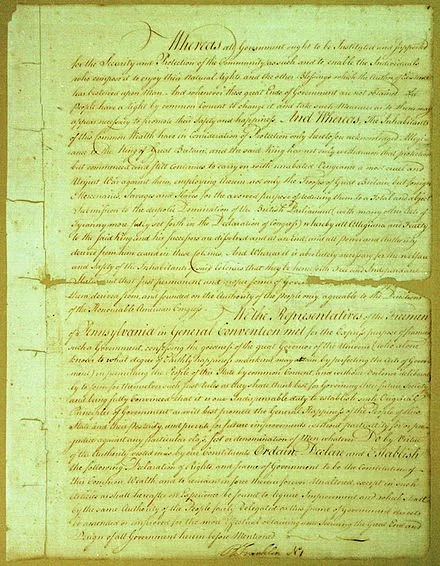
Alternatives to judicial review are hard to find. The Federalist Papers #50 (author not clear: Alexander Hamilton or James Madison) argues in particular that a period commission to review the constitutionality of government actions won’t work, based on the experience Pennsylvania had with just such a system, which stipulated constitutional review every seven years by a “Council of Censors.”
There are two big problems with a periodic commission to review constitutionality: it is likely to be partisan because it will be composed of the usual suspects, who were involved in the original decisions, and it is likely to be toothless. This passage from the Federalist Papers #50 makes both points:
If the periods be separated by short intervals, the measures to be reviewed and rectified will have been of recent date, and will be connected with all the circumstances which tend to vitiate and pervert the result of occasional revisions. If the periods be distant from each other, the same remark will be applicable to all recent measures; and in proportion as the remoteness of the others may favor a dispassionate review of them … a distant prospect of public censure would be a very feeble restraint on power from those excesses to which it might be urged by the force of present motives.
The Pennsylvania Council of Censors had met once, in 1783-1784 since the Pennsylvania Constitution of 1776 was adopted. It provided a lot of evidence for these views.
Partisanship of the Pennsylvania Council of Censors. On the Council of Censors being partisan, and the inevitability of partisanship, the Federalist Papers #50 has this to say (distinct passages separated by added bullets):
… the same active and leading members of the council had been active and influential members of the legislative and executive branches, within the period to be reviewed; and even patrons or opponents of the very measures to be thus brought to the test of the constitution.
Were the precaution taken of excluding from the assemblies elected by the people, to revise the preceding administration of the government, all persons who should have been concerned with the government within the given period, the difficulties would not be obviated. The important task would probably devolve on men, who, with inferior capacities, would in other respects be little better qualified. Although they might not have been personally concerned in the administration, and therefore not immediately agents in the measures to be examined, they would probably have been involved in the parties connected with these measures, and have been elected under their auspices.
Throughout the continuance of the council, it was split into two fixed and violent parties. The fact is acknowledged and lamented by themselves. Had this not been the case, the face of their proceedings exhibits a proof equally satisfactory. In all questions, however unimportant in themselves, or unconnected with each other, the same names stand invariably contrasted on the opposite columns.
It is at least problematical, whether the decisions of this body do not, in several instances, misconstrue the limits prescribed for the legislative and executive departments, instead of reducing and limiting them within their constitutional places.
Is it to be presumed, that at any future septennial epoch the same State will be free from parties? Is it to be presumed that any other State, at the same or any other given period, will be exempt from them? Such an event ought to be neither presumed nor desired; because an extinction of parties necessarily implies either a universal alarm for the public safety, or an absolute extinction of liberty.
Toothlessness of the Pennsylvania Council of Censors. The Federalist Papers #50 has less to say on toothlessness of the Council of Censors, but does have this:
I have never understood that the decisions of the council on constitutional questions, whether rightly or erroneously formed, have had any effect in varying the practice founded on legislative constructions. It even appears, if I mistake not, that in one instance the contemporary legislature denied the constructions of the council, and actually prevailed in the contest.
How has Judicial Review Faired Better? The courts are, of course, quite partisan, but are mostly limited to being reactive to actions of other branches of government. For whatever reason, the courts have been reasonably good at sticking to the rule of only dealing with actual cases and controversies. That is, tough requirements for “standing” for bringing a case have been crucial in keeping the judicial branch from becoming too powerful.
Because the courts deal with one case at a time, it is easier to arrange recusal in the judgment of a decision a judge was previously involved in than in the case of membership or not on something like the Council of Censors that is looking at many different issues. Moreover, the judicial career track now covers much of a judge’s life cycle, so that many judges have not been directly involved in that many legislative branch or executive branch decisions. (Even experience as an executive branch lawyer was often about prejudging the legality of a decision or adjusting a policy toward legal means rather than about making the decision in the first place.) Finally, it takes time for a judge to rise to one of the highest courts and so gain great influence in the judicial branch. And they can serve a long time on one of the highest courts. This puts more time between them and earlier things they were involved in that are related to a case but don’t rise to the level of recusal. That is, one can hope that a high judge’s partisanship is the partisanship of yesterday and not the partisanship of today. Yet the decisions of the legislative or executive branches, or of lower courts, can get reasonably prompt review.
Why hasn’t judicial review been toothless? Here, the fact that it deals with cases piecemeal helps. The typical case is likely to seem individually small in political terms. So the legislative and executive branches won’t be that tempted to interfere with the outcome of a typical case.
Another factor in acquiescence by members of the legislative and executive branches to many judicial decisions is that sometimes the courts agree with a politicians true views, as distinct from the views the politician claims to have in order to get elected.
Finally, for some reason, the voters seem to have accepted the courts as referees of the constitutional system. Complaints about Supreme Court decisions, for example, have often been channeled into the idea of winning elections to control future appointments to the Supreme Court—or in the extreme, packing the court—rather than into the idea of the legislative or executive branch simply ignoring the court.
Below is the full text of the Federalist Papers #50:
FEDERALIST NO. 50
Periodic Appeals to the People Considered
From the New York Packet
Tuesday, February 5, 1788.
Author: Alexander Hamilton or James Madison
To the People of the State of New York:
IT MAY be contended, perhaps, that instead of OCCASIONAL appeals to the people, which are liable to the objections urged against them, PERIODICAL appeals are the proper and adequate means of PREVENTING AND CORRECTING INFRACTIONS OF THE CONSTITUTION. It will be attended to, that in the examination of these expedients, I confine myself to their aptitude for ENFORCING the Constitution, by keeping the several departments of power within their due bounds, without particularly considering them as provisions for ALTERING the Constitution itself. In the first view, appeals to the people at fixed periods appear to be nearly as ineligible as appeals on particular occasions as they emerge.
If the periods be separated by short intervals, the measures to be reviewed and rectified will have been of recent date, and will be connected with all the circumstances which tend to vitiate and pervert the result of occasional revisions. If the periods be distant from each other, the same remark will be applicable to all recent measures; and in proportion as the remoteness of the others may favor a dispassionate review of them, this advantage is inseparable from inconveniences which seem to counterbalance it. In the first place, a distant prospect of public censure would be a very feeble restraint on power from those excesses to which it might be urged by the force of present motives. Is it to be imagined that a legislative assembly, consisting of a hundred or two hundred members, eagerly bent on some favorite object, and breaking through the restraints of the Constitution in pursuit of it, would be arrested in their career, by considerations drawn from a censorial revision of their conduct at the future distance of ten, fifteen, or twenty years? In the next place, the abuses would often have completed their mischievous effects before the remedial provision would be applied. And in the last place, where this might not be the case, they would be of long standing, would have taken deep root, and would not easily be extirpated. The scheme of revising the constitution, in order to correct recent breaches of it, as well as for other purposes, has been actually tried in one of the States. One of the objects of the Council of Censors which met in Pennsylvania in 1783 and 1784, was, as we have seen, to inquire, "whether the constitution had been violated, and whether the legislative and executive departments had encroached upon each other. " This important and novel experiment in politics merits, in several points of view, very particular attention. In some of them it may, perhaps, as a single experiment, made under circumstances somewhat peculiar, be thought to be not absolutely conclusive. But as applied to the case under consideration, it involves some facts, which I venture to remark, as a complete and satisfactory illustration of the reasoning which I have employed. First. It appears, from the names of the gentlemen who composed the council, that some, at least, of its most active members had also been active and leading characters in the parties which pre-existed in the State.
Secondly. It appears that the same active and leading members of the council had been active and influential members of the legislative and executive branches, within the period to be reviewed; and even patrons or opponents of the very measures to be thus brought to the test of the constitution. Two of the members had been vice-presidents of the State, and several other members of the executive council, within the seven preceding years. One of them had been speaker, and a number of others distinguished members, of the legislative assembly within the same period.
Thirdly. Every page of their proceedings witnesses the effect of all these circumstances on the temper of their deliberations. Throughout the continuance of the council, it was split into two fixed and violent parties. The fact is acknowledged and lamented by themselves. Had this not been the case, the face of their proceedings exhibits a proof equally satisfactory. In all questions, however unimportant in themselves, or unconnected with each other, the same names stand invariably contrasted on the opposite columns. Every unbiased observer may infer, without danger of mistake, and at the same time without meaning to reflect on either party, or any individuals of either party, that, unfortunately, PASSION, not REASON, must have presided over their decisions. When men exercise their reason coolly and freely on a variety of distinct questions, they inevitably fall into different opinions on some of them. When they are governed by a common passion, their opinions, if they are so to be called, will be the same.
Fourthly. It is at least problematical, whether the decisions of this body do not, in several instances, misconstrue the limits prescribed for the legislative and executive departments, instead of reducing and limiting them within their constitutional places.
Fifthly. I have never understood that the decisions of the council on constitutional questions, whether rightly or erroneously formed, have had any effect in varying the practice founded on legislative constructions. It even appears, if I mistake not, that in one instance the contemporary legislature denied the constructions of the council, and actually prevailed in the contest. This censorial body, therefore, proves at the same time, by its researches, the existence of the disease, and by its example, the inefficacy of the remedy. This conclusion cannot be invalidated by alleging that the State in which the experiment was made was at that crisis, and had been for a long time before, violently heated and distracted by the rage of party. Is it to be presumed, that at any future septennial epoch the same State will be free from parties? Is it to be presumed that any other State, at the same or any other given period, will be exempt from them? Such an event ought to be neither presumed nor desired; because an extinction of parties necessarily implies either a universal alarm for the public safety, or an absolute extinction of liberty. Were the precaution taken of excluding from the assemblies elected by the people, to revise the preceding administration of the government, all persons who should have been concerned with the government within the given period, the difficulties would not be obviated. The important task would probably devolve on men, who, with inferior capacities, would in other respects be little better qualified. Although they might not have been personally concerned in the administration, and therefore not immediately agents in the measures to be examined, they would probably have been involved in the parties connected with these measures, and have been elected under their auspices.
PUBLIUS.
Links to my other posts on The Federalist Papers so far:
The Federalist Papers #1: Alexander Hamilton's Plea for Reasoned Debate
The Federalist Papers #3: United, the 13 States are Less Likely to Stumble into War
The Federalist Papers #4 B: National Defense Will Be Stronger if the States are United
The Federalist Papers #5: Unless United, the States Will Be at Each Others' Throats
The Federalist Papers #6 A: Alexander Hamilton on the Many Human Motives for War
The Federalist Papers #11 A: United, the States Can Get a Better Trade Deal—Alexander Hamilton
The Federalist Papers #12: Union Makes it Much Easier to Get Tariff Revenue—Alexander Hamilton
The Federalist Papers #13: Alexander Hamilton on Increasing Returns to Scale in National Government
The Federalist Papers #14: A Republic Can Be Geographically Large—James Madison
The Federalist Papers #21 A: Constitutions Need to be Enforced—Alexander Hamilton
The Federalist Papers #24: The United States Need a Standing Army—Alexander Hamilton
The Federalist Papers #27: People Will Get Used to the Federal Government—Alexander Hamilton
The Federalist Papers #30: A Robust Power of Taxation is Needed to Make a Nation Powerful
The Federalist Papers #35 A: Alexander Hamilton as an Economist
The Federalist Papers #35 B: Alexander Hamilton on Who Can Represent Whom
The Federalist Papers #36: Alexander Hamilton on Regressive Taxation
The Federalist Papers #39: James Madison Downplays How Radical the Proposed Constitution Is
The Federalist Papers #41: James Madison on Tradeoffs—You Can't Have Everything You Want
The Federalist Papers #42: Every Power of the Federal Government Must Be Justified—James Madison
The Federalist Papers #44: Constitutional Limitations on the Powers of the States—James Madison
The Federalist Papers #45: James Madison Predicts a Small Federal Government
The Federalist Papers #48: Legislatures, Too, Can Become Tyrannical—James Madison
The Federalist Papers #49: Constitutional Conventions Should Be Few and Far Between