A Nonsupernaturalist Perspective on Meridians in Chinese Medicine

Link to the Wikipedia article “Meridian (Chinese Medicine)”

Link to the Wikipedia article “Meridian (Chinese Medicine)”

Certain aspects of traditional Chinese medicine have impressive empirical support. This is not surprising; there are surely some areas in which trial and error for thousands of years should be able to home in on effective procedures. (Personally, I have had acupuncture treatments. It was actually in the first year I started my blog. I was so excited by my blog that I wasn’t sleeping. I went to the acupuncturist to get help in calming down a bit. It seemed to help.)

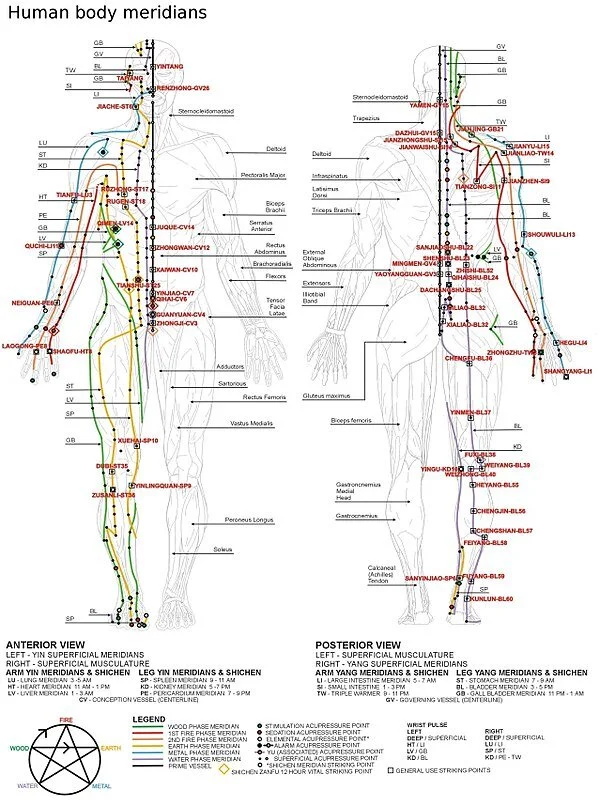
Although important chunks of Chinese medicine pass empirical muster as effective procedures, what doesn’t pass muster is the theory of Chinese medicine: the explanation Chinese medicine gives for why Chinese medicine works. The theory of Chinese medicine involves a substance called qi—which has no counterpart in Western physics. And it involves meridians in specific places along specific paths in the body that have no counterpart in Western anatomy to the surface claims of Chinese medicine.

In “What Do You Mean by 'Supernatural'?” I use inconsistency with modern physics as my definition of “supernatural.” By that standard, Chinese medicine relies on the supernatural in explaining its own workings. Note that the inconsistency with modern physics is no small thing. If a physicist were able to detect qi and, say, incorporate it into refashioned quantum field theory, that would be truly remarkable.

But I think there is a way to rescue the meridian system, with all its specificity, while staying fully consistent with modern physics. It is well known that there are parts of the brain that are specialized for attending to sensations and initiating actions for particular parts of the body. What if the meridians are not in the body in the locations the charts say, but rather in the brain’s “map” of those parts of the body? That is, meridians might represent relatively strong neural pathways between areas of the brain that specially attend to the various points on the meridian. This might or might not be true and would need to be investigated, but it is not particularly unlikely. On this view, qi, too, is easy to understand: it is simply neural signals among different parts of the brain (which are in turn associated with different parts of the body). Neural signals are remarkable, but as far as we know, there is nothing supernatural about them.

The bottom line is:

  1. Don’t dismiss the part of Chinese medicine based on meridians too quickly.

  2. Don’t think that the usefulness of the part of Chinese medicine based on meridians is any reason to believe in the supernatural.

I suspect that this perspective will not seem very satisfying to most practitioners or recipients of Chinese medicine. But this perspective is, in fact, fully consistent with many of the activities of Chinese medicine.

Update, October 11, 2020, 10:22 PM: It looks like the evidence for the effectiveness of acupuncture is flimsier than I thought. See the Wikipedia article on acupuncture. It has been called a “theatrical placebo.” Of course, among placebos, theatrical ones can be especially powerful. But in particular, the evidence that using the meridians to place the needles aids effectiveness is weak. So what remains of the point of this blogpost? That even if the meridians are meaningful guides for placing acupuncture needles, it doesn’t mean there is any supernatural qi.

Related Posts:

Taking Applications for a Full-Time Research Assistantship with the Well-Being Measurement Initiative—Miles Kimball, Dan Benjamin, Ori Heffetz and Kristen Cooper

My top 4 projects in the world are to add deep negative interest rates to the monetary policy toolkit, to fight the rise of obesity and the associated chronic diseases, to enhance the scientific creativity, engagement and impact economists have, and to develop principles that put national well-being indexes on an equal footing with GDP. (On the last, see my “happiness” subblog.) Every one of these projects needs a team to help make their goal into a reality. This post is advertising an opportunity to be part of our team working out all the principles necessary to put national well-being indexes on an equal footing with GDP. The 4 professors are that team are Dan Benjamin, Ori Heffetz, Kristen Cooper and I.

I personally work very closely with our full-time research assistants. I consider many of those who have been our research assistants to be very close friends. We are looking for our next full-time research assistant for a two-year stint to begin Summer 2021, ending Summer 2023. We have two full-time research assistants overall, hiring one each year, and several part-time research assistants as well as additional coauthors on some papers we are working on. So you wouldn’t be lonely working with us!

Our research assistants working on well-being also typically hang out with other research assistants who are working on social science genetics papers with Dan Benjamin and me, and a large cast of other very interesting characters.

I have included below images of the ads for both (1) the well-being RA position and for (2) the social science genetics RA positions, and links to the ads in their original location online.

We look forward to hearing from you!

Slate Star Codex on Saturated and Polyunsaturated Fat

Why was there such a big rise in obesity in the 20th century? I would point mainly to two things: the rise in sugar content (high in almost all processed foods) and a lengthening of the eating window in the day so that people now eat almost from the moment they wake up to the moment they go to sleep at night. (See “Stop Counting Calories; It's the Clock that Counts” on why this matters.)

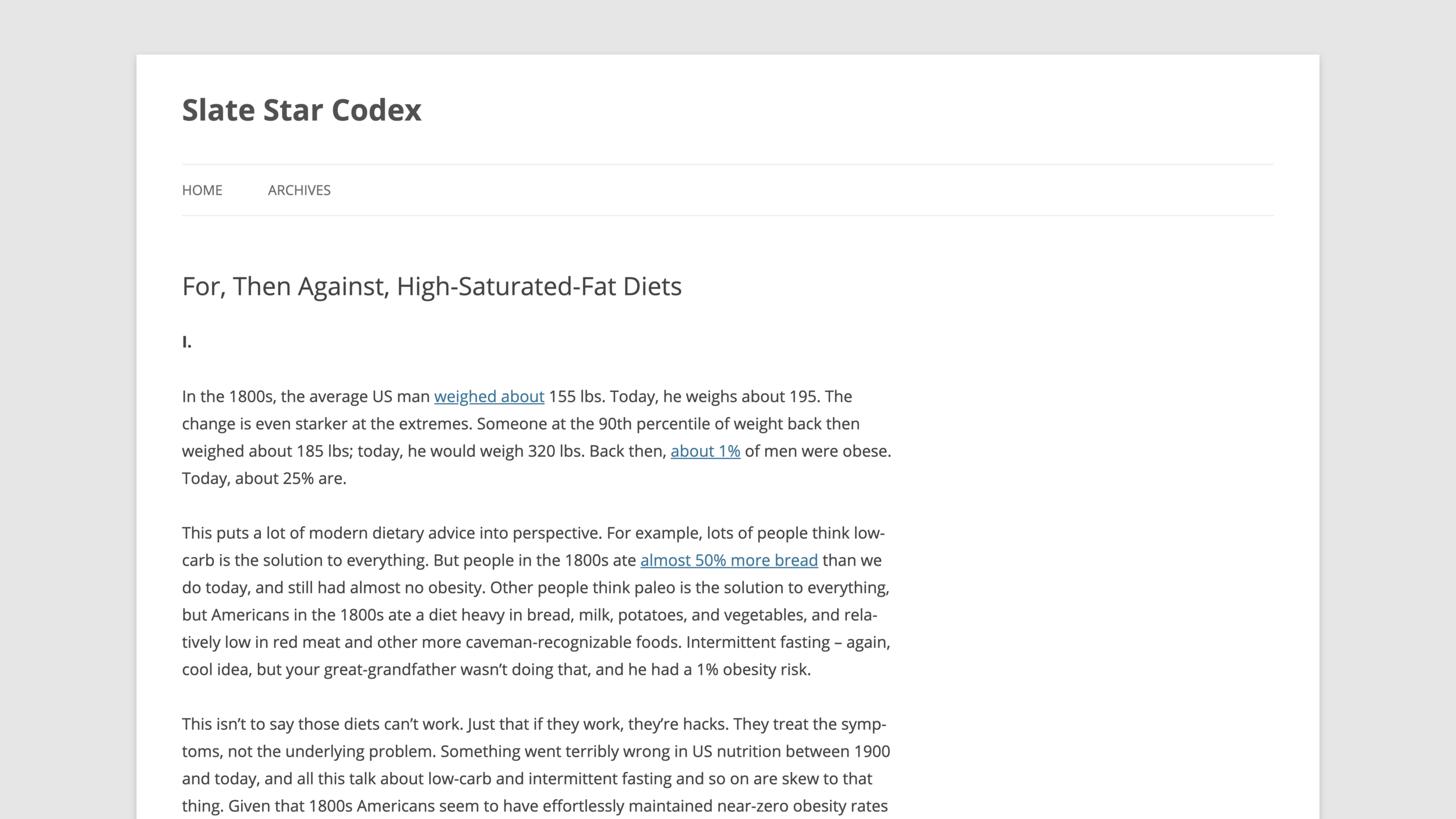
In the blog post “For, Then Against, High-Saturated-Fat Diets,” Slate Star Codex argues that it might be the polyunsaturated fat content of processed food (primarily vegetable oil) as much or more than the sugar content of processed food that led to the rise of obesity.

Why might polyunsaturated fat contribute to obesity? One possibility is that polyunsaturated fat might foster inflammation. That is an intriguing mechanism; focusing on reducing inflammation as a weight-loss tool sounds like a great thing to try. Now that I have said that, I’ll bet I start noticing a lot of articles and research about inflammation and weight gain and loss.

The other possibility for how polyunsaturated fat could contribute to obesity is that it has a lot of calories compared to how satiated it makes people feel. This, too, is a mechanism that would be interesting far beyond just thinking about polyunsaturated fat. I’ll bet that sugar has one of the lowest ratios of satiation to calories of food ingredients. But polyunsaturated fat could be low on this ratio.

For, Then Against, High-Saturated-Fat Diets” discusses the claim that saturated fat has a high ratio of satiation to calories. The evidence discussed seems to suggest that one shouldn’t lump all saturated fat into one category for this: some types of saturated fat seem to have a high ratio of satiation to calories, others not so much.

I like Slate Star Codex’s focus on the question of why obesity is so much higher now than it used to be. This discussion is lacking however, by not talking about the timing of eating. (See “Stop Counting Calories; It's the Clock that Counts.”) Evidence has been accumulating that eating all the time can lead to obesity and disease and conversely that time-restricted eating can reduce obesity and disease.

But even if you believe in fasting (not eating, but drinking water) as a weight-loss tool as I do, the ratio of satiation to calories is a very interesting ratio to measure. Eating foods high on the satiation to calorie ratio for one’s last meal before fasting could make fasting easier, for example.

Let me conclude by saying where I am now in relation to different types of fat. I act on the assumption that avocados and olive oil are healthy (monounsaturated fats). I consume quite a bit of coconut milk (with one type of saturated fat) not being sure that it is healthy, but not yet seeing any big red flags in what I have read. I eat a fair amount of butter and cream. Experientially, they seem quite satiating—perhaps satiating enough to have a high satiation to calorie ratio. When it comes to meat and milk, I have other worries that have nothing to do with their saturated fat content. See “Meat Is Amazingly Nutritious—But Is It Amazingly Nutritious for Cancer Cells, Too?” and “'Is Milk Ok?' Revisited.”


Don’t miss my other recent post on this topic: “Journal of the American College of Cardiology State-of-the-Art Review on Saturated Fats.”

For annotated links to other posts on diet and health, see:

The Federalist Papers #18: Alexander Hamilton and James Madison Point to the Weakness of Confederations of Cities in Ancient Greece to Argue for a Strong Federal Government

Many of the intended audience for the Federalist Papershad some bit of a classical education. So in the Federalist Papers #18, Alexander Hamilton and James Madison felt they could use Greek history to help make their point that a strong federal government was needed. Here is a nice statement of their argument, with its obvious application to the situation in 1787:

Had Greece, says a judicious observer on her fate, been united by a stricter confederation, and persevered in her union, she would never have worn the chains of Macedon; and might have proved a barrier to the vast projects of Rome.

Alexander Hamilton and James Madison’s conclusion to the Federalist Papers #18 echoes the Federalist Paper #17 (see “The Federalist Papers #17: Three Levels of Federal Power). They write (pretending to be a single author, “Publius”:

I have thought it not superfluous to give the outlines of this important portion of history … it emphatically illustrates the tendency of federal bodies rather to anarchy among the members, than to tyranny in the head

The full text of the Federalist Papers #18 is below for context. But let me pull out quotations referring to different ways things went badly from Greek confederations having no center or a center that could not hold. (Many of these descriptions of what happened in these Greek confederations remind me of what happens with the United Nations, which is a weak confederation indeed.)

Weak Confederations are often Dominated by the Strongest Member States

Alexander Hamilton and James Madison point out that, in lieu of being subject to a strong central government, weak confederations often leave weaker states subject to stronger states within the confederation:

The more powerful members, instead of being kept in awe and subordination, tyrannized successively over all the rest. …

It happened but too often, according to Plutarch, that the deputies of the strongest cities awed and corrupted those of the weaker; and that judgment went in favor of the most powerful party.

The smaller members, though entitled by the theory of their system to revolve in equal pride and majesty around the common center, had become, in fact, satellites of the orbs of primary magnitude.

One reason for this was that those running the confederation were entirely beholden to the governments of the member states, and therefore often acted for the interests of those states rather than for the interests of the confederation as a whole:

The powers, like those of the present Congress, were administered by deputies appointed wholly by the cities in their political capacities; and exercised over them in the same capacities.

Vulnerability to Foreign Interference and Civil War

A more serious defect of a weak confederation, or even a confederation of middling strength is that member states can easily be coopted by foreign powers. This vulnerability often arises during wars within a confederation:

Even in the midst of defensive and dangerous wars with Persia and Macedon, the members never acted in concert, and were, more or fewer of them, eternally the dupes or the hirelings of the common enemy.

After the conclusion of the war with Xerxes, it appears that the Lacedaemonians required that a number of the cities should be turned out of the confederacy for the unfaithful part they had acted. The Athenians, finding that the Lacedaemonians would lose fewer partisans by such a measure than themselves, and would become masters of the public deliberations, vigorously opposed and defeated the attempt.

Athens and Sparta, inflated with the victories and the glory they had acquired, became first rivals and then enemies.

The Phocians having ploughed up some consecrated ground belonging to the temple of Apollo, the Amphictyonic council, according to the superstition of the age, imposed a fine on the sacrilegious offenders. The Phocians, being abetted by Athens and Sparta, refused to submit to the decree. The Thebans, with others of the cities, undertook to maintain the authority of the Amphictyons, and to avenge the violated god. The latter, being the weaker party, invited the assistance of Philip of Macedon, who had secretly fostered the contest.

The arts of division were practiced among the Achaeans. Each city was seduced into a separate interest; the union was dissolved. Some of the cities fell under the tyranny of Macedonian garrisons; others under that of usurpers springing out of their own confusions. Shame and oppression erelong awaken their love of liberty. A few cities reunited. Their example was followed by others, as opportunities were found of cutting off their tyrants. The league soon embraced almost the whole Peloponnesus. Macedon saw its progress; but was hindered by internal dissensions from stopping it. All Greece caught the enthusiasm and seemed ready to unite in one confederacy, when the jealousy and envy in Sparta and Athens, of the rising glory of the Achaeans, threw a fatal damp on the enterprise. The dread of the Macedonian power induced the league to court the alliance of the Kings of Egypt and Syria, who, as successors of Alexander, were rivals of the king of Macedon. This policy was defeated by Cleomenes, king of Sparta, who was led by his ambition to make an unprovoked attack on his neighbors, the Achaeans, and who, as an enemy to Macedon, had interest enough with the Egyptian and Syrian princes to effect a breach of their engagements with the league.

The Achaeans were now reduced to the dilemma of submitting to Cleomenes, or of supplicating the aid of Macedon, its former oppressor. The latter expedient was adopted. The contests of the Greeks always afforded a pleasing opportunity to that powerful neighbor of intermeddling in their affairs.

they once more had recourse to the dangerous expedient of introducing the succor of foreign arms. The Romans, to whom the invitation was made, eagerly embraced it. Philip was conquered; Macedon subdued. A new crisis ensued to the league. Dissensions broke out among it members. These the Romans fostered.

These Defects Occurred in Confederation Stronger in Important Respects than the Strength of the Articles of Confederation

Despite the sad accounts of the fates of the two leagues of Greek cities, the Amphictyons and the Achaean League, Alexander Hamilton and James Hamilton that the Articles of Confederation left the 13 states in an even worse situation, especially because the glue of religion was stronger for the Greek cities:

In several material instances, they exceed the powers enumerated in the articles of confederation. The Amphictyons had in their hands the superstition of the times, one of the principal engines by which government was then maintained; they had a declared authority to use coercion against refractory cities, and were bound by oath to exert this authority on the necessary occasions.

The Amphictyons were the guardians of religion, and of the immense riches belonging to the temple of Delphos, where they had the right of jurisdiction in controversies between the inhabitants and those who came to consult the oracle. As a further provision for the efficacy of the federal powers, they took an oath mutually to defend and protect the united cities, to punish the violators of this oath, and to inflict vengeance on sacrilegious despoilers of the temple.

The Relative Strength of the Achaean League Suggests Benefits of the Constitution for the Quality of the Government within States

In what may be considered an aside, Alexander Hamilton and James Madison point to the benefits of even a somewhat strong union of states on the quality of government within each state:

One important fact seems to be witnessed by all the historians who take notice of Achaean affairs. It is, that as well after the renovation of the league by Aratus, as before its dissolution by the arts of Macedon, there was infinitely more of moderation and justice in the administration of its government, and less of violence and sedition in the people, than were to be found in any of the cities exercising SINGLY all the prerogatives of sovereignty. The Abbe Mably, in his observations on Greece, says that the popular government, which was so tempestuous elsewhere, caused no disorders in the members of the Achaean republic, BECAUSE IT WAS THERE TEMPERED BY THE GENERAL AUTHORITY AND LAWS OF THE CONFEDERACY.

Conclusion

I wonder what history people can be assumed to know now to serve as background for political arguments.


FEDERALIST NO. 18

The Same Subject Continued: The Insufficiency of the Present Confederation to Preserve the Union

For the Independent Journal.

Author: Alexander Hamilton and James Madison

To the People of the State of New York:

AMONG the confederacies of antiquity, the most considerable was that of the Grecian republics, associated under the Amphictyonic council. From the best accounts transmitted of this celebrated institution, it bore a very instructive analogy to the present Confederation of the American States.

The members retained the character of independent and sovereign states, and had equal votes in the federal council. This council had a general authority to propose and resolve whatever it judged necessary for the common welfare of Greece; to declare and carry on war; to decide, in the last resort, all controversies between the members; to fine the aggressing party; to employ the whole force of the confederacy against the disobedient; to admit new members. The Amphictyons were the guardians of religion, and of the immense riches belonging to the temple of Delphos, where they had the right of jurisdiction in controversies between the inhabitants and those who came to consult the oracle. As a further provision for the efficacy of the federal powers, they took an oath mutually to defend and protect the united cities, to punish the violators of this oath, and to inflict vengeance on sacrilegious despoilers of the temple.

In theory, and upon paper, this apparatus of powers seems amply sufficient for all general purposes. In several material instances, they exceed the powers enumerated in the articles of confederation. The Amphictyons had in their hands the superstition of the times, one of the principal engines by which government was then maintained; they had a declared authority to use coercion against refractory cities, and were bound by oath to exert this authority on the necessary occasions.

Very different, nevertheless, was the experiment from the theory. The powers, like those of the present Congress, were administered by deputies appointed wholly by the cities in their political capacities; and exercised over them in the same capacities. Hence the weakness, the disorders, and finally the destruction of the confederacy. The more powerful members, instead of being kept in awe and subordination, tyrannized successively over all the rest. Athens, as we learn from Demosthenes, was the arbiter of Greece seventy-three years. The Lacedaemonians next governed it twenty-nine years; at a subsequent period, after the battle of Leuctra, the Thebans had their turn of domination.

It happened but too often, according to Plutarch, that the deputies of the strongest cities awed and corrupted those of the weaker; and that judgment went in favor of the most powerful party.

Even in the midst of defensive and dangerous wars with Persia and Macedon, the members never acted in concert, and were, more or fewer of them, eternally the dupes or the hirelings of the common enemy. The intervals of foreign war were filled up by domestic vicissitudes convulsions, and carnage.

After the conclusion of the war with Xerxes, it appears that the Lacedaemonians required that a number of the cities should be turned out of the confederacy for the unfaithful part they had acted. The Athenians, finding that the Lacedaemonians would lose fewer partisans by such a measure than themselves, and would become masters of the public deliberations, vigorously opposed and defeated the attempt. This piece of history proves at once the inefficiency of the union, the ambition and jealousy of its most powerful members, and the dependent and degraded condition of the rest. The smaller members, though entitled by the theory of their system to revolve in equal pride and majesty around the common center, had become, in fact, satellites of the orbs of primary magnitude.

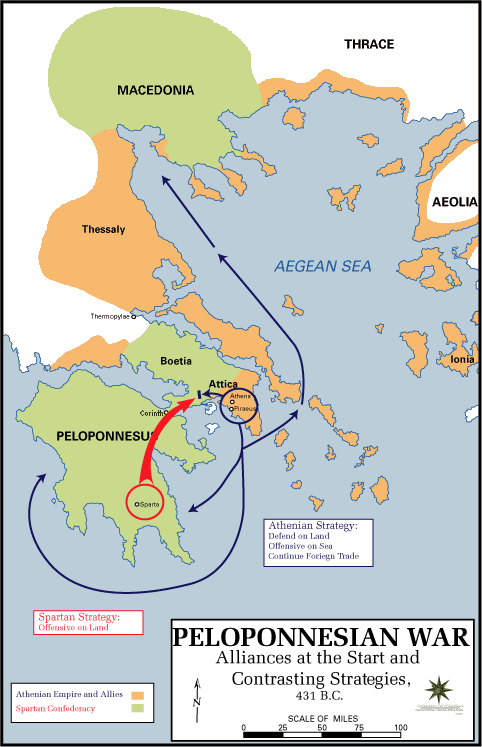
Had the Greeks, says the Abbe Milot, been as wise as they were courageous, they would have been admonished by experience of the necessity of a closer union, and would have availed themselves of the peace which followed their success against the Persian arms, to establish such a reformation. Instead of this obvious policy, Athens and Sparta, inflated with the victories and the glory they had acquired, became first rivals and then enemies; and did each other infinitely more mischief than they had suffered from Xerxes. Their mutual jealousies, fears, hatreds, and injuries ended in the celebrated Peloponnesian war; which itself ended in the ruin and slavery of the Athenians who had begun it.

As a weak government, when not at war, is ever agitated by internal dissentions, so these never fail to bring on fresh calamities from abroad. The Phocians having ploughed up some consecrated ground belonging to the temple of Apollo, the Amphictyonic council, according to the superstition of the age, imposed a fine on the sacrilegious offenders. The Phocians, being abetted by Athens and Sparta, refused to submit to the decree. The Thebans, with others of the cities, undertook to maintain the authority of the Amphictyons, and to avenge the violated god. The latter, being the weaker party, invited the assistance of Philip of Macedon, who had secretly fostered the contest. Philip gladly seized the opportunity of executing the designs he had long planned against the liberties of Greece. By his intrigues and bribes he won over to his interests the popular leaders of several cities; by their influence and votes, gained admission into the Amphictyonic council; and by his arts and his arms, made himself master of the confederacy.

Such were the consequences of the fallacious principle on which this interesting establishment was founded. Had Greece, says a judicious observer on her fate, been united by a stricter confederation, and persevered in her union, she would never have worn the chains of Macedon; and might have proved a barrier to the vast projects of Rome.

The Achaean league, as it is called, was another society of Grecian republics, which supplies us with valuable instruction.

The Union here was far more intimate, and its organization much wiser, than in the preceding instance. It will accordingly appear, that though not exempt from a similar catastrophe, it by no means equally deserved it.

The cities composing this league retained their municipal jurisdiction, appointed their own officers, and enjoyed a perfect equality. The senate, in which they were represented, had the sole and exclusive right of peace and war; of sending and receiving ambassadors; of entering into treaties and alliances; of appointing a chief magistrate or praetor, as he was called, who commanded their armies, and who, with the advice and consent of ten of the senators, not only administered the government in the recess of the senate, but had a great share in its deliberations, when assembled. According to the primitive constitution, there were two praetors associated in the administration; but on trial a single one was preferred.

It appears that the cities had all the same laws and customs, the same weights and measures, and the same money. But how far this effect proceeded from the authority of the federal council is left in uncertainty. It is said only that the cities were in a manner compelled to receive the same laws and usages. When Lacedaemon was brought into the league by Philopoemen, it was attended with an abolition of the institutions and laws of Lycurgus, and an adoption of those of the Achaeans. The Amphictyonic confederacy, of which she had been a member, left her in the full exercise of her government and her legislation. This circumstance alone proves a very material difference in the genius of the two systems.

It is much to be regretted that such imperfect monuments remain of this curious political fabric. Could its interior structure and regular operation be ascertained, it is probable that more light would be thrown by it on the science of federal government, than by any of the like experiments with which we are acquainted.

One important fact seems to be witnessed by all the historians who take notice of Achaean affairs. It is, that as well after the renovation of the league by Aratus, as before its dissolution by the arts of Macedon, there was infinitely more of moderation and justice in the administration of its government, and less of violence and sedition in the people, than were to be found in any of the cities exercising SINGLY all the prerogatives of sovereignty. The Abbe Mably, in his observations on Greece, says that the popular government, which was so tempestuous elsewhere, caused no disorders in the members of the Achaean republic, BECAUSE IT WAS THERE TEMPERED BY THE GENERAL AUTHORITY AND LAWS OF THE CONFEDERACY.

We are not to conclude too hastily, however, that faction did not, in a certain degree, agitate the particular cities; much less that a due subordination and harmony reigned in the general system. The contrary is sufficiently displayed in the vicissitudes and fate of the republic.

Whilst the Amphictyonic confederacy remained, that of the Achaeans, which comprehended the less important cities only, made little figure on the theatre of Greece. When the former became a victim to Macedon, the latter was spared by the policy of Philip and Alexander. Under the successors of these princes, however, a different policy prevailed. The arts of division were practiced among the Achaeans. Each city was seduced into a separate interest; the union was dissolved. Some of the cities fell under the tyranny of Macedonian garrisons; others under that of usurpers springing out of their own confusions. Shame and oppression erelong awaken their love of liberty. A few cities reunited. Their example was followed by others, as opportunities were found of cutting off their tyrants. The league soon embraced almost the whole Peloponnesus. Macedon saw its progress; but was hindered by internal dissensions from stopping it. All Greece caught the enthusiasm and seemed ready to unite in one confederacy, when the jealousy and envy in Sparta and Athens, of the rising glory of the Achaeans, threw a fatal damp on the enterprise. The dread of the Macedonian power induced the league to court the alliance of the Kings of Egypt and Syria, who, as successors of Alexander, were rivals of the king of Macedon. This policy was defeated by Cleomenes, king of Sparta, who was led by his ambition to make an unprovoked attack on his neighbors, the Achaeans, and who, as an enemy to Macedon, had interest enough with the Egyptian and Syrian princes to effect a breach of their engagements with the league.

The Achaeans were now reduced to the dilemma of submitting to Cleomenes, or of supplicating the aid of Macedon, its former oppressor. The latter expedient was adopted. The contests of the Greeks always afforded a pleasing opportunity to that powerful neighbor of intermeddling in their affairs. A Macedonian army quickly appeared. Cleomenes was vanquished. The Achaeans soon experienced, as often happens, that a victorious and powerful ally is but another name for a master. All that their most abject compliances could obtain from him was a toleration of the exercise of their laws. Philip, who was now on the throne of Macedon, soon provoked by his tyrannies, fresh combinations among the Greeks. The Achaeans, though weakenened by internal dissensions and by the revolt of Messene, one of its members, being joined by the AEtolians and Athenians, erected the standard of opposition. Finding themselves, though thus supported, unequal to the undertaking, they once more had recourse to the dangerous expedient of introducing the succor of foreign arms. The Romans, to whom the invitation was made, eagerly embraced it. Philip was conquered; Macedon subdued. A new crisis ensued to the league. Dissensions broke out among it members. These the Romans fostered. Callicrates and other popular leaders became mercenary instruments for inveigling their countrymen. The more effectually to nourish discord and disorder the Romans had, to the astonishment of those who confided in their sincerity, already proclaimed universal liberty [This was but another name more specious for the independence of the members on the federal head.] throughout Greece. With the same insidious views, they now seduced the members from the league, by representing to their pride the violation it committed on their sovereignty. By these arts this union, the last hope of Greece, the last hope of ancient liberty, was torn into pieces; and such imbecility and distraction introduced, that the arms of Rome found little difficulty in completing the ruin which their arts had commenced. The Achaeans were cut to pieces, and Achaia loaded with chains, under which it is groaning at this hour.

I have thought it not superfluous to give the outlines of this important portion of history; both because it teaches more than one lesson, and because, as a supplement to the outlines of the Achaean constitution, it emphatically illustrates the tendency of federal bodies rather to anarchy among the members, than to tyranny in the head

PUBLIUS.

Here are links to my other posts on The Federalist Papers so far:

Thinking about the 'Executive Order on Combating Race and Sex Stereotyping'

There is little question that Donald Trump (perhaps following the advice of others) has declared war on individuals who do a certain type of diversity training. The heart of the 'Executive Order on Combating Race and Sex Stereotyping' is this passage (where I have replaced small letters with bullets):

1. The contractor shall not use any workplace training that inculcates in its employees any form of race or sex stereotyping or any form of race or sex scapegoating, including the concepts that

  • one race or sex is inherently superior to another race or sex;

  • an individual, by virtue of his or her race or sex, is inherently racist, sexist, or oppressive, whether consciously or unconsciously;

  • an individual should be discriminated against or receive adverse treatment solely or partly because of his or her race or sex;

  • members of one race or sex cannot and should not attempt to treat others without respect to race or sex;

  • an individual’s moral character is necessarily determined by his or her race or sex;

  • an individual, by virtue of his or her race or sex, bears responsibility for actions committed in the past by other members of the same race or sex;

  • any individual should feel discomfort, guilt, anguish, or any other form of psychological distress on account of his or her race or sex; or

  • meritocracy or traits such as a hard work ethic are racist or sexist, or were created by a particular race to oppress another race.

The term “race or sex stereotyping” means ascribing character traits, values, moral and ethical codes, privileges, status, or beliefs to a race or sex, or to an individual because of his or her race or sex, and the term “race or sex scapegoating” means assigning fault, blame, or bias to a race or sex, or to members of a race or sex because of their race or sex.

My reaction is that, although this prohibits federal contractors and recipients of federal money (including colleges and universities) from one type of antiracism training, there are many other forms of antiracist training that are still fully allowed.

First, I think there are many documentaries and movies that people could be assigned to watch that would clue them in to the sad history of racism in the United States and in other countries. And current maltreatment of African Americans and other minorities by the police can be addressed.

Second, it is my view that a lot of the racist incidents that should concern us the most are not caused by racism alone, but by racism combined with someone being a jerk. Training that has the effect of making people not act like jerks can reduce serious racist incidents as well as having many other benefits, even if it didn’t reduce racism itself. I wouldn’t suggest this if I didn’t believe there is a program that can, in fact, help people to act less like jerks than they otherwise would—and hopefully have less tolerance for bad behavior by that fraction of people whose propensity to act like a jerk is unfortunately unaffected. I talk about Positive Intelligence in “On Human Potential” and am myself being trained as a Positive Intelligence coach as well already being a Certified Professional Co-Active Coach. (I confess that I am personally using these skills to help out people who, by selection into the program, are already nicer than average. See “How Economists Can Enhance Their Scientific Creativity, Engagement and Impact.” But the principles have been shown to work in corporate contexts where those who—at least initially—are jerks abound.)

In short, even though the intent of the 'Executive Order on Combating Race and Sex Stereotyping' is what one of my tweeps, Andrew Burton called “a naked salvo in the culture war,” I am not alarmed about its practical effects in the way that, for example, the President and Provost of the University of Michigan are. (See also the September 24, 2020 Chronicle of Higher Education article “Trump Bars Federal Grants for ‘Divisive and Harmful’ Racial-Sensitivity Training” by Katherine Mangan.) I think there a workarounds for antiracism training.

The September 28, 2020 Wall Street Journal article “Why Are There Still So Few Black CEOs?” by Te-Ping Chen, provides some useful perspective on diversity training in the corporate context (which should be relevant to diversity training at colleges and universities).

Here are some key quotations from that article (with bullets added to distinguish passages):

  • Many companies tend to emphasize diversity in recruitment but overlook retention and advancement, researchers and executives say. And while companies have long talked about the importance of diversity—spending billions a year on such efforts—money has often been devoted to flawed programs such as diversity training, which show only mixed evidence of effectiveness.

    “It’s as though we pay for effort, but we’re not paying for results. We’re spending money without really investing in the activities that increase diversity,” says Mr. Williams.

    Instead, companies have seen better results from longer-term diversity programs that are focused on retaining and advancing staff. Executives also cite benefits from having mentors, and working for companies where leaders are personally invested in the issue, especially the CEO.

  • Companies have tended to rely on short-term diversity training, which data show often is ineffective or backfires, says Alexandra Kalev, a sociology professor at Tel Aviv University who has studied the effectiveness of diversity programs. Her research on 830 U.S. companies’ diversity efforts, conducted with Harvard professor Frank Dobbin, found such mandatory training can spark manager backlash, and actually coincided with declines in the number of Black women in management.

    She says her research shows initiatives such as mentorship programs and hiring diversity officers or creating diversity task forces are more effective.

  • The study found that when Black employees are elevated to the C-suite, they are frequently given roles with less advancement potential, such as chief human resources officer, chief sales officer or chief administration executive: Black people hold 13%, 20% and 43% of such roles in the Fortune 100, respectively.

  • The experience of being second-guessed or being subject to racial comments adds up. Black professionals are more likely to leave their jobs; 35% say they intend to leave their company within the next two years, with many mentioning isolation and workplace hostility, compared with 27% of their white peers, according to Coqual, a think tank formerly known as the Center for Talent Innovation focused on workplace diversity.


Potential Protective Mechanisms of Ketosis in Migraine Prevention

I don’t get migraines, but some of my friends do. I feel for them and have tried to come up with worthwhile advice. Some advice is straightforward: good sleep hygiene and stress reduction techniques such as meditation or Positive Intelligence. (For a description of the Positive Intelligence approach, see “On Human Potential” and “How Economists Can Enhance Their Scientific Creativity, Engagement and Impact”). Two other recommendations I have made are

  • acupuncture—which the Wikipedia article “Migraine” says there is a little evidence for and seems to me unlikely to have much of a downside, and

  • the combination of a low-insulin-index diet and fasting that is a mainstay of my diet-and-health posts. (See “Miles Kimball on Diet and Health: A Reader's Guide.”

A low-insulin-index diet combined with fasting puts the body in fat-burning mode, or ketosis, a fair share of the time. When the body is in fat-burning mode, fasting (going without food but drinking water) is easy. This is dramatically different from fasting when in sugar-burning mode, which is extremely unpleasant, as the Minnesota starvation experiments showed. (The experimental subjects consumed two small high-carb meals a day—just enough to keep them out of fat-burning mode, but too few calories to let them feel OK without smooth fat burning.)

Going without food when in sugar-burning mode leads to low blood sugar, which can trigger a migraine. By contrast, in fat-burning mode, the brain will be able to get plenty of energy from the ketone bodies that are produced when in fat-burning mode.

To emphasize: the trouble with eating sugar and easily-digested starches and with eating all the time is that it leads to a lot of moments of subjective starvation caused by low blood sugar. Moments of intense subjective starvation tend to point to low blood sugar, which can make migraines more likely.

In a seeming paradox, as long as you are eating low on the insulin index, eating nothing is less likely to lead to moments of intense subjective starvation because the cells in your body are well-fed as long as you are (a) in fat burning mode and (b) still have body fat left to burn.

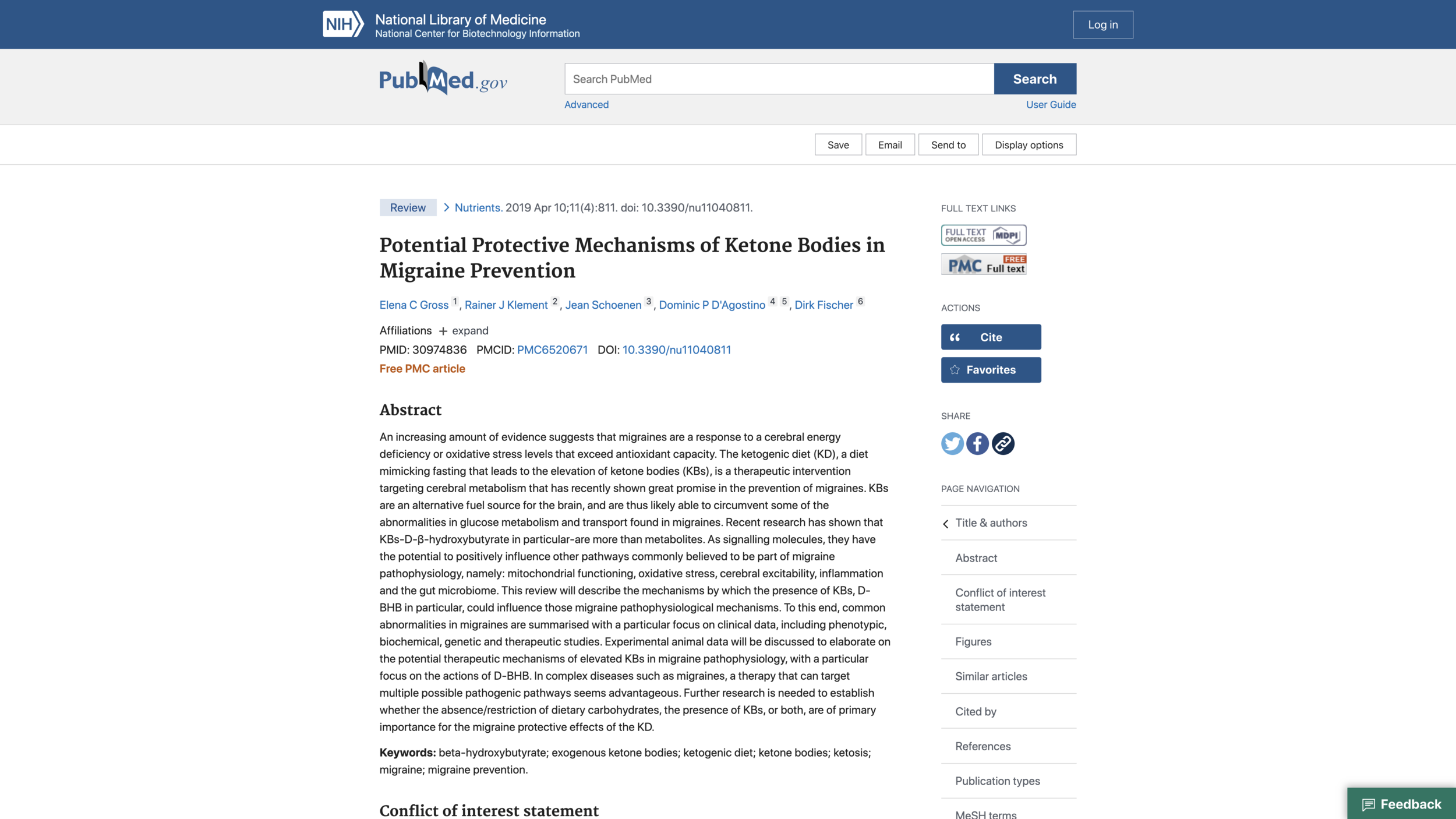
Though full-scale clinical trials remain to be done for the effect of ketosis on migraines, there is decent evidence that ketosis is indeed helpful in reducing migraines. Let me give you a few quotations (with bullets added to separate quotations) from the recent paper “Potential Protective Mechanisms of Ketone Bodies in Migraine Prevention”:

  • Despite migraine’s primary pathogenic mechanisms being still largely unknown [8], accumulating evidence suggests that migraines could be—at least partially—an energy deficit syndrome of the brain …

  • Mimicking this state of fasting, the ketogenic diet (KD) promotes the hepatic production of KBs with a high fat, low carbohydrate and moderate protein content. It was developed about 100 years ago after the observation that prolonged fasting has anticonvulsive properties [11]. Within recent years, the KD has received renewed interest, in particular since KBs might be beneficial for a variety of other neurological disorders [12,13,14]. All brain cells have the capacity to use KBs [ketone bodies] as respiratory substrates [10].

  • Several case studies have demonstrated the potentially migraine protective effects of ketosis [22,33,34,35,36,37]. A one-month observational study of KD in 96 migraine patients as part of a weight loss program found a reduction of up to 80% in migraine frequency, severity and acute medication use [37]. The same intervention in 18 episodic migraineurs induced a 62.5% reduction in migraine days …

In an area such as migraine prevention, sufferers can quickly gather a substantial amount of individual-specific time-series evidence. In saying this, I speak as a macroeconomist: in studying the behavior of GDP, we often have much, much less evidence than a migraine sufferer could gather within a single year from keeping careful track of their own experience about whether a low-insulin-index diet combined with fasting reduced the frequency of migraines.

It is well-established that being in fat-burning mode as opposed to sugar-burning mode puts the brain in a substantially different state. Therefore, a low-insulin-index diet combined with fasting is likely to be a substantial intervention. What evidence there is suggest it is more likely to be in the desired direction of reducing migraines than the opposite. But it is straightforward to find out in one’s own individual case.

Let me caution that one should do the low-insulin-index diet for a while (say six weeks) before trying to skip meals. A good path here is quite similar to what one would do if the objective were to lose weight. See


For annotated links to other posts on diet and health, see:

'Everything Happens for a Reason' for Nonsupernaturalists

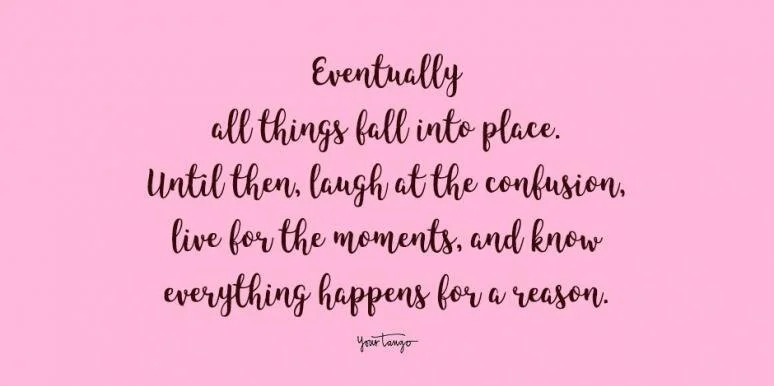
One of the great boons of religion comes from the good effects of the idea that “Everything happens for a reason.” As usually interpreted, this idea leads believers to look for the silver lining in clouds—the good that can be made out of shocks that seem bad.

Fortunately for us nonsupernaturalists, it is not necessary to believe in a benevolent supernatural being or power arranging things in order to search for the silver lining in clouds—and benefit from that search. First, one can approach a tough situation as if there were a benevolent supernatural being or power without actually believing in that power. Metaphors don’t have to be literally true to be useful.

Let me give a homely example of what I find to be a useful metaphor that I definitely don’t take as literally true. Inanimate objects sometimes get lost in my house. After a diligent, but still unsuccessful search, there has been selection against easy hiding places that I would have found it in immediately. So at that point, it helps me to ask “If it were trying to hide from me, where would it hide?” I don’t believe for a minute that the inanimate object can intentionally hide; but after the selection against the most originally most likely answers to “Where is it?” thinking as if it were intentionally hiding often yields the right kind of creative thought in order to find it.

A second nonsupernaturalist “translation” of “Everything happens for a reason” is Shirzad Chamine’s translation of it in Positive Intelligence. (See “On Human Potential” and “How Economists Can Enhance Their Scientific Creativity, Engagement and Impact.”) Shirzad defines what he calls the “Sage Perspective” as the idea that everything—including things that seem very bad—can be turned into a gift and opportunity.

In a quotation send to me from Ryan Holiday’s The Daily Stoic, the brilliant writer Jorge Luis Borges says the same idea beautifully:

A writer — and, I believe, generally all persons — must think that whatever happens to him or her is a resource. All things have been given to us for a purpose, and an artist must feel this more intensely. All that happens to us, including our humiliations, our misfortunes, our embarrassments, all is given to us as raw material, as clay, so that we may shape our art.

Ryan Holiday then extends this beyond art to life:

To decide to use this as raw material? To learn from it? To transform it? To find an opportunity within it? Yes, that remains in our power. Everything is material. We can use it all.

“Everything happens for a reason” works as well as it does for a good reason. Relative to the ancestral environment within human beings evolved, our current environment is a very nice one. (For improvements in recent history, see “Things are Getting Better: 3 Videos.") Quite literally, our instincts are to expect things to be worse and more difficult than they really are. “Optimism” is not a virtue in all circumstances, but it is a virtue in the current circumstances almost all of you enjoy; any situation better than the environment of evolutionary adaptation requires some counterweight to our inherited pessimism which was so appropriate back then, but is not so appropriate now.

  • Everything happens for a reason.

  • It is as if everything happens for a reason.

  • Everything can be turned into a gift and opportunity.

  • All that happens to us, including our humiliations, our misfortunes, our embarrassments, all is given to us as raw material, as clay, so that we may shape our art [and life].

Any of these ideas can sprinkle some stardust on your life and help make your life, not only bearable, but joyous.

Addendum 1: As another expression of the supernaturalist version of “Everything happens for a reason,” see this lyric video of Riley Clemmon’s song “For the Good,” based on Romans 8:28:

And we know that all things work together for good to them that love God, to them who are the called according to his purpose.

Addendum 2: Here is another succinct definition of the attitude I am talking about in this post, and a name for it: amor fati—loving your fate.

Amor fati is a mindset that you take on for making the best out of anything that happens: Treating each and every moment—no matter how challenging—as something to be embraced, not avoided. To not only be okay with it, but love it and be better for it. So that like oxygen to a fire, obstacles and adversity become fuel for your potential.


Eric Lonergan and Megan Greene: Dual Interest Rates Give Central Banks Limitless Firepower

In my post “Helicopter Drops of Money Are Not the Answer,” I argue against indiscriminate scattershot helicopter drops. There are better policies than that. But measures that are equivalent to tightly targeted helicopter drops to support the banking system and neutralize objections to negative interest rates can be very helpful.

Such targeted helicopter drops are not some pie-in-the-sky notion, they are current policy for many of the central banks that have implemented negative rates: both tiered interest on reserves and below-market lending rates offered by the central bank are examples of such “helicopter drops”—or the economic equivalent—targeted to support the banking system.

Concerns about the banking system are the main theoretical reason to doubt the effectiveness of negative interest rates. But targeted helicopter drops to the banking system such as through tiered interest on reserves or below-market lending rates fully neutralize these concerns. See ““Markus Brunnermeier and Yann Koby's ‘Reversal Interest Rate’” for a discussion of both the concern and its solution.

In “Dual interest rates give central banks limitless fire power” on the VoxEU blog, Eric Lonergan and Megan Greene give an enthusiastic thumbs up to such helicopter drops targeted to the banking system associated with a negative rate policy. They are somewhat less concerned about the cost of such targeted helicopter drops to the central bank’s balance sheet than I am. But what is true is that whatever cost there is to the central bank’s balance sheet, there is a long time deal with that cost. A central bank that can print the kind of money its obligations are denominated in will never face a liquidity crisis. It might not have enough other assets to sell to mop up money and reduce the monetary base, but if it is allowed to pay interest on reserves as high as it wants, it can guarantee that a large fraction of the monetary base stays on the sidelines as excess reserves at the cost of gradually increasing that monetary base by the payment of that interest. Eventually, the central bank might need recapitalization from the fiscal authority, but it can afford to wait for recapitalization through several administrations that choose to ignore the central bank’s being underwater according to the usual accounting schemes for central banks. (Note that the usual accounting schemes for central banks neglect what for any private company would be counted a huge asset: the right to print money.) On this issue of how much in the way of targeted helicopter drops to the banking system a central bank can afford, see my post “Why Central Banks Can Afford to Subsidize the Provision of Zero Rates to Small Household Checking and Savings Accounts.”

Ruchir Agarwal feature a particular version of what I am here calling “targeted helicopter drops to the banking system” in our two IMF Working Papers:

In general, wealth effects are not a problem for the effectiveness of negative interest rate policy, because lower rates shift the balance of power to borrowers in each borrower-lender relationship; and it is quite rare for the marginal propensity to spend of lender to be higher than the marginal propensity to spend of a borrower. To have a positive effect on aggregate demand it is not necessary for everyone to spend more; it is only necessary for those who spend more to outweigh those that spend less. Thinking about this borrower-lender relationship by borrower-lender relationship, almost all of these pairings will raise spending when the spending of the borrower and lender in the relationship is added together.

There may, however, be a few borrower-lender relationships where the marginal propensity to spend of the lender is greater than the marginal propensity to spend of the borrower. In addition to targeted helicopter drops to support the banking system, these few odd borrower-lender relationships could be candidates for a targeted helicopter drop. What I am emphasizing is that of the few rational (as opposed to irrational freak-out) and principled (as opposed to narrowly self-interested) objections to negative interest rates, most have to do with some kind of wealth effect. Almost all of these wealth effect issues can be addressed by appropriately targeted helicopter drops.

Take a look at In “Dual interest rates give central banks limitless fire power” in the light of what I say here. It is important to understand the potential here.

For related posts, see “How and Why to Eliminate the Zero Lower Bound: A Reader’s Guide.”

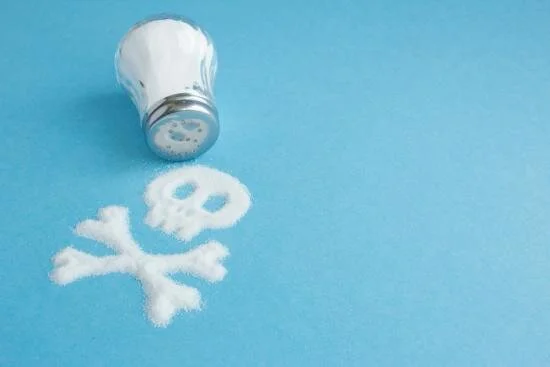
Hypotheses about Salt and Blood Pressure

There is a lot we don’t know about salt and blood pressure. There seems to be a positive correlation between salt consumption and high blood pressure, but a lot of that evidence could be explained by the importance of processed food as a source of salt. Processed food tends to have a lot of sugar as well as a lot of salt; if sugar raises blood pressure, that could get falsely blamed on salt.

Because some of the relevant environments of evolutionary adaptation for human beings were on the seashore and so probably had a lot of salt, one would suspect that within some reasonable range, our bodies are able to get rid of excess sodium. So unless salt consumption is very high, I don’t see why we would have a vulnerability to excess salt.

It should be noted, however, that the standard mechanism for getting rid of excess salt might involve sweating it away or otherwise using water to help get rid of salt. So those who don’t drink enough water might well be harmed by excess salt in a way that those who drink plenty of water are not.

Now think of interventions to lower salt consumption, these might lower blood pressure without salt having been the cause of the high blood pressure in the first place.

Let me describe an analogy. Warfarin acts to as a blood thinner (that is, to reduce the danger of blood clots) by blocking the action of Vitamin K. For the Warfarin to remain effective, the one being treated needs to avoid eating too much Vitamin K or needs to raise the Warfarin dose to compensate for Vitamin K consumed. So Vitamin K can frustrate Warfarin without adjusting the dose. But although less Vitamin K can reduce blood clotting, extra Vitamin K doesn’t increase blood clotting beyond a certain point. The excess would just be ignored or reprocessed by the body.

In the case of sodium, if one has a sodium deficiency then the body might need to reduce the quantity of blood so the sodium concentration doesn’t get too low. That would reduce blood pressure. If blood pressure is too high for some reason other than salt consumption, this sodium deficiency lowering blood pressure might have some beneficial effect.

Note that while it is strange if the body can’t get rid of excess sodium, if there is a sodium deficiency there are fewer ways to get the sodium levels up, mainly conservation and making someone crave salt. If, for medical reasons, the individual doesn’t given in to a salt craving, the body can’t remedy the sodium deficiency that way and has to reduce blood pressure to keep sodium concentrations up, once available avenues of conservation of sodium are exhausted.

I may be totally wrong, but what does this predict? First, that most of the correlation between salt and blood pressure is about the confound of the sugar that tends to come along with salt. This accounts for most of the relationship between salt and is probably a linear relationship accounting for the linear relationship between salt and blood pressure that meets the eye in a scatter plot. Second, intervention evidence that gets the causal effect of salt on blood pressure is mostly about reducing the amount of salt and could work through sodium deficiency reducing blood pressure even if it is easy for the body to get rid of excess sodium. Third, there is a prediction that an experiment that probably wouldn’t pass human subjects review—feeding people extra salt (while making sure they drink plenty of water)—would not cause a rise in blood pressure.

I am not wedded to these hypotheses; I’d be glad to hear a refutation. I am interested. And I also realize I might be wrong about Vitamin K.


For annotated links to other posts on diet and health, see: