Simon Denyer on How Japan Has Handled Covid-19

It has been surprising that Japan has kept its Covid-19 burden as low as it has given that it hasn’t done broad lockdowns or done a lot of testing. This article gives some insight into how it has done as well as it has.

One thing I can say from my time in Japan is that masks during any hint of illness have been a part of Japanese culture for a long, long time—long before Covid-19. That surely helped. And the Japanese custom of bowing rather than giving a handshake is likely to help a little. But those aren’t the only things.

Hat tip to Gail Kimball.

The Federalist Papers #17: Three Levels of Federal Power

Link to the Wikipedia page 1838 “Mormon War

Link to the Wikipedia page 1838 “Mormon War

In the Federalist Papers #17, Alexander Hamilton has trouble imagining a Federal government that horned in on a large share of the internal powers of states. In part, he thought that the Federal government would not be adequately staffed to do such a thing, not conceiving of the rise of the administrative state and its large agencies. (For example, the current version of the Wikipedia article for “United States Environmental Protection Agency” says the EPA has 13,758 employees.)

Alexander Hamilton also did not imagine the 14th amendment, which after much evolution of constitutional law makes the Bill of Rights apply against states, along with the Civil Rights Act and the Voting Rights Act, which make the Federal government a key enforcer of constitutional rights when a state violates or jeopardizes those rights.

However, Alexander Hamilton’s view that the Federal government would lose most disputes with states over their internal affairs was a good description of the situation until the Civil War, and after the end of Reconstruction returned to being a good description of the situation until the Civil Rights revolution of the 1960s.

Conceptually, there are three levels of federal power:

  1. Having authority only over subjurisdictions—and that only if the a subjurisdiction did not object—as was true in the Articles of Confederation

  2. Having direct authority over individuals as well as that kind of very limited authority over subjurisdictions. At this level, Federal law prevailed in cases involving individuals, but the Federal government had very little ability to order a state to do something beyond that influence on the court system. This is what the 1787 Constitution established.

  3. Having the authority to prevent a state government from treating the states own citizens in ways the Federal government prohibits, and the ability to order a state to do many things, in addition to direct authority over individuals.

To make the difference between 2 and 3 vivid, let me give two examples from Mormon history. In 1838, Mormons were driven out of Missouri, with the support of the governor of Missouri for driving them out. When the Mormons appealed to the Federal government, President Martin Van Buren said

Your cause is just, but I can do nothing for you.

Martin Van Buren was saying he had very little power to tell Missouri what to do.

In 1846, the main body of Mormons was driven out of Illinois. The only reason it took that long was that the murder of Mormon founder Joseph Smith mollified those in Illinois who hated Mormons for a while. In 1846 Brigham Young, whom the majority of Mormons chose to follow after Joseph Smith’s death, led Mormons from Illinois to the Great Basin—and founded Salt Lake City among many other cities.

In 1838, President James Buchanan sent an army to the Great Basin in order to get the Mormons to be more obedient to federal appointees. The 1838 “Utah War” or “Mormon Rebellion” ended in a tactical standoff. The Mormons retained considerable autonomy for quite a while afterward.

After the Edmunds Anti-Polygamy Act of 1882 the Federal government sent federal marshals to catch and imprison polygamists. Though they did in fact imprison many polygamists, they were not very successful in stamping out polygamy. Two things allowed the Federal government to eventually enforce its anti-polygamy views relatively well: a stick and a carrot. The stick was that the Federal government did not have to act against the state government in this, but could act against the Mormon Church. The Federal government threatened to confiscate all of the Mormon Church’s property. The carrot was that the Mormon Church desperately wanted statehood to gain more autonomy than a territory could afford; they were willing to promise to end polygamy to get statehood (though officially-sanctioned polygamy continued in secret and in Canada and Mexico for some time after that).

Although the Federal government was not entirely toothless in its interaction with the Mormon Church dominating Utah, it had only partial success in enforcing its will.

Until almost my lifetime (I was born in 1960), the main example of the Federal government enforcing its will against states was the Civil War and Reconstruction. Having to go to war to enforce Federal authority is not a sign of a strong Federal government. Indeed, in the Federalist papers #15, Alexander Hamilton argues that the theoretical authority over the states given by the Articles of Confederation was flawed because it would take war to enforce that authority over a state. (See “The Federalist Papers #16: Authority of the Federal Government Directly over Individuals Means States Can Only Thwart the Federal Government by Active and Obvious Resistance—Alexander Hamilton.”) However, Reconstruction did involve genuine federal authority over the states brought to heel by the Civil War.

Some of the state-level passion that Alexander Hamilton writes of in the Federalist Papers #17, with the wrinkle of whites successfully making themselves much more politically potent than blacks, was behind the end of Reconstruction.

On the whole, Alexander Hamilton has good insights in the Federalist Papers #17 about the wellsprings of state power vis a vis federal power. And his contention that federal power would be quite limited was true for a long time. But his imagination failed to see all the wellsprings of federal power that would arise in the following two-and-a-fraction centuries.

With everything above as a frame, take a look at the details of what Alexander Hamilton wrote in the Federalist Papers #17:


FEDERALIST NO. 17

The Same Subject Continued: The Insufficiency of the Present Confederation to Preserve the Union

For the Independent Journal
Tuesday, December 4, 1787.

Author: Alexander Hamilton

To the People of the State of New York:

AN OBJECTION, of a nature different from that which has been stated and answered, in my last address, may perhaps be likewise urged against the principle of legislation for the individual citizens of America. It may be said that it would tend to render the government of the Union too powerful, and to enable it to absorb those residuary authorities, which it might be judged proper to leave with the States for local purposes. Allowing the utmost latitude to the love of power which any reasonable man can require, I confess I am at a loss to discover what temptation the persons intrusted with the administration of the general government could ever feel to divest the States of the authorities of that description. The regulation of the mere domestic police of a State appears to me to hold out slender allurements to ambition. Commerce, finance, negotiation, and war seem to comprehend all the objects which have charms for minds governed by that passion; and all the powers necessary to those objects ought, in the first instance, to be lodged in the national depository. The administration of private justice between the citizens of the same State, the supervision of agriculture and of other concerns of a similar nature, all those things, in short, which are proper to be provided for by local legislation, can never be desirable cares of a general jurisdiction. It is therefore improbable that there should exist a disposition in the federal councils to usurp the powers with which they are connected; because the attempt to exercise those powers would be as troublesome as it would be nugatory; and the possession of them, for that reason, would contribute nothing to the dignity, to the importance, or to the splendor of the national government.

But let it be admitted, for argument's sake, that mere wantonness and lust of domination would be sufficient to beget that disposition; still it may be safely affirmed, that the sense of the constituent body of the national representatives, or, in other words, the people of the several States, would control the indulgence of so extravagant an appetite. It will always be far more easy for the State governments to encroach upon the national authorities than for the national government to encroach upon the State authorities. The proof of this proposition turns upon the greater degree of influence which the State governments if they administer their affairs with uprightness and prudence, will generally possess over the people; a circumstance which at the same time teaches us that there is an inherent and intrinsic weakness in all federal constitutions; and that too much pains cannot be taken in their organization, to give them all the force which is compatible with the principles of liberty.

The superiority of influence in favor of the particular governments would result partly from the diffusive construction of the national government, but chiefly from the nature of the objects to which the attention of the State administrations would be directed.

It is a known fact in human nature, that its affections are commonly weak in proportion to the distance or diffusiveness of the object. Upon the same principle that a man is more attached to his family than to his neighborhood, to his neighborhood than to the community at large, the people of each State would be apt to feel a stronger bias towards their local governments than towards the government of the Union; unless the force of that principle should be destroyed by a much better administration of the latter.

This strong propensity of the human heart would find powerful auxiliaries in the objects of State regulation.

The variety of more minute interests, which will necessarily fall under the superintendence of the local administrations, and which will form so many rivulets of influence, running through every part of the society, cannot be particularized, without involving a detail too tedious and uninteresting to compensate for the instruction it might afford.

There is one transcendant advantage belonging to the province of the State governments, which alone suffices to place the matter in a clear and satisfactory light,--I mean the ordinary administration of criminal and civil justice. This, of all others, is the most powerful, most universal, and most attractive source of popular obedience and attachment. It is that which, being the immediate and visible guardian of life and property, having its benefits and its terrors in constant activity before the public eye, regulating all those personal interests and familiar concerns to which the sensibility of individuals is more immediately awake, contributes, more than any other circumstance, to impressing upon the minds of the people, affection, esteem, and reverence towards the government. This great cement of society, which will diffuse itself almost wholly through the channels of the particular governments, independent of all other causes of influence, would insure them so decided an empire over their respective citizens as to render them at all times a complete counterpoise, and, not unfrequently, dangerous rivals to the power of the Union.

The operations of the national government, on the other hand, falling less immediately under the observation of the mass of the citizens, the benefits derived from it will chiefly be perceived and attended to by speculative men. Relating to more general interests, they will be less apt to come home to the feelings of the people; and, in proportion, less likely to inspire an habitual sense of obligation, and an active sentiment of attachment.

The reasoning on this head has been abundantly exemplified by the experience of all federal constitutions with which we are acquainted, and of all others which have borne the least analogy to them.

Though the ancient feudal systems were not, strictly speaking, confederacies, yet they partook of the nature of that species of association. There was a common head, chieftain, or sovereign, whose authority extended over the whole nation; and a number of subordinate vassals, or feudatories, who had large portions of land allotted to them, and numerous trains of INFERIOR vassals or retainers, who occupied and cultivated that land upon the tenure of fealty or obedience, to the persons of whom they held it. Each principal vassal was a kind of sovereign, within his particular demesnes. The consequences of this situation were a continual opposition to authority of the sovereign, and frequent wars between the great barons or chief feudatories themselves. The power of the head of the nation was commonly too weak, either to preserve the public peace, or to protect the people against the oppressions of their immediate lords. This period of European affairs is emphatically styled by historians, the times of feudal anarchy.

When the sovereign happened to be a man of vigorous and warlike temper and of superior abilities, he would acquire a personal weight and influence, which answered, for the time, the purpose of a more regular authority. But in general, the power of the barons triumphed over that of the prince; and in many instances his dominion was entirely thrown off, and the great fiefs were erected into independent principalities or States. In those instances in which the monarch finally prevailed over his vassals, his success was chiefly owing to the tyranny of those vassals over their dependents. The barons, or nobles, equally the enemies of the sovereign and the oppressors of the common people, were dreaded and detested by both; till mutual danger and mutual interest effected a union between them fatal to the power of the aristocracy. Had the nobles, by a conduct of clemency and justice, preserved the fidelity and devotion of their retainers and followers, the contests between them and the prince must almost always have ended in their favor, and in the abridgment or subversion of the royal authority.

This is not an assertion founded merely in speculation or conjecture. Among other illustrations of its truth which might be cited, Scotland will furnish a cogent example. The spirit of clanship which was, at an early day, introduced into that kingdom, uniting the nobles and their dependants by ties equivalent to those of kindred, rendered the aristocracy a constant overmatch for the power of the monarch, till the incorporation with England subdued its fierce and ungovernable spirit, and reduced it within those rules of subordination which a more rational and more energetic system of civil polity had previously established in the latter kingdom.

The separate governments in a confederacy may aptly be compared with the feudal baronies; with this advantage in their favor, that from the reasons already explained, they will generally possess the confidence and good-will of the people, and with so important a support, will be able effectually to oppose all encroachments of the national government. It will be well if they are not able to counteract its legitimate and necessary authority. The points of similitude consist in the rivalship of power, applicable to both, and in the CONCENTRATION of large portions of the strength of the community into particular DEPOSITS, in one case at the disposal of individuals, in the other case at the disposal of political bodies.

A concise review of the events that have attended confederate governments will further illustrate this important doctrine; an inattention to which has been the great source of our political mistakes, and has given our jealousy a direction to the wrong side. This review shall form the subject of some ensuing papers.

PUBLIUS.

Here are links to my other posts on The Federalist Papers so far:

Scott Cunningham on Losing a Child

Scott’s thread is about what it is like to be the parent of a child who dies or almost dies. My wife—Gail Deann Cozzens Kimball—and I lost a son to suicide: Spencer Miles Kimball. Gail writes about that in “The Shards of My Heart.” Gail and I also lost two daughters in infancy due to a very rare condition in which they were born with small lungs—presumably a genetic condition because it was similar in both daughters who died. They were named Marianne Camilla Kimball and Laura Beth Kimball.

Our remaining two children, Diana Gail Kimball Berlin and Jordan Matthew Kimball, are doing great.


Getting the Best from Wokeness by Having the Right Mean, Reducing the Variance and Mitigating the Losses from Extreme Values

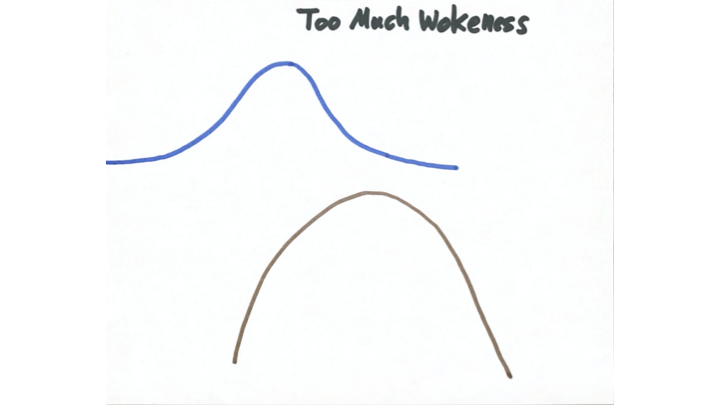
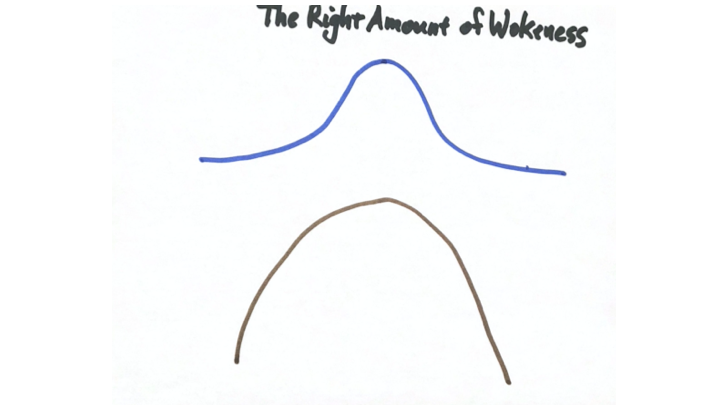
In “The Right Amount of Wokeness” I talk about getting the right mean of wokeness using the following graphs:

too little wokeness.png

In each graph, the bell curve is is the density function for wokeness and the quadratic function below it is the loss function. If one can only control the mean of wokeness, the optimum is to have the mean of the wokeness distribution at the point where the loss is minimized. And given the symmetry of the two functions, one can tell whether one has too much or too little wokeness by whether (a) there are worse horrors coming from too little wokeness than from too much wokeness or (b) there are worse horrors coming from too much wokeness. Without at all minimizing the horrors from too much wokeness (see for example “John McWhorter on Professors Worrying about the Consequences If They Sound Less Than Totally Woke”), I argue that the horrors from too little wokeness are currently worse.

But this simple model points clearly to two other ways to minimize losses: reducing the variance of wokeness and mitigating losses in any given situation (making the loss function less tightly curved).

A start toward reducing the variance of wokeness is criticizing and educating people with a level of wokeness either higher or lower than the vertex of the loss function. Even if it doesn’t change average beliefs, giving people the facts about statistically discriminating beliefs should be able to reduce the variance of “wokeness.” (My post “The Cost of Variance Around a Mean of Statistically Discriminating Beliefs” is related, but has a somewhat different model.) At any rate, we should try to collectively express strong social disapproval for those at either extreme of the wokeness distribution—obviously with more disapproval expressed on one end if the mean of wokeness is not at the vertex of the loss function. Currently that means more expression of social disapproval for too little wokeness, but there will be some people with enough too much wokeness that they deserve strong expression of social disapproval.

Reducing the losses from any given situation affected by high or low wokeness is often a matter of common sense that too often gets blocked in its application by partisanship of those with quite high or quite low wokeness. Those of us nearer the level of wokeness at the vertex of the loss function (a group in which I optimistically put myself :) need to support common sense measures. What do I mean?

  1. Send in the police to stop looting when folks with too much wokeness—while not doing any looting themselves—are too willing to tolerate looting.

  2. Hold the police to account when they mistreat people.

  3. Call out coded racist statements.

  4. Don’t let people hide behind saying they aren’t racist, they are just statistically discriminating. Because of hysteresis or slow convergence, to get to the right equilibrium in a reasonable time frame, we need to do more than just get rid of out-and-out racism. (See “Enablers of White Supremacy.”)

Quite importantly, note that someone is not a racist for opposing too much wokeness. They are only supporting racism if they promote too little wokeness. The distribution of wokeness has a large enough variance that it would be unlikely indeed that there aren’t some people out there with too much wokeness. So there ought to be some criticism of people for too much wokeness; it would be a bad sign if there weren’t. Those who criticize too much wokeness when it is genuinely left of the vertex are heroes, not racists. But those with too much wokeness will fight back, so those who criticize people for too much wokeness need to be tough heroes.

But given the current mean of wokeness, we need many more heroes to attack too little wokeness than the number of heroes we need to attack too much wokeness. I am heartened to see the number of people taking up the cause of antiracism with vigor. It makes me proud of our country.

Fasting Tips

I am in the middle of “My Annual Anti-Cancer Fast,” so my thoughts are turning toward things that make fasting a little easier. Before getting into fasting tips, let me say that I have copied out a set of cautions about fasting from earlier blog posts that you should read if you haven’t seen it already. I label it “Appendix.” From here on in this post I will assume you have read it.

I am a big fan of Jason Fung in the area of fasting for health, as you can see from “Obesity Is Always and Everywhere an Insulin Phenomenon” and “Five Books That Have Changed My Life.” Recently, my wife Gail obtained a fasting coach associated with Jason Fung and has had a very good experience with that fasting coach. The picture and link thefastingmethod.com at the top of this post are for getting a fasting coach in that group. I’ll separate out the fasting tips by how I learned them.

Miles’s fasting tips:

  • One of the biggest aids to a multiple day fast is the rapidly rising number of flavors of sparkling water. (See “In Praise of Flavored Sparkling Water.”)

  • Stay busy while fasting. Distraction is your friend: it helps you forget the mild psychological hunger you shouldn’t be paying attention to. Many of us have no problem staying busy catching up on work. But if you have time, do something fun, like marathoning an especially fun TV series, going on a hike, or playing your favorite video game.

  • To avoid constipation while fasting and in the days right after I start eating again, during the fast I cut back on my regular vitamins and add two psyllium pills each day while fasting (psyllium husks are the active ingredient in Metamucil). I do take one medication and one vitamin that are idiosyncratic to me, and one pill that I recommend to anyone fasting: a “buffered electrolyte salts” pill. Right now, I am using this brand, but have no special allegiance to any particular brand.

  • During the fast, as long as you are eating very low on the insulin index (see “Forget Calorie Counting; It's the Insulin Index, Stupid”) you will continue burning fat; the only thing you have to worry about is that the calories you eat will displace calories burned. (See “Maintaining Weight Loss” and “How Low Insulin Opens a Way to Escape Dieting Hell”)

  • Gail often eats a bit of almond or macadamia butter during her extended fasts if she feels uncomfortably hungry or worries that hunger might disrupt her sleep.

Tips from Gail’s fasting coach:

  • One thing I didn’t realize at all, but makes sense to me on hearing it is that while eating processed food (which includes almost all food in cans or boxes) may give you more salt than you need, when fasting, you might be getting too little sodium. One “buffered electrolyte salts” pill a day probably gives you enough magnesium and potassium, but not enough sodium if you are fasting. If you get too little sodium, it can make you feel weak or faint. Once you realize this, the solution is easy: early in the day put a teaspoon and a half of regular table salt in a small bowl; take pinches of the salt and put them under your tongue. Wash down with water. Repeat, until the teaspoon and a half is all consumed. Try to get this done before 2 PM each day that you are fasting. You will feel better. (I have found a small variant on this works well for me: put a larger amount of salt in a small bowl along with the half-teaspoon measure; put half a teaspoon under my tongue and wash it down fast with several gulps of water; after the first few gulps, swish the water around, then rinse one more time; do three times in the day.)

    Update January 19, 2021: I realized that taking sodium chloride pills was a lot more pleasant than eating table salt straight. Same effect, more pleasant going down. I take 2 one-gram sodium chloride pills a day while doing hardcore fasting (no food) and 1 a day while doing modified fasting, because I salt the radishes I eat. (See “My Modified Fast” on that). Here is the Amazon page for the sodium chloride pills I bought.

    This is a reevaluation of the right dosage: a half teaspoon corresponds to 2.5 to 3 pills of one-gram of sodium chloride each. Steven Gundry’s Your Health magazine says that we need .5 grams of sodium a day, the average American gets about 3.6 grams of sodium and the recommended limit is 2.3 grams a day of sodium if you don’t have high blood pressure and 1.5 grams of sodium a day if you do have high blood pressure. Translating that into grams of sodium chloride, that is 1.3 one-gram pills minimum per day, the equivalent of 9.3 one-gram pills for the average American each day, and a recommended maximum of 5.9 grams of sodium chloride if you don’t have high blood pressure and 3.9 grams if you do have high blood pressure. Hence my idea that 2 one-gram sodium chloride pills is about right during a hardcore fast and 1 one-gram sodium-chloride pill during a modified fast.

  • I have emphasized how eating low on the insulin index makes fasting easy. If you are going into a long fast, you can make the transition into fasting even easier by going extra low on the insulin index. If you like eating meat, choose the fattiest cuts you can find. For beef, that’s ribeye steak. For pork, ribs also seem especially fatty, and bacon is usually quite fatty. For chicken, dark meat is fattier than light meat.

  • I knew Jason Fung recommended green tea as something that helps make your hunger go away during fasting, but Gail’s fasting coach also recommends vinegar. In particular, said it’s OK to eat sugar-free dill pickles during a fast and even recommends drinking the pickle juice.

  • Testing devices that tell you how deeply you are into fat burning (ketosis) can be motivating. Gail likes the Biosense Ketone Breath Analyzer because it is easy to use, doesn’t need blood, and has an almost zero marginal cost (though the initial purchase cost is substantial). Keto Mojo strips have a significant marginal cost and require pricking your finger to get a blood sample. But it is somewhat more accurate than the ketone breath analyzer and provides a blood sugar level as well as a ketone level. It’s not like you necessarily need all that innovation, but it might provide the crucial motivation to keep going.

Finally, one bottom line: fasting is easy if you are eating low on the insulin index. And if the food is low enough on the insulin index, you can even eat it during a fast and you will still get the health benefits of the fast; you will simply have somewhat slower weight loss. But if you try to fast or eat only a few calories a day while eating high-carb or otherwise high on the insulin index, you will be in the territory of the Minnesota Starvation Experiment, which was hellish for the experimental subjects. Eating low on the insulin index makes all the difference for how easy fasting is. As long as you still have body fat to burn, fasting isn’t starvation; it can be relatively easy.

For annotated links to other posts on diet and health, see:

Appendix: Cautions about Fasting.

Before I dive into the technical details, let me repeat some cautions about fasting. I am not going to get into any trouble for telling people to cut out added sugar from their diet, but there are some legitimate worries about fasting. Here are my cautions in “Don't Tar Fasting by those of Normal or High Weight with the Brush of Anorexia”:

  • If your body-mass-index is below 18.5, quit fasting! Here is a link to a BMI calculator.

  • Definitely people should not do fasting for more than 48 hours without first reading Jason Fung’s two books The Obesity Code (see “Obesity Is Always and Everywhere an Insulin Phenomenon” and “Five Books That Have Changed My Life”) and The Complete Guide to Fasting.

  • Those under 20, pregnant or seriously ill should indeed consult a doctor before trying to do any big amount of fasting.

  • Those on medication need to consult their doctor before doing much fasting. My personal nightmare as someone recommending fasting is that a reader who is already under the care of a doctor who is prescribing medicine might fail to consult their doctor about adjusting the dosage of that medicine in view of the fasting they are doing. Please, please, please, if you want to try fasting and are on medication, you must tell your doctor. That may involve the burden of educating your doctor about fasting. But it could save your life from a medication overdose.

  • Those who find fasting extremely difficult should not do lengthy fasts.

  • But, quoting again from “4 Propositions on Weight Loss”: “For healthy, nonpregnant, nonanorexic adults who find it relatively easy, fasting for up to 48 hours is not dangerous—as long as the dosage of any medication they are taking is adjusted for the fact that they are fasting.”

Let me add to these cautions: If you read The Complete Guide to Fasting you will learn that fasting more than two weeks (which I have never done and never intend to do) can lead to discomfort in readjusting to eating food when the fast is over. Also, for extended fasts, you need to take in some minerals/electrolytes. If not, you might get some muscle cramps. These are not that dangerous but are very unpleasant. What I do is simply take one SaltStick capsule each day.

John McWhorter on Professors Worrying about the Consequences If They Sound Less Than Totally Woke

Read the essay at the link above in conjunction with my post “The Right Amount of Wokeness.” It is possible to think that a shift toward a higher mean of wokeness is a good thing and still think that (a) the variance of wokeness should be reduced and (b) the bad consequences coming from realizations with too much wokeness should be mitigated. I plan to write a full length blog post of my own on this math.

Embodiment

I listened to Philip Shepherd’s book Radical Wholeness on Audible while making my giant salad. I was annoyed by his aggressive supernaturalism and the way he attacked rich folks in a tendentious way and then denied that he was attacking them. But he had a good point about the importance of connecting to our bodies.

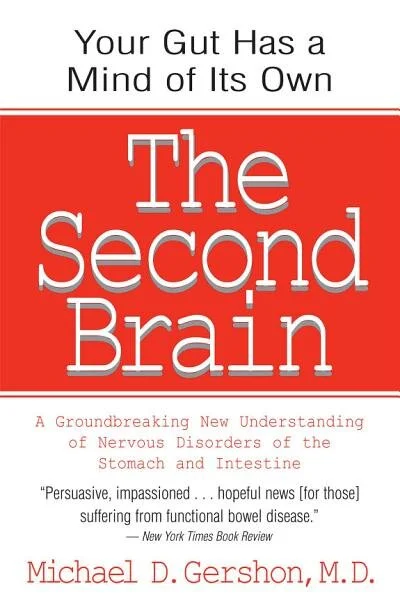
Because Philip Shepherd was focusing on consciousness and the subconscious, the kind of “connecting to our bodies” he was really talking about was connecting fully to the full, comprehensive representation of one’s body in one’s brain. But crucially, our brain is not just in our head. The large collection of neurons in your gut has been called “The Second Brain.” And humans have other collections of neurons that are larger than the brains of some animals.

Let me illustrate the importance of this fact in a science-fictiony way. The first five links at the bottom of this post demonstrate my interest in Robin Hanson’s book The Age of Em. Suppose you wanted to be frozen when you die with the view that, with some positive probability, your frozen brain would get scanned and you would be able to have a second life as a software human (a brain emulation that Robin Hanson nicknames an “em”). I would strongly advise that you get your whole body frozen, not just your head. I think you will have a better experience as a software human (or at any rate, the software human who thinks they are you will have a better experience) if not only your brain in your head gets scanned and converted to software, but also the brain in your gut and the smaller brains in other parts of your body.

Link to the Amazon Page for The Age of Em,  m(Annoyingly—and ironically—there doesn’t seem to be a Kindle version available in the US, so I had to get a paper-and-ink book about digital humans.)

Link to the Amazon Page for The Age of Em, by Robin Hansonm

(Annoyingly—and ironically—there doesn’t seem to be a Kindle version available in the US, so I had to get a paper-and-ink book about digital humans.)

I have no doubt that Philip Shepherd would be aghast at the idea of becoming a software human without a literal body. But the body that counts for one’s experience is the full, comprehensive brain representation of your body including your entire nervous system, plus as full a representation as possible of the rest of the body systems to the level of detail that your brain experiences them. (Particularly important here is the hormonal system, which has a big effect on brain parameters.) As inputs to the brain emulation proper, you need not only the world-facing senses, but also all dimensions of interoception: all aspects of body state as communicated to the brain. And to get interoception right, you need to have a reasonable model of the body systems outside the extended brain.

Update: Robin Hanson gives these comments on Twitter:

I agree that ems will want to include models of the parts of our "brain" outside our heads. However, it is less obvious to me that we can't usefully substitute a generic version of that for any one person, if only their head was frozen.

That is, I'm pretty sure we need your particular head to make a model of you, but less sure we need your particular body to make a creature who remembers being you and enjoys their body.

I respond:

There is some risk aversion in what I wrote. As you say, it might be OK to just have the head, but it might not be.

Robin replies:

Sure, but people are pretty price sensitive here, and head only can be a lot cheaper.


Related Posts:

How Economists Can Enhance Their Scientific Creativity, Engagement and Impact

Miles as a young boy, with lion

Miles as a young boy, with lion

I have always thought of my blog’s target audience as economists who are still curious and open to changing their minds. For economists who meet that test, I am offering a six-week program (on Zoom) to enhance your personal scientific creativity, engagement and impact in economics. This post lays out that offer.

Why? I believe that economists, as a group, make a huge difference in the world, and that how economists approach their work matters not only for their success, but for the world. I want to help economists do their work at a higher level.

I have a lifelong interest in meta-skills and general-purpose skills that can enhance almost any other skill. (I always wanted to be smarter—and reasoned that figuring out general-purpose skills that enhanced many other skills would help.) You can see some of this interest in what I have written about the importance of a dynamic growth mindset for gaining skill at math (see “There's One Key Difference Between Kids Who Excel at Math and Those Who Don't” with Noah Smith and “How to Turn Every Child into a 'Math Person’”) and memory (see “The Most Effective Memory Methods are Difficult—and That's Why They Work”).

In 2020, I gained a fuller appreciation for another type of general-purpose skill that can be called “mental fitness.” Without training, our minds are all over the place. And even successful academics typically only have partial command of their own minds. We live far below our potential. Mental fitness is the skill of putting your brain in the optimal brain-state for what you are trying to do.

If you want creativity, engagement and impact, getting to an optimal brain state is crucial. Creativity requires holding the intensely critical side of you at least temporarily at bay so that ultimately promising ideas are not prematurely killed. Engagement—having the work you do flow and feel surprisingly low-effort—requires silencing or at least quieting distracting, self-destructive mind-chatter. Impact requires being in touch with what really matters—both what matters to you and what matters for the world.

I believe most economists went into economics—as opposed to earning more on Wall Street or in the business world—because they wanted to make a positive difference in the world. But the process of getting a PhD, getting a job and getting tenure (or getting to a certain rank in a non-academic job) can narrow down the professional objectives of economists to something like “publishing papers in top journals” or perhaps “surviving the next semester.” Mental fitness can help you get back in touch with the reason you got into economics in the first place rather than the narrow games the sociology of economics pulls you into. And it can even help you in the narrow games of publishing papers in top journals and surviving the next semester.

What? Mental fitness involves developing the skill of noticing what your mind is doing and the skill of getting your mind to go in the direction you want it to go. Done right, “mindfulness” is a synonym of “mental fitness.” I have become very impressed with Shirzad Chamine’s “Positive Intelligence” as an intensive program for learning a diversified set of key mental-fitness skills. It systematizes things I have been trying to do all of my life but only managed to do in part. You could spend years studying different approaches to mindfulness and not learn what you can learn after six weeks of “Positive Intelligence”—six weeks in which you are continuing with your regular life. What is “intensive” about the program is applying the principles and techniques in your life as soon as you learn them. (For more on the Positive Intelligence approach, see my post “On Human Potential.”)

I am one of the few economists in the world (I’d love to hear of others) who has been trained as a Positive Intelligence Coach, in addition to being a Certified Professional Co-Active Coach. Therefore, I think of training economists in mental fitness using the Positive Intelligence approach as my comparative advantage for service to the discipline of economics.

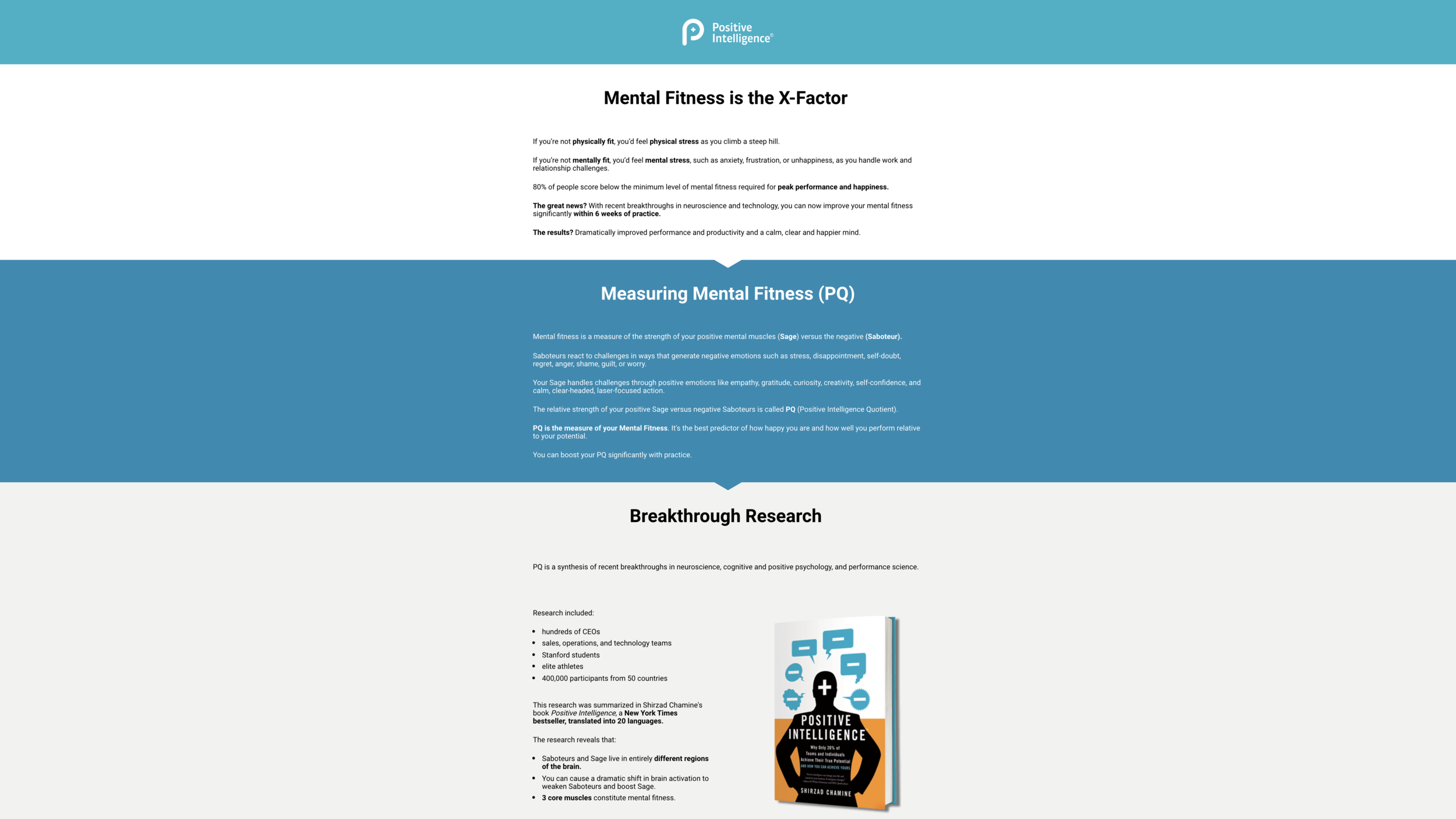
You can see the webpage for the six-week Positive Intelligence training program here. I’ll put some screenshots of that page at the bottom of this post to pique your curiosity. You can see from this webpage that, commercially, enrolling in this six-week program would cost you $995. Many other Positive Intelligence Coaches who have been trained as I have are charging at least a substantial fraction of that for leading the program.

I am offering Positive Intelligence training to economists without charge as a service to a discipline I love. Using as a metaphor the NSF fellowships we all wish we had gotten (or were grateful that we did) if you qualify, I am offering you a “fellowship” for this training.

One reason I am excited about leading Positive Intelligence training is that since I continue to work full time as an economics professor, I don’t have the time to coach many people one-on-one. By coaching groups of economists through the six-week Positive Intelligence program, I can reach a lot more economists. And for those who, through the Positive Intelligence work, see that they want to try some one-on-one Co-Active Coaching, I am happy to serve as matchmaker. Coaches offer free sample sessions, so it is easy to get a taste of coaching and what it is like with a particular coach. I write about Co-Active Coaching here:

I am pleased to co-lead this program with my wife Gail, who is also a highly-trained, experienced coach. In particular, Gail has coached many economists. (Gail has two guest posts on this blog: “Marriage—Not for the Faint of Heart” and “The Shards of My Heart.” We recently celebrated our 37th anniversary.)

How? First, you must be an economist—or be the family member of an economist who is going to do the program at the same time. “Being an economist” means having an economics or finance PhD, being in or being admitted to an economics or finance PhD program, or if you are at earlier stage, convincing me that you are destined to get an economics or finance PhD.

Second, you must be committed to do the work:

  • Attending a 1-hour weekly training meeting (on Zoom) of our Positive Intelligence Circle each week during the six-week program (see below for the timing)

  • Doing 15 minutes per day of short exercises using an app for your phone. (These exercises are spread out over the day and can easily fit into your schedule.)

  • Reading the first eight chapters of the book Positive Intelligence by Shirzad Chamine.

  • Watching a 1-hour video by Shirzad Chamine each week.  

  • Sharing your experiences along the way using Positive Intelligence principles with others in your circle.

Third, you need to pass the modest intelligence test of somehow finding one of my two university email addresses in order to send me an email expressing your interest. (I still use my University of Michigan email address as well as my University of Colorado Boulder email address.)

Fourth, each Positive Intelligence Circle is limited to 9—or at most 10—participants at a time. If rationing is required, many considerations will play a role, but other things equal, the sooner you send me an email, the more likely I will be to fit you into the circle. I’ll automatically put you on a waiting list for later circles if there isn’t room, but when you come off the waiting list is entirely at my discretion.

Update April 20, 2021: Our Positive Intelligence Circles have been so successful that we plan to keep doing them indefinitely. Send me an email to get on the waiting list as soon as possible! Over a longer time horizon, if demand continues at the present level, I hope to recruit other coaches (including hoping to persuade other economists to get coaching training) so that we can expand to running several Positive Intelligence Circles at once.

Our modal time for the seven weekly meetings is Tuesday at 6 PM Eastern Time, but we regularly do variations on that weekly meeting time to accommodate time constraints people have (including being in non-US time zones).

There is one delicate matter I have thought through. To keep my load manageable, I feel I need to set a rule that unless I have another preexisting connection with you, I won’t write a recommendation for you or otherwise do an official evaluation of you simply because you have done the Positive Intelligence work with me. However, if you complete the program, I can provide you with a pdf file in the form of a letter on letterhead describing this Positive Intelligence training and saying that you completed it. Other than altering it, you can then do anything you want with that.

Final Thoughts: I led with the benefits of having command over your own mind for productivity (“creativity, engagement and impact”). But being at choice about your brain state has in many ways even bigger benefits for your happiness and for your relationships. When I did the same six-week Positive Intelligence training, I estimated that the amount of time I felt unhappy was cut to a third of what it was. The reason I am including family members (including anyone you live with and a significant other in a long-distance relationship) in this offer is that I have seen the good this Positive Intelligence training can do for relationships. It will help your relationships even if only you learn these skills, but obviously it is even more powerful if both people in a relationship learn the skills. If you are old enough to have a child or children 15 or older (or you convince me you have a kid who is especially mature), your children are also included in this offer. But you, the economist, need to be doing it at the same time as a family member; you can’t just send them off to do it!

The picture of me with the lion at the top of this post is shorthand for the kind of sage-like, full-of-possibility brain state that can be at your beck and call. I had many unhappy moments in my childhood, but this was a good one. Good moments can be endogenous for you—at your command.

For accounts of others’ experiences in this program, see “Reactions to Miles’s Program For Enhancing Economists’ Scientific Creativity, Engagement and Impact.”


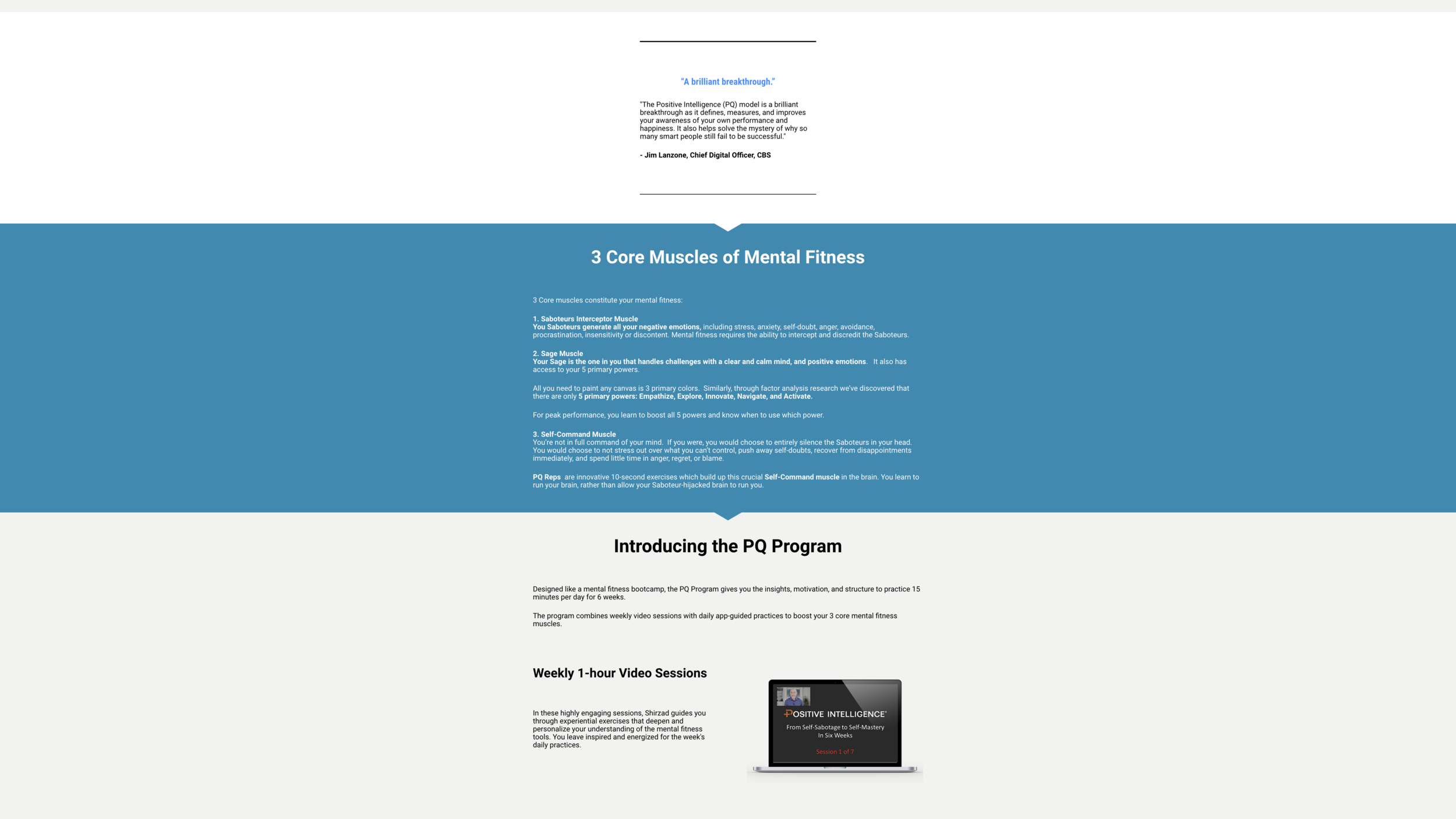
Screenshots of the webpage for the commercial version of the six-week Positive Intelligence training program—to entice you to click on this link and see the real thing, where the type is big enough to actually read. The commercial version is like taking a large class. The Positive Intelligence Circles I will lead will be like taking a small class with the same basic material, taught by an economist.

Screen Shot 2020-09-08 at 5.40.24 PM.png
Screen Shot 2020-09-08 at 5.40.35 PM.png
Screen Shot 2020-09-08 at 5.40.50 PM.png
Screen Shot 2020-09-08 at 5.41.11 PM.png
Screen Shot 2020-09-08 at 5.41.20 PM.png


Journal of the American College of Cardiology State-of-the-Art Review on Saturated Fats

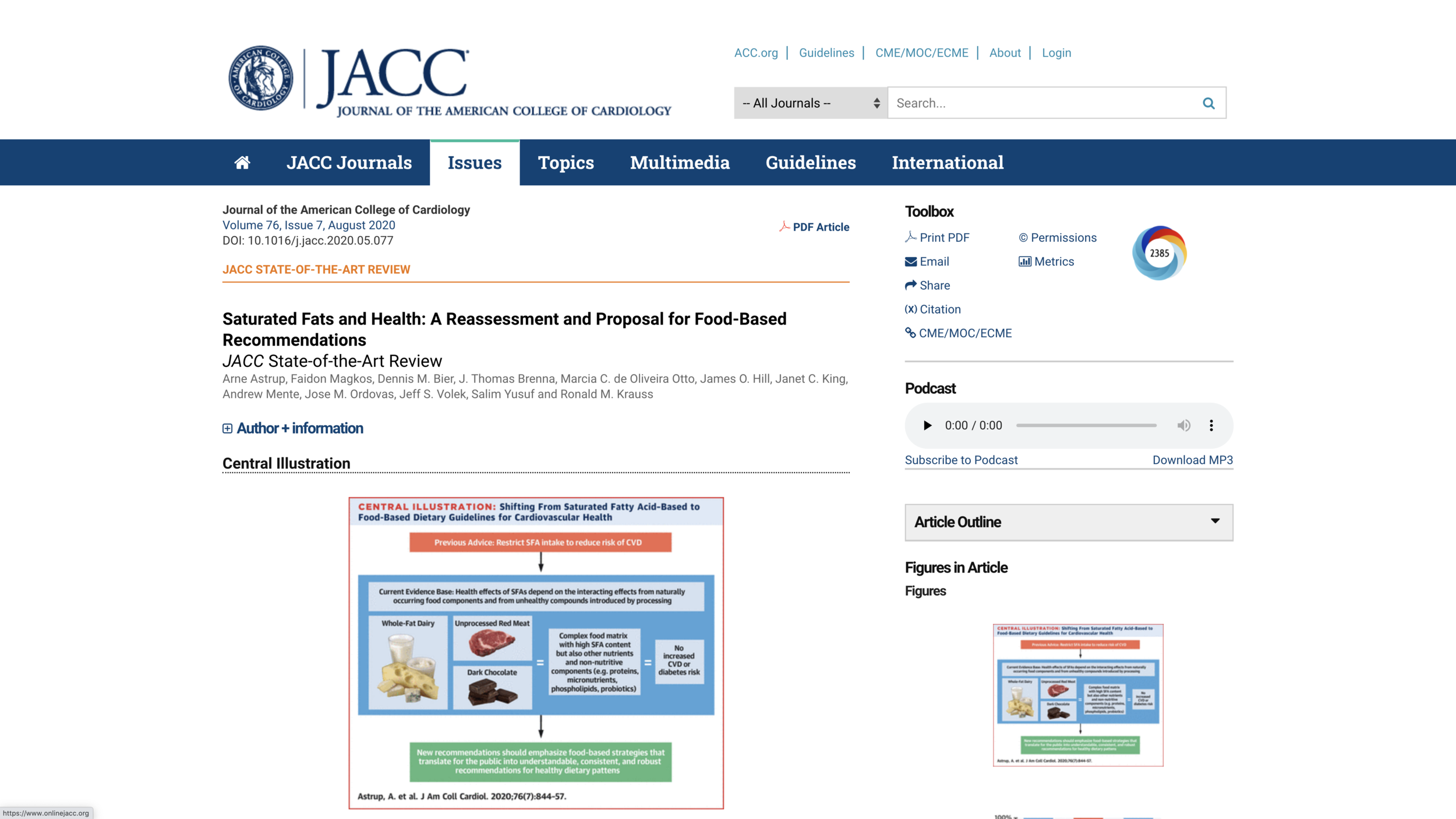
If you think saturated fats are unhealthy, you should read “Saturated Fats and Health: A Reassessment and Proposal for Food-Based Recommendations: JACC State-of-the-Art Review.”

Introduction. I’ll just pull out some quotations that give the highlights. (All quotations are from this paper.) First, from the abstract:

The recommendation to limit dietary saturated fatty acid (SFA) intake has persisted despite mounting evidence to the contrary. Most recent meta-analyses of randomized trials and observational studies found no beneficial effects of reducing SFA intake on cardiovascular disease (CVD) and total mortality, and instead found protective effects against stroke.

But what about the effect of saturated fat on LDL (low-density lipoprotein)? The key thing to know here, which not everyone knows is LDL particle number is the right test for heart disease and stroke danger, not the more commonly given test for the quantity of cholesterol in LDL particles. For the LDL particle numbers, which are the right measure to predict disease risk, saturated fat doesn’t have an adverse effect. Continuing in the abstract, this is how the authors of the paper above explain that:

Although SFAs increase low-density lipoprotein (LDL) cholesterol, in most individuals, this is not due to increasing levels of small, dense LDL particles, but rather larger LDL particles, which are much less strongly related to CVD risk.

A little lower down, here is a summary statement about the effects of saturated fats on the hard outcomes of disease and mortality:

Some meta-analyses find no evidence that reduction in saturated fat consumption may reduce CVD incidence or mortality (3–6), whereas others report a significant—albeit mild—beneficial effect (7,8). 

Where the Idea that Saturated Fat is Bad Came From. In assessing the scientific evidence that saturated fats are unhealthy, one should be aware that this became the “status quo” notion back in the 1950s, long before there was solid scientific evidence one way or another. Ideational inertia since then has given the idea that saturated fats are unhealthy an unfair advantage:

In the 1950s, with the increase in coronary heart disease (CHD) in Western countries, research on nutrition and health focused on a range of “diet-heart” hypotheses. These included the putative harmful effects of dietary fats (particularly saturated fat) and the lower risk associated with the Mediterranean diet to explain why individuals in the United States, Northern Europe, and the United Kingdom were more prone to CHD. In contrast, those in European countries around the Mediterranean had a lower risk. These ideas were fueled by ecologic studies such as the Seven Countries Study.

Evidence on the Effects of Saturated Fat. What do better studies indicate? I have added bullets to separate distinct passages answering this question:

  • A few large and well-designed prospective cohort studies, which used validated questionnaires to assess diet and recorded endpoints in a systematic manner, were initiated recently. They demonstrated that replacement of fat with carbohydrate was not associated with lower risk of CHD [coronary heart disease], and may even be associated with increased total mortality (29–31). Furthermore, a number of systematic reviews of cohort studies have shown no significant association between saturated fat intake and coronary artery disease or mortality, and some even suggested a lower risk of stroke with higher consumption of saturated fat (3,6,32,33). 

  • … biomarkers of very long-chain SFA (20:0, 22:0, 24:0) were not associated with total CHD (associations for fatal and nonfatal CHD were similar), and if anything, levels in plasma or serum (but not phospholipids) may be inversely associated with CHD (34).

  • … increased consumption of all types of fat (saturated, monounsaturated, and polyunsaturated) was associated with lower risk of death and had a neutral association with CVD. By contrast, a diet high in carbohydrate was associated with higher risk of death but not with risk of CVD.

  • … the quintile with the highest saturated fat intake (about ∼14% of total daily calories) had lower risk of stroke, consistent with the results from meta-analyses of previous cohort studies (36).

  • … the substitution of polyunsaturated for saturated fat was associated with higher CVD risk.

  • The PREDIMED (Prevención con Dieta Mediterránea) trial compared a standard low-fat diet with a Mediterranean diet supplemented with nuts or olive oil. Despite an increase in total fat intake by 4.5% of total energy (including slightly higher saturated fat consumption), major cardiovascular events and death were significantly reduced compared with the control group (40).

  • Although there was also a positive relation of saturated fat intake with all-cause mortality, this became significant only with intakes well above average consumption (37).

The Key Test to See If It is Safe or Not for You to Consume a Lot of Saturated Fat. Let me comment on the immediately previous bullet point. I am very high on Peter Attia and highly recommend his podcast The Drive. Overall, his views are very similar to mine, and when I discover his views differ, I start modifying mine toward his, believing him to know more than I do. (However, I still have some useful role in the diet-and-health-education ecosystem, since his podcast is often at a considerably more technical level than my posts on diet and health.) In relation to saturated fat, I take seriously Peter Attia’s sense from his clinical experience that when people go on a diet so high in fat that one can stay in ketogenesis even without fasting, that doing that with a lot of saturated fat leads to a seriously elevated LDL cholesterol particle number for a subgroup of about 5% to 20% of patients. Note how limited this danger is: it is for a very large amount of saturated fat, and still only affects a minority of individuals, though given that kind of diet for those individuals it is a serious concern. The bottom line there is that anyone who is going on a diet primarily focusing on saturated fat should make sure to twist their doctor’s arm so they can get an LDL particle number test to see if they are one of those who can tolerate quite a large amount of saturated fat without ill effects or if a large amount of saturated fat is a problem for them. To emphasize again: elevated LDL cholesterol quantity doesn’t by itself mean you should worry. It just means that you really, really need that LDL cholesterol particle number test to know if you are OK with that very-high-saturated-fat diet or not. (Note: everything I said in this paragraph is just repeating what I thought I heard from Peter Attia. I have no other independent knowledge of this issue.)

Diet-by-Gene Interactions. Further down in the article, the authors discuss diet-by-gene interactions. Let me advise that genetics is moving so fast in improved methods and larger sample sizes that anything said about these genetics is likely to be contradicted and outclassed by results coming five years from now.

Particular Foods. Then comes a useful discussion of evidence about health risk from particular foods. Again, I’ll add bullets to distinguish passages:

  • … despite its high content of SFAs [saturated fatty acids], dairy fat does not promote atherogenesis (89). The ability of adult humans to digest the sugar unique to milk, lactose, evolved separately numerous times (90,91), demonstrating unequivocally that the ancestors of many modern humans required continuous dairy consumption for survival to reproductive age. Bovine (92), goat (93), and sheep (94) domestication started around the same time, about 10,000 years ago, coinciding with the emergence of lactase persistence (i.e., the ability to digest lactose). The saturated fat of the meat of these species was likely a major contributor to human diets, along with fruit oils—where available—such as olive, avocado, and palm, all low in polyunsaturated fat, with the latter also being high in saturated fat. Coconut fat would have been the only abundant lipid-rich seed, and that too is highly saturated. … These historical facts demonstrate that saturated fats were an abundant, key part of the ancient human diet.

  • By the 1970s, many experimental studies in animal models were conducted with dietary coconut oil of unspecified origin, which reliably caused dramatic increases in hepatic and blood cholesterol in rodents; this was taken as evidence that dietary SFAs are inherently atherogenic (95,96). However, coconut oils of the era were usually highly processed and often fully hydrogenated. Recent gentle preparation methods yield “virgin” coconut oils (97) that do not raise LDL cholesterol compared with customary diets and have similar effects compared with olive oil in humans (98). Studies in rodents demonstrated that while highly processed (“refined-bleached-deodorized”) coconut oil raises serum cholesterol, virgin coconut oil does not (99,100).

  • Human studies that assume all foods high in saturated fats are similarly atherogenic come, in many cases, from an era prior to the recognition of process contaminants.

  • Dark chocolate contains stearic acid (C18:0), which has a neutral effect on CVD risk. However, chocolate contains other nutrients that may be more important for CVD and type 2 diabetes than its SFA content. Experimental and observational studies suggest that dark chocolate has multiple beneficial health effects, including potential antioxidative, antihypertensive, anti-inflammatory, antiatherogenic, and antithrombotic properties, as well as preventive effects against CVD and type 2 diabetes (118–120).

  • Although intake of processed meat has been associated with increased risk of CHD, intake of unprocessed red meat is not, which indicates that the SFA content of meat is unlikely to be responsible for this association (121).

  • The dietary recommendation to reduce intake of SFAs without considering specific fatty acids and food sources is not aligned with the current evidence base. As such, it may distract from other more effective food-based recommendations, and may also cause a reduction in the intake of nutrient-dense foods (e.g., dairy, unprocessed meat) that may help decrease not only the risk of CVD, type 2 diabetes, and other noncommunicable diseases, but also malnutrition, deficiency diseases, and frailty, particularly among “at-risk” groups. Furthermore, based on several decades of experience, a focus on total SFAs has had the unintended effect of misleadingly guiding governments, consumers, and industry toward foods low in SFAs but rich in refined starch and sugar. 

Conclusion: Overall, the main drift of the article is to recommend unprocessed food—without worrying much about whether that unprocessed food is rich in saturated fat or not.

Conversely, avoid food that that says it is “low in saturated fat” or simply “low-fat” that comes from a package or can with a complex nutritional label, because it is likely to be highly processed. And if you think it is innocent despite being highly processed, read the ingredient list carefully and with high probability you will see there is a lot of sugar in it, not to mention other additives.

The kind of label you would want as an indication of food quality is something like “unprocessed.” But foods that are genuinely unprocessed often are not required to have a label at all! Another way to think of the distinction between processed and unprocessed food (not original with me) is to realize that unprocessed food, because it tends to have a shorter shelf-life, is often around the periphery of the grocery store, closer to the loading dock or the back room. Processed food is often in the middle of the grocery store. The only staples I get from the center of the grocery store are (a) chocolate (see “Intense Dark Chocolate: A Review”) and (b) flavored sparkling water (see “In Praise of Flavored Sparkling Water”).

For annotated links to other posts on diet and health, see:

The Federalist Papers #16: Authority of the Federal Government Directly over Individuals Means States Can Only Thwart the Federal Government by Active and Obvious Resistance—Alexander Hamilton

The Federalist Papers #16 is easiest to understand in reverse order, starting from the last paragraph. In that last paragraph, Alexander Hamilton argues that if a large share of individuals are violently opposed to a Federal government and its policies, there is no structure of government that can avoid a civil war. And indeed, the Constitution of 1787 did not enable the nation to avoid the Civil War of 1860-1865. On the other hand, a Federal government has enough resources that even quite sizable insurrections can be put down if they involve only a small fraction of the nation’s population.

The three paragraphs before that argue that if the Federal government has legal power over individuals, states can only obstruct the directives of the Federal government through active and obvious means. And because the active and obvious obstruction in any given instance is localized, a particular state (more generally, large sub-jurisdiction) can be identified as the constitutional violator in that particular instance without other states being immediately worried that they are in trouble. Thus, the Federal government typically has a bright-line situation where its authority is being ignored and can act decisively with some real hope that the other states will stand by as mere spectators while the Federal government exerts its power over the obstructing state. And there is also hope that some important fraction of the power in that state will be on the side of the Federal government. In a particular instance.

The first seven paragraphs of the Federalist Papers #16 make at great length the persuasive point that if the Federal government has constitutional authority only over states (large sub-jurisdictions), it is very difficult to punish a state without sending in an army. This would be a mess.

One could imagine a Federal government that had access to some large source of revenue, such as natural-resource-based revenue, land-sale revenue, or tariff revenue, and then got compliance from states by threatening to cut off its largesse to them in spending or transferring money. But under the Articles of Confederation, the national government was in a bad way in regard to revenue; thus, this possibility of the national government gaining compliance through the power of the purse was not one that Alexander Hamilton even discussed. It may have deserved more discussion than Alexander Hamilton gave it. (Note that in our day, the Federal government powerful ability to get compliance by the power of the purse depends in important measure on the Federal government’s authority over individuals in regard to income taxation—an authority it did not have under the Articles of Confederation, or indeed until the 20th century.)

I credit Alexander Hamilton with a lot of depth in the Federalist Papers #16. Here is the full text:


FEDERALIST NO. 16

The Same Subject Continued: The Insufficiency of the Present Confederation to Preserve the Union

From the New York Packet
Tuesday, December 4, 1787.

Author: Alexander Hamilton

To the People of the State of New York:

THE tendency of the principle of legislation for States, or communities, in their political capacities, as it has been exemplified by the experiment we have made of it, is equally attested by the events which have befallen all other governments of the confederate kind, of which we have any account, in exact proportion to its prevalence in those systems. The confirmations of this fact will be worthy of a distinct and particular examination. I shall content myself with barely observing here, that of all the confederacies of antiquity, which history has handed down to us, the Lycian and Achaean leagues, as far as there remain vestiges of them, appear to have been most free from the fetters of that mistaken principle, and were accordingly those which have best deserved, and have most liberally received, the applauding suffrages of political writers.

This exceptionable principle may, as truly as emphatically, be styled the parent of anarchy: It has been seen that delinquencies in the members of the Union are its natural and necessary offspring; and that whenever they happen, the only constitutional remedy is force, and the immediate effect of the use of it, civil war.

It remains to inquire how far so odious an engine of government, in its application to us, would even be capable of answering its end. If there should not be a large army constantly at the disposal of the national government it would either not be able to employ force at all, or, when this could be done, it would amount to a war between parts of the Confederacy concerning the infractions of a league, in which the strongest combination would be most likely to prevail, whether it consisted of those who supported or of those who resisted the general authority. It would rarely happen that the delinquency to be redressed would be confined to a single member, and if there were more than one who had neglected their duty, similarity of situation would induce them to unite for common defense. Independent of this motive of sympathy, if a large and influential State should happen to be the aggressing member, it would commonly have weight enough with its neighbors to win over some of them as associates to its cause. Specious arguments of danger to the common liberty could easily be contrived; plausible excuses for the deficiencies of the party could, without difficulty, be invented to alarm the apprehensions, inflame the passions, and conciliate the good-will, even of those States which were not chargeable with any violation or omission of duty. This would be the more likely to take place, as the delinquencies of the larger members might be expected sometimes to proceed from an ambitious premeditation in their rulers, with a view to getting rid of all external control upon their designs of personal aggrandizement; the better to effect which it is presumable they would tamper beforehand with leading individuals in the adjacent States. If associates could not be found at home, recourse would be had to the aid of foreign powers, who would seldom be disinclined to encouraging the dissensions of a Confederacy, from the firm union of which they had so much to fear. When the sword is once drawn, the passions of men observe no bounds of moderation. The suggestions of wounded pride, the instigations of irritated resentment, would be apt to carry the States against which the arms of the Union were exerted, to any extremes necessary to avenge the affront or to avoid the disgrace of submission. The first war of this kind would probably terminate in a dissolution of the Union.

This may be considered as the violent death of the Confederacy. Its more natural death is what we now seem to be on the point of experiencing, if the federal system be not speedily renovated in a more substantial form. It is not probable, considering the genius of this country, that the complying States would often be inclined to support the authority of the Union by engaging in a war against the non-complying States. They would always be more ready to pursue the milder course of putting themselves upon an equal footing with the delinquent members by an imitation of their example. And the guilt of all would thus become the security of all. Our past experience has exhibited the operation of this spirit in its full light. There would, in fact, be an insuperable difficulty in ascertaining when force could with propriety be employed. In the article of pecuniary contribution, which would be the most usual source of delinquency, it would often be impossible to decide whether it had proceeded from disinclination or inability. The pretense of the latter would always be at hand. And the case must be very flagrant in which its fallacy could be detected with sufficient certainty to justify the harsh expedient of compulsion. It is easy to see that this problem alone, as often as it should occur, would open a wide field for the exercise of factious views, of partiality, and of oppression, in the majority that happened to prevail in the national council.

It seems to require no pains to prove that the States ought not to prefer a national Constitution which could only be kept in motion by the instrumentality of a large army continually on foot to execute the ordinary requisitions or decrees of the government. And yet this is the plain alternative involved by those who wish to deny it the power of extending its operations to individuals. Such a scheme, if practicable at all, would instantly degenerate into a military despotism; but it will be found in every light impracticable. The resources of the Union would not be equal to the maintenance of an army considerable enough to confine the larger States within the limits of their duty; nor would the means ever be furnished of forming such an army in the first instance. Whoever considers the populousness and strength of several of these States singly at the present juncture, and looks forward to what they will become, even at the distance of half a century, will at once dismiss as idle and visionary any scheme which aims at regulating their movements by laws to operate upon them in their collective capacities, and to be executed by a coercion applicable to them in the same capacities. A project of this kind is little less romantic than the monster-taming spirit which is attributed to the fabulous heroes and demi-gods of antiquity.

Even in those confederacies which have been composed of members smaller than many of our counties, the principle of legislation for sovereign States, supported by military coercion, has never been found effectual. It has rarely been attempted to be employed, but against the weaker members; and in most instances attempts to coerce the refractory and disobedient have been the signals of bloody wars, in which one half of the confederacy has displayed its banners against the other half.

The result of these observations to an intelligent mind must be clearly this, that if it be possible at any rate to construct a federal government capable of regulating the common concerns and preserving the general tranquillity, it must be founded, as to the objects committed to its care, upon the reverse of the principle contended for by the opponents of the proposed Constitution. It must carry its agency to the persons of the citizens. It must stand in need of no intermediate legislations; but must itself be empowered to employ the arm of the ordinary magistrate to execute its own resolutions. The majesty of the national authority must be manifested through the medium of the courts of justice. The government of the Union, like that of each State, must be able to address itself immediately to the hopes and fears of individuals; and to attract to its support those passions which have the strongest influence upon the human heart. It must, in short, possess all the means, and have aright to resort to all the methods, of executing the powers with which it is intrusted, that are possessed and exercised by the government of the particular States.

To this reasoning it may perhaps be objected, that if any State should be disaffected to the authority of the Union, it could at any time obstruct the execution of its laws, and bring the matter to the same issue of force, with the necessity of which the opposite scheme is reproached.

The pausibility of this objection will vanish the moment we advert to the essential difference between a mere NON-COMPLIANCE and a DIRECT and ACTIVE RESISTANCE. If the interposition of the State legislatures be necessary to give effect to a measure of the Union, they have only NOT TO ACT, or to ACT EVASIVELY, and the measure is defeated. This neglect of duty may be disguised under affected but unsubstantial provisions, so as not to appear, and of course not to excite any alarm in the people for the safety of the Constitution. The State leaders may even make a merit of their surreptitious invasions of it on the ground of some temporary convenience, exemption, or advantage.

But if the execution of the laws of the national government should not require the intervention of the State legislatures, if they were to pass into immediate operation upon the citizens themselves, the particular governments could not interrupt their progress without an open and violent exertion of an unconstitutional power. No omissions nor evasions would answer the end. They would be obliged to act, and in such a manner as would leave no doubt that they had encroached on the national rights. An experiment of this nature would always be hazardous in the face of a constitution in any degree competent to its own defense, and of a people enlightened enough to distinguish between a legal exercise and an illegal usurpation of authority. The success of it would require not merely a factious majority in the legislature, but the concurrence of the courts of justice and of the body of the people. If the judges were not embarked in a conspiracy with the legislature, they would pronounce the resolutions of such a majority to be contrary to the supreme law of the land, unconstitutional, and void. If the people were not tainted with the spirit of their State representatives, they, as the natural guardians of the Constitution, would throw their weight into the national scale and give it a decided preponderancy in the contest. Attempts of this kind would not often be made with levity or rashness, because they could seldom be made without danger to the authors, unless in cases of a tyrannical exercise of the federal authority.

If opposition to the national government should arise from the disorderly conduct of refractory or seditious individuals, it could be overcome by the same means which are daily employed against the same evil under the State governments. The magistracy, being equally the ministers of the law of the land, from whatever source it might emanate, would doubtless be as ready to guard the national as the local regulations from the inroads of private licentiousness. As to those partial commotions and insurrections, which sometimes disquiet society, from the intrigues of an inconsiderable faction, or from sudden or occasional illhumors that do not infect the great body of the community the general government could command more extensive resources for the suppression of disturbances of that kind than would be in the power of any single member. And as to those mortal feuds which, in certain conjunctures, spread a conflagration through a whole nation, or through a very large proportion of it, proceeding either from weighty causes of discontent given by the government or from the contagion of some violent popular paroxysm, they do not fall within any ordinary rules of calculation. When they happen, they commonly amount to revolutions and dismemberments of empire. No form of government can always either avoid or control them. It is in vain to hope to guard against events too mighty for human foresight or precaution, and it would be idle to object to a government because it could not perform impossibilities.

PUBLIUS.


Here are links to my other posts on The Federalist Papers so far:

Indoors is Very Dangerous for COVID-19 Transmission, Especially When Ventilation is Bad

Reading the news, I have been struck by how important “viral load” seems to be for the novel coronavirus. Being exposed to a large quantity of the virus seems to be much more dangerous than being exposed to a small quantity of the virus. The two big consequences of this are (a) how long one is near other people matters a lot and (b) it matters whether one has good ventilation—as is typical outdoors—or bad ventilation—as is typical indoors. To put a point on it: if you can help it, don’t spend a lot of time indoors with other people from outside your bubble; and if you have to, use a mask, distance yourself and make efforts to get better ventilation. For example, if you have to fly, you can put the air vent on at full blast and point it straight at yourself. (Airplanes tend to have high quality HEPA air filters.)

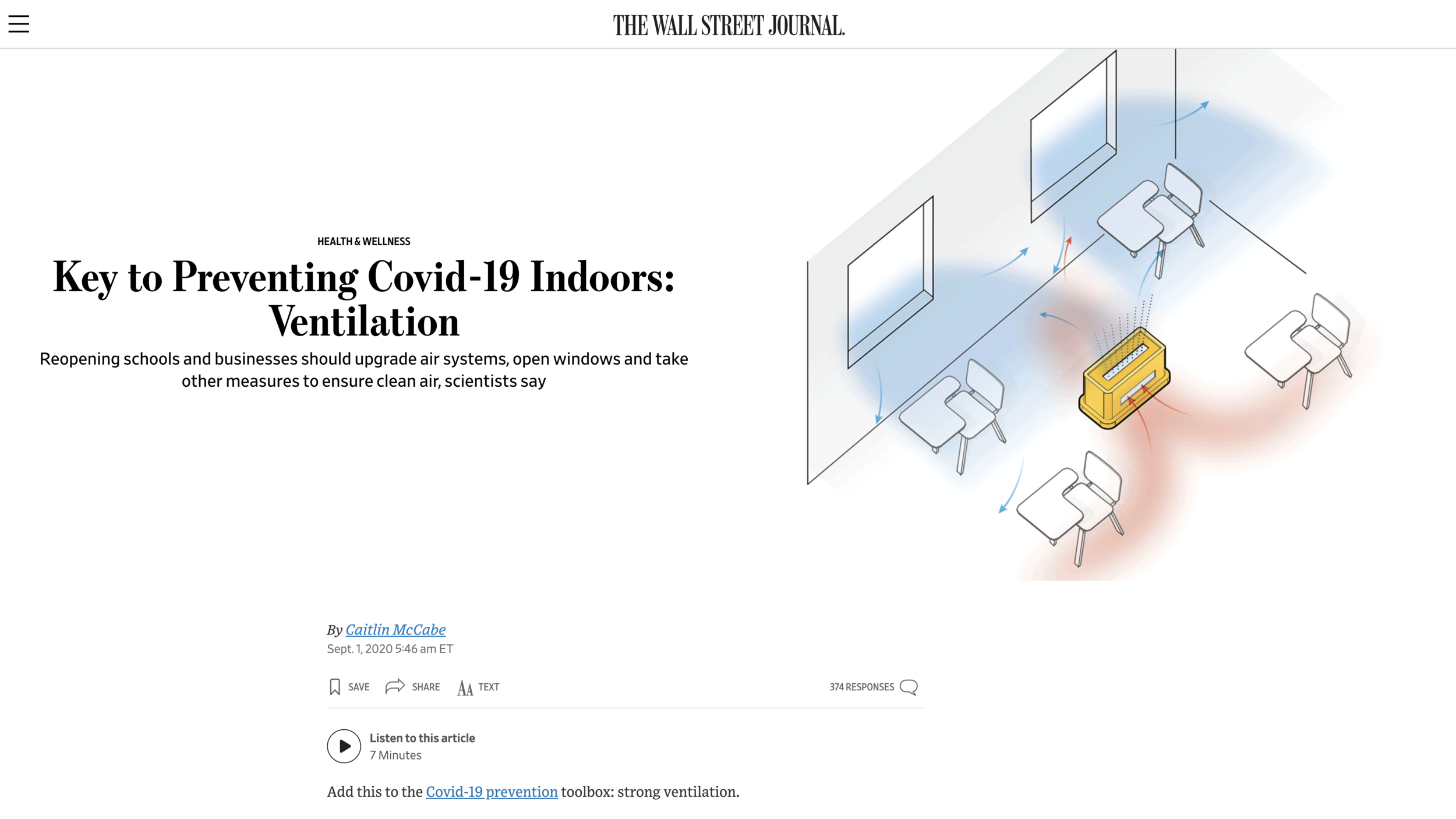
Caitlin McCabe, in the article shown above, “Key to Preventing Covid-19 Indoors: Ventilation,” lays out some key details. (All the quotations below are from that article.) Experts are beginning to emphasize the importance of good ventilation:

After urging steps like handwashing, masking and social distancing, researchers say proper ventilation indoors should join the list of necessary measures.

Contrary to the way many people are acting, being far away from someone isn’t good enough if you are with them indoors with bad ventilation for a long time:

Driving the thinking is mounting evidence that the new coronavirus is transmitted through the air among people with prolonged exposure to the pathogen. Especially troublesome, epidemiologists and other scientists say, is evidence from numerous indoor outbreaks suggesting the virus’s ability to spread to others even when close contact is avoided.

What counts as good ventilation? Turning over the air in a room something like six times every hour:

Ideally, they say, public spaces like a standard classroom should aim to have air replaced with clean air between four to six times an hour to dilute Covid-19 particles that might accumulate.

Common-sense measures can improve ventilation:

[Increasing the rate of air turnover] can be done, aerosol scientists and building engineers say, through strategies that introduce outdoor air and filter indoor contaminants. Those include opening windows and doors, installing window fans, using portable air purifiers with high-efficiency particulate air, or HEPA, filters and upgrading heating, ventilation and air-conditioning systems …

Unfortunately, many school rooms, for example, have air turnover only about once or twice an hour.

Note also that because indoor restaurants and bars are a hard place to use masks as well as often having quite poor ventilation, and often being quite crowded, they are a perfect storm for Covid-19 transmission. And indoor parties are often a lot like indoor restaurants and bars. If you are going to do a party during this pandemic, do an outdoor party!