The Federalist Papers #11 B: Union Will Make Possible a Strong Navy, Allowing America to Chart Its Own Destiny—Alexander Hamilton

Link to the Wikipedia article “History of the United States Navy,” from which this painting of the 1799 battle between the Constellation and L’Insurgente is taken. That battle resulted in the capture of L’Insurgent
In the second half of the Federalist Papers #11, Alexander Hamilton makes the case that union is crucial for keeping the states from falling under European domination, because union is crucial for creating a strong American navy. Let me intersperse in bold my interpretation of the points of his argument between passages in the second half of the Federalist Papers #11:
The United States could have a navy powerful enough to make a real difference:
A further resource for influencing the conduct of European nations toward us, in this respect, would arise from the establishment of a federal navy. There can be no doubt that the continuance of the Union under an efficient government would put it in our power, at a period not very distant, to create a navy which, if it could not vie with those of the great maritime powers, would at least be of respectable weight if thrown into the scale of either of two contending parties. This would be more peculiarly the case in relation to operations in the West Indies. A few ships of the line, sent opportunely to the reinforcement of either side, would often be sufficient to decide the fate of a campaign, on the event of which interests of the greatest magnitude were suspended. Our position is, in this respect, a most commanding one. And if to this consideration we add that of the usefulness of supplies from this country, in the prosecution of military operations in the West Indies, it will readily be perceived that a situation so favorable would enable us to bargain with great advantage for commercial privileges. A price would be set not only upon our friendship, but upon our neutrality. By a steady adherence to the Union we may hope, erelong, to become the arbiter of Europe in America, and to be able to incline the balance of European competitions in this part of the world as our interest may dictate.
Divided, the effective naval strength of the American states would be so low they couldn’t even maintain the rights of neutrality:
But in the reverse of this eligible situation, we shall discover that the rivalships of the parts would make them checks upon each other, and would frustrate all the tempting advantages which nature has kindly placed within our reach. In a state so insignificant our commerce would be a prey to the wanton intermeddlings of all nations at war with each other; who, having nothing to fear from us, would with little scruple or remorse, supply their wants by depredations on our property as often as it fell in their way. The rights of neutrality will only be respected when they are defended by an adequate power. A nation, despicable by its weakness, forfeits even the privilege of being neutral.
A strong navy of the states united would enable maritime flourishing:
Under a vigorous national government, the natural strength and resources of the country, directed to a common interest, would baffle all the combinations of European jealousy to restrain our growth. This situation would even take away the motive to such combinations, by inducing an impracticability of success. An active commerce, an extensive navigation, and a flourishing marine would then be the offspring of moral and physical necessity. We might defy the little arts of the little politicians to control or vary the irresistible and unchangeable course of nature.
Divided, the states would be weak enough that foreign powers could take most of the gains from trade:
But in a state of disunion, these combinations might exist and might operate with success. It would be in the power of the maritime nations, availing themselves of our universal impotence, to prescribe the conditions of our political existence; and as they have a common interest in being our carriers, and still more in preventing our becoming theirs, they would in all probability combine to embarrass our navigation in such a manner as would in effect destroy it, and confine us to a PASSIVE COMMERCE. We should then be compelled to content ourselves with the first price of our commodities, and to see the profits of our trade snatched from us to enrich our enemies and p rsecutors. That unequaled spirit of enterprise, which signalizes the genius of the American merchants and navigators, and which is in itself an inexhaustible mine of national wealth, would be stifled and lost, and poverty and disgrace would overspread a country which, with wisdom, might make herself the admiration and envy of the world.
Union is also important for American power over offshore fisheries and key inland waterways:
There are rights of great moment to the trade of America which are rights of the Union--I allude to the fisheries, to the navigation of the Western lakes, and to that of the Mississippi. The dissolution of the Confederacy would give room for delicate questions concerning the future existence of these rights; which the interest of more powerful partners would hardly fail to solve to our disadvantage. The disposition of Spain with regard to the Mississippi needs no comment. France and Britain are concerned with us in the fisheries, and view them as of the utmost moment to their navigation. They, of course, would hardly remain long indifferent to that decided mastery, of which experience has shown us to be possessed in this valuable branch of traffic, and by which we are able to undersell those nations in their own markets. What more natural than that they should be disposed to exclude from the lists such dangerous competitors?
This branch of trade ought not to be considered as a partial benefit. All the navigating States may, in different degrees, advantageously participate in it, and under circumstances of a greater extension of mercantile capital, would not be unlikely to do it. As a nursery of seamen, it now is, or when time shall have more nearly assimilated the principles of navigation in the several States, will become, a universal resource. To the establishment of a navy, it must be indispensable.
Union would contribute to a strong navy through a greater variety of resources as well as a greater quantity:
To this great national object, a NAVY, union will contribute in various ways. Every institution will grow and flourish in proportion to the quantity and extent of the means concentred towards its formation and support. A navy of the United States, as it would embrace the resources of all, is an object far less remote than a navy of any single State or partial confederacy, which would only embrace the resources of a single part. It happens, indeed, that different portions of confederated America possess each some peculiar advantage for this essential establishment. The more southern States furnish in greater abundance certain kinds of naval stores--tar, pitch, and turpentine. Their wood for the construction of ships is also of a more solid and lasting texture. The difference in the duration of the ships of which the navy might be composed, if chiefly constructed of Southern wood, would be of signal importance, either in the view of naval strength or of national economy. Some of the Southern and of the Middle States yield a greater plenty of iron, and of better quality. Seamen must chiefly be drawn from the Northern hive. The necessity of naval protection to external or maritime commerce does not require a particular elucidation, no more than the conduciveness of that species of commerce to the prosperity of a navy.
Free trade among the states will increase the gains not only from trade among the states but also the gains from foreign trade:
An unrestrained intercourse between the States themselves will advance the trade of each by an interchange of their respective productions, not only for the supply of reciprocal wants at home, but for exportation to foreign markets. The veins of commerce in every part will be replenished, and will acquire additional motion and vigor from a free circulation of the commodities of every part. Commercial enterprise will have much greater scope, from the diversity in the productions of different States. When the staple of one fails from a bad harvest or unproductive crop, it can call to its aid the staple of another. The variety, not less than the value, of products for exportation contributes to the activity of foreign commerce. It can be conducted upon much better terms with a large number of materials of a given value than with a small number of materials of the same value; arising from the competitions of trade and from the fluctations of markets. Particular articles may be in great demand at certain periods, and unsalable at others; but if there be a variety of articles, it can scarcely happen that they should all be at one time in the latter predicament, and on this account the operations of the merchant would be less liable to any considerable obstruction or stagnation. The speculative trader will at once perceive the force of these observations, and will acknowledge that the aggregate balance of the commerce of the United States would bid fair to be much more favorable than that of the thirteen States without union or with partial unions.
If the states are divided, free trade among them won’t last long:
It may perhaps be replied to this, that whether the States are united or disunited, there would still be an intimate intercourse between them which would answer the same ends; this intercourse would be fettered, interrupted, and narrowed by a multiplicity of causes, which in the course of these papers have been amply detailed. A unity of commercial, as well as political, interests, can only result from a unity of government.
Europeans are into domination. We need countervailing power:
There are other points of view in which this subject might be placed, of a striking and animating kind. But they would lead us too far into the regions of futurity, and would involve topics not proper for a newspaper discussion. I shall briefly observe, that our situation invites and our interests prompt us to aim at an ascendant in the system of American affairs. The world may politically, as well as geographically, be divided into four parts, each having a distinct set of interests. Unhappily for the other three, Europe, by her arms and by her negotiations, by force and by fraud, has, in different degrees, extended her dominion over them all. Africa, Asia, and America, have successively felt her domination. The superiority she has long maintained has tempted her to plume herself as the Mistress of the World, and to consider the rest of mankind as created for her benefit. Men admired as profound philosophers have, in direct terms, attributed to her inhabitants a physical superiority, and have gravely asserted that all animals, and with them the human species, degenerate in America--that even dogs cease to bark after having breathed awhile in our atmosphere[“Recherches philosophiques sur les Americains”]. Facts have too long supported these arrogant pretensions of the Europeans. It belongs to us to vindicate the honor of the human race, and to teach that assuming brother, moderation. Union will enable us to do it. Disunion will will add another victim to his triumphs. Let Americans disdain to be the instruments of European greatness! Let the thirteen States, bound together in a strict and indissoluble Union, concur in erecting one great American system, superior to the control of all transatlantic force or influence, and able to dictate the terms of the connection between the old and the new world!
PUBLIUS.
Here are links to my other posts on The Federalist Papers so far:
The Federalist Papers #1: Alexander Hamilton's Plea for Reasoned Debate
The Federalist Papers #3: United, the 13 States are Less Likely to Stumble into War
The Federalist Papers #4 B: National Defense Will Be Stronger if the States are United
The Federalist Papers #5: Unless United, the States Will Be at Each Others' Throats
The Federalist Papers #6 A: Alexander Hamilton on the Many Human Motives for War
The Federalist Papers #11 A: United, the States Can Get a Better Trade Deal—Alexander Hamilton
On Policing: Roland Fryer, William Bratton, John Murad, Scott Thomson and the American People
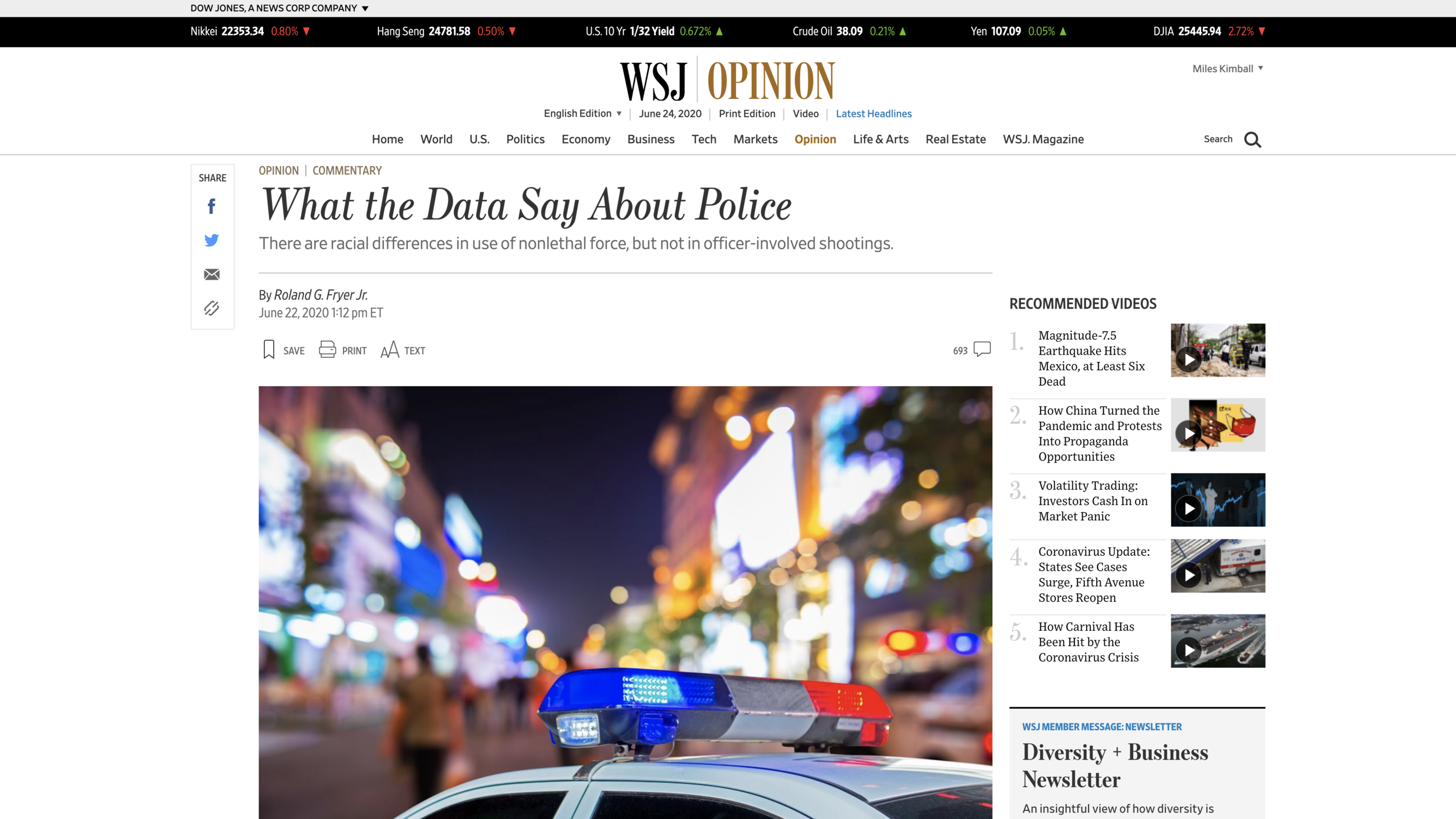
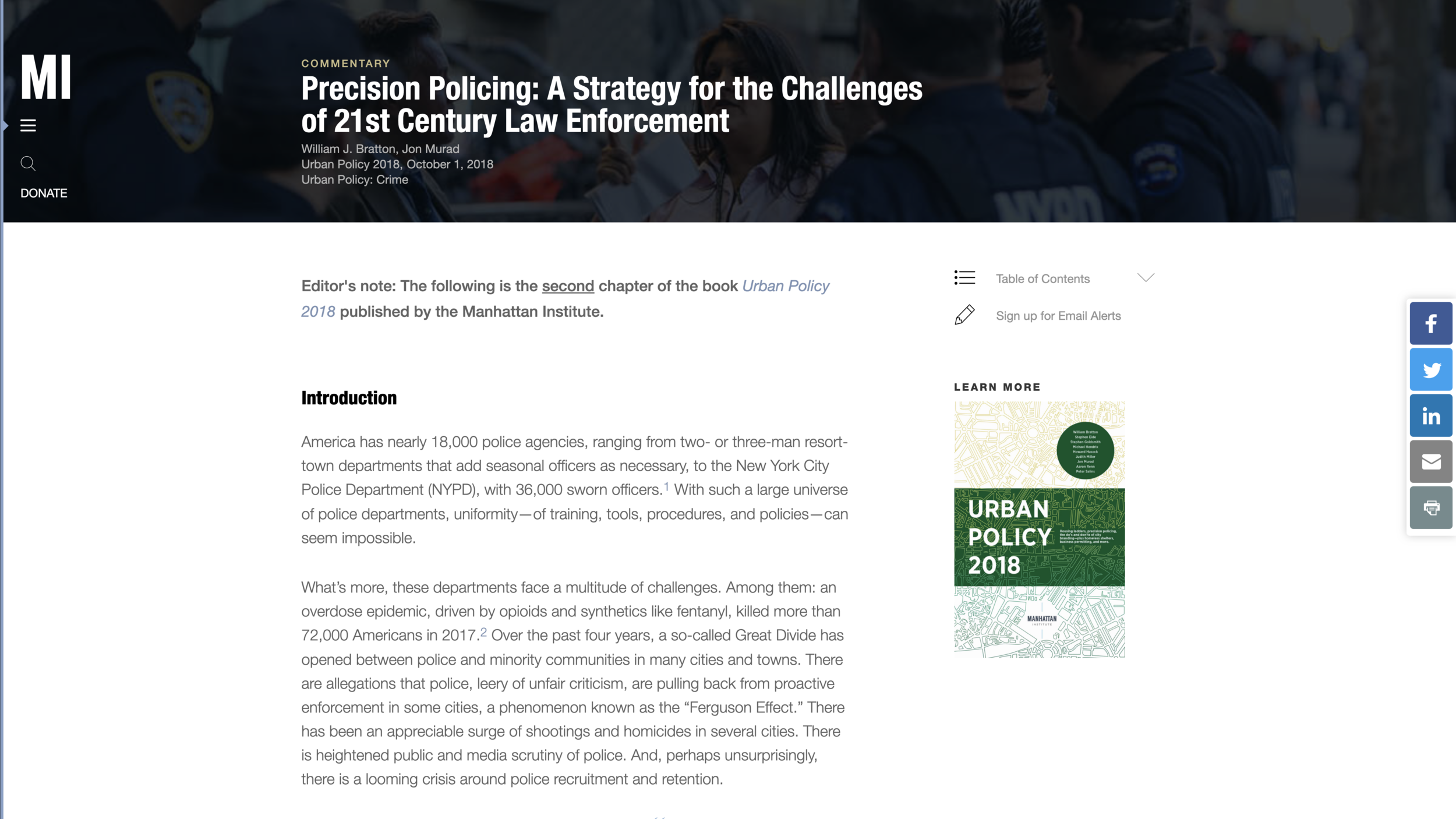
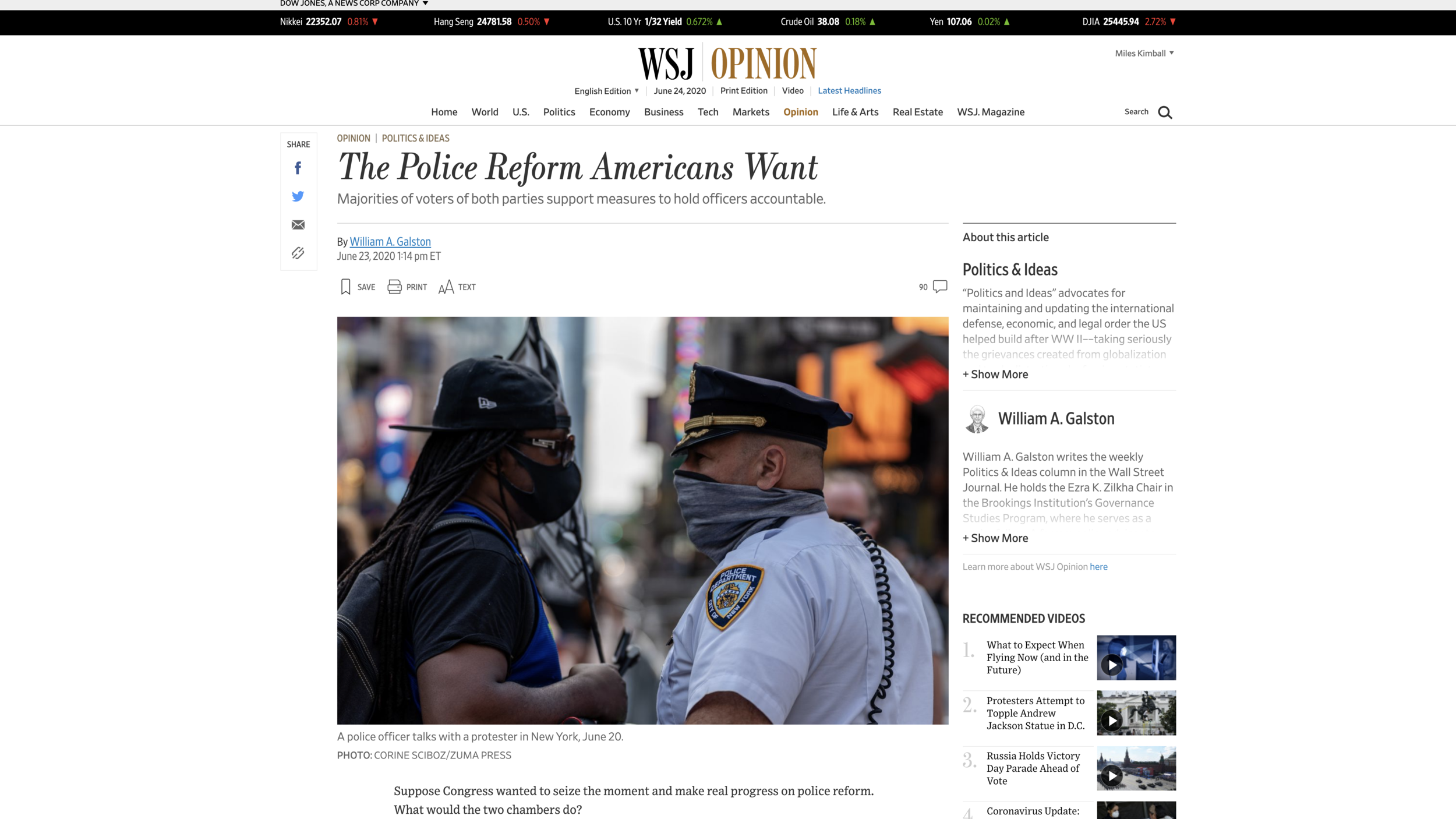
This is a golden moment for police reform. Above, I have links to the four most interesting sources related to the specifics of police reform I have read or listened to in the last few weeks.
First, Roland Fryer gives statistics to understand the problem. Perhaps surprisingly to some, but in what I think makes sense theoretically, the racist tilt of police interactions with civilians is much stronger at lower levels of force that receive less scrutiny than it is in shootings. Here is what Roland writes in the June 22, 2020 Wall Street Journal op-ed “What the Data Say About Police”; I have added bullets to distinguish passages:
My research team analyzed nearly five million police encounters from New York City. We found that when police reported the incidents, they were 53% more likely to use physical force on a black civilian than a white one. In a separate, nationally representative dataset asking civilians about their experiences with police, we found the use of physical force on blacks to be 350% as likely. This is true of every level of nonlethal force, from officers putting their hands on civilians to striking them with batons. We controlled for every variable available in myriad ways. That reduced the racial disparities by 66%, but blacks were still significantly more likely to endure police force.
Black civilians who were recorded as compliant by police were 21% more likely to suffer police aggression than compliant whites.
… when we use our data to calculate the descriptive statistics used in popular databases such as the Washington Post’s, we find a higher percentage of black civilians among unarmed men killed by the police than they do. Those statistics, however, cannot address the fundamental question: When a shooting might be justified by department standards, are police more likely actually to shoot if the civilian is black? Only our data can answer this question, because it contains information on situations in which a shooting might meet departmental standards but didn’t happen. The answer appears to be no.
Our data come from localities in California, Colorado, Florida, Texas and Washington state and contain accounts of 1,399 police shootings at civilians between 2000 and 2015. In addition, from Houston only in those same years, we had reports describing situations in which gunfire might have been justified by department guidelines but the cops didn’t shoot. This is a key piece of data that popular online databases don’t include.
No matter how we analyzed the data, we found no racial differences in shootings overall, in any city in particular, or in any subset of the data.
Roland isn’t as clear as he might be in the last two passages above, but he seems to be saying that “situations in which gunfire might have been justified by department guidelines” involve black civilians with more than proportional frequency, but that for each such situation, blacks are no more likely to be shot than whites.
Importantly, Roland Fryer also says the research he has been involved with suggests that federal investigations of a policy department prompted by a video of policy brutality that went viral are a blunt instrument that causes police to pull back dramatically, at great cost in life:
… investigations not preceded by viral incidents of deadly force, on average, reduced homicides and total felony crime. But for the five investigations that were preceded by a viral incident of deadly force, there was a stark increase in crime—893 more homicides and 33,472 more felonies than would have been expected with no investigation. The increases in crime coincide with an abrupt change in the quantity of policing activity. In Chicago alone after the killing of Laquan McDonald, the number of police-civilian interactions decreased by 90% in the month the investigation was announced.
Importantly, in the eight cities that had a viral incident but no investigation, there was no subsequent increase in crime. Investigations are crucial, but we need to find ways of holding police accountable without sacrificing more black lives.
The Manhattan Institute article “Precision Policing: A Strategy for the Challenges of 21st Century Law Enforcement” by William Bratton and Jon Murad is well worth reading in its entirety. It has two points I found especially interesting. First, that it helps a lot to set priorities in policing that distinguish between serious offenses that need to be immediately addressed by an arrest and what are offenses that people need to be told to stop but can and should be dealt with initially by a warning. Second, historically, rage at police brutality often subsides when innocent police officers are brutality murdered by someone’s hatred of the police. An innocent civilian being killed inflames rage by civilians. An innocent policy officer being killed tamps down rage by civilians at the police.
William Galston, in the June 23, 2020 Wall Street Journal op-ed “The Police Reform Americans Want” collects a remarkable set of poll results showing a majority of Americans calling for dramatic police reform. Again, with my bullets added to distinguish passages, here is what William Galston reports:
A ban on chokeholds and strangleholds is supported by 68% of all Americans and 52% of Republicans, according to the Kaiser poll.
Requiring police to give a verbal warning, when possible, before shooting at a civilian is favored by 89% of Americans, including 83% of Republicans.
More than three-quarters of Americans, and more than 6 in 10 Republicans, favor requiring states to release officers’ disciplinary records …
Most Americans want to create stronger incentives for police to do the right thing—and to pay a price when they don’t. A remarkable 95% would require police to intervene against, and report, the excessive use of force by fellow officers, a measure that could help tear down the “wall of silence” protecting wrongdoers from scrutiny.
Seventy-three percent of Americans, including 55% of Republicans, favor allowing individuals to sue police officers when they believe excessive force has been used against them. Given this consensus, legislators should be able to reach agreement on the court-created doctrine of qualified immunity, which makes it hard to hold officers accountable when they violate constitutional rights.
I won’t try to summarize the podcast “The City That Disbanded Its Police.” But it is well worth listening to. A restart involving police having to reapply for their jobs in a new police department with the old police department disbanded can be an effective way to institute new policing practices if done well. As you listen, it is useful to compare the actual changes in detailed policing practices in this Camden instance to the changes in New York City policing practices discussed in “Precision Policing: A Strategy for the Challenges of 21st Century Law Enforcement.”
Conclusion: Social science became big only with the expansion of colleges and universities after World War II. At least the half century after that, there was a large fraction of inadequate social science. In my view, the last quarter century has begun to have better percentage of decent social science. Knowledge about how to do effective and as-gentle-as-consistent-with-effective policing is one of the areas of social science that is only now beginning to come into its own. We have a long way to go, but there is hope. I hope we do a powerful round of police reform now while we can, but also include in that police reform plenty of data collection and funds for research on and dissemination of effective policing strategies as we continue to learn.
Alasdair Munro: COVID-19 Transmission among Children →
Hat tip to Joshua Hausman.
June 2020 Covid-19 Science Roundup
In case it helps even one of my readers in a practical way, I wanted to collect some of the most useful news snippets I have seen recently about Covid-19 science. Most of this is a confirmation of what I said in “4 Types of Heterogeneity that Offer a Bit of Extra Hope for Keeping the Pandemic Under Control without Blanket Lockdowns”: (a) number of people and (b) duration of contact matter as much as (c) distance and (d) masks. For example, take this passage from Jennifer Calfas’s June 18, 2020 Wall Street Journal article, “California Requires Face Coverings as Some States See Daily Record Cases”, which adds (e) ventilation and (f) talking loudly:
Recent findings among researchers and scientists show close-up interactions, crowded events, poorly ventilated areas and places where people are talking loudly maximize the risk of contracting the virus. Fleeting encounters with people outdoors and contaminated surfaces are less of a risk. These findings are helping shape policy as the Centers for Disease Control and Prevention urges Americans to keep wearing masks and maintaining distance as reopenings continue.
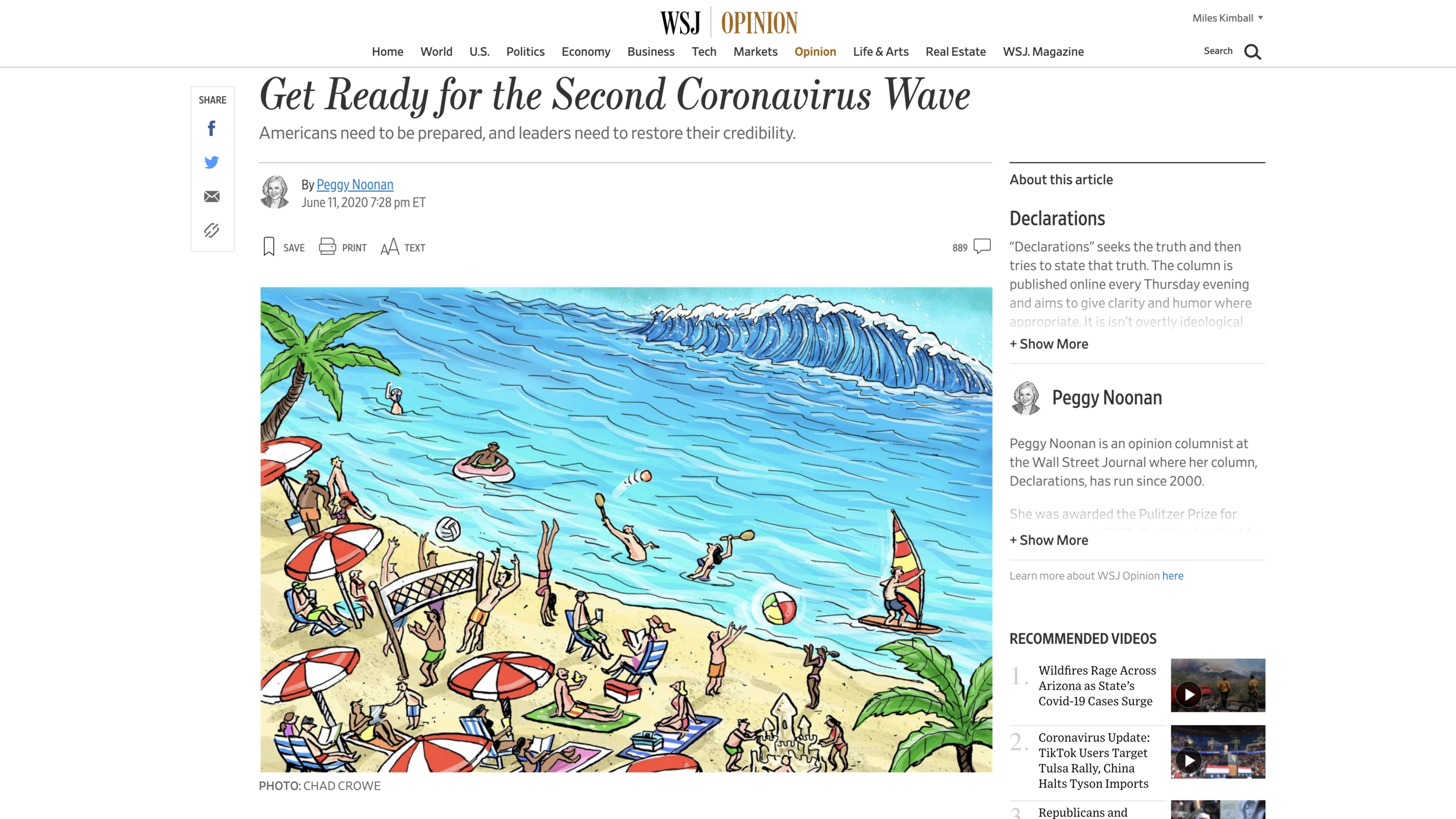
Other sources emphasize that singing has the same kind of malign effect as talking loudly. Peggy Noonan’s June 11, 2020 Wall Street Journal op-ed, “Get Ready for the Second Coronavirus Wave” adds that in addition to good ventilation outside, the sunlight and the now more and more common warm temperature outside can reduce transmission:
Coronavirus doesn’t like sunlight, fresh air or warm temperatures. It prefers coolness and poor ventilation in enclosed places, meatpacking plants being the most famous example.
For me the bottom line is: if you can help it, don’t be inside with someone else you don’t live with—and especially not with a lot of someone else’s—for any extended period of time. If you are, masks don’t mean there is no danger, but they help. And even outdoors, if you are going to be in a large gathering despite the danger, make sure to wear a mask and urge others there to wear one. Don’t be like Debbie Tutor, interviewed for Alejandro Lazo, Andrew Restuccia and Joshua Jamerson’s June 19, 2020 Wall Street Journal article “On Juneteenth, Tulsa Prepares for Unrest as Protesters March Nationwide”
Debbie Tutor, 60, of Wichita, Kan., was among those waiting in line. A longtime Trump supporter, she said it was her first time attending a rally. “I’m just here to support him,” she said.
Ms. Tutor, like the others waiting outside the arena, wasn’t wearing a mask and said she isn’t worried about the coronavirus spreading among rally attendees. She asserted that the president’s opponents are amplifying the health threat to hurt his re-election.
On ideas about how to reduce the danger of a bad outcome from the novel coronavirus conditional on becoming infected, see my posts:
If you haven’t had Covid-19 yet, regardless of your other current health conditions, I believe it will materially help your chances if you do get infected later on to go off sugar right now and making sure you get plenty of Vitamin D—more than the miscalculated minimum daily requirement: see “Carola Binder—Why You Should Get More Vitamin D: The Recommended Daily Allowance for Vitamin D Was Underestimated Due to Statistical Illiteracy.”
The importance of going off sugar immediately (and ideally reducing your eating window each day to as few hours as possible) in order to reverse chronic diseases that put you in greater danger from Covid-19 is emphasized by the statistics on who is dying from Covid-19. We all know that older people die with a greater probability if they get the disease, but a substantial fraction of that age difference may be due to the fact that older people tend to have a greater burden of chronic diseases. Two articles give interesting statistics relevant for this.
First, from the June 12, 2020 Wall Street Journal Editorial “The Covid Age Penalty”:
Older people generally have weaker immune systems and more have underlying respiratory and cardiovascular conditions that appear to exacerbate the illness. More than 95% of people who have died in the United Kingdom had at least one underlying condition. Italian public-health officials have also reported that 96% of deaths involved one chronic condition, and 60% had three or more.
Nursing homes are especially vulnerable because they have large numbers of elderly in cramped quarters. They now account for more than 50% of Covid-19 fatalities in 30 or so states, including Arizona, Washington, Illinois, Pennsylvania and Massachusetts.
The good news is that most people over age 65 who are in generally good health are unlikely to die or get severely ill from Covid-19. Data from Spain’s national antibody study show that about 92% of those infected from ages 60 to 79 have mild or no symptoms, and only about 6% are hospitalized. Three-quarters of people older than 90 have mild or no symptoms and fewer than 10% die.
Second, from David Luhnow and José de Córdoba’s June 19, 2020 Wall Street Journal article, “As Covid-19 Hits Developing Countries, Its Victims Are Younger”:
Another reason fewer older people are dying in poorer nations is the lack of institutionalized care for the elderly. An estimated one-third or more of deaths in the U.S. have taken place in nursing homes, where the virus can easily spread among those most vulnerable. In countries like Mexico, the elderly usually live with their families, making it less likely they pass it on to other at-risk elderly, said Mr. González-Pier.
But health is a bigger factor. Dr. Alejandro Macias, a specialist in infectious diseases who played a leading role in halting the H1N1 pandemic in 2009, says the main reason the country’s Covid-19 victims are much younger than in the U.S. has to do with the prevalence of a host of unhealthy conditions—obesity, hypertension, and diabetes chief among them.
More than 4 in 10 people who have died in Mexico from Covid-19 had hypertension, roughly 4 in 10 had diabetes, and a quarter were overweight, according to government statistics.
Conclusion: I hope this is helpful. One more resource I have found useful is the May 27, 2020 Wall Street Journal podcast, “Is Banning Certain Events the Key to Reopening?”
New insights in Covid-19 continue to emerge. I hope we soon understand it much better than we do now.
How Even Liberal Whites Make Themselves Out as Victims in Discussions of Racism
In reading White Fragility, by Robin DiAngelo (from which I take all the quotations in this post except when noted otherwise), one of the things I found most fascinating was her accounts of her experiences it leading discussions about racism as part of her job as a diversity trainer. Below are some of her descriptions of her experience in that role. (Unless noted otherwise all the quotations in this post are from White Fragility.)
… if and when an educational program does directly address racism and the privileging of whites, common white responses include anger, withdrawal, emotional incapacitation, guilt, argumentation, and cognitive dissonance (all of which reinforce the pressure on facilitators to avoid directly addressing racism). So-called progressive whites may not respond with anger but still insulate themselves via claims that they are beyond the need for engaging with the content because they “already had a class on this” or “already know this.” All these responses constitute white fragility—the result of the reduced psychosocial stamina that racial insulation inculcates.
… intense emotional reactions are common. I have discussed several reasons why whites are so defensive about the suggestion that we benefit from, and are complicit in, a racist system:
Social taboos against talking openly about race
The racist = bad / not racist = good binary
Fear and resentment toward people of color
Our delusion that we are objective individuals
Our guilty knowledge that there is more going on than we can or will admit to
Deep investment in a system that benefits us and that we have been conditioned to see as fair
Internalized superiority and sense of a right to rule
A deep cultural legacy of anti-black sentiment
It is hard to grow up in our society as a white person without ingesting some of the pro-white, anti-black attitudes floating around in our culture.
To me, the most remarkable part of Robin DiAngelo’s accounts of her work as a diversity trainer is the way white people she is talking to try to turn themselves into victims:
One way that whites protect their positions when challenged on race is to invoke the discourse of self-defense. Through this discourse, whites characterize themselves as victimized, slammed, blamed, and attacked. Whites who describe the interactions in this way are responding to the articulation of counternarratives alone; no physical violence has ever occurred in any interracial discussion or training that I am aware of. These self-defense claims work on multiple levels. They identify the speakers as morally superior while obscuring the true power of their social positions. The claims blame others with less social power for their discomfort and falsely describe that discomfort as dangerous. The self-defense approach also reinscribes racist imagery. By positioning themselves as the victim of antiracist efforts, they cannot be the beneficiaries of whiteness. Claiming that it is they who have been unfairly treated—through a challenge to their position or an expectation that they listen to the perspectives and experiences of people of color—they can demand that more social resources (such as time and attention) be channeled in their direction to help them cope with this mistreatment.
When I consult with organizations that want me to help them recruit and retain a more diverse workforce, I am consistently warned that past efforts to address the lack of diversity have resulted in trauma for white employees. This is literally the term used to describe the impact of a brief and isolated workshop: trauma. This trauma has required years of avoiding the topic altogether, and although the business leaders feel they are ready to begin again, I am cautioned to proceed slowly and be careful. Of course, this white racial trauma in response to equity efforts has also ensured that the organization has remained overwhelmingly white.
The language of violence that many whites use to describe antiracist endeavors is not without significance, as it is another example of how white fragility distorts reality. By employing terms that connote physical abuse, whites tap into the classic story that people of color (particularly African Americans) are dangerous and violent. In so doing, whites distort the real direction of danger between whites and others. This history becomes profoundly minimized when whites claim they don’t feel safe or are under attack when they find themselves in the rare situation of merely talking about race with people of color. The use of this language of violence illustrates how fragile and ill-equipped most white people are to confront racial tensions, and their subsequent projection of this tension onto people of color.
Here, I am reminded of Shirzad Chamine’s description of the “Victim” defense mechanism:
Characteristics
If criticized or misunderstood, tend to withdraw, pout, and sulk.
Fairly dramatic and temperamental.
When things get tough, want to crumble and give up.
…
Thoughts
No one understands me.
Poor me.
Terrible things always happen to me.
…
I discuss Shirzad’s book Positive Intelligence in “On Human Potential.” Because of the damage defense mechanisms often do to the one using them, Shirzad calls them “saboteurs.” This is the Victim saboteur in action.
Though there is a lot of additional subtlety to what Robin DiAngelo is saying, one thing I find intriguing is the “tough love” attitude Robin DiAngelo has toward antiracism. We have to buck up and take the feedback that points out structures and attitudes that advantage whites.
Making oneself out out to be a victim is not the only way whites try to avoid confronting their role in perpetuating white privilege. Intellectualizing can be used to insulate one’s heart from seeing one’s own role in the system and one’s own pro-white, anti-black attitudes. For those of us to whom intellectualizing is a reflex, a key question from Robin can help separate out defensive intellectualization from productive intellectual inquiry. She writes:
In my work to unravel the dynamics of racism, I have found a question that never fails me. This question is not “Is this claim true, or is it false?”; we will never come to an agreement on a question that sets up an either/or dichotomy on something as sensitive as racism. Instead I ask, “How does this claim function in the conversation?”
Robin does a good job of pointing to evidence of our pro-white, anti-black attitudes and the various rationalizations through which we avoid feeling bad about our roles in perpetuating white privilege.
One good example of our either devaluing or not thinking about people of color is when we talk about “the good old days.” Robin:
As a white person, I can openly and unabashedly reminisce about “the good old days.” Romanticized recollections of the past and calls for a return to former ways are a function of white privilege, which manifests itself in the ability to remain oblivious to our racial history. Claiming that the past was socially better than the present is also a hallmark of white supremacy. Consider any period in the past from the perspective of people of color: 246 years of brutal enslavement; the rape of black women for the pleasure of white men and to produce more enslaved workers; the selling off of black children; the attempted genocide of Indigenous people, Indian removal acts, and reservations; indentured servitude, lynching, and mob violence; sharecropping; Chinese exclusion laws; Japanese American internment; Jim Crow laws of mandatory segregation; black codes; bans on black jury service; bans on voting; imprisoning people for unpaid work; medical sterilization and experimentation; employment discrimination; educational discrimination; inferior schools; biased laws and policing practices; redlining and subprime mortgages; mass incarceration; racist media representations; cultural erasures, attacks, and mockery; and untold and perverted historical accounts, and you can see how a romanticized past is strictly a white construct. But it is a powerful construct because it calls out to a deeply internalized sense of superiority and entitlement and the sense that any advancement for people of color is an encroachment on this entitlement.
The past was great for white people (and white men in particular) because their positions went largely unchallenged. In understanding the power of white fragility, we have to notice that the mere questioning of those positions triggered the white fragility that Trump capitalized on. There has been no actual loss of power for the white elite, who have always controlled our institutions and continue to do so by a very wide margin.
We are also often ignorant about things going on in the present. For me, and I hope for many others, the protests in the last few weeks have been a wake-up call.
To mention something minor compared to some of my other dimensions of ignorance, I say to my shame that I didn’t know what Juneteenth was until I googled it one day this past week. Let’s make sure that from now on all Americans know that there is a holiday to celebrate one of the best things that has happened in our history: the end of slavery.
In the last few weeks, my wife Gail and I have watched “13th,” “I Am Not Your Negro” (about James Baldwin) and “Selma.” Of those three movies, the documentary “13th” hit me the hardest. I had known abstractly about the rise of the “carceral state” that imprisons a hugely greater fraction of Americans than the fraction imprisoned in other liberal democracies. But the racist origins of the carceral state had not come home to me until I saw “13th.” To put bluntly a key moment in that documentary, Bill Clinton, to win reelection, felt he needed to campaign on law and order, which in our country, sadly, means a lot more than the dictionary definition of “law and order.” Rather, as a politician, if you want to promise in code to lock up a lot of African-Americans, you talk about “law and order.” If you wanted to talk about law and order in the dictionary sense, in a non-racist way, you would want to use another set of words. Bill Clinton then went on to preside over a huge expansion of the number of Americans in prison. Other presidents also presided over a rise, but numerically, the big expansion happened under Bill Clinton.
Robin DiAngelo reminds of some of the racial disparities in policing in 2020:
It has been well documented that blacks and Latinos are stopped by police more often than whites are for the same activities and that they receive harsher sentences than whites do for the same crimes. Research has also shown that a major reason for this racial disparity can be attributed to the beliefs held by judges and others about the cause of the criminal behavior. For example, the criminal behavior of white juveniles is often seen as caused by external factors—the youth comes from a single-parent home, is having a hard time right now, just happened to be at the wrong place at the wrong time, or was bullied at school. Attributing the cause of the action to external factors lessens the person’s responsibility and classifies the person as a victim him or herself. But black and Latinx youth are not afforded this same compassion. When black and Latinx youth go before a judge, the cause of the crime is more often attributed to something internal to the person—the youth is naturally more prone to crime, is more animalistic, and has less capacity for remorse (similarly, a 2016 study found that half of a sample of medical students and residents believe that blacks feel less pain). Whites continually receive the benefit of the doubt not granted to people of color—our race alone helps establish our innocence.
Robin also points to how we perpetuate racism in ordinary social interactions. One way we perpetuate racism is by misrepresenting racism as less of an issue than it really is:
Today we have a cultural norm that insists we hide our racism from people of color and deny it among ourselves, but not that we actually challenge it. In fact, we are socially penalized for challenging racism.
I am often asked if I think the younger generation is less racist. No, I don’t. In some ways, racism’s adaptations over time are more sinister than concrete rules such as Jim Crow. The adaptations produce the same outcome (people of color are blocked from moving forward) but have been put in place by a dominant white society that won’t or can’t admit to its beliefs. This intransigence results in another pillar of white fragility: the refusal to know.
Another way we perpetuate racism is by being too cowardly to challenge overt racism when it appears. Robin gives the example of a racist joke told in an all-white group:
The very real consequences of breaking white solidarity play a fundamental role in maintaining white supremacy. We do indeed risk censure and other penalties from our fellow whites. We might be accused of being politically correct or might be perceived as angry, humorless, combative, and not suited to go far in an organization. In my own life, these penalties have worked as a form of social coercion. Seeking to avoid conflict and wanting to be liked, I have chosen silence all too often.
Conversely, when I kept quiet about racism, I was rewarded with social capital such as being seen as fun, cooperative, and a team player. Notice that within a white supremacist society, I am rewarded for not interrupting racism and punished in a range of ways—big and small—when I do. I can justify my silence by telling myself that at least I am not the one who made the joke and that therefore I am not at fault. But my silence is not benign because it protects and maintains the racial hierarchy and my place within it. Each uninterrupted joke furthers the circulation of racism through the culture, and the ability for the joke to circulate depends on my complicity.
People of color certainly experience white solidarity as a form of racism, wherein we fail to hold each other accountable, to challenge racism when we see it, or to support people of color in the struggle for racial justice.
In my post “Enablers of White Supremacy,” I used the intentionally shocking phrase “white supremacy” both to emphasize the gravity of the state our society is in and to make the idea of institutional racism clear. Robin DiAngelo has a trenchant list of some of the more personal ways in which we become enablers of white supremacy:
In summary, our socialization engenders a common set of racial patterns. These patterns are the foundation of white fragility:
Preference for racial segregation, and a lack of a sense of loss about segregation
Lack of understanding about what racism is
Seeing ourselves as individuals, exempt from the forces of racial socialization
Failure to understand that we bring our group’s history with us, that history matters • Assuming everyone is having or can have our experience
Lack of racial humility, and unwillingness to listen
Dismissing what we don’t understand
Lack of authentic interest in the perspectives of people of color
Wanting to jump over the hard, personal work and get to “solutions”
Confusing disagreement with not understanding
Need to maintain white solidarity, to save face, to look good
Guilt that paralyzes or allows inaction
Defensiveness about any suggestion that we are connected to racism
A focus on intentions over impact
Conclusion
It is time for all of us to heed the wake-up call of how far we still are from racial equality in America.
If you want one more sign of racism and other bad attitudes that resemble racism, see “‘Keep the Riffraff Out!’” In particular, almost always, when people talk about “preserving the character of their neighborhood” by blocking the construction of apartment buildings and multifamily homes, or homes on small lots, there is a racist effect, whatever you think about whether or not there is an out-and-out racist motivation. And what are, by any standard, out-and-out racist motivations are not at all uncommon when people talk about “preserving the character of their neighborhood.” Being in favor of more residential construction—a lot more, so the supply reaches to people of even modest means—wherever people want to live is one of the more powerful ways of being antiracist.
Finally, let me say that there is more than one way to be effective as an antiracist. What we need now is to get wide agreement on the gravity of the continuing problem of racism and to have a critical mass of people working to fight racism in different ways. Some of those ways of fighting racism have increasing returns to scale, so it can often be useful to join with others and follow antiracist leaders. But there are other ways of fighting racism that may work well even on a small scale. Find your own métier in this fight. But don’t stand on the sidelines.
Don’t miss these other posts touching on racism and antiracism:
The Supreme Court Confronts the Principles of Multivariable Calculus in Extending Employment Protections to Gay and Transgender Employees
I think of my core audience as young economists, where “young” refers not to chronological age but rather to a mind still open to persuasion and new ideas from a random blogger (me). One advantage of writing for this audience is that I can assume that a large fraction of my readership has a familiarity with multivariable calculus. As it happens, the debate between Neil Gorsuch’s majority opinion and Samuel Alito’s dissent in Bostock v. Clayton County Georgia hinges on the discrete version of an important issue that comes up in multivariable calculus.
Before explaining the issue, let me be clear that as a policy matter, I am gladdened by the decision to give employment protections to gay and transgender individuals. Hereafter, I focus on the legal issue of whether the Civil Rights Act already enacted these protections, as the Supreme Court has now finally figured out, or whether establishing those protections should require additional legislation.
The First-Derivative Standard
The 1964 Civil Rights Act outlaws discrimination against an individual in the workplace (“with respect to his compensation, terms, conditions, or privileges of employment”) based on sex. Neil Gorsuch argues that this outlaws a nonzero first derivative (actually, first-difference) of treatment of an individual in the workplace with respect to sex. To back this up, let me first quote two passages (separated by a substantial vertical space) that give background:
Neil Gorsuch (majority opinion)
Sometimes small gestures can have unexpected consequences. Major initiatives practically guarantee them. In our time, few pieces of federal legislation rank in significance with the Civil Rights Act of 1964. There, in Title VII, Congress outlawed discrimination in the workplace on the basis of race, color, religion, sex, or national origin. Today, we must decide whether an employer can fire someone simply for being homosexual or transgender. The answer is clear. An employer who fires an individual for being homosexual or transgender fires that person for traits or actions it would not have questioned in members of a different sex. Sex plays a necessary and undisguisable role in the decision, exactly what Title VII forbids.
We must determine the ordinary public meaning of Title VII’s command that it is “unlawful . . . for an employer to fail or refuse to hire or to discharge any individual, or otherwise to discriminate against any individual with respect to his compensation, terms, conditions, or privileges of employment, because of such individual’s race, color, religion, sex, or national origin.”
But it is a third passage that makes the first-derivative standard clear. I have added bolding to the key two sentences:
The question isn’t just what “sex” meant, but what Title VII says about it. Most notably, the statute prohibits employers from taking certain actions “because of ” sex. And, as this Court has previously explained, “the ordinary meaning of ‘because of ’ is ‘by reason of ’ or ‘on account of.’ ” University of Tex. Southwest- ern Medical Center v. Nassar, 570 U. S. 338, 350 (2013) (cit- ing Gross v. FBL Financial Services, Inc., 557 U. S. 167, 176 (2009); quotation altered). In the language of law, this means that Title VII’s “because of ” test incorporates the “‘simple’” and “traditional” standard of but-for causation. Nassar, 570 U. S., at 346, 360. That form of causation is established whenever a particular outcome would not have happened “but for” the purported cause. See Gross, 557 U. S., at 176. In other words, a but-for test directs us to change one thing at a time and see if the outcome changes. If it does, we have found a but-for cause.
Changing one thing at a time to see what happens is looking at a first derivative or a first difference. Another passage appears to talk about the sign of the derivative:
What did “discriminate” mean in 1964? As it turns out, it meant then roughly what it means today: “To make a difference in treatment or favor (of one as compared with others).” Webster’s New International Dictionary 745 (2d ed. 1954). To “discriminate against” a person, then, would seem to mean treating that individual worse than others who are similarly situated.
However, if an individual were treated better because of her or his sex in the “but-for” sense, then it necessarily implies that others are treated worse because of having the other sex. So any nonzero first derivative of treatment with respect to sex is illegal.
In the Multivariable Case, First Derivatives and First Differences are Undefined without Specifying a Coordinate System
The trouble with a first-derivative or first-difference standard is that in a multivariate setting, first derivatives and first differences are not well-defined unless one specifies a coordinate system. In Bostock v. Clayton County, Georgia, Neil Gorsuch and Samuel Alito use and recommend different coordinate systems. Here it is important to realize that a first derivative or first difference depends on what the other coordinates are.
For Neil Gorsuch, the other coordinates are (a) sex of those an individual is attracted to and (b) sex for which an individuals behavior is stereotypical. Here is Neil Gorsuch’s direct description of the coordinate system he is using:
When an employer fires an employee because she is homosexual or transgender, two causal factors may be in play— both the individual’s sex and something else (the sex to which the individual is attracted or with which the individual identifies). But Title VII doesn’t care. If an employer would not have discharged an employee but for that individual’s sex, the statute’s causation standard is met, and liability may attach.
And here (in a passage that is somewhat difficult to read without all the context of the opinion) is Neil Gorsuch’s rejection of other coordinate systems. I have added bolding to the word “labels” because that is the way he refers to what I would call a “coordinate system”:
First, it’s irrelevant what an employer might call its discriminatory practice, how others might label it, or what else might motivate it. In Manhart, the employer called its rule requiring women to pay more into the pension fund a “life expectancy” adjustment necessary to achieve sex equality. In Phillips, the employer could have accurately spoken of its policy as one based on “motherhood.” In much the same way, today’s employers might describe their actions as motivated by their employees’ homosexuality or transgender status. But just as labels and additional intentions or motivations didn’t make a difference in Manhart or Phillips, they cannot make a difference here. When an employer fires an employee for being homosexual or transgender, it necessarily and intentionally discriminates against that individual in part because of sex. And that is all Title VII has ever demanded to establish liability.
In arguing for his coordinate system, Neil Gorsuch points out an especially unattractive coordinate system that is not directly at issue: a coordinate system that, instead of taking occupation as a coordinate takes “gender-appropriate occupation” as a coordinate:
Consider an employer eager to revive the workplace gender roles of the 1950s. He enforces a policy that he will hire only men as mechanics and only women as secretaries. When a quali- fied woman applies for a mechanic position and is denied, the “simple test” immediately spots the discrimination: A qualified man would have been given the job, so sex was a but-for cause of the employer’s refusal to hire. But like the employers before us today, this employer would say not so fast. By comparing the woman who applied to be a mechanic to a man who applied to be a mechanic, we’ve quietly changed two things: the applicant’s sex and her trait of fail- ing to conform to 1950s gender roles. The “simple test” thus overlooks that it is really the applicant’s bucking of 1950s gender roles, not her sex, doing the work. So we need to hold that second trait constant: Instead of comparing the disappointed female applicant to a man who applied for the same position, the employer would say, we should compare her to a man who applied to be a secretary. And because that jobseeker would be refused too, this must not be sex discrimination.
No one thinks that …
Samuel Alito Argues for a Different Coordinate System
By contrast, Samuel Alito argues that “homosexual/heterosexual” or “cisgender/transgender” are natural coordinates. For one thing, he argues these would have been components of a salient coordinate system in 1964 when the Civil Rights Act was enacted. And coordinate system is an important part of “original public meaning.”
Samuel Alito (dissent):
The Court tries to convince readers that it is merely enforcing the terms of the statute, but that is preposterous. Even as understood today, the concept of discrimination be- cause of “sex” is different from discrimination because of “sexual orientation” or “gender identity.” And in any event, our duty is to interpret statutory terms to “mean what they conveyed to reasonable people at the time they were written.” A. Scalia & B. Garner, Reading Law: The Interpretation of Legal Texts 16 (2012) (emphasis added). If every single living American had been surveyed in 1964, it would have been hard to find any who thought that discrimination because of sex meant discrimination because of sexual orientation––not to mention gender identity, a concept that was essentially unknown at the time.
Samuel Alito further argues that he doesn’t need to prove his coordinate system is the only possible one. If it is a reasonable coordinate system, then the Civil Rights Act is ambiguous about whether it makes discrimination on the basis of being gay or transgender illegal. And if a statute is ambiguous, then considerations such as legislative intent can be brought to bear. Samuel Alito:
The Court attempts to prove that point, and it argues, not merely that the terms of Title VII can be interpreted that way but that they cannot reasonably be interpreted any other way. According to the Court, the text is unambiguous. See ante, at 24, 27, 30.
In later passages, Samuel Alito directly illustrates how the first derivative (really first difference) is zero in his coordinate system. I reordered the passages in order to improve the flow:
Contrary to the Court’s contention, discrimination because of sexual orientation or gender identity does not in and of itself entail discrimination because of sex. We can see this because it is quite possible for an employer to dis- criminate on those grounds without taking the sex of an in- dividual applicant or employee into account. An employer can have a policy that says: “We do not hire gays, lesbians, or transgender individuals.” And an employer can implement this policy without paying any attention to or even knowing the biological sex of gay, lesbian, and transgender applicants. In fact, at the time of the enactment of Title VII, the United States military had a blanket policy of refusing to enlist gays or lesbians, and under this policy for years thereafter, applicants for enlistment were required to complete a form that asked whether they were “homosexual.” Appendix D, infra, at 88, 101.
In an effort to prove its point, the Court carefully includes in its example just two employees, a homosexual man and a heterosexual woman, but suppose we add two more indi- viduals, a woman who is attracted to women and a man who is attracted to women. (A large employer will likely have applicants and employees who fall into all four categories, and a small employer can potentially have all four as well.) We now have the four exemplars listed below, with the dis- charged employees crossed out:
Man attracted to men [crossed out]
Woman attracted to men
Woman attracted to women [crossed out]
Man attracted to women
The discharged employees have one thing in common. It is not biological sex, attraction to men, or attraction to women. It is attraction to members of their own sex—in a word, sexual orientation. And that, we can infer, is the employer’s real motive.
In sum, the Court’s textual arguments fail on their own terms. The Court tries to prove that “it is impossible to discriminate against a person for being homosexual or transgender without discriminating against that individual based on sex,” ante, at 9, but as has been shown, it is en- tirely possible for an employer to do just that.
The Court’s remaining argument is based on a hypothetical that the Court finds instructive. In this hypothetical, an employer has two employees who are “attracted to men,” and “to the employer’s mind” the two employees are “mate- rially identical” except that one is a man and the other is a woman. Ante, at 9 (emphasis added). The Court reasons that if the employer fires the man but not the woman, the employer is necessarily motivated by the man’s biological sex. Ante, at 9–10. After all, if two employees are identical in every respect but sex, and the employer fires only one, what other reason could there be?
As Neil Gorsuch does in one of the passages above, Samuel Alito calls a difference of coordinate systems a difference of “labels.” I bold the word “labels” in all the passages I quote in this post.
The problem with this argument is that the Court loads the dice. That is so because in the mind of an employer who does not want to employ individuals who are attracted to members of the same sex, these two employees are not materially identical in every respect but sex. On the contrary, they differ in another way that the employer thinks is quite material. And until Title VII is amended to add sexual orientation as a prohibited ground, this is a view that an employer is permitted to implement. As noted, other than prohibiting discrimination on any of five specified grounds, “race, color, religion, sex, [and] national origin.” 42 U. S. C. §2000e–2(a)(1), Title VII allows employers to decide whether two employees are “materially identical.” Even idiosyncratic criteria are permitted; if an employer thinks that Scorpios make bad employees, the employer can refuse to hire Scorpios. Such a policy would be unfair and foolish, but under Title VII, it is permitted. And until Title VII is amended, so is a policy against employing gays, lesbians, or transgender individuals.
Once this is recognized, what we have in the Court’s hypothetical case are two employees who differ in two ways–– sex and sexual orientation––and if the employer fires one and keeps the other, all that can be inferred is that the employer was motivated either entirely by sexual orientation, entirely by sex, or in part by both. We cannot infer with any certainty, as the hypothetical is apparently meant to suggest, that the employer was motivated even in part by sex. The Court harps on the fact that under Title VII a prohibited ground need not be the sole motivation for an adverse employment action, see ante, at 10–11, 14–15, 21, but its example does not show that sex necessarily played any part in the employer’s thinking.
The Court tries to avoid this inescapable conclusion by arguing that sex is really the only difference between the two employees. This is so, the Court maintains, because both employees “are attracted to men.” Ante, at 9–10. Of course, the employer would couch its objection to the man differently. It would say that its objection was his sexual orientation. So this may appear to leave us with a battle of labels. If the employer’s objection to the male employee is characterized as attraction to men, it seems that he is just like the woman in all respects except sex and that the employer’s disparate treatment must be based on that one difference. On the other hand, if the employer’s objection is sexual orientation or homosexuality, the two employees differ in two respects, and it cannot be inferred that the disparate treatment was due even in part to sex.
How to Pick a Coordinate System
Neil Gorsuch and Samuel Alito point to several considerations relevant to picking a coordinate system:
What was the original public coordinate system considered as part of original public meaning? (Samuel Alito)
In cases of ambiguity about the coordinate system, what coordinate system did the legislators have in mind? (Samuel Alito)
Which coordinate system involves the most semantically primitive coordinates? For example, sex of the person one is attracted to must be determined in order to determine whether one is heterosexual or homosexual. (Neil Gorsuch)
Which coordinate system is implicit in relevant precedents? (Neil Gorsuch)
To these I can add one grace note related to the criterion of being semantically primitive. Suppose someone could hide only their own sex and not anything else—not the sex of others and not behavior. Then an employer could not determine whether an individual was homosexual or transgender. This concealment test might help in defining what is semantically most primitive. (However, note that in this case, the employer could determine whether the stereotypical behavior matched the sex of those an individual was attracted to.)
Conclusion
Bostock v. Clayton County, Georgia not only yielded a policy result to be applauded, but raises fascinating legal issues that can be illuminated by the principle of multivariable calculus that, in general, the first derivative with respect to a variable cannot be defined without specifying the rest of the coordinate system. And a similar principle holds for first differences in a multivariate setting. The court system will be able to clarify these issues much better if it uses the language of calculus and finite differences.
Kristeen Barth: We Don't Have to Be for Everyone

Kristeen Barth
I am pleased to be able to share a guest post from my friend Kristeen Barth from my Co-Active Leadership Program Tribe. I like her message that we don’t have to be everyone’s cup of tea. Here is Kristeen:
In addition to my day job, I am a yoga teacher. In my yoga classes, I like to share ideas that will challenge my students’ preconceptions and make them think. I remember the day when I shared with my yoga class this beautiful quotation from Rumi:
Out beyond ideas of wrongdoing and rightdoing, there is a field. I'll meet you there.
What I love about this quote is that I believe people go to “right and wrong” much too quickly, when putting a value on conversation and relationship would be more valuable.
Rumi’s words caught the students’ attention. I was offering an opportunity for them to reflect on it as they spend the next 60 minutes practicing on their mat, making themselves right or wrong in a certain posture, or during a given transition. I set them up to notice what was new for them or what has been reawakened, if anything when they stepped off the mat. I felt energized throughout class. Feeling my words come together in response to what I was experiencing in the room, reflecting my energetic connection to the individuals and community I was leading.
After class, as I thanked students for joining me, one regular stopped me and asked me to repeat the quote I shared in the beginning of class.
Out beyond ideas of wrongdoing and rightdoing, there is a field. I'll meet you there.
He asked me if there was a more concise meaning, something a little more easily remembered. I said something like “we have choices and the only person that can decide if my choices are right or not is me.” He couldn’t wait to share this idea with his partner.
Then another woman stopped to share her thoughts. She told me I should be careful what I share, that there are some obvious rights and wrongs in the world. I asked for an example. Murder. Murder is objectively wrong. Well, what if you are protecting your child? Is it still wrong? And who decides if it’s wrong? She was so agitated. Well, if we didn’t have right and wrong, we wouldn’t have a civilized society. As our conversation came to a close and she moved toward the locker room, and me onto the next student, I thanked her for thinking about what I said. I thanked her for not just taking my words and making them her words. I share not to change the minds of others, but as an opportunity for thought, reflection, consideration, rumbling with ideas and beliefs. I wonder if she’ll return to my class. I think I really struck a chord with her, maybe even angered her.
Conversation with others continued in the lobby. The male student from earlier shared with me his upbringing in Catholicism —very much perceiving his and others’ actions as right and wrong and while that had many positive impacts on who he is today, he is revisiting the idea. Does it still fit? What good is it doing? What harm is it doing? I could engage in this level of conversation for days.
In all of the work I do, teaching yoga, facilitating corporate leadership and development programs and supporting women to lead their life on purpose, I request and receive direct feedback. This is vulnerable. I continue to practice my relationship with feedback and the meaning I make of the feedback.
Here are some of the thought I use to help stay open to feedback and to reduce the pain of hearing critical feedback:
1. We are not for everyone. And if we want to be for everyone, we’ll be for no-one.
Where I live, the yoga community is very active, with many studios and a seemingly endless number of yoga teachers. I sometimes wonder how there can be so many teachers. What I’ve come to know, is that not every teacher is for every student. This was very apparent to me in my story above. And if I want to play in the middle, I will, at best, only connect with a very limited number of students.
2. Feedback provides an opportunity to see what’s working, what the world wants from me
This feedback is gold. It points me to who resonates with my work. It points me to where I am able to light a fire, a fire that others want to gather around. And in that process, I’m able to refine what I am doing in order to have the greatest impact on the communities and conversations I care about most.
3. Above good marks, it’s engagement that matters
Contrary opinions do not mean I am not a “good” teacher. I think a good teacher, like a good coach, is able to stir things up in a safe, constructive way. I appreciate participants for thinking about the content or experience enough to have a response. I thank them for being engaged enough to argue with me or challenge what’s there. To me, life is about continued growth. The woman mentioned earlier, perhaps as she was pushing against the Rumi quotation, I was a part of her process of getting more clear on what she stands for and what she believes in. What a gift to be part of someone else’s growth.
Kristeen Barth is a champion of leaders. Whether you are looking to take up your leadership in your personal or professional life, Kristeen is an accessible, compassionate, truthful and supportive collaborator who will NEVER give up on you!
Kristeen supports individuals stepping into a new role or joining a new team become clear on the unique value and impact they bring to their organization. She helps you take the risks necessary to be the most meaningful version of yourself. There is nothing more powerful than having a trusted partner when navigating important decisions and building critical relationships.
Kristeen facilitates introspection and transformation – along with joy, laughter and learning. She loves the adventure of being alive. Her enthusiasm for and dedication to growth allow each individual to become more authentic, creative and expressive, while leading their life on purpose.
Kristeen is a Certified Professional Co-Active Coach (CPCC) through the Coactive Training Institute, Associate Certified Coach (ACC) through International Coach Federation and is trained in Agile Coaching and Organization and Relationship Systems Coaching. As a senior leader in a financial services organization, Kristeen guides leaders of all levels to learn new techniques for bringing the best in themselves and those around them. She is also a certified vinyasa yoga teacher, holds a BS in Technology Management and an MBA from the University of Wisconsin – Madison.
Here is her contact information:
Kristeen Barth, kristeen@kristeenbarth.com
Kristeen Barth Coaching, www.kristeenbarth.com
Schedule time with Kristeen, https://www.kristeenbarth.com/scheduling
Check out TENWOMENSTRONG, where Kristeen offers 1 to 1 coaching and champions circles of women to live their life at a TEN.
Don’t Miss These Other Posts Related to Positive Mental Health:
The Federalist Papers #11 A: United, the States Can Get a Better Trade Deal—Alexander Hamilton
Donald Trump is, famously, that author of The Art of the Deal. He would not be President of the United States if many people had not believed him when he claimed he could negotiate better deals with other countries on a wide range of issues. In office as President, he has been very interested in trade policy and eagerly set aside or upset old trade deals in order to negotiate new trade deals. Thus, I find it entertaining that Alexander Hamilton, arguing for the proposed Constitution in the first have of the Federalist Papers #11, gave as one point in favor of the Constitution that durable union among the 13 States would allow them to negotiate better trade deals. Here is how he laid out that point:
FEDERALIST NO. 11
The Utility of the Union in Respect to Commercial Relations and a Navy
For the Independent Journal.
Author: Alexander Hamilton
To the People of the State of New York:
THE importance of the Union, in a commercial light, is one of those points about which there is least room to entertain a difference of opinion, and which has, in fact, commanded the most general assent of men who have any acquaintance with the subject. This applies as well to our intercourse with foreign countries as with each other.
There are appearances to authorize a supposition that the adventurous spirit, which distinguishes the commercial character of America, has already excited uneasy sensations in several of the maritime powers of Europe. They seem to be apprehensive of our too great interference in that carrying trade, which is the support of their navigation and the foundation of their naval strength. Those of them which have colonies in America look forward to what this country is capable of becoming, with painful solicitude. They foresee the dangers that may threaten their American dominions from the neighborhood of States, which have all the dispositions, and would possess all the means, requisite to the creation of a powerful marine. Impressions of this kind will naturally indicate the policy of fostering divisions among us, and of depriving us, as far as possible, of an ACTIVE COMMERCE in our own bottoms. This would answer the threefold purpose of preventing our interference in their navigation, of monopolizing the profits of our trade, and of clipping the wings by which we might soar to a dangerous greatness. Did not prudence forbid the detail, it would not be difficult to trace, by facts, the workings of this policy to the cabinets of ministers.
If we continue united, we may counteract a policy so unfriendly to our prosperity in a variety of ways. By prohibitory regulations, extending, at the same time, throughout the States, we may oblige foreign countries to bid against each other, for the privileges of our markets. This assertion will not appear chimerical to those who are able to appreciate the importance of the markets of three millions of people--increasing in rapid progression, for the most part exclusively addicted to agriculture, and likely from local circumstances to remain so--to any manufacturing nation; and the immense difference there would be to the trade and navigation of such a nation, between a direct communication in its own ships, and an indirect conveyance of its products and returns, to and from America, in the ships of another country. Suppose, for instance, we had a government in America, capable of excluding Great Britain (with whom we have at present no treaty of commerce) from all our ports; what would be the probable operation of this step upon her politics? Would it not enable us to negotiate, with the fairest prospect of success, for commercial privileges of the most valuable and extensive kind, in the dominions of that kingdom? When these questions have been asked, upon other occasions, they have received a plausible, but not a solid or satisfactory answer. It has been said that prohibitions on our part would produce no change in the system of Britain, because she could prosecute her trade with us through the medium of the Dutch, who would be her immediate customers and paymasters for those articles which were wanted for the supply of our markets. But would not her navigation be materially injured by the loss of the important advantage of being her own carrier in that trade? Would not the principal part of its profits be intercepted by the Dutch, as a compensation for their agency and risk? Would not the mere circumstance of freight occasion a considerable deduction? Would not so circuitous an intercourse facilitate the competitions of other nations, by enhancing the price of British commodities in our markets, and by transferring to other hands the management of this interesting branch of the British commerce?
A mature consideration of the objects suggested by these questions will justify a belief that the real disadvantages to Britain from such a state of things, conspiring with the pre-possessions of a great part of the nation in favor of the American trade, and with the importunities of the West India islands, would produce a relaxation in her present system, and would let us into the enjoyment of privileges in the markets of those islands elsewhere, from which our trade would derive the most substantial benefits. Such a point gained from the British government, and which could not be expected without an equivalent in exemptions and immunities in our markets, would be likely to have a correspondent effect on the conduct of other nations, who would not be inclined to see themselves altogether supplanted in our trade.
Here are links to my other posts on The Federalist Papers so far:
The Federalist Papers #1: Alexander Hamilton's Plea for Reasoned Debate
The Federalist Papers #3: United, the 13 States are Less Likely to Stumble into War
The Federalist Papers #4 B: National Defense Will Be Stronger if the States are United
The Federalist Papers #5: Unless United, the States Will Be at Each Others' Throats
The Federalist Papers #6 A: Alexander Hamilton on the Many Human Motives for War
Enablers of White Supremacy
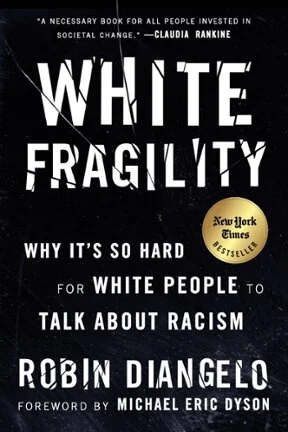
I have some hope that the current protests will be a watershed for race in America. It is far from certain, but it seems reasonable to hope for a change of the same magnitude as has happened as a result of the #metoo movement in the domain of sexual depredations.
One of the books that many people are reading right now—including me—is White Fragility: Why It’s So Hard for White People to Talk about Racism, by Robin DiAngelo. (See Jeff Trachtenberg’s June 5, 2020 Wall Street Journal article “Readers Flock to Books About Race Relations.”) Robin DiAngelo’s answer to the implicit question in the subtitle is this:
Prejudice is foundational to understanding white fragility because suggesting that white people have racial prejudice is perceived as saying that we are bad and should be ashamed. We then feel the need to defend our character rather than explore the inevitable racial prejudices we have absorbed so that we might change them. In this way, our misunderstanding about what prejudice is protects it.
In other words, it is hard for white people to talk about racism because, for most white people, the only alternative they can see to being innocent of racism is that they are a “racist” like the racists who commit hate crimes killing black people or other people of color. This dichotomy doesn’t leave much room for recognizing whatever racism we not-obviously-horrible white people have inside us and trying to reduce its effects on us—and more importantly, reducing its effects on the world.
As a book that draws on academic ideas, White Fragility comes from the perspective of sociology, so it takes some translation to draw out of it the lessons for economists without too much distraction from side-issues related to the different perspectives of sociology and economics. Let me discuss two particular passages from White Fragility (bullets added):
When I say that only whites can be racist, I mean that in the United States, only whites have the collective social and institutional power and privilege over people of color. People of color do not have this power and privilege over white people.
People of color may also hold prejudices and discriminate against white people, but they lack the social and institutional power that transforms their prejudice and discrimination into racism; the impact of their prejudice on whites is temporary and contextual.
I find the phrase “only whites can be racist” needlessly confusing. “Racism” is too well established as having a default common usage focusing on individual traits to clearly mean “systemic racism” without the addition of the adjective “systemic,” or some other modifier that does the same job. On the other hand, I understand the need for a powerful—even shocking—word in order to get people to take it seriously. So, let me use the phrase “white supremacy” to refer to systemic racism. Here are some proposed definitions:
white supremacy (noun): a set of social structures that advantage whites and disadvantage non-whites that are durable, including the capacity to adapt to a changing situation in a way that leads to another set of social structures in the same category of white supremacy. (This notion of adaptation as one of the defining features of white supremacy is influenced by the impressive documentary “13th.”)
white supremacist (noun): someone who advocates white supremacy as desirable.
white supremacism (noun): the activities of white supremacists
white supremacy (adjective): having to do with white supremacy
white supremacist (adjective): having to do with white supremacists
Let me introduce one more concept: enabling white supremacy. Few of us are white supremacists, but almost all white people are enablers of white supremacy in the same sense that someone who makes excuses for an alcoholic and makes it easier for them to continue in their alcoholism is an enabler of that alcoholic’s alcoholism.
To make clear what I am saying, I need to discuss a concept that, to an economist, is the elephant in the room for Robin DiAngelo’s book: statistical discrimination. (Statistical discrimination is treating a group differently only because, given the way the world is, they are in fact different on average—at least in superficial, but practically important ways.) A world in which there were only statistical discrimination and no other form of discrimination would be one in which disadvantaging of people of color resulted from people pursuing their private interests with no racist preferences. Given those non-racist preferences, if the world started in a steady state of racial equality it would stay in that steady state of racial equality. However, if the current social situation in not in that steady state of racial equality, convergence toward that steady state of racial equality could be very slow, if there is any natural tendency toward convergence at all.
To make this more vivid, remember that in a very literal sense, our society was designed over centuries by powerful men who in every sense of the word were white supremacists. This is pretty obvious in the historical documents. It is only since the 1960s that being a white supremacist has been considered a bad enough thing that relatively few people openly advocate white supremacy as a desirable state of affairs. There are very long-lasting effects of past white supremacy (which in turn gained a lot in power because of past white supremacism). For example, the health of parents can easily affect the health of a child.
Although one might hope that racial equality would entail large benefits for everyone (important figures have argued that white supremacy is damaging enough to the souls of white people that there is a Pareto improvement to be had), it is logically possible that a transition from where we are now to a steady state of racial equality could entail non-withes becoming better off and whites becoming worse off than staying in the current situation of white supremacy. A claim that doing only statistical discrimination is not really white supremacy is setting the standard that while we should expect people to give up their racist preferences—or duplicate what would happen if they didn’t have racist preferences, we shouldn’t expect people to sacrifice anything else in order to move toward a situation of greater racial equality. I think that is ethically wrong. It is reasonable to expect people who are now advantaged to sacrifice something beyond just racist preferences in order to get a situation of greater racial equality.
I expect to do more posts based on my reading of White Fragility, but today I will end with that idea even if no one had racist preferences, and people had a very high level of understanding of the racial situation, that those unwilling to pay their fair share of the costs of transition to a steady state of greater racial equality can appropriately be called “enablers of white supremacy.” They might have words to defend their choice to be enablers of white supremacy, but that would be an accurate description of their position.
There are many other ways to be an enabler of white supremacy.
Postscript: Let me attempt a translation using the definitions I have made of this passage I quoted above:
When I say that only whites can be racist, I mean that in the United States, only whites have the collective social and institutional power and privilege over people of color. People of color do not have this power and privilege over white people.
My translation is simply that no one can be an “enabler of black supremacy” because black supremacy is not a real thing in the world for anyone to enable. Anyone who was trying (without success) to bring black supremacy into existence would be more than an enabler. By contrast, being an “enabler of white supremacy” in one of the many ways it is possible to be an enabler of white supremacy is a real and present danger for most of us.
I also have a discussion of racism and anti-racism in: