Nick Timiraos and Andrew Tangel: In the Long Term, an Economy Can’t Expand Faster than the Combined Growth Rates of Its Working Population and Their Output Per Hour

Link to Nick Timiraos's and Andrew Tangel's May 17 Wall Street Journal article "Can Trump Deliver 3% Growth? Stubborn Realities Stand in the Way" shown above

Nick Timiraos and Andrew Tangel's Wall Street Journal article on productivity and number of workers in the US explores many of the same themes as my talk "Restoring American Growth." One of the most basic truisms in the article is the one I made into the title of this post: 

In the long term, an economy can’t expand faster than the combined growth rates of its working population and their output per hour.

Let me talk about each of these in turn, as they do. 

The Drift of Policy is Against Growth in Number of Workers Because It Focuses on Prohibiting People from Working for the US Economy

Nick and Andrew write:

The president is pushing some policies that work against economic growth. Relatively low birthrates and an aging population mean immigration is the source of nearly all of the work force’s net increase, so its growth rate would be even lower if legal immigration were curbed. 

For the most part, economic growth is judged in terms of income per person. But there is one exception: potential military power depends in important measure on total GDP, not just GDP per person. In "Benjamin Franklin's Strategy to Make the US a Superpower Worked Once, Why Not Try It Again?" and "Why Thinking about China is the Key to a Free World," I wrote of how allowing more immigration could add greatly to the military and therefore geopolitical strength of the US. Thus, allowing more immigration is the obvious way to "Make America Great Again" in the geopolitical sense. Conversely, treating being American as a closely guarded privilege that only those born to that privilege are allowed is a path to greatly reduced American power and influence. Of course, allowing more immigration is also extremely valuable to the immigrants themselves, as I talk about in "Us and Them" and "'The Hunger Games' Is Hardly Our Future--It's Already Here." But many people have a "Keep the Riffraff Out!" attitude that trumps concern with the America's power and the well-being of people who want to join us in our fair land. 

Aggregate Demand Is No Longer Scarce

Other than immigration, is there room for expanding the number of workers in the US economy? NIck and Andrew argue this is difficult:

With the unemployment rate now at 4.4% and operating at a level economists consider to be “full employment,” meaning the economy produces as many jobs as it can without spurring inflation, the labor market provides little room for the kind of economic surge that marked the 1980s.

But there is a contrary argument:

White House Budget Director Mick Mulvaney ... pointed to millions of prime-age workers who aren’t in the labor force. “If you created economic opportunity and jobs that they want, they would come back,” Mr. Mulvaney said. “So I’m not worried about the tightness of the labor supply.”

This argument should not be dismissed too quickly. It is quite similar to arguments made by Narayana Kocherlakota in our storified Twitter debate "Narayana Kocherlakota and Miles Kimball Debate the Size of the US Output Gap in January, 2016."

When Monetary Policy Keeps the Economy at the Natural Level, the Supply Side Determines What Happens

Some people think that monetary policy alone can create growth miracles. It can't; not for long. Good monetary policy can readily cut short potential disasters such as the Great Depression or Great Recession, which is in itself quite valuable, but when monetary policy has done its job, then it takes other policies to raise the growth rate of the economy in a sustainable way. 

And indeed, if monetary policy is done well, the remaining story will about the supply side. In my view, one of the best ways to get people to focus on the supply side—or what is sometimes called "structural reform"—is to do monetary policy so well that the economy stays at the natural level, or very close. What would this look like? Something like this description from Nick and Andrew, only more so:

If growth advances and productivity does too, policy makers may be able to keep interest rates lower for longer because productivity growth holds down inflation. Companies can boost profit margins and hold down costs, and thus inflation, when they can produce more goods and services with fewer workers.

If, on the other hand, the administration’s policies boost demand without drawing in new workers or raising their productivity, the growth that results could be harder to sustain because it would produce inflation. The Fed would feel additional pressure to raise interest rates to prevent the economy from overheating.

The Overall Trends in Productivity Growth Are Disappointing

Nick and Andrew include a graph showing how the growth rate of output per work hour has declined in recent years: 
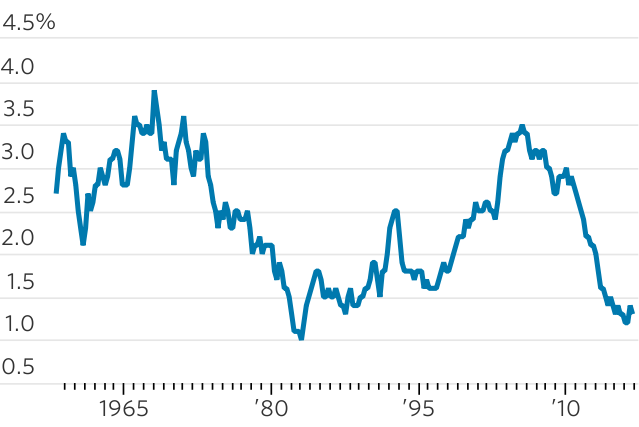
I made a similar graph in the slides for my talk "Restoring American Growth." But where Nick and Andrew's graph gives credit for growth in the next 5 years and the last 5 yearsmy graph gives credit only for growth in the next 5 years after a given date, and so shows the decline in productivity growth after 2003 much more clearly:
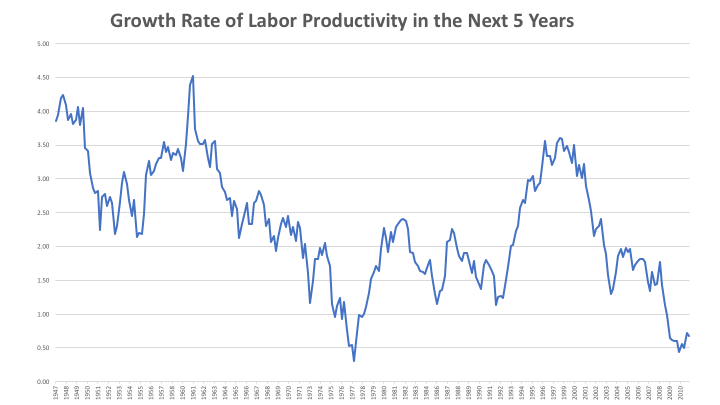
A capsule history of productivity growth since World War II goes like this: 

  1. Fast from the end of World War II in 1945 to 1973
  2. Slow from 1973 to 1995
  3. Fast from 1995 to 2003
  4. Slow from 2003 to the present and maybe beyond (2017+) 

But to provide some perspective, however wrenching they have been politically, the "slow" growth rates from 1973 to 1995 and from 2003 to the present still represent the productivity growth rate that existed during the Industrial Revolution. The fast periods from the end of World War II in 1945 to 1973 and 1995-2003 made many people expect those productivity growth miracles to continue. 

Productivity Growth Is Miserable in Construction

One of the big puzzles for productivity—one that deserves to have many more economists studying it—is why productivity growth in construction has been so miserable. Productivity growth has been quite high in manufacturing. Construction is also a seemingly straightforward physical activity involving the assembly of tangible materials. Why is its productivity growth trend so different from that of manufacturing? 

Look at the difference in the productivity trends between construction ("Structures") and manufacturing (the other two):
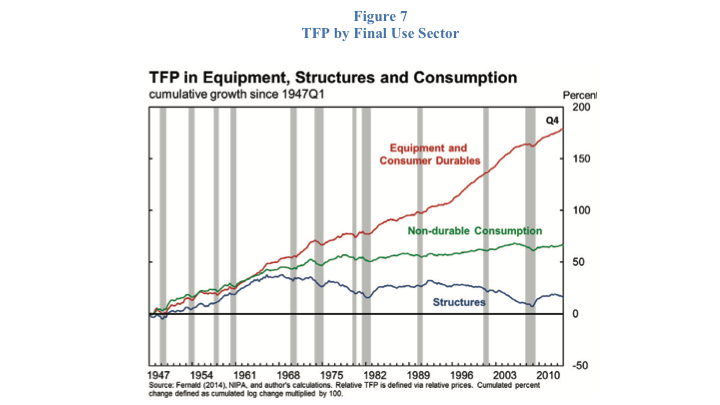
Nick and Andrew also note the low productivity growth in construction. Here is their discussion:

Camden uses efficiencies such as prefabricated concrete building panels and roof trusses, “but there hasn’t been a huge breakthrough yet where we can lower costs dramatically,” said Mr. Campo. “You have a nail gun instead of a hammer, OK? But you still have to line it up and pull the trigger.”

Productivity in construction has contracted at a 1% annual rate since 1995, according to a study by McKinsey Global Institute, the research arm of McKinsey & Co., due in part to reliance on unskilled workers and in part to government red tape.

Joel Shine, chief executive of builder Woodside Homes Inc., visited Kyoto, Japan, to see how firms there use automation in home construction. He thinks it would take at least a decade for the innovations to become mainstream in the U.S., in part because they would require building-code changes.

State and local rules often play as big a role for his business as the federal government. Higher permitting fees, for instance, have raised construction costs in California towns. “There are a lot of places if you gave me a raw lot for free—for free!—I could not even come close to building an entry-level house,” Mr. Shine said.

I think this passage is part of the story. But I think there is more to the story of why construction productivity has gotten worse instead of better. I hope someone does more digging to find out. 

Prospects for Productivity Growth Elsewhere are Unclear

There is hope that productivity growth—that is, growth in output per work hour—will pick up. But the prospects are unclear. Nick and Andrew counterpose these two views:

Some productivity optimists say gains from new technology will build in the years ahead. They see businesses incorporating a backlog of innovations in artificial intelligence, from self-driving vehicles to the processing of routine clerical work.

A paper from four growth specialists published by the Brookings Institution in March takes a dimmer view. It maintains that almost the entire shortfall in output during the recent expansion reflects long-term forces unrelated to the financial crisis and recession, including a drop in a measure of economic dynamism called “total factor productivity.” That measure reflects how efficiently labor and capital are used.

Of course, the future of technology is unavoidably difficult to know; to know enough to predict it well, we would have to know the future technology itself. I talk about that difficulty in "The Unavoidability of Faith." 

What Can Be Done?

The question of what can be done is a difficult one. I know I don't have all of the answers, but I tried in my talk "Restoring American Growth" to make progress on this issue. I would be honored to have anyone reading this post listen to the video of that talk. 
Economics Is Unemotional—And That's Why It Could Help Bridge America's Partisan Divide

Screen Shot 2017-05-15 at 12.04.47 PM.png

Here is a link to my 68th Quartz column, "Economics is unemotional—and that's why it could help bridge America's partisan divide."    Note: You can see all of my previous Quartz columns listed in order of popularity here.

In order to keep things tight, my editor for this column, Sarah Todd, suggested cutting two passages that might interest you: my original introduction, which defines the concept of "politicism," and a passage about the politics of financial stability. I reproduce them below from my early draft of this column:

Original Intro Defining 'Politicism':

Among friends considering where to live, I hear a concern these days I don’t remember hearing when I was younger: “I could never live there because people are too conservative there politically.” A series of social psychology studies by Jarret Crawford, Mark Brandt, Yoel Inbar, John Chambers and Matt Motyl back up the idea that this kind of distaste for those with different political beliefs is common. They have two main findings, based on detailed surveys of 4912 people. First, liberals look down on conservatives just as much as conservatives look down on liberals. Second people look down on others more for discordant beliefs on social issues than they do for discordant beliefs on economic issues.

It is handy having a word for “looking down on a group of people because of their politics.” The word “politicism” seems available. The online Oxford Dictionary defines it as “A concern with or emphasis on the political,” which is close enough for me. The online Urban Dictionary defines it as “voting in a politic election simply based on religion, sex, or ethnicity.” In my definition I am turning that around: politics itself has become a quasi-ethnicity that many people have intense prejudices about. Using my definition of “politicism,” one can say liberals as well as conservatives show a great deal of politicism, and politicism is stronger for social issues than for economic issues.

Original Passage on the Politics of Financial Stability

For a political strategy in which rhetoric focuses on social issues and easy-to-understand economic issues, there is a role for hard-to-understand aspects of economic policy. Hard-to-understand aspects of economic policy are perfect for pleasing sophisticated special interests who understand—while others don’t—that some opaque bit of economic policy will enrich them at the expense of everyone else. A prime example is the hope of banks and other financial firms to get themselves in line for more bailouts in the future by gutting requirements that stockholders put up enough money for banks that stockholders take the hit in a crisis rather than taxpayers. Regular voters know they don’t like bailouts, but their eyes glaze over at discussions of the capital requirements needed to avoid bailouts. Even Elizabeth Warren, who is better at making this kind of thing interesting to the average voter than anyone else, often has to quickly shift the subject to the easier-to-understand issue of people being ripped off by deceptive consumer finance in order to keep her listeners awake.

Edward Lawrence Kimball on Mormonism, Part 1

Link to the video above on YouTube

My Dad, Edward Lawrence Kimball, died on November 21, 2016, a little less than six months ago. I have posted my tribute to my Dad and the tributes of my brothers and sisters, as well as by my Dad's colleague Jack Welch:

Today, and four weeks from today, I am posting videos of John Dehlin's two interviews of my Dad about my Dad's views on Mormonism. (If you can't wait, here is a link to Part 2.) These interviews are excellent at showing how my Dad thought about religion—something he cared deeply about. If you want to see the best face of Mormonism I know of, take a look at these videos. 

Statistical Tests to End the Curse of Gerrymandering

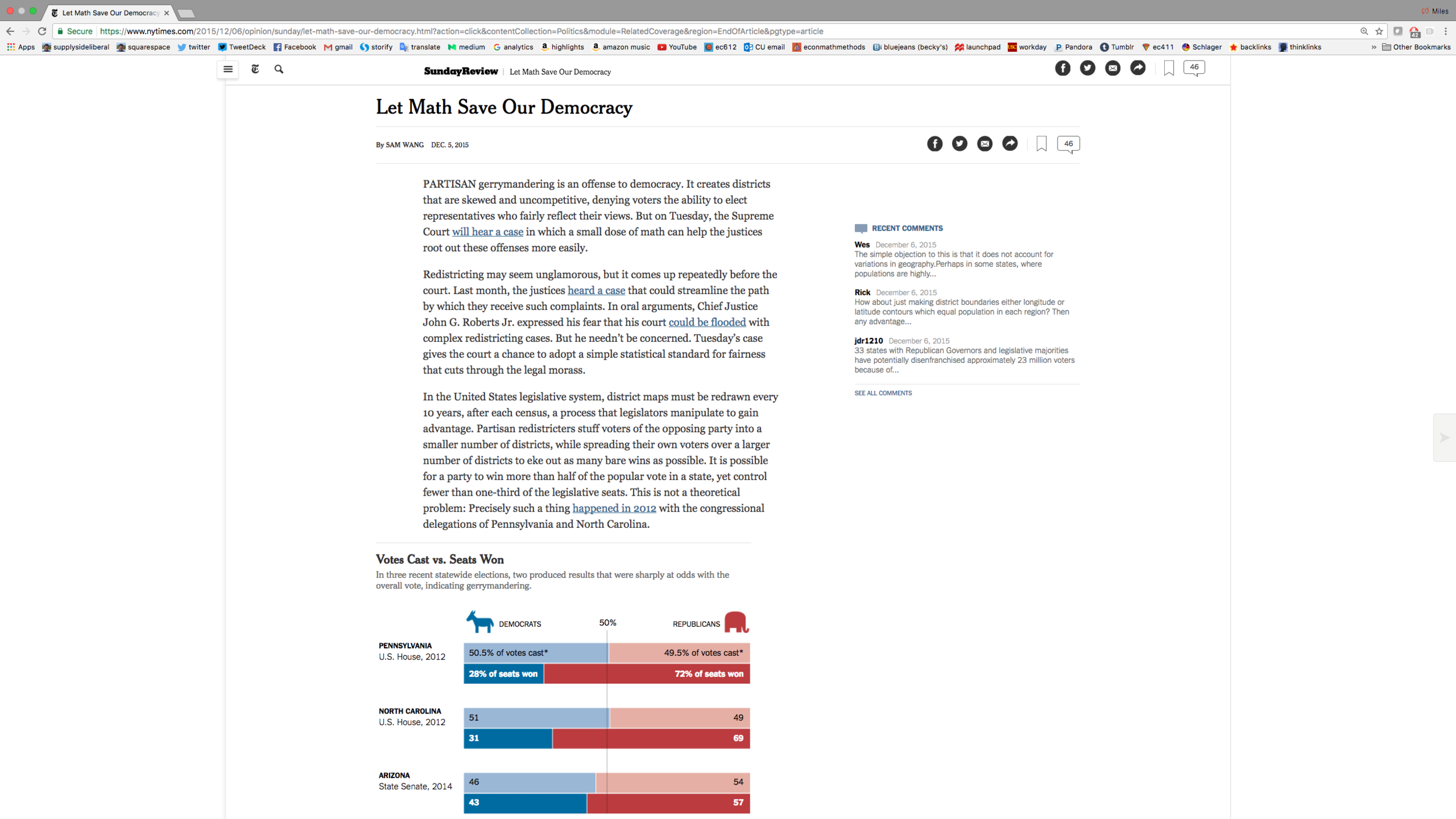
Link to Sam Wang's December 5, 2015 New York Times article "Let Math Save Our Democracy"

Link to Sam Wang's December 5, 2015 New York Times article "Let Math Save Our Democracy"

Sam Wang begins his December 5, 2015 New York Times op-ed "Let Math Save Our Democracy" (flagged by a current article about the upcoming 2020 census) with the words 

Partisan gerrymandering is an offense to democracy. It creates districts that are skewed and uncompetitive, denying voters the ability to elect representatives who fairly reflect their views.

I expressed a similar view in my early post Persuasion

Many people may not realize the extent to which political polarization in the House of Representatives arises from partisan and pro-incumbent redistricting. When electoral districts are designed to be either safe Republican or safe Democratic districts, then the main fear for a politician seeking reelection is losing in the primary. That typically pulls members of the House of Representatives toward the extremes. Nonpartisan redistricting is a way to have more districts be competitive in the general election and so make those running for Congress worry more about the general election relative to how much they worry about the primary. I believe this would pull politicians toward to center and toward a greater willingness to work with those in the other party. Getting change to happen in this area will be hard, but there are groups already working on this. I believe the long-run value to our Republic of nonpartisan redistricting would be substantial.

In my more recent post "Nonpartisan Redistricting," I added:

In other words since most (all but about 40 of 435) Congressional districts are designed to be safe for one party or the other, those in Congress often take actions to please their bases rather than the center. That in turn tends to push Congress toward being more of an arena of posturing rather and less of an arena for deliberating about helpful legislation.  

So I am pleased that the Supreme Court upheld the constitutionality of redistricting commissions. (I am not sure the text of the Constitution fully supports this decision, so ideally it would be good to have a constitutional amendment declaring them legal–and going beyond that, requiring them for all states.)

I hope with the issue of constitutionality settled that more and more states adopt redistricting commissions. Though this may involve short-run sacrifices of reelection probabilities, I think this is actually even in the long-run interest of a party in control of a given state, since parties that get used to appealing to the center to a greater degree are likely to grow in influence.

Sam Wang gives another ray of hope that things can improve even in states that continue to have legislative redistricting:

Simple criteria for identifying gerrymanders would be of great use. The Supreme Court has never rejected a voting district for giving a political party an advantage. ...

A majority of the court, however, supports the idea of finding a test that measures partisan asymmetry. Justice Anthony M. Kennedy, who in the past has provided the deciding vote on this question, has stated his desire to find a workable means of identifying partisan gerrymanders. Either the average-median difference or the lopsided-margin test could serve such a function. Justice Kennedy can have them both.

The trouble with Sam Wang's tests is that they focus on the effect of gerrymandering on overall partisan balance, rather than the number of competitive districts. To me, the number of competitive districts is every bit as important as the overall partisan balance. So a third statistical test is needed: one the counts the number of districts with with close to a 50% vote share for each party. This would force candidates in those districts to try to appeal to independent voters and even voters of the other party, not just voters of their own party. 


On Theft

I have often marveled that the American Revolutionaries went to war—with all the death and destruction that entailed—over their taxes being too high without much say from them in the matter. But their perspective becomes clear when one realizes how well-versed many of the key players were in the writings of John Locke. In section 18 of his 2d Treatise on Government: “On Civil Government,” John Locke writes: 

This makes it lawful for a man to kill a thief, who has not in the least hurt him, nor declared any design upon his life, any farther than by the use of force, so to get him in his power as to take away his money, or what he pleases, from him; because using force, where he has no right, to get me into his power, let his pretence be what it will, I have no reason to suppose, that he, who would take away my liberty, would not, when he had me in his power, take away every thing else. And therefore it is lawful for me to treat him as one who has put himself into a state of war with me, i. e. kill him if I can; for to that hazard does he justly expose himself, whoever introduces a state of war, and is aggressor in it.

The key argument here for equating theft with war is a slippery-slope argument. Why would someone who steals from me a little stop at that if they find they can get away with it? Sometimes there is an answer to this question: for example, the thief (whether or not correct in that view) may feel he or she is righting a finite wrong by stealing something back. Or the thief may only steal barely enough to keep his or her family from starvation. The headiness of getting away with a theft might tempt even such a thief with limited initial intentions to go further. But if a thief really does have principles that strictly limit his or her stealing, such a limited thief is not at war with me in the same sense as a thief who just wants stuff and recognizes no limitations on what he or she will take other than the limitations of prudence in not getting caught. 

Theft may not involve immediate physical injury, but the reality of human existence is that we need things around us to achieve all that we want to achieve. And most of us feel quite bereft when we are thingless. If a thief steals our things, it often feels as if a part of ourselves has been stolen. 

In economic theory and in economic practice, rampant, unchecked theft leads to dramatically lower levels of production and saving, impoverishing entire societies. Limited, principled theft also has a negative effect on production and saving, just not as big.  

In "The Government and the Mob," I wrote

... the basics the government must provide to make anything close to market efficiency possible:

  1. blocking theft,
  2. blocking deception, 
  3. blocking threats of violence.

and quoted from "Leveling Up: Making the Transition from Poor Country to Rich Country": 

The entry levels in the quest to become a rich country are the hardest.  The basic problem is that any government strong enough to stop people from stealing from each other, deceiving each other, and threatening each other with violence, is itself strong enough to steal, deceive, and threaten with violence.  Designing strong but limited government that will prevent theft, deceit, and threats of violence, without perpetrating theft, deceit, and threats of violence at a horrific level is quite a difficult trick that most countries throughout history have not managed to perform.

The situation is not perfect in the United States and other rich countries, but to a remarkable degree we have accomplished this difficult trick. We have much to complain about in relation to our government, but things could be much, much worse. Even those who consider taxation to be theft must admit that, in the US and many other rich countries, taxation is done in accordance with democratic beliefs that keep taxation from going all the way down the slippery slope to enslavement of taxpayers. So democratic governments are at worst limited thieves. 

Anyone who wants to avoid being my enemy needs to declare principles that limit how much he or she would take from me if possible. Anyone who does not set such limits, articulate those limits, and stick to them, should not be surprised when I fight back tenaciously, even if in their own minds they think they have justice on their side. 


Background Reading: Democracy is Not Freedom

Heat Chart: Monthly Average Global Temperatures Relative to 1881-1910

Image via Rosamond Hutt's World Economic Forum post "9 things you absolutely have to know about global warming." This heat chart is used to back up the statement "We’ve now had 627 months warmer than normal, when compared with an 1881-1910 base…

Image via Rosamond Hutt's World Economic Forum post "9 things you absolutely have to know about global warming." This heat chart is used to back up the statement "We’ve now had 627 months warmer than normal, when compared with an 1881-1910 baseline."

For pushback on this and other global warming evidence, see the discussion in the Storify story "Climate Change Science and Climate Change Orthodoxy."

James Hansen's Advice for Not Frying Our Planet

I highly recommend Jeff Goodell's interview of James Hansen, linked above. Jeff introduces James Hansen this way: 

... James Hansen became the first scientist to offer unassailable evidence that burning fossil fuels is heating up the planet. In the decades since, as the world has warmed, the ice has melted and the wildfires have spread, he has published papers on everything from the risks of rapid sea-level rise to the role of soot in global temperature changes ...

It is clear from the interview that James is a no-nonsense guy. Here are some key passages:

1. I would also tell [the President] to think of what the energy sources of the future are going to be and to consider nuclear power. China and India, most of their energy is coming from coal-burning. And you're not going to replace that with solar panels. As you can see from the panels on my barn, I'm all for solar power. Here on the farm, we generate more energy than we use. Because we have a lot of solar panels. It cost me $75,000. That's good, but it's not enough. The world needs energy. We've got to develop a new generation of nuclear-power plants, which use thorium-fueled molten salt reactors [an alternative nuclear technology] that fundamentally cannot have a meltdown. These types of reactors also reduce nuclear waste to a very small fraction of what it is now. If we don't think about nuclear power, then we will leave a more dangerous world for young people.

2. ... the fossil-fuel industry has made a huge investment in fracking over the past 20 years or so, and they now have created enough of a bubble in gas that it really makes no economic sense to reopen coal-fired power plants when gas is so much cheaper. So I don't think Trump can easily reverse the trend away from coal on the time scale of four years.

3. I think that our government has become sufficiently cumbersome in its support of R&D that I'd place more hope in the private sector. But in order to spur the private sector, you've got to provide the incentive. And that's why I'm a big supporter of a carbon fee. ...

[Jeff:] Let's talk more about policy. You're a big believer in a revenue-neutral carbon fee. Explain how that would work, and why you're such a big supporter of it.
[James:] It's very simple. You collect it at the small number of sources, the domestic mines and the ports of entry, from fossil-fuel companies. And you can distribute it back to people. The simplest way to distribute it and encourage the actions that are needed to move us to clean energy is to just give an equal amount to all legal residents. So the person who does better than average in limiting his carbon footprint will make money. And it doesn't really require you to calculate carbon footprint – for instance, the price of food will change as sources that use more fossil fuel, like food imported from New Zealand, become more expensive. And so you are encouraged to buy something from the nearby farm. ...
... our politics ... tend to favor special interests. And even the environmentalists will decide what they want to favor and say, "Oh, we should subsidize this." I don't think we should subsidize anything. We should let the market decide. ...

[Jeff:] I agree that a carbon fee could be an effective tool to cut emissions, but how do you get the politics right to get it done? I mean, it's one thing to...
[James:] Well, you have to make it simple. You can't do this 3,000-page crap, like they did with cap-and-trade in 2009. You gotta simplify it down to the absolute basics, and you do it in a way that the public will not let you change it. If the public is getting this dividend, they won't let you change it.

4. When I was working at NASA, I always felt I was working for the taxpayer. I was not working for the administration. ... When we have knowledge about something, we should not be prohibited from saying it as clearly as we can.


You, Too, Are a Math Person; When Race Comes Into the Picture, That Has to Be Reiterated

Link to the article above.

Link to the article above.

Noah Smith's and my Quartz column "There's One Key Difference Between Kids Who Excel at Math and Those Who Don't" was also published in the Atlantic online as "The Myth of 'I'm Bad at Math.'" This is by more than an order of magnitude the most popular thing I have ever written. That might even be true for Noah. I followed up with the column "How to Turn Every Child into a 'Math Person'." Our message of "You, too, can learn math" should be clear enough, but such is the racism in our society, that when it comes to disadvantaged minorities, the message "You, too, can learn math" needs to be reiterated. Until we see the potential in everyone, regardless of race or household income, prejudice continues. 

The article linked above, "How Does Race Affect a Student's Math Education" talks about racial obstacles to everyone getting the message that the ability to do math is as nearly universal as the ability to read. Letting someone believe they can't learn to do math is like letting someone believe they can't learn to read. Either is cruel in the extreme. 

Sometimes people don't realize that math comes slowly to almost everyone. Those who spend a lot of time thinking about math get good at it. On this theme, in addition to "How to Turn Every Child into a 'Math Person'," see 

Thanks to Richard Watson for pointing me to this article. 


Miles: I wrote a follow-up column "How to Turn Every Child into a "Math Person" that gives links to some of the reactions to "There's One Key Difference Between Kids Who Excel at Math and Those Who Don't" and many resources for math learning. Here are some links to posts on math learning that didn't make it into that column:

Also, here are some Twitter discussions on math learning:

David Brooks: The Crisis of Western Civ

Also note the three links that David Brooks includes in the New York Times essay linked above. Quoting David Brooks,

For Twitter discussion around this essay, see my Storify story "Defending the Principles of Western Civilization While Excoriating Bad Behavior Then and Now." 

Leaving a Legacy

a. Link to the video the acoustic performance by Nichole Nordeman of "Legacy" above; b. Link to the official music video of "Legacy"; c. Link to the lyrics for "Legacy"

I am one of the relatively few nonsupernaturalists who regularly listens to Contemporary Christian Music. This past week, I listened repeatedly to Nichole Nordeman's song "Legacy" because of its resonance with the criticism I made a week ago in my post "Breaking the Chains" of careerism among economists and other academics. There I write:

For most who go into academia, the salary they will get in academia is lower than they could get outside. So most who go into academia make that choice in part out of the joy of ideas, a burning desire for self-expression, a genuine fascination with learning how the world works, or out of idealism—the hope of making the world a better place through their efforts. But by the time those who are successful make it through the long grind of graduate school, getting a job and getting tenure, many have had that joy of ideas, desire for self-expression, thirst for understanding and idealism snuffed out. For many their work life has become a checklist of duties plus the narrow quest for publications in top journals. This fading away of higher, brighter goals betrays the reasons they chose academia in the first place.  

Because I believe it has an important message, but don't believe in the supernatural framing of the message, I want to give a nonsupernatural, teleotheistic interpretation of the lyrics of "Legacy." If you click on the video above, you can hear the song while you read. 

What is Teleotheism?

I first need to define Teleotheism to make a bit clearer what a "teleotheistic interpretation" might be. Teleotheism is the belief that God comes at the end, not at the beginning.

As for the origin and history of the word "Teleotheism," when I wrote the Unitarian-Universalist sermon "Teleotheism and the Purpose of Life," I googled to find the preexisting word "Teleotheism" from the bvio.com post "Talk:-ism." But if you google the word now, you will find my blog post with the text of "Teleotheism and the Purpose of Life" as the top hit. The second hit is to a video of the second time I gave the sermon, at the Universalist Unitarian Church of Farmington. The third is Noah Smith's endorsement of Teleotheism. (For the word "teleotheistic," the top three hits are two for my post "The Teleotheistic Achievement of the New Testament" and one for my post "What If Jesus Was Really Resurrected?")

Pierre Teilhard de Chardin did not use the term "Teleotheism" (or at least the Wikipedia entry on Pierre Teilhard de Chardin makes no mention of it), but Teleotheism is a good description of his beliefs, and particularly of his views about what he called "the Omega Point."  

My Teleotheism differs from Pierre Teilhard de Chardin's Teleotheism by having God at the end only as a possibility, not as a foregone conclusion. Reaching God will require the best efforts of many. Here is the passage from "Teleotheism and the Purpose of Life" that best explains my version of Teleotheism:

The key difference between evolution as our creator and the god of the Bible is that with evolution the best comes at the end, not at the beginning.  There was no Garden of Eden—only primordial soup in a warm pond.   But heaven is still possible; we and our descendants just need to build it.  

The first task is to decide what we want.  The medieval theologian Anselm defined God as “that than which no greater can be thought” and proceeded to argue that God must exist since something that exists is greater than something that doesn’t exist.  Therefore, the greatest of all things must exist.   It is my understanding that modern philosophers reject Anselm’s argument on the basis that “existence” is not an ordinary attribute like being massive or being photosynthetic.  Existence has a special status in logic.  So let me do a riff on Anselm by defining God as “the greatest of all things that can come true.”  God is the heaven—or in Mormon terms, the Zion, the ideal society—that we and our descendants can build, and god is a reasonable description of the kind of people who make up that society.   But what does a heavenly society look like? 

Let’s start with the easier question of what an ideal human being looks like.   Here I look to Jesus.  Not the historical Jesus, but the imagined Jesus who is the projection of every good human trait, as valued by our culture.  It makes all the sense in the world to ask “what would Jesus do” even if one believes that the historical Jesus was only a man, since “what would Jesus do” is a good shorthand for what our culture thinks a good person would do.  This is an example of the way in which many of the highest ideas of goodness in Western Culture are embedded in religious language. 

A Teleotheistic Interpretation of Nichole Nordeman's Lyrics for "Legacy"

In her lyrics for "Legacy," Nichole begins by saying that a certain amount of ordinary ambition is OK:

I don't mind if you've got something nice to say about me
And I enjoy an accolade like the rest
And you could take my picture and hang it in a gallery
Of all the who's-who's and so-and-so's
That used to be the best at such and such,
It wouldn't matter much.

I won't lie, it feels alright to see your name in lights,
We all need an 'Atta boy' or 'Atta girl'

But ordinary ambition can easily get off track. As I wrote in "Breaking the Chains" for the case of academics:

Treating publishing in top journals as the end itself is off target. It is the broad road that leads to the destruction of much of your potential for joy, self-expression, understanding and doing good in the world. Putting the higher, brighter goals first—with publications as only one of several tools for achieving those goals—is the narrow gate to joy, self-expression, understanding and doing good. 

Nichole expresses a corresponding idea this way:

But in the end I'd like to hang my hat on more besides
The temporary trappings of this world.

Without a God who currently exists, getting beyond "the temporary trappings of this world" is a matter of doing things that could withstand the judgment of history a long time from now, when people are much wiser than they are now.

I say "doing things that could withstand the judgment of history" because many of the good things we do will never make it into the historical record at all. And there is another big gap between the set of things that make it into the historical record for those who diligently seek the information out, and those things that any ordinary person will every hear or read about. For example, if you think fame is a reasonable goal for an economist, just ask your non-economist friends how many economists they can name whom they don't know personally. You may be surprised at how few that number is. As another example, even though economists think about Gross Domestic Product quite a bit, and a book exists about the origins of GDP, I think you could safely lay even odds that a randomly chosen economist could not name the economists who put together the conceptual and practical framework for measuring GDP. 

Because of the frailty of human memory and the difficulty of achieving any lasting fame, when Nichole sings

I want to leave a legacy,
How will they remember me?

I take her "How will they remember me?" as mostly literary license. Nevertheless, targeting what our friends who are the wisest and who care about the most people will think of us after we are gone is not a terrible proxy for "doing things that could withstand the judgments of history a long time from now, when people are much wiser than they are now." 

Nichole points to some clues for how to judge one's actions with one's legacy in mind (relative to the lyrics at the link, I moved the question mark from the second line below to the third to better match what I hear): 

Did I choose to love? 
Did I point to you enough
To make a mark on things?

"Did I choose to love?" needs no reinterpretation at all. 

As for the line "Did I point to you enough," given the conventions of Contemporary Christian Music, by "you," Nichole clearly intends "God." The meaning "God's name" for "your name" four lines down in "Who blessed your name unapologetically" is also clear. To give the teleotheistic spin to "Did I point to you enough" and "Who blessed your name unapologetically," consider my "Daily Devotional for the Not-Yet":

In this moment, as in all the moments I have, may the image of the God or Gods Who May Be burn brightly in my heart.

Let faith give me a felt assurance that what must be done to bring the Day of Awakening and the Day of Fulfilment closer can be done in a spirit of joy and contentment.

Let the gathering powers of heaven be at my left hand and my right. Let there be many heroes and saints to blaze the trail in front of me. Let the younger generations who will follow discern the truth and wield it to strengthen good and weaken evil. Let the grandeur of the Universe above inspire noble thoughts that lead to noble plans and noble deeds. Let the Earth beneath be a remembrance of the wisdom of our ancestors and of others who have died before us. And may the light within be an ocean of conscious and unconscious being to sustain me and those who are with me through all the trials we must go through.

In this moment, I am. And I am grateful that I am. May others be, now and for all time.

My post "Daily Devotional for the Not-Yet" gives a detailed teleotheistic interpretation of this devotional, but here what I want to emphasize is that even those of us who doubt that God currently exists can point to God in the sense of "The God or Gods Who May Be." That is, we should always point boldly and unapologetically toward the good and even transcendent things that are possible if people work toward those higher, brighter goals instead of a pitifully small and narrow conception of self-interest.

What your self-interest is depends on what you decide your "self" is. If you decide that your "self" has a part that extends to the end of time, and includes the welfare of the many human beings and other sophonts who exist now and will exist in the future, then your self-interest may tend toward God, or in my phrase, "The God or Gods Who May Be." 

Of course, even if you decide to take an expansive view of your own self-interest that encompasses the interests of many others, both now and in the (possibly distant) future, there are tradeoffs. But there are always tradeoffs. I like working on math problems and hate to stop when I am on a roll; but then that math might come at the expense of sleep. Similarly, tending our self-interest in the direction that encompasses the interests of others sometimes comes at the expense of other dimensions of our self-interest. So it is often appropriate to talk about making sacrifices in order to do good. As Nichole expresses it,

I want to leave an offering

The next line in "Legacy" adds in a different note: "A child of mercy and grace." Here is the context:

A child of mercy and grace
Who blessed your name unapologetically
And leave that kind of legacy.

Teleotheistically, we are all children of mercy and grace in that we have all escaped the destructiveness of the cruel creator god, evolution. In the history of our planet, most genetic lines were wiped out. Our lines were not. That is mercy and grace. But it is not the mercy and grace of a benevolent god, but the grace of a terrible and brutal god, evolution, who brought us into existence by killing off many, many other experiments. We have been spared, not entirely capriciously, but not out of any kindness either. 

Still, a certain gratitude is warranted, or at least an appreciation of the chance that we have been given that only a vanishingly small fraction of all possible human beings (and an even tinier fraction of all possible intelligent beings) have ever had. Let us make the most of this chance that we have. 

To make the most of that chance, we need to steel ourselves for the needed sacrifices. One thought that helps is how short-lived some of the things we might need to sacrifice will be in any case. Nichole's next stanza goes

I don't have to look too far or too long a while
To make a lengthy list of all that I enjoy
It's an accumulating trinket and a treasure pile
Where moth and rust, thieves and such
Will soon enough destroy.

That said, pleasures for ourselves and others are, in my view at least, an element of “the greatest of all things that can come true.” We should not sacrifice unnecessarily now pleasures that are part of our image of heaven in the future. The final words of my "Agnostic Invocation" are

And may we understand more fully the mystery of the humanity we all share, and act as one family to bring this Earth nearer to Heaven. Amen. 

Let us not begrudge ourselves a bit of Heaven now, unless it costs us Heaven later. 

Other than refrains, the final thought in "Legacy" is this: 

Not well-traveled, not well-read
Not well-to-do, or well-bred.
Just want to hear instead,
Well done, good and faithful one'

In itself, being well-traveled is good. Being well-read is good. Being well-to-do is good, if it doesn't come at the expense of other, more important things. And being "well-bred" in the sense of having parents who help one appreciate one's own potential is good. (See "The Unavoidability of Faith.") And for those of us who are academics, let me add to Nichole's list that having many publications and being well-cited is good, insofar as it is an indication of having done worthwhile investigations and having accurately and vividly communicated what one found. But we should not take too much pride in these good things if that pride distracts us from doing what needs to be done to further the cause of building the ideal society and making it possible for those who come after us to reach their full potential, which we now only glimpse "like puzzling reflections in a mirror" as the image of God. 

Now we see things imperfectly, like puzzling reflections in a mirror, but if we could live that long, then we would see everything with perfect clarity,  just as God would then know me completely. (teleotheistic reinterpretation of 1 Corinthians 13:12, taking the New Living Translation as a starting point)