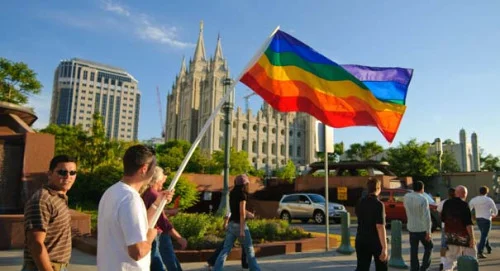
The Mormon Church recently promulgated a policy that considers a person in a marriage with another person of the same sex to be apostate, subject to a mandatory ‘disciplinary council’ [4]. This is where people are excommunicated; lesser forms of discipline are possible, but excommunication is the norm in a case of apostasy. A separate policy segregates children of a person who is in a same-sex relationship, married or not. In certain circumstances, such children cannot be given a name and blessing (analogous to a christening, shortly after birth), be baptized (otherwise normal at age eight), or otherwise participate in ordinances or sacraments, until they are 18 and make independent decisions, decisions which include disavowing their gay parent’s lifestyle [5].
The response among Mormons has been varied, including cries of hoax, quick rationalizations, dissociation (detachment), disassociation (including resignations in significant numbers), despair, depression, risk [6] of suicide, and anger.
Anger
Why anger? When a church does something hurtful, I expect four reactions:
➢ Pain (and anger) from those directly affected.
➢ Disassociation, including resignation, from a few for whom (typically) this is the last straw in a long line of complaints.
➢ Rationalization—“it’s all ok, they know what they’re doing”—from a few.
➢ Relative quiet from most, the many who are not directly affected and busy with the rest of their lives. (Not that they are uncaring or unknowing, but that they worry about other things.)
In the present situation I experience, and see and hear anger, and it is affecting the fourth class, the otherwise quiet or busy elsewhere.
Essential Conflict
The obvious source of anger is the children: How can this possibly make sense for the children!?
But as I try to make sense of this, I think there are deeper roots of the anger as an outward expression of irreconcilable conflict.
On the one hand, Mormonism wants to be universal. The Church teaches the Plan of Happiness. This is not (or not only) a marketing slogan. Mormons really believe:
[C]onsider on the blessed and happy state of those that keep the commandments of God. For behold, they are blessed in all things, both temporal and spiritual; and if they hold out faithful to the end they are received into heaven, that thereby they may dwell with God in a state of never-ending happiness. (Mosiah 2:41, Book of Mormon)
Mormons believe that the ordinances or sacraments–including baptism and marriage and more—are necessary to this state of never-ending happiness. And that these sacraments are only available in the Mormon church performed by proper authority in the authorized manner. So much so that Mormons devote significant time and resources to genealogy and proxy work (in Mormon temples) performing the saving ordinances in the names of and on behalf of the dead.
It takes a cruel and uncaring mind to hold in one place Happy and Necessary and Exclusive and then kick people out. Mormons are not cruel and uncaring. Mormons can make sense of people excluding themselves by choice … by sin, in religious jargon … but to exclude people by the color of their eyes or an accident of birth or their sexual orientation feels wrong.
On the other hand, marriage of same-sex couples is like a perfect storm of trouble for Mormonism.
Consider that in the Mormon imagination god is an anthropomorphic, embodied Heavenly Father [7] paired with a Heavenly Mother about whom nothing is known except gender.
Consider that the self or spirit or soul is very long to infinite in duration, individual and self-aware, generally anthropomorphic, and in particular gender specific, i.e., male or female.
In this Mormon imagination there is no place for essential homosexuality, i.e., gay (and straight and in-between) as essential characteristics of the person. The Mormon imagination could make sense of choice, i.e., homosexuality as an alternate life-style choice which a person could opt in or out of. The Mormon imagination could make sense of disorder, i.e., homosexuality as a disorder or disability that can be cured in this life or the next. However, Mormon imagination has no room, no place, no rationalization, that includes homosexuality as an essential characteristic.
And yet society in general, with Mormons along for the ride, is moving or has moved to an essentialist understanding of homosexuality [8]. Different stories could be told, but in my view social acceptance began with gay people coming out in sufficient numbers that gay is (no longer) ‘other’ but ‘us’, i.e., my sister, my cousin, my friend, my neighbor. When that happened it became obvious—obvious because we’re talking about real known human beings, not abstractions—that they/we are not choosing and are not sick. That they/we are really truly gay (or straight, or bi-, or whatever). In my simple view, again, social acceptance has culminated in marriage. Any number of equal protection, equal treatment, anti-discrimination measures might have been that culmination, but marriage is what happened and marriage is extraordinarily powerful both symbolically and in practical reality, in recognizing gay people as the real thing, not transitory, not choosing, not disordered, not counterfeit, but really truly essentially gay.
Finally, consider that Mormons understand marriage to be the ultimate and forever state of being. Marriage is ideally “for time and all eternity” and in that form marriage is a condition for exaltation or the highest degree of glory [9].
For Mormons it is no small matter that social acceptance culminates in marriage. For Mormons, considering the state of marriage as eternal, patterned by God, and necessary to exaltation, marriage is the single most challenging, threatening, impossible-to-conceptualize way to recognize gay people as essential and real.
Thus the battle for hearts and minds is engaged:
➢ Mormonism wants to be universal.
➢ Mormonism and a Mormon heaven and Mormon happiness requires permanent dimorphic pairing—“male and female created he them.“
➢ Mormonism has no room, on earth or in heaven, in concept or practicality, for homosexuality as an essential characteristic and same-sex couples as married.
The 2015 Mormon answer is to expel same-sex couples. Exclude them from the community. For same-sex couples the state of marriage is so antithetical to the Mormon imagination that it is apostate by definition, apostate not for belief or teaching or action, but apostate by simply being. Although the church would never say in so many words, I think it is no exaggeration to say that for the Mormon Church a married same-sex couple is a living contradiction, an embodied offense [10].
And yet they are my brother, my uncle, my friend, my neighbor. They are me, in every way that matters. How can we possibly square this with the command “You shall love your neighbor as yourself”? (Matthew 22:29, RSV)
So I am angry [11].
Then there’s the children.
The situation for my married gay friends makes me cry. And then there’s the children. Children of gay parents are denied saving ordinances. For no fault of their own, in a church that believes it is one’s own sins that count. This is very difficult to rationalize, to make sense of, to feel anything but despair or anger about. In the first few days after the new policies became known, with regard to the parents, the same-sex couples, I heard a lot of anger but also despair and resigned acceptance, a reluctant “to be expected” reaction. About the children, I heard rage.
The official explanation regarding children is that the ordinances are not denied but only delayed (“there is time for that”, “nothing is lost in the end”), and that separation from the Church in their minority is for the benefit of the children, to minimize conflict, to protect them.
Many observers, Mormon and non-Mormon, conservative and liberal, advocates and critics alike, find the “benefit of the children” explanation unpersuasive or at least incomplete. There are many family situations, including divorce and remarriage (male-female marriage), member/non-member/part-member parents, believers and unbelievers, even excommunicated (for other reasons) parent or parents, where Church policies take no notice in determining how children are respected and included. All this even though the “benefit of the children” rationale would ring just the same. There are only two situations where children are affected by their parents’ status: children of polygamous parents and children of same-sex parents. Both involve marriage that is forbidden by or antithetical to the (current) Mormon church. In both the children are treated differently because of their parents’ status. The disease rationale, the sense of the Church avoiding infection, comes all too easily to mind.
How is this possible, in light of Jesus’ words: “Let the children come to me, and do not hinder them; for to such belongs the kingdom of heaven”? (Matthew 19:14, RSV)
What to do about it?
What should the church do? My first thought is that nothing I say or write will make the least bit of difference. The end.
My second thought (logically inconsistent with the first) is to address the Church: “Please don’t.” “Please stop.” “Please change.”
My third attempt is to look for something that could really happen in the near term. And there I really do have an incrementalist prescription.
First, with respect to the children, let it go, if necessary by indirection. It may be too difficult as an institutional matter to explicitly reverse ground. The Church seldom apologizes or changes tack quickly. Acknowledged change happens, but at the pace not of months or years, but of generations. However, quiet change happens routinely, sometimes just by changing emphasis. With respect to the children of gay parents, this has already started by way of a November 13 letter from the First Presidency that limited the scope of limitations on children and allowed for local discretion in some circumstances. With modest modifications, smart training, selective emphasis, and local discretion, it is very possible to get to a point where the offending language remains as official policy but instances of actual offense are rare and reversible.
I would find that embarrassing, but in a realpolitik sense it may be the best we can do.
With respect to gay members who marry, I have two directions to suggest. First, in the near term, apostasy usually but not always ends in excommunication. Emphasis on the “not always.” It is possible to reason that excommunication should be used only when the couple is causing trouble, which arguably is only when the couple is noisy, actively teaching or speaking against the Church. And not when they are simply being themselves. I have no doubt that many local congregations and bishops feel that way already. On a day-by-day, life in the pew, love thy neighbor sense, Mormons (as also most religious people) have a lot of experience and are pretty good at welcoming all kinds of quiet radicals.
Second, in the middle term (and short of revelatory change in doctrine) the Church could make good use of its general approach to exceptions and variety. The Mormon imagination I outline above doesn’t really have room for single adults. It doesn’t really have room for divorce. It doesn’t really have room for complicated patterns of marriage-divorce-remarriage where a child might find herself with several sets of parents. And yet we find a way. A dash of humility, a pinch of “God will provide,” a sprinkling of “it will work out in the end,” a heaping spoonful of grace, and life goes on. There is no slippery slope. No rush to general application. Notwithstanding the headline news of 2015, marriages of same-sex couples will forever be extraordinary—very small in numbers and vitally important for the few. Just the right situation for quiet exceptions, even if never fully rationalized.
In sum, what I would do is celebrate marriage and don’t ask too many questions. Worship a God who encompasses all of creation in all of its endless variety.