How and Why to Expand the Nonprofit Sector as a Partial Alternative to Government: A Reader’s Guide

The unavoidable urgency of a campaign to eliminate the zero lower bound that I wrote about in my 3d anniversary post “Beacons” has taken me away from campaigning for another proposal that is closer to the heart of what it means to be a Supply-Side Liberal: my proposal of a “public contribution program.” Once the campaign to eliminate the zero lower bound is won, I hope to devote more energy to campaigning for a public contribution program. 

A public contribution program requires donations to charity in place of higher taxes–or if what needed to be done were less expensive–allowed tax reductions accompanied by required donations. The basic logic is that, in areas where it is possible, public goods should be provided by the nonprofit sector rather than government, with government’s role in those areas being pared back to making sure that people direct enough resources toward that provision of public goods by the nonprofit sector. Or as I wrote in The Red Banker on Supply-Side Liberalism:

… my central proposal for keeping the burden of taxation down while providing abundant public goods: a public contribution system that raises taxes rates, but lets people avoid 100% of the extra taxes by making charitable donations focused on doing things the government might otherwise have to do. …

In my book, it isn’t Supply-Side Liberalism without a serious effort to lower the burden of taxation for any given level of revenue, using everything we know about human nature.

For some time, I have hoped to have a post like this, parallel to my post “How and Why to Eliminate the Zero Lower Bound: A Reader’s Guide.” What finally helped me get this done was coming across a passage from John Stuart Mill’s On Liberty discussing the nonprofit sector. That passage is the grand finale of this post. 

I can think of six basic arguments for preferring nonprofit sector action to government action in many areas:

  1. Because the nonprofit sector is more decentralized, it involves a more diverse body of key decision-makers and so can be more creative than government.

  2. In the nonprofit sector, it is easier to sunset programs that don’t work well than in government; people can stop donating to them.

  3. Nonprofit sector provision of public goods tends to be cheaper since wages in the nonprofit sector tend to be lower than in the private for-profit sector, while (except for the high-end of those qualified to be highly-skilled professionals) typical government wages tend to be higher than in the private for-profit sector. 

  4. Even if giving to some charity is required, giving to a charity of one’s choice is much more fun than forking over taxes to the government. Therefore, people will distort their behavior less to avoid required charitable donations than they would to avoid taxes.

  5. Through cognitive dissonance, many who are required to give to charities will end up thinking of themselves as more altruistic and end up actually becoming more altruistic (including for many donating time as well as money to a charity). This tendency will be reinforced by discussing with friends what charity to give to. And children will be brought up surrounded by a culture of giving. 

  6. Thinking about which charity to give to will help educate people about the issues surrounding public good provision.  

John Stuart Mill argues especially for 1 and 6. I would be glad to hear any other arguments. In all of this, it is important to recognize that the nonprofit sector is far from perfect. But fortunately, we have a lot of experience with government regulation of the nonprofit sector to keep things from going too far off track.  

The most common argument against I have run into is that the priorities set by a democratic process are (a) better and (b) more legitimate than the priorities individuals would choose if required to give to a charitable purpose.

On the quality of priorities set by these two democratic vs. democratic mechanisms, I think the story is complex. A public contribution program is likely to increase support for scientific research and foreign aid compared to democratic decisions in the US. On the other hand, I think democratic decisions in the US now do a better job of putting the appropriate priority on national defense and aid to disadvantaged minorities. Both democratic decisions and a public contribution program would put a high priority on taking care of senior citizens. Continuing to have a substantial government budget as now plus a public contribution programs seems likely to do the best job at taking care of the full range of key public goods. Remember also that the details of regulation for the public contribution program can incorporate input from democratic decision-making. For example, perhaps opera houses that mostly serve the rich should not be eligible for public contributions. This decision of eligibility of opera houses for public contributions would be made by the usual imperfect democratic processes. 

On legitimacy, I don't see why a mixed system involving some collective decision-making and some individual choice should be inherently less legitimate than a system that relies more heavily on collective decision-making. 

The Core Argument

The core argument for public contribution program can be found in these three posts:

Additional Arguments

Video

Twitter Discussions

Brief Appeals for Relying More Heavily on the Nonprofit Sector Relative to Government, Short Enough to Copy Out Here

The quotation from John Stuart Mill is the grand finale here. The others are from me. I give the name and link to the post they are drawn from first, then the quotation.

Speaking of decentralization, some government functions (such as taking care of the poor) might be better served if they could be decentralized to nonprofit organizations. In particular, such decentralization allows a trial and error process to work its magic as donations shift away from the least effective nonprofits to more effective nonprofits. Because people love freedom, such decentralization of certain government functions has other advantages as well, as I argue in my post “No Tax Increase Without Recompense.” In that post, I propose a way to make sure such nonprofit efforts are adequately funded.

Growing up, I was often told “You love those whom you serve.”  That is a true principle of psychology. If you help someone out without too much of an ulterior motive, parts of your brain outside the localized glow of consciousness start trying to make sense of why you are being so nice. A handy explanation for your subconscious to turn to is that whoever it is means something to you. And this process of what in economists’ jargon would be called “developing a new altruistic link” works even if you know full well that it is happening. I remember when bargaining with the head of my department over the terms on which I would serve (a now completed term) as director of our Masters of Applied Economics program knowing that I had to be ready for a situation in which I would come to care about those students, even though I didn’t know them yet.

Community and religious organizations that get people involved in helping others—especially when they get people involved in helping others who are in especially bad situations—do a lot to help generate new altruistic links that make the world a fairer, more benevolent place in ways that come easily to us, psychologically, after getting over the initial hump of dealing with someone new. Strangers become friends. And our friends’ problems become our own.

Even government policy can help. Paying taxes does very little toward making us care about those who are helped from those tax revenues. But if, instead of raising taxes, we insisted that those who are comfortable contribute a substantial amount to a charity of their choice, as I advocated in my column “Yes, there is an alternative to austerity versus spending: Reinvigorate America’s nonprofits,” we would care more. And caring more, we would be likely to volunteer our time as well as giving money. And best of all, our children would see us helping other people’s children, and learn early on that loving others—even beyond our own families—is what brings us to the highest level of our own humanity.

One key to sustainably getting resources for helping the poor is to do it in a way that causes the fewest economic distortions. In addition to focusing on the right kinds of taxes, to the extent that there must be taxes, I believe that there is great potential in the kind of public contribution system that I talk about in the links in my post “The Red Banker on Supply-Side Liberalism.“ People often hate taxes, so they try to avoid them. Those efforts at tax avoidance are a social waste. So it makes sense to get many of the resources for helping the poor from public contributions that people won’t want to avoid as much as taxes, and that allow those contributing to be creative in making the world a better place. The creativity and flexibility fostered by a public contribution system are also bound to lead to technological progress in ways to help the poor.

For the record, my proposal for dealing with the long-run budget issues that are the heart of the disagreements between Republicans and Democrats is the system of “public contributions” laid out in my post “No Tax Increase Without Recompense.” This public contribution system would help make sure that the poor and afflicted are taken care of while reducing the footprint of the government in society.

[The] public contribution program will do a lot more to take care of the poor and the sick and to honor the elderly than we do now. [We] just need to be careful not to cut back on direct government programs until we are really confident that the decentralized efforts from the public contribution program are taking care of things in specific areas. 

We should start preparing for a day, maybe 10 or 20 years in the future, when inequality may be much worse. We don't yet know whether it's going to be worse. We should have a contingency plan now. ...

Q: So we'd have a tax increase on wealthier people that would go into effect if some measure of inequality reached a certain point?

A: Yes. If billionaires turn into multi-billionaires, we don't let that happen. If you want to make $10 billion and spend it on yourself, we won't let you. We will take a good fraction of it, and you'll still be a billionaire, so what?

The other side of it is I think we should expand the charitable deduction, so if you make $10 billion and you want to give 90 percent of it away, you can give it away with your name on it so it enhances your prestige, but give it away and you should be able to deduct it.

Q: So we would more aggressively redistribute income from the top?

A: From selfish people at the top who don't want to give it away. You could turn into Bill Gates or an Andrew Carnegie. I think that's OK. Instead of just taxing people—saying, "We're just taking the money, and you'll go to jail if you don't turn it over"—we can find a better way.

I have reserved for the last place a large class of questions respecting the limits of government interference, which, though closely connected with the subject of this Essay, do not, in strictness, belong to it. These are cases in which the reasons against interference do not turn upon the principle of liberty: the question is not about restraining the actions of individuals, but about helping them: it is asked whether the government should do, or cause to be done, something for their benefit, instead of leaving it to be done by themselves, individually, or in voluntary combination.

The objections to government interference, when it is not such as to involve infringement of liberty, may be of three kinds.

The first is, when the thing to be done is likely to be better done by individuals than by the government. Speaking generally, there is no one so fit to conduct any business, or to determine how or by whom it shall be conducted, as those who are personally interested in it. This principle condemns the interferences, once so common, of the legislature, or the officers of government, with the ordinary processes of industry. But this part of the subject has been sufficiently enlarged upon by political economists, and is not particularly related to the principles of this Essay.

The second objection is more nearly allied to our subject. In many cases, though individuals may not do the particular thing so well, on the average, as the officers of government, it is nevertheless desirable that it should be done by them, rather than by the government, as a means to their own mental education—a mode of strengthening their active faculties, exercising their judgment, and giving them a familiar knowledge of the subjects with which they are thus left to deal. This is a principal, though not the sole, recommendation of jury trial (in cases not political); of free and popular local and municipal institutions; of the conduct of industrial and philanthropic enterprises by voluntary associations. These are not questions of liberty, and are connected with that subject only by remote tendencies; but they are questions of development. It belongs to a different occasion from the present to dwell on these things as parts of national education; as being, in truth, the peculiar training of a citizen, the practical part of the political education of a free people, taking them out of the narrow circle of personal and family selfishness, and accustoming them to the comprehension of joint interests, the management of joint concerns—habituating them to act from public or semi-public motives, and guide their conduct by aims which unite instead of isolating them from one another. Without these habits and powers, a free constitution can neither be worked nor preserved; as is exemplified by the too-often transitory nature of political freedom in countries where it does not rest upon a sufficient basis of local liberties. The management of purely local business by the localities, and of the great enterprises of industry by the union of those who voluntarily supply the pecuniary means, is further recommended by all the advantages which have been set forth in this Essay as belonging to individuality of development, and diversity of modes of action. Government operations tend to be everywhere alike. With individuals and voluntary associations, on the contrary, there are varied experiments, and endless diversity of experience. What the State can usefully do, is to make itself a central depository, and active circulator and diffuser, of the experience resulting from many trials. Its business is to enable each experimentalist to benefit by the experiments of others; instead of tolerating no experiments but its own.

Update: This post engendered a lively Facebook discussion, which you can see here

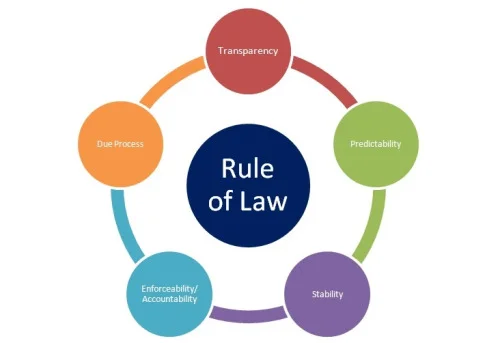
Cass Sunstein on the Rule of Law

In the Obama administration, Cass Sunstein tried with mixed success to restrain the overgrowth of administrative law–an overgrowth that has long since seriously violated “rule of law” principles. In his Bloomberg View column “The Rule of Law Wins One for Tom Brady,” Cass explains what the “rule of law” means, with an application to football’s “Deflategate.” Here is the key paragraph, with numbering added to Cass’s words:

Many people think that the concept has to do with democracy or liberty, or that it requires free markets. But it’s much narrower than that. Reduced to its essentials, the rule of law has just two components.

1. First, the law involved has to be clear and comprehensible, so that people can know, in advance, on what grounds they might be punished.
2. Second, people generally have a right to be heard, and that requires notice of the charges against them, and a fair opportunity to rebut those charges before an unbiased tribunal.

Mike Bird on Negative Interest Rate Policy | Business Insider

Link to the article on Business Insider

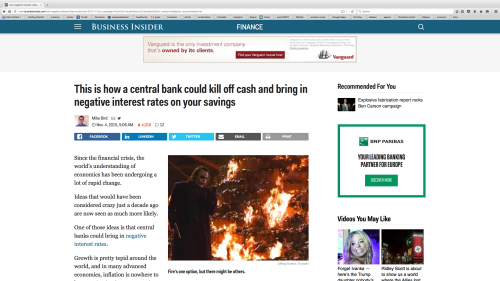
Despite an inflammatory picture and title, Mike Bird’s November 4, 2015 Business Insider article “This is how a central bank could kill off cash and bring in negative interest rates on your savings” is an excellent treatment of negative interest rate policy. Mike discusses at length my new paper “Negative Interest Rate Policy as Conventional Monetary Policy,” and provides helpful context.

Here are the two passages giving Mike’s assessment of the future for negative interest rate policy:

Since the financial crisis, the world’s understanding of economics has been undergoing a lot of rapid change.

Ideas that would have been considered crazy just a decade ago are now seen as much more likely.

One of those ideas is that central banks could bring in negative interest rates

However uncomfortable you are with the idea, you’d better get used to it. What HSBC chief economist Stephen King called the world economy’s “Titanic” problem is going to put governments around the world in a massive bind whenever the next recession hits.

Every lever of economic policy is pretty much tapped out, either for economic or political reasons: Finance departments and heads of government seem strongly against fiscal stimulus. Quantitative easing has been fairly unpopular, and its reputation among academics and economists is mixed at best.

In short, the world’s economy is an ocean liner, and there aren’t enough lifeboats. Despite objections, it may well be that negative interest rates are the path of least resistance.

Paul Taylor and Balazs Koranyi: ECB Rate Setters Converge on December Deposit Rate Cut

Here is the most interesting quotation from this Reuters article:

Another Governing Council member also argued for a bigger deposit rate cut, saying it could go from -0.20 percent to -0.50 percent or even -0.70 percent after the Danish and Swiss examples.

The rate setter said that “zero lower bound”, a term meaning the bottom for interest rates, either “no longer exists, or if it does it is well below zero”.

Patrick Goodney: Peak Car is Near, But Not Yet

Despite some contemporary discussion, the U.S. car industry hasn’t reached its peak yet, but it’s not too far out from doing so either.

I am pleased to host another student guest post, this time by Patrick Goodney. This is the 12th student guest post this semester. You can see all the student guest posts from my “Monetary and Financial Theory” class at this link. This is the second student guest post by Patrick. His first was “The Fed Should Raise Its Target Rate Before the End of 2015.” I was impressed with how judicious both that post and this one are. 


Has the traditional car industry already reached its peak? In July, futurist Thomas Frey argued the U.S. had indeed already reached “peak car”—writing that vehicle ownership, driving and sales are all growing at slower and slower rates.

Frey says the turning point for the car industry was a major shift in American lifestyles spurred by “the perfect storm” of “economic collapse, digital revolution, and major shifts in urban lifestyles.” Ride-sharing startups like Uber and Lyft, as well as the emergence of electric cars and the promise of driverless cars are all leading a shift in consumer’s preferences—and Frey says this is represented in data by the deceleration of auto sales and of driving. Frey says America is already at “peak car,” at that the rest of the world is only a few years away. But are these projections reasonable?

Mark Mills argued in The Wall Street Journal in early October that Frey’s prediction is miscalculated (in a piece aptly titled “We’re a Long Way From ‘Peak Car’”). Mills says of Frey’s theory: “The idea may seem plausible given recent history: tepid new-car sales, fewer miles driven per capita and shrinking gasoline use. In reality, it’s poppycock: The car habits of young adults ages 18–33 simply reflected a lack of jobs and money.”

Mills says millennials are moving to the suburbs, and indeed, are “the fastest growing class of car buyers.” As well, Mills points to the fact that sales of electric cars are down one fifth to help illustrate the uncertain promise of future vehicles. Whereas Frey sees car ownership in the future as “relegated to the hobbyist, luxury market, much like owning airplanes or horses today,” Mills does not see the individual need for car ownership ever fading. Driverless cars will see as much demand as human-driven cars, he says, writing “whether a human or an algorithm is driving, it’s still a car.” He sees the expanded appeal of driverless cars among traditionally excluded groups like the elderly and young as evidence that the industry will continue to grow with technology, not retract.

I, somewhat boringly, view the future of the car industry as a blend of both projections: we are not quite yet at peak car, but we are very much on our way.

I think it very premature for Frey to declare the car industry as peaked; although it is facing competition in the future from the proliferation of ride-sharing and autonomous cars, the technology and its adoption is still too far out for us to already be trending down.

Frey is arguing that we are at peak car because the rate at which car ownership is growing is decreasing; this is not to say that car ownership is decreasing yet. Until we’ve reached that point, I’ll remain skeptical to the claim that the car is fading. Lower rates of ownership growth can be due to many things besides shifts to alternative transportation, anyways (lower birth rates among them).

As far as ride-sharing businesses like Uber and Lyft go, they still have a ways to go before disrupting the car industry. The businesses are young so far. It’s naïve to think many people are swapping car ownership or planned car ownership for ride-sharing at this point in time. If you live in a market where Uber is available and popular, you may think that Uber is more successful than it is. But, you can only use Uber in just over 300 cities worldwide so far (in 64 countries). So, ride-sharing is nowhere near a ubiquitous part of American life yet. There’s no coverage for most of the US. Ride-sharing’s market is very niche, but should continue to grow with time, if legal hurdles do not prove too overwhelming. (Lawmakers are consistently looking to put snags in ride-sharing’s rise.)

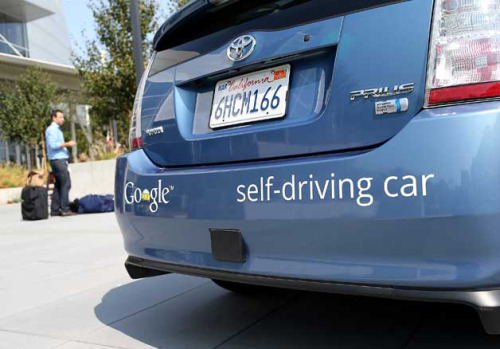
Perhaps the most credible threat for disrupting the auto industry is electric self-driving cars. According to a piece in The Economist, “An OECD study modelling the use of self-driving cars in Lisbon found that shared “taxibots” could reduce the number of cars needed by 80-90%… one extra car in a car-sharing service typically takes 9–13 cars off the road.” The huge reduction in the number of cars on the road promised by autonomous vehicles will surely be the undoing of the modern car industry. But still, the technology (and the road to legality) is quite a bit away from 2015.

I feel Frey’s views that driverless technology and ride-sharing will reduce the need for car ownership in the future is spot-on; however, his timeframe seems a little off. he new technologies are too far out yet to say cars have peaked today. Ride-sharing and the distant promise of driverless technology is not affecting today’s demand for cars in any meaningful way—Mills is wise in blaming the temporary decline to millennials’ lack of access to jobs and money. When future technology actually catches up with consumer demand, we will finally have reached “peak car.” I would say that we’re still at least five years out yet.

Ride-sharing’s impact will only snowball over the next five years. I imagine ride-sharing programs will be available in many, many more cities by 2020 and perhaps there will be ideas we haven’t seen yet born from the tech industry for transportation. Self-driving cars have a lot of promise for slowing down the consumption of cars and are increasingly attracting investment, so I see no reason not to think people will start believing in them as a viable alternative to traditional driving in around five years. Companies such as Apple are shooting for 2019 for releasing self-driving electric cars, according to The Wall Street Journal, so seeing car-buying trends change in around 2020 seems like a reasonable prediction. Between ride-sharing and autonomous cars, the traditional auto industry is bound to slow down in the next five to ten years.

The Mormon Church Decides to Treat Gay Marriage as Rebellion on a Par with Polygamy

I had relatives on both sides of the struggle over whether to continue polygamy within Mormonism. My grandfather, Spencer Woolley Kimball, was the head of the Mormon Church from 1973-1985. One of his first cousins was Lorin Calvin Woolley, who said he had been set apart by the 3d President of the Mormon Church, John Taylor, to keep plural marriage alive if ever the Mormon Church had to distance itself from polygamy. Lorin died in 1934. J. Reuben Clark, the son of Mary Louisa Woolley Clark, was another cousin. In 1934, J. Reuben Clark was called to serve in the First Presidency of the Mormon Church (the top 3 leaders) until his death in 1961. J. Reuben Clark pushed for strict measures against those who wanted to continue plural marriage despite official Mormon Church policy to the contrary.

Mormon policies to root out polygamy have now been extended to cover gay marriage as well. Laurie Goldstein explains the new policy in the November 6, 2015 New York Times article “Mormon Church Bars Same-Sex Couples and Their Children”:

Children of same-sex couples will not be able to join the Mormon Church until they turn 18 — and only if they move out of their parents’ homes, disavow all same-sex relationships and receive approval from the church’s top leadership as part of a new policy adopted by the Church of Jesus Christ of Latter-day Saints.

In addition, Mormons in same-sex marriages will be considered apostates and subject to excommunication, a more rigid approach than the church has taken in the past.

Also, incredibly, for gays, sex within marriage is effectively considered a worse sin than sex outside of marriage (which is a sin for all Mormons). As Laurie Goldstein explains it:

The handbook had already explained that a disciplinary council “may be necessary” for Mormons who engaged in “homosexual relations.” The new policy said a disciplinary council was “mandatory” for Mormons in “same-gender” marriages and “may be necessary” for same-sex couples who are cohabiting but not married.

My interpretation is that gay marriage is seen as rebellion–a challenge to the institution of the Church itself. Calling married Mormon gays “apostates” is consistent with that interpretation. 

This treatment of married Mormon gays is similar to the Mormon Church’s treatment of polygamists. I am not the only one to make that connection. Matt Canham, in his November 6, 2015 Salt Lake Tribune article “New Mormon policy on gay families is dividing even the faithful; church clarifies stance” quotes a former public relations employee of the Mormon Church, Stuart Reid as follows:

“These are the times when people in the church are confronted with the choice of being politically correct or being prophetically correct,” he said Friday. “In other words, they have to choose where they stand and what they are going to support going forward.”

Reid, a former Utah lawmaker, has been an outspoken opponent of same-sex marriage and any movement toward the faith’s acceptance of these now-legal unions. He supports LDS leaders equating gay marriage with apostasy, an offense triggering disciplinary hearings and possible excommunications, and sees it as a step toward consistency.

“They are treating this,” he said, “exactly like they are treating polygamist marriages and the children from polygamist marriages.”

As a nonsupernaturalist outsider to the Mormon Church, with much affection for the Church and its members given my Mormon past–including the gay members who will suffer pain because of this tightening of policy–let me freely give my own advice to Mormon Church leaders–or if God exists and speaks to Mormon Church leaders, let me plead with God as Abraham and Moses pleaded with God on many occasions.

Because plural marriage was so important in 19th century Mormonism, those who strove to continue plural marriage after the main Mormon Church based in Salt Lake City renounced it really were a serious challenge to the Mormon Church as an institution. Rooting out polygamists, while not pretty, may have been necessary for the Church institutionally given the lingering attraction of plural marriage to many Mormons who have been taught that it was God’s will in the 19th century and only discontinued because it was illegal. 

By contrast, gay marriage is not something likely to have any personal appeal or special theological attraction to non-gay members of the Mormon Church. Gay marriage is not a threat to the Church as an institution. Because the Mormon Church already distinguishes so carefully between marriage in a Mormon temple and civil marriage, the Mormon Church could simply say that gay marriage had no religious significance, and that the church would disregard any gay marriage as if it hadn’t happened. Of course, in practice, this would allow local bishops–at their discretion–to treat sex within a gay civil marriage more leniently than sex outside of any marriage.  

There is one other issue I need to address. To have enough vigor to attract new converts and grow fast, a religion needs some sacrifice or stigma to set apart those within the religion from those outside. So if not hardcore opposition to gay marriage, what can the sacrifice be (beyond avoidance of alcohol and coffee and volunteer church service) to create a big difference between Mormons and non-Mormons? Sadly, the answer is easy: a reemphasis on strict and full honesty in all one’s speech and actions can set Mormons apart. 

Such a reemphasis on full and complete honesty by the Mormon Church could fulfill the prophecy that Mormon elders will save the Constitution of the United States when it is hanging by a thread (see 1 and 2). I worry that the fabric of our republic is being frayed by those who twist facts for partisan advantage of one kind or another. If no one can be trusted to tell the truth, how can we make things work? Mormons wouldn’t be the only ones who would tell the truth, but things may come to such a pass that if the Mormon Church reemphasizes total and full honesty in all circumstances, Mormons might at some point represent a shockingly high fraction of those who can be trusted to tell the truth, regardless of partisan advantage or disadvantage.

Mehul Gaur: India Should Follow Guatemala’s Lead in Getting International Help to Fight Corruption

I am delighted to host another student guest post, this time by Mehul Gaur. This is the 11th student guest post of this semester. You can see all the student guest posts from my “Monetary and Financial Theory” class at this link. This is the second student guest post by Mehul. His first was “Bernie Sanders’s Financial Transactions Tax is a Bad Idea.”


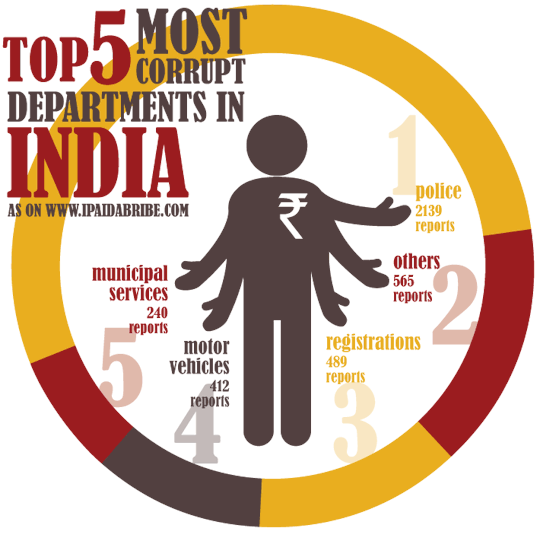
One of my parents’ favorite pastimes is to sit around and discuss how to fix the widespread (to say the least) corruption problem in India. They begin by discussing some recent corruption-related news story and invariably conclude that is impossible to solve because of how much corruption is integrated with daily life. The problem is so endemic in India that a study in 2013 by Transparency International found that 62% of Indian households reported paying a bribe to the police and 36% reported paying a bribe to the judiciary in the last 12 months. How can one expect a country to clean up its corruption, if the primary means of enforcement can be bought? Some might say that the change can be initiated by the top government officials, but political parties are considered the most corrupt organizations in India with 86% of respondents to the 2013 Transparency International study saying that political parties are corrupt/extremely corrupt. It’s a real issue and one that has recently come into the spotlight because of the slowing Indian economy. Much like my parents, I always thought that there was no solution, with the exception of total revolution.

This all changed when I read a recent Wall Street Journal article regarding Guatemala’s efforts against corruption. 8 years ago, the government of Guatemala gave a UN-sponsored organization powers to launch criminal investigations, few believed it would be successful. Now, this organization has provided key evidence to put the president of the country, Otto Perez Molina, behind bars.

I believe India can follow Guatemala’s lead and implement a similar system to help cleanse itself of corruption. By introducing a third-party, India will be able to circumvent its corrupt police force and its corrupt judiciary system. Obviously, there are some major issues with this idea. First and foremost, if the government is actually as corrupt as it is believed to be, then they will not support the creation of this agency. That being said, I believe that there is enough public outcry against corruption that it would be political suicide to oppose such an agency. Next, there is the issue of how to prevent the agency from becoming corrupt. This is where the real genius behind Guatemala’s agency lies. Guatemala’s agency has experience staff that comes from different countries around the world. This makes influencing/corrupting them very difficult, as they have no ties to the country they are fighting corruption. Without this very important trait, the agency essentially is no different from the existing police or judiciary. Another potential issue that needs to be addressed is to not grant this third-party agency too much power. Although it should hold enough power to prosecute members of the government, it should not begin to replace the government. I believe the solution is to continuously evaluate the state of corruption in the country and increase/reduce the agency’s power accordingly. By having an agency that has no ties and is truly intent on solving the corruption issue, India can remove the massive capital outflows that occur as a result and develop with a much stronger economy.

Anand Jetha: Diamonds are Not Your Best Friend

I am delighted to host another student guest post, this time by Anand Jetha. This is the 10th student guest post of this semester. You can see all the student guest posts from my “Monetary and Financial Theory” class at this link. This is the second student guest post by Anand. His first was “Slow Progress in Battery Technology Will Hold Back Electric Cars.”


Many may know of the company De Beers as one of the cornerstones of fine jewelry. They are the leader when it comes to mining and selling diamonds to the world. What you may not have known is that they are the reason people will pay thousands of dollars for a nice diamond wedding ring instead of the hundreds or even tens of dollars you should be paying. How can the price be so inflated? It starts with the fact that De Beers in the early 1900s controlled an almost perfect monopoly of diamond mine production in the world. They single-handedly created a multi-billion dollar industry by finding a way to control both the demand and supply of the then nonexistent diamond market.

Let’s talk about the demand side first. De Beers started a massive advertising campaign with the advertising agency N. W. Ayer in the early 1900s. They wanted to convince the world that diamonds were the only things that could be put on a wedding ring. They ousted every other gem that was being used at the time, including rubies and emeralds, and convinced the world that the “diamond is forever.” They staged diamonds in movies, by giving them to celebrities, and even through songs. The ad agency and De Beers masterfully created diamond demand out of nothing. The advertising is why today it would ludicrous to think about a wedding ring without a diamond since they are the symbol of love and marriage.

The supply side is what’s keeping the price currently from falling. A common misconception is that diamonds are rare and the reason that the price remains high. Actually, of all the gems on Earth, diamonds are the most common and they can even be created in laboratories. However, De Beers’s early and sustained control of over 80% of diamond production allowed them to effectively depress supply.  The company constantly mines and searches for rough diamonds across the world as they are currently doing in Kalahari Desert of Botswana. But they do not release the diamonds. All those diamonds, mined or purchased from others, are kept in vaults. They try to collect as many as possible so the company can control the supply at any given moment. They release just enough diamonds to match the growth in demand (marriages) across the world so they can maintain their artificially high price.

It’s very hard to tell if the bubble will ever pop. Some evidence says that since De Beers is losing market share in new yearly production, the market will start to fill with diamonds and pop the bubble. Because of its vast hoard of diamonds, the sky is the limit if De Beers wanted to increase diamond supply. But its ability to limit diamond supply is compromised if there are other suppliers who want to sell as many as possible while the prices are high. So there is hope that change might be coming to the diamond market. 

Update: On Miles’s Facebook page, Robert Flood makes this point: 

Diamonds are more an example of a very well run monopoly than a bubble. If you like this stuff, gold, which is not a monopoly, is much more puzzling: http://papers.ssrn.com/sol3/papers.cfm?abstract_id=2166636 (Btw, wedding rings are usually just gold, no stones. Engagement rings are the ones with the diamond(s).)

Woo Chul Ro: Affirmative Action by US Colleges is Troubling, But Still a Net Plus for Social Justice

Link to Woo Chul Ro’s LinkedIn homepage

I am delighted to host another student guest post, this time by Woo Chul Ro. This is the 9th student guest post of this semester. You can see all the student guest posts from my “Monetary and Financial Theory” class at this link.


Affirmative action in the US colleges is inefficient to the economy and yet necessary for economic equality and social justice.

What is justice? A famous Korean law professor once told me “justice is something one cannot justify.” I was reminded of this saying after reading the article from the Economist called The Model Minority is Losing Patience. The article argues that Asian Americans are the most successful and hard working minority, but they are also the most discriminated in academia. As an example, an Asian American student from California is introduced. Being second in his class of over 1000, having perfect ACT scores, singing in President Obama’s inauguration, getting into third place in the national piano contest, being in the national debate finals multiple times was not good enough for him to get accepted into six of the seven ivy league schools he applied for. Many candidates, of a different race and much more under qualified than himself, got into the schools that he could not get into. Because of this, around 60 candidates like the student from California (Asian American & qualified) got together to sue Harvard for racial discrimination. The charge was denied by the Department of Education. Harvard practices affirmative action, and therefore the charge against them is invalid.

At first, as an Asian American myself, I definitely considered this an injustice to my ethnicity and inefficient to the economy. Through affirmative action, many Asian Americans are losing the opportunities they might have had if they were a different race. However, if they were a different race, would they have had the same opportunities? The article states that Asian Americans are the most “successful” race. As a matter of fact, Asian Americans have the highest average wage among any other category of race. This means that many Asian Americans were probably raised in a decent socioeconomic environment, where education is not scarce. And then there is the cultural side. Most Asian American parenting is considered to be much different from other races. Asian American parents tend to prioritize education more, and they also train their children to work very hard. As an Asian American, a lot of children are taught to work harder for education, and a lot of Asian American families are thought to invest more of their income on the children’s education.

So is this an unforgivable injustice? It definitely is discrimination; this is probably why affirmative action is also termed “positive discrimination.” In the Wall Street Journal article Poverty or Prosperity – Different Paths After College, the article shows a study of colleges in New York, which suggests that wages after colleges are indeed predictable through the college one attends. Although causality is hard to fully demonstrate, this suggests that prestigious colleges give students a return for their investment of time and money. Assuming this statement is true, it means that the rate of return on their investment in education before college for Asian Americans is indeed hurt by their greater difficulty in getting into prestigious colleges. But the high wages of Asian Americans suggest that they are still doing well despite that handicap. 

Could it be that the return to attending a prestigious college is greater for those who were initially disadvantaged?  A study by Stacy Dale and Alan Krueger suggested that the answer is yes: conditional on where students applied, there is little evidence that attending a prestigious college had high returns unless a student was initially disadvantaged. If this true, then affirmative action in college admissions would benefit those initially disadvantaged more than it hurt Asian Americans and raise social welfare. Some policies for welfare can be considered injustice, but it may be injustice for a larger justice.

Update: On Miles’s Facebook page, Robert Flood recommends this Journal of Economic Perspectives article on affirmative action:

Mario Draghi on Negative Interest Rates and Other Policy Tools—October 31, 2015 Interview by Alessandro Merli and Roberto Napoletano

Link to Wikipedia article on Mario Draghi

Mario Draghi gave a remarkable interview on October 31, 2015, labeled on an official webpage of the European Central Bank as “Interview with Il Sole 24 OreInterview with Mario Draghi, President of the ECB, conducted by Alessandro Merli and Roberto Napoletano.” I am grateful to Mike Bird and JP Koning for alerting me on Twitter to the importance of this interview.

To emphasize the points Mario Draghi is making about the role of various policy tools going forward, I have organized under my own headings what I consider the passages from the interview that I consider most important in their application to the future and to other central banks as well as the ECB. Mario Draghi has been head of the European Central Bank during a crucial period of time; I omit the parts of the interview focused primarily on reviewing that history, and focusing on the eurozone-specific issues.

To preview what is below, I include the Q&A about quantitative easing primarily as context. In the discussion of negative interest rates, Mario Draghi’s statement that 

  • The lower bound of the interest rate on deposits is a technical constraint and, as such, may be changed in line with circumstances. 

is especially important. Compare this to the exact words of the statement I have urged central bank officials to make: 

From a technical point of view, we know how to eliminate the zero lower bound. 

On the truth of that statement, see my IMF Working Paper with Ruchir Agarwal, “Breaking Through the Zero Lower Bound,” which came out on October 23, 2015. (Also see my bibliographic post “How and Why to Eliminate the Zero Lower Bound: A Reader’s Guide.”)

Mario Draghi makes many other important points in the interview with which I am in strong agreement:

  • international monetary policy coordination is not essential; it is OK if each central bank takes care of its own jurisdiction
  • government investments are the safest type of fiscal policy, but good government investments can be hard to find
  • supply-side reform is important; appropriate stimulative monetary policy is helpful to supply-side reform or in some cases neutral for supply-side reform

Here are the parts of the interview focusing on these issues:

Quantitative Easing

Q: You have always said that this outcome depends on the full implementation of your monetary policy and you have added on a number of occasions that there is flexibility in your asset purchase programme in terms of its size, composition and duration. You have also said that the next meeting on 3 December 2015 is when you will “re-examine” these aspects. The financial markets read this date as being decision time for the ECB. Is this interpretation correct? Have you started to consider the relative merits of these three types of action, which could have different effects? Do you envisage using them simultaneously?

Mario Draghi: If we are convinced that our medium-term inflation target is at risk, we will take the necessary actions. In the meantime we are assessing whether the change in the underlying scenario is temporary or less so. Moreover, after the meeting in Malta, we asked all the relevant committees and ECB staff to prepare analyses of the relative effectiveness of the different options for the December meeting. We will decide on this basis. We will see whether a further stimulus is necessary. This is an open question. The programmes that we have put together are all characterised by their capacity to be used with the necessary flexibility.

Negative Interest Rates

Q: However, for the first time you mentioned a cut in the ECB’s bank deposit rate and you said that “things have changed” since you had stated that -0.20% was the minimum lower bound. Can you explain what has changed?

Mario Draghi: The circumstances informing the decision to reduce the bank deposit rate to its current level actually consisted of a macroeconomic framework that has since changed. The price of oil and the exchange rate have changed. I would say that the global economic situation has changed. The interest rate on deposits could be one of the instruments that we use again. Now we have one more year of experience in this area: we have seen that the money markets adapted in a completely calm and smooth way to the new interest rate that we set a year ago; other countries have lowered their rate to much more negative levels than ours. The lower bound of the interest rate on deposits is a technical constraint and, as such, may be changed in line with circumstances. The main test of a central bank’s credibility is – as I have said before – the ability to achieve its objectives; it has nothing to do with the instruments.

Q: So, you see cutting the bank deposit rate as an instrument that can be used at the same time as the amendments to QE?

Mario Draghi: I would say that it is too early to make that judgement.

Q: In Malta, you also said you had discussed “some other monetary policy instruments”. What did you have in mind?

Mario Draghi: It would be too early at this stage to restrict the menu of instruments that will be assessed by the relevant committees and ECB staff. The existing menu is nevertheless extensive – you only have to look at what has been done in the past three years. However, it is too early to say in any case that “this is the menu” and that “there is nothing to add”.

International Monetary Policy Coordination

Q: You spoke earlier about the global macroeconomic environment which is changing. The Vice Chairman of the Federal Reserve System, Stanley Fisher, said that the Fed today takes much greater account of international factors than it did up until a few years ago. Is this true of the ECB as well? And does the Fed’s delay in starting to raise rates influence in some way your decisions, considering that the exchange rate is not a policy target?

Mario Draghi: As I said, external circumstances, the assumptions underlying our forecasts, are important because they influence inflation expectations, and therefore the profile of the return towards price stability and of the growth rate. They form part of the set of information that we, like the other policy-makers, use to take our decisions. As far as the Fed is concerned, there’s no direct link between what we are doing and what they are doing. Both central banks have their mandate defined by the jurisdiction in which they operate, for them it’s the United States, for us it’s the euro area.

Fiscal Policy

Q: In Lima you said that high-debt countries had to prepare for the day when they suffer from the impact of higher yields. At the same time, these countries suffer but also from the fact that inflation is very low, making debt reduction complicated. Isn’t this an even more serious risk? In Europe an increase in yields is not imminent, while too low inflation is making itself felt.

Mario Draghi: Low inflation has two effects. The first one is negative because it makes debt reduction more difficult. The second one is positive because it lowers interest rates on the debt itself. The path on which fiscal policy has to move is narrow, but it’s the only one available: on the one hand ensuring debt sustainability and on the other maintaining growth. If interest rate savings are used for current spending the risk increases that the debt becomes unsustainable when interest rates go up. Ideally, the savings are instead spent on public investments whose rates of return permit repayment of the interest when it rises. Growth is maintained today and future public finances are not destabilised when rates go up.

Obviously it’s not simple because, as we know, there aren’t many public investments with a high rate of return.

Supply-Side Reform

Q: Precisely on the subject of fiscal policy, there’s a lot of discussion in Europe at the political level. You are one of the first to use the expression “fiscal compact” in the European debate. Do you think now, looking back, that the degree of budget restrictions in the euro area was too strong after the crisis, in other words that there has been excessive austerity which has held back the recovery in the euro area?

Mario Draghi: First of all, there are countries which don’t have the scope for fiscal expansion according to the rules which we have given ourselves. Secondly, where this is possible, fiscal expansion must be able to take place without harming the sustainability of the debt. The high-debt countries have less scope to do this. But the fiscal space is not a fact of nature, it can be expanded, even a high-debt country can do it. How? By making the structural reforms which push up potential output, the participation rate, productivity, all factors which substantially boost the potential for future tax revenues. Increasing revenues on a permanent basis expands the possibilities for repaying debt tomorrow and at the same time creates the conditions for fiscal expansion today. The structural reforms are not popular because they involve paying a price today for benefits tomorrow, but if the government’s commitment is real and the reforms are credible, the benefits are gained more quickly and they include fiscal space.

Stimulative Monetary Policy and Supply-Side Reform are Complements or Separable, Not Substitutes

Q: The ECB’s Governing Council stands ready to increase monetary stimulus, should this be necessary. Your critics claim that this reduces the incentive to implement reforms.

Mario Draghi: I think that this is wrong for a number of reasons. First, if we look at the time frame of the main structural reforms implemented in the euro area over the past five years, it shows that this has no correlation with the level of interest rates on government debt in the countries concerned. Labour market reforms, for example, were implemented in both Spain and Italy when interest rates were already very low, and the same is also true in other cases. Second, the structural reforms cover a very wide range of areas. I do not believe, for example, that reform of the legal system has anything to do with interest rate developments. Third, recent experience shows that also when interest rates are high because a country’s fiscal credibility is threatened, this does not increase governments’ propensity to carry out reforms.

Q: How do structural reforms correspond to low interest rates?

Mario Draghi: Structural reforms and low interest rates complement each other: carrying out structural reforms means paying a price now in order to obtain a benefit tomorrow; low interest rates substantially reduce the price that has to be paid today. There is, if anything, a relationship of complementarity. There are also other more specific reasons: low interest rates ensure that investment, the benefits from investment and from employment, materialise more quickly. Structural reforms reduce uncertainty regarding macroeconomic and microeconomic prospects. Therefore, it is the opposite, rather than seeing an increase in moral hazard, I see a relationship of complementarity, of incentive. But it should never get to the point of having to consolidate the government budget when market conditions have become hopeless. Experience over recent years has shown that, in these circumstances, governments often make mistakes in designing economic policies, dramatically hike taxes and reduce public investment, without significantly reducing current spending, and postpone the structural reforms that require social consensus. In this way, they exacerbate the recessionary effects of the high interest rates and slow the fall of the debt-to-GDP ratio.

To conclude, in the euro area the markets do not typically influence the propensity of governments to carry out structural reforms; when this happens, because the governments have delayed the reforms for too long, and owing to the deterioration in the general conditions, the resulting economic policy action does not foster growth.

Steven Landsburg, Using Utilitarian Reasoning, Upholds the Right to Bear Children Against John Stuart Mill

Unlike the US Supreme Court and typical opinion on most rich countries, John Stuart Mill does not recognize bearing a child as within the sphere of personal liberty. He argues in paragraph 15 of On Liberty “Chapter V: Applications” that many other people are involved: the child itself, as well as everyone whose wage might be affected by having more people in the country: 

It is not in the matter of education only, that misplaced notions of liberty prevent moral obligations on the part of parents from being recognised, and legal obligations from being imposed, where there are the strongest grounds for the former always, and in many cases for the latter also. The fact itself, of causing the existence of a human being, is one of the most responsible actions in the range of human life. To undertake this responsibility—to bestow a life which may be either a curse or a blessing—unless the being on whom it is to be bestowed will have at least the ordinary chances of a desirable existence, is a crime against that being. And in a country either over-peopled or threatened with being so, to produce children, beyond a very small number, with the effect of reducing the reward of labour by their competition, is a serious offence against all who live by the remuneration of their labour. The laws which, in many countries on the Continent, forbid marriage unless the parties can show that they have the means of supporting a family, do not exceed the legitimate powers of the State: and whether such laws be expedient or not (a question mainly dependent on local circumstances and feelings), they are not objectionable as violations of liberty. Such laws are interferences of the State to prohibit a mischievous act—an act injurious to others, which ought to be a subject of reprobation, and social stigma, even when it is not deemed expedient to superadd legal punishment. Yet the current ideas of liberty, which bend so easily to real infringements of the freedom of the individual in things which concern only himself, would repel the attempt to put any restraint upon his inclinations when the consequence of their indulgence is a life or lives of wretchedness and depravity to the offspring, with manifold evils to those sufficiently within reach to be in any way affected by their actions. When we compare the strange respect of mankind for liberty, with their strange want of respect for it, we might imagine that a man had an indispensable right to do harm to others, and no right at all to please himself without giving pain to any one.

Taken at his word, John Stuart Mill seems to give moral support to the cruel one-child policy that China has just abandoned in favor of a looser, but still heavy-handed two-child policy

I think John Stuart Mill is quite wrong for reasons that Steven Landsburg explains best. In his book More Sex is Safer Sex: The Unconventional Wisdom of Economics, Steven writes:

The reason you are wealthier than your grandparents, and the reason your grandchildren will be wealthier than you, is that each generation free-rides on the inventiveness of its ancestors. A generation ago, your parents were free to choose among three television channels, probably broadcasting in black and white, showing programs that could not be taped for later viewing. They used electric typewriters, of which the latest models featured a marvelous innovation: a “delete” key that enabled you automatically to erase the last character you had typed. If you wanted to erase the character before that one you were out of luck.

For many of the comforts we enjoy today, we can be grateful to the inventors of cable television, video recorders, and the personal computer–and to the stroke of good fortune that prevented their parents from joining Zero Population Growth. 

The engine of prosperity is technological progress, and the engine of technological progress is people. The more people, the more ideas. The more ideas, the more we prosper. [pp. 25,26]

There are some big benefits of population growth. Most importantly, they’re spillover benefits: when I decided to have a child, you were a winner. To decide whether the earth is over- or under-populated, we’ll want to weigh those spillover benefits against any spillover costs we can think of. 

But first let’s acknowledge the benefits and costs that don’t spill over. The day my daughter was born, my family’s per capita income fell by one-third (because it was now shared among three people instead of two). Without offsetting benefits, that would have been one of the worst days of my life. Instead, it was the best. (Indeed, the economist Peter Bauer once observed that if per capita income were the only measure of human happiness, then the birth of a farm animal would be a blessing and the birth of a child would be a curse.)

Large as they are, these private (nonspillover) costs and benefits are quite irrelevant to the population issue, because people already have every incentive to account for them when they calibrate their family sizes. And they do. Family sizes are quite sensitive to changes in economic conditions. [p. 33]

Steven Landsburg goes on to show that (short of theft) resource usage is not a spillover cost, since those resources come from one’s own family or one’s own paid contributions to the world. Extra crowding is by and large not a spillover cost, since many places are not crowded, and people choose to live in cities because of the benefits of high density. Affecting prices (including any effects on wages) has countervailing spillovers–helping those for whom one direction of price change is beneficial and hurting those on the other side of those transactions–including those affected indirectly–say as customers of the firms that pay the workers.   

Indeed, in a rare lapse, when talking about children, John Stuart Mill forgets the point he made just a few paragraphs earlier in, in paragraph 3 of On Liberty “Chapter V: Applications”–a paragraph I discussed in “John Stuart Mill on Legitimate Ways to Hurt Other People”:

Whoever succeeds in an overcrowded profession, or in a competitive examination; whoever is preferred to another in any contest for an object which both desire, reaps benefit from the loss of others, from their wasted exertion and their disappointment. But it is, by common admission, better for the general interest of mankind, that persons should pursue their objects undeterred by this sort of consequences. In other words, society admits no right, either legal or moral, in the disappointed competitors, to immunity from this kind of suffering; and feels called on to interfere, only when means of success have been employed which it is contrary to the general interest to permit—namely, fraud or treachery, and force.

So overall, I think Steven Landsburg easily got the better of John Stuart Mill in this tussle.

Matt Ridley: Patent Reform is More Important for Technological Progress than Government Funding of Basic Science

Because we economists, too, feed at the trough of government-funded scientific research, it is important for us to make a special effort to seriously consider arguments that government funding of basic science is not socially optimal. Matt Ridley gives such an argument in his Wall Street Journal op-ed “The Myth of Basic Science,” based on his new book, The Evolution of Everything: How New Ideas Emerge. Let me quote four key passages from the his essay, then give my reaction. I can’t encompass all the ways in which Matt backs up his argument within a set of quotations of reasonable length here, so if you want to argue against Matt, you should read his whole article.

Matt Ridley:

1. Simultaneous discovery and invention mean that both patents and Nobel Prizes are fundamentally unfair things. And indeed, it is rare for a Nobel Prize not to leave in its wake a train of bitterly disappointed individuals with very good cause to be bitterly disappointed.

Patents and copyright laws grant too much credit and reward to individuals and imply that technology evolves by jerks. Recall that the original rationale for granting patents was not to reward inventors with monopoly profits but to encourage them to share their inventions. A certain amount of intellectual property law is plainly necessary to achieve this. But it has gone too far. Most patents are now as much about defending monopoly and deterring rivals as about sharing ideas. And that discourages innovation.

2. When you examine the history of innovation, you find, again and again, that scientific breakthroughs are the effect, not the cause, of technological change. It is no accident that astronomy blossomed in the wake of the age of exploration. The steam engine owed almost nothing to the science of thermodynamics, but the science of thermodynamics owed almost everything to the steam engine. The discovery of the structure of DNA depended heavily on X-ray crystallography of biological molecules, a technique developed in the wool industry to try to improve textiles.

Technological advances are driven by practical men who tinkered until they had better machines; abstract scientific rumination is the last thing they do.

3. In 2003, the Organization for Economic Cooperation and Development published a paper on the “sources of economic growth in OECD countries” between 1971 and 1998 and found, to its surprise, that whereas privately funded research and development stimulated economic growth, publicly funded research had no economic impact whatsoever. None. This earthshaking result has never been challenged or debunked. It is so inconvenient to the argument that science needs public funding that it is ignored.

4. … if the government spends money on the wrong kind of science, it tends to stop researchers from working on the right kind of science. …

… we can never know what discoveries were not made because government funding crowded out philanthropic and commercial funding, which might have had different priorities. In such an alternative world, it is highly unlikely that the great questions about life, the universe and the mind would have been neglected in favor of, say, how to clone rich people’s pets.

Miles: On patent reform, I am in agreement with Matt: current patent law and copyright law errs too far in the direction of giving monopolies that are longer-term than necessary to give adequate incentives for innovation and get in the way of progress in other ways. I address this on the copyright side in several posts:

On government support for basic scientific research, I think there is value to understanding the universe even aside from aiding technological progress, and our understanding of the universe is a public good. If indeed it is true that privately funded research is more productive than publicly funded research, the government can still help by requiring high levels of charitable contributions from people–as I proposed in 

and discussed further in 

Finally, with a clear warning that self-interest could be distorting my views here, I think a good argument can be made that social science research directed at policy-relevant questions will often be underprovided by the private market because it isn’t valuable for making money by those who discover it (that is, it is relatively hard to monetize) but only useful from improving the quality of public policy and literally or figuratively enriching many people a little bit. Of course, there is a real danger of having only the government fund policy-relevant research, because then research on what the government is doing badly wrong is likely to be underprovided. So it is important for private individuals and foundations of a wide variety of ideological stripes to fund social science research.    

Update: Many letters came in to the Wall Street Journal from very smart people disputing Matt Ridley’s contention, collected under the heading “Fundamental Science and Useful Applications.” Among other things, these arguments point out why many empirical approaches would fail to detect all the contributions of basic science. Of course, the issue is whether the subsidization of basic science is important. Other arguments are relevant to that. Here are some of the key points:

  • Len Fisher and Ibo van de Poel: Without the very abstract general theory of relativity, your GPS navigation system wouldn’t work. Without the abstract ideas of quantum mechanics, we wouldn’t have lasers and CD players. And without a basic understanding of the structure of the DNA molecule, we would have no chance of tackling many genetically based diseases.
  • Leon Cooper: It would have been difficult to predict that the investigations of Maxwell, Lorentz and Einstein in electromagnetic theory would lead to improvements in communications. Few would have expected that Schrödinger and Heisenberg’s quantum mechanics would lead to the transistor and computers, that Townes’s work on millimeter radiation would give us laser surgery. Premature targeted programs to obtain these technologies would have failed.
  • Standish M. Fleming: I have worked in venture capital for the past 29 years, primarily in the life sciences. Venture capital, biopharmaceutical and other high-tech industries cluster about major research centers because basic science drives innovation. Venture capitalists literally “walk the halls” of major research institutes in search of breakthroughs, embodied in patents and published papers, around which to build companies. Government financing supports those centers.
  • Bob Ward: Matt Ridley neglects to mention that in many advanced economies it is government funding for postgraduate students that ensures successive generations of highly skilled scientists for both the public and private sectors.
  • Val Dusek: One major exception to the lack of corporate funding of truly pure scientific research whose payoff, if any, lay many decades in the future is Bell Labs. [I think Val Dusek’s point is that Bell Labs was government-like support of basic research.]

Jong Beom Park-The $28 Trillion Per Year Woman: Benefits of Full Participation of Women in the World Economy

Link to Jong Beom Park’s Facebook homepage

I am delighted to host another student guest post, this time by Jong Beom Park. This is the 8th student guest post of this semester. You can see all the student guest posts from my “Monetary and Financial Theory” class at this link.


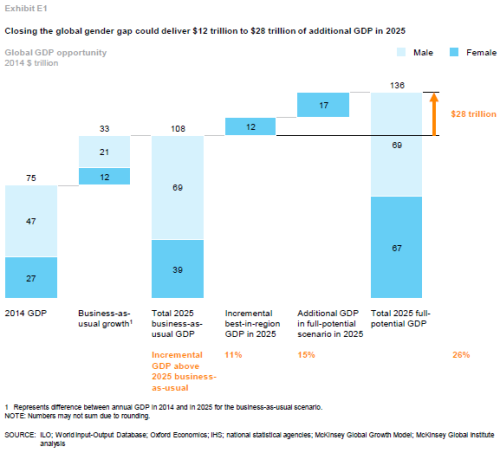
Gender inequality is most often thought more of as a social phenomenon. However, The McKinsey Global Institute, in its September report, has conducted a gender equality assumption study in which a mouth-dropping number was concluded as the potential economic implications of gender inequality: by promoting and achieving gender equality, global GDP could potentially increase by $28 trillion in 2025. It turns out that the economic loss, arising from gender inequality, is enormous.

Here is a figure taken from the McKinsey’s full report:

The research selected women in 95 countries, which together account for 37 percent of global GDP, for this analysis. The last category of the figure above, full-potential GDP, is a prediction that assumes work participation, in terms of labor-force participation rate, of men and women in chosen countries as equal. First, the study looks at the “best-in-region” scenario, which assumes that all countries achieve the same level of gender parity as best-performing countries in their respective continents. For example, India, one of the poorest performing countries in terms of gender equality, is performing well below its fellow countries in South Asia, and this scenario assumes that India is at the same level as other South Asian countries. And then, other potential GDP measures were calculated, taking economic drivers, such as gender wage gap and work hours, into account. Adding all these numbers results in an enormous increase, $28 trillion, in potential GDP by 2025.

So, how exactly was $28 trillion calculated? In this number, all unwaged work, such as housework, and lower-waged work taken by women were replaced by higher-wage work to be equal to those of men, thereby boosting the potential GDP. This means that women working in unpaid jobs, which is more prevalent in developing economies, were included in calculating labor participation rate until the figure was identical for men and women. In order to calculate the economic costs of gender inequality, McKinsey has created its own Gender Parity Score (GPS) of over 90% of men and women around the world and compared which region or country performed well in relative to others (the strongest scoring region is North America and Oceania at 0.74). It is clearly stated in the study that rich economies, though far from perfect, performed significantly better than developing and poor economies, which can then be concluded as the presence of a strong correlation between gender equality and economic performance. And then, calculating the productions from newly-assumed jobs taken by women in the study, new potential GDP was forecasted, resulting in $28 trillion at full potential and $12 trillion in the “best-in-region” scenario.

On contrary to the result that strong economies show relatively more gender equality, South Korea is an example of an advanced country with deeply-rooted gender discrimination (scoring 0.65 on GPS). Here are some statistics: in the World Economic Forum’s gender gap index, an index measuring gender equality, the 14th largest economy in the world, South Korea is ranked 117th with only 53% of South Korean women currently in the active workforce. South Korea is also rated poorly in other figures, such as gender wage gap. The situation is certainly improving with new measures, such as guaranteeing longer maternity leave. A larger population of highly educated women also contributes to less gender discrimination. South Korea has had a long journey, from the ashes of the Korean War to a today’s high-income developed country. But, with further measures towards gender equality, according to the McKinsey report, could lead South Korea to another “Miracle on the Han River.”

Going back to the McKinsey report, McKinsey offers several measures that can be initiated to improve this global problem, such as favorable laws and financial support. Personally, I believe that the roles of new businesses are extremely important. Gender equality might not be achieved in a short time in businesses that have long history and deep-rooted corporate culture. However, newly-formed firms have opportunities to start anew with gender equality. As more newly-formed businesses, with fair mindsets, enter the market, I believe, it could ultimately lead to a society with no or little gender discrimination.

Maybe, it is time that we start taking gender inequality issues seriously as a remedy for the ailing global economy.