Ezra Klein: This is my best advice to young journalists

I found this fascinating. It sounds like great advice to me. Here is one interesting example: 

Don’t just write for your editor. … In particular, your editor will often want something “new.” That is to say, they will want something that they, a highly educated hyper-consumer of news products, hasn’t seen before. … Sometimes, your editor will say that your outlet, or some other outlet, ran that story last June. But your reader likely did not read that story, and if they did read it, they don’t remember it. 

Jordan Anderson: Fixing the Tech Gender Disparity

Link to Jordan Anderson’s LinkedIn Page

Jordan has been a student in my “Monetary and Financial Theory” class this past semester. Here he addresses the issue of gender-bias in tech. This is the 19th student guest post from the semester. You can see the rest here.


The socially constructed archetype of the technology industry employee needs to be dissolved, along with the removal of the stigma surrounding women in the technology industry, in order for the gender disparity to be eliminated.

There are two objectives that I am going to be focusing on with this blog post. First, I am going to try to discover the root of gender discrimination in the technology sector. Second, I am going to try to develop a solution to the problem, and if that is not possible at least figure out how to move the industry in the right direction.

There is a deeply entrenched male culture in the technology sector. One of the theories that I stumbled upon to explain the disparity in males holding tech jobs at technology companies (for example, at Google women only fill 17 percent of the software engineering, database analysis, and other technology based jobs) was described as the ‘Geek Bro Culture,’ which credits the disparity to traditionally nerdy activities, hobbies like comic books, video games, and the technology sector. This mentality encourages the treatment of women as sexual objects, regularly exposes them to inappropriate behavior, and causes them to miss out on promotions that they would have received if they were men. Since boys typically grow up playing computer games they would more likely be interested in computer games and technology causing them to dominate the technology industry. The proportion of males versus females that take the Advanced Placement Computer Science exam acts as further evidence that the gender problem in technology starts at an early age. Out of the 30,000 students that took the exam, less than 6,000 of these students were female. There seems to be a socially constructed persona of a technology industry employee, which is constantly reaffirmed in practice, primarily socially awkward white males who love computers. Women would then have to be constantly combating this culture, trying to demonstrate that although they do not fit this persona they are equally qualified to do this work.

Some people claim that the lack of promotions and job placement for women is warranted because men lead better and therefore do these jobs better. However, the statistics suggest the exact opposite really. Companies with the highest proportion of women board directors actually outperform those with the lowest proportion of women board directors. Economic reason would lead us to believe that this alone would be enough to change the tech industry. If companies want to succeed and outperform their counterparts in order to remain competitive, diversifying their workplace would one of the ways to do that. This alone does not seem to be enough to drive significant change, as the proportion of women in technological based roles at tech companies has been declining over the past 25 years according the U.S. Census.

So, what can be done regarding gender discrimination in the workplace?

One practice undertaken by Harvey Mudd College has been very successful thus far resulting in 40% of its computer science students being women. They split their introductory computer science course into three separate courses. The goal was not overwhelm students by having to compete against students who have been coding since elementary school, which are typically males. Making women feel more comfortable with technology and computer science when they are young seems to be a good approach to fixing the issue since gender disparity starts at an early age. This could remove the deeply entrenched idea in our society that technology and technology based work is more suited for men.

Another approach to the problem is Girls in Tech’s “Raise Awareness” campaign: companies work on practical measures to make the work environment more welcoming to women along with women learning how to effectively ask for a raise. The company could do this with negotiation workshops as well as other policy changes. One of the important aspects of this campaign is that companies that join the movement will be published on the campaign’s website and other media outlets. As more women are made aware that companies in the tech industry are trying to address the problem they would most likely feel more comfortable pursuing this industry, which I feel will help fix the gender gap.

18 Misconceptions about Eliminating the Zero Lower Bound

Update: Link to “21 Misconceptions about Eliminating the Zero Lower Bound” as revised for my November 2018 presentations at Harvard, Brown, MIT and Boston University

Yesterday I spoke on a panel about practical details of negative interest rates at an amazing conference in London entitled “Removing the Zero Lower Bound on Interest Rates,” sponsored by the Imperial College Business School, the Brevan Howard Centre for Financial Analysis, the Centre for Economic Policy Research (CEPR) and the Swiss National Bank.  

Today, I am giving one of several keynote speeches at the Bank of England’s Chief Economists’ Workshop, subtitled “The Future of Money.” It is entitled “18 Misconceptions about Eliminating the Zero Lower Bound (or Any Effective Lower Bound).” Here is the link to the Powerpoint file (in 16:9 aspect ratio). This presentation supplements, rather than replacing, my Powerpoint file “Breaking Through the Zero Lower Bound,” which you can see here, along with all of the places I have given it or the presentation above.

Let me also point you to my bibliographic post 

which has a full set of links to posts and columns I have written about negative interest rates, eliminating the zero lower bound, and electronic money.

Some of my more recent additions to work on eliminating the zero lower bound are 

The last three are based on interviews with the Zurich-based online magazine Finanz und Wirtschaft (which can be translated and Finance and Economics), and give many details about implementation.

Alexander Trentin: Negative Interest Rates and the Swan Song of Cash

The graphic above is a translation (in consultation with Miles Kimball) of the corresponding German language graphic in Alexander Trentin’s original article, in Finanz und Wirtschaft: “Negativzinsen und der Abgesang auf das Bargeld.” Used by pe…

The graphic above is a translation (in consultation with Miles Kimball) of the corresponding German language graphic in Alexander Trentin’s original article, in Finanz und Wirtschaft: “Negativzinsen und der Abgesang auf das Bargeld.” Used by permission.

I am grateful for permission to publish this translation of Alexander Trentin’s companion article to his interview of me, along with Sandro Rosa:

I translated with the help of Google Translate, my college German, and my knowledge of the subject matter. I have also translated two other articles in which Alexander discusses my proposal for eliminating the zero lower bound:


When interest rates in general are negative, paper money becomes a high-rate safe asset. This hinders Swiss monetary policy. An exchange rate between cash and money in bank accounts can help. 

In the strange new world of negative interest rates, Swiss savers have to wonder if they are ultimately going to face negative interest rates on their personal bank accounts, even though so far, Swiss banks are cross-subsidizing regular bank accounts   with revenue from high mortgage rates.

As soon as someone sees his or her account balance fall because of a negative interest rate applied to a regular bank account, paper currency will begin to look very interesting as an investment. Among safe, liquid assets, franc notes earning an interest rate of zero would be the high-yield alternative.

If investors flee from bank accounts into paper money, the monetary policy objectives of the Swiss National Bank will be defeated. The SNB wants negative interest rates to make francs unattractive and therefore to weaken the Swiss franc against the euro. But if negative interest rates for individual investors are pushed down far enough, storing massive amounts of paper currency to circumvent negative interest rates could be made into a profitable business. 

Storage Costs and the Effective Lower Bound on Interest Rates

Nobel laureate economist Paul Krugman argues that negative interest rates can’t go any deeper than is allowed by the “the storage cost of cash.” According to Paul Krugman, there is an effective lower bound on interest rates slightly below zero. University of Michigan Professor Miles Kimball sees no effective lower bound on interest rates. His idea is to extend negative interest rates to cash. He has argued for some time now for resolute action through deep negative interest rates to fight recessions (which might also involve some exchange rate depreciation).  

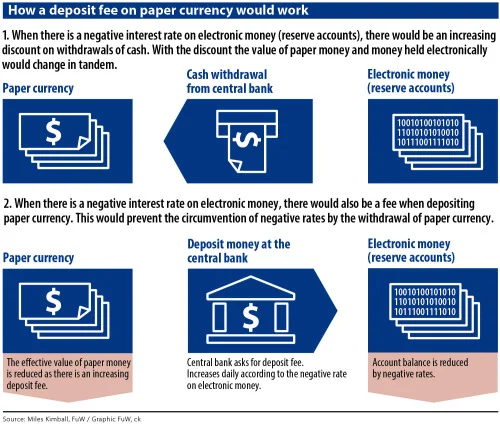
According to Kimball, the best way to implement a negative interest rate on cash is through a gradually increasing paper currency deposit fee at the cash window of the central bank, where private banks come to turn their cash into funds in the accounts that they hold at the central bank (called “reserve accounts” at the Fed and “sight accounts” at the Swiss National Bank). The private bank would owe a fee when it deposited its cash into its account at the central bank. The fee would need to gradually increase in order to generate a negative interest rate on paper currency. For example, to generate a -2% interest rate on paper currency, the paper currency deposit fee would need to rise at a rate of 2% per year. This fee would reduce the value of cash relative to the value of money in the bank (“electronic money”). In the accompanying interview, Kimball compares the implications of this fee to an exchange rate. 

The graphic at the top shows more details of how Kimball’s proposal would work. 

Last year Miles Kimball visited the Swiss National Bank to present a seminar about his idea. Kimball is now “hopeful” that in Switzerland or Sweden, the deposit fee will be implemented quickly. He emphasizes that it would be possible to introduce such a deposit fee "tomorrow”–and thereby gain leeway to lower key interest rates further. For the Swiss National Bank, SNB such an interest rate adjustment would be an effective way to finally weaken the franc.

Because cash is an obstacle to monetary policy, many economists would see it as progress to make electronic money the unit of account and the sole legal tender. The transition from a paper money standard to an electronic money standard would be similar to the transition from the gold standard to a paper standard. With electronic money as the unit of account and cash taken off of its pedestal, the implementation of negative interest rates would no longer be a problem–numbers in the computer can be revised downward as needed, and cash can be handled by changing its value relative to electronic money as discussed above. But cash need not be abolished–and maybe shouldn’t be. Some people like cash. And William Buiter, chief economist of Citigroup points to the value of cash in protecting privacy. And those who don’t have bank accounts would be disadvantaged by the total abolition of cash.  

No Easy Alternatives to a Fee on Paper Currency

Whether the discussion about cash intensifies or goes in reverse depends

on whether central banks are forced to reduce interest rates further below zero. It is possible that the Swiss National Bank might aim for a further cut in interest rates rein in the overly strong franc.

In one study, Beat Siegenthaler, an analyst at UBS comes to the conclusion that going forward, the Swiss National Bank will probably leave interest rates unchanged this year. But forces tending to strengthen the Swiss franc could

lead to further interest rate cuts. Siegenthaler writes: “More negative interest rates would probably draw broader government involvement, since it would require a change in the law to allow the taxation of cash.” Without alternatives, this possibility can’t be ruled out of hand. 

For many Swiss, the idea that fees could ever be charged on cash in liberal Switzerland would have been unthinkable only a few years ago. But that is where the logic of current monetary policy ultimately points. In a time of negative interest rates, paper money with a safe return of zero is like a relic from another time.

Quartz #61—>However Low Interest Rates Might Go, the IRS Will Never Act Like a Bank

Link to the Column on Quartz

Here is the full text of my 61st Quartz column, coauthored with my brother Christian Kimball: “However low interest rates might go, the IRS will never act like a bank.” It is now brought home to supplysideliberal.com. It was first published on April 15, 2015. Links to all my other columns can be found here.

Chris has appeared before on supplysideliberal.com. For example, see

If you want to mirror the content of this post on another site, that is possible for a limited time if you read the legal notice at this link and include both a link to the original Quartz column and the following copyright notice:

© April 15, 2015: Christian Kimball and Miles Kimball, as first published on Quartz. Used by permission according to a temporary nonexclusive license expiring June 30, 2017. All rights reserved.


A revolution has come to Europe–the revolution of negative interest rates. 10-year Swiss government bonds now have a negative yield. Short-term funds kept at the Swiss National Bank now pay -.75%: that is, private banks have to pay .75% per year to the Swiss National Bank to tend their Swiss francs. Denmark now pays -.75% for short-term funds while Sweden is at -.25% and the Eurozone is at -.2%. How low can interest rates go?

Ben Bernanke has started a blog, now that (in his words) he is free from “being put under the microscope by Fed watchers.” In the first few posts, he got into a debate with Larry Summers about what it means that interest rates are so low. Paul Krugman joined in with his own post “Liquidity Traps, Local and Global.” These three—a former Fed Chairman, a brilliant former Treasury Secretary, and a prolific Nobel laureate New York Times columnist, and without question three of the most famous economists in the world—are unanimous in writing that interest rates cannot go much lower than where Europe is now. Ben Bernanke writes:

The Fed cannot reduce market (nominal) interest rates below zero, and consequently—assuming it maintains its current 2% target for inflation—cannot reduce real interest rates (the market interest rate less inflation) below -2%. (I’ll ignore here the possibility that monetary tools like quantitative easing or slightly negative official interest rates might allow the Fed to get the real rate a bit below -2%.)

Larry Summers similarly writes as if there were some law of nature preventing interest rates from falling very far below zero: “The most obvious answer is that short term interest rates can’t fall below zero (or some bound close to zero) and this inhibits full adjustment.” And Paul Krugman stipulates the same presumption in technical jargon, speaking of a “liquidity trap” and a “zero lower bound.”

Every one of them knows better.

Interest rates can go as low as needed

What prevents interest rates from falling much below zero is not an immutable law of nature but an artifact of the way we handle paper currency. If we change our paper currency policy, interest rates can go as low as needed to bring economic recovery after an adverse shock throws the economy into a serious recession. Under our current paper currency policy, paper currency earns an interest rate of zero. As long as that is the case, it is hard to get any lender to accept an interest rate much below zero. But having paper currency earn an interest rate of zero is a policy choice, not a law of nature. As long as the paper currency interest rate is lowered along with other interest rates, the only limit to how low interest rates can go is the economic expansion that low interest rates would stimulate—an expansion that would then raise interest rates by increasing the demand for loans.

The reason that Ben Bernanke, Larry Summers and Paul Krugman talk as if the paper currency policy is immutable is that economists have known for over a century how to make interest rates on paper currency, but no nation has yet implemented negative interest rates on paper currency. Thus, many economists have become discouraged, thinking that the policy will never be broken. Ben Bernanke, Larry Summer and Paul Krugman all have written at length about the damage that this zero lower bound on paper currency can cause—most recently in making recovery from the Great Recession such an agonizingly slow process. But they have given up too easily in accepting zero as a limit.

Other economists, now notably including Harvard economist Kenneth Rogoff (who has become famous in part for his now controversial work with Carmen Reinhart on the effects of national debt on growth) see an eventual victory over the zero lower bound when paper currency is entirely supplanted by credit cards, debit cards and other forms of electronic transactions.

What many don’t realize is that a plan due to Willem Buiter, Chief Economist of Citigroup (and foreshadowed by Robert Eisler in 1932) to generate negative interest rates on paper currency can be implemented in a matter of weeks rather than decades. Miles, on his blog and in presentations to central banks around the world, has explained the nuts and bolts of how to implement this plan. The key is to charge private banks a paper currency deposit fee when they bring paper currency to the cash window of the central bank (returning that fee at the current going rate when a bank takes paper currency back out). The fee needs to gradually increase during the time when interest rates are negative, but can gradually shrink back to zero when interest rates are positive again. During the period the fee is gradually increasing, this effectively gives a negative interest rate on paper currency to any bank or other financial firm that withdraws paper currency, stores it and then redeposits that cash.

Among the economists who take a paper currency deposit fee seriously as a way to break through the zero lower bound are many in central banks around the world. Of the many indications of this, one that we have permission to talk about publicly is that the Bank of England, which was the first to host Miles for a seminar on “Breaking Through the Zero Lower Bound” in May 2013, has invited him back to give a keynote speech on that topic to the Chief Economists’ Workshop on the future of money, on May 19.

Another important mark of how seriously economists are taking this possibility of a change in the current paper currency policy are the arguments by University of Chicago Finance Professor John Cochrane that a change in paper currency policy alone is not enough to allow deep negative interest rates, in his blog post “Cancel currency?” (followed up by “More Cash and Zero Bound.”)

Cochrane was inspired to blog on this topic by Rogoff’s discussion of the possibility of eliminating paper currency entirely. His discussion of the disadvantages of eliminating paper currency entirely is only directly relevant to that extreme proposal, but much of what he says about our current paper currency policy is also relevant to the policy of generating a negative interest rate on paper currency through a paper currency deposit fee that gradually changes over time.

Cochrane gives this list of ways to effectively earn an interest rate of zero even if paper currency, along with money in the bank is earning a negative interest rate. His examples are:

  • Prepay taxes. The IRS allows you to pay as much as you want now, against future taxes.
  • Gift cards. At a negative 10% rate, I can invest in about $10,000 of Peets’ coffee cards alone. There is now apparently a hot secondary market in gift cards, so large values and resale could take off.
  • Likewise, stored value cards, subway cards, stamps. Subway cards are anonymous so you could resell them.
  • Prepay bills. Send $10,000 to the gas company, electric company, phone company.
  • Prepay rent or mortgage payments.
  • Businesses: prepay suppliers and leases. Prepay wages, or at least pre-fund benefits that workers must stay employed to earn.

It’s not easy to get a guaranteed zero interest rate

Of this list, we take the first—prepaying taxes—very seriously; more on that below. But for all the rest, the counterargument to Cochrane is simple: although private firms are happy to offer a zero interest rate while interest rates in general are higher than zero, they would stop giving that kind of deal if interest rates in general were negative. They would have to carry the freight of the negative interest rate every time they let a customer put in a given dollar value of money now, to get back the same dollar value later. If they did give someone a zero interest rate when interest rates in general were negative, we predict it would typically be some sort of promotion to get people to do something else that added to the businesses’ bottom line. People who had already purchased gift cards, or had a contract that implicitly specified a zero interest rate before the business knew interest rates would turn negative would benefit from those favorable preexisting arrangements, but the businesses wouldn’t give them that deal again.

JP Koning is one of the best bloggers out there on the nature and workings of money. In his post “Does the Zero Lower Bound Exist Thanks to the Government’s Paper Currency Monopoly?” he argues along these lines, in effect, that the zero lower bound is a creation of government, because no other organization but government has both the deep pockets and the willingness to run a loss. JP also chimes in in the comment section of Cochrane’s post explaining why gold doesn’t provide a way to escape negative interest rates, and pointing out that business customs can adapt to new situations. He writes:

No, gold won’t allow a zero riskless nominal return. The moment negative rates are put into place the price of gold will spike to level at which it would be expected to decline at a rate equal to the negative interest rate. You’re still penalized.

I’m also underwhelmed by your claim that our legal and financial system deeply enshrines the right to pay early. It also enshrines the right for contracts to require people to pay penalties for early payment. Take for instance prepayment penalties on mortgages or auto loans. A ‘legal revolution’ as you refer to it isn’t required… the laws already exist.

What JP Koning says about gold is true for any asset that can change in price according to market pressures. The only reason that paper currency as it is handled now creates a zero lower bound floor under interest rates is because central banks currently guarantee that a paper dollar will stay at par relative to dollars in the bank. Take away or modify that guarantee through a paper currency deposit fee that changes over time, and interest rates can go as low as needed.

In general, the place to look for things that could put an effective floor under interest rates is the same place one would look for something that could put an effective floor under, say, milk prices: some kind of government guarantee. In Japan, for example, the post office acts as a bank, and a zero interest rate on funds in this government-run bank could act as a floor under interest rates.

The question that Cochrane raises is whether a tax authority like the IRS can be used if it were a government bank offering a zero interest rate on deposits.

The IRS is not a bank

In confronting the question of whether to IRS in particular can be used as if it were a government bank offering a zero interest rate, it helps to be a US tax lawyer used to dealing with complex tax questions, as Chris is. There are two key points:

  1. The tax code actually has several interest rates, including an overpayment rate, an underpayment rate, and zero. The non-zero rates are a function of Federal short-term borrowing rates and while it has never happened, there is no obvious reason that they could not be negative.
  2. The IRS is not a bank with in-and-out privileges. Paying taxes is easy. Getting money back is possible but complicated and uncertain as to time and interest rate.

Underpayment and overpayment rates are defined as the “Federal short-term rate” rounded plus an adjustment (3 percentage points in general, but more or less in specific circumstances, including 0.5 percentage point for large corporate overpayments and 5 percentage points for large corporate underpayments). The Federal short-term rate is determined month by month, and is defined by statute as:

[T]he rate determined by the Secretary based on the average market yield (during any 1-month period selected by the Secretary and ending in the calendar month in which the determination is made) on outstanding marketable obligations of the United States with remaining periods to maturity of 3 years or less.

Translated, this says that if the 3-month Treasury bill rate were negative, the Secretary of the Treasury could declare a negative Federal short-term rate. While an effective zero interest rate would apply to prepayments of taxes, overpayments of taxes could be returned after application of the overpayment rate—which could be negative. Alternatively, an overpayment might be characterized as a deposit. When a deposit is returned, it can be returned dollar for dollar, or with interest, depending on the circumstances. Although it is hard to predict what the IRS would do, in a negative interest rate environment it would be reasonable to expect the IRS to apply a negative interest rate to deposits related to disputed taxes, and to return other amounts quickly, effectively rejecting any deposit not related to a dispute.

In a negative interest rate environment, a taxpayer might want a zero interest rate through a dollar-for-dollar refund or return. The problem is that a taxpayer cannot confidently control how a prepayment or deposit is characterized, and cannot confidently control the timing of a refund or return. To the extent of an actual tax liability, or an actively disputed tax liability, and arguably even a near-term predictable tax liability, money sent to the IRS that is ultimately returned will probably be returned subject to the (possibly negative) overpayment rate. On the other hand, amounts in excess of tax liability (current, disputed, near-term predictable) don’t have an obvious category.

In a positive interest rate environment, taxpayers and the IRS may treat such amounts as zero-rated deposits (and so taxpayers generally are disinclined to make them). In a negative interest rate environment the IRS may simply reject such amounts as not having anything to do with taxes (and so taxpayers generally should be disinclined to make them).

The IRS also largely controls the timing of when a taxpayer gets the money from an overpayment or a deposit. The IRS could decide to return funds immediately upon request, or to return funds significantly later, and could make that decision differently depending on the applicable interest rate. In all this uncertainty, if the IRS takes a position that the taxpayer doesn’t like, e.g., that a negative rate applies, or that the remittance is rejected, or that a deposit will be returned immediately or will be delayed, there may be arguments in some particular cases that the IRS is wrong. However, that probably gets sorted out in court, in a case that could take years to resolve. If the negative interest rate situation only lasts a year or two, even a taxpayer victorious in court (something far from guaranteed) might not get the money back at a zero interest rate until interest rates had been positive again for long enough that a zero interest rate still wouldn’t be as good as what the taxpayer could have earned in the bank.

In short, the IRS is not bank. There are circumstances where money comes back from the IRS, but the effective interest rate might be positive or negative or zero, the taxpayer cannot strictly control or predict the interest rate, and the taxpayer cannot strictly control the timing of refund or repayment. The IRS would be a formidable adversary to someone trying to force it to be a bank when it didn’t want to be. This amount of uncertainty makes it very difficult to arbitrage interest rates against the government through the IRS.

The one concession that is clearly available in the tax law is that prepayment of taxes does have the effect of a zero interest rate. Formally, this may be as much as a one-year opportunity, but after taking account of payroll withholding and estimated tax payment requirements, the most a typical taxpayer could shift the timing of tax payments is only a quarter or two. Because that option is limited in quantity, and not available for unlimited arbitrage, it cannot put a floor under market interest rates. What it does do is provide a welcome shield against negative interest rates up to a reasonable amount of savings for people who are willing to save by paying their taxes early in the year.

We view this as a positive thing for the politics of negative interest rates; the option of prepaying taxes can help protect the diligent small-time savers who would be distressed by negative interest rates. Earlier payment of taxes in a recession combatted by negative interest rates would also partially smooth out the usual effect recessions have of temporarily worsening the government budget deficit.

As for long-term savers, they can always guard against the possibility of negative interest rates by buying long-term bonds that lock-in interest rates at current market levels, which at worst are currently only a little negative. And the monetary stimulus of negative interest rates is likely to soon bring even short-term interest rates back up once an economy is fully back on its feet.

Where do we go from here?

Right now, Europe is leading the charge toward lower interest rates. With the knowledge of how to prevent paper currency from putting a floor under interest rates in hand, there is no limit to how low their interest rates can go other than the self-limiting effect of low interest rates in spurring economic growth.

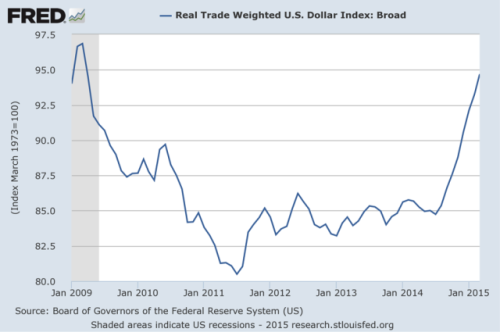
What about the US? Currently, the talk is all about when the Fed will raise interest rates above zero, not when it will go negative. But one thing could change that: the effect of Europe’s negative interest rates on value of the US dollar. The dollar has been appreciating in the last few months, as low interest rates in Europe encourage investors to send their funds to the US. The higher dollar is seen as one of the key things that slowed down the US economy in the first three months of this year by making it more expensive for people in other countries to buy US goods. If Europe pushes its interest rates further down, the Fed may need to do more than just delay when it raises interest rates—it may need to cut rates below zero to keep the US economy on an even keel.

Even if interest rates at the bank become negative, regular taxpayers may be able to keep a portion of their money from shrinking by prepaying fixed obligations, including taxes. But that won’t keep negative interest rates from prevailing in the economy generally, so long as the Fed changes its paper currency policy so that an effective negative interest rate on paper currency opens the way for the Fed to lower other rates (especially its target rate and the interest rate it pays banks).

The fact that the tax system does not allow unlimited interest-rate arbitrage to block negative interest rates across the board is a good thing: low and even negative interest rates and the stimulus they provide are one of the best defenses the US has against falling back into recession when we have so recently escaped the after-effects of the last recession.

How Increasing Retirement Saving Could Give America More Balanced Trade

Here is a link to my 62d column on Quartz, “The TPP would be great for America if Americans had been saving for retirement.”

“TPP” stands for the “Trans-Pacific Partnership,” the free trade deal currently very much in the news. The working title for this column was “Free Trade; Balanced Trade.” I tried to reflect that and to more accurately reflect my views in the title of this post. In taking the screen shot, I consciously cut off the kicker “Whoops” at the top of the column on Quartz, since I tend to think most free trade deals are a good idea in any case. But I think they would be a better deal if we had more balanced trade–something that is possible with a surprisingly simple and interesting policy change.

In the column, I write: 

Using back-of-the-envelope calculations based on the effects estimated in this research, they agreed that requiring all firms to automatically enroll all employees in a 401(k) with a default contribution rate of 8% could increase the national saving rate on the order of 2 or 3 percent of GDP.

Here is a rough idea of the kind of simple calculation that could back that claim up:

  • Suppose current 401(k)’s give only one-quarter or less of the amount of saving if everyone had an 8% contribution rate–partly because many people aren’t covered at all. Then if no one opted out, the new regulation would add 6% to saving as a fraction of labor income. Multiply that by 2/3 for labor’s share, that is 4% more of GDP if no one opted out. Then the opt-out assumption is that 25% to 50% of people opt out.

Alexander Trentin and Sandro Rosa Interview Miles Kimball: Clinging to Paper Money is Like Clinging to Gold

I am grateful to Alexander Trentin, Sandro Rosa, and Finanz und Wirtschaft (Zurich’s “Finance and Economy” online periodical) for permission to publish a translation of the corresponding article here. I translated with the help of Google Translate, my college German, the partial translation Finanz und Wirtschaft posted here, and my knowledge of the subject matter and what I had said in the interview. I posted two earlier articles by Alexander Trentin along with my reactions (and there is more coming):


Negative interest rates can only have their full effect when people can’t flee into paper money. Miles Kimball argues that the holding of paper currency can be discouraged by a time-varying paper currency deposit fee. 

Miles Kimball, an economist at the University of Michigan, is a pioneer on the issue of negative interest rates. He is fighting against the so-called Zero Lower Bound, the lower limit for interest rates near zero. On his blog, he argues that if interest rates fall deep enough into negative territory any recession would be quickly resolved. He estimates that after the financial crisis in 2008, the US economy would have made a robust recovery by the end of 2009 if the Fed had maintained interest rates at -4% throughout 2009.

He sees negative interest rates as a better tool than the purchase of trillions of dollars worth of long-term and mortgage-backed bonds that goes by the name of quantitative easing (QE). For one thing, he argues that economists understand the effect of negative interest rates better than they understand the effects of quantitative easing. The main obstacle to deep enough negative interest rates is cash, because that would continue to provide a zero interest rate. In order to make the holding of banknotes unattractive, he has urged the Swiss National Bank to contemplate a deposit fee for paper money.

Mr. Kimball, your idea is to introduce a fee for depositing paper currency during periods of time when bank accounts face negative interest rates. Withdrawing money would face no fee, but deposits would. This would discourage people from trying to circumvent negative interest rates through paper currency. Do you realize that some people would rebel at this idea?

It is all about how to present it. People don’t like the word fee. Since there is also a discount when withdrawing money it is analytically equivalent to an exchange rate between electronic money – money on reserve accounts – and paper money. I use the phrase “paper currency deposit fee” to indicate a possible basis for the legal authority of the central bank to create such an effective exchange rate. The fee would be de facto a tightly controlled crawling peg exchange rate policy.

Why do you prefer a deposit fee to a withdrawal fee for paper currency?

At every central bank I visit, I warn about a withdrawal fee. Having to pay an extra fee to get cash out of the bank would alarm people much more than a slowly increasing deposit fee.

If the central bank does not want to use paper money, couldn’t it just stop printing money?

That could be a fallback position, if that were the only legal authority a central bank had. Paper currency would become an exotic security with a zero interest rate. The price of bank notes would then run at a premium to electronic money, because of the scarcity of cash. There would a big jump in the price of paper currency, which would be quite disruptive to the economy. By contrast, the paper currency deposit fee starts at zero and increases only very gradually over time during the period when there is a negative interest rate. There would never be a big jump.

You propose to introduce electronic money as a legal tender instead of banknotes. In Switzerland, the Vollgeld movement rallies for a monetary reform in which electronic money would be created by the Swiss National Bank, rather than by commercial bank money creation at the moment of making a loan. It is similar to the idea of full-reserve banking. What is your opinion on this?

Anything that raises the prestige of electronic money–such as making electronic money legal tender–is helpful in making people comfortable with electronic money as the unit of account and putting paper money in a subsidiary role. To make electronic money legal tender, it is important to have accounts for which the central bank certifies that this money is really there. 

I don’t see a 100% reserve requirement as a problem. In the olden days, people worried that a higher reserve requirement would reduce the money supply. But we know how to deal with that: the central bank can just increase the amount of the monetary base through open market operations enough to cancel out any effects changes in the reserve requirement on the money supply. In any case, it is possible to have some accounts which are 100% covered by reserves. Fractional reserve banking is mainly a way to let commercial banks have some of the seignorage revenue that would otherwise go to the government through the central bank. 

Could electronic money be legal tender in the current world of fractional reserve banking?

Electronic money is all money that is just numbers in a computer. To make it legal tender might take some time. The important thing is that the Swiss National Bank could introduce the paper currency deposit fee I propose tomorrow. There is no reason to wait until we can do everything perfectly. If the Swiss economy is being hurt by overly high interest rates and a Franc that is too strong, then you should institute this fee tomorrow. This is what I advised the Swiss National Bank. I think they are seriously considering it. 

Wouldn’t a transition to electronic money and a fee on paper money cause people to lose faith in currency? 

They would know that the government can do whatever it wanted with their cash, devaluing it with a single keystroke.It matters how you explain it to people. I don’t think people would be that alarmed if you explained how gradual everything is. If the interest rate on bank deposits was -2% per year, the corresponding fall in the value of paper money each day would be tiny. It would take three months for the paper currency deposit fee to get as big as .5%. Moreover, retail shops would probably continue to accept paper currency at par for quite some time, they already pay a much bigger fee to credit card companies on credit and debit card transactions than the likely size of the paper currency deposit fee. The only exception would be in the case of a recession or secular stagnation so severe that deeper, more persistent negative interest rates were needed than what I believe would have been sufficient to cut short the Great Recession. 

But how would you deal with the strong emotional attachment to paper currency?

Our societies have been through this before. There was a strong attachment to gold and silver. We went off the gold standard; that was a big deal for people. It is worth remembering that making paper money legal tender was hugely controversial. This was done to raise the prestige of paper money vis-à-vis gold. In that longer historical perspective, paper money was only a way station towards electronic money. If you want to be very traditional, you can use gold; but that will mess up your economy even more than paper money. When people cling to paper money it is like clinging to gold.

In Switzerland and Germany the attachment to paper money seems to be especially strong. Wouldn’t that make your proposal especially controversial there?

It is precisely because of the feelings of the Germans that the Swiss National Bank needs to blaze the trail rather than the ECB. Once Switzerland does it–and I am hopeful also that Sweden might have that kind of courage–there is a huge benefit to other countries by showing the way. One advantage of having Switzerland lead the way is its sophisticated level of banking. There are many practical questions for commercial practices in a negative interest rate environment; Switzerland would be an excellent place to work out such details. Fpr example, in a positive interest rate environment you want people to pay you as soon as possible; in a negative rate environment, you want people to pay you slowly. If negative interest rates are used elsewhere, people around the world would take standard practice from what is done in Switzerland.

As you mentioned, commercial details of doing transactions in a negative interest rate environment would still need to be worked out. Isn’t there a point where there is a structural transformation of how the economy works after introducing deep negative rates?

The funny thing is that for economists it is not a big deal whether interest rates are positive or negative. In terms of real interest rates–that is, interest rates adjusted for inflation–we have had negative rates before. For the most part, negative real rates due to high inflation have the same effect as explicitly negative rates when inflation is zero. We understand the effects of negative rates much better than the effects of Quantitative Easing.  And as for the effects on business practices, firms have to adapt their business practices even when interest rates change within the positive range. Even with positive interest rates, investment decisions need to be made in a much different way when a quick payback is needed because of high interest rates than when a firm can afford to wait a long time for a payback because interest rates are low.

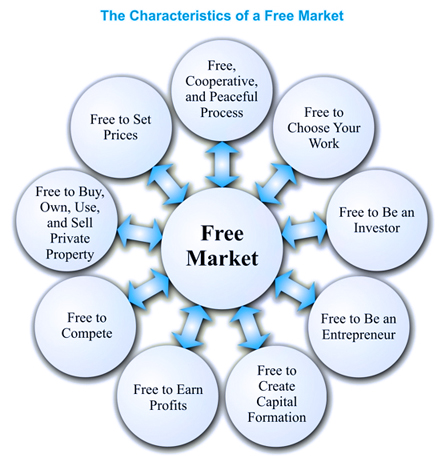
The Free Market and Collective Liberty

I was surprised to see how tepid John Stuart Mill was in championing the free market as a contribution to liberty. To understand the following passage from On Liberty “Chapter V: Applications,” paragraph 4, remember that according to 19th century custom, he used the phrase “free trade” to mean not just free international trade, but all of what we would call the free market. Indeed, in the justifiably replace the phrase “free trade” by “the free market” and the word “trade” in every other instance by “the market”:

Again, trade is a social act. Whoever undertakes to sell any description of goods to the public, does what affects the interest of other persons, and of society in general; and thus his conduct, in principle, comes within the jurisdiction of society: accordingly, it was once held to be the duty of governments, in all cases which were considered of importance, to fix prices, and regulate the processes of manufacture. But it is now recognised, though not till after a long struggle, that both the cheapness and the good quality of commodities are most effectually provided for by leaving the producers and sellers perfectly free, under the sole check of equal freedom to the buyers for supplying themselves elsewhere. This is the so-called doctrine of Free Trade, which rests on grounds different from, though equally solid with, the principle of individual liberty asserted in this Essay. Restrictions on trade, or on production for purposes of trade, are indeed restraints; and all restraint, quâ restraint, is an evil: but the restraints in question affect only that part of conduct which society is competent to restrain, and are wrong solely because they do not really produce the results which it is desired to produce by them. As the principle of individual liberty is not involved in the doctrine of Free Trade, so neither is it in most of the questions which arise respecting the limits of that doctrine; as for example, what amount of public control is admissible for the prevention of fraud by adulteration; how far sanitary precautions, or arrangements to protect workpeople employed in dangerous occupations, should be enforced on employers. Such questions involve considerations of liberty, only in so far as leaving people to themselves is always better, cæteris paribus, than controlling them: but that they may be legitimately controlled for these ends, is in principle undeniable. On the other hand, there are questions relating to interference with trade, which are essentially questions of liberty; such as the Maine Law, already touched upon; the prohibition of the importation of opium into China; the restriction of the sale of poisons; all cases, in short, where the object of the interference is to make it impossible or difficult to obtain a particular commodity. These interferences are objectionable, not as infringements on the liberty of the producer or seller, but on that of the buyer.

Whenever a market exchange is fully voluntary and well-informed on the part of all parties involved in the transaction, it seems to me an abridgment of the collective liberty of that group of people involved to interfere with that exchange. And I think this abridgment of liberty rises above the level of John Stuart Mill’s concession “all restraint, quâ restraint, is an evil.” In sexual matters we recognize the importance of the liberty of two people eager to engage in an activity together to be able to engage in that activity. Why should the liberty of two people eager to engage in a market transaction be any different?

Just as there is sometimes sufficient reason to limit an individual’s liberty in order to prevent that individual from harming someone else, there may sometimes be sufficient reason to interfere in a fully voluntary, well-informed market transaction (including other selves or time slices of the individuals involved viewed as a special case of “someone else”). But it makes no sense to me to deny that this is done at the cost of the collective liberty of the group of individuals who want to engage in a market transaction.

Let me go further and say that the collective liberty argument for economic freedom should often trump Federalism. The “interstate commerce” clause of the constitution has been used to justify a great deal of interference in the free market. A much more appropriate use of the interstate commerce clause would be federal laws limiting how much states can interfere in the free market. I have written many times and hosted many guest posts about the evil (and I choose that word carefully) of excessive licensing requirement:

I have heard many people say “But occupational licensing is a state issue–the federal government can’t do much about it.” The federal government can do many things with its interstate commerce power; stopping lobbyists at the state level from convincing state legislators to unduly restrict the free market is an excellent way to foster interstate commerce. 

Similarly, federal laws to restrain the use of rent control and to prevent undue limitations on residential construction could do a lot of good in ways that can legitimately be seen as fostering interstate commerce. When federalism or “states’ rights” and the most central free market principles come in conflict, I choose the free market. And in choosing the free market, I am choosing an important dimension of liberty. 

Israel Diego: Inflation Expectations of the Well-Educated and Not-So-Well-Educated


Israel Diego is a student in my “Monetary and Financial Theory” class. Here he reports on some interesting research he did. This is the 18th student guest post this semester. You can see the rest here.


Following up from a previous blog post, I made an effort to contrast Michigan’s survey of inflation expectations, the Survey of Professional Forecasters (SPF), and a RW no-change forecast, all forecasting one-year ahead, and I was unable to conclude beyond a reasonable doubt which forecast model would be the best for predicting inflation, however this post revisits this ideology by considering differing levels of income and education of the Michigan survey participants.

As we consider a consumer’s level of income and education, what should we expect to happen to their predictive power of inflation? Some intuition would tell us that as a consumer’s level of income rises, she may have a higher propensity to save relative to consumers with lower income, because she will have more excess funds at her disposal. Naturally, she may invest these funds, and hold a portfolio comprised of stocks, bonds, and other securities, in order to grow her nest egg for retirement, or set money aside to cushion against economic downturns. Thus it would be important for her to frequently keep track of the inflation rate, to make sure that her investment is not eroded by price increases.

blog.supplysideliberal.com tumblr_inline_nnfqyc8kYT1r57lmx_400.jpg

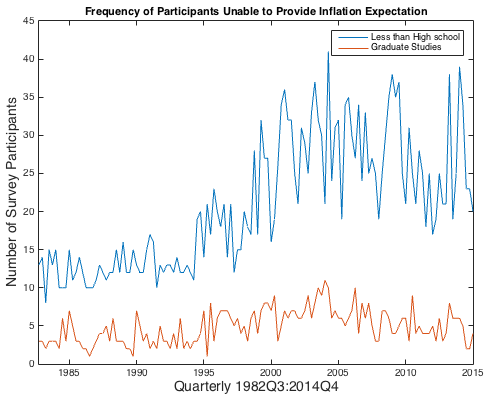
Given education, it is plausible that higher education on average leads to higher income for the consumer, so inflation expectations would improve based on the theory I motivated above. However we can also infer that more educated consumers are more likely to read the newspaper and be more informed about fluctuations in the inflation rate, a claim made by Christopher Carroll. Lastly it may be the case that less educated consumers fail to muster up an estimate for the inflation rate, relative to higher educated consumers, as uneducated consumers would rather not predict the inflation rate, for fear of embarrassingly overshooting the actual rate. To test this claim, we can sum up the number of survey participants according to their income group, from the Michigan Survey, who did not know what to say when asked about their inflation expectation. We see there is evidence that indeed people with lower education were not able to provide an answer more frequently than individuals with a graduate degree. This is looking at the far ends of the education spectrum, but the relationship holds nonetheless, as we increase education, people less frequently fail to give an answer for their inflation prediction. Interestingly it seems that consumers with less than a high school education know less, on average, about inflation now than they did back in the 80s.

My claims above would have no ‘oomph’ to them if I didn’t back them up with any evidence. So are we right in assuming that higher education and income lead to better inflation predictions? Intuitively yes, and I provide evidence that this is actually the case.

Let’s take different education and income subgroups, using the Michigan Survey one more time, and lets take the median inflation expectation at each quarter for each subgroup. I choose the median over mean expectations because, this measure is more robust against outliers in the data, and the differences between income and education subgroups are more stark when I use the mean. Finally lets compare each subgroup against one another and see how well they do in comparison at predicting the median-CPI in our experiment. (Reason for this specific inflation measure is explained on last week’s blog). I also use the same Diebold-Mariano test used on my previous post, to test for statistical significance of predictive superiority amongst subgroups. The time period I analyze is 1982-2014, because 1981Q3 is when the SPF began.

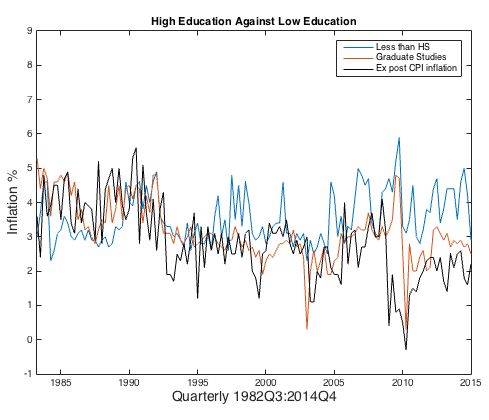
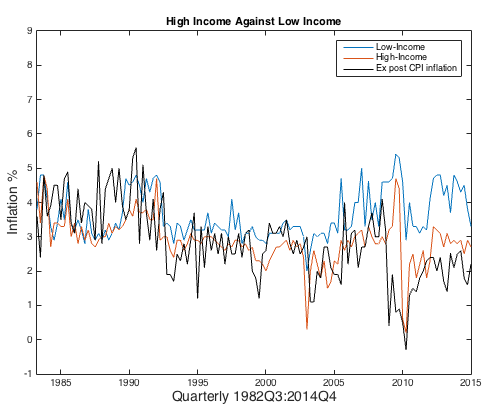
Here is a graph comparing graduate level education vs less than high school, and the top 25% income group against the bottom 25%. What we see is that higher education and income tend to move more closely with the Median-CPI. One thing to note is that inflation expectations for low education and income groups are higher  than their counterparts on average for most of the time period analyzed (1982-2014), which provides further intuition that lower educated and poorer consumers not only fail to predict the inflation better than their counter parts, but constantly over predict the rate.

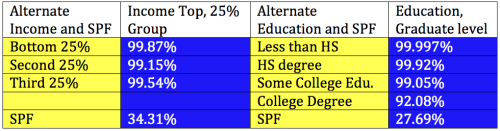
So let’s look at the results! Below I report values for income, as the probability that the highest income group performs better than the alternative income groups. Likewise for education, I display the probability that those with graduate level education do better than their counterparts. Finally we put the highest education and income groups against the SPF, and settle the forecasting battle once and for all. In all of the following results, we should interpret them as probabilities in repeated trials.

The above table demonstrates that survey participants grouped in the top 25% bracket, consistently beat their counterparts with about 99% probability. However when the predictions of the top income group were tested against those from the SPF, there was only a 34.31% probability that the high income group would predict better. Similarly, there is large evidence that the group with graduate school education beats every other education group’s predictions with a 99% probability, except for those with a college Bachelor’s degree, but still beating them with a 92.08% probability. The high education group also lost miserably to the SPF, with a probably of fairing better than the SPF of 27.69%. We get very similar, statistically significant results, when we compare the alternative income groups against a lower levels of income and education against the lowest income and education levels. From this we gain two conclusions:

  1. As income and education increase, predictive ability for inflation increases unambiguously.
  2. There is no subgroup from the Michigan survey that can predict the inflation better than the SPF.

One final note: I find out conclusively that the SPF can do better than all  income groups, although the top 25% group comes closest to the SPF. This result would satisfy the claim in the beginning of the post that those with higher incomes may have a higher predisposition to know the inflation rate because they would be more likely to have an investment portfolio, and it is only those in the top 25% income bracket are able to make predictions somewhat as close to the SPF’s. This claim would be consistent with the fact that about half of Americans hold any assets, hence only individuals in the highest income groups would have any interest in the inflation rate.

Robbie Strom: Finding Growth in Nepal’s Rubble

Robbie Strom’s Twitter homepage @robbiestrom

Dan Benjamin, Ori Heffetz and I have a team of research assistants to help us in our efforts to develop and demonstrate sound techniques for constructing national well-being indices of the kind discussed in our VoxEu article with Samantha Cunningham and Nichole Szembrot: “Happiness and Satisfaction Are Not Everything: Toward Well Being Indices Based on Stated Preferences.” Robbie Strom is a key member of that team. He shared with me these thought about Nepal, which I suggested he make a guest post on supplysideliberal.com. Here it is:


In the terrible wake of a 7.9 magnitude earthquake, India and the international community have an opportunity to help Nepal rebuild and grow. If we do not act, the economic consequences could reverberate for years to come.

The focus of the media’s intense, often short attention has spurred citizens around the world to contribute to relief efforts in Nepal. If you are reading this, and you haven’t already, please consider donating to an organization such as Educate the Children  that will help respond to the immediate medical needs of disaster victims and the long term rebuilding effort in remote villages as well as larger cities and communities.

These relief efforts are crucial to ensuring disaster victims receive proper medical attention, clean water, shelter and nutrition. They are also crucial to preventing economic calamity.

The Nepal central bank has a fixed exchange rate with the Indian rupee that has hampered its economic growth for years and pushed workers abroad, creating a remittance economy that in 2013 constituted 29% of GDP . This exchange rate policy prevents Nepal from instituting the independent monetary and fiscal policy necessary for economic growth.

The earthquake has disrupted tourism and commerce in Nepal, dwindling inventory and spiking prices, for now. With the disruption of normal economic activity potentially slowing money velocity, and without the capability to enact necessary economic policies, Nepal faces a real danger of deflation, the deadly force at root of economic depression. Because of the fixed exchange rate, only the capital inflow of dollars, euros, yen and renminbi converting into Nepali rupees through foreign aid will prevent a shrinking monetary supply .

When the rate of foreign aid decreases Nepal will have to defend its exchange rate and sell its stockpile of foreign currency reserves.  As this scenario unfolds, Nepal will have to request more foreign aid, borrow money from the IMF with historically unscrupulous terms, partner with other governments to transition away from it’s fixed exchange rate policy or face a run on its currency.

In the long run, sustained foreign aid will exacerbate a vicious cycle that increases agricultural imports and pushes workers abroad. More capital inflow can’t increase the nominal exchange rate so it will increase the real exchange rate. Money has to go somewhere when it flows in, and when it does will raise the cost of land and other inputs.

This cycle explains a striking paradox in Nepal: even as large swathes of fields lay fallow within the country, thousands of workers migrate every year to work in fields in India. When they return, they use their earnings to purchase imported Indian rice. Although agriculture remains the primary economic activity of Nepal, as a country it imports over twice as much agricultural product as it exports. In fact, it imports over forty times as much cereal as it exports.  

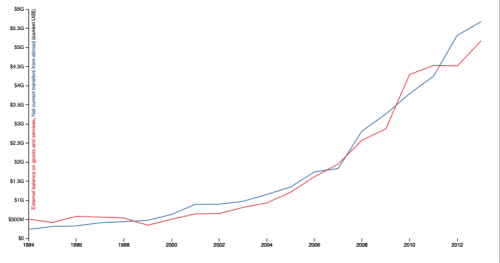
We can observe this cycle empirically in the uncanny relationship between current transfers from abroad into Nepal (i.e. foreign aid and remittance) illustrated with the blue line and the Nepal trade deficit illustrated with the red line in Figure 1 . With each increase in current transfers the trade deficit increases in lock step, one for one, because imports are cheaper than domestic goods. In other words, say a migrant worker sends back money to his family to purchase rice. That money will flow right back out of the country because Indian rice is cheaper than Nepali rice, almost as if the migrant worker had worked abroad and imported the rice himself.

The absolute worst option Nepal could consider is to kick the can down the road and subsequently borrow money in a foreign currency from an international organization like the IMF or World Bank to support its exchange rate. Such a loan would come with strings attached. An IMF loan might force Nepal to undergo structural adjustment, restricting Nepal’s public services while servicing the interests of Western governments, corporations and financial institutions.

The only viable option is for Nepal is to make a smooth transition away from its fixed exchange rate by partnering with India. To do so properly could require significant political capital, and the politicians that represent the over 100 peoples, cultures and languages of Nepal must unite to form an effective constitutional government.

The people of Nepal have been rightfully wary of trusting their own government, let alone the governments of their neighboring giants China and India. Yet they have essentially adopted a foreign currency, ceding economic self-efficacy for a sense of false security and trading short-run stability for long-run fragility. The influence of foreign capital has shaped and corrupted this country for too long.

The Reserve Bank of India must allow the Nepal Rastra Bank to set mutually beneficial terms which the IMF, World Bank or another international organization might appropriately oversee and underwrite. These terms should allow a gradual transition away from the fixed exchange rate to a natural, floating exchange rate that facilitates trade and partnership and, most importantly, allows Nepal to institute independent economic policy.

Nepal’s exchange rate with India is, after all, India’s exchange rate with Nepal. It is also in India’s best interest for the exchange rate to gradually adjust toward its natural rate, and for the rate to naturally fluctuate as trade between the two countries grows.

If there is any hope for growth in the aftermath of this calamity, that growth must come through partnership. At the roots of all sustainable economic growth are democratic institutions and governments that represent the interests of smaller communities and citizens. And the fruits of economic growth are only realized through the cross-pollination of countries, organizations and workers.