Quartz #54—>The National Security Case for Raising the Gasoline Tax Right Now
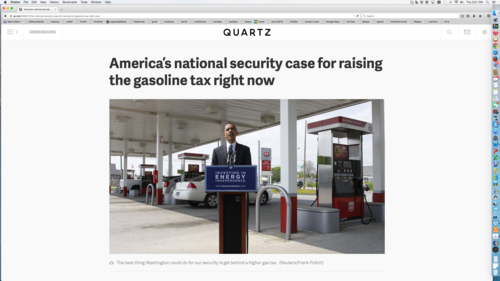
Link to the Column on Quartz

Here is the full text of my 54th Quartz column, “America’s national security case for raising the gasoline tax right now," brought home to supplysideliberal.com. It was first published on December 5, 2014. Links to all my other columns can be found here.

At this writing, this is one of my most popular Quartz column ever. You can see a list of my most popular columns here.

If you want to mirror the content of this post on another site, that is possible for a limited time if you read the legal notice at this link and include both a link to the original Quartz column and the following copyright notice:

© December 5, 2014: Miles Kimball, as first published on Quartz. Used by permission according to a temporary nonexclusive license expiring June 30, 2017. All rights reserved.


The world is a dangerous place. The Russianannexation of the Crimea and invasion of Eastern Ukraine behind tissue-thin pretenses has set Europe on edge. Hard-line factions in Iran are working to sabotage talks to rein in Iran’s nuclear program, in counterpoint to dark words from Bret Stephens in the Wall Street Journal speculating that the Obama administration has accepted the inevitability of an Iranian atom bomb. Meanwhile the Islamic State has carved out large chunks of Iraq and Syria for its grim caliphate. And China, despite its growing economic problems amidst its periodic saber-rattling, is still on track to besting the US in the overall size of its economy, simply because it has four times as many people as the US. (While GDP per personmatters for many international comparison it is total GDP that matters most for military strength.)

To deal with the long-run danger of Chinese dominance, the best strategy is to bring more people into the American fold, as I wrote in “Benjamin Franklin’s Strategy to Make the US a Superpower Worked Once, Why Not Try It Again?” But to shrink the more immediate threats from Russia, Iran, and ISIS down to size, there is another remedy: low prices for oil. Russia’s and Iran’s economies survive economic sanctions as well as they do because of oil revenue. Iran has plenty of money to enrich uranium and build missiles because of oil revenue. And the Islamic State earns millions of dollars a day from smuggled oil to help fund its murderous operations. Lowering the world price of oil puts less money in the hands of our enemies.

More subtly, lowering the world price of oil may help undercut or prevent dictators that may become our enemies in the near future. Economists and political scientists have noticed the “natural resource curse” in which many countries have dysfunctional politics because of natural resources. In a country without many natural resources, people are the main source of wealth; they have to be handled with care by rulers or they won’t produce much wealth. But in a country with oil, controlling the oil fields is enough to control most of the wealth of the country, and provides enough funds to buy off the people without giving them freedom, or to pay soldiers to intimidate the people.

Fortunately, the world price of oil has just fallen dramatically. On November 28, 2014, the Wall Street Journal began its editorial “The New Oil Order” with these words:

America’s unconventional oil boom continues to yield major benefits—economic and geostrategic. The latest evidence is OPEC’s decision on Thursday to defy expectations and maintain its current oil production target despite the steepest price decline since the 2008-2009 recession. The price of Brent crude, the global oil benchmark, plunged as a result to about $70 a barrel, continuing its decline from a peak of nearly $116 in June.

Here, the Journal appropriately gives much of the credit to the fracking boom in the US. In addition, the world’s economic troubles have reduced the demand for oil. And the rulers of Saudi Arabia realize (better than most Americans) that low oil prices are a way to weaken its rival Iran.

What can we do to keep the price of the oil that Russia, Iran and the Islamic State are selling as low as possible?

1. We can keep the fracking boom going

…and open the way for building the pipelines needed to ship oil and natural gas from point A to point B.

2. We can pour more money into solar power research

On November 19, I saw a talk by former Energy Secretary and Nobel Laureate Steven Chu at a (natural gas and oil-funded) conference in Doha, Qatar. He said solar power is close to being cheaper than conventional energy sources even without subsidies. (See also Ramez Naam’s Scientific American article “Smaller, cheaper, faster: Does Moore’s law apply to solar cells?”) Already, solar panels are cheap enough that installation costs are becoming the biggest issue. And there, German firms have figured out how to bring installation costs down far below installation costs in the US. Pushing solar power faster along the path it is already going could do a lot to keep oil demand from pushing prices up as the world economy improves.

3. We can increase gasoline and oil taxes and devote the proceeds to rebuilding our military to combat the new national security challenges that confront us

Gasoline and oil taxes raise the price of oil to consumers, but they also lower the price of oil to producers like Russia and Iran—especially if we convince our allies to raise their gasoline and fossil fuel taxes as well (which they might be willing to do, even though for many, their gasoline taxes are much higher than ours already). A basic principle from Economics 101 is that at the end of the day, taxes affect all players in a market, whoever officially pays them. For oil what that means is that although higher gasoline and oil taxes would involve some sacrifice from US consumers and US producers for the sake of national security, they are also taxes that, at the end of the day, are paid in a real way by US enemies.

One way to make an increase in gasoline and oil taxes easier to swallow is to phase those taxes in over time. Economic theory predicts that credible future gasoline and oil taxes will bring down the price of oil now. If everyone knows and believes gasoline and oil taxes will increase over time, the value of keeping oil in the ground to sell it in the future will be lower, so that oil is more likely to be put on the market now—at a lower price. And down the road, if solar power continues to get cheaper—and new ways to store power get cheaper, too—those gasoline and oil taxes in the future won’t be as painful as they would be now.

For too long, the US and many of its allies have either ignored the dangers of the world and turned inward, or have been drawn into fighting wars against dictators or terrorists funded by oil riches. One of the best ways for the US and its allies to support the valiant men and women who fight and die to defend the free world and to keep those parts of the world that are struggling towards freedom from descending into chaos is by taking high oil revenues out of our enemies’ war chests.


Technical Note: In light of the title, I should point out that, from an efficiency standpoint (without regard to politics), there may no justification for phasing in a gasoline tax increase slowly. If a national security externality were like an environmental externality, that externality should ideally be reflected in the tax rate right now. But the national security externality is actually a pecuniary externality, so it would take some nontrivial reasoning to figure out whether or not there is any justification for phasing a gasoline tax in. It is an optimal taxation problem in which money in the hands of certain parties counts negatively. 

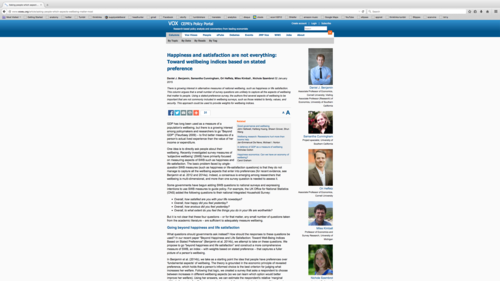
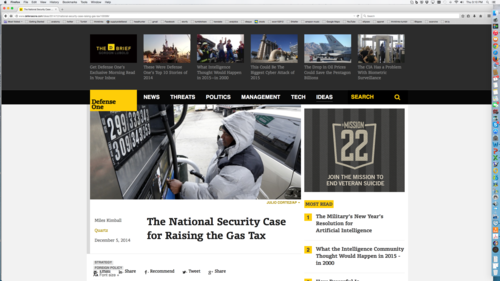
Syndication: I am pleased that this column was syndicated here to another Atlantic Company website as well: Defense One. Here is a screen shot: 
Facebook Convo on Women in Economics

Posting a link to Noah Smith’s Bloomberg View article on women in economics sparked a very interesting, and sometimes heated, discussion on my Facebook page. I especially like Robert Flood’s argument that things will get better because there is a market opportunity: an economics department could rise in the ranks (according to where judgments are headed in the future as the total number of women in economics increases) by hiring more women. I think there is some truth to this. If I went to a currently somewhat obscure economics department as department chair, with a big pile of money for hiring, I think the best chance to ultimately move that department up in the rankings would be to get a reputation of being very friendly to female economists, starting with making offers to many women at once. Just like there are departments that draw strength from having many econometricians–far above the percentage of econometricians in the profession overall, I think a department could draw reputational strength from having 55% women. The idea is that they would come in part for the agglomeration benefits of being in a department with many other female economists, especially if the women in that 55% and the men in the other 45% were also chosen in part for being especially good people and so likely to be supportive of others, including junior colleagues. 

(The other thing I would do would be to focus on new modes of teaching, such as flipped classes and intensive writing like what I have students do in my Monetary and Financial Theory class.)    

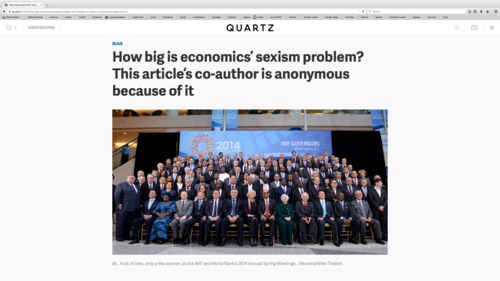
By the way, don’t miss my new column on women in economics, “How big is the sexism problem in economics? This article’s co-author is anonymous because of it,” coauthored with a female economist who chose to remain anonymous.

How Big is Economics' Sexism Problem? This Article's Co-Author is Anonymous Because of It

Here is a link to my 58th column on Quartz, “How big is economics’ sexism problem? This article’s co-author is anonymous because of it,” coauthored with an anonymous female economist. 

Justin Wolfers has more tweets listing excellent female economists than my editor thought we could include without breaking up the flow too much. You can see them at 

https://twitter.com/justinwolfers

I also lobbied unsuccessfully for this sentence 

What we mean is that female economists should be encouraged to assert their power, but male economists should find it hard or impossible to exert illegitimate, sexist power over their female colleagues.

to be changed to this more subtle take:

What we mean is that female economists should be encouraged to assert their power, but male economists should find it hard or impossible to exert illegitimate power (which gives those men an unfair advantage over women when that illegitimate power is exercised to intimidate other men into favoring them over women as well as when it is used directly against women).

But my editor thought that was overkill. 

Reactions: Jeff Smith had a nice blog post reacting to the column, and Claudia Sahm had a very interesting Ello post.

Noah Smith: Economics Is a Dismal Science for Women

Noah asked me to follow up on this hard-hitting Bloomberg View column with one of my own. Along with an anonymous female coauthor, I expect to have a new column on gender bias in economics out tomorrow morning (Tuesday). I will post a link as soon as I see it up.

This is an issue I feel strongly about, after having been on the losing side of many battles within my department in which I wanted to hire or promote a female economist. (To avoid giving the wrong idea, I should say that having been in on hiring decisions for over 27 years and in on tenure decisions for over 21 years, I have also opposed the hiring or promotion of more than one female economist. That side is easier sailing.)

Rebelling Against the Arbiters of Taste

There is a lot to say about this passage from On LibertyChapter IV, “Of the Limits to the Authority of Society over the Individual” paragraph 12, but let me encourage you to read it first:

And a person’s taste is as much his own peculiar concern as his opinion or his purse. It is easy for any one to imagine an ideal public, which leaves the freedom and choice of individuals in all uncertain matters undisturbed, and only requires them to abstain from modes of conduct which universal experience has condemned. But where has there been seen a public which set any such limit to its censorship? or when does the public trouble itself about universal experience? In its interferences with personal conduct it is seldom thinking of anything but the enormity of acting or feeling differently from itself; and this standard of judgment, thinly disguised, is held up to mankind as the dictate of religion and philosophy, by nine-tenths of all moralists and speculative writers. These teach that things are right because they are right; because we feel them to be so. They tell us to search in our own minds and hearts for laws of conduct binding on ourselves and on all others. What can the poor public do but apply these instructions, and make their own personal feelings of good and evil, if they are tolerably unanimous in them, obligatory on all the world?

One thing this reminds me of is my post “David Byrne: De Gustibus Non Est Disputandum,” where I wrote:

Economists use the Latin adage De gustibus, non est disputandum“There is no disputing of tastes"—to express the idea that in assessing an individual’s welfare, economists should use that individual’s preferences, not their own. This doctrine of deference to the desires, likes and dislikes of those who are affected by a policy is also evident in the praise economists usually intend when they use the word ”non-paternalistic.” What this doctrine means in practice is that when economists are acting in their capacity as policy advisors, their self-appointed task is to arrange things so that people get more of what they want, whatever it is that they want.

I strongly recommend the passage from David Byrne I quote in that post, which is long enough I won’t repeat it here. 

Sometimes we think of the rule of deference to people’s own tastes when they make their decisions only in relation to government interference. But in matters of taste, interference from social approval or disapproval is often just as important. Throughout On Liberty, John Stuart Mill is greatly concerned with interference from strong social disapproval as well as government interference.

Sometimes social disapproval causes people to avoid something that they like which should be considered innocent. Sometimes it only causes them to hide the fact that they like something (say, one music playlist to show, another to listen to in private). Unfortunately, keeping an aspect of one’s preferences secret makes it easier for social disapproval to cause someone else to avoid something they like that should be considered innocent. So there is a positive externality for freedom whenever someone comes out as liking something that often meets with social disapproval but is fundamentally innocent. My use of the words “comes out” point to the obvious example of people contributing to freedom by telling the world that they are attracted to members of the same sex, if in fact they are. I can’t honestly contribute to freedom in that way, because I don’t happen to be homosexual, but I can tell some of the preferences I have that are sometimes looked down upon. 

In giving this partial list, let me say first that any defensive notes in my remarks about each thing are a reflection of the social disapproval I have sometimes felt. Second, let me say that I am only so brave. Like almost everyone, there are other preferences I have that I am not willing to share! They fall under what I said in “The Government and the Mob”:

… the selective revelation of one person’s secrets and not the secrets of others makes the person whose secret is revealed look much worse than if all secrets were revealed. I think I would fare very well if the day ever came that Jesus predicted when he said:

For there is nothing hidden that will not be disclosed, and nothing concealed that will not be known or brought out into the open. (Luke 8:17)

But I have no doubt that if someone revealed all of my secrets, while everyone else got to keep theirs, I could be made to look very bad.

Here is my partial list of things I like that are sometimes looked down on or sideways at:

  1. I like TV. We are living in the golden age of TV, when TV is one of our premier arts, but unthinking negative statements about TV are extremely common in our culture.
  2. I like scented candles. This is only dicey because of gender norms.  
  3. I like Country Music. I have often been struck with how strong a negative class marker this seems to be within academia. 
  4. I like German-language Schlager music, which seems to be an even stronger negative class marker in German-speaking countries than Country Music is in the US. (In my Powerpoint file for class on International Finance that complements my post “International Finance: A Primer,” I use the purchase of downloads of Helene Fischer music as an example of a purchase of a foreign good.)  
  5. I also like many other genres of music, including the unusual taste for a nonsupernaturalist of liking Contemporary Christian Music, as I mentioned in my post “Godless Religion.” But perhaps one of the most unusual things about my musical tastes is that my vast music collections is about 99% female vocalists. In general, there are enough more male singers in the business than female singers that I think the opposite preference of liking male singers more might actually not be noticed, but my relatively strong preference for female singers seems to be unusual. 
  6. I like Science Fiction. There are a lot of great things that can be said about Science Fiction, but the literary snobs who not only look down on it but urge everyone else to look down on it are legion.  
  7. I like comic books. For anyone who shares this taste, I strongly recommend a trio of books by Scott McCloud:

I would be glad for comments about things that you like that deserve to be considered innocent for which you have felt some degree of social disapproval.

Note: On gay rights, which I touched on briefly above, you might be interested in my column “The Case for Gay Marriage is Made in the Freedom of Religion.”

Paul Krugman Deconstructs Martin Feldstein's Critique of Quantitative Easing

Since I had starting thinking of what I could write myself about Martin Feldstein’s Wall Street Journal op-ed “The Fed’s Needless Flirtation With Danger,” I am able to appreciate what a good job Paul Krugman did in analyzing Martin’s op-ed. 

You can see my response to an earlier Martin Feldstein anti-QE op-ed here:

QE or Not QE: Even Economists Needs Lessons In Quantitative Easing, Bernanke Style.

Edward L. Kimball: Civil Disobedience

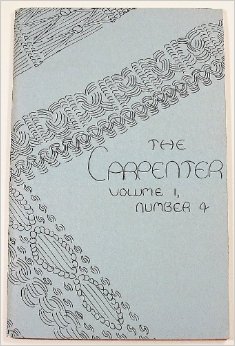
In 1969 to 1971, my father, Edward L. Kimball, was on the editorial board for a short-lived periodical: The Carpenter: Reflections of Mormon Life. A week ago, on Christmas, I posted an excerpt from my father’s Carpenter article “Creative Stewardship,” coauthored with Keith Warner. Today, New Year’s Day, let me post an excerpt from another article my Dad published in The Carpenter: “Civil Disobedience.” (It appeared in no. 2, Summer 1969, on pages 7-14.) I excerpted with an eye toward choosing things of interest to a general audience. Those whose who personally remember the Vietnam war will find it especially interesting. I’ll have a few comments afterwards. 


… under ordinary circumstances, obedience to law is a virtue. … This is … acceptable when the law is morally neutral–requiring payment of taxes, the obtaining of an occupational license, or compliance with traffic rules which involve no question of safety. This principle, however, raises difficult questions when compliance with law seems to the citizens to foster some evil. …

An important consideration is that the principle of obedience to law is entitled to a strong presumption. This is true of bad laws as well as good laws. … This is consistent with our acceptance, in the United States, of government by representatives and by majority vote. Acceptance involves a willingness to abide by decisions with which one disagrees, in the belief that in the long run the majority will is preferable to the will of any elite. We dare reject the law only when it is so basically destructive that obedience is intolerable. 

Before one undertakes to commit unlawful acts, he ought to be clear about the facts. The difficulty of knowing what the real facts are, and the real consequences of alternate courses of action, can be overwhelming. The question, for example, as to what we should do in Viet Nam depends on the facts. If the withdrawal of American troops would lead to the fall of South Viet Nam, the slaughter of its citizens, the collapse of free nations in Southeast Asia and Communist dictatorship over millions of unwilling subjects, then we might conclude that we should fight on, however difficult and costly it might seem. 

On the other hand, it it can be said that with American withdrawal these alleged consequences would not occur or that in any event they would occur ultimately, we might well conclude that we are merely squandering lives and resources to no good end. Much of the debate over Viet Nam is futile because it proceeds upon factual assumptions on which the debating parties disagree. 

As basic as is the need for accurate factual information, it is important that we not hide behind our own ignorance. It would be too easy to say that we must support American policy because we are ignorant of the merits of the dispute. If information is to be had, we have an obligation to seek it out. On the other hand, when information is unobtainable, the presumption against civil disobedience should surely govern. One is free to use lawful means of influencing policy or protesting, even on the basis of partial information; but when he chooses to transcend the law he ought to be very sure of his ground. 

We have need of humility; we need a healthy skepticism of our own views. We are all in the wrong on occasions, and before we set ourselves above the law it is incumbent upon us to consider how likely it is this is one of those occasions. When a jury is unable to agree on a verdict because of one or two dissenters, the judge will instruct them that while they need not give up their conscientious feelings, they should consider whether, in light of the fact that all the other jurors feel differently, their view may be in error.

The strength of one’s feelings is not a fair test of its accuracy; his feeling of sureness does not make him right. 

Part of that humility should be awareness that we may be influenced, perhaps subconsciously, by self-interest. The fact that self-interest is involved does not invalidate in itself the decision, but it needs to be included in the calculus.  

Still another aspect of the need for caution in engaging in civil disobedience is the tremendous destructive power of the individual. A small number of dedicated men can often bring a major institution to a halt. It is so much easier to tear down than to build that the power to obstruct or destroy must be used with greatest reluctance. 

The man who considers civil disobedience must weigh not only the immediate consequences of his act, but how it may affect the decisions of others. The precedent for violation of the law is easily extended by others to use of force and even to terrorism. Ghandi once terminated a campaign of passive resistance because some of his followers turned to violence. The arguments are so similar that refined distinctions among them may be lost upon others. And it is also essential to predict the reaction of persons in opposition. If the response of others to one’s disobedience to law is harshly repressive, much more may be lost than gained. The law is the ultimate safeguard of the dissenter who is not prepared for revolution. There is a great pool of irrationality in the community, which is largely restrained by a general commitment in the society to the ideal of adherence to law. If disobedience leads either to anarchy on the one hand, or dictatorial control on the other, it will have destroyed the very structure which gives broad protections to minority viewpoints. 

If, as Herbert Marcuse has urged, the American system is hopelessly corrupted through control by vested interest of the minds of the people then perhaps any means to destroy that tyranny is proper. The question is again one of fact. If there is still considerable opportunity for dissenting views to be heard and for policy to be changed, then the subversion of the existing system is wastefully destructive. It is often difficutl for the young to understand that to be heard is not the same as to be obeyed. Their great certainty and impatience lead them readily to civil disobedience. On the other hand, their elders may be so sunk in complacency that they do not seriously consider that the factors mentioned above, for all their caution against disobedience, may nonetheless lead to the conclusion that the presumption is overcome and the violation of civil law is justified. 

… We are faced with the possibility of error on both sides–relying placidly on our ignorance as a basis for doing nothing or acting upon well-intentioned impulse without having considered well enough the fundamental social value and … obligation to live within the law.  


ran the following comments past my Dad, who is now 84. He leaned toward agreeing. But I don’t know whether or not his 38-year old self who wrote the article would have agreed.

First, the problem with saying

On the other hand, when information is unobtainable, the presumption against civil disobedience should surely govern.

is that often information is unobtainable precisely because the government is keeping secrets. It seems to me to be stacking things too much in the favor of a potentially oppressive government to say one should always defer to the government when one is quite uncertain. In particular, it seems the presumption should not be so strong against civil disobedience to cause government secrets to be revealed if one does not already know those secrets. If one does know those secrets, then one is responsible for judging the consequences carefully with some deference. But there is at most a weak presumption against the civil disobedience of breaking in to find out the secrets and then make one’s judgement if, given what little information one has before getting hold of those secrets one has legitimate reason to suspect that those secrets maybe should be revealed. But to repeat, the weakness of the presumption against civil disobedience to get access to secrets is only for those who do not already know those secrets. The civil disobedience of those who do know must be judged in the usual way.

I talked about the government and other people’s secrets previously in “The Government and the Mob.”

Second, my Dad’s use of the example of a requirement to get an occupational license as morally neutral seems to me a quaint relic of the days before the rampant overgrowth of occupational licensing requirements seen today. Indeed, when given a chance to judge, the Supreme Court has on many occasions declared an occupational licensing requirement as an unconstitutional abridgement of the freedom to make a livelihood. Now I think that many occupational licensing requirements are highly immoral. I have written about the morality of occupational licensing requirements before:

On this topic of occupational licensing, you may also be interested in these posts:

Gary Conkling on My Federal Lines of Credit Proposal

I recently stumbled across the Under the Dome, CFM Federal Lobbying blog post “Put Economic Growth on the Card, Please” by Gary Conkling, inspired by William Greider’s interview with me about my Federal Lines of Credit proposal. For my original post on Federal Lines of Credit, see “Getting the Biggest Bang for the Buck in Fiscal Policy.” That was my second post after I started this blog, right after “What is a Supply-Side Liberal?” 

Q&A on the Swiss National Bank's Move to Negative Interest Rates

Cezmi Despinar

Cezmi Despinar

Link to this interview on Cezmi’s blog Accemax Analytics

I did an email interview with Cezmi Despinar about the Swiss move to negative interest rates. Cezmi posed great questions. 

Cezmi: Is the SNB now engaging in a “beggar thy neighbor” policy with the Fed, the ECB and the BoE by introducing a negative interest rate? Some people even talk about “currency wars”.

Miles: No. It is only a “currency war” if it involves a policy that would cancel out if every country did it. But if every country introduced negative interest rates, it wouldn’t cancel out, it would be a worldwide shift toward monetary stimulus. Actually, at the zero lower bound, and assuming it focused mostly on short-term government bills, the Swiss National Bank’s already existing policy of purchasing foreign assets to keep the Swiss franc from appreciating was a policy that would cancel out if all countries did it. So the shift toward negative interest rates, which will then require less purchasing of foreign assets, is a shift away from currency war on the Swiss National Bank’s part.     

Cezmi: Have the SNB’s policy tools been reduced significantly? What else can the SNB do to prevent an excessive appreciation of the Swiss franc or to make it less attractive to hold Swiss franc investments? Helicopter money?

Miles: As I explain in my column “The Swiss are now at a negative interest rate due to the Russian ruble collapse,” negative interest rates are a very powerful policy when not only the interest on money kept at the central bank and the target rate, but also the paper currency interest rate is reduced:

There is a world of difference between a central bank that cuts some of its interest rates, but keeps its paper currency interest rate at zero and a central bank that cuts all of its interest rates, including the paper currency interest rate. If a central bank cuts all of its interest rates, including that paper rate, negative interest rates are a much fiercer animal.

The Swiss National Bank knows how to do this. So it has all of the policy tools it needs. The key extra tool in its back pocket is the possibility of using a time-varying paper currency deposit fee to create a negative interest rate on paper currency. 

Cezmi: Switzerland’s monetary base has almost increased by eightfold, but the overall inflation is negative for many months in a row. Which macroeconomic lessons are we supposed to draw from the current unconventional action of the SNB? 

Miles: NYU Professor John Leahy framed it this way when he visited the University of Michigan this Fall: when interest rates on short-term government bills are almost the same as the interest rate on paper currency, the monetary base becomes a misleading measure of monetary policy because some of the monetary base is being used for saving (like short-term government bills at a similar interest rate) rather than transactions. For the size of the monetary base to mean what people are used to, the monetary base has to earn a lower interest rate than short-term government bills, so that the monetary is once again primarily devoted to supporting transactions. 

If the interest rate on the monetary base–including paper currency–were 100 basis points (1%) below the interest rate on short-term government bills, a much smaller monetary basis could be very stimulative. But with interest rates on the monetary basis essentially the same as interest rates on short-term government bills, some of the “monetary base” is not being used as monetary base, but as an equivalent for short-term government bills.

The bottom line is that at low interest rates, the paper currency interest rate is important enough that cutting other interest rates and increasing the monetary base doesn’t do that much (though it has somestimulative effect). So it is crucial to make the paper currency interest rate a tool of policy rather than keeping it always at zero, as has been the tradition.    

With Donna D'Souza, I wrote a children’s story to explain how money being used simply for saving rather than transactions doesn’t stimulate the economy, and how negative interest rates can help: “Gather ‘round Children, Here’s How to Heal a Wounded Economy.” And my column “Optimal Monetary Policy: Could the Next Big Idea Come from the Blogosphere? explains the famous Quantity Equation MV=PY, which says that it isn’t the amount of money M alone that matters for monetary policy, but money’s velocity V as well. When the interest rate on short-term government bills gets too close to the paper currency interest rate, velocity goes way down. The way to restore velocity is to cut the paper currency interest rate.

Does the Fabric of Our Society Depend on a Lie?

On a walk the day after Christmas, I was thinking about the interaction of inflation and loss aversion and about supernatural religions. Loss aversion is when someone, for example, treats something they code as a $10 loss as twice as painful as something they code as a $10 gain, and so have a substantial risk premium even for small risks. If gains and losses are coded in nominal terms, then for the same real return distribution, low inflation makes more of the returns into losses, and so can easily raise the risk premium. In my view, 98% of loss aversion is irrational, so in these cases, the higher effective risk premia are steering people wrong. Irrational loss aversion can thus create one of the few benefits of having higher inflation (something I need to add to my post “The Costs and Benefits of Repealing the Zero Lower Bound … and Then Lowering the Long-Run Inflation Target.”) But this benefit comes from the lie of inflation helping to partially counteract the bad effects of an irrationality.

Similarly, for many people, believing in some supernatural being helps counteract other irrationalities and sometimes even antisocial tendencies. And in the political realm, what Michael Huemer would call the illusion of political authority sometimes helps avoid anarchy and chaos that could cost many lives.

In this line of thought I thought

There is always the logical possibility that the fabric of our society depends on a lie. But I prefer not to think that way.

But should I be saying “I prefer not to think that way?” If I believe in facing the truth, then sholuldn’t  I face the truth about the fact that our society is based on key lies, if it is the truth? 

But besides hating the idea of a “noble lie” (see my post “John Stuart Mill on the Protection of ‘Noble Lies’ from Criticism”), I am not convinced that it is true that “noble lies” are needed. I have often encouraged myself with the thought  "If I am clever enough, I can get away with telling the truth.“ And I believe the same is true for society as a whole:

If we are clever enough, we can get away with telling the truth. 

This is a matter of faith for me, in the sense of "The Unavoidability of Faith.” In religion, my belief that if we are clever enough, we can get away with telling the truth is the theme of my sermon “Godless Religion.”

Technical Note: In addition to loss aversion, Kahneman and Tversky’s Prospect Theory is risk averse among gains and risk loving among losses. So while having the boundary between perceved gains and losses shift closer to the middle of the distribution of real returns can make for a bigger risk premium, pushing the bulk of the return distribution into the category of perceived losses can reduce the risk premium and even turn it negative. If the risk premium falls below the rational level, the resulting behavior is often called reaching for yield.

There is another possible source of “reaching for yield.” If an investor’s agent gets compensated out of “gains” or returns above some specific level, then there is a great incentive to try to encourage risk taking if necessary to have a good probability of getting above that level. The same can be said if there is a fixed reward for getting above some level. 

In any case, if there is either an institutional or psychological reason to care about  nominal “gains” versus “losses” or “above” versus “below” a given nominal level of returns, changing the level of inflation might make a difference for good or ill.

Richard L. Evans: Every True Strength Is Gained in Struggle

You may search all the ages for a person who has had no problems, you may look through the streets of heaven asking each one how he came there, and you will look in vain everywhere for a man morally and spiritually strong whose strength did not come to him in struggle. Do not suppose that there is a person who has never wrestled with his own success and happiness. There is no exception anywhere. Every true strength is gained in struggle.

– Richard L. Evans

W. Keith Warner and Edward L. Kimball: Creative Stewardship

In 1969 to 1971, my father, Edward L. Kimball, was on the editorial board for a short-lived periodical: The Carpenter: Reflections of MormonLife. In the fourth and final Spring 1971 issue, he coauthored with Keith Warner the article “Creative Stewardship.” I read that article only recently (December 8, 2014). I like the message. Here is an excerpt I made, with a broad audience in mind. (He was 40 at the time, considerably younger than my current age of 54!) 


Responsibility for Accomplishment

In the Sermon on the Mount Christ said, “By their fruits ye shall know them.” (Matthew 7:20) This test, by which Christ said men may legitimately be judged, is the test of results, not of intentions.

Many of us comfort ourselves in thinking that if our purposes are right we may be excused if they go awry.

… yet the standard He offers by which we may be judged is that we bring forth good fruit. We are responsible, therefore, for effects and not merely for effort, for accomplishment and not merely activity. …

Elder Hugh B. Brown put the principle another way: “The harvest, and not the master, will accuse the slothful servant.” (Eternal Quest, Salt Lake City: Bookcraft, 1956, p. 430.)

We are familiar with the need to distinguish between faith and works: “faith without works is dead.” (James 2:26) But we often take works to mean activity rather than accomplishment, and in that sense works without results are also dead.

Our concern must be not only with the letter, but also the spirit; not only with the work, but also the fruits of the harvest. Our obligation is not merely to try, but to help the cause succeed. We can have obtained some personal growth by making an effort, even though our efforts are otherwise unfruitful, but for the sake of our community as well as ourselves we must also be effective in the long run. 

Responsibility for Initiative

… It is not unusual for us to acknowledge full responsibility for our own lives and major responsibility for the welfare of our own families and small groups of associates, but when we move beyond these to communities the size of our ward or town, and to the state or nation, most of us begin to feel that we are out of our depth, and that the problems are to be solved by someone else: the leaders, the system—somebody, but not us.

… Each must take responsibility for taking action, whether in the leadership roles to which he may have been called, or in his capacity as helpful follower, or as individual upon whom ultimate responsibility falls to be a creative steward …

The New Republican Majority Should Keep Doug Elmendorf as Director of the Congressional Budget Office

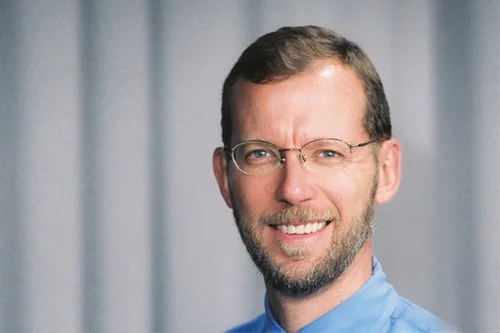
As Diogenes dramatized with his lamp, it is not easy finding an honest man. That is especially true when it comes to honesty in the face of strong political pressures. Doug Elmendorf is that rarity. If he is willing to continue as Director of the Congressional Budget Office (CBO), where honesty is especially needed, the new Republican majority would be well-advised to keep him on. They should remember that it was the CBO under Doug that pointed out what a budget-buster an early incarnation of Obamacare was. (Of course the final version was not cheap either–something the CBO under Doug also pointed out. You can see what I have to say about Obamacare here.) And it was the CBO under Doug that gave the estimate that raising the minimum wage as much as some proposed would cost half a million jobs, when the party line among many Democrats is that raising the minimum wage won’t cost any jobs at all. (You can see what I have posted so far about the minimum wage here: 1,2,3,4. I definitely lean against a higher minimum wage, but I am still debating all of the issues in my mind.) 

David Lawder makes the same case in the Reuters article “Republicans weigh big changes at U.S. budget referee agency.” One of the key issues is “dynamic scoring.” Dynamic scoring is when the changes to tax revenue induced by changes in economic behavior are included in calculations–an area where impartiality in doing the calculations is especially important because of the judgment calls that need to be made. The CBO has already done some dynamic scoring in unofficial estimates. Here are some key excerpts from David Lawder’s reporting:

The budget math used under dynamic scoring has long been a goal for Republican lawmakers, including the incoming chairman of the House Budget Committee, Representative Tom Price, and the current chairman, Paul Ryan, who next month will take over the tax-writing House Ways and Means Committee. …

“What we’re simply striving for is accuracy in score keeping,” Ryan told Reuters in a recent interview. “We know for a fact that it is not accurate or prudent to ignore the effects of economic growth on policies we make in Congress.” …

“I’ve always said that Doug Elmendorf has done an extremely good job at CBO,” Price said. “My complaint, my concern about CBO is not about the individual at the lead of CBO, my concern is the rules under which they operate.” …

… several prominent conservative economists have backed Elmendorf, arguing that Republicans would gain more credibility by keeping the former Clinton administration economist. …

“If you’re going to go with dynamic scoring, Elmendorf is a great guy to implement that,” said Michael Strain, deputy director of economic policy studies at the conservative American Enterprise Institute. “It would be harder to accuse Republicans of putting their thumb on the scale” if he stays.

To everything said above about dynamic scoring, let me add that I think Doug Elmendorf is the right person to implement disciplined capital budgeting to the CBO. I have in mind the approach I advocated when I visited the CBO this past May. (See my post “Capital Budgeting: The Powerpoint File.)

I know Doug well. Doug is a Harvard PhD classmate of mine, a coauthor on "Taxation of Labor Income and the Demand for Risky Assets” and a friend. So I can’t claim to be unbiased. But everything I am saying about Doug Elmendorf, others are saying as well.  

Bleg: It may be important to write again on this topic. So I would be grateful for links and information relevant to the argument for keeping Doug as Director of the CBO.

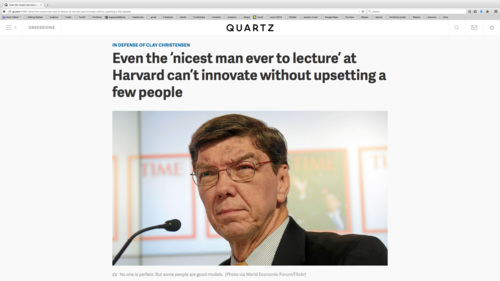
In Defense of Clay Christensen: Even the ‘Nicest Man Ever to Lecture’ at Harvard Can’t Innovate without Upsetting a Few People

Here is a link to my 57th column on Quartz: "In Defense of Clay Christensen: Even the ‘Nicest Man Ever to Lecture’ at Harvard Can’t Innovate without Upsetting a few people.“

I wrote a version of this first as a blog post. I am delighted that my new editor at Quartz, Paul Smalera, liked it enough to publish it in Quartz. (My previous editor, Mitra Kalita, is now overseeing key aspects of Quartz’s global expansion.)

By the way, since I am blogging through Clay’s books (as I have been blogging through John Stuart Mill's On Liberty) I have a virtual sub-blog on Clay Christensen:

http://blog.supplysideliberal.com/tagged/clay

In the column, I give my take on Clay’s theory, which I think is important for economists to understand. Here is a teaser:

My views on Clay as a thinker come from reading six of Clay’s books this year …

As an economist, I found them fascinating. One of the hottest areas of economics in the last twenty years has been the border between economics and psychology. One basic idea at that intersection is that people have limitations in their ability to process information and make decisions. This idea that cognition is finite is a key issue in macroeconomics, as Noah Smith and I wrote about in “The Shakeup at the Minneapolis Fed and the Battle for the Soul of Macroeconomics—Again.” But the idea of finite cognition also matters a lot for businesses. Some decisions are hard even for people who spend their careers making those kinds of decisions, and the support of teams of experts.

Clay, in the management theory he has developed with various coauthors, identifies one key factor in how hard a decision is for a generally well-run business …