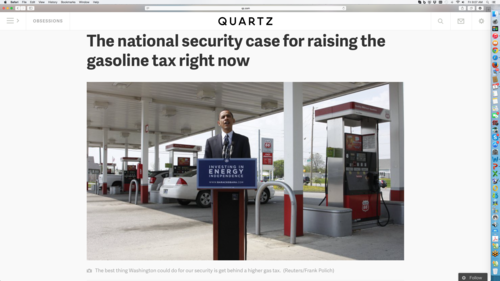
The National Security Case for Raising the Gasoline Tax Right Now

Here is a link to my 54th column on Quartz, “The national security case for raising the gasoline tax right now.”

In light of the title, I should point out that, from an efficiency standpoint (without regard to politics), there may no justification for phasing in a gasoline tax increase slowly. If a national security externality were like an environmental externality, that externality should ideally be reflected in the tax rate right now. But the national security externality is actually a pecuniary externality, so it would take some nontrivial reasoning to figure out whether or not there is any justification for phasing a gasoline tax in. It is an optimal taxation problem in which money in the hands of certain parties counts negatively. 

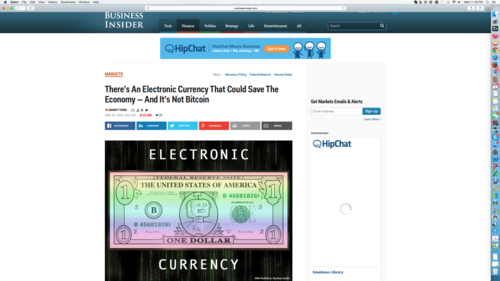
Danny Vinik's Interview with Miles Kimball for Business Insider: There’s an Electronic Currency that Could Save the Economy—and It’s Not Bitcoin

Link to the interview on Business Insider

Here, below the line of stars, is the full text of Danny Vinik’s interview with me for Business Insider. I linked to it when it first came out on November 21, 2013, and cleared with Danny the idea that I could copy it over in full here after some time had passed, given my role in making it possible. I think Business Insider holds the copyright. 

Danny Vinik and I talked for about 75 minutes. One thing I talked a lot about in the interview is that of all the possible ways to handle the demand-side problem, repealing the zero lower bound is the one that leaves us best able to subsequently pursue supply-side growth. Fiscal stimulus leaves us with an overhang of government debt that then has to be worked off by painfully higher taxes or lower spending. Going easy on banks and financial firms to prop up demand (as Larry Summers at least halfway recommends in his recent speech at the International Monetary Fund) risks another financial crisis. Higher inflation to steer away from the zero lower bound (as Paul Krugman favorsmesses up the price system, misdirects both household decision-making and government policy, and makes the behavior of the economy less predictable. (On Paul Krugman, also see this column.)

Let me push a little further the case that electronic money can clear the decks on the demand side so that we can focus on the supply side with this example. Suppose you firmly believed that the demand side played no role in the real economy—that the behavior of the economy could be described well by a real business cycle model, regardless of what the Fed and other central banks do, and regardless of the zero lower bound. From that point of view, in which monetary policy only matters for inflation, electronic money would still be valuable as a way of persuading others that it was OK to have zero inflation rather than 2% inflation.


The United States has been marred in slow economic growth and a weak recovery for years now. Unemployment remains high. This is despite extraordinary efforts by the Federal Reserve to stimulate the economy. This drawn out period of low inflation and high unemployment has gotten more and more people talking about a “new normal” of mediocre growth.

Economists have been looking for ways to give central banks more power to combat recessions and prevent these long, drawn out recoveries. Larry Summers laid out this major impending economic challenge in his recent speech at the IMF. Normally, when a recession hits, central banks cut interest rates to incentivize firms to invest and to spur economic growth. But when interest rates hit zero, those banks lose one of their most important tools to combat recessions. This is called the zero lower bound.

Hitting the zero-lower bound means that interest rates cannot reach their natural equilibrium where desired investment equals desired savings. Instead, even at zero, interest rates are too high, leading to too much saving and a lack of demand. Thus we get the slow recovery.

Until recently, we hadn’t hit that bound. But since the Great Recession, we’ve been stuck up against it and the Fed has been forced to use unconventional policy tools instead. What Summers warned of is that this may become the new normal. When the next recession hits, interest rates are likely to be barely above zero. The Fed will cut them and we’ll find ourselves up against the zero lower bound yet again and face yet another slow recovery.

So what’s the answer?

University of Michigan economist Miles Kimball has developed a theoretical solution to this problem in the form of an electronic currency that would allow the Fed to bring nominal rates below zero to combat recessions. He’s been presenting his plan to different economists and central bankers around the world. Kimball has also written repeatedly about it and was recently interviewed by Wonkblog’s Dylan Matthews.

“If you have a bad recession, then firms are afraid to invest,” he told Business Insider. “You have to give people a pretty good deal to make them willing to invest and that good deal means that the borrowers actually have to be paid to tend the money for the savers.”

But paper currency makes this impossible. 

“You have this tradition that as it is now is enshrined in law in various ways that the government is going to guarantee to all savers that they will get [at least] a zero interest,” Kimball said.

If the Fed lowered rates below zero in our current financial system, savers would simply withdraw their money from the bank and sit on it instead of letting it incur negative returns. The paper currency itself — because it’s something that can be physically withdrawn from the financial system — prevents rates from going negative.

This is where Kimball’s idea for an electronic currency comes in. However, unlike Bitcoin, which prides itself on its decentralization and anonymity, Kimball’s digital currency would be centralized and widely used. He would effectively set up two different types of currencies: dollars and e-dollars. Right now, your $100 bill is equal to the $100 in the bank. If you’re bank account has a 5% interest rate, you earn $5 of interest in a year and that $100 bill is still worth $100. But what would happen if that interest were -5%? Then you would lose $5 over the course of the year. Knowing this, you would rationally withdraw the $100 ahead of time and keep it out of the bank. This is where the separate currencies come in.

“You have to do something a little bit more to get the negative rate on the paper currency,” Kimball said. “You have to have the $100 bill be worth $95 a year later in order to have a -5% interest rate. The idea is to arrange things so let’s say $100 in the bank equals $100 in paper currency now, but in a year, $95 in the bank is equal to $100 in paper currency. You have an exchange rate between them.”

“After a year, I could take $95 out of the bank and get a $100 bill or if I wanted to put a $100 bill into the bank, they would credit my account with $95.”

Got that? After a year of a -5% interest rate, $100 dollars are equal to $95 e-dollars. This ensures that paper currency also faces a negative interest rate as well and eliminates the incentive for savers to hoard dollar bills if the Fed implements a negative rate. Presto! The zero lower bound is solved.

The benefits of this policy go even further though: We can say goodbye to inflation as well.

“Once you take away the zero lower bound, there isn’t a really strong reason to have 2% inflation at this point,” Kimball said. “The major central banks around the world have 2% inflation and Ben Bernanke explained very clearly why that is. It’s to steer away from the zero lower bound.”

He’s right. Back in March, Ryan Avent asked Bernanke why not have a zero percent inflation target. Bernanke answered, “[I]f you have zero inflation, you’re very close to the deflation zone and nominal interest rates will be so low that it would be very difficult to respond fully to recessions.”

But if nominal interest rates are allowed to go below zero, then the Fed has ample room to respond to recessions even if rates start out low. This is another major benefit from eliminating the zero lower bound.

What Kimball, whose blog is titled Confessions of a Supply Side Liberal, is most excited about is moving beyond the demand shortfall the economy currently faces to the supply side issues that hold back long-term growth.

“If you care at all about the future of this country, one of the things you need to realize is we need to solve the demand side so we can get back to the supply side issues that are really the tricky thing for the long run,” he said. “The way to solve the demand side issues that is the most consistent with not messing up our supply side is monetary policy and making it so we can have negative interest rates.”

At the moment, e-dollars are still only a theoretical concept, but Kimball is hopeful that they could be put into action in the near future. He believes that if a government bought in, it could be using an electronic currency in three years and reap the benefits of it soon after. 

“This is going to happen some day,” he concluded. “Let me tell you why. There are a lot of countries in the world and some country is going to do this and it’s going to be a whole lot easier for other countries to do it once some country has stepped out.”

Why, indeed, do we have public schools at all? There are advantages to having an educated public, and there are at least arguments to the effect that the private sector will undersupply education. But that’s an argument for government subsidies or vouchers; it’s not an argument for the government to actually run the schools. The reason the government wants to run schools is so that it can control what is taught. I hope that makes people uncomfortable.

Jonathan Gruber in the Hot Seat

I want to hear what everyone really thinks. So I hate it when people get punished for being frank about their views. Jonathan Gruber is in that situation now. If you haven’t seen it, it is well worth the 55 seconds to watch this video of Jonathan’s comments. Then to see an example of the trouble this has brought him, take a look at what Peggy Noonan wrote in her November 21, 2014 opinion piece in the Wall Street Journal (to jump over the paywall, google the title “The Nihilist in the White House”): 

ObamaCare … has been done in now by the mindless, highhanded bragging of a technocrat who helped build it, and who amused himself the past few years explaining that the law’s passage was secured only by lies, and the lies were effective because the American people are stupid. Jonah Goldberg of National Review had a great point the other day: They build a thing so impenetrable, so deliberately impossible for any normal person to understand, and then they denigrate them behind their backs for not understanding.

One is most likely to be punished for being frank about one’s views if (a) one has not been frank about them all along and (b) if one’s views–or attitudes communicated along with those views–have unappealing aspects to them. So, with due allowance for the constraints one is under, one should (a) seek to be as frank as possible early on and (b) strive for views and attitudes that are as enlightened as possible to begin with.  

The other lesson from Jonathan Gruber’s experience is that, more and more, one must be ready for everything one says to be totally public. For that, I think it is good preparation to have had a blog at some point during one’s career (ideally starting early enough that any mistakes or infelicities can be put down to the inexperience of youth), since blogging seriously involves saying many, many things, all of which are intended to be fully public.  

Note: On the subject of telling the truth, you might be interested in these two posts:

Robin Hanson: Dark Pain, Dark Joy

I recommend Robin Hanson’s post that I link above. There are many things we hide from others, and some that we hide from ourselves. Robin Hanson explores our hidden pains and hidden joys, and why we might hide them. 

There can be legitimate reasons for hiding things from others, though much less often than many people think. (I learned a lot from reading Sissela Bok’s books Lying and Secrets soon after they came out.) But it is too bad to hide something from oneself. As I wrote in my post “Truth or Consequences”: 

In my personal life, in order to keep myself from avoiding the truth, I often say to myself: “Whatever you decide is true, you don’t necessarily have to do anything about it,” lest fear of what I should do given certain findings tempt me to not find out the truth.

Let yourself see the truth, even if it means promising yourself you might not do anything about. As long as there is some chance the truth will set you free, it is worth facing it.

My Math Column with Noah in Spanish: "La Diferencia Fundamental Entre Los Niños Que Se Distinguen en Matemáticas y Los Que No"

blog.supplysideliberal.com tumblr_inline_nfolziwz6u1r57lmx.png

Yesterday, I was pleasantly surprised to stumble across the translation “La diferencia fundamental entre los niños que se distinguen en matemáticas y los que no” on Quartz of my column with Noah Smith “There’s One Key Difference Between Kids Who Excel at Math and Those Who Don’t.” (You can see a German translation of one of my columns, “Die „Hunger Games“ sind nicht unsere Zukunft – Sie sind schon Realität,” here and Japanese translations of quite a number of my posts linked here.)

I am grateful for all of the interesting things that have happened to me and all of the things I have learned since I have started blogging–something that might not have happened without Noah’s urging. And I am grateful for all of you who have taken the time to read some of the things I have written.

If you have time to read one more thing, you might like the column I wrote for Thanksgiving last year: “Human Grace: Gratitude is Not Simple Sentiment; It is the Motivation that Can Save the World.” In the same spirit, you might like Rebecca Hale’s Humanist Thanksgiving prayer

Q&A: Is There Anything to Supply-Side Economics?

Question: Hi Dr. Kimball - So i’m a Larry Kudlow fan- been so since 2005. Do I stand alone here? its easier to find a trend of more critics against Kudlow along with Supply Side Economics. I google SSE and the 1st page is flooded with why it doesn’t work. your thoughts much appreciated.

Answer:  I used to watch “The McLaughlin Group” all the time, and liked Larry Kudlow a lot there.

On your question about supply-side economics, It depends on what people mean by “supply-side economics.” At current rates, in my view neither incentive effects nor Keynesian multipliers are large enough for cutting taxes to raise revenue. But leaving that very specific tax issue aside, the supply-side is of crucial importance, much more important for long-run welfare than the demand side. That is a point I make at length in “The Deep Magic of Money and the Deeper Magic of the Supply Side.”

Several of my sub-blogs particularly address the supply side in many of their posts:

To me, that what I say in those posts is supply-side economics.

Jon Hilsenrath, Brian Blackstone and Lingling Wei on Monetary Policy: Low Rates and QE "Didn’t Cause the Hyperinflation or Obvious Asset Bubbles that Some Lawmakers and Critics Feared"

The well known gap between the Wall Street Journal news pages and editorial pages is well illustrated today in this passage from the article “Central Banks in New Push to Prime Pump” by monetary policy reporters Jon Hilsenrath, Brian Blackstone and Lingling Wei:

The Fed pursued low-rate, QE experimentation for half a decade. It pushed U.S. short-term rates to near zero in December 2008 and promised to keep them there for long periods. Convinced that wasn’t enough, it then launched several rounds of bond purchases that helped push its portfolio of securities, loans and other assets from less than $900 billion to more than $4 trillion.

The policies didn’t cause the hyperinflation or obvious asset bubbles that some lawmakers and critics feared. The fact that the U.S. economy is now doing better than Europe’s or Japan’s suggests the policies helped boost growth, although the degree of support is a matter of great disagreement among economists.

I fully agree with that assessment. I disagree with two other places in the article where they quote Eswar Prasad and Liaquat Ahamed without quoting any contrary views. Here are my contrary views. 

Eswar Prasad’s Views

Jon, Brian and Lingling write:  

Global economic weakness creates a dilemma for the U.S. If the Fed pulls away from easy money as other central banks ramp up money-pumping policies, it could drive up the value of the U.S. dollar, straining U.S. exports. It also could put downward pressure on U.S. inflation and on commodities prices, which are typically denominated in dollars.

Eswar Prasad, a Cornell University professor and former International Monetary Fund economist, said those developments would make it harder for the Fed to move ahead on rate increases.

This is not a dilemma for the US at all. What happens in the rest of the world matters a great deal for the US economy; the greatest dangers the US economy faces in the next few years are bad news about how other nations’ economies are faring. Given this stake we have in the world economy, when the rest of the world is struggling with low aggregate demand and the US central bank is thinking of raising interest rates to rein in aggregate demand, the thing one should hope would happen is that the countries that are struggling depreciate their currencies to boost their aggregate demand, while the US tolerates appreciation of the dollar to rein in its aggregate demand at that juncture rather than reining in aggregate demand by raising interest rates. In other words, when the world as a whole still needs more monetary stimulus, it is good thing for the Fed to stay relatively stimulative, while exchange rate movements are allowed to help steer that stimulus to other countries that need it most.   

Liaquat Ahamed’s Views: “Central banks have done about as much as they can”

Liaquat Ahamed articulately expresses an idea that sounds plausible, but is wrong. Here is the quotation from Jon, Brian and Lingling’s article:

“Central banks have done about as much as they can,” said Liaquat Ahamed, author of “Lords of Finance,” which documented the mistakes global central bankers made before and during the Great Depression.

I have been taking many of the Wall Street Journal monetary policy reporters to task before for this error:

(I recently updated my bibliographic post “How and Why to Eliminate the Zero Lower Bound: A Reader’s Guide” to add a “News and Trends” section for posts likes this.) 

Until central banks have employed negative interest rates, including negative paper currency interest rates (implemented by a time-varying paper currency deposit fee), they have not done all the monetary stimulus they can. 

Of course, it is possible to have too much monetary stimulus. So there are indeed situations in which a central bank has done “all it can” in the sense that more monetary stimulus would be a bad thing. And in the long run, standard models (which I essentially agree with) imply that a central bank can only affect inflation, not real economic activity. (See my post “The Deep Magic of Money and the Deeper Magic of the Supply Side.”

Applying these principles to current events, a central bank can reasonably be said to have “done all it can” to foster economic growth in only two situations:

  1. Additional monetary stimulus would create a genuine danger of a serious, undesirable increase in inflation (that is greater than the danger of too little monetary stimulus).
  2. The central bank has done all it can to raise equity requirements to a level that will make the financial system safe, but has failed in these macroprudential efforts, so that additional monetary stimulus would create a serious danger of a bubble that would endanger the financial system.  

One might argue that the first case applies to the Bank of England or to China’s central bank, but it does not yet apply even to the Fed, and is nowhere close to applying to the European Central Bank or the Bank of Japan.

No central bank has yet qualified for the second case. I have written two Quartz columns on monetary policy and financial stability:

And I address some of the key issues in my all-time most popular blog post so far: “Contra John Taylor.”

The Fed actually has a great deal of authority over equity requirements that it has not fully used yet. On equity requirements, see my recent post “The Wall Street Journal Editorial Board Comes Out for a Straight 15% Equity Requirement” and other posts in my Finance and Financial Stability sub-blog. Of just Quartz columns about equity requirements, see these two:

Liaquat Ahamed’s Views: Supply-Side Reform, not Monetary Stimulus

The account of Liaquat Ahamed’s views continues:

Japan, he said, is burdened by a highly inefficient domestic economy, and Europe by a fragmented and fragile banking system. Pumping cheap credit into these economies won’t directly fix those problems, he said. “They may be just copying the U.S. when they have different problems,” he said. “The world has relied too much on central banks.”

Supply-side reforms are crucial, but as I wrote in my slate article “Governments Can and Should Beat Bitcoin at Its Own Game” about empowering monetary policy by eliminating the zero lower bound:

… every time one set of problems is solved, it allows us to focus our attention more clearly on the remaining problems. It is time to step up to that next level.

People sometimes argue that good monetary policy will distract governments from pursuing supply-side reforms. But because optimal monetary policy keeps output close to its natural level, it would actually make supply-side issues much more salient, since only supply-side forces change the natural level of output. 

Fostering long-run economic growth is a many-sided issue. Writing this post inspired me to add a “Long-Run Economic Growth” sub-blog link to my sidebar. I had some difficulty categorizing posts. I didn’t want to duplicate what I had in my “Long-Run Fiscal Policy” and “Education” sub-blogs too much, but included some of my favorite posts in those categories. And I consciously included many posts about things that could contribute to economic growth correctly measured, even if they wouldn’t contribute to GDP as currently measured.   

Monetary Policy vs. Fiscal Policy vs. Credit Policy

Jon, Brian and Lingling continue, in what may also be a reflection of Liaquat Ahamed’s views: 

In the U.S., Fed officials have been frustrated that they were being relied on to spur growth while the Obama administration and Congress feuded over fiscal policies that slowed growth in the short-run without addressing projected long-run budget deficits.

My view is that monetary policy is exactly what we should be using to keep GDP at its natural level. And except for our unfortunate policy of imposing a zero lower bound on interest rates with the way we now handle paper currency, that would work well. On the issue of monetary vs. fiscal policy, these two posts are a good start:

Overall, in the absence of a zero lower bound, I don’t see traditional fiscal policy (beyond automatic stabilizers) as a good way to deal with fluctuations away from the natural level of output.   

However, credit policy, which lies somewhere between monetary and fiscal policy, can have a useful role to play in stabilization, simply because National Lines of Credit to consumers can have a faster effect on aggregate demand than interest rate changes (which typically take 6-12 months to have their effect). Here is what I wrote in my academic working paper “Getting the Biggest Bang for the Buck in Fiscal Policy” (pp. 3, 9): 

… for the sake of speed in reacting to threatened recessions, it could be quite valuable to have legislation setting out many of the details of national lines of credit but then authorizing the central bank to choose the timing and (up to some

limit) the magnitude of issuance. Even when the Fed funds rate or its equivalent is far from its zero lower bound at the beginning of a recession, the effects of monetary

policy take place with a significant lag (partly because of the time it takes to adjust investment plans), while there is reason to think that consumption could be stimulated quickly through the issuance of national lines of credit. …

… A big advantage of national lines of credit is that, once triggered, the details of spending are worked out through

the household decision-making process, which is relatively nimble compared to corporate and government decision-making processes.

Conclusion

The bottom line is that the conventional wisdom about monetary policy (on the left as well as on the right) is somewhat off target. To the extent that what people say seems reasonable, it is in important measure a self-fulfilling equilibrium: because the conventional wisdom is what it is, only certain policies are thinkable, and therefore what is said in the conventional wisdom makes sense. The concept of the Overton window is very helpful here. There is great value in working to expand the Overton window of policies that can be discussed among “very serious people” rather than just arguing about policies within the Overton window.

John Stuart Mill: How Laws Against Self-Harm Backfire

Deep in the human psyche is the hatred of being under someone else’s power. In On LibertyChapter IV, “Of the Limits to the Authority of Society over the Individual” paragraph 11, John Stuart Mill argues that laws against self-harm are often seen by those they affect through the lens of this hatred of domination. That can make such a law backfire in its intended aim of reducing a particular kind of self-harm:

Nor is there anything which tends more to discredit and frustrate the better means of influencing conduct, than a resort to the worse. If there be among those whom it is attempted to coerce into prudence or temperance, any of the material of which vigorous and independent characters are made, they will infallibly rebel against the yoke. No such person will ever feel that others have a right to control him in his concerns, such as they have to prevent him from injuring them in theirs; and it easily comes to be considered a mark of spirit and courage to fly in the face of such usurped authority, and do with ostentation the exact opposite of what it enjoins; as in the fashion of grossness which succeeded, in the time of Charles II, to the fanatical moral intolerance of the Puritans. With respect to what is said of the necessity of protecting society from the bad example set to others by the vicious or the self-indulgent; it is true that bad example may have a pernicious effect, especially the example of doing wrong to others with impunity to the wrong-doer. But we are now speaking of conduct which, while it does no wrong to others, is supposed to do great harm to the agent himself: and I do not see how those who believe this, can think otherwise than that the example, on the whole, must be more salutary than hurtful, since, if it displays the misconduct, it displays also the painful or degrading consequences which, if the conduct is justly censured, must be supposed to be in all or most cases attendant on it.

Of course, it is not only adults who are inspired to rebel against law that ban self-harm. As Susan Reimer writes in “Why the war on smoking backfires with teens,” a May 2000 Baltimore Sun article sparked by Malcolm Gladwell’s book The Tipping Point

Teens don’t smoke because they want to be seen as more grown-up or more like grown-ups. It is precisely because grown-ups are forbidding them to smoke that they take it up.

There is a social element to this spirit of rebellion:

Teen smokers are the “salesmen,” and Gladwell reports that they are usually defiant, sexually precocious, honest, impulsive, indifferent to the opinions of others, sensation-seeking – in other words, just the kinds of kids other teens are drawn to.

One of the most memorable stories from The Tipping Point was about an campaign to make not smoking a form of teenage rebellion against the manipulative adults in the tobacco companies. In Malcolm Gladwell’s telling, the campaign was abandoned due to pressure from tobacco companies when it was too effective at making teens think ill of tobacco companies–and through seeing tobacco companies as a possible target for rebellion, begin to think differently about smoking.  

In practice, one thing that can add to the chances that a law against self-harm will backfire is that those who champion such laws are often championed by people who make evident the general human pleasure at telling others what to do. That also helps energize a desire to rebel. 

When a law is one against harming others, things are different. It doesn’t look as much like rebellion when someone else understandably says “ouch, that hurts.”

Coda: The exceptions I can think of to the principle that laws against harming others inspire less of a spirit of rebellion are when the ones being hurt have been put into a subhuman category, such as slaves were in the Confederacy, or as illegal immigrants are today by anti-immigration activists. The Confederates saw themselves as rebels defending their rights; and many anti-immigration activists today see themselves as rebels defending their rights.

I have said strong words about anti-immigration attitudes before. For example, see my column The Hunger Games is Hardly Our Future: It’s Already Here. I believe that 200 years from now, with the more increasing sensitivity to harm that time will bring, those who are for restrictive immigration now will look in historical hindsight much as those who were for slavery 200 years ago look to us now.

Robert Flood and Company on Bubbles | A Facebook Convo

I am delighted when my Facebook page becomes the site for serious economic discussion. Here is a great example. 

Miscellaneous Notes about Facebook and Tumblr: A reminder to everyone: my Facebook page is totally public.

By the way, I put links to all of my blog posts on my Facebook page. So anyone who wants to follow my blog on Facebook can do that. At this point, I routinely accept friend requests from everyone who seems human (as opposed to a bot).

Carlo Ratti and Matthew Claudel: Top-Down vs. Bottom-Up

The following quotation is from the Project Syndicate article “Life in the Uber City,” by Carlo Ratti and Matthew Claudel:

As every French fifth-grade student knows, the Internet was invented in Paris. It was called Minitel …

Both Minitel and the Internet were predicated on the creation of digital information networks. Their implementation strategies, however, differed enormously. Minitel was a top-down system; a major deployment effort launched by the French postal service and the national telecommunication operator. It functioned well, but its potential growth and innovation was necessarily limited by its rigid architecture and proprietary protocols.

The Internet, by contrast, evolved in a bottom-up way, managing to escape the telecommunication giants’ initial appeals for regulation. Ultimately, it became the chaotic but revolutionary world-changer that we know today (“a gift from God,” as Pope Francis recently put it).

A key requirement for robust long-run economic growth is to make sure that established players can’t block bottom-up solutions when bottom-up solutions are called for–which is often!

Clay Christensen, Jerome Grossman and Jason Hwang: How to Divide and Conquer Our Health Care Problems

As I discussed in my post “Clay Christensen, Jerome Grossman and Jason Hwang on the Three Basic Types of Business Models,” Clay Christensen and his coauthors in all his business strategy books use a model of three basic types of business models:

  • solution shops
  • value-added processing (VAP)
  • facilitated networks.

In The Innovator’s Prescription (location 375), Clay Christensen, Jerome Grossman and Jason Hwang point out how these different types of business models default to different types of payment structures. Adding some headings:

Solution Shops 

Payment almost always is made to solution shop businesses in the form of fee for service. We’ve observed that consulting firms such as Bain and Company occasionally agree to be paid in part based upon the results of the diagnosis and recommendations their teams have made. But that rarely sticks, because the outcome depends on many factors beyond the correctness of the diagnosis and recommendations, so guarantees about total costs and ultimate outcomes can rarely be made. …

Value Added Processing

VAP businesses typically charge their customers for the output of their processes, whereas solution shops must bill for the cost of their inputs. Most of them even guarantee the result. They can do this because the ability to deliver the outcome is embedded in repeatable and controllable processes and the equipment used in those processes. Hence, restaurants can print prices on their menus, and universities can sell credit hours at guaranteed prices. Manufacturers of most products publish their prices and guarantee the result for the period of warranty.

Since they operate in the realms of empirical and precision medicine, VAP businesses in the health-care industry can do the same thing. MinuteClinic posts the prices of every procedure it offers. Eye surgery centers advertise their prices; and Geisinger’s heart hospitals can specify in advance not just the price of an angioplasty procedure, but can guarantee the result. In a new and remarkable agreement with several European governments, Johnson & Johnson has guaranteed that its new drug Velcade will effectively treat a specific form of multiple myeloma that can be diagnosed with a particular biomarker—or it will refund to the health ministry the cost of the full course of therapy. J&J can do this because the treatment is undertaken after a definitive diagnosis has been made. …

Facilitated Networks

Facilitated network business models in health care can be structured to make money by keeping people well; whereas solution shop and VAP business models make money when people are sick. 

In particular, facilitated networks often work on some kind of subscription or annual fee for payment. 

Clay, Jerome and Jason argue that there are two key steps to making health care less expensive:

  1. separating out the components of health care according to the most appropriate type of business model, and
  2. developing better ways of doing things within each category, building on that higher level of focus within each part of health care. 

Here is how they say it (with my headings):

The need to separate out components of health care according to appropriate business model:

Many who have written about the problems of health care decry the fact that the value of health-care services being offered by hospitals and doctors is not being measured. To them, we would explain that the reason isn’t that these providers don’t want to provide measurable value; they simply can’t, because under the same roof they have conflated fundamentally different business models whose metrics of output, value, and payment are incompatible with one another. …

Using the clear metrics within each category of health care to innovate further:

The reason why this basic segregation of business models must occur from the outset of disruption is that it will enable accurate measurements of value, costs, pricing, and profit for each type of business. A second wave of disruptive business models can then emerge within each of these three types. Powerful online tools can walk physicians through the process of interpreting symptoms and test results to formulate hypotheses, then help them define the additional data they need to converge upon definitive diagnoses. This will enable lower-cost primary care physicians to access the expertise of—and thereby disrupt—specialist practitioners of intuitive medicine. Likewise, ambulatory clinics will disrupt inpatient VAP hospitals. Retail providers like MinuteClinic, which employ nurse practitioners rather than physicians, need to disrupt physicians’ practices.

Avoiding the trap of thinking everything needs to be done in the solution shop business model: 

Hospitals and physicians’ practices have long defended themselves under the banner, “For the good of the patient.” Yet, for the good of the patient, do we really need to leave all care in the realm of intuitive medicine? Much technology has moved past this point, and health-care business models need to catch up. Two landmark reports from the Institute of Medicine—Crossing the Quality Chasm and To Err Is Human—shattered the myth that ever-escalating cost was the price Americans must pay to have the high-quality care that only full-service hospitals staffed by the best doctors can provide.

I find Clay, Jerome and Jason’s indictment of our current health care system as mixing together care appropriate to different business models trenchant. I wish this insight made it into more of the commentary about health care reform.  

You can see the rest of my posts tagged “Clay Christensen” here.

Jessica Lahey: Teaching Math to People Who Think They Hate It

Ever since writing “There’s One Key Difference Between Kids Who Excel at Math and Those Who Don’t” with Noah Smith and “How to Turn Every Child into a ‘Math Person’ as a follow-up, I am on the lookout for ideas helpful for math education. Jessica Lahey’s article linked at the top gives a nice description of the Discovering the Art of Mathematics: Mathematical Inquiry in the Liberal Arts (DAoM) curriculum. 

Among math professors, Stephen Strogatz has one of the strongest presences on Twitter. In the classroom, he uses the Discovering the Art of Mathematics curriculum. Jessica’s article describes an exercise about folding paper so that a scalene (irregular) triangle can be cut out with one cut that is well worth reading about. Here are some other excerpts:

Strogatz has discovered a certain thrill in rectifying the crimes and misdemeanors of math education. Strogatz asks his students, more than half of them seniors, to provide a “mathematical biography.” Their stories reveal unpleasant experiences with math along the way. Rather than question the quality of the teaching they received, they blamed math itself—or worse, their own intelligence or lack of innate talent. Strogatz loves the challenge, “There’s something remarkable about working with a group of students who think they hate math or find it boring, and then turning them around, even just a little bit.” …

Twelve years of compulsory education in mathematics leaves us with a populace that is proud to announce they cannot balance their checkbook, when they would never share that they were illiterate. What we are doingand the way we are doing itresults in an enormous sector of the population that hates mathematics. …

If we only teach conceptual approaches to math without developing skill at actually solving math problems, students will feel weak. … You need to have technique before you can create a composition of your own. But if all we do is teach technique, no one will want to play music at all.

On the Need for Large Movements in Interest Rates to Stabilize the Economy with Monetary Policy

Tomas Hirst was good enough to directly address my post “On the Great Recession,” with his post “Negative Rate Shocks.” I am long overdue in responding. Let me proceed by

  1. set the stage with a quotation from John Maynard Keynes’s General Theory of Employment, Interest and Money I noticed in Philip Pilkington’s post “Keynes’ Theory of the Business Cycle as Measured Against the 2008 Recession,” 
  2. explaining the power of negative interest rates to overwhelm the forces behind any real-world slump,   
  3. then addressing Tomas’s points directly.

Philip Pilkington’s view are closer to Tomas’s than they are to mine. Here is a bit wider window around the very interesting passage he quotes from John Maynard Keynes’s The General Theory of Employment, Interest and Money, chapter 22, section II:

Now, we have been accustomed in explaining the ‘crisis’ to lay stress on the rising tendency of the rate of interest under the influence of the increased demand for money both for trade and speculative purposes. At times this factor may certainly play an aggravating and, occasionally perhaps, an initiating part. But I suggest that a more typical, and often the predominant, explanation of the crisis is, not primarily a rise in the rate of interest, but a sudden collapse in the marginal efficiency of capital.

The later stages of the boom are characterised by optimistic expectations as to the future yield of capital-goods sufficiently strong to offset their growing abundance and their rising costs of production and, probably, a rise in the rate of interest also. It is of the nature of organised investment markets, under the influence of purchasers largely ignorant of what they are buying and of speculators who are more concerned with forecasting the next shift of market sentiment than with a reasonable estimate of the future yield of capital-assets, that, when disillusion falls upon an over-optimistic and over-bought market, it should fall with sudden and even catastrophic force. Moreover, the dismay and uncertainty as to the future which accompanies a collapse in the marginal efficiency of capital naturally precipitates a sharp increase in liquidity-preference–and hence a rise in the rate of interest. Thus the fact that a collapse in the marginal efficiency of capital tends to be associated with a rise in the rate of interest may seriously aggravate the decline in investment. But the essence of the situation is to be found, nevertheless, in the collapse in the marginal efficiency of capital, particularly in the case of those types of capital which have been contributing most to the previous phase of heavy new investment. Liquidity-preference, except those manifestations of it which are associated with increasing trade and speculation, does not increase until after the collapse in the marginal efficiency of capital.

It is this, indeed, which renders the slump so intractable. Later on, a decline in the rate of interest will be a great aid to recovery and, probably, a necessary condition of it. But, for the moment, the collapse in the marginal efficiency of capital may be so complete that no practicable reduction in the rate of interest will be enough. If a reduction in the rate of interest was capable of proving an effective remedy by itself; it might be possible to achieve a recovery without the elapse of any considerable interval of time and by means more or less directly under the control of the monetary authority. But, in fact, this is not usually the case; and it is not so easy to revive the marginal efficiency of capital, determined, as it is, by the uncontrollable and disobedient psychology of the business world. It is the return of confidence, to speak in ordinary language, which is so insusceptible to control in an economy of individualistic capitalism. This is the aspect of the slump which bankers and business men have been right in emphasising, and which the economists who have put their faith in a 'purely monetary’ remedy have underestimated.

I want to focus in on John Maynard Keynes’s claim:

… the collapse in the marginal efficiency of capital may be so complete that no practicable reduction in the rate of interest will be enough.

That is, bringing recovery by monetary policy alone may require a very large reduction in the interest rate by the central bank. Because in this passage JM Keynes is assuming a zero lower bound, he considers the necessary reduction in the interest rate impracticable. But elsewhere in The General Theory, JM Keynes speaks highly of Silvio Gesell’s plan for eliminating the zero lower bound with a stamp tax on currency, making deep negative interest rates possible. Following the lead of Robert Eisler (in 1932) and Willem Buiter (in 2001, 2003, 2004, 2007 and 2009), I have been suggesting a different mechanism to eliminate the zero lower bound in my travels to central banks around the world: a time-varying paper currency deposit fee for private banks depositing paper currency at the cash window of the central bank (with an equal time-varying discount for paper currency when withdrawing cash at the cash window). 

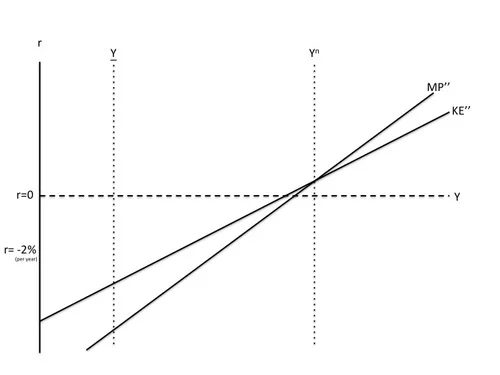
In “On the Great Recession,” I show what things would look like in the absence of the zero lower bound. Here is the key graph:

Eliminating the Zero Lower Bound and Going to Negative Interest Rates Leads to Recovery by the End of 2009 (What Could Have Been)

The slope of the KE curve shows how the perceived marginal efficiency of capital depends on the level of output. In addition to the KE curve having shifted down as a result of an increase in the risk premium (which has important irrational components) the risk premium pulls the marginal efficiency of investment down more when the economy is in a slump (a low level of output Y) and less when it is in a boom (a high level of output Y). In addition, as spell out for this framework in “The Medium-Run Natural Interest Rate and the Short-Run Natural Interest Rate,” it is more valuable to have extra capital when demand is high (a high level of Y) and less valuable to have extra capital when demand is low (a low level of Y). Both of these forces make the interest rate the central bank needs to choose to get the economy out of the slump quite low. And as JM Keynes suggests, a reduction in the perceived marginal efficiency of capital for any given level of output, which shows up as a shift downward in the whole KE curve, is often a precipitating force behind the slump in the first place. That gives a third reason it may require a very low interest rate for monetary policy alone to bring recovery. But as indicated by this graph, if the interest rate can go into deep negative territory there is no question that a low enough interest rate can bring the required economic stimulus. (The monetary policy curve “MP” specifies a very low interest rate when output is low. Although the level of output can still be low in the ultra-short run, for 9 months or so, this makes the natural level of output the only short-run equilibrium level of output.)

I have heard people say that no matter how low interest rates goes, it might not provide enough stimulus. But that is only because they have trouble imagining a world without the zero lower bound, in which the only thing limiting how far interest rates can go into subterranean depths is economic recovery itself. For many countries, the first thing that deep negative interest rates would do would be to cause a big increase in net exports, as the negative interest rates generated outward capital flows (see my post “International Finance: A Primer”). But that is in a situation in which that other countries have not yet broken through the zero lower bound, let’s discuss what would happen if all the major central banks went to deep negative interest rates during a worldwide slump. 

In my column “Monetary Policy and Financial Stability,” I title a section

Monetary Policy Works Through Raising Asset Prices, Loosening Borrowing Constraints, or Affecting the Exchange Rate.

I just put aside the effect on exchange rates by assuming that the major central banks are following each other’s interest rates down (so that the gaps between different countries’ interest rates that matter most for international capital flows, exchange rates, and trade flows remain at their usual level). But the effect of low interest rates on asset prices is in full force.

Higher Asset Prices: Higher asset prices both raise the consumption of those who own those assets and make it easier to raise funds by selling assets. The main limitation on the rise in asset prices that people may believe recovery will come soon, so interest rates will be low only for a short time. But that belief itself would help bring recovery, so that is not a limitation to the power of monetary policy. So let’s dig deeper into the case where people remain very pessimistic.

Even if people are running scared, so risk premia are very high, low enough interest rates will raise asset prices, but it might well be that at first it the prices of the few assets perceived as relatively safe that go up noticeably. Let’s say for the sake of argument, that it is only US government bonds that go up in price. If the US government were acting like a business, that should induce more government investment spending. (See my column with Noah Smith “One of the Biggest Threats to America’s Future Has the Easiest Fix” and my post “Capital Budgeting: The Powerpoint File.”)

But suppose that for political reasons that doesn’t happen. As the central bank pushes the interest rate down further, some other asset will rise enough in price that more investment will begin. It might be house prices for existing houses that go up. That would ignite more house construction. It might at first be only extra construction of luxury homes. But that extra house construction would nevertheless begin to pull the economy out of the slump. 

Now stack the deck against recovery more by supposing everyone has been so burned by a previous fall in house prices that they are unwilling to build new houses despite those high house prices. More generally, prevent refinancing of both mortgage and other household and business debt (much of which is short-maturity debt) by imagining a very high effective risk premium. Further, suppose that business investment also looks too dangerous. In that case, a set of assets whose price will rise is long-lived commodities. So, for example, employment in mining and geological exploration will increase. Of course, until this supply response has time to moderate the price movements the worldwide distribution of wealth will shift between those who have the long-lived commodities and those who need them will shift, but worldwide, there will be an increase in aggregate demand that makes it very difficult for the slump to persist.  

The Storage Option: Now suppose none of that is enough to get the economy out of the slump. At some point, consumers, who otherwise would earn deep negative interest rates in the bank, will decide to get a better return through buying nonperishable goods and storing them for later consumption. They will think of what they are doing as “saving,” but in the national accounts it will be spending that adds to aggregate demand. This physical storage option puts a hard limit on how low interest rates can go without generating a large increase in aggregate demand.

The same storage option operates in the business sector. Currently, many businesses have a lot of liquid assets that they are just sitting on. If those liquid assets were all earning a deep negative interest rate, businesses would realize they could get a better return through buying ahead on materials and equipment they knew they would need in the future–or simply things they planned to resell in the future.

To the extent that some households and businesses have substantial liquid assets, converting any substantial fraction of those assets into durable or storable goods would amount to raising spending far above income in an accounting sense, implying a very strong addition to aggregate demand.

Note that for anyone who has liquid assets to begin with, the attractiveness of the storage option does not depend on being able to get a loan from a bank. And many people must have liquid assets, since any debt in the world–including the large debts of governments–is owed to someone else in the world.

“Broken Banks”: Businesses and banks sitting on idle piles of liquid assets is a telltale symptom of the zero lower bound. Breaking through the zero lower bound restores the functioning of banks. Given negative interest rates those piles of liquid assets (after perhaps earning an initial capital gain), face a low rate of return going forward if they are left in that form. So the banks have to do something. They might simply get involved in financing storage, perhaps through a wholly-owned subsidiary if they didn’t trust anyone else with those funds. And as noted above, storage of long-lived goods alone can bring recovery. But chances are the banks would begin thinking about making loans for regular forms of investment. And the subset of businesses that have their own piles of liquid assets would also begin thinking about using their own money to invest.  

At the end of the day, low enough interest rates will bring recovery one way or another. If risk premia remained high enough, recovery could come through unusual channels, but it would come.  

Taming the Financial Cycle as Well as the Business Cycle–Returning to the Natural Level of Output Does Not Mean Everything is Rosy: By “economic recovery” I only mean returning the economy to the natural level of output. Because risk premia are strongly affected by whether the economy is in a boom or slump–as well as by the risk of a future slump–keeping the economy at the natural level of output through vigorous monetary policy would greatly reduce problems stemming from fluctuations in the risk premium, but wouldn’t eliminate them. Dealing with the remaining “financial cycle” calls for other measures. The first is high equity requirements (implemented by a 50% capital conservation buffer) so financial institutions are playing with their shareholder’s money (equity) rather than depending on taxpayers to bail them out in a pinch. The second is a sovereign wealth fund. (My most recent post on that is “How and Why to Avoid Mixing Monetary Policy and Fiscal Policy.” I collected links to my other posts on a sovereign wealth fund here.)

Why Not Just Do Everything Through Fiscal Policy Instead? I argue for the virtues of monetary policy over fiscal policy at length in my post “Monetary Policy vs. Fiscal Policy ….” To echo that post in brief,

  • while adding to the national debt is not as serious an issue as some economists would lead one to believe (1, 2) it is not a thing of no consequence to add to the national debt. 
  • with the exception of automatic stabilizers–such as taxes automatically going down and transfers automatically going up when income goes down–it is not easy for countercyclical fiscal policy to be handled technocratically, because taxes and spending have too much resonance with the long-run issues that divide the major political parties in most advanced countries.
  • technocratic countercyclical credit policy (which falls somewhere between monetary and fiscal policy) may be possible. The best implementation involves some form of required saving by households in good times with the ability to draw on that saving in a documentable personal emergency or in a recession.   

Answering Tomas Hirst

Having set the stage with the long discussion above, it is time to answer Tomas more directly.

What if Negative Rates Cause an Increase in the Risk Premium? Tomas is in agreement with what I write in “On the Great Recession,” until this point in his post “Negative Rate Shocks.”

Firstly, I think there is the issue of what we can know about the risk premium. It is possible, though not unproblematic, to establish “the gross rental rate of capital R net of the depreciation rate δ”, which would give us the non risk-adjusted KE curve. The risk adjustment, however, depends upon the demand outlook that has been thrown into uncertainty by the shock.

At the point of an economic shock squeezing the real interest rate by sharply dropping deposit rates could have the same effect as the fiscal authorities reducing automatic stabilisers. That is, an assumed support for demand would be removed causing a deterioration in the short term demand outlook. This in turn increases the necessary risk adjustment to the net rental rate and would force monetary authorities to push rates even lower.

If this analysis is right then the act of lowering rates below zero may be a causal factor driving the risk premium higher such that, even though it is not infinite, the real world experience of it under monetary dominance may appear just as if it was. Were investors to react to a central-bank-induced negative rate shock this way then the result could actually be to reduce risky investment even more.

On the Keynesian view, there is a large irrational component to the risk premium. Although I don’t know how big the irrational component of the risk premium is, I suspect it is substantial, and I worry about it. To the extent there is an irrational component to the risk premium, it is possible that it behaves in the way that Tomas suggests. But unless the risk premium increases more than 1-for-1 with declines in the interest rate into negative territory, lower the interest rate will still result in more stimulus. Even if a more than 1-for-1 increase in the risk premium overwhelms the decline in the interest rate at first, it is very unlikely that the risk-premium would respond in a more than 1-for-1 way beyond a certain point. There is likely to be an effective maximum to the risk premium, at least for some projects for which likely outcomes are especially easy to calculate. Storage is one type of project for which the likely outcome is easier to calculate than for more complex investments. But there are bound to be other investment projects for which the outcome has only so much uncertainty to it. No matter how large, any finite level of perceived risk can be overcome by a low enough interest rate.

The most likely side effect of negative interest rates in a bad case is that the channels of stimulus that start to work first are not the most desirable ones. But they will work. And once the economy returns to the natural level of output, the composition of aggregate demand is likely to normalize. (More regular people will have jobs and feel enough confidence to begin spending. More regular businesses will have customers, and feel enough confidence to begin investing.) 

In saying all of this, it is important to point out that to deal with the worst case scenario I am assuming a resolute central bank that understands this logic. In the real world, I believe that even a pioneering, but still feckless central bank that went to a minus -1.5% interest rate and wasn’t prepared to go any further down would see enough of a kickstart to aggregate demand that things would soon be headed in a positive direction. To understand that claim, it is important to realize that the first central bank to break through the zero lower bound would get the increase in aggregate demand from an increase in net exports since the other central banks would not yet be prepared to follow it down with their own target rates. It would only be after negative interest rates got the reputation for working in this way, that the other issues I raise above come into play. So by the time enough of the major central banks are using negative interest rates that the stimulus channel through net exports is cancelled out, negative interest rates would have a reputation for working that is likely to persuade many of the irrational economic actors.  

This net export effect of negative interest rates is nicely analogous to going off the gold standard during the Great Depression. During a major slump, going off the gold standard allows an increase in the money supply and so is helpful even when all nations do it. It is not just a zero-sum game. But the fact that the first countries to go off gold got an extra boost to aggregate demand from an increase in net exports helped persuade other countries to go off gold, and helped investors believe that going off gold would help.  

What If Investors Shift Into Alternative Safe-Haven Assets? In his post, Tomas continues with a comment of Francis Coppola:

My colleague, Frances Coppola, suggests a further problem. Faced with negative nominal rates investors could be tempted to abandon interest-bearing instruments all together and rush into alternative safe haven assets. These could be traditional assets like gold or other commodities (potentially including digital commodities such as crypto-currencies e.g. Bitcoin).

As I have argued above, the rise in asset prices would still eventually raise aggregate demand. More gold mining is to me one of the worst forms of aggregate demand, but it still provides some stimulus. The net export channel arises from pouring investable funds into foreign assets. And it is important to remember that anyone who buys assets puts money into the hands of the one selling those assets. That seller then has to do something with that money. So a rise in the price of assets doesn’t absorb and “use up” the stimulus. Rather, it ultimately reflects the stimulus back onto the real economy. In an initially tough economy, the rise in asset prices might be much more striking than the improvement in the real economy, but both will be there.

What If Negative Interest Rates Increase Perceived Interest-Rate Risk? Finally, Tomas writes:

Moreover, investment may be made in the present but it necessarily incorporates expectations about the future. Lowering the discount rate by pushing down the risk free rate leads to greater uncertainty around the net present value of investment opportunities. Lowering r means a lower discount of the future, which implies more uncertainty about the future is priced into current asset values. (My thanks to @richdhw for that one)

Increasing uncertainty over the future value of investment opportunities could discourage companies from committing money to new projects, especially if the short-term demand outlook remains highly uncertain.

I take this to say that large movements in interest rates can themselves cause a great deal of uncertainty and raise risk premia. But the possibility that interest rates might be very low (in real terms), can only raise the value of an asset. Breaking through the zero lower bound doesn’t do anything to raise the upper end of plausible values of the real interest rate. 

To see the logic here, suppose I told you that your chances of failure in a business venture were the same, but that now, in addition to the possibility of modest success, you now had a significant chance of truly striking it rich. This new upside risk raises the variance of the possible outcomes you face, so it could indeed raise the risk premium. But by raising the mean return as well, it has to raise the overall attractiveness of the business venture! Similarly, for a straightforward investment project, increasing the chances for very low (real) interest rates at the bottom end while keeping unchanged the likely possibilities for interest rates at the high end can only increase the present value of that project.

What If Uncertainty about the Course or Effectiveness of the New Policy Induces a Wait-and-See Attitude on the Part of Firms? For those who think that uncertainty will cause firms to wait and see what will happen next (which I suspect includes Tomas, given his other comments), let me point out that all along in “The Medium-Run Natural Interest Rate and the Short-Run Natural Interest Rate,” and “On the Great Recession,” I am working primarily with the delay condition: under what circumstances will a firm choose to delay investing until next year. If a large amount of uncertainty will be resolved between this year and next, that is a powerful force making a firm want to delay investment in a wait-and-see mode. But a low interest rate is a powerful force making firms want to invest sooner–one that can overwhelm any wait-and-see motivation, if the central bank continues to feel for the interest rate that will restart investment.  

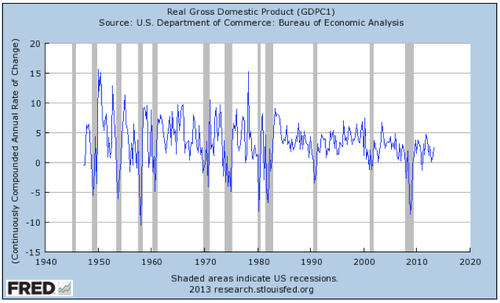
Conclusion: The Long-Run Benefits of Breaking Through the Zero Lower Bound: The graph I used in “Janet Yellen is Hardly a Dove—She Knows the US Economy Needs Some Unemployment” to show the Great Moderation between the mid-1980’s and the beginning of the Great Recession indicates some of the benefits I expect from eliminating the zero lower bound:

If we eliminate zero lower bound, we can return to what we saw in the Great Moderation. That does not require perfect monetary policy, only for central banks to choose target interest rates in the way they are used to without being stopped short by the question of whether those target interest rates are positive or negative.

Over time, I expect to see some improvements in monetary policy beyond the quality of monetary policy during the Great Moderation. For example, the opportunity that breaking through the zero lower bound gives to bring inflation down to zero is likely to tug monetary policy toward price-level targeting rather than inflation targeting. And I hope the kind of research I pursued with Susanto Basu and John Fernald in “Are Technology Improvements Contractionary?” ultimately leads central banks to do better in responding to technology shocks, striving to keep output at the natural level even when that natural level shifts. And as I argued in “Meet the Fed’s New Intellectual Powerhouse” it would be a big improvement to routinely adjust the target rate for observed risk premia to keep commercial rates at appropriate levels.  

But the benefits of breaking through the zero lower bound so that output can be kept close to its natural level go far beyond the direct benefits and the benefits of bringing inflation down to zero. With output closely tracking its natural level and inflation zero, both voters and government officials will make the natural level of output and its determinants much more salient, without the distraction of large business cycles from suboptimal monetary policy. That higher level of salience of the natural level of output will cause voters and government officials to focus more on supply-side measures to raise the natural level of output and on ways to expand measures of economic performance to the kind of disciplined measures of broader national well-being like those I will continue to discuss on my happiness sub-blog.