Dynamic Map of Europe from 1000 A.D. to 1900

blog.supplysideliberal.com tumblr_inline_mvarpv4zaJ1r57lmx.png

Here is a link to a wonderful video showing how the political map of Europe has evolved from 1000 AD to the present.

There is no date counter, but the progress bar at the bottom of the video will give you a good sense of the date at any point. 

Thanks to Robert Graboyes for pointing me to this.

Robert also recommends this (unfortunately not free) amazing video of the shifting battle lines during the Civil War. Here is the free trailer

Jonathan Clements on Integrating Human Capital into Your Portfolio

Jonathan Clements’s June 14, 2014 Wall Street Journal article “How to Calculate Your Net Worth” is an excellent discussion of integrating human capital into your portfolio. Here are some of his main points. The bolded labels are mine, the rest is his:

1. Human Capital is a Big Part of Your Portfolio. If you’re under age 50 and gainfully employed, your most valuable asset is probably your human capital—your ability to pull in a paycheck. The Census Bureau estimates, based on a 2011 survey, that a college graduate who works full time for 40 years might have lifetime earnings of $2.4 million, while someone with a professional degree, such as a doctor or lawyer, might earn $4.2 million.

2. Insure Your Human Capital with Life Insurance. Your human capital should heavily influence how you handle your larger financial life. For instance, to protect your human capital, you likely need health, disability and life insurance. Suppose you go under the proverbial bus or, alternatively, go under the bus but survive. In either situation, the right insurance can help your family cope.

3. Borrowing Against Your Human Capital Can Make Sense. Early in your adult life, you might take on a heap of debt, including student loans, car loans and mortgages. Reckless? Arguably, it’s rational. By borrowing, you can purchase items you can’t currently afford, thus smoothing out your consumption over your lifetime. With any luck, you will have years of paychecks ahead of you, so you can service these debts and eventually retire debt-free.

4. For Some, Human Capital is a Relatively Safe Asset That Can Be Balanced Out With Aggressive Investment in Risky Assets. Your human capital is also the rationale behind investing heavily in stocks when you’re younger. Think of your regular paycheck as akin to receiving interest from a bond. To diversify your big human capital “bond,” you might devote your portfolio mostly to stocks. But as you approach retirement and your last paycheck, you should shift maybe half your portfolio into bonds, so you have investment income to replace the lost income from your human capital.

In the rest of the article, he talks about how (a) you might have some human capital even after you have “retired” if you don’t retire completely, (b) integrating social security wealth (the value of the future social security payments you will get) into your portfolio and © liabilities like everything you will need to spend on a kid.

Let me also flag Jason Zweig’s nice article the day before “Can You Handle the Market’s Stress Test?” about how to fight “loss aversion”–being very risk averse toward relatively small risks. Here is what I tweeted about it:

How to fight loss aversion: avoid nonfinancial stress and make sure to net out gains and losses against each other.

Against Bullying

I never got into a fistfight or suffered physical harm from another kid when I was young, other than a kid once randomly slugging me in the solar plexus. But I was afraid of bullies. I felt a little extra vulnerable because of being a bookworm. I tried to at least put some hard edge onto my intellectuality so that I wouldn’t look too much like a pushover and thereby attract unwanted attention from bullies.

During the years my own children were in elementary school, I was delightfully surprised to learn of serious anti-bullying campaigns, and to see how, as a result, my children felt less fear than I had in school. I see anti-bullying campaigns as part of the anti-violence march of civilization that Steven Pinker documents in The Better Angels of Our Nature: Why Violence Has Declined(See also my post “Things are Getting Better: 3 Videos.”)

Going even further, the spirit of anti-bullying campaigns is being extended to other forms of cruelty that can only be called violence metaphorically. After reading Sumathi Reddy’s Wall Street Journal article “Little Children and Already Acting Mean Children, Especially Girls, Withhold Friendship as a Weapon; Teaching Empathy" I tweeted:

It is wonderful that anti-bullying campaigns are now being extended to fight social exclusion. 

There are certainly many worse things in the world than bullying, but I suspect that many of those worse things are the actions of either those who got practice in bullying when they were young, or whose bad behavior later on was partly revenge on the world for bullying suffered when young. 

To further make the case that bullying is not a trivial matter, in their article in the Proceedings of the National Academy of Science, ”Childhood bullying involvement predicts low-grade systemic inflammation into adulthood,“ William E. Copeland, Dieter Wolkeb, Suzet Tanya Lereya, Lilly Shanahan, Carol Worthman, and E. Jane Costello write:

Bullying is a common childhood experience that affects children at all income levels and racial/ethnic groups. Being a bully victim has long-term adverse consequences on physical and mental health and financial functioning, but bullies themselves display few ill effects. Here, we show that victims suffer from greater increases in low-grade systemic inflammation from childhood to young adulthood than are seen in others. In contrast, bullies showed lower increases in inflammation into adulthood compared with those uninvolved in bullying. Elevated systemic low-grade inflammation is a mechanism by which this common childhood social adversity may get under the skin to affect adult health functioning, even many years later.

(You can see a discussion of this research in the Washington Post here.) One bit of context for this is that inflammation is being seen more and more as a risk factor for heart disease, strokes and other maladies in later life. So inflammation is not innocent. 

A little over a year ago, an overlapping team of researchers reported long-lasting psychological problems resulting from being bullied as a child. Here is the description in an article in Reuters by Genevra Pittman, ”Psychological effects of bullying can last years“:

"It’s obviously very well established how problematic bullying is short-term,” said William Copeland, a clinical psychologist who led the new study at Duke University Medical Center in Durham, North Carolina.

“I was surprised that a decade down the road after they’ve been victimized, when they’ve kind of transitioned to adulthood, we would still see these emotional marks for the victims and also the bullies/victims.”

His team’s research included 1,420 youth from Western North Carolina who were asked about their experiences with bullying at various points between age nine and 16, then were followed and assessed for psychiatric disorders through age 26.

Just over one-quarter of kids and their parents reported they were bullied at least once, and close to one in ten said they had bullied other kids.

After adjusting for the participants’ history of family hardships, the researchers found that, compared to young adults with no history of bullying, former victims were at higher risk for a range of psychiatric conditions.

For example, 6 percent of uninvolved youth went on to have an anxiety disorder, versus 24 percent of former bullying victims and 32 percent of youth who had been both bullies and targets of bullying.

Kids who originally reported both bullying and being bullied were the most likely to be diagnosed with panic disorder or depression as young adults or to consider suicide.

Of course, this does not prove causality; those things that tend to make kids attractive target for bullying might still cause an elevated rate of psychological disorders even if an effective anti-bullying campaign meant that “easy targets” did not in fact suffer from bullying. Most likely there is some of that. But I wouldn’t want to bet on a total lack of causality from being bullied to having psychological problems later on in life. If there are regions of the country where anti-bullying campaigns have not yet begun in earnest, it should be possible to do randomized trials implementing anti-bullying campaigns in half of the schools in a sample.

If metaphorical violence is included, bullies are not absent among adults. The power of adults who are bullies in this broader sense can be reduced if they are clearly labeled as bullies by those around them.

supplysideliberaljp.tumblr.com — Confessions of a Supply-Side Liberal in Japanese

Link to “Confessions of a Supply-Side Liberal” in Japanese

I am delighted and honored that Makoto Shimizu has translated many of my posts in Japanese. Makoto will be in charge of the Tumblr blog for the Japanese version supplysideliberal.com: supplysideliberaljp.tumblr.com. I will post link posts here to each Japanese translation there.

Daily Devotional for the Not-Yet

Earth and the Sun, as viewed by the Space Shuttle Discovery.

Earth and the Sun, as viewed by the Space Shuttle Discovery.

Daily Devotional for the Not-Yet

In this moment, as in all the moments I have, may the image of the God or Gods Who May Be burn brightly in my heart.

Let faith give me a felt assurance that what must be done to bring the Day of Awakening and the Day of Fulfilment closer can be done in a spirit of joy and contentment.

Let the gathering powers of heaven be at my left hand and my right. Let there be many heroes and saints to blaze the trail in front of me. Let the younger generations who will follow discern the truth and wield it to strengthen good and weaken evil. Let the grandeur of the Universe above inspire noble thoughts that lead to noble plans and noble deeds. Let the Earth beneath be a remembrance of the wisdom of our ancestors and of others who have died before us. And may the light within be an ocean of conscious and unconscious being to sustain me and those who are with me through all the trials we must go through.

In this moment, I am. And I am grateful that I am. May others be, now and for all time.

Commentary

Having a window of time on a plane ride when I didn’t need to do anything in particular gave me a chance to realize that I was feeling depleted. Sleep was one obvious remedy, but I felt a need for something to feed my soul as well. So I wrote this prayer as something that might help lift my spirits on a daily basis. I wrote it for myself, but thought some of you might like it as well, perhaps as something to riff off of. (Designing one’s own religious rituals is a well-accepted practice in Unitarian-Universalism, the organized religion I belong to, and it is part of the research program I argue for in my sermon “Godless Religion.”

The basic theological ideas behind this devotional can be found in my sermon “Teleotheism and the Purpose of Life.” There, I define teleotheism this way:

Teleotheism is the view that God comes at the end, not at the beginning, where I am defining “God” as “the greatest of all things that can come true.”

Thus, the “Not-Yet” is the greatest of all things that can come true, which I call God, or more specifically, “the God or Gods Who May Be.” I chose that phrase because it also has an agnostic interpretation, allowing for the possibility that there just might be a god or gods out there already. (If there is a god or gods out there already, I feel pretty confident that God or Gods will not match all the details described in any religion that I know of, since every detailed description of God or Gods I know of has internal contradictions.)

Note that identifying what is the “greatest of all things that can come true” is a job for all of us. As I wrote in “Teleotheism and the Purpose of Life,”

In this view, the quest to discover what are the greatest things that are possible is of the utmost importance. The best of our religious heritage is just such an effort to discover the greatest things that are possible.

One key aspect of my theology is that it is non-supernaturalist. I tried my best to define “supernatural” in my Q&A post “What Do You Mean by “Supernatural”?” There are some phrases that were quite tempting to write into the devotional that I resisted because they were contrary to my non-supernaturalist beliefs.

Three previous prayers I have posted here provide elements for this prayer:

  1. An Agnostic Grace
  2. An Agnostic Invocation
  3. An Agnostic Prayer for Strength

There are some new elements:

The Day of Awakening and the Day of Fulfilment. The final words of “Teleotheism and the Purpose of Life” are

Can there be any greater purpose to life than working toward that day, that fine day, when God and Heaven do exist?“ 

The "Day of Awakening” and “The Day of Fulfilment” are handy names pointing to that time. It is unlikely that “the greatest of all things that can exist” will come into existence suddenly. “The Day of Awakening” is an early day when it seems that the greatest of all things that can exist is beginning to actually exist. “The Day of Fulfilment” is a later day when the greatest of all things that can exist does exist in full.

The Gathering Powers of Heaven. Because “heaven” can also answer the question “what is the greatest of all things that can exist,” in Teleotheism, the word “heaven” refers to the divine as well. “The gathering powers of heaven” is primarily those people (in the broad sense of intelligent agents) and ideas that are working to build heaven. To my mind, that is the same as those people and ideas that are working to make the world a better place, both in the immediate sense, and in the more roundabout sense of working to discover principles that will help us to make things better in the distant future.

Heroes and Saints. In “Adam Smith as Patron Saint of Supply-Side Liberalism?" I define a "hero” as someone who has done or is doing great good in the world, and a “saint” as a hero who in addition is free from scandal. That is, a “saint” is someone who has not only done or is doing great good in the world, but has done no serious, blameworthy harm, even locally.

On this blog, you will notice that there are many people that I admire. I give a set of links to posts about some of them in my recent post “Saint Clay.” I am sure I have forgotten posts I have written about other heroes. And there are many, many people I admire and think of as heroes whom I have not yet had occasion to write about, or have not yet had occasion to laud.

Younger Generations. The full significance of the phrase “younger generations” is only clear in the light of this passage from my column “That Baby Born in Bethlehem Should Inspire Society to Keep Redeeming Itself”:

… however hard it may seem to change misguided institutions and policies, all it takes to succeed in such an effort is to durably convince the young that there is a better way.

Died. The phrase “our ancestors and the others who have died before us” refers to the fact that in this age, we all still face death. Although I believe death will be conquered (see Cyborgian Immortality), unlike Ray Kurzweil, I don’t believe death will be conquered until it is too late for me to escape death. It is my fond hope that the words of this prayer and this post might survive to a time in the future when death is conquered. But I am very conscious of my own mortality. As I have often said, I am not a fan of death. My favorite poem about death is Edna St. Vincent Millay’s “Dirge Without Music.” I hint at the poignancy of the fact that I and others I love face death near the beginning of the prayer above as well, in the phrase “all the moments I have.”

I Am. In “An Agnostic Grace” I make a hat tip to the Mormon religion I grew up in by ending with these words–which still respect my own non-supernaturalist beliefs:

And we remember Jesus Christ, symbol of all that is good in humankind, and thereby clue to the God or Gods Who May Be. Amen.

In the prayer above, the phrase “I am” is the hat tip to the religion I grew up in, since at least the King James Translation renders the God of Abraham, Isaac and Jacob’s explanation of His own name as “I am that I am.” But “I am” also harks back to Renee Descartes rationalist dictum “I think, therefore I am.” (Cogito ergo sum.)

Grateful. I write about the importance of gratitude in “Human Grace: Gratitude is Not Simple Sentiment; It is the Motivation that Can Save the World,” which is also very much an expression of my theological views.

May Others Be, Now and for All Time. In my post about three possible “Armageddons” I wrote

I believe the continued existence of our species is of great value.

By current temperament, I am an optimist, but I don’t take the continuation of our species for granted. Andrew Snyder-Beattie wrote this in his Quartz essay “Finding a new Earth could be a sign we’re on our way to extinction”:

The Great Filter is an argument that attempts to resolve the Fermi Paradox: why have we not found aliens, despite the existence of hundreds of billions of solar systems in our galactic neighborhood in which life might evolve? …

While emergence of intelligent life could be rare, the silence could also be the result of intelligent life emerging frequently but subsequently failing to survive for long. Might every sufficiently advanced civilisation stumble across a suicidal technology or unsustainable trajectory?

I am hopeful that we can make it through the Great Filter. We have already come a long way. Going forward, in addition to avoiding missteps in the short-run, a key to the long-run survival of humanity and our transhuman descendants is for humanity and its offshoots to branch out to the rest of our solar system and beyond. To the stars! (Ad astra.)

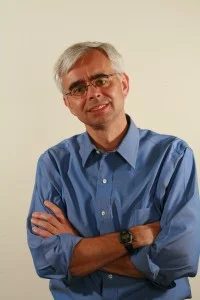
Matthew Rognlie: A Note on Piketty and Diminishing Returns to Capital

Tyler Cowen recommends the pdf linked above in this post.

Matt appears in two other posts on supplysideliberal.com:

The first is one of my most popular posts ever on this blog. The quality of Matt’s arguments there give me very high respect for his acumen.

Will Narendra Modi’s Economic Reforms Put India on the Road to Being a Superpower?

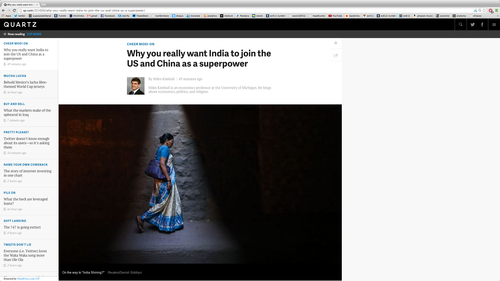
Here is a link to my 49th column on Quartz, “Cheer Modi On: Why you really want India to join the US and China as a superpower.” I kept my working title as the title of this companion post, since it better reflects the content of the column.

Important Note: Thirumaran makes the case in these storified tweets that Narendra Modi has been given a bad rap for his performance during the Gujarat riots in 2002.What I say in my column about that incident is based entirely on the Wall Street Journal article “Why Narendra Modi Was Banned From the U.S.” I would be glad to hear reactions to Thirumaran’s additional perspective.

Populations of the Most Populous Nations. I found the population figures in Wikipedia’s “World population” for the most populous countries very interesting.

  • China: 1,364,970,000
  • India: 1,245,280,000
  • United States: 318,201,000
  • Indonesia: 247,008,052
  • Brazil: 201,032,714
  • Pakistan: 186,709,000
  • Nigeria: 173,615,000
  • Bangladesh: 152,518,015
  • Russia: 143,657,134
  • Japan: 127,180,000

I hadn’t realized that the US was the third most populous nation. All of Europe, including 110,000,000 in the European part of Russia, is only listed at 742,000,000. The reason it makes sense to focus on population figures is that catch-up economic growth up to the cutting-edge level of income per capita is much easier than the economic goal of the US of pushing income per capita to levels the world has never seen before for any large nation.

I was clued into India being headed for beating out China in overall population by Thomas Piketty's Capital in the 21st Century. It is a fat enough book that I am only partway through. And I am glad I am reading it on a Kindle.

Japan's Move Toward a Sovereign Wealth Fund Policy

On January 3, 2013, I wrote in Quartz that the US should establish a sovereign wealth fund to aid in macroeconomic and financial stabilization. Since then, I have returned to this theme many times. Here is a list of my posts and columns that talk about using a sovereign wealth fund as an instrument of macroeconomic policy:

  1. Why the US Needs Its Own Sovereign Wealth Fund

  2. Miles’s First TV Interview: A US Sovereign Wealth Fund

  3. Miles Kimball, David A. Levine, Robert Waldmann and Noah Smith on the Design of a US Sovereign Wealth Fund

  4. Libertarianism, a US Sovereign Wealth Fund, and I

  5. How a US Sovereign Wealth Fund Can Alleviate a Scarcity of Safe Assets

  6. Contra John Taylor

  7. Off the Rails: How to Get the Recovery Back on Track

  8. How to Stabilize the Financial System and Make Money for US Taxpayers

  9. Four More Years! The US Economy Needs a Third Term of Ben Bernanke

  10. After Crunching Reinhart and Rogoff’s Data, We Found No Evidence High Debt Slows Growth

  11. Roger Farmer and Miles Kimball on the Value of Sovereign Wealth Funds for Economic Stabilization

  12. Meet the Fed’s New Intellectual Powerhouse

  13. Answering Adam Ozimek’s Skepticism about a US Sovereign Wealth Fund

In addition, I have three storified Twitter discussions about sovereign wealth funds:

  1. Miles Kimball, David A. Levine, Robert Waldmann and Noah Smith on the Design of a US Sovereign Wealth Fund

  2. Twitter Round Table on Contrarian Sovereign Wealth Funds as a Way to Tame the Financial Cycle

  3. Vaidas Urba Stress Tests Sovereign Wealth Funds,

some posts on closely related issues (two of which are guest posts):

and many posts (of which I will only list three right now) on a key scientific issue relevant for sovereign wealth funds–the level of efficacy of quantitative easing: 

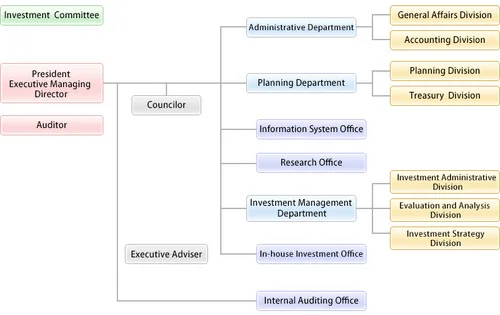
On Tuesday, June 10, 2014, Eleanor Warnock reported in the Wall Street Journal reported that Japan is making a substantial step toward my recommendation that rich countries should use sovereign wealth funds for macroeconomic stabilization, even if their governments are, overall, in debt. Here is the beginning of Eleanor’s article “Giant Japanese Fund Set to Invest More in Stocks, Foreign Bonds”

Japan’s $1.26 trillion public pension fund will likely announce a boost to stock and foreign-bond investments in early autumn, the head of its investment committee said Tuesday, potentially sending tens of billions of dollars into new markets.

“I personally think that we need to complete [the new portfolio] in September or October,” Yasuhiro Yonezawa, head of the Government Pension Investment Fund’s investment committee, said in an interview. “There’s no reason to be slow.”

Mr. Yonezawa outlined a tentative plan for a portfolio shift that would raise the allotments of the fund’s assets to go into domestic stocks, foreign bonds and foreign stocks by five percentage points in each category. The aim is twofold: to boost returns to ensure Japanese retirees get the payouts they expect, and to stimulate risk-taking at home by funneling money into growing Japanese businesses.

That is in tune with the prime minister’s pro-growth “Abenomics” policies.

I don’t mean to claim having had any influence, but I consider what Japan is doing in line with the kind of thing I am recommending, though of course they do not go all the way to the institutional structure that Roger Farmer and I are recommending in the post listed above with Roger’s name in the title.

Update: Roger Farmer now has a book advocating sovereign wealth funds: Prosperity for All: How to Prevent Financial Crises. Also, here is a useful post by Eric Lonergan on this topic: “Tristan Hanson and Eric Lonergan: What Would a UK Sovereign Wealth Fund Look Like?

The Problem of Teacher Sorting

Four of the main justifications for public education are

  1. subsidizing a vehicle for civic indoctrination (I use a blunt phrase, but on the whole, I think the civic indoctrination done in US public schools is quite a good thing)
  2. subsidizing the acquisition of human capital whose full benefits are not captured by the student in the future (note that even income taxes in the future is enough to create a gap between public and private benefit from education, but in all likelihood there are other not-fully-compensated benefit spillovers as well)
  3. alleviating borrowing constraints that make it hard to pay for  education in advance of earning the wage premium from education and
  4. redistribution.

Public education is a particularly attractive form of redistribution, since unlike direct transfers to poor families, (a) education goes directly to the kids and (b) education tends to encourage, rather than discourage hard work.

But public education is seldom optimized as a means of redistribution. Richer school districts often have better facilities and supplies, and typically offer higher salaries to teachers. But even when nominal teacher salaries are equalized across districts by state law, the greater difficulty of teaching the kids who need teaching the most to catch up often means that disadvantaged kids get worse teachers. (And the lower desirability for a teacher of either living near those schools or commuting further also tends to lead to worse teachers for disadvantaged kids.) To even equalize teacher quality would require paying enough of a salary premium for teaching in difficult schools that the typical teacher would be indifferent between taking on the tougher job with that salary premium or taking on an easier job with a lower salary. And an argument can be made that the very best teachers (in terms of being able to motivate kids and teach the most basic and important concepts well) should be teaching the kids who are the furthest behind.

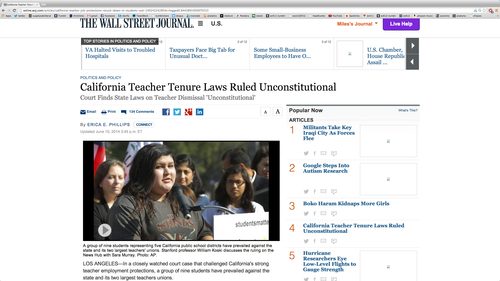
The chickens have now come home to roost. The failure of California to address the problem of teacher sorting led to a remarkable decision yesterday by a Los Angeles Superior Court. As reported in the Wall Street Journal article linked above:

In a closely watched court case that challenged California’s strong teacher employment protections, a group of nine students have prevailed against the state and its two largest teachers unions.

A Superior Court here on Tuesday found that all the state laws challenged in the case were unconstitutional. The verdict could fuel similar lawsuits in other states where legislative efforts have failed to ease rules for the dismissal of teachers considered ineffective.

The student plaintiffs in Vergara v. California argued that the statutes protecting teachers’ jobs serve more often to keep poor instructors in the schools—hurting students’ chances to succeed.

Citing the Supreme Court’s landmark 1954 Brown v. Board of Education “separate but equal” ruling, Superior Court Judge Rolf M. Treu wrote in his decision that the laws in the case “impose a real and appreciable impact on the students’ fundamental right to equality of education.” The decision also agreed with the plaintiffs’ arguments that the poorest teachers tend to end up in economically underprivileged schools and “impose a disproportionate burden on poor and minority students.”

It is easy to get drawn into the debate about the merits of teacher tenure. But I hope people don’t miss the problem of teacher sorting. If many of the worst teachers in a state ended up in the richest school districts, I think it would bring home to wealthy and influential voters the importance of school reform–in many dimensions. Then maybe poor kids would have a chance, as they not only got average rather than below-average teachers, but the average teacher and school performance improved. 

Update: I received some great comments on the Facebook version of this post (which was really only a link to the post here):

Robert FloodPublic schools are not allowed to pay a premium in $ or in class size or load to induce teachers to go where their product is highest. So, to keep the best teachers, they bid with school assignments. My wife, in the last 10 or 15 years of her teaching career taught math to the best kids in Montgomery Co MD - maybe the richest country in the US. The kids were great and the parent support was superb - except for the nutsy parental “grade stalkers.” Her biggest problem with teaching was “up county” administration. The admin grew much faster than the # of kids or # of teachers.

My advice - let schools bid for teachers. I also think that when we see diseconomies of scale in administration, i.e., admin growing faster than the administered, , the teachers need to be consulted and help to design administration.

Chris KimballI recently read (in Malcolm Gladwell’s “What the Dog Saw”, although there’s surely a source behind that) that the range for least effective to most effective teachers runs from ½ (year’s worth of material in one year of class) to 1-½ (year’s worth of material in one year of class). Notwithstanding a raft of questions about the data (is it valid, what does the distribution look like, can the extremes be replicated, etc.) the extent of that range was a wake-up for me–making teacher sorting and selection a much more important issue than I had been thinking.

Michael Bloomberg: A University Cannot Be Great If Its Faculty Is Politically Homogenous

I was delighted to see that Michael Bloomberg gave a Commencement Address at Harvard articulating the same sentiments I expressed in my post “Colleges Should Stand Up For Freedom of Speech!” The text is available in full on his website, and I plugged in the embed code above for the video of his talk. 

Here are some key passages. I am in full agreement:

1. Great universities are places where people of all backgrounds, holding all beliefs, pursuing all questions, can come to study and debate their ideas – freely and openly.

Today, I’d like to talk with you about how important it is for that freedom to exist for everyone, no matter how strongly we may disagree with another’s viewpoint.

Tolerance for other people’s ideas, and the freedom to express your own, are inseparable values at great universities. Joined together, they form a sacred trust that holds the basis of our democratic society.

2. Repressing free expression is a natural human weakness, and it is up to us to fight it at every turn. Intolerance of ideas – whether liberal or conservative – is antithetical to individual rights and free societies, and it is no less antithetical to great universities and first-rate scholarship.

There is an idea floating around college campuses – including here at Harvard – that scholars should be funded only if their work conforms to a particular view of justice. There’s a word for that idea: censorship. And it is just a modern-day form of McCarthyism.

Think about the irony: In the 1950s, the right wing was attempting to repress left wing ideas. Today, on many college campuses, it is liberals trying to repress conservative ideas, even as conservative faculty members are at risk of becoming an endangered species. And perhaps nowhere is that more true than here in the Ivy League.

3. In the 2012 presidential race, according to Federal Election Commission data, 96 percent of all campaign contributions from Ivy League faculty and employees went to Barack Obama.

Ninety-six percent. There was more disagreement among the old Soviet Politburo than there is among Ivy League donors.

That statistic should give us pause – and I say that as someone who endorsed President Obama for reelection – because let me tell you, neither party has a monopoly on truth or God on its side.

When 96 percent of Ivy League donors prefer one candidate to another, you have to wonder whether students are being exposed to the diversity of views that a great university should offer.

Diversity of gender, ethnicity, and orientation is important. But a university cannot be great if its faculty is politically homogenous. In fact, the whole purpose of granting tenure to professors is to ensure that they feel free to conduct research on ideas that run afoul of university politics and societal norms.

When tenure was created, it mostly protected liberals whose ideas ran up against conservative norms.

Today, if tenure is going to continue to exist, it must also protect conservatives whose ideas run up against liberal norms. Otherwise, university research – and the professors who conduct it – will lose credibility.

Great universities must not become predictably partisan. And a liberal arts education must not be an education in the art of liberalism.

The role of universities is not to promote an ideology. It is to provide scholars and students with a neutral forum for researching and debating issues – without tipping the scales in one direction, or repressing unpopular views.

4. … a university’s obligation is not to teach students what to think but to teach students how to think. And that requires listening to the other side, weighing arguments without prejudging them, and determining whether the other side might actually make some fair points.

5. if students graduate with ears and minds closed, the university has failed both the student and society.

And if you want to know where that leads, look no further than Washington, D.C.

Down in Washington, every major question facing our country – involving our security, our economy, our environment, and our health – is decided.

Yet the two parties decide these questions not by engaging with one another, but by trying to shout each other down, and by trying to repress and undermine research that runs counter to their ideology. The more our universities emulate that model, the worse off we will be as a society.

And let me give you an example: For decades, Congress has barred the Centers for Disease Control from conducting studies of gun violence, and recently Congress also placed that prohibition on the National Institute of Health. You have to ask yourself: What are they afraid of?

6. We must not become a country that turns our back on science, or on each other. And you graduates must help lead the way.

On every issue, we must follow the evidence where it leads and listen to people where they are. If we do that, there is no problem we cannot solve. No gridlock we cannot break. No compromise we cannot broker.

The more we embrace a free exchange of ideas, and the more we accept that political diversity is healthy, the stronger our society will be.

7. Standing up for the rights of others is in some ways even more important than standing up for your own rights. Because when people seek to repress freedom for some, and you remain silent, you are complicit in that repression and you may well become its victim.

Do not be complicit, and do not follow the crowd. Speak up, and fight back.

You will take your lumps, I can assure you of that. You will lose some friends and make some enemies. But the arc of history will be on your side, and our nation will be stronger for it.

It is worth comparing the arguments Michael gives to those you can see in the links in “John Stuart Mill’s Brief for Freedom of Speech.” Michael quotes John Stuart Mill in one place, but articulates the fundamental logic of John’s argument in many other places in new words.

The Racist Origins of the Idea of the ‘Dumb Jock’

When I was in high school and college, I took for granted the stereotype of the “dumb jock.” It never occurred to me that this stereotype might be partly racist in origin, until I read The Sports Gene by David Epstein. Here from pages 180 and 184-185 is the key passage, which also hints at just how touchy it is to talk about the possibility of racial differences in physical attributes relevant to sports:

In his 2003 book, Black Superman: A Cultural and Biological History of the People Who Became the World’s Greatest Athletes, and then in his 2006 paper with [Errol] Morrison, [Patrick] Cooper first made the argument that West Africans evolved characteristics like a high prevalence of the sickle-cell gene mutation and other gene mutations that cause low hemoglobin for protection from malaria, and that an increase in fast-twitch muscle fibers followed from that, providing more energy production from a pathway that does not rely primarily on oxygen, for people who have reduced capacity to produce energy with oxygen. The former part of Cooper’s hypothesis–that sickle-cell trait and low hemoglobin are evolutionary adaptations to malaria–now seems undeniable. …

As for whether low hemoglobin in itself might prompt a switch to more fast-twitch fibers, there is evidence that it can in rodents. …

… No scientist has attempted to test Cooper and Morrison’s idea in humans, so there are simply no human studies at all.

Several scientists I spoke with about the theory in insisted that they would have no interest in investigating it because of the inevitably thorny issue of race involved. One of them told me that he actually has data on ethnic differences with respect to a particular physiological trait, but that he would never publish the data because of the potential controversy. Another told me he would worry about following Cooper and Morrison’s line of inquiry because any suggestion of physical advantage among a group of people could be equated to a corresponding lack of intellect, as if athleticism and intelligence were on some kind of biological teeter-totter. With that stigma in mind, perhaps the most important writing Cooper did in Black Superman was his methodical evisceration of any supposed inverse link between physical and mental prowess. “The concept that physical superiority could somehow be a symptom of intellectual inferiority only developed when physical superiority became associated with African Americans,” Cooper wrote. “That association did not begin until about 1936.” The idea that athleticism was suddenly inversely proportional to intellect was never a cause of bigotry, but rather a result of it. And Cooper implied that more serious scientific inquiry into difficulty issues, not less, is the appropriate path.

The idea of prejudice against African Americans begetting prejudice against jocks reminds me of a similar phenomenon I heard about in a Unitarian-Universalist sermon: apparently, some of the prejudice against male homosexuals originally came from the idea that they were like women. (Along those lines, I remember in middle school hearing some of my age-mates use “fem” as an anti-male-homosexual insult.) Thus, prejudice against women generated part of the prejudice against gay men.

The teacher of a class on Plato I audited when I was a grad student at Harvard maintained that for the ancient Athenians, prejudice against women generated a more pro-homosexual attitude for men, since they focused on the higher status of a male as an object of sexual desire rather than any supposed similarity of a gay man to a woman. The common element between ancient Athenian pro-homosexual attitudes and modern American anti-homosexual attitudes would then be prejudice against women. (The Wikipedia article on “Homosexuality in ancient Greece” emphasizes yet other aspects of how prejudice against women affected attitudes toward homosexuality.)

The bottom line is that prejudice affects everything it touches.

John Stuart Mill on the Limits to Top-Down Progress

I have always thought that the great weakness of Obamacare is that its basic philosophy is to mandate that things be done the same way throughout the United States. John Stuart Mill is eloquent in laying out what is lost when top-down control pushes things toward a single approach instead of a diversity of approaches. On this theme for health care, see my posts 

 Of course, the message of On Liberty, Chapter III: “Of Individuality, as One of the Elements of Well-Being,” paragraph 17 and 18 has a much broader application than to health care policy. It points to the benefits of the diversity fostered by liberty in a wide variety of contexts:

We have a warning example in China—a nation of much talent, and, in some respects, even wisdom, owing to the rare good fortune of having been provided at an early period with a particularly good set of customs, the work, in some measure, of men to whom even the most enlightened European must accord, under certain limitations, the title of sages and philosophers. They are remarkable, too, in the excellence of their apparatus for impressing, as far as possible, the best wisdom they possess upon every mind in the community, and securing that those who have appropriated most of it shall occupy the posts of honour and power. Surely the people who did this have discovered the secret of human progressiveness, and must have kept themselves steadily at the head of the movement of the world. On the contrary, they have become stationary—have remained so for thousands of years; and if they are ever to be farther improved, it must be by foreigners. They have succeeded beyond all hope in what English philanthropists are so industriously working at—in making a people all alike, all governing their thoughts and conduct by the same maxims and rules; and these are the fruits. The modern régime of public opinion is, in an unorganized form, what the Chinese educational and political systems are in an organized; and unless individuality shall be able successfully to assert itself against this yoke, Europe, notwithstanding its noble antecedents and its professed Christianity, will tend to become another China.

What is it that has hitherto preserved Europe from this lot? What has made the European family of nations an improving, instead of a stationary portion of mankind? Not any superior excellence in them, which, when it exists, exists as the effect, not as the cause; but their remarkable diversity of character and culture. Individuals, classes, nations, have been extremely unlike one another: they have struck out a great variety of paths, each leading to something valuable; and although at every period those who travelled in different paths have been intolerant of one another, and each would have thought it an excellent thing if all the rest could have been compelled to travel his road, their attempts to thwart each other’s development have rarely had any permanent success, and each has in time endured to receive the good which the others have offered. Europe is, in my judgment, wholly indebted to this plurality of paths for its progressive and many-sided development.

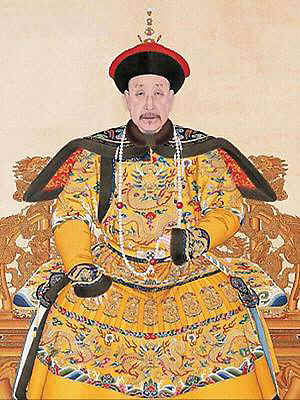
In this passage, I am impressed to see John articulate so early on a theory for why China fell behind that is still taken very seriously by economists: the idea that the top-down nature of the Chinese system under the 1644-1912 Qing dynasty hindered progress. It is worth considering how the end of the 21st century could see a reversal of roles, if the people of China embrace political, intellectual and economic freedom, but top-down control wins out in Europe and its offshoots.