Pranav Krishnan: Fighting European Deflation with Negative Interest Rates

Pranav Krishnan is a student in my my “Monetary and Financial Theory” class. Pranav also has a blog that focuses on the finances of European football. Here is what Pranav has to say about eurozone monetary policy:


There were some positive signs around Europe, where it appeared that Spain’s unemployment rate had bottomed out in late 2013.

Perhaps talk of Europe’s recovery has come a little too early. While there were signs of positive growth in countries like Spain and Italy over the past few months, inflation was very low, and even more so inflation expectations.  David Roman of the Wall Street Journal wrote about a significant deflationary risk in Europe and how officials are expecting the European Central Bank to take the appropriate measures necessary to stem the tide. Josef Makuch, Slovenian Central Bank governor-rightly-feels that deflation could cause even more problems in the long term.

“Several [ECB] policy makers are ready to adopt nonstandard measures to prevent slipping into a deflationary environment,”

It appears that there might be more to this issue, than simply highlighting the risk of deflation.  The article was largely skimming the surface of what could become a wider problem later on.  Demosthenes Tambakis, a professor at the University of Cambridge, wrote for The Economist, outlining his opinion on why the Eurozone is at risk for deflation in further detail,  He points to very low inflation expectations across Europe and that alone increases a risk in deflation.  While he admitted that this risk shouldn’t rise so dramatically based on expectations alone, he does point out a few other institutional design elements that could contribute; Most notably, the European Central bank’s mandate, and the Zero Lower Bound.

The European Central Bank mandate is a bit pedantic in terms of legislature but it can play a role in the eyes of most economists.  The ECB, cites Tambakis, is committed to just below 2%, in contrast to say the Fed who wants to maintain a 2% average over time.  Tambakis believes that this causes an asymmetry which assures everyone that while they do not have to fear runaway inflation, they should worry when prices are too low because the ECB by design would be more reluctant to embark on expansionary monetary policy (increasing the money supply) than they are to contract.  While this point could make some sense in that the ECB might be unintentionally ‘guiding’ people to expecting less inflation in the medium-run and long-run, I would be surprised if this had a serious impact on inflation expectations.  Given the low levels of inflation in Europe, most economists and investors would likely expect lower levels to continue especially with the reduction in German growth rates.

The more likely argument seems to be the one about the Zero Lower Bound.  These risks are determined by the Shiller Index which predicts the long-run frequency of international stock market crashes.  Europe has faced two issues, in that they’ve suffered from the original financial crisis of 2008 and then the individual debt issues that each country faces. So, the natural reaction would be to cut interest rates to stimulate demand, but the Zero Lower Bound in Europe threatens to create a liquidity trap for the Eurozone.   In tandem with the dual mandate language set by the ECB, everyone already has very low expectations of inflation and the inability for countries to set monetary policy and stimulate demand individually threatens to worsen the situation for the Eurozone as a whole.

While there could be some legislation to create a more unified Europe fiscally and financially, the best thing the ECB can hope to do now is if they are going to be rigid about keeping inflation below 2% they should be more flexible about the Zero Lower Bound and allow the interest rate to hover in a broader range of negative interest rates.  The process will be rather painful because inflation expectations could plummet but in the long term, Europe could be better for it and escape the dangers of a long-term liquidity trap.

Robert Shiller: Against the Efficient Markets Theory

On March 26, David Wessel published a very interesting interview with Bob Shiller, “Robert Shiller’s Nobel Knowledge.” This interview gives a reasoned critique of the Efficient Markets Theory.

Ideal Informavores or Lovers of a Good Yarn? To begin with, Bob questions whether it is a reasonable approximation to assume that people acquire information avidly and process that information perfectly:

The story about bubbles was that the markets appear random, but that’s only because markets respond to new information and new information is always unpredictable. It seemed to be almost like a mythology to me. The idea that people are so optimizing, so calculating and so ready to update their information, that’s true of maybe a tiny fraction of 1 percent of people. It’s not going to explain the whole market.

Instead, Bob argues that human beings are avid consumers and tellers of stories:

Psychologists have argued there is a narrative basis for much of the human thought process, that the human mind can store facts around narratives, stories with a beginning and an end that have an emotional resonance. You can still memorize numbers, of course, but you need stories. For example, the financial markets generate tons of numbers—dividends, prices, etc.—but they don’t mean anything to us. We need either a story or a theory, but stories come first.

Can You Earn Supernormal Returns? A failure of Efficient Markets Theory suggests that there should be some way to obtain above-normal returns. But Bob cautions that believing that you personally can earn above-normal returns in the stock market is a little like believing one can win American Idol: definitely true for someone, not likely to be true for you:

The question is often whether it’s possible for anyone to pick stocks, and I think it is. It’s a competitive game. It’s like some people can play in a chess tournament really well, but I’m not recommending you go into a chess tournament if you are not trained in that, or you will lose. So for most people, trying to pick among major investments might be a mistake because it’s an overpopulated market. It’s hard. You have to be realistic about how savvy you are.

By contrast, if you want to try your hand at investing in a market where you have less competition as an investor, you have a better chance, with a lot of hard work:

But if you are thinking about buying real estate and renting it out, fixing it up and selling it, that’s the kind of market that’s less populated by experts. And for someone who knows the town, that’s doing business, I’m not going to tell someone not to do that.

Can Bob Shiller Earn Supernormal Returns? Bob does think that he can pick stocks. The key for him is to pick boring stocks:

Well, I actually think I’m smart enough to pick winners. I’ve always believed in value investing. Some stocks just get talked about, and people pay all sorts of attention to them, and everyone wants to invest in them, and they bid the price up and they are no longer a good buy. Other stocks, they are boring. There is no news about them—they are making toilet paper or something like that—and their price gets too low. So as a matter of routine, you buy low-priced stocks and sell high-priced stocks.

I think of “pick boring stocks that have a present value that can be easily calculated” (and of course only those that are undervalued according to that calculation) as Warren Buffett’s strategy as well.

Can You Succeed at Contrarian Market Timing? The one thing I would add here to what Bob says is this about market timing. Some of Bob’s work, some of it joint with John Campbell, suggests that contrarian market-timing can be a good idea. In particular, their work suggests increasing one’s stock holdings when the price/dividend ratio is low and reducing one’s stock holdings when the price/dividend ratio is high. (Bob has also used the ratio of price to cyclically adjusted earnings or smoothed earnings as a way of gauging if the market is high and likely to fall or low and likely to rise.) I believe this works and try to do it myself. But it is hard to do without a contrarian personality. What makes the market too high is that some story is making people optimistic about the market–a story that is likely to infect you as well; what makes the market too low is that some story is making people pessimistic about the market–again a story likely to infect you as well. So doing any market timing subjects you to the danger of succumbing to the stories out there that, because most other people are succumbing to them at the same time, will make you likely to buy high and sell low. It is only if you naturally like stories other people don’t like and dislike stories that they like that you can be a contrarian investor without great intellectual and emotional self-discipline.

Update: There were many great comments on the Facebook version of this post. The discussion with Robert Flood I am making into the post for Friday, April 18. Let me put the key elements of my discussion with Dennis Wolfe and Richard Manning here:

Dennis Wolfe:  Miles – enjoyed both your post on Saturday and this one – and I tend to believe both, especially Shiller’s points. Have you seen the whitepaper “Capital Idea: The active advantage can help investors pursue better outcomes”? The paper was published late last year by The American Funds to make a their case for active investing over passive investing. Their paper presents strong evidence that some investment managers have a proven model and track record of persistent above average results over rolling periods of time. John Rekenthaler (The Rekenthaler Report), a researcher at Morningstar, published results of a similar study last summer comparing American Funds with Vanguard index funds (The Wrong Side of History; The Horse Race) with similar conclusions. After considering Shiller’s thoughts and the evidence outlined by American Funds and Rekenthaler, I am much more persuaded against the efficient markets theory. I’d be interested in your thoughts.

Miles: The theory is pretty clear that if there is any departure from the efficient markets theory, most people (or people holding a majority of the risk-tolerance weighted money) have to be getting it wrong. Thus, believing that the efficient markets theory is not right makes me *more* skeptical of active investing. When most investors are getting it wrong, one would have to be doing something unusual to be getting it right.

Dennis: 

Thank you, Miles. Active management, the argument goes, is unable to outpace a respective index because of the efficient-market hypothesis.

From the Capital Group whitepaper:

Those who adhere to that theory contend, in brief, that all information is reflected in a firm’s share price, making it impossible to beat the market consistently. But much of the literature in favor of index investing uses “the average active manager” to make the point. And indeed, in aggregate, U.S. equity active managers have not consistently outpaced the Standard & Poor’s 500 Composite Index. …

We believe this is a flawed way to frame the issue, akin to concluding that because the

average person cannot dunk a basketball, no one can dunk a basketball. Obviously,

some are playing at a higher level, and using the average to characterize an entire

industry obscures the fact that there are investment managers that have consistently

added value over a variety of market cycles,

Both studies I referred to in my earlier post demonstrate there are investment managers that have consistently added value over a variety of rolling time periods and market cycles - that is more than talk show chatter. I think it’s important to focus on the qualities associated with success like the contrarian and fundamental value points discussed by Robert Shiller but also including low fees, experience and global research.

While I certainly believe someone like you or Robert Shiller are capable of consistent success, I am skeptical the average person can consistently produce above average results on their own, especially since the average professional investment manager apparently does not (at least after fees). However, I don’t believe that proves the efficient market theory. When there is evidence investment managers that focus on disciplined qualities of success do consistently produce above average results after taxes and fees, then I believe the efficient market theory is hollow. And, If they do it, an average investor can still indirectly succeed by adopting their model by using their funds.

Miles: I am more drawn to the fact that since so many people invest so much money through professionally managed funds, most people putting their money in the hands of professionals must also be doing it wrong, so letting a professional handle one’s funds is no panacea. And that is before paying significant fees, which makes the mistake much worse. The advantage of putting money in low-fee index funds (my Fidelity Spartan accounts have a 0.1% annual fee) is that there is a bound on how far wrong one can go if one comes as close as possibility to holding the universe of accessible risky paper assets in proportion to market capitalizations. The only way to do better than holding a broad set of low-fee index funds is to do things that most investors don’t do when they try to go beyond that. And most investors are more like most investors than they think.  

Dennis:Miles, thank you, again, I appreciate your honest, objective thinking on this and the comments of Robert Flood. I must admit It is more difficult for me to completely understand this issue from economist’s point of view without that background. As a practicing CPA and now CFP, I often think about this practical issue for my clients and want to learn as much as I can, including how to sort through the intense marketing claims from both sides that cloud it. Since moving to the full time practice of financial planning about 14 years ago, I have been most influenced by the principles and work of Benjamin Graham, Burton Malkiel and Charles Ellis. My experience is few investment firms put clients’ interests central to their process and approach. I believe most are simply “commercial” and this is the main reason people are attracted to low cost index funds - not because of the efficient markets theory. In other words, I believe some people will (perhaps should) accept a C rather than seek an A or B when doubt or lack of trust exists. Despite the trust issues that exist in the financial services industry, I believe we should not ignore those firms whose processes consistently produce above average results, after fees and taxes, over rolling periods of time and market cycles. They do exist. However, where doubt exists and as a hedge, I am also also inclined to sometimes use low cost index funds or ETFs for myself and for clients.

A few other thoughts: I generally believe equity markets are more efficient in the U.S. than outside the U.S. - and the evidence is appears overwhelming in that space by objectively examining results. I also believe markets are more efficient for large companies over small and mid-size companies where quality proprietary research seems to yield comparatively better results. And finally, to Shiller’s point, I also believe inefficiency exists because most of us are attracted to interesting stories over “boring” stories. In summary, I continue to be persuaded there is room (given the right process that also puts an investor’s interest central) to produce consistent above average results over time. At the same time, I agree with you that most investors (including me) are more like most investors than we want to admit.

Richard Manning Whether Schiller or others believe the market is technically efficient or not on a moment by moment basis the practical advice for the vast majority is the same: buy and hold a diversified portfolio. No? So why the fuss?


John Stuart Mill: Strong Feelings Strongly Controlled by a Conscientious Will

Although I have been Associate Chair for Administration and Director of our Master of Applied Economics Program, I am saved from some of the more onerous leadership and decision-making roles within my department because I am considered a bit unpredictable and a bit too much outside valued boxes. (There is also a tendency to consider someone who has a generally has a positive outlook on people and situations as a less serious person.) In On Liberty, Chapter III: “Of Individuality, as One of the Elements of Well-Being,” paragraph 16, John Stuart Mill extols the virtues of being, in modern slang, a bit of a “loose cannon” and a bit of an “Energizer Bunny”: 

As is usually the case with ideals which exclude one-half of what is desirable, the present standard of approbation produces only an inferior imitation of the other half. Instead of great energies guided by vigorous reason, and strong feelings strongly controlled by a conscientious will, its result is weak feelings and weak energies, which therefore can be kept in outward conformity to rule without any strength either of will or of reason. Already energetic characters on any large scale are becoming merely traditional. There is now scarcely any outlet for energy in this country except business. The energy expended in this may still be regarded as considerable. What little is left from that employment, is expended on some hobby; which may be a useful, even a philanthropic hobby, but is always some one thing, and generally a thing of small dimensions. The greatness of England is now all collective: individually small, we only appear capable of anything great by our habit of combining; and with this our moral and religious philanthropists are perfectly contented. But it was men of another stamp than this that made England what it has been; and men of another stamp will be needed to prevent its decline.

Update: On the Facebook version of this post, David Yves offers this comment:

“Do not fear to be eccentric in opinion, for every opinion now accepted was once eccentric.” -Bertrand Russell. If only we didn’t have to fear.

Dimitry Slavin: U.S. Stocks Are Not in a Bubble and Here’s Why

I am quite skeptical of attempts to predict where the stock market overall will go, beyond looking at something like the price/dividend ratio or cyclically adjusted price/earnings ratio a la John Campbell and Robert Shiller, and recognizing moments of market overreaction to geopolitical events. But among those who nevertheless attempt (perhaps foolhardily) to predict, I want to put my “Monetary and Financial Theory” student Dimitriy Slavin in contention. (You can see his Flickr page here, and his LinkedIn page here.) What Dmitriy says sounds at least as sensible to me as others who claim to be able to predict what the market will do–including those with outsized reputations. I’d be interested to hear what people think of his analysis:


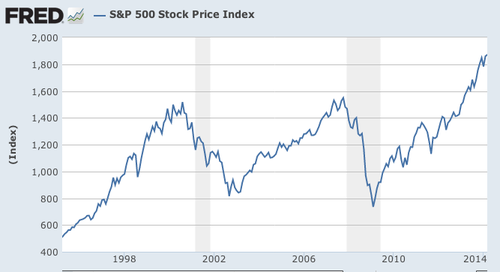
If you take a look at the S&P 500 Stock Index for the past twenty years, you will notice a clear cyclical nature to it- it seems to undergo a cycle about every seven years, with a roughly 5 year period of growth and then a two year period of decline. Five and a half years out of the Great Financial Crisis with the Fed rolling back QE and the S&P index reaching an all time high, some investors are worried that U.S. stocks may be in yet another bubble. In my next two posts, I am going to argue that this is not the case…at least for now.

This weekend I read two interesting documents that have convinced me that it is unlikely we will see a dramatic fall in the S&P anytime soon: JP Morgan’s latest edition ofQuarterly Perspectives and BlackRock’s 2014 Investment Outlook. I will split up my argument into three pieces: (1) Peaks in Stock Prices Vs. Peaks in the Output Gap, (2) Correlation Between the Rise in Stock Prices and the Rise in Corporate Profits, (3) The EV/EBITDA to VIX ratio.

1.    Peaks in Stock Prices Vs. Peaks in the Output Gap

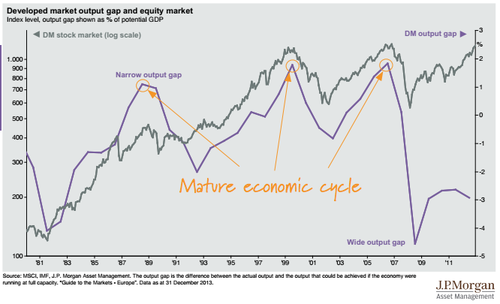
One thing that has characterized past asset bubbles is that they generally tend to coincide with peaks in the economic cycle. As we’ve discussed in class, an economy can’t operate above full capacity for long periods of time, so at some point output must fall. In the past, these falls in economic output have occurred at roughly the same time when the stock market fell:

But as you can see by the graph above, the present case is quite different from the past. The output gap is nowhere near a peak right now, and most would agree that the U.S. economy is still in recovery mode from the financial crisis. This recovery has taken much longer than past recoveries from recessions, and has been characterized by slow initial growth, rising incomes, and slowly falling debt burdens. This slow growth coupled with the current negative output gap is a good sign that the U.S. stock market is not on the cusp of another asset bubble.

2.    Correlation Between the Rise in Stock Prices and the Rise in Corporate Profits

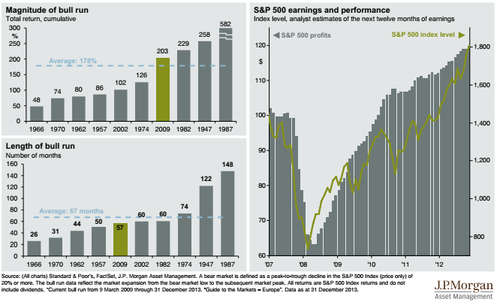
One thing that characterizes practically all asset bubbles is an unjustified surge in stock prices. What I mean by ‘unjustified’ is that people begin to ignore fundamental analysis and start buying up stocks simply because their price is rising, much like what happened during the Tulip-Bulb Craze we read about in Malkiel’s Random Walk Down Wall Street. In contrast, the recent rise in stock price has not been unjustified because stock prices have been rising along with corporate profits:

blog.supplysideliberal.com tumblr_inline_n3wbefD5FF1r57lmx.png

This positive trend gives credence to the argument that investors are not simply building ‘Castles In the Air,’ and rather are basing their investments in sound fundamental analysis. Something to watch out for though is the growth rate of corporate profits versus that of stock prices. I would argue that it is somewhat worrisome that the growth rate in profits for the past three years has been smaller than that of stock prices, and could potentially be a sign that the U.S. stock market will be overvalued in the future. For now though, the difference in growth rates is both tolerable and reasonable.

Taking a look at the left side of the graphic above, we also see that the length of the current bull run is just below the average of past bull runs, yet its return has been slightly higher than average. Roughly average returns + a typical duration time further justify the point that the current bull run on U.S. stocks is not forming an asset bubble.

3.    The EV/EBITDA to VIX ratio

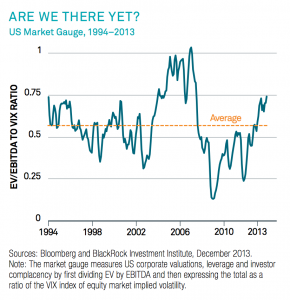
The final part of my argument has to do with a common market indicator- the EV/EBITDA ratio- a tool that gives a measures of US corporate valuations, leverage, and investor complacency by dividing enterprise value (EV) by earnings before interest, taxes, depreciation, and amortization (EBITDA). This ratio is then divided by the stock market volatility index in order to measure investor complacency.

BlackRock’s 2014 Investment Outlook provides a solid interpretation of the above graph:

The ratio of the [the EV/EBITDA and the volatility index] is the key. High valuations combined with low volatility can make for a lethal mix. This market gauge sounded the alarm well before the financial crisis…[Today,] valuations are roughly in line with their two-decade average (and leverage is lower). Yet volatility is hovering just above two-decade lows. The result: The market gauge stands well above its long-term average,but is far short of its pre-crisis highs.

The main point the above graph and discussion make is that although we may be seeing early signs of the formation of an asset bubble, it is not expected to form in the imminent future. It also gives further weight to the argument that corporate earnings need to start rising faster if the economy is to avoid a bubble in the future because a rise in earnings would drive the EV/EBITDA to VIX ratio down (assuming volatility stays low).

In summary, I have laid out a three-pronged argument for why I think the U.S. stock market is not experiencing an asset bubble. A wide output gap, a close correlation between earnings growth and stock price growth, and a reasonably small EV/EBITDA ratio tells me that the U.S. economy is not on the cusp of another bubble. Furthermore, I am generally in agreement with Ray Dalio’s claims (mentioned in some of my previous posts, here and here; the first post examines the long term debt cycle and the second elaborates on the last stage of the cycle- the reflationary period) when he asserts that we are currently in the reflationary period of the long-term debt cycle. Consequently, I expect the economy to make a full recovery in the next couple of years: QE tapering will continue, interest rates will rise slowly but steadily, and both corporate earnings and income growth rates will rise, further dispelling doubts of a possible bubble. With all this in mind though, I think it’s important to keep a close watch on the indicators I discussed throughout this post because they provide a good summary for the state of the U.S. stock market.

Update: Robert Flood notes on Facebook:

Just for the record, the Tulip Bulb Craze (1636) was for fixed-date forward bulb prices not spot. I’m not sure what bubbles you are talking about here - no definition - but I’m real sure you are not studying one in some fixed-date forward/futures price.

Christina Romer: After A Financial Crisis, Economic Disaster Is Not Inevitable—Bonnie Kavoussi Reports

Bonnie Kavoussi worked for Huffington Post before coming to the Master of Applied Economics program at the University of Michigan that I wrote about last week. Bonnie now has her own blog, where Bonnie reports on Christina Romer’s very interesting talk at the University of Michigan on Tuesday (including an embedded video of the talk). The bottom line is that both of Carmen Reinhart and Ken Rogoff’s big claims in the last few years have been called into serious question:

  • Along with many others (many of whom we link  to in our follow-up column here), Yichuan Wang and I found no evidence in Reinhart and Rogoff’s data to support their claim that higher national debt lowers the rate of economic growth.
  • As Bonnie reports, and as I can verify from my own attendance at the talk, Christina Romer and David Romer question, on solid grounds, Reinhart and Rogoff’s claim that financial crises lead with high probability to a relatively intractable, long-lasting economic downturn.  

Mormon Hell Tweets

Yesterday I posted my favorite song from the musical “The Book of Mormon”: the very moving “Sal Tlay Ka Siti.” The title of the storified tweets linked from the title above is inspired by another, much campier, song from “The Book of Mormon”: “Spooky Mormon Hell Dreams.” The tweets themselves are about Noah Smith’s guest post “Mom in Hell.”

By the way, it is worth listening to the song “Sal Tlay Ka Siti” here and then reading “Mom in Hell” again with “Hell” replaced with “desperate poverty abroad” and “Heaven” replaced by “America.”

The Message of ‘Sal Tlay Ka Siti’

To folks in desperate poverty around the world, America is heaven on earth. Maybe we should let people into heaven.

I saw the musical “The Book of Mormon” in London with my family during the week I went to the Bank of England to talk about eliminating the zero lower bound (and wrote A Minimalist Implementation of Electronic Money  and How to Set the Exchange Rate Between Paper Currency and Electronic Money).

To me, the most moving and powerful song was the one above: “Sal Tlay Ka Siti.” Though Salt Lake City is a very nice city, the song is really about America and what America means to people in other countries much poorer than ours. I hope you take time to listen to the song and think about its message. Here is the link to the video above that has the lyrics and audio for the song Sal Tlay Ka Siti from the play. But you can watch it right here. (The music starts about 15 seconds in.)

Note: my column “The Hunger Games is Hardly Our Future: It’s Already Here” has the same message. I think you will like it. I also put out a couple of tweets about immigration on Monday morning while reading the Wall Street Journal article “Jeb Bush to Decide by Year-End Whether to Run for President”:

Noah Smith: Mom in Hell

This is a guest post by Noah Smith. 


How can you be happy in Heaven while your mom is in Hell?

In his famous 1741 sermon, “Sinners in the Hands of an Angry God”, Jonathan Edwards said:

There will be no end to this exquisite horrible misery. When you look forward, you shall see a long for ever, a boundless duration before you, which will swallow up your thoughts, and amaze your soul; and you will absolutely despair of ever having any deliverance, any end, any mitigation, any rest at all. You will know certainly that you must wear out long ages, millions of millions of ages, in wrestling and conflicting with this almighty merciless vengeance; and then when you have so done, when so many ages have actually been spent by you in this manner, you will know that all is but a point to what remains. So that your punishment will indeed be infinite.

Now, in a time when most people still lived lives of poverty and hardship, florid language like that was probably necessary just to get people to pay attention in church. But the sermon illustrates something that I’ve never really understood about Christianity - the idea of Hell.

In the Christian concept of Hell, if you believe in Jesus (and in some denominations, maybe satisfy a few other requirements), you go to Heaven, and if you don’t believe in Jesus, you go to Hell. So in Christianity, it’s perfectly possible for you to be in Heaven while your mom is in Hell, experiencing all the nasty stuff that Jonathan Edwards describes.

Now, a Christian will tell you, we don’t know who will go to Heaven and who will go to Hell. But after you die, you must surely be able to know. If you’re in Heaven, and you want to say hi to your mom, you can just look her up. If she’s in Heaven with you, you should be able to easily find her, using whatever version of the white pages exists in Heaven. If you can’t find her, you will know by process of elimination that she must be in Hell.

So, you’re supposed to be happy in Heaven, right? But suppose your mom goes to Hell. How can you be eternally happy, knowing that your mom is experiencing eternal torment?

Maybe Heaven changes you. Maybe once you go to Heaven, you don’t mind if your mom is in Hell. But that would be a really big personality change, right? I think that if I became someone who didn’t mind my mom suffering eternal torment, I wouldn’t really be me anymore. It would be someone else in Heaven, and I’d just be gone.

Now, a Christian believer in Hell might respond, “What’s to understand? If you go to Heaven and your mom goes to Hell, then you’re just going to have to deal with it.” But in that case, the idea that Heaven is a place where you’re happy forever has got to be tossed out the window.

So I just don’t understand how the Heaven/Hell system works. If people only cared about themselves, then it would make sense, but we care about other people too. And it’s just flat-out impossible for most people to be totally happy while knowing that someone they love is being tortured eternally in the most horrific concentration camp in the cosmos. But according to Christianity, that situation is perfectly capable of happening.

I just don’t get it.


Don’t miss Noah’s other guest religion posts:

  1. God and SuperGod
  2. You Are Already in the Afterlife
  3. Go Ahead and Believe in God

For other religion posts, see my Religion, Philosophy, Humanities, Science Fiction and Science sub-blog.

Update: David Beckworth tweets this very interesting video from a Christian ministry making trenchant arguments from within the Christian tradition against the picture of hell that Noah is attacking.

Yuan Tian: Will the Real Estate Bubble Burst in China?

In this guest post, Yuan Tian, a student in my “Monetary and Financial Theory” class, discusses one of the most important dangers the world economy now faces: a possible collapse of housing prices in China, with unknown effects on China’s banking system. Here is what Yuan has to say: 


It’s always a hot topic among Chinese people to talk about real estate prices. The bubble has become bigger and bigger since the 1990s. Of coruse, a bubble is an unsustainable rise in the price of an asset, well above the market price given fundamentals. A bubble is indicated by three signs: a gap between disposable income and home prices, rising inventory, and a rising number of properties per person.

In a way that would be hard to imagine for Americans, in the current real estate situation the majority of Chinese people still can’t afford a house after working hard for a lifetime. China’s real estate prices have been changing in dramatic ways: prices soaring in the past, and now perhaps an environment of declining prices. That is the question: will the real estate bubble really burst in China?

Optimists insist that the prices won’t decrease a lot due to the large population and demand in China. They also mentioned that right now in the bubble, China’s residential mortgage debt is only 15% while in the U.S. borrowing 80% of a house’s value is considered conservative.

Pessimists don’t think so. They are arguing that as China’s financial market matures, people might be less likely to purchase houses because they will have more other investment options.

As for population growth, statistics show that the population will reach the peak in 2018 and labor force will shrink starting in 2015. Thus people predict that the property prices will start to fall between 2017 and 2018 thanks to the “one child policy” and China’s aging population composition. According to this information, pessimists predict a 40% decrease in the next five years since there will be fewer people willing to purchase a house but the supply is still large. Anther great concern, that I take very seriously, is the possibility of falling dominoes. Once the supply is bigger than the demand, real estate companies will face a money chain rupture. They will have to decrease the price to attract more buyers and save the company.

If there is a crash, it could cause a financial crisis like the United States faced in 2008. In the US, housing prices declined steeply after peaking in mid-2006, and it became difficult for many borrowers to refinance their loans. As adjustable-rate mortgages began to reset at higher interest rates (causing higher monthly payments), mortgage delinquencies soared. Securities backed by mortgages, including subprime mortgages, which were widely held by financial firms globally, lost most of their value. Global investors tried to drastically reduce their holdings of mortgage-backed debt and other securities, and there was a decline in the capacity and willingness of the private financial system to support lending. Concerns about the soundness of U.S. credit and financial markets led to tightening credit around the world and slowing economic growth in the U.S. and Europe. 

To save the market, right now Chinese government is trying hard to come up with policy interventions. Let’s have a brief look at China’s housing industry changes and government policy responses in recent years.

Before 2003, as part of fostering economic growth in China’s, the Chinese government regulated and supported the under-developed housing market. From 2000 on, there was no more government housing allocation in China and people had to purchase houses through housing companies. After that, the government enacted a series new rules and regulations such as lower mortgage rates, reduced down payments, and lower transaction fees to further stimulate the housing industry.

Then in 2002, the Public Land Building System was enacted. Following in 2004, all lands started to be put up for auction. It was around that time that housing prices began to rise. From 2004 to 2006, with Chinese government encouraging housing sales and offered many benefits to the housing industry as well as fostering economic growth more generally. Prices of houses rose a lot not only in big cities but also in small inland cities. Construction boomed rapidly during this period.

In 2005, in response to the increasing prices, “Eight Rules,” “New Eight Rules” and “Opinion of Such Departments as the Ministry of Construction on Effectively Stabilizing House Prices” were enacted, marking the central government’s first efforts to rein in home prices. But the trend was hard to stop. For example, over the course of the one year, 2005, average housing prices in Beijing increased by 20%, while the price had increased only 0.78% from 2000 to 2004. The bubble has only gotten worse since then, despite the government’s efforts to stop it. 

Later in 2010, China posted the “Notice of the State Council on Resolutely Curbing the Soaring of Housing Prices in Some Cities”  to require a down payment on second homes from 40% to 50%. In addition, banks must charge a minimum mortgage rate on second homes of 1.1 times the benchmark interest rate, and increased down payments on first home larger than 90 square meters from 20% to 30%. Then in 2011, China had “National Eight” real estate market regulations. On the other hand, Chinese government has started the property tax pilot program–a program I think is pretty useful. The program asks for higher property taxes for those who own more houses in China. It has been in place in Shanghai and Chongqing since 2011. 

Prices might be controllable in the future by government policies. So far, recent policies have not been given deadlines. In the short run, there may be volatility due to uncertainty. 

Though we can’t know when the bubble will burst, the recent situation in China gives some ominous portents. According to the Securities Times newspaper, housing developers in the industrial city of Hangzhou cut prices this week by an average 19% in a scramble to sell about 120,000 newly-built apartments. The current inventory of new, unsold units now exceeds the total number of housing units offered for sale in Beijing and Shanghai combined. A study by Shanghai’s Tongji University said real estate has been especially shaky in the northeastern city of Wenzhou, where new-home prices have fallen every month for the last two years. 

My view is that the housing bubble will burst in near future–or may now be in the process of bursting.

Yuan Tian

Yuan Tian

Matt Ridley, Michelle Klein and Rob Boyd on Population Size and Technology: Why Some Islanders Build Better Crab Traps

In this ungated Wall Street Journal article, Matt Ridley gives a nice report on research by Michelle Klein and Rob Boyd on the idea that higher effective population size leads to better technology.  The important idea that higher effective population size leads to better technology is also reflected in

On Master's Programs in Economics

With the large demand for graduate education in economics by Chinese students, many economics departments have recently established terminal master’s programs in economics, or are seriously considering doing so. (A terminal master’s program is one that is separate from the PhD program and typically does not lead to a PhD in the same department.) I was Director of the Master of Applied Economics (MAE) Program at the University of Michigan from July 2010 to December 2012, so I wanted to share some thoughts about master’s programs in economics.

The University of Michigan Master of Applied Economics Program. The MAE program at the University of Michigan was well-established long before I arrived as an assistant professor at the University of Michigan in 1987. The composition of the student body has shifted over the years, but the basic nature of the program has not. Our MAE program is very flexible. The formal requirements can be found on the MAE website, but a surprisingly close approximation to the requirements is that there are 5 semester core courses, and then an additional 6 courses that in practice can be almost anything suitably advanced. (There is no master’s thesis in our MAE program.) Students greatly value this flexibility. Here are some examples of different categories of students in our MAE program:

  1. Mid-career government officials who come to increase their knowledge of economics and their skills before returning to government service.  For example, in 2012 we admitted employees of the Central Banks of Japan, Korea, Turkey, Mexico, and Chile, and employees of other government agencies in Afghanistan, Pakistan, Kazakhstan, Korea, Japan, Singapore, Indonesia, Thailand, and China.
  2. Dual-degree students in other programs at the University of Michigan who realize the value of learning more economics.  For example, in 2012 we had dual degree students who were also pursuing a degree in Public Policy, Financial Engineering, MBA and PhD from the Ross Business School, Kinesiology, Urban Planning, Natural Resources, Psychology, Statistics, Education, Health Services Organization and Policy, Industrial and Operations Engineering.
  3. Students who have recently received a bachelor’s degree who hope to prepare for a career in government service, including service in international organizations such as the World Bank and the IMF.
  4. Students who have recently received a bachelor’s degree who hope to prepare for a career in finance.
  5.  Students who tried and failed to get into a Ph.D. program who need a way to further their economics training while they figure out what to do next in their lives if their plan of getting a Ph.D. looks impossible.
  6. Students who belatedly realized their interest in economics and want to switch into economics from another discipline.
  7. Students with a wide range of other objectives.  Here is a list drawn from admittees this year: (a) more analytical rigor to further a business career, (b) understand economics better after having been an economic reporter, (c) get a job in a think tank, as a consultant, as an economic analyst, or in an NGO, (d) understand the art market better, and (e) have a better chance of success as an entrepreneur or running a company.

Most students can easily complete the program in 3 semesters, though a large minority choose to stay 4 semesters, given the attractions of being in our program and being in Ann Arbor. The 5 core courses are all specially designed for the MAE students. They are:

  • Math for Economists
  • Microeconomics
  • Macroeconomics
  • 2 Semesters of Econometrics

For their other 6 courses, MAE students fan out to a wide variety of courses. With a few exceptions, the number of MAE students in any one course they take as an elective is so few that they can easily be accommodated. These electives are all classes that would exist even if we didn’t have an MAE program. For example, MAE students take many advanced undergraduate economics classes. Our advanced undergraduate classes are at the right level for most MAE students, given how rigorous our undergraduate program is. But MAE students also take many classes from other departments and schools within the university: math classes, statistics classes, public policy classes and business school classes. (The University of Michigan has modest transfers between units to compensate units for doing part of the education having students from other schools in their classes. These are sufficient that other units don’t mind having our MAE students in their classes.)

Preparation for PhD Programs? One of my biggest surprises when I became the Director of our MAE program was learning how small our role is in preparing students for PhD programs. As the examples I gave above, the bulk of our students had other goals. Indeed, the modal goal was to do something much like an MBA, but with less networking and more economic rigor. For those students who did want to go on to a PhD program, I had to tell them that our MAE program had no special magic in that regard. Noah Smith and I give our advice about getting into economics PhD programs in “The Complete Guide to Getting into an Economics PhD Program.” But getting a master’s degree is not a key component of that advice. I would be interested in the placement results of other master’s programs into PhD programs, but I felt lucky when we had a handful of our MAE graduates accepted into PhD programs. (Some PhD programs give a preference to graduates of their department’s master’s program. Michigan’s PhD program does not. So I am talking primarily about admission to the PhD programs of other universities.)

Resource Cost: What this means is that the incremental faculty resources needed to keep our MAE program going are only the equivalent of fielding 6 classes: the 5 core classes, plus 1 course worth of administrative time on the part of the Director. In addition, there is a staff coordinator (who has some other non-MAE duties in the department as well). Our MAE program also spends a few hundred dollars a year on parties. (My main innovations as Director of the program were aimed at fully integrating the MAE students into our department socially and making sure they interacted with one another socially as well.) That is about it.

I wish we had more resources devoted to career counseling for MAE students. I think the extra resources that would be needed are quite reasonable in magnitude. There have been discussions in our department about doing exactly that. Also, we have had discussions about adding one elective specifically for MAE students directed at research.

Demand for Master’s Programs: I was amazed at the quality of the applicants to our MAE program. And it isn’t just the grades and test scores. The essays are heartfelt and impressive as well. Of the students we admitted, about 1 in 3 came to our program the first year I did admissions, and almost 1 in 2 came to our program the last year I did admissions. The overwhelming bulk of our applicants (75% or so) were from China. Yet we had no problem in filling out our MAE classes with good students even back in the days when China did not yet believe in students getting an education in Neoclassical economics. So the demand of students for an education in our MAE program far exceeds the number of slots we have. If we were a regular business, we would expand much more than we have. But elite universities remain elite by restricting the supply of spaces in their programs. And the elite reputation of a university spills over from one department to the next. So we are not allowed to expand our program beyond a target of about 50 students in each entering class. I suspect some other economics departments face similar constraints. To the extent existing master’s programs do not expand to meet the demand, it makes sense for additional departments to set up master’s programs.

Conclusion: My main piece of advice to economics departments thinking of setting up a terminal master’s program in economics is to consider the University of Michigan’s low-overhead model of running its MAE program. This is not just a matter of money. Staffing requires also finding faculty who meet our high standards. So programs that rely on larger increments of faculty time are likely to run into staffing headaches that go beyond just needing to pay the salaries.

It actually takes people coming along and saying ‘That’s not so good.’ Those are the people that elevate you artistically and creatively. So the ‘No’ can be a really beneficial thing for artists.

– Keith Urban, on American Idol (during the episode for the 13th season auditions in Detroit, aired January 22, 2014)

John Stuart Mill: Against Enforced Moderation

I have always thought of moderation as a good thing, but John Stuart Mill is willing to take the contrary position and argue against moderation if moderation is imposed by someone else. Here is what he says in On Liberty, Chapter III: “Of Individuality, as One of the Elements of Well-Being,” paragraph 15:

There is one characteristic of the present direction of public opinion, peculiarly calculated to make it intolerant of any marked demonstration of individuality. The general average of mankind are not only moderate in intellect, but also moderate in inclinations: they have no tastes or wishes strong enough to incline them to do anything unusual, and they consequently do not understand those who have, and class all such with the wild and intemperate whom they are accustomed to look down upon. Now, in addition to this fact which is general, we have only to suppose that a strong movement has set in towards the improvement of morals, and it is evident what we have to expect. In these days such a movement has set in; much has actually been effected in the way of increased regularity of conduct, and discouragement of excesses; and there is a philanthropic spirit abroad, for the exercise of which there is no more inviting field than the moral and prudential improvement of our fellow-creatures. These tendencies of the times cause the public to be more disposed than at most former periods to prescribe general rules of conduct, and endeavour to make every one conform to the approved standard. And that standard, express or tacit, is to desire nothing strongly. Its ideal of character is to be without any marked character; to maim by compression, like a Chinese lady’s foot, every part of human nature which stands out prominently, and tends to make the person markedly dissimilar in outline to commonplace humanity.

Chenrui Gao: It's Time to Let Direct Selling Disrupt Our Expensive System of Car Dealerships

I am very proud of the writing of the students in my “Monetary and Financial Theory” class. I ask them to write three blog posts a week. Here is a great one, from Chenrui Gao:


After a long period of fruitless lobbying efforts, Tesla Motor, a public electric car manufacturer, decidee to stop selling its luxury vehicles in New Jersey because the state doesn’t allow it to sell cars directly to consumers. Besides Texas and Arizona, the New Jersey government stands firmly with the dealers and made itself the third state to ban direct sales. Tesla’s mistrust of dealers and its strong faith in directing selling motivates its defense for manufacturer sales. However, dealers afraid that the directing selling could spread to other manufacturers are resisting Tesla’s plan resolutely. The heated discussion between the manufacturer and the state government once again brings back the issue of whether manufacturer sales should be banned or not. I want to argue that manufacturer sales should become an available option because it could benefit both manufactures and consumers.

First of all, manufacturer sales could become a very effective cost-cutting measure. If the manufacturers could avoid the cost of distributing cars to dealers all over the country and accept orders direct from consumers, the vehicle price could be significantly lower. Research by Gerald Bodisch indicates that the cost of the auto distribution system in the United States averages up to 30 percent of the car price. We know form the last financial crisis that General Motors and Chrysler suffered a lot and received 17.4 billion dollars in loans under the Troubled Asset Relief Program. They need effective plans to improve their financial performance and earn more profit. These companies could cut distribution costs by reducing the number of dealers from 6200 to 4100. Also, the build-to-order model could save much of the money spent on storage for products, adding to profitability. According to other research, the total value of new car inventory held by 20700 car dealerships in 2008 was about 100 billion dollars and the annual carrying cost of that inventory was estimated as 890 million dollars. GM started to use this method to produce Celta in Brazil eight years ago and now the Celta is one of the sales leaders in the local market.

Moreover, sometimes it is necessary to let manufactures sell their products directly so that the consumers can have better service. For example, some high-tech vehicle manufacturers like Tesla would do better at explaining their products than dealers who barely know about the functions by studying the instructions themselves.

Some might argue that the Auto Franchise System enforced by most of the states historically benefits manufactures because it helps them focus on developing and producing cars. And they might say dealers do better at assessing and fostering consumer demand than manufactures. However, those arguments assume that the production of a type of vehicle large-scale and that the demand for them is enormous, otherwise a national-wide distribution of dealers is just a faster way to increase costs. The emerging market of electric vehicles is still in its infant stage, with manufacturers Nissan LEAF, Chevrolet Volt and Tesla all fairly new to electric cars. They need more flexible ways to lower costs and expand the market.

Although the Auto Franchise System may make sense in some situations, manufacturers should be allowed to use another distribution system when that fits the product better. 

Chenrui Gao

Chenrui Gao

Will the ECB Go Negative?

On Wednesday (March 26, 2014), the Wall Street Journal had a remarkable news article by Brian Blackstone reporting on how the European Central Bank might be getting more serious about the idea of negative interest rates: “ECB Mulls Bolder Moves to Guard Against Low Inflation: Officials Indicate They Will Consider Negative Interest Rates, Asset Purchases.” Here are the key passages: 

  1. “We haven’t exhausted our maneuvering room” on interest rates, Bank of Finland Governor Erkki Liikanen, told The Wall Street Journal in an interview in Helsinki. … Asked what tools the ECB has remaining, Mr. Liikanen cited a negative deposit rate as well as additional loans to banks and asset purchases.
  2. Bundesbank President Jens Weidmann, in an interview with news agency MNI, didn’t rule out large-scale asset purchases, known as quantitative easing, as a possibility. He also raised the option of negative deposit rates, though he said he wasn’t talking about any imminent decision.
  3. Mr. Draghi was less specific Tuesday on what the central bank might do. But in a speech in Paris, he sought to underscore the bank’s resolve in fighting excessively low inflation, which weakens consumer spending, business profits and investment. “We will do what is needed to maintain price stability,” … [Mr. Draghi’s] comment was reminiscent of his July 2012 pledge to do “whatever it takes” to keep the euro together. That remark triggered a lasting rally in government bond markets in southern Europe. The ECB didn’t even have to purchase any government bonds—Mr. Draghi’s words were enough.
  4. Faced with a negative, or penalty, rate for parking funds at the ECB, commercial banks might instead lend their excess funds to other financial institutions, lowering short-term borrowing costs. It could also make euro-denominated assets less attractive to global investors, taking some of the froth off the value of the euro, and thereby boosting exports and inflation.One potential downside is that banks might pass along the added costs to customers by raising the interest rates they charge for loans. But Mr. Liikanen signaled he doesn’t think a negative deposit rate would generate unwanted side effects. “The question of negative deposit rates, in my mind, isn’t any longer a controversial issue,” he said.
  5. “The perception has been that [ECB officials] talk about it but won’t do it. I think they’re closer [to making the deposit rate negative] than has been perceived,” said Ken Wattret, economist at BNP Paribas.

The next day (yesterday), Brian Blackstone had another article on the same topic: “ECB Faces Uncharted Waters With Negative Deposit Rate Move Could Encourage Lending and Weaken Euro, Bolstering Exports.” One of the key worries discussed in the article is this:

Critics say negative rates could weaken the already fragile European banking industry by sapping its profits.

“The banks that would suffer the most are those ones with lower profitability,” said Alberto Gallo, head of European credit research at Royal Bank of Scotland. That includes small banks in Cyprus and Slovenia, Italian banks and some German Landesbanken, or public banks co-owned by the savings banks and regional governments, he added.

Banks also may pay less interest to savers and could raise the rates they charge on private loans to recoup their costs.

Here let me say something I say in all of my talks at central banks and their regional affiliates. Once the paper currency interest rate becomes something the central bank can choose, as in what I have proposed (see for example “How to Set the Exchange Rate Between Paper Currency and Electronic Money”) all 4 key interest rates under the central banks control can be moved up and down in tandem:

  1. The target rate (fed funds rate in the US)
  2. The lending rate (discount rate in the US)
  3. The interest rate on reserves or on excess reserves
  4. The paper currency interest rate. 

With all four rates moving up and down in tandem, the spreads between them that matter for bank profits can be kept at normal levels. In particular, reductions in the paper currency interest rate would make it possible for banks to reduce the deposit rates they pay enough that they can make profits even if the rates banks earn on loans are very low, even possibly negative. 

Note also that when people say that the demand by borrowers is low, that is at a zero or positive interest rate. At a low enough interest rate, I guarantee that the demand for loans would be high.  

By the way, I am headed to the European Central Bank this July to explain the details of implementing negative paper currency interest rates along with other negative rates. For modest negative paper currency interest rates, a time-varying deposit fee (on net paper currency deposits by banks bringing paper currency to or withdrawing paper currency from the central bank) should be sufficient to do the trick, even without the other measures I have talked about. I would be truly delighted to have Mario Draghi attend my seminar.   

Update, April 3, 2014:Brian Blackstone and Todd Buell reported on April 3 that the ECB’s discussion of negative interest rateshas the imprimatur of the ECB’s President Mario Draghi:

President Mario Draghi’s revelation that the central bank had discussed negative interest rates and large-scale bond purchases—if needed to keep persistently low inflation from undermining growth—caught financial markets by surprise. …

Mr. Draghi said officials had discussed asset purchases, known as quantitative easing, as well as setting a negative rate on bank deposits parked at the ECB—moves that could help bolster the economic recovery and push up prices. The annual inflation rate in the euro zone is just 0.5%, far below the bank’s target of just under 2%. …

The ECB is “resolute” in its determination to keep its easy-money policies in place, he said, and “to act swiftly if required.”

Brian and Todd have this description of the negative interest rate being contemplated:

A negative deposit rate—it is currently zero—would force financial institutions to pay to park their excess funds at the ECB, which may encourage them to lend more to the private sector. Denmark has deployed negative rates since 2012, but it would be largely unchartered territory for a major central bank such as the ECB.

In the US, this would be called a negative interest rate on excess reserves. For negative interest rates to work best, it is important that other key interest rates also go negative, particularly the paper currency interest rate. 

Note: For more details on how to implement negative rates well, see the links collected in “How and Why to Eliminate the Zero Lower Bound: A Reader’s Guide.”