Chris Chegash: College Athletes Deserve a Better Deal

Chris Chegash is a Junior at the University of Michigan pursuing a degree in Financial Mathematics and Economics. He is a student in my “Monetary and Financial Theory” class. This post was selected (by self-selection and then by me) as a guest post here from 100 or so posts students in the class write each week for an internal class blog.  Here is what Chris has to say:


In a previous blog post, I outlined some reasons showing that the NCAA is more concerned with money, than with their stated goal of provided college athletes with an education.  Since the time of that post, there have been significant developments in several instances of litigation against the NCAA pertaining to the compensation of players, and the commercial rights the NCAA has over its players.  The NCAA’s monopolistic iron-grip over players and their compensation has been eroding for several years through many different pieces of ligation.  In this blog, I will quickly discuss the NCAA, the cases against it, and then outline what might happen as a result of these cases.

The NCAA is a non-profit organization that serves as the organizing and regulatory body for college athletics.  Despite all the criticism leveled against the NCAA, they are an essential organization for keeping college athletics as fair as possible for the hundreds of member schools.  Recently, the NCAA has become bloated with money; in 2010 CBS paid $11 billion over 14 years to broadcast the NCAA tournament, and ESPN agreed to pay $5.64 billion over 12 years to broadcast the College Football Playoff.  While the NCAA reaps record profits while functioning under non-profit status, many poor players struggle to afford the costs of college, even while on athletics scholarships.  Many players claim that the actual cost of college is higher than the combination of tuition, room, board, and books, and that universities cannot pay them enough, due to the rules handed down by the NCAA.

A 2002 suit, White v. NCAA, argued that “restricting a scholarship to the cost of tuition, books, housing and meals was an unlawful restraint of trade because of the billions of dollars the NCAA earned through broadcast and licensing deals”.  The NCAA settled out of court for about $10 million.  A more prominent piece of litigation is O’Bannon v. NCAA, set to go to trial in June, that questions the NCAA’s right to commercial use of player’s likeness to gain financially, even long after the player is no longer a collegiate athlete.  Video game maker Electronic Arts paid $40 million to be removed from the claim as a defendant.  Today, March 17, 2014, another lawsuit was filed against the NCAA by a sports labor attorney who has been highly successful against the major sports leagues.  The suit claims that capping the pay of student athletics, at tuition, room, board, and books is a fixed price agreed upon the NCAA and it’s member universities and is unlawful.  Besides litigation, some college football players have sought to unionize to gain more bargaining power against the NCAA, because currently they are forced to more or less sign their rights away to participate in college athletics.

The argument that athletes are making is powerful.  The NCAA is able to generates enormous revenue; for example in 2011-2012, the University of Michigan football team generated $85,209,247 in revenue, compared to $23,640,337 in costs.  This means that the football team made around $62 million in profit, and with 85 scholarship players that amounts to over $700,000 per player.  Obviously every scholarship player didn’t generate equal revenue, a player like Denard Robinson brought in millions while others brought in almost none.  Since his professional career has yet to materialize, Denard capturing some of that profit he generated seems fair. The point being, Michigan, and many other major football programs would more than be able to compensate players more fully without cutting into their bottom line too much.

The opposition from paying players often comes from schools who believe they are already paying their athletes enough or don’t have the means to pay them more.  A scholarship, and a free education, is enough and athletes should be thankful for the opportunity they have received.  I believe this statement distorts the truth.  Yes, receiving a scholarship is a great opportunity, and is significant payment, but why should school administrators and coaches benefit financially from the revenue generated by football players? Nearly all other industries reward employees for generating revenue and profits via bonuses and commissions, but not college athletes.

The NCAA has vigorously defended this system using the mystique of “amateurism”, but major college athletes are hardly treated like amateurs any more.  Football and basketball players don’t even have to stay long enough to get a degree; the top prospects leave after three years and one year respectively.

There are several systems that could be used to compensate players. One is simply increasing scholarships to the full cost of tuition to cover incidental expenses.  Another would be to set up trust funds for players that take a fraction of the revenue they create and give the players access after they leave (or perhaps they graduate).  Neither of these systems are perfect, but they are better than what exists today.
Q&A on Negative Interest Rates and Having an Exchange Rate Between Electronic Money and Paper Currency

I had an interesting email Q&A about electronic money with a questioner who liked the idea of publishing it here, but asked to remain anonymous. 

Questioner: I just read your article in Slate on electronic money and negative interest rates. One question I had is, if interest rates go negative, what’s to prevent someone from borrowing an infinite amount of money?

For example, if a bank is offering -1% interest on a loan, what’s to stop me from borrowing $1 million, immediately repaying $990,000, keeping $10,000 in profit, and then immediately taking out another $1 million loan and doing the same thing over and over again? Perhaps you could put limits on the amount of money a single person could borrow, but it seems the limits would need to be much higher for corporations, and anyone could start dozens of corporations. It seems ripe for abuse. What’s to prevent this from happening?

Miles: Just like savers have to wait to get the benefits of positive interest rates, borrowers have to wait to get the benefits of negative interest rates. I would have to wait until a year later to have the $1 million I borrowed shrink to $990,000. What is also important, no one will give me a negative interest rate long term. They will only give me a negative interest rate for a few quarters during a serious recession. So I can’t just wait and wait until the amount I owe shrinks to nothing. If I have to wait a year to get the -1% and I only get one year, then the maximum shrinkage I can get, total, is 1%.  

Questioner: Why are negative interest rates easier to implement with electronic money than paper money?

Miles: It is easy to make numbers shrink in an electronic account. Paper currency has a number written on the front of it in ink, so (unless a bill has so much electronics in it that it is effectively an electronic account), the meaning of that unchanging number on the front has to change over time. What I propose is a changing exchange rate between paper money and electronic money (=bank money). And it is advantageous to use the electronic money as way all the accounting is done (“unit of account”).

Questioner: The Fed can make paper money less valuable by printing money, quantitative easing, etc. Conversely, they can make money paper more valuable by reducing the money supply. Is your argument that these levers are less efficient than electronic money?

Miles: Yes. All of those depend on making all forms of money less valuable. My proposal makes paper money temporarily less valuable than other forms of money when we need it to be and as much as we need it to be, with high precision. (See “A Minimalist Implementation of Electronic Money and “How to Set the Exchange Rate Between Paper Currency and Electronic Money.”)

Meet the Fed's New Intellectual Powerhouse

blog.supplysideliberal.com tumblr_inline_n2yl4e2bcy1r57lmx.png

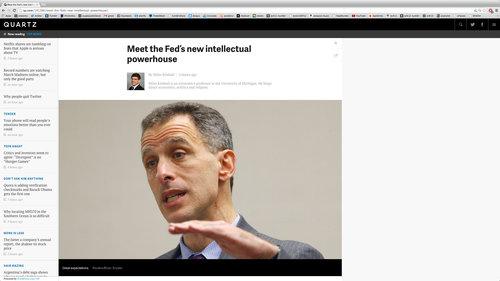
Here is a link to my 47th column on Quartz: “Meet the Fed’s new intellectual powerhouse.”

I have two related columns not directly linked in this piece: “Monetary Policy and Financial Stability” and my discussion of Janet Yellen’s views: “Janet Yellen is Hardly a Dove: She Knows the US Economy Needs Some Unemployment.”

What I say in the column about how a low elasticity of intertemporal substitution affects how the Fed should respond to risk premia is informed by the discussion I gave of a paper of Mike Woodford and Vasco Curdia at a Bank of Japan conference (which I mentioned and linked to here.) Claudia Sahm, Matthew Shapiro and I are working on literature review of empirical work on the elasticity of intertemporal substitution for our paper on that topic. I will have more to say on that in the future. 

Update: I wrote this column (which is about much more than Jeremy Stein himself) just in time. On April 3, 2014, Jeremy Stein announced he was resigning from the Fed. But we might see him again in the future in high government office.

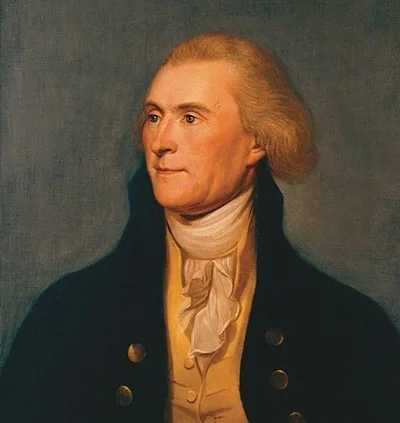
Thomas Jefferson and Religious Freedom

In his book Revolutionaries: A New History of the Invention of America(p. 307), Jack Rakove writes:

As he later explained in Notes on the State of Virginia, Jefferson had further reasons for making historical literacy the foundation of a common education. Rather than “putting the Bible and Testament into the hands of the children, at an age when their judgments are not sufficiently matured for religious enquiries, their memories may here be stored with the most useful facts from Grecian, Roman, European and American history.” … the kinds of historical facts that Jefferson deemed useful and his ideas of education carry over into the subject of bill 82, the bill for religious freedom. Though its formal purpose was to disestablish the Anglican Church, its deeper animus was to free individuals from any obligation to adopt religious views they found unpersuasive. In Jefferson’s view, all religious belief was finally a matter of individual opinion. The history of religious establishments was an unrelenting story of corrupting alliances between churchmen and rulers, abusing their power to impose their opinions and modes of thinking on others. This too was a form of tyranny, as inimical to liberty as anything else the Stuarts and other execrable autocrats had attempted. For Jefferson as for Locke, religion was not  a matter of children inheriting the faith of parents. It was instead a subject of inquiry, and no one could simply adopt another’s convictions. The point of reading history first, scripture later, was to empower individuals to judge the claims of all religions by teaching them that much of what passed for orthodoxy in other times and places depended on the impure alliance of church and state.

See also “The Importance of the Next Generation: Thomas Jefferson Grokked It.”

Haozhao Zhang: The US Should Counter Russia's Natural Gas Weapon With Its Own

Haozhao Zhang is a student in my “Monetary and Financial Theory” class at the University of Michigan. I very much liked this post he did for the internal class blog. I asked him if I could make it a guest post here:


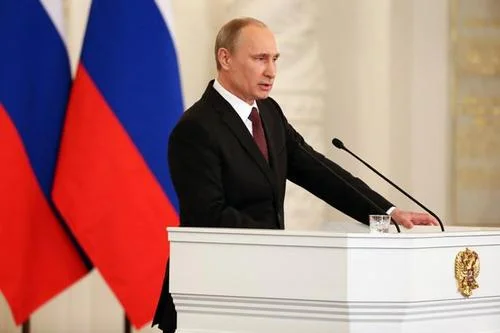
The current conflict in Ukraine is attracting a lot attention. Weeks ago, in order to against the counter force from EU countries, Mr. Putin played his trump card: raise the natural gas price in Ukraine. As a big country rich in natural resources–especially energy–Russia can use its control over the natural gas piped into Europe from Russia as a strategic weapon in this game. 

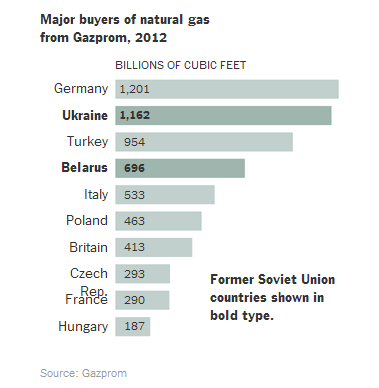
The West has threatened to sanction Russia for moving to annex Crimea. But more than 30% of gas in EU is provided by Russia, so the credibility of those threats is in doubt. Leading countries in the EU such as the UK and Germany are faced with such a concern: the graph below from NYT can shows that major buyers of the Gazprom – Russia’s largest state-owned natural gas company.

Note the positions of Germany and Britain on the list. Actually according to this article in WSJ, Six countries in Europe import 100% of their gas from Russia, and an additional seven rely on it for at least half. It is beyond doubt that Russia has its considerable influence on the attitudes of the EU countries on this affair. U.K. Foreign Secretary William Hague said European nations may need to “recast their approach” to Russian energy purchases if the crisis isn’t resolved.

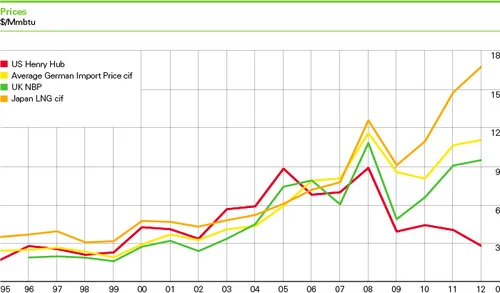
Also reported in WSJ, Obama’s government is taking measures to curb the Russia’s stranglehold over EU’s natural gas supply. US is currently one of the biggest natural gas production nations in the world due to one of its most advancing tech in this field: fracking. The strategy is to increase natural gas exports to the EU from the US, reducing the EU’s dependence on Russian gas. Compared to Russia, US has a big initial cost advantage that can help balance out transportation costs. As the graph from BP’s official site showed below, the natural gas price has kept falling over recent years in North America. The price in US is far lower than that of Asia and Europe.

In this strategy for the US, big oil and gas production firms like ExxonMobil benefit a lot from it, while environmentalists and small manufacturing companies strongly oppose such a claim. From a geopolitical point of view, this strategy seems unstoppable.

There are several reasons why US has restricted oil and natural gas exports in the past:

  1. Exporting more natural gas will increase the price of it in the US. Currently the natural gas price in US is only about 1/5 of that in Japan, which gives an advantage to US manufacturing industries that rely heavily on gas as raw material. More exports would mean less gas available in US, and the price would likely rise.
  2. Environmentalists are concerned about fracking. 
  3. Fear of running out: in the past, with less advanced technology the available gas reserves seemed limited. People were afraid of a natural gas shortage later on if it was exported now.

However, the current situation is dramatically different. Here is why it is now a good time for the US to export natural gas:

  1. There is a boom in natural gas reserves, thanks to the new technology of “fracking.“ 
  2. Increasing the domestic gas price now looks like a good thing. Because of the increase in gas reserves, natural gas producing firms are complaining. Exports would now raise the price and benefit those firms without making the prices seem too high to consumers, compared to what they were used to in the past.
  3. Exporting US natural gas would curb Russia’s power over the EU. The political pressure in the Ukraine will be the main push behind increasing natural gas exports from the US.

Overall, the US strategy is good news, because it can help establish a global natural gas market, and encourage the use of relatively clean, low-carbon natural gas.

On Happiness

image source

This is the audio for a discussion about happiness by three of the best researchers and thinkers on happiness in the world: Justin Wolfers, Matthew Adler and my coauthor Ori Heffetz. (It was for a radio broadcast that never aired. Simon Tulett is the interviewer.) It makes a wonderful addition to my sub-blog on “Happiness.” Thanks to the participants for making this public–especially to Ori, who arranged to post it on his personal website.

John Stuart Mill: Different Strokes for Different Folks

Preference heterogeneity–different people wanting different things–has been a major theme in my research. In On Liberty, Chapter III: “Of Individuality, as One of the Elements of Well-Being,” paragraph 14, John Stuart Mill emphasizes the benefits for people’s welfare of letting them pursue their own desires, even if some of those desires are hard for us to understand:

I have said that it is important to give the freest scope possible to uncustomary things, in order that it may in time appear which of these are fit to be converted into customs. But independence of action, and disregard of custom, are not solely deserving of encouragement for the chance they afford that better modes of action, and customs more worthy of general adoption, may be struck out; nor is it only persons of decided mental superiority who have a just claim to carry on their lives in their own way. There is no reason that all human existence should be constructed on some one or some small number of patterns. If a person possesses any tolerable amount of common sense and experience, his own mode of laying out his existence is the best, not because it is the best in itself, but because it is his own mode. Human beings are not like sheep; and even sheep are not undistinguishably alike. A man cannot get a coat or a pair of boots to fit him, unless they are either made to his measure, or he has a whole warehouseful to choose from: and is it easier to fit him with a life than with a coat, or are human beings more like one another in their whole physical and spiritual conformation than in the shape of their feet? If it were only that people have diversities of taste, that is reason enough for not attempting to shape them all after one model. But different persons also require different conditions for their spiritual development; and can no more exist healthily in the same moral, than all the variety of plants can in the same physical, atmosphere and climate. The same things which are helps to one person towards the cultivation of his higher nature, are hindrances to another. The same mode of life is a healthy excitement to one, keeping all his faculties of action and enjoyment in their best order, while to another it is a distracting burthen, which suspends or crushes all internal life. Such are the differences among human beings in their sources of pleasure, their susceptibilities of pain, and the operation on them of different physical and moral agencies, that unless there is a corresponding diversity in their modes of life, they neither obtain their fair share of happiness, nor grow up to the mental, moral, and aesthetic stature of which their nature is capable. Why then should tolerance, as far as the public sentiment is concerned, extend only to tastes and modes of life which extort acquiescence by the multitude of their adherents? Nowhere (except in some monastic institutions) is diversity of taste entirely unrecognised; a person may, without blame, either like or dislike rowing, or smoking, or music, or athletic exercises, or chess, or cards, or study, because both those who like each of these things, and those who dislike them, are too numerous to be put down. But the man, and still more the woman, who can be accused either of doing “what nobody does,” or of not doing “what everybody does,” is the subject of as much depreciatory remark as if he or she had committed some grave moral delinquency. Persons require to possess a title, or some other badge of rank, or of the consideration of people of rank, to be able to indulge somewhat in the luxury of doing as they like without detriment to their estimation. To indulge somewhat, I repeat: for whoever allow themselves much of that indulgence, incur the risk of something worse than disparaging speeches—they are in peril of a commission de lunatico, and of having their property taken from them and given to their relations.

Jessica Hammer: Venezuela's Deadly Struggle

Jessica Hammer is a student in my "Monetary and Financial Theory” class at the University of Michigan. Students in the class write three blog posts a week for an internal class blog. Of the ones they select as their own best work, I have been choosing a few to publish as guest posts on supplysideliberal.com. This is Jessica’s second appearance here. Her previous guest post is “Jessica Hammer: The World Poverty Situation is Better Than You Think.” This post about Venezuela is a grim but powerful complement to Ezequiel Tortorelli’s guest post, “The Trouble with Argentina.” Here is what Jessica has to say about Venezuela:


When someone hears about Venezuela, I suspect the first thing most people think of is oil. Of course, this is due to the fact that this country is an OPEC member and exports around 25 million barrels of oil to the United States each month. Venezuela has one of the most abundant oil sources in the world but, unfortunately, it is being wasted. Perhaps you remember ex-President Hugo Chavez, and his passing in recent years. Many hoped the tyrannical government would disappear along with him, but the power of “chavismo” (the support for Chavez’s socialist reforms) prevailed. But the current president (the used-to-be bus driver who received no college education and is bluntly incompetent) , Nicolas Maduro, is slowly losing control of the country – or so they hope. The world knows little about the horrid situation in Venezuela, and how this potentially-wealthy nation is destroying itself.

Caracas, the capital, is currently (and has been for a while) the world’s deadliest city. Not Baghdad or Mogadishu. Mexico is known for its drug-related violence, but its murder rate is well below Venezuela’s rate of 73 per 100,000 citizens. Caracas, however, experienced a soaring rate of more than 200 per 100,000 in 2012 (and 2013 was even higher). To put this into perspective, Venezuela’s murder rate is higher than the death rates of the US and the 27 countries of the EU combined. Violence is so predominant, that people live in constant fear of going outside. Most wealthy people have to travel with bodyguards in order to avoid kidnappers. I personally know a lot of Venezuelans, and they all know of someone who has been murdered – either friends, family, or friends of friends. Most cases like these are a result of robberies. But gun fights are common to establish property rights, personal disputes, or drug-related problems. And the problem isn’t only the fact that violence is so widespread; nearly 90% of murders go unpunished. The police are so corrupt that they are often the ones involved in murders.

As if this weren’t enough to put up with, Venezuelans face daily shortages of basic goods. The most common ones include toilet paper, flour, sugar, cooking oil, and chicken. Not only are there rations on available goods, but these goods are not readily available. Producers point to the price controls and the limitations on foreign currency, which limit the availability of resources needed for production. Also, there are viable claims that 30 billion dollars were robbed from Cadivi (the government body which administered currency exchange) by the government elite. This is seen as the cause for the country’s current shortage problems.

Additionally, inflation is among the highest in the world at 56%.  Maduro eliminated the Cadivi program last year, which Venezuelans used to transfer dollars overseas. Today, a dollar goes for 84.2 bolivares in the black market – 13 times more than the official rate. Toyota is halting production, while Ford is significantly reducing its production in Venezuela. Venezuela’s economy is in shambles.

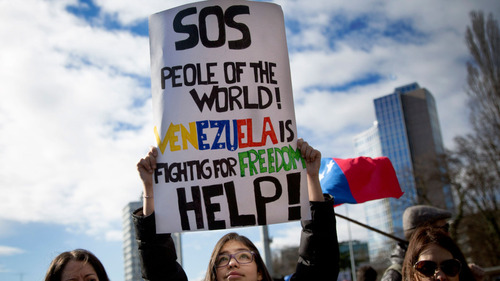
And its government is worse. Without getting into too much detail, Venezuela’s government is best described as a raging civil war where the Chavistas in power have bought the support of enough people to think they can deceive the country into thinking that they are representing them. In the last elections, the result was announced before all the votes were counted. People took to social media to report the fraud. Pictures and videos of military men burning boxes of ballots quickly spread over Facebook and Twitter. But the government had enough power over the military to stay “enchufados” (plugged in), as the opposition says. However, beginning February 12th, Venezuelans have taken to the streets by the millions. They are peacefully protesting against the government that is driving their country into ruins. Sadly, many people have been killed as they continue to take to the streets in protest, and the government persistently uses military force to subdue them. Now, they are outraged that the government is so blunt in oppressing them – not even trying to hide it anymore.

It is tragic to see a country so rich in natural resources, with so much talent and potential, deprived of its capability to provide its people with a decent life-style. Corrupt governments have a far-reaching effect on the economic well-being of a country. Most people in the US, and many other democratic countries, don’t realize the deep extent of corruption that exists in places like Venezuela. My intent is to raise awareness about this. The Venezuelan government is not the only corrupt, undemocratic government in the world, but at the moment, it stands out as one that is close to being brought down in favor of a more open, honest government. More pressure from foreign governments is essential–along with the noble efforts of the Venezuelan people–to put Venezuela back on the path of freedom and democracy.

Will Econ Blogging Hurt Your Career?

I ran across this very interesting youtube video by Noah Smith on “Will Econ Blogging Hurt Your Career?” I wanted to address that question as well. On balance, going forward, I think blogging is likely to be more of a help to your career than a hindrance–at least if you enjoy blogging. 

One way in which my experience has been different from Noah’s is that I spend much more than an hour and a half per week blogging, if I include writing for Quartz. I have undertaken blogging as a serious career move, and so don’t mind spending some serious time at it. But that is something more appropriate for my career stage than it would be for a graduate student or untenured professor. And having grown children who are already off making their way in the world makes it easier. 

As far as my own career goes, I feel the blogging has only been a plus. My colleagues in the Economics Department at the University of Michigan have been very supportive. Part of the reason is that I am not the only blogger here at Michigan. Noah has a list of other bloggers connected with the University of Michigan here. (Folks at the University of Michigan are blog readers, too. Interesing statistic: Ann Arbor edges out New York City as the city generating the most visits to my blog.)

As always, there are tradeoffs. Blogging might take time away from writing economics journal articles. But in my case I have found that blogging is fun enough and rewarding enough that I willingly do it at the expense of many leisure activities. And blogging builds human capital–contacts, writing skill and ideas (generated in important measure at the expense of non-blogging leisure)–that are valuable for research activities. So even the sign of the effect on traditional research productivity is, at this point, unclear. (Also, blogging should have some positive effect on citation accounts just by the inevitable publicizing of one’s own research, and is very helpful for one’s teaching.) Blogging creates additional temptations when one is avoiding hard but necessary tasks. But most of us face plenty of temptations in that regard anyway, and have had to develop techniques of self-discipline sufficient to get our work done.

I have a story to tell. Chris House’s office is right next to mine, with our doors one foot apart from each other. A couple of months ago, I walked into his office to talk as I often do, and he asked me how much time blogging took. I said “It depends on why you are asking; if you are asking so you can scold me for all the time I spend blogging …” Then it turned out he wanted to ask me if I thought it would be worth his while to start blogging. (I should say here that Chris is not the sort of person who would scold in any case; he would tease.)

Along the lines of what I said in my talk “On the Future of the Economics Blogosphere,” I said that I thought blogging was bound to grow in importance within economics–and that there is a first-mover advantage: for any given quality, those who start blogging earlier will gain more prominence and reap more rewards, as long as they remain continuously active.

Chris was persuaded; here is a link to Chris’s excellent blog. Among many other things he has accomplished with his blog, Chris caused Paul Krugman to write the sentences I think are most worthy of anything Paul Krugman has ever said of being included in a collection of famous quotations.

Mary O'Keeffe on Slow-Cooked Math

Mary O'Keeffe was my Ec 10 teacher back in 1977-1978. She has appeared previously on supplysideliberal.com in “My Ec 10 Teacher Mary O’Keeffe Reviews My Blog” and “Another Reminiscence from My Ec 10 Teacher, Mary O’Keeffe.” She gave me permission to share this Facebook post she made in response to the post “Cathy O'Neill on Slow-Cooked Math”:  


I am also a slow-cook mathematician, for the most part. I find I have to get into a state of flow in order to really think math through. Often I find it takes me a while to really understand exactly what the problem is getting at—but after a while, it just sinks in and becomes blindingly crystal clear and beautiful. I am rather glad that I didn’t experience buzzer-style or any kind of timed math contests as a kid—they might have permanently discouraged me and induced me into giving up on doing anything mathematically related. I think one of the reasons my husband and I were such a good partnership (professionally) was that he was good at blazing fast insights and I was good at thinking things through more rigorously and deeply. (This is somewhat of a stereotype. We didn’t always fit neatly into these separate boxes, but it is a pretty good first approximation description.)

Jonathan Haidt—What the Tea Partiers Really Want: Karma

I am a fan of Jonathan Haidt’s work. I learned a lot from his book The Righteous Mind: Why Good People Are Divided by Politics and Religion, and used those ideas in my column “Judging the Nations: Wealth and Happiness Are Not Enough.” I also quoted one of my favorite passages from The Righteous Mind in "God and Devil in the Marketplace.“

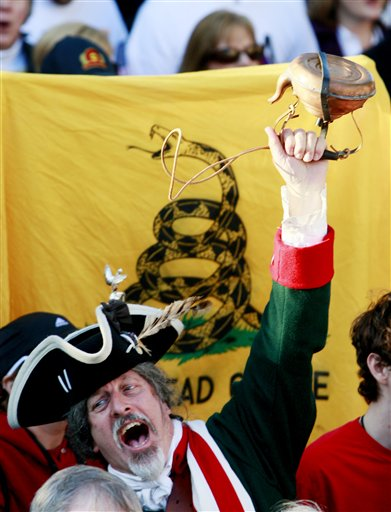
Jonathan wrote a very interesting piece in the Wall Street, October 16, 2010: ”What the Tea Partiers Really Want.“ Here is a key passage:

But the passion of the tea-party movement is, in fact, a moral passion. It can be summarized in one word: not liberty, but karma.

The notion of karma comes with lots of new-age baggage, but it is an old and very conservative idea. It is the Sanskrit word for "deed” or “action,” and the law of karma says that for every action, there is an equal and morally commensurate reaction. Kindness, honesty and hard work will (eventually) bring good fortune; cruelty, deceit and laziness will (eventually) bring suffering. No divine intervention is required; it’s just a law of the universe, like gravity.

Karma is not an exclusively Hindu idea. It combines the universal human desire that moral accounts should be balanced with a belief that, somehow or other, they will be balanced. In 1932, the great developmental psychologist Jean Piaget found that by the age of 6, children begin to believe that bad things that happen to them are punishments for bad things they have done.

To understand the anger of the tea-party movement, just imagine how you would feel if you learned that government physicists were building a particle accelerator that might, as a side effect of its experiments, nullify the law of gravity. Everything around us would float away, and the Earth itself would break apart. Now, instead of that scenario, suppose you learned that politicians were devising policies that might, as a side effect of their enactment, nullify the law of karma. Bad deeds would no longer lead to bad outcomes, and the fragile moral order of our nation would break apart. For tea partiers, this scenario is not science fiction. It is the last 80 years of American history.