John Stuart Mill's Brief for Freedom of Speech

John Stuart Mill couldn’t do hypertext, but I can do it for him. John gave the second chapter of On Liberty the title "Of the Liberty of Thought and Discussion.“ Here is how he sums up his argument at the end of the chapter, with links to the posts where I give his more detailed arguments:

We have now recognised the necessity to the mental well-being of mankind (on which all their other well-being depends) of freedom of opinion, and freedom of the expression of opinion, on four distinct grounds; which we will now briefly recapitulate.First, if any opinion is compelled to silence, that opinion may, for aught we can certainly know, be true. To deny this is to assume our own infallibility. (See ”John Stuart Mill on the Adversary System,“ ”John Stuart Mill on the Protection of ‘Noble Lies’ from Criticism“ and ”Should Troubling Arguments Be Kept Away from Those Who Might Be Unduly Swayed by Them?“)Secondly, though the silenced opinion be an error, it may, and very commonly does, contain a portion of truth; and since the general or prevailing opinion on any subject is rarely or never the whole truth, it is only by the collision of adverse opinions that the remainder of the truth has any chance of being supplied. (See ”A Remedy for the One-Sidedness of the Human Mind“ and ”Why Progressives and Conservatives Need Each Other.“)Thirdly, even if the received opinion be not only true, but the whole truth; unless it is suffered to be, and actually is, vigorously and earnestly contested, it will, by most of those who receive it, be held in the manner of a prejudice, with little comprehension or feeling of its rational grounds. (See ”Let the Wrong Come to Me, For They Will Make Me More Right“ and "In Praise of Trolls.”)And not only this, but, fourthly, the meaning of the doctrine itself will be in danger of being lost, or enfeebled, and deprived of its vital effect on the character and conduct: the dogma becoming a mere formal profession, inefficacious for good, but cumbering the ground, and preventing the growth of any real and heartfelt conviction, from reason or personal experience. (See “How Freedom of Speech for Falsehood Keeps the Truth Alive.”)

Note: "John Stuart Mill’s Defense of Freedom" links to posts on the rest of "On Liberty."

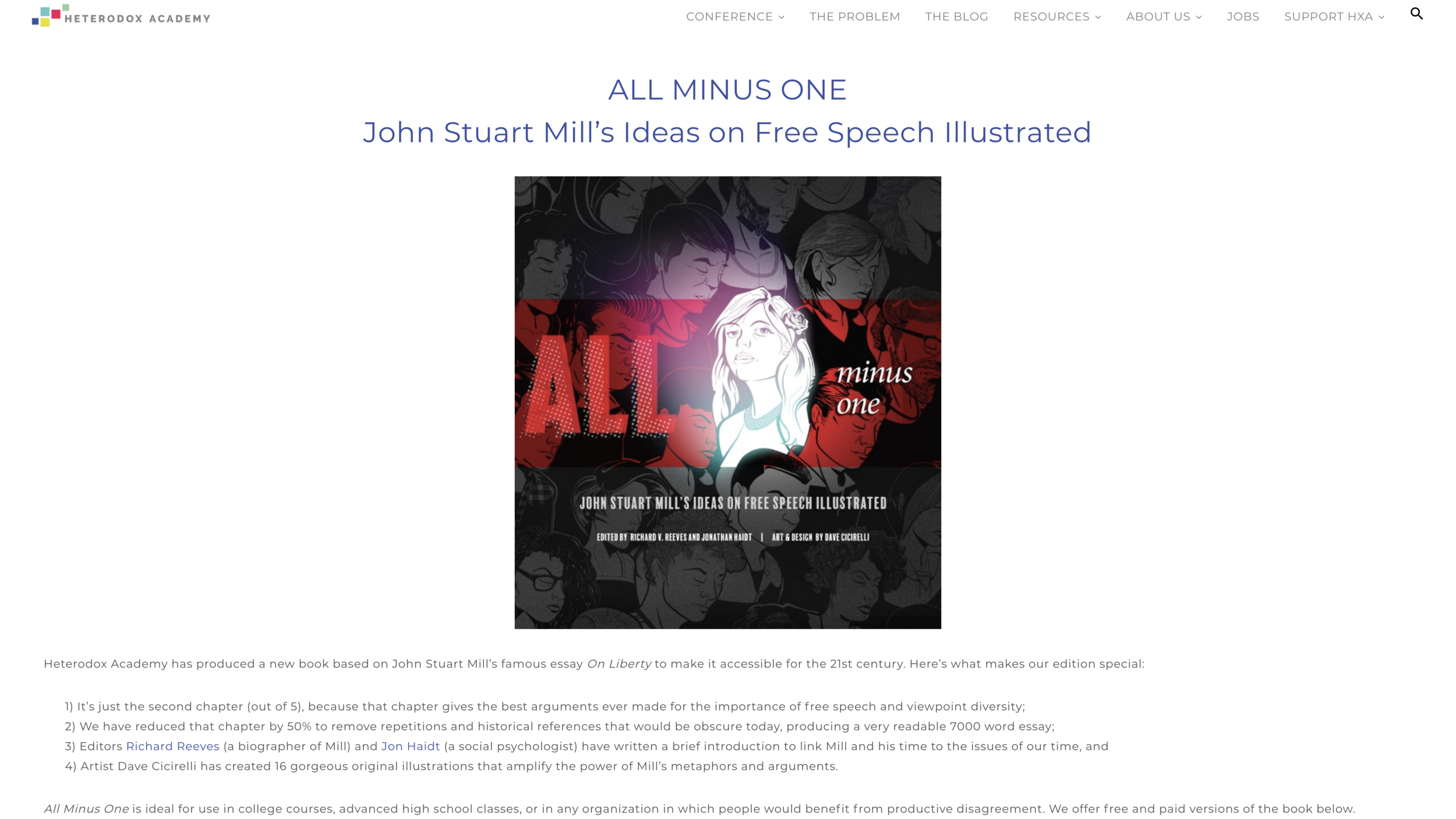
Update, October 19, 2019: Richard Reeves and Jonathan Haidt have created an abridged version of this second chapter of On Liberty to make it’s still timely message more accessible to college students:

Update, October 31, 2019: You might be interested in John Danaher’s layout of John Stuart Mill’s argument for freedom of speech.


Masao Ogaki on Osamu Tezuka: Illusion of Motion on a Stationary Manga Page

On my trip to Tokyo in June, 2013 to teach about the Economics of Risk and Time at Keio University and to gives seminars about electronic money at the Bank of Japan, Keio University and the Ministry of Finance, Masao Ogaki gave me an intriguing account of how famous Manga author Osamu Tezuka achieved some of the subjective effect of a motion picture with a stationary manga page. He kindly agreed to write up a paragraph for supplysideliberal.com. Here is what Masao has to say:

My son, who grew up in the United States, loves to read Manga in Japanese but does not read Manga translated into English.  I asked why, and he explained to me that eye-movements are important for Manga. I got interested in this and searched for internet articles.  An article,  http://shuhosato.mangareborn.jp/blog/?p=59, explains that this technique is called “visual guidance,” which has been used to create a rhythm and sometimes an illusion of motion.    I am not an expert, but think that the first Manga artist who started to use this technique was Osamu Tezuka in 1940s.  He started to use complicated layouts that calculate and guide the reader’s eye-movements of reading sentences and watching pictures.

Because the way the illusion of motion is created depends on habits of how one’s eyes scan a page, the technique would have to be adapted to work for comics or manga in English. I am hoping will try to achieve this affect in a way that works for native English readers, or even better, that someone has already.

Miles and Noah: The Complete Guide to Getting Into an Economics PhD Program

blog.supplysideliberal.com tumblr_inline_mrmveil2r21qz4rgp.png

Here is a link to my 29th Quartz column, coauthored with Noah Smith: “The complete guide to getting into and economics PhD program.”

Personally, I would rather read Noah’s blog than any other blog in cyberspace. That brilliant style shows through here; I think I managed not to spoil things too much in this column.   

In case you are curious, let me say a little about the financial costs and benefits of an economics PhD.  At Michigan and other top places, PhD students are fully funded. Here, that means that the first year’s tuition and costs are covered (including a stipend for your living expenses). In years 2 through 5 (which is enough time to finish your PhD if you work hard to stay on track), as long as you are in good standing in the program, the costs of a PhD are just the work you do as a teaching assistant. So there are no out-of-pocket costs as long as you finish within five years, which is tough but doable if you work hard to stay on track. Tuition is relatively low in year 6 (and 7) if you can’t finish in 5 years. Plus, graduate students in economics who have had that much teaching experience often find they can make about as much money by tutoring struggling undergraduates as they could have by being a teaching assistant.

When a school can’t manage full funding, the first place it adds a charge is in charging the bottom-half of the applicant pool for the first year, when a student can’t realistically teach because the courses the grad students are taking are too heavy. That might add up to a one-time expense of $40,000 or so in tuition, plus living expenses.

On pay, the market price for a brand-new assistant professor at a top department seems to be at least $115,000 for 9 months, with the opportunity to earn more during the summer months. If you don’t quite make it to that level, University of Michigan PhD’s I have asked seem to get at least $80,000 starting salary, and Louis Johnston tweets that below-top liberal arts colleges pay a starting salary in the $55,000 to $60,000 range. But remember that all of these numbers are for 9-month salaries that allow for the possibility (though not the regularity) of earning more in the summer. Government jobs tend to pay 12-month salaries that are about 12/9 of 9-month academic salaries at a comparable level.

There is definitely the possibility of being paid very well in academic economics, though not as well as the upside potential if you go to Wall Street. For example, with summer pay included, quite a few of the full economics professors at the University of Michigan make more than $250,000 a year. (Because we are at a state university, our salaries are public.)

The bottom line is that the financial returns are good enough that you should have no hesitation begging or borrowing to finance your Economics PhD. (Please don’t steal to finance it.)

What about the costs of the extra year it might take to study math the way we recommend? If you have been developing self-discipline like a champion, but are short on money and summers aren’t enough, you could spend a gap year right after high school just studying math, living in your parents’ house at very low cost; most colleges will let you defer admission for a year after they have let you in.    

Update

I liked this comment that Kevin C. Smith (an MD) sent to Quartz:

Great advice!

I almost flunked Grade 8 because my math was so bad [back in the day they would flunk you for that, at least in Alberta.]

I wound up heading for medicine. A friend who was a few years ahead of me warned: “You’ll never make it if you are not good at math!”

I hired a math tutor in August [before University started], and did every question at the end of every chapter in every one of my text books. I couldcall my tutor when I got stuck [God bless her, wherever she is in the world today!] Math got to be fun after a while [like being really good at solving puzzles.]

You might add to you list of suggestions: hire a tutor do all the questions in all your textbooks

Long story short, I won the Gold Medal for Science, and have found that a really good grasp of math has helped my enjoyment of the world and of my work a lot.

Daniel Coyle on Deliberate Practice

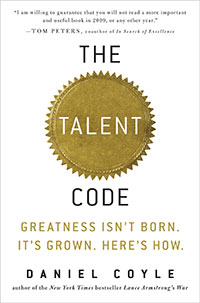
The Talent Code on Amazon.
Video trailer for The Talent Code.

This post is part of my series on deliberate practice (also called deep practice or purposeful practice), which I consider very important for understanding education and human capital accumulation more broadly.

In the last few years, I have often taught an introductory macroeconomics class. Both at the beginning of the semester, and whenever a student comes to me puzzled that they have done worse-than-expected on an exam, I recommend that they read the book The Talent Code. What I hope they get from the book is a sense of what it means to study in a deep way, rather than just “going over the material.” In case students don’t read the book, I have had teams of students from an honors section of the class give a presentation on the book to the entire class of about 250 students. I strongly recommend this

Powerpoint file on The Talent Code put together by my Fall 2012 “Principles of Macroeconomics” students Hrishikesh Kulkarni and Madeline Wills,

which they generously gave me permission to post. I had the audience vote on this and presentations about 5 other books. This was voted best of all 6 presentations. I agreed with the audience’s assessment. (The other books were

Here is the essence of the 3 key slides in Hrishikesh’s and Madeline’s Powerpoint file:

Deep Practice

Chunk it up

  • Absorb–get involved with practice: imitation
  • Break it into chunks–organize practice into smaller pieces
  • Slow it down–take time to practice correctly

Repeat

Learn to feel it

Self-Learning Connection

Master Coaching

  • Having someone inspire you to keep working can be effective
  • However, your greatest coach is yourself

Ignition

  • Make yourself passionate about learning
  • Find your own source of ignition

Deep Practice

  • Absorb–study deeply, not necessarily a lot
  • Break it into chunks–all-nighters are less effect than spreading it out
  • Slow it down–take time to make sure you are learning
  • Repeat–practice makes perfect!

in the text above, I bolded a thought that got a particularly strong audience reaction: the greater effectiveness of spreading study out over time, instead of concentrating it in one all-nighter.

Benjamin Franklin's Strategy to Make the US a Superpower Worked Once, Why Not Try It Again?

Here is a link to my 28th column on Quartz “Benjamin Franklin’s strategy to make the US a superpower worked once, why not try it again?”

Update: Steve Sailer has an interesting post pointing out the importance of birth rates, as well as the immigration rates I emphasize in the column. In order to keep an open mind, before reading Steve Sailer’s post, I recommend reading my post “John Stuart Mill’s Argument Against Political Correctness.” In his post Steve also points out that Ben Franklin favored English immigration over German immigration. 

Ezra and Evan’s Flag. I was very pleased to see Ezra Klein and Evan Soltas flag the column, and intrigued by the way they boiled it down:

KIMBALL: The Ben Franklin strategy to a U.S. renaissance. “The reason China’s economic rise matters for US grand strategy is that China has a much larger population than the United States…An excellent answer is to do everything possible to foster long-run growth of per capita GDP in the US. At a minimum, this includes radical reform of our system of K-12 education, removing the barriers state governments put in the way of people getting jobs, and dramatically stepped-up support for scientific research…The key to maintaining America’s preeminence in the world is to return to Ben Franklin’s visionary grand strategy of making many more of the world’s people into Americans.” Miles Kimball in Quartz.

How Conservative Mormon America Avoided the Fate of Conservative White America

The Mormon Church’s Conference Center

The Mormon Church’s Conference Center

Reading Noah Smith’s incisive post “Conservative White America, You Need a New Grand Strategy,” my main reaction is that American Mormons, while predominantly white, and just as conservative in many dimensions, do much better than Noah’s description of Conservative White America in general. So Mormonism might provide clues to the new grand strategy Noah calls for for Conservative White America. Let me pursue that idea in the spirit of the grand research project I recommended in my post “Godless Religion” of trying to figure out how to get the non-supernatural benefits of religion without requiring supernatural beliefs (a research project saw Ari Schulman questions in his Wall Street Journal op-ed “Does Faith Make You Healthier?”).

I do not have all of the sociological facts at my fingertips, but let me give my impressions on each of the issues Noah raises for Conservative White America, subject to correction by readers who do have the sociological facts at their fingertips. (Lest I seem to be cheerleading too much for Mormonism in what follows, let me remind readers that I personally disagree with Mormonism’s supernaturalism, authoritarianism, patriarchy and opposition to gay marriage, and maintain the very different theology of Teleotheism.) 

Here are Noah’s concerns about Conservative White America and my reactions:

1. First, Conservative White America has failing familiesDivorce rates are highest in the “Bible Belt” states where Conservative White America is strongest. While professional whites (who are often liberals) have reversed the trend toward higher divorce, working-class whites are essentially abandoning marriage. While conservatives would claim that this trend is due to the spread of liberal, secular values, the reverse is true; Bible Belters get married more often and earlier than their Northeastern cousins. They just get divorced a lot. Those conservative values are shoving white people, especially working-class white people, into unhappy marriages that cannot last in the modern world. 

Miles: 

With a strong prohibition on premarital sex and its approaches, and social encouragement for marriage as soon as at least the male has served a proselyting mission, Mormons tend to marry young. But after accounting for the inevitable effects of age at marriage, it is my impression that Mormon divorce rates are relatively low. On the supernaturalist side, the notion that with “eternal marriage,” a marriage lasts even into the afterlife may encourage investment in the marriage relationship. In addition, weekly Mormon teaching focuses heavily on trying to help Mormons have a loyal and rewarding marriages and family life.  

2. Next, Conservative White America has failing health. Of course, this is true of all of the United States, and American blacks and Hispanics fare worse than American whites on most health measures. But white Europeans significantly defeat their American cousins on most health outcomes, while Americans pay much more and enjoy much more uncertain access to care. This is due mainly to the success of conservatives in blocking the implementation of universal health care (a case of all America having problems due to CWA policy triumphs). Some small part of it may also have to do with the effect of suburban sprawl and lightly regulated corporate food (loaded with sugar and/or fat) on obesity rates. Additionally, suburban and rural drug use may be rising, even as urban drug use has fallen steadily. And white teens are more likely than black or Hispanic teens to abuse drugs. These trends do not bode well for the health of Red America.

Miles: 

Mormon prohibitions on alcohol and tobacco–and according to many Mormons, all caffeinated beverages–have direct good effects on health, and also make it possible for rebellious souls to express their rebellion with alcohol, tobacco or even caffeinated beverages, instead of through illegal drugs. The scourge of obesity does not spare Mormons, but overall, Mormons on average live much longer than most other American groups.  

3. Add to that failing economic mobility. Much is made of the economic dynamism of Red states like Texas (well, mainly Texas). But white Americans experience the least economic mobility in the South, the most conservative region. And upward mobility for whites seems to be lowest in regions with heavy sprawl.

Miles: 

Although relatively large Mormon family sizes quickly dilute inherited wealth, Mormons are relatively well educated and have standards of honesty and diligence that make them relatively attractive employees for a given level of education. Academically skilled and religiously faithful  Mormon teenagers can get a heavily subsidized college education at Brigham Young University, which is comparable in quality to many top state universities but with lower tuition, regardless of state of residence. Mormon congregations also provide a source of good educational and career advice for young people. And casual conversation in Mormon country often turns to career and even entrepreneurial ideas to get ahead enough financially to support a relatively large family.    

4. Conservative White America, like the rest of America, also has failing economic performance. Sure, rich people - who have done pretty well over the past 13 years of stagnating incomes - tend to be conservative. But the vast majority of conservative white voters are not rich, and have seen their incomes fall along with the rest.

Miles: 

Utah’s economy, where Mormons predominate, has been doing very well compared to the national economy for quite some time. It isn’t just the long-run trend for Utah that is positive. Visiting Provo and Salt Lake City in Utah regularly over the last few years I have seen no signs at all of effects of the Great Recession. 

5. And to some degree, Conservative White America also has failing social lives. Studies show that suburban residents are less satisfied with their neighborhoods than urban residents, with loneliness and social isolation probably to blame. Other research has shown that urban design has a big influence on social connection. It’s just really hard to meet people in the spread-out, isolated non-cities into which conservatives would have us move - and into which much of white America has moved over the past sixty years. Gone are the days of small-town America where everyone knew their neighbors. In the modern suburbs, you are stuck in a box with nobody and nothing.

Miles: 

Mormon congregations insure that any Mormon who is religiously involved will have an extensive social network. It is very hard to be socially isolated as a Mormon, even for those who would like a little more social isolation. Part of the genius of Mormonism is the way a Mormon congregation functions as an ersatz small town, where everyone knows everyone else. But unlike an actual small town, Mormons can move across the country and immediately be integrated into another ersatz small town.    

6. Now finally we get to Conservative White America's failing electoral clout. The poor performance of the GOP cannot, as some hopeful conservatives have claimed, be ascribed to “missing white voters”. Whites for whom race defines politics - i.e. most of the current Republican base - have shut themselves out of future political coalitions. They could have followed the example of liberal whites, who allied with minorities, including poorer minorities (blacks, Hispanics) and richer minorities (Asians), and thus will have a big say in shaping America’s future policies. Meanwhile, stuck in permanent racial panic mode, all Conservative White America can do is pull their veto levers - the filibuster, etc. - to gum up the machinery of American politics and slow the inevitable.

Miles: 

Mormons are still a small minority, so great electoral clout is not to be expected. But despite Mitt Romney’s liabilities as a presidential candidate, Mormons can feel gratified by having passed the milestone of having had their own major party nominee. Even if Mitt doesn’t run again (far from a bygone conclusion), in John Huntsman, the Mormons have a credible candidate should the Republicans lose too many presidential elections due to overly extreme nominees and become willing to nominate someone who (so far) appears relatively moderate.

Where Does Conservative White America Go Wrong?

Noah makes the following strategic judgment for Conservative White America: 

The five big pieces of Conservative White America’s Grand Strategy that I think need reevaluation are:
1. “White flight” to suburbs and exurbs
2. Rigid and inflexible “family values" 
3. Hostility toward immigrants and minorities
4. Excessive distrust of the government
5. Distrust of education, science, and intellectualism

Miles: 

White Flight. 

Mormons were never thick on the ground in areas that had many African-Americans, so "white flight” has not been a big phenomenon for them in the first place. Although racism is not absent among Mormons, most Mormons I know are so embarrassed by Mormonism’s history of having denied the Mormon priesthood to blacks before 1978 that they try extra hard to have good race relations and to have positive attitudes toward African-Americans.  

Family Values. 

Mormons have what Noah would call “rigid and inflexible ‘family values’” but, I think, manage to implement them better. One reason Mormons can implement family values better is that they have high church leaders spelling out the ramifications of those family values in relatively sensible ways, given the overall family-values commitments. Popular culture alone tends to result in a worse version of “family values.”  

Immigration. 

Mormonism’s eagerness to make the whole world into Mormons spills over into a positive attitude toward immigration. If they want people to come into the Mormon Church and become Mormons, why shouldn’t they want people to come into America and become Americans? Moreover, a large fraction of Mormons serve proselyting missions in other countries in their late teens and early twenties. That not only fosters positive attitudes toward people in other countries (and for languages other than English), but also creates personal ties to non-Americans who would like to become Americans. In its official statements, the Mormon Church is remarkably pro-immigration relative to the Republican norm.  

Government. 

Mormons are negative about government, but positive about the Mormon Church, which has the capacity to take on all the functions of a government–as it did when the Mormon settlers first arrived in Utah. Thus,  Mormonism is not at all prey to radical individualism. Collective action is fine, it is just that government is not seen as the best form of collective action. You can see a notion of collective action inspired by the insights I have gained from my Mormon background in my posts “No Tax Increase Without Recompense” and “Yes, There is an Alternative to Austerity vs. Spending: Reinvigorate America’s Nonprofits.” Science, Education and Intellectualism. Overall, Mormonism distrusts education, science and intellectualism only where education, science and intellectualism cause people to stop believing in Mormonism. The Mormon Church has realized that, in practice, science is not the main enemy of supernaturalist religion, Postmodernism is. (There is a post to come on that topic.)

One advantage Mormonism has in its relationship with science is that its founder, Joseph Smith, fully incorporated early 19th century science into Mormonism. Because Joseph Smith was murdered by a mob in 1844, he did not live to see the publication of Darwin's The Origin of Species, and so could not fully incorporated evolution into Mormonism, so Mormonism has a testy relationship with Darwinism, but BYU professors are allowed to teach Darwinian evolution.

Mormonism lauds its scientists, as long as they continue believing in Mormonism. And it has many believing scientists that it can point to, among them my great uncle, the renowned (but not quite nobel-laureate) chemist Henry Eyring.     

Summing Up

To me, it seems that Mormons have avoided the major problems faced by the bulk of Conservative White America. It is worth thinking about why. In that effort, this post barely scratches the surface. I would love to see a broader discussion of this question.

John L. Davidson on the Decline of the Quality of Information Processing in Lending

My friend John Davidson sees information as the central issue for the economy. In this guest post, he argues that one of our big supply-side problems is the decline in the quality of human-brain information-processing behind lending decisions. 


Noah Smith argues that “Something Big Happened in the Early 70s.”

You and others have your macro theories and I am Keynesian, but I have told everyone until I am blue in the face that short-run stimulus is not enough and events bear me out.

This country is broken because community and commercial banking is broken by risk aversion, undercapitalization, and mis-regulation. We need to return to community bankers being almost merchant bankers.

I also have no regard for economists in the Koch orbit as they are political operatives and nothing but crony capitalism at its worst, so I will start with a real life model.

It is really simple to see a lot of what is wrong in America if one just reads the second chapter of Goldman Sachs: The Culture of Success.while at the same time, watch Copper on Netflicks (which is set in NYC at the time Goldman Sachs was formed).

For more than a few hours, contemplate an economic world in which Goldman was operating as he walked those streets in NYC in 1870 in his Top Hat and Frock coat. He could see, hear, taste commerce all around. The imagination can paint an easy word picture of the streets of New York and Chicago. By contrast, you see, hear, or taste nothing on a trading floor.

Goldman first lent on signature, not collateral. That is the world we need, in America, today. People who have skin in the game (Nassim N.Taleb just taught this lesson on Twitter about the losses at Harvard by Larry Summers)living on their wits, making loans on the street, door to door.

Banking has it backwards, today, lending on collateral and never on signature, worrying about collateral not character.

And, consider the agglomeration economies of information. Look at the network that was in Goldman’s mind. He probably knew 10,000 people first hand and 100,000 second hand. He was the model for my original thinking on information. A partner, with skin the game, walking the street looking to make loans: now that is a node of a powerful information network that made our great cities work.

Sorry for tone but feel strongly about this.

Quartz #26—>The Government and the Mob

Link to the Column on Quartz

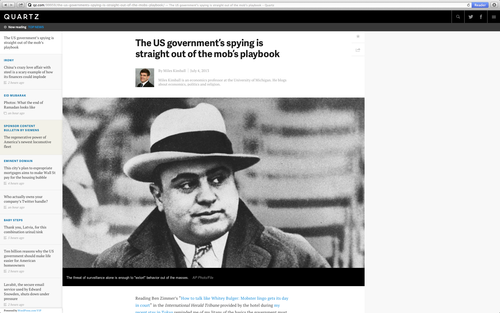
Here is the full text of my 26th Quartz column, “The US government’s spying is straight out of the mob’s playbook,” now brought home to supplysideliberal.com. It was first published on July 4, 2013. Links to all my other columns can be found here. My preferred title above better represents my broader theme: what governments need to do to foster economic growth.

I pitched this column to my editors as an Independence Day column. I am proud of our American experiment: attempting government of the people, by the people, and for the people. This column is about the principles behind that American experiment, from an economic perspective. 

If you want to mirror the content of this post on another site, that is possible for a limited time if you read the legal notice at this link and include both a link to the original Quartz column and the following copyright notice:

© July 4, 2013: Miles Kimball, as first published on Quartz. Used by permission according to a temporary nonexclusive license expiring June 30, 2014. All rights reserved.


Reading Ben Zimmer’s “How to talk like Whitey Bulger: Mobster lingo gets its day in court“ in the International Herald Tribune provided by the hotel during my recent stay in Tokyo reminded me of my litany of the basics the government must provide to make anything close to market efficiency possible:

  1. blocking theft,
  2. blocking deception, 
  3. blocking threats of violence.

Let me give two examples of what I have written in this vein. The first is from “So You Want to Save the World“:

If someone’s overall objective is evil or self-serving, the only way what they do will have a good effect on the world is if all their attempts to get their way by harming others are forestalled by careful social engineering. It is exactly such social engineering to prevent people from stealing, deceiving, or threatening violence that yields the good results from free markets that Adam Smith talks about in The Wealth of Nations—the book that got modern economics off the ground.

The second is from ”Leveling Up: Making the Transition from Poor Country to Rich Country“:

The entry levels in the quest to become a rich country are the hardest.  The basic problem is that any government strong enough to stop people from stealing from each other, deceiving each other, and threatening each other with violence, is itself strong enough to steal, deceive, and threaten with violence.  Designing strong but limited government that will prevent theft, deceit, and threats of violence, without perpetrating theft, deceit, and threats of violence at a horrific level is quite a difficult trick that most countries throughout history have not managed to perform.

How to talk like Whitey Bulger: Mobster lingo gets its day in court“ describes the example I have in mind when I write about “threats of violence”:

Charging “rent” is extorting money from business owners under the threat of violence.

I have thought about whether I should include actual violence in the list, but decided that, with only a few exceptions, the motivations for violence boil down to either theft or being able to provide some credibility for one’s threats of violence.

Deception covers a wide range of destructive activities. The idea that the free market requires tolerance of corporate deception is itself a big lie. Even routine secrets have a measure of deception to them, and as Sissela Bok demonstrates in her book Secrets: On the Ethics of Concealment and Revelation, the ethical justification for keeping secrets is much trickier than many people think.

Blackmail presents an interesting case that doesn’t quite fit my litany: the threat to reveal deception is used to distort the deceiver’s behavior. But there is an element of deception in such a revelation, since the selective revelation of one person’s secrets and not the secrets of others makes the person whose secret is revealed look much worse than if all secrets were revealed. I think I would fare very well if the day ever came that Jesus predicted when he said:

For there is nothing hidden that will not be disclosed, and nothing concealed that will not be known or brought out into the open. (Luke 8:17)

But I have no doubt that if someone revealed all of my secrets, while everyone else got to keep theirs, I could be made to look very bad.

The possibility that threats of selective revelation of secrets could be used by members of the government to blackmail others—or to deceive the public about the relative merits of different individuals—is the most serious concern raised by government spying. That is why I join Max Frankel in advocating that government spying be overseen not by judges in their spare time, but by a dedicated court whose judges can develop special expertise, with lawyers who have high-level security clearance given the task of representing the interests of those whose communications are being monitored, whether directly or indirectly. Frankel said it this way in his New York Times editorial ”Where did our ‘inalienable rights’ go?“:

Despite the predilections of federal judges to defer to the executive branch, I think in the long run we have no choice but to entrust our freedom to them. But the secret world of intelligence demands its own special, permanent court, like the United States Tax Court, whose members are confirmed by the Senate for terms that allow them to become real experts in the subject. Such a court should inform the public about the nature of its cases and its record of approvals and denials. Most important, it should summon special attorneys to test the government’s secret evidence in every case, so that a full court hears a genuine adversarial debate before intruding on a citizen’s civil rights. That, too, might cost a little time in some crisis. There’s no escaping the fact that freedom is expensive.

If modern technology makes it harder to keep secrets in general, I think that is all to the good. People usually behave better when they believe that their actions could become known. (See for example this TedEducation talk by Jeff Hancock, “The Future of Lying,” which reports evidence that people are more honest online than offline.) Those overthrowing tyrants may benefit from secrecy in putting together their revolutions, but tyrants need secrecy even more. So a general decline in the ability to keep secrets is likely to be a net plus even there.

Above, I pointed out the fundamental problem of political economy:

… any government strong enough to stop people from stealing from each other, deceiving each other, and threatening each other with violence, is itself strong enough to steal, deceive, and threaten with violence.

Although it pains me to say so, the literature on economic growth (see for example Pranab Bardhan’s Journal of Economic Literature survey article ”Corruption and Development: A Review of the Issues“) argues that centralized corruption by a strong but evil state can yield better economic outcomes than decentralized corruption by many local mob bosses or warlords. Nevertheless, I believe the elimination of tyrants and the progress of democracy throughout the world will be one of the most important contributors to human welfare in the coming decades. May those of us who enjoy the blessings of democracy be willing to make the sacrifices that could be necessary to help others enjoy that blessing. And may all nations add to democracy all of the other restraints on government necessary to make government our servant rather than our master.

Eric Hanushek on the Importance of Improving Teacher Quality

I recently ran across Eric Hanushek’s October 19, 2010 Wall Street Journal op-ed “There is No ‘War on Teachers.’” Here are two key excerpts from what he has to say:

No longer is education reform an issue of liberals vs. conservatives. In Washington, the Obama administration’s Race to the Top program rewarded states for making significant policy changes such as supporting charter schools. In Los Angeles, the Times published the effectiveness rankings—and names—of 6,000 teachers. And nationwide, the documentary “Waiting for 'Superman,’” which strongly criticizes the public education system, continues to succeed at the box office….

My research—which has focused on teacher quality as measured by what students learn with different teachers—indicates that a small proportion of teachers at the bottom is dragging down our schools. The typical teacher is both hard-working and effective. But if we could replace the bottom 5%-10% of teachers with an average teacher—not a superstar—we could dramatically improve student achievement. The U.S. could move from below average in international comparisons to near the top.

The principle that a small fraction of employees usually causes most of the trouble for productivity is well known in manufacturing. (I think of that as one of the ideas behind the “Six Sigma” approach to process improvement.) Eric is applying that principle to education.  

I did some illustrative calculations using the assumption of a normal distribution of teacher effectiveness. (If the distribution of teacher effectiveness has fat tails, the results below would be more dramatic.) On the left is the fraction of teachers at the bottom of the distribution who are fired (firing the same percentage of the replacement teachers until none of the teachers that remain are in the bottom of the distribution). On the right is the resulting change in the mean of the distribution of teacher effectiveness in standard deviations of the original distribution of teacher effectiveness. 

Mass deleted            Improvement in performance

5%                          +.11   cross-teacher standard deviations 

10%                        +.20   cross-teacher standard deviations

15%                        +.27   cross-teacher standard deviations

20%                        +.35   cross-teacher standard deviations

[The left column is the normal distribution function of x, solved for 5%, 10%, 15% and 20%; the right column is the normal density function–giving an incomplete expectation integral–divided by one minus the normal distribution function.]

To help in interpreting the meaning of these improvements measured in standard deviations, I converted the average teacher effectiveness after deleting the bottom of the distribution into the percentile in the original distribution of a teachers of a teacher who has the same effectiveness as the average effectiveness of teachers after the bottom of the distribution has been fired.  

Mass deleted       Average quality = what percentile of original distribution?

0%                           50

5%                           54.3

10%                         57.9

15%                         60.6

20%                         63.7

[The right column is the normal distribution function of the performance improvements in the table above.] 

Update: @aryal_ga flags some nice graphs of the contribution of teacher quality to long-run student outcomes created by Raj Chetty, John Friedman and Jonah Rockoff:

The Long Term Impacts of Teachers: Teacher Value-Added and Student Outcomes in Adulthood.

How Ben Franklin's Plan for Seignorage Without Inflation Could Have Forestalled the American Revolution

s Ben Franklin the Father of Electronic Money?The illustration, above, that I know from Noah Smith’s @noahpinion Twitter homepage, appears to be the work of Aaron Jasinski. See this link. This is one of the few illustrations I love so much I ha…

s Ben Franklin the Father of Electronic Money?

The illustration, above, that I know from Noah Smith’s @noahpinion Twitter homepage, appears to be the work of Aaron Jasinski. See this link. This is one of the few illustrations I love so much I have used twice. The other time was in my post “Niklas Blanchard Defends Me from the Wrath of Paul Krugman, Despite My Lack of Nuance.” It is fully appropriate here, since Ben Franklin’s plan for negative interest rates anticipated modern electronic money proposals for generating seignorage without inflation, as  detailed in “Paul Romer on the Cashless Society.”

The 1765 Stamp Act the British parliament levied on the American colonists (to help pay the debt incurred by Britain to fight the French and Indian War) was one of the key steps leading to the American Revolution. Conrad Black’s  book The Flight of the Eagle: The Grand Strategies That Brought America from Colonial Dependence to World Leadershiptold me a story about the Stamp Act that I had never heard before: Ben Franklin had an alternative to the Stamp Act that just might have averted the American Revolution. Intriguingly, Ben Franklin’s plan can be seen as a cross between Silvio Gesell’s proposal for stamped currency and the proposal for generating seignorage without inflation detailed in “Paul Romer on the Cashless Society.” But Ben Franklin’s proposal preceded Silvio Gesell’s 1891 book Die Reformation des Münzwesens als Brücke zum sozialen Staat (The reformation of the monetary system as a bridge to a social state)–his first book on reforming the monetary system–by 126 years! 

To understand the following passage, the Wikipedia definition of bill of credit is helpful: “a document similar to a banknote that is issued by a government and designed to circulate as money.” From pp. 39-40;

Shortly after Franklin’s return to London in 1764, debate began on the Stamp Act, which imposed a tax on printed and paper goods in the colonies, including even newspapers and decks of cards, and was so called because payment of the tax was certified by a stamp on the article taxed. Britain already had such a tax domestically. Pitt’s brother-in-law, George Grenville (not to be confused with Lord Granville), was leader of the government in the House of Commons. In presenting the measure, Grenville claimed the right of Parliament to levy taxes anywhere in the Empire, which was not contested by his fellow legislators, but he gave the colonies a year to propose alternatives. None did so, although Franklin himself did. Franklin achieved prodigies of diplomatic access and advocacy, but he had no legitimate status at all, and was merely an information service from Pennsylvania and other colonies that engaged him, to the British government establishment, and public. Franklin’s proposal was to have Parliament establish a colonial credit office that would issue bills of credit in the colonies, and collect 6 percent for renewal of the bills each year, and these could be used as currency. Gold and silver currency were scarce in the colonies, as all transactions with Britain had to be paid in cash, and Parliament had forbidden the issuance of paper money in America. Franklin’s theory was that this would be an adequately disguised tax, and would not be unpopular in American because of the desire there for paper money to replace an inordinate mass of informal IOUs. It isn’t clear how the interest would have been collected, or how inflation would have been avoided, but at least it was creative thinking, and a start.

John Stuart Mill on the Adversary System

John Stuart Mill recommends the adversary system for the court of opinion as well as for courts of law.  In On Liberty Chapter 2 “Of the Liberty of Thought and Discussion,” paragraph 39, he writes:

I do not pretend that the most unlimited use of the freedom of enunciating all possible opinions would put an end to the evils of religious or philosophical sectarianism. Every truth which men of narrow capacity are in earnest about, is sure to be asserted, inculcated, and in many ways even acted on, as if no other truth existed in the world, or at all events none that could limit or qualify the first. I acknowledge that the tendency of all opinions to become sectarian is not cured by the freest discussion, but is often heightened and exacerbated thereby; the truth which ought to have been, but was not, seen, being rejected all the more violently because proclaimed by persons regarded as opponents. But it is not on the impassioned partisan, it is on the calmer and more disinterested bystander, that this collision of opinions works its salutary effect. Not the violent conflict between parts of the truth, but the quiet suppression of half of it, is the formidable evil; there is always hope when people are forced to listen to both sides; it is when they attend only to one that errors harden into prejudices, and truth itself ceases to have the effect of truth, by being exaggerated into falsehood. And since there are few mental attributes more rare than that judicial faculty which can sit in intelligent judgment between two sides of a question, of which only one is represented by an advocate before it, truth has no chance but in proportion as every side of it, every opinion which embodies any fraction of the truth, not only finds advocates, but is so advocated as to be listened to.

The problem I have with this in practice is that it doesn’t work well if too large a fraction of those in a discussion take the role of intensely partisan advocates and too small a fraction take the role of relatively nonpartisan judges. That is, if there are too few “calmer and more disinterested bystanders,” the adversarial system in public affairs cannot achieve the effect that John Stuart Mill hoped for.

JP Koning—Transporting the Macroeconomics Blogosphere Back to 1809: Usury Laws and the 5% Upper Bound

Link to “Transporting the macroeconomics blogosphere back to 1809: Usury Laws and the 5% Upper Bound”

Thanks to JP Koning for giving permission to mirror this excellent Moneyness post (link above) as a guest post on supplysideliberal.com. Although the 5% upper bound in the bad old days was a disequilibrium interference with the market that created a gap between supply and demand, while the current zero lower bound is a promise of unlimited government supply of an asset earning 0%, what they have in common is a bound induced by policy, that can be repealed. 


The zero-lower bound is the well-known 0% floor that a note-issuing bank hits whenever it attempts to reduce the interest rate it offers on deposits into negative territory. Should the bank drop rates below zero, every single negative yielding deposit issued by the bank will be converted into 0% yielding notes. When this happens, the bank will have lost any ability it once had to vary its lending rate.

The ZLB is an artificial construct. It arises from the way the banking system structures the liabilities that it issues, namely cash and deposits. We can modify this structure to either remove the ZLB or find alternative ways to get around it. Much of the discussion over the econblogosphere over the last few years has been oriented around various ways to get below zero.

There is another artificial bound, this one to the upside—let’s call it the 5% upper bound, or FUB. The FUB is an archaic bound. Up until 1854, the Usury Laws prevented the Bank of England from increasing rates above 5%. This constraint meant that for almost two centuries, the Bank of England’s discount rate was bounded within a narrow channel that had as its upper limit the 5% mark as stipulated by the Usury Laws and a lower limit of 0% due to the existence of 0% yielding banknotes (see chart above).

Imagine that we had a time machine and transported the econblogosphere, still hot over the ZLB debate, back to 1809. What sorts of discussions would we be having if we had risen up against the FUB? Given that the conventional route of increasing rates was constrained by the usury prohibitions, what sort of unconventional monetary policies would bloggers be providing to the Directors of the Bank of England to deal with inflationary booms? Would this advice be symmetrical to the policies they have been advocating for escaping the ZLB?

1809 is a significant date because the convertibility of the pound into gold had been suspended for over a decade. Although convertibility would be resumed in 1821, England would be on a ‘fiat’ standard very similar to our own for another decade. In the years since suspension, the pound had gradually depreciated against gold and other European currencies. A healthy debate began to flourish over whether the Bank of England was responsible for the pound’s depreciation (ie. inflation) or if external events such as crop failures were to blame. It was in that context that banker/economist Henry Thornton published his famous Enquiry into the Nature and Effects of the Paper Credit of Great Britain. Although Thornton was circumspect on the precise causes of the deprecation of the pound, he drew attention to the difficulties that the Usury Laws caused in controlling the volume of credit. Here is Thornton:

In order to ascertain how far the desire of obtaining loans at the bank may be expected at any time to be carried, we must enquire into the subject of the quantum of profit likely to be derived from borrowing there under the existing circumstances. This is to be judged of by considering two points: the amount, first, of interest to be paid on the sum borrowed and, secondly, of the mercantile or other gain to be obtained by the employment of the borrowed capital…
The borrowers, in consequence of that artificial state of things which is produced by the law against usury, obtain their loans too cheap. That which they obtain too cheap they demand in too great quantity.

Thornton pointed out that if there was a large deficit between the price at which a businessman could borrow from the Bank of England and the mercantile rate of profit—the rate at which the same businessman could invest the borrowed money—then the demand for and granting of credit would become excessive. While nudging the discount rate higher would normally be sufficient to reduce this excess, the laws against usury might prevent these increases from taking place.

If we were to drop Nick Rowe into the 1809 economic debate, he would complement Thornton quite well by making good use of the same pole-on-a-palm analogy he has so aptly used to explain the ZLB. Running an inflation targeting central bank is sort of like balancing a long pole upright in the palm of one’s hand, says Nick. The bottom of the pole is the interest rate and the top is the inflation rate. As the pole starts to lean (ie. the price level begins to change), the holder needs to quickly move their palm far enough in the same direction (ie. interest rates must be changed) so as to stop the pole from falling over. A wall to the either the north or south impedes the holder’s palm from moving sufficiently far and will cause the pole to tumble over.

Applying this analogy to monetary policy, the Directors of the Bank of England might be required to stop excess inflation by moving rates north of 5%. With the Usury Laws in place, the Director’s efforts would be impeded. Nick’s illustration is Thornton all over again.

Scott Sumner, Lars Christensen, David Beckworth, and other monetarist-types have been strong advocates of quantitative easing as a way to get below the ZLB. Whisk them back to 1809 and would they advocate getting above the FUB by quantity dis-easing, or QD — mass repurchases of Bank of England notes through the liquidation of the Bank of England portfolio of assets?

Assuming that the threat of QD is able to increase the expected purchasing power of the pound (just as the threat of QE is supposed to reduce the same), then the Directors could initiate a QD program to improve the real return on pound notes and deposits. As soon as the real return on notes and deposits exceeds real returns on capital, the inflationary boom will come to a halt. Conveniently for the Directors, the nominal 5% rate will have remained in place — only real rates will have increased — thereby allowing the Directors to abide by the Usury Laws.

What about New Keynesians like Paul Krugman? Promising to hold off on future interest rate increases after a recovery has begun is the sort of advice New Keynesians have given to the Fed as a way to bridge the ZLB. This is called providing forward guidance. As Krugman says, a central bank needs to “credibly promise to be irresponsible”.

Parachute Krugman into 1809 and he would be counseling the Directors to do the opposite: hold off on reducing rates from 5% after a contraction had already set in. In other words, the Directors need to “credibly promise to be hard-asses.” As long as this promise is taken seriously by the market, the promise of future monetary tightening translates into lower inflation in the present, and the real interest rate rises. This should reign in the inflationary boom. Much like Sumner and Christensen, Krugman’s advice would allow the Director’s to hold steady at the 5% nominal rate dictated by the Usury Laws, letting real rates do the job of reeling in prices and slowing down the economy. 

What about Miles Kimball? Transport Miles back to 1809 and he’ll probably be the most aggressive in the outright removal of the Usury Laws. Just as he is currently campaigning for the ability of central banks to set negative rates on deposits, I’m sure he’d by picketing outside of Parliament for the right of the Director’s to bypass the Usury Laws and set 6-7% nominal rates.

Incidentally, what did the Directors of the Bank of England actually do? According to Jacob Viner, there is evidence that

bankers found means of evading the restrictions of the usury laws. In 1818, the Committee on the usury laws stated in its Report that there had been “of late years … [a] constant excess of the market rate of interest above the rate limited by law.” Thornton notes that borrowers from private banks had to maintain running cash with them, and borrowers in the money market had to pay a commission in addition to formal interest, and that by these means the effective market rate was often raised above the 5 per cent level. Another writer relates that long credits were customary in London and a greater discount was granted for prompt payment than the legal interest for the time would amount to.
More convincing evidence that the 5 per cent rate was not of itself always an effective barrier to indefinite expansion of loans by the banks is to be found in the fact that the directors of the Bank of England, although they professed that they discounted freely at the rate of 5 per cent all bills falling within the admissible categories for discount, in reply to questioning admitted that they had customary maxima of accommodation for each individual customer and occasionally applied other limitations to the amount discounted.

In Paper Credit we find Henry Thornton verifying Viner’s claim, noting the “determination, adopted some time since by the bank directors, to limit the total weekly amount of loans furnished by them to the merchants.”

So the Director’s preferred route for getting out from under the thumb of the Usury Laws was to maintain the 5% discount rate, but ration the quantity of loans issued at these rates, thereby limiting the quantity of credit in circulation. While this policy might not have been sufficient to prevent an inflationary boom, it may have prevented a hyperinflation from breaking out. 

Before I sign off, I want to reverse something I said at the outset. I wrote that the 5% upper bound was archaic, but that’s not entirely true. Sure, high interest rates are no longer illegal. But high nominal interest rates have never been politically palatable. Central bankers are not independent of politics, and therefore probably still operate with something akin to a 5% upper bound. Let’s call it an “upper-ish” bound, or the point at which a central banker starts to get dirty looks from those who have the power to reappoint him. Central bankers may need to resort to unconventional techniques to free themselves of the upperish-bound. The Fed’s motivations for adopting quantity targets in 1979, for instance, may have been such a technique. An overt jacking-up of interest rates to 15-20% would have been political suicide, goes the theory, so the FOMC chose to engage in a bunch of hand-waving about hitting money supply targets, thereby distracting would-be critics with a new set of monetary verbiage. This left Paul Volcker free to implement what would be at its peak a tremendously onerous 22%+ fed funds rate.

We’re of course not anywhere near the upper bound these days, at least not in the developed world, but it’s still an interesting puzzle to work through in order to help understand the current situation.

Labels: Bank of EnglandHenry Thorntonhistory of thoughtinflationMiles KimballNick Rowenominal interest ratesopen market operationsPaul Krugmanreal interest rateScott Sumnerusuryzero lower bound

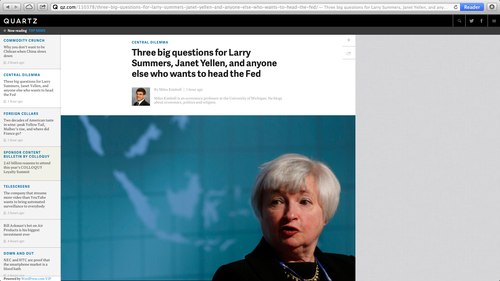
Three Big Questions for Larry Summers, Janet Yellen, and Anyone Else Who Wants to Head the Fed

Here is a link to my 27th column on Quartz, “Three big questions for Larry Summers, Janet Yellen, and anyone else who wants to head the Fed.”

Update: I am delighted that Gerald Seib and David Wessel flagged this column in their August 2, 2013 Wall Street Journal “What We’re Reading” feature. They write

University of Michigan economist Miles Kimball says the best candidate to take over as leader of the Fed will back negative short-term interest rates, nominal GDP targeting, and high equity requirements for banks and financial firms. If a candidate is chosen who opposes any of these three, Mr. Kimball predicts another serious financial crisis in the next two decades. [Emphasis added.]

In their last sentence, they go beyond what I intend when I write

But any candidate for the Fed who gives negative answers to these three questions will be indicating a monetary policy and financial stability philosophy that would leave the economy in continued danger of slow growth (with little room for error) and high unemployment in the short run, and the virtual certainty of another serious financial crisis a decade or two down the road.

Let me clarify. First, it is not these beliefs by the Fed Chief alone that would lead to a financial crisis, but the philosophy that would answer my three questions in the negative, held more generally–by the Fed Chief and other important players around the world. But of course, the Fed Chief is a hugely important player on the world stage.  Second, I write “who gives negative answers to these three questions” meaning negative answers to all three. To separate out the causality more carefully, what I have in mind with the parallel structure of my final sentence in the column (quoted just above) is 

  1. Rejection of both negative interest rates and nominal GDP targeting–and perhaps rejection of negative interest rates alone–“would leave the economy in continued danger of slow growth (with little room for error) and high unemployment in the short run."  
  2. Rejection of high equity requirements for banks and other financial firms would lead to "the virtual certainty of another serious financial crisis a decade or two down the road." 

Outtakes: Here are two passages that I had to cut to tighten things up, but that you may find of some interest:

In brief, the Fed put itself in the position of getting bad results using unpopular methods. By July 2009, the Fed’s job approval rating in a Gallup poll was down to 30%, below the job approval rating for the IRS . By the time of the 2012 presidential election campaign, Republican crowds enthusiastically chanted the title of Republican candidate Ron Paul’s book End the Fed.

…in a 32-second exchange with Charlie Rose that is well worth watching for the nuances, President Obama said “He’s already stayed a lot longer than he wanted, or he was supposed to.” The praise for Bernanke in the Charlie Rose interview is so tepid and ungenerous that my interpretation is the same as US News and World Report editor-in-chief Mortimer Zuckerman’s in his July 25, 2013 Wall Street Journal op-ed “Mistreating Ben Bernanke, the Man Who Saved the Economy”: “This comment made it clear that Mr. Bernanke’s days were numbered.” 

David Byrne: De Gustibus Non Est Disputandum

Economists use the Latin adage De gustibus, non est disputandum“There is no disputing of tastes”–to express the idea that in assessing an individual’s welfare, economists should use that individual’s preferences, not their own. This doctrine of deference to the desires, likes and dislikes of those who are affected by a policy is also evident in the praise economists usually intend when they use the word “non-paternalistic." What this doctrine means in practice is that when economists are acting in their capacity as policy advisors, their self-appointed task is to arrange things so that people get more of what they want, whatever it is that they want. (Of course, economists also often act in the capacity of scientists, with the strict task of finding out the truth and  figuring out how the world works. Greg Mankiw highlights the two tasks of economists both in his Principles of Economics textbook in the title of his Journal of Economic Perspectives article "The Macroeconomist as Scientist and Engineer,”)  

One of the areas where tastes are disputed is in the arts. David Byrne argues that even there, people’s tastes should be respected.  in Chapter 9 of his book How Music Works he takes apart the view that the consumption of some types of art and music is superior to the consumption of other types: 

Is some music really better than other music? Who decides? What effect does music have on us that might make it good or not-so-good? …

… it is presumed that certain kinds of music have more beneficial effects than others. Some music can make you a “better” person, and by extension other kinds of music might even be detrimental (and they don’t mean it will damage your eardrums)–certainly it won’t be as morally uplifting. The assumption is that upon hearing “good” music, you will somehow become a more morally grounded person. How does that work?

The background of those defining what is good or bad goes a long way toward explaining this attitude. The use of music to make a connection between a love of high art and economic success and status isn’t always subtle. Canadian writer Colin Eatock points out that classical music has been piped into 7-Elevens, the London Underground, and the Toronto subways, and the result has been a decrease in robberies, assaults, and vandalism. Wow–powerful stuff. Music can alter behavior after all! This statistic is held up as proof that some music does indeed have magical, morally uplifting properties. What a marketing opportunity! But another view holds that this tactic is a way of making certain people feel unwelcome. They know it’s not “their” music, and they sense that the message is, as Eatock says, “Move along, this is not your cultural space.” Others have referred to this as “musical bug spray.” It’s a way of using music to create and manage social space.

The economist John Maynard Keynes even claimed that many kinds of amateur and popular music do in fact reduce one’s moral standing. In general, we are indoctrinated to believe that classical music, and maybe some kinds of jazz, possess a kind of moral medicine–whereas hip-hop, club music, and certainly heavy metal lack anything like a positive moral essence. It all sounds slightly ridiculous when i spell it out like this, but such presumptions continue to inform many decisions regarding the arts and the way they’re supported. 

John Carey, an English literary critic who writes for The Sunday Times, wrote a wonderful book called What Good are the Arts that illustrates how officiallly sanctioned art and music gets privileged. Carey cites the philosopher Immanuel Kant: “Now I say the beautiful is the symbol of the morally good, and that it is only in this respect that it gives pleasure…The mind is made conscious of a certain ennoblement and elevation above the mere sensibility to pleasure.” So, according to Kant, the reason we find a given work of art beautiful is because we sense–but how do we sense this, I wonder? that some innate, benevolent, moral essence is tucked in there, elevating us, and we like that. In this view, pleasure and more uplift are linked. Pleasure alone, without this beautiful entanglement, is not a good thing–but packaged with moral uplift, pleasure is, well, excusable. That might sound pretty mystical and a bit silly, especially if you concede that standards of beauty just might be relative. In Kant’s Protestant world, all forms of sensuality inevitably lead to loose morals and eternal damnation. Pleasures needs a moral note to be acceptable.

When Goethe visited the Dresden Gallery, he noted the “emotion experienced up entering a House of God.” He was referring to the positive and uplifting emotions, not fear and trembling at the prospect of encountering the Old Testament God. William Hazlitt, the brilliant nineteenth-centuray essayist, said that going to the National Gallery on Pall Mall was like making a pilgrimage to the “holy of holies… [an] act of devotion performed at the shrine of art.” Once again it would appear that this God of Art is a benevolent one who will not strike young William down with a bolt of lightning for an occasional aesthetic sin. If such a punishment sounds like an exaggeration, keep in mind that not too long before Hazlitt’s time, one could indeed be burned at the stake for small blasphemies. And if the appreciation of the finer realms of art and music is akin to praying at a shrine, then one must accept that artistic blasphemy also has its consequences.

A corollary to the idea that high art is good for you is that it can be prescribed like medicine. Like a kind of inoculation, it can arrest, and possibly even begin to reverse, our baser tendencies. The Romantic poet Samuel Taylor Coleridge wrote that the poor needed art “to purify their tastes and wean them from [their] polluting and debasing habits.” Charles Kingsley, a nineteenth-century English novelist, was even more explicit: “Pictures raise blessed thoughts in me–why not in you, my brother? Believe it, toil-worn worker, in spite of thy foul alley, they crowded lodging, thy thin, pale wife, believe it, thou too, and thine will some day have your share of beauty.” Galleries like Whitechapel in London were opened in working-class neighborhoods so that the downtrodden might have a taste of the finer things in life. Having done a little bit of manual labor myself, I can attest that sometimes beer, music, or TV might be all one is ready for after a long day of physically demanding work.

Across the ocean, the titans of American industry continued this trend. They founded the Metropolitan Museum of Art in New York in 1872, filling it with works drawn from their massive European art collections in the hope that the place would act as a unifying force for an increasingly diverse citizenry–a matter of some urgency, given the massive number of immigrants who were joining the nation. One of the Met’s founders, Joseph Hodges Chosate, wrote, “Knowledge of art in its higher forms of beauty would tend directly to humanize, to educate and to refine a practical and laborious people.

The late Thomas Hoving, who ran the Met in the sixties and seventies, and his rival J. Carter Brown, who headed the National Gallery in Washington DC, both felt that democratizing art meant getting everyone to like the things that they liked. It meant letting everyone know that here, in their museums, was the good stuff, the important stuff, the stuff with that mystical aura. [The book illustrates] a promotion the Met did in the sixties in LIFE magazine. The idea was that even reduced to the size of a postcard, reproductions of verified masterpieces could still enlighten the American masses. And so cheap!