Whither the GOP?

I am very interested in how the Republican Party will respond to losing the presidential election. In this post, I have collected some links addressing that question. I see three possibilities.

1. More Pro-immigration. As I see it, the adjustment that maintains competitiveness in presidential elections but keeps the Republican Party’s values as close as possible to what they are now would be to become more pro-immigration. The key issue this would address is clear in the title of one of my recent posts: “Central Political Fact: Mitt Lost Despite Getting Almost 60% of the White Vote.” To be specific about how to change perceptions of the GOP without changing core Republican values, the approach I recommended to Barack in my post “Obama Could Really Help the US Economy by Pushing for More Legal Immigration” would work even better for the Republican Party if they initiated it. I predict that, if the Republican Party were willing to put up with serious grumbling from their base, outflanking the Democratic Party in being pro-immigration, while continuing to make a strong distinction between legal and illegal immigration would dramatically improve the fortunes of the GOP. Noah Smith’s post “Asian-Americans Destroy the Maker-Taker Narrative” is in the same spirit, saying that the Republican Party is in trouble if it continues to be primarily a White party.  

2. More Libertarian. Matthew Yglesias, in “The Central Tension of the GOP Coalition,” in addition to recommending less ethnocentrism, adds another possibility: becoming more libertarian (at least on gay rights) in order to appeal to the young. He writes:

… one option would be to stay committed to the idea of dismantling the welfare state and try to ditch the existing coalition in favor of some different, younger, less-white, less-ethnocentric coalition that’s more likely to want to cut retirement security programs.

3. More Populist. A final possibility is for the Republican Party to become more populist–for example, by attacking the rich and “big business.” That seems to be the direction Bobby Jindal has in mind, based on his recent interview with Jonathan Martin: “Jindal: End ‘dumbed-down’ conservatism.” Bobby also calls for less anti-intellectualism in the GOP. 

Bill Clinton on the National Debt

I liked what Bill Clinton said about the national debt at the 2012 Democratic Convention. (Here is a transcript of his speech.)

Now, let’s talk about the debt. Today, interest rates are low, lower than the rate of inflation. People are practically paying us to borrow money, to hold their money for them.

But it will become a big problem when the economy grows and interest rates start to rise. We’ve got to deal with this big long- term debt problem or it will deal with us. It will gobble up a bigger and bigger percentage of the federal budget we’d rather spend on education and health care and science and technology. It — we’ve got to deal with it.

I like this passage in his speech because he is careful to discuss the fact that interest rates are temporarily low, something I discussed in my post “What To Do When the World Desperately Wants to Lend Us Money.”

God and Devil in the Marketplace

Jonathan Haidt, in The Righteous Mind: Why Good People Are Divided by Politics and Religion, pp. 303, 304:

The next time you go to the supermarket, look closely at a can of peas. Think about all the work that went into it–the farmers, truckers, and supermarket employees, the miners and metalworkers who made the can–and think how miraculous it is that you can buy this can for under a dollar. At every step of the way, competition among suppliers rewarded those whose innovations shaved a penny off the cost of getting that can to you. If God is commonly thought to have created the world and then arranged it for our benefit, then the free market (and its invisible hand) is a pretty good candidate for being a god. You can begin to understand why libertarians sometimes have a quasi-religious faith in free markets.

Now let’s do the devil’s work and spread chaos throughout the marketplace. Suppose that one day all prices are removed from all products in the supermarket.  All labels too, beyond a simple description of the contents, so you can’t compare products from different companies. You just take whatever you want, as much as you want, and bring it up to the register. The checkout clerk scans in your food insurance card and helps you fill out your itemized claim. You pay a flat fee of $10 and go home with your groceries. A month later you get a bill informing you that your food insurance company will pay the supermarket for most of the remaining cost, but you’ll have to send in a check for an additional $15. It might sound like a bargain to get a cartload of food for $25, but you’re really paying your grocery bill every month when you fork over $2000 for your food insurance premium.

Under such a system, there is little incentive for anyone to find innovative ways to reduce the cost of food or increase its quality. The supermarkets get paid by the insurers, and the insurers get their premiums from you.  The cost of food insurance begins to rise as supermarkets stock only the foods that net them the highest insurance payments, not the foods that deliver value to you.

As the cost of food insurance rises, many people can no longer afford it. Liberals (motivated by Care) push for a new government program to buy food insurance for the poor and the elderly. But once the government becomes the major purchaser of food, then success in the supermarket and food insurance industries depends primarily on maximizing yield from government payouts. Before you know it, that can of peas costs the government $30, and all of us are paying 25% of our paychecks in taxes just to cover the cost of buying groceries for each other at hugely inflated costs.

In 2009, [David] Goldhill published a provocative essay in the Atlantic titled “How American Health Care Killed My Father”: One of his main points was the absurdity of using insurance to pay for routine purchases. Normally we buy insurance to cover the risk of a catastrophic loss. We enter an insurance pool with other people to spread the risk around, and we hope never to collect a penny. We handle routine expenses ourselves, seeking out the highest quality for the lowest price. We would never file a claim on our car insurance to pay for an oil change.

Jennifer Hunt: The Impact of Immigration on the Educational Attainment of Natives

In my latest column on Quartz, “Second Act: Obama Could Really Help the US Economy by Pushing for More Legal Immigration,” I wrote:

Additional immigration may cause a problem for native-born Americans who don’t complete high school, but the kind of education reform that will help solve that problem is already one of the president’s strong suits and something strongly supported by Republicans.

Jennifer Hunt, in her recent NBER Working Paper “The Impact of Immigration on the Educational Attainment of Natives,” finds evidence that the impact of additional immigration on high school dropouts is mitigated by the fact that many of the native born come to realize they need more schooling to avoid being in competition with immigrants. Jennifer’s paper was considered of enough general interest that it was featured in the NBER Digest. Here is the NBER Digest’s summary of her paper:   

An increase of one percentage point in the share of immigrants aged 11-64 in the population increases the probability that natives aged 11-17 eventually complete 12 years of schooling by 0.3 percentage points.

In The Impact of Immigration on the Educational Attainment of Natives (NBER Working Paper No. 18047), Jennifer Hunt finds that, contrary to the popular notion that immigrants may have a negative impact on the public education experience of native-born children, the net effect of immigrant children in schools is positive. Using the 1940-2000 censuses and the pooled 2008-2010 American Community Surveys, Hunt focuses on the impact of immigration on the probability of natives’ completion of 12 years of schooling. She finds that an increase of one percentage point in the share of immigrants aged 11-64 in the population increases the probability that natives aged 11-17 eventually complete 12 years of schooling by 0.3 percentage points.

There are at least two ways in which immigration could affect schooling outcomes for natives. Immigrant children could compete for schooling resources with native children, lowering the return to native education and discouraging native high school completion. Conversely, native children might be encouraged to complete high school in order to avoid competing with immigrant high-school dropouts in the labor market. Hunt finds evidence that both channels are operative and that the net effect is positive, particularly for native-born blacks, but not for native-born Hispanics.

Compared to natives, immigrants to the United States are much more likely to be poorly educated, and also more likely to be highly educated. Immigrants are underrepresented among workers with an intermediate level of education, such as a high school diploma.  –Matt Nesvisky

The Digest is not copyrighted and may be reproduced freely with appropriate attribution of source.

The one finding that is worrisome is the less positive effect on education for the native-born Hispanics, who are most similar to the bulk of the immigrants. This suggests that it might be wise for a policy increasing legal immigration to aim for increased immigration from a wide range of different countries. This would be consistent with having a large number of legal immigration slots for those coming from Latin American countries, if most of those slots were reserved for those who already have a strong connection to the United States–for example, by having resided here for a long time.

Central Political Fact: Mitt Lost Despite Getting Almost 60% of the White Vote

I wanted to back up some of the claims I made in my Quartz article yesterday (“Second Act: Obama Could Really Help the US Economy by Pushing for More Legal Immigration”) about the political feasibility for Barack to dramatically change America’s approach to immigration.  

In Wednesday morning’s Wall Street Journal, Gerald Seib had an interesting analysis of the situation now for the Republicans: “Tough Loss Leaves GOP at a Crossroads.” Gerald poses the question from the Republican points of view “What went wrong?” Here is his answer:

But the most significant critique will be the one that says the party simply failed to catch up with the changing face of America. Exit polls showed that Mr. Romney won handily among white Americans—almost six in 10 of them—but lost by breathtaking margins among the nation’s increasingly important ethnic groups: By almost 40 percentage points among Hispanics, by almost 50 points among Asians, and by more than 80 points among African-Americans.

The groups Barack did well among are groups that are becoming a bigger and bigger fraction of voters. 

Neil Irwin’s note “Republicans’ immigration problem in two numbers” on Wonkblog, ties the big margin for Barack among Hispanic voters to Barack’s advantage on immigration policy:

Asked how U.S. immigration policy should deal with illegal immigrants, 74 percent of Republican voters said that they should be deported to the country from which they came. But only 29 percent of voters overall shared that view. (Some 64 percent of all voters favored giving illegal immigrants a chance to apply for legal status).

My argument is that by focusing first on reform of legal immigration, Barack can get support for that from a bigger fraction of the Republican coalition than the 26% or so who are somewhat tolerant of illegal immigration. What I don’t know is how support for an expansion of legal immigration shifts as the size of the expansion increases.

Democracy in Action

We traditionally celebrate our nation on July 4. But in a very real sense, Election Day best symbolizes what America is all about. Most of us care deeply about the outcome of the election, though not all with the same hopes. But the greatest value of free elections is in all of the out-of-equilibrium outcomes that, because of the regularity of free elections, never come close to happening. Abraham Lincoln had it right in what he said about the importance of our democratic experiment:

Four score and seven years ago our fathers brought forth, on this continent, a new nation, conceived in Liberty, and dedicated to the proposition that all men are created equal.

Now we are engaged in a great civil war, testing whether that nation, or any nation so conceived and so dedicated, can long endure. We are met on a great battle-field of that war. We have come to dedicate a portion of that field, as a final resting place for those who here gave their lives that that nation might live. It is altogether fitting and proper that we should do this.

But, in a larger sense, we can not dedicate—we can not consecrate—we can not hallow—this ground. The brave men, living and dead, who struggled here, have consecrated it, far above our poor power to add or detract. The world will little note, nor long remember what we say here, but it can never forget what they did here. It is for us the living, rather, to be dedicated here to the unfinished work which they who fought here have thus far so nobly advanced. It is rather for us to be here dedicated to the great task remaining before us—that from these honored dead we take increased devotion to that cause for which they here gave the last full measure of devotion—that we here highly resolve that these dead shall not have died in vain—that this nation, under God, shall have a new birth of freedom—and that government of the people, by the people, for the people, shall not perish from the earth.

Michael Quinn, Mormon Historian

In Slate, on November 1, David Haglund published a powerful article about key controversies in the recent history of the Mormon Church:

The Case of the Mormon Historian: What happened when Michael Quinn challenged the history of the church he loved.

This history intersects with my own personal history. Although I did not leave Mormonism until 2000, the “Purge” of six Mormon scholars in September 1993 and the surrounding events forever changed my view of Mormonism. I was also a bit player in some of those events, in ways I will share at some point. Let me say that I found the work of the scholars who were purged to be very insightful and revealing.

For those who are not Mormons, I think you will find this article well worth your while as a way to get an insider’s perspective of controversies within Mormonism. There are also hints in the article of the other, more positive, side of Mormonism that engenders such great devotion in the members of the Mormon Church. To understand the pain of being excommunicated, one has to understand the level of devotion to Mormonism that these scholars had–and which many of them still have.

How to Find Your Comparative Advantage

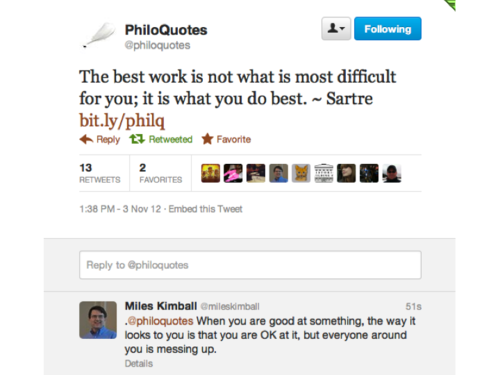
Miles gives a delayed response to Jean-Paul Sartre on Twitter

Jean-Paul Sartre said:

The best work is not what is most difficult for you, it is what you do best.

From my own observation, of others as well as myself, let me say this:

When you are good at something, the way it looks to you is that you are OK at it, but everyone around you is messing up.

When things look that way, be patient with those around you and realize that you may have found your comparative advantage–a comparative advantage that might help you go far.

Divided Government Likely to Win Again

As an independent, I am a fan of divided government. Since Democrats have lately been doing better in their Senate races, while the Republicans are quite unlikely to lose the House of Representatives, there is an excellent chance that the winner in the presidential election will not have a majority in both houses of Congress. Brian Beutler somewhat overstates the case that divided government will win in his post “Why the GOP Agenda is Likely Dead Even If Romney Wins.” Mitt is more likely to win in a situation where the Republicans also do will in their Senate races, than in a situation in which the Democrats hold the Senate. So the folks betting on Intrade are today giving an 18.4% chance that Mitt will win along with the Republicans getting both houses of Congress, while Mitt has a 13.8% chance of winning but facing a Democratic Senate, and quite small chances of winning but facing a Democratic House. (Mitt’s overall probability of winning is 33% according to Intrade.) So conditional on Mitt winning, Intrade suggests he is more likely than not to have both houses of Congress with him, but there is a substantial chance he will be checked by a Democratic Senate.

On the other side, Intrade gives only a 2% chance that Obama will be elected along with both houses of Congress being in Democratic hands. So an Obama victory has a very high chance of also being a victory for divided government. Overall, Intrade gives divided government an 80% chance of winning, with the bulk of the 20% chance of divided government losing falling on Mitt’s side.

Let me make the prediction that, even if Mitt wins the presidency and the Republicans win the Senate as well as the House, Republican control of both houses of Congress would last no more than two years. The President’s party often loses seats at the first midterm election– and the Republicans seem eager to try enough bitter medicine for the body politic–that I suspect an all-Republican government would suffer somewhat larger than usual losses at the elections in 2014.

What all this boils down to is that anyone who fears truly extreme results from the presidential election is unlikely to see those fears realized. We are likely to continue to experience the blessings of divided government bestowed upon us abundantly by the framers of the Constitution through their ingenious design of checks and balances.

Garrett Jones on the Many Macroeconomic Correlates of Human Capital as Measured by IQ

Thanks to Scott Sumner for highlighting this interesting and accessible piece by Garrett Jones here.  To see if you want to read it, start by taking a look at the graphs.

In the title “National IQ and National Productivity: The Hive Mind Across Asia," having read Noah Smith’s diatribe against the Asian "hive mind” stereotype, I recommend ignoring the phrase “Hive Mind.” Also, since IQ depends a lot on how hard people study, I interpret “IQ” as a measure of human capital that may be superior in many ways to just counting years of schooling. In any case, this set of facts is quite intriguing.   

Freeman Dyson on the State of Philosophy

In the most recent New York Review of Books, Freeman Dyson reviews Why Does the World Exist?: An Existential Detective Story, by Jim Holt, which is based on interviews with modern philosophers. Freeman titles his review “What Can You Really Know.” Toward the end, he compares philosophy now to what philosophy used to be:

For most of the twenty-five centuries since written history began, philosophers were important. Two groups of philosophers, Confucius and Lao Tse in China, and Socrates, Plato, and Aristotle in Greece, were dominant figures in the cultures of Asia and Europe for two thousand years. Confucius and Aristotle set the style of thinking for Eastern and Western civilizations. They not only spoke to scholars but also to rulers. They had a deep influence in the practical worlds of politics and morality as well as in the intellectual worlds of science and scholarship.

In more recent centuries, philosophers were still leaders of human destiny. Descartes and Montesquieu in France, Spinoza in Holland, Hobbes and Locke in England, Hegel and Nietzsche in Germany, set their stamp on the divergent styles of nations as nationalism became the driving force in the history of Europe. Through all the vicissitudes of history, from classical Greece and China until the end of the nineteenth century, philosophers were giants playing a dominant role in the kingdom of the mind.

Holt’s philosophers belong to the twentieth and twenty-first centuries. Compared with the giants of the past, they are a sorry bunch of dwarfs. They are thinking deep thoughts and giving scholarly lectures to academic audiences, but hardly anybody in the world outside is listening. They are historically insignificant. At some time toward the end of the nineteenth century, philosophers faded from public life. Like the snark in Lewis Carroll’s poem, they suddenly and silently vanished. So far as the general public was concerned, philosophers became invisible.