What Should the Historical Pattern of Slow Recoveries after Financial Crises Mean for Our Judgment of Barack Obama's Economic Stewardship?

In 2003, Carmen Reinhart and Kenneth Rogoff started writing a book about the aftermath of financial crises: This Time is Different: Eight Centuries of Financial Folly. Their book’s finding that returning to the previous level of per capita GDP takes a long time after serious financial crises has become part of the political debate. In both the Democratic Convention and in the debates, part of the argument that Barack has done a good job, under the circumstances, has relied on the idea that recoveries should be expected to be especially slow after serious financial crises. Noah Smith ably discusses the merits of the  Republican counterattack on the Reinhart-Rogoff finding in his post Reinhart-Rogoff vs. Bordo-Haubrich (with grandstanding by John Taylor). Carmen Reinhart and Ken Rogoff’s own defense of their finding is very useful, especially if you haven’t read their book. They are focused only on the historical evidence in their response. They do not directly engage in the political debate.    

I take the Reinhart-Rogoff finding very seriously, and will treat it as a good historical generalization in this post. But I want to point that–even stipulating that returning to the previous level of per capita GDP has historically taken a long time after serious financial crises–the implications of this Reinhart-Rogoff finding for the political debate are much more less clear than the Democratic argument would suggest. In particular, as Carmen and Ken acknowledge in their recent defense of their finding, what happens after a serious financial crisis is not some immutable law of nature, but depends on the policy response. And the key question for the political debate is not if the policy response of the Obama administration’s policy response was better than the policy response to serious financial crises has been historically, but whether the Obama administration’s policy response was as good as it should have been given what was known at the time. The very existence of This Time is Different: Eight Centuries of Financial Folly (published in September 2009 and surely existing in draft form quite a bit earlier)within a time period relevant for Obama Administration policy making should set the bar higher. 

In particular, in the light of the Reinhart-Rogoff finding that he should have had access to, one can make the argument that Barack should have known he needed to do more than the policies he chose in order to get a robust recovery. Indeed, (as I also cited in my post “Why George Osborne Should Give Everyone in Britain a New Credit Card”) in his excellent Atlantic article, “Obama Explained,” James Fallows wrote:

If keeping the economy growing was so central for Obama, why was the initial stimulus “only” $800 billion? “The case is quite compelling that if more fiscal and monetary expansion had been done at the beginning, things would have been better,” Lawrence Summers told me late last year. “That is my reading of the economic evidence. My understanding of the judgment of political experts is that it wasn’t feasible to do.” Rahm Emanuel told me that within a month of Obama’s election, but still another month before he took office, “the respectable range for how much stimulus you would need jumped from $400 billion to $800 billion.” In retrospect it should have been larger—but, Emanuel says, “in the Congress and the opinion pages, the line between ‘prudent’ and ‘crazy spendthrift’ was $800 billion. A dollar less, and you were a statesman. A dollar more, you were irresponsible.”

Barack certainly had access to Larry Summers’s advice. And I would be surprised if Larry Summers’s advice at the time didn’t incorporate Larry’s awareness of what Carmen and Ken had found. So the fact that Barack did not push for a bigger stimulus package really is an indictment of his economic leadership. According to the reported statement by Larry Summers, it was a political judgement that a bigger stimulus was not politically feasible. I am not at all convinced that a bigger stimulus was politically impossible. It would not have been easy, I’ll grant that, but I was amazed that Barack managed to get Obamacare through. If, instead, Barack had used his political capital and the control the Democrats had over both branches of Congress during his first two years for a bigger stimulus, couldn’t he have done more? 

The bottom line is that (asking a lot of Mitt’s protean ability to shapeshift) if Mitt were willing to distance himself far enough from the Republicans in Congress and the Republican orthodoxy, it would be quite possible to use the Reinhart-Rogoff finding to attack Barack’s economic stewardship. Barack should have known the economy needed more stimulus, and in fact his closest economic advisor knew that the economy needed more stimulus! Mitt could then claim that Barack was so set on forcing through health care reform that he took his eye off the more urgent task of ensuring economic recovery. (I remember Peggy Noonan, without specifying what economic policy should have been taken, forcefully making the argument at the time that Barack was putting too high a priority on health care reform relative to fostering economic recovery.) It is a tricky argument for a Republican to make, saying that with the Republicans dead set against both an adequate stimulus and Obamacare, Barack should have focused on the fight for an adequate stimulus rather than for health care reform, but it is a logically cogent one. (I have to confess to my own ignorance about the extent to which Mitt’s own statements about the stimulus package in 2009 would also cause him trouble in making this argument. Given Mitt’s willingness to emphasize at different times a different one of his contradictory statements over others, did he ever say anything then that could be spun as having warned that the stimulus wasn’t big enough–or should have been the same size but focused on things that most economists would agree would have been more effective at raising aggregate demand?)

Aside from the political argument itself, the issues I raise should be part of history’s judgement of Barack Obama. In particular, I take exception to Joe Biden’s claim in the vice presidential debate with Paul Ryan that “no president could have done better” than Barack has done. I suspect, in fact, that Bill Clinton would have done better if he could have been president again. It is quite possible that Hillary Clinton would have done better–in part because she might have been more gun-shy about health care reform and so have focused more intensely on the more immediate economic issue. And Mitt might well have done better had he won the presidency in 2008 (in part because he would have faced less intense Republican opposition to needed stimulus)–though it is hard to know if he would have taken the right policy direction.

Notice that in all of this, I am treating a larger stimulus of a conventional kind as the best among well-discussed policy options when Barack took office in 2009. So I am backing up Paul Krugman’s criticisms of Barack’s policies at the time. However, given what we know now we could do even better, as I discuss in my post “About Paul Krugman: Having the Right Diagnosis Does Not Mean He Has the Right Cure.”

Update:

About Paul Krugman: Having the Right Diagnosis Does Not Mean He Has the Right Cure

This is the second time in less than a month that Paul Krugman’s picture has headed one of my posts. (The other time is here.) That is no accident. Paul is the true monster of the economics blogosphere–as well as in the beleagured redoubts of non-electronic economic journalism that remain.  I use the word “monster” in the positive and enviable sense of having a large reach and influence with the words that he writes. (Please, may I some day grow up to be a monster? See the illustration from Where the Wild Things Are.

In his recent post, “Smuggish Thoughts (Self-Indulgent),” Paul writes this:

I got obsessed with Japan in the 1990s, and I think can fairly claim to have started the whole modern liquidity-trap literature. I approached the Japan problem the way I approach just about all economic problems, building a stylized, minimalist model (big pdf) that seemed to make sense of the available facts and yielded strong conclusions. But does this style of analysis work in the real world?

Well, events provided an acid test. If you believed in the little models I and others were using, you made some very striking predictions about how the world would work post-crisis–predictions that were very much at odds with what other people were saying. You predicted that trillion-dollar deficits would not drive up interest rates; that tripling the monetary base would not be inflationary; that cuts in government spending, rather than helping the economy by increasing confidence, would hurt by depressing demand, with bigger effects than in normal, non-liquidity trap times.

And the people on the other side of these issues weren’t just academics, they were major-league policy makers and famous investors.

And guess what: the models seem to work. It appears that I wasn’t just a successful self-marketer, that I really did and do know something.

Basically, I agree with Paul’s assessments here–his diagnosis of what happened. But I do not agree with his prescription. As near as I can make out (and I am happy to be corrected on this), his number one recommendation has been a large increase in government spending to provide Keynesian stimulus, and his number two recommendation has been for the Fed to promise future inflation above its normal 2% target.

That secondary recommendation I discussed in my earlier post on Paul Krugman. I will not repeat everything I said there, but let me say a few words about the relevant scientific issue. The issue I have with Paul’s analysis there is that he seems to approach the approximate Wallace neutrality that is likely in the real world–which can account for the facts he mentions above–for the perfect Wallace neutrality of his simple model, which would imply that large scale asset purchases by the Fed (as in QE1, QE2, QE3 and Operation Twist) will not work in any direct way, so that the Fed’s only option for stimulating the economy is to promise (or hint at) inflation above 2% in the future.

In relation to Paul’s primary recommendation of a massive increase in government spending in the short run, my main objection is that (assuming we are not willing to contemplate national bankruptcy), every dollar the Federal government ultimately adds to the national debt is a dollar that has to be paid for by taxes further down the road, or by cuts in government spending further down the road that will be hard to bear, given the aging of the population. Except in the case of spending now that can genuinely serve instead of spending in the future, we have to be very concerned about the cost of stimulative spending.

Let me give a simple numerical example to make the point. After the economy gets fully back on its feet, I expect the interest rate to be something like 4% per year in real terms. Suppose we added $2 trillion more to the debt to stimulate the economy and then wanted to keep that extra debt from growing further in real terms so that the growth of GDP could gradually reduce the debt-to-GDP ratio. To do that, we would have to pay the real interest on that extra debt: $2 trillion * 4% per year = $80 billion per year. If GDP by then is a little higher than now, at $16 trillion per year, that is a ½ % addition to the spending to GDP ratio. A lot of the big arguments between Republicans and Democrats are about differences in government spending on the order of about 3% of GDP. So ½ % of GDP difference in government spending due to extra interest payments is actually a very big deal.

So it is a great advantage to simulate the economy by measures that add less to the national debt, the Federal Lines of Credit which I lay out in my second post “Getting the Biggest Bang for the Buck in Fiscal Policy” and have discussed at great length in the other short-run fiscal policy posts on this blog.

(It seems plausible to me that large scale asset purchases by the Fed also have this property of stimulating the economy while adding relatively little to the national debt in the end. I would be glad to see a careful analysis of the likely round-trip financial costs to the Fed of pushing interest rates down and asset values up by buying long-term government bonds and mortgage-backed securities now to stimulate the economy, and pulling interest rates up and asset values down later by selling them to rein the economy in–or alternatively raising interest on excess reserves later.) 

It matters how we approach the problems that we face. Paul Krugman deserves a lot of credit for getting the basic diagnosis of our problems right, but he needs to be just as serious about identifying the best possible solutions. Traditional Keynesian remedies or promises of inflation may work to stimulate the economy, but what if there is a better remedy, with fewer undesirable side effects? It is my contention that there is a better remedy, that would have the same effectiveness at lower cost: Federal Lines of Credit. And that is in addition to the possibility that the Fed has already found a better approach in large scale asset purchases, if only it pushes hard enough on its string.  

Update: A commenter on Twitter (I’ve lost track of the tweet) points out that the government can stabilize the debt to GDP ratio if it pays only the interest rate minus the growth rate of the economy on the debt each year, rolling over the rest, including rolling over the part of interest payments equal to the growth rate. That makes the long-run picture look less stark than the calculation I make if the interest rate is less than 3% above the growth rate of the economy. For example, approached that way, if the interest rate is only 1.5% above the growth rate of the economy, then the $2 trillion in extra debt would mean a permanent ¼ % of GDP less spending or a permanent ¼% of GDP less taxes.

A New Engine for Discovery in Economics and Other Social Sciences: RAND's American Life Panel

A few years back, economists and other social scientists and technical experts at RAND and the University of Michigan put together a grant proposal focused on seeing what can be done with web surveys. Thanks to funding provided by the National Institute on Aging (part of the National Institute of Health), we were able to find out the answer. Leaving out many details, the basic answer is that, except for a few things that have to be done in person, web surveys are at least as good, and usually better, than other survey methods. RAND’s American Life Panel arose out of that collaboration (though it is now an independent RAND survey that has a wide range of clients other than government research agencies). I can’t pretend to be objective about the American Life Panel. As part of a large team, I have been involved in it from the beginning and I love it. 

An important distinction has to be made between commercial web surveys, which use samples of convenience (often trying to match certain broad demographic frequencies to the population as a whole) and scientific web surveys that make great efforts to get as close to a representative sample as possible–even on characteristics that are unmeasured. The American Life Panel is just such a scientific web survey. Every effort is made not only to draw respondents randomly from the population as a whole, but also to give web access to those randomly chosen who don’t already have web access.

By contrast to most surveys, which fairly soon became calcified under the weight of a standard set of questions that are asked again and again, taking up most of the available survey time, under Arie Kapteyn’s leadership, the American Life Panel (ALP) has grown in power and reach under a unique philosophy of experimental modules initiated in a relatively decentralized way that over time add up to much more than the sum of the parts. At this point, data from a huge variety of experimental modules can now be compared to data on ALP respondents that duplicates most of what is collected from respondents to Michigan’s Health and Retirement Study and data that duplicates a big subset of what is collected from respondents to Michigan's Cognitive Economics Study. Arie’s commitment to supporting “bold, persistent experimentation” in surveys augurs well for the future of the American Life Panel.

Because the American Life Panel has only recently come into its own, most economists don’t realize what is there, what can be done with the existing data on the ALP, and what can be done by collecting new experimental data to combine with the ALP’s existing data. For young economists in particular, I am confident there are many, many dissertations hiding in the data already collected, aside from everything that is coming.    

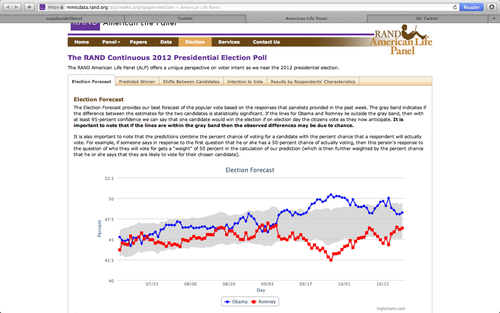
Just for fun, I have put a link under the illustration to the ALP’s election forecast webpage, based on survey questions that probe for probabilities as opposed to discrete answers–a style of survey question that has been advocated most forcefully by Chuck Manski and his coauthors. Also, unlike typical election polls, the results you see above and at the election forecast webpage are based on panel data: the same people are asked the questions repeatedly, so that the changes you see are more likely to be genuine changes in opinion, instead of random  fluctuations in the set of people surveyed. (Note: the election polling behind the picture above is not supported by any government agency.) 

Update: Brad DeLong tweeted to me this interesting comment:

RAND’s reinterview method is a treatment that over time turns low-info voters into high info voters. That’s a powerful bias…

My reaction is that if Brad is right, the views of a high-information sample of otherwise typical voters from a representative sample is itself very interesting. The question that Brad raises is a good example of the value of an experimental survey–to be able to discover and investigate, or rule out, effects such as that.

Al Roth's Nobel Prize is for Economics, but Doctors Can Thank Him, Too

image

Here is a link to my third column in Quartz, about the Nobel Prize in Economics for Lloyd Shapley and Al Roth. This column describes ongoing research by Dan Benjamin, Ori Heffetz and Alex Rees-Jones and me about trade-offs young medical doctors make in their National Resident Matching Program choices–in particular, tradeoffs between happiness and other goods.  

Update: Thanks to Daniel Altman’s digging, Here is a little more detail from Al Roth his efforts with the National Resident Match Program and how it works:

Joshua Muravchik and Bryan Caplan on Field Trials of Socialism

At this link, Bryan Caplan does a great job of framing Joshua Muravchik’s account of Robert Owen’s utopian socialist experiments. Bryan sums up his take in this way:

Until now, I’d always thought that despite his pretensions, Marx was no better than the Utopian socialists.  Now I realize that this was entirely unfair.  Marx was decidedly inferior to his “Utopian” rivals.  They were wrong, but at least they had the common sense and common decency to beta test their radical proposals on a small scale with consenting subjects.

Enrico Moretti on Rich Cities and Poor Cities

Instead of thinking of rich countries and poor countries, rich regions an poor regions, this article by Enrico Moretti recommends thinking about rich cities and poor cities. Here are some of the highlights–the striking outcomes and the paradox that distance still matters in a wired world. One element of the story, at least in the U.S., is the rise of industries in which human capital is more important than physical capital. Highly educated people–who are the key resource for those industries–often want to congregate in interesting cities. (That claim is the main point of Richard Florida’s book The Rise of the Creative Class.)

The economic map of America today does not show just one country – it shows three increasingly different countries. At one extreme are America’s brain hubs – cities like Seattle, Raleigh-Durham, Austin, Boston, New York and Washington DC – with a thriving innovation-driven economy and a labor force among the most creative and best paid on the planet. The most striking example is San Francisco, where the labor market for tech workers is the strongest it has been in a decade. At the other extreme are cities once dominated by traditional manufacturing – Detroit, Flint, Cleveland – with shrinking labor force and salaries. 

In 1980, the salary of a college educated worker in Austin was lower than in Flint. Today it is 45 percent higher in Austin, and the gap keeps expanding with every passing year. The gap for workers with a high school degree is a staggering 70 percent by some estimates. It is not that workers in Austin have higher IQ than those in Flint, or work harder. The ecosystem that surrounds them is different.

In China, Shanghai has reached a per capita income close to that of a rich nation. Its students outperform American and European students in standardized tests by a wide margin. Its public infrastructure is better than that of many American cities. But agricultural communities in western China have made much less progress.

Despite all the hype about exploding connectivity and the death of distance, economic research shows our salary, productivity and creativity increasingly depends on the place where we live.

Video conferencing, e-mail, and Skype have not made a dent in the need for innovative people to work side by side. In fact, that is more important than ever. Thousands of well-educated innovative workers are now moving to San Francisco and Silicon Valley, many attracted by jobs in social networking. They will produce software intended to create virtual communities that erase distance and allow us to share ideas and information from any corner of the world. Ironically, in order to do that successfully, all this talent must concentrate into a single location. Research shows that our best ideas still reflect the daily, unpredictable stimuli that we receive from the people we come across and our immediate social environment.

Does Ben Bernanke Want to Replace GDP with a Happiness Index?

Here is the link to my column on Quartz and a screen shot of the illustration at the top. 

This is my second column on the Atlantic’s new world business website Quartz. One of the interesting things about Quartz is that it is designed to look good on a smartphone or tablet. But it works fine on a regular computer as well, as you can see from the screen shot.   

Anders Åslund on the Lessons of Sweden

Note: The original link is now broken. The best replacement I could find is Scott Sumner’s extensive quotations here.  

Sweden went through some large swings in economic policy highly relevant for U.S. economic policy debates. The full story is important. Here is Anders Aasland’s version. (I think “aa” is an acceptable spelling of an “a” with a circle over it.)

Thanks to Scott Sumner for highlighting this Anders’s essay. Scott notes:Aslund neglects to mention things like Stockholm’s congestion pricing scheme.” 

Greg Ip on Barack Obama's Performance as Steward of the Economy

This is an excellent discussion by Greg Ip of how Barack has done in his economic policy choices and the economic role of presidents in general.

Note: The appropriate judgment of Barack’s performance would be much different if the many ways to stimulate aggregate demand

  1. without adding too much to the national debt and
  2. in an environment where short-term interest rates are already down to zero

had been better understood when he faced the economic challenges of the last few years.

On the many ways to stimulate aggregate demand without adding too much to the debt and in a low-interest rate environment, see my blog posts on short-run fiscal policy and monetary policy, which are nicely laid out in these two “sub-blogs” of tagged posts:

These sub-blogs of tagged posts automatically update as I add more posts with the relevant tags. I put links to these sub-blogs on my sidebar. (I will add links to other sub-blogs soon.)

Edna St. Vincent Millay's "Dirge Without Music"

I have found this poem of Edna St. Vincent Millay’s comforting in times of grief. It expresses my feelings about death; it also expresses my carefully considered views on death.

Dirge Without Music

I am not resigned to the shutting away of loving hearts in the hard ground.
So it is, and so it will be, for so it has been, time out of mind:
Into the darkness they go, the wise and the lovely. Crowned
With lilies and with laurel they go; but I am not resigned.

Lovers and thinkers, into the earth with you.
Be one with the dull, the indiscriminate dust.
A fragment of what you felt, of what you knew,
A formula, a phrase remains,—but the best is lost.

The answers quick and keen, the honest look, the laughter, the
love,—
They are gone. They are gone to feed the roses. Elegant and curled
Is the blossom. Fragrant is the blossom. I know. But I do not
approve.
More precious was the light in your eyes than all the roses in the
world.

Down, down, down into the darkness of the grave
Gently they go, the beautiful, the tender, the kind;
Quietly they go, the intelligent, the witty, the brave.
I know. But I do not approve. And I am not resigned. 

Edna St. Vincent Millay

Nicholas Kristof: "Where Sweatshops are a Dream"

This op/ed by Nicholas Kristof is a classic that Greg Mankiw links to. I use it in my class to make two points:

  1. The value of an extra dollar (or an extra Cambodian riel) can be extraordinarily high for someone who is very poor. (See my post “Inequality Aversion Utility Functions,” where I emphasize that almost all the benefits from redistribution are from helping the poor, not from transferring money from the rich to the middle class.)
  2. Caring about helping the poor does not always mean one should support policies recommended by activists who say they care about the poor.

A number of policies recommended by those who say they care about the poor have the common element of saying, in effect:

If you can’t or won’t create a good job, don’t create a job at all.

For some people, a “bad job” is a lifeline. And if we insist that only good jobs should exist, they will have no job.

I think there is another element behind opposition to sweatshops. When people in poor countries are suffering before the arrival of an American company in their backyard, that hideous suffering from poverty is out of sight for us in America. But as soon as the American company arrives to give the opportunity of taking what look like bad jobs to us, if they choose to, the somewhat lesser suffering of their poverty after taking the “bad job” seems like the fault of the American company for not making the jobs nicer. In fact the company has helped them, but we only see the suffering from poverty after, not the hideous suffering from worse poverty before.

One factor that can make it easier to blame the American company for the suffering left after providing the job is that some of the corporate executives involved in setting up and running the new factory in a poor country may, in fact, be uncaring, unfeeling people (though I doubt this is true anywhere near as often as people suppose). But even if many of the corporate executives involved in setting up and running the new factory are uncaring, unfeeling people, it doesn’t change the fact that, by their actions of setting up and running the factory, they have made people’s lives better. They could have made people’s lives better still if they had taken a bigger fraction of their personal earnings and donated it to helping the poor than they actually did, but that is something that can be said for almost every American.

One policy change that could increase what Americans do to help the desperately poor in other countries is the program of “public contributions” I recommend in my post “No Tax Increase Without Recompense.” That program of public contributions would dramatically increase the amount of assistance American give to the desperately poor in other countries. Government-funded foreign aid is very unpopular–and often is relatively ineffective because much of it is channeled through corrupt foreign governments. But many individuals (with whatever money they have set aside to donate to good causes) are attracted by the idea of helping the desperately poor.

Ryan Avent on the Fed's Plans to Keep Rates Low Even After Recovery is Underway

This is a very interesting post by Ryan Avent about the ways in which the Fed is strengthening its “forward guidance”: promises (or at least half-promises) about the Fed’s future actions. Forward guidance has now moved toward clearer plans to keep stimulating the economy even after it has already recovered.

I have written elsewhere that I have misgivings about forward guidance. (Here is the thread of all my monetary policy posts, and here is the last previous post that addressed this issue.)  I had an extended email discussion with an economist in the Federal Reserve System (whom I will not name) who argued passionately that, given our lack of knowledge about what will work and what won’t, the Fed should be using both large-scale asset purchases and promises that it will keep stimulating the economy even after it has reached the natural level of output–planning to push the economy above the natural level of output for a while.

I still would rather the Fed increased the scale of its asset purchases than strengthen its promises to push the economy beyond the natural level of output in the future. And I am especially uncomfortable with expressing this commitment in terms of specific dates. If the Fed thinks it must commit to going above the natural level of output for a while, it would be better for the Fed to commit to get the aggregate price level back to a track of prices that has increased on average by 2% per year since 2008. (That would be price-level targeting, which is consistent with NGDP targeting as long as the natural level of output is growing at a constant rate.) That would clearly limit how much overstimulation the Fed was indicating it would do–just enough to have enough inflation in excess of 2% to balance out the cumulative inflation we have had below 2% in the last few years. I also believe that if the Fed had done sufficient asset purchases in the last few years (for example, if QE1 and QE2 had each been three times as large), the economy would have recovered enough that the Fed would never have been tempted to rely as heavily on “forward guidance” as it now is. Those who think that large scale asset purchases have large costs aside from the level of stimulus they provide to the economy–which for the sake of this argument I am taking to be a benefit–should articulate clearly what they think those costs are.

The costs of the Fed tying its hands in this way will become evident in the future. I have a memory (perhaps faulty) that having given earlier forward guidance that interest rates would stay low may played some role in the low interest rates the Fed maintained in 2003–low rates that have been blamed, perhaps very unfairly, for helping to create a housing price bubble. I would be glad to hear more about the extent to which readers think earlier forward guidance played a role in the Fed’s maintenance of low interest rates in 2003. 

Inequality Aversion Utility Functions: Would $1000 Mean More to a Poorer Family than $4000 to One Twice as Rich?

Economists use utility functions to represent many aspects of people’s preferences. Even when an economic model has been simplified to (in some sense) have only one good–let’s call it “consumption”–the curved, concave shape of a utility function like the one above can be used to represent any of the following:

  1. Risk aversion (either in a risky investment situation or an insurance situation)
  2. Resistance to intertemporal substitution
  3. Resistance to substituting between one’s own consumption and the consumption (at some ratio to one’s own consumption) of a child, parent, friend, or stranger one cares about
  4.  A good part of how the value of a statistical human life varies with the income level of a society
  5. How people feel about inequality–that is, how they feel about the situation of the poor and the rich.

If there are two goods–lets call them “consumption” and “leisure,” the curved, concave shape of the part of the utility function that depends on consumption can be used to represent how the need to work to be able to afford more consumption changes as the amount of consumption one is doing already increases–whether that increase in consumption occurs from the passage of time or because of luck.  I mention the many things that concave utility functions are used to represent because it is not at all clear that the utility function one should use to represent one of these things should look the same as the utility function one should use to represent another. In this post, I want to focus on just one thing a concave utility function can be used to represent: how people feel about inequality.

I want to emphasize that finding a good utility function to represent how people feel about inequality requires asking about people how they feel about the situation of the rich and the poor. There is no guarantee, for example, that you could ask about someone’s attitudes toward risk and get a good read on how they feel about inequality.

Yoshiro Tsutsui, Fumio Ohtake (both of the University of Osaka) and I arranged to collect data on a rider to the February, 2005 University of Michigan Survey of Consumers that asked directly about people’s feelings about the situation of the rich and the poor. The sample was the same sample as that used for the University of Michigan Consumer Confidence numbers–a sample intended to be representative of the adult U.S. population. This post gives a preview of some of the results from an academic paper we are working on, ably assisted by Daniel Reck and Fudong Zhang. It follows up on what I said about the poor and the rich in my first post “What is a Supply-Side Liberal?” In this post, I am taking the overall philosophical perspective is that of Utilitarianism, as developed by modern welfare economics using a social welfare function. 

Yoshiro, Fumio and I wanted to ask questions that got at the key issues while minimizing reactions based in a shallow way on political ideology. To the extent these questions are about redistribution, the intent is to get at only the benefits of redistribution, as distinct from the costs of redistribution (say through tax distortions).

We began by asking

It is often said that one thousand dollars is worth more to a poor family than to a rich family. Do you agree?

90% of all respondents agreed.  Then we went on to ask questions to probe how much more $1000 is worth to a poor family than a rich family. I won’t give the whole sequence of questions here. Let me just choose two questions that are especially revealing about what the typical adult American thinks. When we asked

Think of two families like yours, one with half the income of your family, the other with the same income as your family. Which would make a bigger difference, one thousand dollars to the family with half your family’s income or four thousand dollars to the family with an income like yours?                                                                                 

66% of all respondents thought the $1000 to the poorer family with half the income would make a bigger difference than $4000 to the richer family. (Everyone who had disagreed from the outset with the idea that $1000 is worth more to a poor family than to a rich family was counted as thinking the $4000 to the rich family would make a bigger difference.) When we asked

Think of two families like yours, one with half the income of your family, the other with the same income as your family. Which would make a bigger difference, one thousand dollars to the family with half your family’s income or eight thousand dollars to the family with an income like yours?

66% of all respondents though the $8000 to the richer family would make a bigger difference than $1000 to the poorer family with half the income. Focusing on the middle opinion, I read this evidence as saying that the median adult American thinks that $1000 to a poorer family with half the income would have about the same impact on that family’s life as an amount of money somewhere between $4000 and $8000 to the richer family. Stretching the interpretation a little more, I am going to take the utilitarian perspective and talk about this median view as “inequality aversion” and as an indication that most people think there would be some benefit to redistribution, though the costs might sometimes–or even often–outweigh the benefits. I do think that view represents the views of those in the middle of the political spectrum.  

How can we represent these views in an inequality-aversion utility function? To make the numbers a little easier, let me lowball the degree of inequality aversion a little, and act as if $1000 to the poorer family with half the income had exactly the same life-impact as $4000 to the richer family. Let me also simplify by assuming that those ratios hold regardless of the initial income level.  With those simplifications, some moderately advanced mathematics implies that the utility function must be of the form

U© = A - B/C

where A and B are some positive numbers and C is the level of consumption spending of an individual or family of a given size. The reason A and B are not determined is that we need some yardstick. It is easy to forget, but almost all measurement requires the choice of some arbitrary yardstick. The exact length of an Earth day is an accident of how our solar system formed and the geological era we are in, but we used it to develop units of time.  Similarly, a kilometer was originally intended to by a 1/40,000 of the circumference of the Earth. In addition to the size of units of measurement, we also often need arbitrary starting points. Our measures of longitude start at 0 at Greenwich, England,  which has to do with historical accidents of geopolitical and scientific power and influence at the time the system of latitude and longitude was chosen.  

Fortunately, no economic logic depends on the values of A and B. The value of A doesn’t matter because for economic decisions because in any decision it is the comparison of how well-off one is under two or more possible situations that matters. When comparing any pair of options,  the difference in utility between those two choices will leave “A” cancelled out. This is analogous to the fact that the path from Ann Arbor to the Detroit Metro Airport would be the same even if, in an egocentric change, Ann Arbor were the starting point for longitude instead of Greenwich, England. And the path from Ann Arbor to the Detroit Metro Airport would also be the same if Kabul, Afghanistan were the starting point for longitude. The value of B doesn’t matter because using one value of B rather than another is like the choice to measure distances in miles rather than kilometers, or in inches rather than yards. The real-world answers are going to come out the same.

For convenience–and only for convenience, since it doesn’t matter–I have chosen A=0 and B=1 for the graph at the top of this post. It may seem odd that utility is then always negative for this functional form, but utility being represented by a negative number is literally meaningless except in relation to what 0 utility means. With A=0, a utility of zero is material bliss–the maximum utility possible. So negative utility simply means that one has fallen short of material bliss.

Marginal utility is the slope of the utility function. It tells how much extra utility there is from a little more consumption. Even before choosing A=0 and B = 1, we can say that marginal utility here is

Marginal Utility = U’© = B/[C squared] 

Notice how A has already dropped out. After choosing B=1, marginal utility becomes

Marginal Utility = U’© = 1/[C squared]

This means that doubling consumption C will reduce marginal utility to one quarter of what it would have been at the lower level of consumption, so $4000 at that higher level of consumption means only as much as $1000 at a consumption level half as big. What this shows is only that the utility function (with its associated slope, marginal utility) is doing OK at representing what we designed the utility function to represent: $1000 to a poorer family with half the income meaning the same as $4000 to a richer family.

It is my contention that bringing the discipline of mathematics to discussions of redistribution is useful in informing the debate about redistribution. Let me give just one example. Looking at the utility function at the top of the post, the slope shows how much a little extra money means to someone at each level of consumption. The difference between the slope at different levels of consumption shows how much benefit there is from redistributing from a richer to a poorer individual or family–a benefit that then needs to be weighed against the costs–for example costs to freedom from the compulsion of taxes, or costs from people’s efforts to evade and avoid taxes. If one thinks of a consumption of 1 as representing the middle class, a consumption of 4 as representing the rich and a consumption of ¼ as representing the poor, one can see that there is a much bigger difference in the slope for the poor minus the slope for the middle class than the difference in the slope for the middle class minus the slope for the rich. So with a utility function that has the slope depend inversely on the square of consumption as here, there are much bigger gains from redistributing dollars from the middle class to the poor than there are from redistributing dollars from the rich to the middle class.

My Mother

Evelyn Bee Kimball, April 25, 1929–September 27, 2012

Evelyn Bee Kimball, April 25, 1929–September 27, 2012

Until this past week, I had a feeling deep in my bones that my Mother, because she was my Mother, would never die.  I was wrong, and it hurts. It leaves a hole in my life and in all of our lives to have her gone.

My Mother was an unstoppable cheerleader for me.  She always expected me to succeed and took seriously my most optimistic career hopes. When I was not good at something—as in my early days of driving and teaching–she was one of the few who thought I was good at it anyway.

By precept and example, Mother gave me two elements of toughness. The first was an ability to go back and forth at will between viewing the world in a very sentimental way and viewing the world in a very unsentimental way. She loved dolls and toys and hugs. We all saw her sentimental side in her interactions with her grandchildren and great grandchildren and in her closeness with her sisters. But she could also switch into talking like a hardbitten detective about people’s motives and strengths and weaknesses. That hardbitten detective’s perspective comes in handy in my work as an economist.

The second element of toughness my Mother bequeathed to me was stubbornness—the stubbornness not to give up when I know what I want, for either myself or for the world. When my Mother had her sights on something and wanted things a certain way, she would do a lot to get it to happen. I have an Eagle Scout badge somewhere to prove it.  The world is not always very cooperative, so stubbornness like my Mother’s is often necessary to get things to happen. People are quick to say that something is too hard to do, or even that it can’t be done, when all it takes is hard work and the kind of stubbornness my Mother gave me.

I think my Mother gave all of her children something else very important.  It was extremely hard on her when her parents divorced.  So hard on her, that she never talked about it when we were growing up and I didn’t learn about it until my late teens.  But what I did get was the picture that marriage is a permanent commitment—something that made a difference from the very first day of my own marriage. I know enough about the statistics of divorce to know that it is unusual to have seven married children, with well over a hundred years of marriage between them, and no divorces. Mother and Dad deserve a lot of credit for that.

My Mother always seemed to me like a force of nature. I didn’t expect her to be like an ordinary human being.  She was in a class of her own.  And in the end, that is why it is so sad that she is gone. Someone unique and irreplaceable is gone from the face of the earth.

My First Column on the Atlantic's New Website "Quartz": "More Muscle than QE3: With an Extra $2000 in their Pockets, Could Americans Restart the U.S. Economy?"

Screen shot of the illustration for my column “More Muscle than QE3: With an Extra $2000 in their pockets, could Americans restart the U.S. economy?” on the Quartz website.

I am one of the columnists on the Atlantic’s new world business website Quartz (qz.com). I expect to have columns appear there approximately weekly, plus some quick reactions to breaking economic events.

At Quartz, I am working with Mitra Kalita and Lauren Brown.