The Federalist Papers #21 B: Alexander Hamilton Complains of the Lack of a Measure Such as GDP Suitable for Apportioning Taxes to the States
Not everything in The Federalist Papers is a timeless truth. The second half of The Federalist Papers #21 is a complaint that there was nothing akin to GDP that could be used to fairly apportion taxes among the 13 states. We take GDP for granted, but it’s development was a great advance for macroeconomic policy. Similarly, I think the development of a national well-being index that has technical strengths on a par with GDP will be a great advance for macroeconomic policy in the future.

Below is the full text of Alexander Hamilton’s complaint about the lack of something like GDP in the second half of The Federalist Papers #21. He also discusses various other taxing options, complaining about the difficulty of valuing land and building as well—something we routinely do for property taxes in most states now. He argues that commodity taxes at least go up with spending—and hence are not as regressive as head taxes.


The principle of regulating the contributions of the States to the common treasury by QUOTAS is another fundamental error in the Confederation. Its repugnancy to an adequate supply of the national exigencies has been already pointed out, and has sufficiently appeared from the trial which has been made of it. I speak of it now solely with a view to equality among the States. Those who have been accustomed to contemplate the circumstances which produce and constitute national wealth, must be satisfied that there is no common standard or barometer by which the degrees of it can be ascertained. Neither the value of lands, nor the numbers of the people, which have been successively proposed as the rule of State contributions, has any pretension to being a just representative. If we compare the wealth of the United Netherlands with that of Russia or Germany, or even of France, and if we at the same time compare the total value of the lands and the aggregate population of that contracted district with the total value of the lands and the aggregate population of the immense regions of either of the three last-mentioned countries, we shall at once discover that there is no comparison between the proportion of either of these two objects and that of the relative wealth of those nations. If the like parallel were to be run between several of the American States, it would furnish a like result. Let Virginia be contrasted with North Carolina, Pennsylvania with Connecticut, or Maryland with New Jersey, and we shall be convinced that the respective abilities of those States, in relation to revenue, bear little or no analogy to their comparative stock in lands or to their comparative population. The position may be equally illustrated by a similar process between the counties of the same State. No man who is acquainted with the State of New York will doubt that the active wealth of King's County bears a much greater proportion to that of Montgomery than it would appear to be if we should take either the total value of the lands or the total number of the people as a criterion!

The wealth of nations depends upon an infinite variety of causes. Situation, soil, climate, the nature of the productions, the nature of the government, the genius of the citizens, the degree of information they possess, the state of commerce, of arts, of industry, these circumstances and many more, too complex, minute, or adventitious to admit of a particular specification, occasion differences hardly conceivable in the relative opulence and riches of different countries. The consequence clearly is that there can be no common measure of national wealth, and, of course, no general or stationary rule by which the ability of a state to pay taxes can be determined. The attempt, therefore, to regulate the contributions of the members of a confederacy by any such rule, cannot fail to be productive of glaring inequality and extreme oppression.

This inequality would of itself be sufficient in America to work the eventual destruction of the Union, if any mode of enforcing a compliance with its requisitions could be devised. The suffering States would not long consent to remain associated upon a principle which distributes the public burdens with so unequal a hand, and which was calculated to impoverish and oppress the citizens of some States, while those of others would scarcely be conscious of the small proportion of the weight they were required to sustain. This, however, is an evil inseparable from the principle of quotas and requisitions.

There is no method of steering clear of this inconvenience, but by authorizing the national government to raise its own revenues in its own way. Imposts, excises, and, in general, all duties upon articles of consumption, may be compared to a fluid, which will, in time, find its level with the means of paying them. The amount to be contributed by each citizen will in a degree be at his own option, and can be regulated by an attention to his resources. The rich may be extravagant, the poor can be frugal; and private oppression may always be avoided by a judicious selection of objects proper for such impositions. If inequalities should arise in some States from duties on particular objects, these will, in all probability, be counterbalanced by proportional inequalities in other States, from the duties on other objects. In the course of time and things, an equilibrium, as far as it is attainable in so complicated a subject, will be established everywhere. Or, if inequalities should still exist, they would neither be so great in their degree, so uniform in their operation, nor so odious in their appearance, as those which would necessarily spring from quotas, upon any scale that can possibly be devised.

It is a signal advantage of taxes on articles of consumption, that they contain in their own nature a security against excess. They prescribe their own limit; which cannot be exceeded without defeating the end proposed, that is, an extension of the revenue. When applied to this object, the saying is as just as it is witty, that, “in political arithmetic, two and two do not always make four.”

If duties are too high, they lessen the consumption; the collection is eluded; and the product to the treasury is not so great as when they are confined within proper and moderate bounds. This forms a complete barrier against any material oppression of the citizens by taxes of this class, and is itself a natural limitation of the power of imposing them.

Impositions of this kind usually fall under the denomination of indirect taxes, and must for a long time constitute the chief part of the revenue raised in this country. Those of the direct kind, which principally relate to land and buildings, may admit of a rule of apportionment. Either the value of land, or the number of the people, may serve as a standard. The state of agriculture and the populousness of a country have been considered as nearly connected with each other. And, as a rule, for the purpose intended, numbers, in the view of simplicity and certainty, are entitled to a preference. In every country it is a herculean task to obtain a valuation of the land; in a country imperfectly settled and progressive in improvement, the difficulties are increased almost to impracticability. The expense of an accurate valuation is, in all situations, a formidable objection. In a branch of taxation where no limits to the discretion of the government are to be found in the nature of things, the establishment of a fixed rule, not incompatible with the end, may be attended with fewer inconveniences than to leave that discretion altogether at large.

PUBLIUS.


Here are links to my other posts on The Federalist Papers so far:

Joseph G. Allen, Akiko Iwasaki and Linsey C. Marr: This Winter, Fight Covid-19 with Humidity

Hat tip to Joshua Hausman. Joshua mentions that while the article says 40% humidity won’t be too hard on your house. But that depends on temperature: below about 20 degrees Fahrenheit, even 40% humidity is likely to lead to significant condensation. But the general idea still holds: figure out what level of humidity is OK for your house given the outside temperature and go up as high as that level.

Gratitude in a Pandemic

The pandemic we are in offers a new perspective on many things. It is possible to be disgruntled about the limitations the pandemic puts on us. But it is also possible to be grateful for things that, in the normal course of things we took for granted, but now can notice.

If you still have a job, that is something to be grateful for, and probably something you notice more now than before the pandemic. If you have a reasonably nice living space, that is something to be grateful for. If those you live with are reasonably pleasant companions, that is definitely something to be grateful for. If you have been able to reconnect with old friends who live at a distance during this time when we can see that distance matters less than it used to, that, too is something to be grateful for.

There are many, many other things to be grateful for. In particular, if one of the things I listed you don’t have, my bet is that you can identify other things that you can be grateful for. In any case, it is easy to see worst-case scenarios all around us, yet most of us are not personally dealing with a worst-case scenario. That is something to be grateful for.

Gratitude puts us in the emotional presence of all the good things in our lives that we are noticing. It is a wonderful feeling. And it tends to make us nicer to the people around us. Three cheers for gratitude!

Thanks, by the way, for reading my blog. It means a lot to me to have you and others care about what I have to say. It makes the writing worthwhile.

Happy Thanksgiving!

Don’t miss these other posts about gratitude:

Japan's Mysteriously Low COVID-19 Death Rate

The blog title above links to an interesting article, addressing an interesting question.

My #1 theory: superspreader individuals make a huge difference, and Japanese culture is one of the few cultures that gets close to universal compliance with advice—thus having few superspreader individuals.

Other contributors:

  • The advice to avoid the 3 Cs recommendations are superior to the recommendations in many countries. They 3 Cs to be avoided are:

    • Enclosed spaces with poor ventilation

    • Crowded places with many people

    • Close contact settings such as face-to-face conversations.

  • Japanese authorities were also clear about the dangers of heavy breathing in proximity to others.

  • The fact that restrictions were voluntary made Japanese authorities willing to activate those restrictions earlier.

The Moral Duty of Uplift (in David Brin's Sense)

In David Brin’s Uplift trilogy, “uplift” is the ancient galactic tradition of identifying species that have the potential to be transformed into intelligent species (that is, technologically sophisticated species that can, say, build spaceships), and bringing about the genetic modifications through genetic engineering and breeding needed to enable that transformation.

The Great Filter (see 1, 2) may have made us the only intelligent species in the visible universe—though if the universe is as big as standard cosmological theories suggest, the part of the universe too far away to be visible is so vast that it almost surely contains other intelligent species. But there are many species on our Earth that have the potential to be uplifted. Here are some obvious candidates:

  • Bonobos

  • Chimpanzees

  • Gorillas

  • Dolphins

  • Octopuses

On the relatively high intelligence of octopuses already, see Peter Godfrey-Smith’s book, Other Minds:

You also might be interested in his more recent book Metazoa. Here is a link to the Wall Street Journal review of that book.

I realize that it might offend some people’s moral sense to “play God” by tinkering with other species enough to make them as intelligent or almost as intelligent as humans are. And some may argue it is too dangerous to uplift other species, lest at some point we wind up at war with them. (The “Planet of the Apes” scenario.) Let me address these concerns.

I would frame the goal of uplift as modifying a species as little as possible subject to safety concerns and subject to getting them to a point where they can write novels and other works of art. These novels and other works of art would help us understand other beings quite different from us. To me, being able to love those who are different, as well as those who are similar to you, is the highest form of love. It is also a strength: those who can love others who are different can form broad coalitions to defend themselves against those who can only love those who are similar to themselves. Indeed, we are doing just that now in fighting the coronavirus. The coronavirus reproduces by cloning (sometimes imperfect cloning). We reproduce by mating with another, quite different human being. And we cooperate with many other human beings. Even within our bodies, there are many cells that, though genetically alike, are epigenetically different.

There is a decent argument to be made that we are not yet ready for uplift: we are still struggling to love other human beings who are different. (See, for example, my post “It Isn't OK to Be Anti-Immigrant.”) But as an optimist (see Steven Pinker’s The Better Angels of Our Nature), I have hope that at some point we will be pretty good (though never perfect) at loving all other human beings. (Here is my effort toward making economists more loving.) Allowing for the lead times needed for the science and technology of uplift, it would be great if, by the time we get pretty good at loving all other human beings, we could stretch ourselves by having other fully intelligent species to learn to love, such as uplifted bonobos, uplifted chimpanzees, uplifted gorillas, uplifted dolphins and uplifted octopuses.

I, too, am genuinely worried about conflict between humans and species we uplift. Therefore, I suggest that in addition to genetic engineering and breeding to make these other species more intelligent that we also “domesticate” them to make them nonviolent, at least toward humans. This is analogous to what humans did to transform wolves into dogs. It is also analogous to installing in robots Isaac Asimov’s First Law of Robotics: “A robot may not injure a human being or, through inaction, allow a human being to come to harm.”

As far as “playing God” goes. In my view, there is no one else available to play god but us. I believe in gods, but I am a nonsupernaturalist. Evolution of genes and memes created us. At this point in our history, within each of us is a Sage that is a god within. When we interact with one another Sage to Sage, that is a god between. Those are the most godlike things I know of. But there are also the god ahead or gods ahead that we are building, or could be building. I talk about the gods ahead in my sermon “Teleotheism and the Purpose of Life.” As a believer in gods, I think there should be more gods in the world. Uplift is a way to foster more gods within, more gods between (including from the interactions between species) and, in all probability, more possibilities for gods ahead. (As far as gods ahead are concerned, we “see through a glass darkly.”)

I’ll discuss the technology of uplift in another post at some point. Let me say only that with the brisk rate of improvement in biotechnology, I predict that uplift will be within our capabilities with technologies we’ll have within 100 years. (Notice that, since humans are already intelligent at the level we are talking about, this is more analogous to copying something already in existence than it is to creating something wholly new.) So it is worth having the ethical debate now. I am pro-uplift. I hope you are too.

Lisa Marshall: Frequent, Rapid Testing Could Turn National COVID-19 Tide within Weeks

Here are some passages as teasers. I added bullets to separate passages.

  • Testing half the population weekly with inexpensive, rapid-turnaround COVID-19 tests would drive the virus toward elimination within weeks—even if those tests are significantly less sensitive than gold-standard clinical tests, according to a new study published today by CU Boulder and Harvard University researchers.

  • When it came to curbing spread … frequency and turnaround time are much more important than test sensitivity.

  • In the past, federal regulators and the public have been reluctant to embrace rapid tests out of concern that they may miss cases early in infection. But, in reality, an infected person can go from 5,000 particles to 1 million viral RNA copies in 18 to 24 hours …

    “There is a very short window, early in infection, in which the PCR will detect the virus but something like an antigen or LAMP test won’t” …

    And during that time, the person often isn’t contagious …

    “These rapid tests are contagiousness tests” …

  • “Less than .1% of the current cost of this virus would enable frequent testing for the whole of the U.S. population for a year,” said Mina, referencing a recent economic analysis published by the National Bureau of Economic Research.

  • “It’s time to shift the mentality around testing from thinking of a COVID test as something you get when you think you are sick to thinking of it as a vital tool to break transmission chains and keep the economy open” …

How the Nature of the Transmission Mechanism from Rate Cuts Guarantees that Negative Rates have Unlimited Firepower

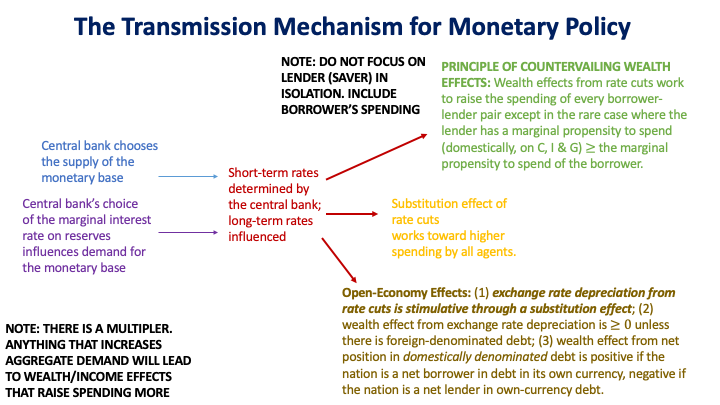
Copyright Miles Kimball, 2020. You may freely use this diagram for any purpose as long as you include a reference and link to this blog post.

Copyright Miles Kimball, 2020. You may freely use this diagram for any purpose as long as you include a reference and link to this blog post.

Negative rates make all the old issues in monetary policy new. Monetary economists didn’t have a consensus on the transmission mechanism for interest rate cuts when rates were in the positive region, but almost no one doubted that rate cuts were, indeed, stimulative in the positive region because there was so much experience showing that they are. Predicting what will happen in the negative region makes monetary theory important. This post lays out the relevant theory. If you disagree, please identify the particular part of the logic of the theory below that you disagree with; I’d love to have you put your critique in a comment.

The first thing to say theoretically is that the effects of interest rate cuts are likely to be continuous. Hence, a very small interest rate cut, such as the 10 basis points that the Bank of Japan went negative, would be unlikely to have a big effect.

Beyond that point, I need to set the stage. I am interested in the effects of rate cuts that are combined with other policies so that they (a) don’t hurt bank balance sheets and (b) don’t cause any massive increase in paper currency storage.

On (a), in the real world, most central banks that use negative rates use tiering of the interest-on-reserves formula or below-market-rate lending to private banks to protect the balance sheets of private banks from negative effects from negative rates. This is certainly what I recommend. (See “Responding to Negative Coverage of Negative Rates in the Financial Times” and Ruchir Agarwal’s and my paper: “Enabling Deep Negative Rates to Fight Recessions: A Guide.”)

As they acknowledge, Markus Brunnermeier and Yann Koby's "Reversal Interest Rate" comes from a model that assumes, contrary to what happens in the real world, that the central bank will do nothing to bolster bank balance sheets when rates are cut in the negative region. Central banks are smarter than that.

On (b), a large share of what I have written or coauthored about negative rate policy has been about modifying paper currency policy in a way that avoids massive paper currency storage. On that, let me refer you to my bibliographic post “How and Why to Eliminate the Zero Lower Bound: A Reader’s Guide,” and especially the papers I highlight at the top there.

To put a point on things, I totally concede that the monetary transmission mechanism might be different in the negative region if a central bank does not protect bank balance sheets or does not modify paper currency policy. This is not relevant to my proposals the more detailed proposals that Ruchir Agarwal and I have made in our papers on negative interest rate policy. But I know that what might happen if a central bank does not protect bank balance sheets or does not modify paper currency policy affects many people’s intuitions about negative interest rate policy, even where those situations are not relevant. Please try to take seriously the assumption that the bank profits problem and the paper currency problem have been neutralized as I go on to discuss the transmission mechanism for rate cuts when those issues have been taken care of.

The diagram at the top of this post gives my perspective on the transmission mechanism for rate cuts. All of the logic in that diagram holds up 100% even when rates are negative.

Like many monetary economists, I think that the transmission mechanism for monetary policy works almost entirely through the interest rate movements it engenders. There are two subtleties:

  1. There are many interest rates, and which assets a central banks buys (say in QE) can affect different parts of the risk- and term-structure of interest rates differently.

  2. Expectations about the entire future path of interest rates matters. This is the lever through which forward guidance can work.

I won’t deal with these two complications in this post. But in the diagram at the top of the post, I do indicate the perspective I teach my students about how most central banks move: short-term risk-free interest rates: Supply and Demand for the Monetary Base.

Once interest rates go down, there are three categories of effects: open-economy effects, wealth effects that would happen even in a closed economy, and the direct substitution effect from the interest-rate cut. Most economists will find what the diagram says about open-economy effects and the direct substitution effect routine, though it takes some care to work through all of the open-economy effects.

I only learned what is in the diagram about the direct wealth effects from rate cuts from thinking about negative rate policy. I named the key insight The Principle of Countervailing Wealth Effects. I wrote about this principle first in my rejoinder to Mark Carney, “Even Central Bankers Need Lessons on the Transmission Mechanism for Negative Interest Rates.” Two other posts followed that up: “Responding to Joseph Stiglitz on Negative Interest Rates” and “Negative Rates and the Fiscal Theory of the Price Level.”

Importantly, The Principle of Countervailing Wealth Effects—particularly the principle that the change in the present value of what the debtor owes is equal and opposite to the change in the present value of what the lender is owed—operates just as well in a fully dynamic model as in a simplified model. If there is no borrowing and lending in the initial situation, there will be no wealth effects from a small interest rate change. Note that in a dynamic model, one is in danger of misanalyzing the effects of interest rate changes if one does not recognize the change in the present value of the consumption path planned in the initial situation as well as the change in the present value of the income stream.

In a dynamic model, no borrowing and lending doesn’t have to come from everyone being identical: those of one type could be very impatient (high utility discount rate), but have income front-loaded enough that they don’t need to borrow, while those of the other type is very patient (low utility discount rate), but have income back-loaded enough that they don’t need to lend. And if the two types have different elasticities of intertemporal substitution, borrowing and lending will arise as rate changes move things away from the initial situation. (In a simple model, the rate changes might need to come from a change in a storage technology; in more complex models the rate changes can come from central bank actions.)

The key question is unaffected by how dynamic and how complex the model of borrowing and lending is:

Which is bigger, the marginal propensity to spend (domestically on C, I and G) of the borrower compared to the marginal propensity to spend of the lender?

If the marginal propensity to spend of the borrower is greater, than the net wealth effect of a rate cut when aggregating over the borrower and lender in any borrower-lender relationship is stimulative. If the marginal propensity to spend of the lender is greater, then the net wealth effect of a rate cut on the combined spending of that particular borrower-lender pair is contractionary, but other borrower-lender pairs, the substitution effect and open-economy effects could still make the rate cut stimulative overall. Thus:

  • It is a good exercise to try to identify borrower-lender pairs for whom the marginal propensity to spend is higher for the lender than for the borrower. This will be hard. If you think you have succeeded, definitely tell me what you found in a comment!

  • However, a particular type of borrower-lender pair that does have the lender’s marginal propensity to spend higher has to be numerous enough and important enough to outweigh the net wealth effects from all the other types of borrower-lender pairs, as well as the substitution effect and open-economy effects if they are on net stimulative (as they will be if the straightforward exchange-rate effect on net exports dominates).

It is a tall order to meet this standard for rate cuts to be contractionary. The most likely case for rate cuts to be contractionary is if a nation has a massive amount of foreign-currency-denominated debt. That is, I think the open-economy effects having to do with foreign debt are the one plausible reason for interest-rate cuts to be contractionary. (Of course, if interest rate cuts are contractionary locally, then interest-rate increases will be stimulative locally, so monetary policy can still stimulate.)

Except in one situation, I think it is very, very hard to maintain that in the real world borrowers overall have lower marginal marginal propensities to spend than lenders, weighting by magnitude of borrowing. As long as borrowers have a higher marginal propensity to spend than lenders, the bottom line is this: the direct wealth and substitution effects of interest rate cuts are unambiguously stimulative, so rate cuts will be unambiguosly stimulative overall if net open-economy effects from rate cuts are stimulative.

What is the one exception I can see? It is actually about rate increases being stimulative, not directly about rate cuts being contractionary. In many hyperinflationary situations, the government feels unable to cut back spending any more, so that its marginal propensity to spend less when its interest rate expenses increase is close to zero—less than the marginal propensity to spend of the bondholders out of their extra interest-rate income. Other than that, it is hard to think of a weighty exception to the the norm that borrowers have a higher marginal propensity to spend than lenders.

This bottom line based on the forces we have analyzed so far leaves two questions:

Q: What will happen to the magnitude of the effects in the diagram when rates start deep in negative territory?

A: It is hard to see why the gap between marginal propensities to spend of borrowers and lenders should narrow dramatically as interest rates go lower. And notice that there is no serious problem for monetary policy firepower if the gap narrows somewhat. As long as the sign of the gap continues to make the marginal propensity to spend higher for borrowers than lenders, there is still the direct substitution effect and the open-economy effects. And their is no plausible real-world reason for the substitution effect to become dramatically smaller as rates go lower. Indeed, negative rates are especially salient, and deep negative rates even more salient, so if one adds in some behavioral-economics effects, one would expect the substitution effect to get somewhat bigger as rates go lower. (Why would deep negative rates be even more salient than shallow negative rates? At some point, rates are negative enough that even after a risk premium is added on top of the risk-free rate, more and more borrowers can borrow at a negative rate at least for short maturities. That is salient!)

Q: What important effects are omitted that need discussion? The main additional effects I can think of are nominal-illusion effects. The key thing here is that nominal-illusion effects will affect borrowers or lenders. So it is important to think about the net effect aggregated over borrowers and lenders of nominal illusions interacting with rate cuts. To me, it seems most plausible that nominal-illusion effects are like the salience effects I discussed above: juicing up the effects of interest-rate cuts on both borrowers and lenders. And borrowers tend to be either equally or less sophisticated than lenders. So the effects of interest rate cuts should be juiced up by nominal illusions more for borrowers overall than for lenders.

Conclusion: Let me conclude by pointing out that it is very easy to make theoretical models in which the marginal propensity to spend is higher for lenders than for borrowers. It is just that those parameter values aren’t very plausible in the real world. A simple example is that in a two-period model one could have for lenders highly curved period-utility in the second period but very slightly curved period-utility in the first period (more or less a “target retirement consumption” utility function) and do the opposite for borrowers: highly curved period-utility in the first period but very slightly curved period-utility in the second period. But why assume such different functional forms for borrowers and lenders? Isn’t it more likely that they have similar functional forms but different utility discount rates (levels of impatience)?

When it comes down to it, do we really believe empirically, in the real world, that there are weighty parts of the economy where lenders have a higher marginal propensity to spend than borrowers? I think not. And if I am right about the rarity of marginal propensities to spend that are higher for lenders in a borrower-lender pair, then only open-economy effects can overturn the idea that rate cuts remain substantially stimulative however low rates go. (“Substantially stimulative” means that there is a strictly positive lower bound on how stimulative a 100-basis-point cut will be, no matter how low rates have gone already.) That yields unlimited monetary-policy firepower if one has addressed the bank profits problem and the paper currency problem so that rates can go as low as necessary.

Inducing Autophagy

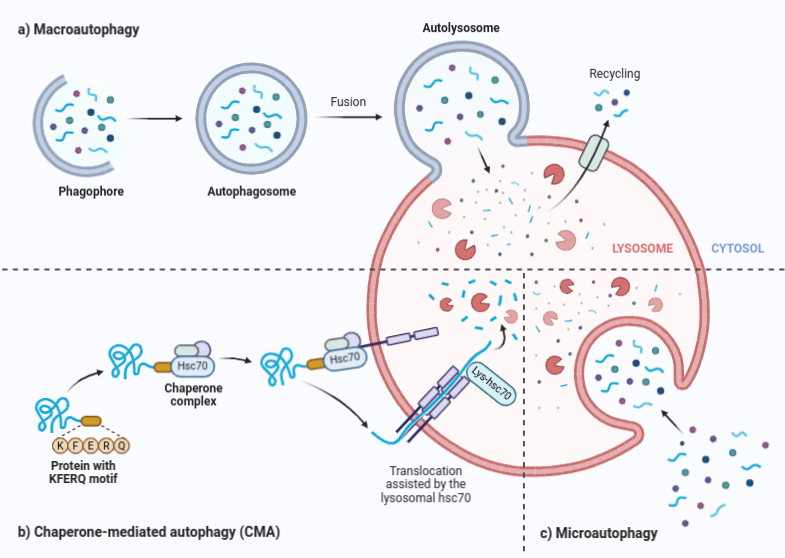
image sourcelink to the Wikipedia article “Autophagy”

image source

link to the Wikipedia article “Autophagy”

Roughly speaking, autophagy is the cannibalization by a cell of defective or questionable molecules to make new, higher-quality molecules. Autophagy is now thought to be quite powerful in reducing disease risk, because it provides quality-control for key types of molecules in the body. This is like saying that your car is likely to break down less if it gets regular servicing—including, crucially, the replacement of parts that are wearing out with new parts.

Low nutrient levels encourage autophagy. One way to induce autophagy is to do a total fast from food for an extended time, only consuming water and plain tea or coffee. But suppose you have trouble doing a total fast from food—what then is likely to be the most powerful way to induce autophagy? I think there is a plausible answer. If you fast totally, your body will be breaking down body fat, and there will therefore still be fat in the bloodstream. So I suspect that eating, as nearly as possible, only fat is likely to keep the signals for autophagy most powerful. And of course, eating as little of that as you can be OK with helps close whatever gap their is between the body’s signals when consuming only one’s own body fat and the body’s signals when consuming some amount of fat from outside.

lmportantly, this is not describing a typical “ketogenic” diet because ketogenic diets often include a lot of meat, which has a lot of protein. I suspect that consuming protein has a substantial effect on signals for the cannibalization of low-quality or possibly low-quality proteins that were already in the body. Among common dairy products, butter has the least protein (and clarified butter the least of all). So some amount of butter is probably OK when you are trying to induce autophagy. Macadamia nuts are also probably OK.

All of this needs additional research. Such research matters because not everyone can tolerate an extended total fast from food. I’d be happy to be corrected on my conjecture above if there is evidence against. More generally, I am very interested in learning more about autophagy and related subjects and would welcome links to articles you think I should see on this.


For annotated links to other posts on diet and health, see:

The Federalist Papers #21 A: Constitutions Need to be Enforced—Alexander Hamilton
Enforcing constitutions is quite a tricky business. Some sort of judicial apparatus is usually required, combined with judicial independence and respect for the courts. The difficulty of enforcing a constitution is illustrated by the fact that many countries that have copied the US Constitution in large measure have at one point or another ended up with dictatorships.

In the US, the reason I don’t worry much about our lapsing into dictatorship is because, as I understand it, our soldiers are taught that their primary duty is to uphold the constitution and only at a lower level than that to obey an particular commander in chief. To put a point to it, in the US, in a very thorny disputed election, I think that whoever is declared by the Supreme Court to be the President of the United States, would be followed by US soldiers. And unlike some, I believe that the members of the US Supreme Court do have a loyalty to the law, where the law is reasonably clear.

The ability of a judicial branch to enforce a constitution depends heavily on individual citizens and companies being subject to the laws of the nation. If only the subordinate governments (in the US, preeminently the States) were subject de jure to the constitution, it is hard to see how the judicial branch could enforce that. It has no army! Much better if a large share of constitutional issues can be handled by court actions vis a vis individual citizens and companies.

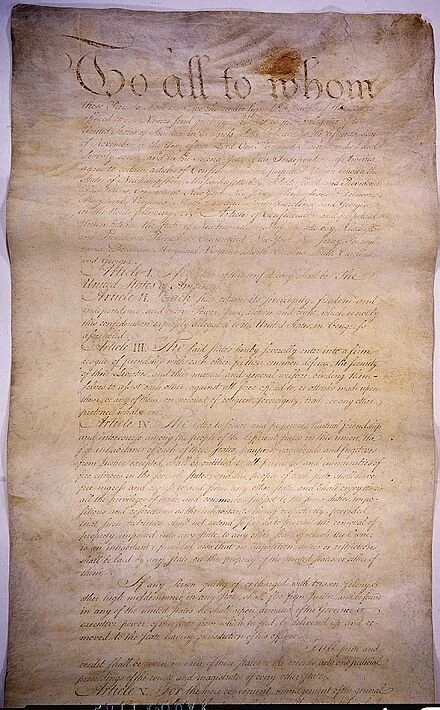
Of course, some constitutional violations are so large that an army or the equivalent of an army is necessary to enforce them. In the the first half of the Federalist Papers #21, Alexander Hamilton argues that the federal government should, in particular, be the guarantor of state constitutions. But it had no such authority under the Articles of Confederation. Alexander Hamilton argues also that some realistic enforcement provisions are needed to ensure performance of the duties states have officially taken on in relation to the federal government.

Below is the text for the first half of the Federalist Papers #21.


FEDERALIST NO. 21

Other Defects of the Present Confederation

For the Independent Journal.

Author: Alexander Hamilton

To the People of the State of New York:

HAVING in the three last numbers taken a summary review of the principal circumstances and events which have depicted the genius and fate of other confederate governments, I shall now proceed in the enumeration of the most important of those defects which have hitherto disappointed our hopes from the system established among ourselves. To form a safe and satisfactory judgment of the proper remedy, it is absolutely necessary that we should be well acquainted with the extent and malignity of the disease.

The next most palpable defect of the subsisting Confederation, is the total want of a SANCTION to its laws. The United States, as now composed, have no powers to exact obedience, or punish disobedience to their resolutions, either by pecuniary mulcts, by a suspension or divestiture of privileges, or by any other constitutional mode. There is no express delegation of authority to them to use force against delinquent members; and if such a right should be ascribed to the federal head, as resulting from the nature of the social compact between the States, it must be by inference and construction, in the face of that part of the second article, by which it is declared, "that each State shall retain every power, jurisdiction, and right, not EXPRESSLY delegated to the United States in Congress assembled." There is, doubtless, a striking absurdity in supposing that a right of this kind does not exist, but we are reduced to the dilemma either of embracing that supposition, preposterous as it may seem, or of contravening or explaining away a provision, which has been of late a repeated theme of the eulogies of those who oppose the new Constitution; and the want of which, in that plan, has been the subject of much plausible animadversion, and severe criticism. If we are unwilling to impair the force of this applauded provision, we shall be obliged to conclude, that the United States afford the extraordinary spectacle of a government destitute even of the shadow of constitutional power to enforce the execution of its own laws. It will appear, from the specimens which have been cited, that the American Confederacy, in this particular, stands discriminated from every other institution of a similar kind, and exhibits a new and unexampled phenomenon in the political world.

The want of a mutual guaranty of the State governments is another capital imperfection in the federal plan. There is nothing of this kind declared in the articles that compose it; and to imply a tacit guaranty from considerations of utility, would be a still more flagrant departure from the clause which has been mentioned, than to imply a tacit power of coercion from the like considerations.

The want of a guaranty, though it might in its consequences endanger the Union, does not so immediately attack its existence as the want of a constitutional sanction to its laws.

Without a guaranty the assistance to be derived from the Union in repelling those domestic dangers which may sometimes threaten the existence of the State constitutions, must be renounced. Usurpation may rear its crest in each State, and trample upon the liberties of the people, while the national government could legally do nothing more than behold its encroachments with indignation and regret. A successful faction may erect a tyranny on the ruins of order and law, while no succor could constitutionally be afforded by the Union to the friends and supporters of the government. The tempestuous situation from which Massachusetts has scarcely emerged, evinces that dangers of this kind are not merely speculative. Who can determine what might have been the issue of her late convulsions, if the malcontents had been headed by a Caesar or by a Cromwell? Who can predict what effect a despotism, established in Massachusetts, would have upon the liberties of New Hampshire or Rhode Island, of Connecticut or New York?

The inordinate pride of State importance has suggested to some minds an objection to the principle of a guaranty in the federal government, as involving an officious interference in the domestic concerns of the members. A scruple of this kind would deprive us of one of the principal advantages to be expected from union, and can only flow from a misapprehension of the nature of the provision itself. It could be no impediment to reforms of the State constitution by a majority of the people in a legal and peaceable mode. This right would remain undiminished. The guaranty could only operate against changes to be effected by violence. Towards the preventions of calamities of this kind, too many checks cannot be provided. The peace of society and the stability of government depend absolutely on the efficacy of the precautions adopted on this head. Where the whole power of the government is in the hands of the people, there is the less pretense for the use of violent remedies in partial or occasional distempers of the State. The natural cure for an ill-administration, in a popular or representative constitution, is a change of men. A guaranty by the national authority would be as much levelled against the usurpations of rulers as against the ferments and outrages of faction and sedition in the community.


Here are links to my other posts on The Federalist Papers so far:

Brian Flaxman: Campfire Tales of Courageous Heroes Setting Millions of Campaign Funds Ablaze; Chapter The First

I am pleased to have another guest post by Brian Flaxman. Although on other occasions he has expressed his concern with the effects on money on politics, today’s post is about times when large amounts of money didn’t have much effect on politics. (His two views can be reconciled: because of the effect of money on name recognition, money could make a big difference in obscure races one never reads about in the national press, but have little effect on marquee races.) In addition to his post below, don’t miss these earlier guest posts of Brian’s:


Hear ye hear ye. Grab some mead and gather ‘round for our celebration of the conclusion of another Presidential Campaign cycle. Since the tavern is unfortunately closed due to Covid concerns, we shall sit around the campfire instead, socially distanced of course, for epic tales of courageous heroes. Our tales take place in the faraway land known as the Establishment Campaign Economy. The first things to know about this faraway land are their strong held rules, rituals, and customs. Cornerstones if you will. I shall list them here, as it is hard to become engrossed in such fanciful tales without being familiar with the vibrant world such tales take place in.

The Three Cornerstones of the Establishment Campaign Economy:

1)     The Cornerstone of the Establishment Median voter: In the parlance of political science and political economy, the concept of the median voter is that of the person with the most moderate position of any voter in the district. The idea being that if you win this voter, and everyone to either the left or right of him, you win an election by having the majority of votes. But in the Establishment Campaign Economy, this conceptualized median voter is one that is thought of by people who have far more money than you ever will have. This hypothetical median voter gets really jazzed when you fight for policies like financial deregulation, increasing federal funds for the military industrial complex, and lowering the capital gains tax. Things that working-class voters of all ethnicities and backgrounds constantly yearn for.

2)     The Cornerstone of the Establishment Principle-Agent: The Establishment’s median voter is represented by a candidate, or as is known in economic terms, the principle being represented by an agent. And of course, this candidate is financially supported by people who have far more money than you ever will have. This support is extended not only in the general election, but in the primary contests as well. They ignore all other candidates completely, especially those in primary contests, by not giving them any cash or exposure that might help them gain traction. That is, of course, unless a primary challenger starts to somehow catch up to our esteemed agent in the primary. This will lead to a valiant and noble effort to quickly and completely snuff that challenger out, regardless of the financial cost to do so.

3)     The Cornerstone of the Establishment’s Information Updating (or lack thereof): Failure to win elections need not be evidence of a need to change tactics, especially if your strategy involves not rocking the boat. And previously held beliefs on effective campaigning need not ever undergo updating with new information. Like the fact that in 2020, EVERY SINGLE SWING DISTRICT HOUSE DEMOCRATIC INCUMBENT who signed on to the far-left leaning Medicare-for-All bill actually WON their re-elections. And information like EVERY SINGLE Democratic loss in the House this cycle came from individuals in swing districts who ran as far-right as they could with their tails between their legs. Furthermore, candidates, consultants, and anybody involved in the political process who demonstrates abject failure are those most likely to be given future opportunities to demonstrate that abject failure. And these opportunities come about by being paid by individuals that, as you have probably guessed, have far more money than you ever will have.

These cornerstones will be reoccurring themes in our tales today. Stories of people with obscenely large amounts of money, lighting them on fire like the kindling in the campfire we sit around. Without further ado, I shall now begin tonight’s epic tales.

We begin first with the tale of Michael Bloomberg as a Democratic Party primary candidate, who so valiantly made the sacrifice of setting millions of his own money on fire. His tale actually has two parts and begins with his quest to vanquish the social-democratic platforms of Bernie Sanders and Elizabeth Warren. As you see, these two individuals had the gall of proposing measures that people want. Things like government run healthcare, taking quick action to protect us from an impending climate crisis, and relieving many college graduates across the country of crippling student loan debt. These are two individuals who actually looked at polling trends, and saw that REGARDLESS OF HOW THE MEASURES ARE FRAMED FOR RESPONDENTS, are UNIVERSALLY POPULAR, and saw a way to both help Americans and to help Democratic candidates win elections. But because they do not hold true to the sacred cornerstone of learning absolutely nothing from new information, Michael Bloomberg recognized he had to vanquish these dastardly foes and take matters into his own hands.

In his first heroic quest, Michael Bloomberg lit $570 million of his own money ablaze, an amount that exceeds the GDPs of some small island nations. He spent this money on effortless ventures such as gratuitous TV ad buys, digital marketing, and paying others to do the legwork for him. He did this all without doing any public events, campaign activities, or other things that we did pre-Covid that require actual elbow grease. But Mr. Bloomberg’s fatal flaw came when he failed to hire a debate coach or any type of assistance for his public speaking abilities. This was an oversight that immediately caused his candidacy to plummet to the ground like a lead balloon soon after making the devastating mistake of actually showing up for a debate. He did, however, valiantly claim 31 of the 4,051 possible pledged delegates in the Democratic Primary, which amounts to $18.4 million being set on fire for each pledged delegate he was able to amass. That said, the money he spent to run interference on the Sanders and Warren campaigns was probably a drop in the bucket compared to the tax increases he would have had to pay if their policies were ever enacted. And I’m sure this was not at all the point of his entering the Democratic Primary

In addition to the massive amounts of money he sent ablaze during the Democratic Primary, as a donor in the general election, Mr. Bloomberg ignited an additional $100 million into the ether. And as we know, at a time when many people are struggling because of Covid to remain employed or find new employment, pay for their rent and mortgages, and to put food on the table, there is absolutely nothing better that this money could have gone towards. This money was spent on helping Joe Biden win Texas, Ohio, and Florida, which in the end, helped garner Joe Biden a grand total of ZERO additional electoral votes. One can only hope that some of his ads running in north Florida might have accidently run on stations on the southern border of Georgia, so that his efforts would not have been entirely in vain.

Our second tale for tonight involves the valiant efforts of the Lincoln Project. The brave heroes behind the Project of Lincoln were noble men of the Republican Party who had the bravery and honor to stand up to Donald Trump, and knew it was time to take swift action. Not based on policy grounds mind you, but after seeing the vile scourges of fake economic populism, lack of decorum, and—most galling of all—mean tweets. These are warriors who are familiar with cornerstone of never updating information. As you see, one of brave knights seated at this round table is a man by the name of Steve Schmidt. If you haven’t heard of him, I don’t blame you. However, you have probably heard of John McCain. Steve Schmidt was John McCain’s campaign manager in the 2008 Presidential Election. And you have probably heard of Sarah Palin, the Vice-Presidential candidate that he pushed a reluctant John McCain to select, the Vice-Presidential candidate who some people believe cost McCain the 2008 election.

But remember, in the faraway land of the Establishment Campaign Economy, undeniable evidence of pure, industrial-strength incompetence is never internalized. And thus, Schmidt was later given plenty of opportunities in cable news punditry and campaign consulting. He has been a contributor on MSNBC for several years since 2008 for his political insight (without any instruction to viewers to reverse the direction and do the exact opposite of what he says), where he railed on Donald Trump as the worst president ever. Schmidt also worked on Howard Schultz’s brief foray into presidential politics when he considered running as an independent in the general election—a venture that had some chance of helping Donald Trump win a second term by syphoning off votes from the eventual Democratic nominee. Because after all, the reward of fat stacks of cash to help a President that you vehemently despise win his reelection easily overrides the distain you have for said President.

But back to the fine folks at the Lincoln Project. You see, their goal was to convince likeminded Republicans to vote for Joe Biden instead and against several GOP Senate candidates by running TV and digital marketing, creating ads bashing Trump and GOP Senate Candidates. Granted, some of the ads were actually quite good. Probably not $67 million good, as that is the estimated amount that they raised to perform this venture. A venture that any group of qualified individuals could have done, and likely done even better at just the fraction of the cost. It is also unfortunate that Donald Trump’s support amongst Republicans INCREASED from 90% in 2016 to 94% in 2020. Also, in an election where Democrats were expected to overtake the Senate, they thus far have come up two seats short, and Democrats only chance of regaining control of the Senate prior to 2022 involves winning both Georgia senate runoff elections that take place at the beginning of January. A superb undertaking by the Lincoln Project indeed.

And alas, much of these $67 million dollars was thus set on fire. And the remaining money will almost surely be sent ablaze in the future. Because you see, the Lincoln Project is now reportedly starting a new media organization whose sole purpose is likely to pull Joe Biden and the rest of our Establishment Democratic heroes to enact the same conservative policies that the Lincoln Project’s founding members have always favored. I am almost certain that this is something that many well-meaning liberals who donated to the Lincoln Project are gleefully celebrating. Some might be tempted to call the people behind Lincoln Project absolute grifters who actively fleeced people in plain sight. But in our Establishment Campaign Economy, they are considered true shining knights of the highest order.

Our final tale for today of money being thrown into flames involves a well-known villain of the establishment of both parties, Alexandria Ocasio-Cortez. The villainous Ocasio-Cortez had the gall in 2018 to throw all three cornerstones of the esteemed Establishment Campaign Economy out the window by ousting the number 4 ranked Democrat Joe Crowley while spending one-tenth of what he did. And she did so by running on things that an ACTUAL median Democratic voter in her district would want. For her misgivings two years prior, she was given a primary challenger: Michelle Caruso-Cabrera. While also being a Hispanic woman with a hyphenated last name, she also was a former CNBC anchor who was a registered Republican until a couple of years ago. The exact type of person I’m sure that her district was absolutely clamoring for. Well not really, as AOC triumphed against MCC by a margin of 74.4%-18.1%. But not before Caruso-Cabrera was able to raise $2.8 million dollars, much of which came from people, who, as you probably guessed, have far more money than you will ever have.

But this was not Ocasio-Cortez’s only foe in this election cycle. For you see, she then had to run against a Republican in the general election. Granted, AOC’s district is bluer than the hottest of flames of our cash-burning inferno. But that did not stop her Republican challenger from raising around $10 million in a 68.7% to 30.3% losing effort. Now, some of this money did come from Republicans who have normal incomes. However, this likely had less to do with support for the Republican challenger himself and more to do with Ocasio-Cortez being the new boogey-woman of the left, as portrayed by right wing media. In fact, the challenger’s name was probably as irrelevant to them as it is to you. You probably didn’t even realize that I haven’t even mentioned his name yet until now: Jon Cummings.

If you found these tales riveting, I hope you will in future join me again around the campfire for future epic tales. For as you see, tales from this faraway land are in anything but short supply. Many of the fanciful tales from this election cycle are still being written as we speak. This is in part due to the scribes of the Federal Election Commission having yet to publish and collect final campaign finance data. It is also due to the results of the election coming in slower than a morphine drip, one that many of us are likely begging for ourselves as we contemplate the next few months of American politics.

Brian Flaxman

Brian Flaxman

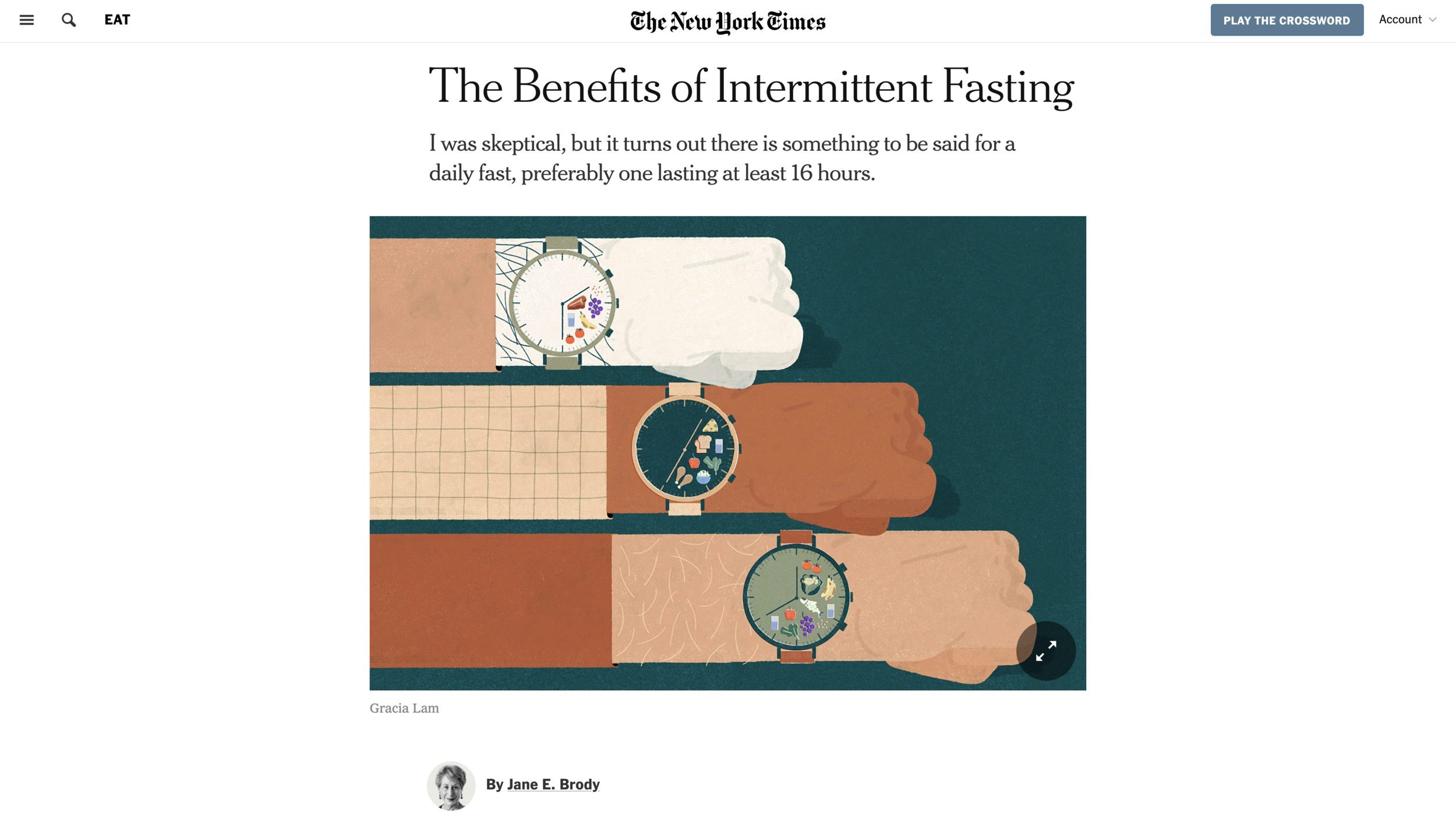
Jane Brody on Intermittent Fasting

“Intermittent fasting” is a bit of a redundant phrase. Logically, non-intermittent fasting would mean constant fasting, which is something likely to lead to death after many months of it have burned through all of your fat reserves. Because almost any reasonable use of fasting is therefore “intermittent fasting,” it is not, in practice, anything more than a synonym for “fasting.”

Jane Brody, in “The Benefits of Intermittent Fasting,” uses “intermittent fasting” to refer to limiting one’s daily eating window to no more than 8 hours (say eating only between 11 AM and 7 PM or only between noon and 8 PM) so that one has on average a 16-hour stretch of fasting each day. Evidence suggests that this, like many other uses of fasting, has important health benefits. (All of the quotations below come from Jane Brody’s article “The Benefits of Intermittent Fasting.”

A lot of the evidence about fasting is animal evidence. For example:

… in an animal model of stroke, those fed only intermittently suffered less brain damage because they were better able to resist the stress of oxygen and energy deprivation.

Other animal studies have shown a “robust disease-modifying” benefit of intermittent fasting on “a wide range of chronic disorders, including obesity, diabetes, cardiovascular disease, cancers and neurodegenerative brain diseases,” the researchers reported. Their review of both animal and human studies found improvements in a variety of health indicators and a slowing or reversing of aging and disease processes.

As for human evidence:

… human studies of intermittent fasting found that it improved such disease indicators as insulin resistance, blood fat abnormalities, high blood pressure and inflammation, even independently of weight loss. In patients with multiple sclerosis, intermittent fasting reduced symptoms in just two months, a research team in Baltimore reported in 2018.

Why would fasting be helpful? Jane Brody’s article “The Benefits of Intermittent Fasting” points to a number of different theoretical reasons (bullets added to separate passages):

  •  Mark P. Mattson, neuroscientist at the National Institute on Aging and Johns Hopkins University School of Medicine, explained that the liver stores glucose, which the body uses preferentially for energy before it turns to burning body fat.

    “It takes 10 to 12 hours to use up the calories in the liver before a metabolic shift occurs to using stored fat,” Dr. Mattson told me. After meals, glucose is used for energy and fat is stored in fat tissue, but during fasts, once glucose is depleted, fat is broken down and used for energy.

  • If you think evolutionarily, Dr. Mattson said, predators in the wild fight for prey in the fasting state and are better at recovering from inevitable injuries. The human counterpart — people who evolved in feast-or-famine environments — would not have survived unless somehow protected by fasting.

    “Our human ancestors did not consume three regularly spaced large meals, plus snacks, every day, nor did they live a sedentary life,” the researchers wrote. The studies they analyzed showed that “most if not all organ systems respond to intermittent fasting in ways that enable the organism to tolerate or overcome the challenge” and then return to normal.

  • Dr. Mattson explained that during a fast, the body produces few new proteins, prompting cells to take protein from nonessential sources, break them down and use the amino acids to make new proteins that are essential for survival. Then, after eating, a lot of new proteins are produced in the brain and elsewhere.

That last passage about protein production is somewhat opaque. It points to a bigger benefit of fasting than it sounds. After a high enough dose of fasting—with what is a “high enough dose of fasting” an area of debate—the body begins seriou: cannibalizing substandard cells for spare parts. Autophagy is an important part of the body’s quality control. This crucial type of cellular quality control takes place mainly during fasting. Cellular quality control should be especially helpful toward preventing cancer. (At lower doses of fasting—too low to engender much autophagy proper—cells increase the cannibalization for spare parts of molecules already within them. This is likely to yield at least some fraction of the benefits of autophagy proper.)

The most important place Jane Brody goes off track in her article is in talking about the difficulty of fasting without pointing out that those on a lowcarb, high fat diet find fasting a lot easier and more pleasant. If the body is already in a fat-burning mode burning fat from food, it is easier for it to make the transition to burning body fat if one begins fasting. To be specific about my point, I’ll bet the “hunger, irritability and a reduced ability to concentrate” from fasting that researchers talk about is highly concentrated in those who eat high-carb diets.

The second most important place Jane Brody goes off track is talking about difficulties of social coordination from a limited eating window. She is assuming you need to have an eating window at the same time each day. Au contraire. Evolutionarily, our ancestors faced an environment in which the timing of fasting was random, due to not finding food right away. We are adapted to that. So there is reason to think having one’s eating window move around in its position within the day is a good thing, not a bad thing. And that makes it easy to plan one’s mobile eating window to coincide with social engagements that involve eating. (The big problems will be from the expectations of those in your own household that you will be eating all day long, or whenever they are eating.)

I’m glad to see fasting getting good press. I hope more people take up fasting as a way to improve their health.

For annotated links to other posts on diet and health, see:

It Isn't OK to Be Anti-Immigrant

Short of murder, rape, torture, slavery or unjustified imprisonment, one of the worst things a government can perpetrate or condone is confining people to desperately poor parts of the world where they are doomed to poverty, when being allowed into rich parts of the world—even if totally denied any safety-net aid—they would be lifted to a dramatically better standard of living.

Treating people as malefactors because they desperately want to come to a reasonably-well-run country such as ours is cruel. There may be morally adequate policy reasons to limit the number of people who can come to our nation at any one time, but if so, we should feel quite apologetic about having to do that.

The easiest way to reduce illegal immigration is to dramatically increase the amount of legal immigration that we allow. It is important enough to do so, that almost any political concession that makes it possible to pass legislation to dramatically increase the amount of legal immigration is worth making.

There is a moral illusion highly relevant to many debates about how we treat desperately poor people in other countries. That illusion is that having nothing to do with a poor person, or effectively deterring them from showing up on our doorstep absolves us of moral responsibility, while we bear a large share of the responsibility of all the suffering in their lives as soon as we have dealings with them. As, at least in principle, a Utilitarian, this makes no sense to me. Within the scope of actions available to us, we bear moral responsibility for the consequences of the choices we make compared to the consequences of the choices we could have made. If someone is worse off because of our actions (such as not allowing more legal immigration), we bear moral responsibility for that, even if we never have and never will meet them.

There are many morally charged issues of public policy. To my mind, the moral weight of immigration policy exceeds the moral weight of all other issues that have been seriously debated in the United States in the last four years.

Middle-aged, non-college-educated white folks have been dying more deaths of despair, in Anne Case and Angus Deaton’s phrase. These folks should not be looked down on. They need to be helped. But keeping legal immigration low is not the way to help them. Even if it really did help them (which it doesn’t, other than reducing cultural discomfort and perhaps helping out job prospects for high-school dropouts), helping one human being a little bit by hurting other human beings a lot is not OK.

Just as we look back aghast at those a couple of centuries ago who spoke of liberty but owned slaves, those in future generations will look back aghast at those who spoke of compassion and human flourishing but shut their hearts to the plight of those exiled by the accident of their birth from the land of the free and the home of the brave.

Gary Cornell: We are Unlikely to Have a Vaccine that is Proven Effective for Seniors for a Long Time Unless Dramatic Action is Taken Now!

I’m glad to be able to feature Gary Cornell again here. Some of the earliest blog posts on supplysideliberal.com were guest posts by Gary Cornell. Here he is again with a post about how the work being done to develop vaccines for Covid-19 is not targeted at the subset of the population that most needs vaccines: older folks. Here is Gary:


The risk of both hospitalization and death from Covid 19 increase greatly with age. Approximately 80% of the deaths from Covid 19 are people over 65 (https://www.cdc.gov/coronavirus/2019-ncov/need-extra-precautions/older-adults.html). The unfortunate truth is that a vaccine that is proven highly effective for seniors is not likely for a very long time, unless we dramatically increase the number of seniors in current trials now.

Why? The gold standard to determine efficacy is a large, placebo-controlled, double-blind clinical trial. There are currently eight vaccines in large Phase 3 trials. But it is very unlikely, maybe even impossible, that any of these vaccine trials will give us definitive information about how effective these vaccines are for people over age 55 — well, unless they change how they are currently setup.

Why? To begin with, none of the four trials that have released their protocols are properly stratified. While they aren’t lumping seniors into the same group as the 18 to 55-year-olds, they should be using three groups i.e. one for each age decile: 55 to 64, 65 to 74, and 75 and older. To be sure, it’s possible to tease out information about how different strata of seniors react to the vaccine even if they are lumped together in one group. However, it likely would take more data because you have to tease out the information for each age decile from a larger group.

But the bigger problem is that even if these trials give us some information about efficacy for seniors, they are unlikely to tell us everything we need to know quickly enough unless we have a far larger number of participants over 55 than the current trials are enrolling. Why? Since Covid-19 can be so deadly in older people, they and the communities they live in have generally been taking better precautions than the general public against becoming infected with the virus SARS-CoV-2 that causes Covid-19. For example, the CDC reports (https://www.cdc.gov/mmwr/volumes/69/wr/mm6939e1.htm#T1_down) that, as of August, roughly speaking, the prevalence among people >75 years old is 1/15 that of people 18–55 years old. And, even if you lump all people over 55 into one group, it is roughly 1/3. And, of course, we are all hoping that prevalence among seniors has gone down significantly since August. But prevalence is what determines the time needed to have a statistically significant efficacy signal from a vaccine trial.

Here’s what information I have gotten from their published protocols for the percentages of seniors enrolled:

AstraZenica: “Randomization will be stratified by age (≥ 18 and < 65 years, and ≥ 65 years), with at least 25% of participants to be enrolled in the older age stratum.” They are also using a 2 to 1 active to placebo division

Johnson & Johnson: “The aim of having a minimum of approximately 25% of recruited participants ≥60 years of age has been adjusted to 30%”

Moderna: “At least 25% of enrolled participants, but not more than 40%, will be either ≥ 65 years of age or < 65 years of age and “at risk” at Screening”

Pfizer: “It is intended that a minimum of 40% of participants will be in the >55-year stratum”

I suppose we seniors should be thankful, originally it was much worse (https://www.nytimes.com/2020/06/19/health/vaccine-trials-elderly.html), and in at least one case, the published protocols made this clear, as people over 55 years old were only added via a late amendment.

Anyway, regardless of what they were planning on doing originally, none of these four trials are enrolling a far larger percentage of people over 55 than they are enrolling under 55. This means the time needed for getting enough cases for people over 55, and especially among people over 75, will be longer than the time needed to get an efficacy signal from 18- to 55-year-olds. And you need to get that signal for seniors as quickly as you get a safety and efficacy signal for younger people. Why? Because once we have a vaccine that has been shown to be safe and effective for people under 55, I believe it is unethical to continue any placebo-controlled Phase 3 trial in the elderly for a disease so deadly to them — all elderly participants would have to be offered the vaccine that worked among younger people. Since designers of these trials are hardly stupid, it seems to me that they are either betting that they will have enough cases in seniors to have an efficacy signal quickly or that enough seniors will agree to stay enrolled in the placebo arm.

A better solution is obvious, don’t bet: dramatically increase the number of participants over 55 in the current trials quickly, no matter what the expense and difficulty is in doing so. The more people we have over 55 in a trial, the more likely it is we will have an efficacy signal before ethical considerations force us to stop the arm of the trial being done on seniors.

What happens if we don’t do this? Then the only thing we will know quickly is what the vaccine candidate does to immune system markers on seniors,such as the antibody levels they induce. And, since the immune system of someone who is 75 tends to work differently than someone who is 55, let alone 25, even having immune system markers in seniors that match those of a 25 year old won’t mean enough to know anything definitive. But I want to make clear that of course, seniors can and should take an approved vaccine based on the results in 18–55 year olds even without their being an efficacy signal for them.

Then, interestingly enough, I expect the same things to happen whether or not we had an efficacy signal for seniors: it’s just that the consequences and information we gain from them is different. What I expect is that correctly stratified trials for people over 55 will quickly begin that compare the approved vaccine(s) to various tweaked formulations or dosing regimens. We did this in order to get a better flu vaccine for seniors for example. But not only will these trials take time, unless we have that efficacy signal for seniors from the original trials, these trials can give us only relative information, not absolute information. For example, a trial might show that half the dose doesn’t work very well while four times the dose is not only safe but it works twice as well. That sounds great, but we aren’t home free if we don’t know how well the original vaccine actually works on seniors of varying ages. Knowing that you have a vaccine tweak that works twice as well as the original vaccine actually doesn’t tell you anything about how well the improved vaccine will work without a baseline! For example, suppose the original vaccine was just 15% effective among people age 75 and older. Doubling the effectiveness with a tweaked formulation puts it at only 30%. Knowing that something is 2X, doesn’t tell you anything without information about X. And information on X is what we won’t have unless we spent the money and effort needed to get it from greatly enlarged trials of the original vaccine in seniors now. This puts us in a completely different position than the flu vaccine where we knew quite well how the original flu vaccine worked in seniors, so the “tweaked” version’s efficacy was easy to compute.

To summarize: given what I feel are the inescapable ethical issues in completing any placebo controlled study on seniors once you have a safe and effective vaccine based on trials in healthy 18–55 olds, we must enlarge the number of seniors in the trials quickly. Failing to do so means that we likely won’t know enough about how well the original vaccine worked in one or more age decile group of seniors. Your castle will be built on little if any foundation.

So, considering how deadly Covid 19 is among seniors, absent great therapeutics, would you, if you were over 55, really change the precautions you are taking such as not getting on a plane because you took a vaccine you have little absolute information about for your age group? I am and I wouldn’t! So, again, I am hoping (perhaps without hope) that we spend the money and take the effort to quickly expand the number of seniors in the current trials.

I want to end by explaining what will likely happen if we don’t change the current trials to include far more seniors. First off, you need to always keep in mind that absent that, we will likely be stuck in the twilight zone of having relative information but needing absolute information! Can biostatisticians do anything down the road to break the barrier between relative information and absolute information if we didn’t enroll enough seniors in the current trials? Of course. What they will do is what is called a paired retrospective study. This means they will look at seniors who chose to get the vaccine and compare them with a matched group of seniors that didn’t get the vaccine. Then, given enough cases and a good enough match between members of the two groups, we will finally have a way to get the absolute information we need. Only after that retrospective study is complete, would seniors know (roughly) how well the best of the vaccine tweaks works for them.

Still, a paired retrospective study would be both difficult and time consuming to perform. Why? The key to doing a paired retrospective study is to pair up the people so that there are no differences between them that can influence the incidence of the disease. And you need to know if seniors who declined to get an approved vaccine, or who didn’t have access to it, are different in some fundamental ways from those who did get the vaccine. I don’t know how to answer that, but I do know that the biostatisticians are going to have a difficult job designing a paired retrospective study.

So I personally would be shocked if we have any absolute information about the efficacy of a Covid-19 vaccine for seniors for a very long time to come unless we spend the money and effort to dramatically increase the number of seniors enrolled in the current trials now.