Don't Tar Fasting by those of Normal or High Weight with the Brush of Anorexia

Healthy Fasting. One of the challenges people face when they use fasting as a tool for weight loss and other health benefits is that people around them may think fasting is more dangerous than it really is. In “4 Propositions on Weight Loss,” Proposition 2 and its gloss are:

For healthy, nonpregnant, nonanorexic adults who find it relatively easy, fasting for up to 48 hours is not dangerous—as long as the dosage of any medication they are taking is adjusted for the fact that they are fasting. …

The best evidence that fasting is not dangerous comes from the experience of those in religious traditions that encourage fasting. For example, the Mormonism I grew up in not only instructed everyone who could to fast for 24 hours once a month, it also encouraged people to fast for longer periods of time for special spiritual purposes. Mormon fasts often involved not drinking as well as not eating. Given the body of experience indicating that even fasts that risked dehydration were usually not that dangerous, nonreligious fasting that encourages the drinking of water should not be dangerous for those in good health who are not pregnant or anorexic. The biggest worry I have about people fasting is that it could easily throw off the dosage of medication they are taking. So anyone taking prescription medication should consult their doctor about medication interactions before fasting. And anyone taking nonprescription medication should think hard about lowering the dose when they fast. 

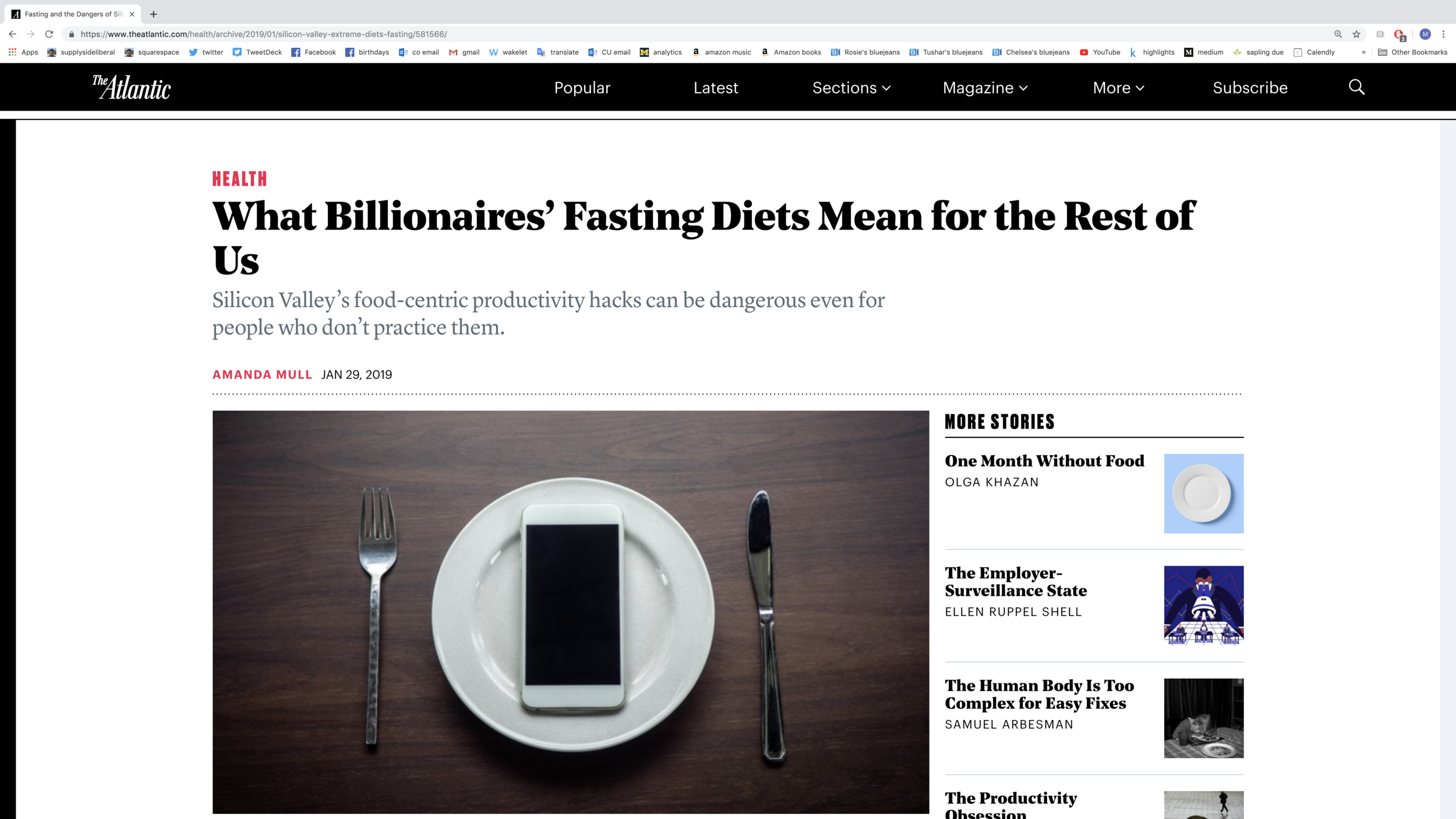
In Amanda Mull’s Atlantic piece “What Billionaires’ Fasting Diets Mean for the Rest of Us,” she unfairly suggests that a short eating window every day is extreme enough to be suspect:

Twitter’s CEO, Jack Dorsey, doesn’t eat for 22 hours of the day, and sometimes not at all. Over the weekend he tweeted that he’d been “playing with fasting for some time,” regularly eating all of his daily calories at dinner and occasionally going water-only for days on end. In many cases, severe and arbitrary food restriction might be called an eating disorder. And while researchers are hopeful that some types of fasts may be beneficial to people’s health, plenty of tech plutocrats have embraced extreme forms of the practice as a productivity hack.

I am in line with Jack Dorsey’s practice, except I try to do my eating window around lunchtime when I can, which is often, since I spend my most research-intensive days working at home. I view fasting for 20-22 hours a day and occasionally for 48 or 72 hours as quite healthy. And as I wrote in “My Annual Anti-Cancer Fast,” I try to fast for a week once a year with the idea that, however hard that might be on me, it will be harder on any cancer cells or precancerous cells I might have.

Given my view that fasting is healthy, I also don’t see anything amiss in timing when I fast to when I most need some extra time. During my teaching semester—four months out of the year—when I teaching Monday, Wednesday, Friday, I fast throughout Monday and Wednesday (making for close to a 44-hour fast when combined with my short eating window on surrounding days) and eat lunch with my colleagues on Friday. Last week, in order to help get a grant proposal done, I fasted an extra day when I wouldn’t have otherwise. During the rest of the year, in addition to the short eating window each day, I find I need to skip eating at least one day every two weeks to keep my weight steady. I wish it weren’t so, but it is what it is. On the other hand, part of that is compensating for vacation days or days when guests are visiting, when I have a longer eating window.

I have to emphasize that if I were fasting this much and it were hard, that would indicate some sort of psychological pathology. But as I have emphasized often in my diet and health posts, if one is eating very low on the insulin index when one does eat fasting can be surprisingly easy, at least for some people, among whom I am one. (See “Forget Calorie Counting; It's the Insulin Index, Stupid,” “Obesity Is Always and Everywhere an Insulin Phenomenon,” and “Why a Low-Insulin-Index Diet Isn't Exactly a 'Lowcarb' Diet.”) And I promise, I am still well within the normal weight range. Putting the lowest weigh I have seen on the scale lately and rounding up my height to the nearest inch, I still get a BMI of 23.1, which is far from any danger zone of being too thin!

In the following paragraph, Amanda Mull summarizes some of the health benefits of fasting, but then argues that fasting raises the risk of anorexia and bulimia:

Intermittent fasting, like most health-and-wellness behaviors, can exist anywhere on a spectrum that runs from very dangerous to potentially beneficial, depending on who’s doing it and how it’s implemented. Fasting in one form or another has been a part of human eating behavior for millennia, and although scientific research on it is still preliminary, early studies suggest it might help reduce the risk of heart disease, cancer, and diabetes. For people with eating issues, though, fasting can be a very risky trigger for anorexia or bulimia. For most people, exploring Dorsey’s lengthy, everyday fasts without oversight from a doctor or nutritionist is probably unwise.

Bulimia. Amanda’s link on “bulimia” is to a Journal of Abnormal Psychology article, “Fasting Increases Risk for Onset of Binge Eating and Bulimic Pathology: A 5-Year Prospective Study.” The authors of this study are more careful in distinguishing correlation from causation in their abstract than in their title. They write:

We tested the hypothesis that fasting (going without eating for 24-hours for weight control) would be a more potent predictor of binge eating and bulimic pathology onset than dietary restraint scores using data from 496 adolescent girls followed over 5-years. Results confirmed that only 23% of participants with elevated dietary restraint scores reporting fasting. Furthermore, fasting generally showed stronger and more consistent predictive relations to future onset of recurrent binge eating and threshold/subthreshold bulimia nervosa over 1- to 5-year follow-up relative to dietary restraint, though the former effects were only significantly stronger than the latter for some comparisons. Results provide preliminary support for the hypothesis that fasting is a stronger risk factor for bulimic pathology than is self-reported dieting.

Wikipedia currently defines bulimia as “an eating disorder characterized by binge eating followed by purging.” One possibility, which I think the authors of this study would take seriously, is that girls who are likely to become bulimic later on in any case, also are prone to a variety of other behaviors. The other important possibility is that if one does fasting without eating low on the insulin index, it is quite dangerous for setting up a cycle of bad eating behavior because of the strong hunger that results. I do not recommend trying to do a lot of fasting without first moving to low insulin-index eating.

Those who are fasting in the way I do recommend should be careful to explain to others who see them fasting that the low-insulin-index eating is an important part of the practice. If people prone to anorexia could get fixated first on avoiding sugar, before they are tempted to do more than that, they would be less likely to do themselves harm.

Fasting is counted as one of the possible types of “purging” in bulimia. But the more common types of purging are vomiting and taking laxatives. Repeated vomiting can be quite dangerous. And laxative abuse is unlikely to be healthy. As far as these very dangerous behaviors go, for someone for whom fasting is easy because they are eating low on the insulin index, I don’t see why they would turn to vomiting or laxatives. And if they are eating low on the insulin index, they are less likely to do extreme binge eating because satiation kicks in fairly quickly if one is avoiding, say, sugar, rice, bread and potatoes and a few other high-insulin-index foods.

As near as I could make out from my online reading, those who induce vomiting or abuse laxatives who are underweight are called anorexics of the binge-purge subtype rather than being classed as bulimics. But clearly, the binge-purge subtype of anorexia shares a lot in common with bulimia. The National Association of Anorexia Nervosa and Associated Disorders gives a .9% lifetime risk for anorexia. Of this, from two studies I looked at on the fractions of each subtype in studies that were taking all the anorexics they could enroll, it appears that the binge-purge subtype is somewhat over half of anorexics, while the restrictive subtype is somewhat less than half.

It is possible that seeing other people fast might inspire someone prone to the restrictive subtype of anorexia to be very restrictive in eating. But it is also possible that if more people not prone to psychopathology were fasting regularly, that those prone to restrictive anorexia who were not fated to fall into anorexia no matter what could be better guided into helpful, rather than harmful patterns of fasting.

The simple fact is that we just don’t know whether having healthy fasting be more common in our culture would make things worse for those prone to anorexia or better. To me, one possibly powerful effect in the direction of making things safer for those prone to anorexia is that if were common knowledge in our culture that weight could be lost by a combination of low-insulin-index eating and fasting whenever someone wanted to, then the total amount of angst about weight in our culture might go down. That might help. One of the biggest ways it might help is if the common knowledge that the combination of low-insulin-index eating and fasting could bring effective weight loss helped everyone to set a bright line that inducing vomiting or abusing laxatives for weight loss is bad and unjustified, no matter how disgusted one is with one’s weight.

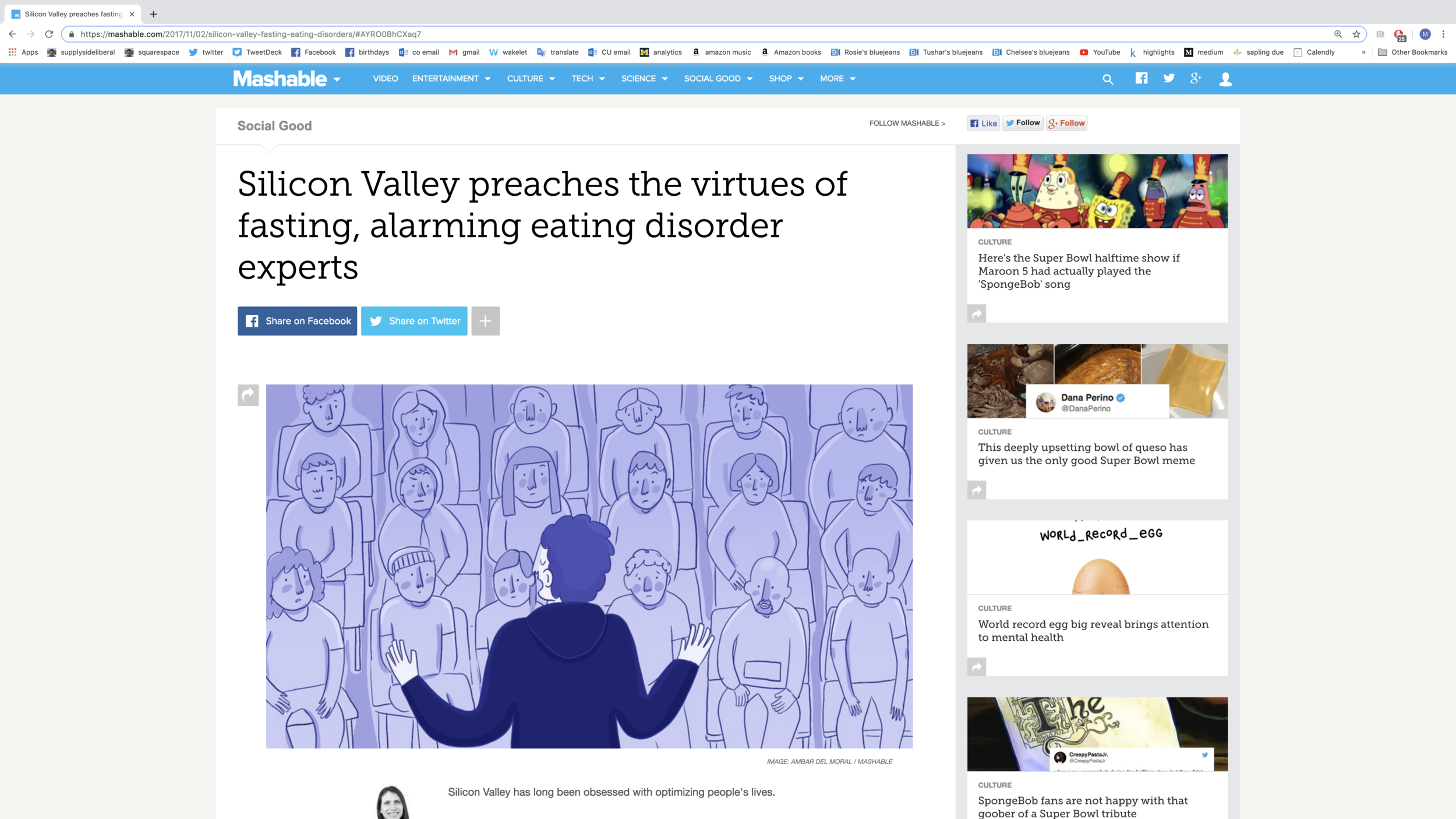
Anorexia. Amanda’s link on “ anorexia” is the second article above, Rebecca Ruiz’s piece “Silicon Valley preaches the virtues of fasting, alarming eating disorder experts.” Rebecca Ruiz relies on Andrew Walen making the immediate judgment that fasting is “disordered eating,” which is exactly the question at issue. Actually, in context, Andrew Walen and the other expert Claire Misko are saying something more subtle: that people who think of weight loss and eating well as a big achievement might be getting into a weird and unhealthy headspace:

"The connection between achievements and food and eating is very alarming," says Claire Mysko, CEO of the National Eating Disorders Association. "Not everybody who gets into this is necessarily going to spiral into a eating disorder, but if you are at risk, this is a really triggering framing."

In other words, Claire is saying it is notion of “achievement” that could trigger disordered eating, not having people around who are calmly doing fasting in the background of their lives as no big deal. And that is exactly how I do fasting: it isn’t a nothing, but for the most part it fades into the background of my life. The reason it can fade into the background is because the combination of low-insulin-index eating and fasting is relatively easy. It is not easy for things that are difficult to fade into the background of one’s life!

Tradeoffs. As I noted above, we just don’t know if having healthy fasting become more common would tip some of those prone to restrictive anorexia—or perhaps even those prone to binge-purge anorexia or bulimia—into worse symptoms. This is not something we have causal evidence of. But even if there is a causal effect in this direction, it needs to be counterposed to the health benefits people get from healthy fasting, including reducing the incidence of all the diseases associated with obesity.

As quoted in Rebecca Ruiz’s article, Geoffrey Woo makes this point:

Geoffrey Woo, who created a private HVMN Facebook group devoted to answering questions about fasting, is sympathetic to such criticism but calls it a "stretch." 

He argues you could make a similar criticism of public health officials who promote hand-washing because some people, presumably who experience obsessive-compulsive disorder, might find such campaigns triggering. Woo knows it's not an equivalent analogy, but it speaks to his view of fasting as a public health intervention.  

"The inspiration of fasting does come from realizing two-thirds of Americans are overweight or obese," he says. 

Let me make another analogy. There is another behavior that is widespread in our society, whose main benefit is pleasure—with some believing that it might aid health based on evidence that is much weaker than the evidence for the health benefits of fasting. That behavior is moderate drinking of alcohol. I think people drinking some alcohol rather than none is much more likely to create a danger for those prone to alcoholism than people doing healthy fasting is to create a danger for those prone to anorexia. But how many of us wish that alcohol and similar drugs didn’t exist? I might, but I think I am in the minority.

The majority who are happy that alcohol exists have a responsibility to distinguish carefully between moderate drinking and excessive drinking. Just so, those who are happy that we have the powerful tool of fasting to aid health in numerous ways have a responsibility to distinguish carefully between healthy fasting and anorexic behavior. Let me try. First is the bright line that inducing vomiting and laxative abuse are bad. Second, I would say that those younger than 20 years old (or are pregnant) should definitely not be fasting more than 24 hours at a stretch, and should not be fasting more than 16 hours with any frequency. Third, it is a red flag if someone is doing a lot of fasting without also avoiding sugar. This could be conducive to a binge-purge pattern. Fourth, it is a red flag if someone is keeping their eating or purging patterns a secret. It can be annoying to have to defend what one is doing with fasting, but being open about what one is doing and defending it to other people—and sometimes recognizing that their worries are well-founded. is an important safeguard against doing something really stupid.

Doctors. What about the idea that one should only fast under a doctor’s supervision? Basically, this is impractical. Do we think every practicing Muslim should be under a doctor’s supervision throughout Ramadan every year, when they fast from sunup to sundown every day? Should every Mormon only do their once-a-month 24-hour fast under a doctor’s supervision?

As another comparison, think of how many lives could be saved if we insisted that no one should eat sugar except under a doctor’s supervision!

There are certain things we should develop a common wisdom about so that we all know what is a sensible way to do them without always needing to use expensive doctors to supervise them. Let me try my hand at beginning to develop that common wisdom:

  • If your body-mass-index is below 18.5, quit fasting! Here is a link to a BMI calculator.

  • Definitely people should not do fasting for more than 48 hours without first reading Jason Fung’s two books The Obesity Code (see “Obesity Is Always and Everywhere an Insulin Phenomenon” and “Five Books That Have Changed My Life”) and The Complete Guide to Fasting.

  • Those under 20, pregnant or seriously ill should indeed consult a doctor before trying to do any big amount of fasting.

  • Those on medication need to consult their doctor before doing much fasting. My personal nightmare as someone recommending fasting is that a reader who is already under the care of a doctor who is prescribing medicine might fail to consult their doctor about adjusting the dosage of that medicine in view of the fasting they are doing. Please, please, please, if you want to try fasting and are on medication, you must tell your doctor. That may involve the burden of educating your doctor about fasting. But it could save your life from a medication overdose.

  • Those who find fasting extremely difficult should not do lengthy fasts.

  • But, quoting again from “4 Propositions on Weight Loss”: “For healthy, nonpregnant, nonanorexic adults who find it relatively easy, fasting for up to 48 hours is not dangerous—as long as the dosage of any medication they are taking is adjusted for the fact that they are fasting.”

The Limits of My Knowledge. I am painfully aware of how little I know about anorexia and bulimia. Please, do educate me in the comments section below. Anorexia and bulimia are terrible. Despite some superficial similarities with fasting, I am questioning how much they have to do with healthy fasting. And no one knows what effect an increase in the fraction of those doing healthy fasting would have on those prone to anorexia and bulimia. It might well depend on exactly how those into healthy fasting do it and how they explain what they are doing.

Don’t miss my other posts on diet and health:

I. The Basics

II. Sugar as a Slow Poison

III. Anti-Cancer Eating

IV. Eating Tips

V. Calories In/Calories Out

VI. Wonkish

VIII. Debates about Particular Foods and about Exercise

IX. Gary Taubes

X. Twitter Discussions

XI. On My Interest in Diet and Health

See the last section of "Five Books That Have Changed My Life" and the podcast "Miles Kimball Explains to Tracy Alloway and Joe Weisenthal Why Losing Weight Is Like Defeating Inflation." If you want to know how I got interested in diet and health and fighting obesity and a little more about my own experience with weight gain and weight loss, see “Diana Kimball: Listening Creates Possibilities and my post "A Barycentric Autobiography.


Silvio Gesell's Plan for Negative Nominal Interest Rates Meets the Mormons

JP Koning tweets this interesting article about Mormon stamp scrip during the Great Depression. It wasn’t just the town of Woergl that employed Silvio Gesell’s plan for negative nominal interest rates to at least some extent! JP Koning also points to Irving Fisher’s explanation of how to manage such a scrip. Ryan Decker then tweets this Cleveland Fed blog post about stamp scrip, highlighting this paragraph:

What made stamp scrip unique among scrip schemes was a series of boxes on the reverse side of the note. Stamp scrip took two basic forms—dated and undated (often called “transaction stamp scrip”). Typically, 52 boxes appeared on the back of dated stamp scrip, one for each week of the year. In order to spend the dated scrip, the stamps on the back had to be current. Each week, a two-cent stamp needed to be purchased from the issuer and affixed over the corresponding week’s box on the back of the scrip. Over the coming week, the scrip could be spent freely within the community. Whoever was caught holding the scrip at week’s end was required to attach a new stamp before spending the scrip. In this scheme, money became a hot potato, with individuals passing it quickly to avoid having to pay for the next stamp.

FocusEconomics: How and When will the Next Financial Crisis Happen?—26 Experts Weigh In

Screen Shot 2019-01-17 at 2.46.39 PM.png

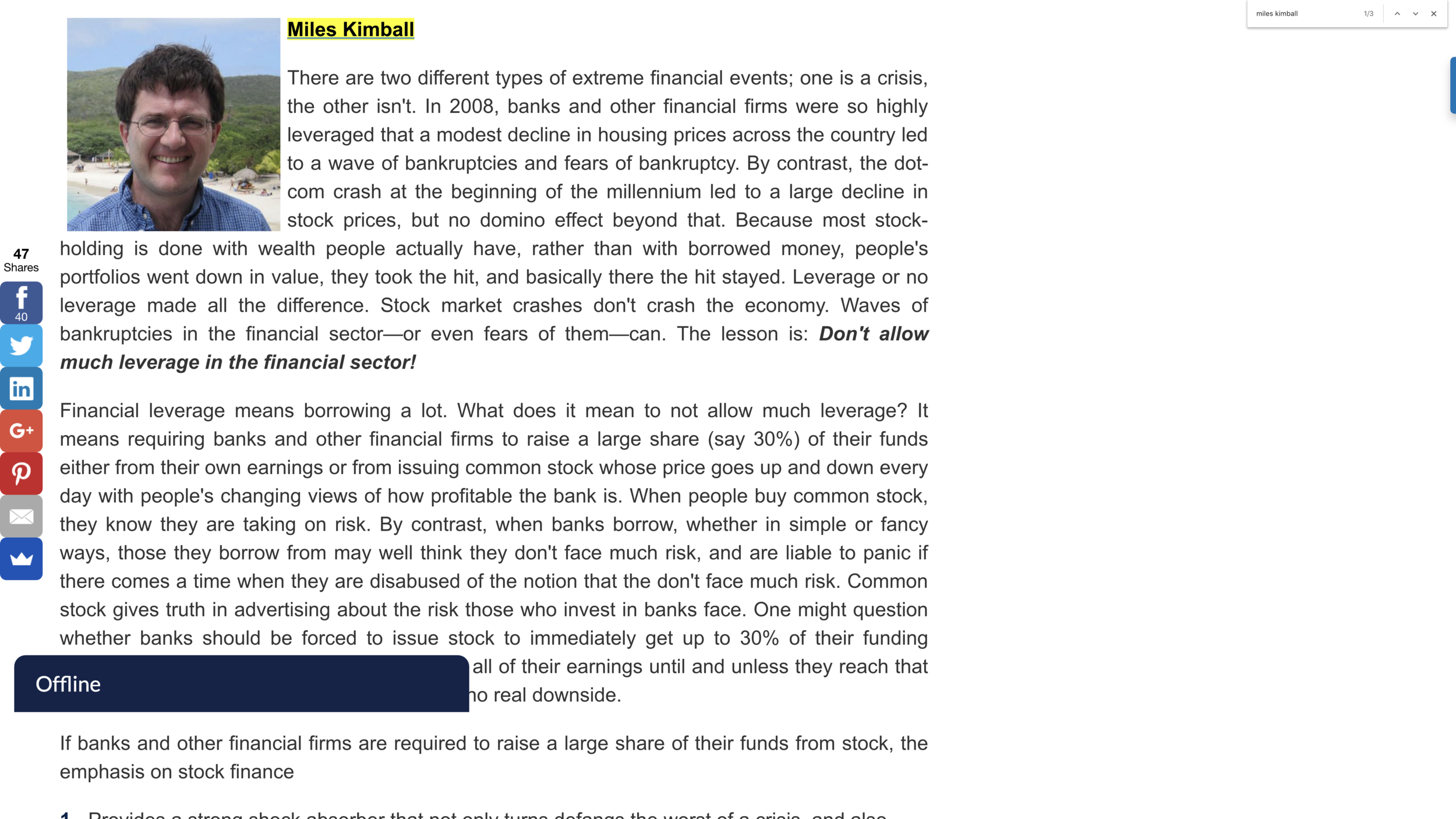
FocusEconomics had 26 people, including me, answer the question: “How and when will the next financial crisis happen?” Here is my answer:


There are two different types of extreme financial events; one is a crisis, the other isn't. In 2008, banks and other financial firms were so highly leveraged that a modest decline in housing prices across the country led to a wave of bankruptcies and fears of bankruptcy. By contrast, the dot-com crash at the beginning of the millennium led to a large decline in stock prices, but no domino effect beyond that. Because most stock-holding is done with wealth people actually have, rather than with borrowed money, people's portfolios went down in value, they took the hit, and basically there the hit stayed. Leverage or no leverage made all the difference. Stock market crashes don't crash the economy. Waves of bankruptcies in the financial sector—or even fears of them—can. The lesson is: Don't allow much leverage in the financial sector! 

Financial leverage means borrowing a lot. What does it mean to not allow much leverage? It means requiring banks and other financial firms to raise a large share (say 30%) of their funds either from their own earnings or from issuing common stock whose price goes up and down every day with people's changing views of how profitable the bank is. When people buy common stock, they know they are taking on risk. By contrast, when banks borrow, whether in simple or fancy ways, those they borrow from may well think they don't face much risk, and are liable to panic if there comes a time when they are disabused of the notion that the don't face much risk. Common stock gives truth in advertising about the risk those who invest in banks face. One might question whether banks should be forced to issue stock to immediately get up to 30% of their funding coming from stock, but forcing banks to retain all of their earnings until and unless they reach that 30% threshold of being financed by stock has no real downside. 

If banks and other financial firms are required to raise a large share of their funds from stock, the emphasis on stock finance 

  1. Provides a strong shock absorber that not only turns defangs the worst of a crisis, and also 

  2. Makes each bank enough safer that after a period of market adjustment, investors will treat this low-leverage bank stock (not coupled with massive borrowing) as much less risky, so the shift from debt-finance to equity finance will be more costly to banks and other financial firms only because of fewer subsidies from the government: less of an implicit too-big-to-fail subsidy, less of an implicit too-many-to-fail subsidy, and less of the tax subsidy to borrowing.

My view on this owes a lot to an important book by Anat Admati and Martin Hellwig: The Bankers' New Clothes. This book has persuaded many economists. 

Sometimes people point to aggregate demand effects as a reason not to reduce leverage with "capital" or "equity" requirements as described above. New tools in monetary policy should make this much less of an issue going forward. And in any case, raising capital requirements during times of low unemployment such as now is the right thing to do. Sometimes people think the economy as a whole will take on too little risk if banks are required to have low leverage. My view is that if the taxpayers are going to take on risk, they should do it explicitly through a sovereign wealth fund, where they get the upside as well as the downside. (See the links here.) The US government is one of the few entities financially strong enough to be able to borrow trillions of dollars to invest in risky assets. However controversial that is, providing an implicit guarantee to financial firms that get the upside while the taxpayers foots the bill for the bailouts should be more controversial. The way to avoid bailouts is to have very high capital requirements, so bailouts aren't needed.    

Rebecca Lake—Bank Teller Fees: How Much It Costs to Talk to a Live Person

The title of this post is a link.

This precedent can be important for negative interest rate policy: suppose for example that there is a fee on paper currency withdrawal at the bank’s ATM, and there has been a longstanding fee for seeing a teller. Coupled with a limit on the amount of cash withdrawal per transaction, this makes getting a lot of paper to store difficult.

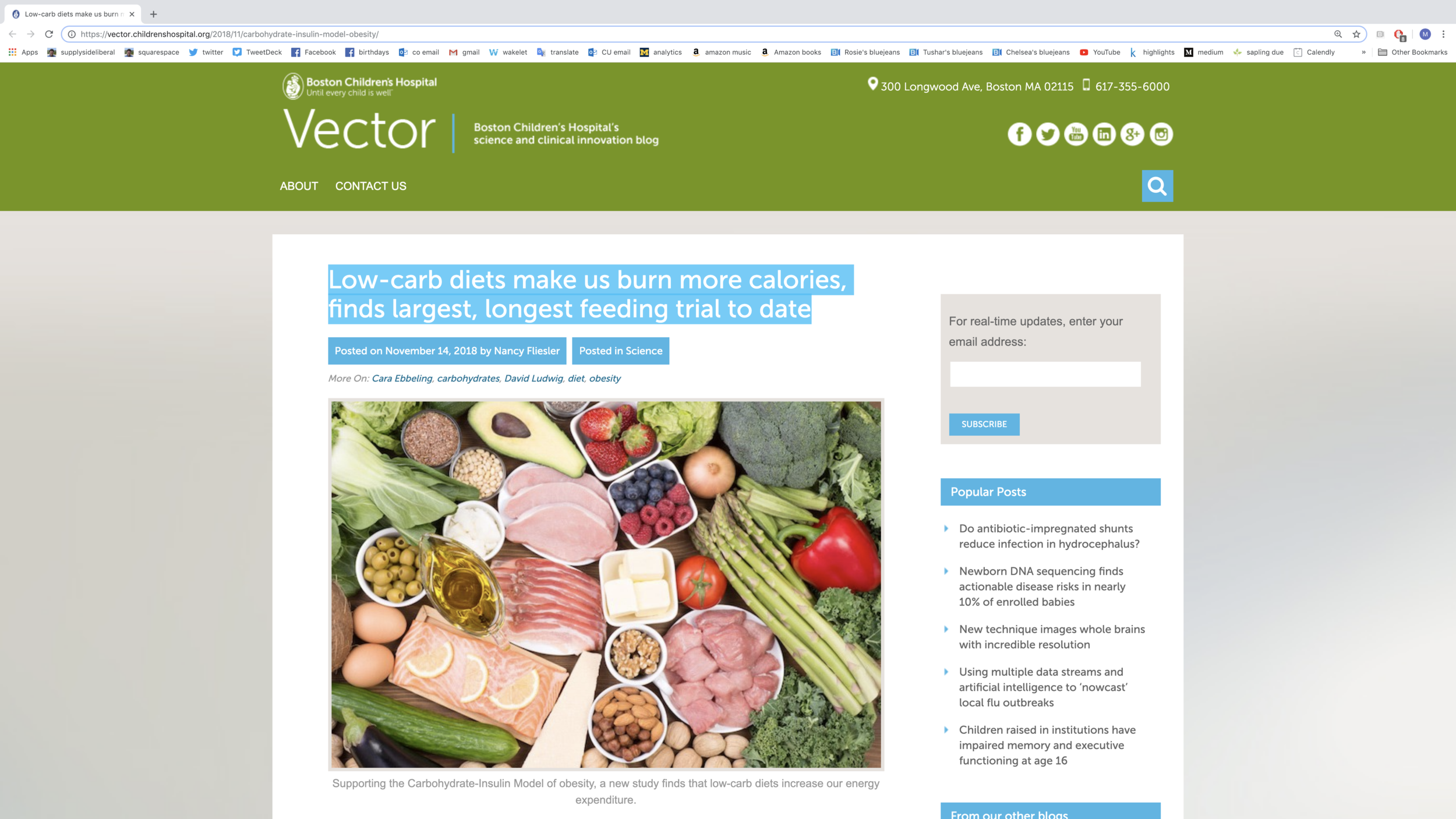
Framingham State Food Study: Lowcarb Diets Make Us Burn More Calories

Link to the article shown above. Hat tip to Austin Nichols.

Link to the article shown above. Hat tip to Austin Nichols.

Without additional assumptions, the calories-in/calories-out identity is not by itself a theory, but this useful identify can tempt people into bad theories. In “Nina Teicholz on the Bankruptcy of Counting Calories” I write:

The calories-in/calories out identity is typically thought of this way:

Weight Gain in Calories = Calories Consumed - Calories Expended

What sneaks in with this arrangement of the identity is the questionable idea that calories consumed and calories expended are fixed quantities not subject to any deeper forces. Rearranging the identity gives a different perspective:

Calories Expended = Calories Consumed + Weight Loss in Calories

This rearrangement subtly hints at the idea that, holding calories consumed fixed, effective weight-loss that puts a lot of fatty acids and ketones into the blood stream from metabolized body fat might make one feel more energetic and so raise calories expended. Conversely, relatively ineffective weight loss combined with a low level of calories consumed will lead to internal starvation with all kinds of body signals going out to discourage energy expenditure and encourage the consumption of more calories. Those body signals are exactly the kinds of signals that can cause suffering. 

In the equations above, an important aspect of “calories expended” is that the more calories expended, the more tolerable it is likely to be for the individual. In order to get a low level of calories expended, body signals have to lower the metabolism, which makes an individual feel tired and listless so they will keep effort levels low. Low levels of “calories expended” are usually an unpleasant experience.

The Framingham State Food Study provides some of the best evidence that two different diets, both adjusted to keep weight steady, can lead to different amounts of calories expended. This is an impressive study: it “tightly controlled what people ate for 30 weeks, providing them with fully prepared food-service meals.” Here is the key result:

Over the 20 weeks, total energy expenditure (measured with the doubly labeled water method) was significantly greater on the low-carb versus the high-carb diet. At the same average body weight, participants who consumed the low-carb diet burned about 250 kilocalories a day more than those on the high-carb diet.

That is more than a 10% increase in calories expended for a typical person. (Women on average consume and expend about 2000 calories per day; men consume and expend about 2500 calories per day.) Here is how David Ludwig interprets the result:

“This is the largest and longest feeding study to test the ‘Carbohydrate-Insulin Model,’ which provides a new way to think about and treat obesity … According to this model, the processed carbohydrates that flooded our diets during the low-fat era have raised insulin levels, driving fat cells to store excessive calories. With fewer calories available to the rest of the body, hunger increases and metabolism slows — a recipe for weight gain.”

I am excited about the other new clinical trial an overlapping team is involved in: it randomizes experimental subjects to a very-low-carb, a high carb/low sugar or a high carb/high sugar diet.

Don’t miss my other posts on diet and health:

I. The Basics

II. Sugar as a Slow Poison

III. Anti-Cancer Eating

IV. Eating Tips

V. Calories In/Calories Out

VI. Wonkish

VIII. Debates about Particular Foods and about Exercise

IX. Gary Taubes

X. Twitter Discussions

XI. On My Interest in Diet and Health

See the last section of "Five Books That Have Changed My Life" and the podcast "Miles Kimball Explains to Tracy Alloway and Joe Weisenthal Why Losing Weight Is Like Defeating Inflation." If you want to know how I got interested in diet and health and fighting obesity and a little more about my own experience with weight gain and weight loss, see “Diana Kimball: Listening Creates Possibilities and my post "A Barycentric Autobiography.

John Locke on Why the Executive and Legislative Power Should Be Separated, but the Executive and Foreign Policy Power Should Be Combined

Schoolchildren in the US are taught about the division of the US government into three branches: the legislative branch, the executive branch, and the judicial branch. Where did this idea of three separate branches come from? Part of the path is likely to be through John Locke: many of the framers of the US Constitution were well-versed in the works of John Locke.

In Sections 143-144 of his 2d Treatise on Government: Of Civil Government, in Chapter XII, “Of the Legislative, Executive, and Federative Power of the Commonwealth,” John Locke makes the case for separating the Legislative from the Executive power. The centerpiece of his case is that combining the Legislative and Executive power in the same people is too great a temptation for misrule, because it guarantees that those who hold both of these power can avoid being subject to the laws themselves. If the two powers are separated, the Executive can ensure that the members of the legislature are subject to the laws—and, unstated by John Locke in this chapter, there is at least the hope that the legislature can hold the executive accountable through some power of impeachment or vote of no confidence.

Intriguingly, John Locke’s case for separating the executive and legislative power contains an argument for legislatures being out of session most of the time (bolding added below), threaded within his argument that combining the legislative and executive powers is too great a temptation for a ruler or rulers:

§. 143. The legislative power is that, which has a right to direct how the force of the commonwealth shall be employed for preserving the community and the members of it. But because those laws which are constantly to be executed, and whose force is always to continue, may be made in a little time; therefore there is no need, that the legislative should be always in being, not having always business to do. And because it may be too great a temptation to human frailty, apt to grasp at power, for the same persons, who have the power of making laws, to have also in their hands the power to execute them, whereby they may exempt themselves from obedience to the laws they make, and suit the law, both in its making, and execution, to their own private advantage, and thereby come to have a distinct interest from the rest of the community, contrary to the end of society and government: therefore in well-ordered commonwealths, where the good of the whole is so considered, as it ought, the legislative power is put into the hands of divers persons, who duly assembled, have by themselves, or jointly with others, a power to make laws, which when they have done, being separated again, they are themselves subject to the laws they have made; which is a new and near tie upon them, to take care, that they make them for the public good.

144. But because the laws, that are at once, and in a short time made, have a constant and lasting force, and need a perpetual execution, or an attendance thereunto; therefore it is necessary there should be a power always in being, which should see to the execution of the laws that are made, and remain in force. And thus the legislative and executive power come often to be separated.  

John Locke follows this argument for separating the legislative and executive power with an argument for combining the executive and foreign policy power in the same agent. The executive power and foreign policy power differ because, by the idiosyncratic nature of interactions with foreign powers, it is hard to constrain the foreign policy power by legislation to the same extent that the executive power can be constrained by legislation. But both the executive and foreign policy power involve someone acting as an agent for the “public good”: the interests of the people of the commonwealth as a whole. Along the way, John Locke gives a nice description of foreign policy from a philosophical point of view:

§. 145. There is another power in every commonwealth, which one may call natural, because it is that which answers to the power every man naturally had before he entered into society: for though in a commonwealth the members of it are distinct persons still in reference to one another, and as such are governed by the laws of the society; yet in reference to the rest of mankind, they make one body, which is, as every member of it before was, still in the state of nature with the rest of mankind. Hence it is, that the controversies that happen between any man of the society with those that are out of it, are managed by the public; and an injury done to a member of their body, engages the whole in the reparation of it. So that under this consideration, the whole community is one body in the state of nature, in respect of all other states or persons out of its community.  

§. 146. This therefore contains the power of war and peace, leagues and alliances, and all the transactions, with all persons and communities without the commonwealth, and may be called federative, if any one pleases. So the thing be understood, I am indifferent as to the name.  

§. 147. These two powers, executive and federative, though they be really distinct in themselves, yet one comprehending the execution of the municipal laws of the society within itself, upon all that are parts of it; the other the management of the security and interest of the public without, with all those that it may receive benefit or damage from, yet they are always almost united. And though this federative power in the well or ill management of it be of great moment to the commonwealth, yet it is much less capable to be directed by antecedent, standing, positive laws, than the executive; and so must necessarily be left to the prudence and wisdom of those, whose hands it is in, to be managed for the public good: for the laws that concern subjects one amongst another, being to direct their actions, may well enough precede them. But what is to be done in reference to foreigners, depending much upon their actions, and the variation of designs and interests, must be left in great part to the prudence of those, who have this power committed to them, to be managed by the best of their skill, for the advantage of the commonwealth.  

§. 148. Though, as I said, the executive and federative power of every community be really distinct in themselves, yet they are hardly to be separated, and placed at the same time, in the hands of distinct persons: for both of them requiring the force of the society for their exercise, it is almost impracticable to place the force of the commonwealth in distinct, and not subordinate hands; or that the executive and federative power should be placed in persons, that might act separately, whereby the force of the public would be under different commands: which would be apt some time or other to cause disorder and ruin.

For links to other John Locke posts, see these John Locke aggregator posts: 

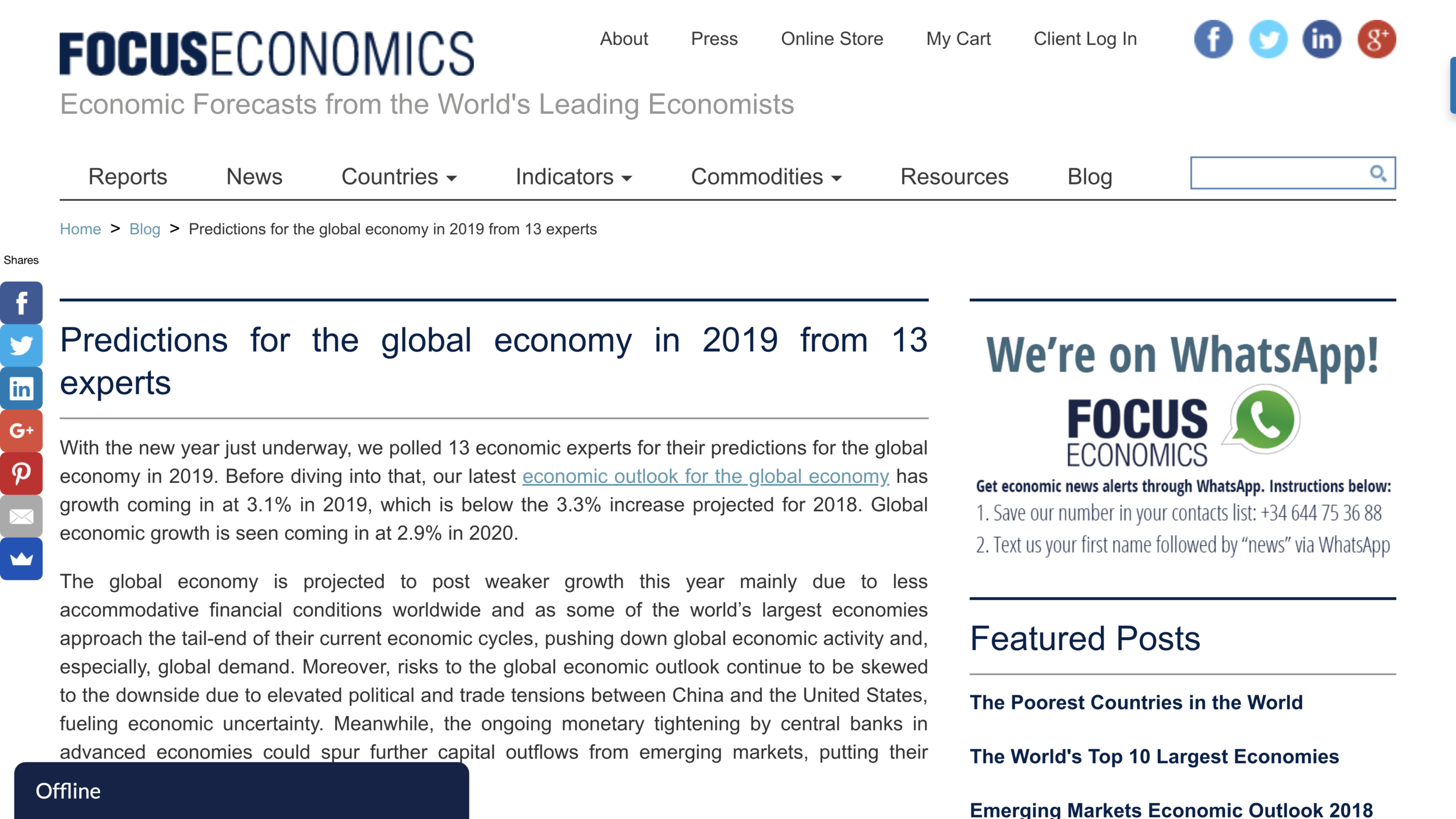
FocusEconomics: Predictions for the Global Economy in 2019 from 13 Experts

Screen Shot 2019-01-17 at 7.55.01 PM.png

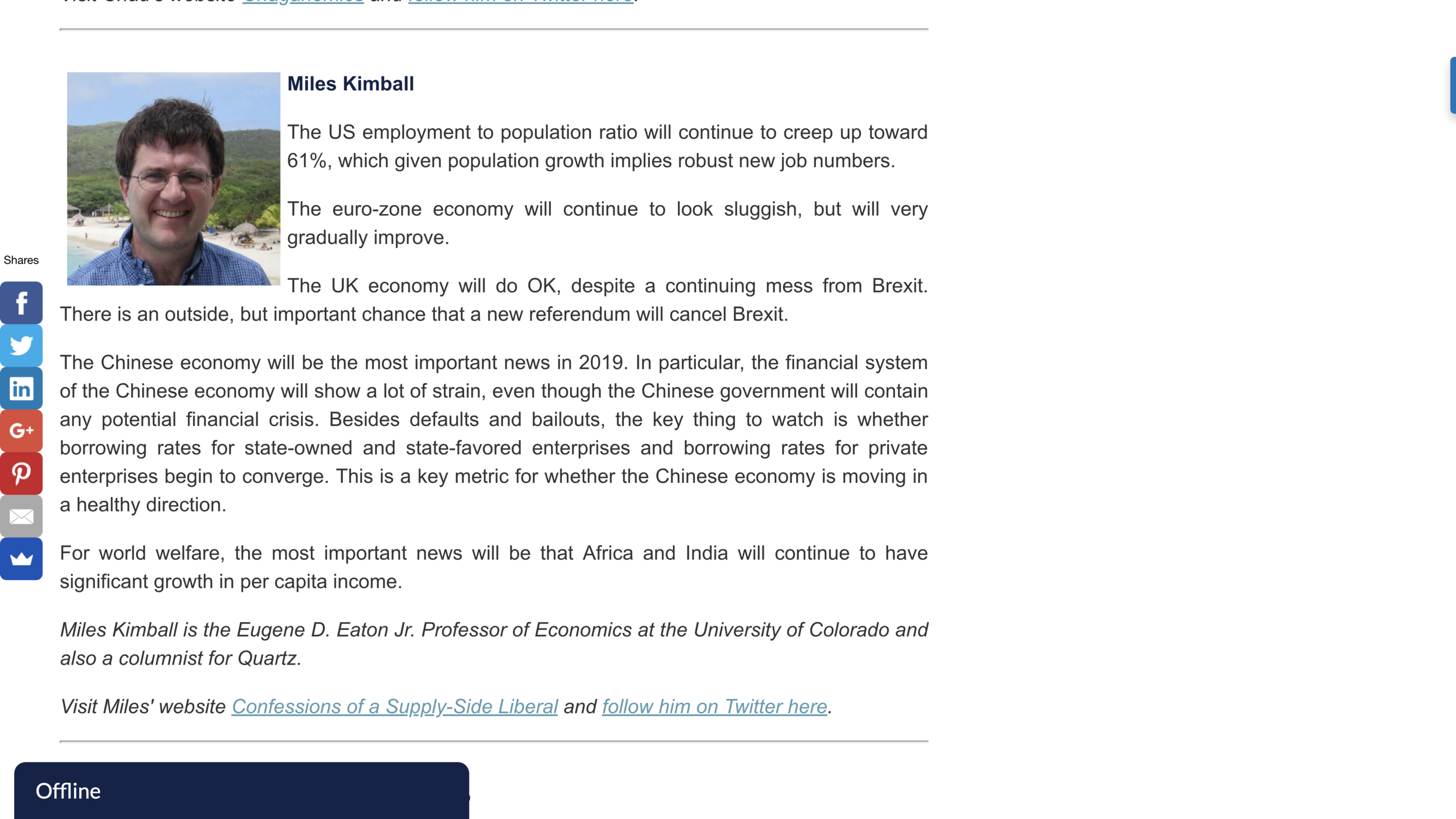
FocusEconomics asked various people, including me, for predictions about the global economy in 2019. Here is my answer, except that they left out my qualifying sentence at the beginning. I have restored it.


I am most likely to be wrong in my predictions for the global economy in 2019, but here is the picture in my head: 

The US employment to population ratio will continue to creep up toward 61%, which given population growth implies robust new job numbers.  

The euro-zone economy will continue to look sluggish, but will very gradually improve.

The UK economy will do OK, despite a continuing mess from Brexit. There is an outside, but important chance that a new referendum will cancel Brexit. 

The Chinese economy will be the most important news in 2019. In particular, the financial system of the Chinese economy will show a lot of strain, even though the Chinese government will contain any potential financial crisis. Besides defaults and bailouts, the key thing to watch is whether borrowing rates for state-owned and state-favored enterprises and borrowing rates for private enterprises begin to converge. This is a key metric for whether the Chinese economy is moving in a healthy direction.

For world welfare, the most important news will be that Africa and India will continue to have significant growth in per capita income. 

Pedro da Costa: How Martin Luther King Helped Shape the Fed's Dual Mandate

Update, January 23, 2019: On the Facebook page for this link post, Charles Steindel says:

Okay, I see the connection with Hawkins and Humphrey--though in both cases I don't know if they needed the memory of Martin Luther King to prompt them to insist on the employment mandate (I don't recall Coretta King being particularly prominent in the runup to the HH Act, though that might have been the case). Furthermore, the Fed had no specific macroeconomic mandate prior to HH, except, perhaps, that related to the 1946 Employment Act. I don't see, then, how the HH shifted the Fed away from a pure inflation target.

Lisa Drayer: Is Fasting the Fountain of Youth?

There are many areas in diet and health where the lack of research to pin things down is scandalous. The lack of gold standard research that could settle once and for all whether sugar is seriously bad for health is a good example.

Fortunately, a great deal of research is being done on the health effects of fasting—periods of time with no food. Lisa Drayer’s CNN article “Is fasting the fountain of youth?” is a useful report on some of this research. The best news is that more research results are on the way. For example, she writes:

Clinical trials are currently underway of IF in patients with various diseases such as multiple sclerosis or cancer to determine if fasting can halt progression. "If you hit cancer cells with chemo or radiation, when the individual is in a fasting state, the cells may be more vulnerable to being killed because they use glucose and cannot use ketones [the source of fuel during fasting]," explained Mattson. Researchers are also currently studying how fasting may impact cognitive performance and the risk of Alzheimer's disease in overweight women.

Fasting and Cancer. The background to the explanation that Mark Mattson (chief of the Laboratory of Neurosciences at the National Institute on Aging) gives about the effect of fasting on cancer is that cancer cells are metabolically handicapped—it is easy to damage delicate structures within the mitochondria that produce energy in cells. As a result, while cancer cells can still get quite a bit of energy from sugar and from certain amino acids that are especially common in animal protein, cancer cells have a tough time metabolizing the fat and ketone bodies that are produced from dietary fat and body fat. By contrast, healthy cells do very well taking in and metabolizing any fat and ketone bodies that are circulating in the bloodstream. (See “Good News! Cancer Cells are Metabolically Handicapped” and “How Fasting Can Starve Cancer Cells, While Leaving Normal Cells Unharmed.”) Another likely implication of cancer cells being metabolically handicapped that is important to test is the idea that fasting can be used to prevent cancer. I am betting on this myself: see “My Annual Anti-Cancer Fast.”

Fasting and Autoimmune Diseases. An important mechanism by which fasting could help with autoimmune diseases such as multiple sclerosis is by giving the body a break from aggravating agents in food. If we understood all of the aggravating agents, avoiding certain types of food might do the trick. (See “What Steven Gundry's Book 'The Plant Paradox' Adds to the Principles of a Low-Insulin-Index Diet” for one theory about particular foods that might aggravate autoimmune diseases.) But even without knowing which things in one’s diet might be aggravating an autoimmune disease, eating nothing gives the body a break from those toxins. (I hesitate to use the word “toxins” because of its use by people advocating “cleanses” that include procedures I don’t believe in, but want to work toward reclaiming the word “toxins” for the rest of us. Below, I try to reclaim the word “cleanse” as well.)

Fasting and Dementia. The proposed research about cognitive performance and risk of Alzheimer’s disease is theorizing that insulin resistance—and the resulting high levels of insulin in the bloodstream as the insulin-producing cells compensate—could have bad effects on the brain. Here, the potential benefits of fasting come because periods with no food are the most powerful way to get to the very low insulin levels that might eventually reduce insulin resistance. Fasting is like a drug holiday from the internal drug insulin, that might be able to restore the effectiveness of the drug at low or moderate dosages. (See “Obesity Is Always and Everywhere an Insulin Phenomenon” and “Forget Calorie Counting; It's the Insulin Index, Stupid.”)

Fasting and Longevity. It would take a lot of time and money to see the effects of fasting on how long human beings live, but researchers have shown that mice live longer when they fast periodically. Lisa writes:

Research involving animals has revealed that intermittent fasting can reduce the risk of obesity and its related diseases, including non-alcoholic fatty liver disease, diabetes and cancer. According to Mark Mattson … research from the 1980s revealed that the lifespan of rats increases substantially when they fast every other day, compared to rats who have food available at all times.

A much more recent study, published this month, found that mice who fasted, whether because they were fed all of their calories only once per day or because their calories were restricted, which naturally caused them to eat all of their limited food at once -- were healthier and lived longer compared to mice who had constant access to food.

Trying to tease out whether fasting is simply a form of calorie restriction is very complicated, according to experts. But "in the absence of calorie restriction, and independent of diet composition, fasting mice do better than non-fasting," explained Rafael deCabo, a scientist at the National Institute on Aging and the study's lead author.

Good Health Effects Beyond Weight Loss: Better Blood Sugar Regulation and Less Belly Fat. The good health effects of fasting are not just about weight loss. In two human trials, those who ate less on some days than others had more improvement in regulation of glucose (blood sugar)—a good sign in relation to diabetes—than those who ate somewhat less, but the same amount every day. They also lost more belly fat—a good sign in relation to heart disease. Lisa writes:

The research behind the popular 5:2 diet -- a type of intermittent fasting where people eat whatever they want for five days per week, then limit their diet to 500 calories for two consecutive days, has also revealed health benefits.

"We published two studies with Dr. Michelle Harvie at the University of Manchester; each included 100 overweight women, and the design of both studies was the same," said Mattson. "We divided them into two groups; one group got the 5:2 diet; the other group had three meals per day but we reduced the amount of calories by 20% to 25% below what they normally eat -- so that the weekly calorie intake of both groups would be the same."

Both groups lost the same amount of body weight over a 6-month period, but that was where the similarities ended. "We saw superior beneficial effects of 5:2 diet on glucose regulation (a risk factor for diabetes) and loss of belly fat (a risk factor for cardiovascular disease) compared to the women eating regular meals but restricting calories," said Mattson.

Fasting and Cellular Renewal. When food intake is low enough, the body looks for old cells it can cannibalize for resources. It breaks apart cells that look substandard for parts. Getting rid of the old junker cells can help avoid problems. When is food intake enough for such cleansing cannibalization to get in gear? The production of ketone bodies from body fat seems to be an important indicator. Lisa writes:

According to experts, a critical aspect of fasting -- which is different from simply restricting calories -- is that the body undergoes a metabolic switch from using glucose to using ketones as fuel, a result of the depletion of liver energy stores and the mobilization of fat. (This switch also occurs during extended periods of exercise.)

"If ketones are not elevated, you don't see the beneficial effects," said Mattson. What's more, these metabolic changes that occur during repeated "cycling" from fasting to eating may help to optimize brain function and bolster its resistance to stress and disease, both of which have positive implications for aging.

According to Longo, the presence of ketones in the blood signifies that on the cellular level, the body is "regenerating" itself, which protects against aging and disease.

"We've published many papers, and the main thing we talk about is multisystem regeneration," said Longo. For example, fasting seems to lower the level of damaged white blood cells -- but when you re-feed, stem cells are turned on, and you rebuild and regenerate new, healthy cells, explained Longo. "You get rid of the junk during starvation -- and once you have food, you can rebuild."

"The damaged cells are replaced with new cells, working cells -- and now the system starts working properly," said Longo. This ultimately impacts disease risk, as risk factors for disease decrease when tissues are healthy and functional, explained Longo.

The metabolic switchover during fasting from using glucose (blood sugar) to using ketones as fuel has another likely implication that needs to be more fully tested. Based on my own experience and the experience of others I know, going entirely without food is much less painful if before beginning the fast one was eating in a lowcarb, highfat way. (See “A Barycentric Autobiography.”) In the first few hours of fasting, a big reason is avoiding what I called the “carb rebound effect” in “Obesity Is Always and Everywhere an Insulin Phenomenon” and more accurately the “insulin backlash” in “Using the Glycemic Index as a Supplement to the Insulin Index.” But experientially, there seems to be some suffering later on in a period of fasting when one has been eating highcarb. The best hypothesis I can see for this is that a rough switchover from being all set up to metabolize glucose to metabolizing fats and ketones accounts for a lot of that suffering. My notion is that the more one’s body is set to be metabolizing dietary fats rather than carbs when one does eat, the smoother the transition to subsisting off of one’s own body fat during fat. As far as I know, this claim that there is more suffering during fasting for those who are eating highcarb or otherwise high on the insulin index), has not been tested. But it is worth testing. If people’s perception of fasting as very difficult is just a side effect of eating highcarb or otherwise high on the insulin index, then periodic fasting might be a more sustainable practice for more people if it is combined with low-insulin-index eating. (The perception of fasting as very difficult—in a context where most people are eating highcarb—is reflected in researchers’ use sometimes of a “fasting mimicking diet” in which for five days out of a month, people eat between 800 and 1,100 calories.)

In my own experience, fasting in the context of generally low-insulin-index eating is easy enough that an eating window of four hours—implying on average 20 hours of fasting a day—seems relatively easy. And occasionally going an entire day without food beyond that—implying at least 30 hours of fasting even if one eats late in the day before the fast and early in the day after—is not that bad. When fasting becomes as easy as it is when one is generally eating low on the insulin index, then it can easily be used as a tool to enhance health in many ways.

Don’t miss my other posts on diet and health:

I. The Basics

II. Sugar as a Slow Poison

III. Anti-Cancer Eating

IV. Eating Tips

V. Calories In/Calories Out

VI. Wonkish

VIII. Debates about Particular Foods and about Exercise

IX. Gary Taubes

X. Twitter Discussions

XI. On My Interest in Diet and Health

See the last section of "Five Books That Have Changed My Life" and the podcast "Miles Kimball Explains to Tracy Alloway and Joe Weisenthal Why Losing Weight Is Like Defeating Inflation." If you want to know how I got interested in diet and health and fighting obesity and a little more about my own experience with weight gain and weight loss, see “Diana Kimball: Listening Creates Possibilities and my post "A Barycentric Autobiography.