[Update, February 6, 2018: As I detail in "The Case Against the Case Against Sugar: Seth Yoder vs. Gary Taubes," I have become convinced that Gary Taubes is not a reliable reporter, so
I deleted the word "excellent" before the phrase "history of nutritional thought Good Calories, Bad Calories" just above, and
I wrote the post "Diseases of Civilization" documenting widespread agreement on the phenomenon of "Diseases of Civilization" to be explained, even though there is much disagreement about what aspects of modern diets and lifestyles causes these diseases.)
In the passage just below, Gary is in line with other sources on the description of the phenomenon of the Diseases of Civilization, and his hypothesis that sugar and other easily digestible carbohydrates play a key role in the Diseases of Civilization is a reasonable, though unproven, hypothesis.]
Here is the way Gary Taubes frames his argument in Chapter 5, "Diseases of Civilization":
On April 16, 1913, Albert Schweitzer arrived at Lambaréné, a small village in the interior lowlands of West Africa, to establish a missionary hospital on the banks of the Ogowe River. Attended by his wife, Hélène, who had trained as a nurse, he began treating patients the very next morning. Schweitzer estimated that he saw almost two thousand patients in the first nine months, and then averaged thirty to forty a day and three operations a week for the better part of four decades. The chief complaints, at least in the beginning, were endemic diseases and infections: malaria, sleeping sickness, leprosy, elephantiasis, tropical dysentery, and scabies.
Forty-one years after Schweitzer’s arrival, and a year and a half after he received the Nobel Peace Prize for his missionary work, Schweitzer encountered his first case of appendicitis among the African natives. Appendicitis was not the only Western disease to which the natives seemed to be resistant. “On my arrival in Gabon,” he wrote, “I was astonished to encounter no cases of cancer…. I can not, of course, say positively that there was no cancer at all, but, like other frontier doctors, I can only say that if any cases existed they must have been quite rare.” In the decades that followed, he witnessed a steady increase in cancer victims. “My observations inclined me to attribute this to the fact that the natives were living more and more after the manner of the whites.”
As Schweitzer had suggested, his experience was not uncommon for the era. In 1902, Samuel Hutton, a University of Manchester–trained physician, began treating patients at a Moravian mission in the town of Nain, on the northern coast of Labrador, or about as far from the jungles of West Africa as can be imagined, in both climate and the nature of the indigenous population. As Hutton told it, his Eskimo patients fell into two categories: There were those who lived isolated from European settlements and ate a traditional Eskimo diet. “The Eskimo is a meat eater,” he wrote, “the vegetable part of his diet is a meager one.” Then there were those Eskimos living in Nain or near other European settlers who had taken to consuming a “settler’s dietary,” consisting primarily of “tea, bread, ship’s biscuits, molasses, and salt fish or pork.” Among the former, European diseases were uncommon or remarkably rare. ...
Most of these historical observations came from colonial and missionary physicians like Schweitzer and Hutton, administering to populations prior to and coincidental with their first substantial exposure to Western foods. The new diet inevitably included carbohydrate foods that could be transported around the world without spoiling or being devoured by rodents on the way: sugar, molasses, white flour, and white rice. Then diseases of civilization, or Western diseases, would appear: obesity, diabetes mellitus, cardiovascular disease, hypertension and stroke, various forms of cancer, cavities, periodontal disease, appendicitis, peptic ulcers, diverticulitis, gallstones, hemorrhoids, varicose veins, and constipation. When any diseases of civilization appeared, all of them would eventually appear. This led investigators to propose that all these diseases had a single common cause—the consumption of easily digestible, refined carbohydrates. The hypothesis was rejected in the early 1970s, when it could not be reconciled with Keys’s hypothesis that fat was the problem, an attendant implication of which was that carbohydrates were part of the solution. But was this alternative carbohydrate hypothesis rejected because compelling evidence refuted it, or for reasons considerably less scientific?
It is not impossible to think that taking a very high dose of a powerful drug every day, year after year could cause many serious side effects. Likewise, the possibility must be considered that very high doses of insulin every day, year after year, could contribute to a wide range of diseases through its side effects on a wide range of cell types. (And of course, a few of these diseases, such as dental cavities, may result from sugar or other refined carbs in a way that does not involve insulin.)
People often talk as if obesity itself caused many chronic diseases. But other than joint problems, and the social stigma of obesity, almost all of the diseases associated with obesity could be due to the common cause of elevated insulin levels. That is,
chronically elevated insulin levels usually cause obesity, and
chronically elevated insulin levels have many dangerous side effects.
There is an interesting theoretical case in which chronically high insulin levels would be de-linked from obesity. Suppose the fat cells of someone caught in a carb rebound cycle became resistant to insulin, but his or her muscle cells retained their normal sensitivity to insulin. Because the fat cells would not respond much to the insulin signal telling them to take in glucose from the bloodstream and convert it into triglycerides and then fat, he or she would not gain much weight. But to keep blood glucose levels in line, insulin levels would have to go up even further to get the job done just from the muscle cell response to insulin. If high insulin levels cause most of the chronic diseases we associate with obesity, then while still normal in weight, he or she would be at risk for all of these chronic diseases. This is someone others might envy for being able to eat anything without gaining weight—right up until he or she died of a heart attack.
The Implications of Insulin Resistance for Obesity
If, on the other hand, muscle cells become more resistant to insulin than fat cells, then the higher insulin levels that result from insulin resistance will lead to weight gain. Moreover, the fact that even a little food can still elevate insulin levels quite a bit will make weight loss very difficult. In saying this, I have in mind this model relating insulin levels to fat accumulation and decumulation
high insulin level —> accumulation of body fat
medium insulin levels over a substantial range —> body fat steady
low insulin level —> fat burning
If you have insulin resistance for muscle cells but not fat cells, even small amounts of food will prevent reaching an insulin level low enough to lead to fat burning. The only way to get insulin levels low enough to lead to fat burning may be to have a substantial period of time with no food at all—fasting.
I should say that in addition to insulin levels, weight gain and loss are also regulated by the amount of body fat an individual already has. Presumably there are hormones fat cells send out saying "Here I am." Because of the effect of high body fat levels in restraining further fat accumulation, high insulin levels lead to a higher steady-state weight, not unending weight gain. According to this theory, current average insulin levels are the main determinant of an individuals weight setpoint or "fat thermostat." Current average insulin levels are in turn determined mainly by current diet and by the progression of insulin resistance.
Similarly, the restraining effect of low body fat levels on further fat burning means that lowering one's average insulin levels a given amount typically leads to a lower steady-state weight, not unending weight loss. In addition to the direct effect of changes in what and when one eats on average insulin levels, it may be possible to lower insulin resistance by the equivalent of a "drug holiday": prolonged periods of very low insulin levels. The way to get prolonged periods of very low insulin levels is through fasting.
The Short-Run Blood Glucose Steady-State Theory of Fasting Done Right
The image many people have of going without food for a period of time is strongly conditioned by their experience of the carb rebound effect, with its abnormally low blood sugar levels. Absent the carb rebound effect, going without food for a period of time is much easier.
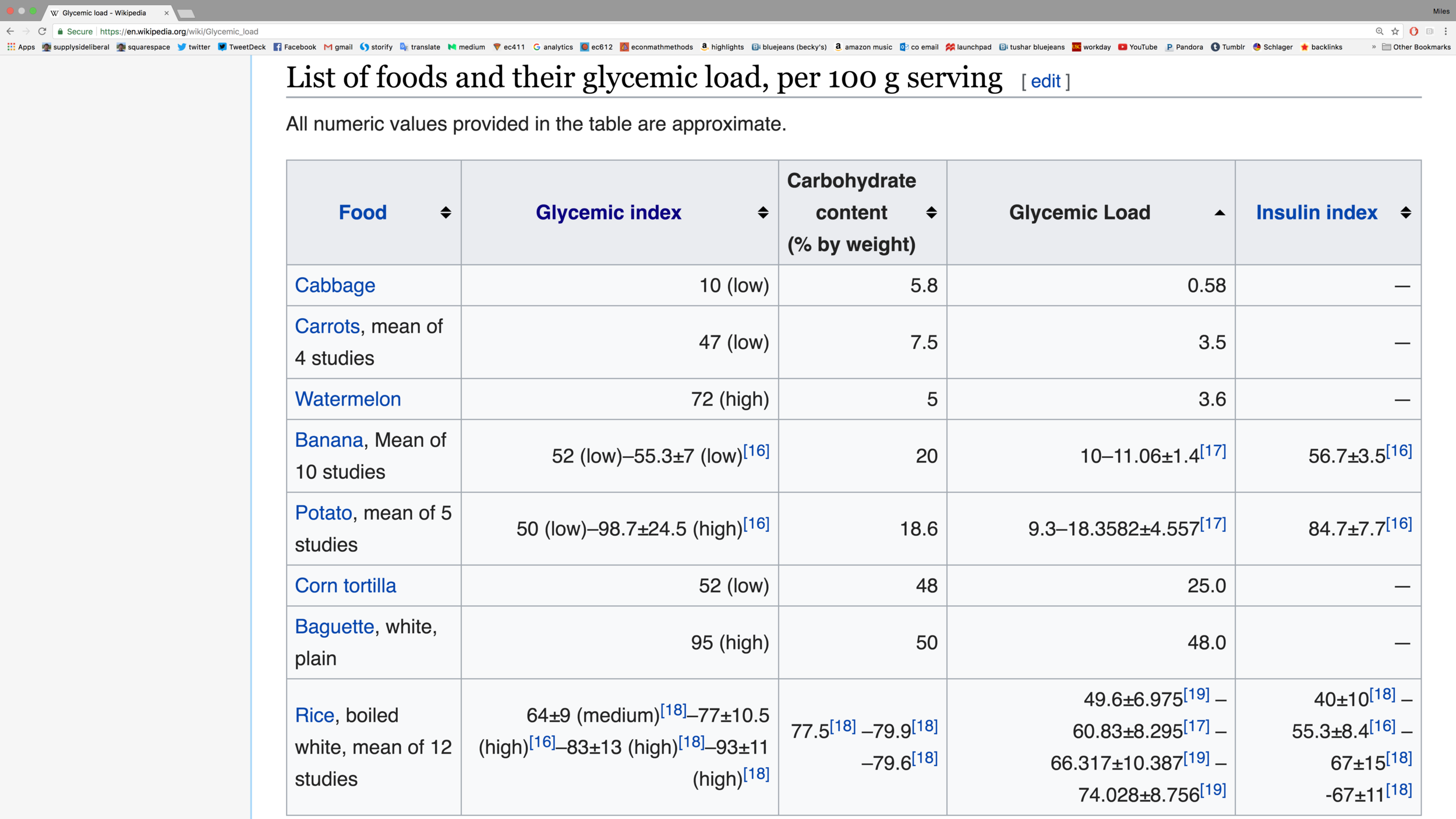
Suppose one's last meal before beginning the fast is comprised entirely of food with a very low food insulin index. Then there will be no rebound. Instead of blood sugar dropping so low it generates intense hunger, blood glucose and insulin levels will drop just low enough that the rate at which glycogen and body fat stores are raided is just enough to replace the glucose that is used up to provide energy. That is, one will go into a short-run steady-state with a slightly low—but not severely low—level of blood glucose.
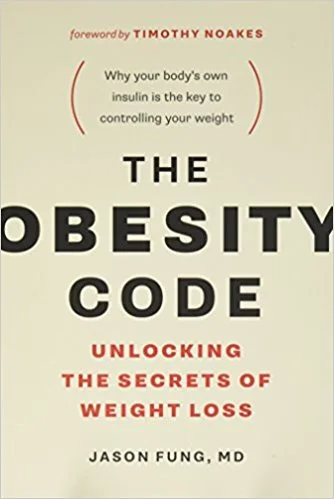
Based on my own experience and that of a couple of other people I know who are following Jason Fung's recommendations, I can describe the phenomenology of this short-run steady-state with a mildly low level of blood sugar as one of gentle hunger that I can readily distract myself from by something as simple as work or TV. (But if I have occasion to think about food, this gentle hunger feels a bit stronger.)
Is Fasting Dangerous?
One danger of fasting is the danger of getting one's electrolytes out of balance. This danger is straightforward to address. One can either drink bone broth during one's fast as Jason Fung recommends, or take the simpler course of taking electrolyte pills such as these SaltStick capsules I have used.