Edward Posnett: Sardex, An Alternative Currency in Sardinia →
As David Keohane tweeted, this is a very interesting story.
A Partisan Nonpartisan Blog: Cutting Through Confusion Since 2012
As David Keohane tweeted, this is a very interesting story.

Link to the website for the “Vigilante Rick Grimes Deluxe” action figure pictured above, which has the following passage:
…. as he discovers that there is more than just the undead to worry about,Rick makes the ultimate choice to do whatever it takes to keep his family and friends alive in this less than moral post-apocalyptic world.
McFarlane Toys’ Rick Grimes Vigilante Edition deluxe figure depicts this transformation from a peace keeping deputy to judge, jury, and executioner. This blood splattered 10-inch figure features the exact likeness of the actor, taken from a full 3D scan of the actor himself, Andrew Lincoln.
One of the best ways to better understand Thomas Hobbes’s and John Locke’s notions of the “state of nature” is to watch “The Walking Dead.” Within a few episodes, the zombies become merely backdrop and detail, as the focus shifts to the struggle of human against human. But this is not an amoral struggle: Issues of right and wrong trouble occupy a big share of the screen time, both purely as moral questions and as key factors motivating loyalty in some cases and antipathy in others.
Before the rise of the zombies in “The Walking Dead,” one of the most vivid pictures of the Hobbesian and Lockian state of nature is the picture most of us have in our minds of the American Wild West. In movies about the Wild West, and in the historical reality of the Wild West, people had a keen sense of right and wrong, often enforced by vigilantism, since formal law courts were often far away and slow to act. Compare that picture of the Wild West to section 7 of John Locke’s 2d Treatise on Government: “On Civil Government”:
And that all men may be restrained from invading others rights, and from doing hurt to one another, and the law of nature be observed, which willeth the peace and preservation of all mankind, the execution of the law of nature is, in that state, put into every man’s hands, whereby every one has a right to punish the transgressors of that law to such a degree, as may hinder its violation: for the law of nature would, as all other laws that concern men in this world, be in vain, if there were nobody that in the state of nature had a power to execute that law, and thereby preserve the innocent and restrain offenders. And if any one in the state of nature may punish another for any evil he has done, every one may do so: for in that state of perfect equality, where naturally there is no superiority or jurisdiction of one over another, what any may do in prosecution of that law, every one must needs have a right to do.
John Locke’s train of logic is:
Right and wrong, according to John Locke, focuses on this principle:
[Each] may not, unless it be to do justice on an offender, take away, or impair the life, or what tends to the preservation of the life, the liberty, health, limb, or goods of another.
(See “The Religious Dimension of the Lockean Law of Nature.”) That is, Locke, focuses on the wrongness of directly killing, injuring and stealing.
Inspired in important measure by John Locke, Robert Nozick discusses right and wrong in the state of nature, and what he considers the fundamentally identical issues of right and wrong in more organized states of society in Anarchy, State and Utopia. Robert Nozick views vigilantes “taking the law into their own hands” as fundamentally no different from the government “taking the law into its own hands.” The issues in both cases is whether enforcement decisions are taken in accordance with what is right and wrong, not who does that enforcement. Of course, certain ways of organizing things may be more conducive to enforcement decisions being taken in accordance with what is right and wrong, but it is the decisions themselves that must be right, regardless of who makes them. If an enforcement action is wrong, the fact that the government did it does not make it OK. If an enforcement action is right, the fact that a private individual did it does not make it morally wrong.
Robert Nozick does recognize the right to insist that if one does not know whether someone is guilty or innocent, that person be judged by a procedure likely to be accurate. But an insistence that people not use a procedure that might or might not be accurate would require compensating those eager to impose such justice. Then Robert Nozick argues that because of the value to people of having some means of enforcing their rights, compensating someone for a prohibition against an inexpensive mode of imposing justice of somewhat questionable accuracy will typically involve providing to them another mode of imposing justice in a way that is affordable to them. To Robert Nozick, this is the moral justification for a the minimal state, which enforces rights to life and limb and property for everyone.
But one of the key implications of freedom is that people may not be prohibited from using an alternative form of justice that is known to be at least as accurate as that use by the dominant form of justice in an area. In this view, a government only has legitimacy as the main form of justice that people choose to be protected by. It differs from other forms of justice only in (a) being the most popular choice and (b) by having the raw power to enforce its own view about what, in fact, are accurate modes of delivering justice. A government has no right to a monopoly of justice if someone comes into the market providing a close substitute of equal accuracy in dispensing justice that the government knows to be of equal accuracy to the government’s own procedures.
Nozick often speaks of a minimalist government as “the dominant protective agency.” In addition to being a reminder that the government has no right to a monopoly of justice, that view also implies that the government has no absolute duty to protect the rights of someone who does not pay the government to protect herhis rights, except to the extent that government is preventing that person from using an alternative mode of justice. That is, if person A does person B wrong, then the government either needs to let person A hire someone else to punish B and get redress, or it needs to itself punish B and get redress for A.
The limitations on the government’s duty to protect everyone’s rights when the government is viewed as simply the dominant protective agency opens up an interesting possibility for punishment in doubtful cases that was highly relevant to the Wild West. Suppose there is not enough evidence to punish someone directly for a crime that they in fact committed with some substantial probability. The government or dominant protective agency could deal with this situation of some evidence but not enough for direct punishment by refusing to provide any more protective services to that person, except in specific cases where the government directly blocks that person from enforcing herhis own rights through some other agency or by self-help. These “outlaws” (not yet convicted, but deprived of the services of the dominant protection agency), would have to use methods of rights enforcement against other outlaws that could not take advantage of all the economies of scale the dominant protective agency has. In practice, they might also be subject to procedures that were not as accurate as those of the dominant protective agency–procedures the dominant protective agency could legitimately stop, but chooses not to.
There is, of course, the potential problem of a dominant protective agency choosing to treat someone as an outlaw simply because poverty meant they couldn’t pay the fee; let me leave that discussion for another day. Here, I am talking about the dominant protective agency refusing to serve someone because of a strong and well-justified suspicion of wrongdoing, not sufficient to warrant direct punishment. This seems to me to be a phenomenon that was quite common in the Wild West. Most people in the Wild West did not get too upset if plausibly bad actors were killed by other plausibly bad actors. And according to Nozickian logic, maybe that fact wasn’t so terrible.
What would be illegitimate are the many cases in the Wild West, when the government did not have enough evidence to punish person A directly, vigilante B attacked A without any more evidence, the government refused to deliver justice against vigilante B and prevented A from pursing herhis own vigilante justice against vigilante B. That just isn’t fair given the limited knowledge of A’s actual guilt or innocence.
“Andrew bequeathed to my father, unaltered, that sense of commitment to unqualified performance of religious duty at any personal sacrifice. The sense of duty and commitment descended in part to my generation and even to my children’s generation, but as the generations changed, the sense of duty was often transformed in its nature and in its object.”
Link to Wikipedia article “Miles Kimball”
It is hard to believe that this Spring it will be 35 years since I earned a Bachelor’s degree from Harvard. I did a profile for the 35th reunion report which you might find of some interest. (It had notes about my children Diana and Jordan at the top.) Here it is:
My religious journey has been a big part of my life. In 2000, at the age of 40, I left Mormonism to become a Unitarian-Universalist. My Mormon background left me with a strong sense of mission, which has become a desire to make a difference in the world that is no longer connected to any belief in the supernatural.
In 2012, I began my blog “Confessions of a Supply-Side Liberal,” which has a personal dimension, in addition to talking about economics, politics and religion. I also began tweeting in earnest under my own name @mileskimball.
In 2016, after 29 years teaching at the University of Michigan in Ann Arbor, I moved to the University of Colorado Boulder as Eugene D. Eaton Jr. Professor of Economics. My wife Gail and I now live in Superior, Colorado, with stunning views of the Front Range.
Professionally, I continue to pursue broad interests in macroeconomics, the economics of risk and cognitive economics, but my most important efforts are working toward restoring the power of monetary policy by working out the details for effective negative interest rate policy and designing well-being indices that can improve policy-making not only for national and regional governments but also for non-governmental organizations. My research has become a very social activity as I work with a large circle of coauthors and research assistants. Technology has made long-distance collaboration easier and easier.
“Before us great Death stands
Our fate held close within his quiet hands.
When with proud joy we lift Life’s red wine
To drink deep of the mystic shining cup
And ecstasy through all our being leaps—
Death bows his head and weeps.”
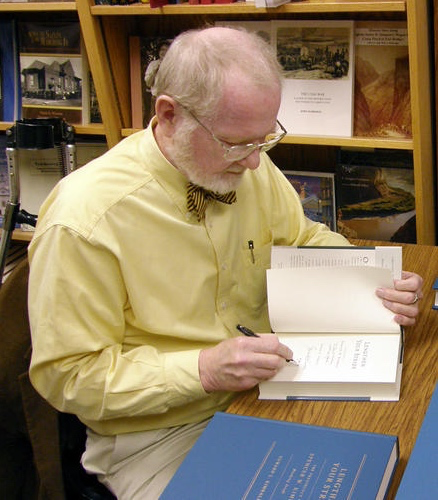
Edward Lawrence Kimball, September 23, 1930–November 21, 2016
Link to Wikipedia article on “Edward L. Kimball”
Link to the Deseret News article on Edward Lawrence Kimball’s death (source of the photo above)
Other than the fictional Clark Kent, my Dad is the only person who has ever made me think spontaneously of the adjective “mild-mannered.” My Mother explained why my Dad took almost no part in disciplining his children, by saying he was too much of a marshmallow. But in intellectual matters, my Dad had a spine of steel. He was not willing to say anything he did not believe, and he was not willing to believe anything he did not think through.
My Dad had an unwavering belief in a universe that makes sense. He rejected the idea that the universe is dead set against us. And while he recognized that people sometimes do terrible things, he always started with the assumption that people would act reasonably if not needlessly antagonized.
My Dad was an example of putting loyalty to the truth first and foremost, without neglecting other loyalties. He could do both because he knew the limits of his own knowledge, and gave people the benefit of the doubt. And because of both that intellectual humility and his tendency to give people the benefit of the doubt, he didn’t turn away by even a hair’s breadth from his friends and relatives whose views differed from his.
My Dad knew well the complexity of Mormon history, but he believed in Mormonism until his last breath. In his last four years, after my Mother died, I had many conversations with my Dad about religion. He was genuinely curious about my beliefs and had me read to him many of my religion posts and Unitarian-Universalist sermons. In our discussions he homed in on the common threads in my beliefs and his.
My Dad, like my Mother, was ambitious for his children. But neither of my parents ever pushed me in a particular career direction. And at moments when I had some success, my Dad made a point of reminding me it was more important to be good than to be successful.
When my Dad was 56 years old, and his Mother followed his Dad in death, he spoke of himself as an orphan. In that same sense, at the age of 56, I am now an orphan. And the world, too, has lost a man it could ill afford to lose.
Update, December 3, 2022: It has been a little over four years since my Dad died. Googling him today, I saw Peggy Fletcher Stack’s excellent obituary for him. See the image below. Here is the link.
Note: This is a companion post to “My Mother” and “Edna St. Vincent Millay’s ‘Dirge Without Music’.”
See also:
Graph of child mortality rates by country over time.
More than 60% of the world’s child deaths happen in just 10 countries, a new study finds.
“We are who we are in large measure because of our ancestors. In addition to shaping who we are within, by their collective strivings, they made the world a much better place than it otherwise would have been. May we do as well in improving the world for our descendants, and act in such a way that if they try to be like us, we would be proud.”
Like John Harvey, I do think that the economics profession bears an important part of the blame for the state the world is in. To a failure of most economists to recognize the fragility of the financial system, I would add slowness in developing monetary policy tools powerful enough to counteract the aggregate demand effects of any elevation of risk premia. Beyond that, what I would add to John Harvey’s discussion is:
1. The word “model” itself has become a reflection of the problem. Logic and reasoning behind a given argument are partly dismissed by saying “You didn’t have a model.” This really means “You didn’t have a [very particular type of] model.” And the limitation to that very particular type of model is often exactly what is interfering with understanding of a problem.
(In passing, let me say that I am not impressed with the realism of the models currently being used in polite circles with great frequency to model financial frictions.)
2. John Harvey is too enamored of heterodox schools. By the nature of heterodoxy, many economists who “think outside of the box” will be sui generis, not belonging to any school at all. (If they are really good, they may eventually they gather disciples who then constitute a school. But they may not belong to any school when they first break out of the mold.)
3. I see the blogosphere as a partial antidote to the dysfunctionality of the economics journals. If one includes the robust and wide-ranging discussion of the real world and real-world policy in the economic blogosphere, things look much better. From that angle, the dysfunction in economics overall can be reduced if more and more people take the blogosphere seriously.
The desire for equality has been used to justify quite heavy-handed action by states. But John Locke, in his 2d Treatise on Government: “On Civil Government” section 6, reasons from the equality of all to natural rights. To John Locke, equality means a starting place in which no one is under the thumb of anyone else, and those who are not under the thumb of anyone else are free. In John Locke’s view, beyond a prohibition on suicide reflecting his view of our relationship to God, the key bound on that freedom is that one is not allowed to “take away, or impair … the life, the liberty, health, limb or goods of another”:
But though this be a state of liberty, yet it is not a state of license: though man in that state have an uncontroulable liberty to dispose of his person or possessions, yet he has not liberty to destroy himself, or so much as any creature in his possession, but where some nobler use than its bare preservation calls for it. The state of nature has a law of nature to govern it, which obliges every one: and reason, which is that law, teaches all mankind, who will but consult it, that being all equal and independent, no one ought to harm another in his life, health, liberty, or possessions: for men being all the workmanship of one omnipotent, and infinitely wise maker; all the servants of one sovereign master, sent into the world by his order, and about his business; they are his property, whose workmanship they are, made to last during his, not one another’s pleasure: and being furnished with like faculties, sharing all in one community of nature, there cannot be supposed any such subordination among us, that may authorize us to destroy one another, as if we were made for one another’s uses, as the inferior ranks of creatures are for ours. Every one, as he is bound to preserve himself, and not to quit his station wilfully, so by the like reason, when his own preservation comes not in competition, ought he, as much as he can, to preserve the rest of mankind, and may not, unless it be to do justice on an offender, take away, or impair the life, or what tends to the preservation of the life, the liberty, health, limb, or goods of another.
Other “natural law” doctrines view people’s freedom as limited by more than just a ban on suicide and not harming others (who are not themselves offenders). Why is it that John Locke views our freedom as so extensive? There is a clue in saying that each of us is sent into the world by God and “about his business.” In effect, John Locke views us each as the one in the best position on Earth to make the ultimate judgement for what God wants each of us to do. Although, presumably, people sometimes fail to do what God sent them to Earth to do, many beautiful things that God did send someone to do might not happen if that person’s freedom of action is blocked.
From a less theistic perspective, the point is that if someone is given freedom, they may do something wonderful that no one else would have thought to have them do. Giving each individual a chance to do that something wonderful that perhaps no one else would have thought of is figuratively giving that individual a chance to fulfill her or his mission in life.
The view that John Locke scorns is the idea that “we were made for one another’s uses.” We were made for greater ends than that. And the final judgment on those greater ends cannot be made by another.
“If a judge put the burden of proof on the defendant to show that he did not commit the crime, the judge would be loading the dice against him. Even if the defendant proved he did not own the gun used to commit the murder, well, perhaps he borrowed it! To disprove that, he must now prove that he did not know the gun’s owner. But perhaps he paid that person to lie! – and so forth, infinitely. Every disproof only creates a new speculation, which must again be disproved. These speculations might seem silly, but they are not logically impossible, and requiring the defendant to prove his innocence – imposing the Devil’s proof on him – would require him to disprove even such bizarre conjectures. Every accused person would find himself in a hall of mirrors, forced to prove himself innocent of an endless series of baseless accusations, without regard for the rules of logic. As a procedural matter, presuming innocence is preferable, because an erroneous conviction is harder to fix than an erroneous finding of innocence. And as a substantive matter, the presumption of innocence is better because a wrongfully convicted person suffers a different, more personal harm than the public experiences if a guilty person goes free. Likewise, there are an indefinite number of speculative reasons that might defeat anyone trying to prove that he should not be deprived of freedom, just as there are an infinite number of ‘what ifs’ that the ‘Devil’ could use against a defendant who tries to prove he did not commit a crime, or a person who tries to disprove the existence of an invisible teapot: What if a person abuses his liberty? What if he doesn’t know how to use it wisely? What if he turns out to be a psychopath – or perhaps his children or grandchildren turn out to be psychopaths? What if there are top-secret reasons of state that warrant imprisoning him – reasons no judge may be allowed to see? Wary of the Devil’s proof, logicians place the burden on the person who asserts a claim, because that is the only logically coherent way to think. Likewise, the presumption of freedom requires those who would take away our liberty to justify doing so, because that is the only logically workable way to think about politics and law.”
Starting at the 20:30 mark in this Mercatus Center video is my presentation “Next Generation Monetary Policy.” Here is a link to the Powerpoint file for the slides I used.
This was at a September 7, 2016 Mercatus Center conference on “Monetary Rules in a Post-Crisis World.” You can see the other sessions here. (Note the 1/5 in the upper left corner of the video. Click on that to access session 1 of 5, 2 of 5, etc.)
“As a matter of procedure, starting with a presumption in favor of freedom is preferable because each step people take away from a state of liberty can be justified in theory by measuring whether they are better off. When two people sign a contract, they bind themselves, and in that sense are less free. But they consider themselves better off, and that is good enough, as long as they harm nobody else. It is not so easy to justify the reverse – a movement from a state of total unfreedom to one that is freer – because each step affects far more people. The totalitarian state is frozen solid, so that every action inflicts consequences on everyone else, and the slightest deviation from rigid order must therefore receive the approval of everyone affected. This means it is not always possible to determine whether people are better off at each step when they move in that direction. This, writes Epstein, ‘is why the restoration of even modest elements of a market system seem to pose such radical problems for Eastern European and Third World nations.’”