John Cochrane: Equity-Financed Banking →
This is an important blog post from John Cochrane.
A Partisan Nonpartisan Blog: Cutting Through Confusion Since 2012
This is an important blog post from John Cochrane.
“Academics frequently say the culture is hard to change because the bureaucrat is opposed to major change: I think that’s exactly wrong. You can’t make changes in a large bureaucracy by simply shouting and exhorting. It takes time. Talk to someone in the private sector about marketing and they’ll talk to you about the number of impressions it takes before somebody hears their message. Government is the same way.”
The entire argument of John Stuart Mill’s On Liberty is summarized in the 12th paragraph of the “Introductory” chapter:
But there is a sphere of action in which society, as distinguished from the individual, has, if any, only an indirect interest; comprehending all that portion of a person’s life and conduct which affects only himself, or if it also affects others, only with their free, voluntary, and undeceived consent and participation. When I say only himself, I mean directly, and in the first instance: for whatever affects himself, may affect others through himself; and the objection which may be grounded on this contingency, will receive consideration in the sequel. This, then, is the appropriate region of human liberty. It comprises, first, the inward domain of consciousness; demanding liberty of conscience, in the most comprehensive sense; liberty of thought and feeling; absolute freedom of opinion and sentiment on all subjects, practical or speculative, scientific, moral, or theological. The liberty of expressing and publishing opinions may seem to fall under a different principle, since it belongs to that part of the conduct of an individual which concerns other people; but, being almost of as much importance as the liberty of thought itself, and resting in great part on the same reasons, is practically inseparable from it. Secondly, the principle requires liberty of tastes and pursuits; of framing the plan of our life to suit our own character; of doing as we like, subject to such consequences as may follow: without impediment from our fellow-creatures, so long as what we do does not harm them, even though they should think our conduct foolish, perverse, or wrong. Thirdly, from this liberty of each individual, follows the liberty, within the same limits, of combination among individuals; freedom to unite, for any purpose not involving harm to others: the persons combining being supposed to be of full age, and not forced or deceived.
The first key concept here is of a personal sphere that an individual cares about more than other people do–or where other people care mainly if they have freely chosen to interact with that individual. In the middle of the description of that concept is an important phrase: “free, voluntary and undeceived consent.” It is not enough to establish valid consent that it be free and voluntary. It must also be undeceived.
The delineation of this personal sphere is the hard part. John Stuart Mill identifies what goes on inside one’s own brain as the most obviously personal sphere. It then requires a deep set of arguments to argue that freedom of thought requires freedom of speech–that we can’t really be who we freely, voluntarily and undeceivedly choose to be even in our own minds unless there is freedom of speech. For one thing, it is easier to think something if one dares to express it to others. For another without other people having freedom of speech, one will have relatively few choices of things to think.
Moving beyond speech to action, the delineation of a personal sphere ultimately requires reference to the physicality of human beings and ownership of objects. There are various ways to delineate this personal sphere. But as long as the principles are followed of giving each person a roughly equal personal sphere, without too much overlap, it will probably be all right. There may even be some ownable things that are “frills” and therefore can be distributed unequally as incentives without compromising people’s lives.
Finally, the idea that people can choose to pool their personal spheres for certain purposes to get together as a group and do their thing is very important. This is one of the most contested areas of the concept of liberty. For example, in current US law, getting together as a group for consensual sexual activity is a liberty that is now quite well protected, but getting together as a group for consensual economic activity is much less well protected–in part because many consensual economic activities that provide surplus to both parts still have a strong adversarial dimension because of disagreements over the relevant wage or price that divides the surplus. Debates about the scope of group liberty rage, with some arguing that sexual freedom should be curtailed, and others arguing that economic freedom should be expanded, while others argue for the status quo of freedom for consensual sexual activities and restraints for consensual economic activities.
Here, it is worth noticing that every argument for how two parties conducting consensual economic activity might affect others has a counterpart argument for how two parties conducting consensual sexual activity might affect others and vice versa.
The moral is that liberty is wonderful, but not simple. It takes deep thought to understand liberty.

Link to the article on the Michigan Daily website
Every year, tuition increases are in the news. What people don’t realize is that for elite public universities like the University of Michigan, there is an easy way to raise quality while lowering tuition. And it is a strategy that can make a particular university more elite while striking a blow against elitism. The strategy is to increase the size of the student body, with a careful plan that scales up everything from dorms to professors to academic advisors to socializing venues necessary to take care of the extra students.
Increasing Quality: In talking of increasing quality, I mean in the first instance increasing the quality of the faculty, which over time has a big effect on the reputation of a university generally. A larger student body means more total tuition revenue that can pay for more professors. Even if the average quality of the professors in a department stayed the same, a larger department is likely to be perceived as stronger. (Whatever bit of research one thinks is important, it is more likely to have been done by someone in Department X if there are more total professors in Department X.) And it isn’t long before having a larger department makes it easier to recruit more impressive professors because there will be plenty of colleagues in a given field to work with in that department.
Reducing Tuition Rates: Increasing the number of students by 50% should be accompanied by increasing the number of professors by 50% in departments that have strong enrollments, the number of professors doesn’t need to be increased that much in departments that have many low-enrollment classes to begin with. And having more students should make it possible to offer a wider range of summer classes which can have extra-low tuition because underused classrooms in the summer come at very low cost to the university. In addition, if the number of slots for out-of-state students is increased by a somewhat bigger percentage than the number of slots for in-state students, the same tuition rate for both in-state and out-of-state students will raise more money per student because of the higher fraction of out-of-state students. Note that this shift policy makes it easier, not harder, for in-state students to get admitted, because there are more slots for in-state students.
Striking a Blow Against Elitism: The beauty of this policy is that while it makes the university more impressive academically, it strikes a blow against elitism since more total people can receive an excellent education. The imprimatur of that prestigious university is given to more total students.
The biggest problem with the strategy is the mechanical aspect of rankings that gives credit to universities simply for turning away a lot of applicants. So an important aspect of this strategy is introducing measures of how much students know by the end of their college education. But that is something a university that cares about student learning should be doing anyway.
To press the point, this strategy involves a genuine belief that the university actually teaches students a lot so that someone can arrive at the university not knowing much and leave it knowing a great deal as a result of what the university has done. If actually adding value is a central goal of a university rather than just choosing students who were already smart, then it needs to be measuring how much students have learned and especially how much knowledge and wisdom students have embodied in long-term memory.
Measuring how much students have learned requires something like adding to the usual practice of student surveys at the end of a class some kind of test that students take two years or so after they have taken core classes to see if they still remember what they learned. To make it a good measure of long-term memory, students should be discouraged from cramming for that test two years later. An easy way to help avoid a temptation for the students to cram is to make their individual grades on that test two years later confidential. Of course, it is important that students try hard on that test. Some very low minimum score needed for passing should ensure that most students try reasonably hard.
Note that the student satisfaction surveys at the end of each class about their experience in the class should also be continued. Student learning may be the most important objective of university classes, but it is not the only one: it also matters how pleasant it was for students to be in the class and learn the amount that they learned. The point is to augment that measure of satisfaction with a measure of learning retained two years later. Having a measure of the success of a class based, say, 2/3 on the amount students learned and 1/3 on how much they enjoyed the experience would have a dramatic effect on how well that objective was achieved.
Lydia Murray Interviews Me: Understanding where I am coming from, you might be interested in what Lydia Murray wrote based on her interviews with me and others in the article “Increasing tuition: a look at why costs continue to rise” for the University of Michigan’s student newspaper the Michigan Daily:
The University of California system saw a 15 percent cut in state funding between 2006 and 2013 and experienced a 52.8 percent increase in tuition revenue during that time frame. The UC system also maintained a three-year freeze in tuition between 2011 and 2014, when its Board of Regents voted for a five percent tuition increase per year for the next five years.
While it is clear that the University has increased its general fund at a much faster rate than other comparable institutions, according Miles Kimball — a University economics professor — increasing the budget is essential to maintaining a high quality of education. Kimball cited the increasing wage premium for highly skilled labor as a source for the expanding budget, as higher salaries are becoming necessary to maintain a high-quality faculty.
Kimball said the UC system is now facing fiscal challenges because it has not adjusted its budget to rising costs.
“You can always ruin your University, and basically the UC system has been going in that direction,” Kimball said. “It is actually very troubled by the kind of budget straightjacket that it has been put into.”
Courant echoed these sentiments, citing the so-called “cost disease phenomenon” in which the cost of highly skilled labor has increased rapidly while the productivity of this group has not changed. According to Courant, the University needs to pay higher salaries to faculty members to retain them and the quality of education they provide for students.
“The relative price of University activity, of University faculty in particular, as well as other skilled labor at the University, tends to rise relative to the economy as a whole,” he said.
Alternatives to Raising Tuition
According to Kimball, the University does not need to raise tuition to increase its revenue and budget size. Instead, Kimball said the University could systematically increase enrollment so that there is a both a larger student population and a higher proportion of out-of-state students. The larger student body and the increase in the number of out-of-state students could then circumvent any need for tuition increases.
“There’s a missed opportunity where we could easily keep the tuition from going up simply by increasing the number of students,” he said. “I think that is a big missed opportunity, and, to the extent that, you miss that opportunity, you’re not doing an appropriate thing, because the appropriate thing would be to seize that opportunity.” …
“You’re going to have to increase the budget,” Kimball said. “But increasing the budget doesn’t mean that you have to increase tuition.”
One thing that didn’t make it into the article was my speculation that the University of California schools will show the damage from overly severe budget pressure more slowly than the University of Michigan would because they have better weather. I am very interested to know just how big a problem the budget pressure in the University of California system is and what strains that has caused. Perhaps it isn’t as bad as the picture I painted in my interview. If so, I hope you will correct me.
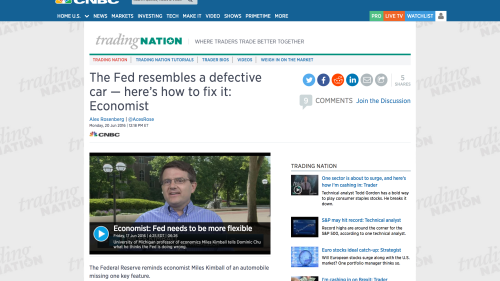
Link to CNBC segment “Economist: Fed needs to be more flexible”
I was very pleased at how this interview turned out. Take a look. Both links above have the video. Only 6 minutes and 26 seconds!
Alex Rosenberg made this happen, and does an excellent summary in the accompanying article, which also discusses Narayana Kocherlakota’s column “The Fed Needs More Than One Direction.”
I learned an interesting fact along the way. I did this interview for free, but CNBC paid the University of Michigan $700 for the use of the video facilities and personnel and satellite link at the University of Michigan to do the videotaping.
Alex Rosenberg interviewed me on the phone the day before the videotaping. Don’t miss his other interviews of me, in these posts:
Link to “The wrong lesson to take from negative yields”
On June 10, 2016, just four days after a remarkable Brookings conference on negative interest rates, the Financial Times gave a ringing endorsement of a vigorous use of negative interest rates. The subtitle, “Central banks should be pushing ahead with monetary stimulus,” aptly describes the tenor of the editorial. The strength of this editorial is in directly answering complaints by bankers about negative rates:
Predictably, banks and investors have renewed their complaints that a negative-rate environment is causing havoc with the financial system and risks a cataclysmic cascade of losses if prices fall and yields go up sharply. Some have explicitly blamed central banks such as the Bank of Japan and European Central Bank which have cut short-term interest rates below zero.
These criticisms are wrong-headed. Long-term yields are not heading below zero because central banks are arbitrarily planning to keep short-term interest rates down for years on end. They are reflecting expectations of anaemic nominal economic growth, with both real expansion and inflation strikingly low, for decades ahead.
The answer is not for central banks to abandon the negative-rate experiment but to continue to find every means possible to deliver the stimulus that will increase growth and, with it, inflation and yields.
Further on in the editorial, the Financial Times drives home the message that the need for negative rates is sad, but the negative rates themselves are part of the solution:
Negative short-term rates are not the problem. They are evidence of central banks’ determination to try to address the problem, which is the weak growth and inflation that is driving longer-term yields to zero and below. Investors and policymakers who fail to see this are making a serious mistake.
Bond yields at or below zero are a bad sign. Savers and banks suffering from them should recognise that throwing as much stimulus at the economy as possible is the answer, not raising short-term interest rates to the levels of earlier decades and imagining that the normality of the past will then return.
Right before that, the Financial Times even answers a potential objection that low rates could hurt financial stability:
If they are worried about the distortion in the financial system caused by low or negative rates, they should turn to their macroprudential tools, such as direct controls, to prevent excessive lending against housing, rather than holding rates higher than is warranted by the growth of nominal demand.
Overall, this is a very strong endorsement of negative interest rate policy by the Financial Times editorial board, that bears comparison to, say, Narayana Kocherlakota’s strong endorsement of negative interest rates policy in these Bloomberg View columns:
One reason I think this comparison is apt is that, like the Financial Times editorial board, Narayana still wishes for fiscal policy help along with negative rates, while I argue that going further with negative rates is preferable to relying partially on fiscal policy. You can see my discussion of that here:
I also tend to think that the conventional monetary policy of negative rates should be used instead of relying partially on the term-premium compression of QE.
Once short-run output gaps are close by interest rate policy, then it will be clearer what the appropriate fiscal policy is from a long-run perspective, which I discuss in
as well as what kind of financial market interventions along the lines of QE might be appropriate for medium-run or long-run reasons. On that last, see the links in my my post
“… we really do want a central bank that will protect the currency from the winds of electoral politics, without losing the benefits of democratic legitimacy and without indulging the myth that all central bank policy is purely technocratic. We can and should be comfortable with the reality that central bankers, like everyone else, are people whose life experiences—including their technical training—give them an ideological frame of reference through which they evaluate the world. The key to reforming the Fed is to know as much about the values of those central bankers as possible.”
Peter Conti-Brown, The Power and Independence of the Federal Reserve.
Note that with the neutral usage Peter makes of the word “ideological,” the meaning is the same as if it said “give them a frame of reference through which they evaluate the world.''
I had a good chance to talk to Narayana Kocherlakota in person at the Brookings conference on negative interest rates on June 6, 2016, and you can see him on the video nodding when I said that we should be telling people that deep negative interest rates are possible if needed. And sure enough, on June 9, Narayana wrote about the possibility of eliminating the zero lower bound in his Bloomberg View column “Negative Rates Are Nothing to Fear.” Here is the relevant passage:
Negative interest rates could eventually become an even more powerful tool. Some economists – such as University of Michigan economist Miles Kimball, who presented at the Brookings conference – point out that central banks are capable of taking rates as far below zero as they deem necessary. To increase the cost of holding currency, for example, they could charge banks a fee to change it into electronic central bank money.
Economically useful as such an option would be, central bankers must recognize that the prospect of being charged, say, 6 percent a year just to hold cash could unsettle people. For such a policy to work as intended, officials would have to do a lot of explaining ahead of time – communication that could have the added benefit of ensuring that the public understands the central bank’s goals and supports its methods of achieving them.
The Brookings conference on negative interest rates was a milestone in many other ways as well. Let me go so far as to say that no journalist writing about negative interest rates is well informed unless they have watched that Brookings conference.

Link: “Negativzinspolitik als konventionelle Geldpolitik” (pdf)
Link to the English version: “Negative Interest Rate Policy as Conventional Monetary Policy”
Journal placement is not the only measure of the importance of an academic paper. I have had many papers published in the American Economic Review or Econometrica, but I have only had one academic paper translated into another language: “Negative Interest Rate Policy as Conventional Monetary Policy,” which is published in the National Institute Economic Review. I appreciate Werner Onken (editor) and Beate Bockting (translator) of the Zeitschrift fuer Sozialoekonomie (Journal for Social Economics) for making the translation happen, Angus Armstrong for arranging for permission from the National Institute Economic Review, and Tilman Borgers and especially Rudi Bachmann for checking the German translation with an eye to the cadence and the economic substance.
Let me also highlight the INWO, the Initiative fuer Naturliche Wirtschafts Ordnung (Initiative for Natural Economic Order). Here is INWO’s webpage on monetary reform, which among other things reports on several important negative interest rate conferences.
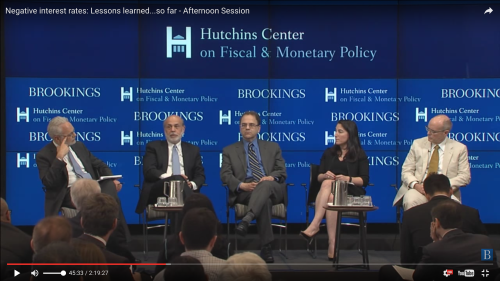
The Brookings (Hutchins Center) conference last Monday was another milestone for negative interest rate policy. I thought every minute of the conference was illuminating. This one is really worth watching. Here is Leon Berkelman’s reaction to watching the video, which he was kind enough to write up as a guest post:
A few weeks ago I gave a talk to some economics undergraduate students at the University of New South Wales. I told them I was ridiculously envious of them. When I was an undergraduate in Australia, it was impossible to know what the giants of the profession were discussing. Without physically attending a conference in the US, you could only rely upon word of mouth, or until someone wrote a book, to ponder their thoughts. Now, it’s different. To channel the Australian Prime Minister, there has never been a more exciting time to be a student of economics.
But I can’t complain too much. I get to reap the benefits now. And so it was with a gold-plated conference that the Brookings Institution ran on the 6th of June on negative interest rates. Soon after the conference finished, several hours of video were posted featuring the musings of rock stars like Bernanke, Kohn, and Slok.
Of most interest to me was Miles Kimball’s presentation. Miles has been discussing methods for overcoming the difficulties in implementing deep negative rates for a while now. Basically, if monetary authorities try to implement rates too far below zero, which they may want to do if the economy is depressed, we think that people and institutions will move away from assets earning negative rates, like deposits, into cash, which earns a zero return. We’ve heard rumblings about this recently in Germany and Japan. Such a move will cause many problems. For example, banks may see their deposit base disappear, but that’s far from the only problem.
The root of the issue is that physical cash maintains its nominal value. That places a limit on how low rates can go. But what if physical cash did not maintain its value? For example, what if you could somehow tax it? Well, then physical cash would be costly to hold, and the incentive to pile into it is gone. Problem solved.
Miles and others have suggested that you could devalue physical currency by having it depreciate. At the moment, a physical dollar is worth one dollar in the bank. However, you could break that one-to-one link, and you could have, say, one dollar in physical cash worth 90 cents in the bank. In the circumstances of a time-varying exchange rate between the two monies, if physical money was expected to depreciate, then once again the allure of physical cash is gone. It is again costly to hold physical cash. Again, problem solved. For the interested reader Miles’s website is a wonderful resource discussing how this idea would work, and some of the challenges it faces.
I’ve written and spoken about this idea before. I like it. However, as mentioned many times in the Brookings conference, the idea is politically toxic. My response is that it is then up to economists to advocate and educate. If economists think that such an idea can be useful, then shrugging our shoulders and saying that politics renders the idea a non-starter is not good enough. Economists consistently butt their heads up against a brick wall when arguing for cuts in fossil fuel subsidies, which are popular, but are economically and environmentally absurd. With strong enough advocacy, economists have chipped away and have had victories in the fossil fuel realm. Why not the Kimball solution too?
There are precedents of previously unthinkable monetary regime shifts. Going off the gold standard is one. Don Kohn, in his discussion during the conference, noted that these shifts involved changes in the relationship between money and goods (for example gold), rather than the relationship between monies. But we have seen different monies trade at different values before. For example, in the United States, before the Civil War, banks issued their own distinct private banknotes that traded at different rates. People did not riot in the streets then. Are we less able to cope with a small degree of complexity than we were in the 1850’s? I don’t think so.
Miles made the comment during the conference that monetary historians can be very useful right now in helping us to think through debates about our monetary system. They know the way things have worked before, and so they know what was politically feasible before. I suspect political feasibility is a more elastic concept than many appreciate.

Link to Wikipedia article on the June 12, 2016 Orlando nightclub shooting
After the Boston Marathon bombings, I posted this wish:
May the best in the human spirit vanquish the worst in the human spirit.
That wish needs to be renewed in the wake of the killing by assault rifle and handgun of at least 51 people in Orlando.
There is a tradition that looks for poverty as the cause of crimes such as this. I think it is indeed poverty that causes such crimes, but not primarily poverty of the wallet, but poverty of the heart. When people don’t find other, better meanings for their lives, they sometimes glom onto a meaning suggested by a murderous organization with a vivid ideology.
May we work hard to help people find better meanings in their lives so that fewer of them will be attracted to the idea of a caliphate founded on the blood of unbelievers.
The world is hurting. A big reason that the world is in as much trouble as it is this: how many people have done less than they should to make things better. We rightly honor those who have helped make the world a better place. It is also right to criticize those who, though able to do so, have failed to help make the world a better place. And each of us should examine themselves closely to see if we should be doing more.
As a practical matter, the law must tilt toward attacking sins of commission–things that people do that stand out from everyday actions and are bad. This can lead people to miss the moral gravity of doing nothing when doing something is called for. John Stuart Mill points out the importance of individual conscience in judging when we have done too little. In the 11th paragraph of the “Introductory” to On Liberty, he writes:
It is proper to state that I forego any advantage which could be derived to my argument from the idea of abstract right, as a thing independent of utility. I regard utility as the ultimate appeal on all ethical questions; but it must be utility in the largest sense, grounded on the permanent interests of man as a progressive being. Those interests, I contend, authorize the subjection of individual spontaneity to external control, only in respect to those actions of each, which concern the interest of other people. If any one does an act hurtful to others, there is a primâ facie case for punishing him, by law, or, where legal penalties are not safely applicable, by general disapprobation. There are also many positive acts for the benefit of others, which he may rightfully be compelled to perform; such as, to give evidence in a court of justice; to bear his fair share in the common defence, or in any other joint work necessary to the interest of the society of which he enjoys the protection; and to perform certain acts of individual beneficence, such as saving a fellow-creature’s life, or interposing to protect the defenceless against ill-usage, things which whenever it is obviously a man’s duty to do, he may rightfully be made responsible to society for not doing. A person may cause evil to others not only by his actions but by his inaction, and in either case he is justly accountable to them for the injury. The latter case, it is true, requires a much more cautious exercise of compulsion than the former. To make any one answerable for doing evil to others, is the rule; to make him answerable for not preventing evil, is, comparatively speaking, the exception. Yet there are many cases clear enough and grave enough to justify that exception. In all things which regard the external relations of the individual, he is de jure amenable to those whose interests are concerned, and if need be, to society as their protector. There are often good reasons for not holding him to the responsibility; but these reasons must arise from the special expediencies of the case: either because it is a kind of case in which he is on the whole likely to act better, when left to his own discretion, than when controlled in any way in which society have it in their power to control him; or because the attempt to exercise control would produce other evils, greater than those which it would prevent. When such reasons as these preclude the enforcement of responsibility, the conscience of the agent himself should step into the vacant judgment seat, and protect those interests of others which have no external protection; judging himself all the more rigidly, because the case does not admit of his being made accountable to the judgment of his fellow-creatures.
Although the distinction between action and inaction is intuitive to many people, from a Utilitarian perspective, the difference is not morally meaningful. As I wrote in another context, “Anything one does has consequences. There is no true ‘inaction.’ There is only “Do A” or “Do B.” As John Stuart Mill points out, the difference between what we call “inaction” as opposed to what we call “action” is relevant to the balance between law, social opprobrium and individual conscience as checks against a socially bad choice. But the fact that something is called “inaction” does not make it any more innocent when one is examining oneself.
One could argue that if one rejects the distinction between so-called “action” and “inaction” as morally meaningful, then when we think that something is genuinely permitted as “inaction,” it may be that it should be permitted as “action.” For example, think of the fact that it is generally accepted in our culture as OK for someone to say that even moderate medical measures–for example, taking a round of antibiotics–should not be taken to keep them alive since they feel that they are ready to die (say because someone else they cared about deeply has already died, rather than because of some other more intractable physical problem). For those who genuinely think that it is OK to reject such moderate medical measures because they want to die, it seems it is not a big step to say that they should then logically view it as OK for who someone in the same situation–except for not needing the antibiotics–to press a button for an overdose of morphine for themselves that would lead them to die.
But that line of thinking is suspect for a simple reason. Our intuitions are better and more reliable for judging the morality of what we tend to call an “action” are better than our intuitions for judging the morality of what we tend to call an “inaction.” Therefore, I argue that the standards we tend to use for “actions” should be applied to “inactions” rather than applying the standards we tend to use for “inactions” to “actions.” Thus, rather than providing an argument for euthanasia (which might be justifiable on other grounds),I view the moral equivalence of “actions” and “inactions” with the same kind of effect as suggesting that people have a duty to try to stay alive if moderate medical measures would suffice to keep them alive and in reasonable health that does not include severe physical or intolerable mental pain (where “intolerable” mental pain means something beyond the normal, but intense, grief one typically feels when someone close has died first).
But despite the interest many of us have in the ethics of euthanasia and the ethics of instructions to limit medical efforts to save one’s life, I think there is a more important application of the principle that our more reliable judgements of the ethics of what we call “actions” should be used to illuminate our duties in relation to what we call “inactions.” The moral equivalence of “actions” and “inactions” (that have the same effect) points to the duty each one of us has to do what we are individually capable of doing toward trying to save the world.