Mackenzie Wolfgram: Capital Lease Accounting is Honest Accounting. Operating Lease Accounting is Not

I am pleased to host another student guest post, this time by Mackenzie Wolfgram. This is the 15th student guest post this semester. You can see all the student guest posts from my “Monetary and Financial Theory” class at this link. This is Mackenzie’s second guest post. His first was “Why the $15 Minimum Wage is Bad for the Poor.” 

To fully understand this post, it is helpful to read the definitions of “Capital Lease” and “Operating Lease” on Investopedia.


Itay Kama, one of my accounting professors at the University of Michigan would always tell us, “the main goal of a company’s financial accounting should always be to reflect their economic reality as accurately as possible.” One would hope that companies would take this to heart and make the effort to be as forthright with the public as they could be without regulation forcing them to do, but this is not always the case, and currently one area that the FASB’s standards are being used improperly is the way in which leases are recognized on the balance sheet. Namely, operating leases are reported in a way that allows companies to artificially boost their ratios, especially revenue/assets, and attempt to mislead investors. Luckily for us, changes appear to be underway.

There are two ways that a lease can be documented, as a capital lease, or an operating lease. A capital lease takes into account all of the payments that will take place during the entire lease and shows the present value of these payments as a long term liability, in contrast with this liability the value of the lease to the company is represented as an asset. These balances are depreciated/expensed over the term of the lease in order to reflect the value of remaining lease term, and the amount owed in the future.  An operating lease is on the other end of the spectrum as far as recognition of liabilities and assets, as there is absolutely no recognition of either. Under an operating lease, each year, you will see a credit to cash and a debit to rental expense for the amount that was paid into the lease that year.  That is the only recognition that makes its way onto the balance sheet.  Even though in the economic reality the company has a liability to pay that same amount for the next X amount of years, there is no admission of this, nor is there any recognition of the assets that the company has the right to use over the life of the lease.  This allows companies to have a considerable amount of off balance sheet activity, including the potential to hide both debt and assets.

Since the Operating Lease method of accounting does not recognize either liabilities or assets from leases, companies vastly prefer operating leases to capital leases. The main reason is that it allows for liabilities to be kept off the books, which makes the company look better since it doesn’t appear that they are indebted heavily to those that they have leased assets form.  Although these companies are contractually obligated to pay large amounts of money into the lease each year, they are able to hide this under the operating lease structure. The Wall Street Journal (Michael Rapoport) estimates that if this accounting standard is changed, American companies will have to recognize an additional $2 trillion in leases. This method is also preferred since it helps the revenue/assets ratio. The higher this ratio, the more revenue a company earns from each dollar invested in assets. When this ratio is high, the company is perceived as being more efficient and capable of utilizing assets in a more profitable way than a company with a lower revenue/assets ratio, or asset turnover ratio.

Clearly, managers are hugely incentivized to recognize leased assets under the operating structure.  As long as they are able to avoid breaking any of the following rules, then a lease is an operating lease. A capital lease must be used only if:

  • Ownership. The ownership of the asset is shifted from the lessor to the lessee by the end of the lease period; or
  • Bargain purchase option. The lessee can buy the asset from the lessor at the end of the lease term for a below-market price; or
  • Lease term. The period of the lease encompasses at least 75% of the useful life of the asset (and the lease is noncancellable during that time); or
  • Present value. The present value of the minimum lease payments required under the lease is at least 90% of the fair value of the asset at the inception of the lease.

Clearly, it is very easy to qualify for the operating lease structure.

This method of accounting reflects reality poorly when compared to the capital leases, and companies don’t even get much advantage out of it in the end. Although household investors and smaller operations may take the warped word of the balance sheet, every single credit rating agency, major brokerage, and investment agency is going to go into the footnotes and find out how the true value of their capital leases. Since this information is required to be included in the footnotes of the report, yet can be hidden on the balance sheet as long as they qualify for a capital lease.  The only people who are truly disadvantaged by this system are those less sophisticated investors who don’t have a professional grade grasp of accounting standards and their implications. For these reasons, FASB Chairman Russell Golden is hopeful that the standards will change, this “will give investors, lenders and others a more accurate picture of the financial condition of the companies to which they provide capital.”  In addition to being more accurate, recognizing leases fully will allow companies to depreciate the value of the lease, which will give them a boosted tax shield.

In the interest of forthright accounting, an area that is complicated enough already, I truly hope that this new standards goes through. Unfortunately, when large companies have the potential to lose a lot of money, things tend to be tricky to change. This new rule has already been proposed twice, and shot down both times. Yet I remain hopeful that this will be the time that we are able to pull the trigger on making accounting more honest.


John Stuart Mill: Making the Government More Powerful than Necessary is Inimical to Freedom

Among all the critiques of too much government power, John Stuart Mill’s critique in paragraph 20 of On Liberty “Chapter V: Applications” is one of the most eloquent:

The third, and most cogent reason for restricting the interference of government, is the great evil of adding unnecessarily to its power. Every function superadded to those already exercised by the government, causes its influence over hopes and fears to be more widely diffused, and converts, more and more, the active and ambitious part of the public into hangers-on of the government, or of some party which aims at becoming the government. If the roads, the railways, the banks, the insurance offices, the great joint-stock companies, the universities, and the public charities, were all of them branches of the government; if, in addition, the municipal corporations and local boards, with all that now devolves on them, became departments of the central administration; if the employees of all these different enterprises were appointed and paid by the government, and looked to the government for every rise in life; not all the freedom of the press and popular constitution of the legislature would make this or any other country free otherwise than in name. And the evil would be greater, the more efficiently and scientifically the administrative machinery was constructed—the more skillful the arrangements for obtaining the best qualified hands and heads with which to work it. In England it has of late been proposed that all the members of the civil service of government should be selected by competitive examination, to obtain for those employments the most intelligent and instructed persons procurable; and much has been said and written for and against this proposal. One of the arguments most insisted on by its opponents, is that the occupation of a permanent official servant of the State does not hold out sufficient prospects of emolument and importance to attract the highest talents, which will always be able to find a more inviting career in the professions, or in the service of companies and other public bodies. One would not have been surprised if this argument had been used by the friends of the proposition, as an answer to its principal difficulty. Coming from the opponents it is strange enough. What is urged as an objection is the safety-valve of the proposed system. If indeed all the high talent of the country could be drawn into the service of the government, a proposal tending to bring about that result might well inspire uneasiness. If every part of the business of society which required organized concert, or large and comprehensive views, were in the hands of the government, and if government offices were universally filled by the ablest men, all the enlarged culture and practised intelligence in the country, except the purely speculative, would be concentrated in a numerous bureaucracy, to whom alone the rest of the community would look for all things: the multitude for direction and dictation in all they had to do; the able and aspiring for personal advancement. To be admitted into the ranks of this bureaucracy, and when admitted, to rise therein, would be the sole objects of ambition. Under this régime, not only is the outside public ill-qualified, for want of practical experience, to criticize or check the mode of operation of the bureaucracy, but even if the accidents of despotic or the natural working of popular institutions occasionally raise to the summit a ruler or rulers of reforming inclinations, no reform can be effected which is contrary to the interest of the bureaucracy. Such is the melancholy condition of the Russian empire, as shown in the accounts of those who have had sufficient opportunity of observation. The Czar himself is powerless against the bureaucratic body; he can send any one of them to Siberia, but he cannot govern without them, or against their will. On every decree of his they have a tacit veto, by merely refraining from carrying it into effect. In countries of more advanced civilization and of a more insurrectionary spirit, the public, accustomed to expect everything to be done for them by the State, or at least to do nothing for themselves without asking from the State not only leave to do it, but even how it is to be done, naturally hold the State responsible for all evil which befalls them, and when the evil exceeds their amount of patience, they rise against the government and make what is called a revolution; whereupon somebody else, with or without legitimate authority from the nation, vaults into the seat, issues his orders to the bureaucracy, and everything goes on much as it did before; the bureaucracy being unchanged, and nobody else being capable of taking their place.

(I modernized some of the spelling.) To try to unpack this paragraph, John Stuart Mill’s worries about overly strong government are

  1. rent-seeking
  2. people being focused on pleasing and influencing government officials, with all of the loss of freedom that entails
  3. leaving too few talented organizers in the private sphere
  4. absorbing the consciousness of people of ambition
  5. rule by the civil service, with a lack of full democratic accountability, as one sees for example in Japan. 

This is a serious list of things well worth being concerned about. For a practical alternative to making the government every bigger and more powerful, while still getting the public things done we should get done, see my post “How and Why to Expand the Nonprofit Sector as a Partial Alternative to Government: A Reader’s Guide.” 

Minority Opinions

Today I am grateful to live in a country that is relatively tolerant of people being different and having different views. That is a good thing, because the idea that there is a majority on any substantial combination of views is probably an illusion in the sense that people are consciously or subconsciously tilting their views into conformity with what they perceive to be the norm, while underneath, they may be much less alike than they are pretending to be.  

Within economics, there is an enormous variety of different views. That is an important reason why it is easy to feel that one’s work is underappreciated. Even if one strives mightily to be the best possible economist, and feels one has succeeded, the definition of “best” is dramatically different from one economist to the next. So how one’s paper fares at a journal, for example, depends a lot on the referee lottery: how close the gradient describing “better” that is in the mind of one’s referee is to being in the same direction as the gradient describing “better” in one’s own mind. There is no one unified evaluation criterion. To most of us it seems there should be a uniform evaluation criterion–the standards each one of us personal holds. But that is not the way it is; people are just too different. This is especially true in macroeconomics. I hear that the gradient defining “better” is a bit more similar among different microeconomic theorists than it is among macroeconomists. But even among microeconomic theorists tastes differ greatly from one person to the next. 

When people have different views–especially when they have different views on things that they care about even more than economists care about their own take on the discipline–it is crucial to have a system that allows people with different views to coexist well. Freedom within a relatively minimalist framework to preserve order is one of the best ways to allow people with dramatically different views to coexist well. There are other things that can help, but allowing each person a bubble of freedom around herhimself is the most basic. In comparison to the other alternatives on offer, the United States of America does pretty well at that.

Toward Freedom in Argentina and the Rest of the World

I very much share the sentiment behind the opening sentence to the Wall Street Journal’s op-ed “Reviving Argentina” about the electoral loss of the Peronism in Argentina, but the arithmetic doesn’t work. The editorial board of the Wall Street Journal writes:

History is replete with great nations that decline into tragic despotism and poverty, but less common is the story of national revival and renewed prosperity.

The very first things that could be called “nations” lived in tragic despotism and poverty, and there were no nations that had escaped despotism and poverty. Now there are nations that that have escaped despotism and poverty. So despite some backsliding along the way, transitions for the better have outnumbered transitions for the worse. 

The fact that governance has gotten better over the millenia is a wonder. As I wrote in “Why Thinking about China is the Key to a Free World”

Freedom is a rarity in human history, and still too much of a rarity in the world today. This should be no surprise. Would-be tyrants abound, and it is not easy to establish a system that keeps them all in check.

There is a lot of grim history behind us, but things are better now, and with our efforts, they can be even better in the future.

Note: There are some tricky issues in the accounting (transitions from non-nationhood to nationhood or vice versa, nations splitting into two or amalgamating into one–or if weighted by number of people, birth and death) but a fair accounting should try to make these kinds of transitions neutral for the question at  hand. The bottom line is that things used to be worse than they are now.

Nicholas Pauze: The University of Missouri Protest Shows the Role Money Plays in Social Change

Link to Nicholas Pauze’s LinkedIn homepage

I am pleased to host another student guest post, this time by Nicholas Pauze. This is the 14th student guest post this semester. You can see all the student guest posts from my “Monetary and Financial Theory” class at this link

I had to look up the Wikipedia article “2015 University of Missouri protests” to get enough information to figure out what I thought about the protests. I come down on thinking that university administrators and professors bear a large responsibility to teach students about both the value of respecting all human beings and the value of free speech. The administrators at the University of Missouri did not do this part of their job. The way to teach both the value of respecting all human beings and the value of free speech at the same time is to use free speech to excoriate racism and all other affronts to human dignity in no uncertain terms. 

It is quite possible to say that someone has a right to say something but that they are totally wrong, for the following powerful reasons … To do things right, the arguments against racism need to be reargued powerfully for every new cohort of students, just as the arguments for free speech need to be reargued powerfully for each new cohort of students (and just as, for example, the scientific arguments for evolution need to be reargued powerfully for each new cohort of students). A university is not the place to rely on authority and tradition. Professors and administrators need to make the case to each new cohort of students for the truths that have been discovered over humankind’s existence. If collectively they can’t make the case for key principles that our civilization is founded on, they don’t deserve to be professors and administrators at a university.  

Here is what Nicholas has to say about how things went down at the University of Missouri, and what that means strategically for those who want to foster positive social change: 


Despite the enormous victory that it represented to many, the Missouri protests show that it is only when money is either to be gained or lost that social change takes place in our country.

This past month had a huge victory for civil rights to end discrimination but a victory that points out a big flaw in our society. What seemed to be yet another story of racism and discrimination finally had a happy ending. After nearly a month of protest and a week and a half of a food fast, the president of Missouri decided to step down. Sadly he did so only the day after the football team joined in–putting money into the equation. Despite the enormous victory that it represented to many, the Missouri protests show that only when money is either to be gained or lost is when the most social change takes place in our country.

What happened this past month with protest leading to action and real change should not be ignored or minimized. This represents the power of even just one student choosing to go all out for a cause and how that can inspire real change. The president at Missouri did need to step down. Even though he himself was not racist, his decision not to act had made him ineffective as a leader. When he stepped down he made thousands of people feel that they had been heard for the first time. The unfortunate part of the whole story is that one could argue that Jonathan Butler’s heroic action was not to get the president fired but to get the football team involved. The football team’s decision to join represents potential money loss because forfeiting would cost the school one million dollars.

Once money became involved, change was quick to follow. The Washington Post documented how the team tweeted out Sunday and by Monday the president had resigned. This represents another important example of how social change really happens when money can be lost. It is a sad truth in our society because we have so much protest going on but much is from those who do not have money or influence and thus do not have a voice that is likely to be heard.

Just one other example from the past week shows the inverse of this when Donald Trump hosted Saturday Night Live. There were over 500 thousand signatures from people protesting his hosting. The Huffington post indicated how the outrage was because of the racist comments Trump has been known to say. Yet despite the massive support and even coverage there was no real threat to his hosting Saturday Night Live because the ratings would still be good and no sponsors were threatening to drop out. 

Protests today need to be aimed at the people who control the money flow because as history shows, the money is what guides many of the people who are targets of such protests. The most successful changes we have seen in recent memory come when sponsors speak or when athletes or people of influence speak because unfortunately they are the ones who affect money and that seems far too important in leading to change. In the meantime we need to point out those who say they want change but only respond to money to try to alleviate the need for money to drive change.

Adam Aldeen: The US Should Attack the Root Cause of Companies Relabeling Themselves as Foreign by Ending Its Taxation of Income Earned Overseas

Link to Adam Aldeen’s LinkedIn homepage

I am pleased to host another student guest post, this time by Adam Aldeen. This is the 13th student guest post this semester. You can see all the student guest posts from my “Monetary and Financial Theory” class at this link


On Thursday, the US Treasury Department revealed new rules to prevent U.S. companies from doing corporate tax inversions to reduce their tax bills. The rules aim to make it harder for any American company to avoid paying taxes by relocating to another country. I think this is an unwise decision because it fails to address the underlying issue that causes firms to leave in the first place.

The American tax code is unnecessarily complex, and recent merger and acquisition activity has been high as companies have rushed to take advantage of lower tax jurisdictions. Right wing critics contend that the solution is to lower corporate tax rates, while those on the left tend to want to make it more difficult to leave in the first place. Evidence suggests, that although the U.S. has one of the highest marginal corporate tax rates in the world—at 35 percent—high corporate tax rates are not the driving factor in a firm’s decision to locate overseas. Indeed, because of tax holes in the U.S. tax code, American firms pay an average of 20.3 percent on domestic profits. The real issue is that companies have to pay U.S. tax rates on income earned abroad but can avoid paying taxes on that income until they repatriate it. The end result is companies having stashed  $2.1 trillion of earnings with their foreign addresses. This is a problem because it erodes the US tax base and we should instead be thinking about how to encourage companies to stay here and pay a guaranteed minimum tax.  

The tax on income earned abroad makes US firms less competitive than foreign counterparts because most nations only tax domestically earned profits. Therefore, a foreign owned firm identical to a US firm pays less in overall taxes than an American corporation. This is just a shame because it means that companies are incentivized to not pay American taxes and contributes to a massive loss of tax revenue to the government. Indeed, the OECD estimates that cash hoarding and inversions cost the government nearly $90 billion a year in lost tax revenue.  

A potential solution would be to stop taxing that income earned abroad. After all, almost every other country in the world does not tax its firms on income earned abroad, and doing so would dissolve the major reason firms leave in the first place. An article from the Economist explains that “Making it hard for American firms to invert does precisely nothing to alter the comparative tax advantages of changing domicile; it just makes it more likely that foreign firms will acquire American ones.” I completely agree with this; instead of indirectly addressing this issue, let’s just get at the heart of it and let companies retain their earnings earned abroad while ensuring some sort of minimum tax in the US through a territorial tax system. Moving to a territorial system, explains the Economist, would result in trapped foreign earnings coming back to America and would stem the flow of jobs overseas because American firms would be buying foreign firms instead of foreign firms buying American firms. This would increase the US tax base, and would be a driving force in stimulating an economy in recovery.

Update: There are some interesting comments on Miles’s Facebook page on this post.

Illusion of Choice, Illusion of Consent: The Bite of Apple

Which choice is the default choice can make a big difference for a software companies profits. When Apple notified me it was going to charge me $11.99 a year for iCloud services I didn’t need and never asked for, it was quite annoying that I had to research how to undo things to avoid being charged. I thought they were giving me a lesser of two evils choice of pay $11.99 a year or pay in trouble and bother and time. But it turned out to be worse. I unchecked backup for my iPhone photos–something I had never asked for and didn’t realize was happening. Then I went through the procedure to downgrade (not a well-displayed option at all) and got to the window you can see at the top of this post. I have the “free option” checked, but the “Done” button is grayed out and does not function. So there is no way to save my choice, and as far as I know I am still slated to be charged $11.99 on December 21. 

Note how it says that I am using less than 1 gigabyte, so it wasn’t a problem of lagged recognition of unchecking the photo backup on my iphone. 

I suspect there is a way to fix this by going to my local Apple Store or calling up customer service. But that isn’t fair at all! That is definitely charging me more than $11.99 in time and bother to avoid a $11.99 charge. And maybe if I were more of an expert, I would know what to do, but I am fairly confident that many, many people would have the same problem I had and give up–which means paying up. This is bad enough I think it could easily constitute an anti-trust violation.

This is how well displayed the free option is. The free option is hidden behind the “downgrade options” button. As far as I know, this screen is the only path to the free option.

This is how well displayed the free option is. The free option is hidden behind the “downgrade options” button. As far as I know, this screen is the only path to the free option.

Christian Kimball: Anger [1], Marriage [2], and the Mormon Church [3]

I am angry about what the Mormon Church is doing to its gay members and those who care about them. I expressed my views gently in “The Mormon Church Decides to Treat Gay Marriage as Rebellion on a Par with Polygamy” because the policy is so harsh that I actually have some hope that top Mormon leaders will modify and blunt it when it becomes apparent how many members whose loyalty is unquestioned by the top Mormon leaders are distressed by it and I wanted to encourage such a result. But I remain angry. So when I saw some of what my brother Chris had written about the Mormon Church’s harsh new policy, I asked if he would write a guest post about it, so that I could ride the coattails of his anger. Here is Chris:


The Mormon Church recently promulgated a policy that considers a person in a marriage with another person of the same sex to be apostate, subject to a mandatory ‘disciplinary council’ [4].  This is where people are excommunicated; lesser forms of discipline are possible, but excommunication is the norm in a case of apostasy. A separate policy segregates children of a person who is in a same-sex relationship, married or not. In certain circumstances, such children cannot be given a name and blessing (analogous to a christening, shortly after birth), be baptized (otherwise normal at age eight), or otherwise participate in ordinances or sacraments, until they are 18 and make independent decisions, decisions which include disavowing their gay parent’s lifestyle [5].

The response among Mormons has been varied, including cries of hoax, quick rationalizations, dissociation (detachment), disassociation (including resignations in significant numbers), despair, depression, risk [6] of suicide, and anger.

Anger

Why anger? When a church does something hurtful, I expect four reactions:

➢ Pain (and anger) from those directly affected.

➢ Disassociation, including resignation, from a few for whom (typically) this is the last straw in a long line of complaints.

➢ Rationalization—“it’s all ok, they know what they’re doing”—from a few.

➢ Relative quiet from most, the many who are not directly affected and busy with the rest of their lives. (Not that they are uncaring or unknowing, but that they worry about other things.)

In the present situation I experience, and see and hear anger, and it is affecting the fourth class, the otherwise quiet or busy elsewhere.

Essential Conflict

The obvious source of anger is the children: How can this possibly make sense for the children!?

But as I try to make sense of this, I think there are deeper roots of the anger as an outward expression of irreconcilable conflict.

On the one hand, Mormonism wants to be universal. The Church teaches the Plan of Happiness. This is not (or not only) a marketing slogan. Mormons really believe:

[C]onsider on the blessed and happy state of those that keep the commandments of God. For behold, they are blessed in all things, both temporal and spiritual; and if they hold out faithful to the end they are received into heaven, that thereby they may dwell with God in a state of never-ending happiness. (Mosiah 2:41, Book of Mormon)

Mormons believe that the ordinances or sacraments–including baptism and marriage and more—are necessary to this state of never-ending happiness. And that these sacraments are only available in the Mormon church performed by proper authority in the authorized manner. So much so that Mormons devote significant time and resources to genealogy and proxy work (in Mormon temples) performing the saving ordinances in the names of and on behalf of the dead.

It takes a cruel and uncaring mind to hold in one place Happy and Necessary and Exclusive and then kick people out. Mormons are not cruel and uncaring. Mormons can make sense of people excluding themselves by choice … by sin, in religious jargon … but to exclude people by the color of their eyes or an accident of birth or their sexual orientation feels wrong.  

On the other hand, marriage of same-sex couples is like a perfect storm of trouble for Mormonism.

Consider that in the Mormon imagination god is an anthropomorphic, embodied Heavenly Father [7] paired with a Heavenly Mother about whom nothing is known except gender.

Consider that the self or spirit or soul is very long to infinite in duration, individual and self-aware, generally anthropomorphic, and in particular gender specific, i.e., male or female.

In this Mormon imagination there is no place for essential homosexuality, i.e., gay (and straight and in-between) as essential characteristics of the person. The Mormon imagination could make sense of choice, i.e., homosexuality as an alternate life-style choice which a person could opt in or out of. The Mormon imagination could make sense of disorder, i.e., homosexuality as a disorder or disability that can be cured in this life or the next. However, Mormon imagination has no room, no place, no rationalization, that includes homosexuality as an essential characteristic.

And yet society in general, with Mormons along for the ride, is moving or has moved to an essentialist understanding of homosexuality [8].  Different stories could be told, but in my view  social acceptance began with gay people coming out in sufficient numbers that gay is (no longer) ‘other’ but ‘us’, i.e., my sister, my cousin, my friend, my neighbor. When that happened it became obvious—obvious because we’re talking about real known human beings, not abstractions—that they/we are not choosing and are not sick. That they/we are really truly gay (or straight, or bi-, or whatever). In my simple view, again, social acceptance has culminated in marriage. Any number of equal protection, equal treatment, anti-discrimination measures might have been that culmination, but marriage is what happened and marriage is extraordinarily powerful both symbolically and in practical reality, in recognizing gay people as the real thing, not transitory, not choosing, not disordered, not counterfeit, but really truly essentially gay.

Finally, consider that Mormons understand marriage to be the ultimate and forever state of being. Marriage is ideally “for time and all eternity” and in that form marriage is a condition for exaltation or the highest degree of glory [9].  

For Mormons it is no small matter that social acceptance culminates in marriage. For Mormons, considering the state of marriage as eternal, patterned by God, and necessary to exaltation, marriage is the single most challenging, threatening, impossible-to-conceptualize way to recognize gay people as essential and real.

Thus the battle for hearts and minds is engaged:

➢ Mormonism wants to be universal.

➢ Mormonism and a Mormon heaven and Mormon happiness requires permanent dimorphic pairing—“male and female created he them.“

➢ Mormonism has no room, on earth or in heaven, in concept or practicality, for homosexuality as an essential characteristic and same-sex couples as married.

The 2015 Mormon answer is to expel same-sex couples. Exclude them from the community. For same-sex couples the state of marriage is so antithetical to the Mormon imagination that it is apostate by definition, apostate not for belief or teaching or action, but apostate by simply being. Although the church would never say in so many words, I think it is no exaggeration to say that for the Mormon Church a married same-sex couple is a living contradiction, an embodied offense [10].  

And yet they are my brother, my uncle, my friend, my neighbor. They are me, in every way that matters. How can we possibly square this with the command “You shall love your neighbor as yourself”? (Matthew 22:29, RSV)

So I am angry [11].

Then there’s the children.

The situation for my married gay friends makes me cry. And then there’s the children. Children of gay parents are denied saving ordinances. For no fault of their own, in a church that believes it is one’s own sins that count. This is very difficult to rationalize, to make sense of, to feel anything but despair or anger about. In the first few days after the new policies became known, with regard to the parents, the same-sex couples, I heard a lot of anger but also despair and resigned acceptance, a reluctant “to be expected” reaction. About the children, I heard rage.

The official explanation regarding children is that the ordinances are not denied but only delayed (“there is time for that”, “nothing is lost in the end”), and that separation from the Church in their minority is for the benefit of the children, to minimize conflict, to protect them.

Many observers, Mormon and non-Mormon, conservative and liberal, advocates and critics alike, find the “benefit of the children” explanation unpersuasive or at least incomplete. There are many family situations, including divorce and remarriage (male-female marriage), member/non-member/part-member parents, believers and unbelievers, even excommunicated (for other reasons) parent or parents, where Church policies take no notice in determining how children are respected and included. All this even though the “benefit of the children” rationale would ring just the same. There are only two situations where children are affected by their parents’ status: children of polygamous parents and children of same-sex parents. Both involve marriage that is forbidden by or antithetical to the (current) Mormon church. In both the children are treated differently because of their parents’ status. The disease rationale, the sense of the Church avoiding infection, comes all too easily to mind.

How is this possible, in light of Jesus’ words: “Let the children come to me, and do not hinder them; for to such belongs the kingdom of heaven”? (Matthew 19:14, RSV)

What to do about it?

What should the church do? My first thought is that nothing I say or write will make the least bit of difference. The end.

My second thought (logically inconsistent with the first) is to address the Church: “Please don’t.” “Please stop.” “Please change.”  

My third attempt is to look for something that could really happen in the near term. And there I really do have an incrementalist prescription.

First, with respect to the children, let it go, if necessary by indirection. It may be too difficult as an institutional matter to explicitly reverse ground. The Church seldom apologizes or changes tack quickly. Acknowledged change happens, but at the pace not of months or years, but of generations. However, quiet change happens routinely, sometimes just by changing emphasis. With respect to the children of gay parents, this has already started by way of a November 13 letter from the First Presidency that limited the scope of limitations on children and allowed for local discretion in some circumstances. With modest modifications, smart training, selective emphasis, and local discretion, it is very possible to get to a point where the offending language remains as official policy but instances of actual offense are rare and reversible.

I would find that embarrassing, but in a realpolitik sense it may be the best we can do.

With respect to gay members who marry, I have two directions to suggest. First, in the near term, apostasy usually but not always ends in excommunication. Emphasis on the “not always.” It is possible to reason that excommunication should be used only when the couple is causing trouble, which arguably is only when the couple is noisy, actively teaching or speaking against the Church. And not when they are simply being themselves. I have no doubt that many local congregations and bishops feel that way already. On a day-by-day, life in the pew, love thy neighbor sense, Mormons (as also most religious people) have a lot of experience and are pretty good at welcoming all kinds of quiet radicals.

Second, in the middle term (and short of revelatory change in doctrine) the Church could make good use of its general approach to exceptions and variety. The Mormon imagination I outline above doesn’t really have room for single adults. It doesn’t really have room for divorce. It doesn’t really have room for complicated patterns of marriage-divorce-remarriage where a child might find herself with several sets of parents. And yet we find a way. A dash of humility, a pinch of “God will provide,” a sprinkling of “it will work out in the end,” a heaping spoonful of grace, and life goes on. There is no slippery slope. No rush to general application. Notwithstanding the headline news of 2015, marriages of same-sex couples will forever be extraordinary—very small in numbers and vitally important for the few. Just the right situation for quiet exceptions, even if never fully rationalized.

In sum, what I would do is celebrate marriage and don’t ask too many questions. Worship a God who encompasses all of creation in all of its endless variety.

Footnotes

  1. Anger is mine. This entire essay is personal—an “as I view it” and “why I am angry” essay. I am not channeling anybody else.
  2. I try to use "marriage” consistently, not “same-sex marriage” or “gay marriage.” Significant litigation and legislation has occurred around the idea of same sex couples being allowed to marry and regarded as married under the law. It is important that “marriage” is not a separate or second class, but marriage the same for everyone. “Same-sex marriage” does not exist in any jurisdiction that I know about. Only marriage. Also, to use the SSM phrase, in some hands, is a political gesture, an attempt to re-argue cases that have been decided, or treat them as still open questions.
  3.  In discussing Mormonism I am using an “in the pew" version of Mormonism—call it Mormon “talk” as opposed to Mormon “doctrine.” I am no expert in Mormon doctrine. I do claim 60 years (personally) and five generations (family history) of Mormon experience and about as much expertise as anybody in how Mormons talk.   
  4. See Grant Hardy’s “Rifts in the Mormon Family: What Just Happened?” for an excellent description of what happened and how people reacted, posted on the University of Chicago Divinity School web site, by Grant Hardy.   
  5. The policy with respect to children is complicated, has already been revised once, and is subject to discretion and case-by-case judgment at several critical points. These variations are important and a proper subject for a much longer piece.   
  6. I am not aware of any suicide linked to the new policies, but it has been reported that calls to suicide prevention hotlines spiked and people in the know are keeping watch and worrying.
  7. I can’t afford to stop at every point where my beliefs are different, but I have to break out in a few places and this is one of them. I think this is a seriously deficient view of god, and in its limitations even as metaphor is a source of misunderstanding, disagreement, and trouble for Mormonism. But my opinion here is definitely not “in the pew” Mormonism. 
  8.  I cannot time this very well. My own thoughts and understanding date to 40 years ago in a relatively unexamined 'this is the truth about my gay friends’ sense, and to 20 years ago in a more carefully examined 'this is the way the world works’ sense. By contrast, it is only in the past couple of years that I have heard gay Mormons say things like 'my sexuality is part of my identity, and I expect to be gay in the resurrection’, and have heard straight conservative Mormons expressly react to and resist such thoughts.  
  9. With apologies to my never married or not-now-married Mormon friends. I know there is more to this, but I don’t have a softer version at the “in the pew” level of Mormon talk.
  10.  It literally makes me nauseous to write these words. My wife describes me this way:
  11. And my husband
  12. Curls and cries,
  13. Grief in his beard,
  14. With groans
  15. too deep for words.
  16. What I’m going to do about it is the subject of thought and prayer, but not here.  
  17. My anger has been festering for 20 years now, since the mid-1990s when I started to see all of this coming at least in broad outline. Unfortunately, the current state of affairs is worse than my worst fears (the children!).

Note: Every other week this blog has a religion post. You can see them all in the “Religion, Philosophy, Humanities and Science” sub-blog.

Alex Rosenberg Interviews Miles Kimball on the Responsiveness of Monetary Policy to New Information

Link to Alex Rosenberg’s “Beyond the first hike: Fed’s pace is unknown”

CNBC’s Alex Rosenberg interviewed me on the phone last week about how the Fed should approach its moves beyond the first interest rate hike. In advance of our conversation, I pointed him to my tweet saying

Fed should not raise rates until it explicitly commits to reverse course quickly if needed.

and my post Larry Summers: The Fed Looks Set to Make a Dangerous Mistake by Raising Rates this Year where I wrote:

In addition to Larry Summers’ arguments for holding off on raising rates, I have a conceptually quite distinct argument: the Fed can afford to wait to raise rates, because it can always raise rates very fast if it needs to later on.

Contrary to what optimal control models suggest, monetary policy committees around the world tend to believe the fallacy that (although events can sometimes overrule this) it is a good thing to raise and lower rates slowly. This belief shows up as policy rate movements being predictably in one direction for a long time, with small steps along the way. Optimal control models suggest that instead a policy rate should look a lot more like a random walk modified by some drift and mean reversion. That means that optimal monetary policy should have lots of reversals and dramatic movements in the interest rate when there has been relatively big news since the last meeting.

Let me address one myth: that Mike Woodford has shown that interest-rate smoothing makes sense. I would be glad to be corrected, but I think this myth arises because Mike talked about the Fed carrying about affecting the bond markets (and more generally macroeconomic) expectations of future rates. Just as backward-looking state variables have forward-looking costate variables, bond market expectations are like a forward-looking state variable for the Fed; those bond market expectations have a corresponding backward-looking costate variable.

As an analogy, in working toward my dissertation, I did an unpublished efficiency-wage model (which you can see and freely download here) in which, to motivate workers with an expectation of future pay making a job valuable, there is a backward-looking costate variable that can be interpreted as “seniority.”

Such backward-looking costate variables giving guidance about doing the right thing in relation to bond-market expectations contribute additional drift terms to the optimal policy rate, but it still seems to me that over a six-week span of time between FOMC meetings, the variance of news is sufficient that the effect of news should typically be substantially larger than the sum of all drift terms on the policy rate. Hence the metaphor of a muddy random walk.

In our conversation, I emphasized that the responsiveness of the Fed’s interest rate target to news–“data dependence”–should go in both directions. I can easily imagine both events that would indicate the target rate should be raised fast, and events that would indicate that the target rate should be cut significantly–whatever direction the Fed had gone at the last meeting. (As an example of why the Fed might need to cut rates, I pointed to the possibility that a big cut in the European Central Bank’s target rate–which would be the right thing for the European Central Bank to do–might cause a significant appreciation in the US dollar, reducing the contribution of net exports to US aggregate demand.) 

I explicitly criticized the inhibition by many central banks against reversing direction, even if incoming data calls for doing so. I also suggested that, overall, being willing to make larger, faster moves in the target rate would make it possible to close output gaps quicker–whether the output gap is negative or positive.  

I recommend that you read the whole article for context, but here is how Alex boiled down our conversation (I corrected the spelling of the adjective “dependent”):

For University of Michigan economist Miles Kimball, the fact that hawks and doves have become divided on the question of data dependency — with the former swearing their allegiance to the data, and the latter emphasizing the psychology of market participants — is unfortunate.

“You do want to be data-dependent, but you want to be data-dependent in both directions,” Kimball said in a Friday interview with CNBC. “No one is mentioning the possibility that if the economy ends up doing worse, that the Fed can reverse course.”

In other words, the Fed has the flexibility to cut rates after it has raised them (or in a reverse situation, raise after it has cut them). That would be in stark contrast to the “path” model currently in force, under which the first rate hike begins a one-way path to further hikes, with the only real question being the pace of such hikes.

“The nature of news is that news is bad about as often as it is good. If you’re really and truly data-dependent, it shouldn’t be a shocking thing if you make your target rate go up by a quarter point and then at the next meeting, if bad news comes, cut it back down,” Kimball said. “We’d have better policy if we made interest rates more sensitive to data.”

It looks as if Alex talked to Robert Murphy after he talked to me. Robert said 

… there is a view that it’s not the movement in the rate today that really matters; it’s the long-term path for where we see rates going.

Here it is quite important to point out that models that have only nondurables give the misleading impression that only medium-to-long-term rates matters for aggregate demand. Once investment goods and consumer durables are brought in, the short-term interest rate has a separate effect. The reason is that an optimizing decision to buy a durable or investment good must pass two tests:

  1. The net present value test, which depends on an interest rate over the life of the durable or investment good.
  2. The Dale Jorgenson delay condition test–“Would it be better to wait to buy the durable or investment good later?”–which depends on the short-term interest rate. (I discuss the importance of this condition in “The Medium-Run Natural Interest Rate and the Short-Run Natural Interest Rate” and “On the Great Recession.”

Because of the delay condition, the current level of the short-term rate is more important than economists whose intuition has been formed by models of optimal monetary policy with only nondurable consumption might realize. 

It is beyond serious doubt that conscious experience is wholly a matter of brain activity, but this doesn’t show us that we don’t know what consciousness is. It shows us that we don’t know what matter is. The hard problem is the problem of matter. Matter is even more extraordinary than we thought, as physicists have been demonstrating for a long time.

– Galen Strawson in a letter to the Economist, October 3, 2015, p. 20. Note: You can see my interest in this topic in my sermon “The Mystery of Consciousness."

US Law for the Tussle Between Different Modes of Payment

Customer choices between different modes of payment (paper currency, check, credit card, debit card, etc).–and what retailers do in relation to those choices– are important for understanding the effects of paper currency policies intended to enable deep negative interest rates when deep negative interest rates are called for. So it is worth knowing the law that applies to merchants trying to influence the mode of payment a customer uses among the modes of payment the merchant accepts. 

In part because my wife only recently retired as a massage therapist, our household received many copies of a notice from American Express, dated October 7, 2015 saying something quite interesting. I quote:

A federal court has ruled that American Express violated the law by prohibiting merchants from influencing the payment form that their customers use. As a result of that ruling, you may now favor any credit card brand that you wish, by, for example, communicating to customers which credit card brand you would prefer that they use, telling customers which credit card grands are the most or least expensive for you, or offering discounts or incentives to customers to use the credit card grand you prefer. Consistent with the federal court’s ruling, you may not, however, disparage or mischaracterize the American Express brand or impose a surcharge (as opposed to a discount) on customers who use an American Express credit card. 

To influence the credit card that a customer uses, you may employ any of the practices listed in Secton III.A of the court’s order, including:

  • Offering a discount or rebate, including an immediate discount or rebate at the point of sale;
  • Offering a free or discounted product;
  • Offering a free or discounted service;
  • Offering an incentive, encouragement, or benefit;
  • Expressing a preference for a particular brand or type of card;
  • Promoting a particular brand or type of card through posted information, through the size, prominence, or sequencing of payment choices, or through other communications to the customer; 
  • Engaging in any other practices substantially equivalent to these.

To review all of the applicable terms and conditions, please refer to the court’s order, a copy of which may be found at [this link]. …

If you choose to attempt to influence a customer’s choice of credit or charge card, you must reasonably indicate that you accept American Express Cards by posting signage, either at the point of sale (including online or on mobile services) or at the store entry, or by communicating orally that you accept the American Express Card prior to the request for authorization of the transaction. For example, you may satisfy this requirement by displaying a sticker at the point of sale or at the store entrance indicating all brands you accept that includes the American Express log. …

To the extent that your Card acceptance contract, or other agreement that governs your acceptance of American Express Cards, contains provisions that are inconsistent with the federal court’s ruling, American Express will not enforce those provisions. 

American Express is presently appealing the federal court’s ruling. If the federal court’s ruling is reversed or modified as a result of the appeal, American Express reserves all rights to cancel or revise these modifications.

How and Why to Expand the Nonprofit Sector as a Partial Alternative to Government: A Reader’s Guide

The unavoidable urgency of a campaign to eliminate the zero lower bound that I wrote about in my 3d anniversary post “Beacons” has taken me away from campaigning for another proposal that is closer to the heart of what it means to be a Supply-Side Liberal: my proposal of a “public contribution program.” Once the campaign to eliminate the zero lower bound is won, I hope to devote more energy to campaigning for a public contribution program. 

A public contribution program requires donations to charity in place of higher taxes–or if what needed to be done were less expensive–allowed tax reductions accompanied by required donations. The basic logic is that, in areas where it is possible, public goods should be provided by the nonprofit sector rather than government, with government’s role in those areas being pared back to making sure that people direct enough resources toward that provision of public goods by the nonprofit sector. Or as I wrote in The Red Banker on Supply-Side Liberalism:

… my central proposal for keeping the burden of taxation down while providing abundant public goods: a public contribution system that raises taxes rates, but lets people avoid 100% of the extra taxes by making charitable donations focused on doing things the government might otherwise have to do. …

In my book, it isn’t Supply-Side Liberalism without a serious effort to lower the burden of taxation for any given level of revenue, using everything we know about human nature.

For some time, I have hoped to have a post like this, parallel to my post “How and Why to Eliminate the Zero Lower Bound: A Reader’s Guide.” What finally helped me get this done was coming across a passage from John Stuart Mill’s On Liberty discussing the nonprofit sector. That passage is the grand finale of this post. 

I can think of six basic arguments for preferring nonprofit sector action to government action in many areas:

  1. Because the nonprofit sector is more decentralized, it involves a more diverse body of key decision-makers and so can be more creative than government.

  2. In the nonprofit sector, it is easier to sunset programs that don’t work well than in government; people can stop donating to them.

  3. Nonprofit sector provision of public goods tends to be cheaper since wages in the nonprofit sector tend to be lower than in the private for-profit sector, while (except for the high-end of those qualified to be highly-skilled professionals) typical government wages tend to be higher than in the private for-profit sector. 

  4. Even if giving to some charity is required, giving to a charity of one’s choice is much more fun than forking over taxes to the government. Therefore, people will distort their behavior less to avoid required charitable donations than they would to avoid taxes.

  5. Through cognitive dissonance, many who are required to give to charities will end up thinking of themselves as more altruistic and end up actually becoming more altruistic (including for many donating time as well as money to a charity). This tendency will be reinforced by discussing with friends what charity to give to. And children will be brought up surrounded by a culture of giving. 

  6. Thinking about which charity to give to will help educate people about the issues surrounding public good provision.  

John Stuart Mill argues especially for 1 and 6. I would be glad to hear any other arguments. In all of this, it is important to recognize that the nonprofit sector is far from perfect. But fortunately, we have a lot of experience with government regulation of the nonprofit sector to keep things from going too far off track.  

The most common argument against I have run into is that the priorities set by a democratic process are (a) better and (b) more legitimate than the priorities individuals would choose if required to give to a charitable purpose.

On the quality of priorities set by these two democratic vs. democratic mechanisms, I think the story is complex. A public contribution program is likely to increase support for scientific research and foreign aid compared to democratic decisions in the US. On the other hand, I think democratic decisions in the US now do a better job of putting the appropriate priority on national defense and aid to disadvantaged minorities. Both democratic decisions and a public contribution program would put a high priority on taking care of senior citizens. Continuing to have a substantial government budget as now plus a public contribution programs seems likely to do the best job at taking care of the full range of key public goods. Remember also that the details of regulation for the public contribution program can incorporate input from democratic decision-making. For example, perhaps opera houses that mostly serve the rich should not be eligible for public contributions. This decision of eligibility of opera houses for public contributions would be made by the usual imperfect democratic processes. 

On legitimacy, I don't see why a mixed system involving some collective decision-making and some individual choice should be inherently less legitimate than a system that relies more heavily on collective decision-making. 

The Core Argument

The core argument for public contribution program can be found in these three posts:

Additional Arguments

Video

Twitter Discussions

Brief Appeals for Relying More Heavily on the Nonprofit Sector Relative to Government, Short Enough to Copy Out Here

The quotation from John Stuart Mill is the grand finale here. The others are from me. I give the name and link to the post they are drawn from first, then the quotation.

Speaking of decentralization, some government functions (such as taking care of the poor) might be better served if they could be decentralized to nonprofit organizations. In particular, such decentralization allows a trial and error process to work its magic as donations shift away from the least effective nonprofits to more effective nonprofits. Because people love freedom, such decentralization of certain government functions has other advantages as well, as I argue in my post “No Tax Increase Without Recompense.” In that post, I propose a way to make sure such nonprofit efforts are adequately funded.

Growing up, I was often told “You love those whom you serve.”  That is a true principle of psychology. If you help someone out without too much of an ulterior motive, parts of your brain outside the localized glow of consciousness start trying to make sense of why you are being so nice. A handy explanation for your subconscious to turn to is that whoever it is means something to you. And this process of what in economists’ jargon would be called “developing a new altruistic link” works even if you know full well that it is happening. I remember when bargaining with the head of my department over the terms on which I would serve (a now completed term) as director of our Masters of Applied Economics program knowing that I had to be ready for a situation in which I would come to care about those students, even though I didn’t know them yet.

Community and religious organizations that get people involved in helping others—especially when they get people involved in helping others who are in especially bad situations—do a lot to help generate new altruistic links that make the world a fairer, more benevolent place in ways that come easily to us, psychologically, after getting over the initial hump of dealing with someone new. Strangers become friends. And our friends’ problems become our own.

Even government policy can help. Paying taxes does very little toward making us care about those who are helped from those tax revenues. But if, instead of raising taxes, we insisted that those who are comfortable contribute a substantial amount to a charity of their choice, as I advocated in my column “Yes, there is an alternative to austerity versus spending: Reinvigorate America’s nonprofits,” we would care more. And caring more, we would be likely to volunteer our time as well as giving money. And best of all, our children would see us helping other people’s children, and learn early on that loving others—even beyond our own families—is what brings us to the highest level of our own humanity.

One key to sustainably getting resources for helping the poor is to do it in a way that causes the fewest economic distortions. In addition to focusing on the right kinds of taxes, to the extent that there must be taxes, I believe that there is great potential in the kind of public contribution system that I talk about in the links in my post “The Red Banker on Supply-Side Liberalism.“ People often hate taxes, so they try to avoid them. Those efforts at tax avoidance are a social waste. So it makes sense to get many of the resources for helping the poor from public contributions that people won’t want to avoid as much as taxes, and that allow those contributing to be creative in making the world a better place. The creativity and flexibility fostered by a public contribution system are also bound to lead to technological progress in ways to help the poor.

For the record, my proposal for dealing with the long-run budget issues that are the heart of the disagreements between Republicans and Democrats is the system of “public contributions” laid out in my post “No Tax Increase Without Recompense.” This public contribution system would help make sure that the poor and afflicted are taken care of while reducing the footprint of the government in society.

[The] public contribution program will do a lot more to take care of the poor and the sick and to honor the elderly than we do now. [We] just need to be careful not to cut back on direct government programs until we are really confident that the decentralized efforts from the public contribution program are taking care of things in specific areas. 

We should start preparing for a day, maybe 10 or 20 years in the future, when inequality may be much worse. We don't yet know whether it's going to be worse. We should have a contingency plan now. ...

Q: So we'd have a tax increase on wealthier people that would go into effect if some measure of inequality reached a certain point?

A: Yes. If billionaires turn into multi-billionaires, we don't let that happen. If you want to make $10 billion and spend it on yourself, we won't let you. We will take a good fraction of it, and you'll still be a billionaire, so what?

The other side of it is I think we should expand the charitable deduction, so if you make $10 billion and you want to give 90 percent of it away, you can give it away with your name on it so it enhances your prestige, but give it away and you should be able to deduct it.

Q: So we would more aggressively redistribute income from the top?

A: From selfish people at the top who don't want to give it away. You could turn into Bill Gates or an Andrew Carnegie. I think that's OK. Instead of just taxing people—saying, "We're just taking the money, and you'll go to jail if you don't turn it over"—we can find a better way.

I have reserved for the last place a large class of questions respecting the limits of government interference, which, though closely connected with the subject of this Essay, do not, in strictness, belong to it. These are cases in which the reasons against interference do not turn upon the principle of liberty: the question is not about restraining the actions of individuals, but about helping them: it is asked whether the government should do, or cause to be done, something for their benefit, instead of leaving it to be done by themselves, individually, or in voluntary combination.

The objections to government interference, when it is not such as to involve infringement of liberty, may be of three kinds.

The first is, when the thing to be done is likely to be better done by individuals than by the government. Speaking generally, there is no one so fit to conduct any business, or to determine how or by whom it shall be conducted, as those who are personally interested in it. This principle condemns the interferences, once so common, of the legislature, or the officers of government, with the ordinary processes of industry. But this part of the subject has been sufficiently enlarged upon by political economists, and is not particularly related to the principles of this Essay.

The second objection is more nearly allied to our subject. In many cases, though individuals may not do the particular thing so well, on the average, as the officers of government, it is nevertheless desirable that it should be done by them, rather than by the government, as a means to their own mental education—a mode of strengthening their active faculties, exercising their judgment, and giving them a familiar knowledge of the subjects with which they are thus left to deal. This is a principal, though not the sole, recommendation of jury trial (in cases not political); of free and popular local and municipal institutions; of the conduct of industrial and philanthropic enterprises by voluntary associations. These are not questions of liberty, and are connected with that subject only by remote tendencies; but they are questions of development. It belongs to a different occasion from the present to dwell on these things as parts of national education; as being, in truth, the peculiar training of a citizen, the practical part of the political education of a free people, taking them out of the narrow circle of personal and family selfishness, and accustoming them to the comprehension of joint interests, the management of joint concerns—habituating them to act from public or semi-public motives, and guide their conduct by aims which unite instead of isolating them from one another. Without these habits and powers, a free constitution can neither be worked nor preserved; as is exemplified by the too-often transitory nature of political freedom in countries where it does not rest upon a sufficient basis of local liberties. The management of purely local business by the localities, and of the great enterprises of industry by the union of those who voluntarily supply the pecuniary means, is further recommended by all the advantages which have been set forth in this Essay as belonging to individuality of development, and diversity of modes of action. Government operations tend to be everywhere alike. With individuals and voluntary associations, on the contrary, there are varied experiments, and endless diversity of experience. What the State can usefully do, is to make itself a central depository, and active circulator and diffuser, of the experience resulting from many trials. Its business is to enable each experimentalist to benefit by the experiments of others; instead of tolerating no experiments but its own.

Update: This post engendered a lively Facebook discussion, which you can see here

Cass Sunstein on the Rule of Law

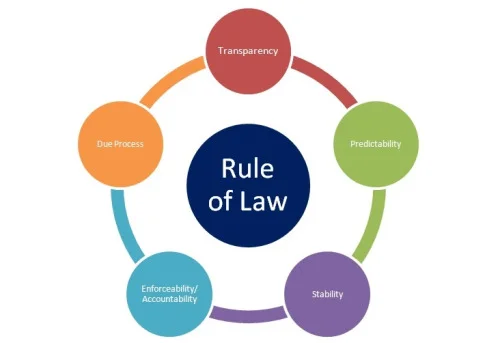
In the Obama administration, Cass Sunstein tried with mixed success to restrain the overgrowth of administrative law–an overgrowth that has long since seriously violated “rule of law” principles. In his Bloomberg View column “The Rule of Law Wins One for Tom Brady,” Cass explains what the “rule of law” means, with an application to football’s “Deflategate.” Here is the key paragraph, with numbering added to Cass’s words:

Many people think that the concept has to do with democracy or liberty, or that it requires free markets. But it’s much narrower than that. Reduced to its essentials, the rule of law has just two components.

1. First, the law involved has to be clear and comprehensible, so that people can know, in advance, on what grounds they might be punished.
2. Second, people generally have a right to be heard, and that requires notice of the charges against them, and a fair opportunity to rebut those charges before an unbiased tribunal.