The Teleotheistic Achievement of the New Testament

Jack Miles won a Pulitzer Prize for his book God: A Biography. By the “biography” of God, he means in this case the character development of God one sees if one reads the Hebrew Bible as a piece of literature. Since there is a significant chronological element to the arrangement of books within the Tanakh, this character development within the Hebrew Bible read as literature follows to an important degree the evolution of thought about the character of God among the Israelites. This evolution of thought about the character of God is of great importance because over time, the concept of God has come closer to being a picture of an ideal character to strive after. In Rabbinic Judaism and Christianity, this evolution of thought about the character of God continued after the books of the Tanakh had all been written. The details were different within Rabbinic Judaism and Christianity, but in both cases God became more and more representative of an ideal.   

In “Teleotheism and the Purpose of Life,” I write:

The key difference between evolution as our creator and the god of the Bible is that with evolution the best comes at the end, not at the beginning.  There was no Garden of Eden—only primordial soup in a warm pond.   But heaven is still possible; we and our descendants just need to build it.
The first task is to decide what we want.  The medieval theologian Anselm defined God as “that than which no great can be thought” and proceeded to argue that God must exist since something that exists is greater than something that doesn’t exist.  Therefore, the greatest of all things must exist.   It is my understanding that modern philosophers reject Anselm’s argument on the basis that “existence” is not an ordinary attribute like being massive or being photosynthetic.  Existence has a special status in logic.  So let me do a riff on Anselm by defining God as “the greatest of all things that can come true.”  God is the heaven—or in Mormon terms, the Zion, the ideal society—that we and our descendants can build, and god is a reasonable description of the kind of people who make up that society.   But what does a heavenly society look like?
Let’s start with the easier question of what an ideal human being looks like.   Here I look to Jesus.  Not the historical Jesus, but the imagined Jesus who is the projection of every good human trait, as valued by our culture.  It makes all the sense in the world to ask “what would Jesus do” even if one believes that the historical Jesus was only a man, since “what would Jesus do” is a good shorthand for what our culture thinks a good person would do.  This is an example of the way in which many of the highest ideas of goodness in Western Culture are embedded in religious language.

Since it is very hard to build God without having a reasonably clear of what one is trying to build, the evolution of the idea of God toward something better is a key step on the path that may someday bring what can reasonably be called God or Gods and Heaven into full existence. So from the standpoint of Teleotheism, the character development of God seen as a literary character is a sketch of the road to pursue in reality.

Aside from its pairing with the New Testament, the Old Testament is a slightly modified and rearranged version of the Tanakh. The books of the Old Testament and Tanakh promise over and over again that God will eventually come in power to rescue Israel from foreign subjugation. By the time of Jesus, the fulfillment of this promise already seemed long delayed, and persuasive excuses for the delay were running out. Amazingly, Rabbinic Judaism and Christianity found two different ways to explain why God allowed the destruction of Jerusalem in 70 AD, and the crushing of the Bar Kokhba revolt in 135 AD. (These events can be appropriately compared in their psychological impact to Hitler’s murder of millions of Jews many centuries later. The number who died in the siege of Jerusalem in 70 AD was high because the Romans chose a time when Jews had gathered in Jerusalem from all around the Roman world and beyond.) Here I will only talk about the explanation given by Christian writers in the New Testament. (I hope to do a post some day about the explanation given by Rabbinic Judaism.)

I will follow closely Jack Miles’s literary interpretation of the New Testament in Christ: A Crisis in the Life of God. (Hat tip to John L. Davidson for recommending this book, in reaction to my post “The Mormon View of Jesus.”) Here is a hint of what Jack means by a literary interpretation, beginning on page 276 of the book: 

Meanwhile, general literary criticism, weary of its own demystification of the author, has begun to place a new emphasis on the work as a work and on the value of cultivating an aesthetic response to it. It has begun to move, in a word, to a new emphasis on beauty. 

Jack uses the metaphor of a rose window to contrast a literary interpretation with historical criticism: literary criticism is looking at the rose window; historical criticism is trying to look through the rose window.   

The historical criticism of the Bible–a process that I have compared to the examination of a rose window, pane by pane, for signs of the absence of stain–may yet prove a paradoxically good preparation for this old/new kind of criticism, for, obviously, if you have checked every pane hoping to find one without stain, you end up knowing something about every pane as well as a great deal about stain. Traditional Bible scholars, though their research has almost always been at least nominally in the service of history, have, de facto, studied the development of images and motifs, noted allusions, explicit and implicit, and performed a thousand other services crucial to the literary appreciation of the Bible–so much so, indeed, that some of what is offered as literary criticism by those who lack their training and have not combed through the text as meticulously as they have may quite understandably strike them as too simple-minded for serious comment. But rather than dismiss literary criticism as sciolist dilettantism, historically trained critics could become literary critics themselves and try to improve the neighborhood. 

Jack Miles argues that the New Testament was written in the first instance for the Greek-speaking Jews of the Diaspora, who were deeply steeped in the words of the Septuagint–the Greek Old Testament. For someone steeped in the Septuagint, what the New Testament portrays is God thinking better of his former warlike ways, and unwilling to come in power until the very end of the world. Knowing the future–that the Jews would continue to be under subjugation to the Romans until even worse befell them–God became a man to suffer along with his people, and to suffer crucifixion in advance of the great suffering the Jews would suffer in the First and Second Jewish-Roman Wars. Only by suffering himself could God justify his decision to allow the Jews to suffer under the Romans and to be slaughtered by the Romans in the Jewish-Roman wars without intervening.

The literary achievement of the New Testament is in part that the willingness of God become man to suffer and die helped to reconcile the readers of the New Testament to God’s unwillingness to free the Jews from subjugation to the Romans (as God had been unwilling to free the Jews from many previous masters). And of course, the claim that by that suffering and death, God had conquered and reversed death itself also helped greatly. 

But now let me step back from the direct literary interpretation of the New Testament, which treats its account as if it were true. I want to talk about what was accomplished historically by this powerhouse of religious literature. It made the image of God better (as Rabbinic Judaism did in another way). Here are some of the virtues exhibited by that Jesus, the God of the New Testament:     

  1. Accountability: The greatest of all is willing to suffer along with his people. This helped greatly in the idea that even kings were not above being questioned and subject to laws.  
  2. Peacableness: Jesus exhibited nonviolence again and again. 
  3. Intellectuality: Jesus spent time expounding scripture, indicating the importance of the written word. 
  4. Love: Instead of victory over enemies, the sign of God’s people was to be the fact that they loved one another, and even loved their enemies.   

This is an image of God that I can endorse. Even in a world that, as I believe, has no supernatural power to turn to, we can all strive to exhibit such virtues, and to build a world in which it will be easier for other people to gain and exercise them.  

I do not think the New Testament image of God is the final word even in goodness. Indeed, I think that the Jesus people refer to nowadays when they ask the question “What would Jesus do?” is better than the Jesus portrayed in the New Testament. But the image of God in the New Testament was a huge advance over what came before, as also the God of Rabbinic Judaism was a huge advance over the image of God before that time. It is important for us to continue to refine our image of what an ideal human being and an ideal human society are as a key step toward making those ideals a reality.

Scott McCloud: Just Because You’ve Decided to Sell Out Doesn’t Mean Anyone’s Going to Buy

Write for yourself. If you just write the kinds of stories you think others will want to read, you’ll be competing with cartoonists who are far more enthusiastic for that kind of comic than you are, and they’ll kick your ass every time. Or to put it another way: “Just because you’ve decided to sell out, that doesn’t mean that anyone’s going to buy.”

Dan Miller: Sleep as a Strategic Resource

tumblr_inline_nk1urgtpmS1r57lmx.jpg

Link to Dan Miller’s LinkedIn homepage

I am pleased to host this guest post by Dan Miller on the importance of sleep–even as compared to other business concerns. It is the third guest post this semester from students in my Monetary and Financial Theory class. You can see links to all of the other student guest posts here. Here is Dan:


The corporate culture in America and around the globe has come to value employees that can work harder than ever before, even if that means working around the clock.  While it is a common understanding that people need at least eight hours of sleep to function properly, there is a small portion of the population (1-3%), are among the “sleepless elite,” people who report only needing a fraction of the sleep that the vast majority of the population needs. There are numerous CEOs, billionaires, and successful politicians including Marissa Mayer, Martha Stewart, and even Barack Obama  who report being members of this unique group.  Donald Trump, another idolized entrepreneur in the “sleepless elite,” has been quoted saying “How can somebody who is sleeping 12 hours a night compete with someone who is only sleeping three or four.”

By discussing their ability to get by with little sleep, these executives are serving as role models for a norm that a full night’s sleep is optional, even a luxury, if you want to get ahead in business.  I believe that the corporate world can and should shed this toxic notion that “sleep is for the weak” for the benefit of individuals, organizations and the economy as a whole. A better, healthier approach to sleep will ensure that organizations are getting the best performance out of its human capital.  However elementary, proper sleep is the best measure to prevent a fatigued or stressed out work force.

Sleep deprivation is viewed by some, not without merit, as a national health crisis similar to obesity.  Organizations should go a step further and help combat this by not only encouraging and a sleep-supportive culture, but also create set of sleep-supportive practices. Organizations should not fear that they are meddling with employees private lives by encouraging sleep. Form a strictly financial perspective some organizations do encourage sleep as a method of reducing healthcare costs. Sleep is a performance enhancing, preventative behavior and it should be a central concern for organizations.

The workplace demands influence sleep, people’s jobs are inextricably linked with their ability to establish healthy sleep habits. Here are some active steps for promoting and preserving employees “sleep life”.

1. Culture

CEOs and managers should go on the record stating how much they benefit from a full nights sleep. This will set a good example because leaders set the tone for organizational habits.  In addition, sleep education programs could be a useful resource for larger organizations where the executives may be distant from large portions of the work force.

2. Allow employees to separate from work when the day is finished.

Checking work related emails late into the night has been cited as a cause for sleep deprivation by some.  Set limits on how late emails can be sent or at least set limits on how late people should be expected to respond to emails.

3. Nap Rooms.

The key idea behind naps is to mange your circadian rhythms and to wake up feeling refreshed, not groggy.  Employees who are struggling with sleep deprivation can at least temporarily alleviate the problem with short bouts of sleep in a napping room. Even small loss in productivity from a few minutes of napping is worth while if it prevents a costly mistake and is a wise investment.

4. Manage or Reduce work hours scheduled and permitted.

Sleep experts suggest that sleep policies should limit scheduled work to no more than 12 hours a day, and preferably less than that.

A critical takeaway from this post is that corporations should start to treat sleep as a strategic resource. Even small deficits of sleep can have negative consequences. Although workers often convince themselves that missing a few hours here and there is no big deal, the literature suggests that doing so creates problems. In fact,missing less than one hour of sleep on one night has been linked to memory declines and increases in workplace injuries and “cyberloafing.”

Quartz #59—>Swiss Pioneers! The Swiss as the Vanguard for Negative Interest Rates

Link to the Column on Quartz

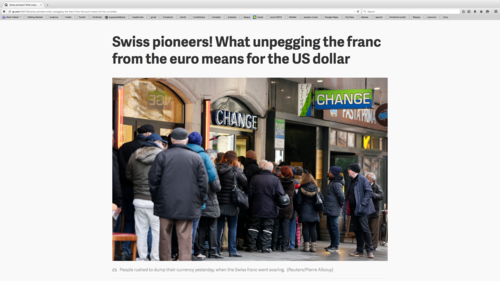
Here is the full text of my 59th Quartz column, “Swiss pioneers! What unpegging the franc from the euro means for the US dollar,” brought home to supplysideliberal.com. It was first published on January 16, 2015. Links to all my other columns can be found here.

This column is a follow-up to “The Swiss National Bank Means Business with Its Negative Rates." Thanks to Mark Fontana for letting me know in real time about the Swiss National Bank’s actions. Note that since I wrote this column, Denmark’s central bank has lowered its certificate of deposit rate to -.75%. I doubt they would have done that at this point without the example of the Swiss National Bank in going down to -.75% for the interest on reserves.   

If you want to mirror the content of this post on another site, that is possible for a limited time if you read the legal notice at this link and include both a link to the original Quartz column and the following copyright notice:

© January 16, 2015: Miles Kimball, as first published on Quartz. Used by permission according to a temporary nonexclusive license expiring June 30, 2017. All rights reserved.


The Swiss National Bank’s dismantling of its ceiling on the value of the Swiss franc yesterday stunned the financial world. Jim Armitage and Russell Lynch of the Independent called the ensuing jump up in the value of the Swiss franc an earthquake; Social media called it “Francogeddon;” while the CEO of Swatch, Nick Hayek, called it “a tsunami for the export industry and for tourism, and finally for the entire country.” Thomas Jordan, the head of the Swiss National Bank, explained, “If you decide to exit such a policy, you have to take the markets by surprise.”

At points during the day yesterday, the Swiss franc was as much as 39% more expensive relative to the euro and the US dollar than it had been the day before. Exchange rate movements have yet to settle down, but seem to be headed for something closer to a 15%-25% increase in the value of the Swiss franc.

In my Dec. 19, 2014 column “The Swiss are now at a negative interest rate due to the Russian ruble collapse” I made three predictions. On one, I was spectacularly wrong. On the second, I was exactly on target. As for the third, its time has not yet come, but will.

When I wrote “no one should underestimate the Swiss National Bank when it says that it will do whatever it takes to keep its exchange rate at 0.833 euros per Swiss franc” I badly underestimated the speed of events. On top of the continuing crisis of the Russian ruble, the financial markets’ belief that the ECB will soon begin serious quantitative easing to lower yields in the eurozone is now also steering investors toward Swiss assets. And buying Swiss assets requires buying Swiss francs. So there is a scramble to get hold of Swiss francs, even at a premium.

The Swiss National Bank decided it was a fool’s game to fight this: keeping the ceiling on the Swiss franc’s price longer would have meant the Swiss National Bank taking bigger losses. As it is, the Swiss National Bank lost on the order of 60 billion Swiss francs (equivalent to about $68 billion in US dollars) when yesterday’s exchange rate movements made its foreign asset holdings worth that much less in terms of Swiss francs.

But events have borne out my second prediction: that the Swiss National Bank would move toward deeper negative interest rates. The SNB’s new interest rate for banks keeping money in an account at the SNB is now down to -0.75 % per year. That is three-quarters of a percent below zero. By comparison, the European Central Bank is still at -0.2% per year, or only a fifth of a percent below zero.

My third prediction was that the Swiss National Bank is prepared, if needed, to push interest rates lower still—beyond the -0.75% they are at now. In a bit of hyperbole, Hans Guenther-Redeker said in a Bloomberg interview that if the Swiss National Bank pushed interest rates down to -2%, “You have to make a bank depositor to pay for the services of the bank—or for the luxury of having a deposit with the bank. That is going to turn capitalism upside down.” Swiss National Bank interest rates at -2% now look much more likely to happen. If the Swiss National Bank does lower interest rates to -2%, capitalism will adjust, and the Swiss economy will get stimulus it badly needs.

Besides lowering interest rates, the other main option the Swiss National Bank has to keep the Swiss economy from sputtering is to push the Swiss franc down relative to the US dollar, now that the SNB has given up pushing the Swiss franc down so hard relative to the euro. But it will have to buy huge amounts of dollar assets to have much of an effect on the Swiss franc/dollar exchange rate if it doesn’t use interest rate cuts to help make the Swiss franc cheaper relative to the US dollar.

I am betting that, going forward, interest rate policy will be the linchpin for the Swiss National Bank rather than exchange rate interventions. What the Swiss National Bank knows that many financial market observers have not yet figured out is this: other than an economy that starts to boom and risk overheating from lower interest rates, there is no limit to how far a central bank can cut interest rates, as long as it cuts the interest rate on paper currency along with other interest rates.

As I explained to an attentive audience at the Swiss National Bank on July 15, 2014, in a negative interest rate environment, all that is needed to bring the rate of return on paper currency down in line with the other interest rates a central bank controls is to introduce, and for a time gradually increase, the size of a paper currency deposit fee when private banks come to deposit paper currency at the cash window of the central bank. Then, once a robust economy leads to positive interest rates again, the paper currency deposit fee at the central bank’s cash window can be gradually reduced back to zero, until the next time that negative interest rates are needed to keep the economy on track. (You can find all the details here.)

Although lowering the paper currency interest rate in tandem with other interest rates avoids the massive paper currency storage that would otherwise be a serious side effect of deep negative rates, there is no question that negative interest rates will require many detailed adjustments in how banks and other financial firms conduct their business. Like it or not, Swiss banks and the rest of the Swiss financial industry may be forced to lead the way in figuring out these adjustments, just as the Swiss National Bank is leading the way in figuring out how to conduct negative interest rate policy. The Swiss are eminently qualified for that pioneering role. The rest of the world would be well-advised to watch closely.

If putting a dollar value on human lives strikes you as cold-hearted, grow up. You implicitly put a dollar value on human lives every time you buy a candy bar with funds that could instead have been donated to the local fire department. No matter who you are, there is a limit to what you’re willing to spend to save lives; the only question is whether you’re willing to think honestly about what that limit is. [Kip] Viscusi thought hard not about his own limit but about how to measure other people’s limits, through observations of their behavior. That’s where the $6.6 million comes from–an estimate of what real people in real situations are willing to pay to make themselves safe.

Hojoon Kim: Will Mobile Payment Apps Replace Cash in the Near Future?

Hojoon Kim

Hojoon Kim

I am pleased to host this guest post by Hojoon Kim on the progress of electronic money–something that could some day make monetary policy easier. It is the second guest post this semester from students in my Monetary and Financial Theory class. You can see links to all of the other student guest posts here. Here is Hojoon:


What do the following apps have in common?

  • Venmo
  • Square Cash
  • PayPal
  • Google Wallet

These mobile apps not only allow users to make transactions without credit cards or cash but they allow people to easily transfer their money from bank account to their friends’ bank accounts. Even if you forget your wallets at home, it is no longer a big problem because you always can pay with Google Wallet or you can borrow money from your friend and pay them immediately through Venmo. It is early in the day to think so that the world is moving in the direction of a cashless society. However, some people already believe that the society without credit card or cash will become a reality. Adrew Kortina, co-founder of Venmo, claims that people won’t be swiping credit cards in 2017. He said, “We are betting people will be using their phones for most payments in the future, instead of plastic cards or desktop computers“. Due to its ease of use or usability, numerous numbers of people are currently using these mobile apps in their daily life and Venmo processes $10 each month, which makes people to think that cash and credit card will likely to disappear. The graph below shows that the mobile transaction volume of Venmo will exceed its Starbucks in the near future.

Therefore, it is reasonable for technology experts to predict that the use of mobile payment apps will prevail over the use of cash or credit cards. According to The Pew Research Center Internet & American Life Project, 65 percent of technology experts believe that making transaction or payments via smartphone will be the dominant by 2020. Hal Varian, chief economist at Google said, “The 2020 date might be a bit optimistic, but I’m sure that this will happen. What is in your wallet now? Identification, payment, and personal items. All this will easily fit in your mobile device and will inevitably do so.”

Although many technology experts expect that cash will disappear by 2020, I personally do not think that cash will ever disappear at least in my life. I admit that mobile payment apps are innovative technologies in a sense that it does not require for people to bring cash or credit cards. Thus, it is more convenient and more secure than the traditional methods of payment such as cash and credit cards. However, here are the reasons why I think that people will keep using cash.

1. Cash is always good for small merchants

When you see merchants selling small stuff on the street, it is easy to notice that most of merchants only accept cash. The reason is very simple if we think of a fee that occurs from transactions of credit card payment or mobile payment apps. Most merchants on the street or at small stores do not sell expensive goods or products, suggesting that it would be costly for them to accept payment cards or mobile payments. Therefore, people will have to use cash when buying goods from small merchants.

2. As long as black market exists, it is unlikely that cash will disappear.

I think this is the most fundamental reason why people will keep using cash. Most crime organizations or crime syndicates heavily rely on untraceability and anonymity of money, especially when they are engaged in drug dealing, terrorism and selling illegal weapons. Once their transactions are traced, it is really easier for police or governments to track them, which is something that criminals do not want. I cannot definitely say that cash will stay forever in our society due to an advancement of technology and increasing demand for mobile payments. However, it would be hard to see the world without cash as long as crime exists in our society.

3.  There are always corrupted government officials who always want to take a secret payments. 

Not only the United States, but also other countries have been spending considerable amount of money and efforts to end bribery and corruption. However, it is not been so successful when we consider the countries with the lowest reported bribery rate all have a bribery rate of at least 1 %. Now, let’s assume that you want to bribe government officials and you have three options to give them money; cash, credit card and mobile payments. What would you choose? Of course, you would want to pay with cash unless you want to go to prison. This is another reasons why cash will never disappear unless government corruption no longer exist.

Drug Legalization and Time Slices of People as Ethical Units

Writing in 1869, John Stuart Mill hadn’t seen just how far Prohibition of alcohol would go in the United States in the 20th century, or how far prohibition of other drugs with recreational potential would go in the 21st century. Even back in the 19th century, people were making the argument that drug use harms other people and so is a legitimate subject for regulation. In On Liberty, Chapter IV, “Of the Limits to the Authority of Society over the Individual” paragraphs 18 and 19, John Stuart Mill is quick to counter the argument by pointing out how this puts no limits on the ability of society to meddle in an individual’s life: 

But, without dwelling upon supposititious cases, there are, in our own day, gross usurpations upon the liberty of private life actually practised, and still greater ones threatened with some expectation of success, and opinions propounded which assert an unlimited right in the public not only to prohibit by law everything which it thinks wrong, but in order to get at what it thinks wrong, to prohibit any number of things which it admits to be innocent.
Under the name of preventing intemperance, the people of one English colony, and of nearly half the United States, have been interdicted by law from making any use whatever of fermented drinks, except for medical purposes: for prohibition of their sale is in fact, as it is intended to be, prohibition of their use. And though the impracticability of executing the law has caused its repeal in several of the States which had adopted it, including the one from which it derives its name, an attempt has notwithstanding been commenced, and is prosecuted with considerable zeal by many of the professed philanthropists, to agitate for a similar law in this country. The association, or “Alliance” as it terms itself, which has been formed for this purpose, has acquired some notoriety through the publicity given to a correspondence between its Secretary and one of the very few English public men who hold that a politician’s opinions ought to be founded on principles. Lord Stanley’s share in this correspondence is calculated to strengthen the hopes already built on him, by those who know how rare such qualities as are manifested in some of his public appearances, unhappily are among those who figure in political life. The organ of the Alliance, who would “deeply deplore the recognition of any principle which could be wrested to justify bigotry and persecution,” undertakes to point out the “broad and impassable barrier” which divides such principles from those of the association. “All matters relating to thought, opinion, conscience, appear to me,” he says, “to be without the sphere of legislation; all pertaining to social act, habit, relation, subject only to a discretionary power vested in the State itself, and not in the individual, to be within it.” No mention is made of a third class, different from either of these, viz. acts and habits which are not social, but individual; although it is to this class, surely, that the act of drinking fermented liquors belongs. Selling fermented liquors, however, is trading, and trading is a social act. But the infringement complained of is not on the liberty of the seller, but on that of the buyer and consumer; since the State might just as well forbid him to drink wine, as purposely make it impossible for him to obtain it. The Secretary, however, says, “I claim, as a citizen, a right to legislate whenever my social rights are invaded by the social act of another.” And now for the definition of these “social rights.” “If anything invades my social rights, certainly the traffic in strong drink does. It destroys my primary right of security, by constantly creating and stimulating social disorder. It invades my right of equality, by deriving a profit from the creation of a misery I am taxed to support. It impedes my right to free moral and intellectual development, by surrounding my path with dangers, and by weakening and demoralizing society, from which I have a right to claim mutual aid and intercourse.” A theory of “social rights,” the like of which probably never before found its way into distinct language: being nothing short of this—that it is the absolute social right of every individual, that every other individual shall act in every respect exactly as he ought; that whosoever fails thereof in the smallest particular, violates my social right, and entitles me to demand from the legislature the removal of the grievance. So monstrous a principle is far more dangerous than any single interference with liberty; there is no violation of liberty which it would not justify; it acknowledges no right to any freedom whatever, except perhaps to that of holding opinions in secret, without ever disclosing them: for, the moment an opinion which I consider noxious passes any one’s lips, it invades all the “social rights” attributed to me by the Alliance. The doctrine ascribes to all mankind a vested interest in each other’s moral, intellectual, and even physical perfection, to be defined by each claimant according to his own standard.

On drug legalization, I am not willing to go as far as John Stuart Mill. In my post Allison Schrager: The Economic Case for the US to Legalize All Drugs, I wrote this:

I agree with Allison that we need to legalize the production and sale of drugs in order to take revenue, and therefore power, away from criminal gangs. But I think it is important that we do whatever we can to drive down the usage of dangerous drugs consistent with taking the drug trade out of the hands of criminals:
  • Taxes on dangerous drugs as high as possible without encouraging large-scale smuggling;
  • Age limits on drug purchases as strict as consistent with keeping the drug trade out of the hands of illegal gangs;
  • Free drug treatment, financed by those taxes;
  • Evidence-based public education campaigns against drug use, financed by those taxes;
  • Demonization in the media and in polite company of those who (now legally) sell dangerous drugs;
  • Mandatory, gruesome warnings like those we have for cigarettes;
  • Widespread mandatory drug testing and penalties for use of dangerous drugs—but not for drug possession;
  • Strict penalties for driving under the influence of drugs.
Notice that in order to keep the drug trade from going underground, prosecutors must not be allowed to use evidence that an individual purchased or possessed drugs as evidence that he or she used drugs. Evidence of use would have to come from some form of drug testing or from behavior.

(Note: Of course, there needs to be strict rules limiting when testing can legitimately be insisted on, since indiscriminate testing is itself an infringement on liberty.)

How can I justify keeping the use of dangerous drugs illegal? First, by “dangerous drugs” I mean, for example, a drug that has a high probability of causing brain damage if used recreationally in an ongoing way that is easy for someone to fall into. My argument is that, ethically, I am every bit as justified in using time-slices of an individual as the unit for ethical concern as opposed to individuals. If we take that tack, then people’s future selves are like (time-slices of) their children: ethical units that those people now typically have a strong enough altruistic attachment to that we can mostly trust them to try to do the right thing. But just as we are justified in taking children out of the homes of parents who show strong enough evidence of doing something harmful enough to those children that either their competence or the strength of their altruistic link toward those children is in serious doubt, it might under some circumstance be reasonable to take someone’s future self out of that person’s present self’s custody.  

Now, when speaking of taking a person’s future self out of that person’s current self’s custody, it is crucial to distinguish between that person doing something unusual in a way that is consistent between future self and present self and something in which the present self shows a serious lack of “parental” concern for the future self. Here is an example of a test–at least as a thought experiment. Suppose that it were possible to have someone experience the harmful effects of a drug first and then experience the more pleasant, recreational aspects of the drug. Regardless of how you or I view the balance between the positive aspects of the drug and the negative aspects, as long as the individual was willing to experience (in the thought experiment) the harmful effects first and only then experience the more pleasant, recreational aspects, I see no reason or justification for stopping that person.  

Notice that the issue I am raising goes far beyond the question of which drugs to legalize. The principle of deference or non-paternalism to another person’s decisions that has (in my view) such a strong basis at a given point in time becomes weaker when there are harmful effects on an individual in the future, and one recognizes that one is concerned–in what I think is an ethically appropriate way–about that person’s future self in a way that is distinct from caring about the individual seen as a single thing. The idea that time-slices of individuals might be appropriate ethical units means that one cannot necessarily simply accept someone else’s degree of impatience (=the utility discount rate). Given the high costs of any interference with another person–including especially the costs to liberty itself, which is something people care deeply about for themselves–there should be a great deal of deference for another person’s own handling of their own future self. But like the deference we give to parents in the handling of their children, our deference to others in the handling of their own future selves does not deserve the same level of deference as the almost absolute deference we should have to people’s handling of their own current selves, within the private sphere.

Virginia Postrel on Charisma

In its precise sense, charisma (originally a religious term) is a quality of leadership that inspires followers to join the charismatic leader in the disciplined pursuit of a greater cause. … Glamour doesn’t persuade the audience to share a leader’s vision. Instead it inspires the audience to project their own longings onto the leader … making glamour most effective at a distance. Charisma, by contrast, works through personal contact. … Charisma draws the audience to share the charismatic figure’s own commitments, seeking that person’s affection or approval. Charisma enhances leadership, glamour enhances sales.

– Virginia Postrel, The Power of Glamour, pp. 116-117

An Audio Narration of "The Coming Transformation of Education: Degrees Don’t Matter Anymore, Skills Do"

I was surprised to stumble across (via a tweet)  an audio narration of my Quartz column “Degrees don’t matter anymore, skills do.” I think this narration is quite well done. (It isn’t me talking, but Larry Rice, who definitely sounds like a professional narrator.) The column sounded better and smarter to me in this narration than it sounded in my head as I was writing it and proofreading it. Of course, however good or bad the article is, it is definitely no smarter or less smart in the narration than in the reading–so that is an illusion! Anyway, you might like it. 

By the way, I am unclear on the copyright issues here, and interested in what you think about that. As far as I know, Umano did this without any permission, and let me say that I am not giving them permission, despite the fact that I am linking to this. At this point, I don’t think this hurts either me or Quartz, but I reserve the right to protest at any later time if I come to the view that circumstances have changed so that the posting of this narration does hurt my interests.  

Update April 15, 2015: My editor now tells me this is with the permission of Quartz.

Quartz #58—>How Big is the Sexism Problem in Economics?

Link to the Column on Quartz

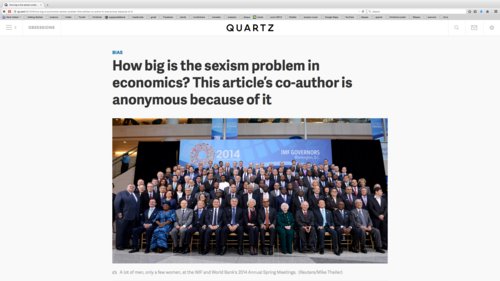
Here is the full text of my 58th Quartz column, “How big is the sexism problem in economics? This article’s co-author is anonymous because of it,” now brought home to supplysideliberal.com. It is coauthored with an anonymous female economist, with whom I have had many interesting discussions since the column was published as well as in the process of writing it.  It was first published on January 6, 2015. Links to all my other columns can be found here.

I regret that my coauthor still feels she needs to remain anonymous. But I understand that a bit better now, after seeing the heat of some of the discussion surrounding this column.

At this writing, this is my 6th most popular Quartz column ever. You can see a list of my most popular columns here.

We want these ideas to get out there. So if you want to mirror the content of this post on another site or make printouts, that is possible for a limited time if you read the legal notice at this link and include both a link to the original Quartz column and the following copyright notice:

© January 6, 2015: Miles Kimball and Anonymous, as first published on Quartz. Used by permission according to a temporary nonexclusive license expiring June 30, 2017. All rights reserved.


The Economist’s recent list of the 25 most influential economists did not include a single woman. Many male former central bankers and regional Federal Reserve Bank governors were included on the list, but the Economist gave itself a special rule to exclude active central bankers, which meant that Janet Yellen—arguably the world’s most influential economist—didn’t make the list.

University of Michigan Professor and New York Times columnist Justin Wolfers responded with a tweeted list of influential women economists. You can read his whole tweetstorm on Twitter

Why are top-notch female economists not being taken seriously? Why are they having trouble being recognized for their contributions to the profession? Why do women still have a hard time in the economics profession in general? There is no shortage of potential explanations.

In their recent academic paper “Women in Academic Science: A Changing Landscape,” Stephen J. Ceci, Donna K. Ginther, Shulamit Kahn, and Wendy M. Williams document the gender gap in economics and discuss many possible hurdles at each stage of a female economist’s career. And in a recent Bloomberg View article, University of Michigan Economics PhD Noah Smith adds to this list of potential hurdles the climate created by many male economists who defend their sexist views as hard-nosed truth telling.

One indication of the career challenges women face in economics is the fact that one of us felt the need to remain anonymous. The co-author of this piece is a still-untenured female economist who has withheld her name because there unfortunately could be real professional risks in publicly discussing many of these issues.

Many male economists underestimate the headwinds women face in economics, but they exist at every stage of a woman’s career. Just as an annual economic growth rate of about .33% per year in the 18th century and 1% in the 19th century transformed the world in the First and Second Industrial Revolutions, women in economics face many forces both large and small that add up to a huge overall damper on the number of women who make it to the higher ranks of our profession.

And even when women do reach these higher levels—despite the difficulty of getting their work published in male-dominated journals and in getting promoted even when they do get their work published—their wages remain lower.

In a Jan. 3 New York Times article, “Racial Bias, Even When We Have Good Intentions,” Harvard economist Sendhil Mullainathan argues that discrimination often operates at an unconscious level:

Even if, in our slow thinking, we work to avoid discrimination, it can easily creep into our fast thinking. Our snap judgments rely on all the associations we have—from fictional television shows to news reports. They use stereotypes, both the accurate and the inaccurate, both those we would want to use and ones we find repulsive.

The same sort of unconscious biases operate against women at every stage.

Here are a few of the issues women in economics face that their male colleagues might not be aware of:

  • New female economics PhD’s have to worry about what to wear during the job market: skirt too short vs. too long, vs. just right.
  • Female economists endure the nasty misogyny of many threads on econjobrumors.com.
  • Students don’t give female professors the same respect as they do male professors. Compare ratings given to online teachers who represent themselves as female to one set of students and male to another, as in the experiment these instructors recently conducted.
  • Female assistant professors have to worry about whether they dare take advantage of tenure clock extensions to have a child, while male assistant professors have no worries about taking advantage of the tenure clock extensions they get when their wives have a child. For the men, it is a simple strategic choice; for the women, it is reminder to their colleagues that (with rare exceptions) they bear the heaviest burden of taking care of a young child—a burden that might take time away from their research.
  • Female professors are often inundated by students needing more “emotional” mentoring (a type of help many students assume they can’t get from male professors).
  • Women in economics often get mistaken at social events for an economist’s spouse instead of being recognized as economists themselves.
  • Female economists have to figure out how to deal with disrespectful comments or “jokes” made by their senior colleagues.

Fostering awareness of issues like these, and a hundred others of the same ilk, is one of the biggest things that can be done to improve women’s lot in economics.

Greater gender equality in economics could also be fostered by a better power balance among colleagues. What we mean is that female economists should be encouraged to assert their power, but male economists should find it hard or impossible to exert illegitimate, sexist power over their female colleagues. If this sounds obvious, it’s much harder than it seems.

Today, women in economics face a Catch-22, where speaking up can easily make them look like a shrew, while not speaking up robs them of legitimate power. There may be some loopholes in this Catch-22, but women starting out in economics need to be shown the ropes. And with so few senior female professors in economics, who can show a female graduate student how to promote herself gracefully, and break into predominantly male conversations without raising hackles? Somehow, that question needs to be answered. As more women push these boundaries, things will become easier. It may become possible to open up new ways of communicating and asserting power that allow women to be themselves and still have others listen to them carefully and respectfully.

If men are allowed to be jerks without suffering serious consequences, while women aren’t, then even well-behaved men have a threat-point that women are denied. One of the most primal reasons to treat someone nicely is the fear of a mistreated person’s anger or revenge. That doesn’t work well for women, because getting angry either makes them look like a harridan, or look overly emotional—both of which carry a big penalty in lost status.

It is easy to confirm that men are allowed to be jerks in ways that women aren’t—by flipping genders when someone does something out of line:

  • What would you think of a particular man’s bad behavior if a woman you know did it?
  • What would you think of a particular woman’s bad behavior if a man you know did it?

We don’t think the answer here is to change the culture so that women can be jerks, too, but to move toward holding everyone, both men and women, to account for bad behavior.  For many men, it will be a revelation to be called out on the ways in which they demean others. Some may not even realize all the ways they routinely put others down—especially those in vulnerable positions who dare not strike back. But if you talk to a few women who spend time in economics departments, you will hear the stories.

Equal pay for equal work

Besides the threat point of men behaving badly, there is another threat point that gives men an advantage over women—one that gets men more than equal pay for equal work. It is typical in academia that a tenured professor who receives a competing job offer and can credibly threaten to leave gets a big raise. By comparison, professors who seem unlikely to jump ship end up underpaid. But given gender inequality on the home front (and the male-female wage differential for spouses), it is a lot more credible that a male professor can convince his wife to move to another city than that a female professor can convince her husband to move. This difference in ability to threaten to leave because of a spouse’s willingness to move is just one of the many ways that different levels of career support from spouses affects women in academia. The only thoroughgoing remedy for this inequity will come from greater gender equality throughout society.

(The situation is different when both wife and husband are academics, especially when they are both in the same discipline. Joint hiring decisions come up so often and go down so many different ways that no one should read any particular case into what we say. In general, because the couple forms a bargaining unit, some of the advantages men have in academia accrue to the wife in the husband-wife power couple. Women hired only because of their spouses—when they should have been hired in their own right—make academic departments look less sexist on paper than they really are. And when a woman who shouldn’t have been hired in her own right is hired in order to attract her spouse, it can be demoralizing to other women trying to make their way in academia on their own. Unfortunately, we don’t see any easy solution for the issues created by joint hiring decisions. But at a minimum they shouldn’t be allowed to distract economists from deeper issues of gender inequality.)

One final step that would make economics less forbidding for women is for each economist to become open to a wider range of scientific approaches and topics. Statistically, men and women are not drawn to the same fields within economics. And even within a field, women are drawn to a different balance between immediate real-world relevance and theoretical elegance. It is natural for each economist (and for each academic in general) to construct a narrative for why his or her approach to economics is the best. But since men in senior ranks in economics are more numerous than women, the narratives that men construct for why their individual approaches to economics are better usually win out in hiring and promotion decisions over the narratives that women construct for why their individual approaches are better.

This imbalance disadvantages junior women, whose individual approaches will on average have fewer champions. Here, the solution, difficult as it is, is for economists to appreciate the boost to scientific progress from having many different approaches and topics well represented—and for the subjective opinions of those who don’t appreciate the value of a wide range of approaches to be discounted. In particular, putting a premium on balancing theory with real-world understanding and policy action will not only make economics a stronger force for good in the world, it will help women take their rightful place in economics.

The Coming Transformation of Education: Degrees Don't Matter Anymore, Skills Do

Here is a link to my 60th column on Quartz, “Degrees don’t matter anymore, skills do.” The first part of the title of this post is my original working title. 

I want to thank Steven Bogden for this crystallized idea about elite universities selling social status: 

There will still be a few expensive elite colleges and universities; these schools are not just providing an education, they are selling social status, and the opportunity to rub shoulders with celebrity professors.

John Erdevig and Kenji Yano: A Personal East/West Convergence and “The Nature God”

John Erdevig and Kenji Yano are two friends that I know from the First Unitarian Universalist Congregation of Ann Arbor. The “I” in this guest post is John, but Kenji contributed just as someone who is interviewed contributes to an interview. Here is what they have to say. 


John’s Note: This post continues some themes explored in my guest post “Head and Heart in ‘Saving’ the Earth.” How do those who cleave to science andreject the supernatural maintain a vital connection to the biosphere, and confront the moral and existential challenge of climate change?

My friend Kenji wasborn in Delaware, mostly raised in Japan, and has lived in the U.S. Midwest most of his adultlife. We had a long talk over lunch last week about our religious beliefs. Kenjiis a biology PhD, but earned instant skeptical blowback from another friend, achemist with a lower tolerance for “god talk,” when Kenji said that “nature ismy god.” It’s become clear to me that he says this, however, in the sense that his vital relationship with the biosphere is very close to what the average listener might understand as an individual-to-god relationship. I say, it was clear to me, because there wasn’t a hint of any of the Yahweh-like personality in this nature god. You know, like there was no big old bearded guy in the clouds calling the shots, choosing nations to covenant with, and listening to and granting prayers. God the Father, Almighty God, the Creator… no, no, none of that. Nor any homegrown Japanese supernaturalism, as would be entailed in a literal interpretation of expressions that Kenji grew up with: “The Sun watches you by day, and the Moon watches you by night.”

That is a phrase Kenji’s mother used to awaken Kenji’s conscience. But these globes only “watch us” in the sense that our awareness of the omnipresent sun and moon awakens our preexisting moral awareness. Our moral awareness is partly rooted in awareness of our concentric spheres of concern (more co-equal and overlapping, in Kenji’s worldview), extending all the way throughout our households/ecosystems. As sun and moon regulate everything from moods to growth to tides, they “watch us” and “watch over us” in several ways. So please, ye who must pooh-pooh tendencies toward a belief in the supernatural among our discussion circle, Kenji’s belief is not that. Indeed, that would be a fatal contradiction for Kenji. There is nothing outside of and above nature. Therefore there is nothing supernatural to believe in. I hope to bypass the debate that gets framed in terms of “Does God exist?” For me, the questions are, “What and perhaps who, in existence, do you find more or less divine? Describe your relationship with it/these.”

So what is the next level of the sacred that is not God, what we’ll call for the sake of discussion “our vital relationship with the biosphere” which I share with Kenji. I approach our convergence from a different way, say, from a West-to-East direction. The vitality on the human side of the relationship might include deep reverence, awe and wonder, at newfound scientific knowledge, enduring mysteries, and piercing sensations. Moreover, in our daily thoughts, if not through concerted efforts in art and ritual, we feel, if not consistently and thoughtfully express, appreciation and reciprocity. The biosphere being what it is – it giveth and taketh away, or better put, everything gets recycled – then a certain humility, even submission, is in order. This should sound like some human inter-relationships, but on a different scale, with a kind of ultimacy, pervasiveness, and unmatched emotion. E.g. “Islam” means “submission.” That’s why I assert that Kenji’s and my relationship with the life-giving biosphere is logically atheistic, but often acts “as if” nature is our god. We could use the corresponding adjective, “divine,” to describe the religious-biospheric process, our story/history… mostly, our correspondence with the biosphere. In Unitarian-Universalism’s 7th Principle, we say, perhaps more tepidly, that we have “respect for the interdependent web of life of which we are a part.”

That we our grounded in our individual bodies and in our smaller spheres (family, community) leads us to reaffirm compassion and reciprocity on the species scale. However, casting one’s gaze toward the dirt and heavens, perhaps with an inner eye during indoor meditation, or perhaps with a hike among the druidic hemlock forest giants, we can expand compassion and reciprocity beyond the species in a way that is practically useful to humans as well as intellectually and emotionally congruent with our modern experience – resolving tensions between science and religion, science and artistic expression, science and love. To me, both study and an almost ecstatic contemplation of the biosphere together lead to a sensible and healthy concern for not only my and my children’s generation, but “The Seventh Generation,” to borrow the Native American phrase. Gaia and my parents launched me and left a legacy. Am I The Prodigal Son, or worse, not only using my fortune but spoiling my children’s chances? In gratitude and reciprocity, can I do better than that?

Not all of nature seems accessible in the worldview and religious practice I just described. True, our biosphere coats a “Goldilocks Planet,” a dynamic and fertile rock favored by a remarkable astronomical and natural history. In nearer space, the orbital and geologic circumstances are discernable and heartwarming. Further off in space and time, we understand that we are elemental dust born in starbursts. Much of the cosmos, however, feels alien… is undeniably cold and radioactive. Beyond biosphere, ozone layer, ionosphere, and the sun’s happy medium of warmth, there are forces ready to not just snuff out our already mortal individual existence, but also quite ready to annihilate all trace of humankind. My mythopoetic relationship over this distance is tenuous. Awe and submission probably are my dominant sacred thoughts. I do not linger as long as the spiritually-minded cosmologists. Not much in the line of enduring grace or “warm fuzzy,” gazing at ancient light (not the stars as they now burn), millions of light years away, or watching science shows about the end of the biosphere, or the end of the entire solar system by various scientifically projected means. Apocalypse has a place in my horizon, but if “religion” is “re-tying” or “connecting,” then the band here is loose or frayed. So, to return to the bosom of Gaia, who/which invites a more generous interpretation of existence…

My first week back from sunny Spain, I skied in County Farm Park three consecutive mornings. High altitude snowflakes or windblown frost from the silvery tree branches swirled and sparkled like fairy dust in the slanting sunshine. “Dawn stretched her rosy fingers across the sky.” – Homer’s Odyssey. The shadows shown blue with reddish highlights, just as the Impressionists taught us. At first, just crows overhead, and rabbit tracks below. Then a tawny-coated, healthy-looking urban coyote crossed warily on a prairie rise ahead of me. And then four minutes later a young buck pranced through the woodlot understory. Too cold for people and dogs, thanks be. To cap it, the sensation of gliding over terra firma begets a giddiness and warmth so effacing of the winter blues that set in for the first couple months of the season.

Another morning, I walked in soggy snow – the welcome January thaw – with the sky a protective envelope of water vapor enclosing warmer temperatures and filtering an ever stronger and longer sunshine. The Carolina Wren whistled exuberantly and sparrows chirped. Of all things, a tiny spider was crawling over the snowy path this time. I am clothed in thick leather, wool and cotton, making my own heat from nuts, grains, fruits, ham, and a quickened pace, and from recollection of last night’s meeting of friends, beer and nachos afterward, and Saturday night’s karaoke and dance party. I start to sing “Lean on Me” until I reach a verse with memory holes in it. So I recite “On Stopping by a Woods on a Snowy Evening,” and it occurs to me that if you whisper almost anything in any language, but certainly these lines by Robert Frost, “the only other sound’s the sweep / of easy wind, and downy flake.”

And May It Be So With You. – John 

Provocative Epigram of the Day: “The most beautiful thing we can experience is the mysterious. It is the source of all true art and science.” – Albert Einstein

Virginia Postrel: Glamour and Yearning

This then is what glamour does as rhetoric. It focuses preexisting, largely unarticulated desires on a specific object, intensifying longing. It thus allows us to imaginatively inhabit the ideal and, as a result, to believe–at least for a moment–that we can achieve it in real life. … Glamour is defined not by the specific desires it promotes but by the process of projection and sense of yearning it creates and … by the recurring elements that generate that projection and yearning: the promise of escape and transformation; grace; and mystery.

– Virginia Postrel, The Power of Glamour, p. 41

Public School Indoctrination: A Facebook Convo

When I posted this quotation 

Why, indeed, do we have public schools at all? There are advantages to having an educated public, and there are at least arguments to the effect that the private sector will undersupply education. But that’s an argument for government subsidies or vouchers; it’s not an argument for the government to actually run the schools. The reason the government wants to run schools is so that it can control what is taught. I hope that makes people uncomfortable.

– Steven E. Landsburg, Fair Playp. 31

I hoped to spark an interesting debate. I did! The link at the top is to what I think is a very interesting Facebook discussion about this.

Finding Out the Truth about Infrastructure Projects

Along with Noah Smith, I write in favor of infrastructure investment in “One of the Biggest Threats to America’s Future Has the Easiest Fix” and followed that up with “Capital Budgeting: The Powerpoint File.” But I am frustrated by my inability to tell from the news how which particular infrastructure investments are a good deal from the standpoint of solid cost-benefit analysis, and which are just meant to be salient shiny baubles for voters–or perhaps worse, meant to be ways to get money into the pockets of campaign contributors or into the pockets of workers being paid more than a free-market wage. It is very, very easy for the government to pay more than it should for an infrastructure project, given that every dollar it spends is someone’s income. And it is very easy to be drawn to a shiny new light rail system, for example, when a better bus system would be a much more cost-effective solution–or to be drawn to building a new road, when fixing the potholes on existing roads is a better investment. 

I was reminded of this frustration by reading Holman Jenkin’s Wall Street Journal op-ed “The Infrastructure Medicine Show and tweeted the following, which is the question I want answered:

Is there any way to establish an independent think tank to make trustworthy analyses of infrastructure projects? http://t.co/irk8xkVpmF

— Miles Kimball (@mileskimball) February 4, 2015