John Erdevig and Kenji Yano: A Personal East/West Convergence and “The Nature God”

John Erdevig and Kenji Yano are two friends that I know from the First Unitarian Universalist Congregation of Ann Arbor. The “I” in this guest post is John, but Kenji contributed just as someone who is interviewed contributes to an interview. Here is what they have to say. 


John’s Note: This post continues some themes explored in my guest post “Head and Heart in ‘Saving’ the Earth.” How do those who cleave to science andreject the supernatural maintain a vital connection to the biosphere, and confront the moral and existential challenge of climate change?

My friend Kenji wasborn in Delaware, mostly raised in Japan, and has lived in the U.S. Midwest most of his adultlife. We had a long talk over lunch last week about our religious beliefs. Kenjiis a biology PhD, but earned instant skeptical blowback from another friend, achemist with a lower tolerance for “god talk,” when Kenji said that “nature ismy god.” It’s become clear to me that he says this, however, in the sense that his vital relationship with the biosphere is very close to what the average listener might understand as an individual-to-god relationship. I say, it was clear to me, because there wasn’t a hint of any of the Yahweh-like personality in this nature god. You know, like there was no big old bearded guy in the clouds calling the shots, choosing nations to covenant with, and listening to and granting prayers. God the Father, Almighty God, the Creator… no, no, none of that. Nor any homegrown Japanese supernaturalism, as would be entailed in a literal interpretation of expressions that Kenji grew up with: “The Sun watches you by day, and the Moon watches you by night.”

That is a phrase Kenji’s mother used to awaken Kenji’s conscience. But these globes only “watch us” in the sense that our awareness of the omnipresent sun and moon awakens our preexisting moral awareness. Our moral awareness is partly rooted in awareness of our concentric spheres of concern (more co-equal and overlapping, in Kenji’s worldview), extending all the way throughout our households/ecosystems. As sun and moon regulate everything from moods to growth to tides, they “watch us” and “watch over us” in several ways. So please, ye who must pooh-pooh tendencies toward a belief in the supernatural among our discussion circle, Kenji’s belief is not that. Indeed, that would be a fatal contradiction for Kenji. There is nothing outside of and above nature. Therefore there is nothing supernatural to believe in. I hope to bypass the debate that gets framed in terms of “Does God exist?” For me, the questions are, “What and perhaps who, in existence, do you find more or less divine? Describe your relationship with it/these.”

So what is the next level of the sacred that is not God, what we’ll call for the sake of discussion “our vital relationship with the biosphere” which I share with Kenji. I approach our convergence from a different way, say, from a West-to-East direction. The vitality on the human side of the relationship might include deep reverence, awe and wonder, at newfound scientific knowledge, enduring mysteries, and piercing sensations. Moreover, in our daily thoughts, if not through concerted efforts in art and ritual, we feel, if not consistently and thoughtfully express, appreciation and reciprocity. The biosphere being what it is – it giveth and taketh away, or better put, everything gets recycled – then a certain humility, even submission, is in order. This should sound like some human inter-relationships, but on a different scale, with a kind of ultimacy, pervasiveness, and unmatched emotion. E.g. “Islam” means “submission.” That’s why I assert that Kenji’s and my relationship with the life-giving biosphere is logically atheistic, but often acts “as if” nature is our god. We could use the corresponding adjective, “divine,” to describe the religious-biospheric process, our story/history… mostly, our correspondence with the biosphere. In Unitarian-Universalism’s 7th Principle, we say, perhaps more tepidly, that we have “respect for the interdependent web of life of which we are a part.”

That we our grounded in our individual bodies and in our smaller spheres (family, community) leads us to reaffirm compassion and reciprocity on the species scale. However, casting one’s gaze toward the dirt and heavens, perhaps with an inner eye during indoor meditation, or perhaps with a hike among the druidic hemlock forest giants, we can expand compassion and reciprocity beyond the species in a way that is practically useful to humans as well as intellectually and emotionally congruent with our modern experience – resolving tensions between science and religion, science and artistic expression, science and love. To me, both study and an almost ecstatic contemplation of the biosphere together lead to a sensible and healthy concern for not only my and my children’s generation, but “The Seventh Generation,” to borrow the Native American phrase. Gaia and my parents launched me and left a legacy. Am I The Prodigal Son, or worse, not only using my fortune but spoiling my children’s chances? In gratitude and reciprocity, can I do better than that?

Not all of nature seems accessible in the worldview and religious practice I just described. True, our biosphere coats a “Goldilocks Planet,” a dynamic and fertile rock favored by a remarkable astronomical and natural history. In nearer space, the orbital and geologic circumstances are discernable and heartwarming. Further off in space and time, we understand that we are elemental dust born in starbursts. Much of the cosmos, however, feels alien… is undeniably cold and radioactive. Beyond biosphere, ozone layer, ionosphere, and the sun’s happy medium of warmth, there are forces ready to not just snuff out our already mortal individual existence, but also quite ready to annihilate all trace of humankind. My mythopoetic relationship over this distance is tenuous. Awe and submission probably are my dominant sacred thoughts. I do not linger as long as the spiritually-minded cosmologists. Not much in the line of enduring grace or “warm fuzzy,” gazing at ancient light (not the stars as they now burn), millions of light years away, or watching science shows about the end of the biosphere, or the end of the entire solar system by various scientifically projected means. Apocalypse has a place in my horizon, but if “religion” is “re-tying” or “connecting,” then the band here is loose or frayed. So, to return to the bosom of Gaia, who/which invites a more generous interpretation of existence…

My first week back from sunny Spain, I skied in County Farm Park three consecutive mornings. High altitude snowflakes or windblown frost from the silvery tree branches swirled and sparkled like fairy dust in the slanting sunshine. “Dawn stretched her rosy fingers across the sky.” – Homer’s Odyssey. The shadows shown blue with reddish highlights, just as the Impressionists taught us. At first, just crows overhead, and rabbit tracks below. Then a tawny-coated, healthy-looking urban coyote crossed warily on a prairie rise ahead of me. And then four minutes later a young buck pranced through the woodlot understory. Too cold for people and dogs, thanks be. To cap it, the sensation of gliding over terra firma begets a giddiness and warmth so effacing of the winter blues that set in for the first couple months of the season.

Another morning, I walked in soggy snow – the welcome January thaw – with the sky a protective envelope of water vapor enclosing warmer temperatures and filtering an ever stronger and longer sunshine. The Carolina Wren whistled exuberantly and sparrows chirped. Of all things, a tiny spider was crawling over the snowy path this time. I am clothed in thick leather, wool and cotton, making my own heat from nuts, grains, fruits, ham, and a quickened pace, and from recollection of last night’s meeting of friends, beer and nachos afterward, and Saturday night’s karaoke and dance party. I start to sing “Lean on Me” until I reach a verse with memory holes in it. So I recite “On Stopping by a Woods on a Snowy Evening,” and it occurs to me that if you whisper almost anything in any language, but certainly these lines by Robert Frost, “the only other sound’s the sweep / of easy wind, and downy flake.”

And May It Be So With You. – John 

Provocative Epigram of the Day: “The most beautiful thing we can experience is the mysterious. It is the source of all true art and science.” – Albert Einstein

Virginia Postrel: Glamour and Yearning

This then is what glamour does as rhetoric. It focuses preexisting, largely unarticulated desires on a specific object, intensifying longing. It thus allows us to imaginatively inhabit the ideal and, as a result, to believe–at least for a moment–that we can achieve it in real life. … Glamour is defined not by the specific desires it promotes but by the process of projection and sense of yearning it creates and … by the recurring elements that generate that projection and yearning: the promise of escape and transformation; grace; and mystery.

– Virginia Postrel, The Power of Glamour, p. 41

Public School Indoctrination: A Facebook Convo

When I posted this quotation 

Why, indeed, do we have public schools at all? There are advantages to having an educated public, and there are at least arguments to the effect that the private sector will undersupply education. But that’s an argument for government subsidies or vouchers; it’s not an argument for the government to actually run the schools. The reason the government wants to run schools is so that it can control what is taught. I hope that makes people uncomfortable.

– Steven E. Landsburg, Fair Playp. 31

I hoped to spark an interesting debate. I did! The link at the top is to what I think is a very interesting Facebook discussion about this.

Finding Out the Truth about Infrastructure Projects

Along with Noah Smith, I write in favor of infrastructure investment in “One of the Biggest Threats to America’s Future Has the Easiest Fix” and followed that up with “Capital Budgeting: The Powerpoint File.” But I am frustrated by my inability to tell from the news how which particular infrastructure investments are a good deal from the standpoint of solid cost-benefit analysis, and which are just meant to be salient shiny baubles for voters–or perhaps worse, meant to be ways to get money into the pockets of campaign contributors or into the pockets of workers being paid more than a free-market wage. It is very, very easy for the government to pay more than it should for an infrastructure project, given that every dollar it spends is someone’s income. And it is very easy to be drawn to a shiny new light rail system, for example, when a better bus system would be a much more cost-effective solution–or to be drawn to building a new road, when fixing the potholes on existing roads is a better investment. 

I was reminded of this frustration by reading Holman Jenkin’s Wall Street Journal op-ed “The Infrastructure Medicine Show and tweeted the following, which is the question I want answered:

Is there any way to establish an independent think tank to make trustworthy analyses of infrastructure projects? http://t.co/irk8xkVpmF

— Miles Kimball (@mileskimball) February 4, 2015

David Warsh's Take on New Classical Economics, Circa 1985

For many years, David Warsh has been writing about economists in a weekly column that moved in 2002 from the Boston Globe to his own website economicprinciples.com. On February 24, 1985, in the middle of my time in graduate school, he wrote a piece in the Boston Globe pondering the significance of Robert Barro’s intermediate textbook, which had been out for about a year. Given the heavy-duty discussions of economic methodology in the economic blogosphere in recent years, I thought you might be interested in this excerpt to get a sense of how things looked back then. To begin with, let me say that David Warsh gives a book recommendation:

“Barro certainly has a very optimistic way of thinking about how markets work,” says Wellesley College’s Arjo Klamer, whose book, Conversations with Economistsexpertly details the scope and history of the controversy between the New Classicals and everybody else.

David himself gives this description of New Classical Economics: 

The late 1960’s were a time of great ferment in technical economics. Out of the period grew a movement called the “New Classical” economics, designed to depose the Keynesian orthodoxy. At a time when Keynesians were moving to tackle what were viewed as imperfections in markets–sticky wages in particular–the New Classicals chose to see things differently. 

Just suppose, the new view went, that markets, especially labor markets, are working the way they are supposed to. Suppose that those who aren’t working aren’t really involuntarily unemployed, that they simply prefer leisure to the prevailing wage. Suppose also that because people correctly anticipate attempts by government to manage the economy, of the sort designed by Keynes and his followers, these managing effots have little or no effect–or worse, actually contribute to instability. 

If so, then the thing for government to do would be to recognize that all was almost always for the best, and to retreat into following a few simple rules, such as keep money growth steady and government spending down. 

Sound like Reagonomics? Well at a deep and satisfying level, maybe so. It was far more sweeping than monetarism, though in its defiant rejection of the conventional medicine, and in its emphasis on mind over apparent illness, it seemed a little like Christian Science to its detractors. 

Let me make two comments. First, perhaps because I was a student of Greg Mankiw, I have always thought that sticky prices were the issue rather than sticky wages. You can see a discussion of that in “Sticky Prices vs. Sticky Wages: A Debate Between Miles Kimball and Matthew Rognlie.”

Second, David Warsh’s emphasis on involuntarily unemployment makes me wonder how Saltwater and Freshwater economists view the now popular labor market search theory in relation to their perennial debates with one another. I don’t really have a good sense of this, except that the folks in the labor search literature seem to be afraid to talk about labor market demand shocks coming from aggregate demand shocks; the literature routinely moves around labor demand through ritual technology shocks, perhaps to avoid the Saltwater/Freshwater controversy. Since labor demand shocks do the same kinds of things to the labor market regardless of where they come from, this is OK except insofar as unwary listeners are lead to think that aggregate demand shocks don’t exist, or that they don’t matter for the labor market!

[My daughter Cayley] knows a lot about right and wrong already. She is an active trader in the schoolyard markets for decals, trading cards, and milk bottle caps. Sometimes Cayley wants to trade with her classmate Melissa but Melissa prefers to deal with Jennifer, from the other fourth-grade classroom. Cayley knows how disappointing that can be, but she also knows she can’t force Melissa to trade with her. More important, she knows it would be wrong to try.

Cayley is too morally advanced even to imagine asking her teacher to intervene and prohibit Melissa from trading with ‘foreigners.’ Only a very unpalatable child would attempt such a tactic.

[Pat] Buchanan sees the U.S. Congress as the great national teacher, maintaining order on the schoolyard, making sure that all the children play the way the teachers’ special pets – or special industries – want them to play. My daughter thinks that stinks. She’s right.

Protectionism is wrong because it robs individuals of a basic human right: the freedom to choose one’s trading partners.

– Steven E. Landsburg, Fair Playp. 14

John Stuart Mill on the Rich and the Elite

Larry Ellison, 5th richest on the Forbes list, on one of his smaller yachts

Larry Ellison5th richest on the Forbes list, on one of his smaller yachts

Not long after I began blogging, in my post “Rich, Poor and Middle-Class,” I wrote:

I am deeply concerned about the poor, because they are truly suffering, even with what safety net exists. Helping them is one of our highest ethical obligations. I am deeply concerned about the honest rich—not so much for themselves, though their welfare counts too—but because they provide goods and services that make our lives better, because they provide jobs, because they help ensure that we can get good returns for our retirement saving, and because we already depend on them so much for tax revenue. But for the middle-class, who count heavily because they make up the bulk of our society, I have a stern message. We are paying too high a price when we tax the middle class in order to give benefits to the middle-class—and taxing the rich to give benefits to the middle-class would only make things worse. The primary job of the government in relation to the middle-class has to be to help them help themselves, through education, through loans, through libertarian paternalism, and by stopping the dishonest rich from preying on the middle-class through deceit and chicanery.

I still feel the same way. I hate bashing of the honest rich. Of course, the dishonest or unworthy rich are a very different matter, as I wrote of in my column “Odious Wealth: The Outrage is Not So Much Over Inequality but All the Dubious Ways the Rich Got Richer.” Whatever arguments one may have for taxing the rich, it is not OK to verbally attack the honest rich. As a society, if we fail to give honor to those who became rich by helping to provide goods and services that we value, then we will have to let them keep more money in order to provide appropriate incentives. On the other hand, the more we honor and tend to the souls of the rich, the more we can tax them and still have adequate incentives. This is the key idea behind these posts and columns:

Envy raises complex philosophical issues for utilitarian social welfare maximization, related to issues about respect for the boundaries between people that I discussed in 

One problem with interfering with conspicuous consumption out of one’s envy is that it has the potential to interfere with the efficient provision of incentives. But envy not only leads to attempts to limit conspicuous consumption, but also often leads to attempts to limit conspicuous excellence. Here is what John Stuart Mill has to say on that, in On LibertyChapter IV, “Of the Limits to the Authority of Society over the Individual” paragraph 17:

To imagine another contingency, perhaps more likely to be realized than the one last mentioned. There is confessedly a strong tendency in the modern world towards a democratic constitution of society, accompanied or not by popular political institutions. It is affirmed that in the country where this tendency is most completely realized—where both society and the government are most democratic—the United States—the feeling of the majority, to whom any appearance of a more showy or costly style of living than they can hope to rival is disagreeable, operates as a tolerably effectual sumptuary law, and that in many parts of the Union it is really difficult for a person possessing a very large income, to find any mode of spending it, which will not incur popular disapprobation. Though such statements as these are doubtless much exaggerated as a representation of existing facts, the state of things they describe is not only a conceivable and possible, but a probable result of democratic feeling, combined with the notion that the public has a right to a veto on the manner in which individuals shall spend their incomes. We have only further to suppose a considerable diffusion of Socialist opinions, and it may become infamous in the eyes of the majority to possess more property than some very small amount, or any income not earned by manual labour. Opinions similar in principle to these, already prevail widely among the artizan class, and weigh oppressively on those who are amenable to the opinion chiefly of that class, namely, its own members. It is known that the bad workmen who form the majority of the operatives in many branches of industry, are decidedly of opinion that bad workmen ought to receive the same wages as good, and that no one ought to be allowed, through piecework or otherwise, to earn by superior skill or industry more than others can without it. And they employ a moral police, which occasionally becomes a physical one, to deter skilful workmen from receiving, and employers from giving, a larger remuneration for a more useful service. If the public have any jurisdiction over private concerns, I cannot see that these people are in fault, or that any individual’s particular public can be blamed for asserting the same authority over his individual conduct, which the general public asserts over people in general.

Virginia Postrel: Jet Age Glamour

Jet Age glamour expressed the longing to experience a world of variety and excitement, a fast-moving, dynamic, and diverse alternative to the familiar and routine. We now inhabit the real version of that world, a world glamour advertised and helped bring about. We can never bring the old illusion back. We can only invent new ones, reflecting new circumstances, new possibilities, new desires, and new versions of yearnings that never go away.

– Virginia Postrel, The Power of Glamour, p, 199

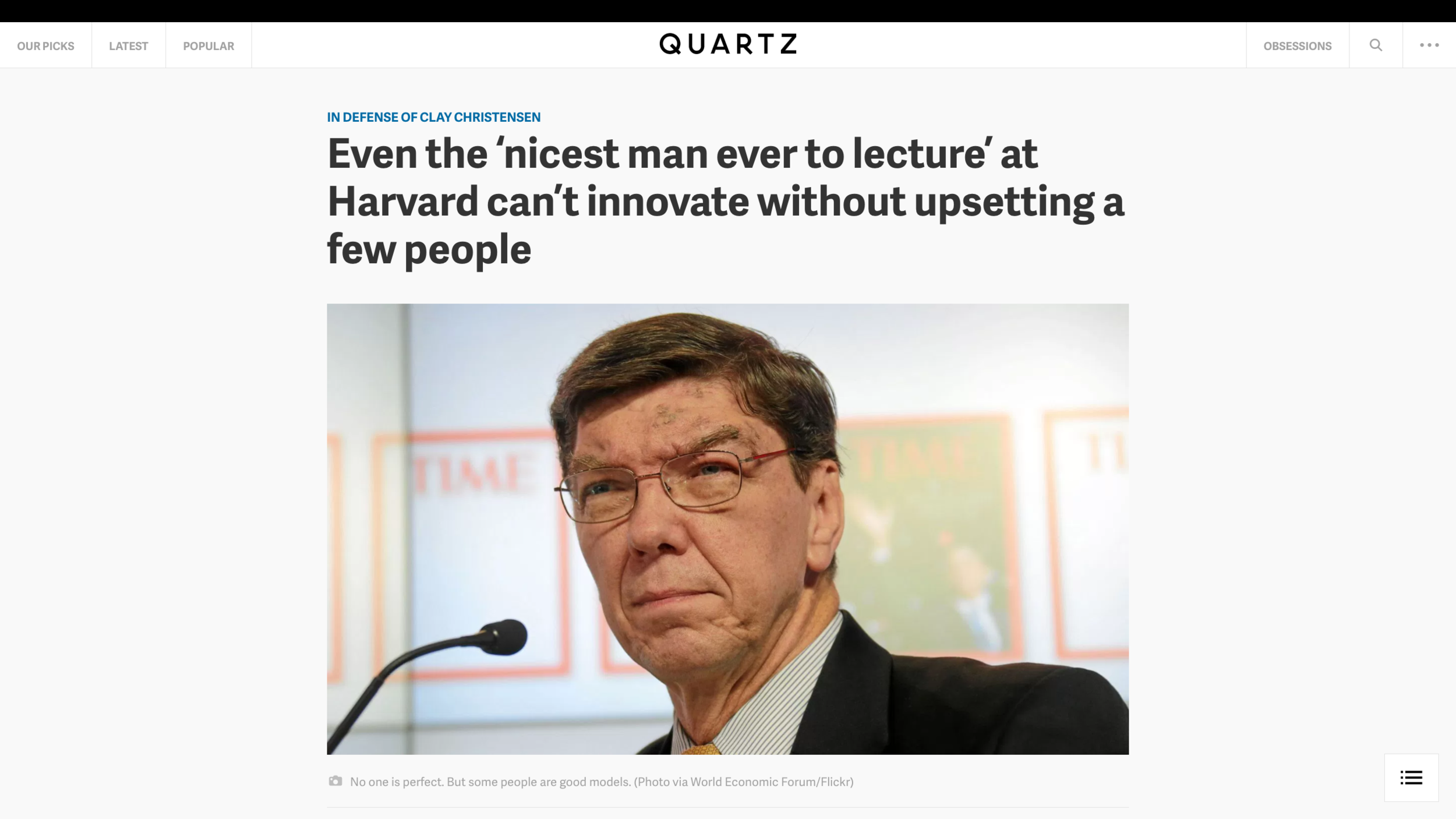
Quartz #57-->In Defense of Clay Christensen: Even the 'Nicest Man Ever to Lecture' at Harvard Can't Innovate Without Upsetting a Few People

Here is the full text of my 57th Quartz column, “Defending Clay Christensen: Even the ‘nicest man ever to lecture’ at Harvard can’t innovate without upsetting a few people,“ now brought home to supplysideliberal.com. It was first published on December 23, 2014. Links to all my other columns can be found here.

I wrote a version of this first as a blog post. I am delighted that my new editor at Quartz, Paul Smalera, liked it enough to publish it in Quartz. (My previous editor, Mitra Kalita, is now overseeing key aspects of Quartz’s global expansion.)

By the way, since I am blogging through Clay’s books (as I have been blogging through John Stuart Mill’s On Liberty) I have a virtual sub-blog on Clay Christensen:

http://blog.supplysideliberal.com/tagged/clay

In the column, I give my take on Clay’s theory as well as defending him personally. 

If you want to mirror the content of this post on another site, that is possible for a limited time if you read the legal notice at this link and include both a link to the original Quartz column and the following copyright notice:

© December 23, 2014: Miles Kimball, as first published on Quartz. Used by permission according to a temporary nonexclusive license expiring June 30, 2017. All rights reserved.

**************************************************************************

Clay Christensen is not only the most famous management guru in the world, he is one of the few public figures—other than full time humanitarians or religious leaders—whom people go out of their way to describe as a good person. For example, in the Financial Times in November 2013, Andrew Hill described Clay Christensen, who had just won an award for most influential management thinker for the second time in a row, as “perhaps the nicest man ever to lecture at Harvard Business School.”

So I was surprised to see key Apple executive-turned-tech-entrepreneur Jean-Louis Gassée criticize not only Clay’s theories but also Clay’s character in his Nov. 25, 2014 Quartz article Clayton Christensen should really disrupt his own innovation theories. I want to defend Clay and his theories.

To be clear about where I am coming from, let me say that I can personally vouch for both Clay’s brilliance as a business thinker and his positive personal qualities. On the personal side, I carpooled across the country from Utah to Boston with Clay back in 1977 when I was beginning my freshman year at Harvard College and Clay was beginning to work toward his MBA from Harvard Business School. I have had relatively little contact with Clay since then, but still remember that trip as a bright moment in my life, and consider Clay a friend to this day. My daughter Diana’s experience as a Harvard MBA student in Clay’s class only reinforced my impression that Clay is one of the best human beings I have met.

My views on Clay as a thinker come from reading six of Clay’s books this year:

As an economist, I found them fascinating. One of the hottest areas of economics in the last twenty years has been the border between economics and psychology. One basic idea at that intersection is that people have limitations in their ability to process information and make decisions. This idea that cognition is finite is a key issue in macroeconomics, as Noah Smith and I wrote about in “The Shakeup at the Minneapolis Fed and the Battle for the Soul of Macroeconomics—Again.” But the idea of finite cognition also matters a lot for businesses. Some decisions are hard even for people who spend their careers making those kinds of decisions, and the support of teams of experts.

Clay, in the management theory he has developed with various coauthors, identifies one key factor in how hard a decision is for a generally well-run business: whether it involves taking care of what are already the business’s core customers, or trying to sell to either peripheral customers or people who have never bought from the business before. No business is successful for any significant length of time if it doesn’t do a reasonably good job of taking care of its core customers. But being good at understanding and serving its core customers may make it bad as an organization at understanding and serving peripheral or potential customers.

Clay’s famous warnings about “disruptive innovation” boil down to saying that any set of peripheral or potential customers a business doesn’t serve well—even if those non-core customers look relatively unprofitable—might provide a ladder for a competitor to climb up and eventually overtake that business. And since the main part of a business is designed to serve its core customers, it may need to set up a separate unit to act like a start-up and focus on other potential customers.

When Clay turns to public policy issues in education and health care, the idea of innovative upstarts overtaking an established business by starting with underserved customers or non-customers morphs into the idea of reforming education and health care by finding chinks in the armor of the status quo. The key public policy recommendation I draw from Clay’s logic is that policy should be supportive of organizations doing things in new ways that help people on the margins who find the current systems difficult to navigate, even if those new approaches don’t improve quality for those who are currently well served by the status quo.

Here is Gassée’s own summary of Clay’s theory:

The incumbency of your established company is forever threatened by lower-cost versions of the products and services you provide. To avoid impending doom, you must enrich your offering and engorge your price tag. As you abandon the low end, the interloper gains business, muscles up, and chases you farther up the price ladder. Some day—and it’s simply a matter of time—the disruptor will displace you.

The first charge Gassée makes against Clay is that Clay is a very persuasive, high-priced consultant who advises rival companies:

… in the mid-to-late 1980s, parlayed his position into a consulting money pump. He advised—terrorized, actually—big company CEOs with vivid descriptions of their impending failure, and then offered them salvation if they followed his advice. His fee was about $200,000 per year, per company; he saw no ethical problem in consulting for competing organizations.

In Clay’s case, I get the sense that he is giving almost every company a variant of the same advice, which is more concerned with potential competitors who might not even be in the picture yet, rather than existing competitors. So I can see why two rival companies might both feel comfortable hiring Clay. As to the price, I also find Clay’s insights valuable, so I am willing to go with the default view of economists that if someone is willing to pay a lot of money for something, it is an indication that they find it quite valuable.

Gassée’s next charge is that Clay is arrogant:

The guru and I got into a heated argument while walking around the pool at one of Apple’s regular off-sites. When I disagreed with one of his wild fantasies, his retort never varied: I’m never wrong.

Had I been back in France, I would have told him, in unambiguous and colorful words, what I really thought, but I had acclimated myself to the polite, passive-aggressive California culture and used therapy-speak to “share my feelings of discomfort and puzzlement” at his Never Wrong posture. “I’ve always been proved right…sometimes it simply takes longer than expected,” was his comeback.

Hyperbole—”exaggerated statements or claims not meant to be taken literally”—has its place in conversation (for example, there is every indication that the historical Jesus frequently used hyperbole). So the exact tone of voice and context matter a lot. The management consulting context is one in which hyperbole might be appropriate in order to help counteract an attachment by someone one is advising to the status quo. In that context, saying “I’m never wrong” might mean simply “You should really, really, listen to my advice.” Given the magnitude of Clay’s claims, if Clay sincerely believes in the advice he is giving, as I suspect he does, the sentiment “You should really, really, listen to my advice” is understandable.

Gassée’s last charge is that Clay became defensive and lashed out when his work was challenged by Jill Lepore. Here is what Gassée has to say about that:

Christensen is admired for his towering intellect and also for his courage facing health challenges—one of my children has witnessed both and can vouch for the scholar’s inspiring presence. Unfortunately, his reaction to Lepore’s criticism was less admirable. In a Businessweek interview Christensen sounds miffed and entitled:

“I hope you can understand why I am mad that a woman of her stature could perform such a criminal act of dishonesty”

In this case, fortunately, the context is known. You can see Drake Bennett’s Businessweek interview “Clayton Christensen Responds to New Yorker Takedown of ‘Disruptive Innovation‘” here. Clay told Drake

… she starts instead to try to discredit Clay Christensen, in a really mean way. And mean is fine, but in order to discredit me, Jill had to break all of the rules of scholarship that she accused me of breaking—in just egregious ways, truly egregious ways. In fact, every one—every one—of those points that she attempted to make [about The Innovator’s Dilemma] has been addressed in a subsequent book or article. Every one! And if she was truly a scholar as she pretends, she would have read [those]. I hope you can understand why I am mad that a woman of her stature could perform such a criminal act of dishonesty …

So Clay’s intemperate phrase “criminal act of dishonesty” is about Jill Lepore writing as if Clay hadn’t ever given any answer to the kinds of questions she raises. A specific case later in the interview clarifies what is angering Clay. Here is Drake Bennett’s question:

Another point Lepore makes is that you leave out relevant factors that would challenge your thesis. In the case of the steel industry, you don’t talk about unionization, which was a major difference between U.S. Steel and upstart minimills.

Clay replied:

Yes and no. The world is actually very complicated and big huge books are written about unionization and the impact that it has, and so … other people have addressed that.

If she’s interested, there’s a case that I use in my course about U.S. Steel that occurred in 1989. There the union contract in Mon Valley Works [one of U.S. Steel’s plants] was a huge factor. So, again, if she were thorough on this issue and she Googled it and put in my name and U.S. Steel, that would have come up. But because her purpose was to discredit me rather than look for the truth, she didn’t even look. Are you feeling a little bit about how she’s caused me to feel?

That is, Clay thinks Jill Lepore did not do even the most basic homework to see if Clay had any subtlety to his views. Here, actually, Lepore’s point is about how differential unionization might weaken the evidence for Clay’s theory of disruptive innovation, which Clay’s Harvard Business School case might not have done anything to address, so Lepore’s fundamental point might stand, but she should have made that argument. And while it may be unreasonable to expect someone writing a magazine article to know one’s whole body of work before vigorously criticizing a piece of it, it is reasonable to expect her to try to talk to Clay to get his side before publishing a traditional-style long-read article attacking Clay’s work. This is a point Clay himself makes:

… if she’s interested and wants to help me—she’s just an extraordinary writer—and if she’s interested in the theory or its impact, I mean, come over! I would love to have you openly invite her to come do this, if she’s interested.

(Like Clay, Jill Lepore is at Harvard.)

I think Drake Bennett is right that Clay was quite angry at Jill Lepore’s article:

Consistently described by those who know him as a generous and thoughtful and upbeat person, he is also capable of fury. “Keep asking me questions,” [Clay] said, “it’s helping me.”

But, I am not going to change my view of Clay as one of the best human beings I have met for controlled anger in a situation like that.

No one is perfect. But in order for us to have a hope of becoming better human beings, we need to at least know which direction is up. Despite his flaws, I don’t know anyone who wouldn’t do well to become a little more like Clay in at least some respect.


Matthew Yglesias on the Need to Eliminate the Zero Lower Bound to Avoid Secular Stagnation

A tweet from Ellie Kesselman pointed me to this piece by Matthew Yglesias. The key passage is

As I’ve been saying for a while, humanity could rid itself of the pesky zero bound problem by eliminating physical currency and creating a situation where nominal interest rates can go negative. Demographic shifts and population aging may someday (like “next few decades” not “later this summer”) soon force us to choose between this option and the world economy falling into a basically permanent recession.

That is, Matthew Yglesias is very worried that the natural interest rate might be below zero on a long term interest rate, and an inability to have negative interest rates would therefore be disastrous. I am less convinced that the natural interest rate will be negative on a long run basis (because I am optimistic about future technological progress), but it is definitely worth being prepared. 

You can see links to what I have written on negative interest rates in my bibliographic post “How and Why to Eliminate the Zero Lower Bound: A Reader’s Guide,” and my discussion of issues surrounding the natural interest rate and secular stagnation in The Medium-Run Natural Interest Rate and the Short-Run Natural Interest Rate” and On the Great Recession.

Greg Shill: So What Are the Federal Reserve’s Legal Constraints, Anyway?

Link to the post on Greg’s blog

Greg Shill is the expert I turn to for a better understanding of legal issues surrounding monetary policy. He is a fellow at New York University Law School and is on Twitter here. This is the first of what I hope are many guest posts by Greg. This one appeared first on his own blog on December 4, 2014. Thanks to Greg for allowing me to reproduce it here. Greg’s words follow: 


Many in the Federal Reserve – both the Board of Governors in DC and the reserve banks around the country – have come to view low inflation as the main threat to the economic recovery. Fed Chair Janet Yellen has repeatedly voiced this concern, which was detailed today by Chicago Fed chief Charles Evans in an interview with the New York Times. The Bank of Japan and the European Central Bank have recently warned of the same problem. Those institutions, and Japanese Prime Minister Shinzo Abe, have staked their reputation on the power of monetary policy to stimulate economic growth, and there are growing calls in and outside the Fed for the US central bank to do more.

The basic problem these institutions are trying to address is that with inflation expectations low – and they have been very low since 2008 – firms and individuals have little incentive to invest or take other economic risks, which means the virtuous cycle of spending and hiring leading to more spending and hiring hasn’t had an opportunity to get rolling yet.

I’m interested in the scope of the Fed’s legal authority to address this collective action problem through so-called unconventional monetary policy, which has come to be defined as the use of unusual monetary measures to stimulate demand. I will soon be writing more about these legal questions here and at Miles Kimball’s blog, Confessions of a Supply-Side Liberal. Miles, an economist at the University of Michigan, has written extensively on how to combat the so-called Zero Lower Bound problem, which is when the economy is stuck in a rut for the long term and the Fed can’t do more to stimulate lending (or inflation) through its conventional policy channels because it can’t take interest rates below zero.

The question I’ll be looking at is, how far can the Fed in unconventional policy go beyond what it’s already done. The Fed’s most prominent use of unconventional policy post-crisis took the form of the three consecutive rounds of “quantitative easing,” during which the bank bought US government bonds and government-backed asset-backed securities (Fannie and Freddie mortgage-backed securities (“agency MBS”)). Many economists believe quantitative easing served as a major stimulus to the economy and was particularly helpful given the inadequacy of the 2008 and 2009 fiscal stimulus measures. However, many “dovish” economists and Fed policy makers, like Evans, would like to see the bank do more.

When I began to look at the legal dimension of monetary policy – after all, that policy is conducted pursuant to a legal mandate – I was surprised to find very little in the way of scholarship or (publicly-available) policy guidance. Until recently, Fed officials and outside observers have strongly suggested that the Fed lacked the authority to expand the bank’s QE program beyond US government bonds and agency MBS. While Fed officials haven’t revised that view publicly, one might reasonably begin to question whether they doth protest too much. In testimony at the ongoing trial of former AIG CEO Hank Greenberg’s lawsuit over the Fed’s bailout of AIG, Fed officials have recently, for the first time, acknowledged the existence of something the NY Fed actually refers to as the “Doomsday Book,” which is a multi-hundred-page book kept in the basement of the NY Fed that outlines the legal parameters of what the bank can do in the event of a crisis (!). The Fed has thus far avoided having to turn this over, so we can only speculate about what it contains.*

As I will discuss in upcoming posts, my initial review of the sources of law governing the Fed (about which very little has been written) suggests that the bank has significantly more monetary policy discretion than is commonly assumed. I personally believe this expansive power is a good thing: the Fed is charged by statute with a dual mission of promoting full employment and “price stability,” and given the importance of that mandate – as illustrated by the continuing weakness of the economy and the extraordinary human suffering it’s caused – it’s important that those terms have real meaning and not be aspirational only. (“Price stability” has normally been taken to require monetary tightening to keep the economy from overheating, but if the Fed’s inflation target is not being met there’s no reason the same term couldn’t permit loosening in order to stimulate the economy.) Further, Congress gave the Fed a broad mandate in the Federal Reserve Act of 1913; for good reasons, it chose not to set monetary policy legislatively. Given how broadly that statute is written, it’s hard not to see the delegation as a deliberate choice, and one that favors a functional interpretation of the statute (literal interpretations of the Federal Reserve Act are often not fruitful exercises).

So those are my (dovish) priors. If one is an inflation hawk, however, there’s even more reason to want a clearer sense of the legal scope of the Fed’s authority. Presumably a hawk would want to restrict the Fed’s authority to stimulate the economy and would want to know where the lines are that circumscribe the bank. Burnishing his hawk credentials, Texas Governor Rick Perry once famously branded then-Fed Chairman Ben Bernanke’s monetary policy “treasonous” and rhapsodized about Texas-style dangers to Bernanke’s safety if he set foot in the state. So it seems it’s safe to say that this subject appeals to cowboys, economists, and policymakers alike, as well as legal academics.

*Interestingly, officials have conceded that the Fed broke the law a few times during the crisis, to facilitate bank rescues (essentially without legal consequences). So there’s even some question about the enforceability of the constraints on the Fed that do exist.


Note: Mike Sankowski told me on Facebook: “Over at monetary realism Carlos R Mucha Cullen Roche and JKH talk about these legal constraints frequently.”

The Race Card Project

“Look past race to underlying humanity” was my entry for the Race Card Project, which asks for short-form thoughts about race. Here is the link to see other race cards, and here is the link if you want to make a race card yourself

Michele Norris, who started the Race Card Project, introduces it this way:

My idea was to use these little black postcards to get the conversation started. But I quickly realized once I hit the road on my book tour that I didn’t really need that kind of incentive. All over the country people who came to hear about my story wound up sharing their own. …

I asked people to think about their experiences, questions, hopes, dreams, laments or observations about race and identity. Then, I asked that they take those thoughts and distill them to just one sentence that had only six words.

Jethra Spector: Using Miles and Noah's Math Column in the Classroom

This is a picture of Jethra Spector at the elementary school where she used to teach. She is now in her 5th year of teaching GED math for Minneapolis Public Schools adult education and her 1st year of teaching developmental math at Minneapolis Community and Technical College. Before that she was an elementary school teacher for 23 years.

I was delighted to get the following email from Jethra Spector to Noah Smith and me about our Quartz column “There’s One Key Difference Between Kids Who Excel at Math and Those Who Don’t,” which was later syndicated to the Atlantic as “The Myth of I’m Bad at Math.” She graciously gave me permission to share it with you. 


I want to thank you again for permission to share your article “The Myth of ‘I’m Bad at Math’” with the students in my remedial math classes at Minneapolis Community and Technical College. Classes started last week, and I assigned the article for homework on the first night of class. 

Here is a link to the student response sheet I made for my students to complete when they were done reading the article. And here is a link to the PowerPoint I made to facilitate a follow-up discussion the next time the class met. 

I thought you might be interested in what I learned from my students’ response sheets and class discussion.

  • Nearly every single one of my students has at some point said that he/she was bad at math, one as early as first grade when other kids laughed at her answers in class. The only students who didn’t say something like that were students who were worse at other subjects like reading, so that made them think math was their strong suit.
  • Almost none of my students had parents who drilled them on math. The few who did were all from other countries.
  • Every single student agreed most with an incremental orientation to intelligence. This was perfect for me because it set them up to realize that they could be successful in my class if they were willing to make the effort and work hard.
  • Most of my students identified with the statement, “I’m not a math person.” But one student wrote that the article changed his perception and he’s not going to say that about himself anymore because now he realizes that with hard work and determination he can master the material. Another student wrote that math is part of our lives, and knowing it could help improve our futures. Many students said that they like math when they get it but feel frustrated when they don’t get it. That just reinforced my belief that as their math teacher one of my goals must be to present the concepts in such as way that they get it. However, I now feel empowered to remind my students that not everyone will get it at the same time, and for some it will take more practice.
  • Everyone agreed that many things can be accomplished through personal perseverance and effort.
  • Only a few wrote about a famous person as a hero or role model (Oprah, Barack Obama, and Nelson Mandela). The rest wrote mostly about family members.
  • I enjoyed reading their responses regarding how much effort they are willing to make to ensure their success in my class. One student wrote 110%. Many wrote, “whatever it takes.” It was a great opportunity for me to remind them that they don’t have to do it alone; the school has many tutors available to help them succeed.
  • Other thoughts about the article included:
  • “It really puts motivation in students to say practice makes perfect. With effort and persistence you can get through anything.”
  • “I think that this was a great article…it has opened up my mind and helped me understand some things that I did not know about being good or bad at math.”
  • “I’m intrigued by the study habits and how many days they go to school in Japan. Even though it seems a lot, one can never have too much education and knowledge.”
  • “It is an eye-opening article. It made me change the way I think about math.”
  • “I knew it! I used to think I was unintelligent, but that was only because I never really tried. Deep down inside I knew I wasn’t putting forth any effort. When I did, I got great results back.”
  • “I learned that I’m not dumb at math. I just have to make the extra effort to succeed at it.”

When I asked my current students if I should have my classes in the future read this article, the overwhelming response was “yes!”

As I collected the student response sheets, some students asked what they should do with the article. I told them to give it to someone else they know who thinks they’re bad at math!

Update–A Note from Jethra: I saw the guest post up last night and already sent the link to a few people. My dad already wrote back and said it brought tears to his eyes. He’s got a PhD in math and taught math at UW-Milwaukee once upon a time.

I hope other people will feel free to use the student response sheet and powerpoint for discussion if they like. As for me, I couldn’t be happier with the results. It was a great learning experience for me because it helped me get to know my students better. It also established the common understanding that students may have to work hard in my class, but that they can and will be successful if they do. One student made a connection to the bible: “As ye sow, so shall ye reap.”

Best to you and Noah, Jethra

Steven Landsburg: Physics or Faith?

In his book Fair Play (pp. 57-59), Steven E. Landsburg writes:

According to the book I’ve just been reading, we are living in the true age of faith. We flip a switch and confidently expect light to flood the room, never stopping to wonder why or how. We fly through the air, cook in microwave ovens, and surf the Web, all with little understanding–and often with even less interest–in the technology that makes it all possible. 

The same book says that our distant ancestors were, by contrast, masters of their reality. When your most advanced achievement is an arrowhead that you crafted by sharpening a stone against a rock, there’s not much danger that your technological reach will exceed your intellectual grasp. 

All of which is worse than nonsense. … Just sitting down on a rock–or a chair–and expecting not to fall right through it is an enormous act of faith for anybody with less than complete command of the quantum mechanical principles that make chairs possible. …

… Let me prove that to you by experiment. Take a twig. Break it in half. Now put the pieces back together. Now let go. Why isn’t the twig back in one piece? All the parts are still there, just as they were before you came along. Now that you’ve put the pieces back together, it appears that all the parts are in the same relative positions they were in before you came along. They had no problem sticking together then. Why won’t they stick together now? What held them together before and why has it stopped working?

Either you can answer those questions or you can’t. If you can’t then your confidence in the basic properties of twigs is a pure act of faith. If you can, then you are probably also the sort of person who has a pretty good idea what makes your lights come on. In either case, twigs are neither more nor less mysterious than house current, and it requires neither more nor less faith to take one for granted than the other.  

I am intrigued at the similarity between the similarity between how Steven is using the laws of physics as a measure of understanding and how I found myself driven to using the laws of physics as a way to distinguish between “natural” and “supernatural” in my post “What Do You Mean by ‘Supernatural’?” Of course, there is some faith left in physics because there are still things we don’t know in physics. But as near as we can tell, there is a bigger fraction of things we don’t understand about most other practical topics that come to mind. 

In particular, contrast physics with social science. When I talk about “The Unavoidability of Faith” in our lives, I point to social science and technological facts that we don’t know and have to guess at. If calculation came free, knowing all the true laws of physics might yield answers to all of the questions of technology, and even social science. But when calculation is not free, one can know the laws of physics but not all the technological facts those laws of physics imply, let alone the social science principles those laws of physics imply.   

To me, religion is the realm of mystery. Not things that will forever be mysteries, but simply things that are mysteries to us now. I put it better in “An Agnostic Grace”

Religion is the “everything else” category in our existence in human societies and as individuals after parceling out the things people understand fairly well about human life—just as “natural philosophy” used to be the “everything else” category after parceling out as natural sciences the things people were beginning to understand fairly well about the natural world.
There is still a great deal we don’t understand well enough about our existence in human societies and as individuals to parcel out as generally understood social science knowledge. I am defining “religion” as encompassing all of those areas touching on our human existence where we are still groping for answers and for the meaning of things (or for a meaning of things), even if one has ruled out supernatural answers.     

Although the metaphor is imperfect, when Steven and I reach for a metaphor for something humankind (speaking collectively and not individually) does understand, we turn to physics.

Quartz #56—>The Swiss National Bank Means Business with Its Negative Rates

Link to the Column on Quartz

Here is the full text of my 56th Quartz column, “The Swiss are now at a negative interest rate due to the Russian ruble collapse,” brought home to supplysideliberal.com. It was first published on December 19, 2014. Links to all my other columns can be found here.

I kept something closer to my working title as the title above. This column is in honor of all the amazing people I met at the Swiss National Bank. 

At this writing, this is my 7th most popular column ever, edging out “The National Security Case for Raising the Gasoline Tax Right Now” for that spot.  You can see a list of my most popular columns here.

Paul Krugman links to this column as a news source in his column “Switzerland and the Inflation Hawks.” The link is on the words “charging banks.” 

I knew I needed a big update to this column when I saw that the Swiss National Bank abandoned the ceiling on the value of the Swiss franc. So I wrote another whole column:

Swiss Pioneers! The Swiss as the Vanguard for Negative Interest Rates

I recommend reading that immediately after you read this column. 

If you want to mirror the content of this post on another site, that is possible for a limited time if you read the legal notice at this link and include both a link to the original Quartz column and the following copyright notice:

© December 19, 2014: Miles Kimball, as first published on Quartz. Used by permission according to a temporary nonexclusive license expiring June 30, 2017. All rights reserved.


The initials “SNB” for the Switzerland’s central bank, the “Swiss National Bank” are about to become just as familiar as the initials ECB for the European Central Bank. Today, the SNB announced it would cut interest rates for banks that keep large amounts of money at the SNB to -.25%. Yes – a negative interest rate.

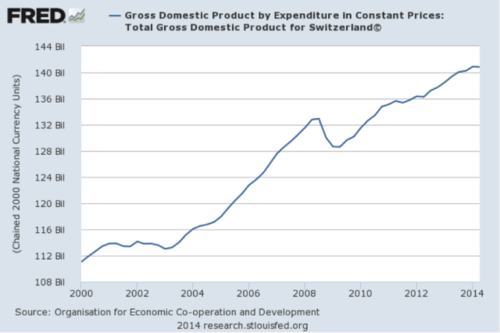
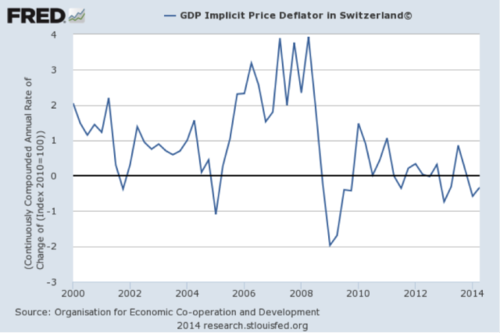
The SNB’s negative interest rate surprise is bigger news than it seems. Switzerland has strong reasons to turn to new monetary policy tools. The lackluster economic growth Switzerland has had since the Financial Crisis in late 2008–visible in the graph of Switzerland’s real GDP in the chart above–has brought inflation down until now it hovers around zero, as shown in the graph below:

The Swiss economy is heavily dependent on exports to the eurozone, which hasn’t fared well lately. And the Swiss economy has had troubles of its own. This past September, BBC News ran the headline “Swiss economy fails to grow as EU stagnates,”  accompanied by this quotation from Maxime Botteron Credit Suisse’s Maxime Botterton:

The trend in exports is not a big surprise. Trade data so far already pointed to a rather weak contribution of exports. What is a bit more surprising is the weak investment spending, especially in the construction sector.

Let me explain why the slowness of Swiss exports matters: Thomas Jordan, the head of the SNB, said during Thursday’s press conference that asset markets have been spooked by the fall of the Russian ruble and are looking for a safe haven. Switzerland has a long history of being just such a safe haven: during times of crisis, money flows in. So the ruble crisis is putting upward pressure on how many euros it costs to buy a Swiss franc, because more investors are trying to buy francs. A more expensive Swiss franc will make Swiss exports even more expensive, making it even harder to sell things produced in Switzerland to the rest of the world. The SNB is determined, therefore, to do whatever it takes to keep the Swiss franc from ever costing more than .833 euros.

The main tool the central bank has had for preventing the Swiss franc from appreciating is buying up enough foreign assets with Swiss francs to guarantee there are enough Swiss francs available in the world for anyone to buy one for .833 euros. The trouble with relying on that approach alone is that Switzerland winds up with a lot of foreign assets that are less safe than Swiss assets would be (especially when the effect of possible future exchange rate changes on those foreign assets are taken into account).

The world is used to positive interest rates: a borrower pays a lender for the use of money. Negative interest rates mean that the lender has to pay the borrower to keep money safe. Negative interest rates are a way for Switzerland to get paid for the safety it provides in a financially dangerous world. Then, if Switzerland ends up with risky foreign assets while foreigners end up with safe Swiss assets, at least Switzerland is getting paid for the difference between the safe assets it provides and the riskier assets it is buying.

The most remarkable thing SNB chief Thomas Jordan added to his initial remarks was the statement that despite already having a -.25% interest rate compared to the ECB’s higher -.2% rate, the SNB is prepared to go even further. As James Shotter and Alice Ross reported in the Financial Times

Mr Jordan said the SNB was prepared to take further steps to protect the minimum exchange rate if needed, including pushing rates deeper into negative territory and lowering the threshold above which the negative rates were charged.

The other hint that the SNB is prepared to go further was in its statement that its band for the Libor interest rate now goes all the way down to -.75 %.

A good question to ask now would be: Why is the SNB confident that it can go down to deeper negative rates? Most central banks are afraid that if they cut their target rates or interest rates on reserves too far into negative territory, people will start piling up paper currency, which may be inconvenient to store, but otherwise pays an interest rate of 0%, which might start looking very good, compared to, say -.75%.

The answer, which most observers don’t realize, is that the SNB can actually inflict a negative interest rate on paper currency as well. In a principle that the underappreciated polymath (art and cultural historian, Biblical scholar and monetary theorist) Robert Eisler groped towards back in 1932, there’s an easy way to exact a negative interest rate: Charge customers an exchange rate between paper currency and money in the bank. More recent economists, notably Willem Buiter (now Chief Economist of Citigroup) further elaborated on this idea.

On July 15, 2014, I gave a presentation at the SNB explaining how to use a fee on paper currency deposited at the SNB by private banks to generate a negative interest rate on paper currency. This was a variant on Robert Eisler’s approach. To generate a negative paper currency interest rate, the paper currency deposit fee has to gradually increase in size. But as soon as interest rates are positive again, the paper currency deposit fee can gradually shrink in size until it finally disappears, and things go back to the way things work now. So the SNB has the idea of a paper currency deposit fee to implement negative interest rates on paper currency in its back pocket.

There is a world of difference between a central bank that cuts some of its interest rates, but keeps its paper currency interest rate at zero and a central bank that cuts all of its interest rates, including the paper currency interest rate. If a central bank cuts all of its interest rates, including that paper rate, negative interest rates are a much fiercer animal.

As a professor who teaches for a living, I care most about whether students learn things in the end. But I can’t help but notice the difference between quick learners and slow learners. When it comes to how to do negative interest rates right, the people at the SNB are some of the quickest learners I’ve seen.

The bottom line is that no one should underestimate the Swiss National Bank when it says that it will do whatever it takes to keep its exchange rate at .833 euros per Swiss franc – even if it requires boldly cutting its interest rates to a depth no central bank has gone to before.

Jonathan Zimmermann—Swiss Franc Shock: Time to Take Advantage of Return Policies

I am very pleased to kick off another season of guest posts from students in my Monetary and Financial Theory class. In this class, every student is required to write 3 blog posts every week. Each of the 40 students chooses 5 over the semester to submit to me, out of which I pick some of the best as guest posts here. (My teaching assistant, Ryoko Sato last year and Adam Larson this year, reads and comments on all of them, 120 a week!)

You can see links to all of the student guest posts from last year here. 

In this guest post, Jonathan Zimmermann is definitely thinking like an economist in the wake of the Swiss franc shock. Note that CHF is the symbol for Swiss francs, and SNB is the abbreviation for “Swiss National Bank.” Here is Jonathan:


In the space of a few minutes, after the decision of the SNB to remove the floor on the EUR/CHF exchange rate, the cost of one Euro in terms of Swiss francs decreased from 1.2 to 0.86. The exchange rate eventually started to stabilize around the 1:1 parity rate, but as I write the Swiss franc is still more volatile than ever.

The repercussions of this decision are gigantic, and many brokers already announced hundreds of millions of losses. As a Swiss national however, I also notice the more direct (and easier to understand) repercussions of this shock. Indeed, most of my revenues and assets being directly indexed to the value of the Swiss franc, my purchasing power for international goods instantly increased by more than 20%.

Of course, our first reaction, we Swiss, is to think “Waouh! I’m rich, everything is cheap now!” Since the prices are likely to readjust progressively in a way or another, we will probably try to buy as many goods as possible from the rest of the world. As for the rest of the world, they will try to buy as few products from Switzerland as possible.

But we also regret everything we bought the previous day: if we had waited a bit more, they would have been much less expensive. And here is where it is interesting: it is actually possible to get some of your money back. Today, more than ever, return policies are powerful free “put options”.

In many physical and online shops, it is possible to return an item up to a few months after having bought it, to get your money back or a credit in the shop. Some stores are more flexible than others, and some even allow you to return an already used item without having to explain the reasons. Let’s say you received a new TV for Christmas last month that cost 1000CHF in Switzerland and was sold for 850 euros in the Eurozone (i.e. more or less the same price with the old exchange rate) only a few kilometers further. Today, by simply returning your TV to the store, changing the Swiss francs you received in euros and re-buying the same model of TV in France, you just earned 150 Swiss francs without losing anything other than time (and a bit of integrity). This is almost a pure form of arbitrage.

But even better: you could use a similar strategy on items you bought in another country, if you paid in Swiss francs with a Swiss credit card. Amazon’s policy, for example, is to refund you in your local currency at the same rate used when you placed the order! Let’s say you bought a pair of shoes last month for $200 (on the US website, but this would work in any country), paying in Swiss francs through the Amazon currency converter when the dollar was at 1.05. If you ask for a refund, Amazon will credit you 210CHF, and if you buy this same pair of shoes again it will now only cost you 180CHF ($200 at the current exchange rate of 0.9 CHF per USD). Amazon does not accept returns on already used items, but since there is no difference between the item you bought last month and the one you can order now, you can simply buy a new pair of shoes and return it as if it was the old one (so you don’t even need to still physically possess the item you purchased in the first place). Here again, without leaving your house you can make an arbitrage gain of 30CHF on a simple pair of shoes.

Of course, the strategy I just described is probably everything but moral, and I wouldn’t advise using it unless you are a huge fan of smoky-tactics-to-spare-a-few-dollars-and-make-you-feel-like-a-smart-guy. I didn’t use this strategy, and I don’t intend to, but I think it is interesting to be aware of and understand this unusual strategy that has never been more efficient than today.

Leon Berkelmans: Why Can't Interest Rates Be Negative?

Dr Leon Berkelmans is Director, International Economy program at the Lowy Institute. Originally published on Lowy Interpreter, December 5, 2014. Republished with permission.

I appreciate Leon’s permission to mirror his post here. I will save my comments until after. Here is what Leon has to say. Some of the intro may be affected by the European Central Bank’s actions tomorrow, but the most important points will not:


Overnight, the European Central Bank once again opted for timidity, with interest rates remaining unchanged. The scale of the deflationary threat Europe faces is awesome. However, with no appetite to engage in quantitative easing, I fear that the bank is not willing to do ‘whatever it takes’ to save the single currency, as someone once said.

This reluctance appears to be fed by a distaste of government debt purchases. If only there were a way to loosen policy without crossing this monetary Rubicon, perhaps the political constraints to quantitative easing will be freed. Well, there is. It is radical, but inevitable. To soften you up to this radical alternative, let me tell you a story that, legend has it, took place in a British bathroom in September 1931.

A British Treasury official was taking a bath when apparently an aid burst into the room proclaiming 'We’re off the gold standard!’ In reply the stunned official said, 'I did not know that was possible’.

We look back patronisingly at this official – of course a currency does not need to be tied to gold. And going off gold was a good thing. When the US went off gold, industrial production grew at its highest rate ever. Keynes called the gold standard a 'barbarous relic’. I think we have another one today, namely the zero lower bound on interest rates.

As things stand, interest rates can’t go too far below zero because if they did, institutions and individuals will prefer to hold physical cash. This preference will cause problems. Banks will withdraw the money they have on deposit at the central bank, transferring it into cash. The consequences of this transfer for the interbank market, through which monetary policy is implemented, are uncertain but likely inimical. Moreover, if banks themselves start to offer negative interest rates to depositors, these depositors will also transfer to cash and banks will face a funding squeeze.

How do we get around this problem? Ken Rogoff of Harvard University has suggested completely abolishing physical currency. This may be feasible in some economies, but even in an economy as sophisticated as the US, vast swathes of the population are unbanked. That problem would need to be dealt with before abolition.

Miles Kimball of the University of Michigan has another idea: have paper money (or in Australia’s case, polymer money) trade at a discount to electronic money. In other words, one dollar in your pocket would no longer be worth one dollar in the bank, so there will be an exchange rate between paper money and electronic money. Then when interest rates are negative, the exchange rate could be set so that physical currency will depreciate in value over time, and there will no longer be an incentive to stuff money into a safe.

In other words, one dollar in your pocket would no longer be worth one dollar in the bank. Then when interest rates are negative, the exchange rate could be set so that physical currency will depreciate in value over time so that banks and depositors will no longer have an incentive to stuff money into a safe.

Kimball’s solution has the central bank setting the price. An alternative is to set the quantity of physical cash in the economy and let the market set the price. I quite like this idea, because then the speculators are speculating among themselves rather than against the government, just like in floating foreign exchange markets.

I’ve heard many objections to the idea of a paper money price. I’m not convinced by them. Will people get angry about having two different prices for their morning cup of coffee – a cash price and a card price? Probably less angry than a 40% youth unemployment rate, which they face in Italy. Besides, in many cases we already receive a discount if we pay cash instead of using our credit card. Will it confuse people? We see exchange rates every day in the news. This would just add one more. But it’s too radical! So was going off gold, at least for some, but the world did so and we were better off.

I think the benefits of breaking the zero lower bound are manifest. The immediate applicability to Europe is obvious, but we are kidding ourselves if we think Australia will forever be immune to these problems. One day we will have the systems available to implement negative interest rates, hopefully soon. Kimball has been taking his ideas around to many central banks, and apparently has received encouraging responses.

Nonetheless, any transition involving a paper money price will, to be sure, require transitionary arrangements. We can’t just flick the switch and have this happen tomorrow. If the government sets the price, careful thought is going to be needed on what the price should be. If the government sets the quantity, then various market conventions will need to be worked out. For example, how is the barista going to figure out what discount to give customers who pay in cash? Presumably the barista’s bank will provide a rate, but there may be other ways.

These are all interesting questions, and there are answers, we just need to get out of the bath and think about it.


Miles: I appreciate Leon’s vote of confidence for my proposal. Let me try to answer one of the questions Leon raises.

I think there is real convenience in having the exchange rate between paper euros and electronic euros (or between paper yen and electronic yen, …) be very predictable and slow moving. (There is even convenience to having the exchange rate be one to one–just not enough convenience to be worth the doldrums the world economy has been in for the last six years.) So I think it is better for the central bank to have a crawling peg for that exchange rate between paper currency and electronic money than to let it float.

Unlike other kinds of exchange rates, the crawling peg between the paper euro and electronic euro (or between paper yen and electronic yen, …) would be totally defensible because the same central bank, under the same authority can issue as much as needed of both paper euros and electronic euros. If people want to trade electronic for paper euros, the ECB can print as many paper euros as needed at the exchange rate peg; and if people want to trade paper euros for electronic euros, the ECB can create as many electronic euros as needed. 

Overall, my aim in designing the details of my proposal to have a proposal that (a) eliminates the zero lower bound and (b) is otherwise as close to the current system as possible. I think a slowly crawling peg satisfies that criterion. A -4% interest rate is a very low interest rate (when inflation is 2%) and probably a more powerful stimulus than would be needed. But even that only changes the exchange rate by 1% every quarter. There is plenty of time for people to get used to the level of the exchange rate at that sedate pace.

The other advantage of a slowly crawling peg over a floating exchange rate is that a slowly crawling peg makes for an easier transition back to par and then staying at par until the next big recession. In that period when it is again appropriate to have positive interest rates, the crawling peg simply stops crawling when it comes back up to 1.