Steven Landsburg: Physics or Faith?

In his book Fair Play (pp. 57-59), Steven E. Landsburg writes:

According to the book I’ve just been reading, we are living in the true age of faith. We flip a switch and confidently expect light to flood the room, never stopping to wonder why or how. We fly through the air, cook in microwave ovens, and surf the Web, all with little understanding–and often with even less interest–in the technology that makes it all possible. 

The same book says that our distant ancestors were, by contrast, masters of their reality. When your most advanced achievement is an arrowhead that you crafted by sharpening a stone against a rock, there’s not much danger that your technological reach will exceed your intellectual grasp. 

All of which is worse than nonsense. … Just sitting down on a rock–or a chair–and expecting not to fall right through it is an enormous act of faith for anybody with less than complete command of the quantum mechanical principles that make chairs possible. …

… Let me prove that to you by experiment. Take a twig. Break it in half. Now put the pieces back together. Now let go. Why isn’t the twig back in one piece? All the parts are still there, just as they were before you came along. Now that you’ve put the pieces back together, it appears that all the parts are in the same relative positions they were in before you came along. They had no problem sticking together then. Why won’t they stick together now? What held them together before and why has it stopped working?

Either you can answer those questions or you can’t. If you can’t then your confidence in the basic properties of twigs is a pure act of faith. If you can, then you are probably also the sort of person who has a pretty good idea what makes your lights come on. In either case, twigs are neither more nor less mysterious than house current, and it requires neither more nor less faith to take one for granted than the other.  

I am intrigued at the similarity between the similarity between how Steven is using the laws of physics as a measure of understanding and how I found myself driven to using the laws of physics as a way to distinguish between “natural” and “supernatural” in my post “What Do You Mean by ‘Supernatural’?” Of course, there is some faith left in physics because there are still things we don’t know in physics. But as near as we can tell, there is a bigger fraction of things we don’t understand about most other practical topics that come to mind. 

In particular, contrast physics with social science. When I talk about “The Unavoidability of Faith” in our lives, I point to social science and technological facts that we don’t know and have to guess at. If calculation came free, knowing all the true laws of physics might yield answers to all of the questions of technology, and even social science. But when calculation is not free, one can know the laws of physics but not all the technological facts those laws of physics imply, let alone the social science principles those laws of physics imply.   

To me, religion is the realm of mystery. Not things that will forever be mysteries, but simply things that are mysteries to us now. I put it better in “An Agnostic Grace”

Religion is the “everything else” category in our existence in human societies and as individuals after parceling out the things people understand fairly well about human life—just as “natural philosophy” used to be the “everything else” category after parceling out as natural sciences the things people were beginning to understand fairly well about the natural world.
There is still a great deal we don’t understand well enough about our existence in human societies and as individuals to parcel out as generally understood social science knowledge. I am defining “religion” as encompassing all of those areas touching on our human existence where we are still groping for answers and for the meaning of things (or for a meaning of things), even if one has ruled out supernatural answers.     

Although the metaphor is imperfect, when Steven and I reach for a metaphor for something humankind (speaking collectively and not individually) does understand, we turn to physics.

Quartz #56—>The Swiss National Bank Means Business with Its Negative Rates

Link to the Column on Quartz

Here is the full text of my 56th Quartz column, “The Swiss are now at a negative interest rate due to the Russian ruble collapse,” brought home to supplysideliberal.com. It was first published on December 19, 2014. Links to all my other columns can be found here.

I kept something closer to my working title as the title above. This column is in honor of all the amazing people I met at the Swiss National Bank. 

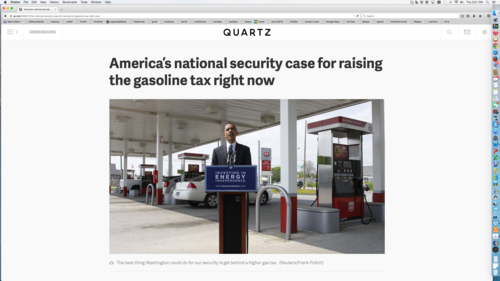
At this writing, this is my 7th most popular column ever, edging out “The National Security Case for Raising the Gasoline Tax Right Now” for that spot.  You can see a list of my most popular columns here.

Paul Krugman links to this column as a news source in his column “Switzerland and the Inflation Hawks.” The link is on the words “charging banks.” 

I knew I needed a big update to this column when I saw that the Swiss National Bank abandoned the ceiling on the value of the Swiss franc. So I wrote another whole column:

Swiss Pioneers! The Swiss as the Vanguard for Negative Interest Rates

I recommend reading that immediately after you read this column. 

If you want to mirror the content of this post on another site, that is possible for a limited time if you read the legal notice at this link and include both a link to the original Quartz column and the following copyright notice:

© December 19, 2014: Miles Kimball, as first published on Quartz. Used by permission according to a temporary nonexclusive license expiring June 30, 2017. All rights reserved.


The initials “SNB” for the Switzerland’s central bank, the “Swiss National Bank” are about to become just as familiar as the initials ECB for the European Central Bank. Today, the SNB announced it would cut interest rates for banks that keep large amounts of money at the SNB to -.25%. Yes – a negative interest rate.

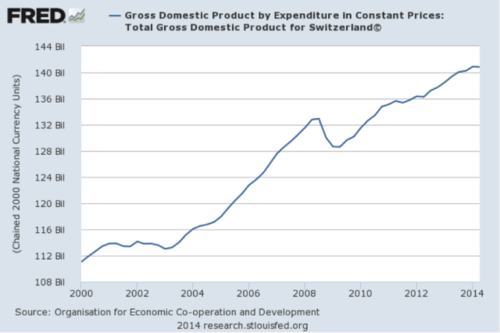
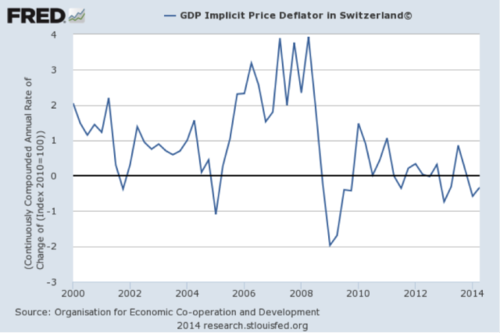
The SNB’s negative interest rate surprise is bigger news than it seems. Switzerland has strong reasons to turn to new monetary policy tools. The lackluster economic growth Switzerland has had since the Financial Crisis in late 2008–visible in the graph of Switzerland’s real GDP in the chart above–has brought inflation down until now it hovers around zero, as shown in the graph below:

The Swiss economy is heavily dependent on exports to the eurozone, which hasn’t fared well lately. And the Swiss economy has had troubles of its own. This past September, BBC News ran the headline “Swiss economy fails to grow as EU stagnates,”  accompanied by this quotation from Maxime Botteron Credit Suisse’s Maxime Botterton:

The trend in exports is not a big surprise. Trade data so far already pointed to a rather weak contribution of exports. What is a bit more surprising is the weak investment spending, especially in the construction sector.

Let me explain why the slowness of Swiss exports matters: Thomas Jordan, the head of the SNB, said during Thursday’s press conference that asset markets have been spooked by the fall of the Russian ruble and are looking for a safe haven. Switzerland has a long history of being just such a safe haven: during times of crisis, money flows in. So the ruble crisis is putting upward pressure on how many euros it costs to buy a Swiss franc, because more investors are trying to buy francs. A more expensive Swiss franc will make Swiss exports even more expensive, making it even harder to sell things produced in Switzerland to the rest of the world. The SNB is determined, therefore, to do whatever it takes to keep the Swiss franc from ever costing more than .833 euros.

The main tool the central bank has had for preventing the Swiss franc from appreciating is buying up enough foreign assets with Swiss francs to guarantee there are enough Swiss francs available in the world for anyone to buy one for .833 euros. The trouble with relying on that approach alone is that Switzerland winds up with a lot of foreign assets that are less safe than Swiss assets would be (especially when the effect of possible future exchange rate changes on those foreign assets are taken into account).

The world is used to positive interest rates: a borrower pays a lender for the use of money. Negative interest rates mean that the lender has to pay the borrower to keep money safe. Negative interest rates are a way for Switzerland to get paid for the safety it provides in a financially dangerous world. Then, if Switzerland ends up with risky foreign assets while foreigners end up with safe Swiss assets, at least Switzerland is getting paid for the difference between the safe assets it provides and the riskier assets it is buying.

The most remarkable thing SNB chief Thomas Jordan added to his initial remarks was the statement that despite already having a -.25% interest rate compared to the ECB’s higher -.2% rate, the SNB is prepared to go even further. As James Shotter and Alice Ross reported in the Financial Times

Mr Jordan said the SNB was prepared to take further steps to protect the minimum exchange rate if needed, including pushing rates deeper into negative territory and lowering the threshold above which the negative rates were charged.

The other hint that the SNB is prepared to go further was in its statement that its band for the Libor interest rate now goes all the way down to -.75 %.

A good question to ask now would be: Why is the SNB confident that it can go down to deeper negative rates? Most central banks are afraid that if they cut their target rates or interest rates on reserves too far into negative territory, people will start piling up paper currency, which may be inconvenient to store, but otherwise pays an interest rate of 0%, which might start looking very good, compared to, say -.75%.

The answer, which most observers don’t realize, is that the SNB can actually inflict a negative interest rate on paper currency as well. In a principle that the underappreciated polymath (art and cultural historian, Biblical scholar and monetary theorist) Robert Eisler groped towards back in 1932, there’s an easy way to exact a negative interest rate: Charge customers an exchange rate between paper currency and money in the bank. More recent economists, notably Willem Buiter (now Chief Economist of Citigroup) further elaborated on this idea.

On July 15, 2014, I gave a presentation at the SNB explaining how to use a fee on paper currency deposited at the SNB by private banks to generate a negative interest rate on paper currency. This was a variant on Robert Eisler’s approach. To generate a negative paper currency interest rate, the paper currency deposit fee has to gradually increase in size. But as soon as interest rates are positive again, the paper currency deposit fee can gradually shrink in size until it finally disappears, and things go back to the way things work now. So the SNB has the idea of a paper currency deposit fee to implement negative interest rates on paper currency in its back pocket.

There is a world of difference between a central bank that cuts some of its interest rates, but keeps its paper currency interest rate at zero and a central bank that cuts all of its interest rates, including the paper currency interest rate. If a central bank cuts all of its interest rates, including that paper rate, negative interest rates are a much fiercer animal.

As a professor who teaches for a living, I care most about whether students learn things in the end. But I can’t help but notice the difference between quick learners and slow learners. When it comes to how to do negative interest rates right, the people at the SNB are some of the quickest learners I’ve seen.

The bottom line is that no one should underestimate the Swiss National Bank when it says that it will do whatever it takes to keep its exchange rate at .833 euros per Swiss franc – even if it requires boldly cutting its interest rates to a depth no central bank has gone to before.

Jonathan Zimmermann—Swiss Franc Shock: Time to Take Advantage of Return Policies

I am very pleased to kick off another season of guest posts from students in my Monetary and Financial Theory class. In this class, every student is required to write 3 blog posts every week. Each of the 40 students chooses 5 over the semester to submit to me, out of which I pick some of the best as guest posts here. (My teaching assistant, Ryoko Sato last year and Adam Larson this year, reads and comments on all of them, 120 a week!)

You can see links to all of the student guest posts from last year here. 

In this guest post, Jonathan Zimmermann is definitely thinking like an economist in the wake of the Swiss franc shock. Note that CHF is the symbol for Swiss francs, and SNB is the abbreviation for “Swiss National Bank.” Here is Jonathan:


In the space of a few minutes, after the decision of the SNB to remove the floor on the EUR/CHF exchange rate, the cost of one Euro in terms of Swiss francs decreased from 1.2 to 0.86. The exchange rate eventually started to stabilize around the 1:1 parity rate, but as I write the Swiss franc is still more volatile than ever.

The repercussions of this decision are gigantic, and many brokers already announced hundreds of millions of losses. As a Swiss national however, I also notice the more direct (and easier to understand) repercussions of this shock. Indeed, most of my revenues and assets being directly indexed to the value of the Swiss franc, my purchasing power for international goods instantly increased by more than 20%.

Of course, our first reaction, we Swiss, is to think “Waouh! I’m rich, everything is cheap now!” Since the prices are likely to readjust progressively in a way or another, we will probably try to buy as many goods as possible from the rest of the world. As for the rest of the world, they will try to buy as few products from Switzerland as possible.

But we also regret everything we bought the previous day: if we had waited a bit more, they would have been much less expensive. And here is where it is interesting: it is actually possible to get some of your money back. Today, more than ever, return policies are powerful free “put options”.

In many physical and online shops, it is possible to return an item up to a few months after having bought it, to get your money back or a credit in the shop. Some stores are more flexible than others, and some even allow you to return an already used item without having to explain the reasons. Let’s say you received a new TV for Christmas last month that cost 1000CHF in Switzerland and was sold for 850 euros in the Eurozone (i.e. more or less the same price with the old exchange rate) only a few kilometers further. Today, by simply returning your TV to the store, changing the Swiss francs you received in euros and re-buying the same model of TV in France, you just earned 150 Swiss francs without losing anything other than time (and a bit of integrity). This is almost a pure form of arbitrage.

But even better: you could use a similar strategy on items you bought in another country, if you paid in Swiss francs with a Swiss credit card. Amazon’s policy, for example, is to refund you in your local currency at the same rate used when you placed the order! Let’s say you bought a pair of shoes last month for $200 (on the US website, but this would work in any country), paying in Swiss francs through the Amazon currency converter when the dollar was at 1.05. If you ask for a refund, Amazon will credit you 210CHF, and if you buy this same pair of shoes again it will now only cost you 180CHF ($200 at the current exchange rate of 0.9 CHF per USD). Amazon does not accept returns on already used items, but since there is no difference between the item you bought last month and the one you can order now, you can simply buy a new pair of shoes and return it as if it was the old one (so you don’t even need to still physically possess the item you purchased in the first place). Here again, without leaving your house you can make an arbitrage gain of 30CHF on a simple pair of shoes.

Of course, the strategy I just described is probably everything but moral, and I wouldn’t advise using it unless you are a huge fan of smoky-tactics-to-spare-a-few-dollars-and-make-you-feel-like-a-smart-guy. I didn’t use this strategy, and I don’t intend to, but I think it is interesting to be aware of and understand this unusual strategy that has never been more efficient than today.

Leon Berkelmans: Why Can't Interest Rates Be Negative?

Dr Leon Berkelmans is Director, International Economy program at the Lowy Institute. Originally published on Lowy Interpreter, December 5, 2014. Republished with permission.

I appreciate Leon’s permission to mirror his post here. I will save my comments until after. Here is what Leon has to say. Some of the intro may be affected by the European Central Bank’s actions tomorrow, but the most important points will not:


Overnight, the European Central Bank once again opted for timidity, with interest rates remaining unchanged. The scale of the deflationary threat Europe faces is awesome. However, with no appetite to engage in quantitative easing, I fear that the bank is not willing to do ‘whatever it takes’ to save the single currency, as someone once said.

This reluctance appears to be fed by a distaste of government debt purchases. If only there were a way to loosen policy without crossing this monetary Rubicon, perhaps the political constraints to quantitative easing will be freed. Well, there is. It is radical, but inevitable. To soften you up to this radical alternative, let me tell you a story that, legend has it, took place in a British bathroom in September 1931.

A British Treasury official was taking a bath when apparently an aid burst into the room proclaiming 'We’re off the gold standard!’ In reply the stunned official said, 'I did not know that was possible’.

We look back patronisingly at this official – of course a currency does not need to be tied to gold. And going off gold was a good thing. When the US went off gold, industrial production grew at its highest rate ever. Keynes called the gold standard a 'barbarous relic’. I think we have another one today, namely the zero lower bound on interest rates.

As things stand, interest rates can’t go too far below zero because if they did, institutions and individuals will prefer to hold physical cash. This preference will cause problems. Banks will withdraw the money they have on deposit at the central bank, transferring it into cash. The consequences of this transfer for the interbank market, through which monetary policy is implemented, are uncertain but likely inimical. Moreover, if banks themselves start to offer negative interest rates to depositors, these depositors will also transfer to cash and banks will face a funding squeeze.

How do we get around this problem? Ken Rogoff of Harvard University has suggested completely abolishing physical currency. This may be feasible in some economies, but even in an economy as sophisticated as the US, vast swathes of the population are unbanked. That problem would need to be dealt with before abolition.

Miles Kimball of the University of Michigan has another idea: have paper money (or in Australia’s case, polymer money) trade at a discount to electronic money. In other words, one dollar in your pocket would no longer be worth one dollar in the bank, so there will be an exchange rate between paper money and electronic money. Then when interest rates are negative, the exchange rate could be set so that physical currency will depreciate in value over time, and there will no longer be an incentive to stuff money into a safe.

In other words, one dollar in your pocket would no longer be worth one dollar in the bank. Then when interest rates are negative, the exchange rate could be set so that physical currency will depreciate in value over time so that banks and depositors will no longer have an incentive to stuff money into a safe.

Kimball’s solution has the central bank setting the price. An alternative is to set the quantity of physical cash in the economy and let the market set the price. I quite like this idea, because then the speculators are speculating among themselves rather than against the government, just like in floating foreign exchange markets.

I’ve heard many objections to the idea of a paper money price. I’m not convinced by them. Will people get angry about having two different prices for their morning cup of coffee – a cash price and a card price? Probably less angry than a 40% youth unemployment rate, which they face in Italy. Besides, in many cases we already receive a discount if we pay cash instead of using our credit card. Will it confuse people? We see exchange rates every day in the news. This would just add one more. But it’s too radical! So was going off gold, at least for some, but the world did so and we were better off.

I think the benefits of breaking the zero lower bound are manifest. The immediate applicability to Europe is obvious, but we are kidding ourselves if we think Australia will forever be immune to these problems. One day we will have the systems available to implement negative interest rates, hopefully soon. Kimball has been taking his ideas around to many central banks, and apparently has received encouraging responses.

Nonetheless, any transition involving a paper money price will, to be sure, require transitionary arrangements. We can’t just flick the switch and have this happen tomorrow. If the government sets the price, careful thought is going to be needed on what the price should be. If the government sets the quantity, then various market conventions will need to be worked out. For example, how is the barista going to figure out what discount to give customers who pay in cash? Presumably the barista’s bank will provide a rate, but there may be other ways.

These are all interesting questions, and there are answers, we just need to get out of the bath and think about it.


Miles: I appreciate Leon’s vote of confidence for my proposal. Let me try to answer one of the questions Leon raises.

I think there is real convenience in having the exchange rate between paper euros and electronic euros (or between paper yen and electronic yen, …) be very predictable and slow moving. (There is even convenience to having the exchange rate be one to one–just not enough convenience to be worth the doldrums the world economy has been in for the last six years.) So I think it is better for the central bank to have a crawling peg for that exchange rate between paper currency and electronic money than to let it float.

Unlike other kinds of exchange rates, the crawling peg between the paper euro and electronic euro (or between paper yen and electronic yen, …) would be totally defensible because the same central bank, under the same authority can issue as much as needed of both paper euros and electronic euros. If people want to trade electronic for paper euros, the ECB can print as many paper euros as needed at the exchange rate peg; and if people want to trade paper euros for electronic euros, the ECB can create as many electronic euros as needed. 

Overall, my aim in designing the details of my proposal to have a proposal that (a) eliminates the zero lower bound and (b) is otherwise as close to the current system as possible. I think a slowly crawling peg satisfies that criterion. A -4% interest rate is a very low interest rate (when inflation is 2%) and probably a more powerful stimulus than would be needed. But even that only changes the exchange rate by 1% every quarter. There is plenty of time for people to get used to the level of the exchange rate at that sedate pace.

The other advantage of a slowly crawling peg over a floating exchange rate is that a slowly crawling peg makes for an easier transition back to par and then staying at par until the next big recession. In that period when it is again appropriate to have positive interest rates, the crawling peg simply stops crawling when it comes back up to 1.

My favorite teaching tool is a fable based on a tale told by Professor James Ingram of North Carolina State University. It’s the tale of a brilliant entrepreneur who invented a new technology for turning grain into cars. The entrepreneur built a factory by the sea, surrounded its inner workings with secrecy, and commenced production.

Consumers were thrilled to learn that the new cars were better and cheaper than anything Detroit had to offer. Midwestern farmers were thrilled when the factory ordered vast amounts of grain to feed into its mysterious machinery. There was indeed dismay among those autoworkers who had been trained in the old methods, but there was also a general recognition that technological progress, even when accompanied by growing pains, is on balance a very good thing.

One day an investigative reporter managed to locate a disgruntled employee who revealed the entrepreneur’s great secret. The vast factory was hollow. The back wall opened out onto a shipping dock. Grain came in the front door and went out the back, where it was sent to foreign countries in exchange for cars.

The shock of these revelations transformed the entrepreneur from a public hero to a public villain.

– Steven E. Landsburg, Fair Play, pp. 12-13

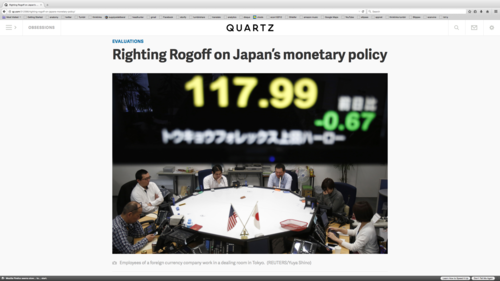
Quartz #55—>Righting Rogoff on Monetary Policy

Link to the Column on Quartz

Here is the full text of my 55th Quartz column, “Righting Rogoff on Monetary Policy,” now brought home to supplysideliberal.com. This column was first published on December 15, 2014. Links to all my other columns can be found here.

If you want to mirror the content of this post on another site, that is possible for a limited time if you read the legal notice at this link and include both a link to the original Quartz column and the following copyright notice:

© December 15, 2014: Miles Kimball, as first published on Quartz. Used by permission according to a temporary nonexclusive license expiring June 30, 2017. All rights reserved.

This column is meant to back up my tweet:

Ken Rogoff is wrong when he says the BOJ’s Kuroda has done “whatever it takes” monetary policy for Japan: http://www.project-syndicate.org/commentary/japan-slow-economic-growth-by-kenneth-rogoff-2014-12…

One other note: Ken sent a nice reply to the email I sent him about my work on eliminating the zero lower bound, soon after I sent it. 

After the text of the column, which focuses primarily on monetary policy, you can see the text of an update to my companion post, which revisits in greater depth Carmen Reinhart and Ken Rogoff’s research on the effects if government debt on economic growth. 


Carmen Reinhart and Ken Rogoff’s 2010 academic paper “Growth in a Time of Debt” was influential in giving policy-makers the impression that higher levels of government debt would lead to slower economic growth. In Spring 2013, University of Massachusetts Amherst graduate student Thomas Herndon and his faculty coauthors Michael Ash and Robert Pollin announced that they had discovered a spreadsheet error marring Reinhart and Rogoff’s work. News of that error led to a broader reevaluation of Reinhart and Rogoff’s claims. My own embarrassment at having relied on Reinhart and Rogoff’s claims led me to examine their claims closely myself, in two Quartz columns coauthored with University of Michigan undergraduate Yichuan Wang. We found no evidence in Reinhart and Rogoff’s data that national debt slows down economic growth at all. Indeed, after taking into account past growth rates, many economies have grown surprisingly fast despite high levels of government debt.

As Reinhart and Rogoff’s claims fell apart, they came under particular criticism for allowing policy-makers to believe they had conclusive evidence that higher government debt slowed down growth at the same time their more cautious words to their fellow economists indicated that they knew the evidence at best only suggested such a view, pending further analysis. Between Reinhart and Rogoff, it was clear this criticism was directed primarily at Rogoff, in view of his greater stature and influence with policy-makers.

Despite his mistakes in badly overstating the evidence that government debt retards growth, Ken Rogoff is a brilliant economist, who has greatly advanced many areas of economics and has a deep concern for real-world economic policy. So it is disappointing to see his analysis of Japanese economic policy limited so sharply by conventional wisdom in his recent Project Syndicate article “Can Japan Reboot?” Indeed, Rogoff makes an unforced error in that article that is every bit as consequential for economic policy as his errors in relation to debt and economic growth.

Rogoff writes:

My own view is that the “three arrows” of Abenomics 1.0 basically had it right: “whatever it takes” monetary policy to restore inflation, supportive fiscal policy, and structural reforms to boost long-run growth. But, though the central bank, under Governor Haruhiko Kuroda, has been delivering on its side of the bargain, the other two “arrows” of Abenomics have fallen far short.

This is wrong. Both the Bank of Japan and Ken Rogoff know that “whatever it takes” monetary policy goes beyond anything the Bank of Japan has done. Governor Kuroda has not been delivering on his side of the bargain. “Whatever it takes” monetary policy would involve cutting the interest rates determined by the Bank of Japan below zero. The fact that paper currency, according to current practice, earns a zero interest rate causes serious complications, but the Bank of Japan knows, at a detailed level, how to implement a negative interest rate on paper currency, too. I know the Bank of Japan knows how to do it because I went to the Bank of Japan in June 2013 to explain the details in an official seminar, to both staff economists and high Bank of Japan officials, and returned in August 2014 to remind them.

On this, my second visit, I spoke about “Portfolio Rebalancing in General Equilibrium” in my official seminar, but I used that visit as an opportunity to talk about negative interest rates in side conversations. And before the financial crisis that precipitated the Great Recession, I spent enough time in residence at the Bank of Japan that I have many friends among the staff economists at the Bank of Japan who have followed my work on negative interest rates closely.

I know that Ken Rogoff appreciates the power of negative interest rates to provide economic stimulus because he has advocated adding negative interest rates to the monetary policy tool kit for exactly that purpose himself. And when I realized from his May 2014 Financial Times opinion piece in that vein of his advocacy of negative interest rates, I emailed him to let him know of my efforts to work out details of implementing negative paper currency interest rates to make deep negative interest rates practical now, instead of a decade or two from now. Thus, Ken Rogoff’s characterization of current Japanese monetary policy being willing to do “whatever it takes” is not just an error, but an unforced error.

The most likely reason Rogoff made the error is because he is too quick to assume the existence of political constraints on monetary policy in Japan. While they may exist today, they could be swept away tomorrow, if Japan’s economy falls deeper into the mire. To my mind, it is the responsibility of an economist giving serious advice to point out what can and should be done even if that may not be politically feasible at the moment. Of course, one should then go on to give the best advice one can within whatever political constraints exist at the moment, as I did when I gave my opinion to the Bank of Japan that quantitative easing would be more powerful if they focused their asset purchases on risky assets.

But progress is ill served if economists fail to point out areas where a government should try to expand the range of what is politically possible. Many economists explain the benefits of free trade, for example, even when the tide of politics is running toward greater protectionism. And many economists explain the benefits of dramatically more open immigration, even when the tide of politics is running toward greater immigration restrictions.

Indeed, while Ken Rogoff has not yet shown the courage of his convictions in his public advice to Japan about monetary policy, he does show the courage of his convictions in tough words about Japan’s immigration policy. He writes:

There has been no significant progress on supply-side reforms, especially on the core issue of how to expand the labor force. With an aging and shrinking population, Japan’s government must find ways to encourage more women to work, entice older Japanese to remain in the labor force, and develop more family-friendly labor policies. Above all, Japan needs to create a more welcoming environment for immigrant workers.

That is all good advice.

While immigration policy can, for the most part, be cleanly separated from monetary policy, monetary policy and fiscal policy are unavoidably intertwined. Rogoff has this to say about Japan’s recent and possible future increases in its consumption tax:

The timing of the April 2014 consumption-tax hike (from 5% to 8%) was also unfortunate. It would not have been easy for Abe to postpone the move, given that it had been locked in place by broad-based political agreement before he took office. But the government could have engaged in more aggressive fiscal stimulus to counteract the hike’s short-term effects. Instead, two successive quarters of negative growth have had a dispiriting psychological impact. …

Mind you, Japan’s outsize government debt and undersize pension assets are a huge problem …

It is clear from these passages that Rogoff wants lower taxes to stimulate the economy (or to keep from creating a drag on the Japanese economy), but worries about the effect of lower taxes on the already supersized national debt of Japan. But if Japan supercharged its monetary policy with negative interest rates, the fiscal drag from higher consumption taxes would be overwhelmed by the monetary stimulus, so that Japan’s tax policy could be focused on the long-run issue of stabilizing its debt level.

In “Can Japan Reboot,” Ken Rogoff presents himself as someone despairing of the potential for better monetary policy to dramatically improve the situation in Japan, and therefore turning to supply-side measures as the main hope for getting the Japanese economy back on track. In my view, Japan can dramatically improve both its monetary policy and its supply-side policies. I have heard the argument that tight monetary policy can foster supply-side reform by holding an economy hostage until politicians enact the supply-side reforms they know their economy needs, but I don’t believe it. (Fortunately, Rogoff makes no such claims.)

Instead, good monetary policy, by keeping the economy at the level of output consistent with stable prices reveals and highlights supply-side issues that need to be addressed. When people believe, with good reason, that bad monetary policy is part of what ails the economy, it is not surprising that they underestimate the need for supply-side reforms such as loosening immigration restrictions and making it easier for new, innovative firms to enter old, jaded markets. Repairing monetary policy clears the way for repairing the underlying ability of an economy to produce the goods and perform the services that enrich people’s lives with material abundance.

In both the reinforcement he gave to policy makers more worried by the effects of debt on economic growth than by the disastrous human consequences of the persistent worldwide slump, and in his current advice to Japan, Ken Rogoff has erred in the direction of making it easy for people who believe a questionable conventional wisdom to continue in that belief. Economists concerned with real-world economic policy should aim higher. It is all well and good to give a verdict on current policy controversies, as they have been framed by politics as usual. But those who know there is a better way need to say so, with patience and tenacity.


Update December 19, 2014: Although the main point of my column is to emphasize the importance of putting negative paper currency interest rates in the monetary policy toolkit now rather than a decade or two from now (with particular urgency for the European Central Bank and the Bank of Japan), I know that for many readers, the reprise of the Spring 2013 media furor about Carmen Reinhart and Ken Rogoff’s work is equally salient. Personally, I believe eliminating the zero lower bound is much more important as whether debt lowers economic growth even when it doesn’t cause a debt crisis, but the issue of debt and growth does need to be addressed as well. 

I had a chance to read Ken Rogoff’s and October 2013 FAQ http://scholar.harvard.edu/rogoff/publications/faq-herndon-ash-and-pollins-critique. Substantively, I think this is a good response to the Thomas Herndon, Michael Ash and Robert Pollin paper (linked there) that started the media furor in Spring 2013. But my own substantive concerns are not those. They are the concerns that Yichuan Wang and I detail in our two Quartz columns and two other posts on Reinhart and Rogoff’s work:

In my view, these posts by Yichuan Wang and me are a good example of how, in Clay Christensen’s terms, the disruptive innovation of the economics blogosphere is beginning to move upscale and challenge traditional economics outlets such as working papers and journal articles.

I hope that, taken as a whole, what I write on my blog puts things in the context of the literature, and—through links—gives the kinds of references that are rightly considered important for academic work. In any case, for me the major source of the not inconsiderable number of references I have had in my academically published work come from other people telling me about work related to my own. The same thing happens online. I deeply appreciate the many links people send me in tweets and in more private communications. 

Although it is natural for an individual blog post to be be much less complete than a working paper or journal article, I hope to achieve a reasonable balance between breadth and depth in this blog as a whole. And of course, the relative difficulty of putting mathematical equations in Tumblr means I will choose the working paper format once the number of equations needed to make a point exceeds a certain threshold. 

To repeat, although Thomas Herndon, Michael Ash and Robert Pollin’s paper definitely piqued my interest and Yichuan’s interest and so led to our analysis of Carmen Reinhart and Ken Rogoff’s postwar data, I am critical of the substance of Carmen and Ken’s work based on my work with Yichuan, not based on the work of Thomas Herndon, Michael Ash and Robert Pollin.

In relation to our own critique of Carmen and Ken’s work, let me make three substantive points:

  1. Nonlinearity. In our last piece on Reinhart and Rogoff’s work, http://blog.supplysideliberal.com/post/55484991854/quartz-25-examining-the-entrails-is-there-any
  2. Yichuan and I look nonlinearly at how different levels of debt are related to growth beyond what one would expect from looking at past growth alone. It would be nice to have more evidence total, but on its face, the hint has a higher growth rate after controlling for past growth at a 90% debt to GDP ratio than at a 50% debt to GDP ratio. And we do suggest that what little evidence there is in the data suggests that, say, 130% debt to GDP ratio is associated with lower growth beyond what would be predicted by past growth than a 90% debt to GDP ratio, though a 130% debt to GDP ratio and a 50% debt to GDP ratio give about the same level of growth beyond what would be predicted by past growth alone. On theoretical grounds, it seems plausible to me, though far from an open-and-shut case that high enough debt levels would cause problems for economics growth. That thinking has led me to argue persistently that monetary stimulus is better than fiscal stimulus because it does not raise national debt. See for example my post “Monetary vs. Fiscal Policy: Expansionary Monetary Policy Does Not Raise the Budget Deficit.”But exactly how high that is matters a lot when people can’t be convinced of the virtues of negative interest rates so that fiscal stimulus remains an issue. I consider the nonlinear smoother result that (given what power there is in the postwar data set) the line is the same at a 130% debt to GDP ratio as at a 50% debt to GDP ratio, even after correcting for “illusory growth” on the part of Ireland and Greece as painting a considerably different picture than someone would get from reading Carmen Reinhart and Ken Rogoff’s, or Carmen Reinhart, Vincent Reinhart and Ken Rogoff’s work.
  3. Is controlling for past GDP growth appropriate? In my view, yes. I consider the past income growth controls important because countries that are generally messed up are likely to have both high debt and low growth. That doesn’t mean the high debt causes low growth. Most of the discussion has focused on reverse causality, but I consider the positive correlation across many dimensions of bad policy to be another big issue. I worry that the past income controls would make it hard to detect whether or not debt overhangs are followed by long-lasting low-growth periods, as Carmen, Vincent and Ken argue. But without some other way to control for the many, many other possible bad policies besides debt (which goes beyond the kind of growth accounting regressions that Ken’s FAQ document points to as strong evidence in favor of the view that debt might slow growth) this seems to me to point toward genuine empirical agnosticism about whether debt lowers growth as the right conclusion. (Theoretical arguments are a different matter.)
  4. Does the prewar data strongly bolster the case the debt slows growth?  Here, it depends on what the question means. The prewar data were not as readily available as the postwar data, so Yichuan and I did not analyze them. And so I don’t know what they say, once subjected to the kind of empirical exercises I would like to subject them to. I would love to see an analysis like the one the Yichuan and I did on the postwar data applied to the prewar data. That said, the prewar data may answer the question of whether a given debt level lowered growth under the gold standard, or with prewar institutions that were weaker than current institutions. So I have my doubts about how much guidance it can give to policy now. Monetary policy in particular, had advanced dramatically since the pre-World War II era, even before the ongoing revolution against the paper currency standard. 

Did Carmen and Ken overstate their case? 

While I feel confident that Yichuan’s and my substantive critique has not been adequately addressed, I am much less confident about claims I made in “Righting Rogoff on Japan’s monetary policy” about how policy-makers interpreted Carmen and Ken’s work (and how they could have been expected to have interpreted it, given what was written).

Ken’s FAQ document points to the 2010 Voxeu article “Debt and Growth Revisited” as something that could have provided more balance to policy makers in interpreting Carmen (and Vincent) and Ken’s work. Because policymakers might be more likely to read a Voxeu article than an academic paper, this Voxeu piece is an important touchstone for whether Carmen and Ken overstated the strength of the empirical evidence in favor of the idea that high public debt slows down growth in the range that was relevant to policy in the last few years.

The issue I have with the Voxeu article “Debt and Growth Revisited” is that it never mentions the fact that the normal standard of establishing causality in economics is to find a good instrument, or some other source of exogeneity or quasi-exogeneity. In other words, the inherent difficulty of establishing causality in this kind of data is never mentioned. Here is how strongly Carmen and Ken suggest in their Voxeu article “Debt and Growth Revisited” that there is causal evidence despite the highly endogenous nature of the data:

Debt-to-growth: A unilateral causal pattern from growth to debt, however, does not accord with the evidence. Public debt surges are associated with a higher incidence of debt crises.9 This temporal pattern is analysed in Reinhart and Rogoff (2010b) and in the accompanying country-by-country analyses cited therein. In the current context, even a cursory reading of the recent turmoil in Greece and other European countries can be importantly traced to the adverse impacts of high levels of government debt (or potentially guaranteed debt) on county risk and economic outcomes. At a very basic level, a high public debt burden implies higher future taxes (inflation is also a tax) or lower future government spending, if the government is expected to repay its debts.

There is scant evidence to suggest that high debt has little impact on growth. Kumar and Woo (2010) highlight in their cross-country findings that debt levels have negative consequences for subsequent growth, even after controlling for other standard determinants in growth equations. For emerging markets, an older literature on the debt overhang of the 1980s frequently addresses this theme. …

… We have presented evidence – in a multi-country sample spanning about two centuries – suggesting that high levels of debt dampen growth.

I appreciate the note of uncertainty in the sentence  

Perhaps soaring US debt levels will not prove to be a drag on growth in the decades to come.  

But I feel that for the typical policy maker reading the Voxeu article, this note of uncertainty is largely cancelled out by the next sentence: 

However, if history is any guide, that is a risky proposition and over-reliance on US exceptionalism may only prove to be one more example of the “This Time is Different” syndrome.

The phrase “if history is any guide” phrase in particular suggests that the historical evidence gives some clear guidance, and the sentence as a whole points to an interpretation of “Perhaps soaring US debt levels will not prove a drag on growth in the decades to come” as simply making a bow toward random variation around a regression line rather than expressing any uncertainty about what the causal regression line for the effect of debt on growth says before other random factors are added in.

In any case, saying “Perhaps soaring US debt levels will not prove to be a drag on growth in the decades to come” is not the same as if Carmen and Ken had said

Of course further research could overturn the suggestion we find in the evidence that high debt lowers growth, and there are always many difficulties with interpreting historical evidence of this kind.

Of course, there is always the possibility that Carmen and Ken said almost exactly that, in a forum that most policy makers would have noticed, but one that Idid not notice. (My own reading is ridiculously far from comprehensive.) If so, I would love to get a link to it. Ideally, I would like to see the main text of Ken’s FAQ document collect in its main text all the details (including of course venue or outlet and date) about all the strongest caveats and cautions against overreading that Carmen, Vincent and Ken wrote about their work. 

One extremely important note that the FAQ document does have is this quotation from Reinhart, Reinhart, and Rogoff (2012), “Public Debt Overhangs: Advanced-Economy Episodes since 1800.” (Journal of Economic Perspectives, 26(3)): 

This paper should not be interpreted as a manifesto for rapid public debt deleveraging exclusively via fiscal austerity in an environment of high unemployment. Our review of historical experience also highlights that, apart from outcomes of full or selective default on public debt, there are other strategies to address public debt overhang, including debt restructuring and a plethora of debt conversions (voluntary and otherwise). The pathway to containing and reducing public debt will require a change that is sustained over the middle and the long term. However, the evidence, as we read it, casts doubt on the view that soaring government debt does not matter when markets (and official players, notably central banks) seem willing to absorb it at low interest rates – as is the case for now.”

This suggests to me that Paul Krugman went overboard in his criticism of Carmen and Ken—at least before he backed off somewhat. I am not up on all the details, but it is my understanding that some of Paul Krugman’s stronger criticisms against Carmen and Ken in terms of providing intellectual backing for austerity might have been better leveled against other influential economists, such as Alberto Alesina. But I would need a lot of help to know whether such criticisms were even appropriate for other influential economists such as Alberto. For the record, the current Wikipedia article on Alberto Alesina says:

In October 2009 Alesina and Silvia Ardagna published Large Changes in Fiscal Policy: Taxes Versus Spending,[3] a much-cited academic paper aimed at showing that fiscal austerity measures did not hurt economies, and actually helped their recovery. In 2010 the paper Growth in a Time of Debt by Carmen Reinhart and Kenneth Rogoff) was published and widely accepted, setting the stage for the wave of fiscal austerity that swept Europe during the Great Recession. In April 2013 some analysts at the IMF and the Roosevelt Institute found the Reinhart-Rogoff paper flawed. On June 6, 2013 U.S. economist and 2008 Nobel laureatePaul Krugman published How the Case for Austerity Has Crumbled[4] in The New York Review of Books, noting how influential these articles have been with policymakers, describing the paper by the ‘Bocconi Boys’ Alesina and Ardagna (from the name of their Italian alma mater) as “a full frontal assault on the Keynesian proposition that cutting spending in a weak economy produces further weakness”, arguing the reverse.

Thus, Wikipedia conflates Carmen and Ken’s views with those of Alberto Alesina and Silvia Ardagna.

But just as Carmen and Ken’s views should not be conflated with Alberto and Silvia’s views, neither should my views be conflated with Paul Krugman’s. Soon after Thomas Herndon, Michael Ash and Robert Pollin’s paper came out, I wrote in Quartz:

Unlike what many politicians would do in similar circumstances, Reinhart and Rogoff have been forthright in admitting their errors. (See Chris Cook’s Financial Times post, “Reinhart and Rogoff Recrunch the Numbers.”) They also used their response to put forward their best argument that correcting the errors does not change their bottom line. Given the number of bloggers arguing the opposite case—that Reinhart and Rogoff’s bottom line has been destroyed—it is actually helpful for them to make their case in what has become an adversarial situation, despite their self-justifying motivation for doing so. And though I see a self-justifying motivation, I find it credible that Reinhart and Rogoff’s original error did not arise from political motivations, since as they note in their response, of their two major claims—(1) debt hurts growth and (2) economic slumps typically last a long time after a financial crisis—the claim that debt hurts growth is congenial to Republicans, while the claim that it is normal for slumps to last a long time after a financial crisis is congenial to Democrats.

The results from the fairly straightforward data analysis that Yichuan and I did made me somewhat less sympathetic to Carmen and Ken. Nevertheless, I think they spoke and wrote in good faith. Errors of omission are a different issue, and there we all stand condemned, in a hundred different directions for each of us. 

It is from the perspective that we all stand condemned for errors of omission of one type or another, that I hope my words in “Righting Rogoff on Japan’s monetary policy” are taken. I also urge you to distinguish carefully between simply reportingone side of the Spring 2013 debate about Reinhart and Rogoff’s work, and things I say on my own behalf: principally that Ken does not challenge policy-maker conventional wisdom as much as I would like to see. 

Carmen and Ken literally did not have time enough to defend themselves adequately back in Spring 2013. Now that the dust has cleared, I would be glad to see them do more to tell their side of the story. 

This update is my effort to make up for some of my own errors of omission when I wrote “Righting Rogoff on Japan’s monetary policy.” In particular, I thought wrestling with Ken’s FAQ document was the least I could do to give a little more voice to Carmen and Ken’s side of the story. (To the extent that you were persuaded by Thomas Herndon, Michael Ash and Robert Pollin’s paper, or were persuaded by unjustified accusations of bad faith on Carmen and Ken’s part, you should take a close look at that FAQ document.)


John Stuart Mill on Freedom from Religion

The US Constitution guarantees freedom of religion, but what we often need is not just freedom of religion, but freedom from religion. It is very common for religions to have prohibitions that seem a very weighty matter to believers, while violating those prohibitions seems a matter of much smaller weight to the non-believers in that particular religion. Yet, prohibitions that at first seem easy to bear for the non-believer grate more and more as time goes on. And in a pluralistic society, accommodating the prohibitions of many religions would add up to a great constriction of life.

Before things get to that point, John Stuart Mill argues that imposing each religious restriction on non-believers (or on believers unwilling to impose it on themselves) is, in any case, illegitimate. Here is what John Stuart Mill writes in  On LibertyChapter IV, “Of the Limits to the Authority of Society over the Individual” paragraphs 13-16:

The evil here pointed out is not one which exists only in theory; and it may perhaps be expected that I should specify the instances in which the public of this age and country improperly invests its own preferences with the character of moral laws. I am not writing an essay on the aberrations of existing moral feeling. That is too weighty a subject to be discussed parenthetically, and by way of illustration. Yet examples are necessary, to show that the principle I maintain is of serious and practical moment, and that I am not endeavouring to erect a barrier against imaginary evils. And it is not difficult to show, by abundant instances, that to extend the bounds of what may be called moral police, until it encroaches on the most unquestionably legitimate liberty of the individual, is one of the most universal of all human propensities. 

As a first instance, consider the antipathies which men cherish on no better grounds than that persons whose religious opinions are different from theirs, do not practise their religious observances, especially their religious abstinences. To cite a rather trivial example, nothing in the creed or practice of Christians does more to envenom the hatred of Mahomedans against them, than the fact of their eating pork. There are few acts which Christians and Europeans regard with more unaffected disgust, than Mussulmans regard this particular mode of satisfying hunger. It is, in the first place, an offence against their religion; but this circumstance by no means explains either the degree or the kind of their repugnance; for wine also is forbidden by their religion, and to partake of it is by all Mussulmans accounted wrong, but not disgusting. Their aversion to the flesh of the “unclean beast” is, on the contrary, of that peculiar character, resembling an instinctive antipathy, which the idea of uncleanness, when once it thoroughly sinks into the feelings, seems always to excite even in those whose personal habits are anything but scrupulously cleanly, and of which the sentiment of religious impurity, so intense in the Hindoos, is a remarkable example. Suppose now that in a people, of whom the majority were Mussulmans, that majority should insist upon not permitting pork to be eaten within the limits of the country. This would be nothing new in Mahomedan countries. 1 Would it be a legitimate exercise of the moral authority of public opinion? and if not, why not? The practice is really revolting to such a public. They also sincerely think that it is forbidden and abhorred by the Deity. Neither could the prohibition be censured as religious persecution. It might be religious in its origin, but it would not be persecution for religion, since nobody’s religion makes it a duty to eat pork. The only tenable ground of condemnation would be, that with the personal tastes and self-regarding concerns of individuals the public has no business to interfere.

To come somewhat nearer home: the majority of Spaniards consider it a gross impiety, offensive in the highest degree to the Supreme Being, to worship him in any other manner than the Roman Catholic; and no other public worship is lawful on Spanish soil. The people of all Southern Europe look upon a married clergy as not only irreligious, but unchaste, indecent, gross, disgusting. What do Protestants think of these perfectly sincere feelings, and of the attempt to enforce them against non-Catholics? Yet, if mankind are justified in interfering with each other’s liberty in things which do not concern the interests of others, on what principle is it possible consistently to exclude these cases? or who can blame people for desiring to suppress what they regard as a scandal in the sight of God and man? No stronger case can be shown for prohibiting anything which is regarded as a personal immorality, than is made out for suppressing these practices in the eyes of those who regard them as impieties; and unless we are willing to adopt the logic of persecutors, and to say that we may persecute others because we are right, and that they must not persecute us because they are wrong, we must beware of admitting a principle of which we should resent as a gross injustice the application to ourselves. 

The preceding instances may be objected to, although unreasonably, as drawn from contingencies impossible among us: opinion, in this country, not being likely to enforce abstinence from meats, or to interfere with people for worshipping, and for either marrying or not marrying, according to their creed or inclination. The next example, however, shall be taken from an interference with liberty which we have by no means passed all danger of. Wherever the Puritans have been sufficiently powerful, as in New England, and in Great Britain at the time of the Commonwealth, they have endeavoured, with considerable success, to put down all public, and nearly all private, amusements: especially music, dancing, public games, or other assemblages for purposes of diversion, and the theatre. There are still in this country large bodies of persons by whose notions of morality and religion these recreations are condemned; and those persons belonging chiefly to the middle class, who are the ascendant power in the present social and political condition of the kingdom, it is by no means impossible that persons of these sentiments may at some time or other command a majority in Parliament. How will the remaining portion of the community like to have the amusements that shall be permitted to them regulated by the religious and moral sentiments of the stricter Calvinists and Methodists? Would they not, with considerable peremptoriness, desire these intrusively pious members of society to mind their own business? This is precisely what should be said to every government and every public, who have the pretension that no person shall enjoy any pleasure which they think wrong. But if the principle of the pretension be admitted, no one can reasonably object to its being acted on in the sense of the majority, or other preponderating power in the country; and all persons must be ready to conform to the idea of a Christian commonwealth, as understood by the early settlers in New England, if a religious profession similar to theirs should ever succeed in regaining its lost ground, as religions supposed to be declining have so often been known to do.

Let me point out that the same principle applies to freedom from secular religions and non-supernatural religions. If one avoided all actions that could offend someone according to some deeply felt belief, one would have very little room to move. 

One problem I have with John Stuart Mill’s argument here is that I don’t see the boundary between self-regarding and other-regarding actions as being quite so clear as he does. I discussed some of the tricky issues in “John Stuart Mill on Being Offended at Other People’s Opinions or Private Conduct, but without any resolution. 

If one says that one should be free to choose one’s own self-regarding conduct, the next question is what counts as "self-regarding conduct.” And it would be circular to then say that self-regarding conduct is conduct we should be allowed to choose freely. 

Here is one possibility for the boundary between self-regarding and other-regarding conduct: self-regarding conduct is conduct that even if one fully understood the consequences of the conduct, one would only care about in someone else if one was close to that person emotionally, or one was imbued with a particular meme–what the Wikipedia article “meme” calls “a unit for carrying cultural ideas, symbols, or practices that can be transmitted from one mind to another through writing, speech, gestures, rituals, or other imitable phenomena with a mimicked theme.” Later on, the article says this:

Proponents theorize that memes are a viral phenomenon that may evolve by natural selection in a manner analogous to that of biological evolution. Memes do this through the processes of variationmutationcompetition, and inheritance, each of which influences a meme’s reproductive success. Memes spread through the behavior that they generate in their hosts. 

Genes respect some boundaries between self and other. Relatives end up being counted as in-between self and other as far as genes are concerned, but at least some people are counted as definitely other. Memes respect no such boundaries. The propagation of an untestable and unverifiable idea, religious or otherwise, can be affected by almost anyone’s actions. So memes care (in the sense of having their replication depend on) what everyone does.

To draw a magic circle of liberty around each person, it is necessary to stop at the radius that his genes would care about, and that other people’s genes would not care about, or would care only a tiny bit about.

The upshot of this rule is that people are allowed to do anything that helps out their own genes–or any interest that ultimately derives from the interests of genes, even if it has wandered far afield from direct gene interests (such as the desire of an infertile person for sexual activity)–unless it interferes with the genes or gene-outgrowth interests of others of others. We then have social rules (hopefully fair) about what to do if my gene or gene-outgrowth interests conflict with yours. But if my gene or gene-outgrowth interests conflict your memetic interests, then I have the right to decide what will happen, not some social mechanism. And if your gene or gene-outgrowth interests conflict with my memetic interests, then you have the right to decide. And these rules tend to provide enough guidance on boundaries to help decide conflicts between my memetic interests and yours. 

I don’t know if this account of “self-regarding” versus “other-regarding” actions really works, but it is all I have right now. I would be glad for any other non-circular definitions of what counts as “self-regarding” versus “other-regarding” that you can show give a different answer about the boundary than the boundary I am proposing that accords with the limits of gene and gene-outgrowth interests.

Virginia Postrel: The Glamour of Autonomy and the Glamour of Synchronization

If autonomy represents the glamour of standing out, synchronization offers the glamour of fitting in. … Here actions, goals, and personalities mesh smoothly. Synchronization encompasses the social glamour of witty repartee–saying the right thing at the right moment, not an hour later–and of camaraderie in a common cause. It intensifies the glamour of fellowship, making the connections between people seem intuitive or telepathic. … Both autonomy and synchronization are illusions, of course, requiring drastic simplifications of reality. Autonomy suggests that we can shed the constraints of complex relationships, whether familial ties or electrical grids, without sacrificing their benefits. Synchronization omits the trials and rehearsal that real coordination requires. It hides conflict and disguises the compromises necessary to achieve apparent harmony. It assumes goals that are not only shared but worthy.

– Virginia Postrel, The Power of Glamour, pp. 94-95

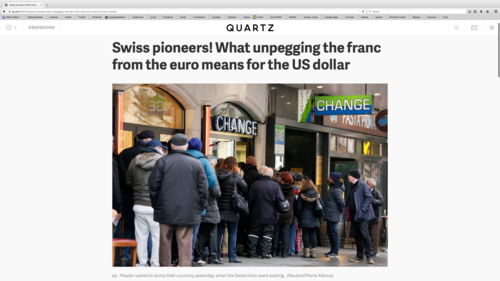
Swiss Pioneers! What Unpegging the Franc from the Euro Means for the US Dollar

Here is a link to my 59th column on Quartz, “Swiss pioneers! What unpegging the franc from the euro means for the US dollar.”

Update, January 19, 2015: Denmark lowered its interest on reserves from -.05% to -.2%. Danmarks Nationalbank has viewed its currency peg with the euro as the heart of its monetary policy for many decades.

Thanks to Mark Fontana for letting me know in real time about the Swiss National Bank’s and Danmarks Nationalbank’s actions.

Fixpoint Cat Can Has Fixpoint Cat on Fixpoint CatReblogged from econlolcats: Terminated recursion has never been this cuddly. By yeltsin.Fixpoint cat is just right as a harbinger of my new Quartz column revisiting the topic of negative int…

Fixpoint Cat Can Has Fixpoint Cat on Fixpoint Cat

Reblogged from econlolcats: Terminated recursion has never been this cuddly. By yeltsin.

Fixpoint cat is just right as a harbinger of my new Quartz column revisiting the topic of negative interest rates in Switzerland, slated to appear today. I will post a link as soon as I see it up. 

If you haven’t seen my first column about negative interest rates in Switzerland, “The Swiss are now at a negative interest rate due to the Russian ruble collapse,” take a look. I realized I was wrong in predicting the Swiss National Bank would continue to defend its ceiling on the Swiss franc, so a wrote a new column as an update.

Laura Overdeck: Math for Pleasure

blog.supplysideliberal.com tumblr_inline_ni71xeEuIa1r57lmx.jpg

A guest post by Laura Overdeck, whose theme is that kids might embrace and excel at math if we made it a part of playtime. The picture above is from one of Bedtime Math’s Crazy 8s club sessions called Glow-in-the-Dark Geometry. You can see Miles’s evaluation of statistical evidence for the efficacy of the Bedtime Math app here. Below are Laura’s words.

College-educated people aren’t afraid to read. When they open a newspaper article or blog post, they assume they’ll be able to read it. That’s because the content is written at roughly the 9th-grade reading level. But do we all feel just as solid on 9th grade math?  Clearly not, as restaurants now calculate the tip for customers – a task that requires only 5th-grade math skills. Americans are afraid to divide by 5. 

Our country bemoans its weakness in math on two levels. On the macro level, our students are regularly trounced by other countries on international tests. On the individual level, kids and adults alike get nervous about math and even despise it, making these test outcomes not all that surprising. As we collectively fret over curricula and lurch from one solution to another, we ignore a much larger piece of the puzzle: our sharp double standard in how we present reading vs. math to our kids. In launching the nonprofit Bedtime Math and navigating the world of early math, I’ve been stunned to discover how our society relentlessly stokes math anxiety – and often from birth.

Let’s quickly run some numbers. Kids live about 8,800 hours a year. Of that, they spend 1,200 hours in school, or fewer if it’s a typical 180-day year. Even if you chop out 3,000 hours or so for sleep, that still leaves far more waking hours spent outside school than in it. As we pound on our schools to perform better, what matters just as much is kids’ exposure to learning outside school. That includes playtime, mealtime, and regular family routines. And the fact is, math is not a big part of that equation.

It begins with our radically different approaches to numeracy and literacy. As Miles Kimball noted in his column “How to Turn Every Child into a “Math Person," if a child is struggling with reading, we don’t give up on him or her. Parents and kids do give up on math, however, eventually decaying to “I’m just not a math person.”  In fact, the more positive thinking about reading takes hold even before a child tries to read himself: most parents know to read bedtime stories at night, creating cozy rituals that lead kids to associate books with loving parental attention. Hence many of us read for pleasure as adults. Sadly, “math for pleasure” just isn’t a phrase we throw around.

That’s because most parents don’t do math for fun with their kids. My husband and I did do this, and frankly on a whim: when our first child turned two, we started giving her a little “bedtime math problem” alongside her bedtime story, simply because we both enjoy math. Together we’d count the ears and noses on her stuffed animals; as she grew, we advanced to a wild range of topics, from flamingos to ninja stunts to the chips in chocolate chip cookies. We rolled in addition, then subtraction, then a second child. Years later when our third child turned two, he ran in one night yelling that he wanted a math problem, alerting us that we’d unwittingly created a very unusual household. Math for pleasure is possible.

Friends urged me to share these enticing math problems, and so I launched Bedtime Math, plying porcupines and pillow fights as vehicles for numbers. The wake-up call came when I told people about the blog and get the reaction, “Ewww…math for little kids? How could you do that?” Would we ever say ewww about reading a book to a 6-month old? Is counting so different from learning the alphabet? And yet the time-honored way to fall asleep is to count sheep! But somehow, some parents had come to view counting as a borderline dangerous endeavor for kids.

Even when ambitious parents introduce math through books, they tack hard towards the serious. Among Amazon’s 100 top-selling educational books for children, not only are there three times as many reading/writing books as math books, but their difference in tone is night and day. The ABC books sport Bob, Dr. Seuss, Richard Scarry characters, and Mad Libs. By contrast, the math books are almost entirely workbooks, and “work” sure doesn’t sound like play. Note that parents see the list of top sellers before anything else, so they’re more likely to click on these workbooks and buy them, thus perpetuating the imbalance. What message does this send to kids about math? I’m proud to say that Bedtime Math has lived among Amazon’s top 20 kids’ math books since it was published, perhaps because it’s often the only playful option on the list. 

On the toy front, we again miss an opportunity to spark a love of math early in life. In Amazon’s current 100 bestsellers for babies and toddlers, which were admittedly wholesome, I counted exactly four even vaguely math-related toys: two shape sorters, a cash register, and the eternally fabulous Spirograph. Everything else was oriented towards music, arts and crafts, and bath splash. Again, we signal that math isn’t part of the fun. 

Thus, a lot of kids meet math for the first time in kindergarten, as they enter the world of homework, quizzes and tests. That’s probably not the most fun way to meet a subject for the first time. Not coincidentally, studies have shown that math anxiety can surface as early as age 5, right when kids start school. What’s worse is that this fear becomes a self-fulfilling prophecy: MRIs of people tackling math problems reveal that anxiety causes blockages that slow one’s working memory, making it harder to perform well. The resulting struggles propagate more math anxiety, and the cycle reinforces itself. 

The final nail in the coffin is our after-school infrastructure. Again, let’s run the numbers: Tens of millions of kids – about 60% of them – play organized sports. Nearly as many embark on music or art activities. I haven’t found hard data on book clubs, but such clubs are plentiful, with offerings from Scholastic, Disney and other nationwide players. There are a couple million Boy Scouts and nearly as many Girl Scouts. By contrast, each year only about 180,000 kids participate in arguably the top organized STEM recreational activity, FIRST Robotics. When you slice down to math itself, the fractions ratchet down even faster: only about 70,000 high schoolers compete in the American Mathematics Competitions (AMC), and about 40,000 in MATHCOUNTS. For elementary school kids, there’s no truly widespread or culturally popular offering, as confirmed by a search on Change the Equation’s database; only engineering initiatives pop up for nationwide K-5 activities. By offering only hardcore competitive options in the pure math space, we again signal that math is work intended only for hard-driving achievers, not a fun subject for everyone to enjoy.

In the face of this, we decided that Bedtime Math should create a truly “recreational” after-school club. Less than a year ago we launched our experimental Crazy 8s Club – deliberately without “math club” in the name, lest we send people screaming for cover. Unlike the competitive-worksheet, Olympiad-style clubs, kids in Crazy 8s explore math by building with glowsticks, competing in “Toilet Paper Olympics,” and playing bingo on a life-size board across the floor, all while engaging in fairly real math. The lively (and sneaky) branding seems to have worked: within just a few months we’ve received orders for over 2,000 kits, serving over 30,000 kids in grades K-5. No matter how hostile our culture around the subject, kids are clearly still hungry for fun math, and open to giving it a chance.

This gives me hope that broader change is possible. True, the challenge is enormous: more than one-third of Americans report that they’d rather clean the bathroom than answer a math question. Parents who didn’t like math during their childhood will be hard to convince to buy math toys for their own kids. They’re the same grown-ups sliding the check towards someone else, pleading, “Could you calculate the tip?” – and in front of their ever-observant children. But at Bedtime Math I’ve received some encouraging emails from such parents. They unload about how they hated math as kids, how they grew up to hate it as adults…but how in doing Bedtime Math with their own kids, they’re starting to enjoy math themselves for the first time ever. By returning adults to simple counting and single-digit addition, we can remind them that they are able to do math and should give it another try – not as work, but as play.

Photo of Laura Overdeck by Kathryn Huang

Photo of Laura Overdeck by Kathryn Huang

Cognitive Economics

The image above is a computer simulation of the branching architecture of the dendrites of pyramidal neurons from the Wikipedia article on “Mind.”

The image above is a computer simulation of the branching architecture of the dendrites of pyramidal neurons from the Wikipedia article on “Mind.”

Here is a link to an ungated copy of my paper "Cognitive Economics" as it appears in the Japanese Economics Review. By special arrangement with the Japanese Economics Review, this paper is in the public domain. The presentation I gave at the Japanese Economic Review conference for this conference volume is here

This paper is written in the same style as my more academic blog posts. So I count it as a major blog post as well as an NBER Working Paper. It just happens to be a blog post that you need to follow a link to see in full. (And sadly, like the typical blog post, despite diligent efforts, a few typos have crept through. The number and severity of typos I find will have to reach a certain critical threshold before I put the NBER staff to the work of putting together a new version. Please let me know if you find a typo)  

Let me give you a bit of a preview, in the form of an outline with one or more key quotations from each section and subsection:

I. Introduction

  • … research in “Cognitive Economics” has already been underway for a long time. But as a participant in this subfield, it seems to me that research in this area has been growing in recent years.

II. Defining Cognitive Economics

  • Cognitive Economics is defined as the economics of what is in people’s minds. In practical terms, this means that cognitive economics is characterized by its use of a distinctive kind of data. This includes data on expectations, hypothetical choices, cognitive ability, and expressed attitudes.

  • The name “Cognitive Economics” might initially sound as if it might be yet another synonym for Behavioral Economics … The most obvious difference is that Cognitive Economics is narrower. Behavioral Economics addresses a huge range of issues and cuts across all of the data types listed above, while Cognitive Economics focuses primarily on innovative kinds of survey data … Second, important pieces of Cognitive Economics are inspired by the internal dynamic of economics rather than by psychology.

  • … there is an obvious complementarity between Cognitive Economics and Behavioral Economics. Although it is possible to consider nonstandard theories of human behavior on the basis of standard data on market decisions alone, freeing up economic theory from traditional assumptions tends to increase the number of free parameters. There is a great value to additional data that can help pin down these additional free parameters.

  • … let me give my opinion on existing research and future directions in Cognitive Economics, organized around three themes: using data on hypothetical choices and mental contents (1) to identify individual heterogeneity, (2) to revisit welfare economics and (3) to study finite cognition.

III. Identifying Individual Heterogeneity

  • Heterogeneity across individuals in preferences and cognitive ability is not at all controversial. But data limitations have often forced economists to assume uniformity. Here the kind of data discussed above can do a lot to allow economists to capture some of the heterogeneity that exists.

IV. Revisiting Welfare Economics

  • The use of self-reported happiness to study welfare issues illustrates a key methodological issue in Cognitive Economics. Whenever a new measure is used, its relationship to standard concepts of economic theory is at issue.

  • It is possible, however, that happiness data could have a tight relationship to preferences even if the level of happiness does not. In particular, to explain the data, Kimball and Willis (2006) suggest that a large component of self-reported happiness depends on recent innovations in lifetime utility. Whenever people receive good news about lifetime utility, self-reported happiness temporarily spikes up; whenever people receive bad news about lifetime utility, self-reported happiness temporarily dips down. If true, this means that while it is questionable to use the level of happiness to infer preferences, the dynamics of happiness are informative about preferences and so can be used to inform welfare economics.

V.  Studying Finite Cognition

  • Moreover, to avoid the judgment Herbert Simon’s phrase “bounded rationality” can inadvertently suggest, I will refer instead to “finite cognition.”[3] Finite cognition means something more than just imperfect information—it means finite intelligence, imperfect information processing, and decision-making that is costly.

  • [3] Often, the inadvertent judgment suggested by “bounded rationality” is quite inappropriate. For example, if decision-making is actually costly, which is more “rational,” to choose in a way that takes into account the costliness of decision-making or to pretend that decision-making has zero cost? If one’s intelligence is actually finite, which is more rational, taking into account the limits on one’s intelligence, or pretending that one’s thinking power is unlimited? There is certainly a sense in which knowing and adjusting to one’s own limitations can often be the height of “rationality.”

  • finite cognition implies that even in the absence of externalities, welfare can often be improved by economic education, setting up appropriate default choices for people, or providing disinterested, credible advice. By contrast, explanations of puzzling behavior on the basis of individuals maximizing exotic preferences imply (if true) that welfare improvements must come in the standard way from addressing externalities, or in the case of inconsistent preferences, by taking sides in an internal conflict. Once puzzling behavior that is difficult to explain on the basis of standard economic theory is identified, it is hard to think of a more important question than whether people behave that way because they want to, or simply because they are confused.

A. The Reality of Finite and Scarce Cognition.

  • Although the inadequacies of our current tools can make it hard to study finite cognition theoretically, the claim that human intelligence is finite–and that finite intelligence matters for economic life—scarce cognition—is not really controversial.[4]

  • [4] There are many problems that are too hard for even very high levels of intelligence. For example, one of the problems with Bayesian updating is that, strictly speaking, it involves putting a positive probability on a much greater than astronomically huge set of possibilities. Various strategies of economizing on information processing are always essential in practice. Even the existence of a utility function itself is, in a sense, a technique of economizing on information transfer and processing. If evolution could process an infinite amount of information, and the genetic code could transmit an infinite amount of information, we could be endowed with decision rules embracing essentially all contingencies instead of mere objective functions and calculation capabilities.

B. Difficulties in Studying Finite Cognition with Standard Theoretical Tools.  

  • One key reason it is not easy using our standard theoretical tools to model finite cognition is the “infinite regress” problem emphasized by John Conlisk (1996). The infinite regress problem afflicts models that assume a cost of computation or other decision-making cost. The problem is that figuring out how much time to spend in making a decision is almost always a strictly harder decision than the original decision.

  • Costs to decision-making are a natural enough assumption for economists that a substantial percentage of all applied economic theory papers might include them, if it were not for the infinite regress problem. Finessing the infinite regress problem somehow is essential if economists are to develop effective theoretical tools for studying finite cognition. There are several feasible strategies for getting around the infinite regress problem—every one of which requires breaking at least one inhibition shared by many economists.

  1. Least transgressive are models in which an agent sits down once in a long while to think very carefully about how carefully to think about decisions of a frequently encountered type.

  2. A second strategy is to give up on modeling finite cognition directly and use models of limited information transmission capacity as a way of getting agents to make more imperfect decisions. In other words, one can accept the fact that our standard tools require constrained optimization with its implication of infinite intelligence somewhere in the model, but handicap agents in the model by giving them a “thick skull” that is very inefficient at transmitting information to the infinitely intelligent decision-maker within (that is, the perfect constrained optimizer within).

  3. A third feasible strategy is in the spirit of what the complexity theorists call “agent-based modeling. … This type of modeling substitutes the problem of agents that have unrealistically subhuman intelligence for the problem we have been focusing on of agents that have unrealistically superhuman intelligence. Despite this lack of realism, the results can be very instructive because the failure of realism is in the opposite direction from what economists are used to.

  4. I would like to focus on a fourth strategy for getting around the infinite regress problem–one that seems to me less commonly used: modeling economic actors as doing constrained optimization in relation to a simpler economic model than the model treated as true in the analysis. This simpler economic modeled treated as true by the agent can be called a “folk theory.“ … A folk theory should not be confused with the Folk Theorem of repeated game theory. I am talking about folk economics in the same sense as the well established ideas of “folk psychology,” “folk physics” and “folk biology.”

C. Modeling Unawareness Requires a Subjective State Space for the Economic Actor Distinct from the True State Space.

  • Dekel, Lipman and Rustichini (1998) argue for relaxing what they call the “real states” assumption as follows:

  • In standard state-space models, states play two distinct roles: they are the analyst’s descriptions of ways the world might be and they are also the agent’s descriptions of ways the world might be. If the agent is unaware of some possibility, though, ‘his’ states should be less complete than the analyst’s. In particular, the propositions the agent is unaware of should not ‘appear in’ the states he perceives.

  • Departures from the real states assumption would allow agents to have a different model of the economic situation in their minds than the maintained assumptions the analyst is using to model the situation of those very agents.

  • Note that if someone is successfully taught a more sophisticated model, this would involve an expansion in the individual’s subjective state space. If positive probabilities were accorded to the newly added states, this must necessarily involve a departure from Bayesian updating. Presumably it is also possible for people to “see the light” even without being explicitly taught. For example, the agent might be driven to entertain an expanded model if the probability of observed events conditional on the initial folk model ever appeared sufficiently low. We all recognize the practical importance of expansions in one’s subjective state space when in scientific contexts we say “Asking the right question is half the battle.”

D. Using Folk Theories to Model Finite Cognition: A Portfolio Choice Example. 

  • Clearly, the desirable properties for a modeled folk theory are quite different from the desirable properties for a theory proposed as a good approximation of reality. A folk theory need not be logically consistent at a deep level. Indeed, in representing reality, it may be a positive virtue for a folk theory to have logical inconsistencies of a form similar to the logical inconsistencies real people might have in their views of the world. Other than (a) descriptive accuracy as a reasonable representation of how people actually view the world, for theoretical purposes the key desirable properties for a modeled folk theory are (b) providing a clear prediction for how the people holding that folk theory will behave in various circumstances and © representing clearly what the people holding the folk theory are confused about and what they do understand. In terms discussed in Richard Herrnstein (1997)–particular in the chapters with Drazen Prelec–a folk theory should at least implicitly model the accounting framework that an agent uses, in addition to the objective function. Because it need not be logically consistent at a deep level, the argument for a folk theory can involve (correct reasoning about) logical leaps and plausible, though fallacious reasoning.

  • In reality, I am confident that people’s thinking about portfolio choice varies from person to person with a wild profusion of different kinds of misunderstanding. In most other contexts as well—at least where there is some complexity–any model that assumes everyone’s folk theory is of the same type is likely to be false. Realizing that people don’t always have the same mental model of a situation as the economist studying that situation is the first step toward facing the motley truth about people’s folk theories.

VI. Conclusion

  • Economic research using more and more direct data about what is in people’s minds is flourishing. But much more can be done. Fostering continued progress in this area of Cognitive Economics calls for three inputs. First, new theoretical tools for dealing with finite cognition need to be developed, and existing theoretical tools sharpened. Second, welfare economics needs to be toughened up for the rugged landscape revealed by peering into people’s minds. Third, the statement “The data are endogenous” needs to become not only an econometrician’s warning but also a motto reminding economists that new surveys can be designed and new data of many kinds can be collected to answer pressing questions.

So endemic did these and other philosophers [Kierkegaard, Kant, Nietzsche, Schopenhauer, etc.] find envy… it becomes clear that one must factor in envy in considering our judgments of our own and of others’ actions. If one’s judgments are to be straight and honorable, one must be certain that they are not infected by envy. To do so one must begin by understanding the mechanics of envy: what triggers it, what sustains it, what effects it can cause.

– Joseph Epstein, Envy, p. xxii

Noah Smith: Islam Needs To Separate Church and State


The Islamist terrorist attack on the French satirical newspaper Charlie Hebdo and the hideous nightmare of ISIS have reignited the controversy in the West over the nature of Islam. President Obama and others have argued that ISIS is “not Islamic,” and some Muslim scholars have called the Charlie Hebdo attacks a “betrayal” of Islam. The French gunmen and ISIS warriors, of course, beg to differ.

I’m not going to take a position on whether modern Islamist violence is truly Islamic or not - I’m not a scholar of Islam, and thus I am not qualified to judge (and neither is President Obama). That is a question for Islamic scholars to decide. But as an outside observer, I do think it is pretty clear that the wave of Islamist violence that has rocked the world in the last few decades shows that there is a major, deep-seated problem with the Islamic religion, and I think I know what it is. Most of Islam has not yet recognized the importance of the separation of church and state.

Consider the most famous waves of Christian violence, in the 16th and 17th centuries. Wars of religion devastated Europe, killing huge percentages of national populations. States disintegrated and acts of terror were commonplace. The main impetus for these wars was the question of which Christian sect - Protestantism or Catholicism - would rule each state. Clergy had great amounts of political power, dispensing law and owning huge tracts of land. Nationalism was, as yet, weak. The question of which religion would dominate in which area was also the question of who would rule. 

Eventually Europe’s religious wars calmed down, and a solution was reached. In the Peace of Westphalia, it was agreed that governments - not clergy - would get to decide which religion would prevail in their territories. A century later, the founders of the United States went even further, declaring that religious institutions and governmental institutions should be separate. No doubt the holocaust of the previous century loomed large in their minds.

Nowadays, the Middle East is embroiled in a set of conflicts that look a bit reminiscent of the European Wars of Religion. A few powerful, cohesive states - Iran, Saudi Arabia, and Turkey - are fueling proxy wars in anarchic areas like Iraq, Syria, Pakistan, Afghanistan, Somalia, Libya, and Yemen. The wars are being carried out by religious zealots, who have heeded a global call to arms. Meanwhile, lone individuals or small groups carry out horrific acts of individual violence that we now know as “terrorism,” claiming religion as their motivation. Two sects - Sunni and Shia - are pitted against each other, although there is also fighting among Sunnis of different sects, and ethnic and tribal fighting mixed in. Just as the European Wars of Religion featured Christians mostly killing Christians, the Islamic Wars of Religion feature mostly Muslims killing other Muslims.

It’s worth noting that the Islamic Wars of Religion are, so far, much less violent and deadly than their European predecessors. Christianity’s troubles killed tens of millions; Islam’s have probably killed less than one million, out of a much larger population. The modern age really is less violent than the past. But the violence in Islamic countries and by Muslim terrorists is still disturbing and needs to stop.

The obvious solution, it would seem, is for Islam to come to the same collective realization that Christianity came to after 1648 - that church and state make for a volatile mix, and should be separated. I believe this will eventually happen. But it is going to be difficult, for three reasons.

The first reason is historical. Islam, unlike Christianity, was originally sold as a means for creating the Good Society. I highly recommend Tamim Ansary's Destiny Disrupted: A History of the World Through Islamic Eyes, which explains the political orientation of early Islam. Whereas Christianity, like most religions, was born as a spiritual cult, Islam was born as a conquering empire and a system of jurisprudence. Christianity acquired its addiction to state power long after its founding, while Islam’s came immediately and never really went away.

Whatever the reason, most Muslims still seem to think of Islam as a legal system, rather than as a path to salvation or spiritual enlightenment. According to a 2013 Pew survey, large majorities in most Muslim countries support making sharia (Islamic religious law) the law of the land. If Islam is ever going to embrace separation of church and state, this idea will have to go.

The second reason is linguistic. Countries like Iran, Turkey, Indonesia, and Bangladesh, though majority-Islamic, have had far more success in escaping theocracy (and avoiding the scourge of Islamist violence) than have the Arab countries. (Iran is only a partial exception: Iran has remained largely peaceful since its revolution, and is quasi-democratic. Its sponsorship of international terrorism has been very limited.) Since Arab countries share a common language, the forces of nationalism in Iraq or Syria or Saudi Arabia will naturally be weaker, and the forces of theocracy will be that much stronger in comparison. Saddam Hussein and the Assad family tried to substitute nationalism for theocracy, but their regimes ultimately proved too fragile.

The third reason is economic. The Arabian peninsula and Iran are rich with oil, which brings the curse of bad institutions. National governments have little incentive to build strong secular national institutions like bureaucracies, educational systems, and courts, because they can just tax oil revenue and live like princes (which, of course, many of them are). That lack of good institutions opens a vacuum for Islamists to fill.

So the deck is stacked against the Arabian peninsula and North Africa. It will simply be harder for these countries to embrace separation of church and state than it was for European countries to do so. But still, I think that there is only so much theocratic violence that people can stomach before they wake up to the collective realization that a religion does not make a good government. Separation of church and state may be late in coming to the Islamic world, but come it must.

Virginia Postrel: The Glamour of Star Trek

Star Trek’s allure may be lost on fashionistas, but for the right audience, the show’s distant and idealized universe offers it own glamour, arising from the graceful, mysterious setting: a future where today’s conflicts and frustrations have disappeared. … Like studio-era movies, this fictional setting addresses not one but many different kinds of desire. It offers the obvious allure of adventure and exploration, along with Star Trek’s famously inclusive vision of “infinite diversity in infinite combinations.” But many fans cite another, less remarked-upon appeal, analogous to the glamorous portrayal of married affection in old movies: the idea of a highly functional, meritocratic workplace where ‘everyone has a role, and is important.’

– Virginia Postrel, The Power of Glamour, p. 40

Quartz #54—>The National Security Case for Raising the Gasoline Tax Right Now

Link to the Column on Quartz

Here is the full text of my 54th Quartz column, “America’s national security case for raising the gasoline tax right now," brought home to supplysideliberal.com. It was first published on December 5, 2014. Links to all my other columns can be found here.

At this writing, this is one of my most popular Quartz column ever. You can see a list of my most popular columns here.

If you want to mirror the content of this post on another site, that is possible for a limited time if you read the legal notice at this link and include both a link to the original Quartz column and the following copyright notice:

© December 5, 2014: Miles Kimball, as first published on Quartz. Used by permission according to a temporary nonexclusive license expiring June 30, 2017. All rights reserved.


The world is a dangerous place. The Russianannexation of the Crimea and invasion of Eastern Ukraine behind tissue-thin pretenses has set Europe on edge. Hard-line factions in Iran are working to sabotage talks to rein in Iran’s nuclear program, in counterpoint to dark words from Bret Stephens in the Wall Street Journal speculating that the Obama administration has accepted the inevitability of an Iranian atom bomb. Meanwhile the Islamic State has carved out large chunks of Iraq and Syria for its grim caliphate. And China, despite its growing economic problems amidst its periodic saber-rattling, is still on track to besting the US in the overall size of its economy, simply because it has four times as many people as the US. (While GDP per personmatters for many international comparison it is total GDP that matters most for military strength.)

To deal with the long-run danger of Chinese dominance, the best strategy is to bring more people into the American fold, as I wrote in “Benjamin Franklin’s Strategy to Make the US a Superpower Worked Once, Why Not Try It Again?” But to shrink the more immediate threats from Russia, Iran, and ISIS down to size, there is another remedy: low prices for oil. Russia’s and Iran’s economies survive economic sanctions as well as they do because of oil revenue. Iran has plenty of money to enrich uranium and build missiles because of oil revenue. And the Islamic State earns millions of dollars a day from smuggled oil to help fund its murderous operations. Lowering the world price of oil puts less money in the hands of our enemies.

More subtly, lowering the world price of oil may help undercut or prevent dictators that may become our enemies in the near future. Economists and political scientists have noticed the “natural resource curse” in which many countries have dysfunctional politics because of natural resources. In a country without many natural resources, people are the main source of wealth; they have to be handled with care by rulers or they won’t produce much wealth. But in a country with oil, controlling the oil fields is enough to control most of the wealth of the country, and provides enough funds to buy off the people without giving them freedom, or to pay soldiers to intimidate the people.

Fortunately, the world price of oil has just fallen dramatically. On November 28, 2014, the Wall Street Journal began its editorial “The New Oil Order” with these words:

America’s unconventional oil boom continues to yield major benefits—economic and geostrategic. The latest evidence is OPEC’s decision on Thursday to defy expectations and maintain its current oil production target despite the steepest price decline since the 2008-2009 recession. The price of Brent crude, the global oil benchmark, plunged as a result to about $70 a barrel, continuing its decline from a peak of nearly $116 in June.

Here, the Journal appropriately gives much of the credit to the fracking boom in the US. In addition, the world’s economic troubles have reduced the demand for oil. And the rulers of Saudi Arabia realize (better than most Americans) that low oil prices are a way to weaken its rival Iran.

What can we do to keep the price of the oil that Russia, Iran and the Islamic State are selling as low as possible?

1. We can keep the fracking boom going

…and open the way for building the pipelines needed to ship oil and natural gas from point A to point B.

2. We can pour more money into solar power research

On November 19, I saw a talk by former Energy Secretary and Nobel Laureate Steven Chu at a (natural gas and oil-funded) conference in Doha, Qatar. He said solar power is close to being cheaper than conventional energy sources even without subsidies. (See also Ramez Naam’s Scientific American article “Smaller, cheaper, faster: Does Moore’s law apply to solar cells?”) Already, solar panels are cheap enough that installation costs are becoming the biggest issue. And there, German firms have figured out how to bring installation costs down far below installation costs in the US. Pushing solar power faster along the path it is already going could do a lot to keep oil demand from pushing prices up as the world economy improves.

3. We can increase gasoline and oil taxes and devote the proceeds to rebuilding our military to combat the new national security challenges that confront us

Gasoline and oil taxes raise the price of oil to consumers, but they also lower the price of oil to producers like Russia and Iran—especially if we convince our allies to raise their gasoline and fossil fuel taxes as well (which they might be willing to do, even though for many, their gasoline taxes are much higher than ours already). A basic principle from Economics 101 is that at the end of the day, taxes affect all players in a market, whoever officially pays them. For oil what that means is that although higher gasoline and oil taxes would involve some sacrifice from US consumers and US producers for the sake of national security, they are also taxes that, at the end of the day, are paid in a real way by US enemies.

One way to make an increase in gasoline and oil taxes easier to swallow is to phase those taxes in over time. Economic theory predicts that credible future gasoline and oil taxes will bring down the price of oil now. If everyone knows and believes gasoline and oil taxes will increase over time, the value of keeping oil in the ground to sell it in the future will be lower, so that oil is more likely to be put on the market now—at a lower price. And down the road, if solar power continues to get cheaper—and new ways to store power get cheaper, too—those gasoline and oil taxes in the future won’t be as painful as they would be now.

For too long, the US and many of its allies have either ignored the dangers of the world and turned inward, or have been drawn into fighting wars against dictators or terrorists funded by oil riches. One of the best ways for the US and its allies to support the valiant men and women who fight and die to defend the free world and to keep those parts of the world that are struggling towards freedom from descending into chaos is by taking high oil revenues out of our enemies’ war chests.


Technical Note: In light of the title, I should point out that, from an efficiency standpoint (without regard to politics), there may no justification for phasing in a gasoline tax increase slowly. If a national security externality were like an environmental externality, that externality should ideally be reflected in the tax rate right now. But the national security externality is actually a pecuniary externality, so it would take some nontrivial reasoning to figure out whether or not there is any justification for phasing a gasoline tax in. It is an optimal taxation problem in which money in the hands of certain parties counts negatively. 

Syndication: I am pleased that this column was syndicated here to another Atlantic Company website as well: Defense One. Here is a screen shot: 

Facebook Convo on Women in Economics

Posting a link to Noah Smith’s Bloomberg View article on women in economics sparked a very interesting, and sometimes heated, discussion on my Facebook page. I especially like Robert Flood’s argument that things will get better because there is a market opportunity: an economics department could rise in the ranks (according to where judgments are headed in the future as the total number of women in economics increases) by hiring more women. I think there is some truth to this. If I went to a currently somewhat obscure economics department as department chair, with a big pile of money for hiring, I think the best chance to ultimately move that department up in the rankings would be to get a reputation of being very friendly to female economists, starting with making offers to many women at once. Just like there are departments that draw strength from having many econometricians–far above the percentage of econometricians in the profession overall, I think a department could draw reputational strength from having 55% women. The idea is that they would come in part for the agglomeration benefits of being in a department with many other female economists, especially if the women in that 55% and the men in the other 45% were also chosen in part for being especially good people and so likely to be supportive of others, including junior colleagues. 

(The other thing I would do would be to focus on new modes of teaching, such as flipped classes and intensive writing like what I have students do in my Monetary and Financial Theory class.)    

By the way, don’t miss my new column on women in economics, “How big is the sexism problem in economics? This article’s co-author is anonymous because of it,” coauthored with a female economist who chose to remain anonymous.