On the Need for Large Movements in Interest Rates to Stabilize the Economy with Monetary Policy

Tomas Hirst was good enough to directly address my post “On the Great Recession,” with his post “Negative Rate Shocks.” I am long overdue in responding. Let me proceed by

  1. set the stage with a quotation from John Maynard Keynes’s General Theory of Employment, Interest and Money I noticed in Philip Pilkington’s post “Keynes’ Theory of the Business Cycle as Measured Against the 2008 Recession,” 
  2. explaining the power of negative interest rates to overwhelm the forces behind any real-world slump,   
  3. then addressing Tomas’s points directly.

Philip Pilkington’s view are closer to Tomas’s than they are to mine. Here is a bit wider window around the very interesting passage he quotes from John Maynard Keynes’s The General Theory of Employment, Interest and Money, chapter 22, section II:

Now, we have been accustomed in explaining the ‘crisis’ to lay stress on the rising tendency of the rate of interest under the influence of the increased demand for money both for trade and speculative purposes. At times this factor may certainly play an aggravating and, occasionally perhaps, an initiating part. But I suggest that a more typical, and often the predominant, explanation of the crisis is, not primarily a rise in the rate of interest, but a sudden collapse in the marginal efficiency of capital.

The later stages of the boom are characterised by optimistic expectations as to the future yield of capital-goods sufficiently strong to offset their growing abundance and their rising costs of production and, probably, a rise in the rate of interest also. It is of the nature of organised investment markets, under the influence of purchasers largely ignorant of what they are buying and of speculators who are more concerned with forecasting the next shift of market sentiment than with a reasonable estimate of the future yield of capital-assets, that, when disillusion falls upon an over-optimistic and over-bought market, it should fall with sudden and even catastrophic force. Moreover, the dismay and uncertainty as to the future which accompanies a collapse in the marginal efficiency of capital naturally precipitates a sharp increase in liquidity-preference–and hence a rise in the rate of interest. Thus the fact that a collapse in the marginal efficiency of capital tends to be associated with a rise in the rate of interest may seriously aggravate the decline in investment. But the essence of the situation is to be found, nevertheless, in the collapse in the marginal efficiency of capital, particularly in the case of those types of capital which have been contributing most to the previous phase of heavy new investment. Liquidity-preference, except those manifestations of it which are associated with increasing trade and speculation, does not increase until after the collapse in the marginal efficiency of capital.

It is this, indeed, which renders the slump so intractable. Later on, a decline in the rate of interest will be a great aid to recovery and, probably, a necessary condition of it. But, for the moment, the collapse in the marginal efficiency of capital may be so complete that no practicable reduction in the rate of interest will be enough. If a reduction in the rate of interest was capable of proving an effective remedy by itself; it might be possible to achieve a recovery without the elapse of any considerable interval of time and by means more or less directly under the control of the monetary authority. But, in fact, this is not usually the case; and it is not so easy to revive the marginal efficiency of capital, determined, as it is, by the uncontrollable and disobedient psychology of the business world. It is the return of confidence, to speak in ordinary language, which is so insusceptible to control in an economy of individualistic capitalism. This is the aspect of the slump which bankers and business men have been right in emphasising, and which the economists who have put their faith in a 'purely monetary’ remedy have underestimated.

I want to focus in on John Maynard Keynes’s claim:

… the collapse in the marginal efficiency of capital may be so complete that no practicable reduction in the rate of interest will be enough.

That is, bringing recovery by monetary policy alone may require a very large reduction in the interest rate by the central bank. Because in this passage JM Keynes is assuming a zero lower bound, he considers the necessary reduction in the interest rate impracticable. But elsewhere in The General Theory, JM Keynes speaks highly of Silvio Gesell’s plan for eliminating the zero lower bound with a stamp tax on currency, making deep negative interest rates possible. Following the lead of Robert Eisler (in 1932) and Willem Buiter (in 2001, 2003, 2004, 2007 and 2009), I have been suggesting a different mechanism to eliminate the zero lower bound in my travels to central banks around the world: a time-varying paper currency deposit fee for private banks depositing paper currency at the cash window of the central bank (with an equal time-varying discount for paper currency when withdrawing cash at the cash window). 

In “On the Great Recession,” I show what things would look like in the absence of the zero lower bound. Here is the key graph:

Eliminating the Zero Lower Bound and Going to Negative Interest Rates Leads to Recovery by the End of 2009 (What Could Have Been)
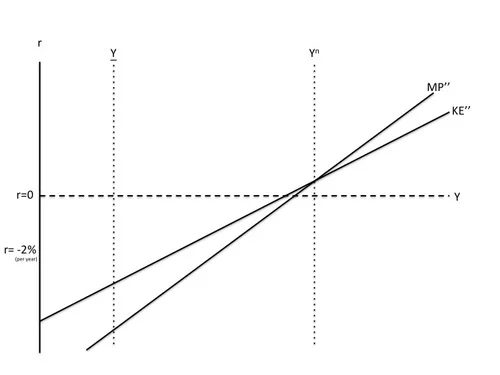
The slope of the KE curve shows how the perceived marginal efficiency of capital depends on the level of output. In addition to the KE curve having shifted down as a result of an increase in the risk premium (which has important irrational components) the risk premium pulls the marginal efficiency of investment down more when the economy is in a slump (a low level of output Y) and less when it is in a boom (a high level of output Y). In addition, as spell out for this framework in “The Medium-Run Natural Interest Rate and the Short-Run Natural Interest Rate,” it is more valuable to have extra capital when demand is high (a high level of Y) and less valuable to have extra capital when demand is low (a low level of Y). Both of these forces make the interest rate the central bank needs to choose to get the economy out of the slump quite low. And as JM Keynes suggests, a reduction in the perceived marginal efficiency of capital for any given level of output, which shows up as a shift downward in the whole KE curve, is often a precipitating force behind the slump in the first place. That gives a third reason it may require a very low interest rate for monetary policy alone to bring recovery. But as indicated by this graph, if the interest rate can go into deep negative territory there is no question that a low enough interest rate can bring the required economic stimulus. (The monetary policy curve “MP” specifies a very low interest rate when output is low. Although the level of output can still be low in the ultra-short run, for 9 months or so, this makes the natural level of output the only short-run equilibrium level of output.)

I have heard people say that no matter how low interest rates goes, it might not provide enough stimulus. But that is only because they have trouble imagining a world without the zero lower bound, in which the only thing limiting how far interest rates can go into subterranean depths is economic recovery itself. For many countries, the first thing that deep negative interest rates would do would be to cause a big increase in net exports, as the negative interest rates generated outward capital flows (see my post “International Finance: A Primer”). But that is in a situation in which that other countries have not yet broken through the zero lower bound, let’s discuss what would happen if all the major central banks went to deep negative interest rates during a worldwide slump. 

In my column “Monetary Policy and Financial Stability,” I title a section

Monetary Policy Works Through Raising Asset Prices, Loosening Borrowing Constraints, or Affecting the Exchange Rate.

I just put aside the effect on exchange rates by assuming that the major central banks are following each other’s interest rates down (so that the gaps between different countries’ interest rates that matter most for international capital flows, exchange rates, and trade flows remain at their usual level). But the effect of low interest rates on asset prices is in full force.

Higher Asset Prices: Higher asset prices both raise the consumption of those who own those assets and make it easier to raise funds by selling assets. The main limitation on the rise in asset prices that people may believe recovery will come soon, so interest rates will be low only for a short time. But that belief itself would help bring recovery, so that is not a limitation to the power of monetary policy. So let’s dig deeper into the case where people remain very pessimistic.

Even if people are running scared, so risk premia are very high, low enough interest rates will raise asset prices, but it might well be that at first it the prices of the few assets perceived as relatively safe that go up noticeably. Let’s say for the sake of argument, that it is only US government bonds that go up in price. If the US government were acting like a business, that should induce more government investment spending. (See my column with Noah Smith “One of the Biggest Threats to America’s Future Has the Easiest Fix” and my post “Capital Budgeting: The Powerpoint File.”)

But suppose that for political reasons that doesn’t happen. As the central bank pushes the interest rate down further, some other asset will rise enough in price that more investment will begin. It might be house prices for existing houses that go up. That would ignite more house construction. It might at first be only extra construction of luxury homes. But that extra house construction would nevertheless begin to pull the economy out of the slump. 

Now stack the deck against recovery more by supposing everyone has been so burned by a previous fall in house prices that they are unwilling to build new houses despite those high house prices. More generally, prevent refinancing of both mortgage and other household and business debt (much of which is short-maturity debt) by imagining a very high effective risk premium. Further, suppose that business investment also looks too dangerous. In that case, a set of assets whose price will rise is long-lived commodities. So, for example, employment in mining and geological exploration will increase. Of course, until this supply response has time to moderate the price movements the worldwide distribution of wealth will shift between those who have the long-lived commodities and those who need them will shift, but worldwide, there will be an increase in aggregate demand that makes it very difficult for the slump to persist.  

The Storage Option: Now suppose none of that is enough to get the economy out of the slump. At some point, consumers, who otherwise would earn deep negative interest rates in the bank, will decide to get a better return through buying nonperishable goods and storing them for later consumption. They will think of what they are doing as “saving,” but in the national accounts it will be spending that adds to aggregate demand. This physical storage option puts a hard limit on how low interest rates can go without generating a large increase in aggregate demand.

The same storage option operates in the business sector. Currently, many businesses have a lot of liquid assets that they are just sitting on. If those liquid assets were all earning a deep negative interest rate, businesses would realize they could get a better return through buying ahead on materials and equipment they knew they would need in the future–or simply things they planned to resell in the future.

To the extent that some households and businesses have substantial liquid assets, converting any substantial fraction of those assets into durable or storable goods would amount to raising spending far above income in an accounting sense, implying a very strong addition to aggregate demand.

Note that for anyone who has liquid assets to begin with, the attractiveness of the storage option does not depend on being able to get a loan from a bank. And many people must have liquid assets, since any debt in the world–including the large debts of governments–is owed to someone else in the world.

“Broken Banks”: Businesses and banks sitting on idle piles of liquid assets is a telltale symptom of the zero lower bound. Breaking through the zero lower bound restores the functioning of banks. Given negative interest rates those piles of liquid assets (after perhaps earning an initial capital gain), face a low rate of return going forward if they are left in that form. So the banks have to do something. They might simply get involved in financing storage, perhaps through a wholly-owned subsidiary if they didn’t trust anyone else with those funds. And as noted above, storage of long-lived goods alone can bring recovery. But chances are the banks would begin thinking about making loans for regular forms of investment. And the subset of businesses that have their own piles of liquid assets would also begin thinking about using their own money to invest.  

At the end of the day, low enough interest rates will bring recovery one way or another. If risk premia remained high enough, recovery could come through unusual channels, but it would come.  

Taming the Financial Cycle as Well as the Business Cycle–Returning to the Natural Level of Output Does Not Mean Everything is Rosy: By “economic recovery” I only mean returning the economy to the natural level of output. Because risk premia are strongly affected by whether the economy is in a boom or slump–as well as by the risk of a future slump–keeping the economy at the natural level of output through vigorous monetary policy would greatly reduce problems stemming from fluctuations in the risk premium, but wouldn’t eliminate them. Dealing with the remaining “financial cycle” calls for other measures. The first is high equity requirements (implemented by a 50% capital conservation buffer) so financial institutions are playing with their shareholder’s money (equity) rather than depending on taxpayers to bail them out in a pinch. The second is a sovereign wealth fund. (My most recent post on that is “How and Why to Avoid Mixing Monetary Policy and Fiscal Policy.” I collected links to my other posts on a sovereign wealth fund here.)

Why Not Just Do Everything Through Fiscal Policy Instead? I argue for the virtues of monetary policy over fiscal policy at length in my post “Monetary Policy vs. Fiscal Policy ….” To echo that post in brief,

  • while adding to the national debt is not as serious an issue as some economists would lead one to believe (1, 2) it is not a thing of no consequence to add to the national debt. 
  • with the exception of automatic stabilizers–such as taxes automatically going down and transfers automatically going up when income goes down–it is not easy for countercyclical fiscal policy to be handled technocratically, because taxes and spending have too much resonance with the long-run issues that divide the major political parties in most advanced countries.
  • technocratic countercyclical credit policy (which falls somewhere between monetary and fiscal policy) may be possible. The best implementation involves some form of required saving by households in good times with the ability to draw on that saving in a documentable personal emergency or in a recession.   

Answering Tomas Hirst

Having set the stage with the long discussion above, it is time to answer Tomas more directly.

What if Negative Rates Cause an Increase in the Risk Premium? Tomas is in agreement with what I write in “On the Great Recession,” until this point in his post “Negative Rate Shocks.”

Firstly, I think there is the issue of what we can know about the risk premium. It is possible, though not unproblematic, to establish “the gross rental rate of capital R net of the depreciation rate δ”, which would give us the non risk-adjusted KE curve. The risk adjustment, however, depends upon the demand outlook that has been thrown into uncertainty by the shock.

At the point of an economic shock squeezing the real interest rate by sharply dropping deposit rates could have the same effect as the fiscal authorities reducing automatic stabilisers. That is, an assumed support for demand would be removed causing a deterioration in the short term demand outlook. This in turn increases the necessary risk adjustment to the net rental rate and would force monetary authorities to push rates even lower.

If this analysis is right then the act of lowering rates below zero may be a causal factor driving the risk premium higher such that, even though it is not infinite, the real world experience of it under monetary dominance may appear just as if it was. Were investors to react to a central-bank-induced negative rate shock this way then the result could actually be to reduce risky investment even more.

On the Keynesian view, there is a large irrational component to the risk premium. Although I don’t know how big the irrational component of the risk premium is, I suspect it is substantial, and I worry about it. To the extent there is an irrational component to the risk premium, it is possible that it behaves in the way that Tomas suggests. But unless the risk premium increases more than 1-for-1 with declines in the interest rate into negative territory, lower the interest rate will still result in more stimulus. Even if a more than 1-for-1 increase in the risk premium overwhelms the decline in the interest rate at first, it is very unlikely that the risk-premium would respond in a more than 1-for-1 way beyond a certain point. There is likely to be an effective maximum to the risk premium, at least for some projects for which likely outcomes are especially easy to calculate. Storage is one type of project for which the likely outcome is easier to calculate than for more complex investments. But there are bound to be other investment projects for which the outcome has only so much uncertainty to it. No matter how large, any finite level of perceived risk can be overcome by a low enough interest rate.

The most likely side effect of negative interest rates in a bad case is that the channels of stimulus that start to work first are not the most desirable ones. But they will work. And once the economy returns to the natural level of output, the composition of aggregate demand is likely to normalize. (More regular people will have jobs and feel enough confidence to begin spending. More regular businesses will have customers, and feel enough confidence to begin investing.) 

In saying all of this, it is important to point out that to deal with the worst case scenario I am assuming a resolute central bank that understands this logic. In the real world, I believe that even a pioneering, but still feckless central bank that went to a minus -1.5% interest rate and wasn’t prepared to go any further down would see enough of a kickstart to aggregate demand that things would soon be headed in a positive direction. To understand that claim, it is important to realize that the first central bank to break through the zero lower bound would get the increase in aggregate demand from an increase in net exports since the other central banks would not yet be prepared to follow it down with their own target rates. It would only be after negative interest rates got the reputation for working in this way, that the other issues I raise above come into play. So by the time enough of the major central banks are using negative interest rates that the stimulus channel through net exports is cancelled out, negative interest rates would have a reputation for working that is likely to persuade many of the irrational economic actors.  

This net export effect of negative interest rates is nicely analogous to going off the gold standard during the Great Depression. During a major slump, going off the gold standard allows an increase in the money supply and so is helpful even when all nations do it. It is not just a zero-sum game. But the fact that the first countries to go off gold got an extra boost to aggregate demand from an increase in net exports helped persuade other countries to go off gold, and helped investors believe that going off gold would help.  

What If Investors Shift Into Alternative Safe-Haven Assets? In his post, Tomas continues with a comment of Francis Coppola:

My colleague, Frances Coppola, suggests a further problem. Faced with negative nominal rates investors could be tempted to abandon interest-bearing instruments all together and rush into alternative safe haven assets. These could be traditional assets like gold or other commodities (potentially including digital commodities such as crypto-currencies e.g. Bitcoin).

As I have argued above, the rise in asset prices would still eventually raise aggregate demand. More gold mining is to me one of the worst forms of aggregate demand, but it still provides some stimulus. The net export channel arises from pouring investable funds into foreign assets. And it is important to remember that anyone who buys assets puts money into the hands of the one selling those assets. That seller then has to do something with that money. So a rise in the price of assets doesn’t absorb and “use up” the stimulus. Rather, it ultimately reflects the stimulus back onto the real economy. In an initially tough economy, the rise in asset prices might be much more striking than the improvement in the real economy, but both will be there.

What If Negative Interest Rates Increase Perceived Interest-Rate Risk? Finally, Tomas writes:

Moreover, investment may be made in the present but it necessarily incorporates expectations about the future. Lowering the discount rate by pushing down the risk free rate leads to greater uncertainty around the net present value of investment opportunities. Lowering r means a lower discount of the future, which implies more uncertainty about the future is priced into current asset values. (My thanks to @richdhw for that one)

Increasing uncertainty over the future value of investment opportunities could discourage companies from committing money to new projects, especially if the short-term demand outlook remains highly uncertain.

I take this to say that large movements in interest rates can themselves cause a great deal of uncertainty and raise risk premia. But the possibility that interest rates might be very low (in real terms), can only raise the value of an asset. Breaking through the zero lower bound doesn’t do anything to raise the upper end of plausible values of the real interest rate. 

To see the logic here, suppose I told you that your chances of failure in a business venture were the same, but that now, in addition to the possibility of modest success, you now had a significant chance of truly striking it rich. This new upside risk raises the variance of the possible outcomes you face, so it could indeed raise the risk premium. But by raising the mean return as well, it has to raise the overall attractiveness of the business venture! Similarly, for a straightforward investment project, increasing the chances for very low (real) interest rates at the bottom end while keeping unchanged the likely possibilities for interest rates at the high end can only increase the present value of that project.

What If Uncertainty about the Course or Effectiveness of the New Policy Induces a Wait-and-See Attitude on the Part of Firms? For those who think that uncertainty will cause firms to wait and see what will happen next (which I suspect includes Tomas, given his other comments), let me point out that all along in “The Medium-Run Natural Interest Rate and the Short-Run Natural Interest Rate,” and “On the Great Recession,” I am working primarily with the delay condition: under what circumstances will a firm choose to delay investing until next year. If a large amount of uncertainty will be resolved between this year and next, that is a powerful force making a firm want to delay investment in a wait-and-see mode. But a low interest rate is a powerful force making firms want to invest sooner–one that can overwhelm any wait-and-see motivation, if the central bank continues to feel for the interest rate that will restart investment.  

Conclusion: The Long-Run Benefits of Breaking Through the Zero Lower Bound: The graph I used in “Janet Yellen is Hardly a Dove—She Knows the US Economy Needs Some Unemployment” to show the Great Moderation between the mid-1980’s and the beginning of the Great Recession indicates some of the benefits I expect from eliminating the zero lower bound:
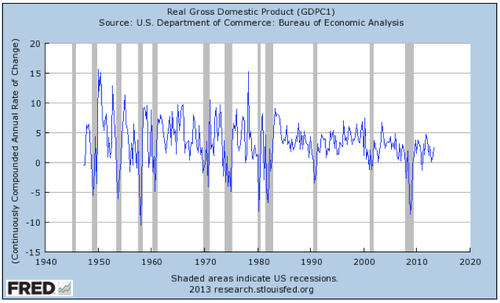
If we eliminate zero lower bound, we can return to what we saw in the Great Moderation. That does not require perfect monetary policy, only for central banks to choose target interest rates in the way they are used to without being stopped short by the question of whether those target interest rates are positive or negative.

Over time, I expect to see some improvements in monetary policy beyond the quality of monetary policy during the Great Moderation. For example, the opportunity that breaking through the zero lower bound gives to bring inflation down to zero is likely to tug monetary policy toward price-level targeting rather than inflation targeting. And I hope the kind of research I pursued with Susanto Basu and John Fernald in “Are Technology Improvements Contractionary?” ultimately leads central banks to do better in responding to technology shocks, striving to keep output at the natural level even when that natural level shifts. And as I argued in “Meet the Fed’s New Intellectual Powerhouse” it would be a big improvement to routinely adjust the target rate for observed risk premia to keep commercial rates at appropriate levels.  

But the benefits of breaking through the zero lower bound so that output can be kept close to its natural level go far beyond the direct benefits and the benefits of bringing inflation down to zero. With output closely tracking its natural level and inflation zero, both voters and government officials will make the natural level of output and its determinants much more salient, without the distraction of large business cycles from suboptimal monetary policy. That higher level of salience of the natural level of output will cause voters and government officials to focus more on supply-side measures to raise the natural level of output and on ways to expand measures of economic performance to the kind of disciplined measures of broader national well-being like those I will continue to discuss on my happiness sub-blog.


Noah Smith: Original Sin


A new survey indicates that Germany is the most popular country on the planet. Whatever the reasons for that, and whatever the survey’s scientific shortcomings it strikes me as a very good sign. It hints that the world no longer stereotypes Germany as “those guys who tried to conquer the world and kill all the Jews back in the early 20th century”.

I have never been a big fan of collective ancestral guilt. There seems to me to be no benefit in holding people responsible for what their ancestors did. My reasons for thinking this are threefold:

1. It makes people unnecessarily sad. I have a German professor friend whose grandfather was an officer in the S.S. When she hears about the Holocaust or other Nazi atrocities, she breaks down crying. It’s good for people to remember and learn about past atrocities and feel a bit bad when hearing or thinking about them - that is how we prevent future atrocities. But the degree of guilt and sadness my friend feels is huge overkill. 

2. It strikes me as grossly unfair. Consider my German professor friend. Why should she have to feel bad about something that she didn’t do? I’m sure I have ancestors who ate babies, tortured people, etc. etc. Why should my German friend bear more than her fair share of the responsibility of remembering, and feeling guilty and bad about, humanity’s past atrocities, just because her evil ancestors lived more recently than my evil ancestors?

3. It perpetuates a cycle of group hatreds. At some point in the past, all of our ancestors did terrible things to all of our other ancestors. If we were able to maintain all those feuds, every member of every race, religion, ethnicity, and nationality on the planet would hate every other member of every other race, religion, ethnicity, and nationality on the planet. A universe of Hatfields and McCoys. Who needs that?? 

Anyway, it occurs to me that the question of collective ancestral guilt for things like the World Wars and the Holocaust is really the question of Original Sin. One of the interesting parts of David Graeber’s Debt: The First 5,000 Years was his discussion of the idea that people are born with debts to society that need to be repaid. The religious idea of Original Sin is the idea that we owe God a blood debt - not just our lives, but our infinite afterlives - because Adam and Eve disobeyed God and ate a forbidden fruit.  

Even putting aside the oddity of the question of why this punishment is proportional to the crime, it seems wrong to me that any person should be held accountable, even by God, for something someone else did. From the first time I heard about the idea of Original Sin, I thought it was utterly and irredeemably absurd. 

My attitude is a result of our species’ great transition from collectivism to individualism. 

But it also strikes me that there is a way in which Original Sin, in a slightly modified form, can be a useful, good concept in a modern, individualistic society. All humans have the capacity to do evil things, and we need to remember that fact. What World War 2 taught us is not that Germans are evil, it’s that any people can become evil in the right situation. Every one of us carries the potential for cruelty, sadism, callousness, and barbarism in his or her brain, inherited from our real-life Adams and Eves.  

We don’t owe God a blood debt. We don’t bear responsibility for the crimes of our ancestors. But we do have something dark within us, always straining to get out, always testing its strength against the bonds of empathy, morality, and society that constrain it. We must always keep this Beast in check - not by lamenting the sins of our ancestors, but by imagining all our own possible future sins, and making sure that they never happen.

Quartz #53—>Why You Should Care About Other People's Kids as Much as Your Own

tumblr_inline_nezmuu1oKT1r57lmx.png

Link to the Column on Quartz

Here is the full text of my 53d Quartz column, “Why you should care about other people’s kids as much as your own,” now brought home to supplysideliberal.com. It was first published on October 12, 2014. Links to all my other columns can be found here.

This column doesn’t just say we should care, it gives a plan for getting there. In particular, how we handle long-run fiscal policy can make a big difference to the level of altruism in our nation.

If you want to mirror the content of this post on another site, that is possible for a limited time if you read the legal notice at this link and include both a link to the original Quartz column and the following copyright notice:

© October 12, 2014: Miles Kimball, as first published on Quartz. Used by permission according to a temporary nonexclusive license expiring June 30, 2017. All rights reserved.


The remarkable popularity of Danielle and Astro Teller’s essay “How American parenting is killing the American marriage” points to an incipient backlash against the cult of parenthood.

But if there is going to be a backlash against the cult of parenthood, I hope it is the right backlash. To me, the problem here is not at all the elevation of child rearing. After all, those who are children today really are the future of our species and our civilization, as I wrote in my Christmas column last year: “That baby born in Bethlehem should inspire society to keep redeeming itself.” What deserves a backlash is the elevation of my child or your child over everyone else’s children, and over all the adults who hold things together and move things forward until those who are now children are ready to run things.

Among the middle-aged, the most common type of thoroughgoing selfishness is not “Me, me, me,” but “my, my, my” on behalf of a precious daughter or son. But isn’t this just human nature? Isn’t it just tilting against windmills in the grand tradition of Don Quixote to inveigh against the extreme favoritism people exhibit towards their own children? Actually, no.  As adult human beings, how many children we care about, and how much, is a curiously malleable aspect of our personalities. People love their adopted children dearly. And it is hard to coach a soccer team, be a Cub Scout den leader, or run a math club without starting to care about the kids one works with.

Growing up, I was often told “You love those whom you serve.”  That is a true principle of psychology. If you help someone out without too much of an ulterior motive, parts of your brain outside the localized glow of consciousness start trying to make sense of why you are being so nice. A handy explanation for your subconscious to turn to is that whoever it is means something to you. And this process of what in economists’ jargon would be called “developing a new altruistic link” works even if you know full well that it is happening. I remember when bargaining with the head of my department over the terms on which I would serve (a now completed term) as director of our Masters of Applied Economics program knowing that I had to be ready for a situation in which I would come to care about those students, even though I didn’t know them yet.

Community and religious organizations that get people involved in helping others—especially when they get people involved in helping others who are in especially bad situations—do a lot to help generate new altruistic links that make the world a fairer, more benevolent place in ways that come easily to us, psychologically, after getting over the initial hump of dealing with someone new. Strangers become friends. And our friends’ problems become our own.

Even government policy can help. Paying taxes does very little toward making us care about those who are helped from those tax revenues. But if, instead of raising taxes, we insisted that those who are comfortable contribute a substantial amount to a charity of their choice, as I advocated in my column “Yes, there is an alternative to austerity versus spending: Reinvigorate America’s nonprofits,” we would care more. And caring more, we would be likely to volunteer our time as well as giving money. And best of all, our children would see us helping other people’s children, and learn early on that loving others—even beyond our own families—is what brings us to the highest level of our own humanity.

Richard V. Reeves, Isabel Sawhill and Kimberly Howard: The Parenting Gap

This is a long, but thoughtful and valuable read. Here is an interesting passage to whet your appetite:

… parents without a high-school diploma spent more than twice as much time each day with their children in the 2000s than they did in the mid-1970s, according to data from the American Heritage Time Use Study, marshaled by Harvard’s Robert Putnam. But parents with at least a bachelor’s degree increased their investment of time more than fourfold over the same period, opening up a gap in time spent with kids, especially in the preschool years.

The quality of time matters as much as the quantity of time, of course. In a famous study from the mid-1990s, Betty Hart and Todd R. Risley from the University of Kansas found large gaps in the amount of conversation by social and economic background. Children in families on welfare heard about 600 words per hour, working-class children heard 1,200 words, while children from professional families heard 2,100 words. By the age of three, Hart and Risley estimated, a poor child would have heard 30 million fewer words at home than one from a professional family.

I heard about this post from Matt O'Brien's Wonkblog article “Poor kids who do everything right don’t do better than rich kids who do everything wrong.” 

If grown persons are to be punished for not taking proper care of themselves, I would rather it were for their own sake, than under pretence of preventing them from impairing their capacity of rendering to society benefits which society does not pretend it has a right to exact.

– John Stuart Mill, On Liberty, Chapter IV, “Of the Limits to the Authority of Society over the Individual,” paragraph 11

Susan Athey on Bitcoin as a Medium of Exchange

Susan Athey is one of my favorite economists. I hadn’t realized that she was a go-to person for journalists who want some perspective on Bitcoin until seeing her when she came to the University of Michigan last week.  

Michael Hiltzik's Los Angeles Times article “Bye-bye, bitcoin? The crypto-currency’s price agonies intensify” has a quotation from Susan Athey that closely matches my view:

For those who use bitcoins as transactional instruments–that is, to move money in and out of currencies or across national borders without financial authorities interfering–the price might be irrelevant. That’s the view of Stanford University economist Susan Athey, an expert in crypto-currencies. Athey told us last year that if you’re selling goods in bitcoins and exchanging them for dollars, or trying to transfer your wealth from yuan in Beijing to euros in Frankfort, “in principle, you need to only worry about the exchange rate for 10 minutes…. The point is that we have a new technology that allows any individual in the world to send value from one place to another instantly, in a way that’s secure and verifiable.”

You can see my take on a closely related point in answer to a question at the Cryptocurrency conference I spoke at last February in the video post “Cryptocurrencies: Is the Dollar Doomed? Video of a Discussion Between Miles Kimball, Justin Wolfers and Matt Yglesias on Electronic Money.” At that conference and in the associated Slate article “Governments Can and Should Beat Bitcoin at Its Own Game,” I emphasized that central banks will continue to be needed in order to manage the unit of account for price stability and for keeping output close to its natural level. And to put a point on it, because of its inevitable price fluctuations relative to other goods and services, Bitcoin would be a terrible unit of account. However (as I said in answer to a question) there is no serious monetary policy problem raised by having a non-governmental such as Bitcoin in a widespread medium-of-exchange role, as long as it does not become a unit of account. Since whenever Bitcoin is used, there is a computer handy to do the conversion between the number of Bitcoins and the number of dollars or other unit of account, I don’t see any reason why the unit of account function and medium-of-exchange function can’t be separated in this case.   

Students in introductory economics courses traditionally learn that the three functions of money are as 

  1. medium-of-exchange
  2. store of value
  3. unit of account

Of these three, what is most important for monetary policy is the unit-of-account function–or perhaps if more closely analyzed, the closely related function of being the unit of price stickiness. Monetary policy may require some medium-of-exchange and store of value aspect to official money, but it does not require an official monopoly, or even near monopoly of the medium-of-exchange or store-of-value functions. But monetary policy would be very difficult if a central bank did not have a near monopoly on the unit of account function within its region.

Could the European Central Bank be Preparing to Break Through the Zero Lower Bound?

Photo of one of the European Central Bank buildings that I took when I visited. I give full permission to anyone to use this photo as long as they link to this post.

Photo of one of the European Central Bank buildings that I took when I visited. I give full permission to anyone to use this photo as long as they link to this post.

In Brian Blackstone’s November 6, 2014 Wall Street Journal article “ECB Unites on Possible Further Stimulus,” after discussing the planned $1 Trillion euro chunk of balance sheet expansion that is on its way, Brian says this:

The ECB left its main rate—the rate that it charges commercial banks on its regular loans—at a record low 0.05% as expected.

However, Mr. Draghi said ECB staff and committees have been asked to ensure “the timely preparation of further measures to be implemented, if needed.” He added that ECB staff and committees have a proven record of delivering what they have been asked to do, an indication that the ECB is prepared to act on their recommendations if necessary.  

Could these further measures being prepared by the staff include a negative paper currency interest rate (implemented by a time-varying paper currency deposit window at central bank cash windows)? I hope so. Key staff members were certainly there in my ECB seminar on “Breaking Through the Zero Lower Bound” in July.    

Let me say that if the ECB does break through the zero lower bound, those who are influential in making that happen within the ECB will easily deserve a supplysideliberal.com designation as heroes of humanity if they pursue such a policy resolutely, as called for.

Note: My bibliographic post “How and Why to Eliminate the Zero Lower Bound: A Reader’s Guide” now has a section on “News and Trends.”

John Stuart Mill on Raising the Next Generation

In the nature vs. nurture debate it is common to look at the fraction of the variation in outcomes due to genetic factors “nature”), and the fraction of variation in outcomes due to other factors (“nurture” + other things). Noah Smith and I discuss these kinds of comparisons in “There’s One Key Difference Between Kids Who Excel at Math and Those Who Don’t” and I look at them even more closely in “How to Turn Every Child into a ‘Math Person.’” The thing people often don’t realize is that how much of the variation in outcomes is due to genes and how much is due to upbringing are as much a reflection of how much genes and upbringing vary in the population of interest as it is about the strength of the effects of genes and upbringing.

For example, the fraction of the variation accounted for by genes is much, much larger if one is looking at many species than if one is only looking only at members of one species: homo sapiens. The reason racist views about the genes of different ethnic groups are wrong is that Homo sapiens descended from a small group of common ancestors not that long ago at a time when only a few humans were left, and there has been a lot of mixing of the gene pool in the thousands of years since. The otherwise tragic extinction of Homo floresiensis 12,000 or so years ago saves us from serious racism against a relative much closer than chimpanzees, but distant enough that claims of substantial genetic differences would actually be true. 

Focusing in on nurture, the fraction of the variation accounted for by upbringing is less if one is looking at the population of adopted kids (say identical twins adopted into different families), simply because adoption agencies try and to some extent succeed at screening out the lower tail of people who would be bad parents (along with screening out many people who would be great parents). At the other extreme, the striking differences in human behavior across cultures have to be attributed mostly to differences in upbringing.

Differences in human behavior are so large between different cultures because the influences of everyone else in the society–and the structure of the society itself–are added to the influences of parents. Psychologists often emphasize how much people’s behavior is affected by the situations they are in. But the situations they are in have a lot to do with the culture they are in. 

I emphasized in my column “Why You Should Care about Other People’s Children as Much as Your Own” that how we set up our culture has a big effect on how children turn out. It is our responsibility as adults to make sure that the next generation is better than we are. This view is one I share with John Stuart Mill. He emphasizes the importance of how a society raises its children and how effective its power can be in that child-rearing in On LibertyChapter IV, “Of the Limits to the Authority of Society over the Individual” paragraph 11:

But with regard to the merely contingent, or, as it may be called, constructive injury which a person causes to society, by conduct which neither violates any specific duty to the public, nor occasions perceptible hurt to any assignable individual except himself; the inconvenience is one which society can afford to bear, for the sake of the greater good of human freedom. … But I cannot consent to argue the point as if society had no means of bringing its weaker members up to its ordinary standard of rational conduct, except waiting till they do something irrational, and then punishing them, legally or morally, for it. Society has had absolute power over them during all the early portion of their existence: it has had the whole period of childhood and nonage in which to try whether it could make them capable of rational conduct in life. The existing generation is master both of the training and the entire circumstances of the generation to come; it cannot indeed make them perfectly wise and good, because it is itself so lamentably deficient in goodness and wisdom; and its best efforts are not always, in individual cases, its most successful ones; but it is perfectly well able to make the rising generation, as a whole, as good as, and a little better than, itself. If society lets any considerable number of its members grow up mere children, incapable of being acted on by rational consideration of distant motives, society has itself to blame for the consequences. Armed not only with all the powers of education, but with the ascendancy which the authority of a received opinion always exercises over the minds who are least fitted to judge for themselves; and aided by the natural penalties which cannot be prevented from falling on those who incur the distaste or the contempt of those who know them; let not society pretend that it needs, besides all this, the power to issue commands and enforce obedience in the personal concerns of individuals, in which, on all principles of justice and policy, the decision ought to rest with those who are to abide the consequences.

In other words, society should fight self-destructive behavior with good education and child-rearing.

Stupid Criminals

My Dad is an emeritus law professor who specialized in criminal law. One thing I often heard from him is that criminals don’t always fully optimize. The video above, via isomorphismes, is in that vein. Also, but googling “stupid criminals,” I quickly found this entertaining post

Here are the musings of isomorphismes on the video above:

If people are rational and self-interested, why do they incriminate themselves after being Mirandised?

After minute 31 an experienced Virginia Beach interrogator-cum-3L explains how he convinces criminals to confess, against their interest, even after advising them that “Anything you say may be used in court”.

Especially after minute 34, 36, 38, 39, 40, 45, 47 he explains how he has outsmarted several criminal archetypes over 28 years.

Also check the interrogator’s view (at min 45) on cultural prejudice and presumption of guilt in Virginia Beach criminal court.

ASSET BUBBLES

In a 1985 paper, [Jean Tirole] offered three conditions needed to create a bubble: durability, scarcity and common beliefs. ‘The possibility of creating too much’ of an asset ‘may prevent bubbles,’ he wrote. ‘The scarcity requirement explains why, at first sight, bubbles often affect assets that for historical reasons cannot be reproduced.’

– Nick Timiraos and Charles Duxbury, in the Wall Street Journal article “5 Contributions to Economics from Nobel Winner Jean Tirole

Ricardo Hausman: The Tacit Knowledge Economy

The trouble with this illustration from Shawn Callahan’s post “What do we mean by tacit knowledge” is that it emphasizes only the difficulties of recording knowledge. Economically, the difficulties of getting knowledge into someone’s head are a…

The trouble with this illustration from Shawn Callahan’s post “What do we mean by tacit knowledge” is that it emphasizes only the difficulties of recording knowledge. Economically, the difficulties of getting knowledge into someone’s head are at least as important a difficulty and getting knowledge out of someone’s head.

 I highly recommend Ricardo Hausman’s post “The Tacit Knowledge Economy.” Ricardo poses the following revealing puzzle:

Brazil in 2010 was 84.3% urban; its fertility rate was 1.8 births per woman; its labor force had an average of 7.2 years of schooling; and its university graduates accounted for 5.2% of potential workers. These are better social indicators than the United Kingdom had in 1960. …

Brazil is not a unique case: Colombia, Tunisia, Turkey, and Indonesia in 2010 compare favorably to Japan, France, the Netherlands, and Italy, respectively, in 1960. Not only did these countries achieve better social indicators in these dimensions; they also could benefit from the technological innovations of the past half-century: computers, cellphones, the Internet, Teflon, and so on. …

So today’s emerging-market economies should be richer than today’s advanced economies were back then, right?

Wrong – and by a substantial margin. …

Why can’t today’s emerging markets replicate levels of productivity that were achieved in countries with worse social indicators and much older technologies?

Ricardo proposes this answer to the puzzle: 

The key to this puzzle is tacit knowledge. To make stuff, you need to know how to make it, and this knowledge is, to a large extent, latent – not available in books, but stored in the brains of those who need to use it.

Getting it there is really tough. 

You can see my take on this theme of difficult-to-transfer knowledge in one of my favorite posts, “Two Types of Knowledge: Human Capital and Information.” Here is the key idea there:

Human capital is knowledge that is hard to transfer.

Information is knowledge that is easy to transfer.

Electronic Money: The Travelogue

Link to Gail’s blog on Tumblr: gailkimball.tumblr.com. Photo of Miles and Gail in front of the Basilica di Santa Maria del Fiore in Florence.

Link to Gail’s blog on Tumblr: gailkimball.tumblr.com. Photo of Miles and Gail in front of the Basilica di Santa Maria del Fiore in Florence.

Unlike the case for my ancestors, who crossed land and sea to preach Mormonism without purse or scrip, traveling the world to urge the abolition of the zero lower bound has not been a personal hardship for me. On the contrary, it has been a very pleasant experience, both because of the people I have met and the cities I have been able to see.

I have been especially lucky to have my wife Gail travel with me on many of my journeys. In her own blog, Gail has documented many of the journeys we have taken together. Below, I copied over the list from “Electronic Money: The Powerpoint File” of places I have given my presentation “Breaking Through the Zero Lower Bound,” with links to Gail’s posts on the relevant cities for which she has written a post. I plan to keep the list below update as we continue our travels and as Gail has a chance to write more posts. 

  • Bank of England (London, 1,2,3,4), May 20, 2013
  • Bank of Japan (Tokyo, 1,2,3,4,5,6,7), June 18, 2013
  • Keio University, June 21, 2013
  • Japan’s Ministry of Finance, June 24, 2013
  • University of Copenhagen, September 5, 2013
  • National Bank of Denmark, September 6, 2013
  • Ecole Polytechnique (Paris), September 10, 2013
  • University of Paris, September 12, 2013
  • Banque de France, September 13, 2013
  • Federal Reserve Board, November 1, 2013
  • US Treasury, May 19, 2014
  • European Central Bank, July 7, 2014
  • Bundesbank, July 8, 2014
  • Bank of Italy, July 11, 2014
  • Swiss National Bank, July 15, 2014
  • Society for the Advancement of Economic Theory Conference in Tokyo (1,2,3,4,5,6,7,8,9,10,11), August 20, 2014
  • Princeton University (1,2), October 13, 2014
  • Federal Reserve Bank of New York (1,2,3,4,5,6,7,8,9), October 15, 2014
  • New York University (1,2,3), October 17, 2014
  • European University Institute, (Florence1,2,3,4,5,6,7), October 29, 2014
  • Qatar Central Bank and Texas A&M University at Qatar joint seminar, November 17, 2014

For completeness, let me mention that Gail has posts on several cities where we traveled without me presenting “Breaking Through the Zero Lower Bound.” Here is the list. For those of you interested in the Economics of Happiness, I put in bold the cities where I gave my presentation on “Utility and Happiness” (related to work I write about on my happiness sub-blog): 

Brian Blackstone Doubles Down on a Big Mistake in Reporting on Monetary Policy

I think it is a pity that (with the possible exception of his transitive flagging of “Larry Summers Just Confirmed that He is Still a Heavyweight on Economic Policy” through Brad DeLong in his op-ed “A Permanent Slump”) Paul Krugman continues to talk as if the zero lower bound is a law of nature, rather than a policy choice. At least Paul has the potential excuse that he is writing on the opinion page, and is making a strategic choice about how he can best affect policies in the directions he wants to affect them. But Brian Blackstone is the Wall Street Journal’s news reporter in Frankfurt, who specializes in reporting on the actions of the European Central Bank; when he says uncritically in his November 2 article “European Central Bank’s Bond Conundrum” that 

ECB interest rates can’t go lower.

without any qualification, that is just bad reporting.

When I gave my presentation “Breaking Through the Zero Lower Bound” at the ECB in July, the staff there took very seriously the idea that a time-varying paper currency deposit fee as I advocate in that presentation could allow the ECB to cut its target rate to -1.25% immediately. They realized that was a big deal and not an easy policy choice to make, both because it would be something unprecedented, and because it touches several political nerves. But there was much less dispute over whether it would work than I see about whether quantitative easing can stimulate the eurozone economy enough. And if there are any limitations on the ECB’s authority that would prevent such an action, no one there pointed to such a limitation. 

Brian was within the scope of my previous criticism of reporting in my post “The Wall Street Journal’s Big Page One Monetary Policy Mistake,” which makes the case for the newsworthiness of my proposal to make deep negative interest rates possible for the ECB with a time-varying paper currency deposit fee at the cash windows in the ECB and other banks in the European System of Central Banks. I would be delighted to talk to him directly about that proposal.

In general, reporting what government agencies can do, but choose not to, is helpful by holding them to account. Just so, I believe that matter-of-fact reporting that the ECB could make deep cuts in its interest rate, but so far chooses not to, would help make the ECB accountable–which in turn would better policy more likely. And if the ECB faces any limitations on its authority that would prevent the kind of policy I advocate, reporting on those limitations would help people understand what the issue is. So it matters.  

See my annotated bibliography on what I have written about employing negative interest rates in my post “How and Why to Eliminate the Zero Lower Bound.”

Adam Mossoff: The “Common Law Property” Myth in the Libertarian Critique of IP Rights, Part 1

I am posting this link to Part 1 of Adam Mossoff’s post on the history of copyright law because I think our copyright law is too restrictive. My interest in copyright policy can also be seen in my post “Copyright,” and from the link post that I am reproducing in full below: 

The Wonderful, Now Suppressed, Republican Study Committee Brief on Copyright Law

This is an excellent policy brief that is a well-written, fast, easy read. You can still see it thanks to Maryland Pirates.  Alex Tabarrok flagged it here. And Matthew Yglesias has a great discussion of the politics and the economic merits in his post “The Case of the Vanishing Policy Memo.” But on the economic merits, the policy brief speaks well for itself.

Truth or Consequences

One of my highest allegiances is to truth. (Except in the title and at the beginning of sentences, and toward the end of this one, I will use the lowercase “truth” because many groups capitalize “Truth” to refer to things that are not true at all.) The Mormonism I was raised in teaches that fidelity to truth is a higher value even than fidelity to Mormonism. It does so in a way many Mormons don’t recognize by the frequent avowal that “The Church is true.” If truth can validate Mormonism, then truth can judge Mormonism; and if there is ever a parting of ways between truth and a religion, so much the worse for that religion.

This past week, I thought again about allegiance to truth when I heard that there was a ban on federal funding on research about the effects of guns. I was relieved to find that President Barack Obama had lifted that ban in January, 2013, But there are many who would like to reinstate a ban on federal funding of gun research.

In my personal life, in order to keep myself from avoiding the truth, I often say to myself: “Whatever you decide is true, you don’t necessarily have to do anything about it,” lest fear of what I should do given certain findings tempt me to not find out the truth. In this context, let me say clearly that even if we find that guns are very damaging, it doesn’t mean that we have to tighten controls over them, and even if we find that guns are not very damaging at all, it doesn’t mean we have to loosen controls over them even further. Let’s find out what is true, and then argue over what to do about it. 

Also, let’s not let our own failings in relation to the truth compromise our allegiance to the truth. We are all imperfect, and most of us at least occasionally tell lies. But let us nevertheless strive to set up social structures that avoid leading us into the temptation to tell lies, and that make it less likely that others will tell us lies.  

Though no one is perfect, a simple way to increase one’s incentives to tell the truth is to advocate in favor of truth-telling: the costs of lying oneself are higher when one has scolded others for lying. If your psychological makeup is of the standard variety, putting oneself at risk of the accusation of hypocrisy, one is likely to think twice about telling a lie in any particular circumstance.   

As I wrote in my column “Judging the Nations: Wealth and Happiness Are Not Enough,” in a stiff competition of well over 100 different characteristics of a nation, Dan Benjamin, Ori Heffetz, Nichole Szembrot and I found that the one people on average valued the most was

freedom from injustice, corruption, and abuse of power in your nation

and eighth most valued characteristic was 

people’s freedom from being lied to, deceived or betrayed.

People hate being lied to, and they hate the injustice, corruption and abuse of power that tend to go along with official lying. 

In order to find out the truth, careful research is often necessary. In some cases, that research is done by journalists. In other cases, it is done by scientists. When scientists make the case that they should be supported in their efforts to discover the truth, it is important that they in fact be devoted to finding out the truth, regardless of whether the truth fits in with their personal ideology or not. Given the subtle ways in which our subconscious minds steer us toward reinforcing our own preexistent biases, if we ever allow ourselves to consciously suppress things in order to further our side of the debate, we are in deadly quicksand. And whenever we lie in public to further our side of a scientific debate, we have gone far, far over the line, and deserve to be reprimanded severely. (And having previously subjected oneself to a financial temptation to lie in public debate provides no valid excuse for lying.)

Though it doesn’t always work this way, I think a fascination with the math behind applied statistics can be an aid in keeping one honest in empirical research. The love of that math can distract one at crucial moments from the temptation to follow one’s ideological prejudices. Also, it may well be that having just a touch of Asperger’s syndrome on the autism spectrum is protective against the temptation to follow one’s own ideological biases. And having techy friends to answer to who care more about getting the statistics right than getting the ideologically correct answer can also help.

As economists (speaking to those of you who are economists), let us work to strengthen the social pressure we put on each other to tell the truth in both shallow and deep ways. And as human beings, let us work to reduce the temptation we and others face to tell lies. I think we make ourselves less than we might otherwise be when our allegiance to the truth wavers. Let us instead make ourselves more.