Quartz #51—>Italy Should Look to Ancient Rome to Reform Its Ineffective Senate
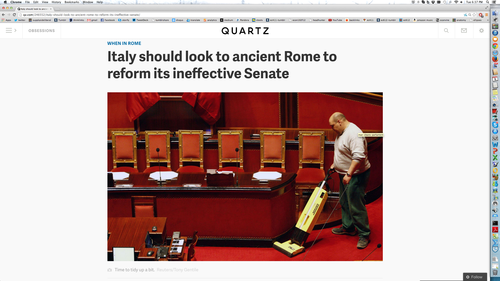
Here is the full text of my 51st Quartz column, "Italy should look to ancient Rome to reform its ineffective Senate,“ now brought home to supplysideliberal.com. It was first published on August 8, 2014. Links to all my other columns can be found here.
The idea for this column emerged during my trip to Rome, when I talked to Luigi Guiso about the economic and political situation in Italy. I wanted to thank him for all of his insights. Don’t construe that as his endorsement of my proposal, though!
If you want to mirror the content of this post on another site, that is possible for a limited time if you read the legal notice at this link and include both a link to the original Quartz column and the following copyright notice:
© August 8, 2014: Miles Kimball, as first published on Quartz. Used by permission according to a temporary nonexclusive license expiring June 30, 2017. All rights reserved.
The prime minister of Italy, Matteo Renzi, wants to miniaturize the Italian Senate—both in number of senators and in power. Under Renzi’s reform plan, senators would be appointed by regional councils and have no power to approve budgets, pass most national laws, or hold a no confidence vote on the government.
One of the touted motivations is to save money: the equivalent of about $58 million in salaries, plus pension benefits. But even if it all added up to $100 million a year total, that would be only .005% of Italy’s $2 trillion a year economy. Any pluses or minuses for governance have to vastly outweigh the direct cost savings, so the issue should be thought of primarily as a constitutional issue, not a budgetary issue.
Italian senators are resisting. They have introduced almost 8000 amendments to Renzi’s reform bill to put the brakes on this constitutional change. This trench warfare was predictable. Back in March, James Mackenzie explained in Reuters that Renzi’s plan “to transform the Senate into a non-elected chamber stripped of the power to approve budgets or hold votes of no-confidence in a government” would meet stiff opposition:
[Renzi’s] bill would scrap the current fragmented system, which grants equal powers to the Senate and the lower house Chamber of Deputies but elects them by different rules which make it hard for any group to win a stable overall majority in parliament. …
But despite loud public calls for change from all sides of the political spectrum, the reform is expected to encounter strong opposition from many in the 320-strong upper house who will have to vote to scrap their own jobs.
Italian blogger Roberta Damiani gives an excellent primer on Renzi’s reform plan for the Italian Senate. She explains:
Currently, Italy has a system known as “perfect bicameralism”: both chambers are directly elected during the same general election, and have exactly the same authority on every matter, including monetary ones. This is really rare, especially in parliamentary systems; Italy and Romania are indeed the only two countries in the EU with such a system.
Such a system makes it hard to pass legislation. Right after Italy’s Fascist era under Mussolini, it made sense to make it hard for the government to do anything big. But now, when Italy faces a host of economic problems, that need imaginative solutions, it is a problem.
Ancient Rome provides the inspiration for a very different reform of the Italian Senate—a reform that doesn’t save any money on senators’ salaries, because it would let the senators keep their jobs, but would:
- End the gridlock caused by the current system;
- Elevate the Italian Senate as a deliberative body;
- Maintain the equality of the Senate with the other house of Parliament, the Chamber of Deputies.
The highest officials in the Roman Republic were two consuls. The consuls took turns running the show, with one consul in charge one month and the other in charge the next month. The consul who was in charge was said to hold imperium. One consul could veto the actions of the other when the other was in charge, but used that power sparingly in order to avoid being checked in turn when it was his month.
For the modern Italian Parliament, here is what I am proposing: just as consuls in Ancient Rome took turns being in charge in alternate months, let the modern Italian Senate and the other house of Parliament, the Chamber of Deputies, be in charge in alternate years. Require an active vote by 55 percent of the house of Parliament that is not in charge to veto an action by the one that is. (To minimize opposition to this reform plan, leave the number of senators the same as it is now.)
Besides an occasional veto vote, what would a house of Parliament do during its off year? Although they might shirk in their duties, members of parliament in an off year would be expected to turn their house of Parliament into a kind of think tank, preparing and thinking through the actions they planned to take in the following year when they would again collectively be in charge. Having to watch the other house of Parliament be in charge during an off year would do a lot to stimulate creativity in putting together a program for the year when their house held imperium.
Under this system, the members of parliament could all keep their jobs, as long as the voters kept reelecting them. The fact that the house of Parliament in charge could pass legislation with a simple majority vote but the other house could veto only with an active vote of 55 percent would do a lot to reduce gridlock. The years each house of Parliament would go through having to sit on the sidelines would do a lot to foster deeper deliberation.
Italy has not been an easy country to govern. I think prime minister Renzi is trying to make things better, but he chose the wrong model for constitutional reform in Italy. For a better model—one that wouldn’t face the uphill battle of persuading senators to vote their own jobs out of existence—he can turn to the ancient Roman Republic, the source of so many of the world’s key democratic principles and traditions.
The Future of Dough: A Rap Video for Money20/20
This is an entertaining rap video about the dramatic changes coming for payment systems. One prediction I think is a bit off target is the second sentence in this part of the rap lyric:
You can pay by finger, by eye or Google glass. The next evolution: PayByAss. …
By the way, you can see my rap video about the monetary policy possibilities opened up by electronic money here (and here is Tom Grey’s better rendition of the same lyrics).
“May the day come when your life is half-full rather than half-empty.”
Act Like Someone Who Loves Math | Mathematical Association of America →
Via Mary O'Keeffe I saw this notice on the Mathematical Association of America website about my column “How to turn every child into a ‘math person.’”
Shark Tank Markups

For an economist, one of the most educational and entertaining shows on TV these days is Shark Tank, which lies squarely in the intersection between venture capital and reality TV. The judges, called "sharks” are shown as choosing whether or not to invest their own money in ventures on the spot as entrepreneurs make their pitch during the taping of the show. There are also some follow-up segments about how ventures one or more of the sharks invested in previously have been doing.
It is well worth hearing the incisive questions and opinions given by the sharks. Among the inevitable questions are “How much do you sell it for?” and “How much does it cost to make and deliver?” or in the case of a service “How much does it cost you to do it?” The intriguing thing to me about that is being able to get a measure of the actual markup ratio
Actual Markup Ratio = Price/Marginal Cost
for a wide variety of goods and services. I think a great undergraduate economics thesis could be written by watching all of the episodes of Shark Tank, compiling all the data on price and marginal cost and then analyzing the determinants of the markup ratio (such as sector and how different the product is from competing products–something that could be coded up systematically from the televised discussion in the show).
Once price has had a chance to adjust optimally, the markup ratio should equal the target markup ratio
Target Markup Ratio = Price/Marginal Revenue = ε / (ε - 1)
where ε is the price elasticity of demand seen by the firm. The price elasticity of demand seen by a typical firm (or a typical firm’s target markup ratio) is a key parameter for macroeconomics as well as for industrial organization. For example, the value of ε tells how close things are to perfect competition. and ε is important for optimal monetary policy, as you can see in my discussion of Michael Woodford and Vasco Curdia’s paper at a conference at the Bank of Japan. Macroeconomists typically assume a value of 1.1 for the markup ratio, which implies ε = 11. To me, that seems too low a markup ratio and correspondingly, too high a firm-level price elasticity of demand. In any case, the value of typical markup ratios is a central issue that should be disputed in the light of as many different types of relevant information as we can get hold of.
Sometimes the sharks also ask about marketing costs. It is important to recognize that marketing costs (for example, “customer acquisition costs”) should not be included in marginal cost. They are a different animal. When price is above marginal cost, then there is a reward to marketing that pushes out the demand curve the firm faces. If a firm is optimizing, then it should be true that
Marginal Cost to Make and Deliver + Marginal Marketing Cost of Raising Demand by 1 Unit at the Going Price = Price
So if one (in my view mistakenly) includes marginal marketing cost as part of “marginal cost” then the markup ratio should always look like 1 for an optimizing firm. This obscures the key forces arising from a markup of price over the marginal cost of making and delivering a product.
Avik Roy: A Conservative Case for Universal Coverage →
Avik argues that Switzerland and Singapore may provide a good model for conservative health care reform.
“Too many people spend too much time trying to perfect something before they actually do it. Instead of waiting for perfection, run with what you’ve got, and fix it along the way.”
Kim Schoenholtz and Stephen Cechetti: Has Paper Money Outlived Its Purpose?
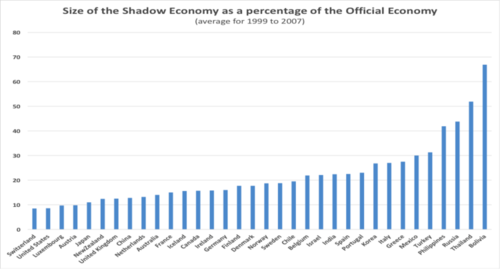
Link to Kim Schoenholtz’s and Stephen Cechetti’s post “Has paper money outlived its purpose?”
This is a nice article that speaks favorably of my proposal for enabling negative interest rates. In the end, they come down in favor of keeping paper money.
I wish Kim and Stephen had made it clearer that my proposal in “How Subordinating Paper Currency to Electronic Money Can End Recessions and End Inflation” involves keeping paper money in a subordinate role that retains the positive aspects of paper money they mention. Indeed, during periods of time in which negative interest rates haven’t been necessary for a while, the monetary system I propose would look very much like the current system. That makes it very different from proposals to abolish paper money entirely.
John Cochrane: Larry Summers' Martin Feldstein Speech →
I love this post by John Cochrane.
John Stuart Mill: People Should Be Allowed to Govern Their Own Lives Because They Care More and Know More about Themselves Than Anyone Else Does

Image source: “Self-knowledge, A Path to Happiness” by Karem-Barrett
Even if the self is an illusion, what we call the self reflects a fundamental fact about the aggregate of all human consciousness: informational links are much thicker within a human being than between human beings. Even a Utilitarian social planner who has no doctrinal attachment to Libertarianism should take advantage of those dense informational links within a human being by allowing each person to make decisions about his or her own life.
John Stuart Mill makes that case in On Liberty, Chapter IV, “Of the Limits to the Authority of Society over the Individual” paragraph 4:
But neither one person, nor any number of persons, is warranted in saying to another human creature of ripe years, that he shall not do with his life for his own benefit what he chooses to do with it. He is the person most interested in his own well-being: the interest which any other person, except in cases of strong personal attachment, can have in it, is trifling, compared with that which he himself has; the interest which society has in him individually (except as to his conduct to others) is fractional, and altogether indirect: while, with respect to his own feelings and circumstances, the most ordinary man or woman has means of knowledge immeasurably surpassing those that can be possessed by any one else. The interference of society to overrule his judgment and purposes in what only regards himself, must be grounded on general presumptions; which may be altogether wrong, and even if right, are as likely as not to be misapplied to individual cases, by persons no better acquainted with the circumstances of such cases than those are who look at them merely from without. In this department, therefore, of human affairs, Individuality has its proper field of action.
John talks not just about an individual knowing more about his or her own situation but also about how the individual cares more about him or herself than others do. Letting people make decisions about their own lives does a lot to take care of bringing the the strongest preferences into social choice.
But in addition to simply making sure that all strong preferences are well represented in social choice, letting each individual make decisions about his or her own life makes sense also because each person also typically has a knowledge advantage not only with regard to circumstances, but also with regard to his or her own preferences. Without a great deal of tricky inference, one of the most difficult things for someone else to know about me without me telling them, is what I want and how much I want it. One of the most basic jobs of any adult is to carefully figure out what he or she wants. It is difficult for anyone else to do that for the individual, though software designers for websites like Amazon, Netflix, Pandora etc. are trying hard to be able to predict what someone will like.
Emily Silberstein: Who Repays Microloans? →
Emily Silberstein’s is Head of Asia at Entrepreneurial Finance Lab, which helps lenders use psychological tests to gauge credit risk. In the article linked above, she reports these non-obvious results about characteristics that are predictive of loan repayment:
- Honest people are more likely to pay loans, but not if they are super-honest. Emily speculates that super-honest people may be slow to detect the dishonesty of others they deal with.
- Optimism is positively correlated with loan repayment for young people, but negatively correlated with loan repayment for older people.
- People who feel they have control over their own lives are more likely to repay loans. People who feel that outside forces control their lives are less likely to repay loans.
- However, cultural difference in the way people answer the questions used to assess this should be taken into account.
Reihan Salam: Miles Kimball’s Quixotic but Interesting Tax Proposal
Link to Reihan Salam’s National Review essay "Miles Kimball’s Quixotic but Interesting Tax Proposal"
I was pleased to belatedly run across Reihan Salam’s discussion of my proposal to provide key public goods with a minimum of tax distortion by expanding the non-profit sector rather than expanding government. In Reihan’s article, “Miles Kimball’s Quixotic but Interesting Tax Proposal,” Reihan says it might not curtail growth in government spending, but then continued:
What Kimball’s proposal does do, however, is address the normative demands made by egalitarians for higher taxes on the affluent (the notion of paying your fair share) while not directly addressing this structural dynamic. This is arguably a feature of Kimball’s proposal and not a bug, as it undermines the most potent case for higher taxes (the rich should bear more of the burden of making the investments we need to help vulnerable people flourish) without effectively rewarding public sector inefficiency.
Unfortunately, as Kimball would surely acknowledge, this proposal is wildly unrealistic, in no small part because it would drive a shift in resources from the public sector to civil society organizations that will embrace a wide variety of business models, not all of which will be incumbent-friendly. And over time, one assumes that incumbents will work to stymie empowering innovations in this space that prove threatening. That doesn’t change the fact that Kimball’s proposal is extremely interesting.
The Book of Uncommon Prayer

The Book of Uncommon Prayer is a collection of prayers for non-supernaturalists. I plan to keep this updated, and to add a section of shorter mantras.
“The Litany Against Fear” was written by Frank Herbert, the rest by me. The title of each prayer below also serves as a link to the original post that has commentary on each prayer.
Daily Devotional for the Not-Yet
In this moment, as in all the moments I have, may the image of the God or Gods Who May Be burn brightly in my heart.
Let faith give me a felt assurance that what must be done to bring the Day of Awakening and the Day of Fulfilment closer can be done in a spirit of joy and contentment.
Let the gathering powers of heaven be at my left hand and my right. Let there be many heroes and saints to blaze the trail in front of me. Let the younger generations who will follow discern the truth and wield it to strengthen good and weaken evil. Let the grandeur of the Universe above inspire noble thoughts that lead to noble plans and noble deeds. Let the Earth beneath be a remembrance of the wisdom of our ancestors and of others who have died before us. And may the light within be an ocean of conscious and unconscious being to sustain me and those who are with me through all the trials we must go through.
In this moment, I am. And I am grateful that I am. May others be, now and for all time.
An Agnostic Prayer for Strength
May I be strong and steadfast,
calm and collected,
as I set out to serve
the God or Gods who may be.
An Agnostic Prayer for Awareness
May I be subtly aware of everything going on around me
So that I may better champion the God or Gods Who May Be.
May this gathering uplift our hearts, enlighten our minds, and inspire our endeavors to bring us closer to, and glorify, the God or Gods Who May Be.
Gratitude: (We are thankful …)
Hopes: (We hope …)
Concerns (We are concerned …)
Worries (We are worried about …)
Thoughts (We are thinking of …)
Addition wishes (May …)
etc., in no particular order
And may we understand more fully the mystery of the humanity we all share, and act as one family to bring this Earth nearer to Heaven. Amen.
May the works that we do, sustained by this food, bring us closer to, and glorify, the God or Gods Who May Be.
Gratitude: (We are thankful …)
Hopes: (We hope …)
Concerns (We are concerned …)
Worries (We are worried about …)
Thoughts (We are thinking of …)
Addition wishes (May …)
etc., in no particular order
And we remember Jesus Christ, symbol of all that is good in humankind, and thereby clue to the God or Gods Who May Be. Amen.
An Agnostic Prayer for Awareness
May I be subtly aware of everything going on around me so that I may better champion the God or Gods Who May Be.
The Litany Against Fear (from Frank Herbert's Dune)
I must not fear.
Fear is the mind-killer.
Fear is the little-death that brings total obliteration.
I will face my fear.
I will permit it to pass over me and through me.
And when it has gone past I will turn the inner eye to see its path.
Where the fear has gone there will be nothing.
Only I will remain.