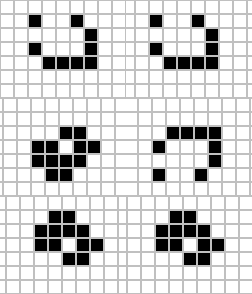
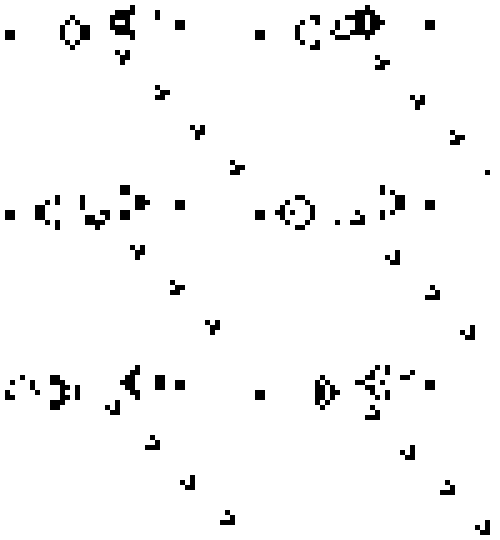
I first got an inkling of the philosophical importance of Conway’s Game of Life when I read Daniel Dennett’s book Darwin’s Dangerous Idea, which, more than any other book, tugged me toward being a nonsupernaturalist. In his earlier book Elbow Room: The Varieties of Free Will WorthWanting, Daniel Dennett talks about something being inevitable or unavoidable as the opposite of free will. He argues that any creature that can avoid something therefore has at least the most rudimentary imaginable form of free will. Animals avoid many things, and so have a bit of capability for voluntary action. But there are also creatures in Conway’s Game of Life that can avoid some of the moving objects coming at them. So by that standard those patterns of black and white squares also have a bit–though a much smaller bit–of capability for voluntary action.
To my human eye, so eager to interpret things in terms of intentions, even a simple blinker seems full of intention. And if Game of Life blinkers, toads, beacons, pulsars, spaceships, gliders and glider guns enchant, intrigue and amaze me, how much more enchanting, intriguing and amazing are human beings.
Not everyone is a fan of Daniel Dennett’s argument that the existence of avoiders in Conway’s Game of Life means that determinism does not imply inevitability. Aaron Swartz says it all rests on a pun between unavoidable and inevitable, which really have two very different meanings. But that depends on what kind of inevitability you care about. The idea that things are in some sense inevitable at the fundamental particle level (which is consistent with at least some interpretations of quantum mechanics) is interesting, but otherwise makes no difference in my life. To me the key fact is that at the human scale bad things can be avoided and good things can be pursued. And if even an avoider in Conway’s Game of Life can avoid things, then maybe we as individuals and as a species can avoid possible catastrophes that might overtake us if we didn’t take care. Acting as if the hand of fate makes it impossible for us to steer our path toward better things is just a way of substituting a stupid deterministic process for a smart deterministic process of trying to predict the consequences of our actions and modifying them accordingly. We are fortunate that for the most part, deterministic processes have favored our being smart in seeing that we have what Daniel Dennett calls a “variety of free will worth wanting,” that we need to exercise carefully.
Let’s now turn to consciousness proper. Consciousness does seem magical. So I have felt some temptation to think that while a sophisticated robot can act as if it is conscious, it can’t really be conscious. “I feel, therefore I am really conscious.” So suppose there was a robot that was an exact copy of me in terms of its quarks, electrons, Higgs bosons, etc. that could only pretend to be conscious, while only I would actually be conscious, since only I would have a supernatural spirit attached to me. Either the supernatural spirit has an effect on the quarks, electrons, Higgs bosons etc. in my body or not. If it does have an effect on those quarks, electrons, Higgs bosons etc., then that effect of that supernatural spirit on fundamental particles should be detectable by the extremely sensitive instruments used by physicists. (Of course, if there is a supernatural realm that is intentionally trying to hide itself, then all bets are off.)
What about the possibility that the supernatural spirit attached to me has no effect on the quarks, electrons, Higgs bosons, etc. of my body, but is what really feels the experiences that my body is going through? The trouble is that, however hard it is for us, and however much we might claim that things are inexpressible, we actually talk about our conscious experiences, and seem to understand to at least some extent what we are saying to each other in that regard. What that means is that if there are supernatural spirits that feel, but have no effect on our bodies, that extra bit of consciousness is not the consciousness we are talking about. We speak and write and talk in sign language with our bodies. So a supernatural consciousness would have to be able to affect the quarks, electrons, Higgs bosons etc. of our bodies in order for us to be talking about it.
The implication that a supernatural spirit would have to have some effect on the quarks, electrons, Higgs bosons, etc. of our bodies is even stronger if the supernatural spirit was supposed to be the source of free will. The Mormonism I was raised in was and is quite anti-alcohol. For a supernatural free decision of my spirit to make the difference between me walking into a bar or resisting the temptation and walking past it, that supernatural spirit has to be able to either directly or indirectly affect some of the particles known to physicists enough to cause a neurochemical/neuroelectrical cascade to go one way as opposed to another. Even if that were by a subtle change in quantum-mechanical probabilities, the kind of diligent efforts that convinced the world of the existence of the Higgs boson could detect an effect big enough to do that.
Does that mean there is no such thing as spirit? Not at all. Daniel Dennett points out that there are two very different categories of things: matter/energy and information. Information can be embedded in matter/energy in many, many different ways. For example, the genetic code can be embedded in DNA, RNA, or in the bits and bytes of computer code that store the results of the Human Genome project and its sister projects to sequence the genomes of Neanderthals, Chimpanzees, Horses, Cows, Honeybees, and Grapes. So, body and spirit can be interpreted as matter/energy and information. And surely, the information embedded in human beings is what makes us precious. The unorganized elements alone of which we are composed is little more than a handful of dust. In that sense, by value, human beings are spirit, even with a totally non supernatural view of things.
It is clear that consciousness operates on the spiritual, information side of the ledger. It may be embedded and written in matter, but it is its own thing.The same can be said for free will. It may be embedded in matter and energy and operate according to the laws of physics, but 99.99% of what makes free will of special value is all on the spiritual, information side of things.
Humans as Spiritual Beings
The fact that we humans are spiritual beings who care deeply about the informational side of things is one of the most important things about us.
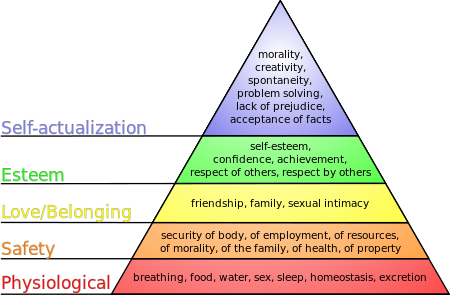
Think of Maslow’s hierarchy of human needs. I am drawing my account from the Wikipedia article on Maslow’s hierarchy of needs. Maslow’s idea was that there are some very basic needs that usually need to be satisfied before we start focusing on other needs, that Maslow represented as being at a higher level. At the bottom of the pyramid are physiological needs, such as breathing, food, water, sex, sleep, homeostasis and excretion. At the next level up are safety needs, such as security of body, security of employment, security of resources, security of the family, security of health and security of property. At the third level up the pyramid are love and belonging needs, such as friendship, family, and sexual intimacy. Above that are esteem needs, such as self-esteem, confidence, achievement, and respect of and by others. Finally, at the top of the pyramid are self-actualization needs such as morality, creativity, spontaneity, problem solving, and facing the truth, even when the truth is hard to bear or goes against one of our prejudices.