Avik Roy: A Conservative Case for Universal Coverage →
Avik argues that Switzerland and Singapore may provide a good model for conservative health care reform.
A Partisan Nonpartisan Blog: Cutting Through Confusion Since 2012
Avik argues that Switzerland and Singapore may provide a good model for conservative health care reform.
“Too many people spend too much time trying to perfect something before they actually do it. Instead of waiting for perfection, run with what you’ve got, and fix it along the way.”
Link to Kim Schoenholtz’s and Stephen Cechetti’s post “Has paper money outlived its purpose?”
This is a nice article that speaks favorably of my proposal for enabling negative interest rates. In the end, they come down in favor of keeping paper money.
I wish Kim and Stephen had made it clearer that my proposal in “How Subordinating Paper Currency to Electronic Money Can End Recessions and End Inflation” involves keeping paper money in a subordinate role that retains the positive aspects of paper money they mention. Indeed, during periods of time in which negative interest rates haven’t been necessary for a while, the monetary system I propose would look very much like the current system. That makes it very different from proposals to abolish paper money entirely.
I love this post by John Cochrane.

Image source: “Self-knowledge, A Path to Happiness” by Karem-Barrett
Even if the self is an illusion, what we call the self reflects a fundamental fact about the aggregate of all human consciousness: informational links are much thicker within a human being than between human beings. Even a Utilitarian social planner who has no doctrinal attachment to Libertarianism should take advantage of those dense informational links within a human being by allowing each person to make decisions about his or her own life.
John Stuart Mill makes that case in On Liberty, Chapter IV, “Of the Limits to the Authority of Society over the Individual” paragraph 4:
But neither one person, nor any number of persons, is warranted in saying to another human creature of ripe years, that he shall not do with his life for his own benefit what he chooses to do with it. He is the person most interested in his own well-being: the interest which any other person, except in cases of strong personal attachment, can have in it, is trifling, compared with that which he himself has; the interest which society has in him individually (except as to his conduct to others) is fractional, and altogether indirect: while, with respect to his own feelings and circumstances, the most ordinary man or woman has means of knowledge immeasurably surpassing those that can be possessed by any one else. The interference of society to overrule his judgment and purposes in what only regards himself, must be grounded on general presumptions; which may be altogether wrong, and even if right, are as likely as not to be misapplied to individual cases, by persons no better acquainted with the circumstances of such cases than those are who look at them merely from without. In this department, therefore, of human affairs, Individuality has its proper field of action.
John talks not just about an individual knowing more about his or her own situation but also about how the individual cares more about him or herself than others do. Letting people make decisions about their own lives does a lot to take care of bringing the the strongest preferences into social choice.
But in addition to simply making sure that all strong preferences are well represented in social choice, letting each individual make decisions about his or her own life makes sense also because each person also typically has a knowledge advantage not only with regard to circumstances, but also with regard to his or her own preferences. Without a great deal of tricky inference, one of the most difficult things for someone else to know about me without me telling them, is what I want and how much I want it. One of the most basic jobs of any adult is to carefully figure out what he or she wants. It is difficult for anyone else to do that for the individual, though software designers for websites like Amazon, Netflix, Pandora etc. are trying hard to be able to predict what someone will like.
Emily Silberstein’s is Head of Asia at Entrepreneurial Finance Lab, which helps lenders use psychological tests to gauge credit risk. In the article linked above, she reports these non-obvious results about characteristics that are predictive of loan repayment:
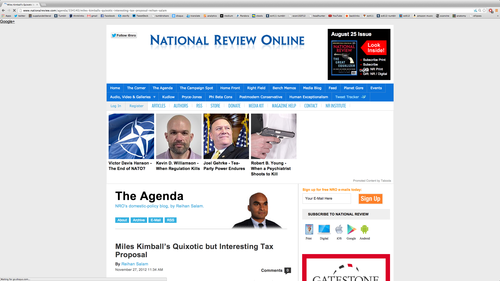
Link to Reihan Salam’s National Review essay "Miles Kimball’s Quixotic but Interesting Tax Proposal"
I was pleased to belatedly run across Reihan Salam’s discussion of my proposal to provide key public goods with a minimum of tax distortion by expanding the non-profit sector rather than expanding government. In Reihan’s article, “Miles Kimball’s Quixotic but Interesting Tax Proposal,” Reihan says it might not curtail growth in government spending, but then continued:
What Kimball’s proposal does do, however, is address the normative demands made by egalitarians for higher taxes on the affluent (the notion of paying your fair share) while not directly addressing this structural dynamic. This is arguably a feature of Kimball’s proposal and not a bug, as it undermines the most potent case for higher taxes (the rich should bear more of the burden of making the investments we need to help vulnerable people flourish) without effectively rewarding public sector inefficiency.
Unfortunately, as Kimball would surely acknowledge, this proposal is wildly unrealistic, in no small part because it would drive a shift in resources from the public sector to civil society organizations that will embrace a wide variety of business models, not all of which will be incumbent-friendly. And over time, one assumes that incumbents will work to stymie empowering innovations in this space that prove threatening. That doesn’t change the fact that Kimball’s proposal is extremely interesting.
The Book of Uncommon Prayer is a collection of prayers for non-supernaturalists. I plan to keep this updated, and to add a section of shorter mantras.
“The Litany Against Fear” was written by Frank Herbert, the rest by me. The title of each prayer below also serves as a link to the original post that has commentary on each prayer.
Daily Devotional for the Not-Yet
In this moment, as in all the moments I have, may the image of the God or Gods Who May Be burn brightly in my heart.
Let faith give me a felt assurance that what must be done to bring the Day of Awakening and the Day of Fulfilment closer can be done in a spirit of joy and contentment.
Let the gathering powers of heaven be at my left hand and my right. Let there be many heroes and saints to blaze the trail in front of me. Let the younger generations who will follow discern the truth and wield it to strengthen good and weaken evil. Let the grandeur of the Universe above inspire noble thoughts that lead to noble plans and noble deeds. Let the Earth beneath be a remembrance of the wisdom of our ancestors and of others who have died before us. And may the light within be an ocean of conscious and unconscious being to sustain me and those who are with me through all the trials we must go through.
In this moment, I am. And I am grateful that I am. May others be, now and for all time.
An Agnostic Prayer for Strength
May I be strong and steadfast,
calm and collected,
as I set out to serve
the God or Gods who may be.
An Agnostic Prayer for Awareness
May I be subtly aware of everything going on around me
So that I may better champion the God or Gods Who May Be.
May this gathering uplift our hearts, enlighten our minds, and inspire our endeavors to bring us closer to, and glorify, the God or Gods Who May Be.
Gratitude: (We are thankful …)
Hopes: (We hope …)
Concerns (We are concerned …)
Worries (We are worried about …)
Thoughts (We are thinking of …)
Addition wishes (May …)
etc., in no particular order
And may we understand more fully the mystery of the humanity we all share, and act as one family to bring this Earth nearer to Heaven. Amen.
May the works that we do, sustained by this food, bring us closer to, and glorify, the God or Gods Who May Be.
Gratitude: (We are thankful …)
Hopes: (We hope …)
Concerns (We are concerned …)
Worries (We are worried about …)
Thoughts (We are thinking of …)
Addition wishes (May …)
etc., in no particular order
And we remember Jesus Christ, symbol of all that is good in humankind, and thereby clue to the God or Gods Who May Be. Amen.
An Agnostic Prayer for Awareness
May I be subtly aware of everything going on around me so that I may better champion the God or Gods Who May Be.
The Litany Against Fear (from Frank Herbert's Dune)
I must not fear.
Fear is the mind-killer.
Fear is the little-death that brings total obliteration.
I will face my fear.
I will permit it to pass over me and through me.
And when it has gone past I will turn the inner eye to see its path.
Where the fear has gone there will be nothing.
Only I will remain.
This is a link to Rana Foroohar’s piece about Anat Admati in Time.
Anat is one of my heroes for her dogged advocacy in favor of the high equity requirements that will give us a stable financial system.
As you can see from the link above, for most people, it might not be that big a deal if paper currency were demoted, as I advocate in my column “How Subordinating Paper Money to Electronic Money Can End Recessions and End Inflation." For those who actually use paper currency a lot, the system I advocate would help them financially because it would lead to lower inflation, and therefore a lower implicit tax on paper currency. And of course, other than those who use it for illegal purposes, those who use paper currency for a large share of their transactions are more likely to be borrowers than lenders, so they would benefit in the short run from the low interest rates possible when the safest interest rates are negative. And in the long run, they would benefit along with everyone else from a more stable economy.
Question: I can’t resolve a question I have about breaking the ZLB with electronic money, and it’s driving me nuts.
I re-read a couple of your posts that mention a kind of ‘first-mover’ advantage in breaking the zero lower bound: not only does a first-mover get the usual stimulus from lowering the interest rate, but the fact that it is the only country in the world that can offer such a low interest rate is likely to boost demand further.
I’m struggling with the effect on the supply of loanable funds within the first-moving country. Essentially, as the central bank lowers the interest rate, and economy-wide interest rates fall, won’t some investors begin to look abroad for better risk-reward alternatives? I know that it’s not costless or riskless to transfer to a different currency, but it seems that the central bank’s effectiveness in unilaterally changing interest rates would be hampered by the existence of outside options: either some interest rates will remain high or some agents will begin to 'cash out,’ if you’ll pardon the pun, and move their money abroad.
I hope it’s clear what I’m trying to ask. Would you help me figure out what I’m missing?
Answer: Great question. I am using logic from Mankiw’s textbook treatment of international finance, which I lay out in my post “International Finance: A Primer.”
Basically, when people start investing abroad because rates of return are higher abroad, that is a capital outflow, and that is why exports go up. Capital outflows put domestic currency in the hands of those abroad. They don’t really want it, so exchange rates adjust until that currency (whether physical or virtual) makes its way back to its home country to buy exports. “Moving money abroad” is a stimulus to exports, because goods follow money.
The only way an outside option would cause trouble is if firms starting setting prices and wages in a foreign currency. It is crucial that sticky prices and/or wages (or at least most of them) be set in terms of the electronic dollar (or whatever the domestic electronic currency unit is called).
In my electronic money seminar, I make the point that, when they occur, negative interest rates on paper currency are not meant to disadvantage paper currency. What those negative interest rates on paper currency do is make it so there is nowhere to hide from the negative interest rates except by spending the money. You can send your own funds abroad, but then the person who took your dollars in exchange for their own currency now can’t hide from the negative interest rates except by spending the dollars. In that situation, by sending dollars abroad, you haven’t eliminated the hot potato of dollars earning a negative interest rate from the world, you have only made it someone else’s problem. The only escape from those negative interest rates is to spend the money, so someone–you or someone further down the chain–will be driven to spend it.
Follow-up Question: Ok. In other words, this kind of behavior (bailing on the domestic currency) will just lead the exchange rate to adjust until some form of interest rate parity is achieved again. Is that the right?
Answer: No. There might continue to be an interest rate difference. But the international flow of funds to the higher interest rate stimulates exports through its effect on the exchange rate.
Here is the key passage, but the whole thing is eminently worth reading:
What actually happened in the 80s, however, was that central banks — most famously the Fed, but also the Thatcherite Bank of England and others — drastically tightened monetary policy to bring inflation down. And inflation did indeed come down — eventually. But along the way there were deep recessions and soaring unemployment, which went on much longer than you could justify with any plausible story about the monetary shock being unanticipated.
This was very much a vindication of more or less Keynesian views about the economy, and the 80s were in fact marked by the New Keynesian comeback.
Models in which human beings are always maximizing their utility perfectly are the simplest kinds of models. But it is hard to maintain that children are always maximizing their own utility perfectly. In a discrete-time model, it is easy to have an initial period in which someone is not nonrational, followed by later periods of full rationality. But In continuous time, there are likely to be an in-between period in which some types of decisions are close to full rationality, while other decisions are far from fully rational in advancing self-interest. (For example, this post on the Edutopia blog talks about the “hyperrational adolescent brain,” but is about anything but.)
In On Liberty, Chapter IV, “Of the Limits to the Authority of Society over the Individual” paragraph 4, John Stuart Mill has to face the lack of full-scale rationality on the part of children, using the phrase “self-regarding virtues” to talk about the kind of rationality that allows one to advance one’s own interest. He writes:
I am the last person to undervalue the self-regarding virtues; they are only second in importance, if even second, to the social. It is equally the business of education to cultivate both. But even education works by conviction and persuasion as well as by compulsion, and it is by the former only that, when the period of education is past, the self-regarding virtues should be inculcated. Human beings owe to each other help to distinguish the better from the worse, and encouragement to choose the former and avoid the latter. They should be for ever stimulating each other to increased exercise of their higher faculties, and increased direction of their feelings and aims towards wise instead of foolish, elevating instead of degrading, objects and contemplations. But neither one person, nor any number of persons, is warranted in saying to another human creature of ripe years, that he shall not do with his life for his own benefit what he chooses to do with it.
Notice that in American custom, we tend to add to the kind of deference John is recommending for another adult’s decisions in regard to that adult’s own life, a deference for a parent’s decisions in regard to that parent’s own children. But the logic is unavoidably weaker for deference to parent’s decisions about their own children than it is for an adult’s decisions regarding his or her own life.
One interesting area where our culture is shifting in regard to parent’s decisions about their own children is in our attitudes towards spanking. When I was a child, we children took the possibility of spanking (including many elaborated threats of spanking) and sometimes the reality of being spanked for granted. Not long into my experience as a father myself, I realized that social tolerance of spanking was waning. And nowadays, parents who spank their children often have a niggling, if perhaps exaggerated, fear that child-welfare arms of the government (“Social Services”) will punish them.
John Stuart Mill allows for the possibility that compulsion might be necessary in bringing up children. And I find it hard to rule out the possibility that there may be situations in which some form of corporal punishment for a child may be the best available option. But compulsion (of which corporal punishment is only one type) should only be used when absolutely necessary, since it tends to have unwanted side effects. For example, in “John Stuart Mill Argues Against Punishing or Stigmatizing, but For Advising and Preaching to People Who Engage in Self-Destructive Behaviors,” I wrote
…punishing and stigmatizing may often be ineffective because the elements of a riven psyche one wants to encourage may have trouble seeing a punisher or stigmatizer as friendly.