Money is the most powerful secular force in the world. … Money is linked to everything–safety, health, relationships, creativity and spontaneity, social belonging. It’s the one thing that intersects everything, and as soon as I’m talking about money, all the family dynamics come out.

– Brad Klontz, author of Mind Over Money, as quoted in Clutch by Paul Sullivan, p. 196

Fields Medal Winner Maryam Mirzakhani's Slow-Cooked Math

Maryam MIrzakhani, First Women to Win the Fields Medal

Maryam MIrzakhani, First Women to Win the Fields Medal

Going beyond the usual news articles such as these two, 

Quanta magazine gives a more in-depth treatment of the the work of the first woman to win a Fields Medal, which is aptly described as the Nobel Prize of mathematics:

I know about this article thanks to Mary O'Keeffe’s Facebook post on my wall. Mary points out that Maryam describes herself as pursuing what I have called “slow-cooked math” (most recently in my Quartz column “How to turn every child into a ‘math person’”): 

Mirzakhani likes to describe herself as slow. Unlike some mathematicians who solve problems with quicksilver brilliance, she gravitates toward deep problems that she can chew on for years. 'Months or years later, you see very different aspects’ of a problem, she said. There are problems she has been thinking about for more than a decade. 'And still there’s not much I can do about them,’ she said.

Mirzakhani doesn’t feel intimidated by mathematicians who knock down one problem after another. 'I don’t get easily disappointed,’ she said. 'I’m quite confident, in some sense.

Her slow and steady approach also applies to other areas of her life.

The J Curve

Reblogged from econlolcats:Things are gonna get better.

Reblogged from econlolcats:

Things are gonna get better.

I have a few thoughts about the J-curve in International Finance. The idea is that the medium-run supply and demand elasticities with respect to the exchange rate are higher than the short-run elasticities. So in an era of deprecations within a fixed-exchange-rate regime, that would mean that the quantities of exports and imports would at first respond less than the prices, but later on the quantities would move more, so the value of net exports would go down right after the depreciation, but later go up.  

Here is my question. Think of a flexible-exchange-rate regime in which capital flows are determined by what people want to do with their portfolios, as I describe in my post “International Finance.”  Then, if the domestic central bank cuts interest rates and people want to shift toward foreign assets, that intentional capital outflow plus any unintentional capital flow plus any other flows of funds across borders that are not associated with the purchase of goods and services internationally (such as remittances) has to equal net exports. There might be a short time when unintentional capital flows cancel out some of the intentional flows, but it seems to me that in a flexible-exchange-rate regime, pretty soon net exports have to match those intentional capital flows. So the prediction would be that the low short-run elasticities of imports and exports would show up in a bigger movement in the exchange rate in the short run than in the medium run. Of course there are some risky arbitrage possibilities with that kind of movement. But do we see such a quickly-reverting pattern for exchange rates anyway? It certainly seems like exchange rates move an awful lot in the short run.

An interesting case is when the short-run price elasticity of net exports is less than one. (Note how different that is from gross exports or gross imports having an price elasticity less than one.) If depreciation means less of the local currency gets spent on net exports, then net exports can’t equilibrate with a fixed level of capital outflow. What I think would have to happen in the short run is that the initial capital outflow causes a drastic enough decline in the value of the domestic currency that the financial market rethinks the initial intentional capital outflow. That is, someone needs to see the domestic currency as so cheap they want to move their portfolio into it. It may take a very large depreciation before that is the case. Does that story make sense?

How to Turn Every Child into a "Math Person"

blog.supplysideliberal.com tumblr_inline_na59bz78Mh1r57lmx.png

Here is a link to my 52d column on Quartz, “How to turn every child into a ‘math person.’”

In the companion post below, I have collected a few memories, ideas and suggestions that had to be cut out of the Quartz column to make the column flow well. I added some headings to make it clear where each bit fits in:

I spent at least as much time on math when I wasn’t supposed to be doing math as when I was: The teacher might have been talking about social studies, but I was finding the prime factorizations of all the numbers from 1 to 400 by writing “2 ×” for every other number “3 ×” for every third number, “5 ×” for every fifth number, etc.–and then repeating that process for every other even number, every third multiple of 3, every fifth multiple of 5, and so on). The prime factorizations I learned from that satisfyingly tedious task I distracted myself with in elementary school came in handy when I took my SAT’s. And to this day, the way I get a hotel room number firmly into my memory is by doing its prime factorization.

Nothing seemed like a failure: At one point I knew just enough algebra to know that doing the same thing to both side of an equation left it a true equation. So for a long time, I transformed equations endlessly with no idea at all of where I was trying to go with those equations. Later on, when I actually had a purpose in mind for what I wanted to accomplish with a bit of algebra, I was able to draw on all of that experience just wandering around in algebra-land. And because I knew what it was like to do math without having any particular objective, I was able to appreciate how important it was keep the objective clearly in mind when there was an objective.

Proofs on other topics to get kids ready for proofs in Geometry class: Many kids who do well with arithmetic and algebra have trouble with geometry class in middle school or high school. It is often very hard to understand the idea of a proof when can’t see any reason to doubt the proposition to be proved in the first place. It is much better to get kids used to the idea of a proof earlier on in a context where the proof tells them something that doesn’t seem obvious. My favorite is the proof that there are an infinite number of primes. (There is a whole page of Youtube videos to choose from on this.) And a lot of kids wonder if imaginary numbers are numbers at all. The proof that complex numbers with an imaginary components obey all the rules of arithmetic and algebra and therefore can be treated as legitimate numbers not only answers a question kids really have, but uses concepts from “The New Math” that confused many kids in the 1960’s in a way that is obviously useful.

Math resources I found useful:

Resources to check out that might be good but that I don’t have any experience with:

Note: if you want to advertise your tool or method for math instruction here, I encourage you to advertise it in a comment that you post in the comment box below. When I moderate the comments, I will approve comments that advertise tools or methods for math instruction like that unless I have reason to believe there is something wrong with that tool or method.

The Mystery of Consciousness

This is the text for my August 10, 2014 Unitarian-Universalist sermon to the Community Unitarian-Universalists in Brighton, Michigan. This is the seventh Unitarian-Universalist sermon I have posted. The others are

This is the second sermon I have given that I have known in advance I would post. I wrote it with my online readers in mind as well as the Unitarian Universalists in Brighton.

For the Unitarian-Universalist “Celebration of Life” service, the text for the “reading” was “Moment” by Wisława Szymborska, while the text for the meditation was my "Daily Devotional for the Not-Yet.“

Here is the abstract I wrote a few weeks in advance for the sermon, followed by the sermon itself:

Abstract: The mystery of consciousness is central to religion. Many religions even claim that consciousness is supernatural.

A major job-to-be-done for religion is improving our conscious experience. In particular, much of what seems transcendent to us is in conscious experience, and encouraging certain types of subjective spiritual experiences is a central part of many religions. 

Although we care deeply about our own conscious experience, it is not the only thing we care about. Most of us also care about the conscious experience of others, and some of us care about the state of external reality even apart from any difference in conscious experience.

I once read a book by the philosopher Colin McGinn called The Mysterious Flame: Conscious Minds in a Material World. True to the title’s claim that consciousness is a mystery, I felt no wiser about the nature of consciousness when I got to the end of the book than when I started. But I like the image of consciousness as a flame. The symbol of Unitarian Universalism is a flaming chalice; it is easy to see that flaming chalice as in part a symbol of the flame of consciousness.

Conciousness makes possible our perception of beauty, goodness and truth. Beauty, goodness and truth make up the trio of ideas Renaissance Humanists identified as central to the Plato’s philosophy.  In his distillation “I think, therefore I am,” René Descartes emphasized the quest for truth as a demonstration of consciousness, but the appreciation of beauty and the judgment of goodness are equally hallmarks of consciousness.  

Evolutionary biologist Richard Dawkins begins his book Unweaving the Rainbow with these beautiful words about death and life and the consciousness we are granted by life: 

We are going to die, and that makes us the lucky ones. Most people are never going to die because they are never going to be born. The potential people who could have been here in my place but who will in fact never see the light of day outnumber the sand grains of Arabia. Certainly those unborn ghosts include greater poets than Keats, scientists greater than Newton. We know this because the set of possible people allowed by our DNA so massively outnumbers the set of actual people. In the teeth of these stupefying odds it is you and I, in our ordinariness, that are here. We privileged few, who won the lottery of birth against all odds, how dare we whine at our inevitable return to that prior state from which the vast majority have never stirred?

But it is a broader theme of his book Unweaving the Rainbow that I want to talk about: beautiful and wonderful things are just as beautiful and wonderful even when we understand them. We do get a thrill from secrets and suspense, since it gives us the hope that something might be even more awe-inspiringly beautiful, wonderful or interesting than it really is, but apart from that illusion, there is no reason for understanding to destroy beauty. A rose is still a rose, even if you know that the softness of a rose petal comes from its papilla cells. And a rose with any degree of understanding of its biochemistry would smell as sweet. I want to see if I can’t demystify consciousness a bit, but then point to the preeminent value of improving both our own conscious experience and the conscious experience of others.

Is Consciousness Supernatural? 

Some people are horrified by the idea that according to a standard nonsupernaturalist worldview, you and I are very sophisticated robots. But on the principle that a rose is still a rose, even if you understand the science of roses, if we are robots, then robots are not necessarily robotic. Our notion of "robotic” comes from our experience with relatively simple robots, not our experience with very sophisticated robots such as you and me.

Among the things that make human beings amazing is our consciousness. That consciousness is often pointed to as evidence of the supernatural. The argument is the challenge “How could such a wondrous thing arise from nonsupernatural, mechanical causes?” In the one computer programming class I took in college, back in 1981, one of the assignments was to write code for Conway’s Game of Life. Conway’s Game of Life is a cellular automaton based on extremely simple, mechanical rules, but it can do many things lifelike enough to justify the name of the game.

Here is how simple the rules are: on a chessboard with many, many squares, “live” squares are in black and dead squares are in white. At each tick of the game’s clock (the Game of Life’s third dimension), the following transitions happen (see the Wikipedia article on Conway’s Game of Life):

  1. Any live cell with fewer than two live neighbours dies, as if caused by under-population.
  2. Any live cell with two or three live neighbours lives on to the next generation.
  3. Any live cell with more than three live neighbours dies, as if by overcrowding.
  4. Any dead cell with exactly three live neighbours becomes a live cell, as if by reproduction.

Here are a few examples from the Wikipedia article on Conway’s Game of Life of what can come from these extremely simple rules:

Blinker:

Toad: 

Beacon:

Pulsar:

Light-Weight Space Ship:

Glider:

Gliders can be Created by Gosper’s Glider Gun:

I first got an inkling of the philosophical importance of Conway’s Game of Life when I read Daniel Dennett’s book Darwin’s Dangerous Idea, which, more than any other book, tugged me toward being a nonsupernaturalist.  In his earlier book Elbow Room: The Varieties of Free Will WorthWanting, Daniel Dennett talks about something being inevitable or unavoidable as the opposite of free will. He argues that any creature that can avoid something therefore has at least the most rudimentary imaginable form of free will. Animals avoid many things, and so have a bit of capability for voluntary action. But there are also creatures in Conway’s Game of Life that can avoid some of the moving objects coming at them. So by that standard those patterns of black and white squares also have a bit–though a much smaller bit–of capability for voluntary action.

To my human eye, so eager to interpret things in terms of intentions, even a simple blinker seems full of intention. And if Game of Life blinkers, toads, beacons, pulsars, spaceships, gliders and glider guns enchant, intrigue and amaze me, how much more enchanting, intriguing and amazing are human beings. 

Not everyone is a fan of Daniel Dennett’s argument that the existence of avoiders in Conway’s Game of Life means that determinism does not imply inevitability. Aaron Swartz says it all rests on a pun between unavoidable and inevitable, which really have two very different meanings. But that depends on what kind of inevitability you care about. The idea that things are in some sense inevitable at the fundamental particle level (which is consistent with at least some interpretations of quantum mechanics) is interesting, but otherwise makes no difference in my life. To me the key fact is that at the human scale bad things can be avoided and good things can be pursued. And if even an avoider in Conway’s Game of Life can avoid things, then maybe we as individuals and as a species can avoid possible catastrophes that might overtake us if we didn’t take care. Acting as if the hand of fate makes it impossible for us to steer our path toward better things is just a way of substituting a stupid deterministic process for a smart deterministic process of trying to predict the consequences of our actions and modifying them accordingly. We are fortunate that for the most part, deterministic processes have favored our being smart in seeing that we have what Daniel Dennett calls a “variety of free will worth wanting,” that we need to exercise carefully.   

Let’s now turn to consciousness proper. Consciousness does seem magical. So I have felt some temptation to think that while a sophisticated robot can act as if it is conscious, it can’t really be conscious. “I feel, therefore I am really conscious.” So suppose there was a robot that was an exact copy of me in terms of its quarks, electrons, Higgs bosons, etc. that could only pretend to be conscious, while only I would actually  be  conscious, since only I would have a supernatural spirit attached to me. Either the supernatural spirit has an effect on the quarks, electrons, Higgs bosons etc. in my body or not. If it does have an effect on those quarks, electrons, Higgs bosons etc., then that effect of that supernatural spirit on fundamental particles should be detectable by the extremely sensitive instruments used by physicists. (Of course, if there is a supernatural realm that is intentionally trying to hide itself, then all bets are off.)

What about the possibility that the supernatural spirit attached to me has no effect on the quarks, electrons, Higgs bosons, etc. of my body, but is what really feels the experiences that my body is going through? The trouble is that, however hard it is for us, and however much we might claim that things are inexpressible, we actually talk about our conscious experiences, and seem to understand to at least some extent what we are saying to each other in that regard. What that means is that if there are  supernatural spirits that feel, but have no effect on our bodies, that extra bit of consciousness is not the consciousness we are talking about. We speak and write and talk in sign language with our bodies. So a supernatural consciousness would have to be able to affect the quarks, electrons, Higgs bosons etc. of our bodies in order for us to be talking about it.

The implication that a supernatural spirit would have to have some effect on the quarks, electrons, Higgs bosons, etc. of our bodies is even stronger if the supernatural spirit was supposed to be the source of free will. The Mormonism I was raised in was and is quite anti-alcohol. For a supernatural free decision of my spirit to make the difference between me walking into a bar or resisting the temptation and walking past it, that supernatural spirit has to be able to either directly or indirectly affect some of the particles known to physicists enough to cause a neurochemical/neuroelectrical cascade to go one way as opposed to another. Even if that were by a subtle change in quantum-mechanical probabilities, the kind of diligent efforts that convinced the world of the existence of the Higgs boson could detect an effect big enough to do that.

Does that mean there is no such thing as spirit? Not at all. Daniel Dennett points out that there are two very different categories of things: matter/energy and information. Information can be embedded in matter/energy in many, many different ways. For example, the genetic code can be embedded in DNA, RNA, or in the bits and bytes of computer code that store the results of the Human Genome project and its sister projects to sequence the genomes of Neanderthals, Chimpanzees, Horses, Cows, Honeybees,  and Grapes. So, body and spirit can be interpreted as matter/energy and information. And surely, the information embedded in human beings is what makes us precious. The unorganized elements alone of which we are composed is little more than a handful of dust. In that sense, by value, human beings are spirit, even with a totally non supernatural view of things. 

It is clear that consciousness operates on the spiritual, information side of the ledger. It may be embedded and written in matter, but it is its own thing.The same can be said for free will. It may be embedded in matter and energy and operate according to the laws of physics, but 99.99% of what makes free will of special value is all on the spiritual, information side of things.   

Humans as Spiritual Beings

The fact that we humans are spiritual beings who care deeply about the informational side of things is one of the most important things about us.

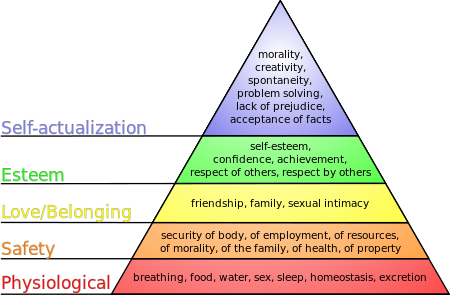
Think of Maslow’s hierarchy of human needs. I am drawing my account from the Wikipedia article on Maslow’s hierarchy of needs. Maslow’s idea was that there are some very basic needs that usually need to be satisfied before we start focusing on other needs, that Maslow represented as being at a higher level. At the bottom of the pyramid are physiological needs, such as breathing, food, water, sex, sleep, homeostasis and excretion. At the next level up are safety needs, such as security of body, security of employment, security of resources, security of the family, security of health and security of property. At the third level up the pyramid are love and belonging needs, such as friendship, family, and sexual intimacy. Above that are esteem needs, such as self-esteem, confidence, achievement, and respect of and by others. Finally, at the top of the pyramid are self-actualization needs such as morality, creativity, spontaneity, problem solving, and facing the truth, even when the truth is hard to bear or goes against one of our prejudices. 

Notice that, in general, as you go up Maslow’s hierarchy, things move markedly toward the spiritual, informational side of things. Love and belonging needs, esteem needs and self-actualization needs all seem equally spiritual to me in this sense, but those all seem more spiritual than safety needs, which in turn are obviously more spiritual than immediate physiological needs, since judgments of safety require trickier thinking about the future than immediate physiological needs do.  

Touched by commerce, but in very much the same vein, there has been a trend toward more and more of an informational content to Gross Domestic Product–GDP–in the process of rich countries getting richer. We can define what is informational by whether something can be sent as an electronic file, or in the olden days, as the contents of a document. By that standard, I am not counting agriculture as an informational component of GDP–at least not in those days when agricultural products used to make up the bulk of GDP. After the period when agriculture dominated GDP, came the rise of manufacturing. Then came the rise of services. And now we see the rise of information goods proper: software, digital music, digitized videos, computer games, Kindle books, mobile apps and communications, the cloud, including the blogosphere and online social networks, and things we are barely beginning to get an inkling of. But so far, the way we compute GDP does a bad job at counting up the true value of information goods. For example, so far, the value to you of anything you can read or see free online when surfing the web isn’t counted in GDP at all, though the value to advertisers of influencing you with online ads is counted according to their willingness to pay for advertising. And the way economists now calculate GDP is even worse at measuring the transformations of human existence that I think are coming next.

Looking forward to the future of cultures fortunate enough to collectively provide more and more opportunities and choices for people–which in economics is the deeper meaning of “getting richer”–I see people wanting in turn food, clothing, shelter and physical security, and of course basic family relationships, then refrigerators, cars, washing machines, indoor plumbing and then the books, movies, radio shows, TV shows etc., that become progressively digitized. Now, I think the big thing people want next, if they have all of those things with some level of security, is an interesting, challenging, rewarding job, with good coworkers. But after that, I think people will turn in earnest toward improving the quality of their own consciousness and the consciousness of others they care about more directly.

It is easier to be happy if you understand how happiness works. And social scientists are beginning to understand better the things that go into happiness: things like good news, sleep, exercise, time with friends, meditation and antidepressants.

Antidepressants are an easy way to get happier, and many people quite appropriately take advantage of them. In the surprisingly distinct spiritual realm of pain and pain reduction, I have been very glad for ibuprofen in the 13 days since my dentist replaced a crown, with all of the disturbance of the roots of my tooth that entailed.

Meditation is a path to raising happiness and otherwise improving the quality of one’s consciousness that I think people will turn to more and more in the future as the other things on their wish list besides quality of consciousness get checked off as attained. In my own household, we do a little bit of Transcendental Meditation and a fair bit of Mindfulness Meditation, as well as meditations based on words.

But meditation is part of a larger class of spiritual exercises that have powerful effects on consciousness. With the Dalai Lama’s encouragement, Tibetan monks have been scanned by functional magnetic resonance imaging machines while meditating. Just google “Tibetan monks MRI” to learn about the fascinating results. I would love to see the result from Mormons praying sincerely in MRI machines as well. And I think most religions have some spiritual practice that powerfully affects consciousness. My bet is that, by and large, each changes consciousness in a different way, that would show up differently on the brain scans. I don’t think all religious experience is one experience. It is many, many different experiences.

Internal spiritual experience is a more important strength to religions than many sociologists of religion give it credit for. People value religious community a lot. But it is not uncommon for people to demonstrate by their actions that they value internal spiritual experience–both for themselves and others–even more.

A key moment in my transition away from Supernaturalism was when a friend who was also a Mormon pointed out that subjective spiritual experiences–even subjective spiritual experiences that fulfilled in a striking way a prediction by Mormon scripture–didn’t necessarily mean that there was a supernatural God out there in the universe. What it did mean was that there were remarkable and powerful spiritual experiences here on earth. I am glad I had those spiritual experiences as a Mormon, even though I no longer believe they were supernatural. Not only for the sake of curiosity, but also because the feelings themselves seem valuable, I have an ongoing, though slow-going, project of trying to investigate how close I can get to those spiritual states without having to believe things that I now don’t believe.

My friend Andrew Oswald, who like me does a lot of research on the Economics of Happiness, believes that essentially everything we value can be thought of as some kind of internal mental state. I wouldn’t go quite that far. Most of us at least care quite a bit about the internal mental states of those we love, as well. Many of us care about the internal mental states of animals. And some of us care about things being a certain way in the external world even if no human being could ever know for sure that it was so–and don’t want to be deceived about whether it is so. Nevertheless, internal mental states are a very big part of what we value. And that is as it should be for spiritual beings like us.  

People often say “Don’t be so materialistic.” But as I see it, that isn’t the big issue. It isn’t “You shouldn’t be so materialistic,” it’s “Don’t make the mistake of thinking you are more materialistic than you really are.” One of the great values of a religious community is having someone to remind us that we are spiritual beings, whether we like it or not, and even if our spirits could not exist without being etched into patterns of quarks, electrons, Higgs bosons and the other particles and forces we are in the process of discovering, governed by equations that will someday be in every truly advanced physics textbook.

Paul Krugman: The Monetary Fever Swamps

This piece is interesting in its own right, but I was also happy to see that Paul Krugman flagged my post “Contra John Taylor” again. The earlier occasion was Paul’s piece “Calvinist Monetary Economics.”

Paul also flagged me one other time, when I critiqued John Taylor and his coauthors on another related count. Here is that Krugman post: “Stimulus Derangement Syndrome." 

Italy Should Look to Ancient Rome to Reform Its Ineffective Senate

blog.supplysideliberal.com tumblr_inline_n9zppfCEy41r57lmx.png

Here is a link to my 51st column on Quartz, “Italy should look to ancient Rome to reform its ineffective Senate.”

The idea for this column emerged during my trip to Rome, when I talked to Luigi Guiso about the economic and political situation in Italy. I wanted to thank him for all of his insights. Don’t construe that as his endorsement of my proposal, though!   

My Most Popular Storify Stories

Since soon after I started blogging, I have used Twitter extensively, and have put tweets from Twitter discussions together into “stories” using Storify. I have been surprised at how many views some of these stories have gotten. (A couple of my stories are popular enough that they could have made it into my list of most popular posts.) So I decided to systematically see which ones have been most popular (starting by leaving aside anything with less than 200 views). Here is the result. I cover a lot of topics in Tweets that I don’t have time to write full-scale blog posts on, so I think you will find something of interest in this list of my top 37 Storify stories. And many of my favorite stories didn’t manage to get 200  views yet in order to make this list. You can find all of my stories here.

Here is the list of my most popular sets of storified tweets with links, and the number of views as of August 5, 2014 next to each link: 

  1. How the Mormons Became Largely Republican 2464
  2. A More Personal Bio: My Early Tweets 2280
  3. Noah Smith, Miles Kimball and Claudia Sahm on Math in Economics 1034
  4. Roger Farmer, Noah Smith, Miles Kimball, Tony Yates and Others on Math in Economics 667
  5. Umair Haque on Liberalism 635
  6. Miles Kimball and Brad DeLong Discuss Wallace Neutrality and Principles of Macroeconomics Textbooks 591
  7. The Marginalization of Economists at the Consumer Financial Protection Bureau 532
  8. Miles Kimball and Noah Smith on Balancing the Budget in the Long Run 520
  9. Why the Nominal GDP Target Should Go Up about 1% after a 1% Improvement in Technology 462
  10. Daniel Altman and Miles Kimball: Should We Expand Government or Expand the Nonprofit Sector? 453
  11. The Time Miles was Called a “Neoliberal Sellout” by Matt Yglesias and was Glad for the Compliment in the End 430
  12. The Paul Ryan Tweets 425
  13. Should We Have Tight Monetary Policy in Order to Help Virtuous Savers? 413
  14. Miles Kimball, David A. Levine, Robert Waldmann and Noah Smith on the Design of a US Sovereign Wealth Fund 401
  15. Which is More Radical? Electronic Money or a Higher Inflation Target? 378
  16. Unlearning Economics, Sanders Wagner and Miles Kimball: Nature, Nurture and Individual Agency 326
  17. Claudia Sahm on Reforming the Refereeing Process in Economics 354
  18. Daniel Altman and Miles Kimball: Is It OK to Let the Rich Be Rich As Long As We Take Care of the Poor? 281
  19. Miles Kimball’s Comments on the Scott Sumner/David Andolfatto Debate 281
  20. Business Cycles: A Shocking Discussion 281
  21. Where is the Republican Party on Monetary Policy? 277
  22. The Balance Between Persistence and Finding Your Own Comparative Advantage 260
  23. Matthew C. Klein and Miles Kimball on the Effects of Negative Interest Rates on Savers 249
  24. Monetary Policy and Financial Policy Discussions Sparked by the Kimball and Konczal vs. Peter Schiff HuffPost Live 249
  25. Edward J. Epstein, Miles Kimball, Brad Delong, Alex Bowles and Ramez Naam: Was Edward Snowden a Spy? 236
  26. What is Monetary Policy? 235
  27. Tomas Hirst Recoils at the Starkness of Efficiency Wage Theory 230
  28. Twitter Round Table on Targeting Core Inflation 227
  29. Socialism and Capitalism: A Conversation of Miles Kimball, Unlearning Economics, Adam Gurri and Daniel Hart 224
  30. Immigration Tweet Day, February 4, 2013: Archive 221
  31. College as a Marriage Market: A Twitter Discussion 221
  32. Electronic Money, Nominal GDP Targeting, and the Transmission Mechanisms for Monetary Policy 215
  33. Preaching in the Temple: Presenting “Breaking Through the Zero Lower Bound” at the Fed 215
  34. High Bank Capital Requirements Defended 213
  35. Noah, Richard, Miles and Jake Talk about God and SuperGod 208
  36. Tomas Hirst and Miles Kimball on Fiscal Stimulus vs. Negative Rates 207
  37. Daniel Altman and Miles Kimball on the Long-Run Target for Inflation 200

Kevin Remisoski on Teaching and Learning Math

Link to Kevin Remisoski’s Twitter homepage and his LinkedIn page and an article in the local news (picture above)

Link to Kevin Remisoski’s Twitter homepage and his LinkedIn page and an article in the local news (picture above)

In response to our column “There’s One Key Difference Between Kids Who Excel at Math and Those Who Don’t,” Noah Smith and I received many comments. Some of them gave good advice about teaching math to kids. Among those was this email from Kevin Remisoski, who graciously gave me permission to share this with you:


I liked most of the points you addressed in this article, however, I feel you missed one very important and crucial point.  There are a good number of people who also have dyscalculia.  This disorder is often times undiagnosed, and while some estimate that 5% of our population has this disorder, I would venture a guess that this in some form could likely affect as many as 20% of our population.  Many of the symptoms seem fairly common to people I have helped with math over the years and my wife didn’t even know she had it until I gave her an assessment after she was complaining about how she always switched numbers around.  This assessment went over 30 questions that are common symptoms of dyscalculia, and she answered 27 of them with yes.

I myself always excelled in math.  This wasn’t due to parental drilling, flash cards, or anything of the sort.  This was purely genetic, and this also seems to be the case with my stepson, though I’ve been teaching him more advanced techniques for his age as well as basic physics (he is 8). 

I think somewhere along the way, teachers forgot how to teach math and left it to the text books and the curriculum to teach for them while they assist the book in the learning process.  I’m sure this is most certainly due to laziness, but most human beings are lazy and just want to get home at the end of their work day.  I know I struggled with some of my teachers in my youth, because countless times I’d approached them with easier ways of solving problems from basic math in elementary school all the way through college.  I just don’t understand why some teachers are so focused on only teaching one solution to a problem.

You see the problem with dyscalculia, is that it is not impossible to teach math to people who suffer from this disorder.  You just have to be creative, even if that means providing creative and abstract solutions at times.  I have taught my wife quite a bit simply by using unorthodox approaches to math. 

With all of that being said, in a base 10 number system, I feel that it is important that children understand a few basic concepts:

If A + B = C, then C – A = B, and C – B = A.  I am not suggesting teaching 5 year olds the concept of substituting numbers with variables, but rather that they understand this concept as much as they will later be expected to memorize their multiplication tables.  One exercise, I’ve worked on with my stepson is repetition.  We don’t play with flash cards or have any visual representation, because I feel that defeats the purpose of memorization. 

So, instead I would go with the range of numbers 0-9, and have him add and subtract different numbers within that range to see the relationships between those addends, sums, subtrahends, and difference.  One way I went about this is as follows:

1+1, 1+2, 1+3……2+1, 2+2, 2+3…..3+1,3+2,3+3, and so on until each starting addend was added to zero through nine (despite starting with one in this example).

After I was sure he was comfortable with this, I would then have him add 1+2 for example and then 3-2, and 3-1.   I would continue to have him solve addends, and then solve the difference from the sum when one of those addends was converted to a subtrahend, and then solve for the second one.

You see, I don’t believe in waiting for children to memorize addition and subtraction on their own.  They should be able to look at any two numbers and solve either the sum or difference just as easily as they breathe.

The same can be said for multiplication when they are ready.  They should not only write their multiplication tables out ten to twenty times a day until they have them committed to memory, but much like in my above example, they should understand the following: 

If A * B = C, then C / A = B, and C / B = A.

This is the way to teach children math.  I also firmly believe that until a child has memorized their multiplication tables at least through ten as well as committed addition and subtraction to memory, that they should not be allowed to even learn how to use a calculator.  Genetic dispositions, as well as disorders, can be toppled by the human brain’s efficiency at memorization through repetition.  If we are to believe that the day may come when no one will utter the words “I’m just not good at math.”, we also need to believe that there is a better way of instilling confidence in those young minds.  Without the fundamentals of understanding the basic building blocks as I’ve described here, it’s really no wonder why so many children bomb in basic math much less algebra, geometry, trigonometry, and calculus.  If Einstein could find a way to overcome dyscalculia, anyone can.

John Stuart Mill Argues Against Punishing or Stigmatizing, but For Advising and Preaching to People Who Engage in Self-Destructive Behaviors

When it is treated as anything more than a convenient simplification–or a solid starting place for thinking things through–one of the silliest conceits of economics is the idea that people never act against their own interests. Most often, people act against their own interests because cognitive limitations make it hard for them to figure out the right choice, even though strictly speaking, all the information they need to make  an informed ex ante choice is in front of them. But sometimes, people’s psyches are riven by internal divisions. When someone’s soul is embroiled in a hammer-and-tongs civil war, it is natural and appropriate for others to want to weigh in on behalf of one side or another in that struggle. And sometimes, even when one side of an internal psychic division seems firmly in charge, others may want to foment regime change.  

In On LibertyChapter IV, “Of the Limits to the Authority of Society over the Individual” paragraphs 3-4, John Stuart Mill lays down rules for such an intervention. In particular, he argues that punishment and strong social stigma should be off limits, but that other efforts to help people improve their lives are a  good thing:

As soon as any part of a person’s conduct affects prejudicially the interests of others, society has jurisdiction over it, and the question whether the general welfare will or will not be promoted by interfering with it, becomes open to discussion. But there is no room for entertaining any such question when a person’s conduct affects the interests of no persons besides himself, or needs not affect them unless they like (all the persons concerned being of full age, and the ordinary amount of understanding). In all such cases there should be perfect freedom, legal and social, to do the action and stand the consequences.  It would be a great misunderstanding of this doctrine to suppose that it is one of selfish indifference, which pretends that human beings have no business with each other’s conduct in life, and that they should not concern themselves about the well-doing or well-being of one another, unless their own interest is involved. Instead of any diminution, there is need of a great increase of disinterested exertion to promote the good of others. But disinterested benevolence can find other instruments to persuade people to their good, than whips and scourges, either of the literal or the metaphorical sort.

One big reason to limit efforts to change what seems like someone else’s self-destructive behavior to advice and preaching rather than punishing or stigmatizing is that one might be wrong. But another reason is that punishing and stigmatizing cause direct harm. For example, the many people in prison for drug use have lives that were already blighted by drugs now blighted by prison as well. Finally, punishing and stigmatizing may often be ineffective because the elements of a riven psyche one wants to encourage may have trouble seeing a punisher or stigmatizer as friendly.

Quartz #50—>Odious Wealth: The Outrage is Not So Much Over Inequality but All the Dubious Ways the Rich Got Richer

Link to the Column on Quartz

Here is the full text of my 50th Quartz column, “Odious Wealth: The Outrage is Not So Much Over Inequality but All the Dubious Ways the Rich Got Richer,” now brought home to supplysideliberal.com. It was first published on June 30, 2014. Links to all my other columns can be found here.

If you want to mirror the content of this post on another site, that is possible for a limited time if you read the legal notice at this link and include both a link to the original Quartz column and the following copyright notice:

© June 30, 2014: Miles Kimball, as first published on Quartz. Used by permission according to a temporary nonexclusive license expiring June 30, 2017. All rights reserved.


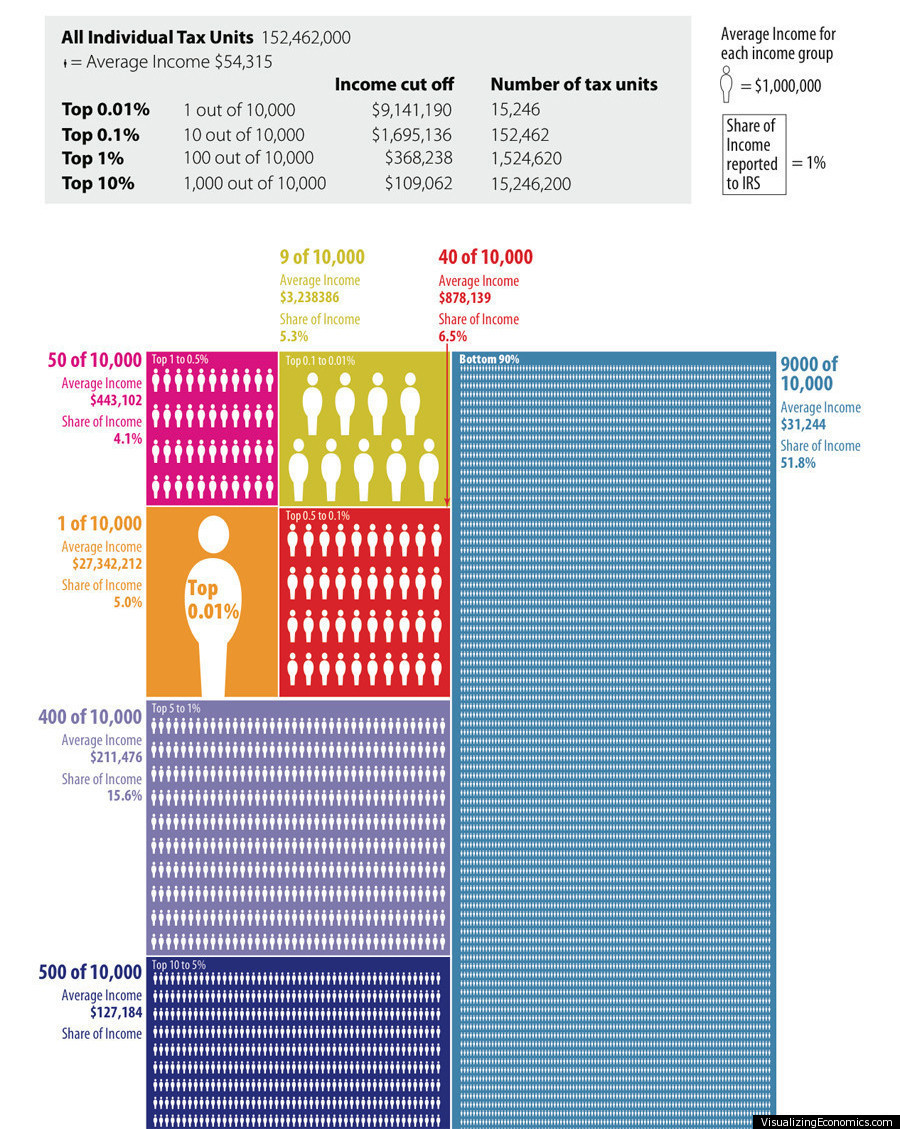
Concern about income inequality, and the even more striking inequality in wealth in the United States, is a key theme for the 2014 US congressional elections and has made Thomas Piketty’s book Capital in the Twenty-First Century a surprise bestseller. There are many reasons to be concerned about wealth inequality itself, regardless of the source of that inequality, but it is hard to pursue a discussion on the topic for long before someone makes a claim about whether the wealthy acquired their money in a deserving way. Partisans on the political left and right know which side of this argument they are supposed to emphasize: many who feel the government needs more revenue conveniently argue as if almost all wealth comes from underhanded, unscrupulous skullduggery, while many who feel the government needs less revenue conveniently argue as if almost all wealth were created by the likes of Steve Jobs, who brought us i-everything. But unlike these partisan stories, in every list of 1,500 or so billionaires, many deserve their wealth while others deserve very little of the wealth they have. While in some cases the principles for whether wealth is deserved or not are obvious, in other cases they are quite subtle.

To start with an easy category, wealth obtained by deceit is illegitimate. For example, given the way tobacco companies lied about the dangers of smoking,the gigantic legal judgments against them seem appropriate (though it is too bad how big a share of that money went into the pockets of lawyers). And although the magnitude of the crime might not be as great, GM’s recently outed behavior in hiding problems with ignition switches has a disturbing resonance with the earlier behavior of the tobacco companies. As these examples make clear, standard legal principles often make it possible to take away wealth obtained by deceit once that deceit is well established. But a greater hatred of deceit on the part of juries, judges, and legislators would help in further neutralizing this form of wealth.

If undeserved wealth always arose in cases where the logic was as simple as that for deceit, and were similarly reprehensible from a criminal or civil law point of view, then the issue of undeserved wealth could be appropriately handled in the courts. In an IMF paper, Harvard Economics professor Michael Kremer and Northwestern University Economics professor Seema Jayachandran make the intriguing proposal that debt incurred by a non-democratic government (after the appropriate international organization has declared that the debt is not in the interests of the people of a country) should be considered “odious debt” that later (and hopefully better) governments of that country need not pay back.

We could similarly talk about “odious wealth”—wealth that is hateful in its origin. But our instincts about the merits of different means of acquiring wealth often go astray. Let me take two extreme examples: old songs that people love and the kind of “vulture capitalism” whose reputation helped sink Mitt Romney’s chances in the 2012 presidential election.

There is currently a dispute over whether songs recorded before 1972 should continue to earn royalties. By naming their bill to extend royalties to pre-1972 recordings the “Respecting Senior Performers as Essential Cultural Treasures Act or “RESPECT” Act, congressmen George Holdings and John Coyners are using the fact that the musicians who recorded songs before 1972 (that we still listen to 42 years later) inspire feelings of gratitude, since songs of lasting popularity give many listeners much more pleasure than those listeners have paid for the right to listen to those songs. But the prospect of that very gratitude, plus 42 years of royalties, would have provided more than enough motivation for musicians to work hard back in 1971 to make great songs, if they had the ability.

Forty-two years is a long time. And money coming in the near future looks (and is) more valuable than money coming in the more distant future. And even songs that last typically get more play in their early years. So at the time a musician is working hard on a song, the prospect of 42 years of royalties and undying fame should, to a surprisingly close approximation, be just as motivating as, say, 80 years of royalties and undying fame. So we don’t need to extend royalties to pre-1972 recordings to bolster the confidence of musicians making songs now that they will be properly rewarded for their efforts. And on the downside, charging royalties for pre-1972 songs has the potential to inhibit the development of internet and satellite radio—and in particular how often people get to listen to the best pre-1972 songs on internet and satellite radio. So there is a lot of downside, not much upside to extending royalties to pre-1972 recordings. But the folks who would earn those royalties, if they are still alive, are attractive recipients of the money, even in cases where they are relatively wealthy.

By contrast, few ways of getting wealth seem less attractive than acquiring companies and then making them more profitable by laying off many of the employees. In August 29, 2012, Matt Taibbi wrote in the Rolling Stone essay “Greed and debt: the true story of Mitt Romney and Bain Capital:”

A man makes a $250 million fortune loading up companies with debt and then extracting million-dollar fees from those same companies, in exchange for the generous service of telling them who needs to be fired in order to finance the debt payments he saddled them with in the first place. …

Instead of building new companies from the ground up, we took out massive bank loans and used them to acquire existing firms, liquidating every asset in sight and leaving the target companies holding the note.

This is what I am calling “vulture capitalism.” But vultures have an important place in the ecosystem. Just like literal vultures, who help clear away dead carcasses, vulture capitalists help in the difficult process of moving workers from making and doing things that people don’t need as much anymore to making and doing things that people are eager to pay for. For example, Mitt Romney helped unwind K-B Toys, whose toys could no longer compete with video games. This was enormously painful for the employees of K-B Toys, who were ultimately sent on their way in an arduous transition to new jobs (and some to early retirement). But an enormous amount of good work has been accomplished by former employees of K-B Toys in new jobs with efforts that would have been squandered on trying to make unwanted toys if K-B Toys had been kept limping along for a few more years.

Since they are unlikely to get much gratitude from their brutal but useful work, vulture capitalists have to be rewarded with money. Otherwise, who would want to do that task of dismantling companies and letting go of people and other resources that should be devoted to other purposes?

None of this is to say that the incentives for vulture capitalism are precisely right. It is unfortunate when, as is too often the case, the efforts of highly trained professionals are focused on transactions that make sense only because of quirks of the tax law. But the basic idea that the old must sometimes be dismantled to provide the human and non-human building blocks for new things is sound. And if something that painful is going to happen, it sometimes makes sense to say as Jesus said to Judas: “What you are about to do, do quickly.” The wealth earned by vulture capitalists may then look like the 30 pieces of silver Judas was given for betraying Jesus, but it must be considered legitimate, nonetheless, because the job needs to be done.

There are two points to take away. First, it is not right to treat all large fortunes as odious wealth (or as otherwise illegitimate in origin) or to treat all large fortunes as beneficent wealth. Second, without careful analysis, our instincts will often lead us astray about which is which.

Although people complain a lot about wealth and income inequality, I suspect that a great deal of that anger comes from how the rich made their fortunes. An ideal version of capitalism—the version in the economic models taught in introductory economics classes around the world—would make it impossible to get rich without doing great good for society. There are certainly areas where doing great good for society is not understood and therefore not appreciated. But there are also many areas where the wrong things are rewarded because of market distortions, or where the government piles on rewards beyond those that are needed.

Among market distortions, lies and deception are a key category. But it is also a problem that the legal remedies available to deal with lies and deception are not matched by any ability to bring a legal tort claim for, say, raising the planet’s temperature by burning coal.

Among excessive rewards caused by the government, bailouts without increases in equity requirements big enough to prevent future bailouts are especially unfair. But actions by the government to protect the profits and business models of firms already in place by standing in the way of firms doing new things in new ways  can in the long run be just as damaging.  And in the digital age, copyright law is long overdue for reevaluation.

Wealth and income inequality are a topic of perennial fascination. But the heat has been turned up not only by increases in such inequality, but also by the feeling that the 2008 financial crisis and the Great Recession suggest that something is fundamentally wrong with our economic system. Among the many reasons to redesign the monetary plumbing of our economic system to avoid a repeat of the Great Recession, one of the most important is to help us gain clarity on the many long-run issues we face, of which economic inequality is one of the most difficult to deal with.


In the 20th century, the development of bureaucracy had increased the potential power of the nation state enough that the Keynesian situations caused by the disabling of short-run monetary policy inherent in the gold standard made Fascism, Socialism and other variations on the theme of central planning look attractive to those who didn’t realize where it would lead.
— Miles Kimball

Virginia Postrel: Libertarian or Supply-Side Liberal?

As an admirer of well-written nonfiction books and their authors, Virginia Postrel is someone who was famous to me before I ever started blogging. So I was delighted to have some interactions with her since I started blogging, especially on Twitter. One of the first interactions was when  she said in the comments to Tyler Cowen’s post, “Reminiscences of Miles Kimball, and others” (near the bottom) that she wondered if I was dead, since as she later tweeted to me, Tyler’s post sounded a bit like an obituary.

It was nice to have Virginia say in that exchange she was glad I was not dead, but I was even more pleased to see her review-in-a-tweet of my post “Safe, Legal, Rare and Early.” She tweeted:

Safe, Legal, Rare and Early: Thoughtful & true post on abortion by @mileskimball

I am on the waiting list at the library for her latest book, The Power of Glamour, about which Tyler Cowen says:

Her best and most compelling book. It is wonderfully researched, very well written, the topic is understudied yet of universal import, and the accompanying visuals are striking.

Wikipedia currently says that Virginia “is an American political and cultural writer of broadly libertarian, or classical liberal, views.” But I am wondering if maybe she is at heart a Supply-Side Liberal

On cultural issues, the dominant thread on this blog so far has been it focus on John Stuart Mill's On Liberty. (I give the links to relevant posts in “John Stuart Mill’s Brief for Freedom of Speech” and “John Stuart Mill’s Brief for Individuality.”) But there are also many other posts on my Religion, Humanities and Science sub-blog (linked at my sidebar) that address cultural issues. 

By the way, I discussed the relationship between my own views and Libertarianism a bit in my “Libertarianism, a US Sovereign Wealth Fund, and I.”