The Surprisingly Strong Case for Colonizing Venus →
Very cool.
A Partisan Nonpartisan Blog: Cutting Through Confusion Since 2012

Here is the full text of my 49th Quartz column, “Why you really want India to join the US and China as a superpower" now brought home to supplysideliberal.com. It was first published on June 13, 2014. Links to all my other columns can be found here.
I kept my working title as the title of this companion post, since it better reflects the content of the column.
If you want to mirror the content of this post on another site, that is possible for a limited time if you read the legal notice at this link and include both a link to the original Quartz column and the following copyright notice:
© June 13, 2014: Miles Kimball, as first published on Quartz. Used by permission according to a temporary nonexclusive license expiring June 30, 2017. All rights reserved.
Iraq joined Syria in civil war and Ukraine’s crisis persisted this week. And yet let me argue that this week’s most important geopolitical news is the economic program of India’s new prime minister, Narendra Modi.
Any increase in the chances for a full-scale supply-side transformation of India’s economy is cause to cheer for many reasons. First and foremost, faster economic growth in India would lift hundreds of millions of people out of dire poverty. But its geopolitical significance should not be underestimated. India is the only nation that rivals China in its population–and is on track to surpass China’s population. As I wrote in a previous Quartz piece, “Benjamin Franklin’s strategy to make the US a superpower worked once, why not try it again?”:
The reason China’s economic rise matters for US grand strategy is that China has a much larger population than the United States. … if China has ¼ the per capita GDP, but four times as many people, its total GDP will be the same size. … Power corrupts. So … it should surprise no one that the US has done some bad things as a superpower. Yet I am convinced that the combination of Chinese nationalism and “Communist” oligarchy—or the combination of Chinese nationalism with some tumultuous future political transition in China—would lead a dominant China to behave much worse than the US has.
I believe a future in which India joins China and the US as a superpower would be a safer world than one in which China and the United States are the only superpowers. News of Chinese saber-rattling over territorial disputes has become a commonplace in the last few years. Here is a recent example. And the 25th anniversary of the Tiananmen Square Massacre is a reminder of the ugliness of China’s politics now and the tough road China has ahead even in the best-case scenario in which it does become more democratic.
Narendra Modi’s own past is a reminder that India has its own political ugliness. He is the only person to ever have been denied a US visa based on a law designed to punish foreign officials for “severe violations of religious freedom,” since as the head of the Indian state of Gujarat, he failed to stop a Hindu vs. Muslim riot that left more than 1,000 people dead.
Yet, India has been a functioning democracy since 1950, with genuine handoffs of power between different political parties since 1977. And both the religious tensions Modi fatally mishandled and the welfare state he now challenges point to the orientation of Indian politics primarily toward domestic issues, rather than territorial disputes with neighboring countries. What ideological gap exists between the Indian electorate and the US electorate would be narrowed further if further economic liberalization in India is successful. So I do not worry about what India might do as a future superpower the way I worry about what China might do.
What does India’s new government plan to do to make the Indian economy as big as possible, as fast as possible? One key element of the policy address by India’s president Pranab Mukherjee earlier this week, reflecting the prime minister’s agenda, is to make making agricultural markets more competitive, so that farmers can get a better price for their crops. The Wall Street Journal explains:
Subsidies and make-work schemes discourage farmers from concentrating on maximizing yields. Under the Agriculture Produce Marketing Committee Act, they are required to sell produce to monopolistic middlemen. As a result, much of India’s harvest rots before it gets to consumers, further driving up food prices.
The policy address outlines the rest of Modi’s agenda:
There is always a big gap between government promises and government performance. But this list of initiatives is remarkable for what it doesn’t emphasize. There is not much in the way of direct handouts. By contrast, I learned at a “Cashless Society” workshop, sponsored by New York University’s Urbanization Project, that under the previous Indian government, when government officials came to take the biometric measurements to make it possible to establish identitywithout needing an identity card, people were happy to cooperate because they see government officials coming to town as a sign that some new handout, subsidy, or goody is on the way.
Most of the things Modi’s government is promising are things that, if delivered, will foster the quantity and quality of private economic activity. To give just two examples, more toilets would not only reduce the number of girls who get raped while going out to the fields to relieve themselves, it would save those girls a lot of time every day that they could devote to their schoolwork. And pushing the educational system heavily in the direction of massively open online courses could speed India toward the kind of low-cost, effective education that ace management guru Clay Christensen and his coauthors predict is the future of education everywhere in the world.
The policy address by the new Indian government is also relatively sophisticated in realizing the obstacles to rolling out new policies. It recognizes that, as a practical matter, many things that need to be done for economic development need to be done at the level of Indian states or groups of Indian states, rather than at the national level. If some states are more willing to work with the national government to foster economic development than others, those states can move ahead faster, and hopefully at some point, citizens of the remaining states will insist on policies like the successful policies of neighboring states.
In a previous election, Modi’s Bharatiya Janata Party (BJP) began using the slogan “India Shining.” If the new Indian government is able to implement even half of its policy agenda, and subsequent Indian governments continue to push further along the road of supply-side improvement, it won’t be long before “India Shining” is no longer just a slogan. It will be an accurate description of the world’s newest superpower.
Populations of the Most Populous Nations. I found the population figures in Wikipedia’s “World population” for the most populous countries very interesting.
I hadn’t realized that the US was the third most populous nation. All of Europe, including 110,000,000 in the European part of Russia, is only listed at 742,000,000. The reason it makes sense to focus on population figures is that catch-up economic growth up to the cutting-edge level of income per capita is much easier than the economic goal of the US of pushing income per capita to levels the world has never seen before for any large nation.
I was clued into India being headed for beating out China in overall population by Thomas Piketty’s Capital in the 21st Century. It is a fat enough book that I am only partway through. And I am glad I am reading it on a Kindle.
“The type of personal responsibility that is needed to be good in the clutch is different. It is always there, but under pressure it becomes purely focused and is the underlying force in the action: I am doing this because it is the right thing to do, and if I fail, I know I tried. Responsibility here is not accounting for your actions; it is your actions. And however it turns out, you are the one who did it. … That is responsibility. That is doing what is right and leaving the rest to be sorted out.”
– Paul Sullivan, Clutch p. 143
Until I was almost 18 years old, the Mormon Church would not ordain men of black African descent to the Mormon priesthood. That all changed in 1978–a change I wrote about in these posts:
Having changed its policy to allow men of African descent to be ordained, could the Mormon Church ever allow women to be ordained? On the one hand, the Mormon Church recently excommunicated Kate Kelly for founding and leading the group Ordain Women, which advocates allowing women to be ordained to the Mormon priesthood. (See Emma Green’s June 24, 2014 Atlantic article “Kicked Out of Heaven for Wanting Women Priests.” And here is a podcast of an excellent interview with Kate Kelley that Sid Sharma alerted me to.) On the other hand, it seems as if Ordain Women’s efforts are having some effect. Among those efforts, one of the most powerful has been organizing women to line up to get into (and get turned away from) the “Priesthood Session” of the Mormon Church’s twice-a-year “General Conference.” The Mormon Church’s sensitivity to this bit of activism is indicated by the efforts it has made to ban news cameras from Temple Square to avoid more pictures of Ordain Women’s protest about women being excluded.
Kate Kelly did not want to be thrown out of the Mormon Church. My view is that, given the realities of how the Mormon Church as an institution operates, Kate Kelly’s sacrifice of being willing to stand her ground and be excommunicated was an important contribution toward greater equality between men and women in the Mormon Church, for two reasons. First, organizing women for a highly visible protest of women’s exclusion–and Kate’s excommunication itself–get Mormons talking about the issue.
Second, the advocacy of Ordain Women creates space for quite a bit of movement toward greater equality under cover of saying “Those women trying to get into the Priesthood Session of General Conference are going too far, but …”. In other words, progress often requires someone to volunteer to be the hippie for “hippie-punching.” (See Josiah Neeley’s guest post “The Science of Hippie-Punching on Noah Smith’s blog Noahpinion for an explanation of the term "hippie-punching.”)
Even top leaders of the Mormon Church can now push for greater equality between men and women while reassuring more conservative colleagues that they won’t go too far in undoing the traditional exclusion of women from positions of power by agreeing that Kate Kelly had to be excommunicated. (The concern of more conservative Mormon leaders would be to (a) keep the Mormon Church from looking bad and (b) to set limits.) Given the likely discussions among top Mormon leaders about what to do about Ordain Women before Kate Kelly was actually excommunicated, it is appropriate to see Mormon Apostle Dallin Oaks’s General Conference talk “The Keys and Authority of the Priesthood” as the outcome of such dynamics within the leadership of the Mormon Church. (As you can see from Suzette Smith's Ordain Women blog post “Reflections on Elder Oaks’ Remarks in the Priesthood Session of General Conference," I am not alone in seeing Dallin Oaks’s talk as a favorable development for women’s equality in the Mormon Church.)
In the Mormon Church, the longest-serving apostle still alive becomes the head–President and Prophet–of the Mormon Church. And seniority in this sense of time in rank is also very important in how Mormon leaders interact with one another. Dallin Oaks is currently the 5th most senior apostle, and several of the more senior apostles are in poor health due to advanced age. Also, before being appointed to high church office, Dallin Oaks was a high-powered lawyer. So other Mormon Church leaders trust him to present their position well. Given his lawyer’s training, Dallin is careful to represent the collective views of the Mormon Church leadership, but he himself has a mild liberal streak, having served as founding member of the editorial board of Dialogue: A Journal of Mormon Thought, which sometimes hosts articles in opposition to official positions of the Mormon Church (including keyarticles that helped prepare the way for the extending the Mormon priesthood to men of black African descent.
Here are some key passages from Dallin’s General Conference talk "The Keys and Authority of the Priesthood” with my commentary after each passage.
1. With the exception of the sacred work that sisters do in the temple under the keys held by the temple president, which I will describe hereafter, only one who holds a priesthood office can officiate in a priesthood ordinance.
Mormon temples are at a much higher level of sacredness than the regular meetinghouses where Sunday services are held. They are the site of many powerful and very interesting rituals that non-Mormons never see. The passage just above from Dallin’s talk is remarkable for openly acknowledge that in Mormon temples, women officiate in certain rituals in what to all appearances is a priestly capacity fully parallel to the way in which men officiate in a priestly capacity in the corresponding rituals. If Mormon women took roles this closely parallel to those taken by men in rituals outside of temples as well, they would have a version of the Mormon priesthood in all but name.
2. We are accustomed to thinking that all keys of the priesthood were conferred on Joseph Smith in the Kirtland Temple, but the scripture states that all that was conferred there were “the keys of this dispensation” (D&C 110:16). At general conference many years ago, President Spencer W. Kimball reminded us that there are other priesthood keys that have not been given to man on the earth, including the keys of creation and resurrection.
Dallin’s reference to one of my (unfortunately deceased) grandfather Spencer W. Kimball’s statements is a reminder that, as the official distillation of Mormon belief into thirteen “Articles of Faith” says, “we believe that [God] will yet reveal many great and important things pertaining to the kingdom of God.” In context, this is a positive note that God could open the door to ordination, or at least more extensive priestly or priest-like roles for Mormon women. (A good example of an additional priest-like role for Mormon women that would not be too radical a change from current policy would be if Mormon women were once again encouraged, as they were in the 19th century, to give healing blessings–that is, when appropriate, to put their hands on someone’s head while saying a prayer for that person to recover from a sickness.)
3. The divine nature of the limitations put upon the exercise of priesthood keys explains an essential contrast between decisions on matters of Church administration and decisions affecting the priesthood. The First Presidency and the Council of the First Presidency and Quorum of the Twelve, who preside over the Church, are empowered to make many decisions affecting Church policies and procedures—matters such as the location of Church buildings and the ages for missionary service. But even though these presiding authorities hold and exercise all of the keys delegated to men in this dispensation, they are not free to alter the divinely decreed pattern that only men will hold offices in the priesthood.
Just as Mormon Church leaders said about extending the Mormon priesthood to men of African descent, Dallin is saying it would take a special revelation from God to extend the Mormon priesthood to women. But of course, Mormons believe that God did give a special revelation in 1978 that the Mormon priesthood should be offered to all faithful men. So that is not at all ruling out more extensive priestly roles for women, only saying that Mormon Church leaders would have to feel they had a powerful subjective spiritual experience (which they interpreted with confidence as an actual communication from God) in favor of such a change before they would think they had the warrant to do so.
4. In an address to the Relief Society, President Joseph Fielding Smith, then President of the Quorum of the Twelve Apostles, said this: “While the sisters have not been given the Priesthood, it has not been conferred upon them, that does not mean that the Lord has not given unto them authority. … A person may have authority given to him, or a sister to her, to do certain things in the Church that are binding and absolutely necessary for our salvation, such as the work that our sisters do in the House of the Lord. They have authority given unto them to do some great and wonderful things, sacred unto the Lord, and binding just as thoroughly as are the blessings that are given by the men who hold the Priesthood.”
In that notable address, President Smith said again and again that women have been given authority. To the women he said, “You can speak with authority, because the Lord has placed authority upon you.” He also said that the Relief Society “[has] been given power and authority to do a great many things. The work which they do is done by divine authority.” And, of course, the Church work done by women or men, whether in the temple or in the wards or branches, is done under the direction of those who hold priesthood keys. Thus, speaking of the Relief Society, President Smith explained, “[The Lord] has given to them this great organization where they have authority to serve under the directions of the bishops of the wards … , looking after the interest of our people both spiritually and temporally.”
Thus, it is truly said that Relief Society is not just a class for women but something they belong to—a divinely established appendage to the priesthood.
We are not accustomed to speaking of women having the authority of the priesthood in their Church callings, but what other authority can it be? When a woman—young or old—is set apart to preach the gospel as a full-time missionary, she is given priesthood authority to perform a priesthood function. The same is true when a woman is set apart to function as an officer or teacher in a Church organization under the direction of one who holds the keys of the priesthood. Whoever functions in an office or calling received from one who holds priesthood keys exercises priesthood authority in performing her or his assigned duties.
In giving this quotation from Joseph Fielding Smith, an earlier church leader who later became President of the Mormon Church, Dallin not only alludes again to the clearly priest-like functions women perform in Mormon temples, but also says that while women do not have “the priesthood,” they routinely have “the authority of the priesthood” in the many “callings” (appointive church volunteer positions) in which they serve in the Mormon Church. The effect is to more nearly equate the prestige of the callings women serve in to the callings men serve in.
5. As stated in the family proclamation, the father presides in the family and he and the mother have separate responsibilities, but they are “obligated to help one another as equal partners.” Some years before the family proclamation, President Spencer W. Kimball gave this inspired explanation: “When we speak of marriage as a partnership, let us speak of marriage as a full partnership. We do not want our LDS women to be silent partners or limited partners in that eternal assignment! Please be a contributing and full partner.”
In the eyes of God, whether in the Church or in the family, women and men are equal, with different responsibilities.
Despite its origins as a document hoping to hold the line against legal gay marriage (a topic I address here), and its essentialist views on gender, “The Family: A Proclamation to the World” does say that men and women are equal. This and other official statements that men and women are equal because they have the potential to counteract the very understandable inference by Mormons that since only men hold the priesthood, men are more than equal to women. It is this difficult-to-suppress inference that is the most damaging aspect of Mormon women being excluded from priesthood offices–much more damaging than the (significant) hurt from not being able to perform certain rituals.
6. In his insightful talk at BYU Education Week last summer, Elder M. Russell Ballard gave these teachings:
“Our Church doctrine places women equal to and yet different from men. God does not regard either gender as better or more important than the other. …
“When men and women go to the temple, they are both endowed with the same power, which is priesthood power. … Access to the power and the blessings of the priesthood is available to all of God’s children.”
In most religions that have ordained women, women have gained the opportunity to take on exactly the same offices as men. That is the usual pattern. But in Mormonism, what the threads of past tradition point to as a more likely resolution of the current structural inequality between men and women is (a) the recognition of a parallel priesthood for women that is different, but of equal dignity and (b) inclusion of women in all the decision-making councils of the church on the basis of their separate but equal priesthood. Already it is well within the discretion of the bishop who leads a Mormon congregation to include female leaders in the key decision-making meetings. (And many do.) A simple step for the Mormon Church would be to insist that all bishops do this, rather than merely allowing it. A more radical step would be to recognize the top female leader in a Mormon congregation as the co-equal of the bishop, just as the church leaders Dallin quotes recognize the wife as a co-equal of the husband in a marriage.
One of the great strengths of Mormonism is its adaptability. Unlike in Catholicism, where the Pope is limited to interpreting the preexisting tradition, the Mormon Prophet can declare de novo revelations from God. And to the extent precedents are desired, Joseph Smith, the founder of Mormonism, was creative enough (and other Mormon leaders also felt latitude to be creative given the doctrine that they could get inspiration from God) that a wide variety of precedents are available. The Mormon hierarchy is set up in such a way that it is led by old men, who have a great deal of wisdom from their life experience. So it is resistant to fads and sometimes resistant to changes that should happen. But with the lag one would expect from the age structure of the leadership, many changes that should happen eventually do happen. Someday, I expect women to have a much more equal station in the Mormon Church than they do now. As part of that equality, I see a future Mormon Church that is led by wise old women as well as wise old men.
Despite being a non-supernaturalist myself, I know that religions that expect belief in the supernatural matter a lot to their adherents, just as religions that fully welcome non-supernaturalists matter to people like me. And having grown up within Mormonism, and having many friends and family who are still believers, makes me care about Mormonism. I think that equality between men and women is important for both supernaturalist and non-supernaturalist religions. However, in religions that believe in the supernatural, beliefs about the distribution of supernatural gifts between men and women matter. One way or another, I hope that Mormonism finds its way to a greater level of equality between men and women, as I think it will.
– written in Rome
In the Alphaville post linked above, Tomas Hirst gives a persuasive account of why the level of interest rates that will hold after economic recovery is likely to be lower than in the past.
(For the difference between the medium-run natural interest rate and the short-run natural interest rate, see “The Medium-Run Natural Interest Rate and the Long-Run Natural Interest Rate.”)
I saw the personal computer revolution firsthand. It all went down very fast. In December 1973, when I was 13, I got a chance to use a calculator for the first time. I was visiting my brother Christian Kimball (1, 2), who was then an undergraduate at Harvard; there was a calculator in one of the Harvard libraries that allowed me to do conversions between 3-dimensional radial coordinates of nearby stars to xyz coordinates so I could better understand the layout of our interstellar neighborhood. A year and half later, in 1975, I learned a little computer programming at an NSF supported math camp at Utah State University. In 1978 and 1979 I had to get special access to Harvard Business School computers in order to run some regressions. But in August 1983, I convinced my father (1, 2) to help me buy a used Osborne “portable” computer. It wasn’t easy to learn to use, but I did ultimately write my Harvard Ph.D. program economic history paper “Farmer’s Cooperatives as Behavior Towards Risk” (which was ultimately published in the American Economic Review). In 1986 and 1987, when I wrote my dissertation, I was only able to manage to typeset all of the equations because my wife Gail was an ace scientific secretary with access to the needed computers and software. (After I convinced her to marry me and move to Massachusetts, she found a job working as a secretary first for professors at Harvard Business School and then later for Eric Maskin, Mike Whinston in the Economics Department.) But by Fall of 1987, as a new assistant professor at the University of Michigan, I could typeset equations myself using TeX (not yet LaTeX) on the new desktop computer the University of Michigan had given me.
In The Innovator’s Prescription (location 316), Clay Christensen, Jerome Grossman and Jason Hwang give this analytical account of the personal computer revolution:
Until the 1970s there were only a few thousand engineers in the world who possessed the expertise required to design mainframe computers, and it took deep expertise to operate them. The business model required to make and market these machines required gross profit margins of 60 percent just to cover the inherent overhead. The personal computer disrupted this industry by making computing so affordable and accessible that hundreds of millions of people could own and use computers.
The technological enabler of this disruption was the microprocessor, which so simplified the problems of computer design and assembly that Steve Wozniak and Steve Jobs could slap together an Apple computer in a garage. And Michael Dell could build them in his dorm room.
However, by itself, the microprocessor was not sufficient. IBM and Digital Equipment Corporation (DEC) both had this technological enabler inside their companies, for example. DEC eschewed business model innovation and tried instead to commercialize the personal computer from within its minicomputer business model, a model that simply could not make money if computers were priced below $50,000. IBM, in contrast, set up an innovative business model in Florida, far from its mainframe and minicomputer business units in New York and Minnesota. In its PC business model, IBM could make money with low margins, low overhead costs, and high unit volumes. By coupling the technological and business model enablers, IBM transformed the computing industry and much of the world with it, while DEC was swept away.
And it wasn’t just the makers of expensive computers that were swept away. The systems of component and software suppliers, and the sales and service channels that had sustained the mainframe and minicomputer industries, were all disrupted by a new supporting cast of companies whose economics, technologies, and competitive rhythms matched those of the personal computer makers. An entire new value network displaced the old network.
The analogy Clay, Jerome and Jason draw to health care is that one need not despair when seeing how the bulk of health care providers are set up to do things in a very expensive way. As long as we don’t let regulations smother new providers, doing things in new, less expensive ways–though perhaps at first in somewhat lower quality ways–there is hope. (See “Clay Christensen, Jerome Grossman and Jason Hwang on the Agenda for the Transformation of Health Care” and “Tyler Cowen: Regulations Hinder Development of Driverless Cars.”)
This is a very insightful article, vividly illustrating a phenomenon I also learned about from reading Matt Gentzkow’s and Jesse Shapiro’s Econometrica article “What drives media slant? Evidence from U.S. newspapers.” I would love to have the corresponding article on right-wing use of language to pair with it. But the fact that both parties do it does not make it innocent.
Even in a year when the abortion issue has been relatively quiet, the struggle over abortion policy continues to make news. On June 26, the Supreme Court decided that a 35-foot buffer zone around abortion clinics was too great an imposition on the free-speech rights of anti-abortion activists. On June 3, the US Court of Appeals for the 9th Circuit struck down restrictions on pills that induce abortion early in pregnancies.
And Wendy Davis’s uphill campaign to become governor of Texas was jumpstarted by her filibuster against restrictions on late-term abortions.
The American politics of abortion generates a lot of heat because of the passion of those with extreme views. Yet most Americans have moderate views on abortion. The debate over abortion restrictions involves a tragic conflict between a human life—however small and undeveloped—and the freedom of a potential mother to determine the course of her life.
Bill Clinton famously said during the 1996 presidential campaign: “Abortion should not only be safe and legal, it should be rare.” In saying this, he missed another important proviso. According to most Americans, abortion should be not only safe, legal and rare–when there is an abortion, it should be done early in pregnancy.Gallup polls from 2012 indicate that only 31% of adults think abortion should be illegal in the first trimester, but 64% think abortion should be illegal during the second trimester, and 80% think abortion should be prohibited in the third trimester. And these attitudes have been remarkably stable over time.
I agree with the majority of Americans. It makes sense to me that someone ought to have the right not to be killed the day before they would otherwise have been born. And it makes sense to me that, despite its potential, the interests of a single human cell from a recently fertilized egg cannot weigh as much in the balance as the interests of a woman in choosing one of the most basic aspects of what her future will look like. In between, I see the ethical weight of nascent human life as increasing gradually over time. There are milestones along the way: fertilization, implantation, getting a heartbeat, becoming able to feel pain, being born. But even those transitions, seen up close, are gradual ones. For example, birth is not one moment of transition, but many: the breaking of the water, the emergence of the baby’s head, the first breath, the cutting of the umbilical cord, and many key moments along the way.
Even after birth, loving parents feel a baby becoming more and more precious with every passing day. And with passing time, the child gains a greater and greater consciousness of its own existence, and (in all but pathological cases) its own strong desire to live. At the other end, even before conception, I like to think that even the unconceived have at least some small ethical interest in getting a chance to become an actual human being.
So to me, there are no sudden ethical jumps, but instead, a gradually increasing ethical weight to a developing human life, at least from shortly before conception to shortly after birth. What this ethical view means for policy is that when an abortion does happen it is better to have it occur early. Laws against partial-birth abortion seem ethically appropriate to me just as laws against killing the baby one day later are, but attempts to discourage women from using morning-after pills such as “Plan B” do not. It takes many, many fertilized eggs to equal the ethical weight of a single one-month-along fetus aborted because a woman was kept from using a morning-after pill. And while it might be reasonable to consider short waiting periods to encourage people to think things through, restrictions on abortion (or harrassments to drive out abortion clinics) that force women to go to another state at the cost of weeks of delay magnify the horror of the abortion that ultimately does take place.
Unfortunately, the extreme viewpoints that have driven much of the policy debate have left little room for us to focus on trying to insure that the abortions that do occur are early ones. The politically most active parts of the pro-life movement claim that a fertilized egg is the moral equivalent of a baby, while the politically most active parts of the pro-choice movement are loath to give any rights to a human being the day before birth. So it is the duty of the rest of us—who have both pro-choice and pro-life leanings jostling in our hearts at the same time–to work toward policies that will insure that abortions are not only safe, legal and rare, but also early.
A famous psychological study challenging the economic principle that more choice is better fails to replicate. Chalk up one for the economists.
I have been publishing a post based on John Stuart Mill’s On Liberty every other Sunday since January 27, 2013. Each of these posts is a bit like a homily based on a passage of scripture; but the “scripture” in this case is On Liberty, and occasionally I disagree with John.
Chapter I of On Liberty is an introduction. When I completed my series of posts on Chapter II of On Liberty, “Of the Liberty of Thought and Discussion,” I organized that series of posts in “John Stuart Mill’s Brief for Freedom of Speech.” That post is #1 in my list of most popular posts (as distinct from Quartz columns) and exhibits a continuing steady popularity long after its first appearance. I have now completed my series of posts of Chapter III of On Liberty, “Of Individuality, as One of the Elements of Well-Being.” So I wanted to do a post gathering together links to all my posts based on that chapter.
Time has passed quickly enough that I am surprised by the total number of posts. I think the titles of these posts give a pretty good idea of the progression of John’s argument:
On the whole, I think John’s argument for individuality is a bit less well known than his argument for freedom of speech. I found many of the things he had to say surprising.
Note: "John Stuart Mill’s Defense of Freedom" links to posts on the rest of "On Liberty."
Robert Shiller says mismatch between Eugene Fama’s findings and theories must make him feel like a priest who has discovered God does not exist.
Here is the full text of my 48th Quartz column, “The Man in the Tank: It’s time to honor the unsung hero of Tiananmen Square," now brought home to supplysideliberal.com. It was first published on June 3, 2014. Links to all my other columns can be found here.
I was deliberate in choosing July 4 to post the full column. The honor of our nation, which moves me deeply, is that it does not send tanks to suppress free speech.
In addition to my editor, Mitra Kalita, I want to thank my father, Edward Kimball, for excellent editorial suggestions in putting together this column. The Tiananmen Square Massacre is an event well-deserving in its infamy of a two-day memorial. My post the following day also remembered.
If you want to mirror the content of this post on another site, that is possible for a limited time if you read the legal notice at this link and include both a link to the original Quartz column and the following copyright notice:
© June 3, 2014: Miles Kimball, as first published on Quartz. Used by permission according to a temporary nonexclusive license expiring June 30, 2017. All rights reserved.
It is now 25 years since the Tiananmen Square Massacre of June 3 and 4, 1989. On this anniversary of that wretched event, it is right that we honor the man in the iconic picture who at least for a while stopped a column of tanks by putting himself in harm’s way. But let us also honor the man at the controls of the lead tank, who stopped that tank dead in its tracks to avoid crushing another human being. In the final analysis, despots and tyrants cannot impose their will on a country of any size without the help of many thugs and other amoral enforcers to do their dirty work for them.
Every time one person refuses to enforce evil, evil gets weaker.
When enough people refuse to enforce a particular brand of evil, that brand of evil falls. By contrast to China, where 1989 was a year of bleak disappointment for freedom, in Europe 1989 saw civil servants in Germany, Hungary and Czechoslovakia opening loopholes that let people leave East Germany for the West. Then on Nov. 9, Gunter Schabowski, the Communist party boss in East Berlin, interpreted ambiguous instructions to announce that the gates to West Berlin were open a day earlier than higher-ups intended. Finally, the unwillingness of guards and their immediate superiors at the Berlin Wall to authorize deadly force led to the destruction of that obstacle to human freedom. At every step of the way, numerous officials in East Germany tilted their decisions bit by bit in the direction of freedom.
Those of us lucky enough to live in (relatively) smoothly functioning democracies are sometimes too ready to think the cause of freedom is won in our land. But the cause of freedom has never fully gained victory as long as there continue to be illegitimate exercises of government power, even when those actions follow the forms of democratic decision-making. No exercise of government power can be legitimate if those pushing it forward know in their hearts that it is not good for the country and the world as a whole, but is only a way to advance some private interest. When those making decisions have honest disagreements about public goods, there must be a way to decide, and at this stage of human history, democracy is, as Winston Churchill said, the least bad of the available options for many, many decisions. But when no one thinks in his or her heart of hearts that a decision is good and right, it doesn’t matter how many votes that decision can get based on narrow self-interest, it is still wrong.
What of those who want to avoid a questionable exercise of government power, but are under orders to do so? For them, a simple litmus test is that they should not execute such orders unless they believe that those orders might be in the interests of the country and the world, with all due allowance for the fact that one might be mistaken in one’s own opinions that are contrary to the views of higher-ranked leaders. But whenever an officer of the government can see no possible way that a directive could be for the good of the country and the world, I would rather risk a bit of disarray that might result from his or her not obeying that directive than the wrong such an officer of government believes is certain if he or she does obey the directive.
For those who work for private employers rather than the government, disobeying a directive to do wrong should be an easy decision, but often is not, because of the personal sacrifices involved in defying an employer. Human weakness is understandable, but for many, developing broadly valuable job skills and putting away a little savings can help reduce the temptation to do wrong. That is, if one can avoid depending on a particular job too much, then one is less likely to be tempted to save one’s own hide, financially speaking, by being a party to the furthering of evil. New doctors take an oath to do no harm. If we each vow not to do clear evil even when the powers that be urge us to help them in their corrupt and twisted designs, the world will be a better place.
In my post “Debora Spar on the Dilemma of Modern Women,” I wrote
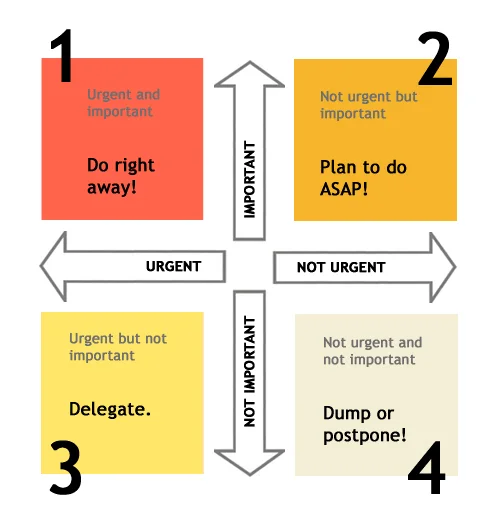
If you think “setting priorities” is a pleasant platitude, you don’t understand what it really is. “Setting priorities” is the brutal process of deciding which things won’t get done.
This is actually something I could use some help with. Recently, I read the Harvard Business Review article “Find the Coaching in Criticism” by Sheila Heen and Douglas Stone. Like many Harvard Business Review articles, it is of high quality (and unfortunately, that high quality doesn’t come for free–it is supported in part by the revenue generated through the Harvard Business Review's paywall.) They write:
Feedback is less likely to set off your emotional triggers if you request it and direct it. … Find opportunities to get bite-size pieces of coaching from a variety of people throughout the year. Don’t invite criticism with a big, unfocused question like “Do you have any feedback for me?” Make the process more manageable by asking a colleague, a boss, or a direct report, “What’s one thing you see me doing (or failing to do) that holds me back?” That person may name the first behavior that comes to mind or the most important one on his or her list. Either way, you’ll get concrete information and can tease out more specifics at your own pace.
I feel that I already get plenty of advice on things I should be doing more of–both for my academic career and for my career as an economic journalist (which is how I categorize my efforts on this blog). What I could use more of is advice on what I should be doing less of–things that I am putting time and effort into that don’t have an adequate payoff. To clarify, I need to say that I have three goals:
Both my academic career and my career as an economic journalist contribute to both goals, but in different degrees. My academic career is still at least an order of magnitude more important in providing income than my career as an economic journalist. (Any change in that fundamental fact would be a change that would look dramatic to outside observers as well as me.) But I feel my career as an economic blogger/journalist is at least as important as my academic career in making the world a better place. So I definitely want to keep up with both my academic career and my career as an economic journalist. But what I do within each of those categories, and the exact balance between them, is something I could use advice on.
Notice that in both academia and in blogging/journalism, a certain amount of self-promotion and institutional promotion is optimal. If I manage to write something worth reading, it is worth putting forth a certain amount of effort to get 5000 people to read it instead of 500. And some aspects of promotion of a blog are cumulative over time. I see the goal of having at least one post a day in that category. Even during a stretch where no one post is a big hit, it means something to readers to know there will be something every day.
All of that is just meant to direct you away from some possibly tempting, but I think, misguided pieces of advice like “Quit watching TV” (What? Reduce my leisure time further and lose my chance to enjoy the premier art form of our time?) or “Quit doing your blog” or “Abandon your academic career and become an economic journalist full-time.” By contrast, three pieces of feedback I have received, which may or may not be the right advice, but are definitely the kind of thing I am looking for, are “Twitter beyond basic announcements of posts and maybe one more tweet a day isn’t worth the time it takes if the goal is blog promotion,” “You don’t need to copy over the whole text of a post to Facebook, the link alone is plenty,” or “Reading and commenting on 200 blog posts from your students in the course of a semester is above and beyond the call of duty.”
In addition to getting your advice for myself, I wanted to recommend that those of you who feel you are overextended and overly busy also consider asking those around you
What should I be putting less time and effort into? What do think I am doing that isn’t worth the time and effort I put in?
To get useful responses, you might need to spell out your objectives clearly as I tried to do above for myself.

Cast your minds back, to a time when everyone supposedly loved each other. By MichaelH
Econlolcats on my blog are a sign of good things to come. Sometime this morning, I expect to have my latest column appear on Quartz. This one is on “Odious Wealth.”
The link above is to the Japanese version. “The Costs and Benefits of Repealing the Zero Lower Bound … and Then Lowering the Long-Run Inflation Target” in English can be found here.