North Carolina Clergy Bring Religious Freedom Lawsuit against State’s Same-Sex Marriage Ban

I don’t mean to claim I had any effect, but I am interested to see that the argument I made in my column “The Case for Gay Marriage is Made in the Freedom of Religion” is being pursued in North Carolina. My thanks to John Davidson for pointing me to the news report by Lorelei Laird linked above. Here are key passages:

A federal lawsuit filed yesterday in the Western District of North Carolina puts a new spin on same-sex marriage litigation: religious freedom. In it, several individual clergy members and the General Synod of the United Church of Christ argue that state laws banning same-sex marriage unconstitutionally penalize them for practicing their faith. …

North Carolina has both a constitutional amendment and a statute making same-sex marriages invalid. Furthermore, North Carolina General Statute §51-6 makes it a crime for members of the clergy to perform marriages for couples who do not have a license.

As a result, the complaint says, state law forbids the plaintiffs from practicing their religions, in violation of the free exercise and free association clauses of the First Amendment. The plaintiffs also make the due process and equal protection arguments more common in same-sex marriage lawsuits after last year’s U.S. Supreme Court ruling in United States v. Windsor.

Quartz #47—>Meet the Fed's New Intellectual Powerhouse

Link to the Column on Quartz

Here is the full text of my 47th Quartz column, “Meet the Fed’s new intellectual powerhouse,” now brought home to supplysideliberal.com. It was first published on March 24, 2014. Links to all my other columns can be found here.

I wrote this column just in time. On April 3, 2014, Jeremy Stein announced he was resigning from the Fed. But we might see him again in the future in high government office. And this column is at least as much about enduring issues of monetary policy as it is about Jeremy. 

If you want to mirror the content of this post on another site, that is possible for a limited time if you read the legal notice at this link and include both a link to the original Quartz column and the following copyright notice:

© March 24, 2014: Miles Kimball, as first published on Quartz. Used by permission according to a temporary nonexclusive license expiring June 30, 2017. All rights reserved.

I have two related columns not directly linked in this piece: “Monetary Policy and Financial Stability“ and my discussion of Janet Yellen’s views: ”Janet Yellen is Hardly a Dove: She Knows the US Economy Needs Some Unemployment.”

What I say in the column about how a low elasticity of intertemporal substitution affects how the Fed should respond to risk premia is informed by the discussion I gave of a paper of Mike Woodford and Vasco Curdia at a Bank of Japan conference (which I mentioned and linked to here.) Claudia Sahm, Matthew Shapiro and I are working on literature review of empirical work on the elasticity of intertemporal substitution for our paper on that topic. I will have more to say on that in the future. 


Janet Yellen led her first monetary policy meeting as chair last week. But with Yellen’s emphasis so far on consensus and continuity, the key news from the Fed last week wasn’t anything Janet Yellen said, but what Federal Reserve Board Governor Jeremy Stein said at the International Research Forum on Monetary Policy on Mar. 21.

Jeremy Stein is currently the junior member of the Federal Reserve Board, having served only since May 30, 2012. (Several recent nominees to the Federal Reserve Board have yet to be approved.) But with Ben Bernanke’s departure, Stein now has the most distinguished academic record of anyone currently making decisions about US monetary policy. His background as a Harvard Professor of Economics and former President of the American Finance Association shows. He holds office hours for staff at the Federal Reserve Board, and from the half hour that I once spent with him, I can say that he stands ready to debate the fine points of economic models with anyone. In his speech last Friday, Governor Stein showed how much genuine light an academic approach can shed on practical monetary policy questions in the right hands.

Victoria McGrane and Jon Hilsenrath at the Wall Street Journal summarize Stein’s speech with the headline, “Financial Stability Considerations Should Influence Monetary Policy.” But Stein’s message is subtler than that headline suggests. He asks first: “Should financial stability concerns, in principle, influence monetary policy decisions? … This question is about theory, not empirical magnitudes, and, in my view, the theoretical answer is a clear ‘yes.’”

As he clearly spells out, the key to his argument is his “third and final assumption … that the risks associated with an elevated value of [financial market vulnerability] cannot be fully offset at zero cost with other non-monetary tools, such as financial regulation.” Stein summarizes:

Thus one way to think of my construct of FMV [financial market vulnerability] is that it is a stand-in for the level of financial vulnerabilities that remain after regulation has done the best that it can do, given the existing real-world limitations.

To explain what he is saying, let me make the analogy to cancer treatment. Because the newer targeted chemotherapies are still not 100% effective, they are still often combined with the older chemotherapies that attack any and all growing cells—leading to the all-too-familiar side effects of hair loss, nausea, anemia, and so on. Similarly, if targeted policies such as financial regulation can’t fully prevent financial crises, then it might sometimes make sense to add a bit of tight monetary policy to help rein in financial excesses.

But the same logic says that the better we get at using targeted tools to prevent financial crises, the less we will need to rely on a monetary broadside—with all of its undesirable side effects—as a secondary preventative measure. So it matters when Anat Admati and Martin Hellwig make a careful argument that high equity requirements for banks have very few true social costs or when I argue that a US Sovereign Wealth Fund would not only stabilize the financial system, but also make money for US taxpayers. (I am not alone in advocating for contrarian debt-financed sovereign wealth funds. UCLA Economics Professor Roger Farmer is just as strong an advocate, as well as top-flight economics journalist John Aziz and my fellow Quartz columnist and coauthor Noah Smith.)

Governor Stein, after making the case that financial stability concerns should play at least some role in monetary policy-making, however small, makes an excellent suggestion of how to guess when financial excess is a concern. He suggests focusing on the size of risk premiums in the bond market. If people are willing to pay almost as much—or equivalently, willing to accept interest rates almost as low—for junk bonds as they are for the very safest bonds (still US Treasuries, despite all of our government debt follies), that is the time to worry.

In addition to all the reasons Governor Stein gives for focusing on risk premiums in the bond market as a way to guess the extent of financial dangers, a focus by the Fed on risk premiums in the bond market has another benefit. Too much discussion of monetary policy has proceeded under the fiction that there is only one interest rate. As soon as one recognizes that there are as many different interest rates as there are types of assets, an obvious question arises: “Which interest rates give the best idea of the cost of borrowing for the home-building, consumer spending, and business investment that drive aggregate demand for the economy?” The obvious—and correct—answer is that it is rates for mortgages, consumer loans, and loans to businesses (of which the lending represented by corporate bonds is an important part) that best represent the borrowing costs that matter for aggregate demand.

So even when the Fed states its policy in terms of the safe fed funds rate, it should be looking past that safe rate to the mortgage rates, consumer-loan rates, and corporate borrowing rates that result. Even before considering the risk of a financial crisis, the Fed should react to an increase in bond risk premiums almost one-for-one by a reduction in the safe rate, and should react to a narrowing of bond risk premiums almost one-for-one by an increase in the safe rate. (The reason I write “almost” one-for-one is that the risk premium has an effect on savers as well as on borrowers, but evidence suggests that savers are not very sensitive to interest rates, so it is the effect of the key rates on borrowers that is of greatest concern.)

The metaphor of an ivory tower is used to contrast academia to the “real world.” But differences among academics in how much they understand the real world are just as big as any gap between academics in general and non-academics. The details of Jeremy Stein’s academic publications and government experience indicate that he combines a respect for theory with a practical bent. And the fact that his specialty is finance is a good sign in that regard: the abundance of good financial data anchors the field of finance into the real world, as reflected in the lack of a divide within finance to match the divide in macroeconomics between “Freshwater” and “Saltwater” macroeconomists. In intellectual style, Jeremy Stein reminds me of the brilliant Larry Summers, but Stein is free of the political baggage that led to Summers being passed over for Chairman of the Federal Reserve Board. My crystal ball is often cloudy, but if I make no mistake, I see an exhilarating trajectory ahead for Jeremy Stein.


John Stuart Mill on the Chief Interest of the History of Mankind: The Love of Liberty and Improvement vs. Custom

When John Stuart Mill claims that something is “the chief interest of the history of mankind,” it is worth taking notice. In On Liberty, Chapter III: “Of Individuality, as One of the Elements of Well-Being,” paragraph 17, he writes:

The despotism of custom is everywhere the standing hindrance to human advancement, being in unceasing antagonism to that disposition to aim at something better than customary, which is called, according to circumstances, the spirit of liberty, or that of progress or improvement. The spirit of improvement is not always a spirit of liberty, for it may aim at forcing improvements on an unwilling people; and the spirit of liberty, in so far as it resists such attempts, may ally itself locally and temporarily with the opponents of improvement; but the only unfailing and permanent source of improvement is liberty, since by it there are as many possible independent centres of improvement as there are individuals. The progressive principle, however, in either shape, whether as the love of liberty or of improvement, is antagonistic to the sway of Custom, involving at least emancipation from that yoke; and the contest between the two constitutes the chief interest of the history of mankind.

To a surprising degree, custom vs. liberty and improvement is not only the chief interest of the story of mankind, but the chief interest of the story of life itself, since natural selection operates by amplifying the small fraction of random variations in the genetic code that lead to improvement in survival and reproduction:

  • The genetic code establishes the customary order. Without a large measure of this order, life would fall apart.
  • Given what one can expect from basic chemistry, random variations in the genetic code are the DNA or RNA chemistry equivalent of liberty.
  • Natural selection among those variations is the closest counterpart in chemistry to improvement.  

Jennifer Breheny Wallace—The Upside of Envy: Envy Can Lower "Life Satisfaction," but at Its Best, Can Provide Motivation and Inspiration

As an economist heavily invested in studying happiness and life satisfaction, I was very interested in the essay by Jennifer Breheny Wallace linked above. Here is the key passage:

A study published last August by the journal Plos One, led by researchers at the University of Michigan, found that the more people used Facebook, the less satisfied they were with their lives. In another study last year involving almost 600 Facebook users, German researchers say they witnessed the “rampant nature of envy” on social-networking websites.

So modern envy seems to be bad—but it doesn’t have to be. Researchers are finding that, if approached the right way, there can actually be an upside to this deadly sin.

Psychologists classify envy in two ways: malicious and benign. With benign envy, you are motivated by another person’s success and strive to emulate it. With malicious envy, you want to cut the advantaged person down so you look better by comparison. Let’s say you feel pangs of envy after your rival at another firm gets promoted. Malicious envy might drive you to undermine his success, but benign envy would inspire you to work harder and get promoted, too.

Studies show benign envy can be a great motivator. In a 2011 study published in the Personality and Social Psychology Bulletin, researchers in the Netherlands conducted a series of experiments with more than 200 university students. Researchers found that when they triggered feelings of benign envy—as opposed to admiration or malicious envy—in the students, it drove them to want to study more and perform better on a test measuring creativity and intelligence. While admiration may feel better, the researchers found, it doesn’t motivate performance like the pain and frustration of envy.

The research mentioned is not mine–the University of Michigan is a hotbed for research on happiness and life satisfaction in general. I’d be glad for the reference.  

Matt Ridley on the Debate Between Economists and Ecologists

The piece linked above is an excellent essay by Matt Ridley in the Wall Street Journal this morning. Here are some key passages that provide a taste, followed by my own views:

1. What frustrates [economists] about ecologists is the latter’s tendency to think in terms of static limits. Ecologists can’t seem to see that when whale oil starts to run out, petroleum is discovered, or that when farm yields flatten, fertilizer comes along, or that when glass fiber is invented, demand for copper falls.

That frustration is heartily reciprocated. Ecologists think that economists espouse a sort of superstitious magic called “markets” or “prices” to avoid confronting the reality of limits to growth. The easiest way to raise a cheer in a conference of ecologists is to make a rude joke about economists.

I have lived among both tribes. I studied various forms of ecology in an academic setting for seven years and then worked at the Economist magazine for eight years. When I was an ecologist (in the academic sense of the word, not the political one, though I also had antinuclear stickers on my car), I very much espoused the carrying-capacity viewpoint—that there were limits to growth. I nowadays lean to the view that there are no limits because we can invent new ways of doing more with less. …

2. The best-selling book “Limits to Growth,” published in 1972 by the Club of Rome (an influential global think tank), argued that we would have bumped our heads against all sorts of ceilings by now, running short of various metals, fuels, minerals and space. Why did it not happen? In a word, technology: better mining techniques, more frugal use of materials, and if scarcity causes price increases, substitution by cheaper material. We use 100 times thinner gold plating on computer connectors than we did 40 years ago. The steel content of cars and buildings keeps on falling.

3. …  thanks to fracking and the shale revolution, peak oil and gas have been postponed. They will run out one day, but only in the sense that you will run out of Atlantic Ocean one day if you take a rowboat west out of a harbor in Ireland. Just as you are likely to stop rowing long before you bump into Newfoundland, so we may well find cheap substitutes for fossil fuels long before they run out.

4. In 1972, the ecologist Paul Ehrlich of Stanford University came up with a simple formula called IPAT, which stated that the impact of humankind was equal to population multiplied by affluence multiplied again by technology. In other words, the damage done to Earth increases the more people there are, the richer they get and the more technology they have.

Many ecologists still subscribe to this doctrine, which has attained the status of holy writ in ecology. But the past 40 years haven’t been kind to it. In many respects, greater affluence and new technology have led to less human impact on the planet, not more. Richer people with new technologies tend not to collect firewood and bushmeat from natural forests; instead, they use electricity and farmed chicken—both of which need much less land. In 2006, Mr. Ausubel calculated that no country with a GDP per head greater than $4,600 has a falling stock of forest (in density as well as in acreage).

Haiti is 98% deforested and literally brown on satellite images, compared with its green, well-forested neighbor, the Dominican Republic. The difference stems from Haiti’s poverty, which causes it to rely on charcoal for domestic and industrial energy, whereas the Dominican Republic is wealthy enough to use fossil fuels, subsidizing propane gas for cooking fuel specifically so that people won’t cut down forests.

As for my own views, for the kinds of reasons Matt Ridley gives, I am definitely not worried about the world running out of resources. I do worry more than Matt seems to about the possibility that fossil fuels are so abundant that we might fry the planet. You can see my views about how to deal with that danger in my column “Actually, There Was Some Real Policy in Obama’s Speech” and in my repeated Twitter refrain “Kill coal!” I think environmental activists can be most effectively heroic in saving the planet at this point in history

  • by singling out coal for demonization among all fossil fuels and
  • by pushing for more support for solar power research.

The First Translation of Miles's Work: Die „Hunger Games“ sind nicht unsere Zukunft – Sie sind schon Realität

Link to Kalle Kapner’s German Translation of “The Hunger Games is Hardly Our Future: It’s Already Here,” on the German Open Borders website

I was pleased when Kalle Kapner asked if he could translate my column that you can read in English here:

The Hunger Games is Hardly Our Future, It’s Already Here.

I am grateful to Max Huppertz and Rudi Bachmann for looking over Kalle’s translation. Since this is the first translation I know of for any of my work, let me reproduce the full translation here (with Kalle’s approval). Based on my college German, I think it sounds better in the German translation than in the original, at least to a lover of foreign languages like me!


Miles Kimball ist Professor für Volkswirtschaftslehre und Umfrageforschung an der University of Michigan und bloggt auf Confessions of a Supply-Side Liberal. Der folgende Text erschien im Dezember 2013 bei Quartzund wurde durch Kalle Kappner für Offene-Grenzen.net übersetzt.

Die Hunger Games¹ zeichnen ein auf unheimliche Art und Weise passendes Bild der Realität. Das Kapitolentspricht den reichen Staaten unserer Welt: Den USA, Kanada, Australien, Japan, Israel, Neuseeland, einigen Öl-Königreichen, den meisten europäischen Staaten. Die Distrikte sind die armen Staaten unserer Welt: Haiti, Nepal, Bangladesch, Kambodscha, Laos, Papua-Neuguinea, viele Länder in Zentralasien und Afrika mit Pro-Kopf-Einkommen von weniger als 10 Dollar pro Tag.

Das Kapitol, mit all seinem Überfluss an Nahrungsmitteln, guter medizinischer Versorgung und technischem Schnickschnack, ist von einer gigantischen, mit Sprengfallen versehenen High-Tech-Mauer umgeben. Um das materielle Paradies des Kapitols zu erreichen, müssen sich die Distrikt-Bewohner durch die Mauer graben ohne getötet oder gefangen und zum Verhungern in die Distrikte zurückgeschickt zu werden.

Der wichtigste Unterschied zwischen Suzanne Collins‘ Hunger Games und meiner Interpretation ist, dass die Armut in der realen Welt unbegreiflich bitterer ist als die in den Hunger Games dargestellte Armut. Um dies meinen Studenten, die die Vereinigten Staaten nie verlassen haben, klar zu machen, lese ich ihnen Nicholas Kristofs New York Times-Essay „Where Sweatshops are a Dream“ Wort für Wort vor.

Der andere Unterschied liegt darin, dass die bösen Machenschaften des Kapitols in Suzanne Collins‘ Romanen so tiefe Wurzeln haben wie die Nation selbst. Wir in den Vereinigten Staaten dagegen bauen eine Mauer um Immigranten fernzuhalten, obwohl dies unserer eigenen historischen Tradition und dem guten Beispiel unserer Gründerväter widerspricht. Das ist nicht nur herzlos von uns – zum aller Wahrscheinlichkeit nach nur geringen Nutzen eines kleinen Teils der Bevölkerung – sondern auch dumm. Die strikten Einwanderungsbeschränkungen schaden unserer Wirtschaft, erschweren den zukünftigen Ausgleich des Staatshaushaltes und hemmen die Zukunft der Vereinigten Staaten als geopolitische Macht.

Sind Einwanderungsbeschränkungen notwendig? Es mag ein Limit bei der Geschwindigkeit geben, mit der wir Neuankömmlinge aufnehmen können. Aber es gibt gute Gründe, anzunehmen, dass dieses Limit sehr viel höher liegt als die derzeitige Einwanderungsrate. Im Jahrzehnt von 1900 bis 1910 kamen pro Jahr Einwanderer im Umfang von 1 % der Bevölkerung ins Land. Sicher, es gab ein paar Spannungen, aber das Land fiel nicht auseinander. Heute ist Amerika aufgrund der Einwanderer des frühen 20. Jahrhunderts und deren Nachfahren weitaus stärker. Zum Vergleich: Die Anzahl neuer legaler und dauerhaft bleibender Immigranten in den USA liegt heute pro Jahr bei nur 0,33 % der Bevölkerung.  Und die Gesamtanzahl aller illegalen Einwanderer in den USA, gespeist aus vielen, vielen Jahren der Immigration, beträgt nur 3,7 % der US-Bevölkerung – nicht einmal annährend so hoch wie die Einwanderungsrate von 1 %, die die Vereinigten Staaten in der ersten Dekade des 20. Jahrhunderts aufwiesen. Diese Immigranten könnten sich sehr viel schneller in unsere Gesellschaft integrieren, wenn sie nicht zu einem Leben im Verborgenen gezwungen wärenaufgrund von Gesetzen, die sie zu Kriminellen erklären.

Der Philosoph Michael Huemer liefert hier eine gute Diskussion der Ethik der Einwanderungsbeschränkungen. Eine wichtige Einsicht ist, dass viele US-Bürger gerne Einwanderer aus anderen Ländern aufnehmen würden. Doch einige Amerikaner halten andere Amerikaner davon ab, Einwanderer so willkommen zu heißen, wie sie es wünschen. Und viele Menschen aus der ganzen Welt wären überglücklich in die Vereinigten Staaten kommen zu dürfen, selbst wenn ihnen jeder Anspruch auf öffentliche Leistungen versagt würde.

In unserer Welt ist Exklusion eine Form der Grausamkeit, die wir achselzuckend hinnehmen. Menschen ohne Grund aus dem materiellen Paradies auszuschließen verwandelt eine Utopie in eine Dystopie. Indem sie Immigranten fernhalten, übernehmen die Vereinigten Staaten – wie die anderen reichen Staaten der Erde – die Rolle des Kapitols in meiner Interpretation der Hunger Games. Doch alles was wir tun müssen um dies zu ändern, wäre, die Inschrift auf der Freiheitsstatue wieder ernst zu nehmen: “Give me your tired, your poor, your huddled masses yearning to breath free” – “Gebt mir eure Müden, eure Armen, euregeknechteten Massen, die frei zu atmen begehren.”

© 8. Dezember 2013: Miles Kimball, zuerst veröffentlicht bei Quartz. Weiterverwendet auf Basis einer temporären, nicht-exklusiven Lizenz, die am 30. Juni 2017 abläuft.

¹ Die Romantrilogie “The Hunger Games” und deren Verfilmung sind im Deutschen unter dem Titel „Die Tribute von Panem“ erschienen.

Drew Hinshaw: Nigeria Produces Half the Electricity of North Dakota-for 249 Times More People

I have heard distressing, yet fascinating, stories from a colleague who has spent time in Africa about how folks in Africa often act like the “Homo Economicus” of our theories, but without the benefit of adequate property rights to keep things on track. One example I found vivid is the routine theft of wire from power lines in order to sell the copper. So I was interested to read Drew Hinshaw's Wall Street Journal article linked above about electricity in Nigeria. I particularly noticed these passages which help make vivid the kinds of problems that can face a poor country trying to get richer:

The quest to turn the lights back on in Nigeria is pitting some of the country’s richest men against rusted power lines, pilfered electricity and grenade-lobbing saboteurs. …

Half of Nigeria’s electricity is stolen or lost on quarter-century-old power lines. Companies have taken on the job of installing electric meters and bringing bills to the hundreds of thousands of Nigerian households that run wires to nearby electrical poles, without paying. …

Nigeria will need to lay fresh pipelines to tap its gas reserves—the world’s eighth largest—to fuel those turbines. One problem: Saboteurs lurking in the swamps keep throwing grenades under what few gas pipelines exist in an attempt to extort protection money from Nigeria’s government. …

When Mr. Elumelu’s staff first walked into the plant last November—they weren’t given access until it was purchased—they discovered technicians weren’t wearing safety goggles or even shoes. Some crawled into the innards of deadly gas turbines wearing flip flops.

Those workers had also lost track of turbine parts, rendering the massive machines unusable. All told, the station produces just 160 megawatts—half the wattage the company assumed when it bought the place.

Michigan, University and State, Occasion a Landmark Supreme Court Decision on Affirmative Action

The link above is to a well-written and careful discussion by Jess Bravin in the Wall Street Journal of the Supreme Court’s 6-2 decision to uphold the right of a state—in this case Michigan—to prohibit the use of explicitly race-based affirmative action at its universities.

Within Michigan, the voter initiative against using race-based affirmative action was prompted in the main by the University of Michigan’s actions.

As a professor at the University of Michigan, what I regret most is this: by going too far in the direction of formulaic affirmative action, the University of Michigan caused a backlash that may imperil the ability of the faculty and administrators at the University of Michigan to do affirmative action based on case-by-case judgments. That seems especially unfortunate to me because I think affirmative action based on case-by-case judgments is likely to strike a better balance among all the different kinds of affirmative action that might be warranted.

Here is a link to an earlier Wall Street Journal article giving some of the history of the legal battle about affirmative action in Michigan:

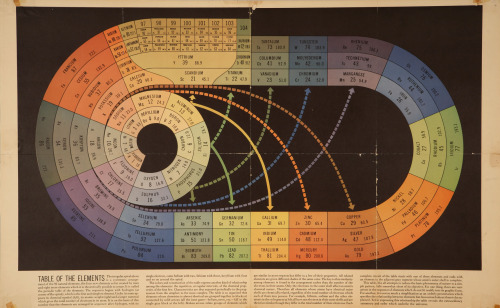
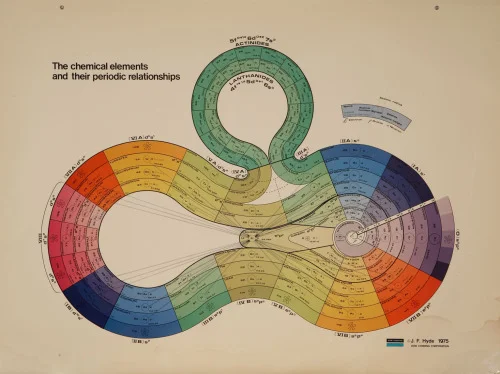
The Periodic Table in the Round

I like these different versions of the periodic table flagged by othmeralia, who wrote: 

In 1869 Dmitrii Mendeleev sketched his first draft of the periodic table.  While Mendeleev’s version remains the most common, alternative arrangements include circular, cylindrical, pyramidal, spiral, and triangular layouts.  Indeed, Edward Mazurs chronicled over 140 types in his seminal work, Graphic Representations of the Periodic System over 100 Years! Which one gets your vote?

The trouble is that the more well-known you are, the more difficult it is to hide away and actually work. When no one is interested in you and inviting you to things, it’s easier.

– British designer Zandra Rhodes, in an interview for the April, 2014 issue of Harvard Business Review by Alison Beard. My title for this quotation isThe Boon of Being Unknown.