On Master's Programs in Economics

With the large demand for graduate education in economics by Chinese students, many economics departments have recently established terminal master’s programs in economics, or are seriously considering doing so. (A terminal master’s program is one that is separate from the PhD program and typically does not lead to a PhD in the same department.) I was Director of the Master of Applied Economics (MAE) Program at the University of Michigan from July 2010 to December 2012, so I wanted to share some thoughts about master’s programs in economics.

The University of Michigan Master of Applied Economics Program. The MAE program at the University of Michigan was well-established long before I arrived as an assistant professor at the University of Michigan in 1987. The composition of the student body has shifted over the years, but the basic nature of the program has not. Our MAE program is very flexible. The formal requirements can be found on the MAE website, but a surprisingly close approximation to the requirements is that there are 5 semester core courses, and then an additional 6 courses that in practice can be almost anything suitably advanced. (There is no master’s thesis in our MAE program.) Students greatly value this flexibility. Here are some examples of different categories of students in our MAE program:

  1. Mid-career government officials who come to increase their knowledge of economics and their skills before returning to government service.  For example, in 2012 we admitted employees of the Central Banks of Japan, Korea, Turkey, Mexico, and Chile, and employees of other government agencies in Afghanistan, Pakistan, Kazakhstan, Korea, Japan, Singapore, Indonesia, Thailand, and China.
  2. Dual-degree students in other programs at the University of Michigan who realize the value of learning more economics.  For example, in 2012 we had dual degree students who were also pursuing a degree in Public Policy, Financial Engineering, MBA and PhD from the Ross Business School, Kinesiology, Urban Planning, Natural Resources, Psychology, Statistics, Education, Health Services Organization and Policy, Industrial and Operations Engineering.
  3. Students who have recently received a bachelor’s degree who hope to prepare for a career in government service, including service in international organizations such as the World Bank and the IMF.
  4. Students who have recently received a bachelor’s degree who hope to prepare for a career in finance.
  5.  Students who tried and failed to get into a Ph.D. program who need a way to further their economics training while they figure out what to do next in their lives if their plan of getting a Ph.D. looks impossible.
  6. Students who belatedly realized their interest in economics and want to switch into economics from another discipline.
  7. Students with a wide range of other objectives.  Here is a list drawn from admittees this year: (a) more analytical rigor to further a business career, (b) understand economics better after having been an economic reporter, (c) get a job in a think tank, as a consultant, as an economic analyst, or in an NGO, (d) understand the art market better, and (e) have a better chance of success as an entrepreneur or running a company.

Most students can easily complete the program in 3 semesters, though a large minority choose to stay 4 semesters, given the attractions of being in our program and being in Ann Arbor. The 5 core courses are all specially designed for the MAE students. They are:

  • Math for Economists
  • Microeconomics
  • Macroeconomics
  • 2 Semesters of Econometrics

For their other 6 courses, MAE students fan out to a wide variety of courses. With a few exceptions, the number of MAE students in any one course they take as an elective is so few that they can easily be accommodated. These electives are all classes that would exist even if we didn’t have an MAE program. For example, MAE students take many advanced undergraduate economics classes. Our advanced undergraduate classes are at the right level for most MAE students, given how rigorous our undergraduate program is. But MAE students also take many classes from other departments and schools within the university: math classes, statistics classes, public policy classes and business school classes. (The University of Michigan has modest transfers between units to compensate units for doing part of the education having students from other schools in their classes. These are sufficient that other units don’t mind having our MAE students in their classes.)

Preparation for PhD Programs? One of my biggest surprises when I became the Director of our MAE program was learning how small our role is in preparing students for PhD programs. As the examples I gave above, the bulk of our students had other goals. Indeed, the modal goal was to do something much like an MBA, but with less networking and more economic rigor. For those students who did want to go on to a PhD program, I had to tell them that our MAE program had no special magic in that regard. Noah Smith and I give our advice about getting into economics PhD programs in “The Complete Guide to Getting into an Economics PhD Program.” But getting a master’s degree is not a key component of that advice. I would be interested in the placement results of other master’s programs into PhD programs, but I felt lucky when we had a handful of our MAE graduates accepted into PhD programs. (Some PhD programs give a preference to graduates of their department’s master’s program. Michigan’s PhD program does not. So I am talking primarily about admission to the PhD programs of other universities.)

Resource Cost: What this means is that the incremental faculty resources needed to keep our MAE program going are only the equivalent of fielding 6 classes: the 5 core classes, plus 1 course worth of administrative time on the part of the Director. In addition, there is a staff coordinator (who has some other non-MAE duties in the department as well). Our MAE program also spends a few hundred dollars a year on parties. (My main innovations as Director of the program were aimed at fully integrating the MAE students into our department socially and making sure they interacted with one another socially as well.) That is about it.

I wish we had more resources devoted to career counseling for MAE students. I think the extra resources that would be needed are quite reasonable in magnitude. There have been discussions in our department about doing exactly that. Also, we have had discussions about adding one elective specifically for MAE students directed at research.

Demand for Master’s Programs: I was amazed at the quality of the applicants to our MAE program. And it isn’t just the grades and test scores. The essays are heartfelt and impressive as well. Of the students we admitted, about 1 in 3 came to our program the first year I did admissions, and almost 1 in 2 came to our program the last year I did admissions. The overwhelming bulk of our applicants (75% or so) were from China. Yet we had no problem in filling out our MAE classes with good students even back in the days when China did not yet believe in students getting an education in Neoclassical economics. So the demand of students for an education in our MAE program far exceeds the number of slots we have. If we were a regular business, we would expand much more than we have. But elite universities remain elite by restricting the supply of spaces in their programs. And the elite reputation of a university spills over from one department to the next. So we are not allowed to expand our program beyond a target of about 50 students in each entering class. I suspect some other economics departments face similar constraints. To the extent existing master’s programs do not expand to meet the demand, it makes sense for additional departments to set up master’s programs.

Conclusion: My main piece of advice to economics departments thinking of setting up a terminal master’s program in economics is to consider the University of Michigan’s low-overhead model of running its MAE program. This is not just a matter of money. Staffing requires also finding faculty who meet our high standards. So programs that rely on larger increments of faculty time are likely to run into staffing headaches that go beyond just needing to pay the salaries.

It actually takes people coming along and saying ‘That’s not so good.’ Those are the people that elevate you artistically and creatively. So the ‘No’ can be a really beneficial thing for artists.

– Keith Urban, on American Idol (during the episode for the 13th season auditions in Detroit, aired January 22, 2014)

John Stuart Mill: Against Enforced Moderation

I have always thought of moderation as a good thing, but John Stuart Mill is willing to take the contrary position and argue against moderation if moderation is imposed by someone else. Here is what he says in On Liberty, Chapter III: “Of Individuality, as One of the Elements of Well-Being,” paragraph 15:

There is one characteristic of the present direction of public opinion, peculiarly calculated to make it intolerant of any marked demonstration of individuality. The general average of mankind are not only moderate in intellect, but also moderate in inclinations: they have no tastes or wishes strong enough to incline them to do anything unusual, and they consequently do not understand those who have, and class all such with the wild and intemperate whom they are accustomed to look down upon. Now, in addition to this fact which is general, we have only to suppose that a strong movement has set in towards the improvement of morals, and it is evident what we have to expect. In these days such a movement has set in; much has actually been effected in the way of increased regularity of conduct, and discouragement of excesses; and there is a philanthropic spirit abroad, for the exercise of which there is no more inviting field than the moral and prudential improvement of our fellow-creatures. These tendencies of the times cause the public to be more disposed than at most former periods to prescribe general rules of conduct, and endeavour to make every one conform to the approved standard. And that standard, express or tacit, is to desire nothing strongly. Its ideal of character is to be without any marked character; to maim by compression, like a Chinese lady’s foot, every part of human nature which stands out prominently, and tends to make the person markedly dissimilar in outline to commonplace humanity.

Chenrui Gao: It's Time to Let Direct Selling Disrupt Our Expensive System of Car Dealerships

I am very proud of the writing of the students in my “Monetary and Financial Theory” class. I ask them to write three blog posts a week. Here is a great one, from Chenrui Gao:


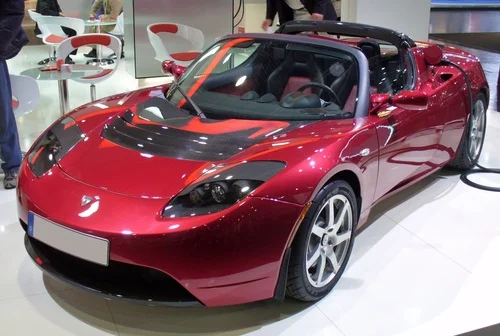
After a long period of fruitless lobbying efforts, Tesla Motor, a public electric car manufacturer, decidee to stop selling its luxury vehicles in New Jersey because the state doesn’t allow it to sell cars directly to consumers. Besides Texas and Arizona, the New Jersey government stands firmly with the dealers and made itself the third state to ban direct sales. Tesla’s mistrust of dealers and its strong faith in directing selling motivates its defense for manufacturer sales. However, dealers afraid that the directing selling could spread to other manufacturers are resisting Tesla’s plan resolutely. The heated discussion between the manufacturer and the state government once again brings back the issue of whether manufacturer sales should be banned or not. I want to argue that manufacturer sales should become an available option because it could benefit both manufactures and consumers.

First of all, manufacturer sales could become a very effective cost-cutting measure. If the manufacturers could avoid the cost of distributing cars to dealers all over the country and accept orders direct from consumers, the vehicle price could be significantly lower. Research by Gerald Bodisch indicates that the cost of the auto distribution system in the United States averages up to 30 percent of the car price. We know form the last financial crisis that General Motors and Chrysler suffered a lot and received 17.4 billion dollars in loans under the Troubled Asset Relief Program. They need effective plans to improve their financial performance and earn more profit. These companies could cut distribution costs by reducing the number of dealers from 6200 to 4100. Also, the build-to-order model could save much of the money spent on storage for products, adding to profitability. According to other research, the total value of new car inventory held by 20700 car dealerships in 2008 was about 100 billion dollars and the annual carrying cost of that inventory was estimated as 890 million dollars. GM started to use this method to produce Celta in Brazil eight years ago and now the Celta is one of the sales leaders in the local market.

Moreover, sometimes it is necessary to let manufactures sell their products directly so that the consumers can have better service. For example, some high-tech vehicle manufacturers like Tesla would do better at explaining their products than dealers who barely know about the functions by studying the instructions themselves.

Some might argue that the Auto Franchise System enforced by most of the states historically benefits manufactures because it helps them focus on developing and producing cars. And they might say dealers do better at assessing and fostering consumer demand than manufactures. However, those arguments assume that the production of a type of vehicle large-scale and that the demand for them is enormous, otherwise a national-wide distribution of dealers is just a faster way to increase costs. The emerging market of electric vehicles is still in its infant stage, with manufacturers Nissan LEAF, Chevrolet Volt and Tesla all fairly new to electric cars. They need more flexible ways to lower costs and expand the market.

Although the Auto Franchise System may make sense in some situations, manufacturers should be allowed to use another distribution system when that fits the product better. 

Chenrui Gao

Chenrui Gao

Will the ECB Go Negative?

On Wednesday (March 26, 2014), the Wall Street Journal had a remarkable news article by Brian Blackstone reporting on how the European Central Bank might be getting more serious about the idea of negative interest rates: “ECB Mulls Bolder Moves to Guard Against Low Inflation: Officials Indicate They Will Consider Negative Interest Rates, Asset Purchases.” Here are the key passages: 

  1. “We haven’t exhausted our maneuvering room” on interest rates, Bank of Finland Governor Erkki Liikanen, told The Wall Street Journal in an interview in Helsinki. … Asked what tools the ECB has remaining, Mr. Liikanen cited a negative deposit rate as well as additional loans to banks and asset purchases.
  2. Bundesbank President Jens Weidmann, in an interview with news agency MNI, didn’t rule out large-scale asset purchases, known as quantitative easing, as a possibility. He also raised the option of negative deposit rates, though he said he wasn’t talking about any imminent decision.
  3. Mr. Draghi was less specific Tuesday on what the central bank might do. But in a speech in Paris, he sought to underscore the bank’s resolve in fighting excessively low inflation, which weakens consumer spending, business profits and investment. “We will do what is needed to maintain price stability,” … [Mr. Draghi’s] comment was reminiscent of his July 2012 pledge to do “whatever it takes” to keep the euro together. That remark triggered a lasting rally in government bond markets in southern Europe. The ECB didn’t even have to purchase any government bonds—Mr. Draghi’s words were enough.
  4. Faced with a negative, or penalty, rate for parking funds at the ECB, commercial banks might instead lend their excess funds to other financial institutions, lowering short-term borrowing costs. It could also make euro-denominated assets less attractive to global investors, taking some of the froth off the value of the euro, and thereby boosting exports and inflation.One potential downside is that banks might pass along the added costs to customers by raising the interest rates they charge for loans. But Mr. Liikanen signaled he doesn’t think a negative deposit rate would generate unwanted side effects. “The question of negative deposit rates, in my mind, isn’t any longer a controversial issue,” he said.
  5. “The perception has been that [ECB officials] talk about it but won’t do it. I think they’re closer [to making the deposit rate negative] than has been perceived,” said Ken Wattret, economist at BNP Paribas.

The next day (yesterday), Brian Blackstone had another article on the same topic: “ECB Faces Uncharted Waters With Negative Deposit Rate Move Could Encourage Lending and Weaken Euro, Bolstering Exports.” One of the key worries discussed in the article is this:

Critics say negative rates could weaken the already fragile European banking industry by sapping its profits.

“The banks that would suffer the most are those ones with lower profitability,” said Alberto Gallo, head of European credit research at Royal Bank of Scotland. That includes small banks in Cyprus and Slovenia, Italian banks and some German Landesbanken, or public banks co-owned by the savings banks and regional governments, he added.

Banks also may pay less interest to savers and could raise the rates they charge on private loans to recoup their costs.

Here let me say something I say in all of my talks at central banks and their regional affiliates. Once the paper currency interest rate becomes something the central bank can choose, as in what I have proposed (see for example “How to Set the Exchange Rate Between Paper Currency and Electronic Money”) all 4 key interest rates under the central banks control can be moved up and down in tandem:

  1. The target rate (fed funds rate in the US)
  2. The lending rate (discount rate in the US)
  3. The interest rate on reserves or on excess reserves
  4. The paper currency interest rate. 

With all four rates moving up and down in tandem, the spreads between them that matter for bank profits can be kept at normal levels. In particular, reductions in the paper currency interest rate would make it possible for banks to reduce the deposit rates they pay enough that they can make profits even if the rates banks earn on loans are very low, even possibly negative. 

Note also that when people say that the demand by borrowers is low, that is at a zero or positive interest rate. At a low enough interest rate, I guarantee that the demand for loans would be high.  

By the way, I am headed to the European Central Bank this July to explain the details of implementing negative paper currency interest rates along with other negative rates. For modest negative paper currency interest rates, a time-varying deposit fee (on net paper currency deposits by banks bringing paper currency to or withdrawing paper currency from the central bank) should be sufficient to do the trick, even without the other measures I have talked about. I would be truly delighted to have Mario Draghi attend my seminar.   

Update, April 3, 2014:Brian Blackstone and Todd Buell reported on April 3 that the ECB’s discussion of negative interest rateshas the imprimatur of the ECB’s President Mario Draghi:

President Mario Draghi’s revelation that the central bank had discussed negative interest rates and large-scale bond purchases—if needed to keep persistently low inflation from undermining growth—caught financial markets by surprise. …

Mr. Draghi said officials had discussed asset purchases, known as quantitative easing, as well as setting a negative rate on bank deposits parked at the ECB—moves that could help bolster the economic recovery and push up prices. The annual inflation rate in the euro zone is just 0.5%, far below the bank’s target of just under 2%. …

The ECB is “resolute” in its determination to keep its easy-money policies in place, he said, and “to act swiftly if required.”

Brian and Todd have this description of the negative interest rate being contemplated:

A negative deposit rate—it is currently zero—would force financial institutions to pay to park their excess funds at the ECB, which may encourage them to lend more to the private sector. Denmark has deployed negative rates since 2012, but it would be largely unchartered territory for a major central bank such as the ECB.

In the US, this would be called a negative interest rate on excess reserves. For negative interest rates to work best, it is important that other key interest rates also go negative, particularly the paper currency interest rate. 

Note: For more details on how to implement negative rates well, see the links collected in “How and Why to Eliminate the Zero Lower Bound: A Reader’s Guide.”

Chris Chegash: College Athletes Deserve a Better Deal

Chris Chegash is a Junior at the University of Michigan pursuing a degree in Financial Mathematics and Economics. He is a student in my “Monetary and Financial Theory” class. This post was selected (by self-selection and then by me) as a guest post here from 100 or so posts students in the class write each week for an internal class blog.  Here is what Chris has to say:


In a previous blog post, I outlined some reasons showing that the NCAA is more concerned with money, than with their stated goal of provided college athletes with an education.  Since the time of that post, there have been significant developments in several instances of litigation against the NCAA pertaining to the compensation of players, and the commercial rights the NCAA has over its players.  The NCAA’s monopolistic iron-grip over players and their compensation has been eroding for several years through many different pieces of ligation.  In this blog, I will quickly discuss the NCAA, the cases against it, and then outline what might happen as a result of these cases.

The NCAA is a non-profit organization that serves as the organizing and regulatory body for college athletics.  Despite all the criticism leveled against the NCAA, they are an essential organization for keeping college athletics as fair as possible for the hundreds of member schools.  Recently, the NCAA has become bloated with money; in 2010 CBS paid $11 billion over 14 years to broadcast the NCAA tournament, and ESPN agreed to pay $5.64 billion over 12 years to broadcast the College Football Playoff.  While the NCAA reaps record profits while functioning under non-profit status, many poor players struggle to afford the costs of college, even while on athletics scholarships.  Many players claim that the actual cost of college is higher than the combination of tuition, room, board, and books, and that universities cannot pay them enough, due to the rules handed down by the NCAA.

A 2002 suit, White v. NCAA, argued that “restricting a scholarship to the cost of tuition, books, housing and meals was an unlawful restraint of trade because of the billions of dollars the NCAA earned through broadcast and licensing deals”.  The NCAA settled out of court for about $10 million.  A more prominent piece of litigation is O’Bannon v. NCAA, set to go to trial in June, that questions the NCAA’s right to commercial use of player’s likeness to gain financially, even long after the player is no longer a collegiate athlete.  Video game maker Electronic Arts paid $40 million to be removed from the claim as a defendant.  Today, March 17, 2014, another lawsuit was filed against the NCAA by a sports labor attorney who has been highly successful against the major sports leagues.  The suit claims that capping the pay of student athletics, at tuition, room, board, and books is a fixed price agreed upon the NCAA and it’s member universities and is unlawful.  Besides litigation, some college football players have sought to unionize to gain more bargaining power against the NCAA, because currently they are forced to more or less sign their rights away to participate in college athletics.

The argument that athletes are making is powerful.  The NCAA is able to generates enormous revenue; for example in 2011-2012, the University of Michigan football team generated $85,209,247 in revenue, compared to $23,640,337 in costs.  This means that the football team made around $62 million in profit, and with 85 scholarship players that amounts to over $700,000 per player.  Obviously every scholarship player didn’t generate equal revenue, a player like Denard Robinson brought in millions while others brought in almost none.  Since his professional career has yet to materialize, Denard capturing some of that profit he generated seems fair. The point being, Michigan, and many other major football programs would more than be able to compensate players more fully without cutting into their bottom line too much.

The opposition from paying players often comes from schools who believe they are already paying their athletes enough or don’t have the means to pay them more.  A scholarship, and a free education, is enough and athletes should be thankful for the opportunity they have received.  I believe this statement distorts the truth.  Yes, receiving a scholarship is a great opportunity, and is significant payment, but why should school administrators and coaches benefit financially from the revenue generated by football players? Nearly all other industries reward employees for generating revenue and profits via bonuses and commissions, but not college athletes.

The NCAA has vigorously defended this system using the mystique of “amateurism”, but major college athletes are hardly treated like amateurs any more.  Football and basketball players don’t even have to stay long enough to get a degree; the top prospects leave after three years and one year respectively.

There are several systems that could be used to compensate players. One is simply increasing scholarships to the full cost of tuition to cover incidental expenses.  Another would be to set up trust funds for players that take a fraction of the revenue they create and give the players access after they leave (or perhaps they graduate).  Neither of these systems are perfect, but they are better than what exists today.

Q&A on Negative Interest Rates and Having an Exchange Rate Between Electronic Money and Paper Currency

I had an interesting email Q&A about electronic money with a questioner who liked the idea of publishing it here, but asked to remain anonymous. 

Questioner: I just read your article in Slate on electronic money and negative interest rates. One question I had is, if interest rates go negative, what’s to prevent someone from borrowing an infinite amount of money?

For example, if a bank is offering -1% interest on a loan, what’s to stop me from borrowing $1 million, immediately repaying $990,000, keeping $10,000 in profit, and then immediately taking out another $1 million loan and doing the same thing over and over again? Perhaps you could put limits on the amount of money a single person could borrow, but it seems the limits would need to be much higher for corporations, and anyone could start dozens of corporations. It seems ripe for abuse. What’s to prevent this from happening?

Miles: Just like savers have to wait to get the benefits of positive interest rates, borrowers have to wait to get the benefits of negative interest rates. I would have to wait until a year later to have the $1 million I borrowed shrink to $990,000. What is also important, no one will give me a negative interest rate long term. They will only give me a negative interest rate for a few quarters during a serious recession. So I can’t just wait and wait until the amount I owe shrinks to nothing. If I have to wait a year to get the -1% and I only get one year, then the maximum shrinkage I can get, total, is 1%.  

Questioner: Why are negative interest rates easier to implement with electronic money than paper money?

Miles: It is easy to make numbers shrink in an electronic account. Paper currency has a number written on the front of it in ink, so (unless a bill has so much electronics in it that it is effectively an electronic account), the meaning of that unchanging number on the front has to change over time. What I propose is a changing exchange rate between paper money and electronic money (=bank money). And it is advantageous to use the electronic money as way all the accounting is done (“unit of account”).

Questioner: The Fed can make paper money less valuable by printing money, quantitative easing, etc. Conversely, they can make money paper more valuable by reducing the money supply. Is your argument that these levers are less efficient than electronic money?

Miles: Yes. All of those depend on making all forms of money less valuable. My proposal makes paper money temporarily less valuable than other forms of money when we need it to be and as much as we need it to be, with high precision. (See “A Minimalist Implementation of Electronic Money and “How to Set the Exchange Rate Between Paper Currency and Electronic Money.”)

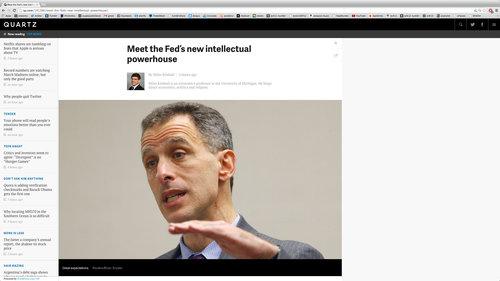
Meet the Fed's New Intellectual Powerhouse

blog.supplysideliberal.com tumblr_inline_n2yl4e2bcy1r57lmx.png

Here is a link to my 47th column on Quartz: “Meet the Fed’s new intellectual powerhouse.”

I have two related columns not directly linked in this piece: “Monetary Policy and Financial Stability” and my discussion of Janet Yellen’s views: “Janet Yellen is Hardly a Dove: She Knows the US Economy Needs Some Unemployment.”

What I say in the column about how a low elasticity of intertemporal substitution affects how the Fed should respond to risk premia is informed by the discussion I gave of a paper of Mike Woodford and Vasco Curdia at a Bank of Japan conference (which I mentioned and linked to here.) Claudia Sahm, Matthew Shapiro and I are working on literature review of empirical work on the elasticity of intertemporal substitution for our paper on that topic. I will have more to say on that in the future. 

Update: I wrote this column (which is about much more than Jeremy Stein himself) just in time. On April 3, 2014, Jeremy Stein announced he was resigning from the Fed. But we might see him again in the future in high government office.

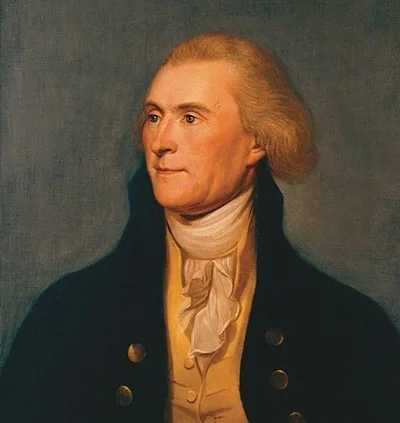
Thomas Jefferson and Religious Freedom

In his book Revolutionaries: A New History of the Invention of America(p. 307), Jack Rakove writes:

As he later explained in Notes on the State of Virginia, Jefferson had further reasons for making historical literacy the foundation of a common education. Rather than “putting the Bible and Testament into the hands of the children, at an age when their judgments are not sufficiently matured for religious enquiries, their memories may here be stored with the most useful facts from Grecian, Roman, European and American history.” … the kinds of historical facts that Jefferson deemed useful and his ideas of education carry over into the subject of bill 82, the bill for religious freedom. Though its formal purpose was to disestablish the Anglican Church, its deeper animus was to free individuals from any obligation to adopt religious views they found unpersuasive. In Jefferson’s view, all religious belief was finally a matter of individual opinion. The history of religious establishments was an unrelenting story of corrupting alliances between churchmen and rulers, abusing their power to impose their opinions and modes of thinking on others. This too was a form of tyranny, as inimical to liberty as anything else the Stuarts and other execrable autocrats had attempted. For Jefferson as for Locke, religion was not  a matter of children inheriting the faith of parents. It was instead a subject of inquiry, and no one could simply adopt another’s convictions. The point of reading history first, scripture later, was to empower individuals to judge the claims of all religions by teaching them that much of what passed for orthodoxy in other times and places depended on the impure alliance of church and state.

See also “The Importance of the Next Generation: Thomas Jefferson Grokked It.”

Haozhao Zhang: The US Should Counter Russia's Natural Gas Weapon With Its Own

Haozhao Zhang is a student in my “Monetary and Financial Theory” class at the University of Michigan. I very much liked this post he did for the internal class blog. I asked him if I could make it a guest post here:


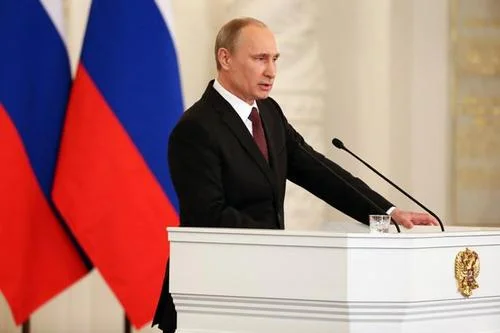
The current conflict in Ukraine is attracting a lot attention. Weeks ago, in order to against the counter force from EU countries, Mr. Putin played his trump card: raise the natural gas price in Ukraine. As a big country rich in natural resources–especially energy–Russia can use its control over the natural gas piped into Europe from Russia as a strategic weapon in this game. 

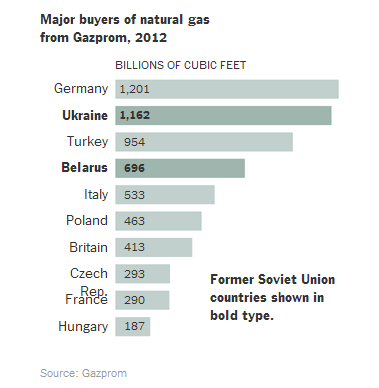
The West has threatened to sanction Russia for moving to annex Crimea. But more than 30% of gas in EU is provided by Russia, so the credibility of those threats is in doubt. Leading countries in the EU such as the UK and Germany are faced with such a concern: the graph below from NYT can shows that major buyers of the Gazprom – Russia’s largest state-owned natural gas company.

Note the positions of Germany and Britain on the list. Actually according to this article in WSJ, Six countries in Europe import 100% of their gas from Russia, and an additional seven rely on it for at least half. It is beyond doubt that Russia has its considerable influence on the attitudes of the EU countries on this affair. U.K. Foreign Secretary William Hague said European nations may need to “recast their approach” to Russian energy purchases if the crisis isn’t resolved.

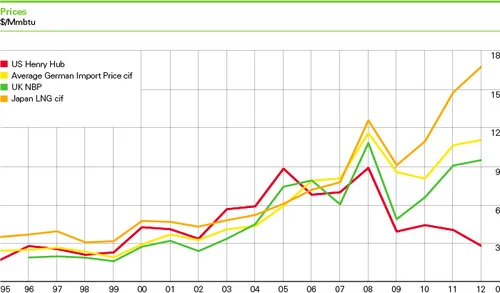
Also reported in WSJ, Obama’s government is taking measures to curb the Russia’s stranglehold over EU’s natural gas supply. US is currently one of the biggest natural gas production nations in the world due to one of its most advancing tech in this field: fracking. The strategy is to increase natural gas exports to the EU from the US, reducing the EU’s dependence on Russian gas. Compared to Russia, US has a big initial cost advantage that can help balance out transportation costs. As the graph from BP’s official site showed below, the natural gas price has kept falling over recent years in North America. The price in US is far lower than that of Asia and Europe.

In this strategy for the US, big oil and gas production firms like ExxonMobil benefit a lot from it, while environmentalists and small manufacturing companies strongly oppose such a claim. From a geopolitical point of view, this strategy seems unstoppable.

There are several reasons why US has restricted oil and natural gas exports in the past:

  1. Exporting more natural gas will increase the price of it in the US. Currently the natural gas price in US is only about 1/5 of that in Japan, which gives an advantage to US manufacturing industries that rely heavily on gas as raw material. More exports would mean less gas available in US, and the price would likely rise.
  2. Environmentalists are concerned about fracking. 
  3. Fear of running out: in the past, with less advanced technology the available gas reserves seemed limited. People were afraid of a natural gas shortage later on if it was exported now.

However, the current situation is dramatically different. Here is why it is now a good time for the US to export natural gas:

  1. There is a boom in natural gas reserves, thanks to the new technology of “fracking.“ 
  2. Increasing the domestic gas price now looks like a good thing. Because of the increase in gas reserves, natural gas producing firms are complaining. Exports would now raise the price and benefit those firms without making the prices seem too high to consumers, compared to what they were used to in the past.
  3. Exporting US natural gas would curb Russia’s power over the EU. The political pressure in the Ukraine will be the main push behind increasing natural gas exports from the US.

Overall, the US strategy is good news, because it can help establish a global natural gas market, and encourage the use of relatively clean, low-carbon natural gas.

On Happiness

image source

This is the audio for a discussion about happiness by three of the best researchers and thinkers on happiness in the world: Justin Wolfers, Matthew Adler and my coauthor Ori Heffetz. (It was for a radio broadcast that never aired. Simon Tulett is the interviewer.) It makes a wonderful addition to my sub-blog on “Happiness.” Thanks to the participants for making this public–especially to Ori, who arranged to post it on his personal website.

John Stuart Mill: Different Strokes for Different Folks

Preference heterogeneity–different people wanting different things–has been a major theme in my research. In On Liberty, Chapter III: “Of Individuality, as One of the Elements of Well-Being,” paragraph 14, John Stuart Mill emphasizes the benefits for people’s welfare of letting them pursue their own desires, even if some of those desires are hard for us to understand:

I have said that it is important to give the freest scope possible to uncustomary things, in order that it may in time appear which of these are fit to be converted into customs. But independence of action, and disregard of custom, are not solely deserving of encouragement for the chance they afford that better modes of action, and customs more worthy of general adoption, may be struck out; nor is it only persons of decided mental superiority who have a just claim to carry on their lives in their own way. There is no reason that all human existence should be constructed on some one or some small number of patterns. If a person possesses any tolerable amount of common sense and experience, his own mode of laying out his existence is the best, not because it is the best in itself, but because it is his own mode. Human beings are not like sheep; and even sheep are not undistinguishably alike. A man cannot get a coat or a pair of boots to fit him, unless they are either made to his measure, or he has a whole warehouseful to choose from: and is it easier to fit him with a life than with a coat, or are human beings more like one another in their whole physical and spiritual conformation than in the shape of their feet? If it were only that people have diversities of taste, that is reason enough for not attempting to shape them all after one model. But different persons also require different conditions for their spiritual development; and can no more exist healthily in the same moral, than all the variety of plants can in the same physical, atmosphere and climate. The same things which are helps to one person towards the cultivation of his higher nature, are hindrances to another. The same mode of life is a healthy excitement to one, keeping all his faculties of action and enjoyment in their best order, while to another it is a distracting burthen, which suspends or crushes all internal life. Such are the differences among human beings in their sources of pleasure, their susceptibilities of pain, and the operation on them of different physical and moral agencies, that unless there is a corresponding diversity in their modes of life, they neither obtain their fair share of happiness, nor grow up to the mental, moral, and aesthetic stature of which their nature is capable. Why then should tolerance, as far as the public sentiment is concerned, extend only to tastes and modes of life which extort acquiescence by the multitude of their adherents? Nowhere (except in some monastic institutions) is diversity of taste entirely unrecognised; a person may, without blame, either like or dislike rowing, or smoking, or music, or athletic exercises, or chess, or cards, or study, because both those who like each of these things, and those who dislike them, are too numerous to be put down. But the man, and still more the woman, who can be accused either of doing “what nobody does,” or of not doing “what everybody does,” is the subject of as much depreciatory remark as if he or she had committed some grave moral delinquency. Persons require to possess a title, or some other badge of rank, or of the consideration of people of rank, to be able to indulge somewhat in the luxury of doing as they like without detriment to their estimation. To indulge somewhat, I repeat: for whoever allow themselves much of that indulgence, incur the risk of something worse than disparaging speeches—they are in peril of a commission de lunatico, and of having their property taken from them and given to their relations.