Radagast the Brown: Modeling the Climate of Middle Earth
Link to the full article in Dwarvish (screen shot below)
Hat tip to John Aziz for his retweet on this one.
A Partisan Nonpartisan Blog: Cutting Through Confusion Since 2012


Link to the full article in Dwarvish (screen shot below)

Hat tip to John Aziz for his retweet on this one.

Here is the full text of my 41st Quartz column, “Gather ’round, children, here’s how to heal a wounded economy,” now brought home to supplysideliberal.com. It was first published on December 17, 2013. Links to all my other columns can be found here.
I did several followup posts to this column, including 4 YouTube videos:
If you want to mirror the content of this post on another site, that is possible for a limited time if you read the legal notice at this link and include both a link to the original Quartz column and the following copyright notice:
© December 17, 2013: Miles Kimball, as first published on Quartz. Used by permission according to a temporary nonexclusive license expiring June 30, 2015. All rights reserved.
University of Missouri-Kansas City professor Stephanie Kelton threw down the gauntlet for everyone serious about influencing economic policy into the next generation when she put out her MMT Coloring Book as a downloadable stocking-stuffer (pdf). (MMT stands for “Modern Monetary Theory,” the name of Stephanie’s viewpoint.) In response, I tweeted:

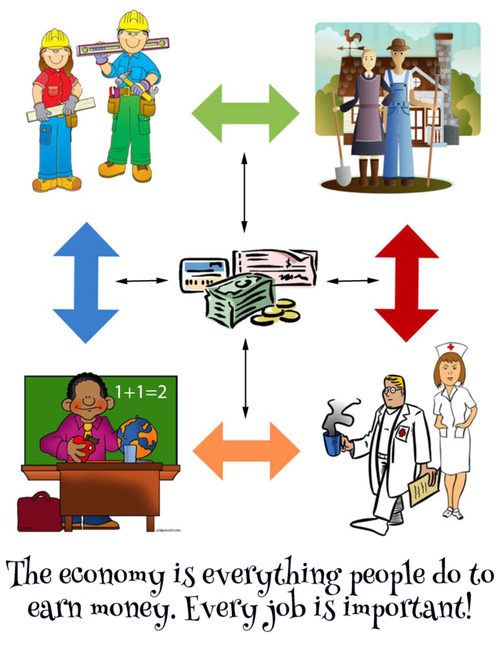
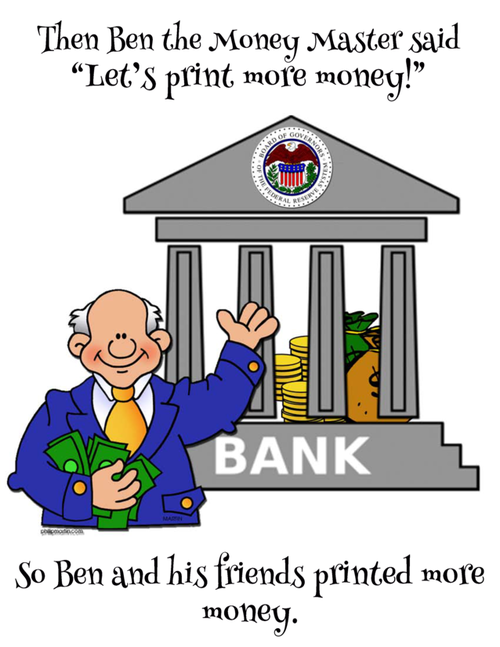
…and sent out a plea for creative help with a macroeconomic coloring book laying out my views about monetary policy. Donna D’Souza answered my call and did a great job illustrating the story. The downloadable coloring book (pdf) and colored-in storybook (pdf) are our gift to you and your children and grandchildren during this season of lights. You can also read the colored-in storybook version just below, followed by an explanation of the economics behind the story.
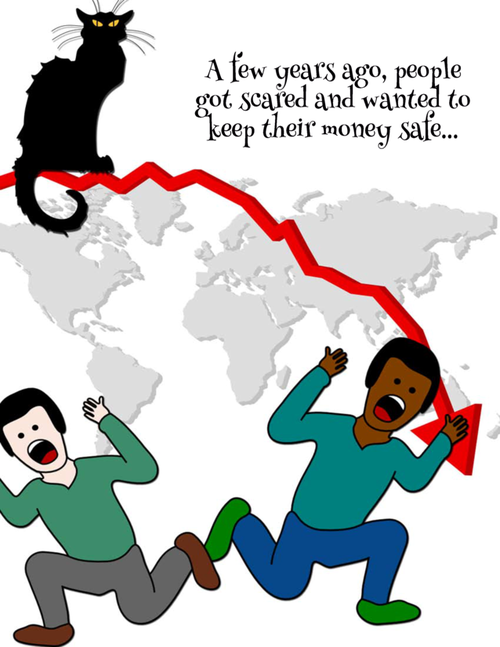
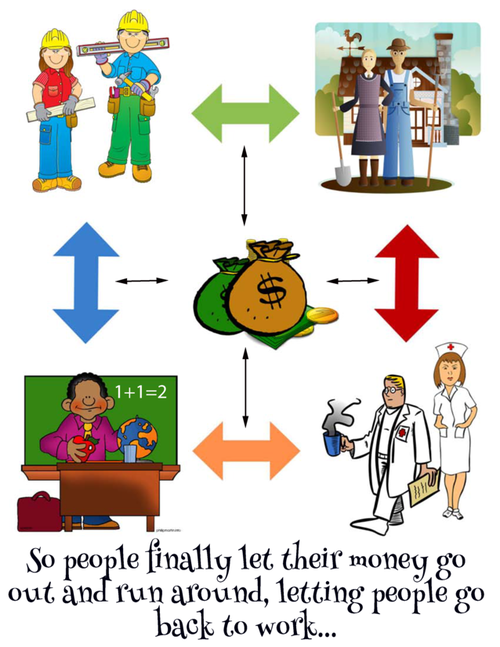
Milton the Maltese Falcon represents Milton Friedman, who was one of the greatest champions of monetary policy the world has known and one of the most effective economists ever at explaining economics to the public. Milton Friedman used an equation for the effects of monetary policy that emphasized two things: the quantity of money and the velocity of money. Money sitting in a bank vault or under a mattress has no velocity, and drags down the average velocity of money throughout the economy. It is only when money is being lent out and used (to build factories, buy equipment, build houses, buy cars) that it stimulates the economy.
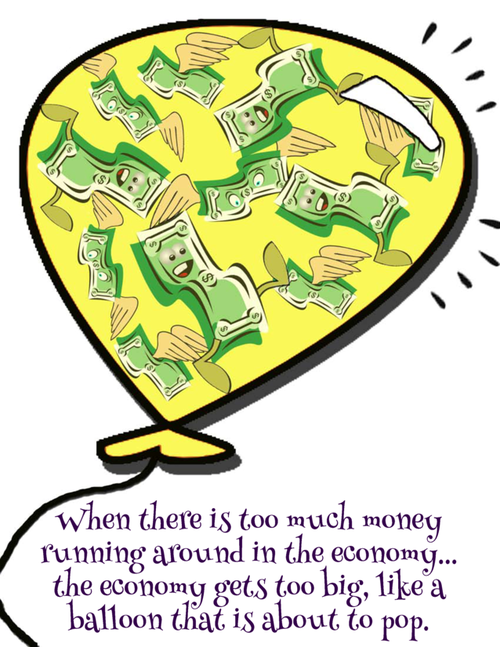
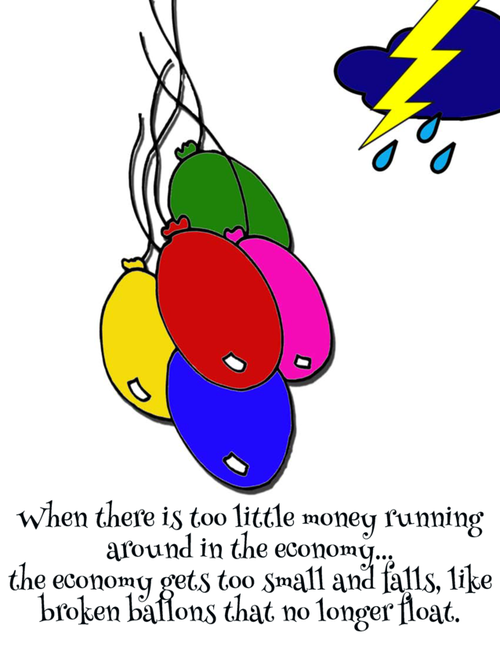
Of course, too much monetary stimulus is bad because it causes inflation (the balloon about to pop). But too little monetary stimulus is bad because it causes unemployment (the broken balloons). And how much stimulus a given amount of money provides depends a lot on whether it is at work in the economy (running around) or locked away in a bank vault, in a corporate treasury, or under a mattress, doing nothing.
The reason a lot of money has been lying around doing nothing is because the appropriate interest rate for the economy has been very low—below zero. If we had negative interest rates for a year or so, things would get back to normal. Without that tonic, bad times drag on and on.
A key thing to understand is that the rest of the government is preventing the Federal Reserve (Ben the Money Master and his friends) from doing what it needs to do to heal the economy. Here is how: the government prevents interest rates from going below zero by the way it handles paper currency. As things are now, holding a pile of paper currency is a way for people to earn a zero interest rate without putting their money to work in the economy.
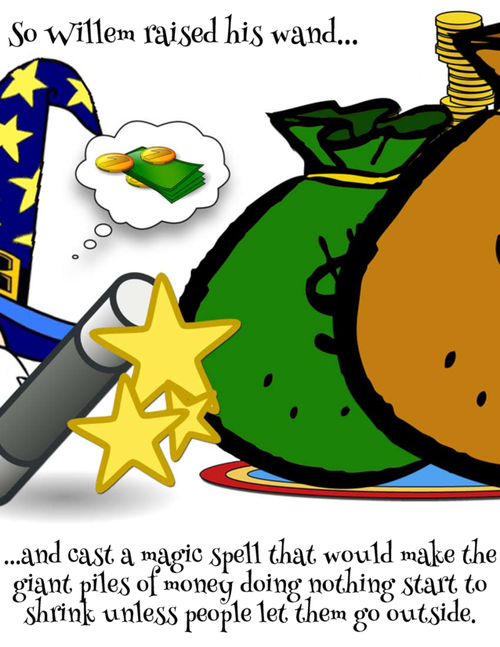
There is a solution, due in its modern form to Willem Buiter, now chief economist of CitiGroup, who appears in the story as “Willem the Wise Warlock.” Buiter discusses various options for repealing what economists call “the zero lower bound”: the economically damaging government guarantee that anyone can lend as much as they want to the government at a zero interest rate just by keeping a big pile of cash. I have elaborated on one of Willem Buiter’s ideas in Quartz, on my blog, and in presentations to central banks around the world, including the Federal Reserve Board.
If we do what it takes to make money sitting around doing nothing shrink, it will provide a strong boost to the economy as people put money to work in the economy. Not everyone will like it, but it will quickly bring full economic recovery, without the bad side effects of other means of trying to stimulate the economy (such as budget deficits or encouraging financial bubbles). Once the economy recovers, everything can go back to what people are used to. Some economists talk about the possibility that negative interest rates might be needed for a long time, but I don’t buy it. In my view, negative interest rates should only be needed for a short time during serious economic slumps. If the Fed and other central banks are given that authority, recessions can be brief and people can get back to work again.
One of the most important reasons we need to keep the economy in good working order—in this case with appropriate monetary policy—is so that economics can recede a bit more into the background of people’s lives. Then people can concentrate again on the things that should matter most: nurturing relationships with friends and family, creating wild, wonderful varieties of meaning in their lives, and taking time to stand in awe of the universe.
We all know that the way to prevent the troubles that would be caused by shooting ourselves in the foot is to avoid shooting ourselves in the foot. Just so, our economic troubles have a straightforward cause and a straightforward technical solution. Both the cause of our troubles and the essence of the solution to our troubles are told in Milton the Maltese Falcon’s ballad.

On December 16, 2013, I gave a talk at the University of Michigan Library “On the Future of the Economics Blogosphere.” Here is the video of the talk.
Before watching the video, I recommend taking a look at the very high quality storify creation P. F. Anderson put together from the talk, including two sets of live tweets sent out during the talk. This was far, far from being a polished presentation, but there is a lot of substance to the talk, which you can see in P. F. Anderson’s storify piece.
The Powerpoint file is not so interesting all by itself; but here it is, if you want to refer to it.
You can see other talks in the series here.
The debate continues! This discussion is at just as high a level as yesterday’s.
This was a very interesting Twitter discussion with Daniel Altman and others. I easily put it in my top 5 Twitter discussions during the 19 and a fraction months I have been blogging.
Several related links are collected in my post “The Red Banker on Supply-Side Liberalism.”

Via murketing:
Arguably the ultimate in dedigitization.
And via procrastinaut:
This is a concept GIF showcasing how kittens will be free on the Internet one day.
The general structure of Aldo Raines’s argument in this Twitter discussion sparked by my column “The case for gay marriage is made in the freedom of religion” is worth noting: instead of arguing against legalizing gay marriage, he asserts a strong correlation between support for gay marriage and other beliefs he disagrees with. I don’t think that works, logically. Not only are the posited correlations far from perfect, but it is very easy for someone to be right about some of herhis beliefs and wrong about others.

For Mormon Church watchers, it was big news when (without any other announcement) the official website of the Mormon Church posted on December 6, 2013 a new article on “Race and the Priesthood.” The subject of the article was this fact:
… for much of its history—from the mid-1800s until 1978—the Church did not ordain men of black African descent to its priesthood or allow black men or women to participate in temple endowment or sealing ordinances.
The article is remarkable in forthrightly rejecting the racist theories that Mormons had given historically for this policy. As part of the argument against racist theologies as an explanation, the article points to the fact that the Mormon Church ordained men of African descent during the lifetime of its founder, Joseph Smith. Then the ban on people of African descent being allowed to receive the priesthood is presented as an unexplained action of Joseph Smith’s successor, Brigham Young:
During the first two decades of the Church’s existence, a few black men were ordained to the priesthood. One of these men, Elijah Abel, also participated in temple ceremonies in Kirtland, Ohio, and was later baptized as proxy for deceased relatives in Nauvoo, Illinois. There is no evidence that any black men were denied the priesthood during Joseph Smith’s lifetime.
In 1852, President Brigham Young publicly announced that men of black African descent could no longer be ordained to the priesthood, though thereafter blacks continued to join the Church through baptism and receiving the gift of the Holy Ghost. Following the death of Brigham Young, subsequent Church presidents restricted blacks from receiving the temple endowment or being married in the temple. Over time, Church leaders and members advanced many theories to explain the priesthood and temple restrictions. None of these explanations is accepted today as the official doctrine of the Church.
The article does not give examples, but two prominent theories were
Although there is no text of a divine revelation recorded for Brigham Young’s policy of denying people of African descent the Mormon priesthood, Mormon Church leaders believed that a divine revelation was necessary to overturn this policy:
Nevertheless, [in the 1950’s,] given the long history of withholding the priesthood from men of black African descent, Church leaders believed that a revelation from God was needed to alter the policy, and they made ongoing efforts to understand what should be done.
Among the Mormon Church leaders who believed a divine revelation was necessary to change the policy of denying people of African descent the priesthood was my grandfather, Spencer W. Kimball. Consequently, as President of the Church, he sought such a divine revelation. The article “Race and the Priesthood” cites my father Edward L. Kimball's BYU Studies article “Spencer W. Kimball and the Revelation on Priesthood” for a detailed account of my grandfather’s spiritual experience and the spiritual experiences to which he led his colleagues–spiritual experiences which led to the adoption of the Mormon Church’s “Official Declaration 2,” which erases all official racial barriers in Mormonism. (“Official Declaration 1” was the beginning of the renunciation of polygamy.)
Today, the Church disavows the theories advanced in the past that black skin is a sign of divine disfavor or curse, or that it reflects actions in a premortal life; that mixed-race marriages are a sin; or that blacks or people of any other race or ethnicity are inferior in any way to anyone else. Church leaders today unequivocally condemn all racism, past and present, in any form.23
In addition to the renunciation of racist explanations for the pre-1978 ban on people of African descent holding the priesthood, the article “Race and the Priesthood.” is interesting in what it says about the fallibility of Mormon Church leaders. The doctrine of continuing revelation that is so central to Mormonism always implied that church leaders can be wrong about theology. In that spirit,
Soon after the revelation [in 1978] Elder Bruce R. McConkie, an apostle, spoke of new “light and knowledge” that had erased previously “limited understanding.”22
It is also clear that Mormon Church leaders can change previous policies. But the Church leadership is essentially held to be infallible in major decisions about what the Church should do at a given moment in time. That doctrine was necessary when the Mormon Church turned away from polygamy, to the dismay of many members. “Official Declaration 1” as it appears in Mormon scriptures includes this statement by Mormon Church President Wilford Woodruff:
The Lord will never permit me or any other man who stands as President of this Church to lead you astray. It is not in the programme. It is not in the mind of God. If I were to attempt that, the Lord would remove me out of my place, and so He will any other man who attempts to lead the children of men astray from the oracles of God and from their duty.
According to these principles, the Mormon Church can renounce past policies and can renounce past theologies, but it cannot renounce the rightness of past policies at the time they were in effect. This subtle position provides the institutional strength that comes from a doctrine of infallibility without the rigidity that would result from a less subtle version of an infallibility doctrine.
In my reading, the article “Race and the Priesthood” is very careful to avoid saying that Brigham Young made a mistake in denying men of African descent the priesthood–unless the condemnation of “racism, past and present, in any form” is intended as a condemnation of that policy. But I think that wording is intended to be ambiguous and deniable; for example, if God thought the pre-1978 ban was wise for some inscrutable reason, that would not be racism, since God, being perfect, cannot be racist. A possible objective would be to have the words seem to condemn the policy to those who think the policy was racist, but not to seem to condemn it to those who think Church leaders could not make such a big mistake.
In the 1990’s one of my friends coined the wonderful phrase “flexible dogmatism” to describe the Mormon position on infallibility. The one key difference between flexible dogmatism then and flexible dogmatism now is that the rise of the internet has reduced the extent to which the Mormon Church can pretend beyond historical fact that its current policies held in the past as well. I am impressed by how gracefully the article “Race and the Priesthood” deals with the inability to dissemble in that way, while maintaining the essence of flexible dogmatism.
As part of what makes flexible dogmatism work, my friend points to “rolling interpretations” of authoritative statements that provide the "authority of the past to the changing present.“ (For example, when Brigham Young said that some day men of African descent would enjoy the blessings of the priesthood, he may have meant they would receive the priesthood in the afterlife. This statement was later interpreted as a foreshadowing the extension of the priesthood to men of African descent in 1978.)
At the grassroots level, the Mormon version of infallibility is well expressed by the children’s song with these lyrics:
Follow the prophet, follow the prophet,
Follow the prophet; don’t go astray.
Follow the prophet, follow the prophet,
Follow the prophet; he knows the way.
The power of this song is hard to appreciate without hearing the tune, which has always sounded to me like a tune for the kind of Russian dance pictured below:

This is a followup to my Christmas column “That baby born in Bethlehem should inspire society to keep redeeming itself.”
I am not making a narrowly legal argument in “The case for gay marriage is made in the freedom of religion." It as addressed at least as much to current and future voters and legislators as to lawyers crafting arguments for judges.
This was a very interesting post by Noah, even before he added me, as explained in these two tweets.
Noah says some very nice things about me. I thought about copying them out here, but that thought triggered (at least temporarily) even my sorely underdeveloped inhibitions about bragging; so you will have to click the link in the post title to see them, along with Noah’s other Heroes of blogging.
Let me say conversely that Noah is definitely one of my blogging heroes. In fact, there is no blog I would rather read than Noah’s.

Stranger in a Strange Land, the science fiction novel in which Robert Heinlein coined the word “grok.” I use “grokked” here to mean “understood intuitively, to the core of his being.”
In my Christmas column, “That baby born in Bethlehem should inspire society to keep redeeming itself,” I point out how central the fact of generational replacement is to any attempt to influence the long-run future:
For those of us already in the second halves of our lives, the fact that the young will soon replace us gives rise to an important strategic principle: however hard it may seem to change misguided institutions and policies, all it takes to succeed in such an effort is to durably convince the young that there is a better way.
Thomas Jefferson understood this principle. Jack Rakove, writes in his book Revolutionaries: A New History of the Invention of America (pp. 318-319):
Taken as a whole, Notes on the State of Virginia could profitably be read by any enlightened member of the international republic of letters that counted Jefferson, Franklin, and Adams among its citizens. But on the sensitive topics of constitutions and especially the nexus of slavery and race, Jefferson really did intend his thoughts for a generation younger than his own or even the cohort to which Madison, Monsroe, and the martyred John Laurens (children of the 1750s) belonged. In “the interesting spectacle of justice in conflict with avarice and oppression,” he wrote to the English radical Richard Price, he took heart “from the influx into office of young men grown and growing up. These have sucked in the principles of liberty with their mother’s milk, and it is to them I look with anxiety to turn the fate of this question.” Here again was an expression of Jefferson’s deep, even pioneering interest in the concept of a generation, the motif that recurs in his ideas of entail, inheritance, the use of public land, education, religion, and now emancipation. In effect he imagined the future of Virginia as a tale of two rising generations: one to be taught to let their bondsmen go, the other reared for freedom in some unknown Canaan.
Jack Rakove takes up the same theme a few pages earlier as well (pp. 307-308):
Here was another twist on Jefferson’s recurring concern with issues of inheritance, whether from parent to child or from one generation to the next. For Jefferson the concept of posterity was more than a vague reference to those who would come later. His schemes of education and religious freedom, like the abolition of primogeniture and entail and his plans for using public lands to sustain newly married couples, all rested on a concern with the legacy one generation bequeathed to another. That he would think of this in wartime, when the liberty his contemporaries were seeking remained at risk, was again a tribute to a view of the American future that was either wholly optimistic or terribly naive.
More on the Abolition of Entail: Here is more background on Thomas Jefferson’s view on entail (pp. 302,305):
The first [bill Jefferson proposed] on October 14, [1776,] was to abolish entail, a medieaval mode of inheritance that kept estates intact by prohibiting successive eldest heirs from subdividing the entailed property among their descendants. …
… he was actively pondering the consequences of allowing a relatively small number of families to monopolize so much of the new state’s land.
One fruit of this concern was the act abolishing entail, which Jefferson ushered through the assembly in the fall of 1776. Its passage was uncontroversial because it enabled the gentry to dispose of their property as they wished.
Note that In the case of abolishing entail, moving in a libertarian direction could help move wealth distribution toward greater equality. However, the additional freedom of landholders to subdivide their land came at the cost of the freedom of their ancestors to prevent them from doing so.
As macroeconomic theorists, Roger Farmer and I have very different perspectives, but we have both come the conclusion that advanced economies should create institutions that treat sovereign wealth funds as a tool of economic stabilization. Sovereign wealth funds are already routine for governments that have more paper assets than liabilities. The new idea is that it is worthwhile for governments to borrow if necessary to finance sovereign wealth funds as a tool of economic stabilization. Here is my brief appeal for a US sovereign wealth fund in “Off the Rails: How to Get the Recovery Back on Track”:
Establishing a US Sovereign Wealth Fund to do the purchasing of long-term and risky assets would give the Fed room to maneuver in monetary policy, and restrict its job to steering the economy rather than making controversial portfolio investment decisions. And a US Sovereign Wealth Fund could stand as a bulwark against wild swings in financial markets.
The same argument holds for the UK or any other large advanced economy.
In his academic research, Roger Farmer focuses on models with multiple rational-expectations equilibria, and takes that perspective in discussing his prescription for dealing with financial instability. By contrast, along with Robert Shiller and George Akerlof, I tend to think of genuine financial instability as arising from irrational swings in expectations with no firm foundation in fundamentals. Despite this stark theoretical difference, our policy views about sovereign wealth funds as agents of economic stabilization are remarkably similar. (This is not just my assessment: Roger was actually the first one to notice the similarity of our policy views some months back, and we have corresponded since then.)
Yesterday’s post by Matthew C. Klein, “Buy $3 Trillion in Stocks. What Could Go Wrong?” is a good source of links to others who are talking about a US sovereign wealth fund. I think what follows answers some of the objections that Matthew raises. In particular, the institutional architecture for a sovereign wealth fund must be very carefully designed, and should be more like the way central banks are set up than the way current government investment funds are designed. And Roger solves the problem of how to vote shares for what the government owns.
Let me lay out references and quotations for the key elements of our argument.
1. Purchases of Long-Term and Risky Assets Work to Stimulate the Economy, Even When Short-Term Rates are at the Zero Lower Bound, But Such Purchases Deserve a New Institutional Framework
This is the gist of the argument in my first column on this issue:
Several other posts detail my thoughts on setting up such an institution:
Roger calls such an insitution a “fiscal authority,” while I call it simply a “sovereign wealth fund,” even though it would have key new features relative to existing sovereign wealth funds. But our essential idea is the same. Here is the relevant passage Roger’s John Flemming Memorial Lecture, given at the Bank of England on 16 October 2013: “Qualitative easing: a new tool for the stabilisation of financial markets” (pdf):
The institution that I would like to promote is a fiscal
authority, with the remit to actively manage the maturity
structure and risk composition of assets held by the public.
This authority would continue the policy of qualitative easing, adopted in the recent crisis, and by actively trading a portfolio of long and short-term assets it would act to stabilise swings in asset prices. I will show that asset price instability is a major cause of periods of high and protracted unemployment, and I will argue that by varying the maturity and risk composition of government debt, we can control large asset price fluctuations, and prevent future financial crises from wreaking economic havoc on all of our lives.
It is clear from other passages that Roger intends the sovereign wealth fund to deal with risky private sector assets as well. In the design of how such an institution would handle stock holdings, Roger solved one problem I was stumped by: how to avoid government interference in the private sector by the way the sovereign wealth fund votes the shares of stock it owns. Exchange traded funds provide the solution. Here is the relevant passage from Jason Douglas's Wall Street Journal blog post about Roger’s proposal “How to Stop Financial Panics? Say Hello to Qualitative Easing”:
In an interview, Mr. Farmer said he isn’t advocating government agencies buy individual stocks in such operations. Buying a stock index through a fund might be a less controversial approach, he said. He added international cooperation between such these qualitative-easing institutions would also be highly desirable.
Roger’s lecture at the Bank of England gives an extended defense of the efficacy of government purchases of long-term and risky assets. Roger uses the term “Qualitative Easing” whenever QE is done as a “twist” without increasing the money supply:
Following the 2008 financial crisis, central banks throughout the world engaged in an unprecedented set of new and unconventional policies. I would like to draw upon a distinction that was made by Willem Buiter, a former member of the Monetary Policy Committee, between quantitative and qualitative easing (Buiter (2008)). When I refer to quantitative easing I mean a large asset purchase by a central bank, paid for by printing money. By qualitative easing, I mean a change in the asset composition of the central bank. (2) Both policies were used in the current crisis, and both policies were, in my view, successful.
But when short-term rates are at zero, either way the oomph from QE comes the purchases of the long-term and risky-assets, not from whether that is done by issuing money or by issuing short-term safe bonds, so I am content to lump both quantitative and qualitative easing together as QE. Here are some things I have written on QE that I especially recommend:
2. Central Banks Should Not Be Too Quick to Worry about Financial Instability as a Result of Central Bank Action
Roger explains how QE works in this way:
If confidence is low, the private sector places a low value on existing buildings and machines. Low confidence induces low wealth. Low wealth causes low aggregate demand, and low aggregate demand induces a high-unemployment equilibrium in which the lack of confidence becomes self-fulfilling. Qualitative easing works to combat this vicious cycle by increasing the value of wealth as governments absorb the risks that private agents are unwilling to bear.
I would say “partially self-fulfilling” rather than “self-fulfilling,” but otherwise this is very much like what I write in my column
There I argue that monetary policy has to work either through raising wealth or by making it possible for people to borrow who couldn’t borrow before. If increases in wealth due to monetary policy and people who couldn’t borrow before becoming able to borrow are always seen as dangerous financial instability, then there is no room for monetary policy to do its job during a serious recession without someone complaining of dangerous financial instability.
3. A Sovereign Wealth Fund Can Reduce Financial Instability by Countercyclical Investment Policies
Here is the case I make:
For the case Roger makes, let me start with what Jason Douglas says in his article about Roger’s plan, “How to Stop Financial Panics? Say Hello to Qualitative Easing”:
How can governments stop financial panics wrecking their economies? A paper published by the Bank of England on Friday proposes a radical solution: a new breed of central bank-like institutions that buy and sell assets to prevent destabilizing swings in prices.
Mr. Farmer writes that financial crises are a frequent occurrence and often hurt citizens not yet born, never mind those who have to live through them. Citing evidence from past stock market crashes and the more-recent fallout from the subprime housing collapse in the U.S., Mr. Farmer argues that asset market volatility wreaks havoc in the real world. Some people will pay twice as much for a home than a neighbor who purchased theirs only a few years earlier. School leavers seeking work in a recession may earn far less throughout their lives than near-contemporaries lucky enough to have found a job in a boom. Mass unemployment frequently follows financial collapse.
His solution: “qualitative easing,” and new institutions to implement it.
Here is Roger himself, in his lecture at the Bank of England:
The efficient markets hypothesis has two parts that are often confused. The first, ‘no free lunch’, argues that without insider information, it is not possible to make excess profits by buying and selling stocks, bonds or derivatives. That idea is backed up by extensive research and is a pretty good characterisation of the way the world works.
The second, ‘the price is right’, asserts that financial markets allocate capital efficiently in the sense that there is no intervention by government that could improve the welfare of one person without making someone else worse off. That idea is false. Although there is no free lunch, the price is not right. In fact, the price is wrong most of the time.
The crisis was caused by inefficient financial markets that led to a fear that financial assets were overvalued. When businessmen and women are afraid, they stop investing in the real economy. Lack of confidence is reflected in low and volatile asset values. Investors become afraid that stocks, and the values of the machines and factories that back those stocks, may fall further. Fear feeds on itself, and the prediction that stocks will lose value becomes self-fulfilling. …
In my view, the policy of qualitative easing should be retained as a permanent component and new tool for the stabilisation of financial markets. Initially it was considered a radical step for central banks to control interest rates. The use of interest rate control to stabilise prices has proven to be effective and should be continued. But one instrument, the interest rate, is not sufficient to successfully hit two targets. … The remedy is to design an institution, modelled on the modern central bank, with both the authority and the tools to stabilise aggregate fluctuations in the stock market.
Since the inception of central banking in the 17th century, it has taken us 350 years to evolve institutions that have proved to be successful at managing inflation. The path has not been easy and we have made many missteps. It is my hope that the development of institutions that can mitigate the effects of financial crises on persistent and long-term unemployment will be a much swifter process than the 350 years that it took to develop the modern central bank.
A Final Thought: High Equity (Capital) Requirements as the Key to Minimizing the Harm from Remaining Financial Instability
A sovereign wealth fund, investing in a contrarian way, can reduce financial instability. But there is likely to be some financial instability remaining. The harm from this remaining financial instability can be reduced dramatically by high equity requirements. What do I mean by dramatically? The Financial Crisis of 2008 is the kind of thing that happens as a result of financial shocks when equity financing is only about 3% of the relevant asset class–mortgage-backed securities in this case. The crash of the internet stock bubble in 1999-2001 is the much less damaging kind of thing that happens as a result of financial shocks when equity financing is more than half of the relevant asset class.
I don’t know Roger’s views on this, and it is something that became clear to me only after much of what I have written on sovereign wealth funds. But I feel passionately about the importance of high equity requirements, which seem highly relevant to the topic of this post. So let me lay out here some of what I have written on high equity requirements as a way to protect the economy from the worst effects of financial shocks:
On the topic of equity requirements, my views are very close to those of Anat Admati and Martin Hellwig, which you can see at their website on this issue:
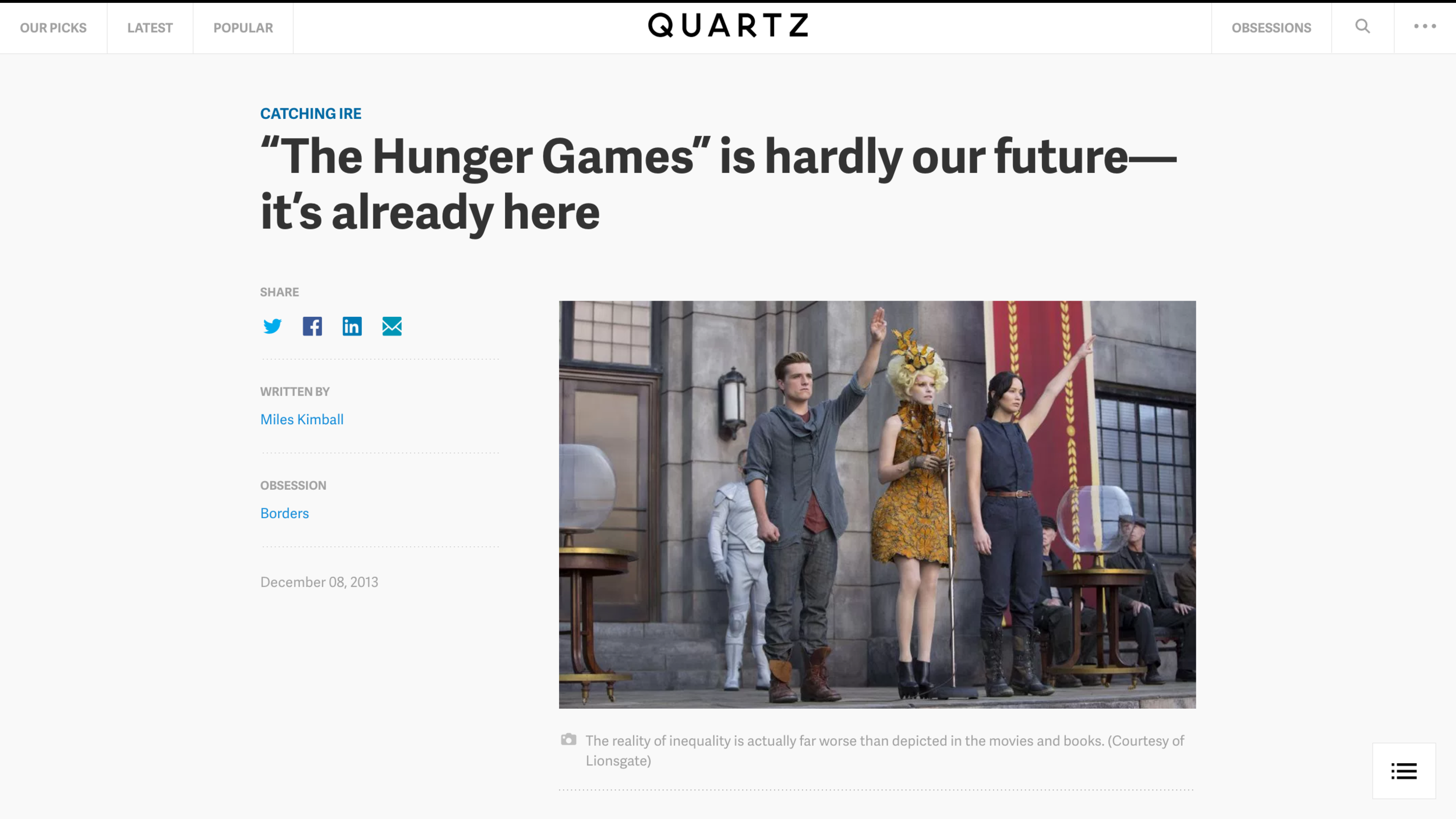
Here is the full text of my 40th Quartz column, “The Hunger Games is hardly our future—it’s already here," now brought home to supplysideliberal.com. It was first published on December 8, 2013. Links to all my other columns can be found here.
If you want to mirror the content of this post on another site, that is possible for a limited time if you read the legal notice at this link and include both a link to the original Quartz column and the following copyright notice:
© December 8, 2013: Miles Kimball, as first published on Quartz. Used by permission according to a temporary nonexclusive license expiring June 30, 2017. All rights reserved.
***********************************************************************
The Hunger Games paints an eerily apt picture of the world’s reality. The Capitol is the rich nations of the world: the US, Canada, Australia, Japan, Israel, New Zealand, some oil kingdoms, most European nations. The Districts are the poor nations of the world—Haiti, Nepal, Bangladesh, Cambodia, Laos, Papua New Guinea, many countries in central Asia and Africa, all of which have per capita incomes less than $10 per day.
The Capitol, with all of its abundance of food, advanced medical care, and gadgets, is surrounded by a giant high-tech, booby-trapped WALL. The point of the Games is to burrow through the WALL to get to the material paradise of the Capitol without getting killed or caught and sent back to the Districts to starve.
The most important difference between Suzanne Collins’s Hunger Games and my variant is that the poverty in the real world is unfathomably worse than the poverty depicted in the series. The only way I know to convey this to my students who have never left the United States is to read to them every word of Nicholas Kristof’s New York Times essay, “Where Sweatshops are a Dream.”
The other difference is that, in Suzanne Collins’s version, the evil the Capitol does with its Games has roots as deep as the nation itself, while in the United States, at least, we build a wall to keep immigrants out in contradiction to our own historical traditions and the example set by the founders of our nation. We do this not only heartlessly, for the sake of what are in all likelihood relatively small gains for a modest slice of our population, but also stupidly. The tight restrictions we impose on immigration come at great cost to our economy, to future government budgets and the future geopolitical power of the United States.
Are immigration restrictions necessary? There may be some limit to the speed at which we can take in newcomers. But there is good reason to think it is much higher than the current rate of immigration. In the decade from 1900 to 1910, immigration was over 1% of the US population per year. There were some strains, but things didn’t fall apart, and America is much stronger now because of those early 20th century immigrants and their descendants. For comparison, the number of permanent legal immigrants into the US now is only 0.33% of the US population per year and the entire stock of undocumented immigrants in the US, from many many years of migration, is only 3.7% of the US population—nothing close to the 1% immigration rate the US had in the first decade of the 20th century. And those immigrants would assimilate much more quickly into our communities if they didn’t have to hide in the shadows because of the laws that brand them as criminals.
The philosopher Michael Huemer gives a good discussion of the ethics of immigration restrictions here. A key point is that many US citizens would love to host immigrants from other countries. Some Americans are preventing other Americans from welcoming immigrants as they would like to. And many people around the world would be delighted to come to the United States even if they were totally barred from receiving any public assistance whatsoever.
In the real world, exclusion is a form of cruelty that we take for granted. Keeping people out of a material paradise for no good reason turns utopia into dystopia. By keeping immigrants out, the United States—like the other rich nations of the world—plays the role of the Capitol in my twist on The Hunger Games. But all we need to do to change that is to honor once again the words on the Statue of Liberty: “Give me your tired, your poor, your huddled masses yearning to breath free …”

Wikipedia article on the “Bowen Technique”
My wife Gail is a massage therapist. I am not. But I am a certified Bowenwork practicioner. Here is the description of Bowenwork that I wrote during the qualifying exam:
Bowenwork is a minimalist form of hands-on bodywork that uses the body’s signalling system to encourage the body to heal and rebalance itself. The moves are gentle and safe, and the technique can induce profound relaxation as well as address many specific problems.
One thing I like about Bowenwork is that there is no theoretical orthodoxy to it. The results are surprisingly powerful in relation to the moves themselves (which are spaced out at intervals to allow the body to process each set of signals before the next set). Tom Bowen, the Australian inventor of the type of bodywork named after him, did things without giving any explanation for why they worked. But they do.
I enjoyed taking the classes to learn Bowenwork with my wife. I feel I have learned a lot in a relatively short amount of time. It is nice to be able to help my wife with some of her aches and pains. And by learning a technique of bodywork I have gained a lot more confidence in thinking through the nature of my own aches and pains.
(I read in a massage magazine a critique of our culture only a bodyworker in the broad sense would think of: “We are a flexion-based culture.” Flexion is when joints bend in the direction they bend when someone curls up into a ball, like a fetus is curled up in the womb. Using our electronic devices and deskwork more generally tend to bend us in that direction. Something needs to be done to counteract that. Bowenwork helps, and so does stretching and exercising in the opposite direction: extension. One important principle most people don’t realize is that it is typical to hurt on the opposite side from where they are tight. For example, tight chest muscles will often make people hurt between their shoulders. In that case, counterintuitively, the remedy is to stretch the chest muscles–by, say lying backward on an exercise ball–and to do exercises that contract the hurting, overstretched muscles between the shoulders in order to strengthen them. Similarly, if the backs of one’s hands hurt, it is typically a sign of doing a lot of work that pulls the fingers together. The remedy is to do exercises opening up the hand against the resistance of a rubber band around all five fingers near their ends, which strengthens the extensor muscles on the back of the hand and forearm that are hurting because their opposites on the insides of the hands and forearms have gotten so strong and contracted.)
One of the remarkable things about Bowenwork is that the moves are gentle enough it is easy to do them on oneself. There are some quick moves I do on myself almost every day to counteract the effects of many hours at the computer keyboard. As a blogger, Bowenwork is my secret weapon enabling me to do as much as I do online, without suffering too many adverse side effects from the physical aspects of computer work, particularly in the neck, shoulders and arms.
I live in my head a lot. But I depend on my body to be ready to do what needs to be done to execute ideas for research and writing. And the body also affects the mind, if only because pain is distracting. I am glad to have some extra tools to help keep my body in good working order.
When I drafted the column “Catching Ire: The Hunger Games is hardly our future—it’s already here,” I spelled out how the story could be modified into a parable about immigration policy in more detail than made it into the final version.
The Capitol—with all of its abundance of food, advanced medical care, and gadgets—is surrounded by a giant high-tech WALL, well-stocked with booby-traps. The point of the Games is to burrow through the WALL to get to the material paradise of the Capitol without getting killed or caught and sent back to the Districts to starve. Here is the outline:
In Hamlet, Shakespeare wrote
What a piece of work is a man, how noble in reason,
how infinite in faculties, in form and moving,
how express and admirable in action, how like an angel in apprehension, how like a god!
John Stuart Mill said something similar in a passage I quoted a bit ago in my post in honor of Nelson Mandela, “Individuality: Noble and Beautiful; Crushing Individuality: Despotism”:
It is not by wearing down into uniformity all that is individual in themselves, but by cultivating it and calling it forth, within the limits imposed by the rights and interests of others, that human beings become a noble and beautiful object of contemplation; and as the works partake the character of those who do them, by the same process human life also becomes rich, diversified, and animating, furnishing more abundant aliment to high thoughts and elevating feelings, and strengthening the tie which binds every individual to the race, by making the race infinitely better worth belonging to. (Chapter III, paragraph 9)
Mormonism goes further, making the idea that (with the help of those who are already gods) those of us who are now human can become gods one of its central doctrines. As the Mormon Prophet Lorenzo Snow said:
Any attempt to downplay the importance of this doctrine within Mormonism badly misrepresents Mormonism. As the Wikipedia article on “Divinization” indicates, this idea has many other precedents within Christianity, though Mormonism takes it further than most.
As a teleotheist, I take seriously the possibility that there is no god yet–a possibility Noah Smith discusses memorably in his guest religion post “God and SuperGod." Transhumanism hopes to transform individuals in a godlike direction. But there is another possibility for the birth of gods. What if something emerges from the interaction of individuals that is as much greater than individual humans (or transhumans) as the brain is greater than an individual neuron? We already have some inkling of this. Despite all of its imperfections, in my book the invisible hand of the market has already risen to a status at least equal to a real-world version of one of the gods of ancient Greece–if not a Zeus, at least a Hermes. Scientific disciplines, which are organized on a very different plan than the market, are also at least the equal of a real-world version of the gods of Ancient Greece. And Vladimir Lenin created some dark gods with his political technologies.
We can do better in constructing institutions than we have in the past. As one key principle, let me claim that the best general warranty that institutions will be good rather than bad is if the people from which those institutions are built are each fully developed in their individuality, with the kind of freedom that John Stuart Mill writes of in On Liberty. When combined with wise rules for interaction, freedom and individuality not only make groups greater than the sum of the parts, but also make each of the parts greater–whether those parts are human or transhuman:
In proportion to the development of his individuality, each person becomes more valuable to himself, and is therefore capable of being more valuable to others. There is a greater fulness of life about his own existence, and when there is more life in the units there is more in the mass which is composed of them. (Chapter III, paragraph 9)
But I am not talking about an individualistic vision at all. Many of us want to be part of something greater than ourselves that involves tipping our hats toward others in various ways rather than being narrowly self-interested.
The trick is to devise rules of interaction that help create a coherent whole while preserving freedom and individuality. Social media entrepreneurs routinely face this design challenge–how to foster free creative individuality while encouraging people to interact in positive ways.
At a structurally higher level, those of us making up the economics blogosphere or other blogospheric domains should be attentive to the rules for interaction that we champion, with an eye toward giving each individual who participates a good chance to flourish–and making the whole a thing of wonder. If someday, someone should exclaim when contemplating our blogosphere domain "How Like a God!”, it will be a good sign that we are on a fruitful track.
A victory for accuracy! David Beffert pointing out an error, amplified by me, Paul Krugman and Mark Gongloff got Bret’s attention. I very much appreciate Bret making a correction. (It may be gated.) In my judgment, what he says in the correction brings his contentions within the bounds of honest disagreement. Of course, what I said about the Wall Street Journal failing in its proofreading duties still holds. Bret should feel embarrassed; however he must be given credit for doing what is appropriate to having embarrassed oneself, in at least one very important dimension. (Another another possible dimension would be a contrite rather than a combative tone.)
In this context, you might be interested in the retraction that I needed to issue after the Reinhart and Rogoff errors came out:
As a result of that mistake, I also wanted to do our own (Yichuan Wang’s and my) analysis of the Reinhart and Rogoff data:
Update: David Andolfatto tweets that a contrite tone would have been appropriate if Bret had been replying primarily to me, but not in replying to Paul Krugman.
I love John Cochrane’s health care proposal in the December 26, 2013 Wall Street Journal op-ed “What to Do When Obamacare Unravels” (ungated on John’s blog). It should work very well, and to the extent it is imperfect, experimenting with John Cochrane’s proposal would teach us a lot more about health care delivery than the Obamacare experiment will.
My favorite passage is this:
No other country has a free health market, you may object. The rest of the world is closer to single payer, and spends less.
Sure. We can have a single government-run airline too. We can ban FedEx and UPS, and have a single-payer post office. We can have government-run telephones and TV. Thirty years ago every other country had all of these, and worthies said that markets couldn’t work for travel, package delivery, the “natural monopoly” of telephones and TV. Until we tried it. That the rest of the world spends less just shows how dysfunctional our current system is, not how a free market would work.
I wish I had written “What to Do When Obamacare Unravels.” I have some hopes that what I did write, “Don’t Believe Anyone Who Claims to Understand the Economics of Obamacare,” is still worth reading as a companion article to what John says.
Update: There is a very interesting discussion of this post on my Facebook wall.
Link to Paul’s New York Times blog post
I like Paul Krugman’s post “Things That Aren’t Bubbles,” for several reasons. First of all, it has my favorite lead-in ever from Paul:
Noah Smith, who is a better human being than I am, …

Without at all denigrating Paul Krugman’s goodness as a human being, I can amply testify to Noah’s goodness.
I also love Paul’s definition of an irrational bubble:
… what do we mean when we talk about bubbles? Basically, I’d argue, we mean that people are basing their decisions on beliefs about the future that are based on recent experience but can’t be fulfilled. …
The point, whether prices are involved or not, is that the expectations of individuals add up to an aggregate impossibility.
Note that Paul does not venture a definition of a rational bubble at all, but reserves the term “bubble” for an irrational bubble.
It is clear to me why we would want a definition of an irrational bubble–we are interested in knowing that something is bound to pop sooner or later. The purpose of defining a rational bubble is less clear to me, except to distinguish it from an irrational bubble. Clarifying the purpose of distinguishing a “rational bubble” from things that aren’t bubbles at all, should help in choosing a good definition of a “rational bubble.”
Multiple rational expectations equilibria are perennially fascinating. (Indeed, I have often warned graduate students to beware of the danger that this particular fascination might distract them from the optimal choice of research topic for advancing their careers; studying the intricacies of multiple equilibria can easily absorb enormous amounts of time, often far out of proportion to the useful knowledge won.) Thus, one possible purpose for the term “rational bubble” is using it as a way of talking about multiple equilibria that differ first and foremost in a particular asset’s price.
As Paul says, money is clearly not an irrational bubble. Whether money is a “rational bubble” or not depends on the definition of “rational bubble.” Here is one reasonable definition:
An asset price exhibits a rational bubble if there are multiple rational expectations equilibria (within a given class) that have different prices for the asset, and the asset price is above its minimum price over those equilibria.
By that definition, money looks like a rational bubble, for quite relevant classes of rational expectations equilibria. In particular, the equilibrium in which paper money has zero value has substantial historical relevance.
As I say in that exchange, let me remind everyone that given my settings, anything said on my Facebook wall is totally public, just as comments on this blog are.
Here is the full text of my 39th Quartz column, “Gratitude is more than simple sentiment; it is the motivation that can save the world,” now brought home to supplysideliberal.com. It was first published on November 28, 2013. Links to all my other columns can be found here.
This is my first Thanksgiving column; I am making it my New Year’s Day post as well. My Thanksgiving-inspired post in 2012 was
I also had a Christmas column this year, and a Christmas post last year:
If you want to mirror the content of this post on another site, that is possible for a limited time if you read the legal notice at this link and include both a link to the original Quartz column and the following copyright notice:
© November 28, 2013: Miles Kimball, as first published on Quartz. Used by permission according to a temporary nonexclusive license expiring June 30, 2015. All rights reserved.
As my regular academic work slows down in the days leading up to Thanksgiving, my thoughts have turned toward gratitude. In a visceral way, I feel thankful for my family, for my work, for the exhilarating November air on a brisk walk around my neighborhood, for my friends both here in Ann Arbor and online, and for being alive in this very interesting era—in what I believe is still close to the dawn of human history, yet a time of great abundance compared to what has gone before in past centuries.
Gratitude is a surprisingly powerful force in our souls—powerful enough to badly contradict simple economic models filled with “agents” who are in it only for themselves (and maybe for their dynasty of direct descendants). Evolutionary psychologists and evolutionary philosophers call gratitude reciprocal altruism, and point to it as a central part of what makes us human. We may not be the only species that displays reciprocal altruism, but we seem to be one of the few, and the only species in which we know reciprocal altruism to be associated with strong emotions of gratitude.
Gratitude is an important foundation of friendship, and for lucky people like me, of lasting marriages. But gratitude is also one of the foundations of larger social units.Here, the trick, as near as I can make it out, is for a society to have a ready answer to the question “Where do all the good things in my life come from?” Or to be more precise, to have a ready answer to the question “And where does that come from?” For many cultures or subcultures, the answer at the end of the chain is God or other divine beings. At the other extreme, in the worst excesses of tyranny, the answer at the end of the chain is the great dictator himself (usually) or herself (still rare).When a culture—like the more secular side of American culture, or international cosmopolitan culture—has no ready answer to this question of what underlying power to be grateful to, it is bound to be harder to motivate people to do what it takes to keep society from flying apart at the seams—harder, but not impossible.
It matters how well we can encourage people to feel existential gratitude and then “pay it forward” by looking after the general welfare of their communities, humanity, or all of life. I am not talking about the desire to “save the world” in one particular way, but the desire to find one’s own way—or a way made one’s own—to make the world better than it would have been otherwise. Those who already feel in any measure the desire to save the world should contemplate how to kindle that desire in the hearts of others. A good place to start is to ponder (without exaggerating its strength) the origins of one’s own desire to do good in the world.
Like many a bookworm, I spent much of my childhood reading. That I was not destined to be an English professor was intimated by the way in which the voices of all the authors of most of the books I read merged into a single authorial voice. I felt a great deal of gratitude for those authors who made thoughts leap in my head and stories play out in my mind’s eye—gratitude, and admiration. I wanted to be like them someday—to be able to cause someone else the pleasure I got from reading. Later, as an adult, my reading of history and life experience at long last made me feel in my gut deep gratitude and admiration for the framers of the US Constitution that, for all its imperfections, has made it so I have had the freedom to believe as I choose, and to express those beliefs in both word and deed—even when others don’t agree. In all nations, and with all varieties of opinion, I hope that most of those who enter the public arena around the world have a desire to be like the wisest men and women in the past in trying to build a strong and good foundation for human flourishing and the flourishing of life itself for ages to come.
Energized by gratitude toward God, authors, framers, or the beautiful blended image of all those who have done us good, let us go forward to do what we can to make the world a better place. It won’t be easy. We need to be carefully self-reflective about our other motives, intelligent in our tactics, and always pay attention to the crucial task of trying to inspire others to take on the role of white hat as we go forward. But I believe the universe, though it may be heartless and too often cruel, is fair enough that even a very small army of human beings, honestly trying to do good, will make something good come to pass.