Scrooge and the Ethical Case for Consumption Taxation
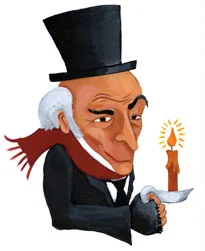
Most of the popular discussion about tax fairness focuses on how much money people make. But it has always seemed to me that it is when people spend money on themselves that they incur whatever debt to society the principles of taxation ought to imply.

  • Suppose first that I made  $10 billion, and gave all but $100,000 of it away to take care of the poor. Should I really be taxed on the $10 billion that I no longer have, but already gave away, or only on the $100,000 that I then actually spend on myself? And with that much of the task of taking care of the poor taken off of the shoulders of the government, won’t it have enough money from taxing everyone’s spending to take care of the other necessary tasks of government?
  • Next, suppose I save the money. Then it is still indeterminate whether I will eventually spend the money on myself or give it away. Shouldn’t the government wait until it is clear whether I will spend the money or give it away to take care of the poor before the government taxes it?  Here, notice also that in saving the money for later use, I am making resources available for building factories or other places of business, which employ people.  
  • Now, suppose I give the money to my children. Then shouldn’t the government wait to see whether the children spend the money on themselves or give it away to take care of the poor before the government taxes it?

The essence of this argument is that it is only at the moment of consumption spending that I appropriate money for myself. Until then, I am only acting as a steward for those resources whose ultimate use has not yet been determined. And if I give money to my children, it is only at the moment of consumption spending that my children actually appropriate money for themselves. 

For the rest of the argument, click through to Steven Landsburg’s essay  “What I Like About Scrooge: In Praise of Misers.” Here is a short excerpt:

If you build a house and refuse to buy a house, the rest of the world is one house richer. If you earn a dollar and refuse to spend a dollar, the rest of the world is one dollar richer—because you produced a dollar’s worth of goods and didn’t consume them.

Postscript. Most of the tricky issues that remain after saying this much fall under the heading of defining “consumption spending.” But I maintain that income is much harder to define than “consumption spending” is.

There is one more point to be made about aggregate demand. If I am going to spend money on something sooner or later, I am being more helpful to society if I spend the money during a recession than if I spend it during a boom. But it would be even more helpful if during the recession I gave it away to take care of the poor (which would also add to aggregate demand, and alleviate suffering). When the economy is at the natural level of output or above, there is no social value in adding to aggregate demand, since that creates inflationary pressures that need to be counteracted. The benefit to those I employ is balanced out by the harm to those left unemployed because of the measures that will be taken to avoid inflation.

George Lakoff on Science

In “Whose Freedom: The Battle over America’s Most Important Idea,” p. 56, George Lakoff writes: 

But science is about more than mere belief or conjecture. Science is fundamentally a moral enterprise, following the moral imperative to seek truth. Science is fundamentally about freedom, freedom of inquiry into the truth without the bias of initial faith or belief. Within science as an institution, a “scientific theory” is in fact a material explanation of a huge range of data based on experiment and evidence. Within science, it is normal for theories to compete. The basis of competition is clear: amount of evidence, convergence of independent evidence from many areas, coverage of data, crucial experiments, degree and  depth of explanation. The judges of the competition are distinguished scientists who have spent their careers studying the scientific evidence.

In the science of biology, evolution wins the competition, governed by the rules of the scientific method, hands down. There are no other legitimate competitors. Freedom here is freedom of objective inquiry, on the basis of evidence and explanation. Other theories are free to enter the competition, but if they do not follow the rules of the competition, they will be eliminated–fairly and justly.

As I Faced the Fiscal Cliff, I Failed to Find Comfort in the Words of Winston Churchill

As I read in the Wall Street Journal about the failure to come to some agreement to resolve the fiscal cliff, I thought again about these words: 

We can always count on the Americans to do the right thing, after they have exhausted all the other possibilities.

I have often heard these words attributed to Winston Churchill. But a web search for the source took me to the quoteinvestigator.com article on this quotation, which indicates this is a folk quotation. Many people have had a hand in inventing it, but there is no evidence that Winston Churchill participated in that invention. Still, I hope it is true.

For the record, my proposal for dealing with the long-run budget issues that are the heart of the disagreements between Republicans and Democrats is the system of “public contributions” laid out in my post “No Tax Increase Without Recompense.” This public contribution system would help make sure that the poor and afflicted are taken care of while reducing the footprint of the government in society.

Q&A: How Can Electronic Money Eliminate Inflation?

Q: I’m not clear on how electronic money could eliminate inflation. Would you explain this to me? Thanks!

A: Electronic money eliminates the zero lower bound on the nominal interest rate. The reason central banks (Fed, ECB, …) have chosen 2% as their long run inflation target instead of zero is because they are worried about the zero lower bound.

The Twitter version of the answer stimulated some discussion, which you can find storified here. The opening monologue to that discussion is also copied out below:

  1. W or w/o depreciating currency, e-money eliminates the zero lower bound…
  2. The main reason many central banks (Fed, ECB …) have a long-run inflation target of 2% instead of 0 is b/c they’re worried about the ZLB.
  3. So if the zero lower bound is eliminated by electronic money, I predict central banks will choose a long-run inflation target of zero.
  4. With electronic money (think reserves, bank accounts, …) as the unit of account, depreciating paper currency makes the ZLB non-binding.
  5. Having the same central bank with authority to issue both e-money and currency means the exchange rate between them is fully defensible.
  6. So a central bank with the needed legal authority can announce a track for the exchange rate between e-money and paper money.
  7. Announcing a track for the e-money/paper money exchange rate that has paper money depreciating gives paper money a rate of return below zero
  8. Just choose a rate of depreciation of paper money relative to e-money that makes its ROR less than Fed funds target & interest on reserves.
  9. When the Fed funds rate target is positive, paper money can appreciate relative to e-money until it returns to par.
  10. If inflation is zero, to be able to continue to return to par, what is needed is for the real interest rate to be positive on average.
  11. Or say the health of the banking system required Fed funds rate to be at least 2% above the ROR of currency, avg r > 2% allows return to par

The Neomonetarist Perspective

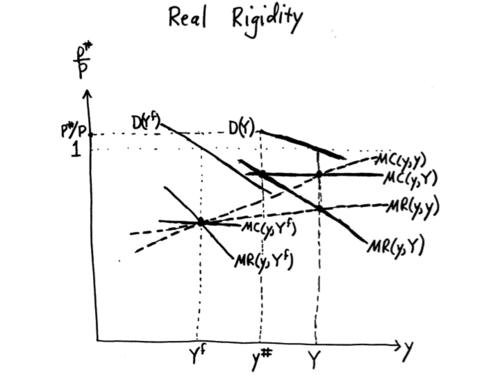
In May 2000 I gave a series of three lectures on business cycle theory at Harvard’s Economics Department. In the first lecture, I presented a set of slides on “The Neomonetarist Perspective.” I have copied the contents of those slides below. Let me provide a few annotations. First, in the slides, I mention the concept of “real rigidity” introduced by Larry Ball and David Romer in 1990. Real rigidity makes prices adjust less even when firms have the chance to adjust their prices. My own treatment of real rigidity is in my 1995 paper “The Quantitative Analytics of the Basic Neomonetarist Model.”  Second, my views on the labor supply elasticity have shifted as a result of my 2008 paper with Matthew Shapiro: “Labor Supply: Are the Income and Substitution Effect Both Large or Both Small?” toward larger values since I wrote these slides. (However, the intensive Frisch labor supply elasticity of around 1 that Matthew and I find is still somewhat lower than that used in many real business cycle models.) Third, the qualitative analytics I mention are best illustrated by my working paper “Q-Theory and Real Business Cycle Analytics”–which also provides a methodological discussion consistent with “The Neomonetarist Perspective” below. Fourth, my textbook draft “Business Cycle Analytics” provides many illustrations of quantitative analytics. (Both of these are on my University of Michigan website.) 

Four Elements of the Neomonetarist Perspective

  1. Attributing the fluctuations at business cycle frequency primarily to the interaction of real and monetary shocks with sticky prices.
  2. Seeing the qualitative properties of “Real Business Cycle” models as descriptions of the decadal fluctuations of the economy rather than fluctuations at business cycle frequencies.
  3. Viewing with skepticism many of the parameter values, functional forms, and mechanisms that have become traditional in much of business cycle theory.
  4. Pursuing a research strategy that emphasizes detailed intuitive understanding and systematic analytical methods over purely numerical results.

Neomonetarist Modeling of Sticky Prices

(a) Background requirements for plausibility:

  • imperfect competition.
  • increasing returns to scale.
  • real rigidity.

(b) Macroeconomic effects of imperfect price flexibility lasting several years.

  • Price adjustment that is fast relative to adjustment of the capital stock, but slow relative to adjustment of output to demand. 
  • Overlapping price setting.  At any one time, only a small fraction of prices will be changed.
  • Leaning toward optimization.
  • Neoclassical, fully optimizing households.
  • Cost-Minimizing firms.
  • Price-setting modeled as optimization subject to important procedural constraints.
  • Variation in the actual markup as the link between the monetary, nominally sticky side of the model and the real equations of the model. 

The Argument for “Real Business Cycle Models” as Models of the Medium-Run Adjustment of the Capital Stock Rather than Models of Business Cycle Fluctuations:

(a) Basic “Real Business Cycle Models” are sophisticated versions of the “Solow Growth Model” of capital adjustment.

(b) With plausible parameter values, the endogenous rate of adjustment of the capital stock is on the order of ten years. 

(c ) Most shocks to total factor productivity (“technology”) should be essentially permanent; therefore, business cycle fluctuations must result from an endogenous business-cycle-frequency (about three-year) mechanism rather than from business-cycle-frequency movements in the driving variable of technology. 

(d) If the degree of imperfect competition and increasing returns to scale are relatively small–and prices adjust several times faster than the capital stock–“Real Business Cycle Models” are good models of the medium-run adjustment of the capital stock even when prices are sticky in the short run.

A New Take on Parameter Values and Functional Forms

(a) Prescott’s original strategy of calibrating models of economic fluctuations by looking at a wide range of micro-economic, partial equilibrium and long-run trend evidence and logic needs to be pursued with greater earnestness.  Prescott’s genuine contribution here is the approach, not the particular parameter values and functional forms he chooses.  Flexible functional forms should be preferred where possible; functional form restrictions need to be justified.  

(b) There is no microeconomic or partial equilibrium evidence of high labor supply elasticities.  The arguments of Rogerson and Hanson are not an adequate defense of high labor supply elasticities.  Effort-elicitation models of efficiency wages also do not justify high labor supply elasticities. 

(c ) There is no microeconomic or partial equilibrium evidence of a strong response of nondurable consumption to the real interest rate. 

(d) There is a great deal of microeconomic and long-run-trend evidence that the income and substitution effects of a permanent increase in the real wage approximately cancel.

Three Analytical Toolboxes

(a) Approximation theory.

  • The certainty equivalence approximation links the perfect foresight model to the corresponding stochastic model.
  • Writing down a discrete-time model and then taking a continuous-time limit yields the most insight into a model. 
  • The approximation of a hierarchy of adjustment speeds allows one to deal with more than one state variable in an intuitive way. 

(b) Qualitative analytics.

  • Analyzing the partial equilibrium pieces of a model with model-specific graphs and the principles of monotone comparative statics. 
  • Contemporaneous general equilibrium.
  • Dynamic general equilibrium on the phase diagram. 
  • Steady state comparative statics.

(c ) Quantitative analytics.

  • Steady-state relationships.
  • Log-linearization around the steady-state.
  • Calculation of the convergence rate and impulse responses.

Eliezer Yudkowsky: Evaporative Cooling of Group Beliefs

Eliezer’s post “Evaporative Cooling of Group Beliefs” is a brilliant explanation of why failed prophecies can lead to a group with increased belief and fanaticism. What is more, this post hints at a possible future direction for mathematical sociology. This statistical mechanics perspective is also important for the economics of religion as an alternative explanatory principle.

Raj Chetty on Taxes and Redistribution

Several people have asked me where they could learn more about the economics of taxes. David Agrawal (a Michigan Ph.D. who is now at the University of Georgia) pointed out to me that Raj Chetty, one of the top experts in the world on the economics of taxes and redistribution, has put his lectures on taxes and redistribution online.

Here is the homepage for Raj Chetty’s lectures.

Here is a direct link to the videos on YouTube.

Neil Irwin: American Manufacturing is Coming Back. Manufacturing Jobs Aren't

Sometimes a sector of the economy has so much technological progress that over many decades, output in the sector increases while inputs into the sector–particularly the amount of labor used–decreases. Agriculture went through this transformation first. In more recent decades, manufacturing employment has been shrinking while manufacturing output has been growing. Just as we need only a few farmers to feed everyone, we are moving toward a world where we only need a few people to manufacture things, while almost everyone is employed in the service sector.

Neil Irwin describes this transformation in his post “American manufacturing is coming back. Manufacturing jobs aren’t.”

Marcelo Gleiser: "Astrotheology: Do Gods Need to Be Supernatural?"

In my post “The Egocentric Illusion,” which gives my take on David Foster Wallace’s Kenyon College Commencement Address, I wrote:

Up until I was 39 or 40 years old, I genuinely believed in an afterlife, and like most people assumed my afterlife would be a pleasant one.  Then I decided I did not believe in God. I had always thought that an afterlife would require someone powerful to make it happen. So not believing in God meant I did not believe in an afterlife either. Realizing that most likely there was no afterlife was a big item of bad news for me. It made me less happy than I normally would have been for several years. That unhappiness caused me to think. Then and sometimes now, I tried to imagine the intelligent aliens who might be recording my consciousness digitally for later cybernetic resurrection, but I have lacked enough social support for that belief for it to be all that reassuring.

The link (embedded in the title of this post) to Marcelo’s Gleiser’s post, shows that social support for such a belief may not be totally lacking.

Steven Pinker on Straw Men

In his book The Stuff of Thought, (p. 89), Steven Pinker writes (bullets added):

The beauty of the straw man is that he can be used in so many ways.

  • The most hackneyed is the straw man boxing match, in which one replaces a formidable opponent with a defeatable simpleton. 
  • But there’s also the straw-man two-step: first set up the effigy, then acknowledge that he is not so fatuous after all, but frame his reasonableness as a capitulation to one’s devastating criticisms.
  • And then there is the sacrificial straw man, useful when one worries about being on the fringe of respectable opinion: set up a fanatical version of one’s theory, then distance oneself from it as proof of one’s moderation.

Judging the Nations: Wealth and Happiness Are Not Enough

blog.supplysideliberal.com tumblr_mejabdMaDi1r57lmx.png

Here is a link to my 8th column on Quartz: “Emotional Indicator: Obama the libertarian? Americans say they’d be happy if government got out of their way.”

The title of this post is the original working title of the column. 

In early drafts, I related what I say in the Quartz column to Jonathan Haidt’s six moral tastes in his book The Righteous Mind: Why Good People Are Divided by Politics and Religion. Here is a New York Times book review by William Saletan, and here is a good passage from Jonathan Haidt summarizing his theory, chosen by Bill Vallicella, in Bill’s post “Jonathan Haidt on Why Working Class People Vote Conservative.”

There is a key chunk of text making the link to Jonathan Haidt’s theory that was appropriately cut for being too wonkish, but that I think you might find valuable

  1. for making that connection and 
  2. for more carefully stating the key findings about people’s preferences in hypothetical policy choices from my paper with Daniel Benjamin, Ori Heffetz and Nichole Szembrot

Here it is:

The most important boon people want for the nation as a whole is freedom. In the words we used for the choices we gave them, the #1, #2, #10, #13, #18 and #23 things people want for the nation are

  • freedom from injustice, corruption, and abuse of power in your nation
  • people having many options and possibilities in their lives and the freedom to choose among them;
  • freedom of speech and people’s ability to take part in the political process and community life;
  • the amount of freedom in society;
  • people’s ability to dream and pursue their dreams; and
  • people’s freedom from emotional abuse or harassment.

The next most important boons people want for the nation are goodness, truth, loyalty, respect and justice. On our list, the #3, #6, #8, #17, #19 and #21 most highly-valued aspects of the good society are

  • people being good, moral people and living according to their personal values;
  • people’s freedom from being lied to, deceived or betrayed
  • the morality, ethics, and goodness of other people in your nation; and
  • people having people around them who think well of them and treat them with respect
  • the quality of people’s family relationships
  • your nation being a just society.

The exact picture of “goodness” and “justice” might differ from one person to the next, but it is clear that they represent more than just money and happiness.  University of Virginia psychologist Jonathan Haidt,  in his brilliant book The Righteous Mind: Why Good People Are Divided by Politics and Religion argues that morality comes in six flavors (“The righteous mind is like a tongue with six tastes.”):

  1. liberty vs. oppression,
  2. fairness vs, cheating,
  3. sanctity vs. degradation,
  4. loyalty vs. betrayal,
  5. authority vs subversion, and 
  6. care vs. harm.

The first five of Haidt’s flavors of morality are well represented above.  The fourth flavor of morality, care vs. harm, is the one many authors focus on, to the exclusion of the others. It is the bread and butter aspects of people’s lives. In our findings, care vs. harm is reflected in 11 of the top 25 (numbers 4, 7, 9, 11, 12, 13, 16, 18, 22, 24, 25), including “the overall well-being of people and their families” in your nation, people’s health, financial security, and freedom from pain; “people having people they can turn to in time of need” and a “sense of security about life and the future in general” and balance, as reflected in the items “people’s mental health and emotional stability,” “how much people enjoy their lives” and “how peaceful, calm and harmonious people’s lives are.”

In addition to all of these, people want meaning, as reflected by #5 and #14 on our list: “people’s sense that they are making a difference, actively contributing to the well-being of other people, and making the world a better place, and “people’s sense that their lives are meaningful and have value.”  In addition to his discussion of key dimensions of morality, in The Righteous Mind: Why Good People Are Divided by Politics and ReligionJonathan Haidt emphasizes the importance of meaning—in particular, the importance of feeling one is a part of a larger whole. One of his central metaphors is “We are 90 percent chimp and 10 percent bee.” That is, Haidt believes that perhaps 90% of the time we are out for ourselves, however gently, but perhaps 10% of the time we are out for a higher cause (like the general good of everyone in our group) to the deepest level of our beings. A sense of “meaning” often comes from making that connection to something greater than ourselves.  

You can see my other posts on happiness in the happiness sub-blog linked at my sidebar, and here:

http://blog.supplysideliberal.com/tagged/happiness