"Wallace Neutrality" on wikipedia

Link to the “Wallace Neutrality” article on wikipedia

Two months ago, I proposed a public service project for the readers of this blog, in this post:

A Proposal for the supplysideliberal Community’s First Public Service Project: a wikipedia Entry on “Wallace Neutrality”

Thanks to Fudong Zhang, the wikipedia article on “Wallace Neutrality” is up on wikipedia!

I hope that many of you will try your hand at editing it further. For example, I think it is true that in some models with Wallace neutrality, when the nominal interest rate is already zero, the only way to stimulate the economy by monetary policy is to make people expect higher output gaps in the future, after the economy is no longer at the zero lower bound, as discussed in my post “Should the Fed Promise to Do the Wrong Thing in the Future to Have the Right Effect Now?” If it were possible to pin this point down better theoretically and explain exactly how Wallace neutrality figures into the result, that would be a great addition to the wikipedia article.

For the theoretically inclined, a good place to start in thinking about the “Should the Fed Promise to Do the Wrong Thing in the Future to Have the Right Effect Now?” dilemma is Ivan Werning’s continuous-time model of monetary and fiscal policy at the Zero Lower Bound when Wallace neutrality holds: “Managing a Liquidity Trap: Monetary and Fiscal Policy.” More generally, references to ways in which Wallace neutrality has explicitly or implicitly entered into real-world discussions of monetary policy would be of interest in the article.  

I very much appreciate Fudong’s efforts and am glad to see this project on its way. Let’s not stop here.

The True Story of How Economics Got Its Nickname "The Dismal Science"

Comments to my post “Dismal Science Humor: 8/3/12” corrected me in my claim that the nickname “the dismal science” was a response to Malthus. It turns out that only the word “dismal” was a response to Malthus.  

David Levy and Sandra Peart tell a more interesting story about Thomas Carlyle’s motives in coining the phrase “the dismal science” in “The True Story of the Dismal Science. Part I: Economics, Religion and Race in the 19th Century.” Carlyle called economics “the dismal science” in response to John Stuart Mill’s arguments against slavery. So the true history of the phrase “the dismal science” means that all economists can answer to the nickname “dismal scientist” with pride.  

Should Everyone Spend Less than He or She Earns?

Question: exjunior asked

I’ve always thought Kant’s categorical imperative was a good guide for ethical behavior. But then I pose the question, should I spend less than I earn? Following Kant, I consider what would happen if everybody spent less than they earn all the time. Insofar as I understand modern macroeconomic theory, the result would be a depression. But spending less than you earn is manifestly a good thing. Has economics proven Kant was wrong?

Answer: I disagree with your statement that “spending less than you earn is manifestly a good thing.” In order to save for retirement, spending less than you earn is a good idea when you are young. But it is totally appropriate for retirees to be spending more than they are currently earning. In the long run, looking past business cycles, retirees spending more than what they earn during their retirement years (as they should) balances out for younger people spending less than what they earn (as they should).  

Fed Transparency and Obscurantism

Question: docstocks asked

As I’m sure you know, the House just passed the ‘Audit the FED’ bill. Putting aside the merits of this bill, which I’m sure is just an attempt by Ron Paul to constrain the FED, what are the reasonable arguments for and against more transparency at the FED?

Answer: In general, I think that more transparency is good, on the grounds that it helps generate discussion of policy that can gradually improve policy. You will generally see me arguing for more transparency. However, in my post “Going Negative: The Virtual Fed Funds Rate Target,” I argued that sometimes, in order to avoid headlines that would generate political heat on the Fed and so possibly compromise Fed independence, it is a good idea for the Fed to provide enough information for people to figure out what it is going to do, but not connect all the dots to say that it will buy yeay many gigadollars or teradollars worth of certain assets. In other words, the Fed should disclose things in a way that makes it very transparent for sophisticated Fed watchers. But in some cases it may be OK for the Fed to say things in a way that is a little obscure for the general public, which have to be explained to them by the journalists covering the Fed. Even for the general public, it can be argued that this is in service of the maximum level of understanding, since the initial impression that the issues are hard to understand and require reading a whole article rather than just a headline is accurate.

In the case of Fed actions during the financial crisis, which involved bailouts, in the end, I think the Fed has to report everything it has done, but if I were at the Fed in charge of that reporting, I would try to do it in a way that would make the most boring headlines possible given the inflammatory content.  

Despite my support for occasional obscurantism to keep political inflammatory dollar figures out of headlines so that people have to actually read the newspaper article to see them, I think the Fed in general should do everything reasonably within its power to help the general public understand monetary policy. On that score, I strongly favor Bernanke’s approach toward explaining monetary policy over Greenspan’s approach.

Big Brother Speaks: Christian Kimball on Mitt Romney

My older brother Chris has been reading my blog. He sent me an email disagreeing with some of what I said in my post “Will Mitt’s Mormonism Make Him a Supply-Side Liberal?” (and in these storified tweets) about Mitt Romney. I thought what he had to say was interesting, and asked him to give me a version that I could post, which he did.

Though Mitt is a hard person to really know, Chris certainly knows Mitt much better than I do. Chris was in the same Mormon congregation as Mitt for a while and interacted with Mitt in that context. (My own limited contact with Mitt occurred when I visited Chris and attended church with him.) In addition, Chris began serving as the ecclesiastical leader of a Mormon congregation in the Boston area not long after Mitt stepped down as head of all the Mormon congregations in the Boston area, and so had a good chance to hear about what Mitt’s church leadership style had been like. 

Local Mormon Church leaders serve while keeping their day jobs–day jobs such as Mitt’s work at Bain Capital and Chris’s work as a tax lawyer and tax law professor. Like ecclesiastical leaders in other denominations, Mormon church leaders spend a significant amount of their time in a “social worker” role, talking to and helping people in trouble. I found what wikipedia had to say about Mitt’s service as head of the congregations in the Boston area illuminating, and consistent with what I have heard from friends in the area:

During his years in business, Romney held several specific positions in the local lay clergy, which generally consists of males over the age of 12.[13] Around 1977, he became a counselor to the president of the Boston Stake.[102] He served as bishop of the ward (ecclesiastical and administrative head of his congregation) at Belmont, Massachusetts, from 1981 to 1986.[103][104] As such, in addition to home teaching, he also formulated Sunday services and classes using LDS scriptures to guide the congregation.[105] He forged bonds with other religious institutions in the area when the Belmont meetinghouse was destroyed by a fire of suspicious origins in 1984; the congregation rotated its meetings to other houses of worship while it was rebuilt.[99][104]

From 1986 to 1994, he presided over the Boston Stake, which included more than a dozen wards in eastern Massachusetts with about 4,000 church members altogether.[68][105][106]He organized a team to handle financial and management issues, sought to counter anti-Mormon sentiments, and tried to solve social problems among poor Southeast Asian converts.[99][104] An unpaid position, his local church leadership often took 30 or more hours a week of his time,[105] and he became known for his tireless energy in the role.[68] He generally refrained from overnight business travel owing to his church responsibilities.[105]

He took a hands-on role in general matters, helping in maintenance efforts in- and outside homes, visiting the sick, and counseling troubled or burdened church members.[103][104][105] A number of local church members later credited him with turning their lives around or helping them through difficult times.[99][104][105] Some others were rankled by his leadership style and desired a more consensus-based approach.[104] Romney tried to balance the conservative dogma insisted upon by the church leadership in Utah with the desire of some Massachusetts members to have a more flexible application of doctrine.[68] He agreed with some modest requests from the liberal women’s group Exponent II for changes in the way the church dealt with women, but clashed with women whom he felt were departing too much from doctrine.[68] In particular, he counseled women not to have abortions except in the rare cases allowed by LDS doctrine, and also in accordance with church policy encouraged single women facing unplanned pregnancies to give up the baby for adoption.[68] Romney later said that the years spent as an LDS minister gave him direct exposure to people struggling in economically difficult circumstances, and empathy for those going through problematic family situations.[107]

I think a reasonable way to intepret this is as more evidence that Mitt is not, at his core, ideological.

It would be very easy for me to be wrong about Mitt. I know that my reading of the Mormon scriptures cited in “Will Mitt’s Mormonism Make Him a Supply-Side Liberal?” –prompted by brilliant church lessons from my other distant cousin, Tony Kimball, in the Boston area–made me more concerned about the poor than I would otherwise be. And my exposure to Mormon political culture predisposed me toward helping the poor in ways that make as little use of the heavy hand of government as possible. I am only guessing where Mitt is coming from.

I think Mitt’s Mormon background provides two other clues to understanding Mitt. First, the Boston area has several of the most liberal congregations in the Mormon Church. (I was an active Mormon when I was attending Harvard as an undergraduate and graduate student.) The kinds of moderate views that Mitt expressed on social issues in his early campaigns would not be unusual views for a highly educated Mormon in the Boston area.

Second, Mormonism has a strong emphasis on honesty in its training of children. I think this early training in honesty has helped make Mitt a bad liar. When he lies, it is often quite obvious. To me, the most dangerous liar is one who is good at it. Mitt is not that. The problem with Mitt’s untruths–in addition to what they say about his character–is that once they are ignored, we have relatively little to go on to figure out what kind of President of the United States he would be.  

This was a longer introduction than I originally intended. Let me at long last give you what my big brother Chris has to say.  Chris cautions that this is his personal opinion. Chris is not representing or speaking for any other person or organization. Chris: 

I think you are wrong about Romney in certain respects. Even though I have no real knowledge of his personal beliefs, what I do know and surmise is somewhat different.

First, on the particular issue of care for the poor, I think the more likely view on his “heart of hearts” true belief is that he cares but believes strongly in a self-help and private help (family, church, private charity) approach with little or nothing from government. To the extent it matters, Mormon patterns and belief in the 20th century trended that way (as contrasted with a communitarian approach in the 19th century). I don’t believe Mormon views (culturally – one can debate the Book of Mormon approach) have ever been consonant with a strong government involvement. The exception might be in a theocratic structure, such as the intermountain West in the State of Deseret period (pre-Utah statehood).
Second, thinking of policy more broadly, I suggest the following breakout is helpful, considering the areas where a U.S. President might have some influence:
1. Domestic Economic
In this arena the president has very little control. Most of what gets done is by and through Congress. Romney might get more done (than Obama) because Republicans in Congress would be less obstructionist, but only if he were moving in the direction that the Republicans want. (Not to say that “getting more done” is an unequivocal good–if it means getting the wrong things done it can be a bad.) In short, whether or not his apparent policy statements in the Domestic Economic arena are his true belief or are pandering, and whether or not they make sense (in my opinion tax and spending is nonsense, so far), he would probably have to live with his statements. The likelihood is that his statements become reality whether (in his “heart of hearts”) he likes it or not.
2. Domestic Human Rights (immigration, gay rights, rights of corporations vs individuals, voting rights, reproductive and other issues affecting women in particular, etc.)
In this arena I think Romney means most of what he says. I suspect that the campaign has forced him to take a somewhat more extreme position than he really believes, but I read that as a matter of degree not direction. To the extent we’re looking for Mormon influences, the modern (21st century) church is a mixed story but the 20th century Mormon views and discourse, that have the most influence on Romney, would be consonant with what he’s saying. And personally, I disagree with just about everything he says and claims in this arena. 
3. Foreign Policy and Defense
This is the arena where the president can really do something, and in many cases almost unilaterally. There is no reason to think that Romney’s history, experience or education has prepared him for foreign policy and defense. In this area Romney seems to be ill informed, lacks any subtlety, and arguably doesn’t even get the policy statements right for the neoconservative audience he is speaking too. Further, to the extent I can extract a policy view from his statements (sometimes substituting or updating country names) my guess is that he means what he says–perhaps a bit naive, but true belief. My own opinion is that those expressed views are not just wrong-headed but frightening in a person who is asking to be Commander in Chief.
I’m very negative on Romney, as you can see. I am positive about Obama, which is a different discussion. That is not anywhere close to a 100% endorsement–he has made a lot of mistakes, but he has also done a lot right. And I trust him particularly in the foreign policy and defense area, which is what I look to first in choosing a President. (In assessing the President’s performance, particularly in the domestic economic arena, I do adjust my expectations by (a) an allowance for an “anything to hurt Obama” obstructionist Republican House, and (b) my belief that the recent recession involves a step-change in housing prices and values, and in employment, the causes and pressures for which have a longer history but which we have experienced as sudden changes from which I do not expect a recovery but rather a new normal.)

Legal Notice Relating to Reproduction or Use of Content from supplysideliberal.com, Superseding All Earlier Legal Notices on supplysideliberal.com

Update, June 17, 2018: In addition to providing a link to the original blog post, any use of content that I, Miles Spencer Kimball, own should include the notice:

Used by permission according to a temporary nonexclusive license expiring June 30, 2024. All rights reserved.

Additionally, content that I own, but which first appeared in another outlet needs that other outlet acknowledged. In those cases, I provide the modified notice, but the date of expiry should be adjusted to June 30, 2024. For example, "The Coming Transformation of Education: Degrees Won’t Matter Anymore, Skills Will" has listed as the appropriate notice

© February 9, 2015: Miles Kimball, as first published on Quartz. Used by permission according to a temporary nonexclusive license expiring June 30, 2017. All rights reserved. 

Going forward, this can be modified to:

© February 9, 2015: Miles Kimball, as first published on Quartz. Used by permission according to a temporary nonexclusive license expiring June 30, 2024. All rights reserved. 

The purpose of the revocability and expiration clauses is to keep open the possibility of commercial deals in which I give some entity exclusive rights to some of this content (or exclusive rights with some exceptions). The date June 30, 2024 is chosen as a period of time within which I am quite confident there will be no such commercial opportunities. If I become quite confident there will be no such commercial opportunities for a longer period of time, I will post another update here. 

June 25, 2015 Update

I have extended the permission to June 30, 2020. All occurrences of “June 30, 2017,” “June 30, 2015,” “June 30, 2014” and “June 30, 2013” below and in the model copyright notices I sometimes provide within a post should be considered as changed to “June 30, 2020.” For material that appeared first on supplysideliberal.com (the default), use of that material beyond fair use must be accompanied by both a link to the original post and the following notice:  

© [date on the post]: Miles Kimball. Used by permission according to a temporary nonexclusive license expiring June 30, 2020. All rights reserved.

For anything published first on another website, I will specify the required notice in the post that repatriates that publication to supplysideliberal.com. However, the date in that notice should be changed to June 30, 2020.

April 11, 2014, Update

I have extended the permission to June 30, 2017. All occurrences of “June 30, 2015," "June 30, 2014” and “June 30, 2013” below and in the model copyright notices I sometimes provide within a post should be considered as changed to “June 30, 2017.” For material that appeared first on supplysideliberal.com (the default), use of that material beyond fair use must be accompanied by both a link to the original post and the following notice:  

© [date on the post]: Miles Kimball. Used by permission according to a temporary nonexclusive license expiring June 30, 2017. All rights reserved. 

For anything published first on another website, I will specify the required notice in the post that repatriates that publication to supplysideliberal.com. However, the date in that notice should be changed to June 30, 2017. 

October 9, 2013, Update

I have extended the permission to June 30, 2015. All occurrences of “June 30, 2014” and of “June 30, 2013” below should be considered as changed to “June 30, 2015.” For material that appeared first on supplysideliberal.com (the default), use of that material beyond fair use must be accompanied by both a link to the original post and the following notice:  

© [date on the post]: Miles Kimball. Used by permission according to a temporary nonexclusive license expiring June 30, 2015. All rights reserved. 

For anything published first on another website, I will specify the required notice in the post that repatriates that publication to supplysideliberal.com.

March 12, 2013, Update

1. I have extended the permission to June 30, 2014. All occurrences of “June 30, 2013” below should be considered as changed to “June 30, 2014.” For material that appeared first on supplysideliberal.com (the default), use of that material beyond fair use must be accompanied by both a link to the original post and the following notice:  

© [date on the post]: Miles Kimball. Used by permission according to a temporary nonexclusive license expiring June 30, 2014. All rights reserved. 

2. For posts that previously appeared on Quartz, I will put the text of the notice that should be included with use of material from that post, in order to give credit to the original appearance of the material on Quartz. The general form will be:

© [date of first publication on Quartz]: Miles Kimball, as first published on Quartz. Used by permission according to a temporary nonexclusive license expiring June 30, 2014. All rights reserved. 

A link to the original Quartz article must be included.

August 6, 2012 Update (Preamble to the August 5, 2012 Legal Notice) 

For those wanting to refer to this blog, a fair use summary or quote plus a link will always be OK, but if you want to do more, read on.

I have been approached by one website interested in putting up enhanced versions of some of my posts on their site, and another interested in doing a Japanese translation of some of my posts. I want to encourage this kind of thing in the near future, but I want to make sure to be able to sign the standard legal documents in a book deal (or online equivalent) down the road.  

So from now until June 30, 2013, I am allowing reprinting of my posts in full with a clearly visible and clearly identified working link to my blog (or the closest equivalent for paper copies) and the following notice:

Copyright: Miles Spencer Kimball. Used by permission according to a temporary nonexclusive license expiring June 30, 2013. All rights reserved.

The full reprint would have to be taken down on June 30, 2013, and print copies could not be sold or transferred after that date. The details are below, below the row of asterisks.

I found wrestling with the intellectual property law issues involved in crafting this legal notice interesting. I am not a lawyer, but my father, brother and sister are all lawyers (though not specialists in intellectual property law), which makes me more aware of legal issues than I would otherwise be. I crafted this legal notice myself.

–Miles Spencer Kimball


August 5, 2012, 11:34 AM Eastern Daylight Time

I, Miles Spencer Kimball, author of the content on supplysideliberal.com, currently appearing as the Tumblr blog http://www.tumblr.com/blog/supplysideliberal, am publishing this legal notice. This legal notice supersedes an earlier legal notice relating to reproduction or use of content on this blog: “Notice of Revocable Permission to Reproduce Content from this Blog with Appropriate Attribution to this Blog and Notice of Miles Spencer Kimball’s Copyright.” Nothing in this notice or earlier notices affects people’s right to make fair use of content from this blog, according to the legal doctrine of “fair use.” 

My legal intent is this: in order to promote this blog and its ideas, I want to give permission for people to reproduce and use content from this blog for a window of time beginning now and ending on June 30, 2013, while retaining all the rights necessary for me to be able to promise exclusive use of content from this blog to a publisher or other party I name in the future. Only I, Miles Spencer Kimball, at my sole discretion, have legal authority to extend the date June 30, 2013 after which reproduction or use of content from this blog (beyond legally established fair use) must cease and desist.

At my sole discretion, I, and only I, also have the legal authority to extend this date for some uses of the content of this blog but not for others. This requires specific authorization from me.  (For example, anyone wishing to translate content from this blog to a language other than English and reproduce or use that translation beyond fair use should contact me.)

Three legal issues have come to my attention:

  1. The need to insure that third parties are informed of the limitations I have placed on reproduction or use of content from this blog.  
  2. The need to insure that no one relies on being able to reproduce or use content from this blog after June 30, 2013. 
  3. The need to insure that (a) no one can limit in any way my right to reproduce and use content from this blog that I have authored and (b) no one can limit in any way my right to permit others as I see fit to reproduce and use content from this blog that I have authored.

Therefore, I require that anyone who reproduces or uses content from this blog (beyond fair use) include in an easily visible way the following notice, word for word as it appears in the block quote immediately below:

Copyright: Miles Spencer Kimball. Used by permission according to a temporary nonexclusive license expiring June 30, 2013. All rights reserved.

IN ADDITION, I require that anyone who reproduces or uses content from this blog provide easily visible and clearly identified working links to this blog or the relevant post or posts on this blog, UNLESS they are technologically unable to do so given the form of reproduction or use. I REQUIRE that anyone technologically unable to provide a working link to this blog or its posts must provide in an easily visible way (a) the web address in the following block quote 

http://blog.supplysideliberal.com 

AND (b) the corresponding web address or addresses of the relevant post or posts.

Unless I, Miles Spencer Kimball, duly authorize otherwise, the following steps (among others) must be taken to cease and desist any use (beyond fair use) of content from this blog after June 30, 2013:

  1. At or before midnight, June 30, 2013, all reproductions or uses of content from this blog beyond fair use must be taken down from all websites other than this one.
  2. No print reproduction of content from this blog may be sold or transferred in any way from one party to another after June 30, 2013.  
  3. No electronic file containing content from this blog may be transferred in any way from one party to another after June 30, 2013. (However, until further notice, people may view supplysideliberal.com itself on any device, and RSS feeds may transfer content from a post within 24 hours of its posting, as long as this content is not thereafter transferred from one party to another more than 24 hours after it is posted.)

LIMITATIONS TO THE TEMPORARY NONEXCLUSIVE LICENSE EXPIRING JUNE 30TH, 2012:

LIMITATION 1: The temporary, nonexclusive license I am hereby giving to reproduce and use content from this blog until June 30th, 2012 does NOT extend to anything I write or otherwise create that appears on any other website. It only applies to content taken directly from this website. That is, you must be able to see the content you want to reproduce or use at a web address that begins with the characters     http://blog.supplysideliberal.com   in order for the permission above to apply.  

LIMITATION 2: The temporary, nonexclusive permission I am hereby giving to reproduce and use content from this blog until June 30th, 2012 does NOT extend to any post appearing on this website (including any content in the comments to that post to which I hold copyright) if the post has a notice of exception at the top of the post (above other content but below the title).  

Two notes:

  1. For students, I think it would be especially valuable to send them to this blog itself, because they might click on some economics beyond what is assigned and learn even more!
  2. Limitation 1 means that if I take something down from the website, the temporary nonexclusive permission no longer applies even before June 30, 2012, since you have to be able to take it directly from the most recent version of the website.  Also, in the much more common case of a post that has had some revisions, it means that you need to use the most recent, updated version of a post, taken directly from the current version of the website at the time you need to download.     

Dismal Science Humor: 8/3/12

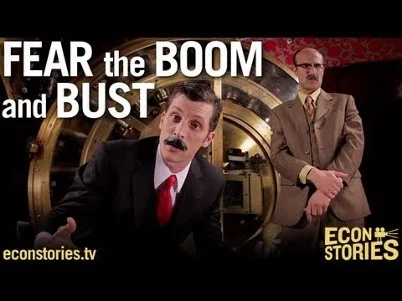
“Fear the Boom and Bust” a Hayek vs. Keynes Rap Anthem.“

Thomas Robert Malthus and John Stuart Mill inspired Thomas Carlyle to coin the sobriquet "the dismal science” for economics. This nickname has stuck, in part because economists often seem overly serious.  But dismal scientists and others interested in the dismal science have created some economic humor. Unlearning Economics tweeted today a link to this wonderful cartoon about the fact that a large enough Keynesian multiplier would mean that make-work tasks could be a good thing if the economy was in a bad recession and there was no better way to stimulate the economy. 

Kevin McDonald replies to the tweet by recommending the video “Fear the Boom and Bust” a Hayek vs. Keynes Rap Anthem.“  This is a very funny video about two very famous, but unfortunately very dead economists, Friedrich Hayek and John Maynard Keynes (the economist Keynesian economics is named after–there is a debate about whether Keynesian economics accurately represents his thinking). There is also a very funny sequel to this video: "Fight of the Century: Keynes vs. Hayek Round Two.”

I have put a date in this post’s title hoping that more economic humor worth sharing will come my way in the future. Please let me know about any economic humor that tackles your funny bone in the comments.

Grammar Girl: Speaking Reflexively

Mignon Fogarty–a.k.a. “Grammar Girl”–specializes in giving practical online grammar tips in a cheerful, sprightly, non-dogmatic way. I have found Mignon Fogarty’s tips very helpful. Even my coauthors like them. Here are her tips that I have used so far: 

“Like” versus “Such As”

“Like” versus “As”

“Which” versus “That”

Should it be “You” or “Your” with Gerunds?

My number one grammar pet peeve is the overuse of the reflexive pronouns “myself” and “yourself.” I hear this mistake in very high places. I cringe every time. Here is what Mignon,  Grammar Girl, has to say about it:

How to Use “Myself” and Other Reflexive Pronouns

Ontology and Cosmology in 14 Tweets

Nick Violet asks this (in a link within a link that he called to my attention with a tweet):

…my question to economists or social scientists, or even physicists if interested is: are immaterial infrastructures (like institutions) thermodynamic systems (like the car we talked about) or not? And if yes, or not, why?

Click on the title of this post or here for my answer. This represents what understanding I have of ontology and cosmology from my reading. (Someday I’ll post a list of books I’ve read since 1995.)

A note on the tweet count: Nick Violet’s tweet, representing the question, is 1 of the 14 tweets. Questions are an indispensable part of the road to truth, and deserve credit. Here is an example of the importance of questions in economics:

In my judgment, Ed Prescott fully deserves his Nobel Prize for the questions he asked (including his methods for asking them), though he wouldn’t have deserved a Nobel Prize for his answers.  

(Finn Kydland was there with Ed, asking the questions, and fully deserves his Nobel Prize for asking those questions. But Finn is less associated with Ed’s later answers.)

Why My Retirement Savings Accounts are Currently 100% in the Stock Market

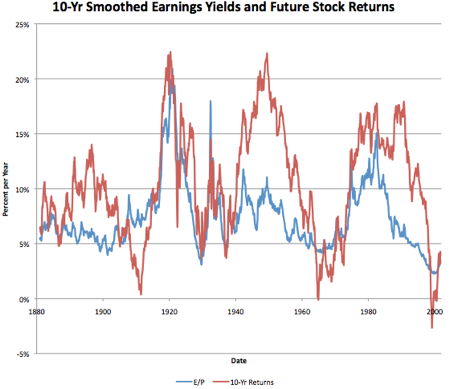
In his recent post "Stocks for the Medium Run,” Brad DeLong gives a good argument for being in the stock market based on likely future returns. The graph is explained there.

My own portfolio allocation in terms of paper assets hasn’t changed much for a while. Leaving aside checking and saving accounts, my University of Michigan Retirement Saving Account–92% of all my retirement savings–is entirely in Fidelity’s Spartan International Fund. Despite how long it has been since I put a summertime grant through the National Bureau of Economic Research (NBER)–and so how few months’ worth of pension payments it represents–my NBER Retirement Saving Account represents 8% of my retirement savings. This is because Vanguard’s Emerging Market Stock Index Fund has done well over the last two decades or so, and returns build on themselves through compounding.

International Diversification. My reasoning for having most of my retirement savings in an international index fund is primarily diversification. I figure that my salary will go up more if the U.S. economy does well than if the U.S. economy does badly. So my job is like a U.S. stock fund. Therefore, investing in other major countries (mostly Europe and Japan in the Spartan International Fund) is a way to avoid putting all of my eggs in one basket.

Why have 100% of my paper assets in stocks? I am not yet 52 years old. The fact that I am tenured and have quite a bit of pay coming between now and when I retire about 20 years from now also means that only a fraction of my overall resources are in stocks even though almost 100% of my paper assets are in stock. So I don’t feel that what I am doing is all that risky. And even a conservative read of past history suggests that stocks are likely (though not certain) to earn several percentage points more than bonds annually over the next few decades.  

Economists call the asset value of future pay “human wealth.” One of the most overlooked principles of asset allocation and portfolio choice is that one needs to think about this human wealth in choosing how much stock to hold. Thinking about one's human wealth matters in two ways.  

  1. The size of the portfolio including human wealth is larger, so that any given size of investment is a smaller percentage of the total–often much smaller.  
  2. The risks in one's human wealth have to be considered, as I did in trying to balance out my U.S. job with European and Japanese stocks.

Annual Fees. The one other big consideration in my portfolio choices is fees. In my “Monetary and Financial Theory” class, I do calculations showing that for long-term investors, fees of 1% per year can easily reduce the amount of retirement spending one can afford by 10% to 20%. An annual fee of 1% per year is close to being the average level of fees, but it is horrifically high for what most investors are getting, despite mutual fund company claims. 

Vanguard’s fees are generally low for each asset class. Fidelity has a mix of high-fee and low-fee funds. So for them, like most mutual fund companies, one needs to drill down into the fund’s website to look up the fees. (After clicking on SPTN INTL INDEX INS, scrolling down gets to the fees in the third window’s worth of text.) Even then, what they say is not that easy to understand. I hope the following means I am paying 7/100 of 1% of the value of what I have in Fidelity’s Spartan International Fund. Or do I need to add the 12/100 of 1% “management fee” for total annual fees of 19/100% per year?   

Short-term Trading Fee

1.00%

Short-term Fee Period

90 Days

Management Fee

0.12%

Expenses & Fees

Expense Ratio

as of 05/04/2012

0.095%

($0.950 per $1000)

Expense Ratio after Reductions

as of 02/29/20120.07%

($0.70 per $1000)

Expense Cap

as of 09/08/2011

0.07%

($0.70 per $1000)

Expense Cap is a limit that Fidelity has placed on the level of the expenses borne by the fund until 04/30/2013 and indicates the maximum level of expenses (with certain exceptions) that the fund would be paying until that time. After the expiration date, the Expense Cap may be terminated or revised, which may lower the fund’s yield and return.

You should compare this .07% per year (or .19% per year if I need to add the “management fee”) with what you are paying in fees. Vanguard is the only company I know of with a consistent low-fee policy. Fidelity seems to have at least some low-fee funds like mine sprinkled in with its high-fee funds. Many other mutual fund companies are much, much worse than Fidelity with its mix of high- and low-fee funds. TIAA-CREF, an important fund for academics, used to have low fees, but has increased them in more recent years.  

Implications of the Financial Crisis. The combined value of my retirement savings accounts has gone through some large fluctuations in recent years. But I didn’t make any reallocations and kept all of the new retirement saving account contributions from my paycheck going 100% into Fidelity’s Spartan International Fund, and the value of my retirement savings accounts has mostly bounced back to where it was before the fall of Lehman (September 15, 2008). 

I take the view that the Great Recession, as bad as it is, has likely left the long-run future of the economy relatively unchanged. (See “Things are Getting Better: 3 Videos” for perspective, and pay special attention to what Alex Tabarrok says in his TED talk flagged there on the effect of the Great Depression on long-run economic growth.) Given that view, I have often consoled myself with the idea that, since it is a long time before I plan to retire, that for the most part, I own more or less the same stream of future dividends as before the  Financial Crisis of 2008 and the Great Recession. The market price of that stream of future dividends has gone down, but that fall in the market price is only about as important as having the market price of one’s house go down when one plans to live in it for the rest of one’s life. From that perspective, the fall in the market price of my stream of future dividends matters, but not in a big way. (Older people for whom more of the dividend stream will come after their death have to worry more about a long-lasting decline in the market price, since they will want to sell the tail end of the dividend stream to someone younger.)

Of course, if only I had had a functioning crystal ball, I could have done much better. If I think of valuing assets by how much retirement spending they can support, my stocks haven’t gone down that much in the retirement spending I think they can support, but I missed the amazing bull market in Treasury bills and Treasury bonds. If I had had that crystal ball in the past few years, but it refused to function to predict anything beyond today’s date, I would have been out of the stock market in 2008, but I would still be in the stock market now.  

If you think I am making a mistake–or could to better–I am glad to hear investment advice from anyone in the comments section.

Daniel Kuehn: Remembering Milton Friedman

I am flagging Daniel Kuehn’s post for this quotation from a paper by David Henderson:

“In his testimony before the commission, Mr. Westmoreland said he did not want to command an army of mercenaries. Mr. Friedman interrupted, "General, would you rather command an army of slaves?” Mr. Westmoreland replied, “I don’t like to hear our patriotic draftees referred to as slaves.” Mr. Friedman then retorted, “I don’t like to hear our patriotic volunteers referred to as mercenaries. If they are mercenaries, then I, sir, am a mercenary professor, and you, sir, are a mercenary general; we are served by mercenary physicians, we use a mercenary lawyer, and we get our meat from a mercenary butcher.”“

Isomorphismes: A Skew Economy & the Tacking Theory of Growth

Isomorphismes is one of the most articulate commenters on my blog. His post explores the fact that economic growth usually shows up not as a general increase in income for the same set of goods, but rather as the introduction of a new good or reduction in price for some particular good. This explains some of why people don’t “feel the growth.” People think of getting rich as moving up the ladder to the consumption bundles that those high in the income distribution have. Economic growth delivers something unexpected, which is just as good, but may not be fully appreciated.  

Here are three passages to give you the flavor of this post by isomorphismes:

The picture we are now getting in “the news media” is of rich economies (US & Europe) that have ground to a halt, are not producing jobs, median wages stagnating

… what does capitalism look like in a rich world with many people making low wages?

I think it looks exactly like this: the poor people have a good standard of living in terms of absolute magnitude, but they have little freedom. With a tight budget constraint (near the origin) obtusely and extremely scalening off in various directions of cheap stuff (sox, packaged food with lots of preservatives, canned food [can o’ corn], modular homes, satellite TV, Budweiser beer, … the only way to live like a richie is to buy specifically the stuff that is cheap

… what does a world with high productivity, low wages to many and high wages to some, look like?

  • Most obvious is envy. You are going to watch Americans go live like kings in Thailand, Brits go live like kings in Argentina, mansions in the Gran Canarias, chalets in Andorra and beach houses in Tahiti. All of this will be technologically possible but out of reach for you. So you will be aware that it’s possible and that somebody’s doing it and loving it, but not you.
  • Next is opportunity. The more money our robo-programmers make, the more they are going to want to free up their time and have every service done for them. Massage therapists, personal trainers, life coaches, psychotherapists, cleaners, cooks, upscale morticians, model organic farms that you can vacation on, drug dealers, hoteliers, sycophantic investment researchers, and personal assistants all have opportunities to form the perfect life for the robo-programmers, tending to their every need and desire, and get paid for it. Service economy, ho!

Note: In a link post like this one, where the title sends you to the post I am flagging, the way to get to the page for my post (for example, to leave a comment to my post here as opposed to isomorphismes’s post) is to use the “all posts by date” button on my sidebar.

Milton Friedman: Celebrating His 100th Birthday with Videos of Milton

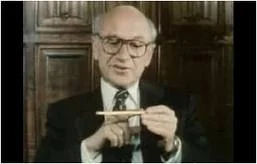
Power of the Market: The Pencil

Milton Friedman on the Basis of the Free Market (Consumer sovereignty)

Milton Friedman on Printing Money (A great deal at 29 seconds)

Milton Friedman on Public Education (Not about vouchers, but about the condescension behind public education.)

Persuasion vs. Coercion (The importance of giving people the chance to hear intellectually diverse viewpoints.)

Free Market Exchange (I love what Milton says in this video about the free development of language, English Common Law, and science.)

The Proper Role of Government (Legally formalizing ethical rules is different from other, more arbitrary legislation.)

Socialism is Force

Why Do We Let This Happen?

Population and Ecology (Milton backs Pigou taxes on pollution.)

Market Failure (Milton recommends careful balancing between concerns of market failure and concerns of government failure.)

Milton Friedman Puts a Young Michael Moore in His Place (Not really Michael Moore–only “a Michael Moore” in the sense of someone like Michael Moore. Milton argues for a finite value of a human life and argues that enforcing laws against fraud is a legitimate purpose of government.)

Corporatism and Medicare (Debate between Milton and Michael Harrington)

Incentives for Immoral Behavior (Pay attention to what Milton says about the decline of corruption in England.)

Redistribution of Wealth (Milton: “As you grow up, you will discover that this is really a family society, and not an individual society.”)

Responsibility to the Poor

Private Charity vs. Taxes

The Robin Hood Myth

In The Robin Hood Myth, Milton talks about his brother-in-law Aaron Director’s Law, saying:

Director’s Law is, that almost invariably, government programs benefit the middle income class, at the expense of the very poor and the very rich.

I take up my lance to tilt against the windmill of Director’s Law in my post “Rich, Poor and Middle Class.”

Note: There are many more videos of Milton out there. Of the ones I watched, I did some picking and choosing, based on a value per minute criterion. I tried to put the videos in a logical order.  

Mark Thoma on the Politicization of Stabilization Policy

Mark Thoma has a new post “Starving the Beast in Recessions” that links to his article in the Fiscal Times: “How GOP Lawmakers have the Fed Over a Barrel.” Mark’s post backs up the concern I expressed in “Preventing Recession-Fighting from Becoming a Political Football” that traditional stimulative fiscal policy–tax cuts or increases in goverment spending–entangles recession fighting in political disputes about the size and scope of government. In that post, I wrote:

By avoiding big changes in taxes or spending, I hope my Federal Lines of Credit proposal can help to depoliticize stabilization policy. 

“Preventing Recession-Fighting from Becoming a Political Football” is a difficult post. For more accessible posts on Federal Lines of Credit, go to my second post “Getting a Bigger Bang for the Buck in Fiscal Policy” or to “My First Radio Interview on Federal Lines of Credit.” I plan to do a set of index posts for my sidebar giving links to all of my posts by topic area soon. At that point, the index post on “Short-Run Fiscal Policy” will link to all of my posts on Federal Lines of Credit.     

Government Purchases vs. Government Spending

I am going to use my blog heavily in teaching my “Principles of Macroeconomics” class this Fall. So I will be posting things I think might be useful for teaching. Click on this link to see a post by Donald Marron that has a great graph to 2012 of

  1. government purchases (=government spending on goods and services)

  2. total government spending (including transfers and interest on the debt)

as percentages of GDP. That is, it graphs 

  1. G/Y

  2. (G+iB+Transfers)/Y

with the fractions expressed as percentages.

Y=GDP

G=government purchases of goods and services

i=nominal interest rate (not adjusted for inflation)

B=government debt (B is a mnemonic for “bonds”)

Google Search Hints

I haven’t yet figured out how to get Tumblr to give me a general search box. So far I have only been able to find a tag-only search box. In the meanwhile, this link is to the best explanation of Google search hints I have seen. I am posting it here partly so I can easily find it again myself. The hint for searching within a blog like this is as follows. If you wanted to search for “teleotheism” in my blog, type into Google 

site:supplysideliberal.com teleotheism

If you then decide you want to search for “taxes” or “redistribution” in my blog, you only have to change the word “teleotheism” to “taxes” or “redistribution”. 

"It Isn't Easy to Figure Out How the World Works" (Larry Summers, 1984)

Update to my post “Dr Smith and the Asset Bubble”: Ever since I wrote this post I have been wracking my brain trying to remember whether Larry Summers told me “It isn’t easy to understand how the world works” as in an earlier version of this post, or “It isn’t easy to figure out how the world works.” At first, I dismissed “figure out” because that is a favorite phrase of mine and I feared I had substituted that into my memory. But I keep coming back to “figure out.” And it occurred to me that maybe one of the reasons I like “figure out” may be precisely Larry Summers using it in this context. In any case I have decided to edit the repeated quotation to the “figure out” form. If anyone knows from Larry’s speech patterns which he would have been more likely to say, let me know.  

By the way, this is a good place to let readers know that I have enough of a random, patchwork, perfectionistic impulse that I routinely allow myself silent edits in my blog posts without an update notification. I am not running for office, I am not on trial, and I already have tenure, so I don’t have to play the game of “gotcha.” In my case, it is my words that matter, not me, and the words that matter are the ones I am willing to stand behind in the end.

But in this case, the “It isn’t easy to understand how the world works” version of the quotation has already gone out into the world and even become the title of a blog post by Kevin Grier—“Angus” at Kids Prefer Cheese, so I feel I need to clearly signal this particular update.  On other occasions, clearly signaling an update helps to drive home the overall point of a post. And if I ever write on some other website, I will follow the norms there.