You are Introspecting Too Much—Auren Hoffman →
Introspection should stop once it has done 3 jobs: identify your strengths, identify your weaknesses, and identify what you want, Auren Hoffman argues.
The Quarter-Millenial of the United States of America
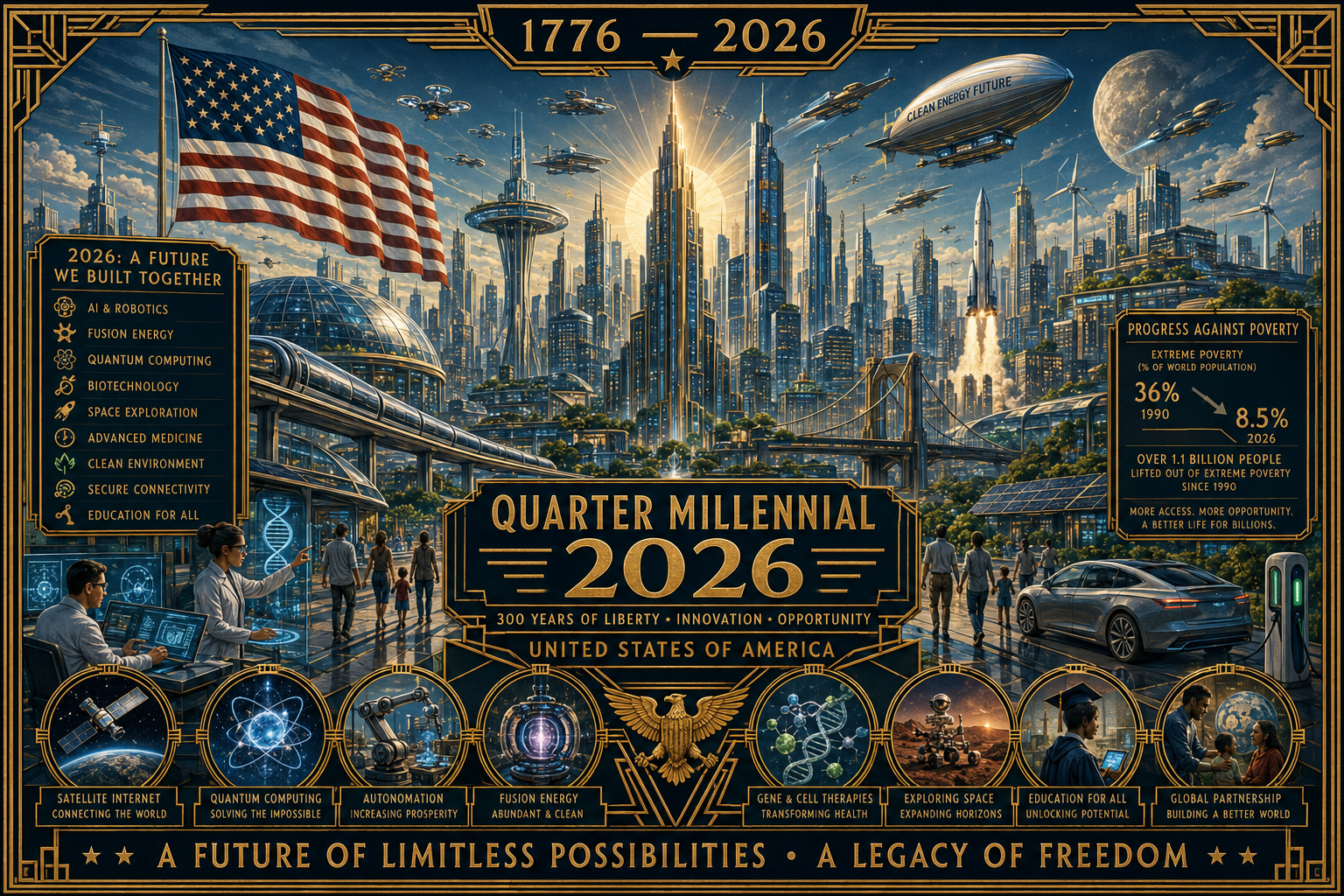
Note: I think “semiquincentennial” is a poor choice for the name of this anniversary. You can see my name for it.
I couldn’t let the United States bicentennial pass without writing a post. As I wrote what is below, I surprised myself with what was on my mind when I think about where the United States of America is 250 years after its founding. The image above that I had ChatGPT make expresses my overall positive attitude about the world today. In many ways, the world is a horrible place. But it used to be almost unimaginably worse. Let’s be grateful that things are as they are rather than the unimaginably worse situation people faced a few centuries ago.
The time in my life I most clearly remember being deeply moved by a speech was when my daughter Diana spoke about America as a young schoolchild. Today, I continue to be moved by the ideals of freedom and governments responsive to the desires of the people. I have been privileged in many ways, but hundreds of millions of others in our nation have also been privileged as I have: able to make my own choices for my life, living a life of wild abundance compared to anything before the last 150 years of history, and never having to go involuntarily to war.
One thing that is very hard for anyone to come by is to have everyone else treat you nicely. As I get older, I think more and more that many of the great and obvious evils in the world begin with small slights and nastinesses. People often remember vividly small bad things done to them when they were young, and sometimes when get enough power before having properly dealt with those feelings take their anger and resentment out on many others. This is especially true for ethnic hatreds. Why would you hate another group if every time you turn around members of that group are doing another nice thing for you and none do you wrong? Even if someone else had a story of how horrible that group was, you might make inquiries to find out the truth of the matter.
Based on the belief that slights and disrespect of others are corrosive, I think it is a good sign that we now have both anti-bullying efforts for children and a growing appreciation of neurodiversity along with other forms of diversity. On the negative side, many who have championed good treatment of other groups have shown enormous disrespect toward the many adults in America who do not have a college education. No one likes being looked down on. Having large numbers of the college-educated look down on those who are not college-educated has had political consequences. It is important to collectively listen to, and try to understand everyone.
Sometimes bad treatment goes beyond small slights. One of the greatest evils in this country that mostly well-intentioned people perpetrate is to try to keep additional people from living in their neighborhood. Anticonstruction attitudes are, in practice, anti-human attitudes—or at least anti-freedom attitudes, because they reduce people’s freedom to live where they want to live.
At this Quarter-Millenial, we stand at the cusp of a new age of the world. I won’t repeat here the little bit I said about that in “The Age of AI,” but as people wonder about AI consciousness, let me point to Eric Schwitzgebel’s philosophical argument in The Weirdness of the World, that human collectives such as the United States of America may have their own consciousness already. After all, it is a standard view that human consciousness arises from the interactions of quarks, leptons, force particles and the like. Then why can’t the interactions of human beings results in distinct emergent consciousnesses? (That can apply to the “Invisible Hand as well. See section B here.) If so, this birthday for the United States of America could be the. birthday for a conscious entity. If so, it has my thanks.
Robert Pinsky's 2012 Commencement Speech at Concord Academy →
h/t Larry Kotlikoff
The Age of AI
Image made with the help of ChatGPT
It has been 14 years since my first blog post: What is a Supply-Side Liberal? I have written an anniversary post every year since:
My blogging continues at a slower pace; in addition to my more immediate duties as a professor, husband, father and grandfather, a key part of my research has heated up: my work with Dan Benjamin, Ori Heffetz, Kristen Cooper, Jiannan Zhou, Tushar Kundu and Hannah Solheim toward developing the principles for national well-being indexes that can stand as coequals with GDP and thereby help create a world where what matters most to people matters most to rulers.
More and more, I wonder if the rulers “creating a world where matters most to people matters most to rulers” refers to will be artificial intelligences. In that case, developing comprehensive measures of well-being will be a key part of AI alignment: it is not enough to make AIs care about human welfare. They also need to have a very sophisticated, comprehensive and open-ended concept of human welfare, lest they foster certain human values while crushing others. Jack Williamson’s classic science fiction story “With Folded Hands”—which he later expanded into the novel The Humanoids—is a warning about this. He tells the story of a future where the robots advance human safety at the expense of many other human values.
Like many others, I have been thinking about AI a lot in the past year. I have avidly read news and commentary about AI. I have worried about unaligned AI. I have made sure I was invested heavily in the stock market on the view that AI will lift the economy as a whole, but for large-cap have invested in an equally-weighted fund, which has no theoretical attraction for me, but is simply a way to bet on AI while also betting that the Magnificent Seven (Nvidia, Alphabet, Apple, Microsoft, Amazon, Tesla, Meta) don’t have good enough moats to avoid facing fierce competition in the future, so that their valuations will leak out to other firms, deflating them in relative terms. I have used AI for the first time to help write exams (especially the false answers in multiple choice exams). I have used songs I created with the help of Suno AI to help students remember key ideas in my Intermediate Macroeconomics class. I have used ChatGPT as a tutor to help me learn about three-dimensional and higher-dimensional geometry. And I have experimented with using AI for blog posts. I know I haven’t gotten things down yet. I have tried to represent interesting dialogues I have had with ChatGPT, but ChatGPT is naturally quite long-winded. Nevertheless, here are the posts I have done in the last year using ChatGPT—most of them based on dialogues I had with ChatGPT simply out of curiosity that I then copy-pasted:
The one full post I wrote this past year without involving AI was
I don’t know how many people share this impression, but subjectively speaking, I feel I was in the same technological era from when I was born in 1960 all the way up to 2022. Then, since November 30, 2022, when ChatGPT was released into the wild, it seems everything has been changing with incredible rapidity. We are going into a period in which human-AI teams will beat humans. What is beyond that is hard to foresee with any clarity.
So, to preserve one’s own competitive position, my advice is to experiment with AI and act like a fan, even if you aren’t. And to the extent their are dangers from AI, it will be those who have been doing that experimentation who will be best equipped to cope with those dangers (though those who won’t touch AI will help in warning of the dangers). We are living inside the fabled Chinese curse: “May you live in interesting times.”