The Quarter-Millenial of the United States of America
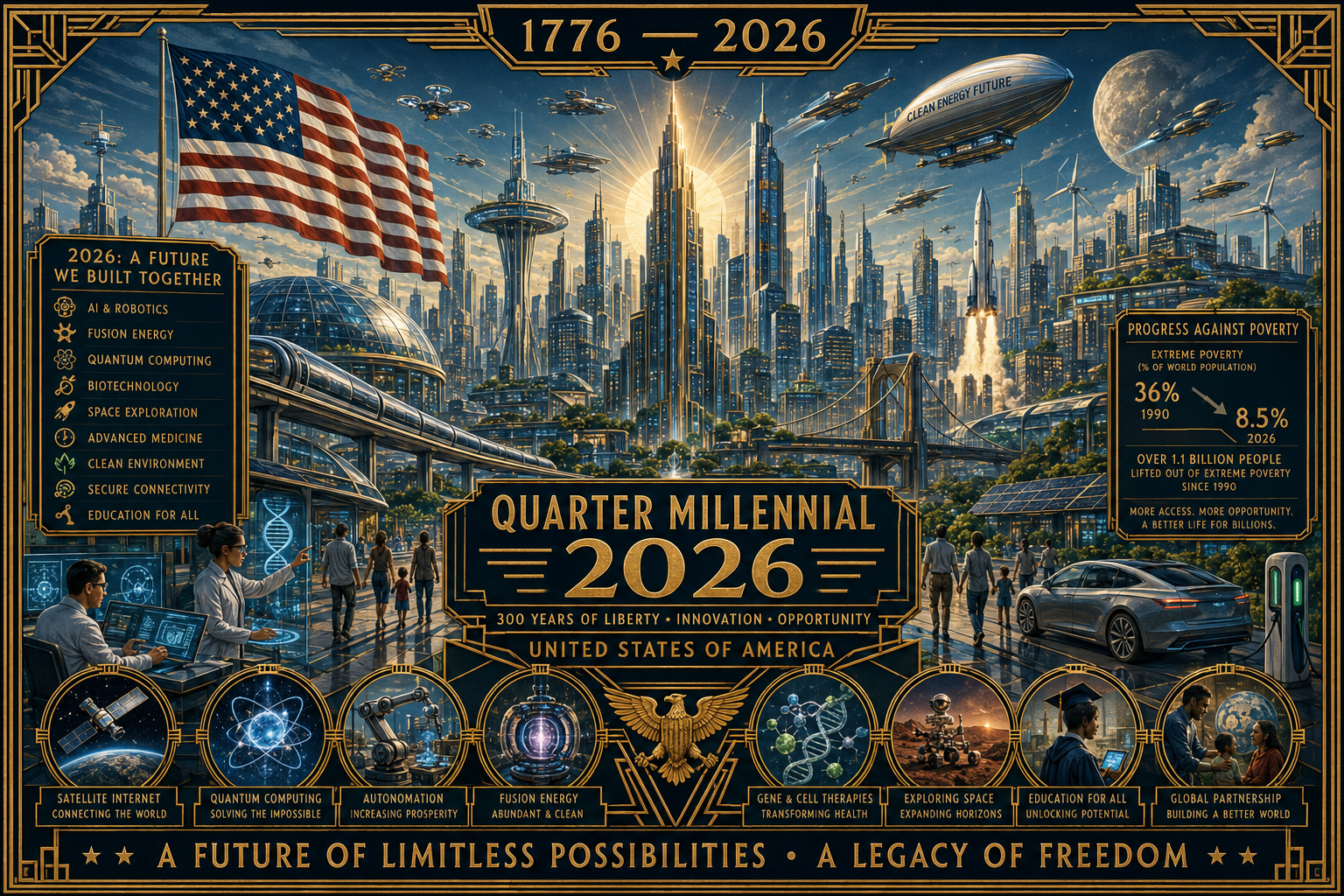
Note: I think “semiquincentennial” is a poor choice for the name of this anniversary. You can see my name for it.
I couldn’t let the United States bicentennial pass without writing a post. As I wrote what is below, I surprised myself with what was on my mind when I think about where the United States of America is 250 years after its founding. The image above that I had ChatGPT make expresses my overall positive attitude about the world today. In many ways, the world is a horrible place. But it used to be almost unimaginably worse. Let’s be grateful that things are as they are rather than the unimaginably worse situation people faced a few centuries ago.
The time in my life I most clearly remember being deeply moved by a speech was when my daughter Diana spoke about America as a young schoolchild. Today, I continue to be moved by the ideals of freedom and governments responsive to the desires of the people. I have been privileged in many ways, but hundreds of millions of others in our nation have also been privileged as I have: able to make my own choices for my life, living a life of wild abundance compared to anything before the last 150 years of history, and never having to go involuntarily to war.
One thing that is very hard for anyone to come by is to have everyone else treat you nicely. As I get older, I think more and more that many of the great and obvious evils in the world begin with small slights and nastinesses. People often remember vividly small bad things done to them when they were young, and sometimes when get enough power before having properly dealt with those feelings take their anger and resentment out on many others. This is especially true for ethnic hatreds. Why would you hate another group if every time you turn around members of that group are doing another nice thing for you and none do you wrong? Even if someone else had a story of how horrible that group was, you might make inquiries to find out the truth of the matter.
Based on the belief that slights and disrespect of others are corrosive, I think it is a good sign that we now have both anti-bullying efforts for children and a growing appreciation of neurodiversity along with other forms of diversity. On the negative side, many who have championed good treatment of other groups have shown enormous disrespect toward the many adults in America who do not have a college education. No one likes being looked down on. Having large numbers of the college-educated look down on those who are not college-educated has had political consequences. It is important to collectively listen to, and try to understand everyone.
Sometimes bad treatment goes beyond small slights. One of the greatest evils in this country that mostly well-intentioned people perpetrate is to try to keep additional people from living in their neighborhood. Anticonstruction attitudes are, in practice, anti-human attitudes—or at least anti-freedom attitudes, because they reduce people’s freedom to live where they want to live.
At this Quarter-Millenial, we stand at the cusp of a new age of the world. I won’t repeat here the little bit I said about that in “The Age of AI,” but as people wonder about AI consciousness, let me point to Eric Schwitzgebel’s philosophical argument in The Weirdness of the World, that human collectives such as the United States of America may have their own consciousness already. After all, it is a standard view that human consciousness arises from the interactions of quarks, leptons, force particles and the like. Then why can’t the interactions of human beings results in distinct emergent consciousnesses? (That can apply to the “Invisible Hand as well. See section B here.) If so, this birthday for the United States of America could be the. birthday for a conscious entity. If so, it has my thanks.