… there is always pressure to block criticism: to shut off alternatives, shelter the familiar, stifle the imagination. Criticism is, after all, no fun for its targets. No one wants to be a failure, even a relative one. So reactionaries who fear disruption, technocrats who want to pick winners, and self-interested parties who want to shut out rivals can all be counted on to try to limit criticism and competition. The ability to resist this collusion against new ideas is perhaps the single most distinguishing feature of dynamic systems.

– Virginia Postrel, The Future and Its Enemies

Expansionist India

I received a comment on my post “Will Narendra Modi’s Economic Reforms Put India on the Road to Being a Superpower?” that I thought was important enough that I should make it into a guest post. It had a lot of information that I had been unaware of. The author chose to remain anonymous. Here is what shehe wrote:


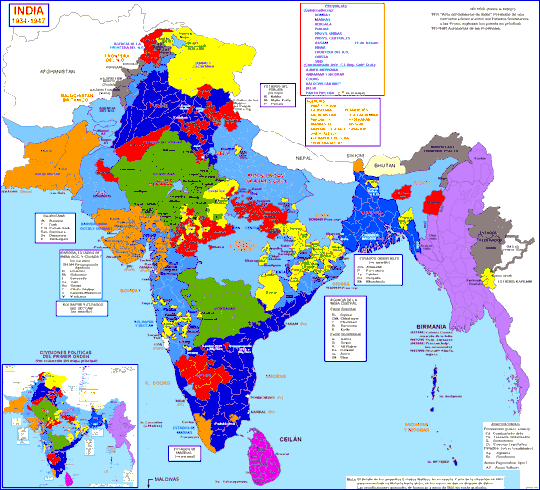
I am surfing the web and chanced upon this site, nice blog. Since you are opened to revision in response to cogent arguments, I am going to take a stab here. I think you have a fundamental misunderstanding of India. Yes I know, India is a democracy and all that. But this is a rather superficial understanding of the country. You might not have heard of India’s territorial disputes in the news, but this doesn’t mean India does not have them. In fact India (with the possible exception of Bangladesh, since I read that India and Bangladesh have reached an agreement to settle their borders this January) has not settled its borders with any of its neighbors. And worst, India has the dubious distinction of annexing every single of its neighbors land since it was created by the British in 1947. I know this may come as a shock to you, but here are the links you may want to check out:

1947 Annexation of Kashmir

http://www.counterpunch.org/2015/02/06/indias-shame/

http://thediplomat.com/2015/08/kashmirs-young-rebels/

1949 Annexation of Manipur

http://www.tehelka.com/manipurs-merger-with-india-was-a-forced-annexation/

1949 Annexation of Tripura

http://www.crescent-online.net/2009/09/the-myths-of-one-nation-and-one-hinduism-in-india-zawahir-siddique-2316-articles.html

1951 Annexation of South Tibet:

http://kanglaonline.com/2011/06/khathing-the-taking-of-tawang/

http://www.mainstreamweekly.net/article2582.html

1961 Annexation of Goa:

http://goa-invasion-1961.blogspot.in/2013/09/india-pirated-goa-china-is-regaining_16.html

1962 Annexation of Kalapani, Nepal:

http://www.eurasiareview.com/07032012-indian-hegemony-in-nepal-oped/

1962 Aggression against China:

http://gregoryclark.net/redif.html

http://asiapacific.anu.edu.au/news-events/podcasts/renewed-tension-indiachina-border-whos-blame

1971 Annexation of Turtuk, Pakistan:

http://www.openthemagazine.com/article/nation/suddenly-indian

1972 Annexation of Tin Bigha, Bangladesh

http://www.dhakatribune.com/op-ed/2014/feb/20/killing-fields

1975 Annexation of Sikkim (the whole country):

http://nepalitimes.com/issue/35/Nation/9621#.UohjPHQo6LA

http://www.amazon.com/Smash-Grab-Annexation-Sunanda-Datta-Ray/dp/9383260386

http://indiatoday.intoday.in/story/annexation-of-sikkim-by-india-was-not-legal-wangchuk-namgyal/1/391498.html

1983 (Aborted) Attempted invasion of Mauritius

http://thediplomat.com/2013/03/when-india-almost-invaded-mauritius/

1990 (Failed) Attempted annexation of Bhutan:

http://www.nytimes.com/1990/10/07/world/india-based-groups-seek-to-disrupt-bhutan.html

2006 Annexation of Duars, Bhutan:

http://wangchasangey.blogspot.in/2015/11/different-kind-of-anxieties-on.html#comment-form

2013 Annexation of Moreh, Myanmar

http://www.huffingtonpost.com/nehginpao-kipgen/easing-indiamyanmar-borde_b_4633040.html

If you talk to India’s neighbors, the words ‘bullying’, 'hegemonic’, 'meddling’, 'intrusive’…are probably some of the adjective its neighbors will use to describe India. A recent example is India rejection of Bhutan’s plan to build a highway in the southern part of Bhutan. An earlier example is India’s creation of the Tamil Tigers which plunged Sri Lanka into many years of civil war. You might not have aware of it, but India has a rather testy relations with almost all of its neighbors.

As to why India is such a misunderstood country, I pondered it for a long time and here are the reason I think may have something to do with it.

1) India was created under British auspices and hence British India relations have a sort of mentor protégé element to it. As such Britain is naturally protective of India and hence tacitly approved or at least tolerate India’s aggression. Britain, as one the key member of the West, set the tone of how India should be treated.

2) In the early years after India’s creation in 1947, Britain saw India as a kind of proxy that represents Britain’s interest in South Asia. As such India’s aggression was not viewed to be detrimental to the world’s order. In fact not many people know, after 1947 a lot of the British Raj officials stayed and served in the new government especially in the foreign policy department. Hence the expansionary instinct (in order words land grabbing) of the British Raj continues in the new country.

3) The subcontinent was colonized for two hundred years, when it gained independence, there were a lot of goodwill towards India all over the world, not less from Britain itself. The situation is not dissimilar to South Africa. Nehru was basically the Nelson Mandela of his time. India skillfully exploits this sentiment and assume a role of moral superiority in dealing with international affairs. Nehru is famous for his self-righteousness internationally. This makes it hard to criticize India.

4) India is a democracy. The notion that democracies are intrinsically peaceful is seldom challenged. In fact the belief is so strong that whatever India says are usually accepted as fact with no question asked. Take Sikkim as an example, fifteen years before Saddam Hussein annexed Kuwait, India annexed Sikkim. But how do India explain its act? According to India’s explanation, 97% of Sikkimese voted to join India, so India just spread its democracy to Sikkim by 'incorporating’ Sikkim into the India. I remembered when before the first gulf war when Saddam Hussein said he conducted an election and 99% of Iraqi voted for him, it was immediately dismissed as ridiculous (which it is). But when India says the same thing, it was accepted as fact.

5) Gandhi is a well-known icon of India. And Gandhi’s non-violence struggle against the British are well-known. This non-violence stereotype stick and people just assume that India is non-violence against its neighbors also. But of course nothing is further from the truth. Over seventy thousands Kashmiris disappeared without a trace in India occupied Kashmir with many show up in mass graves. A few years ago there was an uprising in Kashmir and in one demonstration Indian troops gunned down hundreds of Kashmiris. But the press seems not to be too bother about it. India gets away with murder, literally.
From a Request for a Referee Report

I found this passage from an email asking me to referee a paper very perceptive. The editor wrote:

From personal experience, there is a (growing?) tendency for referees to provide very long, detailed reports that sometimes read - with slight exaggeration - like an essay on the question “how I would have written this paper”. This is not always optimal - it costs the referee’s time, and it may result in a lengthy, non-converging refereeing process overall. Our main interest is in receiving advice on a. the overall significance of the findings and claims b. their technical correctness. In my experience, a relatively brief report containing a set of consecutively numbered paragraphs, each making one point, is most useful in reaching a final decision.

Update: This quotation received an extraordinarily positive reaction on my Facebook page (with 201 likes and counting, including many from well-known economists, plus several positive comments), as you can see here

John Stuart Mill on the Importance of Having Many Public Policy Analysts and Critics Outside of Government

Unless it faces some form of competition, almost every institution becomes slovenly. The objective of minimizing violence overall often makes it appropriate for governments to monopolize the use of most forms of violence. But that is all the more reason that governments must face competition in the realm of ideas. A government not subject to vocal criticism is a government bound to do some part of its job very badly.

One of the downsides of a large government is that it leaves fewer people outside of government who are well equipped to give penetrating critiques of government habits and government actions. (This can be a big problem at the state, regional and local level as well as at the national level.) John Stuart Mill expresses this concern well in paragraph 22 of On Liberty “Chapter V: Applications”:

It is not, also, to be forgotten, that the absorption of all the principal ability of the country into the governing body is fatal, sooner or later, to the mental activity and progressiveness of the body itself. Banded together as they are — working a system which, like all systems, necessarily proceeds in a great measure by fixed rules — the official body are under the constant temptation of sinking into indolent routine, or, if they now and then desert that mill-horse round, of rushing into some half-examined crudity which has struck the fancy of some leading member of the corps: and the sole check to these closely allied, though seemingly opposite, tendencies, the only stimulus which can keep the ability of the body itself up to a high standard, is liability to the watchful criticism of equal ability outside the body. It is indispensable, therefore, that the means should exist, independently of the government, of forming such ability, and furnishing it with the opportunities and experience necessary for a correct judgment of great practical affairs. If we would possess permanently a skilful and efficient body of functionaries — above all, a body able to originate and willing to adopt improvements; if we would not have our bureaucracy degenerate into a pedantocracy, this body must not engross all the occupations which form and cultivate the faculties required for the government of mankind.

Note: This post is the latest in a series on John Stuart Mill’s “On Liberty” that begins on my Tumblr blog “Confessions of a Supply-Side Liberal.” Links to others can be found here:

Chapter II John Stuart Mill’s Brief for Freedom of Speech

Chapter III: John Stuart Mill’s Brief for Individuality

Chapter IV: John Stuart Mill’s Brief for the Limits of the Authority of Society over the Individual

More recents John Stuart Mill posts can be found in my 

DC Central Kitchen Brings Charter School Principles that Work to Adult Education that Turns People’s Lives Around

This is a heart-warming segment from the PBS newshour. But it is more than heartwarming. It is also very instructive. It suggests that the same principles that work in the “Knowledge is Power Program” or KIPP schools work for adults as well as children. As I wrote in “Magic Ingredient 1: More K-12 School” and quoted again in “The Coming Transformation of Education: Degrees Won’t Matter Anymore, Skills Will”:

“The secret recipe behind the “Knowledge is Power Program” or KIPP schools (which have been very successful even with highly disadvantaged kids) is this:

  1. They motivate students by convincing them they can succeed and have a better life through working hard in school.
  2. They keep order, so the students are not distracted from learning.
  3. They have the students study hard for many long hours, with a long school day, a long school week (some school on Saturdays), and a long school year (school during the Summer).”

Abstracting a bit from the specifics, the recipe is

  1. Give them hope
  2. Use tough love
  3. Make them work hard

By this recipe, they can gain skills that will turn their lives around.

The Aluminum Rule

In line with what many other religious traditions have preached as well, Jesus said: 

Do unto others as you would have them do unto you. 

This has been called the Golden Rule. Not everyone feels ready to follow the Golden Rule. So I would like to propound the Aluminum Rule, framed as a less demanding version of Utilitarianism:

When acting collectively–or considering collective actions–put a weight on the welfare of human beings outside the in-group at least one-hundredth as much as the welfare of those in the in-group. 

To make clear what this means, conducting cost-benefit analysis that put a weight of zero on non-citizens, for example, would violate the Aluminum rule. 

It might seem that the Aluminum rule would not have much bite, but that is not so. In “Inequality Aversion Utility Functions: Would $1000 Mean More to a Poorer Family than $4000 to One Twice as Rich?” talked about results that indicate that there is actually quite wide agreement that a dollar means at least 4 times as much to someone who is living on half as much income. Extending that elasticity (of 2 or more) to lower levels of income, it means that a dollar would mean something like 100 times as much to someone who has only 1/10 the income. Thus, a weight of 1/100 on someone in the out-group can be counteracted by someone in the out-group having an income only 1/10 or less of those in the in-group. Given the enormous differences in income levels between the typical individual in various different countries, following the aluminum rule would then mean that the welfare of those in relatively poor nations would bulk large in overall Aluminum-Rule calculations.

One might think that this would recommend that we do more foreign aid. It isn’t that easy. As Angus Deaton argues in his wonderful book The Great Escape: Health, Wealth, and the Origins of Inequality, foreign aid is very often literally corrupting, by putting money in the hands of people who don’t necessarily have the welfare of other people in their nation at heart. No, the most reliable way to help people in poor countries is to let them in. As I wrote in “The Message of Jesus for Non-Supernaturalists”:

The essence of oppression is to run things for the benefit of an in-group at the expense of an out-group. In my post “‘Keep the Riffraff Out!’” I point out three ways in which we routinely use exclusion to run things for the benefit of an in-group at the expense of an out-group.

The first is to put up fences and guards to keep out immigrants desperate to become part of a well-run liberal democracy. Why do we keep them out? In order to benefit a subset of citizens—of the in-group—even at terrible cost to those being kept out. Or when they get in despite our best efforts, we keep them in constant fear of deportation and thereby keep them at the margins of society.

We are often moved to compassion when we see pictures of people suffering in other countries, and send money to help. But other than limited areas such as fighting illness, it is very difficult to make things better over there where evil rules. But if we focus on helping people rather than helping nations, it is simplicity itself to help the people in other nations: let them in! It is much easier to bring the people to good systems of governance than it is to bring good systems of governance to people where they are. Where they are, evil systems designed for oppression will fight us tooth and nail. Here at home, we only have to fight the evil in our own hearts, with a fundamentally good system designed to keep our own evil in check backing us up.

The cost-benefit calculus for more open borders is only strengthened by considering how it may save those of us already in well-run countries. As I wrote in “Why Thinking about China is the Key to a Free World”:

Strengthening the free world numerically

Bringing more people into the free world is easier than it sounds. The key is to focus on people, not patches of ground. Although it is hard to bring a patch of ground currently subject to an oppressive regime under free institutions, the economic importance of land—apart from what is on top of the land—continues to decline relative to the importance of people, education and training, ideas and capital. Once one focuses on people, the answer is clear: bring people to where freedom already rules. That is so easy it is hard to do the opposite. Many people in benighted countries seek freedom and the prosperity that full freedom enables. Standing in the way of those hopes, many otherwise free countries make strenuous efforts to keep those people seeking prosperity and freedom out.

Currently, there is much agonizing about the dangers of allowing refugees from war-torn Middle-Eastern countries to come into safe-haven countries for fear that this might let terrorists in, even after strenuous efforts to identify potential terrorists to keep them out while letting others from those war-torn countries in. I do not think a man who willingly allowed himself to be crucified in order to demonstrate the power of love would take such a position. But be that as it may, rest assured that even if one takes such a position, there are many, many people from other benighted countries who can be let in who pose no such danger.  

I don’t mean to suggest at all that the only implications of the Aluminum Rule are for immigration policy. I would love to see the outcome of many calculations based on the Aluminum Rule. The principle of the Aluminum Rule can go far in illuminating what we should do, and may yet prove a stepping stone toward the Golden Rule itself. 

Alex Fedder—Competing Illusions: Organic and Non-GMO

tumblr_inline_nztcxj8ePV1r57lmx_250.jpg

Link to Alexander Fedder’s Linked In profile

I am pleased to host another student guest post, this time by Alexander Fedder. This is the 29th student guest post this semester. You can see all the student guest posts from my “Monetary and Financial Theory” class at this link.

I thought Alex’s account of the competition between “organic” and “non-GMO” (non-genetically-modified organism) food was very interesting. I have my own comments after the text of what Alex wrote. Here is Alex:


There has long been established the struggle for market share in the food industry between traditional products and those that are considered ‘organic.’  This label itself comes with an extensive list of certifications and health standards when it comes to checking up on ingredients by the USDA.  But, as the popularity of health foods has grown, there is a new label that has come to prominence among consumers as well―non-GMO.  These products are empty in what are called ‘genetically modified organisms.’  Explicitly, these are plants and animals involved in producing ingredients used in some traditional products that have been DNA-altered by genes from other organisms, which includes viruses and bacteria.  The motivation for using these GMOs is the ability to cut down on supply side costs for large food companies.  For example, genetic modification is sometimes applied to reduce the susceptibility of corn to pesticides and pests, so that there is no contamination of final product.  The use of pesticides on the crops is considered essential by some farmers to the growing process because it allows for less loss of product.  The point is that these non-GMO companies are direct competitors in the niche natural food market with the organic companies because GMOs are perceived to be harmful for humans to consume.  Hence, an increase in demand for one of these types of food products inevitably leads to a decrease in demand for the other.  In fact, this ongoing battle back and forth seems to be fairly close when it comes to consumer perception in the overall market.  As reported by Jacob Bunge and Annie Gasparro in their Wall Street Journal article about the choice between the two for skeptical consumers, “[l]ast year, foods labeled non-GMO claimed 3.7% of total food sales in U.S. grocery stores, more than the 3.5% for organic items, according to market-research firm Nielsen NV.  About 49% of consumers polled by Nielsen called non-GMO an important factor in food-and-beverage shopping, versus 47% for organic.”  This isn’t to say anything about the particulars of the race for market share, but to highlight the nonsense and inefficiency of the entire rivalry.  Consider the perspective of the average consumer that has fairly little concern about the safety of non-organic (standard GMO) food products.  It is quite possible that this type of consumer purchases organic or non-GMO products in a sort of bandwagon effect.  But then he must choose between two relatively meaningless labels, ultimately contributing to demand for one or the other.  It is clear that as he is indifferent in regards to health standards, he will choose the cheaper option.  At the same time, many well-informed and “rational” consumers are well aware of the low probability that GMOs pose a threat, something that has been stressed by U.S. health regulators such as the FDA.  For this type of consumer, this definitely updates their choices, pushing them away from marked-up organic and non-GMO products.  And yet, these health food products continue to hold space on the shelves of grocery stores.  This is a fact that indicates that there are a significant portion of those aforementioned average consumers that are buying into the illusion, since those consumers that actually have serious concerns over safety make up such a small fraction of the market. Moreover, there is less and less incentive for health food innovation and advances in food-relevant biotechnology because these products have firmly established their place.  Accordingly, the debate over these health products is holding back productivity growth.

Not only are the resources required to differentiate such natural food labels a wasteful provision, but there is current price distortion as a result of consumers’ understanding of the subtle discrepancies between those labels in regards to certification.  The organic companies are without a doubt trying to correct this faulty consumer perception, although their motivations are up for debate.  According to the same article, Oren Holle, an organic farmer well known for his services in Bremen, Kan, commented on what he feels is a serious issue.  “While some consumers may migrate from [non-GMO products] to organic foods, Mr. Holle said he worries about ‘a perception out there that if I buy the non-GMO it’s a little less costly when you run up to the checkout counter, and it’s just about as good.”  The idea is that the organically-certified products must actually jump through many more hoops than their non-GMO counterparts, but this isn’t reflected in the prices as consumers that are buying the products believe that they are relatively substitutable with regard to health standards.  This is the other aspect of the argument that the labels are causing market inefficiency.  In fact, it ties directly into the average consumer decision that was discussed before.  The more rigorous health standards of organic foods relative to non-GMO foods almost surely indicate that the cheaper option will be the non-GMO products.  And for products that can be viewed as almost perfectly substitutable for these average consumers, the non-GMO companies will eventually win the greater share of demand.  However, this isn’t what the organic food companies claim to be concerned about.  To these firms, the fear is openly announced to be in regards to an interest in public knowledge.  Vernon Peterson, owner of Abundant Harvest Organics in Kingsburg, California, asserts, “‘[w]hen you have a confused public, it’s never good.’”  It is doubtful that these firms will actually be worried about social costs and more likely that they will be applying marketing techniques to further the notion that organic is somehow safer than non-GMO, which means that consumers who will listen should be willing to pay more for organic products.  Finally, the alternative drain on efficiency comes in when we consider that there has been extensive research to show that the organic companies themselves are a major source of funding for the fight against GMOs.  They are trying to get market share away from genetically modified food without letting food with only the label “non-GMO” take too much of that freed-up market share. 


Miles: To some extent, both “non-GMO” and “organic” are selling illusions. Having competing illusions for sale–both of which appeal to the relevant class of people–seems likely to lead to more efficiency. They can then choose the cheaper of the two illusions. Although “non-GMO” is certainly a costly illusion, I wonder if “organic” isn’t an even more expensive illusion. 

The other complicated feature of this competition is that even for people like me who have no real worries about the safety of non-organic food, I find that organic food tends to be more expensive, higher-quality food as well. It could have been labeled “craft food” or something like that, but in fact it is labeled “organic food." 

Siyuan Liu: Netflix’s Secret Weapon

Link to Siyuan Liu’s Linked-In profile

I am pleased to host another student guest post, this time by Siyuan Liu. This is the 28th student guest post this semester. (The final exam is today, but there is at least one more to come.) You can see all the student guest posts from my “Monetary and Financial Theory” class at this link.

When he visited Ann Arbor last year, Hal Varian said that the new thinking about what insurance companies do emphasizes the fact that they have the data and therefore the knowledge about what the biggest dangers are and how to address those dangers. Siyuan’s analysis of Netflix is in that spirit. It may look like the video files it distributes are the key to its business, but Siyuan argues that the data files on customers’ preferences are just as important in understanding the nature of its business. 


Netflix’s competitive advantage lies in the way it uses its large customer database.

Netflix caught my attention because of a news from Wall Street Journal, saying that it is entering into the feature films market by making movies that studios no longer will. Netflix is an interesting firm pioneering online streaming media. What makes it stand out among its competitors is its efficient use of its customer base.

Netflix does many interesting things. First, it has a decent selection of drama, picking ones that have a certain group of loyal audiences; second, it foresees popular programs; lastly, it is planning to produce its original programs, aiming at a blank market where certain types of movies are not made by major film producers.

The rising streaming media industry puts wind in Netflix’s sails as it builds up its user database.  Entertainment products enjoy a highly inelastic demand of economic situations because watching sports games, dramas and shows is the cheapest and simplest way to relax. Online streaming provides people with the convenience to watch almost anything at any time without waiting for the channels to broadcast, which no doubt attracts large amount of traditional TV audiences. Netflix, starting almost the earliest, has become a major provider, and is the first site that most people will turn to when it comes to online streaming. By the end of September in this year, Netflix already had 69 millions of subscribers for its streaming services.

Similar to Alibaba, the e-commerce giant who doesn’t solely rely on service charges, membership fee is not the only goal of Netflix, neither. As Alibaba uses the platform to identify profitable businesses, Netflix uses its large customer database to trace users’ preferences and thus to pick programs strategically. This is the secret of how Netflix captures people’s hearts. And this also helps cut cost: when only ‘valuable’ programs are shown, unnecessary funding spent on those licenses will be saved. For example, only 6.5 out of 7 seasons of the classic Mad Man are available on Netflix, probably because not many people are interested in the rest 0.5 seasons.

Besides picking available shows, it is even good at predicting good ones before they become popular. Take House of Cards for instance, Netflix outbid all other networks when MRC approached them because it believed the show was incredibly promising for it covers many elements that its users are interested in, politics being one of them. Eventually the show turned out to be extremely successful. With statistical tools, Netflix is going further than many of its peers.

Moreover, Netflix has been exploring new markets. It is entering high-quality television series to produce its original programs. Targeting at a ‘blank market’ - movies that are not made by major film makers – as long as statistics show there’s a market behind a type of movie, Netflix will go for it . Since it doesn’t rely on 'box tickets’, its goal is to attract the people who are fond of these exclusively offered programs to become members, which again adds to its database. Then this becomes a virtuous cycle.

What else can Netflix do? It may be thinking of cooperating with movie producers to release films online, soon, since it seems to be the trend for film distribution. It simply won’t give away any chance to expand its business. In any case, with its powerful database and expansion of its business domain, Netflix will keep growing for many years to come.

Matthew Vallade: Money Can Buy Happiness If You Know How

Link to Matthew Vallade’s LinkedIn profile

I am pleased to host another student guest post, this time by Matthew Vallade. This is the 27th student guest post this semester. You can see all the student guest posts from my “Monetary and Financial Theory” class at this link.

This is also the latest post in my Happiness Sub-Blog. Click this link to see the rest.


We have all heard over and over again that, “money can’t buy happiness” and the Bible even states that , “the love of money is the root of all evil.”  The idea of pursuing wealth has a negative connotation connected with it, and many believe wealth will not bring joy to ones life. This may be false though. Money can bring a sense of happiness and purpose into ones life if they use their money to buy experiences instead of material items, and if they give a portion of their income away.

Studies show you’ll get more contentment from putting cash toward experiences (like vacations) than material things (like a new TV).  Material items derive their value because they are appreciated by others. For example, shoes are only “cool” if society as a whole agrees that they are “cool”. In order to bring joy to our lives, material goods need the approval of others and the utility it brings may not be as high as as expected. Also, the value of material goods diminishes over time as new products are introduced and as one adjusts to the purchased item. Experiences are much different, they build bonds and relationships that can be extended over long periods of time. They create memories that do not diminish as time goes on. Experiences create value in our mind that is bigger and better than that of which any object can produce, and thus we should spend our disposable income on these experiences with others, rather than material goods. 

Research has been performed all over the world that shows that those who spent money on other people were happier than those who treated themselves.  This increase in happiness can be seen from those who have lots and from those who have little. Many plan to give when they are rich and have lots to give away, but it is important to give even when one is early on in their career. Giving to others can have a large impact on our happiness and should be taken into consideration during the entirety of our lives.

Money is especially important for those in the lower income bracket. We see that those who struggle to get by with the basic necessities have lower happiness levels, and wealth can help alleviate stress and make ones life more enjoyable. Also,  there is a correlation that people who have large amounts of debt also have an increased amount of stress and a decreases in happiness. Money is necessary for survival in the world that we live and financial stability is crucial in the pursuit of happiness.

The idea that money can’t bring happiness comes from those who are greedy. When money is the sole place where one finds happiness and their only joy is having more than others,  you will find a man who is miserable. The key to using money in an effective manner is to spend it on others and with others. We are creatures who were made to spend life together, and that is how we should spend our money as well.

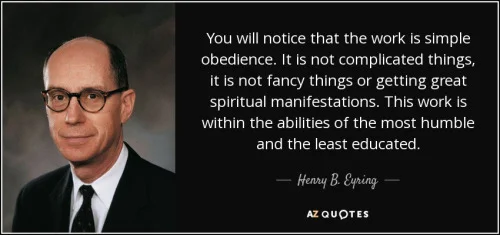
Simple Obedience

Image source. Trivia fact: Henry B. Eyring is Miles’s Dad’s 1st cousin–which makes him, in the terminology I recommend in New Words for a New Year a “second uncle.” Henry B. Eyring is currently the “1st Counselor” to President Thomas S. Monson,…

Image source. Trivia fact: Henry B. Eyring is Miles’s Dad’s 1st cousin–which makes him, in the terminology I recommend in New Words for a New Year a “second uncle.” Henry B. Eyring is currently the “1st Counselor” to President Thomas S. Monson, effectively the vice president of the Mormon Church.

As you can see in the example above, the phrase “simple obedience” is in use among Mormon Church leaders. In my Storified tweets in “A Perspective on the Mormon Church’s Official Twitter Feed,” I interpreted the phrase “simple obedience” as an injunction to not question Mormon Church leaders. (In my life, I have questioned Mormon Church leaders a great deal; they have not always been happy about that.) I do think it has that as one of its meanings, but it has another meaning as well, which is nicely described by this anonymous guest post (which came to me initially as a Facebook message). It is important to understand this meaning as well, particularly for those whose secular background would leave them without the awareness of such a concept. 


Hello Miles. I hope you are well. We haven’t talked directly for quite a while, but I do check out your blog from time to time and quite often find insightful, interesting things there about both economics and religion. Though I sometimes find myself in disagreement with your interpretation on matters of religion, I don’t comment because I think religious views are based on individual experience that varies a good deal from person to person. Disagreement also makes life interesting and enjoyable, so vive la difference! Nevertheless, among your comments about certain church originated tweets following the most recent session of conference was something that seemed to make a rather heroic assumption about the author’s intent, on which I had a non-public comment to offer. I don’t recall it exactly what it was, but unless I misread, you said something along the lines that an exhortation to “simply obey” was code speak for suppression of independent thought. I also don’t know the intent of the author, but it seems equally likely to me that the intent was to urge someone struggling with life to try obedience as a way to get one’s life in order.   

I have known people with certain behavioral issues for which a reasonable approach might be to simply set some guidelines, live by them for a while (even unthinkingly so, perhaps) to establish more productive patterns of behavior, and then move forward with a better foundation for life. Similarly, I can imagine telling a struggling student that he/she should try “just doing the work” to see if that makes things better.  I wouldn’t consider that suppression of independent thought, but just an exhortation to play by the rules. Now, I think the most productive form of “obedience” arises in response to an individual’s internal desire to follow the principles that serve as one’s moral foundation. And I believe that obedience to whatever set of rules one might follow without considering how those rules align with one’s moral compass does not tend to lead one to the further development of moral character. Nevertheless, I think there are times when simply playing by the rules can help one get through a difficult stretch, and, as I’ve already said, may help one establish a more productive foundation on which to live. Essentially, while I am not a fan of “obedience for its own sake,” neither am I a fan of “disobedience for its own sake.”  Suggesting that urging obedience is equivalent to limiting independent thought, in my opinion, leans too far toward the second of these two errors.


Mackenzie Wolfgram: The Key to the First Wave of Welfare Benefits from Animal Cloning is the Cloning of Studs

I am pleased to host another student guest post, this time by Mackenzie Wolfgram. This is the 26th student guest post this semester. You can see all the student guest posts from my “Monetary and Financial Theory” class at this link. This is Mackenzie’s 3d guest post. His first two were “Why the $15 Minimum Wage is Bad for the Poor” and “Capital Lease Accounting is Honest Accounting. Operating Lease Accounting is Not.”


Recently, Tianjin China announced plans to build the first large scale animal cloning facility, which is set to be up and running sometime in 2016. There has been sufficient controversy surrounding the subject, with some touting this as the 21st century advancement that will allow us to help feed the masses, while others claim that this is an example of people playing god, is unethical, and will have unintended consequences. One such consequence is that the reduced variety in the gene pool of farm animals could allow for less resilience to disease and lead to plague like illness ravaging our food, this could potentially more than offset any advantage of the cloning program. Regardless of opposition, the plans are going to proceed. While I don’t think that this operation will actually be able to “feed the masses” immediately, animal cloning has been a long time coming and will have benefits akin to those we see from genetically modified plants, which will included cheaper, higher quality meat.

In the short term, there is no feasible way that this cloning facility will be vastly superior at rapid beef production than any other factory farm.  People hear cloning and they get visions of fully grown cows being 3d printed and slaughtered in a matter of minutes, orc style. Yet, these cows will still have to go through a normal cow life cycle, from infants to adulthood. The main difference between using a cloning facility and not is cost effectiveness. Currently, you have bulls with good genes selling on the market for upwards of one million dollars, just for the breeding prospects. Since they rear larger cows with better meat, less fat, etc. farmers are willing to pay large sums of money for them. Even though there is no guarantee that the offspring of these bulls will be genetically superior, farmers are still clamoring to pay around $3,500 per ejaculation of the semen of choice bulls.  While this may seem to be a ridiculous price, it is a means of producing better cows and more meat, which in the end is a net gain for farmers.

This cloning facility does not mean that we will have unlimited cows immediately, thus the ability to feed the masses has been overstated; however we will see the cost of producing a “perfect cow” sharply fall, and the ability to do so rapidly increase. For instance, right now there are few bulls with choice characteristics as aforementioned. These few bulls have extraordinary qualities that merit the high prices paid for their sperm. At the new Chinese factory, after a few generations of gene alterations, perfect cows could be produced without the need for expensive bull semen. We will see genetic modifications allowing for faster cow growth, more milk production, better fat/meat ratios and other desirable qualities happen within only a few generations. Scientists could pick and choose these qualities and quickly mass produce them instead of waiting for genetic chance to suddenly make the lucky farmer who owns a “perfect bull” an overnight millionaire. 

Critics who fear that we will become more susceptible to illness on a large scale have a very valid point, and we will have to find a way to circumvent this problem. As of now, there is no end all solution for the issue of decreased lack of diversity, however I imagine that the reward is worth the risk in this scenario. I think that overall, animal cloning and genetic modification will provide a net benefit to societies that partake in it. While we may not feed the masses overnight, “perfect cows” on a large scale could indeed drive up the quality and availability of beef while simultaneously cutting the price. Eventually, if we were able to produce cows that grew to be twice as big in half the time, we could see massive gains in our ability to provide meat to a growing populous. So while this operation is not without critics, or risk, it is a worthwhile advancement that is soon going to be necessary to support our populations increasing size and our growing appetite for meat.

QE May or May Not Work for Japan; Deep Negative Interest Rates Are the Surefire Way for Japan to Escape Secular Stagnation

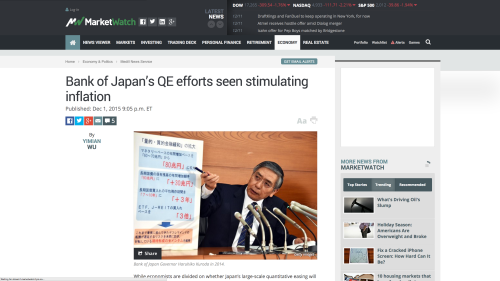
In my view “secular stagnation” is simply a name for being stuck at the zero lower bound. Yimian Wu interviewed me in an article for MarketWatch about whether Japan was on the road to getting the higher inflation it wants in order to make the zero lower bound less binding. In the article she writes:

University of Michigan economics professor Miles Kimball, said Japan should keep stimulating its economy until it is overheated to a point that the inflation rate is higher than desired.

This deserves clarification. What I said is this: I think there is still a lot of slack in the Japanese economy, and I will only believe that the slack in the Japanese economy is exhausted when Japan gets more inflation than it wants. To find out exactly how much slack it has, it is worth it for Japan to risk higher-than-desired inflation.

When I walk around Tokyo, I see many workers doing low-productivity activities that no one would ever be paid to do in the US. So I think there is a lot of potential to increase output per work hour by having workers work more intensely or do higher productivity activities as demand picks up. 

Hanging on to workers even if there isn’t much of any great importance to do is sometimes called “labor-hoarding.” The amount of labor-hoarding in Japan is reflected by its historically high percentage of extra output from each percentage point reduction in unemployment in Japan’s version of Okun’s law. And historically, Japan has been able to have quite low unemployment rates without accelerating inflation.  

Yimian goes on to write about her phone interview with me:

However, he said Japan’s large-scale QE might have some side effects that can’t be predicted. “We knows a fair bit about what it (quantitative easing) does with a certain dosage, and then you triple that dosage and nobody knows.”

Instead of quantitative easing, Kimball advocated negative interest rates. In a phone interview, he explained that cutting interest rates, even below zero, would have a more direct effect in stimulating the economy than increasing long-term bond purchases.

In addition to the phone interview, Yimian emailed a set of questions, which I answered as follows:

Yimian: How would you comment on Japan’s Quantitative Easing from 2001-2006? It clearly did not help improve inflation but without the QE, would Japan’s economy then be worse? Did it increase economic activities?

Miles: The size of QE during that period was quite small. I wouldn’t have expected it to do much, and it didn’t do much. 

Yimian: How would you comment the QE starting in 2013? When do you expect Japan would exit QE this time? When do you project Japan can hit the 2 percent inflation target?

Miles: Here is what I have written on recent QE in Japan:

With a negative interest rate policy, as I would recommend, it is not necessary to hit a 2% inflation target. What matters is getting to full employment, which is quite achievable. Once Japan is at full employment so people can easily find jobs, the Japanese government should take measures to make layoffs easier so that people can be steered away from less productive toward more productive work.  

Yimian: Do you think a large scale of QE is sustainable for Japan, considering its speed and scale of asset purchase? How would you compare the two QE programs, in terms of goal, scale and impact? Did the two QE spur company borrowing and consumer spending? Real wages and household savings seem to continue declining, how will QE work if consumers have less to spend and consumption tax is increased?  

Miles: QE is a very risky way to go because it might not work. Also, no one knows the side effects of very large doses of QE. There is no real experience from other countries in the use of QE starting from such a low level of inflation. The surefire way to get the economy to full employment is to use negative interest rates.

… I have links to other things I have written and a video of an interview you should look at here:

Also, you should be aware that many of the shorter pieces I have written on negative interest rate policy have been translated into Japanese:

    Ningxing Zhang: The Policy Mistakes that Led to Terrible Air Pollution in Beijing

    Link to Ningxing Zhang’s Twitter homepage

    I am pleased to host another student guest post, this time by Ningxing Zhang. This is the 25th student guest post this semester. You can see all the student guest posts from my “Monetary and Financial Theory” class at this link.


    Recently, serious air pollution in Beijing forced people has to pay more attention on it. Hazardous smog engulfs Beijing in past several weeks and people had to wear protective face masks if they want to go outside; drivers had to reduce car speed because of poor visibility. It is no exaggerations to say that one cannot see any buildings which are locate more than 50 meters away. “Beijing air quality late Tuesday was 516, or “beyondindex,” according to a U.S. Embassy reading, with harmful particles known asPM2.5 reaching 20 times the amount the World Health Organization considershealthy.”  Compare to that, PM2.5 in Ann Arbor was less than 30 today.

    If you still can’t image how serious the air pollution was in Beijing, let’s see this interesting fact: an artist known as Brother Nut has vacuumed the dust in Beijing during past 87 days, and then has used the collection of dust to make a tangible brick! “Nearly everyone in Beijing would have a brick in their stomachs. Older people, maybe five,” “If all of the dust in Beijing was collected together, it would be enough to build the world’s biggest environmental protection bureau.” People in Beijing are forced to inhale a large amount of dust in their lung. The air pollution in Beijing had grown infuriatingly worse in recent years.

    The government needs to take responsibility for the serious air pollution in Beijing. In around 2010, the government noticed that air pollution in Beijing was already beginning to deteriorate. But the policies meant to reduce air pollution made it worse. One of the most important actions is moving those factories or industries which can create air pollution out of Beijing area. However, almost all of those factories have been moved to Hebei Province which is the nearest province to Beijing. Shougang (capital steel industry) is one of the biggest steel plants in china. It was in Beijing area, has also been moved to Tangshan in Hebei in2009. It has stopped production altogether in Beijing by end of 2010 and fully moved to Heibei. Government wants to decrease emissions of air pollution by moving polluted factories and industries out of Beijing. However, the result is that pollution actually was not been controlled even a little bit. Air quality in Beijing has continuously deteriorated in last five years without any improvement.

    The biggest reason is that Hebei is not far away from Beijing. Moving those polluted factories to Hebei didn’t really solve the problem. After 2010, air pollution problem became very serious in Hebei. If we check the list of most polluted cities in china, five cities of top 10 are from Heibei province. Also, Beijing’s air quality was not improved. Air pollution is not like other kinds of pollution, for example, water pollution, is relative steady and usually just within a certain area; it can quickly diffuse by blow of wind. Thus, air pollution in Hebei can easily move to Beijing and suddenly become hazardous smog. If we also consider about the very high population density in Beijing, which makes urban building’s density in Beijing are also very high, then things are even worse. Once air pollution reached Beijing area, those buildings will “lock” it which is hardly to blow away even with very heavy wind. That is why Beijing’s air pollution is not always that terrible, but on some days it becomes extreme.  

    The other contributing factor is the weakness of administration system. Like Shougang, a very large proportion of firms as well as factories which have been moved to Hebei are state-owned enterprises. Those firms are supervised directly by Chinese central government. Before moving, those firms in Beijing are strictly supervised by central government; under the pressure of the National Environment department, they have to carefully control their emissions. However, since they have moved to Hebei, the local government and local environment department are not authorized to supervise those state-owned enterprises, because they have same administration level. The result is that without strict restriction, those firms will increase production without consideration of air pollution. Although after that, central government has noticed the problem and has authorized local government to supervise those state-owned enterprises, the situation was not improved at all. Increasing production of state-owned enterprises will also lead to huge local economic development; of course local government were glad to see that and not really took actions to control air pollution. Compare to economic development, environment protection was usually not that important, especially for local government in china.

    Both geographic problem and political weakness made government policies of control of Beijing’s air pollution have failed. Thus, government should carefully make new policies to stop air pollution by fully consideration about its feasibility. Wrong policies will lead to a sequence of serious problem in future.

    Mayumi Matsushita: Social Networks and Terrorism

    tumblr_inline_nz8wwvdGA91r57lmx_500.jpg

    Link to Mayumi Matsushita’s Linked In profile

    I am pleased to host another student guest post, this time by Mayumi Matsushita. This is the 24th student guest post this semester. You can see all the student guest posts from my “Monetary and Financial Theory” class at this link.


    The recent Paris attacks made us shocked everyone on one time at 13 November 2015. Not only Parisians but also people who live in different countries could share their alarm on social networks. People might have noticed unusual notifications appeared on Facebook: friends name live in Paris was marked safe, which Facebook introduced last year inspired by an employee project built in the wake of the devastating tsunami that struck Japan in 2011. Other Social Networks like Twitter and Google showed their powers. On Twitter, Parisians used the hashtag #PorteOuverte—or open door in French—to offer shelter to stranded visitors. Google was making international calls to France from its Hangouts mobile communication app free through the weekend, so people could check on the status of friends and relatives. Actually, for me, using Twitter was the best way to gauge the real-time information about the attack. Changing the number of dead people made me connected directly with Parisians. So totally I found the power of Social Networks in the Paris attack. Moreover, after the attack, Social networks intended to protect us from terrorism by using their powers more aggressively. Facebook started to remove a profile page used by one of two people suspected of killing 14 people the previous day in San Bernardino, Calif. Facebook said it has hundreds of people on its community operations team, which vets content reported by users from four offices worldwide, according to the Wall Street Journal.

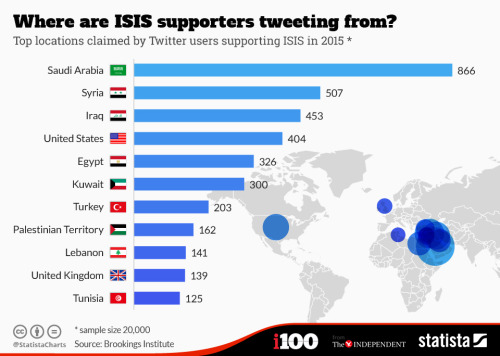
    However, there is a limit to completely and fairly protect from terrorism and, for this reason, there is a fact that social network systems have supported indirectly to create the terrorism. The volume of information on Social Networks is huge and we might not judge all of the contents and remove the dangerous ones completely. If we strengthen the regulation for the contents directly, the possibility of making another kind of discrimination would increase and the merits of Social Networks like easily sharing information and connecting with people would disappear. This dilemma has indirectly supported the terrorism, unfortunately. Because of cost-free registration and free speech, there are a lot of supporters of ISIS on Twitter (see the graph below). This data shows  how the terror group extends its presence across social media, which is both alarming and a sign of our digital era. ISIS uses Social networks as one strategy to recruit supporters globally. This is one of the reasons why they would upload sensational announcements and videos on the net. They would get big attention from potential supporters, using the social networks as the recruit or commercial advertisements.

    So we should understand the good and downside of social networks. It can protect us from terrorism but also promote it by connecting individuals and creating an information bias easily. It has a huge power to connect and gather people and information in a single direction from both good and bad aspects. To make well-balanced decisions, we should continue to try to control this power for the right direction as possible and keep in mind that we always face the risks to be agitated by information bias.

    John Stuart Mill on Why a Free People, to Stay a Free People, Should Do Many Things Outside of Government

    Jeff Guo, discussing in the Washington Post the announcement that Mark Zuckerberg and his wife Priscilla Chan were setting aside $45 billion to do good in the world through the Chan Zuckerberg Initiative, quoted this excerpt from a 2010 Der Spiegel interview with the German billionaire Peter Krämer:

    Krämer: I find the US initiative highly problematic. You can write donations off in your taxes to a large degree in the USA. So the rich make a choice: Would I rather donate or pay taxes? The donors are taking the place of the state. That’s unacceptable.

    SPIEGEL: But doesn’t the money that is donated serve the common good?

    Krämer: It is all just a bad transfer of power from the state to billionaires. So it’s not the state that determines what is good for the people, but rather the rich want to decide. That’s a development that I find really bad. What legitimacy do these people have to decide where massive sums of money will flow?

    SPIEGEL: It is their money at the end of the day.

    Krämer: In this case, 40 superwealthy people want to decide what their money will be used for. That runs counter to the democratically legitimate state. In the end the billionaires are indulging in hobbies that might be in the common good, but are very personal.

    I recoil at the statism in Peter Krämer’s views. The state has no monopoly on wisdom, and it seems unwise to give it a monopoly in providing public goods. It is also a danger to freedom in other matters to give the state a monopoly in providing public goods, as John Stuart Mill cogently explains in paragraph 21 of On Liberty “Chapter V: Applications”:

    A very different spectacle is exhibited among a people accustomed to transact their own business. In France, a large part of the people having been engaged in military service, many of whom have held at least the rank of non-commissioned officers, there are in every popular insurrection several persons competent to take the lead, and improvise some tolerable plan of action. What the French are in military affairs, the Americans are in every kind of civil business; let them be left without a government, every body of Americans is able to improvise one, and to carry on that or any other public business with a sufficient amount of intelligence, order, and decision. This is what every free people ought to be: and a people capable of this is certain to be free; it will never let itself be enslaved by any man or body of men because these are able to seize and pull the reins of the central administration. No bureaucracy can hope to make such a people as this do or undergo anything that they do not like. But where everything is done through the bureaucracy, nothing to which the bureaucracy is really adverse can be done at all. The constitution of such countries is an organization of the experience and practical ability of the nation, into a disciplined body for the purpose of governing the rest; and the more perfect that organization is in itself, the more successful in drawing to itself and educating for itself the persons of greatest capacity from all ranks of the community, the more complete is the bondage of all, the members of the bureaucracy included. For the governors are as much the slaves of their organization and discipline, as the governed are of the governors. A Chinese mandarin is as much the tool and creature of a despotism as the humblest cultivator. An individual Jesuit is to the utmost degree of abasement the slave of his order, though the order itself exists for the collective power and importance of its members.

    As you can see in my post four weeks ago, “How and Why to Expand the Nonprofit Sector as a Partial Alternative to Government: A Reader’s Guide,” I advocate going in exactly the opposite direction that Peter Krämer recommends. (And see this reply to the kinds of objections to philanthropy that Peter Krämer makes: William MacAskill: 5 Criticisms of Billionaire Mega-Philanthropy, Debunked.) It is good to have the government fill in the gaps among important things that–for one reason or another–are not popular objects of charity. But many important things can be done not only well, but better by nonprofits than by the government–and would be popular objects of donation for people required by the government to give to some worthy cause.