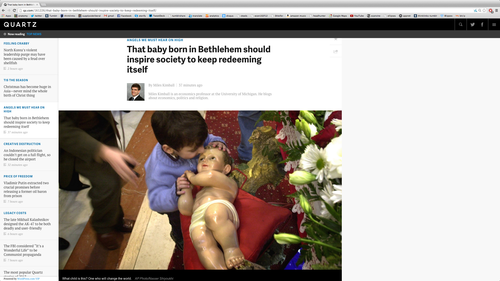
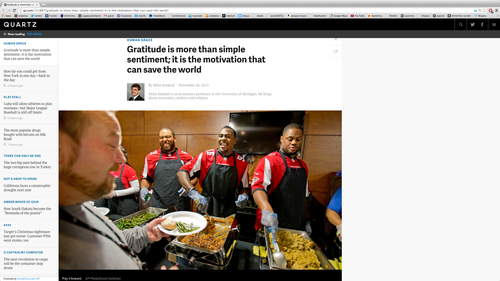
Quartz #39—>Gratitude Is More Than Simple Sentiment: It Is the Motivation That Can Save the World

Link to the Column on Quartz

Here is the full text of my 39th Quartz column, “Gratitude is more than simple sentiment; it is the motivation that can save the world,” now brought home to supplysideliberal.com. It was first published on November 28, 2013. Links to all my other columns can be found here.

This is my first Thanksgiving column; I am making it my New Year’s Day post as well. My Thanksgiving-inspired post in 2012 was

I also had a Christmas column this year, and a Christmas post last year:

If you want to mirror the content of this post on another site, that is possible for a limited time if you read the legal notice at this link and include both a link to the original Quartz column and the following copyright notice:

© November 28, 2013: Miles Kimball, as first published on Quartz. Used by permission according to a temporary nonexclusive license expiring June 30, 2015. All rights reserved.


As my regular academic work slows down in the days leading up to Thanksgiving, my thoughts have turned toward gratitude. In a visceral way, I feel thankful for my family, for my work, for the exhilarating November air on a brisk walk around my neighborhood, for my friends both here in Ann Arbor and online, and for being alive in this very interesting era—in what I believe is still close to the dawn of human history, yet a time of great abundance compared to what has gone before in past centuries.

Gratitude is a surprisingly powerful force in our souls—powerful enough to badly contradict simple economic models filled with “agents” who are in it only for themselves (and maybe for their dynasty of direct descendants). Evolutionary psychologists and evolutionary philosophers call gratitude reciprocal altruism, and point to it as a central part of what makes us human. We may not be the only species that displays reciprocal altruism, but we seem to be one of the few, and the only species in which we know reciprocal altruism to be associated with strong emotions of gratitude.

Gratitude is an important foundation of friendship, and for lucky people like me, of lasting marriages.  But gratitude is also one of the foundations of larger social units.Here, the trick, as near as I can make it out, is for a society to have a ready answer to the question “Where do all the good things in my life come from?” Or to be more precise, to have a ready answer to the question “And where does that come from?” For many cultures or subcultures, the answer at the end of the chain is God or other divine beings. At the other extreme, in the worst excesses of tyranny, the answer at the end of the chain is the great dictator himself (usually) or herself (still rare).When a culture—like the more secular side of American culture, or international cosmopolitan culture—has no ready answer to this question of what underlying power to be grateful to, it is bound to be harder to motivate people to do what it takes to keep society from flying apart at the seams—harder, but not impossible.

It matters how well we can encourage people to feel existential gratitude and then “pay it forward” by looking after the general welfare of their communities, humanity, or all of life. I am not talking about the desire to “save the world” in one particular way, but the desire to find one’s own way—or a way made one’s own—to make the world better than it would have been otherwise. Those who already feel in any measure the desire to save the world should contemplate how to kindle that desire in the hearts of others. A good place to start is to ponder (without exaggerating its strength) the origins of one’s own desire to do good in the world.

Like many a bookworm, I spent much of my childhood reading. That I was not destined to be an English professor was intimated by the way in which the voices of all the authors of most of the books I read merged into a single authorial voice. I felt a great deal of gratitude for those authors who made thoughts leap in my head and stories play out in my mind’s eye—gratitude, and admiration. I wanted to be like them someday—to be able to cause someone else the pleasure I got from reading. Later, as an adult, my reading of history and life experience at long last made me feel in my gut deep gratitude and admiration for the framers of the US Constitution that, for all its imperfections, has made it so I have had the freedom to believe as I choose, and to express those beliefs in both word and deed—even when others don’t agree. In all nations, and with all varieties of opinion, I hope that most of those who enter the public arena around the world have a desire to be like the wisest men and women in the past in trying to build a strong and good foundation for human flourishing and the flourishing of life itself for ages to come.

Energized by gratitude toward God, authors, framers, or the beautiful blended image of all those who have done us good, let us go forward to do what we can to make the world a better place. It won’t be easy. We need to be carefully self-reflective about our other motivesintelligent in our tactics, and always pay attention to the crucial task of trying to inspire others to take on the role of white hat as we go forward. But I believe the universe, though it may be heartless and too often cruel, is fair enough that even a very small army of human beings, honestly trying to do good, will make something good come to pass.

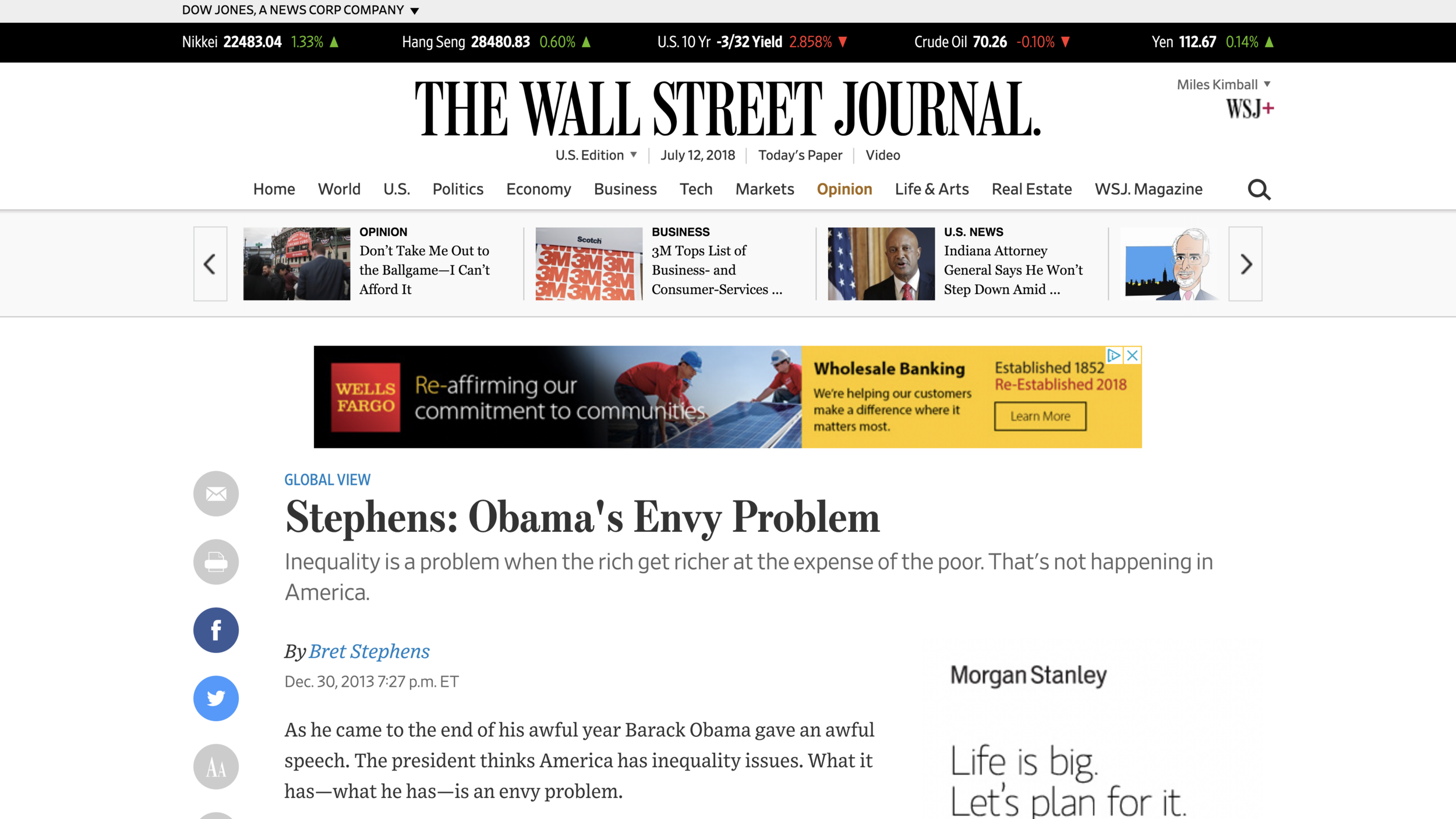
The Wall Street Journal's Quality-Control Failure: Bret Stephens's Misleading Use of Nominal Income in His Editorial "Obama's Envy Problem"

Even on the editorial page, a major newspaper such as the Wall Street Journal has the responsibility to screen out clear analytical errors. To fail at this task can and should hurt a newspapers reputation.  

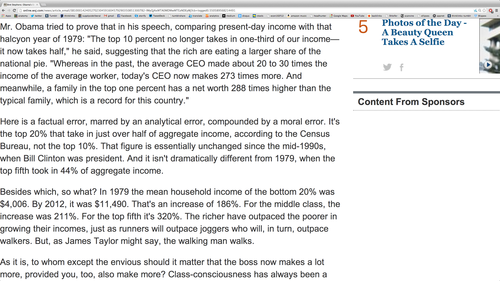
In Bret Stephens’s otherwise interesting piece in the December 30, 2013 Wall Street Journal, he takes Barack Obama to task for an “analytical error” and then commits a serious one of his own: using nominal income figures that are uncorrected for inflation to argue that the bottom 20% of the population is much better off now than it was in 1979. It is possible to argue in more appropriate ways that the bottom 20% of the population is better off now than in 1979, but not by anywhere near the 186% that Bret claims in this passage:

Besides which, so what? In 1979 the mean household income of the bottom 20% was $4,006. By 2012, it was $11,490. That’s an increase of 186%. For the middle class, the increase was 211%. For the top fifth it’s 320%. The richer have outpaced the poorer in growing their incomes, just as runners will outpace joggers who will, in turn, outpace walkers. But, as James Taylor might say, the walking man walks.

It is hard to read the 186% figure in this passage in any way that is not egregiously misleading. The gist of the argument is that a rising tide is lifting all boats, so that the passage seems to suggest that the bottom 20% have been lifted by 186%. Even on the editorial page, the Wall Street Journal’s journalistic standards should be higher.  

Thanks to David Beffert for alerting me in a tweet to the error in Bret Stephens’s piece. David also provides a source for real income changes in another tweet

Update 1: I am pleased that Paul Krugman picked up on this. However, in his post he gives me too much credit and David Beffert too little for catching this. 

Also, don’t miss Mark Gongloff’s piece on this, in the Huffington Post.

Update 2: Bret Stephens issued a correction today in “About Those Income Inequality Statistics." I very much appreciate that.

The Most Popular Quartz Stories of 2013

Noah’s and my column “There’s one key difference between kids who excel at math and those who don’t” was apparently the 2d most popular article on Quartz in 2013. Take a look at the rest of the list as well. There are many other interesting articles. 

Noah tweeted this tongue-in-cheek reaction to the news:

What?? 2nd place is the first loser! DAMN YOU, BEES!!! *shakes fist*

Quartz #38—>The Shakeup at the Minneapolis Fed and the Battle for the Soul of Macroeconomics—Again

blog.supplysideliberal.com tumblr_inline_mycespQ62L1r57lmx.png

Link to the Column on Quartz

Here is the full text of my 38th Quartz column, and 3d column coauthored with Noah Smith, “The shakeup at the Minneapolis Fed is a battle for the soul of macroeconomics—again.” I am glad to now bring it home to supplysideliberal.com, and I expect Noah will post it on his blog Noahpinion as well. It was first published on November 25, 2013. Links to all my other columns can be found here.

Our editor insisted on a declarative title that seriously overstates our degree of certainty on the nature of the specific events that went down at the Minneapolis Fed. I toned it down a little in my title above.

If you want to mirror the content of this post on another site, just include both a link to the original Quartz column and the following copyright notice:

© November 25, 2013: Miles Kimball and Noah Smith, as first published on Quartz. Used by permission according to a temporary nonexclusive license expiring June 30, 2015. All rights reserved.

Then, as logically required by the notice above, check back at this link on my blog shortly before June 30, 2015 to see if you can keep it up beyond that time or not. (Noah has agreed to give permission on the same terms as I do.) You may also freely print paper copies until then, as long as they include the copyright notice. 

Reactions and Followup: This column received a fair bit of attention. Most was positive (for example, see this flag by Paul Krugman), but the column also generated a modest bit of controversy. Here is an early discussion of some reactions in a Facebook post of mine, and here is Noah’s brief response to some criticism by Stephen Williamson.

A few days after this column came out, I got a call from a reporter about the shakeup at the Minneapolis Fed when I was working with a student and so could only talk very briefly. He said that Ed Prescott was more optimistic about the future of Freshwater macro. In response, I quoted to the reporter this from the column: “It makes all the difference in the world when the number one event shaping the questions macroeconomists ask is no longer the Great Inflation of the 1970s, but the Great Recession.”

The reporter also quoted Ed Prescott as saying that Freshwater macroeconomists were more intellectually rigorous. I laughed, and pointed to Mike Woodford as someone I think of as being on the Saltwater side who is every bit as intellectually impressive and as intellectually rigorous as Ed Prescott. 


A personnel shakeup at the US Federal Reserve Bank of Minneapolis last week at first flew under the radar; by the time the Minneapolis Star-Tribune reported the news, followed by other news outlets, it had been percolating through the economist grapevine for weeks. But the world should be paying attention, because the shakeup may be a part of big changes that are happening at the Fed, as well as a tectonic shift in the field of economics itself.

What Happened

Two of the Minneapolis Fed’s most eminent and long-serving economists, Patrick Kehoe and Ellen McGrattan, have been fired. The Star-Tribune article makes it clear that their departure was not voluntary on the part of either researcher. (Fortunately, both Kehoe and McGrattan will be fine, career-wise—both have stellar publication records and tenured professorships at the University of Minnesota.)

Why did this happen? We cannot know, especially since Minneapolis Fed Chief Narayana Kocherlakota isn’t giving his side of the story. But Jeffrey Sparshot makes this possible connection in the Wall Street Journal

Mr. Kocherlakota switched in 2012 from opposing some of the Fed’s easy-money policies to calling for more aggressive Fed action to spur economic growth and employment. The move reflected a shift in his views on persistently high unemployment: He went from thinking the cause was largely structural (and thus could not be fixed with monetary policy) to thinking it was largely due to weak demand (which means it could be addressed through policies aimed at boosting demand).

In other words, although the Minneapolis Fed shakeup could be due to any number of reasons—a personality conflict, a disagreement over the Fed bank’s mission, etc.–one possibility is that the personnel changes are related to Fed officials’ changing attitude toward business cycles. To understand that possibility, it is crucial to understand an academic controversy that has been simmering for decades.

Freshwater vs. Saltwater

Patrick Kehoe, one of the economists dismissed from the Fed, is a key figure in a school of economics called “Freshwater Macroeconomics” (the other, Ellen McGrattan, is his frequent co-author). The labels “Freshwater” and “Saltwater” go back to the arguments and new ideas generated by the double-digit inflation in the 1970s. The names refer to the geography of key combatants in that period, when economists at the University of Chicago, Carnegie Mellon University and the University of Minnesota spearheaded the “Rational Expectations Revolution.” They believed that people are very, very smart and sensible in their economic decisions. Taken to its logical extreme, the idea of economic rationality led the Nobel-winning Freshwater pioneer Edward Prescott to argue that recessions are not economic failures, but instead are inevitable, healthy outcomes of economies responding to the uneven pace of technological progress. In other words, Prescott and the economists who followed his lead said that the government shouldn’t try to fight recessions.

If the Fed prints money to try to stimulate demand, they say, it will only succeed in creating inflation rather than reviving the economy. And given this view of rationality, Freshwater macroeconomics often pushes the idea that the government should keep its hands off the economy in other policy domains as well.

Prescott and his fellow-travelers established a bastion for this apotheosis of Freshwater macroeconomics at the University of Minnesota and the Minneapolis Fed. Patrick Kehoe carries that torch, being one of the greatest of the Freshwater macroeconomists to follow the founding generation, and one of the most extreme in his views.

The Freshwater school gained enormous clout in the ‘80s. But in the ‘90s, there was a counterattack from the coast. The Saltwater macroeconomists believed that recessions were economic failures, and that monetary policy was important in fighting them. Led by Michael Woodford, they adopted the tools and language of the Freshwater economists, and managed to convince many of their Freshwater brethren to reluctantly agree that monetary policy can, in fact, boost the economy. But one bastion of hard-line freshwater thinking held firm: “Minnesota macro.” The researchers at the University of Minnesota and the Minneapolis Fed have largely hung onto the belief that monetary policy can affect inflation, but can’t fight recessions.

But there is good reason to think that this view is losing credibility at the Fed.

Narayana Kocherlakota is an influential Fed official, and as such is an important bellwether of Fed thinking. His views have shifted decisively toward believing that monetary policy can stabilize the economy. What changed his mind? The answer is obvious: the Great Recession, and the failure of large purchases of long-term government bonds and mortgage-backed assets—QE—to create inflation. It makes all the difference in the world when the number one event shaping the questions macroeconomists ask is no longer the Great Inflation of the 1970s, but the Great Recession that still casts its shadow over the world.

Nor is Kocherlakota the only Fed official to change his mind. So even if the Minneapolis Fed shakeup wasn’t caused by a clash of ideas, the Fed’s shift toward Saltwater macro is a real phenomenon, and needs to be understood.

Freshwater Not So Fresh?

Whether people realize it or not, the thinking behind macroeconomic policy has such a decisive influence on the world that it is worth the effort for everyone to try to understand the central ideas and characteristics of the key schools of macroeconomics. Even many non-economists will remember John Maynard Keynes and Milton Friedman; it is these economists whose ideas led to the theories of the Saltwater school. But very few people even know what Freshwater macro is. We hope to give you a little introduction.

We are hardly unbiased teachers for such an introduction; Miles has been an unabashed partisan of the Saltwater side since 1985, and Noah has often criticized Freshwater macro on his blog. But it is easier to see the failings of a rival school of thought than the failings of one’s own, so we feel it is okay to point out the weaknesses of Freshwater macroeconomics, and will leave to others the task of pointing out the failings of our own school of Saltwater macroeconomics. Besides our experience as partisans, we both have the advantage of the time we have spent at the University of Michigan, where both Freshwater and Saltwater macroeconomists have coexisted on very good terms for the 26 years Miles has been on the faculty and the years Noah spent as a graduate student there. So we hope we can give a critical, yet stillsympathetic view of Freshwater macroeconomics.

One reason it is easy for us to be sympathetic with Freshwater macroeconomics (at least when away from the heat of the battle) is that the central tenets of Freshwater macroeconomics simply exaggerate the main conceits of economics itself. Relative to other social scientists (and even more relative to the general public) economists (a) emphasize the idea of rationality, (b) take great pride in their skill at mathematics, and ( c ) think about the world by using formal models. These are all things that Freshwater macro has taken to extremes.

The idea of rationality is both a great strength and the greatest blind spot of economics. Economists routinely pretend in their models that everyone (with the possible exception of government officials) is infinitely intelligent—or at least smart enough to make excellent economic decisions, even in very complex environments. Although there is a touching humility to this pretense (not always matched by humility of economists in relation to the real flesh-and-blood people they interact with), it is not true. As a (good or bad) approximation to the truth, the assumption that everyone is very, very smart is a shortcut economists use to avoid impossible complications in their already difficult models; it is much easier to study the one correct economic decision in a given situation with given objectives than the thousands of ways someone could get things wrong. Sometimes economists forget that perfect rationality is only an approximation. Within Freshwater macroeconomics, however, to doubt perfect rationality is to commit at least a minor heresy.

On mathematical pride, we realize we are a pot calling the kettle black. Early in his career, Miles received a memorable critique of one of his papers from an anonymous referee that scolded him for an excessive pride in engineering mathematics. The key point he took was that, in economics, taking too much pride in one’s mathematical pyrotechnics can lead to a neglect of fully arguing one’s case and fully assessing the broader arguments at stake in understanding an economic phenomenon. (On the role of math in economics, also see 12.) Among Freshwater macroeconomists, the stock placed in mathematical skill is great enough that they have played a major role in making the advanced mathematics of “Real Analysis” a prerequisite for graduate school in economics, despite what we consider the very limited relevance of Real Analysis for understanding how the economy works. (As far as extra-high-level math goes, we think Convex Analysis and Perturbation Theory would be more useful.)

Advanced economic models are not easy to describe. Consider UCLA (now emeritus) professor Axel Leijonhufvud’s 1973 spoof (pdf), “Life Among the Econ.” It begins:

The econ tribe occupies a vast territory in the far North. Their land appears bleak and dismal to the outsider, and travelling through it makes for rough sledding; but the Econ, through a long period of adaptation, have learned to wrest a living of sorts from it. They are not without some genuine and sometimes even fierce attachment to their ancestral grounds, and their young are brought up to feel contempt for the softer living in the warmer lands of their neighbours, such as the Polscis and the Sociogs. …

Among the Econ,

… status is tied to the manufacture of certain types of implements, called “modls.” … Both the tight linkage between status and modl-making and the trend toward making modls more for ceremonial than for practical purposes appear, moreover, to be fairly recent developments, something which has led many observers to express pessimism for the viability of the Econ culture.

This assessment was too pessimistic. Economics has thrived since 1973, and well-crafted economic models have a lot to do with that success. But “Life among the Econ” gives a good picture of the role of bad models in economics—to show off the skill of the model builder without necessarily shedding any light on the world we live in. Part of the genius of economics is boiling down all the complexity of the real world to a few essential aspects that can be studied in depth. But if it is possible to carefully pare away less important aspects of the world in order to think deeply about the more important, it is also possible to carelessly pare away aspects of the world that don’t accord with an arbitrary set of traditions about how economic models should be done. In the case of Freshwater macroeconomics there is a large set of purity taboos prohibiting certain model elements (elements Saltwater economists think are necessary to explain the world). Freshwater macro also insists on following a certain standard template–complete with mathematical and empirical tools and conventions—that has been handed from Prescott and other early Freshwater pioneers. That template is seldom reexamined, leading many outsiders to believe that Freshwater macro is not so fresh.

Unlike politics, macroeconomics has been getting less polarized over time. Even before the Great Recession, the number of moderates who put Saltwater elements in Freshwater models or Freshwater elements into Saltwater models was growing over time, and the boundary between Freshwater and Saltwater economics blurred considerably. But the “Minnesota macro” folks remained the purest of the pure in their Freshwater convictions. In 2008, on the eve of the crisis, even as Saltwater economist Olivier Blanchard published a paper arguing that the two schools had essentially reached agreement, Kehoe published his own paper arguing vehemently that models with any Saltwater taint (in particular, the so-called “New Keynesian” models) were fundamentally flawed.

The Great Recession Tips the Scales

A few months later, at the end of 2008, America tumbled into its biggest economic slump since the Great Depression, soon followed by much of the rest of the world. Freshwater macroeconomists were left scratching their heads. How could this calamity represent the efficient outcome of a well-functioning economy? But the Saltwater New Keynesians—who included Fed chairman Ben Bernanke—had an answer: the economy had malfunctioned, and America needed the Fed to get us out of the hole. Bernanke and the Fed responded first by extraordinary measures to contain the financial crisis that was the immediate source of trouble, then lowering interest rates to zero and beginning an unprecedented campaign of Quantitative Easing.

As QE ramped up, disputes broke out among Fed economists. Some, like Philadelphia Fed president Charles Plosser (himself a noted Freshwater researcher) and Minneapolis Fed president Narayana Kocherlakota, argued that QE would put us in danger of inflation. But as the Fed’s printing presses rattled on and inflation failed to materialize, some “hard money” advocates had second thoughts. Last year, Kocherlakota declared that he had changed his mind, and now supported QE.

Whither the Freshwater School?

So what does it all mean? We are strong proponents of the idea that scientific progress—especially in economics—depends on a vigorous debate among widely divergent points of view. (See 123, and in the extreme 456.) So Freshwater macroeconomics has been a crucial part of the scientific ecosystem. Within the Federal Reserve System, Freshwater macroeconomists have played an important devil’s advocate role by highlighting potential dangers that saltier macroeconomists might be tempted to overlook in their eagerness to print money in search of economic recovery.

But we believe it would hinder scientific progress in macroeconomics if purist Freshwater views were to play a predominant role going forward, and could lead to policies whose costs would run into millions of lives disfigured by needless unemployment and uncounted trillions of dollars in lost GDP.

Scientifically, Freshwater macroeconomics plays an important role in laying out how the world should be if everyone thought like an economist. And improvements on Prescott’s Real Business Cycle Theory in particular have the potential to be a theory of where the economy should end up once short-run adjustments are complete. But gaining the insight we need into the world as it is requires:

  • accepting the existence of important aspects of the world that we don’t fully understand (such as prices and wages that don’t seem to adjust as quickly to economic circumstances as it seems they should) and incorporating them into our models (in ad hoc ways if necessary, or as brute facts),
  • bringing limitations on people’s ability to process information into our models (even though doing this will require arduous work), and
  • recognizing the complexity of human psychology.

Whither Monetary Policy?

In the conduct of monetary policy, it makes sense to give primacy to those who actually believe that monetary policy matters. The logic is straightforward. If what the Fed or other central bank does doesn’t matter, then any monetary policy is okay. But if monetary policy does matter, then those who believe that it matters are likely to have a better handle on how to deal with that weighty fact. Things aren’t quite so simple, since even purist macroeconomists believe that monetary policy affects inflation. But that just means that those who believe monetary policy matters more broadly can be trusted with many judgments as long as they are constrained to keep inflation from going up too high or falling down too low in a long-lasting way. But that is a rule for the conduct of monetary policy that is felt deep in the bones of almost all macroeconomists, Saltwater as well as Freshwater.  (There is a legitimate question of what the right long-run level of inflation is. Most central banks say 2%. Some Saltwater macroeconomists say 4%. Miles wants to make it possible to safely have zero inflation.)

There can be other effects of monetary policy besides recession-fighting (which purist Freshwater macroeconomists discount) and affecting inflation. Effects on financial stability are the most worrisome. Pointing out such possibilities is where Freshwater macroeconomists in the Fed and other central banks can still play a constructive role. But to the extent that recession-fighting and inflation are the main effects of monetary policy, it seems to us that a saltier approach that believes in the existence of both of these effects–and pays due attention to inflationary dangers–is a better place to start deliberations than a purist Freshwater approach that dismisses the possibility of recession-fighting from the get-go. And it seems clear that Fed officials like Kocherlakota, Lacker, and others have been shifting toward the saltier view.

What the Minneapolis Shakeup Means

Of course, this still leaves the question of whether the Minneapolis Fed shakeup is a part of this intellectual shift.

Kehoe and McGrattan’s dismissal drew loud protests from other members of the Freshwater school. Ed Prescott, the father of purist Freshwater macro, was quoted in the Star-Tribune article as saying “It sends a bad message…Something very good is breaking down rapidly.” Steve Williamson, a Freshwater economist at Washington University, blogged that Kocherlakota “seems intent on destroying the [Minneapolis Fed] as a research institution.” So whether or not the firings had anything to do with economic theories, Freshwater folks are concerned, and with good reason. A key part of the genesis of Freshwater macro was a desire to say something about monetary policy (i.e., why not to use it). If the Fed refuses to listen to leading Freshwater voices, then a big chunk of the real-world influence of this school of thought will be gone.

In any case, speculating on the reasons for what ultimately might boil down to simple personality conflicts is not our purpose here. Nor do we seek to offer any judgment on Kocherlakota’s personnel decision, which could have far-reaching impacts on the relationship between central banks and universities and the type of employment contracts offered by Fed banks. Instead, we want to highlight the tectonic shifts in economics itself. From that perspective, the shakeup may turn out to be part of the understandable rebalancing of macroeconomics in the Saltwater direction, as economists try to comprehend the Great Recession and figure out how to avoid an encore.
Daniel Bergstresser on Religion, Past and Future

I was very pleased with the warm reception that my sermon “The Message of Mormonism for Atheists Who Want to Stay Atheists” has had since I posted it on supplysideliberal.com. One of the most thoughtful reactions I got back was from Brandeis Finance professor Daniel Bergstresser. I encouraged him to expand his response into a guest religion post. I was especially intrigued by his prediction about the future of Mormonism. Here is what Daniel has to say.


On January 14, 1697, Revered Samuel Willard of the Third Church in Boston read aloud in church an apology from church member Samuel Sewall. Five years earlier Judge Sewall had served on a panel of nine judges in Salem; this famous panel condemned to death twenty people accused of witchcraft. Five years later, on a day of church-wide fasting and reflection, Judge Sewall acknowledged his grave errors during these misguided proceedings and made a plea for forgiveness for his role in them. If July 4, 1776 is viewed as the birthday of independence in this country, January 14, 1697 could also be commemorated as a milestone in the history of humility. 

Churches, even churches with continuous institutional histories, change over time. The Third Church in Boston continues to exist and thrive, although it has changed a great deal since the 1692 Witch Trials and Judge Sewall’s subsequent apology. The church is now served by its twentieth senior minister, the Reverend Nancy Taylor. Known now as the Old South Church in Boston, the church is a member of the United Church of Christ, a progressive Congregationalist Protestant denomination.  Over the years the Church has played an important role in American history. One example is the (original) Tea Party, which was organized by church deacon Samuel Adams at the Old South Meeting House in 1773.     

Miles Kimball’s recent post on religion highlighted his own spiritual journey from the Mormon faith to his current membership in a Unitarian Universalist congregation. The post also noted the rapid pace at which Mormon doctrine has evolved, and noted in particular the change in official Mormon doctrine on the membership of Black men. I was interested in this post, and am more generally sympathetic to Miles’ ongoing open discussion of religion on his blog. I emailed back to Miles some thoughts, which he invited me to post as a guest post on this blog.

I feel that it is appropriate to acknowledge my own views on religion. I was raised in what is sometimes referred to as a ‘Mainline’ Protestant faith. The term Mainline is probably inaccurate and certainly lacking in humility, but the church denominations that cluster under that label share some important characteristics and the label is therefore useful.  I am an observant and active member of the Old South Church mentioned above.

Although I am extremely enthusiastic about interfaith dialogue, this enthusiasm should not be confused with holding the point of view that all faiths are fundamentally the same. I am humble about the likely underlying reason why I follow my faith – I am a mainline Protestant, as were my father and mother, as were their fathers and mothers, as were their fathers and mothers. The principle of symmetry suggests to me that if I had been born to a line of Buddhists I would be an observant Buddhist. There are some limits to this symmetry – it is hard for me to imagine being an enthusiastic participant in a religion that requires literal belief in events that are extremely implausible or even demonstrably false.

In any case, the faiths are different in important ways, and to ignore these differences can be lazy and disrespectful. One could construct a set of dimensions along which different faiths differ.  I will make little effort to distinguish between ‘faith traditions’ and ‘philosophical traditions,’ so at the risk of causing offense I will attempt to be broad in my taxonomy that follows. This means that I will consider both philosophical traditions such as Stoicism and faith traditions such as Christianity.

One important characteristic of faith traditions is the tilt towards community versus the tilt towards individual. Both the Mormon faith and the United Church of Christ are characterized by a high degree of focus on the community over the individual. These two faiths can be distinguished from the Objectivist philosophy of Ayn Rand. Objectivism tilts towards celebrating the individual over the community. This difference is important, and the recent phenomenon of prominent American political leaders professing to be followers of both Jesus Christ and Ayn Rand mystifies me.  Christianity and Objectivism appear to me to be almost perfectly incompatible. While it is possible that my view reflects some intellectual or spiritual limitation, Ayn Rand herself appears to have shared my point of view on the incompatibility of these two worldviews.

A second differentiating characteristic is the degree to which honest and well-intentioned doubt is tolerated or even encouraged among members. It is the sacred tradition of the United Church of Christ that Jesus, Son of God, was born into extremely humble circumstances. This tradition holds that he spent his life in a ministry defined by the radical embrace of diversity, bringing love to people who were traditionally the outsiders of society.

This faith tradition can be distinguished from others that emphasize the importance of a literal understanding of the Bible. For example, I do not care if the stories at the core of my faith tradition are true in any literal sense.

To me and many others in my faith tradition, the question of literal truth is a distraction from the underlying message. The important part is that we collectively celebrate a deity who was born to an unwed homeless refugee mother. That message has important and obvious consequences for the way that I aspire to live. 

This comfort with doubt about the literal ‘truth’ of events depicted in the Bible is not unusual within the United Church of Christ. It would be less typical in many other Christian faith traditions. It would also, in all likelihood, have been an extremely unusual and potentially dangerous point of view in my own church when it was founded 340 years ago.  

A third dimension is the degree to which faith traditions support a ‘transactional’ view of the behavior of their deity or deities. Religious practice in the Voodoo tradition, some types of modern Wiccan practice, and the Christian ‘Prosperity Gospel’ appear to me to support a view of deities who are receptive to specific prayers for material well-being, the destruction of enemies, or other material goals. This transactional deity is foreign to my own tradition. Most participants in my own faith tradition would be uncomfortable with the image of a deity who exists to serve us in such specific and particular ways. I am reverent enough of my own tradition to view serious prayer for specific material goals with something stronger than mere skepticism. In this regard, my own tradition is more similar to certain strands of Buddhist and Ancient Stoic practice than to the faith traditions of some of my fellow Christians – in particular those Christians who worship a deity who listens attentively to their prayers as he decides how to influence both major and minor human events.

Or, as a Muslim friend has explained to me: ‘In Islam, the opposite of faith is ingratitude.’ I am a Christian, but this point of view resonates with me. I have to confess that I am alarmed by the idea of specific prayers for things that I don’t have. Those specific prayers can crowd out the essential and more general prayer of gratitude. 

A fourth dimension along with faith traditions differ has to do with their governance structures. I was raised in the Methodist church, a mainline Protestant denomination that is highly centralized.  In a Methodist church, your minister is assigned to you by your Bishop. Your minister, should he or she want to remain a Methodist minister in good standing, is absolutely bound to follow the denomination’s rules on a number of important matters. For example, a Methodist minister is absolutely not free to marry a man to a man, or a woman to a woman. This is true even if 100 percent of the members of their specific church are in favor of blessing such a union.

The United Church of Christ, on the other hand, is a confederation. The local church establishes their bylaws, manages their affairs, and hires their minister independently. This federated structure has important benefits and costs. This flexibility has allowed the United Church of Christ to avoid the schism over gay marriage that appears inevitable in the United Methodist Church. My transition from membership in a Methodist church to membership in a Congregationalist UCC church does not amount to anything close to a conversion, but it is a transition. Both Methodists and Congregationalists are part of a larger Mainline Protestant family, and individual churches and people within those traditions are extremely diverse.  

I think that gay marriage is an important topic, and I think that religious schisms should only occur over important topics. My own view – one that I believe to be widely shared among other members of the Old South Church – is that it is absolutely appropriate and consistent with our faith traditions to bless and celebrate permanent unions between two people, regardless of their gender. This is something much stronger than mere tolerance – it is active celebration of diversity.

Faith guides my view here. Kindness, tradition, and reason are all important. Most of the time kindness, reason, and tradition will all lead us in the same direction. There are times when they come into conflict. Faiths differ on the weight they apply to these competing priorities. My own faith is that we should apply the following prioritization: first kindness, then reason, then tradition. This is not to say that tradition is unimportant. But when, upon prayerful collective consideration, tradition appears to come into conflict with kindness, my own view is that kindness should win. My enthusiastic support of gay marriage thus comes not in spite of but because of my faith.

This leads to the next-to-last distinction between different faith traditions that I intend to discuss: the extent to which these systems of belief are now ‘closed’ to new revelation. The Mormon faith occupies an interesting extreme, with a process for ongoing revelation through a restored and ongoing line of prophets. Although the process is somewhat opaque to me as an outsider, the evident result can be rapid changes in church doctrine. The process in the Mormon faith appears to differ from the evolutionary process that governs my own church. In the United Church of Christ, it is official church doctrine that, as we put it, ‘God is still speaking.’ It is our view that there is and will continue to be new meaning to be extracted from our sacred texts as history proceeds. As John Robinson, pastor to the Pilgrims who set forth on the Mayflower, said: ‘Do not cling to where Calvin and Luther left us. God hath yet more light and truth to break forth from God’s Holy Word.’ The process that governs this evolution in understanding is not mysterious or esoteric; it just involves prayerful debate, study, and discussion.

The last distinction that I will mention is the comfort that different faiths have in proselytizing. The Mormon faith is distinguished by its emphasis on missionaries and winning new converts to their faith. Members of the Mainline Protestant churches are often uncomfortable proselytizing. I believe that proselytizing among members of other faiths is ill-conceived and demonstrates a lack of humility. This point of view has been widely shared by other members of my denomination, including the prominent theologian Reinhold Niebuhr. This point of view, however, does not reflect any failure to appreciate the distinct history of my religious traditions and their continuing relevance for me.

Miles’ post on the evolution of the Mormon faith stirred something in me, and so I dropped him a line which became this longer line. In a nutshell, as both an enthusiastic American and a person of faith, I think that it is important to pay reverent and respectful attention to the Mormon faith.  In any case, if current trends hold up, our grandchildren or great-grandchildren could well be Mormons. So rational dynastic self-interest motivates learning more. This is particularly true given the Mormon practice of offering baptism to long-deceased ancestors. As long as there is a good chance that one of my well-intentioned converted descendants will attempt to baptize me into the Mormon faith, I feel that I enjoy some license to make observations about this faith and its rapid and impressive development. As an interested and respectful outsider, I will make the following observations:

  1. The Mormon faith is growing rapidly. If we are humble about the potential that God is at work in the world, then it follows that there may be something about that growth that suits God’s purposes, however inscrutable these purposes are to us. If we can make an analogy between America and the Roman Empire, perhaps the LDS church will be our empire’s Roman Catholic Church. Food for thought. 
  2. I certainly acknowledge a tension between my respect for the rapidly growing Mormon faith and my own deep and discomfort with proselytizing among believers in other traditions. I am also no longer comfortable allowing my own (probably just aspirational) humility to prevent me from articulating clearly what my own tradition and beliefs are.  I acknowledge the underlying silliness involved in crafting a long note, intended for public consumption, on the role of humility in faith.
  3. Mormon doctrine appears to this outsider to be capable of rapid change – more rapid even than the transformation in my own tradition that has turned witch-killing Puritan fundamentalists into enthusiastically ecumenical Mainline Protestants. The process that governs this change appears, at least on the surface, to differ from the process that governs change within my own UCC tradition.  
  4. There are important distinctions between religious traditions that should not be papered over or ignored. The Mormon Church and my own faith tradition are very different. But the two traditions stand in decided opposition to more individualist traditions as well as the philosophies of nihilism and radical atheism. The non-avoidable differences between the United Church of Christ and the Mormon Church on the question of gay marriage highlight the importance that marriage and stable families play in both traditions.
  5. As a progressive and observant Christian, I am troubled by the ongoing decline of the Mainline Protestant churches as a group. I believe that the Mainline traditions, which emphasize respect and equality across our very different religious traditions, the separation of church and state, kindness, reason, tradition, and social justice, have important things to contribute to our society’s various ongoing debates.

Dylan Matthews: The Only Kid's Book You Need to Understand the Federal Reserve

blog.supplysideliberal.com tumblr_inline_my9mmwPnf01r57lmx.png

I was delighted to see Dylan Matthews featuring in Wonkblog the children’s monetary policy storybook Donna D'Souza and I put together. Dylan accompanied the storybook with these very kind words:

Miles Kimball is one of the most consistently creative economists working these days, and so it’s our luck that he’s taken to writing for a popular audience. His latest work is a foray into kid’s lit, summarizing the basics of how central banks respond to economic downturns in a children’s coloring book (see above).

I have made an effort to promote our storybook in a new medium: with my daughter Diana’s technical assistance, I made and posted three YouTube videos of the storybook:

John Stuart Mill and C. S. Lewis on Originality

Originality is the opposite of orthodoxy. As such, originality is much more controversial in practice than the ritual praise our culture heaps on originality would suggest. So when face to face with an actual instance of originality, it is worth remembering what John Stuart Mill wrote about originality in On Liberty chapter III, “Of Individuality, as One of the Elements of Well-Being,” paragraph 11:

… originality is a valuable element in human affairs. There is always need of persons not only to discover new truths, and point out when what were once truths are true no longer, but also to commence new practices, and set the example of more enlightened conduct, and better taste and sense in human life. This cannot well be gainsaid by anybody who does not believe that the world has already attained perfection in all its ways and practices. It is true that this benefit is not capable of being rendered by everybody alike: there are but few persons, in comparison with the whole of mankind, whose experiments, if adopted by others, would be likely to be any improvement on established practice. But these few are the salt of the earth; without them, human life would become a stagnant pool. Not only is it they who introduce good things which did not before exist; it is they who keep the life in those which already existed. If there were nothing new to be done, would human intellect cease to be necessary? Would it be a reason why those who do the old things should forget why they are done, and do them like cattle, not like human beings? There is only too great a tendency in the best beliefs and practices to degenerate into the mechanical; and unless there were a succession of persons whose ever-recurring originality prevents the grounds of those beliefs and practices from becoming merely traditional, such dead matter would not resist the smallest shock from anything really alive …

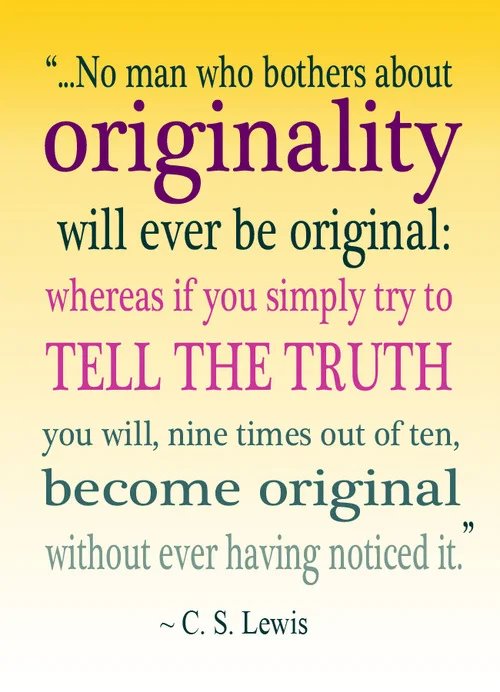
For those who value originality of the world-improving kind John Stuart Mill writes of, C. S. Lewis gives good advice in Emily Sutherland’s poster at the top of this post. (I like the way Emily polishes this gem from the original passage.) What C. S. Lewis says reminds me of something I often say to myself in touchy situations: “If I think hard enough, there has to be some way to get away with telling the truth.”

Geometric Coin Sculptures

From junkculture: "Complex Geometric Forms Made from Coins Notched and Joined Together.“ Geometry never gets old.

h/t dianakimball

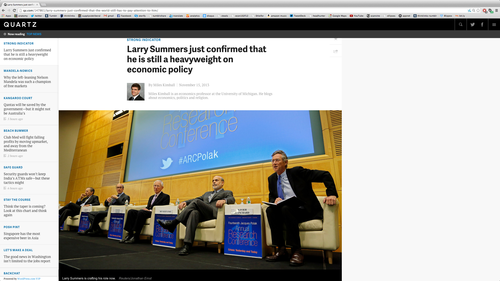
Quartz #37—>Larry Summers Just Confirmed that He is Still a Heavyweight on Economic Policy

blog.supplysideliberal.com tumblr_inline_mxg4q2fgBa1r57lmx.png

Link to the Column on Quartz

Here is the full text of my 37th Quartz column, “Larry Summers just confirmed that he is still a heavyweight on economic policy,” now brought home to supplysideliberal.com. It was first published on November 15, 2013. Links to all my other columns can be found here.

If you want to mirror the content of this post on another site, that is possible for a limited time if you read the legal notice at this link and include both a link to the original Quartz column and the following copyright notice:

© November 15, 2013: Miles Kimball, as first published on Quartz. Used by permission according to a temporary nonexclusive license expiring June 30, 2015. All rights reserved.


Janet Yellen was in the hot seat yesterday before the Senate Banking Committee. Due to a remarkably public vetting process, the presidential nomination for US Federal Reserve Chair that put her there also constituted a comedown for Yellen’s principal rival for the job: Larry Summers. At an International Monetary Fund Conference in honor of former Bank of Israel Governor—and earlier IMF chief economist—Stan Fischer on Nov. 8, Summers made a strong bid for continued relevance to economic policy-making as a private citizen with a trenchant speech. (David Wessel gives an overall report on the conference in this Wall Street Journal article.) Here is the speech:

Summers begins by crediting Fischer for inspiring him to be a macroeconomist, saying this of Fischer’s graduate course on Monetary Economics at MIT:  “It was a remarkable intellectual experience. And it was remarkable also because Stan never lost sight of the fact that this was not just an intellectual game: getting these questions right made a profound difference in the lives of nations and their peoples.” Summers transmitted that attitude to me as one of my professors at Harvard, and I have tried to hand it on to my own students.

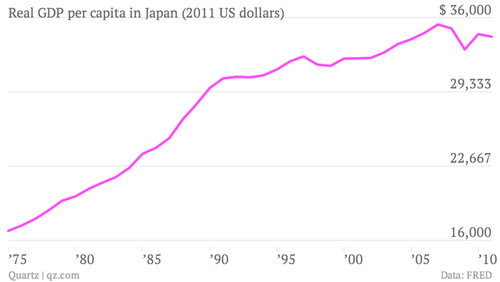
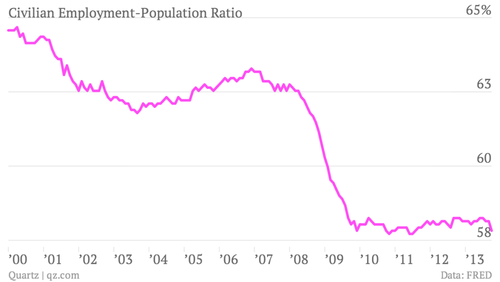
After his praise of Fischer, Summers gives a conventional account of the financial crisis in the fall of 2008 and the largely successful efforts to contain that crisis. But the rest of his speech goes in surprising directions. Summers emphasizes the possibility of “secular stagnation” like that the Japanese economy has suffered in the last two decades. The extent of Japan’s stagnation is breathtaking: In 2013, the Japanese economy is only half the size economists in the 1990’s predicted it would be by now. Even here in the US, GDP is falling further and further behind what we would have predicted just a few years back, and the fraction of the population that has a job has hardly recovered at all in the past four years, despite the fact that the financial crisis was well-contained by November 2009.

What lies behind the stagnation the Japanese economy has suffered in the last two decades and that Summers fears for the United States? He suggests this:

Suppose that the short-term real interest rate that was consistent with full employment had fallen to negative 2% or negative 3% sometime in the middle of the last decade.

With a 2% rate of inflation, an interest rate 3% below inflation would be a negative 1% interest rate in ordinary terms (what macroeconomists would call a -1% nominal interest rate.) But conventional monetary policy can’t reach an interest rate as low as -1%, because anyone can lend as much as they want to the government at 0% by piling up paper currency. This is the zero lower bound on nominal interest rates that macroeconomists justly obsess over. The zero lower bound creates situations where interest rates seem low, but are not low enough to put the economy in high gear.

In the years before the financial crisis, financial excess propped the economy up without ever getting to the kind of excess demand that would push unemployment down to unsustainably low levels and cause higher inflation. In Summers’ words:

Even a great bubble wasn’t enough to produce any excess of aggregate demand…Even with artificial stimulus to demand, coming from all this financial imprudence, you wouldn’t see any excess.

After the financial crisis, the end of financial excess left too little demand and stagnant employment.

What can be done? It isn’t easy to fix things:

  • People grudgingly tolerate zero interest rates for years on end. But that is not enough.
  • It is hard to keep running huge budget deficits year after year after year—and Japan’s experience with trying to escape stagnation by government spending casts doubt about whether that would do the job.
  • There are serious concerns about doing quantitative easing for years with no end in sight.
  • Finally, Summers points out that the very financial regulations that could prevent another financial crisis tend to drive the interest rates people earn when they save further below the interest rates they pay when they borrow, effectively tightening the zero lower bound.

Here is Larry Summers’s conclusion, which stops just short of what the US and the world economy needs—a solution:

It is not over until it is over…We may well need, in the years ahead, to think about how we manage an economy in which the zero nominal interest rate is a chronic and systemic inhibitor of economic activity, holding our economies back, below their potential.

So let me return to versions of two of the questions I posed at the end of July, in “Three big questions for Larry Summers, Janet Yellen, and anyone else who wants to head the Fed.”

  1. Why not eliminate the zero lower bound entirely by changing the way we handle paper currency?
  2. Couldn’t we afford to have much stricter financial regulations—in particular high equity (“capital”) requirements—to avoid a future financial crisis if the zero lower bound were no longer a problem?

Though crucial, diagnosing a problem is not enough. Every diagnosis suggests places to look for a cure. If the zero lower bound is the problem, then getting rid of it is an obvious solution. The economists I talk to, including the many economists I have talked to in central banks around the world, recognize that the real difficulties in eliminating the zero lower bound are political difficulties rather than technical difficulties. So the major economies of the world and the many smaller ones that face the zero lower bound have a choice: politics as usual, with a real chance of secular stagnation, or paving the way for negative interest rates. Politics will stay the same until a critical mass of people do what it takes to make them different. Summers proved at the IMF conference that he is still an economic policy heavyweight—someone who could contribute a lot toward reaching that critical mass in the war against the zero lower bound, if he is willing to join the fight.

Gather 'round, Children, Here's How to Heal a Wounded Economy

blog.supplysideliberal.com tumblr_inline_mxyhvcFHmK1r57lmx.png

Here is a link to my 41st column on Quartz: “Gather round, children, here’s how to heal a wounded economy." It could also be called "Electronic Money: The Coloring Book.”

Thanks are due to Donna D'Souza for her help in the cause of healing the economy, starting with education about electronic money.  

In case there are any problems with the SoundCloud links in the Quartz column, here is the audio of me reading the story aloud and the audio of me singing the operatic ballad that has the words of the story as the lyrics.

Since I began writing about electronic money, many people have told me that the biggest issues with serious negative (nominal) interest rates and the subordination of paper currency to electronic money needed to make them possible are political issues. I agree. I have thought that the way to change the politics of negative interest rates is to keep explaining them, from many different angles. This is the children’s storybook angle.

I think our storybook/coloring book works as a children’s story. There is an attempt to solve a problem that fails, then there is a twist that solves the problem from an unexpected direction–using a seeming curse that is actually a blessing. See what you think.

Reactions

Greg Mankiw writes on his blog:

If my favorite textbook hasn’t simplified things enough for you…

My friend and former student Miles Kimball takes a stab at explaining some basic macroeconomics through the vehicle of a child’s storybook.

Gerald Seib and David Wessel, in the Wall Street Journal, write:

University of Michigan economist Miles Kimball posts a downloadable coloring book and colored-in storybook to explain his simplified version of how the macro-economy and monetary policy work. [Quartz]