Documents for Review of Statistics Drawn from My “Monetary and Financial Theory” Class at the University of Michigan
I recommend that you print these documents out and bring them to class (except for the class notes—those won’t be needed in class).
A Partisan Nonpartisan Blog: Cutting Through Confusion Since 2012
I recommend that you print these documents out and bring them to class (except for the class notes—those won’t be needed in class).
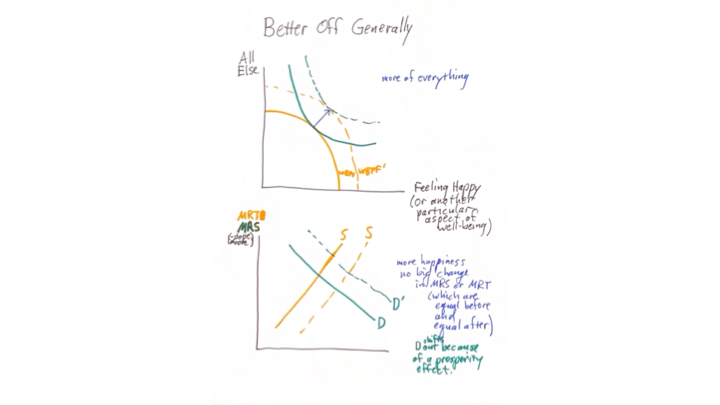
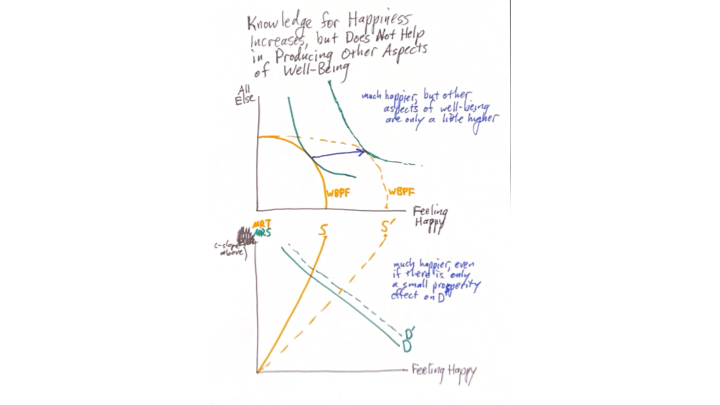
WBPF = Well-Being Possibility Frontier (Orange)
Green is for preferences (indifference curves above, demand below)
MRT = Marginal Rate of Transformation: the opportunity cost of the other things that must be sacrificed to get one point more of happiness
MRS = Marginal Rate of Substitution: amount of other things the individual is willing to sacrifice to get one point more of happiness
Notes:
The Supply Curve is a graph of minus the slop of the WBPF. It has the level of the highlighted aspect on the horizontal axis and the marginal utility (MU) of the highlighted aspect (which is technically the marginal rate of substitution (MRS) relatve to an amalgam of all other aspects (“all else”).
The Demand Curve is a graph of minus the slope of the indifference curve an individual is on. That means that any shift that puts an individual onto a different indifference curve shifts the demand curve, unless all the indifference curves are parallel vertical shifts of each other (quasi-linearity). That is not a good assumption. The shift of the demand curve occasioned by ending up on a new indifference curve is analogous to income effects on demand for market goods. Because it isn’t literally income, I don’t call these income effects, I call them prosperity effects. The demand curve has the level of the highlighted aspect on the horizontal axis and the marginal rate of transformation (MRT) of “all else” into the highlighted aspect.
Comparative Statics Exercise #1:
Comparative Statics Exercise #2:
Comparative Statics Exercise
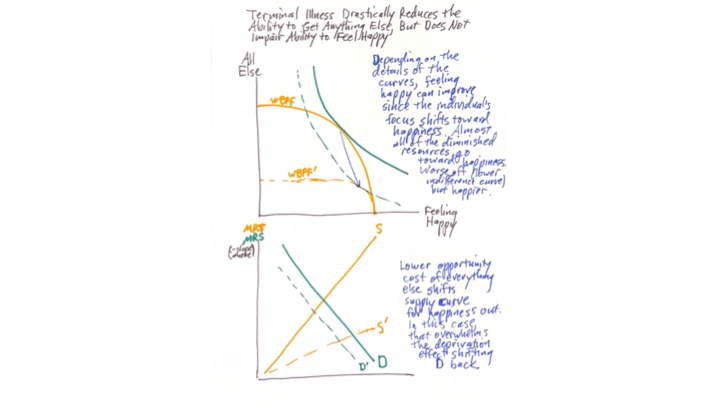
Comparative Statics Exercise #4:
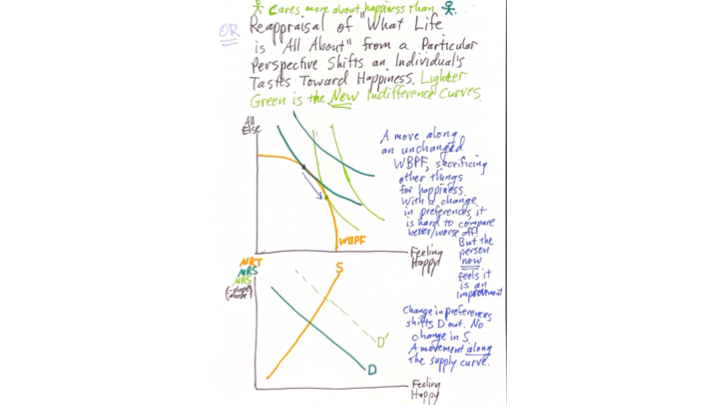
I realized that for Quiz #1, there are a lot of shorter readings. So I am only going to test through the first third of the Layard-De Neve book on Quiz #1. That is, you are responsible at this point for everything through Chapter 7, so that Quiz #2 will begin with Chapter 8, “Exploring Well-Being”.
Key resources for this Quiz are:
2025
The graphing question was Comparative Statics Exercise #3. See Well-Being Possibility Frontier/Indifference Curves AND The Corresponding Supply and Demand Graphs.
This was a tough exam. I thought people did well. Here is the letter grade translation for the multiple-choice part of Quiz #1, as if it were the only thing I had to go on at the end of the semester. It really wouldn’t be enough to go on at the end of the semester, so some numbers translate into something between two letter grades. The high score was 28—almost perfect. The low score was 10.
26–28 A
24–25 A-
23 A-/B+
21–22 B+
20 B+/B
18–19 B
17 B-/C+
16 C+
14–15 C
10–13 C-
You’ll notice there there wasn’t a big point difference between C and B. If your score translates to a C, you are well within reach of a B if you do well on other things. The quizzes do matter quite a bit, simply because scores on other assignments have much lower variances among those who do them. The weights in the syllabus are weights in the linear combination I used for the final score. The variance of each subscore also matters for how important it is.
I am required to make close to half of the final grades C+ or below, but I feel no obligation to give anything below a C-. With rare exceptions, I use D’s and F’s only for people who aren’t doing all the assignments.
The graphing question will take longer to grade, since I have to grade it by hand. My goal is by next Wednesday, but it might slip to by next Friday.
2023
Histogram for Quiz #1 (Remember that a lot of your grade is writing assignments. The quizzes are a modest percentage of your grade.)
Blog Posts and Articles to Read to Prepare for the Quiz
Each of the following has one multiple-choice quiz question. Most of them are of the form “Which of the following is NOT a quotation from …”
Push Through the Learning Pit (including watching the short Pema Chodron video)
There's One Key Difference Between Kids Who Excel at Math and Those Who Don't
The Most Effective Memory Methods are Difficult—and That's Why They Work
Cognitive Behavioral Therapy for Insomnia Can Prevent Major Depression
An Example of Ideology Leading to Bad Statistics and Social Injustice
Why a Low-Insulin-Index Diet Isn't Exactly a 'Lowcarb' Diet (Focus on (i) the interpretation of the DIETFITS study and (ii) the 2025 edits.)
Exorcising the Devil in the Milk (an example of trying to interpret less-than-perfect evidence, and of scatterplots)
Also, to help with the “Which of the following is NOT a quotation from …” style of question I often use, take a look at “Critical Reading: Apprentice Level”
The remainder of the exam will be
Multiple choice statistical algebra questions
multiple-choice questions (mostly of that form) on the first 1/3 of the Layard de Neve book (all of the first 7 chapters and everything before the first chapter)
one short answer question for which you need to be able to graph on another blank sheet the effect of a change on both the well-being possibility frontier/indifference curves diagram AND on the supply and demand diagram for an aspect of well-being. NOTE THAT YOU WILL NEED TO REMEMBER TO WRITE YOUR NAME ON THAT ANSWER ON THE SEPARATE BLANK SHEET!
You will be able to keep the exam itself. I only need the scantron sheets and your graphs. PLEASE WRITE THE ANSWERS YOU GAVE ON YOUR COPY OF THE EXAM. THAT WILL BE THE ONLY WAY FOR YOU TO FIGURE YOUR SCORE. I DON’T LIKE USING CANVAS TO REPORT SCORES BECAUSE CANVAS DOESN’T UNDERSTAND HOW I GRADE.
Get a meditation app for your phone and use it. Late in the semester, I’ll ask you to write half to one page about your experience doing that.
Some Meditation Apps (some free, some that charge for a subscription)
Waking Up (You can get this free. Thanks for Brendan for providing the link: https://app.wakingup.com/scholarship )
10% Happier
Headspace (free)
Calm
Balance
I personally use Waking Up and 10% Happier. One of my Economics colleagues likes Headspace. I don’t know anything about Calm and Balance, they just came up when I put “meditation” in the app search box on my phone. Also, take a look at this article:
Due 11 PM Mountain Time on Thursday, February 20th. Submit on Canvas. (The assignment is already set up on Canvas. I am asking you to submit it as a pdf; Word has a feature to “print” as a pdf that you can then turn in.)
3-5 pages.
Choose one of Jordan Peterson’s 12 rules that you especially like and what it means to you.
If you dislike all the rules, write your paper about that.
If you want to do something else in relation to the book, that can be negotiated with me.
Remember that any use of AI (beyond thesaurus, spell-check and grammar-check functions) you need to clearly signal. If you are getting more than a word or two from AI, the way to cite it is to say what prompt you used and then the words you got from AI.
Presentation on The Righteous Mind by Jonathan Haidt
Presentation on Moral Politics by George Lakoff
Presentation on The Happiness Hypothesis: Finding Modern Truth in Ancient Wisdom by Jonathan Haidt
Presentation on The Coddling of the American Mind, by Greg Lukianoff and Jonathan Haidt
Presentation on The Tyranny of Merit by Michael Sandel (pptx) (pdf)
Presentation on GDP: A Brief but Affectionate History by Diane Coyle (pdf) (Google slides)
Presentation on The Age of Em: Work, Love and Life when Robots Rule the Earth by Robin Hanson
2025 Presentations:
Presentation on Supercommunicators: Unlocking the Secret Language of Connection by Charles Duhigg
Presentation on Factfulness by Hans Rosling, with Ola Rosling and Ann Rosling Roennlund
Presentation on Smarter, Faster, Better by Charles Duhigg
Presentation on The Anxious Generation by Jonathan Haidt
Presentation on Beyond Order: 12 More Rules for Life by Jordan Peterson
Timing: The presentations will be during the 7 classes from Friday, January 24, through Friday, February 7.
7 Books for 7 Teams:
Build the Life You Want: The Art and Science of Getting Happier
by Arthur C. Brooks and Oprah Winfrey
Supercommunicators: How to Unlock the Secret Language of Connection, by Charles Duhigg
Smarter Faster Better: The Secrets of Being Productive in Life and Business, by Charles Duhigg
Factfulness: Ten Reasons We’re Wrong about the World—and Why Things Are Better Than You Think by Hans Rosling
The Anxious Generation by Jonathan Haidt
Beyond Order: 12 More Rules for Life by Jordan Peterson
The Fourth Turning Is Here: What the Seasons of History Tell Us About How and When This Crisis Will End, by Neil Howe
First Assignment, Due 11 PM, January 15
1. Write a few sentences about what drew you to this class and what you hope to learn and get out of it.
2. List in order your 1st, 2d and 3d choices for the additional book you want to read and do a group presentation on.
3. Write a few sentences on why you are particularly interested in reading your 1st choice. (Optional: you can write about your 2d and 3d choices, too if you want to.)
Extra Book: One of the two extra credit opportunities for this class is, for half the credit you would get for the other book papers, to read and write about one of these five books as you wrote about the other books, focusing on what you learned:
Good Energy: The Surprising Connection Between Metabolism and Limitless Health by Casey Means (with Calley Means)
Atomic Habits: An Easy & Proven Way to Build Good Habits & Break Bad Ones by James Clear
The Seven Principles for Making Marriage Work: A Practical Guide from the Country's Foremost Relationship Expert by John Gottman and Nan Silver
The Age of Em: Work, Love and Life When Robots Rule the Earth by Robin Hanson (Related blog posts laid out here.)
The Talent Code: Greatness Isn't Born. It's Grown. Here's How by Daniel Coyle
The Culture Code: The Secrets of Highly Successful Groups by Daniel Coyle
Think Again: The Power of Knowing What You Don’t Know by Adam Grant
Moral Politics by George Lakoff
The Righteous Mind by Jonathan Haidt
The Happiness Hypothesis: Finding Modern Truth in Ancient Wisdom by Jonathan Haidt
Maps of Meaning: The Architecture of Belief by Jordan Peterson
We Who Wrestle with God: Perceptions of the Divine by Jordan Peterson
Hold Me Tight: 7 Conversations for a Lifetime of Love by Susan Johnson
Meditations for Mortals: Four Weeks to Embrace Your Limitations and Make Time for What Counts by Oliver Burkeman
Atomic Habits: An Easy & Proven Way to Build Good Habits & Break Bad Ones
You need to send in the paper on the extra book before the last class to get credit.
You can only get extra credit for one book above. But you can get additional extra credit beyond that subscribing to, reading and writing a bit about what you learned from the Daily Stoic emails.
The Daily Stoic: Subscribe to the daily email from The Daily Stoic at https://dailystoic.com/ and get extra credit for up to three 200-word reactions about a daily message that was especially meaningful to you, explaining why it is was meaningful to you.
Dating coach James Bauer writes:
Psychologists call it “self-care.” I have seven super-easy suggestions[3] for injecting some self-care into your daily routine.
Make a literal list of things you don’t like to do. It might include optional activities you don’t enjoy (like seeing horror movies), or limiting when you do some things (like not checking work email at night). Then don’t do those things.
Sleep can help keep your appetite in check, boost cognitive ability, lift your mood, help your body heal, and even lower your blood pressure.[4]
Besides burning calories and toning muscle, exercise improves your mood, super-charges your energy levels, and helps you get better sleep.[5]
Mediation keeps your brain young, works as a natural antidepressant, helps you concentrate, and reduces anxiety.[6]
Time with family can be very rewarding. Who doesn’t like to feel loved? And if you’re not on the best of terms with your biological family, consider adjusting your definition of “family” to include what I call “chosen family” – your friends that are like family.
Every day, spend at least a few minutes doing something completely relaxing. Take a bath, go for a short walk, or just veg on the couch without trying to accomplish anything.
Every day, do something purely for your own pleasure. Hang out with a friend, read fiction for fun, or treat yourself to a really good meal.
Course Evaluations: https://colorado.campuslabs.com/courseeval
Blog Posts and Articles to Read to Prepare for the Quiz
“Desiderata,” by Max Ehrmann (Optional: Wikipedia article on “Desiderata”)
“Measuring the Essence of the Good Life,” by Dan Benjamin, Kristen Cooper, Ori Heffetz and Miles Kimball
“Challenges in Constructing a Survey-Based Well-Being Index,” by Dan Benjamin, Kristen Cooper, Ori Heffetz and Miles Kimball
“Let's Set Half a Percent as the Standard for Statistical Significance,” by Miles Kimball
“What Do You Think Would Make You Happier? What Do You Think You Would Choose?” by Dan Benjamin, Ori Heffetz, Miles Kimball and Alex Rees-Jones
“Judging the Nations: Wealth and Happiness Are Not Enough,” by Miles Kimball
“There's One Key Difference Between Kids Who Excel at Math and Those Who Don't,” by Miles Kimball and Noah Smith
Statistical Interpretation Principles to be Tested on the Quiz
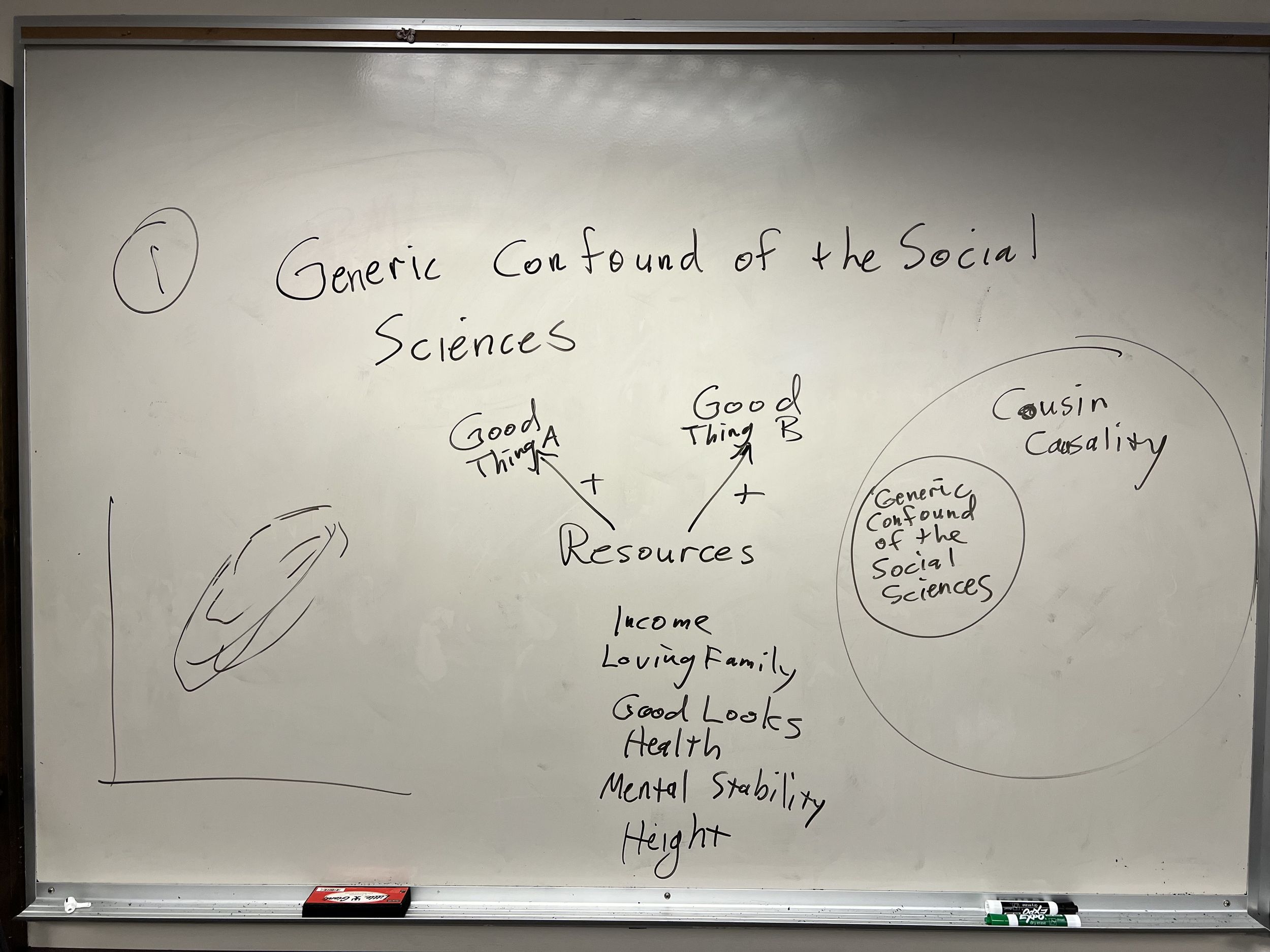
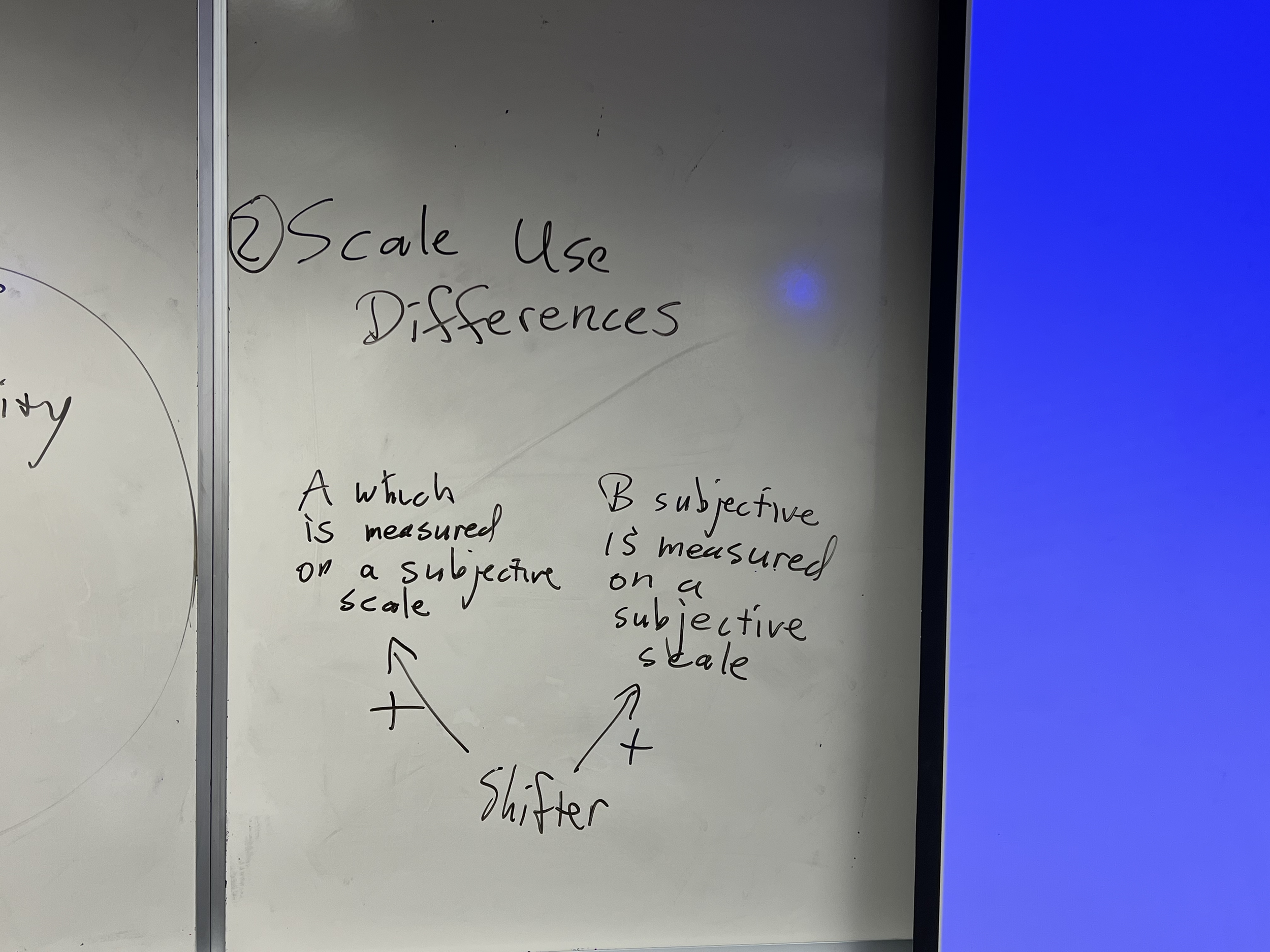
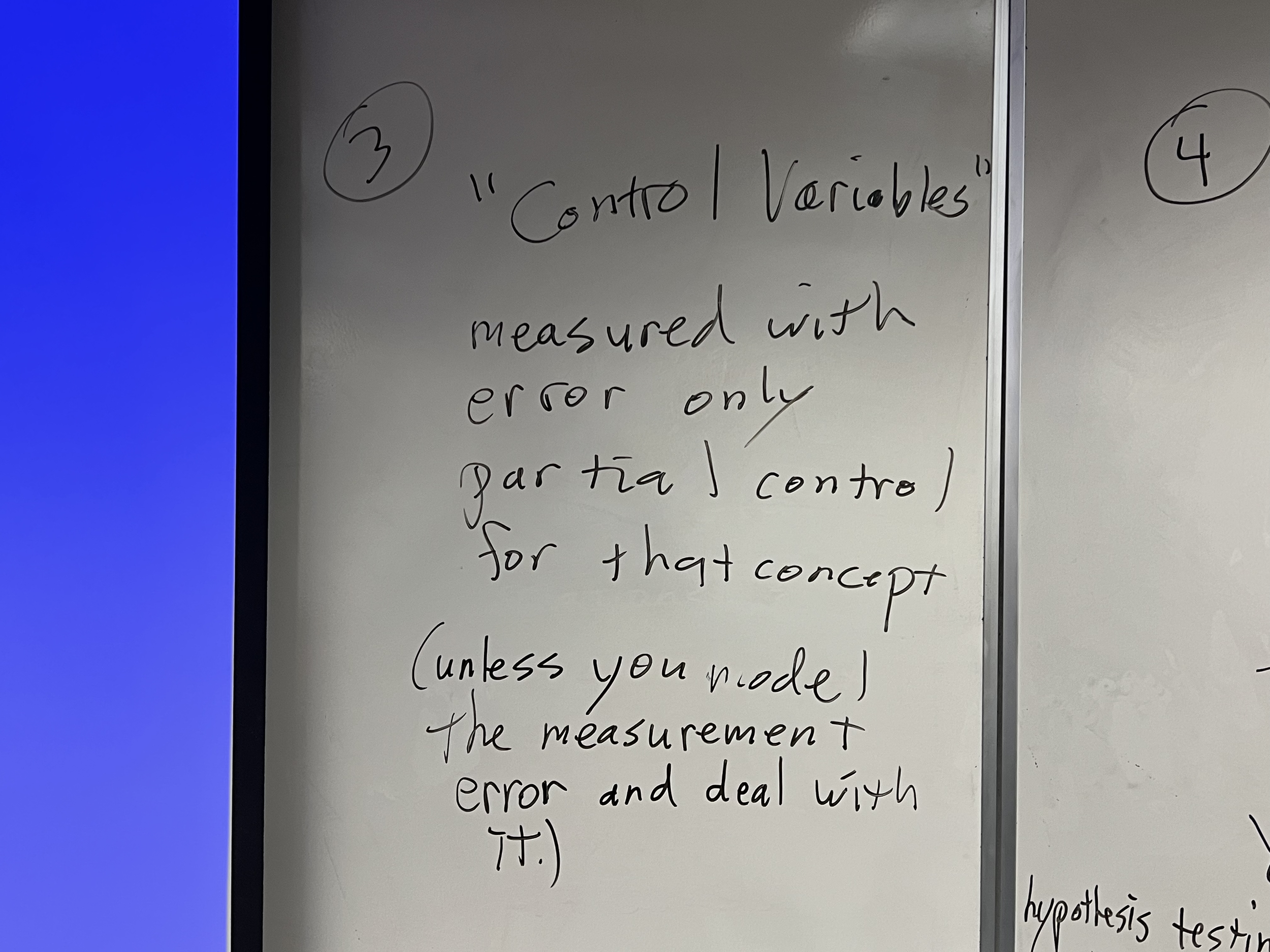
Whether the direction of bias is 0, +, - or ? given an arrow diagram with +’s and -’s on the arrows
Multicollinearity in practice
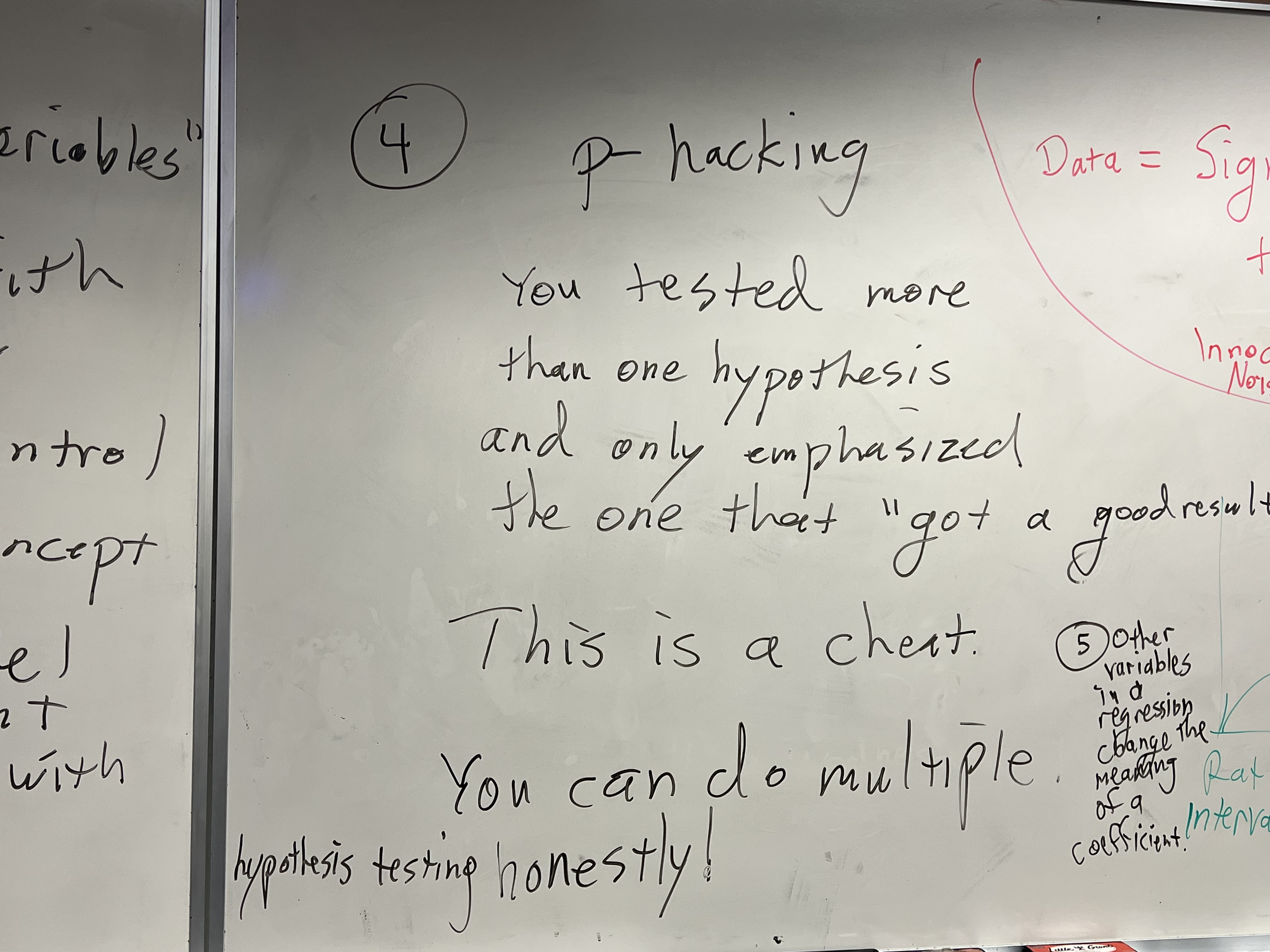
Note: Using the false discovery rate (FDR) approach to deal with multiple hypothesis testing will not be tested on this quiz, but you will be expected to use it where appropriate in your term paper. Note that “Who Leaves Mormonism?” and “A Well-Being Snapshot in a Changing World” use the false discovery rate approach.