Are We Happy Yet?—Jessica Grose →
h/t Lukas Bolte
A Partisan Nonpartisan Blog: Cutting Through Confusion Since 2012
h/t Lukas Bolte
h/t Joseph Kimball
The link on the title leads to the substack article on the path to African prosperity. Also, don’t miss Maggate Wade’s TED Talk: “Why it's too hard to start a business in Africa -- and how to change it”.
“There is one miracle for all time: the existence of the universe — including the existence of consciousness. Every birth is a celebration of that miracle, and all our fear of death is worship of that miracle.”
Related Posts:
Miles’s Unitaritan-Universalist sermons:
Sharing Epiphanies (including the video)
The Message of Mormonism for Atheists Who Want to Stay Atheists (video here)
Other related posts:
Being Less Controlling by Softening Attachment (included here mainly for the sake the links at the bottom of the post)
This paper gives our team’s overall take on the economics of happiness literature, and our recommendations for those interested in research in this area.
It has been 12 years since my first blog post: What is a Supply-Side Liberal? I have written an anniversary post every year since:
Because our research team trying to bring about national well-being indexes that can stand as coequals with GDP has been at a critical and highly engrossing stage now for several years, I have tended to think of this blog as on hiatus. But as I look more closely, I see that my blog output is not zero; it is simply advancing at a snail’s pace.
In my own view, my most important post in the past year is “A Tweetstorm on Imperfect Information Processing.” Then there are several important pieces in video form:
There is one bit of PR for our work on well-being indexes:
Then I learn something about myself from what I ended up writing about. Though I am in a period of reevaluation of what I believe, I continue to be very interested in diet and health. After all, I at least have to figure out what to do myself, and might as well keep some record of things I learn and think about here on this blog. Here is what I have written in the past year on diet and health:
I teach about statistical identification in my “Ethics, Happiness and Choice” class at the University of Colorado Boulder. (You can see links to all of my course websites if you click the “Resources” button at the top of the page.) So I am always on the lookout for good examples to use. Here is one I found this past year:
For my classes generally, I have a bibiographic post under construction: “Posts Useful for Teaching.” You might see something there.
I continue to be very interested in US Supreme Court decisions, in part because I come from a family of lawyers. (My Dad, my uncle Spencer Levan Kimball and my brother Chris were all law professors.) The current revolution in constitutional and statutory interpretation is fascinating to me. Here are two posts I wrote:
It is good to be fortified by stories of how good ideas often meet initial resistance. So I wanted to keep hold of this story:
And there are many other useful things I wanted to keep track of; I used link posts as some of our forebears used commonplace books. You can page down to see those linkposts. I won’t try to repeat them here.
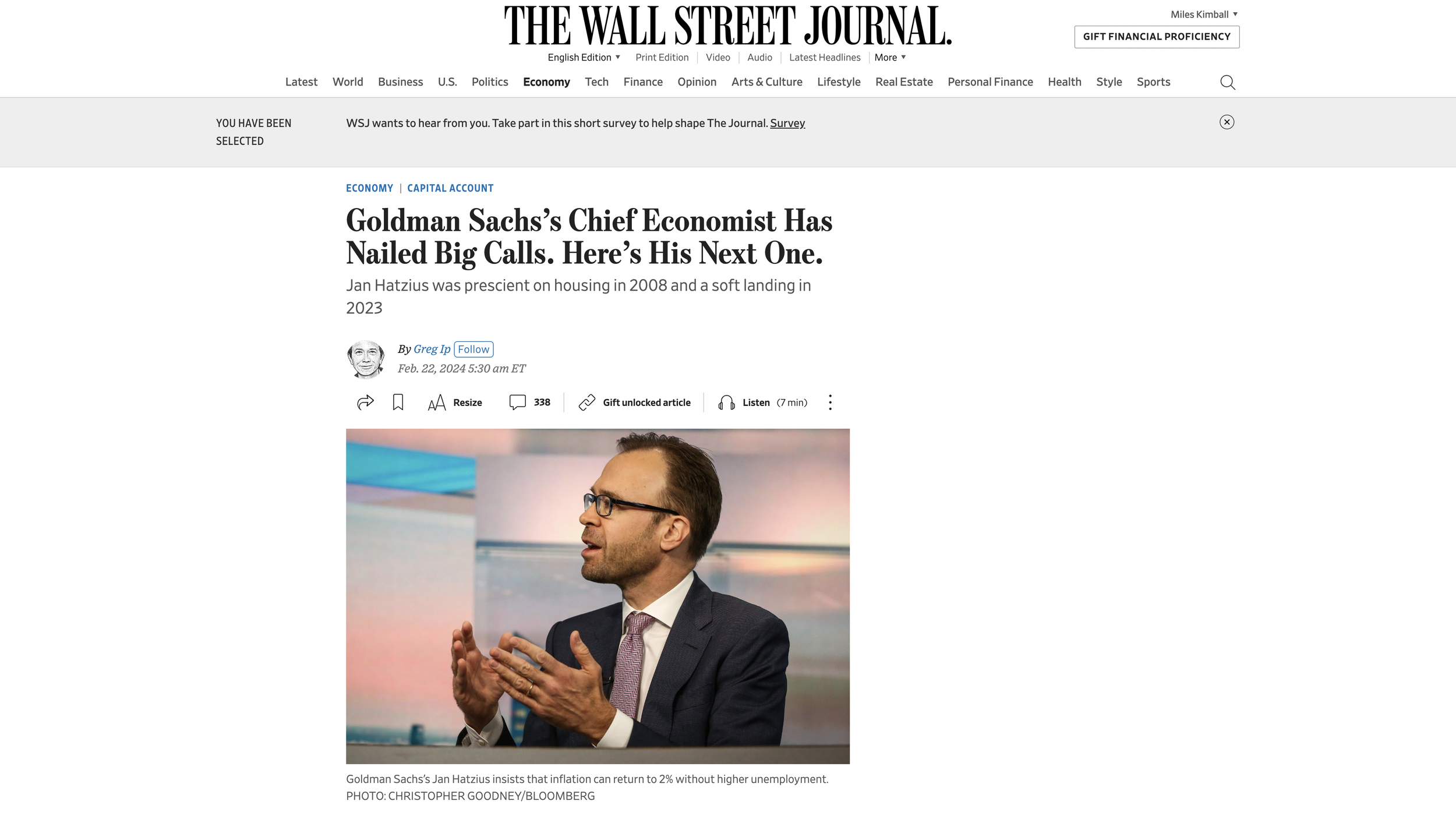
“In 2007, many analysts dismissed the significance of subprime mortgage losses, which they compared to a bad day in the stock market. In a report that November, Hatzius called the analogy flawed. Citing research by the economists Tobias Adrian and Hyun Song Shin, he noted that stocks were mostly owned by ‘long-only’ investors such as pension funds who ‘passively accept a hit to their net worth.’
By contrast, mortgages are owned by leveraged institutions such as banks, investment dealers, hedge funds, Fannie Mae and Freddie Mac. For every dollar of losses, these investors would have to shrink their balance sheets to preserve their capital ratios. This was a key reason Hatzius projected weaker growth and a higher risk of recession in 2008 than the consensus.”
Because inflation today is caused by firms changing price today & inflation tomorrow is caused by a different set of firms changing price tomorrow, sticky inflation in the face of a big macro shock means firms are changing prices without fully incorporating the new information.
— Miles Kimball (@mileskimball) February 22, 2024
Mankiw and Reis interpret their model as a model of sticky information: firms periodically wake up and get all the new macroeconomic information, then set a new price path accordingly.
— Miles Kimball (@mileskimball) February 22, 2024
Macroeconomic information is actually very easy and cheap to get ahold of. Just google "FRED" and you have a cornucopia of macroeconomics information. Getting macro information is not hard. What is hard is appropriately *processing* macroeconomic information.
— Miles Kimball (@mileskimball) February 22, 2024
When information processing is very costly, it makes sense to economize on it. Hence, most firms only process macroeconomic information into their prices at long intervals. This gives rise to sticky inflation.
— Miles Kimball (@mileskimball) February 22, 2024
In the last half century we have seen modeling *imperfect information* become a solved problem. By contrast, we remain miserable at trying to model *imperfect information processing.*
— Miles Kimball (@mileskimball) February 22, 2024
And avoiding modeling agents who are too smart by modeling agents who are too stupid (e.g., adaptive expectations, finite-state automata, agent-based models) is not that helpful.
— Miles Kimball (@mileskimball) February 22, 2024
Anyone who can come up who can come up with a model of imperfect information processing that is elegant enough that it gets taught around the world in core graduate micro will be a hero.
— Miles Kimball (@mileskimball) February 22, 2024
For more on these issue of finite and scarce cognition (a synonymous phrase for imperfect information processing), see my paper "Cognitive Economics." It isn't easy to publish a methodology paper. This is mine. https://t.co/ZtCbpFdfzz
— Miles Kimball (@mileskimball) February 22, 2024