Here are my links as I sent them to Brad:
Ruchir Agarwal and Miles Kimball's 3-Part Series "The Future of Inflation" in Finance & Development:
https://blog.supplysideliberal.com/post/2022/4/7/the-future-of-inflationruchir-agarwal-and-miles-kimball
"Ruchir Agarwal and Miles Kimball on Negative Interest Rates and Inflation—IMF Podcasts"
https://blog.supplysideliberal.com/post/2022/4/14/imf-podcast-ruchir-agarwal-and-miles-kimball-on-negative-interest-rates-and-inflation
Bibliographic Post on Negative Interest Rate Policy: "How and Why to Eliminate the Zero Lower Bound: A Reader’s Guide"
https://blog.supplysideliberal.com/emoney
"How a Toolkit Lacking a Full Strength Negative Interest Rate Option Led to the Current Inflationary Surge"
https://blog.supplysideliberal.com/post/2022/9/5/how-a-toolkit-lacking-a-full-strength-negative-interest-rate-option-led-to-the-current-inflationary-surge
"How Having Negative Interest Rate Policy in Its Toolkit Would Make the Fed Braver in Confronting Inflation with Needed Rate Hikes—A Tweetstorm"
https://blog.supplysideliberal.com/post/2022/12/28/how-having-negative-interest-rate-policy-in-its-toolkit-would-make-the-fed-braver-in-confronting-inflation-with-needed-rate-hikesa-tweetstorm
"Brad DeLong Confirms that Not Having Negative Interest Rate Policy in the Monetary Policy Toolkit Makes People Afraid of Vigorous Rate Hikes to Control Inflation"
https://blog.supplysideliberal.com/post/2022/10/1/brad-delong-confirms-that-not-having-negative-interest-rate-policy-in-the-monetary-policy-toolkit-makes-people-afraid-of-vigorous-rate-hikes-to-control-inflation
2 other relevant tweets:
Serious silliness: “There are really good reasons for them to slow down if they can..I think they want to avoid pausing only to have to re-hike later, and getting down to 25 basis points allows them the best chance of avoiding that possibility”
https://twitter.com/mileskimball/status/1606107538772090880
On the Fed’s 3/4% hikes this year: “‘What’s impressed me to no end is it hasn’t broken anything. For all the talk of crashing the economy & breaking the financial markets, it hasn’t done that,’ said Fed governor Christopher Waller last month”
https://twitter.com/mileskimball/status/1606107963407667200
"Next Generation Monetary Policy":
https://blog.supplysideliberal.com/post/2017/2/1/next-generation-monetary-policy
Durable Goods and Monetary Policy
I'm trying to get a link from Chris House directly on this.
The Barsky, House, Kimball paper, "Sticky-Price Models and Durable Goods," is relevant to how bad an idea it is to ignore durables in models where monetary policy matters:
https://www.aeaweb.org/articles?id=10.1257/aer.97.3.984
"The Government and the Mob" (in the beginning of which which I am groping in 2013 toward what Acemoglu and Robinson say more clearly in The Narrow Corridor).
"Miles's Tweetstorm of Favorite Passages from Noah Smith's Review of Brad DeLong's book ‘Slouching Towards Utopia’"
https://blog.supplysideliberal.com/post/2022/12/12/miless-tweetstorm-of-favorite-passages-from-noah-smiths-review-of-brad-delongs-book-slouching-towards-utopia
The Age of Em by Robin Hanson
https://en.wikipedia.org/wiki/The_Age_of_Em
Blog Posts Miles has Written Referencing The Age of Em:
"On Being a Copy of Someone's Mind"
https://blog.supplysideliberal.com/post/2019/8/18/on-being-a-copy-of-someones-mind
"Will Your Uploaded Mind Still Be You? —Michael Graziano"
https://blog.supplysideliberal.com/post/2019/9/29/will-your-uploaded-mind-still-be-youmichael-graziano
"Interstellar Travel and Uploaded Humans"
https://blog.supplysideliberal.com/post/2020/7/5/space-travel-and-uploaded-humans
"Consensual, Non-Solipsistic Experience Machines"
https://blog.supplysideliberal.com/post/2020/8/2/consensual-non-solipsistic-experience-machines
"Embodiment"
https://blog.supplysideliberal.com/post/2020/9/13/embodiment
Other Blog Posts Miles has Written on Consciousness (which are relevant to my using the phrase "digital humans" instead of "brain emulations")
"The Mystery of Consciousness" (My Unitarian-Universalist sermon on this topic)
https://blog.supplysideliberal.com/post/94309255267/the-mystery-of-consciousness
"On the Effability of the Ineffable"
https://blog.supplysideliberal.com/post/2019/8/4/on-the-effability-of-the-ineffable
"Christof Koch: Will Machines Ever Become Conscious?"
https://blog.supplysideliberal.com/post/2019/12/22/christof-koch-will-machines-ever-become-conscious
"Cyborgian Immortality" (the Ship of Theseus argument)
https://blog.supplysideliberal.com/post/39212472423/cyborgian-immortality
Are We Already in a Simulated World?
"Frank Wilczek: Are We Living in a Simulated World?"
https://blog.supplysideliberal.com/post/2020/2/2/frank-wilczek-are-we-living-in-a-simulated-world
"The Virtual Reality Theory of Dualism"
https://blog.supplysideliberal.com/post/2019/10/27/the-virtuality-reality-theory-of-dualism
Looking Backward by Edward Bellamy: (as an example of what economics bloggers should each contribute toward a "Concrete Economics": a description of the world in 2075-2100 if 80% or so of one's recommendations were adopted)
https://en.wikipedia.org/wiki/Looking_Backward
"The Decline of Drudgery and the Paradox of Hard Work" (Keynes probably would be right in "...Grandchildren" that we'd be working less now if jobs were as unpleasant as they used to be. Also, if jobs getting more pleasant has a big effect on hours, it is hard for it to not have a really big effect on welfare. The broader context was that after food, shelter, clothing and consumer durables, people want enjoyable, meaningful jobs and then happiness of the sort that meditation helps with)
https://www.nber.org/papers/w29041
"Podcast: Miles Kimball on the Potential of a National Well-Being Index"
https://blog.supplysideliberal.com/post/2021/12/16/podcast-miles-kimball-on-the-potential-of-a-national-well-being-index
"Judging the Nations: Wealth and Happiness are Not Enough" (on a national well-being index)
https://blog.supplysideliberal.com/post/47017089094/quartz-8-judging-the-nations-wealth-and
"My Experiences with Gary Becker" (mostly on my research on happiness and well-being)
https://blog.supplysideliberal.com/post/84824118992/my-experiences-with-gary-becker
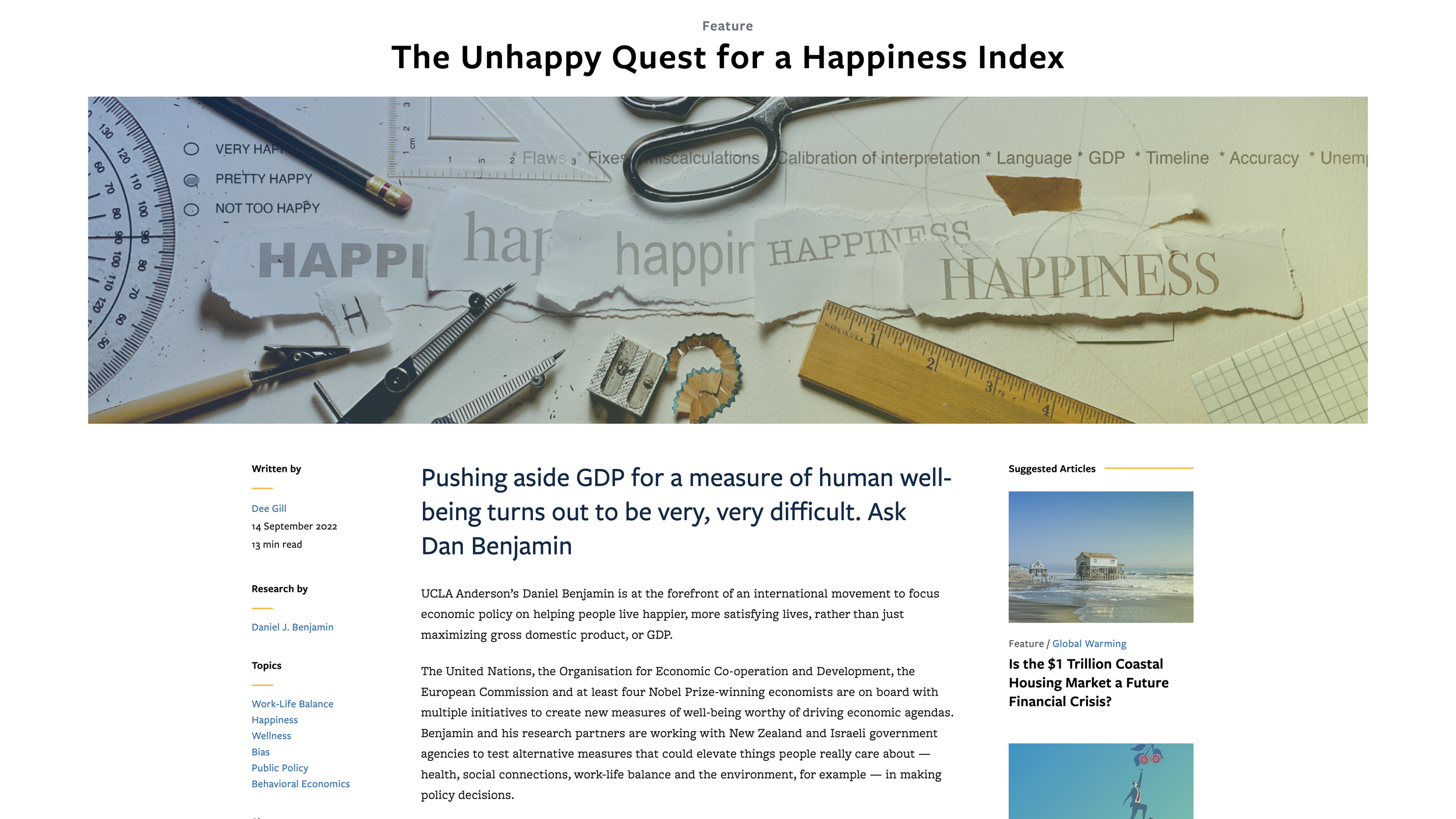
"Pushing aside GDP for a measure of human well-being turns out to be very, very difficult. Ask Dan Benjamin"
https://anderson-review.ucla.edu/the-unhappy-quest-for-a-happiness-index/
"Benjamin Franklin's Strategy to Make the US a Superpower Worked Once, Why Not Try It Again?" (on the national security case for more immigration, prompted by the question of what GDP is good for)
https://blog.supplysideliberal.com/post/60999482427/quartz-28-benjamin-franklins-strategy-to-make
"Why GDP Can Grow Forever" (on how weird GDP is as a welfare measure)
https://blog.supplysideliberal.com/post/2017/7/10/why-gdp-can-grow-forever
"How Economists Can Enhance Their Scientific Creativity, Engagement and Impact" (Miles as one of the few economists who is a certified professional life coach offering free "Positive Intelligence" training to raise productivity and happiness, for example through taming one's inner critic)
https://blog.supplysideliberal.com/post/2020/9/10/how-economists-can-enhance-their-scientific-creativity-impact-and-engagement
Experiences of other economists in this program:
https://blog.supplysideliberal.com/post/2020/10/19/testimonials-for-positive-intelligence-1
"Odious Wealth: The Outrage is Not So Much Over Inequality but All the Dubious Ways the Rich Got Richer" (related to the idea of dividing the economy up into about 20 sectors and solving a design problem of aligning the interests of business people with the common weal in each of those sectors)
https://blog.supplysideliberal.com/post/93469513195/quartz-50-odious-wealth-the-outrage-is-not-so
"Oren Cass on the Value of Work" (my endorsement of Morgan Warstler's EITC on steroids, which he argues for with right-wing rhetoric, along with the argument that work is good for the soul, which is why I am against universal basic income. However, I view child-rearing as real work, so I see a child tax credit as a much better policy than universal basic income.)
https://blog.supplysideliberal.com/post/2018/12/6/oren-cass-on-the-value-of-work-2
"Janet Yellen is Hardly a Dove—She Knows the US Economy Needs Some Unemployment" (I also talked about Morgan Warstler's proposal in the context of discussing efficiency wage theory in this Quartz column)
https://blog.supplysideliberal.com/post/63725670856/janet-yellen-is-hardly-a-dove-she-knows-the-us
"How and Why to Expand the Nonprofit Sector as a Partial Alternative to Government: A Reader’s Guide" (Bibliographic post on my proposal for raising taxes with all of them avoidable through a 100% charitable deduction up to that maximum (with more strict rules on what it's used for than the current charitable deduction).
https://blog.supplysideliberal.com/post/133246182760/how-and-why-to-expand-the-nonprofit-sector-as-a
"Miles Kimball on John Locke's Second Treatise" (links to all my blog posts blogging through John Locke's 2d Treatise)
https://blog.supplysideliberal.com/post/2019/10/20/miles-kimball-on-john-lockes-second-treatise