Grace Wetzel: Orgasmic Inequality

I am not entirely comfortable with talking about sex on this blog, but in this case, it is important for discussing an important dimension of sexism in our society. Grace Wetzel—in her TEDx talk which you can watch above—does an admirable job of driving home the argument that there is orgasmic inequality as a result of inegalitarian attitudes toward women. Here is the argument she makes:

  1. In heterosexual encounters, women experience only about 25% of the encounters.

  2. This is associated with the fact that only 25% of women regularly experience orgasms from penetration without additional clitoral stimulation.

  3. However, it is not due to female orgasms being any more difficult to achieve for women than for men: for both men and women, the average masturbation time to orgasm is 4 minutes.

  4. The fact the orgasm rates for lesbians are almost the same as orgasm rates for men also suggests that there is no great inherent biological difficulty in female orgasm.

  5. Despite oral sex received by women being one activity that is especially helpful for clitoral stimulation and therefore for female orgasm, men receive oral sex much more than women do.

  6. Orgasmic inequality is not confined to being a lower-class phenomenon: orgasmic inequality and the behavioral patterns that lead to it are rife among college students.

  7. Grace discusses many of the gender dynamics that help preserve orgasmic inequality. One telltale sign of the dysfunction in our society that preserves orgasmic inequality is the statistic that more than half of all women have faked an orgasm.

A religious belief that the only purpose of sex is reproduction would reduce the concern about orgasmic inequality, since there wouldn’t be the need for much sex at all, and what sex there was could be quite humdrum and still do the reproductive job. But to the extent that sex also serves the purposes of pleasure and emotional bonding for a couple, mutual satisfaction is quite valuable.


Somewhat relatedly, below is a TEDx talk reporting research indicating that even short-term participation in a peer-support group of other women can improve women’s sexual experience substantially:

Appropriately Dosed Rapamycin and Metformin Can Improve Immune Function and Seem to Be Partial Preventatives for COVID-19

Peter Attia is one of the authorities I turn to for greater understanding of diet and health. His podcast “The Drive” is consistent in its message with what I say on supplysideliberal.com about diet and health, but often gets much more technical than I ever get here and often adds nuance. (As an example of nuance, I now believe, based on listening to Peter Attia that 5-20% of people have their low-density lipoprotein particle number shoot up when they eat a lot of saturated fat and that this minority of people should avoid saturated fat. Relatedly, I also learned that a testing of low-density-lipoprotein particle number is a much better test than low-density-lipoprotein mass tests that are all most of us usually get at the doctor’s office.)

I plan to discuss many of Peter Attia’s podcasts in depth in the future. But I thought the recent podcast above deserved to be highlighted immediately because of its relevance to the current pandemic. Please don’t try to make any use of the implicit suggestion in the title of this blog post without (a) listening to the whole podcast and (b) talking to your doctor (ideally after getting your doctor to listen to the whole podcast). Both rapamycin and metformin are drugs that your doctor should have the authority to give you a prescription for, if warranted. Note that rapamycin has an inverted-U-shaped effect on immune function: a little bit aids immune function but larger doses are routinely used to suppress immune function.

One intriguing thing about rapamycin and metformin in relation to Covid-19 is that (1) the danger of Covid-19 goes up dramatically with age and (1) rapamycin and metformin are some of the best bets Peter Attia knows of for general anti-aging drugs.

Postscript: My son-in-law Erik Berlin is a cofounder of Breaker. Breaker is the best podcast search app in existence on our planet. Try it! You can easily find it free in the app store. I listen to Peter Attia’s podcast using Breaker.


For annotated links to other posts on diet and health, see:

On Ex-Muslims

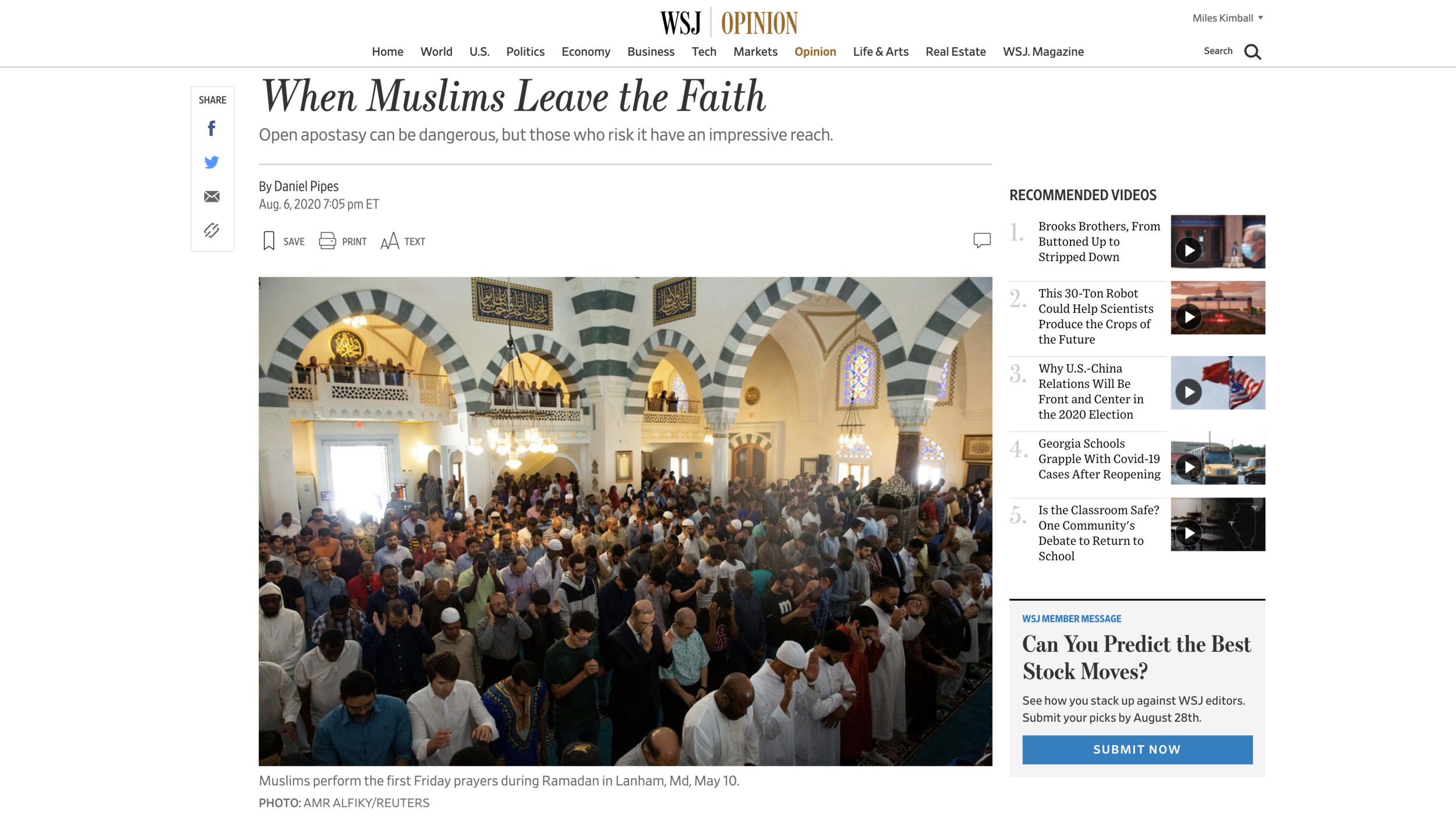
I learned a bit more about Islam from Daniel Pipes’s essay “When Muslims Leave the Faith” in the August 6, 2020 Wall Street Journal. One point he makes that I had had some inkling of is that Islam is one of the most dangerous religions to leave:

Overtly apostatizing is a radical act that can lead to execution in some Muslim-majority countries, including Iran. Even in the West, apostates often meet rejection by families and friends that can turn violent.

Daniel also cites the following interesting statistics:

There are about 3.5 million Muslims in the U.S., according to a 2017 Pew Research Center survey. The data suggests that about 100,000 of them abandon Islam each year, while roughly the same number convert to Islam. Altogether nearly a quarter of those raised in the faith have left, with Iranians disproportionately represented. Similar trends prevail in Western Europe, where conversions in and out of Islam appear roughly to balance out.

In the U.S., ex-Muslims’ motives for leaving vary. Asked what their “main reason” was for no longer identifying as Muslim, Pew found 25% had general issues with religion and 19% with Islam in particular. Some 16% said they prefer another religion, and 14% cited “personal growth.” More than half of them abandon religion entirely, and 22% now identify as Christian.

There have been some efforts by ex-Muslims to support other ex-Muslims:

The activists Nonie Darwish and Ayaan Hirsi Ali wrote books about becoming “infidels.” …

Some ex-Muslims living in the West do something inconceivable in Muslim-majority countries: They publicly organize against Islam in dozens of groups like Germany’s Central Council of Ex-Muslims and Ms. Darwish’s Former Muslims United. Such organizations also provide mutual support in the face of intense hostility and raise troublesome issues—with female genital mutilation among the most prominent in recent years—thereby becoming some of the most credible critics of Islamism.

Other than the threat of death for ex-Muslims and the threat of female genital mutilation for current Muslims, all of this is familiar to me from what happens with ex-Mormons, who do a fair amount to support one another.

One book-writing ex-Muslim Daniel Pipes fails to mention is Reza Aslan, who has writing a book about the past, present and future of Islam:

I ran into this book by accident (or by the design of Amazon’s algorithm) this past week and put it on my book wishlist. (I have a deal with myself that if I list a book on an Excel file I have that I can buy it as soon as I will actually sit down to begin reading it. This is a big help in reducing how much I spend on books.)

Note: I have a tag “religionhumanitiesscience” that will get you to my posts on religion and my posts on political philosophy. If you click on the link on this sentence, that will also take you there.

100 Economics Blogs and 100 Economists Who Are Influential Online

Screen Shot 2020-08-12 at 4.24.26 PM.png

I am pleased to have this blog listed again as one of the Top 100 Economics Blogs by the Intelligent Economist and to have Richtopia list me as one of the top 100 most economists most influential online. I try hard not to let desire for rank cause me to sacrifice anything else important, but I like high rank :) You do too ;)

If you want, you can see more purely academic indications of rank for me in this post. The numbers fluctuate from month to month, but by REPEC’s overall ranking, with rounding, I am roughly the 450th highest ranked economist in the world and I am roughly 250th by fully-adjusted citations (“Number of Citations, Weighted by Number of Authors and Recursive Impact Factors, Discounted by Citation Age”). Currently, I am listed by REPEC as 121st economist in number of Twitter followers.

I am currently 79th on REPEC in “Breadth of citations across fields.” I like this because I see myself as interested in almost everything in economics, as well as many, many things that are outside of economics as its boundaries are conventionally understood. (But see “Economics Needs to Tackle All of the Big Questions in the Social Sciences” and “Defining Economics.” I would love to see “economic imperialism” extend to nutrition, as you can gather from reading my diet and health posts.)

Don't Drink Sweet Drinks Between Meals—Whether Sugary or with Nonsugar Sweeteners

For the bottom line of this post, you may want to jump to the Conclusion. Everything else is about backing up that advice.

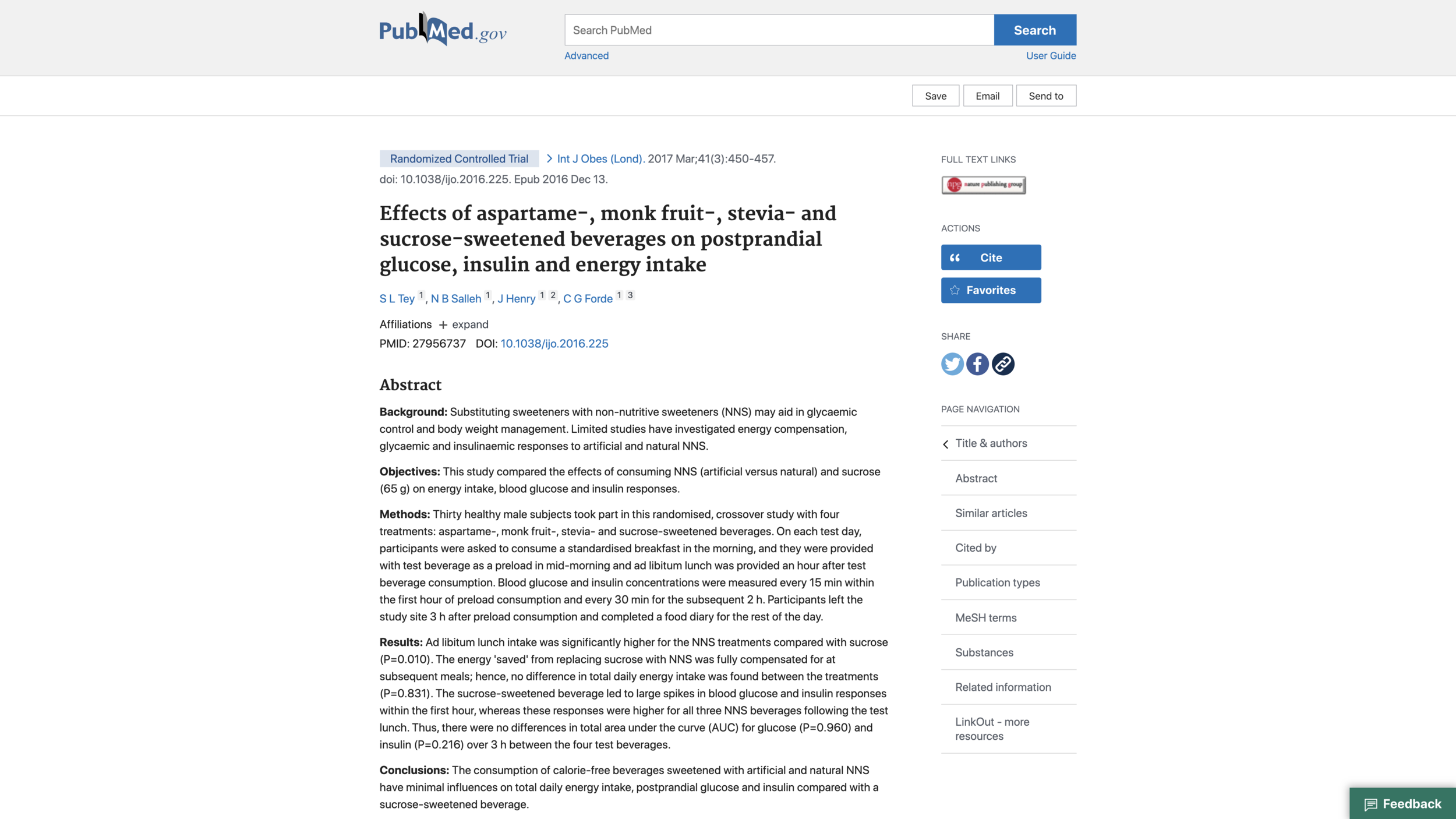
Existing research doesn’t tell us as much about the effects of nonsugar sweeteners as one would like. But “Effects of aspartame-, monk fruit-, stevia- and sucrose-sweetened beverages on postprandial glucose, insulin and energy intake” by S L TeyN B SallehJ Henry, and C G Forde gives some hint that using nonsugar sweeteners as part of a substantial meal or snack is better than using nonsugar sweeteners in a zero-calorie beverage consumed as a snack on its own.

To be more precise, consuming a beverage on its own with a nonsugar sweetener seems to lead to people eating enough more that it doesn’t reduce overall calorie intake, blood glucose levels or blood insulin levels overall below what would happen if one consumed a sugary beverage. By contrast, using a nonsugar sweetener instead of sugar as part of a substantial snack seems to help in reducing overall calorie intake.

The introduction to the paper shown above reports on an experiment in which nonsugar sweeteners were part of a substantial snack:

To date, only one study has investigated the effects of artificial and natural NNS on food intake, postprandial glucose and insulin. This randomised crossover study utilised a double preload design to compare the effects of consuming two preloads of crackers and cream cheese sweetened with sucrose (986 kcal), aspartame (580 kcal) or stevia (580 kcal); one before lunch and one before dinner, on energy intake, postprandial glucose and insulin concentrations. Daily energy intake was significantly lower when participants consumed preloads with aspartame and stevia, compared with a sucrose preload. stevia preload also showed additional benefit of lowering postprandial blood glucose and insulin concentrations, compared with aspartame and sucrose preloads. However, it is unknown whether the beneficial effect of stevia can be generalised to monk fruit and also whether the same result can be obtained if the preload contains no calories, for example, diet beverage.

The conclusion of the paper shown above contrasts the results from a nonsugar sweetener instead of sugar as part of a substantial snack and the results from a nonsugar sweetener instead of sugar as part of a standalone beverage snack. As part of a standalone beverage snack, the zero-calorie beverage with a nonsugar sweetener left calorie intake, overall glucose level and overall insulin level in the same ballpark as an otherwise similar sugar-sweetened beverage:

… when participants consumed a preload of crackers with cream cheese sweetened with NNS, 20 min before lunch, postprandial glucose concentration following lunch was significantly lower with NNS compared with a preload sweetened with sucrose. Overall, the evidence seems to suggest that consuming NNS alone without any energy (empty calorie) before a meal may lead to larger spikes in glucose and insulin responses after the meal. The preload used in the current study resembles a pre-meal beverage such as a mid-morning sugar-sweetened beverage before lunch or a midafternoon soft drink before dinner

Conclusion: My advice is to not use sugar at all (see “Sugar as a Slow Poison” and “Letting Go of Sugar”) and only use nonsugar sweeteners as part of a meal or a substantial snack. Note also that juice counts as a sugar-sweetened drink—something to be avoided entirely. (Juice is much worse than whole fruit. See “Forget Calorie Counting; It's the Insulin Index, Stupid.”)

On the question of which nonsugar sweeteners to choose as part of a meal or substantial snack, see “Which Nonsugar Sweeteners are OK? An Insulin-Index Perspective.”

What to Drink Instead: Avoiding sweet drinks between meals doesn’t mean you have to drink plain water. Unsweetened coffee and tea (or perhaps minimally sweetened coffee or tea) do not have the problem sweet drinks have. Carbonated water, as from SodaStream or one of its competitors is great. And there is now a huge variety of flavored sparkling water. On that, see my post “In Praise of Flavored Sparkling Water” where I mention some of my favorites. (New varieties keep appearing so I may need to write another review of flavored sparkling water sometime.)


For annotated links to other posts on diet and health, see:

The Federalist Papers #14: A Republic Can Be Geographically Large—James Madison

James Madison is incisive in his arguments in his numbers of the Federalist Papers. In the Federalist Papers #14, he argues that the United States would not be to large to be governed to a Congress of representatives meeting in one place. To show how he makes his argument, let me add my own summary headings in bold italics to James Madison’s text:

FEDERALIST NO. 14

Objections to the Proposed Constitution From Extent of Territory Answered

From the New York Packet
Friday, November 30, 1787.

Author: James Madison

To the People of the State of New York:

Thesis statement: The supposed difficulties of governing a territory even as large in extent as the Union are imaginary.

WE HAVE seen the necessity of the Union, as our bulwark against foreign danger, as the conservator of peace among ourselves, as the guardian of our commerce and other common interests, as the only substitute for those military establishments which have subverted the liberties of the Old World, and as the proper antidote for the diseases of faction, which have proved fatal to other popular governments, and of which alarming symptoms have been betrayed by our own. All that remains, within this branch of our inquiries, is to take notice of an objection that may be drawn from the great extent of country which the Union embraces. A few observations on this subject will be the more proper, as it is perceived that the adversaries of the new Constitution are availing themselves of the prevailing prejudice with regard to the practicable sphere of republican administration, in order to supply, by imaginary difficulties, the want of those solid objections which they endeavor in vain to find.

Republics rely on representatives; they can operate well over much larger geographical regions than direct democracies where the bulk of the citizens meet in person.

The error which limits republican government to a narrow district has been unfolded and refuted in preceding papers. I remark here only that it seems to owe its rise and prevalence chiefly to the confounding of a republic with a democracy, applying to the former reasonings drawn from the nature of the latter. The true distinction between these forms was also adverted to on a former occasion. It is, that in a democracy, the people meet and exercise the government in person; in a republic, they assemble and administer it by their representatives and agents. A democracy, consequently, will be confined to a small spot. A republic may be extended over a large region.

Monarchist writers tend to lump republics and direct democracies together—and choose troubled examples.

To this accidental source of the error may be added the artifice of some celebrated authors, whose writings have had a great share in forming the modern standard of political opinions. Being subjects either of an absolute or limited monarchy, they have endeavored to heighten the advantages, or palliate the evils of those forms, by placing in comparison the vices and defects of the republican, and by citing as specimens of the latter the turbulent democracies of ancient Greece and modern Italy. Under the confusion of names, it has been an easy task to transfer to a republic observations applicable to a democracy only; and among others, the observation that it can never be established but among a small number of people, living within a small compass of territory.

America’s republic would be a new type of thing, so old, failed examples do not apply.

Such a fallacy may have been the less perceived, as most of the popular governments of antiquity were of the democratic species; and even in modern Europe, to which we owe the great principle of representation, no example is seen of a government wholly popular, and founded, at the same time, wholly on that principle. If Europe has the merit of discovering this great mechanical power in government, by the simple agency of which the will of the largest political body may be concentred, and its force directed to any object which the public good requires, America can claim the merit of making the discovery the basis of unmixed and extensive republics. It is only to be lamented that any of her citizens should wish to deprive her of the additional merit of displaying its full efficacy in the establishment of the comprehensive system now under her consideration.

The Continental Congress hasn’t been troubled by a lack of attendance by representatives from the more distant states.

As the natural limit of a democracy is that distance from the central point which will just permit the most remote citizens to assemble as often as their public functions demand, and will include no greater number than can join in those functions; so the natural limit of a republic is that distance from the centre which will barely allow the representatives to meet as often as may be necessary for the administration of public affairs. Can it be said that the limits of the United States exceed this distance? It will not be said by those who recollect that the Atlantic coast is the longest side of the Union, that during the term of thirteen years, the representatives of the States have been almost continually assembled, and that the members from the most distant States are not chargeable with greater intermissions of attendance than those from the States in the neighborhood of Congress.

The United States, between the Atlantic and the Mississippi, is not much larger than some European nations that have an effective assembly of representatives.

That we may form a juster estimate with regard to this interesting subject, let us resort to the actual dimensions of the Union. The limits, as fixed by the treaty of peace, are: on the east the Atlantic, on the south the latitude of thirty-one degrees, on the west the Mississippi, and on the north an irregular line running in some instances beyond the forty-fifth degree, in others falling as low as the forty-second. The southern shore of Lake Erie lies below that latitude. Computing the distance between the thirty-first and forty-fifth degrees, it amounts to nine hundred and seventy-three common miles; computing it from thirty-one to forty-two degrees, to seven hundred and sixty-four miles and a half. Taking the mean for the distance, the amount will be eight hundred and sixty-eight miles and three-fourths. The mean distance from the Atlantic to the Mississippi does not probably exceed seven hundred and fifty miles. On a comparison of this extent with that of several countries in Europe, the practicability of rendering our system commensurate to it appears to be demonstrable. It is not a great deal larger than Germany, where a diet representing the whole empire is continually assembled; or than Poland before the late dismemberment, where another national diet was the depositary of the supreme power. Passing by France and Spain, we find that in Great Britain, inferior as it may be in size, the representatives of the northern extremity of the island have as far to travel to the national council as will be required of those of the most remote parts of the Union.

Those matters of government that most require proximity are still the business of the individual states; the federal government is only dealing with enumerated issues.

Favorable as this view of the subject may be, some observations remain which will place it in a light still more satisfactory.

In the first place it is to be remembered that the general government is not to be charged with the whole power of making and administering laws. Its jurisdiction is limited to certain enumerated objects, which concern all the members of the republic, but which are not to be attained by the separate provisions of any. The subordinate governments, which can extend their care to all those other subjects which can be separately provided for, will retain their due authority and activity. Were it proposed by the plan of the convention to abolish the governments of the particular States, its adversaries would have some ground for their objection; though it would not be difficult to show that if they were abolished the general government would be compelled, by the principle of self-preservation, to reinstate them in their proper jurisdiction.

Let the future worry about how to govern when there is further expansion of the United States.

A second observation to be made is that the immediate object of the federal Constitution is to secure the union of the thirteen primitive States, which we know to be practicable; and to add to them such other States as may arise in their own bosoms, or in their neighborhoods, which we cannot doubt to be equally practicable. The arrangements that may be necessary for those angles and fractions of our territory which lie on our northwestern frontier, must be left to those whom further discoveries and experience will render more equal to the task.

Note that in the future, there will be more and better roads and canals.

Let it be remarked, in the third place, that the intercourse throughout the Union will be facilitated by new improvements. Roads will everywhere be shortened, and kept in better order; accommodations for travelers will be multiplied and meliorated; an interior navigation on our eastern side will be opened throughout, or nearly throughout, the whole extent of the thirteen States. The communication between the Western and Atlantic districts, and between different parts of each, will be rendered more and more easy by those numerous canals with which the beneficence of nature has intersected our country, and which art finds it so little difficult to connect and complete.

The most distant states might be thought to complain most about having to send representatives a long way, but they are also likely to be, in some sense, border states, who benefit greatly from being part of the Union. So they will be less likely to complain than the distance by itself might suggest.

A fourth and still more important consideration is, that as almost every State will, on one side or other, be a frontier, and will thus find, in regard to its safety, an inducement to make some sacrifices for the sake of the general protection; so the States which lie at the greatest distance from the heart of the Union, and which, of course, may partake least of the ordinary circulation of its benefits, will be at the same time immediately contiguous to foreign nations, and will consequently stand, on particular occasions, in greatest need of its strength and resources. It may be inconvenient for Georgia, or the States forming our western or northeastern borders, to send their representatives to the seat of government; but they would find it more so to struggle alone against an invading enemy, or even to support alone the whole expense of those precautions which may be dictated by the neighborhood of continual danger. If they should derive less benefit, therefore, from the Union in some respects than the less distant States, they will derive greater benefit from it in other respects, and thus the proper equilibrium will be maintained throughout.

It is a noble thing to do something new. Conversely, a rule that says we can only do what has been done before would hamstring us.

I submit to you, my fellow-citizens, these considerations, in full confidence that the good sense which has so often marked your decisions will allow them their due weight and effect; and that you will never suffer difficulties, however formidable in appearance, or however fashionable the error on which they may be founded, to drive you into the gloomy and perilous scene into which the advocates for disunion would conduct you. Hearken not to the unnatural voice which tells you that the people of America, knit together as they are by so many cords of affection, can no longer live together as members of the same family; can no longer continue the mutual guardians of their mutual happiness; can no longer be fellowcitizens of one great, respectable, and flourishing empire. Hearken not to the voice which petulantly tells you that the form of government recommended for your adoption is a novelty in the political world; that it has never yet had a place in the theories of the wildest projectors; that it rashly attempts what it is impossible to accomplish. No, my countrymen, shut your ears against this unhallowed language. Shut your hearts against the poison which it conveys; the kindred blood which flows in the veins of American citizens, the mingled blood which they have shed in defense of their sacred rights, consecrate their Union, and excite horror at the idea of their becoming aliens, rivals, enemies. And if novelties are to be shunned, believe me, the most alarming of all novelties, the most wild of all projects, the most rash of all attempts, is that of rendering us in pieces, in order to preserve our liberties and promote our happiness. But why is the experiment of an extended republic to be rejected, merely because it may comprise what is new? Is it not the glory of the people of America, that, whilst they have paid a decent regard to the opinions of former times and other nations, they have not suffered a blind veneration for antiquity, for custom, or for names, to overrule the suggestions of their own good sense, the knowledge of their own situation, and the lessons of their own experience? To this manly spirit, posterity will be indebted for the possession, and the world for the example, of the numerous innovations displayed on the American theatre, in favor of private rights and public happiness. Had no important step been taken by the leaders of the Revolution for which a precedent could not be discovered, no government established of which an exact model did not present itself, the people of the United States might, at this moment have been numbered among the melancholy victims of misguided councils, must at best have been laboring under the weight of some of those forms which have crushed the liberties of the rest of mankind. Happily for America, happily, we trust, for the whole human race, they pursued a new and more noble course. They accomplished a revolution which has no parallel in the annals of human society. They reared the fabrics of governments which have no model on the face of the globe. They formed the design of a great Confederacy, which it is incumbent on their successors to improve and perpetuate. If their works betray imperfections, we wonder at the fewness of them. If they erred most in the structure of the Union, this was the work most difficult to be executed; this is the work which has been new modelled by the act of your convention, and it is that act on which you are now to deliberate and to decide.

PUBLIUS.

Here are links to my other posts on The Federalist Papers so far:

The Right Amount of Wokeness

Don’t miss the sequel to this post: “Getting the Best from Wokeness by Having the Right Mean, Reducing the Variance and Mitigating the Losses from Extreme Values.”

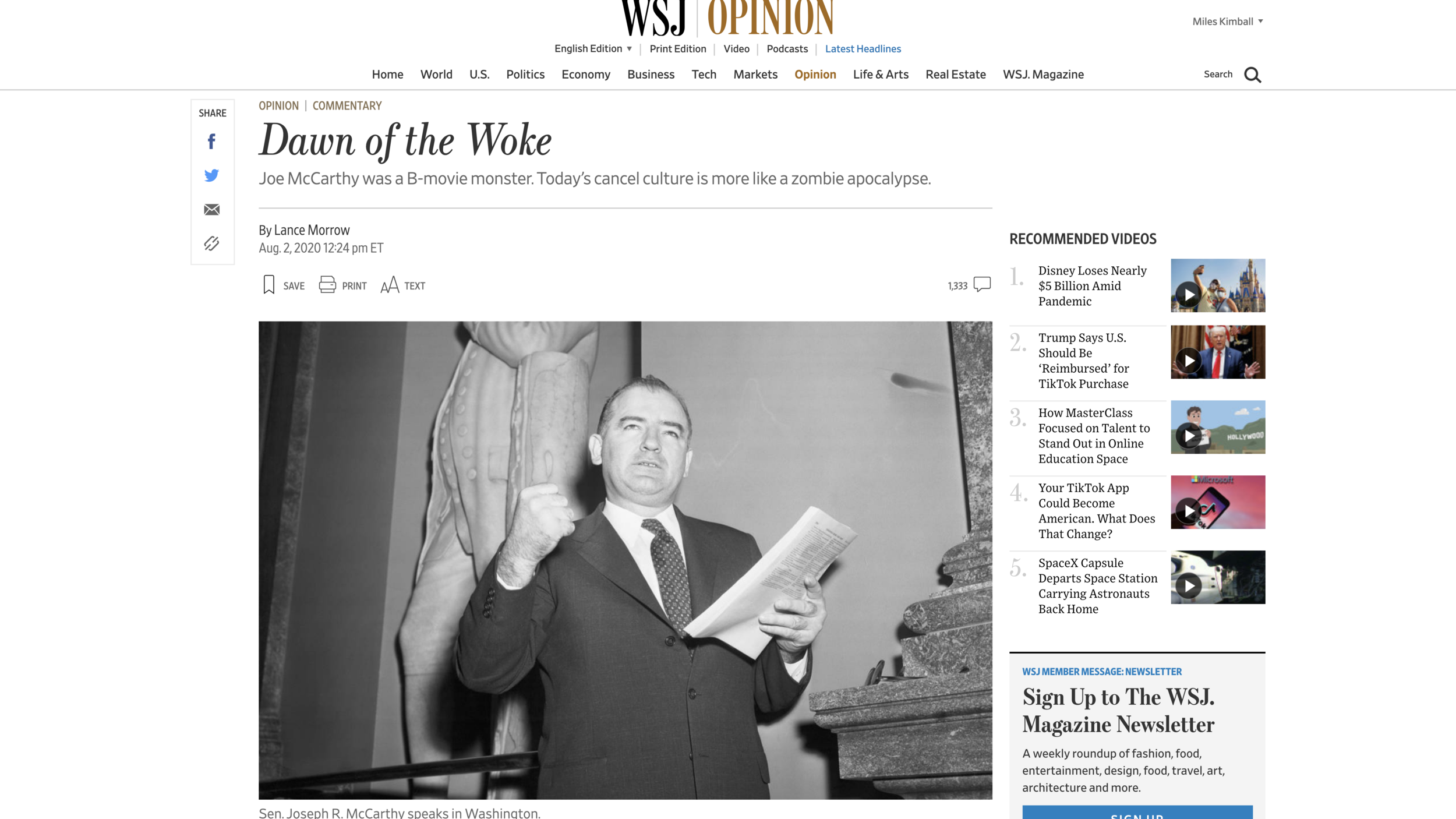
Lance Morrow, in his August 2, 2020 Wall Street Journal op-ed “Dawn of the Woke,” and Andrew Michta, in his July 31, 2020 Wall Street Journal op-ed “The Captive Mind and America’s Resegregation,” mince no words about the dangers of too much wokeness.

Here is a sample of Lance Morrow (bullets added to distinguish different passages):

  • … cancel culture … is the 21st century’s equivalent of McCarthy’s marauding. The country’s myriad cancelers emit the odor not of sanctity but of sanctimony, and of something more ominous: the whiff of a society decomposing.

  • The indignant woke, who imagine themselves to be righteously awake and laying the foundations for a more just and humane world, ought to pause—to draw back for a moment, and consider the possibility that they are, as it were, fast asleep, caught up in strange, agitated dreams: that they have become a mass joined in a cult of self-righteousness, moral vanity and privilege. One of these days, they will have to be deprogrammed and led back to the real world. Woke institutions will need to be fumigated.

  • McCarthyism and the cancel culture—which is the military wing of wokeness—are most alike in their power to conjure fear. It was fear that kept McCarthy up and running for several years, and it is fear—of losing a job, losing an assistant professorship, losing one’s good name, one’s friends, fear of saying the wrong thing and bringing down ruin on one’s head, fear not to sign a party-line faculty petition—that fortifies and sustains the cancelers.

  • The woke, like hyenas, hunt in packs, and those in authority are craven.

  • Wokeness will prove harder to kill than McCarthyism. McCarthy was a B-movie monster. Wokeness is a zombie apocalypse.

And here is a sample of what Andrew Michta writes:

  • The ill-named progressivism that has inspired shrill demands to dismantle police forces and destroy statues is only a small manifestation of a massive project aimed at the re-education of the American population. The goal of this project is to negate the story of the American republic and replace it with a tale anchored exclusively in race categories and narratives of oppression. The nature of this exercise, with its sledgehammer rhetoric that obliterates complexities in favor of one-dimensional “correct” interpretations, is as close to Marxist agitprop as one can get. 

  • … radicals destroying monuments and issuing wholesale denunciations of America’s past are wreaking destruction on ordinary Americans and their history, not on the elites and their ideology. Today’s elites as a rule do not believe they have any obligation to serve the public, only to rule it, and so they express little or no disapproval of college students toppling statues on federal land or looters raiding supermarkets. To criticize them would open elites to the charges of “populism” and “racism.”

  • The current radical trends carry the seeds of violence unseen in the U.S. since the Civil War. The activists ascendant in American cities insist on the dominance of their ideological precepts, brooking no alternative. Such absolutism forces Americans away from the realm of political compromise into one of unrelenting axiology, with one side claiming a monopoly on virtue and decency while the other is expected to accept its status as perpetually evil, and thus assume a permanent penitent stance for all its real and imagined misdeeds across history. 

  • The U.S. is roiled by spasms of violence and intolerance today because government at all levels—public education systems, states that allow universities to promulgate speech codes and “safe spaces,” court decisions that define constitutionally protected speech as, in effect, everything but political speech …

  • ideologues have nearly succeeded in remaking our politics and culture; they are reinforced by a media in thrall to groupthink, by credentialed bureaucrats, and by politicians shaped in the monochrome factories of intellectual uniformity that are America’s institutions of higher learning. 

At a minimum, I have sympathy for concerns that too much wokeness might hurt freedom of speech, which I care deeply about, as you can see from all the posts flagged in “John Stuart Mill's Brief for Freedom of Speech.” So, at least for the sake of argument, let’s concede that too much wokeness can cause bad things to happen. What does that say about how much wokeness we should wish to have on average in society?

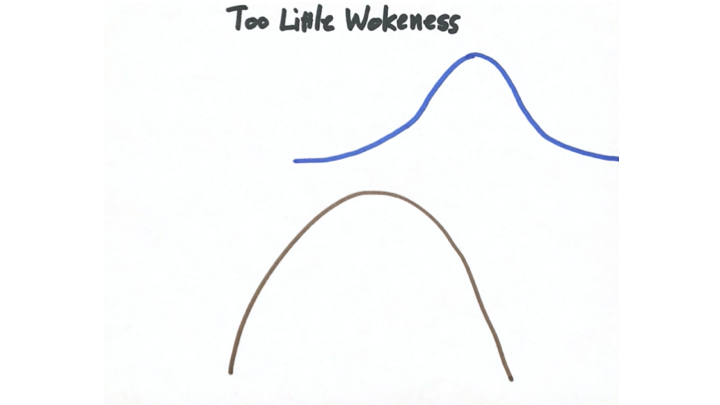
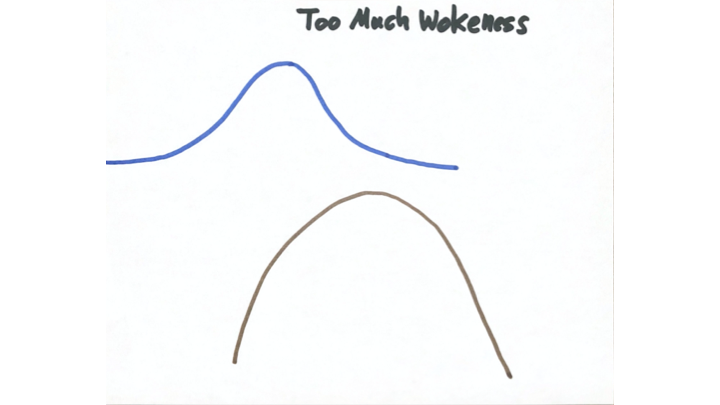
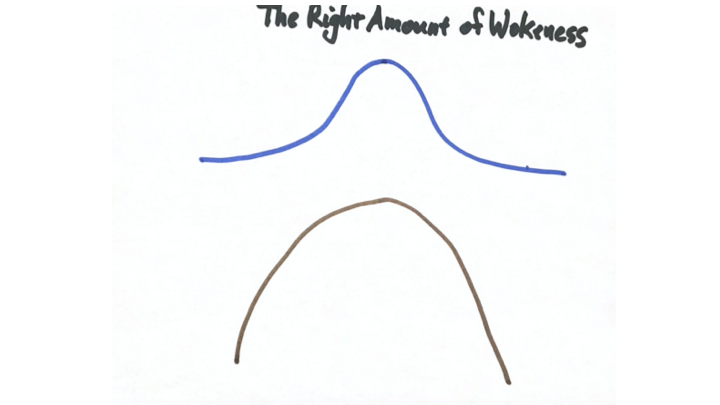
We can do some simple analysis. Take a look at the following figures, which I will explain. To match our usual left-right political conventions, I draw greater wokeness as being further to the left.

Slide1.png
Slide2.png

A key assumption I will make is that, whatever the average level of wokeness in society, there will be people with higher and lower levels of wokeness. For simplicity, I’ll model this as a normal distribution, which seems pretty reasonable since it might well be that many approximately additive forces (additive for an OK metric of wokeness) contribute to one’s level of wokeness.

The probability distribution of wokeness interacts with a loss function that shows how losses are generated from a wide variety of situations impacted by differing levels of wokeness. (I will draw the loss function upside-down so higher values are better.) One can and should argue about the shape of the loss function, but to make my point, let me assume it is symmetric. If a normal distribution interacts with a symmetric loss function, then we should wish that the mean (average) level of wokeness be right at minimum of the loss function—the top of the hill as I draw it above.

What would it look like in our world if the mean of the normal distribution of wokeness were at the minimum of the loss function? There is a simple answer: the horrors from too much wokeness would be as great as the horrors from too little wokeness. I don’t think we are there yet. Anyone who has been paying attention lately and tried to get a historical perspective should realize that the horrors from too little wokeness are still truly awful. The horrors from too much wokeness are still not at the same level. So from where we are now, increasing the average level of wokeness (while retaining the same standard deviation of the normal distribution) would be a good thing. It will cause some horrible things to happen from the highest extremes of wokeness, but it will prevent many other horrible things from happening from the lowest extremes of wokeness.

The Artery-Aging Properties of TMAO and the TMAO-Producing Effect of Animal Protein Consumption

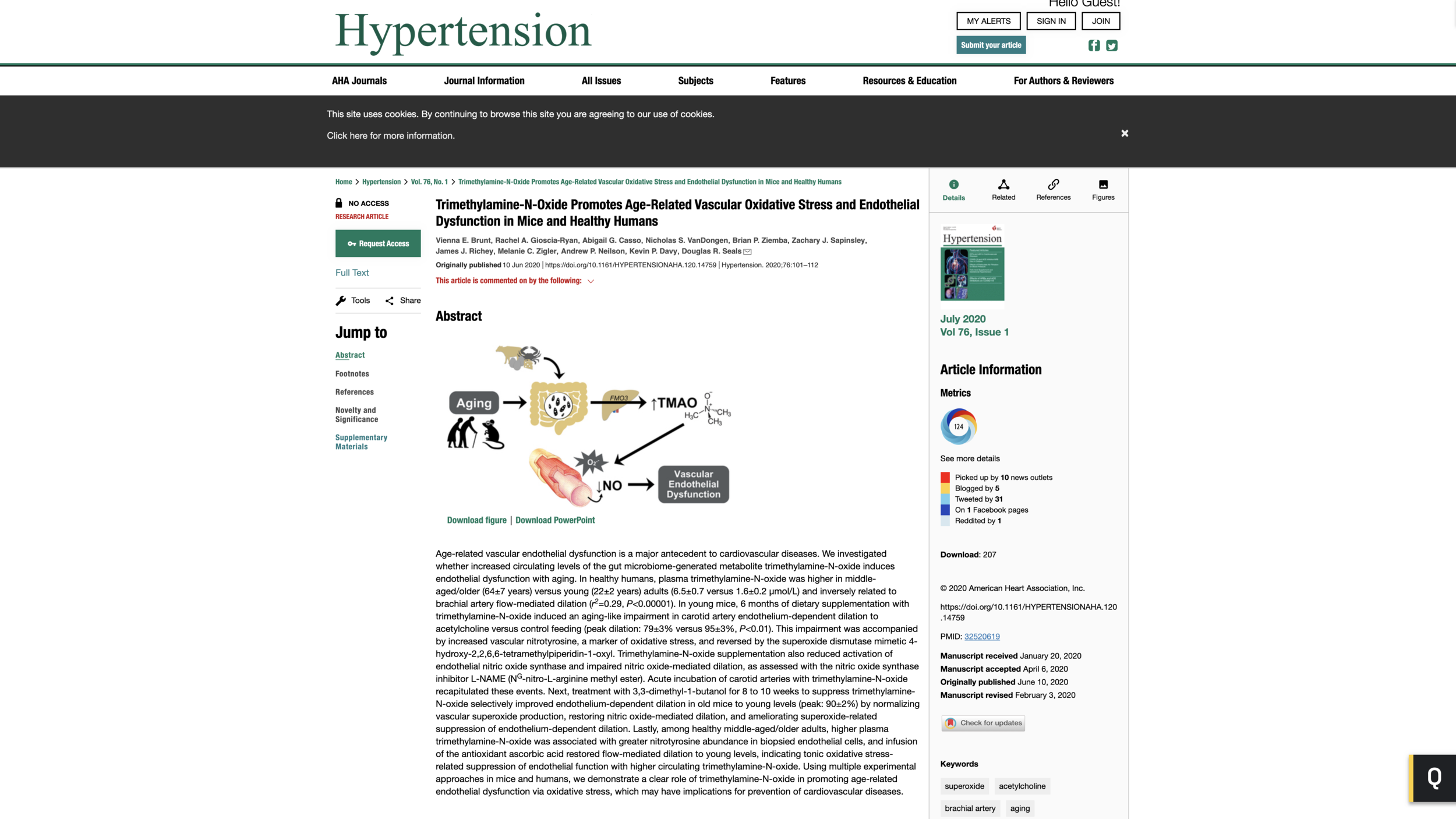
In injecting TMAO ( trimethylamine-N-Oxide) into mice makes their arteries look like those of older mice. Blocking TMAO makes the arteries of mice look like those of younger mice:

… treatment with 3,3-dimethyl-1-butanol for 8 to 10 weeks to suppress trimethylamine-N-oxide selectively improved endothelium-dependent dilation in old mice to young levels …

The quotation is taken from the abstract of the Hypertension article “Trimethylamine-N-Oxide Promotes Age-Related Vascular Oxidative Stress and Endothelial Dysfunction in Mice and Healthy Humans” whose abstract is shown at the top of this post.

Lisa Marshall’s CU Boulder Today article “What makes arteries age? Study explores new link to gut bacteria, diet” on this finding, goes on to make the point that two amino acids common in animal protein, L-carnitine and choline, are converted into TMAO by gut bacteria:

Eat a slab of steak or a plate of scrambled eggs, and your resident gut bacteria get to work immediately to break it down. As they metabolize the amino acids L-carnitine and choline, they churn out a metabolic byproduct called trimethylamine, which the liver converts to trimethylamine-N-Oxide (TMAO) and sends coursing through your bloodstream.

At least in mice, these bacteria that produce TMAO from L-carnitine and choline are more common in older individuals:

(This falls in line with a previous study in mice, showing the gut microbiome—or your collection of intestinal bacteria—changes with age, breeding more bacteria that help produce TMAO).

The dangers from TMAO add to the reasons to worry about animal protein.

In general, I am more worried about animal protein than I am about saturated fat. But I am becoming convinced by Peter Attia that in a minority of people (he estimates between 5% and 20%), saturated fat raises high-quality measures of the number of low-density-lipoprotein (LDL) particles (sometimes called “bad blood cholesterol”).

I think protein has a better reputation in our culture than it deserves. We need some protein, but few of us in rich countries have any serious danger of having too little protein. When lowering carbs, if you care about health, it is dietary fat that should be increased, not protein.

On potential trouble from protein, see also:


For annotated links to other posts on diet and health, see:


Consensual, Non-Solipsistic Experience Machines

Experience machines get a bad rap. People often use thought experiments involving a machine that gives an ultra-high-quality illusion of life experience to argue that people want things to be “real.” There is a grain of truth to this, but I want to narrow down what I think people most want to be real: the other human beings one seems to be interacting with.

Being in an experience machine alone doesn’t sound at all attractive to me on a long-term basis, even if the experiences themselves are extremely pleasant and engaging. But if the possible experiences go far beyond what is otherwise possible, it seems great to be in an experience machine in which I genuinely interact with billions of other people as real as me—including all the people I care most about.

A movie, “The Matrix” seems to take the opposite view: that there is something wrong with being embedded in an experience machine along with a huge number of other human beings one is genuinely interacting with. But “The Matrix” brings in another element that is detestable: being put in the experience machine without one’s own consent. It may be that we irreduceably hate things being done to them without their consent, or it may be that being put in a situation without one’s consent is such a reliable indicator of something being wrong with that situation that we are justifiably suspicious. In any case, being put into an experience machine without one’s own consent is not a logically necessary element of the experience machine experience.

Rather than the situation in “The Matrix,” the type of experience machine that I think of first is the situation of the trillions of human beings in Robin Hanson’s fascinating book The Age of Em:

Link to the Amazon Page for The Age of Em (Annoyingly—and ironically—there doesn’t seem to be a Kindle version available in the US, so I had to get a paper-and-ink book about digital humans.)

Link to the Amazon Page for The Age of Em

(Annoyingly—and ironically—there doesn’t seem to be a Kindle version available in the US, so I had to get a paper-and-ink book about digital humans.)

The reason Robin Hanson predicts there will be trillions of digital humans if certain technological conditions hold is that it takes a lot fewer resources to support a digital human than a flesh-and-blood human. I don’t think the digital humans would pine for being flesh-and-blood humans if the quality of their experience was at least as good as the experience of flesh-and-blood humans if they share that kind of experience with trillions of other digital humans and they know the truth about everything in the sense that no one is lying to them about the bit picture.

Postscript: In “The Matrix,” the motivation for keeping humans in the matrix without their consent is lame: in violation of the laws of thermodynamics, the humans connected in give off more useable, low-entropy energy than they take in. A much more plausible motivation could have been borrowed from Dan Simmons’s Hyperion Cantos: using spare brain power of a huge number of humans for hypercomputing. In the Hyperion Cantos, though, this is done by an organ giving them physical immortality rather than by putting them in virtual reality, but one could easily have stipulated in “The Matrix” that using spare brain cycles is easier if someone is embedded in virtual reality.

To avoid giving too much credit to Dan Simmons, however, let me mention that Dan Simmons makes a huge ecological blunder in one of the novels in the Hyperion Cantos, by have a planet where creatures eat humans and human eat those creatures, but no new energy for the ecosystem is being brought in from the outside. This could last for only a short time before the ecosystem shrank away to nothing. (Despite this complaints, I think often about the Hyperion Cantos and highly recommend them.)

Related Posts: